Learning Cross-lingual Word Embeddings from Twitter via Distant Supervision
Jose Camacho-Collados
♦∗Yerai Doval
♥∗Eugenio Mart´ınez-C´amara
♠Luis Espinosa-Anke
♦Francesco Barbieri
♣Steven Schockaert
♦♦School of Computer Science and Informatics, CardiffUniversity, United Kingdom ♥Escola Superior de Enxe˜nar´ıa Inform´atica, Universidade de Vigo, Spain
♠DaSCI Institute, University of Granada, Spain ♣Telef´onica Innovation Alpha, Barcelona, Spain ♦{camachocolladosj,espinosa-ankel,schockaerts1}@cardiff.ac.uk,
♥[email protected], ♠[email protected], ♣[email protected]
Abstract
Cross-lingual embeddings represent the meaning of words from different languages in the same vector space. Recent work has shown that it is possible to construct such represen-tations by aligning independently learned monolingual em-bedding spaces, and that accurate alignments can be obtained even without external bilingual data. In this paper we explore a research direction that has been surprisingly neglected in the literature: leveraging noisy user-generated text to learn cross-lingual embeddings particularly tailored towards social media applications. While the noisiness and informal nature of the social media genre poses additional challenges to cross-lingual embedding methods, we find that it also provides key opportunities due to the abundance of code-switching and the existence of a shared vocabulary of emoji and named entities. Our contribution consists of a very simple post-processing step that exploits these phenomena to significantly improve the performance of state-of-the-art alignment methods.
1
Introduction
Twitter provides a wealth of uncurated text (Derczynski et al. 2013) and has been found to constitute a valuable source for developing natural language processing (NLP) systems in, for example, sentiment analysis (Mart´ınez-C´amara et al. 2014), sarcasm detection (Felbo et al. 2017) or humour and irony modeling (Reyes, Rosso, and Buscaldi 2012). Given their abundance and multilingual nature, we argue that tweets are a powerful but surprisingly neglected source for learning cross-lingual vector representations of words (henceforth, cross-lingual embeddings).
Cross-lingual embeddings are the result of mapping two or more monolingual word embedding spaces into a shared vector space in which words and their translations are rep-resented by similar vectors. Along with obvious applica-tions in, for example, machine translation (Artetxe et al. 2018; Lample, Denoyer, and Ranzato 2018; Lample et al. 2018), cross-lingual embeddings also constitute a major step forward towards knowledge transfer between languages (Ruder, Vuli´c, and Søgaard 2019), usually having English
∗
Authors marked with an asterisk contributed equally. Copyright c2019, Association for the Advancement of Artificial Intelligence (www.aaai.org). All rights reserved.
as source or pivot. Several recent approaches have shown that accurate mappings can indeed be learned with mini-mal amounts of supervision, to the point that external bilin-gual data may no longer be needed (Conneau et al. 2018; Artetxe, Labaka, and Agirre 2018b; Xu et al. 2018). How-ever, previous work has mostly focused on controlled or noise-free environments, reporting results from using clean and comparable corpora as source. In this paper we make a case for the potential (and discuss the limitations) of social media data for learning cross-lingual embeddings, thus part-ing ways with the traditional ‘noise-free’ settpart-ing explored in most recent literature.
In monolingual settings, it has already been shown that word embeddings trained on Twitter lead to increased per-formance in social media NLP tasks (Tang et al. 2014; Godin et al. 2015; Yang, Macdonald, and Ounis 2018). One of the main reasons is that such embeddings cover a much wider range of slang terms and neologisms, and therefore provide a more faithful snapshot of the particularities of the language used in social media. Twitter-specific cross-lingual embeddings can thus also be expected to provide solid grounds for cross-lingual social media NLP tasks. In this paper, we demonstrate that this is indeed the case for, specifically, word translation and cross-lingual sentiment analysis, where we use data for English to train classifiers for other languages.
Another crucial advantage of Twitter is that it is peppered with a significant number of tokens1 that are shared across different languages. This is relevant, as previous work has demonstrated that the shared meaning of numerals can be exploited for effectively learning cross-lingual embeddings in a self-supervised fashion (Artetxe, Labaka, and Agirre 2017). For instance, we can assume that the embedding for ‘5’ will embody similar properties in, e.g., English and Spanish. We can also assume that embeddings for emoji ob-tained from tweets in different languages will generally rep-resent the same or a very similar meaning (Barbieri et al. 2016b). Finally, and most importantly, we also take advan-tage of the fact that many words in non-English tweets have an exact counterpart in English, which can be attributed to
1We usetokenas umbrella term covering anything from a word to an emoji, or any other social media textual artifact.
code-switching and to the presence of interlingual homo-graphs2, including many named entities.
We exploit this vocabulary of shared tokens across tweets from different languages to implement a very simple post-processing technique, which maps identical tokens from dif-ferent languages to the same vector in the cross-lingual em-bedding space. Clearly, it is overly simplistic to assume that two words from different languages have the same meaning simply because they are spelled in the same way, and even emoji sometimes have language-specific meanings. Surpris-ingly, however, we find that such a simple post-processing strategy nonetheless leads to substantial performance gains in the tasks of word translation and cross-lingual sentiment analysis.
Pre-trained monolingual and cross-lingual embedding models for all languages explored in this paper (i.e., En-glish, Spanish, Italian, German and Farsi) are available at https://github.com/pedrada88/crossembeddings-twitter.3
2
Motivation
Learning unsupervised cross-lingual embeddings (i.e. with-out the need for any kind of external supervision) has become one of the most prominent tasks in NLP in cent years (Ruder, Vuli´c, and Søgaard 2019), both as a re-search challenge in itself and for its potential for transfer-ring knowledge across languages. Such cross-lingual word embeddings have already proved effective in cross-lingual NLP tasks, typically after being trained on standard cor-pora such as Wikipedia (Artetxe, Labaka, and Agirre 2017; Conneau et al. 2018; Glavaˇs et al. 2019). However, cross-lingual resources specifically tailored to the colloquial na-ture of social media are scarce, which constitutes the main motivation for this paper. We argue that unsupervised cross-lingual embeddings are a highly appealing resource in this regard. They enable the development of multilingual tech-nologies without requiring any form of manual supervision, which usually ranges from parallel data to word transla-tions, both of which are generally lacking in the social me-dia domain and especially in less-resourced languages. Cru-cially, this technology can have an impact in applications with direct societal implications, e.g., when natural disasters hit areas where people speak a low-resource language (Im-ran et al. 2018). Despite the success of unsupervised cross-lingual embeddings, their effectiveness in social media have remained untested so far. In this paper, therefore, we compile Twitter corpora in five different languages (English, Spanish, Italian, German and Farsi) and provide an extensive analysis of their resulting cross-lingual word vector mappings.
We found that the effectiveness of existing state-of-the-art cross-lingual embeddings methods in the social media setting is limited, but discovered that usingfreesupervision such as identical tokens can be a promising workaround. Af-ter analyzing the nature of these identical tokens (see Sec-tion 4.1 and the ablaSec-tion test in SecSec-tion 6), we put forward
2Interlingual homographs can be defined as words written iden-tically in two or more different languages.
3This repository will be updated with embeddings for additional languages (Finnish and Japanese are already available).
a simple post-processing step which causes a sharp perfor-mance increase for all languages and tasks we considered, both intrinsic and extrinsic, over state-of-the-art unsuper-vised and weakly-superunsuper-vised cross-lingual embedding mod-els. The motivation for this post-processing technique (see Section 4.3) is to exploit some specific features of social media text, namely its code-switching nature and the occur-rence of special interlingual tokens such as numerals and, especially, emoji. These features are not usually present in other different types of corpora but, as we will show, they turn out to be powerful bilingual signals in cross-lingual em-bedding learning.
3
Related Work
3.1
Cross-lingual word embeddings
Cross-lingual embeddings are becoming increasingly pop-ular in NLP (Upadhyay et al. 2016; Ruder, Vuli´c, and Søgaard 2019), especially since the recent introduction of models requiring almost no supervision (Mikolov, Le, and Sutskever 2013; Faruqui and Dyer 2014; Xing et al. 2015; Smith et al. 2017; Artetxe, Labaka, and Agirre 2017; Doval et al. 2018). These models have shown to be highly com-petitive compared to fully supervised baselines (which are typically trained on parallel corpora).
Despite their effectiveness, these recent models still need some form of supervision signal, which often takes the form of a bilingual dictionary. This limitation motivated the emer-gence of fully unsupervised models, based on, among others, adversarial training (Zhang et al. 2017; Conneau et al. 2018; Xu et al. 2018; Chen and Cardie 2018). However, as shown by Søgaard, Ruder, and Vuli´c (2018), some of these fully unsupervised methods (e.g., Conneau et al. (2018)) may be brittle when dealing with different types of languages and corpora. In a parallel direction, Artetxe, Labaka, and Agirre (2018b) proposed an alternative unsupervised model for learning cross-lingual embeddings, based on a similarity-based dictionary initialization and a linear transformation. While this approach proved to be more robust, and can even surpass supervised models exploiting synthetic or external bilingual dictionaries (Mikolov, Le, and Sutskever 2013; Xing et al. 2015; Smith et al. 2017), they only considered standard corpora.
In this paper we evaluate some of the most prominent cross-lingual embedding models in the more challenging setting of social media. Our evaluation shows that unsuper-vised models often struggle with noisy user-generated text, and the resulting aligned spaces seem to perform poorly in standard evaluation benchmarks (both intrinsic and extrin-sic).
3.2
Cross-lingual sentiment analysis
As with most NLP tasks, the availability of training data and linguistic resources for sentiment analysis (SA) is gen-erally skewed towards English, which motivates the cre-ation of cross-lingual SA systems. However, most existing work in cross-lingual SA is built upon (1) machine transla-tion systems (Salameh, Mohammad, and Kiritchenko 2015; Zhou, Wan, and Xiao 2016); (2) parallel (Meng et al. 2012;
Chen et al. 2018) or comparable corpora (Rasooli et al. 2018); (3) synthetic corpora developed with documents written in the source and the target language (Vilares, Alonso, and G´omez-Rodr´ıguez 2017); or (4) bilingual lexi-cons (Barnes, Klinger, and Schulte im Walde 2018). Conse-quently, all these works depend on the availability of anno-tated data or the quality of off-the-shelf machine translation systems, which are generally ill-suited for social media text. In contrast, the approach we consider in this paper eff ec-tively enables zero-shot cross-lingual transfer in sentiment analysis without the need for external bilingual resources.
4
Learning Cross-lingual Embeddings
Most approaches for learning cross-lingual embeddings without parallel corpora make use of standard pre-trained monolingual vectors. These are mapped onto a shared cross-lingual space, usually with the help of external bicross-lingual dic-tionaries. As an alternative, in this paper we consider auto-matically acquired dictionaries. In Section 4.1, we discuss how these dictionaries can be constructed from Twitter data. These dictionaries will then be used as the supervision signal for well-known state-of-the-art methods, which are briefly recalled in Section 4.2. Finally, we introduce a simple post-processing step which drastically improves performance in different benchmarks (Section 4.3).4.1
Automatic creation of a bilingual dictionary
There are two main approaches to automatic dictionary con-struction from monolingual corpora: by distant supervision or by relying on the distribution of monolingual embed-dings. In our method, we will rely on distant supervision signals from Twitter. However, let us first briefly introduce the latter “fully unsupervised” methods.
Unsupervised (distributional).Approaches from this class construct a dictionary by exploiting the distribution of monolingual embeddings. There are two prominent meth-ods that rely on this intuition: Artetxe, Labaka, and Agirre (2018b) exploit the structural similarity of monolingual embeddings, specifically, the fact that cross-lingual syn-onyms have close similarity distributions across different languages. Conneau et al. (2018), on the other hand, learn this initial bilingual dictionary through adversarial training.
Distant supervision (identical tokens). To construct a syn-thetic bilingual dictionary in an automatic fashion, we rely on the following intuition: whenever a token appears in both monolingual corpora, we assume it has the same meaning. In other words, our dictionary only contains trivial entries, where a word is equal to its (presumed) translation. These identical tokens can be split into the following three types:
(i) Numerals:Given their extensive usage, Arabic numer-als constitute a ubiquitous cross-lingual distant supervision signal. They were first leveraged by Artetxe, Labaka, and Agirre (2017).
(ii) Emoji:Emoji are ideograms depicting people, objects and scenes (Cappallo, Mensink, and Snoek 2015), which co-exist with words in social media communication. While some emoji preserve cultural differences, they have been
shown to share similar meaning across languages and coun-tries (Barbieri et al. 2016b). One of their potential advan-tages with respect to numerals, in addition to their preva-lence in social media, is their diversity, as there are emoji for a wide range of domains such as medicine ( ), sports ( ), business ( ) or geography ( ). Emoticons such as smileys, e.g.,:-), provide a similar bilingual signal.
(iii) Shared words: English words are often used by non-English speakers in spontaneous communication in social media. This phenomenon is particularly common in lan-guages that are related to or which share their alphabet with English, where vocabularies of shared words may arise due to the existence of interlingual homographs4 or
code-switching environments. Even in more distantly related lan-guages, English words are used in the form of many bor-rowed and loan words, especially in digital communication.
4.2
Alignment strategies
Various methods have been proposed for aligning two mono-lingual embedding spaces. Two recent methods in particu-lar have obtained outstanding results in both unsupervised and semi-supervised settings: MUSE (Conneau et al. 2018) and VecMap (Artetxe, Labaka, and Agirre 2018a). Recall that the seed supervision signal required for these methods comes in the form of a bilingual dictionary, which may be external or automatically generated. These two methods are similar in that they learn an orthogonal linear transforma-tion which maps one monolingual embedding space into the other. In VecMap this is done using SVD, while MUSE uses Procrustes analysis. VecMap applies this approach in an it-erative fashion, where at each step the previously used bilin-gual dictionary is extended based on the current alignment. It is also worth noting that after the initial orthogonal trans-formation, VecMap fine-tunes the resulting embeddings by giving more weight to highly correlated embedding compo-nents, improving its performance in word translation.
Finally, let us refer to Doval et al. (2018), who recently proposed a method which extends VecMap and MUSE with a post-processing step. This method consists in applying an additional linear transformation, learned by linear regression on the translation pairs from external bilingual dictionar-ies. In this way, cross-lingual synonyms are mapped to their corresponding average embedding. Note that this dictionary can again be obtained through distant supervision, although this was not explored in Doval et al. (2018) or its extension (Doval et al. 2019).
4.3
Averaging cross-lingual embeddings
We put forward a simple post-processing step inspired by Doval et al. (2018). However, in contrast to the latter method, which modifies the vector representations of all words, we simply replace the representations of the words in our synthetic dictionary by the average of their initial
4Clearly, there are examples of words which are written in the same way in two languages, but which have a different meaning. For instance, the correct English translation of the Spanish word sensible issensitive, not sensible. Nonetheless, such a na¨ıve as-sumption proves to be indisputably helpful.
vector and the initial vector of their presumed translation, leaving all other vectors unchanged. In our experimental re-sults, we show that, surprisingly, this simple approach leads to substantially better results than those obtained by compet-ing baselines. Our method crucially relies on the availability of a sufficiently large bilingual dictionary. In this regard, one of the main contributions of this paper is showing that suit-able dictionaries can be obtained automatically from Twitter corpora.
In addition to this vanilla averaging method, we also con-sider a variant in which the average is weighted by fre-quency:
~µw1,w2=
f1~v1+f2~v2
f1+f2
(1)
wheref1andf2are the number of occurrences of the tokens
w1andw2in their corresponding monolingual corpora, and
~v1and~v2represent the embeddings ofw1andw2in the
cross-lingual vector space.5The main intuition behind this
alterna-tive is that even when a word occurs in tweets from both lan-guages, it may still be underrepresented in one of them. This would be the case, for instance, if in one of the languages the word were only used in a code-switching context, or sim-ply because of it being less prominent due to cultural or ge-ographical differences. For instance, the wordNFL, which stands forNational Football Leaguein the United States is also used in Spain, but much less frequently. We can thus expect that its Spanish embedding will be less accurate than the English one. Therefore, in this case it would make sense to give more prominence to the English vector. We will use
Plain andWeighted to refer to our standard and weighted averaging strategies respectively.
5
Evaluation
We analyze the performance of cross-lingual word embed-dings in the context of Twitter corpora, focusing in particu-lar on the effectiveness of our post-processing method. First, however, let us describe the setting for cross-lingual embed-ding training.
Corpus compilationWe collected five monolingual Twitter corpora between October 2015 and July 2018.6These
cor-pora were independently gathered using geolocalized tweets which were tagged with specific languages:7 United States
(English), Spain (Spanish), Italy (Italian), Germany (Ger-man) and Iran (Farsi). To encourage more tweet diversity, only a maximum of twenty tweets per user were retained. After preprocessing (tokenization and duplicate removal), the final corpora consisted of 21,461,242 tweets for English, 10,122,550 for Spanish, 4,546,508 for Italian, 7,905,827 for German and 3,724,602 for Farsi. All languages contained more than 60M tokens overall and more than 1M unique
5f
1and f2may be either absolute or relative frequencies. In our case we did not find noticeable differences given that all monolin-gual corpora were of comparable size.
6While all tweets were downloaded between these two months for all corpora, the Farsi set contains tweets from a shorter period.
7We relied on Twitter language identification procedure for gathering the language-specific tweets.
Language # Tweets # Tokens # Unique
English 21,461,241 294,276,603 5,499,846 Spanish 10,122,550 144,394,815 3,312,603 Italian 4,546,508 63,076,614 1,601,218 German 7,905,827 114,545,634 2,301,059 Farsi 3,724,602 90,288,567 1,038,666
Table 1: Number of tweets and tokens (overall and unique) per corpus.
tokens, with English being the largest among the five lan-guages considered. Table 1 summarizes the main statistics (overall number of tweets and tokens, and number of unique tokens) of all Twitter language-specific corpora used in our experiments.
Monolingual embeddingsAll comparison systems use the same monolingual embeddings as input. These embeddings were trained on the Twitter corpora described above using FastText (Bojanowski et al. 2017). FastText was chosen due to its handling of subword units, making it more robust to misspellings as compared to alternatives like Word2Vec (Mikolov et al. 2013) or GloVe (Pennington, Socher, and Manning 2014). The monolingual embeddings were trained with FastText’s default hyperparameters, fixing the dimen-sion size to 100.
Distant supervisionAs explained in Section 4.1, we auto-matically extracted bilingual dictionaries of identical tokens to be used as supervision for the cross-lingual models. This resulted in dictionaries of 122,469 word pairs for Spanish, 66,037 for Italian, 93,695 for English-German and 6,142 for English-Farsi.
Comparison systems We used VecMap (Artetxe, Labaka, and Agirre 2018b) and MUSE (Conneau et al. 2018) to ob-tain the initial cross-lingual word embeddings, experiment-ing with their (semi-)supervised and unsupervised settexperiment-ings. In the former case, the supervision came from our synthetic dictionaries of identical tokens. The semi-supervised version of VecMap (Artetxe, Labaka, and Agirre 2018a) is used as our base model on which we evaluate two post-processing techniques: Meemi (Doval et al. 2018) and our proposed av-eraging strategy. Finally, for the sake of completeness, as baseline we also include a version of VecMap which uses ex-ternal bilingual data in the form of a bilingual dictionary as external supervision. Following Artetxe, Labaka, and Agirre (2017), who showed how their semi-supervised model could work with as few as 25 word pairs as supervision, we per-form an experiment with 100 word pairs from an external dictionary as supervision.8For all the baseline systems we
followed their official implementations on GitHub.9
8These 100 pairs sampled from the Europarl training dictionar-ies provided by Dinu, Lazaridou, and Baroni (2015) and Artetxe, Labaka, and Agirre (2017).
9VecMap: https://github.com/artetxem/vecmap; MUSE: https://github.com/facebookresearch/MUSE; Meemi: https://github.com/yeraidm/meemi
Supervision Model
EN-ES EN-IT EN-DE EN-FA
Europarl Facebook Europarl Facebook Europarl Facebook Facebook
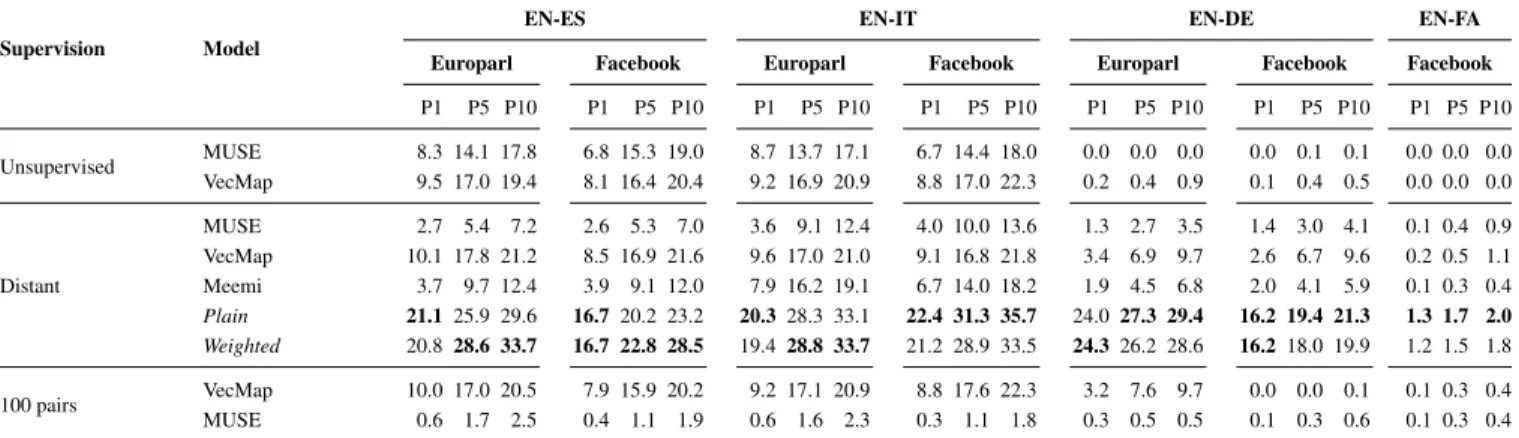
P1 P5 P10 P1 P5 P10 P1 P5 P10 P1 P5 P10 P1 P5 P10 P1 P5 P10 P1 P5 P10 Unsupervised MUSE 8.3 14.1 17.8 6.8 15.3 19.0 8.7 13.7 17.1 6.7 14.4 18.0 0.0 0.0 0.0 0.0 0.1 0.1 0.0 0.0 0.0 VecMap 9.5 17.0 19.4 8.1 16.4 20.4 9.2 16.9 20.9 8.8 17.0 22.3 0.2 0.4 0.9 0.1 0.4 0.5 0.0 0.0 0.0 Distant MUSE 2.7 5.4 7.2 2.6 5.3 7.0 3.6 9.1 12.4 4.0 10.0 13.6 1.3 2.7 3.5 1.4 3.0 4.1 0.1 0.4 0.9 VecMap 10.1 17.8 21.2 8.5 16.9 21.6 9.6 17.0 21.0 9.1 16.8 21.8 3.4 6.9 9.7 2.6 6.7 9.6 0.2 0.5 1.1 Meemi 3.7 9.7 12.4 3.9 9.1 12.0 7.9 16.2 19.1 6.7 14.0 18.2 1.9 4.5 6.8 2.0 4.1 5.9 0.1 0.3 0.4 Plain 21.1 25.9 29.6 16.720.2 23.2 20.328.3 33.1 22.4 31.3 35.7 24.0 27.3 29.4 16.2 19.4 21.3 1.3 1.7 2.0 Weighted 20.8 28.6 33.7 16.7 22.8 28.5 19.428.8 33.7 21.2 28.9 33.5 24.3 26.2 28.6 16.218.0 19.9 1.2 1.5 1.8 100 pairs VecMap 10.0 17.0 20.5 7.9 15.9 20.2 9.2 17.1 20.9 8.8 17.6 22.3 3.2 7.6 9.7 0.0 0.0 0.1 0.1 0.3 0.4 MUSE 0.6 1.7 2.5 0.4 1.1 1.9 0.6 1.6 2.3 0.3 1.1 1.8 0.3 0.5 0.5 0.1 0.3 0.6 0.1 0.3 0.4
Table 2: Word translation results on 4 target languages: Spanish (ES), Italian (IT), German (DE) and Farsi (FA). ThePlainand
Weightedmodels are built with our proposed post-processing technique over the base VecMap model.
5.1
Intrinsic evaluation: Word translation
The task of word translation, or bilingual dictionary induc-tion, consists in retrieving the correct translation in a target language given a word in a source language.
Experimental setting To predict the translation of a word, we return its nearest neighbor from the other language in the cross-lingual embedding space, using cosine similarity. The performance is evaluated with the precision atkmetric
(P-k, wherek ∈ {1,5,10}), which is defined in this context as the percentage of test instances for which the correct answer is among thekhighest ranked candidates. For this task, we used the standard test sets released by Conneau et al. and those extracted from Europarl (Dinu, Lazaridou, and Baroni 2015; Artetxe, Labaka, and Agirre 2017).
Results As can be observed in Table 2, the plain and weighted averaging methods yield the best overall results in Spanish, Italian and German. A similar pattern can be ob-served for Farsi, although in this case the results are poor overall. The base VecMap embeddings perform better over-all in the distantly supervised setting than in the unsuper-vised setting and even the weakly-superunsuper-vised setting of 100 pairs. This lends support to the usefulness of synthetically constructed dictionaries with identical tokens in the social media context. The trend contrasts with previous analyses in more standard corpora (Vuli´c and Korhonen 2016), where this seeding was proved inferior to other strategies. How-ever, this behaviour is not consistent in the case of MUSE, which differs from what was found by Søgaard, Ruder, and Vuli´c (2018) on more standard corpora. With the exception of English-Farsi, where it fails to generalize10, VecMap out-performs MUSE in both supervised and unsupervised set-tings.
Table 2 also shows that going from English to Farsi is challenging for all the tested models. This may be attributed
10In this case, VecMap gets stuck in poor local optima, probably due to the non-optimal initialization in this language pair, an issue that was discussed in Artetxe, Labaka, and Agirre (2018b).
to the structural differences between this language and En-glish, and a reflection of cultural differences, which in turn causes a lower prevalence of English words. Indeed, the bilingual dictionary of identical tokens for Farsi is notably the smallest one: 6,142 word pairs against 66,037 for the second-smallest dictionary.
Finally, it is important to highlight that the test dictionar-ies contain a large number of words whose translation is identical to the word itself. Therefore, the fact that the tested methods use synthetic dictionaries which are based on iden-tical tokens might be regarded as giving them an unfair ad-vantage in this task. In particular, this means that the scores obtained for P@1 may be artificially high, especially for Spanish and Italian, where the number of words with identi-cal translations is considerable.11However, we should stress
that the training dictionaries are obtained automatically from the training corpora, and they were used by all comparison systems in the distantly supervised mode. Furthermore note that they share no connection with the test corpora other than being in the same language.12 In what follows we discuss the capability of our post-processing technique by means of a qualitative analysis.
Analysis We performed an error analysis on our model, examining wrong translations, and found that in many cases, the mistranslated word was very similar to the correct trans-lation. For example, in our weighted model the English verbrequestedis mapped to the Spanish verbmandado( or-dered), and is also near its gold translation,pedido. As far as the baseline post-processing technique is concerned (i.e., Meemi), we can observe substantial drops in the quantita-tive scores with respect to the base model VecMap. A quick
11The percentage of identical word pairs in the Facebook test sets are 16.5% for Spanish, 21.1% for Italian, 16.0% for German, and 4.3% for Farsi. Accordingly, a significant percentage of test pairs are included in our synthetic dictionary: 16.1% for Spanish, 19.0% for Italian, 15.7% for German, and 0.4% for Farsi.
12In the Europarl test sets word translations were obtained from alignments of the European Parliament proceedings, and therefore reflect a realistic distribution of the languages in that domain.
review of the output reveals a general trend of translating source words to target words in the same language (i.e., an English word in the source domain is often translated to some English word which also exists in the target domain). This phenomenon can also be observed for our model. For example, the five nearest neighbors of the English word rec-ognizeare also English words from the induced Spanish dic-tionary:recognize,recognizes,acknowledge,acknowledged
and acknowledgement. While this is not the intended re-sult for the bilingual dictionary induction task, this reveals a seamless integration of both languages which may partially explain the success of these embeddings in cross-lingual sentiment analysis (Section 5.2).
Finally, we performed a more qualitative analysis on the types of translations that cannot be found in standard dictio-naries, for which cross-lingual embeddings trained on Twit-ter are particularly well-suited. Table 3 shows some exam-ples for translations of selected English slang words and neologisms found in our weighted model (top three near-est neighbours according to cosine similarity). From the ex-amples presented, we may draw special attention tochillax, a neologism composed of the verbs chillandrelax, which translates also to colloquial ways of referring to the same idea across languages (relajaditoin Spanish), and perhaps evoking more the notion of coziness in German (gem¨utlich). Let us also highlight acronyms like wthandomfg, whose translations denote surprise, but in an informal register (go-ing as far as translat(go-ing into swearwords in Farsi, for ex-ample). In line with the quantitative results, for Farsi we find mostly noise, but also interesting translations like (sleep), (wake up) and (night awake) for ‘chillax’.
wth supernerd
ES IT DE FA ES IT DE FA
pufff schifo h¨a frikifan ratman lovecrafts aggg chissene h¨a¨ah friky cinecomic trilogie madremia chifo n¨a¨a¨a frikie fumetti gamestar
chillax omfg
ES IT DE FA ES IT DE FA
relajadito rilassando entspan diooo mioddio maaah relaxx rilasso gem¨utlich wtfff ommiodio njaahah relajaito rilassa relaxte diooo oddiooo hahaha
Table 3: Translations of slang words and neologisms.
5.2
Extrinsic evaluation: Cross-lingual sentiment
analysis
In this section we test the performance of our cross-lingual embeddings in the sentiment analysis (SA) task. We focus in particular on polarity classification (Pang and Lee 2008).
Experimental setting We selected an annotated dataset of English tweets as training data, and annotated datasets of Spanish, Italian and German tweets as test data. Since our main aim is the comparison of the cross-lingual embeddings, we used a standard Bidirectional Long Short-Term Mem-ory (BiLSTM) architecture as classification system, with
Dataset Positive Neutral Negative Total
SemEvalEN 3,094 2,043 863 5,999 GCTASSES 22,233 1,305 15,845 39,382 InterTASSES 642 216 768 1,625 COSTES 5,637 - 5,789 11,426 SentipolcIT 316 255 734 1,305 SB-10KDE 533 351 216 1,426
Table 4: Size of the sentiment analysis datasets.
the same configuration across all experiments.13 We used the cross-lingual embeddings for initializing the embedding layer. Given our cross-lingual evaluation setting, the weights of this embedding layer were not updated during training.
Datasets As training data we used the English dataset of the Sentiment Analysis in Twitter task of SemEval 2016 (Nakov et al. 2016). For evaluation we used the General Corpus of TASS (GCTASS) (Villena-Rom´an et al. 2013), COST (Mart´ınez-C´amara et al. 2015) and InterTASS (D´ıaz-Galiano et al. 2018) for Spanish, Sentipolc (Barbieri et al. 2016a) for Italian and SB-10K (Cieliebak et al. 2017) for German. Table 4 lists statistics of these datasets. We car-ried out both two-class (positive and negative) and three-class (positive, neutral and negative) evaluations with the GCTASS, InterTASS, Sentipolc and SB-10K datasets, and a two-class evaluation with COST.
Lower and upper bounds In addition to the comparison systems, in this experiment we also considered two lower bound systems and one upper bound, aimed at providing a broader context for our experimental results. As lower bound systems we included: (1) always predicting the majority class from the SemEval 2016 training corpus; and (2) train-ing and testtrain-ing the neural network with a set of monoltrain-ingual English embeddings (FastText EN). This latter baseline is introduced as a sanity check, as its only source for cross-lingual transfer comes from the fact that the vocabularies of different languages may overlap. The upper bound is a monolingual BiLSTM classification system which is trained for each test dataset using the associated training data.
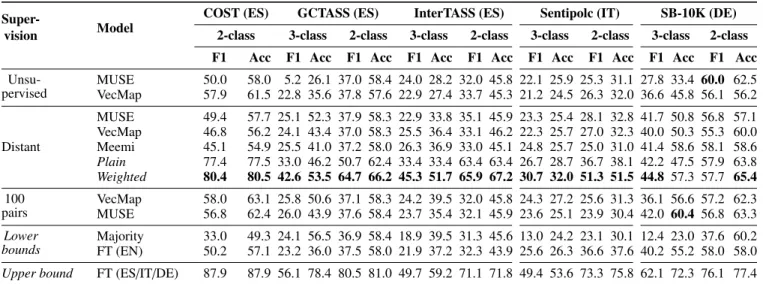
Results Table 5 summarizes the results for this cross-lingual SA evaluation. Our main findings, which are con-sistent for the three languages, are as follows: (a) there are no large differences between the unsupervised and distantly supervised variants of MUSE and VecMap, which in general behave similarly to the two lower bound baselines; (b) the re-sults of the Meemi post-processing technique are also in line with the base VecMap model; (c) our two post-processing techniques lead to substantial improvements over the base VecMap model, including its weakly-supervised variant; and (d) using frequency weighting clearly outperforms the un-weighted variant of our model, with peak performances on
13More details about the model and configuration (hyperparam-eters, etc.) are provided in the appendix.
Super-vision Model
COST (ES) GCTASS (ES) InterTASS (ES) Sentipolc (IT) SB-10K (DE) 2-class 3-class 2-class 3-class 2-class 3-class 2-class 3-class 2-class F1 Acc F1 Acc F1 Acc F1 Acc F1 Acc F1 Acc F1 Acc F1 Acc F1 Acc Unsu-pervised MUSE 50.0 58.0 5.2 26.1 37.0 58.4 24.0 28.2 32.0 45.8 22.1 25.9 25.3 31.1 27.8 33.4 60.0 62.5 VecMap 57.9 61.5 22.8 35.6 37.8 57.6 22.9 27.4 33.7 45.3 21.2 24.5 26.3 32.0 36.6 45.8 56.1 56.2 Distant MUSE 49.4 57.7 25.1 52.3 37.9 58.3 22.9 33.8 35.1 45.9 23.3 25.4 28.1 32.8 41.7 50.8 56.8 57.1 VecMap 46.8 56.2 24.1 43.4 37.0 58.3 25.5 36.4 33.1 46.2 22.3 25.7 27.0 32.3 40.0 50.3 55.3 60.0 Meemi 45.1 54.9 25.5 41.0 37.2 58.0 26.3 36.9 33.0 45.1 24.8 25.7 25.0 31.0 41.4 58.6 58.1 58.6 Plain 77.4 77.5 33.0 46.2 50.7 62.4 33.4 33.4 63.4 63.4 26.7 28.7 36.7 38.1 42.2 47.5 57.9 63.8 Weighted 80.4 80.5 42.6 53.5 64.7 66.2 45.3 51.7 65.9 67.2 30.7 32.0 51.3 51.5 44.8 57.3 57.7 65.4 100 pairs VecMap 58.0 63.1 25.8 50.6 37.1 58.3 24.2 39.5 32.0 45.8 24.3 27.2 25.6 31.3 36.1 56.6 57.2 62.3 MUSE 56.8 62.4 26.0 43.9 37.6 58.4 23.7 35.4 32.1 45.9 23.6 25.1 23.9 30.4 42.0 60.4 56.8 63.3 Lower bounds Majority 33.0 49.3 24.1 56.5 36.9 58.4 18.9 39.5 31.3 45.6 13.0 24.2 23.1 30.1 12.4 23.0 37.6 60.2 FT (EN) 50.2 57.1 23.2 36.0 37.5 58.0 21.9 37.2 32.3 43.9 25.6 26.3 36.6 37.6 40.2 55.2 58.0 58.0 Upper bound FT (ES/IT/DE) 87.9 87.9 56.1 78.4 80.5 81.0 49.7 59.2 71.1 71.8 49.4 53.6 73.3 75.8 62.1 72.3 76.1 77.4
Table 5: Macro-average F1 and accuracy (%) results in the cross-lingual SA evaluation, using different embeddings as features. ThePlainandWeightedmodels are built with our proposed post-processing technique over the base VecMap model.
COST and InterTASS.
In general, the results provided by our simple post-processing technique are encouraging, especially taking into account that (1) these embeddings were learned without making use of any external resources or bilingual data, (2) no data in the target language was used for training, and (3) the distribution of the English dataset used for training clearly differs from all these datasets (see Table 4). What is particularly surprising is the performance gap of our pro-posed technique with respect to the state-of-the-art cross-lingual embeddings of VecMap and MUSE. In fact, our weighted postprocessing technique leads to improvements of over 40% over the base models in most cases.
Analysis The main difference of our proposed averaging methods compared to VecMap and MUSE lies in the fact that they are creatinganchorpoints between languages. This turns out to be essential in a zero-shot cross-lingual trans-fer task. As argued in Section 4.1, identical tokens such as emoji, numerals or homographs provide a reliable bilingual signal, and anchoring them to a middle point in the vector space facilitates the learning process. For example, the fol-lowing Spanish tweetBuenos Dias a todos, menos a mi :(
(Good Morning everyone, except for me) was tagged as pos-itive for both VecMap and MUSE, irrespective of their su-pervision. Similarly, VecMap and MUSE tagged the Italian tweetAlla ricerca del nirvana (Looking for nirvana) as neg-ative. These systems thus overlooked a key emotion feature, i.e., :(, and a critical loanword, i.e.,nirvana. In contrast, the same sentiment analysis model trained with our weighted
cross-lingual embeddings correctly classified these two ex-amples.
6
Ablation analysis
As shown throughout all the experiments, using identi-cal tokens as supervision proved more robust than
fully-unsupervised methods. In order to get more insights from the results achieved in both evaluation tasks, we performed an ablation test on the different types of identical tokens in the synthetic dictionaries (see Section 4.1). For this analy-sis, we focus on the base VecMap model and our proposed
weightedpost-processing strategy.
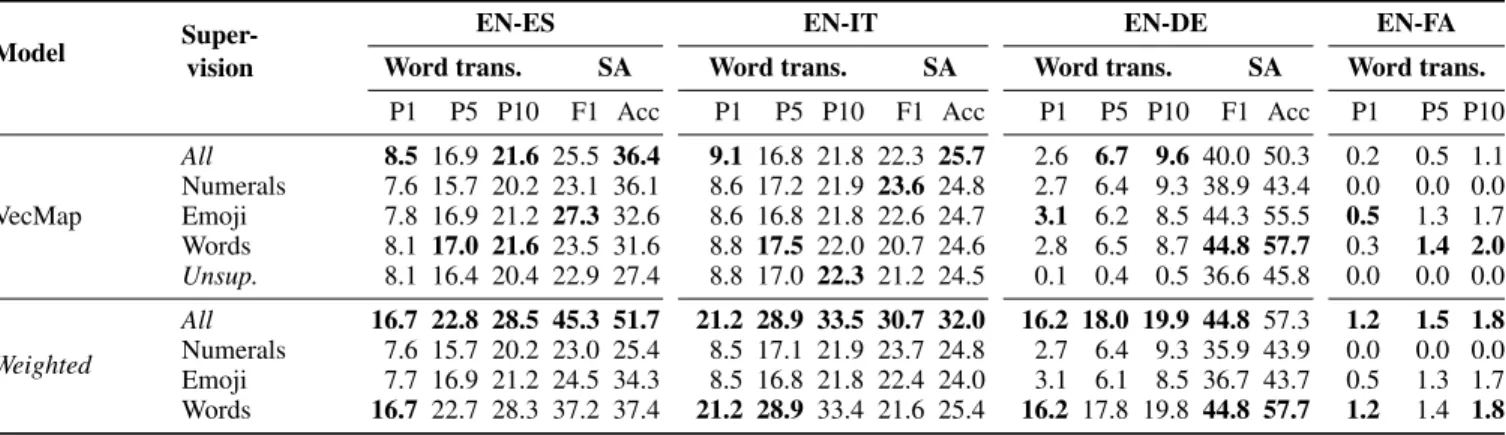
Table 6 shows the results of this ablation test on the two considered tasks: word translation and cross-lingual sen-timent analysis (SA).14 Unsurprisingly, the dictionaries of
shared words (i.e. identical tokens that are neither numer-als nor emoji) provide the best results among the individ-ual features, often being close to the full dictionary of iden-tical tokens. This type of dictionary is the largest in size, comprising over 95% of all identical tokens in the cases of Spanish and Italian. However, for the base VecMap model dictionaries consisting of either numerals or emoji seem to be enough to achieve similar results in most tasks and lan-guages. This is not the case when using our weighted post-processing, which highlights its potential for taking advan-tage of the heterogeneity of all identical tokens. In fact, using the dictionary of all identical tokens consistently provides the best results in all tasks and languages (including Farsi) except in one single measure in German SA.
7
Conclusion
The main contribution of this paper is two-fold. On the one hand, we have presented a comprehensive study on the performance of state-of-the-art methods for learning cross-lingual embeddings without external bicross-lingual data in the domain of social media communication. The overall re-sults are encouraging, as they show that high-quality cross-lingual embeddings can be obtained directly from noisy
14Due to space constraints and for the sake of clarity, for this ablation test, Table 6 shows the results on the Facebook datasets on word translation and on the 3-class configuration on SA, using the most recent InterTASS dataset for Spanish.
Model Super-vision
EN-ES EN-IT EN-DE EN-FA
Word trans. SA Word trans. SA Word trans. SA Word trans.
P1 P5 P10 F1 Acc P1 P5 P10 F1 Acc P1 P5 P10 F1 Acc P1 P5 P10
VecMap All 8.5 16.9 21.6 25.5 36.4 9.1 16.8 21.8 22.3 25.7 2.6 6.7 9.6 40.0 50.3 0.2 0.5 1.1 Numerals 7.6 15.7 20.2 23.1 36.1 8.6 17.2 21.9 23.6 24.8 2.7 6.4 9.3 38.9 43.4 0.0 0.0 0.0 Emoji 7.8 16.9 21.2 27.3 32.6 8.6 16.8 21.8 22.6 24.7 3.1 6.2 8.5 44.3 55.5 0.5 1.3 1.7 Words 8.1 17.0 21.6 23.5 31.6 8.8 17.5 22.0 20.7 24.6 2.8 6.5 8.7 44.8 57.7 0.3 1.4 2.0 Unsup. 8.1 16.4 20.4 22.9 27.4 8.8 17.0 22.3 21.2 24.5 0.1 0.4 0.5 36.6 45.8 0.0 0.0 0.0 Weighted All 16.7 22.8 28.5 45.3 51.7 21.2 28.9 33.5 30.7 32.0 16.2 18.0 19.9 44.8 57.3 1.2 1.5 1.8 Numerals 7.6 15.7 20.2 23.0 25.4 8.5 17.1 21.9 23.7 24.8 2.7 6.4 9.3 35.9 43.9 0.0 0.0 0.0 Emoji 7.7 16.9 21.2 24.5 34.3 8.5 16.8 21.8 22.4 24.0 3.1 6.1 8.5 36.7 43.7 0.5 1.3 1.7 Words 16.7 22.7 28.3 37.2 37.4 21.2 28.9 33.4 21.6 25.4 16.2 17.8 19.8 44.8 57.7 1.2 1.4 1.8
Table 6: Ablation test. Tasks: word translation (Word trans.) and cross-lingual sentiment analysis (SA).
user-generated corpora without external resources via dis-tant supervision. These embeddings can be leveraged for cross-lingual downstream applications where training data may be scarce, as shown in our sentiment analysis experi-ments. However, our evaluation suggests there is significant room for improvement overall. Our results show that, espe-cially in the case of distant languages such as English-Farsi, state-of-the-art cross-lingual mappings fail to learn an accu-rate mapping between the languages.
On the other hand, we have also introduced a simple post-processing technique which alters the embeddings of tokens that appear in both languages by simply averaging their ini-tial embeddings. Despite its simplicity, our proposed tech-nique clearly improves the quality of state-of-the-art cross-lingual word embedding approaches. In fact, we showed how a standard sentiment analysis system can achieve re-sults of up to 80% in accuracy without the need of any train-ing data in the test language by ustrain-ing our proposed method, improving the state of the art by more than 40% in several cases. The results also suggest that our method can be fur-ther improved by tuning it to specific applications or by ex-ploiting the underlying idea to local neighbours in the vec-tor space, amplifying its impact. In general, the simplicity of our approach opens up exciting avenues of research on cross-lingual applications in social media, where annotated data in English can be exploited for other languages with few resources. The construction of cross-lingual embedding models also paves the way for the development of unsu-pervised machine translation systems (Artetxe et al. 2018; Lample et al. 2018), in this case specifically targeting noisy user-generated text for which parallel data is extremely scarce, and not even available at all for widely spoken lan-guage pairs. Indeed, standard machine translation tools are generally not suited for the kind of noisy text that is found in social media, where the language used is very dynamic and new terms are constantly being introduced.
Acknowledgements
Steven Schockaert was supported by ERC Starting Grant 637277. Yerai Doval is supported by the Span-ish Ministry of Economy, Industry and
Competitive-ness (MINECO) through projects FFI2014-51978-C2-2-R, TIN201785160C21-R and TIN201785160C22-R; the Span-ish State Secretariat for Research, Development and Innova-tion and the European Social Fund (ESF) under an FPI fel-lowship (BES-2015-073768) associated to project FFI2014-51978-C2-1-R; and by the Galician Regional Government under project ED431D 2017/12. Eugenio Mart´ınez C´amara was supported by the Spanish Government Programme Juan de la Cierva Formaci´on (FJCI-2016-28353). Finally, we would like to thank Taher Pilehvar for his help with the Farsi qualitative analysis.
References
Artetxe, M.; Labaka, G.; Agirre, E.; and Cho, K. 2018. Un-supervised neural machine translation. In Proceedings of ICLR.
Artetxe, M.; Labaka, G.; and Agirre, E. 2017. Learning bilingual word embeddings with (almost) no bilingual data. InProceedings of ACL, 451–462.
Artetxe, M.; Labaka, G.; and Agirre, E. 2018a. Generalizing and improving bilingual word embedding mappings with a multi-step framework of linear transformations. In Proceed-ings of AAAI.
Artetxe, M.; Labaka, G.; and Agirre, E. 2018b. A robust self-learning method for fully unsupervised cross-lingual map-pings of word embeddings. In Proceedings of ACL, 789– 798.
Barbieri, F.; Basile, V.; Croce, D.; Nissim, M.; Novielli, N.; and Patti, V. 2016a. Overview of the evalita 2016 sentiment polarity classification task. InProceedings of CLiC-it. Barbieri, F.; Kruszewski, G.; Ronzano, F.; and Saggion, H. 2016b. How cosmopolitan are emojis?: Exploring emojis us-age and meaning over different languages with distributional semantics. InProceedings of ACMM, 531–535.
Barnes, J.; Klinger, R.; and Schulte im Walde, S. 2018. Bilingual sentiment embeddings: Joint projection of senti-ment across languages. InProceedings of the 56th Annual Meeting of the Association for Computational Linguistics (Volume 1: Long Papers), 2483–2493. Melbourne, Aus-tralia: Association for Computational Linguistics.
Bojanowski, P.; Grave, E.; Joulin, A.; and Mikolov, T. 2017. Enriching word vectors with subword information. Trans-actions of the Association of Computational Linguistics
5(1):135–146.
Cappallo, S.; Mensink, T.; and Snoek, C. G. 2015. Im-age2emoji: Zero-shot emoji prediction for visual media. In
Proceedings of ACMM, 1311–1314.
Chen, X., and Cardie, C. 2018. Unsupervised multilin-gual word embeddings. InProceedings of the 2018 Confer-ence on Empirical Methods in Natural Language Process-ing, 261–270.
Chen, X.; Sun, Y.; Athiwaratkun, B.; Cardie, C.; and Wein-berger, K. 2018. Adversarial deep averaging networks for cross-lingual sentiment classification. Transactions of the Association for Computational Linguistics6:557–570. Chollet, F. 2015. Keras. https://github.com/fchollet/keras. Cieliebak, M.; Deriu, J. M.; Egger, D.; and Uzdilli, F. 2017. A twitter corpus and benchmark resources for german sen-timent analysis. In Proceedings of the Fifth International Workshop on Natural Language Processing for Social Me-dia, 45–51. Association for Computational Linguistics. Conneau, A.; Lample, G.; Ranzato, M.; Denoyer, L.; and J´egou, H. 2018. Word translation without parallel data. In
Proceedings of ICLR.
Derczynski, L.; Ritter, A.; Clark, S.; and Bontcheva, K. 2013. Twitter part-of-speech tagging for all: Overcoming sparse and noisy data. InProceedings of RANLP, 198–206. D´ıaz-Galiano, M. C.; Mart´ınez-C´amara, E.; Angel´ Garc´ıa Cumbreras, M.; Vega, M. G.; and Rom´an, J. V. 2018. The democratization of deep learning in TASS 2017.
Procesamiento del Lenguaje Natural60:37–44.
Dinu, G.; Lazaridou, A.; and Baroni, M. 2015. Improving zero-shot learning by mitigating the hubness problem. In
Proceedings of ICLR, Workshop track.
Doval, Y.; Camacho-Collados, J.; Espinosa-Anke, L.; and Schockaert, S. 2018. Improving cross-lingual word embed-dings by meeting in the middle. InProceedings of EMNLP. Doval, Y.; Camacho-Collados, J.; Espinosa-Anke, L.; and Schockaert, S. 2019. Meemi: Finding the middle ground in cross-lingual word embeddings. arXiv preprint arXiv:1910.07221.
Faruqui, M., and Dyer, C. 2014. Improving vector space word representations using multilingual correlation. In Pro-ceedings of EACL, 462–471.
Felbo, B.; Mislove, A.; Søgaard, A.; Rahwan, I.; and Lehmann, S. 2017. Using millions of emoji occurrences to learn any-domain representations for detecting sentiment, emotion and sarcasm. InProceedings of EMNLP, 1615– 1625.
Glavaˇs, G.; Litschko, R.; Ruder, S.; and Vuli´c, I. 2019. How to (properly) evaluate cross-lingual word embeddings: On strong baselines, comparative analyses, and some miscon-ceptions. InProceedings of the 57th Annual Meeting of the Association for Computational Linguistics, 710–721. Flo-rence, Italy: Association for Computational Linguistics.
Godin, F.; Vandersmissen, B.; De Neve, W.; and Van de Walle, R. 2015. Named Entity Recognition for Twitter Mi-croposts using Distributed Word Representations. In Pro-ceedings of ACL Workshop on Noisy User-generated Text, 146–153.
Hochreiter, S., and Schmidhuber, J. 1997. Long short-term memory.Neural computation9(8):1735–1780.
Imran, M.; Castillo, C.; Diaz, F.; and Vieweg, S. 2018. Pro-cessing social media messages in mass emergency: Survey summary. InCompanion Proceedings of the The Web Con-ference 2018, 507–511. International World Wide Web Con-ferences Steering Committee.
Lample, G.; Ott, M.; Conneau, A.; Denoyer, L.; and Ran-zato, M. 2018. Phrase-based & neural unsupervised ma-chine translation. InProceedings of the 2018 Conference on Empirical Methods in Natural Language Processing, 5039– 5049.
Lample, G.; Denoyer, L.; and Ranzato, M. 2018. Unsuper-vised machine translation using monolingual corpora only. InProceedings of ICLR.
Mart´ınez-C´amara, E.; Mart´ın-Valdivia, M. T.; Ure˜na L´opez, L. A.; and Montejo-R´aez, A. 2014. Sentiment analysis in Twitter. Natural Language Engineering20(1):128.
Mart´ınez-C´amara, E.; Mart´ın-Valdivia, M. T.; Urea-L´opez, L. A.; and Mitkov, R. 2015. Polarity classification for Span-ish tweets using the COST corpus. Journal of Information Science41(3):263–272.
Meng, X.; Wei, F.; Liu, X.; Zhou, M.; Xu, G.; and Wang, H. 2012. Cross-lingual mixture model for sentiment classi-fication. InProceedings of the 50th Annual Meeting of the Association for Computational Linguistics (Volume 1: Long Papers), 572–581. Association for Computational Linguis-tics.
Mikolov, T.; Chen, K.; Corrado, G.; and Dean, J. 2013. Ef-ficient estimation of word representations in vector space.
CoRRabs/1301.3781.
Mikolov, T.; Le, Q. V.; and Sutskever, I. 2013. Exploiting similarities among languages for machine translation.arXiv preprint arXiv:1309.4168.
Nair, V., and Hinton, G. E. 2010. Rectified linear units im-prove restricted boltzmann machines. InProceedings of the 27th International Conference on Machine Learning, 807– 814.
Nakov, P.; Ritter, A.; Rosenthal, S.; Sebastiani, F.; and Stoy-anov, V. 2016. Semeval-2016 task 4: Sentiment analysis in Twitter. InProceedings of SemEval, 1–18.
Pang, B., and Lee, L. 2008. Opinion mining and sentiment analysis. Foundations and Trends in Information Retrieval
2:1–135.
Pennington, J.; Socher, R.; and Manning, C. D. 2014. GloVe: Global vectors for word representation. In Proceed-ings of EMNLP, 1532–1543.
Rasooli, M. S.; Farra, N.; Radeva, A.; Yu, T.; and McKe-own, K. 2018. Cross-lingual sentiment transfer with limited resources. Machine Translation32(1):143–165.
Reyes, A.; Rosso, P.; and Buscaldi, D. 2012. From humor recognition to irony detection: The figurative language of social media.Data&Knowledge Engineering74:1–12. Ruder, S.; Vuli´c, I.; and Søgaard, A. 2019. A survey of cross-lingual word embedding models. Journal of Artificial Intelligence Research65:569–631.
Salameh, M.; Mohammad, S.; and Kiritchenko, S. 2015. Sentiment after translation: A case-study on arabic social media posts. In Proceedings of the 2015 Conference of the North American Chapter of the Association for Compu-tational Linguistics: Human Language Technologies, 767– 777. Denver, Colorado: Association for Computational Lin-guistics.
Smith, S. L.; Turban, D. H.; Hamblin, S.; and Hammerla, N. Y. 2017. Offline bilingual word vectors, orthogonal transformations and the inverted softmax. In Proceedings of ICLR.
Søgaard, A.; Ruder, S.; and Vuli´c, I. 2018. On the lim-itations of unsupervised bilingual dictionary induction. In
Proceedings of ACL, 778–788.
Tang, D.; Wei, F.; Yang, N.; Zhou, M.; Liu, T.; and Qin, B. 2014. Learning sentiment-specific word embedding for twit-ter sentiment classification. InProceedings of ACL, 1555– 1565.
Upadhyay, S.; Faruqui, M.; Dyer, C.; and Roth, D. 2016. Cross-lingual models of word embeddings: An empirical comparison. InProceedings of the 54th Annual Meeting of the Association for Computational Linguistics (Volume 1: Long Papers), volume 1, 1661–1670.
Vilares, D.; Alonso, M. A.; and G´omez-Rodr´ıguez, C. 2017. Supervised sentiment analysis in multilingual environments.
Information Processing&Management53(3):595 – 607. Villena-Rom´an, J.; Lana-Serrano, S.; Mart´ınez-C´amara, E.; and Gonz´alez-Crist´obal, J. C. 2013. TASS - workshop on sentiment analysis at sepln. Procesamiento del Lenguaje Natural50(0):37–44.
Vuli´c, I., and Korhonen, A. 2016. On the role of seed lexi-cons in learning bilingual word embeddings. InProceedings of the 54th Annual Meeting of the Association for Computa-tional Linguistics (Volume 1: Long Papers), volume 1, 247– 257.
Xing, C.; Wang, D.; Liu, C.; and Lin, Y. 2015. Normal-ized word embedding and orthogonal transform for bilingual word translation. InProceedings of NAACL, 1006–1011. Xu, R.; Yang, Y.; Otani, N.; and Wu, Y. 2018. Unsuper-vised cross-lingual transfer of word embedding spaces. In
Proceedings of the 2018 Conference on Empirical Methods in Natural Language Processing, 2465–2474. Association for Computational Linguistics.
Yang, X.; Macdonald, C.; and Ounis, I. 2018. Using word embeddings in twitter election classification. Information Retrieval Journal21(2):183–207.
Zhang, M.; Liu, Y.; Luan, H.; and Sun, M. 2017. Earth mover’s distance minimization for unsupervised bilingual lexicon induction. InProceedings of EMNLP, 1934–1945.
t1 t2 t3
...
tl Embeddings lookup lstmf 1 lstmf2 lstmf3...
lstmfl lstmb 1 lstmb2 lstmb3...
lstmblconcat concat concat
...
concatDense layer1 Dense layer1 Dropout1 Dense layer2 Dropout2 Flatten Softmax Polarity(t)
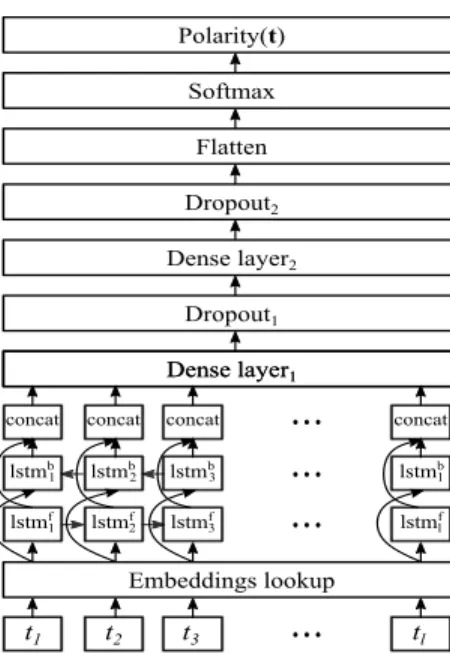
Figure 1: Architecture of the neural network developed for the cross-lingual sentiment analysis evaluation.
Zhou, X.; Wan, X.; and Xiao, J. 2016. Cross-lingual sen-timent classification with bilingual document representation learning. InProceedings of ACL, 1403–1412.
Appendix: Sentiment Analysis Classification
System
We provide specific details of the classification system used in our sentiment analysis experiments (Section 4.2 of the pa-per). As classification system, we made use of a standard Bidirectional Long Short-Term Memory (BiLSTM) recur-rent neural network architecture (Hochreiter and Schmidhu-ber 1997), developed in Keras (Chollet 2015). In the follow-ing we describe the details and hyperparameters of the spe-cific architecture which is used across all experiments. The goal of the neural network is the classification of the opin-ion of tweets, hence the input is composed of a sequence of tokens of a tweet, and the output is the sentiment meaning of the tweet (t). Specifically, the input of the neural network is the sequence of tokenst1:l.
The first layer is the embeddings lookup layer, which re-turns the sequences ∈ IRl×100. Since our aim is to test our cross-lingual embeddings, which were used to initialize the embedding layer, in a cross-lingual setting, the embedding weights are not updated during the training of the network. The output of the embedding layer is encoded by a BiLSTM, which is an elaboration of two Long Short-Term Memory (LSTM) layers. One of the LSTM layers processes the se-quence s1:l(LS T Mf), and the second one processes the
se-quencesl:1(LS T Mb). We concatenated the output of the two
LSTM layers, which are the state vectors of each token of the sequence s. Since the number of internal units of each LSTM layer is 128, the output of the BiLSTM layer is the sequencec∈IRl×256.
func-tion (Nair and Hinton 2010) process the sequence to the out-put of the BiLSTM layer. The outout-put dimensions of the two fully connected layers are 64 and 32, respectively. A dropout layer is added after each fully connected layer, with a rate value of 0.5.L2regularization is applied to the weights of the
fully connected layers with a value of 0.001, and to the out-put of the fully connected layers with a value of 0.0001. The output of the last fully connected layer is flattened, hence the dimension of the sequencecafter the processing of the two dense layers is IRl×32. The last layer is a softmax classifica-tion funcclassifica-tion. The output dimension of the softmax layer de-pends on the number of opinion labels (o), which in our case is 2 or 3 (o ∈ {2,3}). Finally, the training is performed by a cross-entropy loss function, and optimized using Adam. For the sake of clarity, Figure 1 depicts the architecture of the neural network architecture.