This is the author manuscript accepted for publication and has undergone full peer review but has not been through the copyediting, typesetting, pagination and proofreading process, which may lead to differences between this version and the Version of Record. Please cite this article as doi:
10.1111/nyas.13382.
How to select a nanosimilar
Alain Astier,1,a Amy Barton Pai,2 Marco Bissig,3 Daan J.A. Crommelin,4 Beat Flühmann,5 Jean-Daniel Hecq,6 Josefien Knoeff,5,7 Hans-Peter Lipp,8 Alberto Morell-Baladrón,9 and Stefan Mühlebach5,10
*All authors contributed equally to this work.
1Pharmacy Department, Henri Mondor University Hospitals, Créteil, France. 2Department of Clinical Pharmacy, University of Michigan, Ann Arbor, Michigan. 3Hospital Pharmacy, Ospedale Regionale di Lugano, Lugano, Switzerland. 4Deptartment of Pharmaceutical Sciences, Utrecht University, the Netherlands. 5Vifor Pharma Ltd., Glattbrugg, Switzerland. 6Hospital Pharmacy, University Hospital of Mont-Godinne, Yvoir, Belgium. 7Faculty of Sciences, Vrije Universiteit Amsterdam, the Netherlands. 8Hospital Pharmacy,
Universitätsklinikum Tübingen, Germany. 9Hospital Pharmacy, La Princesa Hospital, Madrid, Spain. 10Department of Pharmaceutical Sciences, University of Basel, Switzerland
Address for correspondence: Beat Flühmann, Vifor Pharma Ltd., Flughofstrasse 61, 8152 Glattbrugg, Switzerland. [email protected]
Short title:Nanosimilar selection
Abstract
Nanomedicines in the class of non-biological complex drugs (NBCDs) are becoming increasingly available. Up to 23 nanomedicines have been approved, and approximately 50 are in clinical development. Meanwhile, the first nanosimilars have entered the market through the generic approval pathway, but clinical differences have been observed. Many healthcare professionals may be unaware of this issue and must be informed of these
clinically relevant variances. This article provides a tool for rational decision making for the inclusion of nanomedicines into the hospital formulary, including defined criteria for
a
evaluation of substitutability or interchangeability. The tool was generated by conducting a round table with an international panel of experts and follows the same thought process as developed and published earlier for the selection of biologicals/biosimilars. In addition to the existing criteria for biosimilars, a set of seven criteria were identified that specifically apply to nanosimilars. These include (1) particle size and size distribution, (2) particle surface characteristics, (3) fraction of uncaptured bioactive moiety, (4) stability on storage, (5)
bioactive moiety uptake and (6) distribution, and (7) stability for ready-to-use preparation (7). Pharmacists should utilize their pharmaceutical expertise to use the appropriate criteria to evaluate the comparability of the drug to decide on interchangeability or substitutability.
Keywords: nanomedicines; nanosimilars; hospital formulary; interchange; substitution
Introduction
Recently, a discussion emerged on the therapeutic equivalence of non-biological complex drug (NBCD) products and their follow-on versions, also referred to as NBCD similar (see Box 1 for glossary of terms). One distinct class of NBCDs are nanomedicines, which can be defined as medicinal products developed and manufactured using nanomaterials and
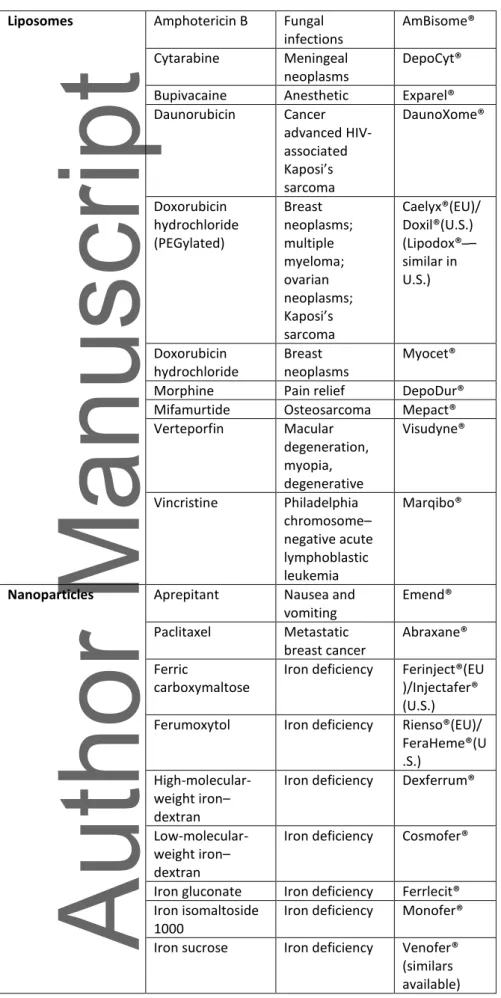
nanotechnology and consisting of multiple structures. This is a rapidly expanding field in medicine. A total of 23 parenteral non-biological nanomedicines have been approved, and 52 more are under clinical investigation.1 Examples of available nanomedicines are given in Table 1. With the first patents expiring, large market opportunities for nanosimilars are opening up. Examples of first-generation nanomedicines that came off patent are iron– carbohydrate (iron–sugar) drugs, a number of liposome products, and glatiramoids.2,3 Follow-on versiFollow-ons appeared Follow-on the market with the introductiFollow-on of irFollow-on–sucrose similars (ISS), approved via the approval pathway of small molecule generic products. Authorization of these generic products is based on showing pharmaceutical equivalence and bioequivalence to the listed reference product, ultimately leading to therapeutic equivalence and
interchangeability or substitutability. This authorization process proved successful for fully characterizable small molecule products. However, owing to the complexity of
nanomedicines, showing equivalence is more challenging for follow-on products of
nanomedicines (further referred to as nanosimilars).4 This has been clinically shown for iron sucrose, but potentially accounts for all nanosimilars. After market introduction of ISS, which were approved on the basis of physicochemical comparability to the iron–sucrose originator (Venofer®) but without considering the nanocolloidal character of the products, efficacy and safety issues were observed in the clinic.5–9 Alarmed by these findings, discussion on the regulatory approval pathway of follow-on nanomedicines was started by the European Medicines Agency (EMA) and the U.S. Food and Drug Administration (FDA).2,10–12
The rationale behind designing nanomedicines is to optimize and enlarge the
therapeutic use of drugs, for example by improving drug delivery (e.g., by controlled and/or site-specific drug release or improved drug transport across biological barriers).
Nanomedicines are by definition different from biologicals and therefore not assessed via the biosimilar pathway, although nanomedicines share a comparable or even increased level of complexity. However, the regulatory experience with biosimilars can be of assistance for shaping the landscape of nanosimilars, since some basic evaluation criteria have been defined already in the biosimilar approval paradigm. These requirements include pharmacological aspects (i.e., clinical efficacy and safety)13 and pharmaceutical aspects (i.e., evaluation of physicochemical properties, biological activity, immunochemical properties, purity, and quantity).14
Notably, the interchangeability or substitutability of nanosimilars and their listed reference product(s) cannot be taken for granted. Therefore, it is of great importance that pharmacists who have to evaluate such nanosimilars become familiar with the concept and complexity of nanomedicines before including nanosimilars in the hospital formulary and elaborating the necessary guidance for use. However, a survey among hospital pharmacists in France and Spain showed alarmingly low awareness about the clinical differences between various intravenous (i.v.) iron products.15 Consequently, such drug selection decisions and subsequent drug interchange/substitution practices are neither consistent nor based on
scientifically and clinically sound criteria among various hospitals. Despite studies published in peer-reviewed papers showing clinical differences between the originator and its follow-on products, a high proportion of nanosimilars are being dispensed. Because these clinical differences among nanomedicines and approved follow-on products are observed, the pharmacists should bring in their expertise about structure–activity relationships to ensure safe and efficacious use of nanomedicines for the sake of patients. In the case of biosimilars, the EMA has stated that market authorization as a biosimilar does not automatically imply interchangeability with the originator.16 Consequently, evaluation criteria have been
published for healthcare professionals to judge the substitutability and interchangeability of biosimilars to make a rational decision for formulary inclusion. At present, there are no such tools available for the evaluation of nanosimilars for hospital formulary inclusion.17,18
Here, we intend to provide a tool for rational decision making for the inclusion of nanomedicines into the hospital formulary, including defined criteria for evaluation of substitutability or interchangeability. We aim to provide a framework that defines a reasonable totality of evidence needed to decide on therapeutic equivalence or therapeutic interchange of nanosimilars. On the basis of this proposal, national policies may be adapted and implemented.
Methods
A consensus round table session with leading expert hospital pharmacists from Belgium, France, Germany, Spain, Switzerland, and the United States was organized to identify and discuss the criteria that are specifically important for the evaluation of nanosimilars.
Previously defined formulary selection criteria for biosimilars were summarized and provided as a literature-based algorithm to the chair (H.P. Lipp, a pharmacist), who used it as a starting
point for discussion.17,18 On top of this, additional nanosimilar-specific criteria were identified during the discussion. Concluding statements on discussion points or specific criteria were considered as consensus upon unambiguous agreement on the respective topic among the participants.
Results
In contrast to small molecules, large, non-homomolecular nanomedicines require additional attention regarding their physicochemical characteristics, namely the physical stability of particles during shelf life and in ready-to-use drug preparations. Another important aspect is the particle interaction with the innate immune system, which influences the pharmacokinetic (PK) and pharmacodynamic (PD) profiles of the drug.
In addition to the existing formulary inclusion criteria for biosimilars,16 seven nanosimilar-specific criteria have been identified: particle size and size distribution, particle surface characteristics, fraction of uncaptured bioactive moiety, stability on storage and ready-to-use stability, and fate in the body, more specifically uptake and distribution (Fig. 1).
In Table 2, these criteria are turned into questions that should be used as a structured tool for the evaluation of nanosimilars. As we aim to give the complete picture of selection criteria for such nanosimilars, non-drug-specific criteria like product labeling aspects, supply, and manufacturer evaluation are also given in Table 2.
In the following sections, the criteria are discussed in detail using relevant scientific data from various examples of nanomedicines. As ISS were the first nanomedicine follow-on products introduced, there are unique clinical data published showing the challenges faced with generic substitution of nanomedicines. Therefore, iron–sucrose can be seen as a
representative of the nanomedicine drug class and the challenges encountered when similars are marketed for which equivalence has not appropriately assessed, leading to therapeutic nonequivalence.
Pharmaceutical quality
Particle size and size distribution. Particle size influences uptake, biodistribution, and degradation of the nanomedicine and therefore the drug’s pharmacokinetic profile.19–21 As shown in Figure 2, differences in the size of polystyrene particles result in an altered spleen uptake after i.v. administration in rats.19 Larger particles (200 nm and above) are more efficiently taken up from the blood by Kupffer cells compared with their smaller counterparts.22,23 Another important aspect to evaluate is the size distribution, since nanomedicines are often heterogeneous colloidal dispersions covering a range of particle sizes. Even though nanosimilars may have the same average size, their particle size distribution can still differ, resulting in a changed biodistribution and therapeutic profile. Therefore, not only the average particle size but also the size distribution must be compared.
Particle surface characterization. The particle’s morphology and surface can influence clinical efficacy and safety. First, biodistribution is affected by the character of the nanoparticulate structure, as shown in studies in mice.21,24 This finding is supported by pharmacovigilance results from different i.v. iron products. The available i.v. iron products are all colloidal dispersions, but the carbohydrates stabilizing the iron cores differ physically (e.g., linear/branched; mono-/oligo-/polysaccharides). In the United States,
pharmacovigilance studies revealed large differences in reported deaths and adverse
events.25,26 Additionally, the charge of the nanoparticle should be assessed, since differences in charge may alter PK and the clinical outcome. Different values for the zeta potential of gold nanoparticles showed a significantly different distribution in organs, tissues, and body fluids.23 Interaction of nanoparticles with body fluids after injection may lead to different opsonization patterns, which in turn can influence interactions with cell membranes and toxicity. Their exact surface structure in the biological environment is still not fully
understood today, and hence yet-unknown physicochemical parameters can further influence drug disposition.
Uncaptured bioactive moiety fraction. The PK/PD profile of a nanomedicine is determined by the entire structure of the nanoparticle. The bioactive moiety of nanomedicines is
embedded (captured) in non-homomolecular nanostructures. Therefore, the properties of such medicinal products are defined by the entire formulated product, which has to be
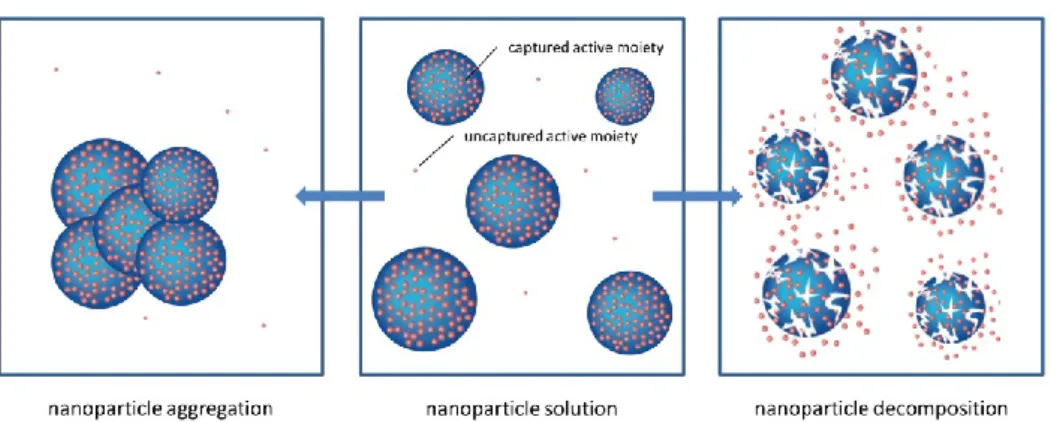
characterized as a whole. Ideally, the nanomedicine consists of a homogeneous colloidal dispersion of intact nanoparticles. However, in reality, a distinction should be made between the captured bioactive moiety and an uncaptured, non-nanoparticular bioactive moiety (sometimes also expressed as free molecule or labile moiety content). This relationship can vary depending on the type of nanoparticles and manufacturing conditions. The nanoparticle can, depending on its environment, stability, and/or reactivity, decompose or aggregate,27 as shown in Figure 3. High levels of uncaptured bioactive moiety present in solution upon administration affect the pharmacokinetics of the nanomedicine, with implications for its efficacy and safety. This was observed in the case of i.v. iron products. For unstable i.v. iron preparations, a higher amount of labile iron (uncaptured bioactive moiety) is directly released into the bloodstream, where it binds to transferrin. When labile iron is released in serum above a certain level, transferrin becomes saturated, and highly reactive non-transferrin-bound iron (NTBI) is formed, which is hypothesized to cause oxidative stress and eventually inflammation and may have acute and long-term consequences.28–30 Elevated transferrin saturation (TSAT) and increased inflammation markers were observed in hemodialysis patients after administration of ISS, compared with IS.5,6 In the case of liposomal doxorubicin preparations, administration of Lipodox® (a nanosimilar of Doxil®/Caelyx®) in a human ovarian cancer mouse model resulted in only approximately half of the intratumoral
doxorubicin concentrations compared with equal doses of the originator nanomedicine.31 The lower drug availability is in line with reduced efficacy in the mouse model, as well as lower or no efficacy of Lipodox in ovarian cancer treatment compared with Doxil, as was observed during a national shortage of Doxil in the United States.32,33
Stability on storage. Acknowledging the critical importance of the preservation of nanoparticulate characteristics of nanomedicines over time, in addition to the chemical stability, all aspects that were discussed above regarding the physical state of the
nanoparticles need to be assessed when establishing their shelf life. Special attention should be paid to ensure stability of the uncaptured/captured ratio of the bioactive moiety, as well as the degree of aggregation/decomposition (Fig. 3), by measuring particle size and size
distribution.
Pharmacokinetics
Uptake and distribution. Nanomedicines from different manufacturing processes may have different uptake and distribution characteristics. The nanomedicine is administered as
nanoparticles in the bloodstream, and its bioactivity depends on the degradation of the particle and release of the bioactive moiety, which is often handled by the innate immune system. Particles are actively taken up by the cells of the mononuclear phagocyte system (MPS) in the liver, spleen, and bone marrow. In these cells (macrophages), degradation takes place, and the bioactive moiety is released.34 Subtle changes in particle composition (e.g., size or charge) can affect the biodistribution of the nanosimilar.19–23,34,35 In the case of PEGylated nanoparticles, a hydrodynamic radius of less than 150 nm was shown to produce an increased uptake of particles in the bone marrow of rabbits, whereas particles with a diameter of 250 nm were mostly sequestered in the spleen and liver, with only a small fraction of uptake by the bone marrow.36
Differences in uptake and tissue distribution profiles between originator nanomedicines and their nanosimilars were observed among liposomal doxorubicin preparations as well as various ISS.31 The correlation between biodistribution and physicochemical properties is not fully understood, and plasma PK studies alone are not sufficiently informative about the drug’s fate in the body. Despite this, in contrast to EMA, the FDA does not require biodistribution data for approval of follow-on intravenous iron nanomedicines.37,38
Ready-to-use preparation and administration
Stability for ready-to-use administration. The efficacy and safety profiles of nanomedicines depend on the protocol for making the product ready for use by the
pharmacist or nurse. The physicochemical properties, in combination with the environment (dilution, type of infusion fluid, pH, nature of primary packaging), can affect the integrity of the medicinal product, destabilize the nanoparticle leading to particle aggregation or
undesired drug release, or trigger adsorption phenomena. It was shown in a retrospective clinical survey that inappropriate dilution can affect the safety profile of nanomedicines.7 In a gynecology ward, a significant increase of adverse events was observed upon switching patients from IS to ISS. With the intention to mitigate this effect and to improve tolerance, the amount of saline in the infusion was increased according to the routine for small
molecular solutions. The nanoparticles were destabilized, and the number of adverse events further increased (Fig. 4).7 Therefore, it is of utmost importance to ensure that data is available showing stability of the nanomedicine when diluted for infusion.39
Discussion
Nanomedicines, as a distinct subgroup of NBCDs, should be given special attention when evaluated in a drug formulary committee. For the first follow-on products approved by the generic pathway, differences in the clinical efficacy and safety were reported in the scientific literature after their approval. This created doubts about their therapeutic equivalence and hence their interchangeability/substitutability. Owing to the fact that these nanomedicines consist of non-homomolecular structures and are not fully characterizable by
physicochemical techniques and because the biological interaction of the nanoparticles with the body is presently not fully understood, additional aspects need to be considered when evaluating the comparability of a nanosimilar with the originator medicinal product. Two specific areas were identified where the nanoparticulate characteristics of these drugs can lead to clinically meaningful differences and require specific attention beyond the criteria used for small molecules and biologics: (1) physical stability of the colloidal dispersion during shelf life and the ready-to-use preparation of the drug (e.g., dilution) and (2)
pharmacokinetic consequences of the direct interaction of the nanoparticles with the innate immune system as part of their intended, targeted uptake mechanism.
The pharmacokinetics are much more complex compared with those of small molecules. The uptake involves active processes like phagocytosis, and the PK depend strongly on the physicochemical characteristics of the nanostructures. Therefore, nanosimilars have to be evaluated differently from generics to form conclusion on comparability. In order to make a rational decision about interchangeability or
substitutability, pharmacists should evaluate clinical data on therapeutic equivalence rather than bioequivalence only.
First, equivalence should be shown regarding pharmaceutical quality criteria,
including particle size, size distribution, particle character, uncaptured bioactive moiety and the release from the captured form, and particle stability.
Second, since a direct correlation has not been found between the physicochemical properties of a nanomedicine and its clinical efficacy and safety, nonclinical and clinical pharmacokinetics, specifically uptake and biodistribution, must be evaluated. In order to determine the interchangeability and substitutability of nanosimilars, therapeutic equivalence of efficacy and safety has to be demonstrated in a relevant clinical setting. Relevant clinical differences of a nanosimilar and the reference product cannot be excluded without the
necessary scientific data, including comparative clinical outcome studies. Pharmacists have to bring their specific pharmaceutical expertise to the evaluation of this type of drugs, using a structured tool such as the one suggested in Table 2, enabling them to make a science-based selection of nanosimilars for the drug formulary. At present, the amount of comparative data
in the public space is limited and mainly restricted to iron sucrose and liposomal doxorubicin preparations. A nanosimilar is not by definition therapeutically worse than its reference product, but publically available clinical data should confirm this before a statement can be made about the therapeutic equivalence. Comparative data should be available if a
nanosimilar is approved in an appropriate manner according to the proposed requirements.10,11
Conclusions
Follow-on products of nanomedicines have in the past been approved by the generic pathway; however, differences in clinical efficacy and safety were reported in the scientific literature after their approval. Healthcare professionals must be aware that nanosimilars may exert clinically relevant differences compared with the originator products. This article provides a structured tool (questionnaire) that can help pharmacists evaluate a nanosimilar medicinal product and decide upon interchangeability or substitutability based on their unique pharmaceutical expertise.
Acknowledgments
Alain Astier, Amy Barton Pai, Marco Bissig, Daan J A Crommelin, Beat Flühmann, Jean-Daniel Hecq, Josefien Knoeff, Hans-Peter Lipp, Alberto Morell-Baladrón, and Stefan
Mühlebach participated in the consensus round table discussion. Josefien Knoeff prepared the draft manuscript; all authors reviewed and approved the manuscript before submission. Beat Flühmann takes responsibility for the integrity of the manuscript and correct reflection of the consensus round table discussion. The meeting room for the consensus round table was kindly provided by the NBCD Working Group.
Competing interests
Daan J.A. Crommelin, Beat Flühmann, and Stefan Mühlebach are members of the NBCD Working Group. Beat Flühmann, Josefien Knoeff, and Stefan Mühlebach are employed by Vifor Pharma, the market authorization holder of colloidal i.v. iron products Venofer® and Ferinject®. Hans-Peter Lipp joined an advisory board and received speaker honoraria from Vifor Pharma. Alain Astier, Amy Barton Pai, Marco Bissig, Jean-Daniel Hecq, and Alberto Morell-Baladrón report no competing interests.
1. Noorlander, C.W., M.W. Kooi, A.G. Oomen, et al. 2015. Horizon scan of nanomedicinal products. Nanomedicine. 10: 1599–1608.
2. Ehmann, F. & R. Pita. 2016. The EU is ready for non-biological complex medicinal products. GaBI. 5: 1–6.
3. Crommelin, D.J.A. 2015. Non-biological complex drugs. J.S.B. de Vlieger. AAPS Advances in the Pharmaceutical Sciences Series. NY: AAPS/Springer.
4. Ehmann, F., K. Sakai-Kato, R. Duncan, et al. 2013. Next-generation nanomedicines and nanosimilars: EU regulators' initiatives relating to the development and evaluation of nanomedicines. Nanomedicine (Lond).8: 849–856.
5. PRottembourg, J.B., A. Kadri, E. Leonard, et al. 2011. Do two intravenous iron sucrose preparations have the same efficacy? Nephrol. Dial. Transplant. 26: 3262– 3267.
6. Agüera, M.L., A. Martin-Malo, M.A. Alvarez-Lara, et al. 2015. Efficiency of original versus generic intravenous iron formulations in patients on haemodialysis. PLoS One.
10: e0135967.
7. Lee, E.S., B.R. Park, J.S. Kim, et al. 2013. Comparison of adverse event profile of intravenous iron sucrose and iron sucrose similar in postpartum and gynecologic operative patients. Curr. Med. Res. Opin. 29: 141–147.
8. Stein, J., A. Dignass & K.U. Chow. 2012. Clinical case reports raise doubts about the therapeutic equivalence of an iron sucrose similar preparation compared with iron sucrose originator. Curr. Med. Res. Opin. 28: 241–243.
9. Martin-Malo, A., A. Merino, J. Carracedo, et al. 2012. Effects of intravenous iron on mononuclear cells during the haemodialysis session. Nephrol. Dial. Transplant. 27:
2465–2471.
10. European Medicines Agency. 2015. Reflection paper on the data requirements for intravenous iron-based nano-colloidal products developed with reference to an innovator medicinal product. March 26, 2015. Accessed January 4, 2017.
http://www.ema.europa.eu/docs/en_GB/document_library/Scientific_guideline/2015/0 3/WC500184922.pdf.
11. European Medicines Agency. 2013. Reflection paper on the data requirements for intravenous liposomal products developed with reference to an innovator liposomal product. February 21, 2013. Accessed January 4, 2017.
http://www.ema.europa.eu/docs/en_GB/document_library/Scientific_guideline/2013/0 3/WC500140351.pdf.
12. U.S. Food and Drug Administration. 2015. Liposome Drug Products - Guidance for Industry. October, 2015. Accessed January 4, 2017.
http://www.fda.gov/downloads/drugs/guidancecomplianceregulatoryinformation/guida nces/ucm070570.pdf.
13. European Medicines Agency. 2014. Guideline on similar biological medicinal products containing biotechnology-derived proteins as active substance: non-clinical and clinical issues. December 18, 2014. Accessed January 4, 2017.
http://www.ema.europa.eu/docs/en_GB/document_library/Scientific_guideline/2015/0 1/WC500180219.pdf.
14. European Medicines Agency. 2014. Guideline on similar biological medicinal
products containing biotechnology-derived proteins as active substance: quality issues. May 22, 2014. Accessed January 4, 2017.
2014.http://www.ema.europa.eu/docs/en_GB/document_library/Scientific_guideline/2 014/06/WC500167838.pdf.
15. Knoeff, J., B. Flühmann & S. Mühlebach. 2017. Medication practice in hospitals: are nanosimilars evaluated and substituted correctly? Eur J Hosp Pharm. 0:1–6 (in print, doi:10.1136/ejhpharm-2016-001059).
16. Schellekens, H., S. Stegemann, V. Weinstein, et al. 2014. How to regulate
nonbiological complex drugs (NBCD) and their follow-on versions: points to consider.
AAPS J. 16: 15–21.
17. Griffith, N., A. McBride, J.G. Stevenson, et al. 2014. Formulary Selection Criteria for Biosimilars: Considerations for US Health-System Pharmacists. Hosp. Pharm. 49:
813–825.
18. Boone, N., H.V.D. Kuy, M. Scott, et al. 2013. How to select a biosimilar. Eur. J. Hosp. Pharm. 20: 275–286.
19. Epstein-Barash, H., D. Gutman, E. Markovsky, et al. 2010. Physicochemical parameters affecting liposomal bisphosphonates bioactivity for restenosis therapy: Internalization, cell inhibition, activation of cytokines and complement, and mechanism of cell death. J. Control Release. 146: 182–195.
20. Storm, G., S.O. Belliot, T. Daemen, et al. 1995. Surface modification of nanoparticles to oppose uptake by the mononuclear phagocyte system. Adv. Drug. Deliv. Rev. 17:
31–48.
21. Doane, T.L. & C. Burda. 2012. The unique role of nanoparticles in nanomedicine: imaging, drug delivery and therapy. Chem. Soc. Rev. 41: 2885–2911.
22. Moghimi, S.M., C.A. Hunter & J.C. Murray. 2005. Nanomedicine: current status and future prospects. FASEB J. 19: 311–330.
23. Hirn, S., M. Semmler-Behnke, C. Schleh, et al. 2011. Particle size-dependent and surface charge-dependent biodistribution of gold nanoparticles after intravenous administration. Eur. J. Pharm. Biopharm. 77: 407–416.
24. Cheng, Y., A.C. Samia, J.D. Meyers, et al. 2008. Highly efficient drug delivery with gold nanoparticle vectors for in vivo photodynamic therapy of cancer. J. Am. Chem. Soc. 130: 10643–10647.
25. Chertow, G.M., P.D. Mason, O. Vaage-Nilsen, et al. 2004. On the relative safety of parenteral iron formulations. Nephrol. Dial. Transplant. 19: 1571–1575.
26. Bailie, G.R. 2012. Comparison of rates of reported adverse events associated with i.v. iron products in the United States. Am. J. Heal. Pharm. 69: 310–320.
lipid particles. Biomaterials. 24: 4283–4300.
28. Geisser, P. & S. Burckhardt. 2011. The pharmacokinetics and pharmacodynamics of iron preparations. Pharmaceutics. 3: 12–33.
29. Brookhart, M.A., J.K. Freburger, A.R. Ellis, et al. 2013. Infection risk with bolus versus maintenance iron supplementation in hemodialysis patients. J. Am. Soc. Nephrol. 24: 1151–1158.
30. Pai, A.B., D. Pharm, A.V. Boyd, et al. 2007. Comparison of Oxidative Stress Markers After Intravenous Administration of Iron Dextran, Sodium Ferric Gluconate, and Iron Sucrose in Patients Undergoing Hemodialysis. Pharmacotherapy. 27: 343–350. 31. Smith, J.A., L. Mathew, M. Burney, et al. 2016. Equivalency challenge: Evaluation of
Lipodox® as the generic equivalent for Doxil® in a human ovarian cancer orthotropic mouse model. Gynecol. Oncol.141: 357-363.
32. Smith, J.A., A.B. Costales, M. Jaffari, et al. 2016. Is it equivalent? Evaluation of the clinical activity of single agent Lipodox® compared to single agent Doxil® in ovarian cancer treatment. J. Oncol. Pharm. Pract. 22: 599-604.
33. Berger, J.L., A. Smith, K.K. Zorn, et al. 2014. Outcomes analysis of an alternative formulation of PEGylated liposomal doxorubicin in recurrent epithelial ovarian carcinoma during the drug shortage era. Onco. Targets Ther. 7: 1409-1413.
34. Desai, N. 2012. Challenges in development of nanoparticle-based therapeutics. AAPS J. 14: 282–295.
35. Toblli, J.E., G. Cao & M. Angerosa. 2015. Nitrosative stress and apoptosis in non-anemic healthy rats induced by intravenous iron sucrose similars versus iron sucrose originator. BioMetals. 28: 279–292.
36. Porter, C.J.H., S.M. Moghimi, L. Illum, et al. 1992. The
polyoxyethylene/polyoxypropylene block co-polymer Poloxamer-407 selectively redirects intravenously injected microspheres to sinusoidal endothelial cells of rabbit bone marrow. FEBS Lett. 305: 62–66.
37. European Medicines Agency. 2011. Reflection paper on non-clinical studies for generic nanoparticle iron medicinal product applications. March 17, 2011. Accessed January 4, 2017.
http://www.ema.europa.eu/docs/en_GB/document_library/Scientific_guideline/2011/0 4/WC500105048.pdf.
38. U.S. Food and Drug Administration. 2013. Draft Guidance on Iron Sucrose. November, 2013. Accessed January 4, 2017.
http://www.fda.gov/downloads/drugs/guidancecomplianceregulatoryinformation/guida nces/ucm297630.pdf.
39. Philipp, E., M. Braitsch, T. Bichsel, et al. 2016. Diluting ferric carboxymaltose in sodium chloride infusion solution (0.9% w/v) in polypropylene bottles and bags: effects on chemical stability. Eur. J. Hosp. Pharm. 23: 22–27.
pharmaceutical products need similar terminology. AAPS J. 16: 11–14.
41. European Commission. 2013. What you need to know about biosimilar medicinal products. Published Online First: 2013. Accessed January 4, 2017.
http://ec.europa.eu/enterprise/sectors/healthcare/files/%0Bdocs/biosimilars_report_en. pdf.
42. Li, E.C. & J.G. Stevenson. 2015. Biosimilars—the time is now: challenges and opportunities for pharmacists [abstract]. 50th ASHP Midyear Clinical Meeting and Exhibition. December 7, 2015.
Figure legends
Figure 1. Formulary selection criteria for nanosimilars. The nano-specific criteria are
highlighted in red. CSTDs, closed-system transfer devices. Adapted with permission from the American Society of Health-System Pharmacists.17,42
Figure 2. Effect of particle size on the spleen uptake of poloxamer-407–coated polystyrene particles after i.v. administration to rats. Reproduced from Ref. 20.
Figure 3. Schematic overview of different physical forms of nanoparticles possibly present in a heterogeneous colloidal nanoparticle solution.
Figure 4. Effect of IS dilution on adverse side effects. IS original was diluted in 100 mL saline. Reproduced from Ref. 7.
Box 1. Glossary of terms
Bioequivalence (BE) is considered to bedemonstrated if the 90% confidence intervals of the ratios for log AUC0–t and Cmax between the two preparations lie in the range 80.00–125.00% correlating to a 90% BE confidence interval.40
Dynamic light scattering is a technique to determine the size distribution profile of small particles in suspension. A laser beam illuminates the suspension, and the fluctuations of the scattered light are detected by a fast photon detector.
Nanomedicine is amedicinal product developed and manufactured using nanomaterials and nanotechnology and often comprising multiple structures, biological or nonbiological.
Nanosimilar is a follow-on product of a reference nanomedicine.4
NBCD. A medicinal product, not being a biological medicine, where the active substance is not a homomolecular structure, but consists of different (closely) related and often
described by physicochemical analytical means. It is also unknown which structural elements might affect the therapeutic performance. The composition, quality, and in vivo performance of NBCDs are highly dependent on the manufacturing processes of both the active ingredient and the formulation. Examples of NBCDs include liposomes, iron–carbohydrate (iron–sugar) drugs, and glatiramoids.40
Interchangeability at the individual level means that, in an individual patient, two medicinal products that are believed to be therapeutically equivalent can be alternated or switched with the authorization of the initial prescriber. Interchangeability at the individual level is a condition for substitution.40,41
Interchangeability at the population level means that two medicinal products that are believed to be therapeutically equivalent can be used for treatment for the same condition in the same population.40
Pharmaceutical equivalence implies the same amount of the same active substance(s), in the same dosage form, for the same route of administration and meeting the same or comparable standards.
Substitutability means a dispensing policy to allow replacement at the individual level of a medicinal product for a similar/bioequivalent medicinal product without the prior
authorization of the initial prescriber.40,41
Switchability means that the product can be changed (e.g., from reference product to biosimilar or vice versa) in a patient during the course of treatment.40
Therapeutic equivalence of two different products enables the products to be interchanged. Two medicinal products with systemic effects are therapeutically equivalent if they are pharmaceutically equivalent and if their bioavailabilities after administration at the same molar dose are similar to such a degree that their effects, with respect to both efficacy and safety, will be essentially the same (bioequivalent).40
Zeta potential is the electric potential of the surface of a (solid) particle immersed in a liquid relative to a point in the bulk fluid away from the interface.
Table 1: Examples of parenteral nanotherapeutic products on the market, including similars if available.
Nanotechnology Active substance Indication Brand name originator Nanocrystals Olanzapine Schizophrenia Zypadhera®
Paliperidone Schizophrenia Xeplion®(EU)/ Invega®(US)
Polymeric drugs Pegaptanib Wet macular degeneration Macugen® Glatiramer acetate Multiple sclerosis Copaxone® (similars available)
Liposomes Amphotericin B Fungal infections AmBisome® Cytarabine Meningeal neoplasms DepoCyt®
Bupivacaine Anesthetic Exparel®
Daunorubicin Cancer advanced HIV-associated Kaposi’s sarcoma DaunoXome® Doxorubicin hydrochloride (PEGylated) Breast neoplasms; multiple myeloma; ovarian neoplasms; Kaposi’s sarcoma Caelyx®(EU)/ Doxil®(U.S.) ipo o – similar in U.S.) Doxorubicin hydrochloride Breast neoplasms Myocet®
Morphine Pain relief DepoDur®
Mifamurtide Osteosarcoma Mepact®
Verteporfin Macular degeneration, myopia, degenerative Visudyne® Vincristine Philadelphia chromosome– negative acute lymphoblastic leukemia Marqibo®
Nanoparticles Aprepitant Nausea and vomiting Emend® Paclitaxel Metastatic breast cancer Abraxane® Ferric carboxymaltose
Iron deficiency Ferinject®(EU )/Injectafer® (U.S.) Ferumoxytol Iron deficiency Rienso®(EU)/
FeraHeme®(U .S.)
High-molecular-weight iron– dextran
Iron deficiency Dexferrum®
Low-molecular-weight iron– dextran
Iron deficiency Cosmofer®
Iron gluconate Iron deficiency Ferrlecit® Iron isomaltoside
1000
Iron deficiency Monofer® Iron sucrose Iron deficiency Venofer®
(similars available)
Evaluation criteria of nanosimilars for
formulary inclusion
Pharmaceutical quality
Chemical composition Chemical components in the formulation of the
nanosimilar
Identity Are the chemical structures
of the active ingredients similar?
- Pharmacological active moiety - Nanoparticulate
structure
Quantity Are there differences in
quantity of the
pharmacological moiety in the formulations of the nanosimilar compared with the reference product? Pharmacopoeial
specifications
Are there any differences between the properties of the nanosimilar under consideration and the pharmacopoeial specifications of the reference product? Particle size and size
distribution
Does the average size of the nanosimilar differ from the reference product? Is there a similar size distribution between the nanosimilar under consideration and the reference product? Particle surface
characteristics
Do particle
morphology/surface and charge/zeta potential differ from the reference product? Uncaptured pharmacological
active moiety
Is the fraction of free active moiety released at the time of administration similar compared to the reference product, shown in in vitro and in vivo studies? (ratio uncaptured/captured active moiety)
Storage stability Are there differences in shelf life between the nanosimilar under consideration and the reference product?
Is the ratio of
captured/uncaptured active moiety included in the criteria for the determination of the shelf life of the
nanomedicine?
Is the degree of aggregation of the nanoparticles included for the determination of the shelf life of the
nanomedicine?
Efficacy/safety
Pharmacokinetics Are there nonclinical and/or clinical studies available showing the (comparative) uptake of the active pharmaceutical ingredient?
- Are there major differences between the nanosimilar under consideration and the reference product regarding the interaction with the innate immune system or plasma clearance? Are there differences in biodistribution profiles between the nanosimilar under consideration and the reference product?
- What is the effect of these differences on the efficacy and safety and use compared to the reference product? Clinical data Is there a sufficient amount
of clinical data available for the indications being considered for formulary inclusion?
If appropriate, have head-to-head evaluations been done in patients?
Have postapproval studies been evaluated?
Are relevant clinical data from peer-reviewed studies available?
Indications Is the reference product
currently used for multiple indications?
- If yes, is the nanosimilar under consideration being evaluated for all those same indications,
EMA-/FDA-approved indications and those considered standard of care? Immunogenicity Are there any differences in
the immunogenic profiles between the nanosimilar under consideration and the reference product with respect to the incidence of hypersensitivity reactions (e.g., hypersensitivity, anaphylactic reaction, cross reaction)?
Therapeutic
interchange/substitution
Does scientific clinical evidence support the nanosimilar under consideration to be
automatically substituted for the reference product (and vice versa)?
Will patients who are taking the reference product at home be required to convert to the nanosimilar under consideration?
- If yes, how will the drug transition be managed? Will policies need to be developed to specifically manage therapeutic care transitions? Are there any differences between the nanosimilar under consideration and the reference product regarding tolerance and compatibility (e.g., injection pain and interference with laboratory assays)?
Manufacturer considerations
Supply-chain reliability Are there any differences in the hospital use and/or retail availability between the nanosimilar under consideration and the reference product that may affect the overall availability of the product?
Does the manufacturer have a process to ensure a reliable and continuous supply of the product?
maintain adequate levels of product in stock locally and available on demand? Does the manufacturer have more than one
manufacturing location, if necessary, to meet demand?
- What is the time effect on product availability? - What is the effect
on the pro uct’s costs?
History of drug shortages Has the manufacturer experienced shortages of this or other products in the past?
Has the product ever been recalled owing to quality concerns?
Have other products of the manufacturer ever been recalled as a result of quality concerns?
Supply-chain security Does the manufacturer apply and document adequate security technologies for product authentication, warehouse/cargo security, and market surveillance to detect potential product diversion or counterfeits? Does the manufacturer document and maintain controlled temperature during stock and
transportation of the product (GDP)?
Does the manufacturer take the necessary steps to prevent damage or potential (exterior) contamination of vials?
Anti-counterfeit measures Does the manufacturer possess a program to protect against counterfeiting? Patient assistance programs Does the manufacturer
provide patient assistance programs that are necessary or advantageous for the patient’s care?
Reimbursement support Are reimbursement support and other programs (e.g., product replacement, co-payment assistance, and insurance denial support)
available for
uninsured/underinsured patients receiving the nanosimilar under consideration?
- If not, will the overall cost of adding the nanosimilar under consideration to formulary be affected? Manufacturer services, expertise
Is the company a relevant and recognized player for healthcare products?
Product considerations
Product packaging Are the containers,
packaging, and labeling well designed and easy to read and to distinguish (in order to prevent medication errors)? Are there any differences in packaging between the nanosimilar under consideration and the reference product?
Are there any differences in warning labels regarding use and handling between the nanosimilar under consideration and the reference product?
Barcoding Is the labeling of the
nanosimilar under consideration compatible with the facility’s current technology?
Compatibility with CSTDs, robotics
Are there any differences in compatibility with CSTDs or robotics between the nanosimilar under consideration and the reference product? Ready-to-use preparation
and administration
Is there any data available on stability upon dilution or interactions with container materials (e.g., infusion bags) for the nanosimilar under consideration compared with the reference product?
- Are there relevant differences affecting the use compared with the reference product?
the delivery system or device between the nanosimilar under consideration and the reference product (e.g., autoinjector)?
- Does the labeling for the nanosimilar under consideration include information on administration? - What is the plan for
educating patients receiving a
nanosimilar with an administration system/device different from the reference product? Does the nanosimilar under consideration have fewer approved routes of administration than the reference product?
If provided in vials, are there any differences in the amount of excess product between the nanosimilar under consideration and reference product (filling volume)?
Are there any differences in need of pharmacy technician time and techniques for compounding between the nanosimilar under
consideration and reference product?
Are there any differences in administration time or patient experience that may affect patient and nurse preference between the nanosimilar under
consideration and reference product?
Storage requirements Are there differences in shelf life or storage requirements (e.g., light and temperature protection) between the nanosimilar under
consideration and reference product?
Do any differences in storage conditions offer an
advantage or disadvantage in terms of patient care?
Will both the nanosimilar under consideration and the reference product be stored based on differing
indications?
- If so, how will the nanosimilar under consideration and reference product be stored to eliminate the potential for a dispensing error? Are there any differences in product packaging (e.g., size or shape) between the nanosimilar under consideration and the reference product that could affect compatibility with a robotic compounder?
Hospital and patient factors
Economic considerations Will all governmental and commercial payer policies apply equally to both the reference product and the nanosimilar under consideration?
Are there any differences between the nanosimilar under consideration and reference product with respect to ease of access to the product?
Are there financial and/or legal risks of using the nanosimilar under consideration for an unapproved indication for which the reference product has approval?
Does the difference in cost for the nanosimilar under consideration versus the reference product support a full formulary conversion, including necessary changes in internal guidance and usage policies?
Transition of care Will the patients who are taking the reference product at home be required to convert to the nanosimilar under consideration?
- If yes, how will care transitions be
managed? - Will policies be
developed to specify manage care transitions? IT and medication system
changes
Does the hospital have a robust information technology infrastructure to support: - Distinguishing the nanosimilar under consideration from the reference product during order entry? - Tracking which product was administered? Educational requirements Does the manufacturer
provide patient education materials? Do materials appropriately distinguish nanosimilars and generics? Is it necessary to develop materials for educating patients on the interchangeability of nanosimilar? Pharmacovigilance
requirements
What specific measures are needed to fulfill the authority requirements for PV? Are there ongoing clinical trials to foster necessary indications or precaution measures?
NOTE: Derived and modified from Ref 15.The specific criteria for nanosimilars are added and colored in red. CSTDs, closed system transfer devices