PLEASE CITE AS: Syaputra, E. (2019). Local Wisdom for Character Education: A Study of Character Values in Tabot Tradition in Bengkulu. Indonesian Journal of Social Science Education (IJSSE), 1(2), 136-144. doi:http://dx.doi.org/10.29300/ijsse.v1i2.2245
http://ejournal.iainbengkulu.ac.id/index.php/ijsse
E-ISSN: 2655-6278 P-ISSN: 2655-6588
Local Wisdom for Character Education: A Study of Character
Values in Tabot Tradition in Bengkulu
EEN SYAPUTRA
Institut Agama Islam Negeri Bengkulu, Bengkulu, Indonesia Jl. Raden Fatah, Kel. Pagar Dewa, Kota Bengkulu
Email: [email protected]
ABSTRACT:
TABOT ceremony is an annual event, which is done by the people of Bengkulu, particularly by the Sippai tribe, to memorize the death of Husein bin Ali bin Abi Talib, the grandson of Prophet Muhammad, in Karbala war in 61 Hijri or 681 AD. In this article, the discussion will focus on the activities of the Tabot Ritual Ceremony, especially regarding the values of character education contained in. This research used descriptive qualitative method. The data collection is done by doing a literature study, then analysed it using qualitative data analysis. Based on research that has been done, the result showed that Tabot Ritual Ceremony in Bengkulu is full of character values; symbolized from the equipment used, the philosophical foundation in each activity, and values that are reflected in the activities undertaken. From what has been found, the character values contained in Tabot Ritual Ceremonies are religious values, the spirit of struggle, love peace, brotherhood, hard work, self, love of the homeland, caring culture, and responsibility, which fits the character education proposed by the curriculum centre of Indonesia.
Keywords: Local Wisdom, Character Education, Tabot Tradition, Bengkulu.
ABSTRAK:
Tradisi TABOT merupakan acara rutin yang diselenggarakan oleh masyarakat Bengkulu, khsusnya suku Sipai, untuk mengenang kematian Husein bin Ali bin Ali Thalib, cucu Nabi Muhammad dalam perang Karbala pada tahun 681 H. Dalam artikel ini, pembahasan akan berfokus pada srangkaian aktivitas dalam ritual Tabot, khususnya mengenai muatan nilai-nilai pendidikan karakter yang terkandung di dalamnya. Penelitian ini dilakukan dengan metode deskriptif kualitatif. Pengumpulan data dilakukan melalui studi literature dan dianalisis menggunakan teknik analisis data kualitatif. Berdasarkan hasil studi, ditemukan bahwa Tabot adalah tradisi yang syarat akan nilai-nilai karakter, yakni sebagaimana tercermin dari peralatan yang digunakan, tujuan dasar dari aktivitas yang dilakukan dan nilai-nilai yang tercermin dari aktivitas yang dilakukan. Adapun nilai-nilai pendidikan karakter yang trekandung dalam tradisi Tabot adalah nilai religious, semangat perjuangan, cinta damai, persaudaraan, kerja keras, mendiri, cinta tanah air, dan tanggung jawab.
137 | P a g e A. INTRODUCTION
The problem of morality is one of the biggest problem faced by Indonesians now adays. Immorality is thrived in the country as if it had been the part of its growth. Most of us, daily, are treated to the crime news; murder, rape, roberry, and other kind of violence conducts. As for the worst, most of the criminals are still under age.
Addressing these issues, the role of education as a mean to get rid of the problem become very imporant. Thus, it wouldn’t be a surprise if many parties are blaming educational system as the main causative factor. Accordingly, to address this allegation, then, a movement to bring education with more than cognitive focus, including the affectional education, is emerged. Consequently, the product of such image of education system is called charater education.
As a follow-up of the policy, Curriculum Center then identifies eighteen point of values to be invested in schools: 1) religious, 2) honesty, 3) tolerance, 4) discipline, 5) hard work, 6) creativity, 7) autonomy, 8) democracy, 9) curiousity, 10) nationalism, 11) love of country, 12) achievement appreciation, 13) communicative, 14) peace, 15) perchant for reading, 16) environmental care, 17) social care, and 18) responsibility, (Depdikbud, 2010).
In an effort to embed those values to the youngsters, commonly, there are four strategies can be utilized, that are instilling them in instructional process, enacting
exemplary models, doing some
reinforcements, as well as habituation, (Sudrajat, 2011; Depdikbud, 2010). With regard to the instructional process, there is a
breakthrough come from the experts called local wisdom-based character education.
In accordance with, in the globalization era, local wisdoms in regions are considered important to be recalled. As what Nyoman Kuta Ratna said (2012:484) that local wisdoms, through its sacred values, serves as an adhesive, which strengthen community relation, family harmony, and bigger communities such as race or nations. Additionally, Mestika Zed (2012:2) also explained that local wisdom is a standard of behavior in which a particular culture containing the values can provide directions of behaving. In other words, cultural values are seen as standarts to judge the good and the bad, the allowed and the disallowed, the worthy and the unworthy, and so forth, (Sibrani, 2013:130).
Hence, based on the previous elucidations, culture ontaining local wisdom in Indonesia is very potential to be integrated in learning process at schools. The idea runs in line with Sariyatun (2013:231), said that digging and reinvesting local wisdom inherently through education is regarded as a movement back to the base and the local culture in an effort to build a national identity, as well as a filter in the selection of other cultural influences.
In the context of the community in Bengkulu, one of such local wisdom is TABOT tradition or also commonly called TABUT. It is mentioned in various sources, that tradition TABOT in Bengkulu is a ceremonial day of mourning for Shiites on Husen Bin Ali Bin Abi Talib’s death, the Prophet Muhammad's grandson who died in the battle of Karbala in the year 61 Hijri, (Zacky, 2003: 40; Hamidy, 1992 : 61-62).
Page | 138
In Bengkulu, this tradition is an annual event that is held regularly every 1 to 10 Muharram, also coincided with the Islamic New Year. As for the purpose, this Tabot ceremony was to commemorate the efforts of the leaders of Shiite and his people, who collect the parts of the bodies of Husein bin Ali bin Abi Talib, paraded, and buried him in Padang Karbala, (Rohimin, et al. 2009: 26; Hamidy, 1992: 63).
Nonetheless, the Tabot ceremony in Bengkulu is different from that done in other countries such as Iran. In Bengkulu, this tradition has been experiencing acculturation with the local culture, adjusting to cultural values in Bengkulu, so it is no longer a ritual performances in total, but shifted into pseudo ritual. According to Setiyanto (2001: 3), the Tabot ceremony became the local genius which is able to withstand various cultural clashes.
Furthermore, Setiyanto (2001: 5) says that if it is examined from the perspective of the philosophy of history, Tabot is a symbol of the growing concerns social, and the product is a social solidarity or social wisdom. In short, the Tabot in Bengkulu is a tradition full of moral teachings, both in relation to the creator, and the relationships among humans, and also in the relationship between the people and leaders. In this context, according to the author, the Tabot should be well understood.
Based on the above arguments, the study of the content of the values of character education in Tabot is important to do.
B. RESEARCH METHOD
This research is a library research with a descriptive analysis approach, which is a series of activities relating to the method of collecting library data, reading and recording
as well as analyzing research data, (Zed, 2008: 3). Therefore, in this study, researcher limit the material only for library collections (books, journal articles, scientific magazines, mass media, research reports, curriculum documents, etc.), without conducting field research (observation, interviews, etc.). )
Some of the steps taken in this study are: 1) preparing tools and equipment; 2) compiling work bibliography; 3) setting research time; 4) reading and making research notes; and 5) concluding and analyzing the results of the study (Zed, 2008).
C. RESULT AND DISCUSSION
1. The Description of Tabot Tradition Based on the results of literature study, there are results illustrating that Tabot Ritual Ceremony consists of nine stages. a. Mengambik Tanah
“Mengambik Tanah” is the first activity undertaken in tabot. This ritual takes place on the night of the 1st of Muharram, around 22:00 pm. In practice, the activities led by shaman of tabot, the most senior person in the tabot family. As for what are done, the people of tabot take some soil, then use it to make dolls. The activity takes place in sacred place, namely Keramat Tapak Padri and Keramat Anggut.
In both places, before taking the soil begins, the ritual of giving offerings in the form of red pulp, white pulp, sugar, seven earring betel, seven nipa palm cigarettes, a cup of black coffee, a cup of serabot water, a cup of whey, a cup of sandalwood water, a cup of basil water is held in advance. The soil taken in both places then shaped like a human doll and wrapped in a white shroud, then placed in
139 | P a g e gerga (center / headquarter of tabot
group).
b. Duduk Penja
Duduk penja is done on the 5th of Muharram around 16.00 pm. Penja is an object made of brass, silver or copper in the form of human hands, full with fingers, hence the other name of this penja is the radius. According to Sippai tribe, penja is a sacred object containing elements of magic. Penja should be washed with flowered water and lime juice (lime) annually. Penja washing ritual is called duduk penja, the ritual procession is done at tabot family leaders home.
c. Menjara
Menjara was the third activity undertaken in tabot. Menjara is an activity of visiting among members of tabot family for the test match of tabot drum called dol. This event was held on the 6th and 7th of Muharram at 20:00 until 23:00 pm. On February 6th, the tabot bangsal group come to the tabot berkas group, whereas on 7th Muharram tabot berkas group come to the tabot bangsal group. This activity occurred in an open space provided by each group.
d. Meradai
Meradai is an activity of withdrawals done by jola (fundraiser) consisting of children aged 10-12 years. Meradai event was conducted on the 6th of Muharram, at around 07:00 to 17:00 pm. This event was conducted throughout the city of Bengkulu, where the jola traveled to homes, offices, and various places in the city of Bengkulu requesting funds to the community. Funds collected are then submitted to the chairman of the
respective tabot group, and will be used for the purposes of tabot celebration. e. Arak Penja
Arak penja or arak jari-jari is a ceremonial activities parading radius (penjas) that have been washed in the ritual of duduk penja, those penja was placed in the sacred tabot building. Penja procession was held on the evening of the 8th of Muharram, at around 19:00 to 21:00 pm by taking the main streets in the city of Bengkulu
f. Arak Serban
Arak Serban is the ritual of parading turbans, exactly the same activities with a procession of duduk penja, but those things are paraded in addition to penja, there is also a white turban placed on coki (small sacred tabot building). In addition, there are also flags used to accompany sacred tabot buildings; white, green and blue flags with the name of "Hasan and Husain" written on Arabic calligraphy. This event was held on the evening of the 9th of Muharram, at around 19:00 to 21:00 p.m. and has the same route as the procession of duduk penja.
g. Gam
Gam is a quiet period, in which all activity are stopped. Gam period was held on the 9th of Muharram around 07:00 a.m. to 16:00 p.m.
h. Arak Gedang
Arak gedang is a large parade ceremony, the activity is parading all tabot around the city of Bengkulu. Arak gedang is held on the evening of 9th Muharram. The first act to do is a ritual of releasing sacred tabot buildings in their respective headquarters at 19.00 pm.
Once the ritual is complete, tabot groups and musical groups marched on
Page | 140
the headquarters of each route, as prescribed, by bringing tabot buildings while sounding the musical instrument (dol, Tessa and others). Then the groups will meet, so it will form a huge parade, and march into the Merdeka Square (Provincial Monument Square). Arriving at the Merdeka Square, tabot buildings are aligned, and the event ended with a great variety of entertainment.
i. Tabot Terbuang
Tabot tebuang is the last event of the tabot ritual. Tabot tebuang is an activity discarding the sacred tabot building in a special place that has been determined. This activity took place in the morning of 10th Muharram. All tabot sacred buildings that has been gathered in Merdeka Square at night of Arak Gendang (tabot besanding) are paraded again headed to Padang Jati and ended up at the public cemetery Karbela.
The trip to the disposal site is accompanied with the beat of dol and Tessa and dances that are magical. This place become the location of the event of tabot tebuang because it is the tomb of Imam Senggolo, pioneer of tabot ceremony in Bengkulu. At the tomb, a ritual of reading a special prayer-prayer is held and the ritual can only be led by the Oldest Shaman of Tabot, namely the shaman of the tribe Sippai. After the prayer ritual is completed, then, tabot buildings are thrown into the swamp that is located adjacently to the cemetery complex. With the waste of the whole tabot circuit, the ceremony ended. (Explanation of the Nine stages of Tabot Ritual Ceremony can be seen in the Dahri. 2009: 88-93, Hamidy, et al. 1992: 66-73, & Rohimin, et al. 2009: 27-30)
2. Character Values of Tabot Tradition
Having a pretty picture of the process of Tabot Ritual Ceremony, then, the analysis will be done to draw a conclusion about content of character values contained in the ceremony. The results of this analysis are as follows:
a. Character Values in the Procession of Mengambik Tanah
The character values contained in this stage is religious values. In the process of “mengambik tanah, religious values are reflected on two things. First, the process of taking some soil that is, then, shaped like a doll resembling human. According to Hamidy (1992: 107), the dolls are symbol of Husen dead body symbolling the death, and human origin (in Islam). From these explanations it can be deduced that the messages contained in the process is to form our obligations, humans, to believe the origin of creation, that is, from the ground and we will go back into the ground.
Second, religious values are also reflected in the chnting of prayers performed by the ritual leader. The prayers are a form of human recognition of the power of God. Because believe in the power of god, then people are encouraged to pray.
b. Character Values in The Process of Duduk Penja
Character values in “duduk penja” are reflected by the Penja itself. Hamidy (1992: 109) explains that Penja is the epitome of Husen body torned apart by the cruelty of Ubaidullah bin Zaid in Karbela War. The battle was not equal, in which Husen troops were only about 300 or there
141 | P a g e is also mention 72 people faced the
opposing forces of the 3000 or 4000 soldiers.
Based on these records, then Penja can be interpreted as a symbol of the spirit of struggle. Furthermore, Penja, which is in the form of palm, can also be interpreted as a symbol of shaking hands, forgiving each other, and the attitude to “tidam
pendendam”. Therefore, besides
containing the value of spirit of struggle, Duduk Penja also contains the value of peace.
c. Character Values in the Process of Menjara
Values of characters contained in menjara is fraternity. The values of fraternity in Menjara was illustrated when the tabot bangsal group and Tabot berkas group, in turn, pay a visit to each other. In the perspective of Islam, visiting each other among the family and community members is referred as keeping the strap. In Islam or any other religion, establishing a good relation among people is something that is highly recommended as it is very important character in maintaining social harmony.
d. Character Values in The Process of Meradai
Character values contained in Meradai are the value of perseverance, independence and mutual help. Values of perseverance and independence are reflected when Jolas, children who served as fundraisers, drive around the city of Bengkulu to collect donations for the celebration of Tabot.
Furthermore, the value of mutual help is illustrated when members of the community, on behalf of institutions or individuals, voluntarily, contribute to the
Jola to support Tabot Festival. It means that there is a process of helping each other in The Meradai activity.
e. Character Values in The Process of Arak Penja
The values contained in Arak Penja activity are not much different from which contained in Duduk Penja. In this activity, Penjas which has been washed, then, are paraded around the route that has been determined. The same as what is in the second phase, Penjas are the symbol of spirit of struggle and peace.
The difference is, Arak Penja also contains the value of responsibility, which is reflected by the children and adolescents as the executor of activities. Children and adolescents are the future generation, so it can be be interpreted that in children and adolescents the responsibility to continue the struggle, as what Husen exemplified, is charged
f. Character Values in The Process of Arak Serban
This activity is similar to the previous activity with some additional attributes that are also participated in the procession. At this stage, the procession is equipped with flags and Serban. The flag represents the sovereignty of a country. It refers to the classical Islamic period, where each troop who fought had the flag which should always be upheld. The flag fall, means a defeat for the troops.
Furthermore, turban is a symbol of a person's obedience to the command of God. It may also refer to the history of Muslims in Arab countries, where the majority of the male Muslim wore a turban over their head of. The same goes with the history of Muslims in Indonesia, this case was also found. However, in Indonesia,
Page | 142
only the trustees or syech who typically use the turban.
Based on the description above, it can be concluded that there are at least four Serban Arak character value, namely fighting spirit, peace, patriotism, and religious.
g. Character Values in The Process of Gam
At this stage, all activities are ceased, so it is also called as the period of silence. For the purposes of education, period of silence can be interpreted as a time to do self-evaluations or Muhazabah, in Islamic term.
In the teachings of Islam, Muhazabah is an important thing to do to improve Moslems’ piety. By doing muhazabah routinely, one is expected to know the weak points owned, so it can always be improved to be even better.
h. Character Values in The Process of Arak Gedang
Character Values contained in Arak Gedang is the spirit of struggle and cultural awareness. At this stage, all Tabot buildings that had been prepared are
paraded and are juxtaposed to each other. In the process of parade, Dol and Tasa, symbol of the war drums of Husen forces, are also sounded.
Aside from being a symbol of war drums, Dol and Tasa is also a proof of the awareness of the importance of preserving local culture as Dol and Tasa is a musical instrument which is originated from the local area. Therefore, in addition to the spirit of struggle, Arak Gedang activity also contains the value of cultural awareness i. Character Values in The Process of
Tabot Terbuang
Tabot Terbuang is the last step of the Tabot ceremony. Tabot Terbuang is a symbol of the effort of Husen troops to bury his body after completeing the collection of body parts. Tabot Terbuang contains religious value, particularly with regard to helping the funeral procession of a relative or neighbor who died.
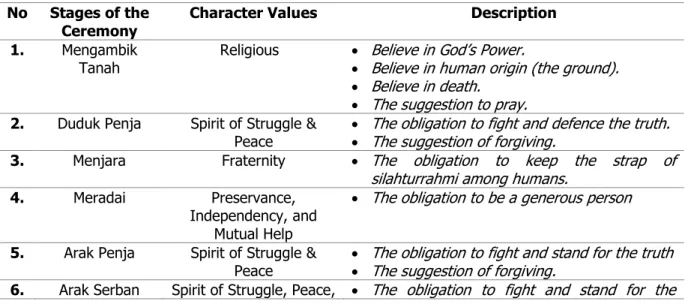
Based on the analysis above, it can be concluded that each stage in Tabot ceremony is full of character values. The detailed description of the character values are in table 1:
Table 1. The Description of Character Education Values in Tabot Ceremony: No Stages of the
Ceremony Character Values Description
1. Mengambik
Tanah Religious Believe in God’s Power. Believe in human origin (the ground). Believe in death.
The suggestion to pray. 2. Duduk Penja Spirit of Struggle &
Peace The obligation to fight and defence the truth. The suggestion of forgiving. 3. Menjara Fraternity The obligation to keep the strap of
silahturrahmi among humans.
4. Meradai Preservance,
Independency, and Mutual Help
The obligation to be a generous person 5. Arak Penja Spirit of Struggle &
Peace The obligation to fight and stand for the truth The suggestion of forgiving. 6. Arak Serban Spirit of Struggle, Peace, The obligation to fight and stand for the
143 | P a g e Nationalism, &
Responsibility. truth. The suggestion of forgiving. The obligation to love the country.
The obligation to continue the prophets’ struggle.
7. Gam Religious The suggestion of self-evaluation.
8. Arak Gedang Spirit of Struggle &
Cultural Awareness. The obligation to fight and stand for the truth. The obligation to preserve and develop the
local culture. 9. Tabot Terbuang Religious and
Responsibility
Obligation to visit, pray, and bury the dead in the event of death.
The classification of the values of these characters is open, meaning that it can be any other classification in accordance with the purpose of the research. The classification is important to do to make it easier to see the relevance of values in character education that is being promoted.
D. CONCLUTION
Character education is the right choice for creating learners who are smart and have a good character, and in order to realize the character education, local knowledges which are scattered in various regions in Indonesia are very potential to be used. For Bengkulu province, the Tabot tradition is one among variety local wisdoms containing a lot of wisdom values. Some character value contained in tabot tradition are religious, fighting spirit, fraternity, hard work, independency, love of country, peace, culture awareness, and responsibility. These values are the basic that are important to be owned by learners. Hence, Tabot is considered suitable to be integrated into a wide range of subjects in schools.
In terms of its integration in schools, local wisdom in tabot ceremony can be applied in some subjects that have relevance such as History, Sociology, and Arts & Culture for
High School and social studies for Junior Secondary. In terms of strategy, teachers can also utilize Tabot tradition for many things, it can be as a learning model or as a material development.
E. REFERENCES
Dahri, Harapandi. (2009). Tabot: Jejak Cinta Keluarga Nabi di Bengkulu. Jakarta: Penerbit Citra.
Depdikbud RI. (2010). Pengembangan Pendidikan Budaya dan Karakter Bnagsa: Pdeoman Sekolah. Jakarta: Depdikbud RI.
Depdikbud RI. (2010). Kerangka Acuan Pendidikan Karakter Tahun 2010. Jakarta: Kemendikbud RI.
Hamidy, Badrul Munir, dkk. (1992). Upacara Tradisional Daerah Bengkulu: Upacara
Tabot di Kotamadya Bengkulu.
Jakarta: Depdikbud
Ratna, Nyoman Kuta. (2014). Peranan Karya Sastra, Seni dan Budaya dalam
pendidikan Karakter. Yogyakarta:
Pustaka Pelajar.
Rohimin, dkk. (2009). Penyerapan Nilai-Nilai Budaya Lokal dalam Kehidupan Beragama di Bengkulu: Studi tentang Tradisi Tabot di Bengkulu. Dalam “Harmonisasi Agama dan Budaya di Indonesia Jilid II”. Jakarta: Balai Penelitian dan Pengembangan Agama Jakarta.
Page | 144
Sariyatun. (2013). Pengembangan Model Pendidikan Nilai Budaya di SMP Berbasis Tradisi Seni Batik Klasik Surakarta. Paramita: Historical Studies Journal, 23 (2), 230-241.
Setiyanto, Agus. (2001). BU.SE.RA. Bengkulu. Bengkulu: Lemlit UNIB Press.
Sibrani, R. (2013). Foklore sebagai Media dan Sumber Pendidikan: Sebuah Ancangan Kurikulum dalam Pembentukan Karakter Siswa Berbasis Nilai Budaya Batak Toba. In Suwardi Endaswara (Ed). Foklore Nusantara: Hakikat,
Bentuk dan Fungsi. Yogyakarta:
Ombak.
Sudrajat, A. (2011). Mengapa Pendidikan Karakter? Jurnal Pendidikan Karakter, 1 (1), 47-58.
Zed, Mestika. (2012). Peran Sejarah dalam Menggali Kearifan Lokal Sebagai
Warisan Budaya Bangsa. Makalah
dalam Seminar Nasional IKAHIMSI. Padang , 16 April 2012.
Zed, M. (2008). Metode Penelitian Kepustakaan. Jakarta: Obor.