Modeling Examples to Test and
Understand Software
Inauguraldissertation
der Philosophisch-naturwissenschaftlichen Fakultät der Universität Bern
vorgelegt von
Markus Gälli
von Tübach (SG)
Leiter der Arbeit: Prof. Dr. Stéphane Ducasse
Prof. Dr. Oscar Nierstrasz
Modeling Examples to Test and
Understand Software
Inauguraldissertation
der Philosophisch-naturwissenschaftlichen Fakultät der Universität Bern
vorgelegt von
Markus Gälli
von Tübach (SG)
Leiter der Arbeit: Prof. Dr. Stéphane Ducasse
Prof. Dr. Oscar Nierstrasz
Institut für Informatik und angewandte Mathematik
Von der Philosophisch-naturwissenschaftlichen Fakultät angenommen.
Bern, 13.11.2006 Der Dekan:
Abstract
One of the oldest techniques to explain abstract concepts is to provide concrete exam-ples. By explaining an abstract concept with a concrete example people make sure that the concept is understood and remembered.
Examples in software can be used both to test the software and to illustrate its func-tionality. Object-oriented programs are built around the concepts of classes, methods and variables, where methods are the atoms of the functionality. But the meta-models of object-oriented languages do not allow developers to associate runnable and compos-able examples with these concepts and particularly not with methods.
Unit tests on the other hand, assure the quality of the units under test and document them. Not being integrated into the language, unit tests are not linked explicitly to their units under test which makes it unnecessarily difficult to use them for documenting, typing and debugging software. In addition they are not composable making it hard to develop higher level test scenarios in parallel with higher level objects.
In this thesis we analyze unit tests to learn about implicit dependencies among tests and from tests to the methods under test. We develop a technique to partially order unit tests in terms of their covered methods, which reveals possible redundancies due to the lack of composability. We show how partial orders can be used to debug and to comprehend software. We then develop a taxonomy based on several case studies revealing that a high fraction of unit tests already implicitly focuses on single methods. We show that the rest of the tests can be decomposed into commands focusing on single methods.
We build a meta-model based on our findings of analyzing test interdependencies which establishes how tests can be explicitly linked to their method under test and how they can be composed to form higher-level test scenarios. We explain how the problems of missing links between tests and units under test are solved using our meta-model. Furthermore, we implemented the meta-model and a first user interface on top of it to give first evidence of how our model supports the developer.
Acknowledgments
First and foremost, I would like to thank my advisors Oscar Nierstrasz and Stéphane Ducasse. They gave me the opportunity to work in an inspiring environment based on trust. They provided me lots of good examples of how to collaborate in a scientific environment – how to do research, how to work on papers and how to give presentations and lectures. Oscar and Stéph, it was a great pleasure to work with you during all these years.
Many thanks also for giving me some time to play around with Etoys and letting me present two papers in Berkeley, which were not directly related to my thesis. I was glad to be able to go there.
I would also like to thank the other member of my Ph.D. committee, Robert Hirschfeld. Thanks for inviting me to Potsdam. You gave me very detailed and good critique of my thesis! All: Keep on Squeaking!
Very special thanks go to my parents, you helped me a lot during the hard times and al-ways trusted in me. Thanks for your love and for invoking the playful child in me. I would also like to thank my friends for all the adventures and the good times we have experienced together and for the support and advice you have given me. Best regards especially go to the most venerable members of the “Zieschtigsclub”, to the “french connection” and to all I ever had a cool beer and good talk with – was it in the “Musigbistrot” or in the “Chine”.
Many thanks also to all the colleagues who have helped me and collaborated with me during my work, especially to Doru and Orla, who always have an open ear and a helpful advice. Thanks for reviewing my thesis and for being an integral part of the social center at the Software Composition Group.
Many thanks go to Marcus for being part of our common Squeak adventures.
Next I would like to thank all the former and current members of the Software Compo-iii
sition Group. It was a pleasure to work (and party) with you : Gabriela Arevalo, Alexan-dre Bergel, Frank Buchli, Philipp Bunge, Juan Carlos Cruz, Marcus Denker, Adrian Kuhn, Michele Lanza, Adrian Lienhard, Philippe Marschall, Michael Meyer, Laura Poni-sio, Stephan Reichhart, Lukas Renggli, Matthias Rieger, David Röthlisberger, Nathanael Schärli, Andreas Schlapbach, Therese Schmid, Florian Thalmann, Sander Tichelaar, Rafael Wampfler, and Roel Wuyts.
I would also like to thank all the people that supported and hosted me during my travels and stays abroad and send my best to all the great people I have met and talked to at conferences, meetings, workshops, online and elsewhere.
Denise, thanks for your great support during the difficult months of the thesis. I am happy we found each other – you are key.
Markus Gälli
Table of Contents
Abstract i
1 Introduction 1
1.1 The Problem . . . 2
1.2 Our Approach in a Nutshell . . . 5
1.3 Contributions. . . 7
1.4 Thesis Outline . . . 8
2 Problems in Understanding and Testing 9 2.1 Agile Development aligns Viewpoints of Customers and Coders. . . 10
2.2 Constraints of Test-Driven Development . . . 12
2.3 Problems of Implicit Test Interdependencies . . . 14
2.3.1 Creating test scenarios is time-consuming and complex . . . 15
2.3.2 Understanding the interplay of a system is hard . . . 18
2.3.3 Testing time is unnecessarily long . . . 18
2.3.4 The problem of identifying relevant tests in the case of a failure . . . 20
2.3.5 The problem of detecting similar tests . . . 20
2.4 Problems of Implicit Test / Code Interdependencies . . . 21
2.4.1 Understanding the focus and the kind of a test is hard . . . 21
2.4.2 The problem of separating good examples from less appropriate ones 22 2.4.3 The problem from separating tidy from untidy examples . . . 23
2.4.4 The problem of keeping the tests and the code synchronized . . . 23
2.4.5 The problem of seeing a method in a debugger . . . 24
2.5 Problems of Implicit Code Interdependencies: Typing . . . 24
2.6 Related Work . . . 25
2.7 Summary . . . 27
3 Partially Ordering Unit Tests 29 3.1 Implicit dependencies between unit tests. . . 30
3.2 Ordering broken unit tests . . . 32
3.2.1 Approach . . . 32
3.2.2 Implementation. . . 34
3.3 Case studies . . . 34
3.3.1 Setup of the experiments . . . 35
3.3.2 Results. . . 36
3.4 Discussion . . . 39
3.4.1 Semantic ordering of tests . . . 39
3.4.2 Limitations . . . 40
3.5 Related Work . . . 41
3.6 Summary . . . 43
4 Taxonomy of Unit Tests 45 4.1 Introduction . . . 46
4.2 Basic Definitions . . . 48
4.3 A Taxonomy of Unit Tests. . . 48
4.3.1 Method test commands . . . 50
4.3.2 Method example commands . . . 51
4.3.3 Multiple-method test suite . . . 52
4.3.4 Others . . . 54
4.3.5 First validation: Maven . . . 55
4.4 Automatic Classification of Unit Tests . . . 56
4.4.1 Instrumentation . . . 56
4.4.2 Lightweight Heuristics. . . 57
4.4.3 A First Case Study: Squeak Unit Tests . . . 59
4.4.4 A Second Case Study: SmallWiki . . . 59
4.5 Discussion . . . 60
4.6 Related Work . . . 63
4.7 Summary . . . 65
5 An exemplified Meta-Model for Examples: Eg 67 5.1 The Bank Account and its Tests refactored . . . 68
5.2 Exemplified Responsibilities of Eg . . . 72
5.2.1 Module. . . 72
5.2.2 Example Module . . . 76
5.2.3 Method Command . . . 80
5.2.4 Negative Method Command. . . 83
5.2.5 Positive Method Command . . . 84
5.2.6 Method Test. . . 85
5.2.7 Method Example . . . 85
TABLE OF CONTENTS vii
5.2.9 Method . . . 87
5.3 Validation . . . 88
5.3.1 Creating Test Scenarios is easy . . . 88
5.3.2 Our sorting techniques help to understand the interplay of the system89 5.3.3 Minimizing Testing Time . . . 90
5.3.4 Identifying relevant failed tests in the case of a failure is easy. . . 90
5.3.5 We can detect similar tests . . . 92
5.3.6 We know exactly the scope and the kind of a test . . . 92
5.3.7 We can highlight the best examples for methods . . . 93
5.3.8 We can separate tidy from untidy examples . . . 93
5.3.9 We can synchronize tests with code with a minimal overhead . . . 93
5.3.10All exemplified methods can be seen in a debugger . . . 93
5.3.11Typing . . . 94
5.4 Converting existing tests into Eg-Tests: A Case Study . . . 94
6 Conclusions 97 6.1 Contributions. . . 97
6.2 Lessons learned . . . 98
6.2.1 Getting Feedback and Spreading the Idea by A Filmed Thinking Aloud in Pairs Experiment . . . 98
6.3 Future Work . . . 99
6.3.1 Integration of Traits . . . 99
6.3.2 Scale freeness of method call distributions . . . 99
6.3.3 Programming as a sequence of commands . . . 99
6.3.4 The best examples . . . 100
6.3.5 Partial Ordering Unit Tests: More Techniques and Case Studies . . . 100
6.3.6 Implementing Eg in other languages . . . 101
6.3.7 Ruby . . . 102
6.3.8 Java . . . 102
A First Validations of the Eg-Browser 103 A.1 GOMS keystroke-level model . . . 104
A.1.1 Validation of the EgBrowser . . . 104
A.1.2 Creating a test for an existing method . . . 104
A.1.3 Creating a test for a new method . . . 105
A.2 Usability Experiment . . . 105
A.2.1 Test Setup. . . 106
A.2.2 Tasks . . . 106
A.2.3 Questionnaire . . . 107
A.2.4 Questionnaire Analysis . . . 107
List of Figures
1.1 “Example” defined in the Myriam Webster Online Dictionary. Note how dictionaries use examples to explain words in their context: “There are many sources of air pollution, exhaust fumes, for example.” The concept of examples is currently not used in object-oriented programming languages which makes it hard to test and document software. . . 1 1.2 Both language designers and developers came up with a list of independent
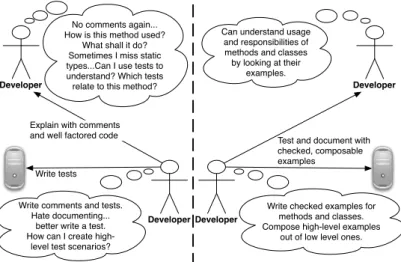
techniques and concepts to ease the process of translating requirements into tests, of documenting and of testing code. . . 3 1.3 Agile developers favor writing tests over documentation, but these tests are
not well integrated into languages and thus not browsable. Examples on the other hand can be used both to test software and to explain it. . . 4 1.4 A condensed version of our meta-model: Each method can have an
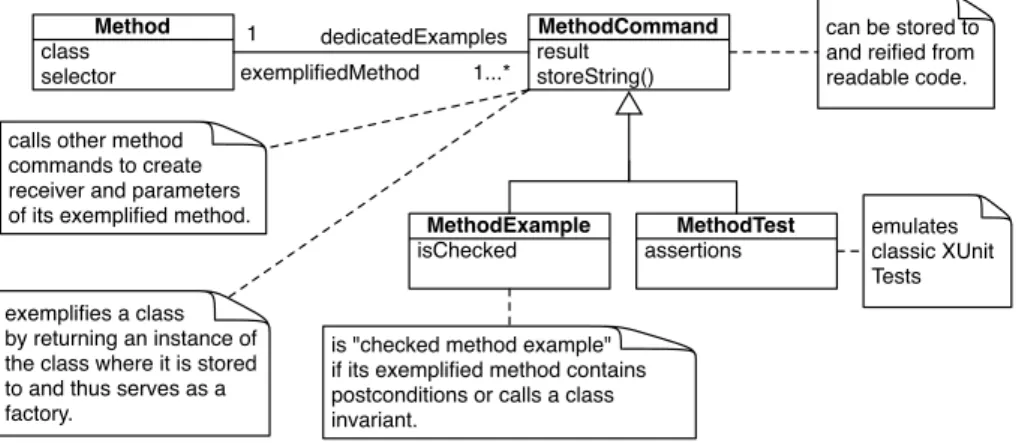
ex-ample stored in a method command. These commands deliver exex-ample instances of their classes and thus can call each other to build higher level test scenarios. Commands can also be stored into and reified from source code. . . 6
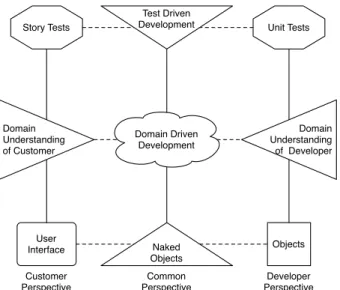
2.1 “Moments before he was ripped to shreds, Edgar vaguely recalled having seen that same obnoxious tie earlier in the day.”. . . 10 2.2 Recent methodologies align the viewpoints of the customers and developers
to thesame model using thesame testsand the same user interface. . . 11 2.3 Customers and developer are composing new storytests, developers new
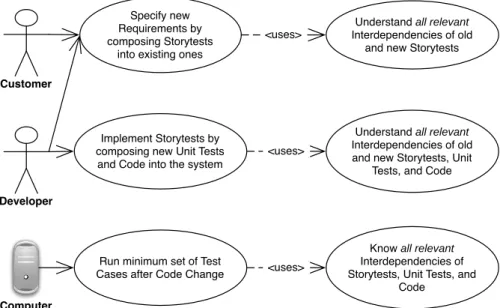
unit tests and code into an existing system and computers should run the minimum set of relevant tests after a code change. All parties can only fully understand relevant artefacts like tests and code, by understanding the interdependencies of these artefacts. . . 14 2.4 A transitive reduction of all possible interdependencies between agile
con-cepts. None of these interdependencies is explicit, which causes problems in understandability of the concepts. . . 15
2.5 The canonical bank account in Smalltalk and some typical SUnit tests for it.16 2.6 The canonical bank account: The bank customer can deposit and withdraw
money, the bank admin can create an account, but for doing so a bank object must be created first. The relations between these concepts are not reflected in the system which hinders its comprehensibility and thus its evolvability. . . 17 2.7 The canonical bank account described in an example notation. The
addi-tional tasks for agile developers who take this point of view are depicted. We will show in the rest of this thesis, that fulfilling these task can be easily integrated in current development styles. . . 19
3.1 The test for #becomeProfessorIn: covers the test for #addPerson:. Inter-secting signatures are displayed gray. . . 30 3.2 Two small unit tests, which do not cover each other. . . 31 3.3 A sample test hierarchy based on coverage sets. . . 32 3.4 The coverage hierarchy of the Code Crawler tests visualized with Code
Crawler. . . 36 3.5 The distribution of comparable test nodes in our four case studies. . . 37 3.6 An avalanche effect in the coverage hierarchy of Magic Keys. One manually
introduced bug causes 10 test cases to fail. . . 38 3.7 The generated partial order of a test suite concerned with a timestamp
functionality in Squeak 3.7. The two equivalence classes of tests displayed in the two big ellipses on the top include similar method names indicating that they test similar behavior. Our overview also indicates, that storing and printing timestamps is similar if not interdependent behavior, like wise comparing and sorting timestamps. . . 40
4.1 An enhanced class browser shows methods and their Method tests side by side. Note that the test returns its result, thus enabling other unit tests to reuse it. We thus store tests like other factory methods on the class side. . 47 4.2 Taxonomy of unit tests. Nodes are gray and denote concrete occurrences
of unit tests. . . 49 4.3 Manual classification of unit tests for the base Squeak system . . . 50 4.4 Method test suites, multi-facet test suites and cascaded test-suites are
decomposable into Method tests. . . 53 4.5 Manual classification of 50 random unit tests of Maven . . . 56 4.6 Manual classification of unit tests for the SmallWiki system . . . 60
5.1 The Canonical Bank Account in Smalltalk now with Pre- and Postcondi-tions. . . 69
LIST OF FIGURES xi
5.2 The bank account tests refactored to our new meta-model. We managed to abstract all assertions into pre- and postconditions in the code. We implemented our meta-model in a light way: We say, that thelast method called is the method under test. By returning the result we can compose the examples. As a consequence only two tests have to be called to gain
the full coverage. . . 70
5.3 Inverse Tests are made explicit, by storing them in this schema. . . 72
5.4 The generated partial order of the old tests (left) and the refactored tests (right) of the bank account. We only added the two tests on the bottom right making the setup explicit. The structure stays the same as we refactored the tests keeping their semantics. The partial order thus serves as a good hint how tests can be recomposed. . . 73
5.5 The hierarchy of commands in our meta-model. An exemplified method can collect all its exemplifying commands and display them to the developer. . 74
5.6 An object diagram depicting the relationship of a checked method example, an executed method and a method testing the bank application. . . 88
5.7 Creating an example for depositing money with Eg, the tool. More complex objects than numbers represented by method commands can be dragged and dropped out of the left pane into the parameters fields.. . . 89
5.8 The sorted refactored bank tests according to what test reuses what other tests. This structure mirrors the structure of the system under test: A bank has to be created before an account can be added to the bank, some money has to be deposited on the account, before it can be withdrawn. . . 90
5.9 One can see the partial order of tests for the Squeak package Aconagua. All tests are green. . . 91
5.10 We planted an error in reverseDo:, reran the tests but display them using the original order of running tests. . . 92
5.11 A prototype of a five pane Eg browser even displays the concrete receivers and parameters of the exemplified method after hovering over the method signature using a tooltip. In this case the method deposit has been called via three tests, all of them feeding the account with an amount of 100. The method deposit: always returns an account. Inferring the concrete types just means to ask the concrete values for its classes. . . 94
A.1 Results of the questionnaire displayed as box plots. . . 108
A.2 Analysis of task 1 . . . 110
A.3 Analysis of task 2 . . . 111
A.4 Analysis of task 3 . . . 112
A.5 Analysis of task 4 . . . 113
List of Tables
3.1 The resulting coverage of unit tests in our case studies. . . 36 3.2 Results of our automatic mutation experiments. . . 37 3.3 Examples for equivalent test cases. . . 39
4.1 Preliminary manual and automatic classifications of Method commands of the Squeak Unit Tests. . . 58 4.2 Preliminary manual and automatic classifications of Method commands of
the SmallWiki Unit Tests. . . 59 A.1 GOMS model . . . 104
Chapter 1
Introduction
Figure 1.1: “Example” defined in the Myriam Webster Online Dictionary. Note how dictionar-ies use examples to explain words in their context: “There are many sources of air pollution, exhaust fumes, for example.” The concept of examples is currently not used in object-oriented programming languages which makes it hard to test and document software.
People learn new concepts by example. Theye.g.,learn new words by looking them up in dictionaries and understand them in an exemplified context. Dictionaries like the Oxford Dictionary of Current English [Soanes, 2001] or the Webster Online Dictionary Figure 1.1 (p.1) all present exemplified usages of words for different kinds of contexts where they are used. Cognitive psychologist Jerome Bruneret al. state that all learning means to compare examples and counter examples in order to derive an intentional description of the subject at hand [Bruner et al., 1956] while Einstein even believed, that “Example isn’t another way to teach. It is the only way to teach.”.
But the concept of examples is not established within current object-oriented program-ming languages.
1.1
The Problem
Context Software developers have to illustrate their abstract programs to two audi-ences: The computer, which is supposed to run and quality-assure their programs on its own by using tests, and developers, who are supposed to understand the program while building it and at a later time while extending it. In traditional software devel-opment the process of writing documentation is different from the process of writing tests. This dichotomy is reflectedor causedby existing concepts of object-oriented pro-gramming languages. There are concepts whicheither test or document programs but there are no concepts which testand document software at the same time (Figure1.2
(p.3)). All programming languages used in industry today provide means to document code whereas none provides means to automatically test the programs out of the box by integrating automated testing into the development cycle. On the other hand devel-opers prefer to write code over documentation, which explains the rise of unit testing frameworks being an integral part of current agile software methodologies like eXtreme programming.
Agile methodologies aim to reduce the number of superflous artifacts used in traditional software development and rely more on executable and well factored code and tests than on written documentation. Agile developers aim at self documenting code, as the code is written with meaningful class, variable and method names, functionality is not duplicated, and as much functionality as possible is tested. As a consequence written documentation rarely exists in these projects and tests become the most useful resource for understanding the software. (See Figure1.3(p.4))
Unit test frameworks are an ad-hoc addition to current programming environments and thus not well integrated into them: Though they help developers to write repeatable automated tests, they leave them alone both with exploiting these tests as means of
1.1. THE PROBLEM 3
Method Comments
Static Types
Pre- / Postconditions Examples in Methods Mock Objects xUnit Tests Class Comments
Class Invariants
Unbound but dynamic concepts to document and test code
created by developers Bound but static concepts
to document and test code created by language designers
Examples bound to classes and methods Bound and dynamic JML
Figure 1.2: Both language designers and developers came up with a list of independent tech-niques and concepts to ease the process of translating requirements into tests, of documenting and of testing code.
documentation and with composing scenarios for higher level unit tests - which is the most time consuming part of writing tests as mentioned by Zeller [Zeller, 2005].
The main reason for unit tests not being integrated into current programming languages and environments is that the relationship of unit tests to other code artifacts – including other unit tests – is left open by the unit test framework designers.
No distinction of possible units under tests are made. As a consequence developers write all kinds of unrelated unit tests: Some of those tests focus on single methods and execute them only in one scenario, some of them test several methods in different scenarios, and none of them can be reused by yielding their scenarios to create higher level scenarios. Agile communities have renamed “unit tests” into “developer tests” and “acceptance tests” into “customer tests”. This reveals on the one hand the similarity of those two kinds of tests, but on the other hand focuses more on who is writing the tests and even less on what the tests are testing.
Not having an explicit link between a unit test and its unit under tests, browsers cannot display them side-by-side. Thus developers are not reminded to write tests, they cannot see tests side by side to the unit under test to better understand a unit, they do not know if a unit has a dedicated test, and they cannot automatically run the unit test when the unit has changed. Not being able to compose unit tests out of other unit tests, developers have to write redundant tests, which leads to code duplication and
Developer Write comments and tests.
Hate documenting... better write a test. How can I create
high-level test scenarios?
Write checked examples for methods and classes. Compose high-level examples
out of low level ones. No comments again...
How is this method used? What shall it do? Sometimes I miss static types...Can I use tests to understand? Which tests relate to this method?
Write tests Developer
Explain with comments and well factored code
Developer
Test and document with checked, composable examples
Developer Can understand usage
and responsibilities of methods and classes by looking at their
examples.
Figure 1.3: Agile developers favor writing tests over documentation, but these tests are not well integrated into languages and thus not browsable. Examples on the other hand can be used both to test software and to explain it.
unnecessarily long testing times.
Unit tests can also serve as templates of how to use the units under test. As I am writing this thesis, I do not follow an abstract thesis writing process, but I rather adapt a successful example of a thesis of our group [Schärli, 2005]. Having a template or example of a thesis at hand facilitates the task of writing a thesis: Whereas my template thesis explains the problems of multiple inheritance and how to solve them with traits, my task is to explain the problems of missing examples of how to run and test object-oriented programs and how to solve them with commands.
There is no rigorous definition of a unit test, how it is structured or what level of gran-ularity it should address: IEEE defines unit testing as
Testing of individual hardware or software units or groups of related units. See also: component testing; integration testing; interface testing; system testing.
[ANS, 1983]
Hence developers have written all kinds of tests with different levels of granularity and scope. But not denoting the unit under test explicitly makes unit tests unusable as examples, thus developers cannot use them to understand how the units under test should be used.
1.2. OUR APPROACH IN A NUTSHELL 5
In addition to not being able to compose unit tests out of other unit tests, developers have to write redundant tests, which leads to code duplication and unnecessarily long testing times.
Furthermore unit tests are not orthogonal to static typing: Test-driven developers using a statically typed language have to provide the types twice: When they develop the test they need to come up with concrete instances to build the scenario for the unit under test. If the unit under test is a method, they then have to again statically type that method, though these types could have been inferred out of the test scenario.
1.2
Our Approach in a Nutshell
Our approach consisted of several iterations of analyzing existing unit test suites, de-signing the problems we found away into a meta-model and implementing according prototypes – always guided by the metaphor of examples.
Metaphor. We are relying on the metaphor ofexampleswhich is not yet fully exploited in the context of object-oriented software engineering. The metaphor of examples not only suggests a strong connection between the concept to be exemplified and the ex-ample itself, but also to create high-level exex-amples out of low-level ones: The idea of composing tests is awkward, whereas it is natural to describe large examples out of smaller ones.
Analysis. To make a transition from the perspective of tests towards the perspective of examples, we first need to know how current unit tests are implicitly related to each other, and how they implicitly relate to the concepts of object-oriented languages. — To understand the implicit relationships of unit tests to other unit tests we are
intro-ducing a new technique of dynamic analysis: We partially order unit tests by the sets of signatures of the methods called by the tests. Our experimentation with different case-studies has revealed that a high percentage of current unit tests is comparable to other unit tests using this technique. The partial order supports our understand-ing of how unit tests correlate and suggests ways in which they can be refactored. Moreover, our technique supports software debugging activities: Using this scheme we can present the developer the most relevant failing test case first together with the according methods causing the error.
— To understand the implicit relationships of unit tests to the concepts of object-oriented languages such as classes and methods, we researched case studies, some
of them consisting of more than thousand unit tests, and iteratively built a catego-rization scheme based on the relationship of the tests to the atomic unit of object-oriented programming, the method.
Design. We can model the relationships found in our analysis-phases explicitly by ex-ploiting our metaphor of examples. This model is called a meta-model, as we are not modeling outer-world concepts but introduce new concepts of object-oriented program-ming languages themselves. Our meta-model centers around the concept of composable method commands which serve as dedicated exemplifications of one method. In Fig-ure1.4 (p.6)you can see a condensed version of our meta-model based on the concept of method commands. As you can see method commands serve the purpose of exem-plifying methods and classes, they can be stored into readable code or reified from this code, and they are composable to form higher-level commands.
MethodCommand result storeString() Method class selector exemplifiedMethod 1 dedicatedExamples 1...* MethodTest assertions MethodExample isChecked calls other method
commands to create receiver and parameters of its exemplified method.
exemplifies a class by returning an instance of the class where it is stored to and thus serves as a factory.
is "checked method example" if its exemplified method contains postconditions or calls a class invariant.
emulates classic XUnit Tests can be stored to and reified from readable code.
Figure 1.4: A condensed version of our meta-model: Each method can have an example stored in a method command. These commands deliver example instances of their classes and thus can call each other to build higher level test scenarios. Commands can also be stored into and reified from source code.
We explain how commands can be used to exemplify classes, methods, and variables. We also show how they can be composed, and that every object can either be expressed as a literal or as a result of a method command.
Implementation. We present a light-weight implementation of this meta model in Smalltalk and finish by showing how our prototypes using these meta model can help developers to test and understand software.
1.3. CONTRIBUTIONS 7
Thesis statement. Tests are neither composable nor explicitly bound to the concepts of current object-oriented languages. The reason is that tests are only linked implicitly to their unit under test and to other unit tests. Detecting these implicit links and making them explicit using the guiding metaphor of examples helps developers to document, type, debug and test object-oriented programs.
1.3
Contributions
The main contributions of this thesis can be summarized as follows:
1. A detailed illustration and analysis of the various problems that are associated with the absence of linkable and composable examples for the building blocks of object-oriented programs.
2. A detailed analysis of unit tests and their interdependencies with each other and with the code under test:
(a) A new and simple trace summarization technique: First we flatten the sig-natures of the traced methods of unit tests into sets. Then we use a partial order mechanism to compare these sets. It turns out that a high percentage of unit tests becomes comparable using this simple mechanism. We show [Gaelli
et al., 2004a] how the resulting partial order can be used to understand and refactor the code with its test suites and to prioritize failing tests.
(b) A taxonomy of unit tests with respect to their units under test and to their composability. Our case studies reveals that most unit tests are either method commands focusing on one method or are decomposable into such method commands. [Gaelliet al., 2005b]
3. Based on this analysis a suggestion of a new meta model to include unit tests from the very beginning into the development cycle and environment:
(a) A light-weight implementation for making missing test links explicit [Gaelliet al., 2004b] [Gaelli, 2004] [Gaelliet al., 2005a] together with an implementation in Smalltalk.
(b) The development of a meta-model abstracting from our implementation. (c) The development and evaluation of a programming methodology around this
meta-model exemplified by a tool called “Eg”.
(d) Suggestions how to implement this meta-model in light ways in other lan-guages such as Java, Ruby and Python.
1.4
Thesis Outline
This dissertation is structured as follows:
Chapter2(p.9)identifies and illustrates problems of missing examples in object-oriented programs by establishing a bank example which will be used throughout this the-sis.
Chapter 3(p.29)analyzes the interdependencies among unit tests. It presents a tech-nique to partially order unit tests in order to understand, debug, and refactor existing test suites.
Chapter 4 (p.45) analyzes the interdependencies of unit tests with their units under tests using several case studies, one of them consisting of more than 1000 tests and establishes a taxonomy of unit tests. It also introduces first heuristics to categorize unit tests automatically.
Chapter 5 (p.67) establishes our meta model Eg for linking unit tests with the code under test and with other unit tests. It first describes a light way implementation of the meta-model in Smalltalk. It then introduces the meta-model in detail by explaining the responsibilities of the classes of our meta-model – illustrated by use cases to test, debug and understand the Bank example. It finishes by pointing out how the meta-model solves the problems described in Chapter2(p.9)and gives an
outlook how to implement Eg in languages like Ruby and Java.
Chapter 6(p.97)summarizes how the main results of our work support the statement of the thesis, and we look forward to future work related toEg.
Chapter 2
Problems in Understanding and
Testing
Software understanding and testing is a wide field and so in this thesis we are research-ing problems of understandresearch-ing and testresearch-ing software only in the context of agile develop-ment. Agile developers aim for simplicity in order to translate the problem domain into tested and understandable code. Coming from an object-oriented background, they heav-ily rely on automated tests while doing so. The main software related tasks for agile developers are to write new tests and to enhance and to debug the the software. For writing new tests developers spend most of their time in creating tests scenarios, for de-bugging they spend most of their time in isolating the failure-inducing change and for developing they spend their time in understanding the existing code-base. But current object-oriented programming environments neither support agile developers to create sce-narios for high-level tests out of existing ones nor to debug or understand code by using tests as composable examples. The reason for this lack of help from programming environ-ment is that tests are neither composable nor explicitly bound to the concepts of current object-oriented languages. In this chapter we define the scope of this thesis not only by specifying the problem, but also the “owners” of the problem – agile developers – and the context they are living in. We do so by
— explaining the motivations and constraints of lightweight agile methodologies,
— examining the minimal set of concepts agile developers are relying on, namely tests and code,
— defining a set of constraints that code and tests have to fulfill to keep software evolv-able in an agile environment,
— examining the problems arising from implicit interdependencies of tests and code. 9
2.1
Agile Development aligns Viewpoints of Customers
and Coders
The quest for fighting unnecessary complexity continues. Though Brooks argues that there is no “silver bullet” in software engineering [Brooks, 1987] and Nierstrasz [ Nier-strasz, 2002] emphasizes that “as long as industry remains focused on short-term goals, and maintains a technology-centric view of software development, no progress will be made”, industry continues to build new technology-oriented solutions and to buzz these solutions to be “the next great thing” Figure2.1(p.10).
Figure 2.1: “Moments before he was ripped to shreds, Edgar vaguely recalled having seen that same obnoxious tie earlier in the day.”
Any problem in computer science can be solved with another level of indi-rection. But that usually will create another problem. — David Wheeler [Wikipedia, 2006]
2.1. AGILE DEVELOPMENT ALIGNS VIEWPOINTS OF CUSTOMERS AND CODERS 11
Often only the first sentence is getting quoted. This observation fits well with another observation, namely that
Software people tend to favor the joy of complexity, yet we should strive for the joy of simplicity. — Alan Kay
The agile development movement as explained by Cockburn [Cockburn, 2002] can be seen as the result of technically overcomplex solutions: Agile developers and their cus-tomers focus on a rapid feedback cycle between them and the code by removing as many unnecessary “silver bullets” or artificial artifacts imposing unnecessary levels of indirec-tions as possible. [Fowler and Highsmith, 2001] They strive for the “Joy of Simplicity”. Accordingly one of the mantras of the agile movement is “Do the simplest thing, that could possibly work”1.
Many recent efforts like spreadsheet testing [Rothermelet al., 2001], Dabble DB2, Etoys [Allen-Conn and Rose, 2003], Test-Driven Development or “Naked Objects” [Pawson and Matthews, 2002] are agile in the sense that they focus on “end-user programming”. All these efforts not only aim to align the viewpoints of end-users with the viewpoints of de-velopers, they even want to empower end-users with abilities to do the real programming (see Figure2.2(p.11)).
User Interface
Story Tests Unit Tests
Objects Domain Driven Development Customer Perspective Developer Perspective Common Perspective Naked Objects Test Driven Development Domain Understanding of Customer Domain Understanding of Developer
Figure 2.2: Recent methodologies align the viewpoints of the customers and developers to the
same model using thesame testsand the same user interface.
1The Simplest Thing that Could Possibly Work – A Conversation with Ward Cunningham, Part V, by Bill
Venners, www.artima.com/intv/simplest.html
Let us have a more detailed look into the two complementing agile methodologies, namely domain-driven design and test-driven development.
Domain-Driven Design. Domain-driven design (DDD) as described by Evans [Evans, 2003] tries to bridge the existing gap between domain understanding and software im-plementation decisions: It questions the traditional separation between software design and requirements analysis. Domain-driven design uses only one model “throughout all aspects of the development effort, from code to requirements analysis”. This model, at the heart of software, facilitates communication with users. It also serves as the imple-mentation guide for programmers. Not separating concepts from their impleimple-mentation provides a “ubiquitous language” for all project stakeholders, and even improves soft-ware usability, since the user’s model will match the programmer’s model of the system. Domain-driven design’s defining characteristic is its “priority on understanding the tar-get domain and incorporating that understanding into the software”, where some of its elements closely correspond to elements in the model.
Test-Driven Development. Beck and Cunningham collaborated while inventing pair-programming but went in different directions when it came to testing: Whereas Beck invented the Xunit Test framework and promoted “Test-Driven Develolpment” [Beck, 2003] for developers, Cunningham focused as usual 3 on the collaborative aspect and built a tool calledFIT [Mugridge and Cunningham, 2005b]. FIT (Framework for Inte-gration Testing) allows customers (with the help of developers) to build high-level story-tests which in turn can be used by developers as concrete specifications to implement against. As soon as the story test is running, the customer can see a green light in a web-interface thus tracking the progress of the developers.
Agile projects try to align the viewpoints of customers and developers on the problem domain by minimizing the set of concepts used. That minimal set of concepts used in test-driven development which are also represented as programs consists of story tests, unit tests and code.
2.2
Constraints of Test-Driven Development
In this thesis we are focusing on the minimal set of programmable concepts necessary for test-driven development coming from a domain-driven design perspective.
3Ward Cunningham became famous for having invented the Wiki-Principle of collaborative Website Editing
2.2. CONSTRAINTS OF TEST-DRIVEN DEVELOPMENT 13
Customers are specifying their requirements iteratively with story tests, possibly with the help of developers. The developers then iteratively translate these story tests into unit tests and code as described by Beck [Beck, 2003]. We will not explore the role of user stories [Cohn, 2004] which are an integral part of development in eXtreme pro-gramming as they are not put into an electronic format.
Whereas customers deal with writing high level storytests4, developers help them doing so. Developers also have to understand these storytests in order to compose in lower level unit tests and appropriate code to satisfy both the story- and the unit tests. The computer on the other hand should always be able to run the minimum set of rele-vant tests after a change in the code, where relevant means that the test is calling the code.
We thus end up with three different “users” of tests and code: customers, developers and the computer as seen in Figure 2.3 (p.14). We subsume the role of the customers with the role of the developers in the context of domain-driven design: In our experience it is still common that customers do not write storytests and let developers do this work, or at least help them doing so. Having unified our target audience we also unify the tests they dealing with, namely storytests and unit tests into the concept of tests.
Although we do not claim that the following goals of agile test-driven development are reachable, we however do claim that they represent the utopia test-driven developers are aiming at, and that our approach is a contributing factor to approaching this goal. We say that the set of agile concepts (tests and code) areminimal and sufficient to de-scribe an evolvable system implementing some external requirements if
— all possible branches of all requirements are tested by a storytest, — there exist no redundancies within tests and code,
— all storytests either test if a requirement is met or are indirectly used by a storytest which tests if a requirement is met,
— all code is covered by at least one storytest , — all unit tests are used by storytests5,
The set of agile electronically available concepts does not include any kind of classic documentation. Thus it is crucial, that the tests and the code base are as understand-able as possible. We say that the set of agile concepts (tests and code) are perfectly understandable
4Storytests are also known under the name of acceptance tests
5We take the perspective that a system only has a bug, if that bug is reachable by the end-user of the
system. Thus we question the value of standalone unit tests and claim that each unit test can be part of a high level storytest belonging to a user story, which specifies this situation.
Customer
Developer
Implement Storytests by composing new Unit Tests and Code into the system
Understand allrelevant Interdependencies of old and new Storytests, Unit
Tests, and Code <uses>
Specify new Requirements by composing Storytests
into existing ones
Understand allrelevant Interdependencies of old
and new Storytests <uses>
Run minimum set of Test Cases after Code Change
Know allrelevant Interdependencies of Storytests, Unit Tests, and
Code <uses>
Computer
Figure 2.3: Customers and developer are composing new storytests, developers new unit tests and code into an existing system and computers should run the minimum set of relevant tests after a code change. All parties can only fully understand relevant artefacts like tests and code, by understanding the interdependencies of these artefacts.
— if the concepts areminimal and sufficient,
— if agile team members can be aware of all interdependencies between the concepts they have to deal with.
— if the computer can automatically run allrelevant tests after a code change.
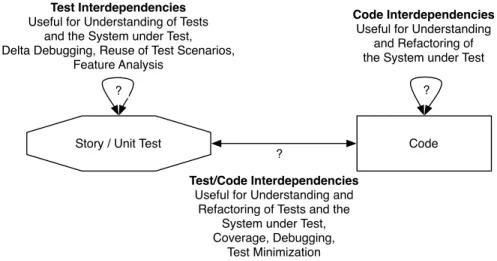
In the rest of this chapter we take a detailed look at all possible interdependencies of agile conceptsas shown in Figure 2.4 (p.15) and the problems of comprehensibility and local testability arising from the fact, that they are implicit. We will discuss the current approaches dealing with these problems in the appropriate chapters.
2.3
Problems of Implicit Test Interdependencies
We motivate the problems arising from implicit test interdependencies by introducing the canonical example of a bank account as depicted in Figure 2.6 (p.17). Typical user stories here areCreate Bank,Create an account, Deposit money andWithdraw money.
2.3. PROBLEMS OF IMPLICIT TEST INTERDEPENDENCIES 15
Code Story / Unit Test
?
? ?
Test/Code Interdependencies Useful for Understanding and Refactoring of Tests and the
System under Test, Coverage, Debugging,
Test Minimization
Code Interdependencies Useful for Understanding
and Refactoring of the System under Test Test Interdependencies
Useful for Understanding of Tests and the System under Test, Delta Debugging, Reuse of Test Scenarios,
Feature Analysis
Figure 2.4: A transitive reduction of all possible interdependencies between agile concepts. None of these interdependencies is explicit, which causes problems in understandability of the con-cepts.
The order of the stories defines the prerequisite relationing –e.g.,an account must exist before money can be deposited, similarly the money is withdrawn only after the money has been deposited. To better understand this example which will follow us throughout this thesis, we show the code containing an implementation of this example in Smalltalk in Figure2.5(p.16).
2.3.1
Creating test scenarios is time-consuming and complex
More than 50% of the effort of writing tests is spent writing the test scenarios ([Zeller, 2005]). Whereas it is easy to develop low level unit tests, which use only scalar data types such as numbers or strings, the higher the level of the class under test, the more complex it gets to create appropriate scenarios. Creating instances of the required input parameters is more complex, as these parameters depend recursively on other objects in the object net.
Example. Consider as an example the Account » withdrawmethod in the bank account as seen in Figure2.6(p.17). To test this method it is necessary to first create a bank and
an account which already has money deposited on it. Having no instances ready for use in complex tests is the main reason why writing tests of high level objects is such a time-consuming task.
Object subclass: #Bank.Model.Bank instanceVariableNames: 'accounts' classVariableNames:'' poolDictionaries: '' category: 'Bank.Model' Bank.Model.Bank>>initialize accounts := Dictionary new. ^self
Bank.Model.Bank>>accounts ^accounts values
Bank.Model.Bank>>accountNumbered: aNumber ^accounts at: aNumber
Object subclass: #Bank.Model.Account instanceVariableNames: 'balance number' classVariableNames:''
poolDictionaries:'' category: 'Bank.Model'
Bank.Model.Account class>>numbered: aNumber ^self new initializeFor: aNumber
Bank.Model.Account>>balance ^balance
Bank.Model.Account>>withdraw: someAmount self assert: [self canWithdraw: someAmount]. balance := balance - someAmount
Kernel-Classes.Behavior(Bank class)>>new ^self basicNew initialize
Bank.Model.Bank>>createAccount: aNumber |anAccount|
self assert: [(self includesAccount: aNumber) not]. anAccount := Account numbered: aNumber. accounts at: aNumber put: anAccount. ^self Bank.Model.Bank>>includesAccount: aNumber ^accounts includesKey: aNumber
Kernel-Classes.Behavior(Account class)>>new ^self basicNew initialize
Bank.Model.Account>>initializeFor: aNumber number := aNumber. ^self Bank.Model.Account>>deposit: someAmount balance := balance + someAmount
Bank.Model.Account>>number ^number
Bank.Model.Account>>canWithdraw: someAmount ^balance >= someAmount
Bank.Tests.TestCase subclass: #Bank.Tests.AccountTest instanceVariableNames: 'bank account'
classVariableNames: '' poolDictionaries: '' category: 'Bank'
Bank.Tests.AccountTest>>testDeposit account deposit: 100.
self assert: account balance = 100.
Bank.Tests.AccountTest>>testAccount1234Exists self should:[bank createAccount: 1234] raise: Exception Bank.Tests.AccountTest>>testDepositAndWithdrawAll account deposit: 100. account withdraw: 100. self assert: account balance =0.
Bank.Tests.AccountTest>>setup bank := Bank new createAccount: 1234.
"Developers do put assertions in the setup" self assert: bank accounts isEmpty.
account := bank accountNumbered: 1234
Bank.Tests.AccountTest>>testWithdraw account deposit: 80.
account withdraw: 30.
self assert: account balance = 50.
Bank.Tests.AccountTest>>testWithdrawTooMuch self account deposit: 80.
self
should:[account withdraw: 100] raise: Exception
Figure 2.5: The canonical bank account in Smalltalk and some typical SUnit tests for it. Bank.Model.Bank denotes the class Bank within a package called Bank.Model.
2.3. PROBLEMS OF IMPLICIT TEST INTERDEPENDENCIES 17 Bank Admin Bank Customer Developer Storytest:
Withdraw money from account with enough money Storytest:
Withdraw money from account with not enough money
Storytest: Deposit money on account
Storytest: Create an account Storytest:
Create an account although account already exists
Unit Test: Create a bank. Code: Account>> withdraw: someMoney Code: Account>> deposit: someMoney Code: Bank>> createAccount: aNumber Code:
Bank class >> new
? ? ? ? ? (Unknown link between tests) ? ? (Unknown link between tests and code) ? ? ? ? ? <uses> <uses> <uses> <uses> <uses>
Figure 2.6: The canonical bank account: The bank customer can deposit and withdraw money, the bank admin can create an account, but for doing so a bank object must be created first. The relations between these concepts are not reflected in the system which hinders its comprehensi-bility and thus its evolvacomprehensi-bility.
2.3.2
Understanding the interplay of a system is hard
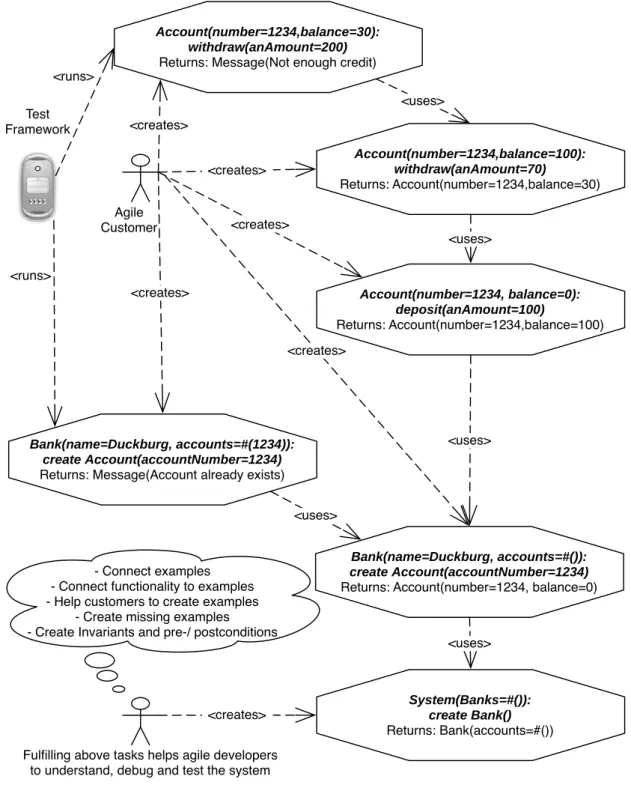
User stories only make sense in the context of the other user stories which either are required by or depend on them – and thus the according storytests also only make sense in the context of other tests: Dependency graphs as seen in Figure2.7(p.19)would help
developers to understand the functionality and their according tests in context.
It is possible to build these kind of dependency graphs using a technique called gui ripping as described by Memonet al. [Memonet al., 2003] but this technique requires user interaction with the system. To our knowledge there is no way to automatically infer them out of the running systems. These graphs are easy to create if the interde-pendencies of the test were explicit.
We take the perspective that unit tests describe low level use cases: Each functionality a developer has to write can be seen as a use case, though often a technical one. Be it connecting to a database, filtering some data or processing it somehow, none of these functionalities are treated different in the mind of a programmer to a high-level function-ality like transferring money from one account to another, which just gets decomposed into smaller unit cases.
These arguments above apply also to the viewpoint of the developer writing unit tests: To understand a certain functionality developers need to put this functionality into context of all prerequisite functionalities. If they write or read functionalities, writing or reading the unit tests for the required functionalities helps them not only to create test scenarios but also to understand the context this functionality is living in.
Example. If developers of a bank system were able to have a glance at anautomatically generated dependency graph as seen in Figure2.7 (p.19)where the test interdependen-cies of the system are show together with the interdependeninterdependen-cies of the functionality using concrete examples, they could directly infer thate.g.,one needs to deposit money into an account before being able to withdraw money from it.
2.3.3
Testing time is unnecessarily long
Having a set of storytests which are only implicitly calling each other tempts the devel-opers to recreate test scenarios for each of them, although smaller storytests already provide the fixture to be used by other tests. This may lead to unnecessary long testing times.
Example. In the case of our example bank system a bank has to be created before being able to create an account on it (Figure2.6(p.17)). Writing two independent storytests for this clearly leads to an unnecessary increase of testing time as opposed to a cascading
2.3. PROBLEMS OF IMPLICIT TEST INTERDEPENDENCIES 19
Account(number=1234,balance=30): withdraw(anAmount=200)
Returns: Message(Not enough credit)
Account(number=1234,balance=100): withdraw(anAmount=70) Returns: Account(number=1234,balance=30) Account(number=1234, balance=0): deposit(anAmount=100) Returns: Account(number=1234,balance=100) Bank(name=Duckburg, accounts=#(1234)): create Account(accountNumber=1234)
Returns: Message(Account already exists)
System(Banks=#()): create Bank()
Returns: Bank(accounts=#())
Bank(name=Duckburg, accounts=#()): create Account(accountNumber=1234)
Returns: Account(number=1234, balance=0) <uses> <uses> <uses> <uses> <uses> <creates> <creates> <creates> Agile Customer <creates> <creates> Test Framework
Fulfilling above tasks helps agile developers to understand, debug and test the system
<creates> <runs>
<runs>
- Connect examples - Connect functionality to examples - Help customers to create examples
- Create missing examples - Create Invariants and pre-/ postconditions
Figure 2.7: The canonical bank account described in an example notation. The additional tasks for agile developers who take this point of view are depicted. We will show in the rest of this thesis, that fulfilling these task can be easily integrated in current development styles.
style where the quality assured bank object can be reused for further test scenarios. (See Figure2.5(p.16)).
T esttimeindependent=createBankT estt+createBankF ixturet+createAccountT estt> T esttimecascading=createBankT estt+createAccountT estt
(2.1)
2.3.4
The problem of identifying relevant tests in the case of a
fail-ure
One fault can cause several unit tests to break, so developers do not know which of the broken unit tests gives them the most specific debugging context and should be examined first.
Example. Suppose the developer accidently changes addition into subtraction in the
Account » deposit: someMoney method. (See Figure2.5 (p.16)) Clearly the according test
AccountTest » testDepositwill fail. But this will not be the only test failing! To withdraw money, one first has to deposit money, accordingly the correctness of the Account » deposit: someMoneymethod is a prerequisite for testing the correctness of theAccount » withdraw: someMoneymethod. Otherwise the tester will assume an initial balance of the account of 80 to withdraw from, whereas is actually has a balance of -80 leading to a result of -110 – and not of 50 as expected. In our trivial example it is clear which of these failing tests should be attacked first. But facing a more complex domain, which the developers possibly have not built themselves, they might be misled and try to fix a test first, which is testing a perfectly well functioning method. Thus would lead to an unnecessary proliferation of debugging time.
2.3.5
The problem of detecting similar tests
Developers are free to write one test which tests a unit under several circumstances, or, as an alternative, to write several tests, each focusing on the same unit but in several scenarios. Developers who are reading these tests though are interested, if there are other tests which focus on the same unit, but they only can detect them by reading code and relying on brittle naming conventions. If a refactoring of code and tests becomes necessary, it is desirable to present the developers all related tests automatically. Example. In our example the testsAccountTest » testWithdrawTooMuch andAccountTest » testWithdrawrepresent two tests focusing on the same unit under test: Whereas the first
2.4. PROBLEMS OF IMPLICIT TEST / CODE INTERDEPENDENCIES 21
is testing the boundary condition, the second one is testing the default case. It is only the brittle naming conventions and the fact that they are residing in the same test class which connects those two siblings.
2.4
Problems of Implicit Test / Code Interdependencies
Developers have written all kinds of unit tests using xUnit: some of them focus on one method, sometimes testing it in one and sometimes in several scenarios, some of them focus on several methods at the same time, some of them assure, that the method under test throws an exception if used in a wrong context, and some of them just call a method under test without checking its outcome.
As a consequence, tests are not only related implicitly to other tests as explained be-fore, but also to their units under test. In the following we describe several problems arising out of the fact, that the relationships between tests and their unit under test are implicit.
2.4.1
Understanding the focus and the kind of a test is hard
Developers who are reading unit tests not only have to decrypt the focus of the test in order to understand what functionality the test is testing, but also the type of the test in order to understand to what degree it is testing the functionality. Typical questions the developers have to ask themselves include:
— Are the called methods in the test independent from each other as the test tests several independent aspects of a unit under test?
— Or is each method call required to successfully call later methods in the test?
— Is the test checking if the unit under test is working correctly after some valid input state has been established?
— Or is it ensuring, that the unit under test fails correctly, if its precondition is violated? This is cumbersome, time consuming and could be avoided by making both the unit under test and the type of the test explicit in a meta-model.
To detect the focus of a unit test, one must understand what unit the unit test is focussing on. Is it a method, a bunch of methods, a class, or a bunch of classes? Currently the only name developers have to describe a unit test besides “developer test” is “unit test” itself, adding much to the confusion in this area. Using names like “unit”,
“thing”, “entity” is a bad sign in object-oriented programs and means that the “unit” is not yet well understood.
Like design-patterns [Gamma et al., 1995] allow developers to spot, communicate and reuse recurring solutions for recurring design problems, a well based nomenclature and description of the several kinds of unit tests should help developers to understand existing test suites. Having established such a terminology one could also encode the kind of unit test explicitly in the unit test itself. This is impossible without having a meta-model for unit tests.
The only hints of the xUnit framework for detecting the unit under test is the naming convention of the test classes and methods, which often implies the signature of the method under test. But this naming convention is brittle, as it is not stable to refac-torings like renaming the method under test or changing the contents of a test. Van Deursenet al. [Deursen and Moonen, 2002] explore the relationships between testing and refactoring. They suggest that refactoring of the code should be followed by refac-toring of the tests. Many of these dependent test refacrefac-torings could be automated or at least made easier, if the exact relationships between the unit tests and their methods under test would be known.
Example. Is the test AccountTest » testWithdrawTooMuchin Figure2.5 (p.16) testing both
Account » deposit:andAccount » withdraw:? Though the name of the test implies the latter, developers are free to test the former one also by inserting some assertions after calling
Account » deposit.
Developers have to imply that this test is bound to succeed if it’s call to it’s method under test fails. They can do so by either looking at the exception catching mechanism or by reading the name of the test. Though it is a small mental step to do so, it still takes time to read the test. Developers cannot yet rely on asummarywhich implies that this test (1) serves as a bad example by ensuring that a functionality breaks accordingly if called in a wrong situation, and (2) focuses onAccount » withdraw:.
2.4.2
The problem of separating good examples from less
appropri-ate ones
Beck points out the value of unit tests as documentation of their units under tests [Beck, 2003] but how can a unit test document a unit, if the relationship between the unit test and the unit under test is implicit? The only relationship between the unit test and a unit under test a developer using the xUnit framework can detect right now, is if the xUnit test calls a given method. The reader of the test has to bring in lots of contextual knowledge to decide, whether the test is using a given method only to setup a scenario,
2.4. PROBLEMS OF IMPLICIT TEST / CODE INTERDEPENDENCIES 23
if it is used for checking a desired state an object should be in, if it is used to clean up the test scenario, or if – indeed – it is the method which is in the focus of the test. Wittgenstein [Wittgenstein, 1953] and Lakoff [Lakoff, 1990] argue, that not all examples are equal – it depends on the context, if a given example is a good example or not. It would be a bad idea to explain a child the concept of a bird using a penguin as a first example. Only after the child has some knowledge about typical bird-examples like sea-gulls, eagles and pigeons, one might want to introduce the example of a penguin as a typical non-flying bird.
Example. For understanding the functionality ofAccount » deposit:the developer should be pointed first to the test(s) focusing on this functionality, which would beAccountTest » testDeposit:. Certainly the developer should be also able to see how this functionality is used in different contexts as like inAccountTest » testWithdraw:orAccountTest » testWith-drawTooMuch: but pointing the developer first to a classic example of this functionality before pointing to some derived functionalities speeds up the process of comprehen-sion.
2.4.3
The problem from separating tidy from untidy examples
We say that an example istidy if its execution does not create any left-overs like open windows or changed global state. Currently developers do not make a distinction be-tween tidy and untidy examples. Though it is useful to have untidy examples in order to open application in an exemplified context and thus to understand them, these untidy examples are neither composable nor can they be easily executed automatically.Example. Imagine the following code snippet: Account classeditAccount1234
Bank exampleAccount1234 openInWorld
The above would be an untidy example as it would leave open a window showing the account in action whereasBank classexampleAccount1234 would be a tidy example which could be used for testing purposes.
2.4.4
The problem of keeping the tests and the code synchronized
Saff et al. [Saff and Ernst, 2003] suggest to continuously run all unit tests in the background, so that the developers do not have to run them explicitly. On the one hand this still leaves lots of functionality uncovered as it is not known if a method is covered by a test at all. On the other hand this brute force algorithm spends lots of unnecessary cycles to check unchanged functionality.If methods were explicitly connected to their executing tests, one could only rerun those: Also Winger suggests to connect methods and tests via pragmas in VisualWorks Smalltalk, so that after a changed method has been saved, the according test can be run automatically [Winger, 2004].
On the other hand, test cases can be changed, too. As soon as a test is added, changed or deleted the relevant code under test should be exercised in order to assess if the code coverage stays the same and if the code complies with the current set of tests.
Test-driven development as introduced by Beck [Beck, 2003] suggests to first write a unit test and then to write the method(s) to implement this unit test. Thus the first test-driven session to implement some methods can be seen as a debugging session: The task of the developer is to enhance the method in a such a way, that the former failing unit test focusing on this method does not fail any more.
Example. Changing the functionality ofAccount » depositshould trigger all tests which call Account » deposit – directly or indirectly. These would be: AccountTest » testDeposit,
AccountTest » testWithdrawandAccountTest » testWithdrawTooMuch.
2.4.5
The problem of seeing a method in a debugger
One classic way to debug and understand some methods is to insert a breakpoint into them and then to hope to know an executable entry point or command which would trigger this breakpoint during its execution. Squeak developers recently introduced a
debug item into the classicaldo it, print it, inspect itdialog with which any command can be inspected in action in a debugger. But as long as there is no explicit knowledge about which tests execute which methods along the way, thisdebug menu item cannot be included into the context menu of any method. As a consequence developers have a hard time to seeany method within the debugger. Not being able to see a method in the debugger requires developers to understand methods in an abstract way,e.g.,they often have to guess the actual callers of a possibly polymorphic method in a special use case and cannot step through its actual concrete behavior.
2.5
Problems of Implicit Code Interdependencies:
Typ-ing
Test-driven developers using a dynamically typed programming language only provide the types of the parametersimplicitly. In theory a program could detect the types for all variables of all classes instantiated by the tests and also the types of parameters and
2.6. RELATED WORK 25
return values of all methods executed by the tests. But to our knowledge no tool exists until today to exploit tests in the context of dynamically typed languages to also infer the concrete types for those entities mentioned above.
Test-driven developers using a statically typed programming language have to provide the type6 of variables and parameters twice – once explicitly when they define the class or method – and once implicitly when they provide concrete parameters and fill the instance variables in order to set up the test scenarios.
We believe that the reason for this is that there exists no meta-model for unit tests which makes it impossible to exploit unit tests for providing the type information of their units under test although all the necessary information is just lying there waiting to be picked up: If we connect a unit test with alls methods executed by it in an explicit way, not only the parameters of these methods can be exemplified and thus also concretely typed, also the type of the return value of these methods can be deduced, as at least one concrete value could be computed along the way when the test gets executed.
As test coverage in current systems is rarely 100%, the approach of using dynamic information for typing has not been followed yet – but with the rise of test-driven de-velopment one could easily imagine check in policies that would only allow methods to be stored which are actually covered by at least one repeatable command. The same reasoning applies for the storage of classes: A class-definition could only be checked into the code-repository if there is at least one way to create an instance of this class – or in the case of abstract classes one of its concrete subclasses –, where all its variables are initialized with a concrete object.
2.6
Related Work
Examples are heavily used in all fields of education such as mathematics where Mason et al. find that examples help students to stay focused on the problem at hand [Mason John H., 2001]. Watsonet al. point out the effectiveness of student-generated examples as a teaching tool in [Watson Anne, 2002]. They examine the roles played by examples constructed and generated by students, illustrate and analyze the use of this tool, and develop a theory for the act of exemplification as an act of cognition.
Examples are used for learning programming: Andersonet al. describe in [Andersonet al., 1984] an example-based model of instruction, with practice and feedback to help abstract from the examples. They suggest that students have heuristics that help them generalize from examples to idioms. Problem solutions are learned and reused when 6Withtypingwe mean specifying the concrete types of variables, parameters and return values at