Social Work
Practices: Report
of the National
Evaluation
Nicky Stanley, Helen Austerberry,
Andy Bilson, Nicola Farrelly,
Katrina Hargreaves, Katie Hollingworth,
Shereen Hussein, Anne Ingold,
Cath Larkins, Jill Manthorpe,
Julie Ridley & Vicki Strange
University of Central Lancashire
Institute of Education
This research report was commissioned before the new UK Government took office on 11 May 2010. As a result the content may not reflect current
Government policy and may make reference to the Department for Children, Schools and Families (DCSF) which has now been replaced by the Department for Education (DfE).
The views expressed in this report are the authors‟ and do not necessarily reflect those of the Department for Education.
Acknowledgments
We are grateful to all children, young people, parents, carers and practitioners who have assisted with this research as participants and respondents as well as to those who have facilitated data collection in the pilot and comparison sites and at national levels. We thank Department for Education staff and members of the Evaluation Advisory Group for their support.
The design above was contributed by young people from the evaluation‟s Young People‟s Advisory Group.
Contents
Evaluation of Social Work Practices: Executive Summary ... i
Introduction ... 1
The Background ... 1
The Evaluation ... 4
Aims and Methodology
... 4
Constructing Samples and Collecting Data
... 5
Analysis ... 9
Limitations ... 9
The Changing Context of the Evaluation ... 10
Report Coverage ... 11
Chapter 1 –SWP Pilot Commissioning and Start-up ... 12
1.1 Commissioning SWPs ... 12
1.1.1 Local Authorities‟ Commissioning Processes ... 12
1.1.2 Developing Bids ... 14
1.1.3 Payment by Results ... 15
1.1.4 Selecting a Successful SWP Bid ... 15
1.2 SWP Start-Up ... 17
1.2.1 Staff Transfer and Recruitment ... 17
1.2.2 Size, Complexity and Location of Cohort ... 18
1.2.3 Transferring the Cohort ... 19
1.2.4 Children‟s and Young People‟s Choices about Transfer ... 20
1.2.5 Parents‟ Choices about Transfer ... 23
1.2.6 Transferring Case Files ... 23
1.3. SWP Offices and Equipment ... 24
Chapter 1 Summary Points ... 25
Chapter 2 - The SWP Pilots in Operation ... 27
2.1 Pilot Staff ... 27
2.1.1 Key Characteristics of the SWP Workforce ... 27
2.1.2 Staff Views on SWP Ethos ... 31
2.2 In-house SWP ... 34
2.2.1 Benefits and Challenges of being In-house ... 35
2.3.1 Advantages and Disadvantages of Flatter Management Structure and Staff
Involvement in Decision Making ... 36
2.3.2 Financial Decision Making ... 38
2.4 Advantages and Challenges of Devolving Budget Responsibilities to Front-line Staff
... 39
2.4.1 Multi-disciplinary Teams ... 39
2.4.2 Small Teams ... 40
2.4.3 A Personalised, Flexible Service ... 41
2.4.4 Advantages and Disadvantages of Offering a Personal, Flexible and Accessible
Service ... 42
2.4.5 Reducing Bureaucracy and Paperwork ... 42
2.5 Support for the Pilots ... 44
2.6 Children‟s and Young People‟s Participation in the Pilots ... 45
2.6.1 Children‟s and Young People‟s Understanding of SWPs ... 46
2.6.2 Young People, Participation and Governance ... 47
2.7 Future of the Pilots ... 51
Chapter 2 Summary Points ... 52
Chapter 3 - Other Perspectives on SWP Operations ... 54
3.1 Other Professionals‟ Perspectives... 54
3.1.1 Other Professionals‟ Understandings of the Pilots ... 54
3.1.2 SWP Practice and Planning ... 54
3.1.3 Implementation of Plans ... 55
3.1.4 Quality of Direct Work with Children and Families ... 55
3.1.5 Stability, Accessibility and Communication ... 57
3.1.6 Impact of SWPs on Local Authorities and Other Agencies ... 58
3.1.7 Perceptions of Children‟s and Young People‟s Satisfaction with SWPs ... 59
3.1.8 Summary of Other Professionals‟ Perspectives ... 59
3.2 IRO Perceptions ... 59
3.2.1 Children‟s and Young People‟s Attendance and Participation in Reviews ... 60
3.2.2 Implementation and Follow-Up of Plans ... 60
3.2.3 IRO Views of Direct work with Children and Young People, Families and Carers
... 61
3.2.4 IRO Perceptions of Continuity and Stability ... 61
3.2.5 IRO Perceptions of Accessibility of Social Workers ... 62
3.3 Local Authority Commissioners‟ Perspectives on the Pilots ... 63
3.3.1 Identified Benefits ... 63
3.3.2 Identified Risks ... 64
3.3.3 Pilot Finances ... 65
3.3.4 Impact of SWPs on Children‟s Services ... 65
3.3.5 Impact on Commissioning ... 66
3.3.6 Future Prospects for SWPs ... 67
3.4 Care Planning and Reviews ... 67
3.4.1 Extent to which Plans were in Place ... 68
3.4.2 Children‟s and Young People‟s Awareness of and Involvement in Care Planning
and Reviews ... 68
3.4.3 Involvement of Others in Care Plans and Reviews ... 70
3.4.4 Changes in Care Plans ... 71
3.4.5 Summary of Care Planning and Reviews ... 72
Chapter 3 Summary Points ... 72
Chapter 4 - Children‟s and Young People‟s Views and Experiences ... 75
4.1 Perceptions of Allocated Workers ... 76
4.1.1 Continuity and Transition ... 76
4.1.2 Accessibility and Responsiveness ... 76
4.1.3 Out-of-hours and Holidays ... 79
4.1.4 Quality of Relationship ... 80
4.2 Knowing the Offices and Other Staff ... 82
4.3 Safety and Support ... 83
4.4 Contact with Family ... 86
4.5 Placements and Accommodation ... 88
4.6 Speed of Decision Making ... 90
4.7 Overview of Children‟s and Young People‟s Views and Experiences ... 91
Chapter 4 Summary Points ... 91
Chapter 5 - Parents‟ Perceptions and Experiences ... 93
5.1 Parent Characteristics ... 93
5.2 Information about the Pilot ... 93
5.3 Continuity and transition ... 94
5.4 Perceptions of Allocated Workers ... 94
5.4.1 Accessibility and Responsiveness ... 94
5.5 SWP Offices and Other Staff ... 97
5.6 Relationships with Carers ... 98
5.7 Contact ... 99
5.8 Levels of Support ... 100
5.9 Involvement and Engagement in Decision Making ... 102
5.9.1 Disagreements with Social Workers ... 102
5.9.2 Involvement in Reviews ... 102
5.9.3 Comparison with Previous Experiences of Involvement in Decision Making .. 103
5.10 Overview of Parents‟ Perceptions and Experiences ... 103
Chapter 5 Summary Points ... 104
Chapter 6 - SWP Impact on Carers ... 105
6.1 Survey Response Rates ... 105
6.1.1 Demographic Characteristics of Carers and Children at Time 1 ... 107
6.1.2 Demographic Characteristics of Carers and Children at Time 2 ... 108
6.2 Analysis of Survey Data ... 112
6.2.1 Survey Results ... 112
Chapter 6 Summary Points ... 119
Chapter 7 - Impact on the Workforce ... 120
7.1 Participants‟ Profiles ... 120
7.2 Expectations of SWPs ... 121
7.3 Time Expenditure ... 121
7.4 Perceived Workloads ... 123
7.5 Views on Quality of Care and Relationships ... 124
7.6 Views on Staff Autonomy, Participation and Support ... 125
7.7 Job Satisfaction, Job Content, and Burnout Levels ... 127
7.7.1 Job Satisfaction ... 127
7.7.2 Karasek Job Content Questionnaire (JCQ) ... 127
7.7.3 JCQ: Psychological Job Demand ... 129
7.7.4 JCQ: Job insecurity ... 130
7.7.5 Maslach Burnout Inventory (MBI) ... 131
7.7.6 Emotional Exhaustion (EE) ... 132
7.7.7 Depersonalisation (Dp) ... 132
7.7.8 Personal Accomplishment (PA) ... 132
Chapter 7 Summary Points ... 134
Chapter 8 - Conclusions and Key Messages ... 135
8.1 Organisational Issues ... 136
8.1.1 The Role of the Local Authority ... 136
8.1.2 Commissioning SWPs ... 136
8.1.3 The Professional Partnership Model ... 136
8.1.4 SWP Finances ... 137
8.1.5 Payment by Results ... 137
8.1.6 Round-the-Clock Services ... 137
8.1.7 Small is Beautiful but Risky... 137
8.1.8 Time Allocation and Caseload Size ... 138
8.1.9 Interprofessional Work ... 138
8.2 Impact of SWP Pilots on Children and Young People, their Parents and Carers . 139
8.2.1 Choosing SWPs ... 139
8.2.2 Continuity and Consistency ... 139
8.2.3 A More Responsive Service?... 139
8.2.4 Contact and Birth Families ... 140
8.2.5 Children‟s Participation ... 140
8.2.6 User-friendly Buildings ... 140
8.3 Impact of SWPs on Carers ... 141
8.4 Impact of SWPs on the Workforce ... 141
References ... 144
Appendix 1 - Evaluation Advisory Group to the Social Work Practices Evaluation ... 149
Appendix 2 - Interview Schedule for Children and Young People – Time 1 ... 150
Appendix 3 - Practitioners Survey ... 160
Appendix 4 - The Characteristics of Children and their Outcomes in Pilot, Host and
Comparison sites: Using SSDA903 Data ... 171
Appendix 5 - Account of Statistical Analysis of Carers Survey ... 198
i
Evaluation of Social Work Practices: Executive Summary
Nicky Stanley, Helen Austerberry, Andy Bilson, Nicola Farrelly, Katrina Hargreaves, Katie Hollingworth, Shereen Hussein, Anne Ingold, Cath Larkins, Jill Manthorpe, Julie Ridley and Vicky Strange
The Social Work Practice Pilots
Five social work practice (SWP) pilots started up in England between December 2009 and May 2010. These independent organisations were commissioned by local authorities to provide services for looked after children and care leavers. The pilots were introduced to discover whether smaller social work-led organisations independent of local authorities could improve the morale and retention of social workers and bring decision making closer to front-line practice. These changes were expected to deliver increased consistency and stability of care for looked after children and care leavers. The pilots have differed substantially in their organisational forms and their origins and in the numbers and profiles of looked after children and young people they support (the Cohort). The SWPs comprised:
SWP A An in-house SWP which has remained within the local authority as a separate and discrete unit. Cohort of 180 young people aged 14-21.
SWP B
A professional practice run as a private company by an organisation that already delivered social care training. Cohort of 80 children and young people aged 8-17 with high levels of need.
SWP C A voluntary organisation already providing the local authority‟s care leaving service. Taking on the attributes of an SWP was a gradual process for an already established service. Cohort of 582 young people aged 16-24 at start-up (increased to 727 by Nov 2011).
SWP D
An SWP run by a voluntary organisation with a long history of providing services for local authorities. The SWP was a new venture for this organisation and staff were recruited specifically to this service. Cohort of 120 children and young people aged 0-17.
SWP F
A professional practice run as a social enterprise established by a group of social work practitioners who formerly worked for the host local authority and who moved out to form the SWP, taking with them responsibility for many of the children with whom they already worked. Cohort of 148 children and young people aged 8 and above.A sixth pilot failed to start as the local authority was diverted by an Ofsted inspection report that required it to focus on its core functions. At May 2012, three pilots looked set to continue until at least 2013 when contracts for those outside the local authority come up for renewal. However, two of the pilots had learnt that the local authorities would not be renewing their contracts and plans for returning these children and young people to the care of the local authorities were in place.
The Evaluation
An independent evaluation was commissioned by the Department for Education (formerly the Department for Children, Schools and Families) to:
ii
1. analyse the advantages and disadvantages of the overall Social Work Practice concept, and the specific benefits (or otherwise) of the different models employed and any lessons for alternate models;
2. identify the impact of SWP pilots on children, their carers and their families; 3. discover the impact of the SWP model on the children's social care workforce; 4. identify the impact of SWP pilots on statutory child care social work in the host
local authorities and on the work of other agencies.
The evaluation employed a matched control design with integral process evaluation; the local authorities piloting SWPs were matched with six carefully selected comparison sites. A wide range of data has been collected and brought together for analysis including:
225 interviews with looked after children and care leavers – 121 children and young people were interviewed from the pilots (56 were interviewed twice) and 48 from comparison sites.
31 interviews with SWP Staff (in 2010 and 2011; 12 were interviewed twice), interviews with 7 SWP Project Officers, 10 Local Authority Commissioners and 13 interviews with members of the SWP Evaluation Advisory Group (EAG).
Interviews with 11 young people involved in SWP governance at different points in time. Interviews with 19 birth parents of children and young people looked after by SWPs. Interviews with 22 professionals from a range of social, education and health care
agencies and with 21 Independent Reviewing Officers (IROs) in the five pilot sites. 45 care plans from pilots and comparison sites were analysed and compared. Data supplied by the pilots on their looked after children and workforce.
Analysis of data on key measures included in the DfE‟s SSDA903 returns for the pilot and comparison sites.
On-line baseline (1101 responses) and second (949 responses) surveys of local authority practitioners in the pilot and comparison sites
Carers‟ baseline (1,782 responses) and second (1,676 responses) postal surveys of foster carers, kin carers and managers of residential homes and supported lodgings across the pilot and comparison sites.
Key Findings
The evaluation has yielded mixed findings with stronger evidence in relation to some aspects of the pilots‟ work than in others. The views of stakeholders, such as IROs, other professionals, local authority commissioners and EAG members, as to whether the SWPs performed better than their local authority counterparts or whether they represented good value were divided. There were also variations found in perceptions of different pilots with some emerging as stronger performers than others.
Despite this variety, there is some evidence of positive change for children, parents, carers and the workforce that can be attributed to the pilots and this is highlighted below.
The Role of the Local Authority
“If you were to analyse all the Social Work Practices that are working very well it‟s because they have a good relationship with the local authority.” (SWP Staff Member) The partnership with the local authority was fundamental to the survival and achievements of the SWPs who were reliant on local authorities for a range of services, expertise and support.
iii
The in-house SWP, which was the pilot that was most dependent on the parent local authority, emerged as a viable model while the other pilots depended on the parent local authority for various key functions such as out-of-hours services, IT systems, rental of premises and equipment, training, supervision, legal services, access to psychological services for children and advice on complex cases and child protection issues. Reliance on the local authority constrained the autonomy of the pilots to differing extents: in particular, only one SWP had full control over the placement budget. In the light of this, it is difficult to see how SWPs would function were local authorities to move all their children‟s services out into SWPs as some local authorities are reportedly contemplating. In the case of such a scenario, some of the core functions and expertise of the local authorities essential for the success of SWPs would be lost. Commissioning SWPs
„They were just finding the process difficult in terms of the amount of work and when they actually got the tender document and saw what they had do to produce in terms of getting everything ready, they baulked at that…‟ (Project Manager)
Commissioning was experienced as an arduous process for all concerned despite the support provided by government appointed consultants. Small groups of social workers who came together to bid for a professional partnership were disadvantaged and dissuaded by the time required and their lack of business experience. Larger organisations with the infrastructure to support the bidding process fared better.
The Professional Partnership Model
The two pilots that were most frequently and consistently described as respectively successful and failing by stakeholders were both professional partnerships. That is, they were small organisations run by social workers themselves. However, the pilot that was consistently identified as successful was a social enterprise established by social workers moving out of the local authority and the other was a private profit-making company run by social workers who already operated a social care business. A key factor distinguishing these two pilots was the closeness and strength of the relationship with the relevant local authority.
SWP Finances
While this evaluation did not include a full cost-benefit analysis, local authority commissioners did not consider that the pilots had reduced costs and, in some cases, costs were considered to be higher than those of the equivalent in-house service. The impact of local government
spending cuts on SWPs was discernible in decisions to terminate contracts while higher numbers of looked after children led to demands for them to add to SWP numbers resulting in larger caseloads for some pilots in the second year.
Payment by Results (PBR)
This was a controversial aspect of the original SWP model that attracted considerable criticism. In the event, only two SWPs used it and this was in relation to savings on the placement budget rather than outcomes for LAC and care leavers. Only three local authorities monitored pilot outcomes for children and young people systematically and it therefore seems unlikely that pilot staff were motivated to deliver a higher quality service by a system of rewards, although in the two sites that used PBR there was an incentive to select cheaper placements.
Round-the-Clock Services
The requirement for SWPs to provide a round-the-clock service was identified as a disincentive for organisations bidding for pilots and impacted on the cost of the pilots. Only two sites were
iv
providing their own out-of-hours services by 2012. Children and young people reported making limited use of out-of-hours services and, when they did, this usually took the form of informal contact with their individual worker. It was notable that this informal out-of-hours contact also occurred in some comparison sites.
Small is Beautiful but Risky
„…even the receptionist lady, I can phone her up and she knows who I am, I can speak to her about anything.‟ (Parent)
In common with other studies, various benefits were associated with small size. Children, young people and parents valued the flexibility and accessibility of a small service where they were known to staff. Small size allowed SWP team members to acquire familiarity with one another‟s cases and was reported to facilitate decision-making. Other professionals also found it easier to „know‟ and collaborate with a small team.
However, the small size of the SWPs made for a reliance on individuals in key roles such as managers or administrators and acted to restrict pilots‟ autonomy with regard to finances since it was agreed that control of the volatile placement budget was too risky a proposition for a small organisation. Being a small venture also made SWPs risky for staff since reliance on a single contract made for threats to job security.
Time Allocation and Caseload Size
„Having a smaller caseload frees up me to work more directly with not only the young person but with foster carers, parents and other professionals.‟
(Practitioner, SWP)
SWP staff were more likely than staff in local authorities to consider that they spent the right amount of time in direct work with children and families and they explained this as a
consequence of smaller caseloads. Most (but not all) pilots were able to ensure that staff had caseloads of less than 18 and the practitioner survey found that pilot staff were more likely than other respondents to report having sufficient time for direct work with children, families and carers. Likewise, some professionals and parents described pilot staff as having more time to devote to direct work with children and families. An exclusive and concentrated focus on looked after children and young people also appeared helpful. With the exception of the in-house team, SWP staff did not take full responsibility for complex child protection cases.
Interprofessional Work
There was evidence from the analysis of care plans and from other professionals that the pilots worked well with a wide range of other professionals and agencies. In some cases, these relationships were fostered by having specialist staff such as mental health or Connexions workers located in the SWP teams.
Choosing SWPs
„They had no choice, we all had no choice, we had to move over.‟
(18 year old, female care leaver, SWP)
For many (but not all) the children and young people, the move to an SWP involved disruption in the form of a change of key worker. Most children and young people did not appear to have exercised choice in relation to transferring to the pilots and none of their parents were offered choices about the move. Children and young people had limited understanding of the role of SWPs although awareness was higher when staff had moved out of the local authority alongside the children and young people.
v
A small number of children and young people expressed anger about their lack of involvement in the decision and regarded the move to the pilot as yet another change that had been imposed on them. It is important that those children selected for inclusion in an SWP are fully consulted about the change, that the reasons are clearly explained to them individually and that their views are taken into account.
Continuity and Consistency
Interviews with children and young people suggested that pilot children were more likely to have experienced continuity of worker in the last year and staff turnover figures supplied by the pilots confirmed this picture for three of the smaller pilots. However, in the SWP which was larger and in the SWP where there were ongoing difficulties, staff turnover was higher.
Furthermore, as noted above, the move to SWPs involved a change of worker for the majority of the children and young people and a further change of key worker was anticipated for most of the children and young people in the two SWPs where contracts were ending in 2012.
Most of the SWPs were successful in reducing placement change rates for children and young people in their first year of operation. Interviews with children and young people indicated that age and suitability of placement were key factors contributing to placement change.
A More Responsive Service?
„…she'll always try and get that bit more if I need it for something, or if I ask for it, she always does.‟ (17-19 year old, male care leaver, SWP)
„she just, she goes out of her way like for people.‟
(17-19 year old, male care leaver, comparison site)
Children‟s and young people‟s accounts showed no differences between pilots and comparison sites in terms of allocated workers‟ accessibility and responsiveness. Most found it easy to contact their worker, although there were some differences between pilots. Likewise, there were no substantial differences found between SWPs and local authority teams regarding the quality of children‟s relationships with allocated workers or their satisfaction with support. Some staff in both types of service were described as „going the extra mile‟ in the provision of support. SWP staff considered that shared responsibility for decision making made for speedier
decisions and carers looking after SWP children were more likely than other carers to consider that the social worker had often been able to take key decisions in the previous six months. Children‟s perceptions of SWP staff decision making were mixed. While most references to instant or quicker decision making came from SWP children and young people, there were also slightly more comments about delays in decision making from pilot children and young people than from those in comparison sites.
Contact and Birth Families
„we chose what we wanted to do when we wanted contact and they all said it was our choice, and then they gave us some money and stuff so we could like do activities or whatever … they arranged like transport.‟
(18 year old, male care leaver, SWP)
In line with other research findings, contact with birth families emerged as a key preoccupation for children and young people and their parents. Some pilots adopted a particular focus on the needs of birth parents and the facilitation and support of contact. Carers were particularly positive about SWP staff‟s work with birth families in relation to some pilots.
vi
Parents valued staff who acknowledged their needs as well as those of their children and were more satisfied with contact arrangements when they were involved in making decisions about contact. Slightly more children and young people in SWPs were satisfied with arrangements for contact than in comparison sites, but levels of satisfaction varied considerably between pilots. Children’s Participation
“I‟m meeting lots of people, I‟m …meeting new people and new experience…” (17 year old, male care leaver, SWP)
Most children and young people had no or very limited understanding of the role and tasks of SWPs; awareness was higher among children and young people in SWP F where staff and children had moved to the pilot together. SWPs involved children and young people in a range of participation activities which contributed to their personal development and sometimes offered them opportunities to contribute to the service development. The young people concerned enjoyed these activities and felt they had an impact on their social skills, and sometimes on service delivery. Such participation was not unique to the SWPs as young people in the comparison sites reported participating in similar activities.
Analysis of care plans showed that most children were involved in reviews and there were some examples in both SWPs and comparison sites of innovative approaches to involving children in these meetings. Children and young people in SWP D were more likely to feel that their reviews had improved since joining the SWP.
User-friendly Buildings
„I just chill there and watch telly and like there‟s all these kids like, well not kids, like my age, playing pool‟ (14-16 year old, looked after girl, SWP)
Where a tightly-drawn catchment area made it viable for pilots to offer this, user-friendly
premises that provided space and resources that young people could drop in and use as well as facilities for active contact sessions were appreciated by children, young people and their families. Knowing and being „known‟ to other SWP staff gave children and families a stake in SWPs and contributed to a view of the pilots as accessible, personalised services; this perception was shared by IROs and other professionals. A central location was important as well as attractive décor and furnishings and offices that young people could access without encountering security barriers were particularly appreciated.
Impact of SWPs on Carers
Carers looking after SWP children were significantly more likely than carers looking after local authority children to view the support they received from their child‟s social worker positively. They also felt better supported by SWP staff in assisting children and young people in the areas of health, education or leisure activities.
Impact of SWPs on the Workforce
SWP staff participating in the practitioner survey reported feeling more positive about their work and were more likely to feel that they spent enough time in direct work with children, families and carers. They also scored lower on „depersonalisation‟ than staff from local authorities, an indication of higher morale. However, this difference was not found in relation to other aspects of job satisfaction such as staff satisfaction and decision latitude. SWP staff did however report higher levels of peer and supervisor support and this may be linked to their small size.
The survey findings also point to the risks of SWP staff experiencing job insecurity and this conflicts with an emphasis on continuity of support for looked after children and young people.
vii
Longer term contracts may be one solution and in-house SWPs offer another way forward; longer-term research would be helpful in this respect.
Key Messages for the Development of SWPs
SWP set-up and operation are facilitated by a trusting relationship between the local authority and the SWP providers. This could be promoted by sharing essential details concerning the nature of the proposed cohort as part of the tender process. The
development of a checklist detailing transfer requirements such as up-to-date case files and functioning IT systems would assist both local authorities and SWP providers. Implementation has seen considerable dilution or adaptation of the original theoretical
SWP model. Some controversial aspects of the original SWP model, such as payment by results and a round-the-clock service for looked after children, have not been consistently retained. Since these were the source of resistance and concerns about SWPs, continued insistence on their inclusion in the model seems inappropriate. It is important that those children selected for inclusion in an SWP are fully consulted
about the change and that their views are taken into account. Feelings of
disempowerment and dissatisfaction might be avoided by ensuring that the possible risks and benefits of a proposed move to an SWP are fully discussed with children and young people on an individual basis beforehand.
Key Messages for Services for Looked After Children and Young People
User-friendly buildings can play a role in eliciting higher levels of engagement from children and young people who live locally. Children and their families value being recognised and welcomed by staff; sharing information about cases within a social work team can facilitate this sense of being known to the organisation.
Small teams appear supportive and make for a flexible and personalised service. Co-locating specialist staff such as mental health workers in these teams promotes interagency communication and collaboration.
Reduced caseloads and an exclusive focus on looked after children both have the effect of freeing up time that can be used to improve the quality and focus of work with looked after children and young people and their families. Reduced caseloads also have a positive effect on staff morale.
A focus on contact and the needs of birth parents reflects the concerns of children and their families and contributes to satisfaction with the service. This does not necessarily mean increasing contact, but rather providing the practical and emotional support required to meet the difficulties that are associated with contact.
Summing Up
The achievements of the SWP pilots can be summarised as increased opportunities for direct work with children and young people; good quality support for carers and small integrated teams offering a personalised service and in some cases creative work with birth parents and/or the use of accessible and user-friendly premises. In most pilots, but not in all, a reduction in the rate of placement change was achieved. However, continuity of key worker was not consistently
viii
achieved, particularly since the contracted out nature of the service involved some children and young people experiencing disruption as a consequence of transfer both in and out of SWPs. The lack of information and choice children reported in relation to such changes was
concerning. Children and young people in SWPs did not appear to find staff more responsive or accessible than their counterparts in the comparison sites.
A number of confounding factors make it difficult to attribute positive outcomes solely to the SWP model. This is particularly the case given that the SWP model was implemented in diluted form with the dilution becoming more pronounced in some sites where numbers of children and young people increased during the life of the pilot. SWP staff and other stakeholders identified reduced caseloads as salient and the level of support from the local authority was found to be crucial in many respects. A tight remit and a clear focus on the looked after/care leaver
population without responsibility for child protection work also emerged as factors contributing to increased opportunities for direct work.
Although the SWP model‟s characteristics of a flattened hierarchy and staff involvement in decision making were unevenly implemented, this approach, together with higher levels of supervision, more opportunities for direct work and the sense of being a new and „special‟ project engendered by pilots appeared to contribute to SWP staff‟s positive perceptions.
However, higher levels of morale may have been offset by the increased risk of job insecurity in the context of a short term contracted out service.
1
Introduction
Social Work Practices (SWPs) have generated considerable comment and debate in England since their inception; this report is the first full evaluation of their implementation and impact covering the period December 2009 to March 2012. This introduction describes the background to the introduction of the pilot SWPs in England in 2009/10; outlines their key characteristics and describes the evaluation‟s aims and methods. The coverage of this report is identified for the reader.
The Background
Despite much attention in government policy to improving services for children who are looked after by local authorities, looked after children (LAC) in England continue to be at high risk of poor outcomes (Stein 2006, Dixon 2008). Compared with other young people, care leavers are more likely to be unemployed (Wade and Dixon 2006), to gain fewer qualifications, to
experience mental health problems (Meltzer et al. 2003), be imprisoned (Social Exclusion Unit 2002), and to become teenage parents (SCIE 2004). Government has acknowledged that progress towards improved outcomes for looked after children remains slow and has emphasised children‟s needs for continuity and consistency (Department for Education and Skills 2007) while research (Stanley et al. 2005; Stanley 2007; Unrau et al. 2008) has
highlighted the absence of continuity as a key factor contributing to the poor mental health and emotional needs of looked after children. The accessibility and availability of social workers have been identified as a key issue for both looked after children and their carers (Statham et al. 2006; Sinclair et al. 2004). Dickson et al.‟s (2009) review of studies that captured the views of looked after children themselves found that looked after children and young people wanted continuity in their relationships with social workers and valued professionals who took an interest in them and listened to them. Changes of social worker represent one sort of
disturbance, but changes of placement also characterise the experience of being looked after and affect children‟s lives at a fundamental level. Ward‟s (2009) longitudinal study showed that the majority of placement changes experienced by children in her sample were attributable to resource shortfalls and poor planning.
Garrett (2008) argues that characterisation of the looked after system as a „failing system‟ does not take account of the complexity and variety of experiences that the care system
encompasses. In this, he draws on the arguments of researchers such as Stein (2006) and Forrester et al. (2009) who have proposed that outcomes for different groups of looked after children need to be carefully differentiated and that outcomes for looked after children reflect the needs that bring them into the care system. A recent study of the reunification of children with their birth families (Wade et al. 2011) found that outcomes in respect of stability and well-being were better for those children who remained in care than for the matched group who returned home. It is also the case that while continuity of care has emerged as central to the quality of a wide range of health and social care organisations (Haggerty et al. 2003), it remains an elusive goal for many services.
The piloting of SWPs was first proposed in the Care Matters Green Paper (Department for Education and Skills 2006). SWPs were described in the Green Paper as autonomous organisations, similar to GP practices, which would contract with local authorities to provide services to looked after children. They could take a variety of organisational forms such as voluntary or community organisations, social enterprises or private businesses. The aim was for social workers to be freed from the restrictions of local authority procedures and high caseloads to enable them to focus their efforts and energies on looked after children. The
2
report of the working party chaired by academic and policy adviser, Professor Julian Le Grand (2007), provided the platform for the implementation of SWPs arguing that smaller social worker-led organisations, independent of local authorities, could improve the morale and retention of social workers and would bring decision making closer to front-line practice. These changes were expected to deliver a level of consistency and stability of care for looked after children and care leavers that had proved difficult to achieve (DfES 2007). However, as the report noted, the question of whether social workers in SWPs would have more „hands-on time for building relationships with looked after children, remains open‟ (Le Grand 2007: 24).The legislative framework for piloting SWPs was established by the Children and Young Persons Act 2008 under the New Labour Government. This legislation permitted local authorities to delegate their functions in relation to looked-after children and care leavers to SWPs although the
responsible local authority would continue to be the „corporate parent‟ for such children and young people. The Act allowed for SWPs to be piloted in a number of local authorities for a period lasting up to five years and required that they would be evaluated. Subject to the evaluation‟s findings, the power to delegate these functions might be extended to all local authorities.
The SWP pilots have proved controversial although services such as residential child care and independent fostering agencies have been outsourced for many years (Sellick 2011). This is because introducing SWPs entailed moving some aspects of the statutory roles and tasks of children‟s social workers outside the local authority into independent organisations. The
introduction of SWPs was described by critics as the privatisation of children‟s welfare services and the commodification of children (Cardy 2010; Garrett 2008). Questions were raised about whether the pilots would consult sufficiently with looked after children and their parents (Garrett 2008). Cardy (2010) suggested that practitioners might lack the business skills and knowledge to develop and run an independent SWP and queried whether enough attention had been paid to calculating costs and risks.
Six pilots were originally identified by the DCSF and five started up in 2009-10; this process is described in the following chapter. At the time of writing this report in March 2012, four of the original six SWP pilots were functioning as independent SWPs. One of the original six failed to start up as the local authority was diverted by an Ofsted (regulatory) report that required it to refocus on its core functions and which resulted in major restructuring of children‟s social care services in that authority. The start-up of the sixth SWP was delayed until May 2010 by the mode of governance proposed for the pilot which was considered to lack sufficient
independence from the local authority to meet the statutory framework for SWPs. The local authority subsequently decided to keep the pilot within its Children‟s Services department as a separate unit operating in accordance with SWP principles. A number of local circumstances appear to have contributed to this decision, including concerns about the potential risks for a small local authority of placing a substantial proportion of its Children‟s Services budget outside the local authority in a climate of public sector cuts.
At the time of writing, three of the five existing SWP pilots look set to continue until at least 2013 when contracts for those outside the local authority come up for renewal. However, two of the pilots have learnt that their contracts will not be renewed in 2012. In one site, there have been serious concerns about the performance of the pilot; in the other, financial considerations on the part of the local authority have resulted in the pilot functions and staff being taken back into the local authority‟s Children‟s Services department.
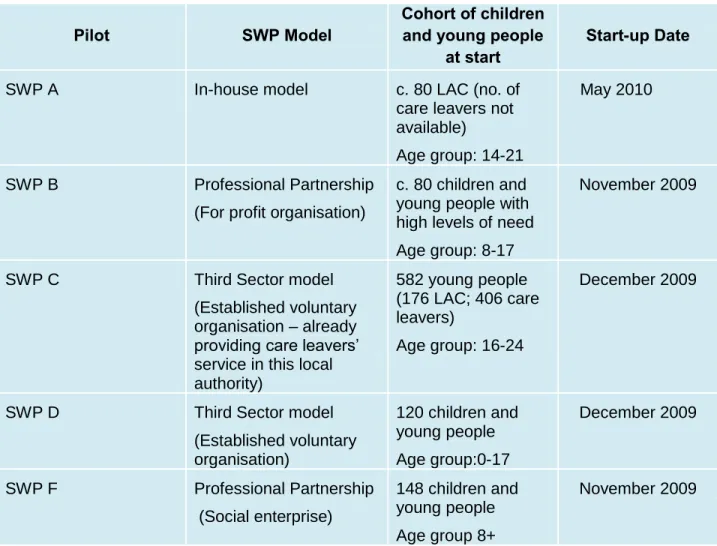
As shown in Table 1, the pilots differed substantially in their origins, their organisational forms and the groups of looked after children and young people with whom they worked. As noted above, SWP A has remained within the local authority as an in-house model. SWP F was a
3
professional partnership organised as a social enterprise. It was established by a group of social work practitioners who formerly worked for the host local authority and who moved into an SWP, together with many of the children they already worked with. SWP B was also a
professional partnership but was run as a private company by an organisation that also
delivered social care training. New staff were head-hunted and recruited to the SWP; none had been previously employed by the relevant local authority. SWP C was run by a large voluntary organisation which was already providing the local authority‟s care leaving service. Taking on the attributes of an SWP was a gradual process for this already established service. SWP D was run by a large voluntary organisation with a long history of providing services for the host local authority. However, this was a new venture for this organisation and staff were recruited specifically to this service.
Table 1 – The Five SWP Pilots at Start-Up
Pilot SWP Model Cohort of children and young people
at start Start-up Date
SWP A In-house model c. 80 LAC (no. of
care leavers not available)
Age group: 14-21
May 2010
SWP B Professional Partnership
(For profit organisation)
c. 80 children and young people with high levels of need Age group: 8-17
November 2009
SWP C Third Sector model
(Established voluntary organisation – already providing care leavers‟ service in this local authority) 582 young people (176 LAC; 406 care leavers) Age group: 16-24 December 2009
SWP D Third Sector model
(Established voluntary organisation) 120 children and young people Age group:0-17 December 2009 SWP F Professional Partnership (Social enterprise) 148 children and young people Age group 8+ November 2009
4
The Evaluation
Aims and Methodology
The evaluation was structured around four key aims:
1. To analyse the advantages and disadvantages of the overall Social Work Practice concept, and the specific benefits (or otherwise) of the different models employed and any lessons for alternate models;
2. To identify the impact of SWP pilots on children, their carers and their families; 3. To discover the impact of the SWP model on the children's social care workforce; 4. To identify the impact of SWP pilots on statutory child care social work in the host
local authorities and on the work of other agencies.
A matched control design with integral process evaluation has been employed; this is considered the most rigorous evaluation approach where a randomised control trial is not possible (Breslow 1996). Six local authorities1 were selected as comparison sites for the pilot sites according to a set of essential criteria supplemented by desirable criteria. These are described in the following section.
The matched control design provides a framework for examining both the processes of planning and implementing SWPs and delivering services to looked after children and the impact of SWPs on looked after children, their carers and families. The impact of SWPs on the children‟s social care workforce and on organisations, including the host local authorities and other local social care, education and health agencies, has also been examined. As Table 1 shows, there has been a high level of variation in the intervention evaluated and members of the Expert Advisory Group appointed by the DCSF (now the Department for Education (DfE)) to advise the evaluation team acknowledged the challenges this presented for the evaluation.
As recommended by Jowell‟s (2003) review of government pilots, a mixed methods approach has been adopted and this allows quantitative and qualitative data to complement and enhance one another. The evaluation captures a range of perspectives including the views of children and young people, families, carers, local authority social workers and SWP staff, as well as professionals working in other agencies. The methodology recognises the complexity of the question „what works?‟ (Pawson and Tilley 1997) and acknowledges the range of impacts which SWP pilots may have for diverse groups of stakeholders.
Ethical approval for the evaluation was provided by the Institute of Education‟s Research Ethics Committee and from research governance committees in local authorities. The Association of Directors of Children‟s Services Research Committee also positively reviewed the study. All those participating in the evaluation were provided with accessible information about the evaluation and its purposes and informed consent procedures were adopted. Looked after children, care leavers and birth parents were provided with gift vouchers to acknowledge their time and interest. Care has been taken to anonymise all participants in this report and data have been stored securely.
The evaluation aimed to ensure that the views of key stakeholders were fed into both the research design and the interpretation of findings. The study was advised by an Evaluation
1
5
Advisory Group (EAG) initially convened by the DCSF and subsequently supported by the DfE; its members are listed in Appendix 1. In addition, the evaluation held annual Stakeholders Workshops attended by representatives of the pilots; the local authorities hosting the pilots and the comparison sites. These workshops were run in parallel with a Young People‟s Advisory Group which has included looked after young people and care leavers from the pilots who commented on research tools and discussed emerging findings.
Constructing Samples and Collecting Data
Selecting Comparison SitesComparison sites for the pilot local authorities were selected using two sets of criteria agreed with the Evaluation Advisory Group. These comprised essential and key criteria and included:
Essential Criteria
1. General Demographic Criteria - the ratings accorded to local authorities in the Children's Services Statistical Neighbour Benching Marking Tool
(http://www.dcsf.gov.uk/rsgateway/DB/STA/t000712/index.shtml) which groups local authorities together according to socio-demographic criteria.
2. Key characteristics of the local looked after populations – the two DCSF
indicators used for this were: LAA1 – Children looked after at 31st March, rate
per 10,000 children aged under 18 years and NI 62 - The percentage of children looked after at 31 March with three or more placements. The
selection of these LAC criteria was informed by the DCSF report, Regression Analysis on Children Looked After Stability National Indicators (Winkworth 2009).
Key Criteria
1. Workforce criteria - the total social services social work vacancy rate as provided by a 2009 survey of local authorities carried out by Community Care (Maier 2009). The total social services social workers vacancy rate was chosen over Children‟s Services social worker vacancy rate as these data were more complete.
2. Safeguarding criteria – to capture the wider activity of Children‟s Services in
relation to looked after children and to offer an indication of an authority's threshold for entry into the care system. DCSF indicator LAC6, Rates per 10,000 children who started being looked after during the year ending 31st March, was used for this purpose.
Where sites matched on all essential criteria, then those matching according to key criteria were selected and approached first. Directors of Children‟s Services at those sites providing good matches to SWP sites were contacted and invited to participate in the evaluation. Three
agencies declined the offer to participate. Those interested were followed up and site meetings with senior managers were organised.
6
Interviews with LAC and Care LeaversEighty LAC and care leavers were interviewed face-to-face in four pilot sites in 2010 with the aim of capturing their views and experiences shortly after the move to the SWPs (see Appendix 2 for the interview schedule). Young people from SWP A had independently conducted a questionnaire survey of children‟s and young people‟s views during summer 2010 and this SWP chose not to participate in this aspect of the national evaluation. Each site supplied
demographic characteristics of their cohort (or in SWP C, a random sample of one in six of their cohort). The evaluators purposively sampled Black and minority ethnic (BME) and disabled young people since these were considered „harder to reach‟ groups. We sampled the rest by quota across the following categories: gender; age category (education key stages; care
leavers); education, training or employment category; length of time in care; number of moves in last year; type of placement or accommodation. Children and young people selected for
interview were contacted by the relevant SWP staff. Around half those initially selected were unavailable or refused an interview and had to be substituted with another child/young person with a similar/matched profile. The majority of refusals came from older teenagers, though not all. SWP staff reported a range of reasons for refusals including that the child/young person‟s had chosen not to participate; that children and young people with learning difficulties or autism would be unlikely to understand the purpose of the interview or that this was a particularly difficult time in the child/young person‟s life.
In 2011, 97 LAC and care leavers were interviewed in the pilots with children and young people from SWP A participating in this set of interviews. Where possible, those interviewed in 2010 were interviewed a second time: 56 of these interviews were second interviews. Where it was not possible to interview the same person twice, a substitute child or young person was selected for interview who matched the original interviewee on the key characteristics described above. Additionally, 48 children and young people were interviewed in the comparison sites; while the evaluators requested that these children be selected to reflect the distribution of key
characteristics across the SWP sample, it was not always possible to achieve an exact match since the researchers were dependent on comparison site managers and practitioners acting as „gatekeepers‟ (see Munro et al. 2005).
Interviews with SWP Staff, SWP Project Officers and Local Authority Commissioners
Three members of staff from each of the pilots were interviewed twice, first in 2010, then in 2011, and an additional three members of staff were interviewed in 2011 to reflect staff
changes2. In each pilot, the manager, a qualified social worker and a member of staff without a social work qualification (a Personal Adviser or Family Support Worker) were interviewed face-to-face; in total, 31 interviews were completed with SWP staff. Five Project Managers and two Children‟s Service Managers with responsibility for introducing and setting-up the pilots were also interviewed in 2009 with the aim of capturing their views on the early processes of
implementing the pilots. In 2011-12, nine local authority commissioners from the five pilot local authorities were interviewed to provide a longer-term perspective on the process of
commissioning and managing the SWP contracts.
2 Space considerations have made it impossible to include copies of all interview schedules used for the evaluation. Copies of this and other interview schedules together with the information sheets used with participants are available on request from the research team at [email protected].
7
Interviews with Young People Involved in Governance
Eleven young people aged between 15 and 20 years, who were identified by local authority project officers and pilot staff as involved in SWP governance, were interviewed face-to-face. Approximately half of these were male and half were female.
All five pilots were represented and interviews took place both at the pilots‟ start-up stage and subsequently with the aim of capturing young people‟s involvement at different stages in the pilots‟ development.
Interviews with Parents
Nineteen birth parents were interviewed face-to-face in the five pilot sites; they were selected for interview by SWP staff on the grounds that they had had a substantial amount of contact with the pilot, they had contact with their children and they would be willing and able to participate in a research interview. This approach to selection reflects the fact that birth parents are a difficult group to access for research.
Interviews with Other Professionals
Twenty-two professionals from a range of key agencies and from Children‟s Services were interviewed by telephone in late 2011 - early 2012 at a time when most pilots (with the exception of SWP A that started up late) had been operational for two years. These mainly constituted managers and practitioners who were nominated by the SWPs as professionals who had worked with the SWP although some were selected for interview by role, for example Virtual School Heads and Chairs of Local Safeguarding Children Boards (LSCBs). In selecting
Children‟s Services managers for interview, we aimed to interview one manager responsible for safeguarding and one responsible for looked after children‟s teams in order to elicit their
perceptions of collaboration and any impact of the pilot in their area. Interviews with Independent Reviewing Officers (IROs)
Twenty-one IROs were nominated for interview by IRO Co-ordinators in the five pilot sites. The key criteria informing selection was that the IRO had relevant experience of chairing reviews for children looked after by SWPs. These interviews were carried out by telephone.
Interviews with EAG Members
EAG members played important but differing roles in influencing the SWP model and the
development and implementation of the pilots. Interviews were conducted in 2009 and 2011/12 with 13 EAG members in total who included DfE staff, DCSF/DfE appointed consultants as well as researchers and other experts. Individuals were selected for interview with the aim of capturing a representative spread of roles and interests.
Care Plans
A sample of 45 case files - 25 from SWPs and 20 from comparison sites - was analysed with a view to examining the quality of documentation, planning and decision making. Files were accessed from Children‟s Services databases with consent from the children and young people concerned. A schedule was devised, piloted and used for identifying and storing anonymised data and the information extracted was then analysed using a framework based upon key themes identified in the literature on care planning (Thomas 2011).
8
Practitioners’ SurveyThe construction of the on-line survey of practitioners working with children and families drew on relevant literature and research on the social care workforce and included a range of questions relating to workload, time allocation and perceptions of autonomy and decision making, as well as two validated scales (see Appendix 3 for the on-line survey tool). Karasek‟s Job Content Questionnaire „JCQ‟ measures a number of scales related to decision making authority, skills‟ discretion, support received from supervisor/manager and from colleagues (Karasek, 1976 and Karasek et al. 1998). The Maslach Burnout Inventory „MBI‟ was employed to establish levels of elements contributing to job stress and burnout, namely: emotional exhaustion, personal
accomplishment and depersonalisation (Maslach and Jackson 1984; Maslach and Leiter 2008). The survey was piloted and sent to all staff identified by local authorities as working with
children and families in the six original pilot local authorities (in 2009 when the survey was distributed it was still envisaged that there would be six pilots) and six comparison sites in 2009-10 prior to start-up of the pilots. This Time 1 survey achieved a highly creditable 50% response rate (1101 returns from a total 2,203 valid email invitations). It was repeated in 2011 (Time 2) when pilot staff also participated in the survey and the response rate achieved was 43% (949 returns from a total 2,208 valid email invitations).
Carers’ Survey
A postal survey of foster carers, kin carers, managers of residential homes and supported lodgings for care leavers was completed in the pilot local authorities and the comparison sites at two points in time (2009/10 and 2011). The design of the survey was informed by relevant research literature, incorporated consultation with the EAG and with IROs, and was piloted. Local authority staff assisted in compiling lists of all carers used by their local authority and all those identified received two postings of the questionnaire. The first baseline survey achieved a good response rate of 42% (1,782 returned from total posting of 4,241) with the second follow-up survey eliciting a response rate of 43% (1,676 returned from total posting of 3,890).
Secondary Data
The SWP pilots provided the evaluation team with statistical data relating to their cohorts of children and young people and their staffing. Local reports produced by the pilots were also made available to the evaluation team. The evaluators were also given access to the contracts signed by local authorities and SWPs.
The DfE supplied the evaluation team with SSDA903 returns for the host local authorities and comparison sites. SSDA903 returns are completed annually by local authorities for every child who is looked after and for a group of formerly looked after children whose 19th birthday fell during the same year. All looked after children and young people and 19 year-old care leavers who were on the caseloads of the SWP pilots were thus included in these returns. The DfE supplied these data for our host and comparison sites covering all children looked after during the reporting years 2009 to 2011. We additionally obtained unique child identification codes from the pilot sites to identify the children and young people looked after by the pilots. These data were used to provide a description of the children cared for by the pilots and how they differed from other children in the host local authorities. They also provide some evidence on performance although, because the 903 returns are collected in March at the end of the financial year, only one year‟s worth of these data, that for April 2010 to March 2011, covered the period when the pilots were operational. The findings from the analysis of these data are included in Appendix 4.
9
Analysis
All interviews were recorded with participants‟ permission, were transcribed and coded using themes emerging from the data as well as those identified from the literature that informed the interview schedules (Coffey and Atkinson, 1996). Evaluation team members worked in groups of two or three continuously checking and revising codes against the data. NVivo software was used to assist data sorting and storing.
The Carers‟ Survey data were double entered on SPSS to ensure a high level of accuracy. An ordinal logistic regressions analysis was used, employing Stata software, to determine
intervention effects.
Data from the Practitioners‟ Survey were imported and analysed using R software version 2.1 (R Development Core Team 2007). The analysis involved several stages of descriptive and multi-variate analyses. Statistical techniques used addressed the clustering nature of responses employing hierarchical mixed-effect models to account for multi-level error structure. Responses to the small number of open questions included in the practitioners‟ survey were coded and qualitatively analysed.
The final analysis involved combining different types of data which allowed various
stakeholders‟ perspectives on a particular issue to be contrasted and permits one form of data to be used to contextualise or explain another. The report aims to be explicit about the source of particular findings and conflicting evidence and perspectives are identified where found. The analysis has paid attention to the variation between pilots and, throughout this report, we highlight differences between them in terms of both their processes and outcomes as well as comparing outcomes in pilot sites with those in comparison sites.
Limitations
The evaluation encountered a high level of variation in the „intervention‟ delivered in the different pilot sites. Such variations were found at a number of levels including: structure, provider, client or „user‟ group and level of resources, both financial and staffing. Time constraints have made for difficulties in utilising „hard‟ outcome measures such as government indicators for looked after children, with only a single year‟s worth of relevant data being available on the pilots‟ preformance. However, the large number of in-depth interviews completed with looked after children and young people go some way to compensate for this.
It is also important to acknowledge that the pilots have been provided with financial and consultancy support which has not been available to the comparison sites. These „hidden subsidies‟ (EAG member) have been described in this report but their impact is hard to measure. Similarly, it is likely that the status attached to being a pilot that is the subject of national interest and evaluation will have affected the morale and commitment of pilot staff. Different stakeholders brought varying levels of investment in the pilots to the task of the evaluation and this report has acknowledged this by reporting the views and perspectives of different groups separately. The time point at which views are captured is also relevant,
especially when reporting on pilots that have only been in operation for two years. For instance, in Chapter 4, we note that children‟s perceptions of the quality of their relationships with their social workers improved over time. For this reason, the views of a number of informant groups were captured at two time-points.
10
The Changing Context of the Evaluation
The context of the evaluation has experienced rapid change with key developments taking place in relation to the size of the looked after children population, the demands on public services, workforce challenges and reform, and in (two) governments‟ policy priorities. The rising numbers and needs of looked after children are an on-going, major challenge for Children‟s Services. DfE figures, for the year ending March 2011, show that the total number of children looked after continues to increase with the 2011 figure representing the highest number since 1987 (DfE2011http://www.education.gov.uk/researchandstatistics/datasets/a00196857/children-looked-after-by-las-in-england).
Increasing numbers make for greater demands on both organisations and individual
practitioners. The Social Work Reform Board (2010) found that vacancies remained high and in November 2010, Community Care reported that one in six of the 89 local authorities surveyed had LAC either unallocated or allocated to a professional who was not a qualified social worker (Garboden 2010). This use of staff who are not qualified social workers to hold cases was raised by managers attending the evaluation‟s Stakeholder Seminar in November 2010; it is established practice for older care leavers but may be adopted for younger care leavers and LAC in this context of rising numbers.
The Munro Review (Munro 2011) emphasised the complexity of the decisions that social
workers make about vulnerable children and highlighted the emotional and intellectual demands of the work. Staff retention in children‟s social care continues to be a key issue which
government has sought to address (Social Work Task Force 2009; DfES and DH 2006). It impacts both on the workload and on the quality of service experienced by LAC and care leavers. New models are emerging in children‟s social care. The evaluation of the Reclaiming Social Work Initiative in the London Borough of Hackney (Cross et al. 2010) found that the introduction of small multi-skilled units achieved shifts in the organisational culture that impacted both on key indicators and on social work processes. CWDC‟s evaluation of the Remodelling Social Work Pilots (Baginsky et al. 2011) reported that reduced caseloads freed up staff time for more direct work with children and families, which made for earlier or more intensive
interventions and the evaluation flagged up the value of flexible services based in familiar and accessible locations. NICE/SCIE guidance (NICE/SCIE 2010) emphasised the importance of attending to the mental health needs of LAC and care leavers and argued for integrated
accessible services, delivered from one site that included expert resources, to address physical and emotional health needs.
The change of government in 2010 had a significant effect on the level of public interest in and wider significance of the SWP pilots. SWPs embody some of the key ideas of the Coalition Government such as „the Big Society‟, the aim of reducing the size of the public sector as well as a means of exploring alternative models for delivering welfare services, such as social enterprises and mutual organisations (HM Government 2010). In consequence, the position of the DfE in relation to the pilots shifted from a neutral to a more proactively supportive
stance. However, the evaluation team is made up of researchers who have taken an
independent stance and have sought to let the evidence and the research participants speak for themselves.
11
Report Coverage
This report has been structured so that process data are reported first, followed by impact data. Since different groups of informants bring very different perspectives to bear on the work of the pilots, their views and experiences are reported separately with links and associations between different data sets emphasised throughout the report.
Chapter 1 reports on the commissioning and start-up of the pilots and includes information on the extent to which children exercised choice about transferring to SWPs. Chapter 2 reports on the operations of the pilots between 2010 and 2012, drawing on interviews with staff as well as interviews with children and young people which described their levels of knowledge and participation in the pilots, including their involvement in governance. Chapter 3 reports a range of perspectives on the work of SWPs, including the views of other local professionals, IRO perceptions, the assessments of local authority commissioners and an analysis of care plans undertaken in both pilot and comparison sites.
Chapter 4 reports on the impact of the pilots on children and young people, drawing on in-depth interviews with 174 children and young people in pilot and comparison sites. This is followed in Chapter 5 by an account of the views and experience of 19 birth parents of children and young people cared for by the SWPs. Chapter 6 reports on the large-scale surveys of carers views undertaken at baseline and follow-up. Chapter 7 describes the impact of the pilots on the workforce, again using two large-scale surveys to compare the experiences and views of pilot staff with those of staff in both the comparison sites and the „host‟ local authorities where the pilots were located. The Conclusion summarises and discusses the key findings of the evaluation.
Examples of some of the key research tools used are available in Appendices 2 and 3. A detailed account of the analysis and findings of the SSDA903 data is provided in Appendix 4. Additional information and tables relating to the findings and analysis of the large scale carers‟ (Appendix 5) and practitioners‟ surveys (Appendix 6) are included as appendices to this report.