Bowstroke Database: A Web-Accessible Archive of Violin
Bowing Data
Diana Young
MIT Media Laboratory20 Ames Street Cambridge, MA 02142
[email protected]
Anagha Deshmane
MIT Media Laboratory20 Ames Street Cambridge, MA 02142
[email protected]
ABSTRACT
This paper presents a newly created database containing calibrated gesture and audio data corresponding to various violin bowstrokes, as well as video and motion capture data in some cases. The database is web-accessible and search-able by keywords and subject. It also has several important features designed to improve accessibility to the data and to foster collaboration between researchers in fields related to bowed string synthesis, acoustics, and gesture.
Keywords
violin, bowed string, bowstroke, bowing, bowing parame-ters, technique, gesture, audio
1.
INTRODUCTION
This paper presents the design and development of a new web-accessible Bowstroke Database. The motivation behind the development of this tool is the desire to organize and share bowing data produced by real bowed string players and recorded using a playable measurement system for violin bowing recently created.
1.1
Bowing Measurement System
This project originated from the work developed in [28], in which a violin bowing technique study and a virtual vi-olin performance study were conducted. As part of this re-search, the Hyperbow interface [26, 32] was revised in order to improve its suitability for use in studies of violin bowing gesture. Before this recent work began, one of the primary features of the Hyperbow was that it was quite playable, as it was designed first as an interactive tool for live performance by a traditionally trained violinist. However, soon after, its potential use in bowed string physical model performance was explored [18, 31], as was its application to the study of the real-time interaction of violin bowing parameters [27].
As a result of these early explorations, several key im-provements to the Hyperbow sensing system (which included
Permission to make digital or hard copies of all or part of this work for personal or classroom use is granted without fee provided that copies are not made or distributed for profit or commercial advantage and that copies bear this notice and the full citation on the first page. To copy otherwise, to republish, to post on servers or to redistribute to lists, requires prior specific permission and/or a fee.
NIME07, June 7-9, 2007, New York, NY
Copyright 2007. Copyright remains with the author(s).
3D acceleration, 2D bow force, and electric field position sensing) were made. The most important of these revisions were the addition of 3D angular velocity sensing to the bow, resulting in a full six degrees of freedom inertial measure-ment unit (IMU), and the placemeasure-ment of a duplicate IMU on the violin. These changes enabled 3D position and orienta-tion tracking of the bow relative to the violin. This improved sensing system was then calibrated in S.I. units (as described in [28]), making this not just a music controller but also a playable measurement system for violin bowing technique. In this way, this apparatus may be used in performance as well as in scientific investigations.
This current playable measurement system was installed on a Yamaha SV-200 Silent Violin [25] and a CodabowR
ConservatoryTM carbon fiber bow [6]. The choice of this
electric violin for the research conducted in [28] was made in order to simplify the recording setup for each study.
1.2
Bowing Data
Using a simple Pd patch [15] the gesture data from the measurement system were recorded simultaneously with the audio produced by each violinist study participant. Specifi-cally, the gesture data has an original sampling rate of 200 Hz. As it is recorded, it is resampled to 689 Hz (44100/64 Hz) and embedded inside a second channel of the audio recording. Inside the second channel, the data is organized serially, allowing 63 channels of gesture data at up to 689 Hz sampling rate (one channel is used as a header).
Figure 1 shows a typical recording scenario in which the playable measurement system, evolved from earlier Hyper-bow designs, is used to capture the the gesture and audio data produced by the player when performing various bow-ing techniques from the traditional repertoire.
Though significant previous work has been done to cap-ture calibrated bowing parameters produced by real players [3, 2], the data sets collected were small and contributed by a small number of violinists. The studies conducted in the course of the research described above generated a large body of experimental data. The recording sessions con-ducted for the bowing technique study alone, which included eight violinists, have generated well over 1000 experimental audio and gesture data files, as well as video files. Figure 2 shows a subset of the gesture data collected in three trials of the bowing technique study, along with the audio waveforms produced.
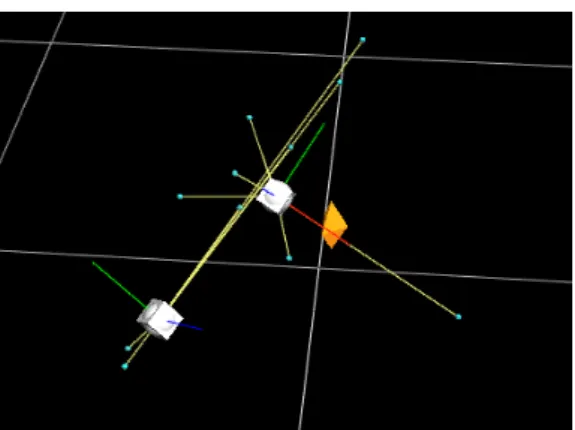
Related recording sessions were also conducted using a Vicon motion capture system [21] to generate generate ad-ditional gestural data. Figure 3 is a screenshot of an
Figure 1: Using the recently created playable mea-surement system developed in [28] that was evolved from earlier Hyperbow designs, audio and calibrated gesture data are easily collected in simple recording sessions conducted in normal performance environ-ments.
tion generated from the Vicon motion capture data collected in a related experiment.
Throughout this work, it was critical to establish a reli-able method to store and backup these data collected in the experimental sessions already conducted as well as those to come. It was also clear that analyzing these data would be an iterative process and that any given file might need to be revisited and examined many times. Therefore, organizing these data to improve accessibility for both short and long term use was extremely important. The accessibility re-quirements became more complicated with the prospects of continued collaborative research on the interaction of bow-ing parameters in bowstrokes generated by real players and on the development of a virtual violin (complete with real-istic physical controller) grew. It was obvious that progress would be faster if the exchange of data, both gesture and audio, was made easy. In considering this scenario, the pos-sibility that other independent researchers might also benefit from such a resource of bowing data was considered.
In response to these issues, a web-accessible database [29] was created to serve as an archive of the bowing data col-lected in this research, as well as assist in future research and collaboration.
2.
BACKGROUND
There are several recent research projects that share simi-lar goals to the Bowstroke Database presented in this paper. Most notably are the Rutgers MCL Interaction Catpure Re-spository [13] and the CMU Graphics Lab Motion Capture Database [5].
The Rutgers MCL Interaction Capture Respository is a web-based resource containing force capture and motion cap-ture data corresponding to various hand movements. Users may download these data corresponding to sixteen different manual manipulations such as “index finger surface scratch-ing” or “index finger pad presses”. As stated by the authors, the primary purpose of this website is to further research on interaction capture and synthesis [11] by making their data available to other researchers.
At the time of this writing, the CMU Graphics Lab
Mo-! !"# $ $"# % %"# &'$!# !!"# ! 9:;25 ! %!! <!! =!! >!! $!!! !!"% !!"$ ! )*4'?5-3,'@AB ! %!! <!! =!! >!! $!!! ! !"% !"< ;5C7'?5-3,'@AB ! %!! <!! =!! >!! $!!! !%! ! %! &'*33,)'@DEF %B ! %!! <!! =!! >!! $!!! ! $! %! +'*33,)'@DEF %B ! %!! <!! =!! >!! $!!! !%! ! %! G'*33,)'@DEF %B ! %!! <!! =!! >!! $!!! !% ! % &'8+-5'@-*;2*7FEFB ! %!! <!! =!! >!! $!!! !%! ! %! +'8+-5'@-*;2*7FEFB ! %!! <!! =!! >!! $!!! !# ! # G'8+-5'@-*;2*7FEFB F*D1),F ! !"# $ $"# % %"# &'$!# !!"# ! !"# ()*+,-'./'01233*45/'6'04-278 9:;25 ! %!! <!! =!! >!! $!!! !!"% !!"$ ! )*4'?5-3,'@AB ! %!! <!! =!! >!! $!!! ! !"% !"< ;5C7'?5-3,'@AB ! %!! <!! =!! >!! $!!! !%! ! %! &'*33,)'@DEF %B ! %!! <!! =!! >!! $!!! ! $! %! +'*33,)'@DEF %B ! %!! <!! =!! >!! $!!! !%! ! %! G'*33,)'@DEF %B ! %!! <!! =!! >!! $!!! !% ! % &'8+-5'@-*;2*7FEFB ! %!! <!! =!! >!! $!!! !%! ! %! +'8+-5'@-*;2*7FEFB ! %!! <!! =!! >!! $!!! !# ! # G'8+-5'@-*;2*7FEFB F*D1),F
Figure 2: This image shows an example of a sub-set of the gesture data produced by the playable measurement system for violin bowing described in [28]. Here, 3D acceleration and 3D angular veloc-ity of the violin bow corresponding to three trials of spiccato performance are plotted in arbitrary units, along with the corresponding audio waveforms pro-duced. (The gesture data channels are resampled from 200 Hz to 689 Hz, while the audio is sampled at 44100 Hz.)
tion Capture Database, another web-based resource, con-tains 2642 trials in 6 different motion categories: human in-teraction, interaction with environment, locomotion, physi-cal activities and sports, situations and scenarios, and test motions. The database provides motion capture data files correponding to each of the trials, as well as video files and animations. Unlike the Rutgers repository described above, the data on this website is searchable by subject number or keyword.
As in these two projects, one of the primary motivations behind the development of the Bowstroke Database was the hope that it would someday be of use not just to the au-thors but also to other researchers in related fields. In this case, the researchers in the fields of bowed string synthesis [20, 19, 17] and acoustics [7, 8, 23, 24], in which there is typically a lack of calibrated bowing data from real players, are considered as primary future users.
In addition, it is possible that this research tool will also be of use to composers, who may use the gesture data avail-able in the database to assist in the development of musi-cal mappings for interactive compositions such as those de-scribed in [30]. This ability may be especially useful when workshop time with live players is limited as can often be the case.
Such a database may even be of use to the research fields of gesture and mappings for new digital instruments [22, 9],
Figure 3: The Bowstroke Database is designed to include not only original audio and gesture data, but also to include video and motion capture data. This is a screenshot of an animation of violin bow-ing created usbow-ing a Vicon motion capture system to capture a live performance on the playable measure-ment system for violin bowing described above.
as it could provide a new opportunity for in depth study of the actual physical mappings used in performance of tradi-tional acoustic bowed string instruments. Also, as discussed in [28], such a database could help to document more quan-titatively the performance techniques and practices of tra-ditional instruments as well as new interfaces (such as the Hyperbow), and facilitate the study of individual skill de-velopment, as suggested in [1]. Further, investigations in gesture recognition of violin bowstrokes [16, 4, 28] may also benefit from more real player bowing data, as recognition techniques may be easily tested on many data sets.
The importance of storing and sharing musical gesture data is a topic of increasing interest, as discussed in [10], in which issues and goals related to the development of a standard Gesture Description Interchange Format (GDIF) are presented. In consideration of the potential benefits of real player bowing data to related research fields, great care was taken in designing the Bowstroke Database so that it would be as usable as possible.
3.
DESIGN GOALS
The first goal of this project was to create a secure and reliablearchive for the experimental gesture and audio data collected using the playable measurement system for violin bowing (evolved from earlier Hyperbow designs) described above. However, due to the initial amount of collected data and the intention to increase the size of this collection, it became clear that in order to provide fast access to these data, the archive should besearchable.
As the bowing technique and physical model performance studies described in [28] progressed, other design priorities emerged, such as providing the ability to maintain not just the original bowing data but also store related data. For instance, when using the data to drive a bowed string model, it is advantageous to be able to store any synthesized audio produced with the original gesture and audio data, as well as any related analysis files. Further, in order to better navigate the data and keep track of any progress, the ability to annotate these files with comments andratings became
desirable.
In addition to providing an easy way for the authors to ac-cess these bowing data, it was also hoped that this database could assist other researchers. Therefore, in order to fa-cilitate continued research by the authors and as well as by colleagues, it was important to enable remote access to the database. Because of this, the decision was made to make the database web-accessible, like the Rutgers and CMU projects described above. However, not only was it important to provide downloading functionality, but sup-porting easy uploading was also a priority. This was due both to the fact that bowing data are most often recorded in remote locations as well as to the goal of encouraging other researchers to share their discoveries made using the database. In this way, the Bowstroke Database stands in contrast to the Rutgers and CMU projects.
Because it was expected that multiple users would con-tribute to the database, it was important to enable each in-dividual user to administrate his or her own files by setting file permissions to specify access by other users.
All of these design goals were implemented using MySQLR
[12] and PHP [14] in the format described below order to cre-ate not just a data archive, but also a viable research tool for collaboration between researchers interested in bowing.
4.
DATABASE IMPLEMENTATION
The Bowstroke Database contains three main categories of data files. These are original recorded data (audio and calibrated gesture data from the playable measurement sys-tem for violin bowing, video, and motion capture), analysis of audio and gesture, and synthesized audio (created using gesture data).
When a file (orignal data or analysis) is uploaded to the database, the user can specify corresponding keywords as well as a subject number for each file. This information is stored in a table which also includes fields for category, permission settings, and comments. These elements are set through various pages on the website, as described below. Most importantly, the table includes a field for group affili-ation, allowing all analysis files related to a particular set of source data to be displayed in an organized fashion. In ad-dition, we have a separate table for comments made about groups of data and analysis. This table holds the name of the data group being commented upon, the comment itself, and a numerical rating.
Because the body of data contained within the Bowstroke Database is quite large and is expected to grow with future research, the organizational design of this resource was crit-ical. While maintaining the design goals described above, a number of features were implemented in order to provide good accessibility to the data as well as to encourage interac-tion and collaborainterac-tion between fellow researchers. The fea-tures are organized into the Stroke Group, Database Search, My Files, and My Bookshelf pages of the database website.
4.1
Stroke Group
The organizational element most central to the design of the Bowstroke Database is the Stroke Group. For each bow-stroke recording (gesture and audio data) in the database there is a corresponding Stroke Group. The Stroke Group includes all files related to its original bowstroke recording, and these can be viewed on the Stroke Group page, which serves as a “homepage” for the original data. Files are listed
Figure 4: This screeshot shows one of the stroke group pages. From this view, the audio and ges-ture data fro this stroke may be downloaded. Also, any available related files, such as video, analysis, or synthesis files may also be donloaded or added to a user’s My Bookshelf list.
on the Stroke Group page in blocks determined by the cat-egories described above, along with any comments provided by their owners.
To encourage research collaboration and to improve navi-gation through the data, the features of user comments and ratings have been enabled on the Stroke Group page. Rat-ings apply to the Stroke Group as a whole, while comments allow collaborating researchers to discuss specific files in de-tail. Any comments and ratings made on this page are stored in a table. The numerical ratings are averaged over all the relevant entries and the result is printed on the Stroke Group page.
Furthermore, each Stroke Group page has its own BibTeX entry that may be used to reference the original recorded gesture and audio data so that researchers may document the data any they use. An excerpt of an example Stroke Group page is shown in Figure 4.
4.2
Database Search
The Database Search function performs a keyword and filename search of all the files in our database. It can take multiple search terms as input in order to return a more narrow set of data. Search results are presented as a list of Stroke Groups that contain files that match the search parameters. Also displayed in this view are the initial key-words and comments made by the owner of the original bow-ing data for each Stroke Group, and the average user rat-ings. In addition, keywords for each Stroke Group are listed. These can be used to quickly refine the search results.
Because audio is a simple way to quickly preview and sift through the information contained within a Stroke Group, each Stroke Group is returned with its original audio file for quick previewing while still in the Database Search view. Users can also sort the search results by the name of the Stroke Group, the Stroke Group rating, keywords, and sub-ject number.
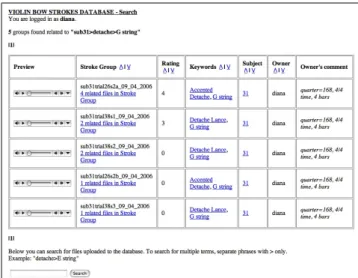
Figure 5: This Stroke Group listing is the result of a search using “sub31” (subject number 31), “de-tache”, and “G string” as search terms. As can be seen from this screenshot, in addition to information such as user ratings and comments, the main audio file associated with each stroke group can be played from this view.
Figure 5 shows the results of an example search.
4.3
My Files
The My Files database view acts as a control panel for file information. From this mode the user can assign the file categories (described above) and file permissions to his or her files in bulk.
Each file also has a File Details page, which allows the user to edit the file’s keywords, Stroke Group affiliation, file owner’s comments, and permissions settings (which allow researchers to specify which other users do or do not have access to the file’s content).
In order to simplify navigation through the database, spe-cial attention has been given to each user’s previous use of the database. In particular, the list of possible Stroke Group labels in the File Details menu (used to assign newly up-loaded files to existing Stroke Groups) has been compiled from the list of Stroke Groups from which the user has pre-viously downloaded data.
4.4
My Bookshelf
To facilitate browsing, a simple bookmarking function has been included. The My Bookshelf feature is a tool to help re-searchers navigate the database. When a user finds a Stroke Group that contains some interesting files, he or she can add those files to his or her bookshelf. A list of users who have bookmarked a particular file is stored in the main table with its other identifying parameters.
The My Bookshelf page contains a list of files that have been bookmarked. Along with the name of the file, it lists the file’s keywords, category, and a link back to the Stroke Group to which it belongs.
5.
FUTURE WORK
To date, the database has served its initial purpose of providing reliable storage and organization for the data col-lected throughout recent work, as well as creating an easy vehicle for communication. Continued bowing sessions to collect more gesture and audio data to contribute to the Bowstroke Database are in progress, as are several research projects enabled by these data, such as an exploration of vir-tual violin performance, studies of bowing techniques and the interaction of bowing parameters throughout various bowstrokes.
Future implementations of the gesture file format may in-clude a metadata file related to channel description, units, etc. Higher layers of information may also contain descrip-tion of specific bowing techniques. Possible integradescrip-tion using GDIF will also be explored.
Future work on the database itself will most likely focus on the addition and refinement of features that facilitate collab-oration and interaction between users. This will begin with Help menus and website navigation tools to assist new users while they learn how to use the database. New features may include file tagging, file sharing and implementing a process for suggestions between users, and user groups (specific, per-haps, to research fields, projects, or institutions).
6.
CONCLUSION
In this paper, the motivation and design of a Bowstroke Database have been described. This project is the first of its kind, combining gesture and audio data corresponding to violin bowstrokes together in a format that provides fast, remote access online, and several important design features, such as the organization of the Stroke Group page. The main motivation behind this project is the obvious need for bowing data in research communities such as those of bowed string synthesis, acoustics, gesture, and interactive music composition. Unlike other online repositories for ges-ture data, the Bowstroke Database developed here provides not only the ability to download data, but also the abil-ity to upload data. In this way, it encourages interaction and collaboration between researchers. It is hoped that this research tool will continue to develop and serve as an ever-growing respository of knowledge on bowing.
7.
ACKNOWLEDGMENTS
The authors would like to thank Andr´e Roy (Department of Performance) and Stephen McAdams (CIRMMT) from the Schulich School of Music of McGill University and Esm´e Acton and Helen Thorp from the Royal Academy of Music for their help in organizing bowing studies. Special thanks to all of the violinists who have contributed data to the bowstroke database so far.
8.
REFERENCES
[1] A. Askenfelt. Study your bowing technique! In Proceedings of the Stockholm Music Acoustics Conference (SMAC 83), pages 123–391, Stockholm, 1983.
[2] A. Askenfelt. Measurement of the bowing parameters in violin playing. II. Bow-bridge distance, dynamic range, and limits of bow force.Journal of the Acoustical Society of America, 86(2):503–16, Aug. 1989.
[3] A. Askenfelt. Measurement of bow motion and bow force in violin playing.Journal of the Acoustical Society of America, 80(4):1007–15, Oct. 1986. [4] Fr´ed´eric Bevilacqua, Nicolas H. Rasamimanana,
Emmanuel Fl´ety, Serge Lemouton, and Florence Baschet. The augmented violin project: research, composition and performance report. InProceedings of the 2006 Conference on New Interfaces for Musical Expression (NIME-06), Paris, 2006.
[5] CMU. CMU Graphics Lab Motion Capture Database. http://mocap.cs.cmu.edu/.
[6] CodaBow. Conservatory Violin Bow. http://www.codabow.com/.
[7] K. Guettler, E. Schoonderwaldt, and A. Askenfelt. Bow speed or bowing position – which one influences spectrum the most? InProceedings of the Stockholm Music Acoustics Conference (SMAC 03), Stockholm, August 2003.
[8] Knut Guettler. A Closer look at the string player’s bowing gestures.CASJ (Series II), 4(7):12–16, 2003. [9] A.D. Hunt, M. Paradis, and M. Wanderley. The
Importance of Parameter Mapping in Electronic Instrument Design. InProceedings of the 2002 Conference on New Instruments for Musical Expression (NIME-02), 2002.
[10] Jensenius, A. R., Kvifte, T. and Godøy, R. I. Towards a Gesture Description Interchange Format. In
Proceedings of the 2006 Conference on New Interfaces for Musical Expression (NIME-06), Paris, 2006. [11] Paul Kry and Dinesh Pai. Interaction capture and
synthesis. InACM Transactions on Graphics (Proceedings of the SIGGRAPH conference), volume 25, pages 872–880, 2006.
[12] MySQL. http://www.mysql.com/.
[13] Dinesh Pai and Paul Kry. Rutgers MCL Interaction Capture Repository.
http://www.interactioncapture.org/.
[14] PHP: Hypertext Preprocessor. http://www.php.net/. [15] Miller Puckette. Pure Data (Pd).
http://www.crca.ucsd.edu/ msp/software.html. [16] N. H. Rasamimanana. Gesture analysis of bow strokes
using an augmented violin. Master’s thesis, Universit´e Pierre et Marie Curie, 2004.
[17] R.T. Schumacher and J. Woodhouse. Computer Modelling of Violin Playing.Contemporary Physics, 36(2):79–92, March-April 1995.
[18] Stefania Serafin and Diana Young. Bowed string physical model validation through use of a bow controller and examination of bow strokes. In Proceedings of the Stockholm Music Acoustics Conference (SMAC 03), Stockholm, August 2003. [19] J. O. Smith. Recent developments in musical sound
synthesis based on a physical model. In Proceedings of the Stockholm Music Acoustics Conference (SMAC 03), Stockholm, August 2003.
[20] J. O. Smith. Virtual acoustic musical instruments: Review and update.Journal of New Music Research, 33(3), 2004.
[21] Vicon Motion Capture System. http://www.vicon.com/.
[22] Marcelo M. Wanderley Vicent Verfaille and Philippe
Depalle. Mapping Strategies for Gestural and Adaptive Control of Digital Audio Effects.Journal of New Music Research, 35(1):71–93, 2006.
[23] J. Woodhouse and P. M. Galluzzo. The bowed string as we know it today.Acustica - Acta Acustica, 90(4), Aug 2004.
[24] James Woodhouse. On the Playability of Violins. Part II: Minimum Bow Force and Transients.Acustica, 78(3):137–53, April 1993.
[25] Yamaha. SV-200 Silent Violin.
http://www.global.yamaha.com/index.html [26] Diana Young. The Hyperbow controller: Real-time
dynamics measurement of violin performance. In Proceedings of the 2002 Conference on New Instruments for Musical Expression (NIME-02), Montreal, 2002.
[27] Diana Young. Wireless sensor system for measurement of violin bowing parameters. InProceedings of the Stockholm Music Acoustics Conference (SMAC 03), Stockholm, August 2003.
[28] Diana Young.A Methodology for Inveestigation of Bowed String Performance Through Measurement of Violin Bowing Technique. PhD thesis, M.I.T., 2007. [29] Diana Young and Anagha Deshmane. Bowstroke
Database. http://bowing.media.mit.edu/.
[30] Diana Young, Patrick Nunn, and Artem Vassiliev. Composing for Hyperbow: A Collaboration Between MIT and the Royal Academy of Music. InProceedings of the 2006 Conference on New Interfaces for Musical Expression (NIME-06), Paris, 2006.
[31] Diana Young and Stefania Serafin. Playability evaluation of a virtual bowed string instrument. In Proceedings of the 2003 Conference on New Interfaces for Musical Expression (NIME-03), Montreal, 2003. [32] Diana S. Young. New frontiers of expression through
real-time dynamics measurement of violin bows. Master’s thesis, M.I.T., 2001.
![Figure 1: Using the recently created playable mea- mea-surement system developed in [28] that was evolved from earlier Hyperbow designs, audio and calibrated gesture data are easily collected in simple recording sessions conducted in normal performance en](https://thumb-us.123doks.com/thumbv2/123dok_us/10594946.2946690/2.892.489.814.86.453/recently-developed-hyperbow-calibrated-collected-recording-conducted-performance.webp)