hydrogen and Oxygen
Preparation of hydrogen by electrolysis of a dilute aqueous sulfuric acid solution. Hydrogen gas and oxygen gas are liberated at the electrodes. As required by the reaction stoichiometry, the volume of H2(g) liberated is twice as great as that of O2(g).
Two of the most abundant elements are hydrogen and oxygen. Hydrogen (atomic number 1, atomic mass 1.0079) is the most abundant element in the universe and is the ninth most abundant element in the earth’s crust (Figure C.1). Hydrogen constitutes over 10% of water by mass and occurs in petroleum and all organic matter.
Oxygen (atomic number 8, atomic mass 15.9994) is the most abundant element on earth and the third most abundant element in the universe, ranking behind only hydrogen and helium (Figure C.2). Most rocks contain a large amount of oxygen. For example, sand is predominantly silicon dioxide, SiO2(s), and consists of more than 50% oxygen by mass. Almost 90% of the mass of the oceans and two-thirds of the mass of the human body are oxygen. Air at sea level is 21% oxygen by volume. We can live weeks without food, days with-out water, but only minutes withwith-out oxygen.
c-1. Most hydrogen Is Used to produce
ammonia and Methanol
Free hydrogen occurs in nature as a diatomic mole-cule, H2(g). It is a colorless, odorless, tasteless, explo-sive gas with a boiling point of –253°C (20 K). Only helium has a lower boiling point (4.3 K). Hydrogen is the least dense substance (0.09 g·L–1 at 0°C and 1 bar), being twice as light as helium under the same conditions. There are three isotopes of hydrogen: ordinary hydrogen, consisting of one proton and one electron; deuterium, consisting of one proton, one neutron, and one electron; and tritium, consisting of one proton, two neutrons, and one electron. Naturally occurring hydrogen consists of 99.985% by mass of ordinary hydrogen and 0.015% by mass of deuterium. Tritium is radioactive and occurs only in the upper atmosphere in trace amounts (Figure C.3). Water that contains deuterium as its hydrogen constituent is designated by D2O(l) and is called heavy water. Heavy water is used commercially in the nuclear industry.
Enormous quantities of hydrogen are used indus-trially in the synthesis of ammonia in the Haber process:
300°C, 300 bar
3 H2(g) + N2(g) → 2 NH3(g)
Large amounts of hydrogen are also used in the pro-duction of hydrocarbons and alcohols by the Fischer-Tropsch process. For example,
300°C, 200 bar
CO(g) + 2 H2(g) →catalyst CH3OH(l) methanol
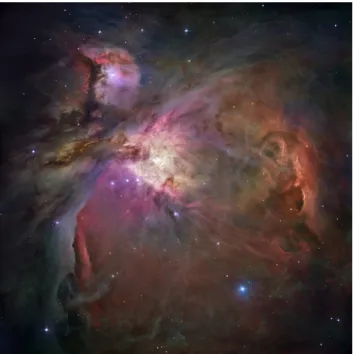
Figure c.1 Hydrogen in interstellar space in the form of gas clouds.
Figure c.2 Oxygen is produced by photosynthesis. An underwater plant produces oxygen gas, which appears as gas bubbles around the leaves.
University Science Books, ©2011. all rights reserved. www.uscibooks.com
The hydrogen used in these large-scale processes is produced on site either by the steam reforming of natural gas (principally methane, CH4),
1000°C, 30 bar
CH4(g) + H2O(g) → CO(g) + 3 H2(g) or by the water-gas reaction, given by
800°C
C(s) + H2O(g) → CO(g) + H2(g) Hydrogen is also used industrially in the hydro-genation of fats and vegetable oils, in the manufac-ture of electronic components, in the preparation of HCl(g) and HBr(g), and in the reduction of metals from their oxides at high temperature by reactions such as that described by
Cr2O3(s) + 3 H2(g) → 2 Cr(s) + 3 H2O(g)
c-2. hydrogen Is reactive at
high temperatures
Small quantities of hydrogen can be prepared for lab-oratory use by the reaction of many metals with acids, such as that described by
Zn(s) + 2 HCl(aq) → ZnCl2(aq) + H2(g)
or by the reaction of reactive metals such as sodium or calcium with water,
Ca(s) + 2 H2O(l) → Ca(OH)2(aq) + H2(g) or by the reaction of many metallic hydrides with water,
NaH(s) + H2O(l) → NaOH(aq) + H2(g) or by passing an electric current through water (elec-trolysis) using an apparatus similar to the one shown in the Frontispiece. The chemical equation for the electrolytic decomposition of water is
electrolysis
2 H2O(l) → 2 H2(g) + O2(g)
The energy necessary to decompose water into hydro-gen and oxyhydro-gen by electrolysis is supplied by a bat-tery or other external power source. Electrolysis is described in more detail in Chapter 25.
Hydrogen is not particularly reactive under ordi-nary conditions, but at high temperatures and pres-sures it is quite reactive and forms compounds with many elements, from the alkali metals,
400°C
2 Na(s) + H2(g) → 2 NaH(s) to the halogens,
H2(g) + Cl2(g) → 2 HCl(g)
The reaction of H2(g) and Cl2(g) does not occur in the dark but occurs explosively if the reaction mixture is exposed to sunlight or is sparked. Hydrogen and oxy-gen also form very dangerous mixtures; they do not react unless sparked or heated to a high temperature, but then they do so explosively (Figure C.4). Hydrogen also burns in air, and the flame of an oxyhydrogen blowtorch (Figure C.5) has a temperature of about 2500°C, which is high enough to melt platinum.
c-3. Over nineteen Million Metric
tons of Oxygen are Sold annually in
the United States
Oxygen in air exists primarily as the diatomic mol-ecule O2(g). It is a colorless, odorless, tasteless gas with a boiling point of –183°C and a freezing point of –218°C. Although oxygen is colorless as a gas, both liquid and solid oxygen are pale blue (Figure C.6). Figure c.3 The isotope tritium, hydrogen-3, glowing
as a result of being excited in a microwave excitation apparatus.
Industrially, oxygen is produced by the fractional distillation of liquid air, a method that exploits the dif-ference in the boiling points of nitrogen and oxygen, the principal components of air (see Chapter 16). The nitrogen can be separated from the oxygen because nitrogen boils at –196°C, whereas oxygen boils at –183°C. The pure oxygen thus obtained is compressed
in steel cylinders to a pressure of about 150 bar. Approximately 19 million metric tons of oxygen are sold annually in the United States (Appendix H). The major commercial use of oxygen is in the blast furnaces used to manufacture steel. (To save transportation costs, the oxygen is produced on site.) Oxygen is also used in hospitals, in oxyhydrogen and oxyacetylene
Figure c.4 The explosion of the German dirigible Hindenburg during landing in Lakehurst, New Jersey. Today helium, a nonflammable lighter-than-air gas, is used in place of hydrogen in lighter-than-air craft in order to eliminate the possibility of a similar disaster.
Figure c.5 An oxyhydrogen torch. The flame temperature is about 2500°C.
Figure c.6 Although gaseous oxygen is colorless, liquid oxygen is pale blue.
University Science Books, ©2011. all rights reserved. www.uscibooks.com
torches for welding metals, at athletic events, and to facilitate breathing at high altitudes and under water. Tremendous quantities of oxygen are used directly from air as a reactant in the combustion of hydrocar-bon fuels and coal that supply about 90% of the energy consumed worldwide. In terms of total usage (pure oxygen and oxygen used directly from air), oxygen is the number two chemical, ranking behind water.
Most of the oxygen in the atmosphere is the result of photosynthesis, the process by which green plants combine CO2(g) and H2O(l) into carbohydrates and O2(g) under the influence of visible light (Figure C.2). Carbohydrates are so named because their chemical formulas can be written as (CH2O)n (carbo- from carbon and -hydrate from water). The carbohydrates appear in the plants as starch, cellu-lose, and sugars. The net reaction is given by
visible light
CO2(g) + H2O(l) → carbohydrates + O2(g) Photosynthesis is an active area of chemical research. Although many details of photosynthesis have yet to be worked out, it is known that the light is first absorbed by the chlorophyll molecules of the plants. In one year, more than 1010 metric tons of car-bon are incorporated worldwide into carbohydrates by photosynthesis. Photosynthesis is the source of most of the oxygen in the earth’s atmosphere.
c-4. Oxygen reacts directly with
Most elements
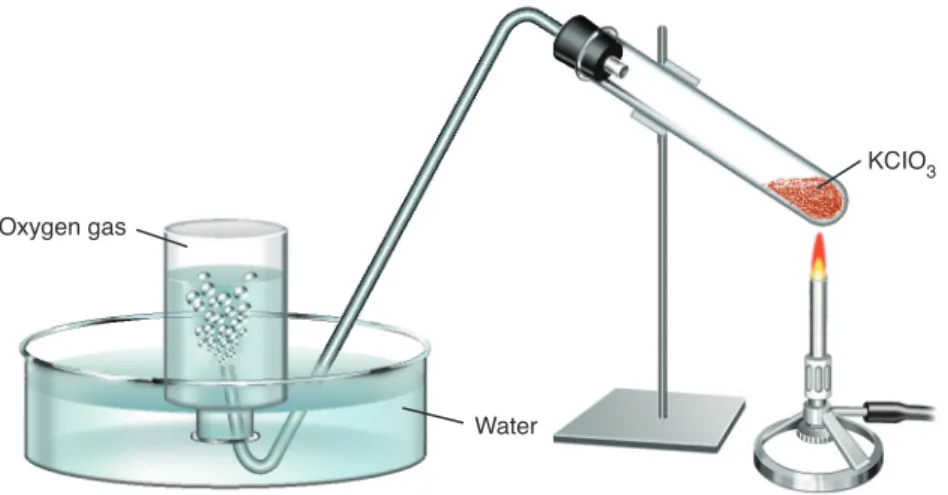
A frequently used method for preparing oxygen in the laboratory involves the thermal decomposition
of potassium chlorate, KClO3(s) (Figure C.7). The chemical equation for the reaction is
high T
2 KClO3(s) → 2 KCl(s) + 3O2(g) This reaction requires a fairly high temperature (400°C), but if a small amount of manganese diox-ide, MnO2(s), is added, the reaction occurs rapidly at a lower temperature (250°C). The manganese diox-ide speeds up the reaction, yet is not a reactant itself. We shall meet examples of this behavior often. A sub-stance that facilitates a reaction but is not consumed in the reaction is called a catalyst. Catalysts are dis-cussed in Chapter 18.
An alternate method for the laboratory prepara-tion of oxygen is to add sodium peroxide, Na2O2(s), to water:
2 Na2O2(s) + 2 H2O(l) → 4 NaOH(aq) + O2(g) This rapid and convenient reaction does not require heat. Oxygen also can be prepared by the electrolytic decomposition of water (Frontispiece).
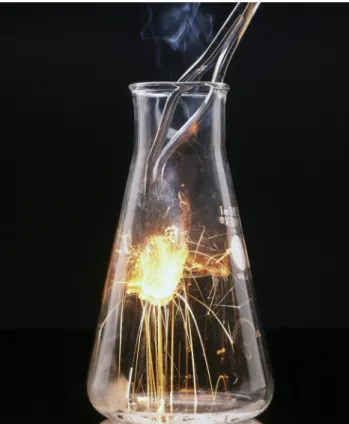
Oxygen is a very reactive element. It reacts directly with all the other elements except the halo-gens, the noble gases, and some of the less reactive metals to form a wide variety of compounds. Only fluorine reacts with more elements than oxygen. Oxygen forms oxides with many elements. Most met-als react rather slowly with oxygen at ordinary tem-peratures but react more rapidly as the temperature is increased. For example, iron, in the form of steel wool, burns vigorously in pure oxygen but does not burn in air (Figure C.8).
Figure c.7 A typical experimental setup for the production of small amounts of oxygen from the thermal decomposition of KClO3(s). Because it is only slightly soluble in water, the oxygen is collected by the displacement of water from an inverted bottle. Oxygen gas Water KCIO3 Author Figure # Artist Date Title
Check if revision Approved
General Chemistry - 4th ed McQuarrie/Gallogy George Kelvin 09/10/09 011-006
x
Fuels are compounds that burn in oxygen and release large quantities of heat. Such a reaction is called a combustion reaction. Most fuels are
hydrocarbons, which are compounds that contain only carbon and hydrogen. Methane, the main constituent of natural gas, burns in oxygen accord-ing to the equation
CH4(g) + 2 O2(g) → CO2(g) + 2 H2O(g) methane
All hydrocarbons burn in oxygen to produce car-bon dioxide and water. For example, gasoline is a mixture of hydrocarbons. Using octane, C8H18(l), as a typical hydrocarbon in gasoline, we write the com-bustion of gasoline as
2 C8H18(l) + 25 O2(g) → 16 CO2(g) + 18 H2O(g) octane
The energy released in hydrocarbon combustion reac-tions is used to power machinery and to produce elec-tricity, and to heat buildings and homes (Chapter 14 and Interchapter L).
Figure c.8 Although steel wool does not burn in air, it burns vigorously in pure oxygen.
A mixture of acetylene and oxygen is burned in the oxyacetylene torch. The chemical equation for the combustion of acetylene is
2 C2H2(g) + 5 O2(g) → 4 CO2(g) + 2 H2O(g) acetylene
The flame temperature of an oxyacetylene welding torch is about 2400°C, which is sufficient to melt iron and steel. A combustion reaction with which we are all familiar is the burning of a candle. The wax in a candle is composed of high-molar-mass hydrocar-bons, such as C20H42(s). The molten wax rises up the wick to the combustion zone the way ink rises in a piece of blotting paper.
Although most metals yield oxides when they react with oxygen, some of the very reactive metals, such as sodium and barium, yield peroxides, which are molecules containg an O22– ion. With potassium and cesium, superoxides are obtained (Interchap-ter D). One of the most important peroxides is hydrogen peroxide, H2O2(l), a colorless, syrupy liq-uid. Hydrogen peroxide can be prepared in the lab-oratory by adding cold dilute sulfuric acid to barium peroxide:
BaO2(s) + H2SO4(aq) → BaSO4(s) + H2O2(l) A 3% aqueous solution is sold in drugstores and is used as a mild antiseptic and as a bleach. It is often sold in brown bottles because hydrogen peroxide decomposes in light according to the equation
light
2 H2O2(aq) → 2 H2O(l) + O2(g) More concentrated solutions (30%) of hydrogen peroxide are used industrially. Some of the industrial applications of hydrogen peroxide are as a bleach-ing agent for feathers, hair, flour, bone, and textile fibers; in renovating old paintings and engravings; in the artificial aging of wines and liquor; in refining
different flames have different temperatures. the temperature of a hot region of a candle flame is about 1200°c, that of a Bunsen burner flame is about 1800°c, and that of an oxyacetylene torch flame is about 2400°c.
University Science Books, ©2011. all rights reserved. www.uscibooks.com
oils and fats; and in photography as a fixative elimi-nant. Concentrated solutions of hydrogen peroxide are extremely corrosive and explosive and must be handled with great care.
c-5. Ozone Is a triatomic Oxygen Molecule
When a spark is passed through oxygen, some of the oxygen is converted to ozone, O3(g):
3 O2(g) → 2 O3(g)
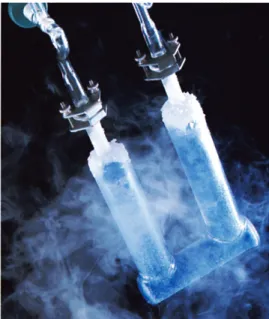
Ozone is a pale blue gas at room temperature. It has a sharp, characteristic odor, which often is noticed after electrical storms or near high-voltage genera-tors. Liquid ozone (boiling point –112°C) is a deep blue, explosive liquid (Figure C.9). Ozone is so reac-tive that it cannot be transported, but must be gener-ated as needed. Relatively unreactive metals, such as silver and mercury, which do not react with oxygen, react with ozone to form oxides. Ozone is used as a bleaching agent and is sometimes used as a replace-ment for chlorine in water treatreplace-ment because of the environmental problem involving chlorinated hydrocarbons.
Figure c.9 Dark blue solid ozone inside a glass container being remove from a tank of liquid nitrogen.
Oxygen and ozone are called allotropes.
Allotropes are two different forms of an element that have a different number or arrangement of the atoms in the molecules. Many other elements have allotropic forms. For example, graphite and diamond are allo-tropes. They both consist of carbon atoms, but the atoms are arranged differently in the two substances (Chapter 15 and Interchapter M).
Ozone plays a vital role in the earth’s atmosphere. The action of sunlight on oxygen in the upper atmo-sphere leads to the production of ozone according to
uv radiation from sunlight
(1) O2(g) → 2 O(g)
(2) O(g) + O2(g) + M(g) → O3(g) + M(g)
where M(g) indicates that some other molecules (e.g., another O2 or N2 molecule) or atoms must be present to carry away the energy released when ozone is formed. The ozone produced in the upper atmo-sphere absorbs the ultraviolet (uv) radiation from sunlight that would otherwise destroy most life on earth. Without ozone in the upper atmosphere, there could be no life as we know it on earth.
terMS yOU ShOULd KnOW
isotope C1
deuterium C1
tritium C1
Haber process C1
Fischer-Tropsch process C1 steam reforming of natural gas C2 water-gas reaction C2 photosynthesis C4 carbohydrates C4 catalyst C4 combustion reaction C5 hydrocarbon C5 peroxide C5 ozone C6 allotrope C6
QUeStIOnS
c-1. What is the most abundant element in the universe?
c-2. Name the naturally occurring isotopes of hydrogen.
c-3. What is heavy water? c-4. What is the Haber process?
c-5. Write the chemical equation that represents the steam reforming of natural gas.
c-6. Complete and balance the following equations: (a) Mg(s) + HCl(aq) → (b) Na(s) + H2O(l) → (c) CaH2(s) + H2O(l) → (d) Na(s) + H2(g) ———
→
c-7. What is electrolysis? lightc-8. Sand is predominantly what oxide? c-9. How is oxygen produced commercially?
c-10. What is the source of most of the oxygen in the earth’s atmosphere?
c-11. Describe two methods used to produce small quantities of oxygen in the laboratory.
c-12. What is a catalyst?
c-13. Describe combustion in chemical terms.
c-14. Write the chemical equation for the combustion of the principal component of natural gas.
c-15. Write the chemical equation for the heat- producing reaction of an oxyacetylene torch.
c-16. What is an allotrope?