Conservation Education
A Case Study of the Program in Sustainable
Development and Conservation Biology at the
University of Maryland
The field of conservation biology (Soulé 1985 ) and the Society for Conserva-tion Biology are new enough that many of the scientists important in their conception are still alive and active in the field, and the business of training students explicitly in this field is even newer. A large number of the existing graduate programs began about the same time, around 1990, when many—including the University of Maryland’s—were initi-ated in response to the funding ini-tiative of the Pew Charitable Trust, “Integrated Approaches to Training in Conservation and Sustainable De-velopment” ( Jacobson 1990 ). In 1995, Jacobson et al. listed 51 gradu-ate programs, and now about 75 are listed on the Web site (http://conbio. net/scb/services/programs/). But the growth of new graduate programs in conservation biology seems to have slowed down in the past several years (a qualitative impression based on announcements of new programs and changes in the list on the Web site), perhaps indicating that conser-vation education has reached some plateau and maybe even a carrying capacity. Another indicator of the youth of the field is that there has not yet been any ranking of graduate programs in conservation biology by a disciplinary organization such as the Society for Conservation Biology, a governmental panel such as the Na-tional Research Council, or even a pri-vate effort such as that of the maga-zine U.S. News and World Report.
Assuming that the programs for training graduate students to
be-come practitioners of this new field may have reached some equilibrium, it seems an opportune time to con-sider issues such as what kinds of students are applying to these pro-grams, what kinds of students are being admitted to them, and where graduates of the programs are em-ployed. Given the difficulties of sur-veying multiple programs at a vari-ety of universities (Inouye tried), we address these issues from the per-spective of a case study of the Sus-tainable Development and Conserva-tion Biology program directed by Inouye, which may or may not be a “representative” program. How-ever, as one of the approximately 30 programs designed in response to the Pew Charitable Trusts initiative in 1987, the program at the Univer-sity of Maryland ( UM ) is probably similar to those on other campuses in that pool. The information re-ported here may be of interest to readers advising undergraduates about graduate work in conservation biology or to students considering careers in the field. For details about the variety of graduate programs available, please see the links avail-able through the Society for Conser-vation Biology’s Web site ( http:// conbio.net/scb/).
The University of
Maryland Program
The graduate program in Sustainable Development and Conservation
Biol-ogy ( adopted from the title of the Pew Charitable Trusts initiative) is a non-thesis, interdisciplinary M.S. program that seeks to train students who will become involved in the management of development or conservation programs. The curricu-lum was designed with the help of a panel of potential employers from conservation and development orga-nizations in the Washington, D.C., area. Students are required to take 39 graduate credits, which they typi-cally complete in four semesters. About 16 of these credits come from four required core courses: (ecol-ogy, resource economics, policy, and problem-solving: Touval & Dietz 1994; Cannon et al. 1996; Inouye & Dietz 2000 ). Remaining credits are completed in elective courses that students can use to develop their in-terests in resource economics, envi-ronmental policy, envienvi-ronmental ed-ucation, ecology, or other areas. Students are also required to write a scholarly paper ( “library thesis” ) and to complete an internship, typi-cally during the summer and often in a nongovernmental organization or federal agency in or near Washing-ton, D.C.. The program has no fac-ulty of its own; the director and as-sociate director are both faculty members in the Biology Depart-ment, and students take most of their courses from other depart-ments. In addition, several adjunct faculty members from organizations around the Washington, D.C., area teach seminars, advise interns, and give lectures. Because this is a
non-Inouye & Brewer Conservation Education 1205
thesis degree program, individual ad-visors are not required or assigned. The director and associate director of the program serve as advisors, and peer-advising among students is common. As of December 2002, there are 118 alumni of this program. (For more information about the pro-gram, see www.umd.edu/cons.)
The Applicant Pool
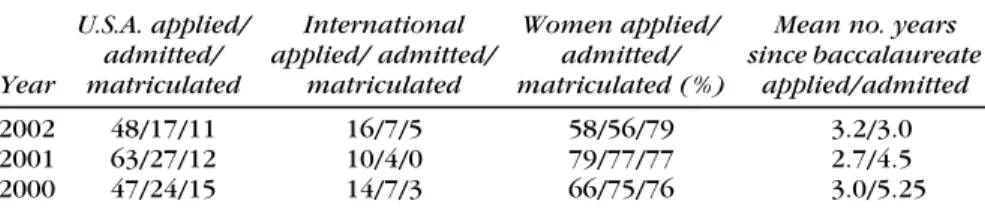
In the first year of the graduate pro-gram in Sustainable Development and Conservation Biology ( 1990 ), there were 6 applicants. Within a few years the number had increased 10-fold, and since 1995 the number has ranged from 61 to 72 each year (Table 1). The subset of international applicants has grown more slowly, but for the past few years has ranged from 10 to 15. Grade point average ( GPA ) and Graduate Record Exam statistics for the applicant pool are shown in Table 2. It is possible that there has been some self-selection in the applicant pool in response to the UM program home page, which in-cludes statistics on the GRE and GPA of recently admitted applicants.
The percentage of women apply-ing to the UM program has consis-tently been much higher than that of men, for reasons that are unclear to us. In the past 3 years the percent-age of females applying has ranged from 58% to 79% ( 58% in 2002 was the closest to an equal gender ratio; this may have been an outlier be-cause the ratio in 2003 was back to 72% ). This bias does not apply uni-versally to graduate applications at the UM campus, although the Biol-ogy Department graduate programs have received more applications from women than men over 2 of the past 3 years ( 62%, 63%, 50% ). Most applicants to the Sustainable Devel-opment and Conservation Biology program are one or more years post-baccalaureate (Table 1, Fig. 1), with a range in the past 3 years of 0–23 years. Few applications are received
from minority students, despite ef-forts at recruiting them. Applica-tions from people with advanced de-grees are not uncommon, including a lawyer, two veterinary doctors, and people with Ph.D.s in econom-ics and psychology ( all of whom were admitted ). Two students have enrolled in the UM program while concurrently completing law de-grees. Six of 43 current students en-rolled already possessed masters’ de-grees in engineering administration, economics, environmental science, international training and educa-tion, neuroscience and behavior, or physics.
There seems to be a trend for in-creasing diversity in the undergradu-ate backgrounds of students apply-ing to the UM program. Most of the applicants have had undergraduate majors in biology, but students also have been accepted with undergrad-uate degrees in accounting, pology or sociology, biological anthro-pology and anatomy, communication studies, comparative area studies, eco-nomics, environmental science, geo-graphy, history, individualized study,
international affairs, international re-lations, Latin American studies, polit-ical science, physics, politpolit-ical theory and constitutional democracy, public relations, social relations, and wildlife biology.
Admissions Process and
Matriculating Pool
In addition to standard application materials (general GRE scores, two es-says, three letters of recommendation), applications are screened for indica-tions that a student is likely to be able to benefit from, as well as con-tribute to, the graduate program. For example, one indication is one or more years of post-baccalaureate ex-perience ( e.g., Peace Corps experi-ence, work in a nongovernmental organization or in business ). The ad-missions committee also looks for in-dications that a student is likely to become a leader in the field of con-servation biology. The criteria for this are not quantitative but may be less nebulous than it might seem Table 1. Profile of applicants to the University of Maryland’s Program in Sustainable Development and Conservation Biology.*
Year U.S.A. applied/ admitted/ matriculated International applied/ admitted/ matriculated Women applied/ admitted/ matriculated (%)
Mean no. years since baccalaureate
applied/admitted
2002 48/17/11 16/7/5 58/56/79 3.2/3.0
2001 63/27/12 10/4/0 79/77/77 2.7/4.5
2000 47/24/15 14/7/3 66/75/76 3.0/5.25
*Number, gender ratio, number of years since baccalaureate of applicant, students admitted, and students enrolling for the last 3 years. Applicants from the United States (U.S.A.) and from other countries (international) are reported separately.
Table 2. Mean GPA and GRE scores for applicants and admitted students (2002) for the Program in Sustainable Development and Conservation.
GPA Verbal Quantitative Analytical Total
Applicants United States 3.41 577 668 675 1920
international 3.04* 472 587 564 1623
Admitted United States 3.65 643 726 744 2113
international 3.23* 452 608 527 1587
1206 Conservation Education Inouye & Brewer
(Dietz et al. 2004). They include evi-dence that candidates are intellec-tual role models, have strong inter-personal skills, have the courage to vocalize controversial ideas and opin-ions, can convey a passion for work and environmental interests, and are cited for the quality of their work. As is probably true at most universi-ties, there is pressure from the higher administration to pay attention to GPA and GRE scores, but the Sus-tainable Development and Conserva-tion Biology program has no absolute criteria for any of these quantitative measures.
Each year, the intention is to en-roll about 15 new students, so the admissions target is to identify a few more than this number in case some of the students admitted decline to accept, which happens regularly. Each year, some admitted students are lost to what are considered com-peting programs ( such as those at Duke and Yale ), but more com-monly applicants have been trying to decide between alternate career paths and wait to make that choice until after they see which graduate programs offer them admission. Each year a few of the applicants ad-mitted end up going into Ph.D. pro-grams instead, having decided they
are more interested in research ca-reers. Last year, six of the students admitted to the Sustainable Develop-ment and Conservation Biology Pro-gram fell into this category, a larger number than usual. Other students move on to Ph.D. work after com-pleting their M.S. degree in the UM program.
Although there are no absolute cri-teria for quantitative measures ( e.g., the mean GRE scores of interna-tional applicants accepted last year were lower in some areas than those of the general international applicant pool, possibly reflecting language and/ or test-format biases; Table 1), students admitted to the UM program tend to rank at the higher end on quantita-tive measures of performance such as GPA and GRE (Table 2). These rank-ings have been higher than those for other graduate programs (mostly Ph.D. ) in the College of Life Sci-ences at UM and are among the high-est for programs across the campus. The biased gender ratio that charac-terizes the applicant pool also car-ries over to the matriculating pool: for the past 3 years the gender ratio has been 76%, 77%, and 79% ( Table 1 ). The average post-baccalaureate period for admitted students in 2002 was 3 years ( range 0–19 years ),
indistin-guishable from the mean for the ap-plicant pool (range 0–19 years).
How Are Students Funding
Their Education?
The Sustainable Development and Conservation Biology Program is for-tunate to be able to offer financial support to almost all students who request it. A few students each year receive graduate school fellowship support ( for their first year only ). These fellowships are awarded through a campus-wide competi-tion. Other students are employed as teaching assistants, primarily in un-dergraduate biology courses, or sometimes as graduate assistants for various programs on campus ( e.g., advising undergraduates or working in the fellowship office ). Teaching assistantships and graduate assistant-ships provide a 9-month stipend and 10 credits of tuition remission per semester in exchange for about 20 hours of work per week. The major-ity of students receive additional fi-nancial support associated with their internships. It is our impression from talking with students that many other conservation graduate pro-grams are not able to provide finan-cial support to such a large propor-tion of their students (particularly in larger programs).
Funding for international students is more problematic because they of-ten do not meet minimum English lan-guage skills for a teaching assistant-ship, and their GPA or GRE scores may not be competitive for univer-sity fellowship support. Most inter-national students in the Sustainable Development and Conservation Biol-ogy Program have come with out-side fellowship support, through agencies such as LASPAU: Academic and Professional Programs for the Americas (www.laspau.harvard.edu), Fulbright, or the Organization of American States, or with support from their governments. If other Figure 1. The distribution of post-baccalaureate years of experience for the
2002 cohort of applicants, subdivided into admitted and rejected applica-tions.
Inouye & Brewer Conservation Education 1207
sources of support for international students were available, it probably would be possible to increase the number of international students ad-mitted to the program.
Graduates and Their
Employment
The track record for employment by graduates of the Sustainable Devel-opment and Conservation Biology Program has been remarkably good. None of the students has reported difficulties finding jobs for the past decade. Many of their job opportuni-ties have arisen through contacts made during internships or in the problem-solving course, during which students work as consultants for conservation-related clients in the Washington, D.C. area. Network-ing among the alumni and/or ad-junct faculty from our program also has been productive. In the past few years, graduates have taken jobs at nongovernmental organizations such as Conservation International, The Nature Conservancy, World Wildlife Fund, American Bird Con-servancy, National Geographic Soci-ety, and International Association of Fish and Wildlife Agencies, or in government agencies such as the U.S. Department of Agriculture’s Natural Resources Conservation Ser-vice, the U.S. Geological Survey, the National Oceanic and Atmospheric Administration, the Organization of American States, and the Chesa-peake Bay Critical Area Commission. A few have gone into education, teaching at high schools or universi-ties ( instructor level ) and, in one case, as an interpretive exhibit man-ager for the National Zoological Park. The international students mostly have returned to their home countries to work either for private organizations or government agencies and to teach in university positions they held before entering the UM pro-gram. (Information about alumni and
their employment is available at www.umd.edu/cons/list.html. ). It is not clear to what degree the job-placement success of UM graduates is related to the geographical prox-imity to Washington, D.C. and its con-servation-related employers.
About 15% of graduates have gone into Ph.D. programs in biology, geog-raphy, public affairs, resource eco-nomics, and other environmental fields after completing the non-thesis M.S. degrees at UM. These graduates have reported that the breadth and depth of training they received in the Sus-tainable Development and Conserva-tion Biology M.S. program served them well as they worked on more narrowly focused Ph.D. projects.
Conclusions and Call for
Further Study
About the time many graduate pro-grams in conservation biology were just getting off the ground, Jacobson (1990) pointed out that the develop-ment of graduate training in conser-vation biology as a cross-disciplinary field faced a variety of obstacles. These included the disciplinary structure of academia, barriers to communication among disciplines, and the lack of model curricula. For-tunately, most of those barriers now seem to have been overcome. For example, in the Sustainable Develop-ment and Conservation Biology Pro-gram, core courses are required in three different colleges, and the fac-ulty in those areas are pleased to have the additional diversity that stu-dents in the program represent. A student-run group focusing on eco-logical economics draws participants from several different departments, and UM is about to implement a dual M.S. degree program in conservation biology and public policy.
Given that 60–70 students apply for about 15 slots in the program each year, it appears that there is a significant pool of students wishing
to ( 1 ) pursue careers in manage-ment of developmanage-ment or conserva-tion programs after training at the M.S. level or ( 2 ) develop breadth in conservation biology before pursu-ing Ph.D. studies. It also appears that many of these students are of high caliber, at least matching the quality of students applying to Ph.D. pro-grams in biology. These students are coming to the field of conservation biology with a wide range of under-graduate majors ( albeit primarily re-lated to biology ) and with a diverse range of post-baccalaureate experi-ences. In some cases they are making significant career changes from un-related fields, and in other cases they want to develop interests inspired during post-baccalaureate nonaca-demic experiences. It is possible that, because there are no prerequisites for most of the courses in this pro-gram (e.g., no requirement for chem-istry, physics, cell or molecular biol-ogy, statistics, or calculus, although some of these are recommended ), perceived barriers to making a career change are minimized.
It is not clear whether or not the female-biased gender ratio of UM ap-plicants and matriculating students characterizes all graduate programs in conservation biology. This trend seems unusual because of the well-documented male-female disparity that has resulted in very male-biased populations in most mathematics and science programs and careers. Why are some of these students now reconsidering a science-based pro-gram of study at the M.S. level? Stu-dents at UM had some opinions to offer. For example, several students in the Sustainable Development and Conservation Biology Program sug-gested that women may pay less at-tention than men to the income-gen-erating potential of different careers and that they may therefore have a greater tendency to pursue careers to which they feel a personal com-mitment or that will help solve envi-ronmental problems (i.e., value-driven decisions ), even if such careers are
1208 Conservation Education Inouye & Brewer
not likely to be lucrative. We have, in fact, occasionally heard such opin-ions expressed in applicatopin-ions from women. However, none of the stu-dents had done any research into what the potential salaries are for positions they might qualify for after graduating ( a salary survey is now in progress ). Seymour and Hewitt ( 1997 ) may shed light on why the field of conservation biology is attrac-tive to women. Students in their study who left the sciences as under-graduates were looking for course-work and programs that emphasized understanding and application of concepts, thinking and figuring things out, discussion, and stimulat-ing and relevant content. Perhaps the maturing field of conservation biology exemplifies these elements of relevance and engagement and thereby draws more women stu-dents and stustu-dents from other un-derrepresented groups at the gradu-ate level. This is a hypothesis worth further examination.
The fact that UM graduates have had great success in the job market and in pursuing Ph.D. studies indi-cates that there is not yet a surplus of students being trained in conser-vation biology at the M.S. level. Al-though the recent economic down-turn, and one several years ago, resulted in significant declines in budgets at most conservation-related nongovernmental organizations, ap-parently there is still enough growth, or at least turnover, of jobs in that sector to provide many employment opportunities. Thus, graduate pro-grams in conservation biology at the
M.S. level appear to be serving an important role of training students for these opportunities.
It is unclear to what degree the UM program is typical of others in the United States, but given the fact that it was one of those initiated in response to the Pew Charitable Trusts funding initiative, we expect a significant similarity with those other programs. Also, it is not clear to what degree the UM applicant pool reflects that of other programs, although we do know that many stu-dents who apply to this program also have applied to other programs on the east coast of North America such as those at Yale and Duke, as well as to other universities such as the University of Michigan and the University of Wisconsin. We have not done any follow-up work to find out how many of the applicants who were declined admission at UM en-rolled in other conservation biology graduate programs. Perhaps the So-ciety for Conservation Biology can be encouraged to take the lead in be-ginning to compile and track some of these statistics to provide insights at the national level. We encourage graduate directors to collect and share the kinds of statistics we have reported here so that a broader com-parison of programs will be possible in the future.
Acknowledgments
Useful comments were provided by J. Dietz, G. Dodge, C. Studds, students in the graduate program in
Conser-vation Biology and Sustainable De-velopments at the University of Mary-land, and an anonymous reviewer.
David W. Inouye
Graduate Program in Sustainable Development and Conservation Biology, University of Mary-land, College Park, MD 20742–4415, U.S.A., email [email protected]
Carol Brewer
Division of Biological Sciences, University of Montana, Missoula, MT 50912, U.S.A., email [email protected]
Literature Cited
Cannon, J. R., J. M. Dietz, and L. A. Dietz. 1996. Training conservation biologists in human interaction skills. Conservation Bi-ology 10:1277–1282.
Dietz, J. M., R. Aviram, S. Bickford, K. Douth-waite, A. Goodstine, J.-L. Izursa, S. Ka-vanaugh, K. MacCarthy, M. O’Herron, and K. Parker. 2004. Defining leadership in conservation: a view from the top. Con-servation Biology 18: in press.
Inouye, D. W., and J. M. Dietz. 2000. Creating academically and practically trained grad-uate students. Conservation Biology 14: 595–596.
Jacobson, S. K. 1990. Graduate education in conservation biology. Conservation Biol-ogy 4:431–440.
Jacobson, S. K., E. Vaughan, and S. W. Miller. 1995. New directions in conservation biol-ogy: graduate programs. Conservation Bi-ology 9:5–17.
Seymour, A., and N. M. Hewitt. 1997. Talking about leaving: Why undergraduates leave the sciences. Westview Press, Boulder Colorado. Soulé, M. E. 1985. What is conservation
biol-ogy? BioScience 35:727–734.
Touval, J. L., and J. M. Dietz. 1994. The prob-lem of teaching conservation probprob-lem solving. Conservation Biology 8:902–904.