Director, Operational Test and Evaluation
RQ-4B Global Hawk Block 30
Operational Test and Evaluation Report
May 2011
This report on the RQ-4B Global Hawk Block 30 fulfills the provisions of Title 10, United States Code, Section 2399. It assesses the adequacy of testing and the operational effectiveness and suitability of the RQ-4B Global Hawk Block 30 system.
J. Michael Gilmore Director
Executive Summary
The RQ-4B Global Hawk Block 30 demonstrated the capability to provide about 40 percent of requested intelligence, surveillance, and reconnaissance (ISR) coverage when used at low operational tempos (two to three sorties per week using three air vehicles). However, the system is not operationally effective for conducting near-continuous, persistent ISR as specified in the Air Force Concept of Employment.1 The Enhanced Imagery Sensor Suite (EISS) provides imagery that meets or exceeds most operational requirements and provides actionable imagery intelligence (IMINT) products to operational users. The Airborne Signals Intelligence Payload (ASIP) provides a limited operational utility to detect, identify, and locate some threat radars and to detect some communication signals, but does not consistently deliver actionable signal
intelligence (SIGINT) products to operational users due to technical performance deficiencies and immature training, tactics, techniques, and procedures. The RQ-4B Global Hawk Block 30 is not operationally suitable. Global Hawk long endurance flights do not routinely provide persistent ISR coverage due to low air vehicle reliability. Assessments are based on operational testing conducted from October 2010 through December 2010. Additional data from
developmental test and field observations supplemented operational test data.
The RQ-4B Global Hawk Block 30 system can conduct launch and recovery operations from both deployed and main operating base airfields. Operators currently conduct worldwide operations by employing time-consuming, interim operating procedures to mitigate airspace compliance and mission planning deficiencies. Ground station communication and situational awareness deficiencies hinder mission management and coordination.
When on station, the RQ-4B Global Hawk Block 30 IMINT suite of sensors produce high-resolution electro-optical (EO), infrared (IR), and synthetic aperture radar (SAR) spot mode imagery that provides valuable intelligence at short and medium ranges. The SAR sensor mode produces high-resolution imagery at longer ranges, although intelligence value degrades as range increases. The system does not provide required Wide Area Search (WAS) imaging or ground moving target indicator (GMTI) capabilities. When integrated with supporting IMINT
processing, exploitation, and dissemination systems, the RQ-4B Global Hawk Block 30 system provides imagery to support pre-planned and standard ad hoc target requests, but IMINT transmission and processing times limit capabilities to respond to some short-notice, time-sensitive target imaging requests.
The RQ-4B Global Hawk Block 30 SIGINT payload collects large volumes of
information across the designated frequency spectrum and provides a limited capability to detect, identify, and locate specific signals of interest. Technical deficiencies, inadequate training, and immature tactics currently limit SIGINT operational utility. SIGINT sensor instability also reduces on-station operational effectiveness. When integrated with supporting intelligence
1
The Air Force Concept of Employment for a Global Hawk Combat Air Patrol consisting of three air vehicles and
supporting ground stations is defined in the Capabilities Development Document (CDD) for the Global Hawk
Remotely Piloted Aircraft (RPA) System, July 2006 and the Air Force Air Combat Command Enabling Concept for
processing and dissemination systems, the Global Hawk Block 30 system does not consistently deliver actionable SIGINT reports to operational users.
The Global Hawk Block 30 is survivable in low to medium, ground-based threat
environments. IMINT sensor performance allows collection of high-resolution imagery outside the maximum engagement ranges of most short and medium range ground-based threat systems using multiple sensor modes.2 The SAR sensor mode provides imagery at longer ranges that meets minimum image resolution requirements, which provides a limited long-range standoff IMINT collection capability. The SIGINT sensor is also capable of signal reception beyond the engagement ranges of short and medium range ground-based threats. The classified Annex A to this report provides additional information on intelligence collection capabilities at standoff ranges.
A RQ-4B Global Hawk Block 30 Combat Air Patrol (CAP) of three air vehicles and supporting ground stations cannot consistently generate or sustain long endurance missions to support persistent ISR operations. When operating at near-continuous operational tempos, the system provides less than half the required 55 percent Effective-Time-On-Station (ETOS) coverage over a 30-day period. Frequent failures of mission critical air vehicle components reduce takeoff reliability and increase mission abort rates, which reduces ETOS performance. Rapid depletion of available spare parts reduces air vehicle availability to support additional missions at near-continuous operational tempos. A Global Hawk CAP can consistently generate sorties at a lower operational tempo of up to three sorties per week, when sufficient spare parts are available. However, these individual sorties collectively produce only 42 percent of the “tasked” ISR coverage time due to poor takeoff reliability, maintenance ground aborts, and high air abort rates. Current and planned Air Force reliability improvement activities will improve system reliability. In the interim, operational commanders should anticipate low air vehicle mission capable rates, spare part shortages, and a heavy reliance on system contractor support to sustain operations when attempting to conduct operations at near-continuous operational tempos The RQ-4B Global Hawk Block 30 Initial Operational Test and Evaluation (IOT&E) was adequate to support these conclusions. Testing was conducted in accordance with the Director, Operational Test and Evaluation (DOT&E)-approved test plan.
System Description and Mission
The Northrop Grumman RQ-4B Global Hawk Block 30 is a remotely piloted, high-altitude, long-endurance airborne ISR system. The Global Hawk Block 30 mission is to provide persistent, high-altitude, intelligence collection capabilities to support joint combatant forces or national authorities during worldwide peacetime, crisis, and wartime operations. A Global Hawk CAP consists of three air vehicles with integrated IMINT and SIGINT sensor payloads and supporting ground control stations. An integrated command, control, and communications architecture supports air vehicle operations, payload operations, and intelligence data transmission. The system is intended to provide near real-time, broad-spectrum intelligence
2 The Global Hawk System Threat Assessment (STAR), NASIC‐1574‐2139‐2009, August 2009 defines short range
collection capabilities in all-weather and day/night conditions to support operations in low to medium threat environments. When coupled with existing intelligence processing, exploitation, and dissemination systems, the RQ-4B Global Hawk Block 30 is intended to deliver near-real time intelligence data to operational commanders.
Test Adequacy
The operational testing of the RQ-4B Global Hawk Block 30 system was adequate to support an evaluation of operational effectiveness and operational suitability. The Air Force Operational Test and Evaluation Center (AFOTEC) conducted the RQ-4B Global Hawk Block 30 IOT&E from October 4 through December 14, 2010. During IOT&E, the Air Force 9th Reconnaissance Wing operated four production-representative RQ-4B Global Hawk Block 30 air vehicles delivered as low-rate initial production systems. One air vehicle was equipped with both the EISS and ASIP and the three remaining air vehicles carried only the EISS payload. Production Launch and Recovery Element (LRE) and Mission Control Element (MCE) ground stations supported all IOT&E missions. Operators launched and recovered missions using LREs located at Beale Air Force Base (AFB), California and Edwards AFB, California. A Beale AFB MCE controlled all IOT&E missions.
Operational intelligence tasking, processing, exploitation, and dissemination facilities supported IOT&E missions. The Air Force Combined Air Operations Center-Nellis (CAOC-N) at Nellis Air Force Base (AFB), Nevada, tasked and directed IOT&E missions. CAOC-N personnel provided operationally realistic, real-time interaction with mission crews to include coordination of dynamic mission and target changes. Intelligence analysts from the Air Force 480th Intelligence, Surveillance, and Reconnaissance Wing exploited IMINT data at the Distributed Ground Station (DGS)-2 site. Army intelligence analysts exploited imagery at a tactical intelligence site at China Lake Naval Air Warfare Center, California. Signals
intelligence analysts exploited SIGINT data at the Beale AFB DGS-2 site and other distributed communications intelligence exploitation sites.
The test team evaluated RQ-4B Global Hawk Block 30 operational unit capabilities to employ the system and execute missions derived from Major Combat Operation planning
scenarios, current overseas contingency operations, and homeland defense operations. Scenarios included ISR operations to detect, locate, identify, and monitor targets and operations of
intelligence interest. The test team developed 19 mission scenario variations to provide an operationally realistic mission context for planning IMINT and SIGINT collection operations. Operational Effectiveness
The RQ-4B Global Hawk Block 30 demonstrated the capability to provide about 40 percent of requested ISR coverage when used at planned peacetime or non-crisis operational tempos. However, the system is not operationally effective for conducting near-continuous, persistent ISR as specified in the Air Force Concept of Employment. The EISS provides imagery that meets or exceeds most operational requirements and provides actionable IMINT products to operational users. The ASIP provides a limited operational utility to detect, identify, and locate some threat radars and to detect some communication signals, but does not
consistently deliver actionable SIGINT products to operational users due to technical performance deficiencies and immature training, tactics, techniques, and procedures.
The RQ-4B Global Hawk Block 30 system can conduct launch and recovery operations from both deployed and main operating base airfields. A lack of air vehicle anti-ice or de-ice systems limits all-weather operations and may restrict takeoff and landing operations at cold weather operating locations. Redundant air vehicle command and control systems effectively support mission operations. Operators currently conduct worldwide operations by employing time-consuming, interim operating procedures to mitigate existing airspace compliance and mission planning deficiencies. Ground mission management and coordination capabilities are adequate for most operations, but communication system deficiencies and a lack of real-time crew situational awareness tools for weather and air traffic information reduce mission effectiveness.
When operating on-station, the RQ-4B Global Hawk Block 30 provides an operational capability to collect, transmit, and process IMINT information. During daytime, clear weather conditions, the EISS EO sensor produces high-resolution spot mode imagery that provides valuable intelligence information at ranges up to 80 km. During night, clear weather operations, or in environments with high thermal gradients, the IR sensor produces high-resolution spot mode imagery at short, near-nadir (overhead) ranges. The SAR sensor provides around-the-clock, all-weather IMINT collection capabilities, producing high-resolution spot mode imagery at ranges up to 200 km, although intelligence value decreases as range increase. The EISS does not meet operational requirements for providing Wide Area Search imagery, GMTI capabilities, or target-quality coordinates from imagery. When integrated with supporting IMINT processing, exploitation, and dissemination systems, the RQ-4B Global Hawk Block 30 system provides imagery to support pre-planned and standard ad hoc target requests. IMINT transmission and processing times limit capabilities to respond to some short-notice, time-sensitive target imaging requests.
The RQ-4B Global Hawk Block 30 ASIP payload meets the Battlespace KPP
requirement to collect SIGINT data across a designated frequency range. The sensor provides a limited operational capability to detect, identify, and locate radar threat emitters and to detect communications signals of interest. ASIP technical performance for electronic intelligence (ELINT) collection varies widely by threat radar signal type and operating mode. ASIP detected 62 percent of all threat radar signals. Detection rates were 70 percent or greater for 15 of the 32 specific threat radar types and modes presented during IOT&E. The system automatically identified 79 percent of the all detected signals and displayed accurate geo-containment ellipses for 66 percent of these signal sources. Although these overall threat radar signal detection, identification, and geo-location rates do not meet ASIP technical specifications, the system generates very accurate information for approximately half the tested threat radar signal types and modes, which provides a limited operational capability against these specific threats systems. ASIP technical performance supports a very limited communications intelligence (COMINT) operational capability. The system demonstrated a capability to receive large volumes of COMINT emissions at rates approaching 27,000 receptions per minute. Despite the large number of receptions, emission detection and geo-location rates for known communication
signals present in the operating environment were very low. ASIP detected only 34 percent (3,601 of 10,719) of the scripted communication emissions transmitted during schedule range periods. From those detections, ASIP generated only 14 geo-containment ellipses and only seven actually contained the signal source geographic location. ASIP sensor instability also reduces operational effectiveness. Frequent sensor or application resets are required to clear system faults. Full SIGINT collection capabilities are available only 48 percent of the time during mission operations. The Global Hawk Block 30 system does not provide required SIGINT data recording capabilities necessary to allow autonomous intelligence collection operations when satellite or tactical data link systems are not available.
When integrated with supporting intelligence processing, exploitation, and dissemination systems, the Global Hawk Block 30 system did not consistently deliver SIGINT products or reports to operational users due to the combination of technical performance deficiencies and immature training, tactics, techniques, and procedures. SIGINT end-to-end mission scenario success rates are very low. Only 26 percent (40 of 152) of ELINT mission scenarios produced the expected operational intelligence reports following data processing, exploitation, and dissemination. For COMINT mission scenarios, the success rate was only eight percent (6 of 75). Inconsistent detection of threat radar emitters and communication signals reduces mission success rates. The lack of ASIP technical data and incomplete operator training often prevent full utilization of system capabilities. For most ASIP operators and supporting SIGINT exploitation sites, the IOT&E missions were the first attempt to execute operationally realistic, end-to-end missions with the Global Hawk ASIP sensor. As a result, tactics, techniques, and operating procedures were immature. The cumulative effects of these shortfalls prevent
consistent delivery of SIGINT reports to operational users. Classified Annexes A and B provide detailed ASIP evaluation results.
The Global Hawk Block 30 is survivable in low to medium, ground-based threat
environments. IMINT sensor performance allows collection of high-resolution imagery outside the maximum engagement ranges of most short and medium range ground-based threat systems using multiple sensor modes.3 The SAR sensor mode provides imagery at longer ranges that meets minimum image resolution requirements, which provides a limited long-range standoff IMINT collection capability. The SIGINT sensor is also capable of signal reception beyond the engagement ranges of short and medium range ground-based threats. The lack of a near-real time tactical operating picture display reduces pilot threat situational awareness. The classified Annex A to this report provides additional information on intelligence collection capabilities at standoff ranges.
The RQ-4B Global Hawk Block 30 system does not currently meet Net Ready Key Performance Parameter (KPP) requirements for interoperability or information assurance. The Joint Interoperability Test Command (JITC) did not recommend joint interoperability
certification due to critical deficiencies in communication and situational awareness systems. Implementation of required DoD information assurance controls is not complete. The Global
3 The Global Hawk System Threat Assessment (STAR), NASIC‐1574‐2139‐2009, August 2009 defines short range
Hawk Block 30 system is currently conducting operations under an interim authority to operate pending implementation and verification of required system security controls. See classified Annex A to this report for a summary of information assurance evaluation results.
Operational Suitability
The RQ-4B Global Hawk Block 30 is not operationally suitable. The system cannot consistently generate or sustain long endurance missions necessary to support a near-continuous, persistent ISR operational tempo. A Global Hawk CAP of three air vehicles provides less than half the required 55 percent ETOS coverage during a 30-day period. Aircraft Readiness Model (ARM) simulation results, based on system performance data collected for IOT&E, show that a single RQ-4B Global Hawk Block 30 CAP provides 27 percent ETOS during a 30-day period of near-continuous operations while relying only on pre-planned deployment spare part kits. During a shorter, seven-day “mission surge” demonstration, three air vehicles provided 39 percent ETOS while operating at near-continuous operational tempos from a main operating base with normal base supply support.
Frequent failures of mission-critical air vehicle components reduce takeoff reliability and increase mission abort rates, which reduces ETOS performance. These failures also create a high demand for mission-critical spare parts. Rapid depletion of available spare parts reduces air vehicle availability to support additional missions at near-continuous operational tempos. The high demand for air vehicle maintenance often exceeds Air Force maintenance repair
capabilities. Extensive, unplanned use of system contractors is required to generate missions and sustain operations. Incomplete maintenance technical data, inadequate training, and an
ineffective integrated diagnostic system also degrade system maintainability. MCE and LRE ground stations are reliable and do not contribute to low ETOS performance.
A single Global Hawk CAP can consistently generate sorties to support ISR operations at lower operational tempos. During IOT&E “non-surge” operating periods, the operational unit consistently generated up to three sorties per week, when sufficient spare parts were available. However, these individual sorties collectively produced only 42 percent of the “tasked” ISR coverage time due to poor takeoff reliability, maintenance ground aborts, and high air abort rates.
The RQ-4B Global Hawk Block 30’s inability to support near-continuous, persistent ISR operations can be mitigated if the Air Force implements strong corrective actions for identified system reliability problems. Current and planned Air Force reliability improvement activities will improve system availability rates, and increase sortie generation and mission sustainment capabilities. For example, the expected 2011 delivery and retrofit of an improved 25 KVA generator will increase ETOS performance by three to five percent. Resolving maintenance technical data, training programs, and integrated diagnostic system deficiencies will improve system maintainability. In the interim, when attempting to conduct operations at near-continuous operational tempos, operational commanders should anticipate low air vehicle mission capability rates, high air abort rates, critical spare part shortages, high air vehicle cannibalization rates, and a heavy reliance on system contractor support to sustain operations.
Recommendations
The Air Force should consider the following recommendations and should verify the corrections to deficiencies during follow-on test and evaluation.
Operational Effectiveness
• Develop mission planning tools that reduce the current four-week planning process for new missions to improve rapid employment capabilities
• Develop a capability to upload new mission plans after takeoff to enable autonomous execution of new or revised missions and reduce operational risk
• Upgrade communication systems to provide real-time Global Hawk Virtual Crew voice capabilities, integrated SIPRNET access, and a redundant air traffic control voice communication capability to improve crew situational awareness and mission coordination capabilities
• Integrate real-time weather, air traffic, and tactical common operating picture information into the MCE to improve pilot situational awareness
• Develop an air vehicle anti-ice and de-ice capability to improve all-weather operational capabilities
• Continue to develop air traffic sense and avoid capabilities to ensure future access to worldwide airspace
• Complete development of EISS wide area search, GMTI, and ground target geo-location capabilities required to meet IMINT operational requirements
• Resolve ASIP signal detection, identification, and geo-location technical deficiencies to improve SIGINT capabilities
• Develop an IMINT and SIGINT data recording capability that meets the operational requirement to conduct autonomous “off-tether” missions without reliance on line-of-sight (LOS) or beyond-line-of-line-of-sight (BLOS) data link systems for intelligence data transmission
• Resolve joint interoperability and information assurance deficiencies Operational Suitability
• Develop, fund, and implement a comprehensive reliability growth plan to correct system reliability deficiencies and increase effective-time-on-station performance
• Review spare part acquisition plans and consider increasing mission critical spare part availability until reliability deficiencies are corrected
• Resolve ASIP sensor stability deficiencies to improve on-station SIGINT collection capabilities
• Complete development and delivery of all required system maintenance and sensor payload documentation and technical data
• Improve maintenance and ASIP operator training programs
• Resolve deficiencies in air vehicle and ASIP integrated diagnostic and health monitoring systems
J. Michael Gilmore Director
Contents
System Overview ... 1 Test Adequacy ... 11 Operational Effectiveness ... 17 Operational Suitability ... 39 Recommendations ... 57 Classified Annex A ... Separate Cover Classified Annex B ... Separate CoverSection One
System Overview
This report covers the Initial Operational Test and Evaluation (IOT&E) of the RQ-4B Global Hawk Block 30 intelligence, surveillance, and reconnaissance (ISR) Unmanned Aerial System. The RQ-4B Global Hawk Block 30 is one of several Air Force Global Hawk variants. The Global Hawk program began as an Advanced Concept Technology Demonstration (ACTD) to provide an unmanned, high-altitude, imagery intelligence (IMINT) collection capability. The RQ-4A Global Hawk Block 10 was a production version of the initial ACTD system. The larger RQ-4B Global Hawk Block 20 system increased payload capacity and incorporated an improved imagery sensor payload. The RQ-4B Global Hawk Block 30 system, evaluated in this report, is similar to the RQ-4B Global Hawk Block 20 variant, but adds the Airborne Signals Intelligence Payload (ASIP). An additional planned Air Force variant, the RQ-4B Global Hawk Block 40, will incorporate the Multi-platform Radar-Technology Insertion Program (MP-RTIP) sensor payload. The Navy is also developing the Broad-Area Maritime Surveillance unmanned system based on the Air Force RQ-4B Global Hawk platform.
Since fiscal year (FY) 2005, the Air Force has procured 10 RQ-4B Global Hawk Block 30 air vehicles and 10 ground segments through a series of low-rate initial production decisions. The Air Force plans to procure up to 26 additional Block 30 air vehicles. Initial operational fielding and employment of the RQ-4B Global Hawk Block 30 system occurred in FY 2011 at operating bases within the continental United States and at overseas operating locations.
While not specifically designed as a one-for-one replacement for existing airborne ISR platforms, the Air Force plans to reduce existing U-2 force structure following the fielding of the RQ-4B Global Hawk Block 30 system. The current Air Force projection for U-2 operational aircraft retirement is FY 2016.
Mission
The RQ-4B Global Hawk Block 30’s mission is to provide persistent, high-altitude, intelligence collection capabilities to support joint combatant forces or national authorities during worldwide peace, crisis, and wartime operations. The system uses a suite of IMINT and signals intelligence (SIGINT) sensors to provide near real-time, broad-spectrum intelligence collection capabilities. The system is intended to operate in all-weather and day/night conditions to support operations in low to medium threat environments. When coupled with existing intelligence processing, exploitation, and dissemination systems, the RQ-4B Global Hawk Block 30 provides near-real-time intelligence data to operational commanders.
System Description
The RQ-4B Global Hawk Block 30 is a remotely piloted, high-altitude, long-endurance airborne ISR system. The system consists of an unmanned air vehicle, a ground support
and communications architecture supports air vehicle operations, payload operations, and intelligence data transmission.
Air Vehicle
The RQ-4B Global Hawk Block 30 air vehicle has a wingspan of 116 feet and operates at altitudes up to 65,000 feet. It has a maximum takeoff weight of 26,750 pounds and is powered by an Allison Rolls Royce AE 3007H turbofan engine.
Figure 1-1. RQ-4B Block 30 Air Vehicle
On-board avionics incorporate a highly accurate, three-dimensional navigation system to support automated taxi, takeoff, landing, and mission operations. Mission computer contingency modes provide predictable operation and recovery to primary or alternate bases in the event of lost communications or other system malfunctions. The Global Hawk air vehicle does not incorporate any self-contained threat system awareness or threat protection systems.
Ground Segment
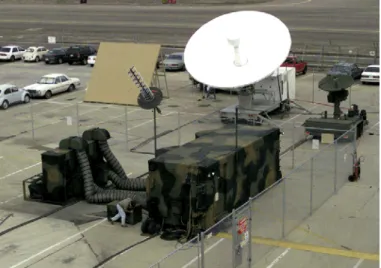
The ground segment is composed of two major elements: the RD-2A Mission Control Element (MCE) used to control the air vehicle and payloads; and the RD-2B Launch and
Recovery Element (LRE) that serves as the control station during takeoff, approach, and landing. The RD-2A MCE serves as the remote Global Hawk “cockpit” for the pilot and imagery sensor operator during en route and mission execution phases of flight. The MCE crew stations provide control of the air vehicle, Enhanced Integrated Sensor Suite (EISS) payload, and
communication systems via line-of-sight (LOS) and beyond-line-of-sight (BLOS) data links. The MCE pilot station displays flight instrumentation, system status, mission plans, and
navigation data. When necessary, the MCE pilot can independently conduct takeoff and landing operations from remote operating locations. The EISS sensor operator station provides the capability to command sensor operations, upload new imagery targets, monitor sensor status, initiate calibration, and distribute/store imagery data.
Figure 1-2. RD-2A Mission Control Element
The RD-2B LRE serves as the control station for takeoff, approach, and landing phases of flight. The LRE pilot station displays only flight instrumentation, system status, and data links necessary to support takeoff and landing operations. The LRE does not provide payload
operations or monitoring capability. After executing takeoff operations, the LRE pilot transfers command and control (C2) of the air vehicle to the MCE before the air vehicle travels outside the range of LOS data link systems. During recovery and landing phase, the MCE transfers air vehicle control to the LRE pilot after a reliable LOS data link is established. The LRE normally deploys with the air vehicle to support operations at forward operating locations.
Figure 1-3. RD-2B Launch and Recovery Element Sensor Payloads
The RQ-4B Global Hawk Block 30 is a multi-intelligence collection system equipped with both IMINT and SIGINT collection payloads. Both payloads operate simultaneously to provide broad area intelligence collection and sensor cross-cueing capabilities. The Air and
Ground Sensor Management Units installed in the air vehicle and MCE act as the control
interface between sensor payloads and the ground segment. This system provides sensor control capabilities for sensor operators. The system uses both LOS and BLOS data links to transmit collected data to intelligence exploitation sites.
IMINT Payload
The EISS payload, developed by Raytheon, contains an independent electro-optical (EO) sensor, an infrared (IR) sensor, and synthetic aperture radar (SAR) to provide high-resolution imagery necessary to identify intelligence Essential Elements of Information (EEIs). The EO sensor is a digital camera that collects reflected solar energy to support daytime image collection. The IR sensor is a thermal imaging device used to support both day and night image collection. The SAR sensor is a radar ground mapping radar used to support day, night, and all-weather imagery collection. It also collects and processes Ground Moving Target Indication (GMTI) data. The SAR sensor can function simultaneously with either the EO or the IR sensor. An EISS sensor operator controls the payload from the MCE.
SIGINT Payload
The AN/ASQ-230 Airborne Signals Intelligence Payload (ASIP), developed by Northrop Grumman Mission Systems Electromagnetic Systems Laboratory, collects and processes radio frequency (RF) signals to support intelligence operations and analysis. The system provides automatic signal detection, identification, direction finding, and geo-location. The ASIP sensor operator controls the payload from the supporting Distributed Common Ground System (DCGS) facility.
ASIP also supports network-centric, collaborative geo-location of high-priority signals by providing emitter data in support of Airborne Overhead Cooperative Operations (AOCO). The classified appendices to this report include additional information on ASIP frequency collection ranges and AOCO capabilities.
C2 and Data Transmission Architecture
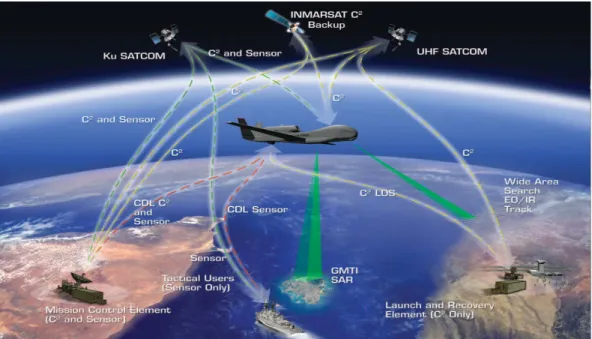
The RQ-4B Global Hawk Block 30 Airborne Integrated Communication System (AICS) provides redundant radio and satellite communications for aircraft C2, voice communications, and payload data transmission. The AICS system includes a wideband Ku-band Satellite Communications (SATCOM) data link, ultra high frequency (UHF) LOS or SATCOM C2 data link, and wideband air-to-ground Common Data Link (CDL) LOS system. Voice
communication between mission crews and external agencies use the Ku-band SATCOM data link or CDL. An integrated International Maritime Satellite (INMARSAT) system provides a backup C2 capability. The Communications Airborne Modem Assembly (CAMA) controls all air vehicle communication systems. Figure 1-4 depicts the current C2 and data transmission architecture.
Figure 1-4. RQ-4B Global Hawk Block 30 C2 and Intelligence Data Transmission Architecture Key Supporting Systems
Supporting systems that are not part of the core RQ-4B Global Hawk Block 30 system, but are integral to Global Hawk operations, include the Global Hawk Operations Center (GHOC) and the Air Force DCGS. The Global Hawk “Virtual Crew” concept integrates the activities of the Global Hawk mission crew with supporting systems and personnel.
Global Hawk “Virtual Crew”
The Global Hawk “Virtual Crew” includes all primary mission participants operating from geographically separated locations. Virtual crew core members are the LRE pilot, MCE pilot, EISS sensor operator, ASIP sensor operator, DCGS ISR mission commander, GHOC personnel, and the Combined Air Operations Center (CAOC) Global Hawk liaison officer (LNO). Mission requirements may expand this crew to include the CAOC Time-Sensitive Targeting (TST) cell, and other ISR system operators. Members communicate and coordinate mission activities in real time using a variety of voice and networked computer systems.
Global Hawk Operations Center (GHOC)
The GHOC is the focal point of Global Hawk operations for missions using the main operating base (MOB) MCE facility. The GHOC is manned by a Global Hawk pilot, EISS sensor operator, and intelligence officer that function as a mission coordination cell. The GHOC pilot and sensor operator support the MCE mission crew by coordinating directly with tasking authorities, operational users, and supporting agencies to maintain overall mission situational awareness. GHOC personnel monitor collection plan progress and update collection strategies to support dynamic target operations. They also provide direct support to the MCE mission crew by providing weather updates, monitoring alternate airfield status, assisting with emergencies, and providing threat awareness updates. In general, the GHOC assumes responsibility for many mission coordination activities, allowing the MCE mission crew to focus on mission tasks.
Air Force Distributed Common Ground System
The Air Force AN/GSQ-272 SENTINEL DCGS tasks, receives, processes, exploits, correlates, and disseminates intelligence data from national, theater, tactical, and commercial ISR sensors in a distributed environment. The RQ-4B Global Hawk Block 30 system routes IMINT and SIGINT data through the MCE to DCGS facilities using the Global Hawk communications architecture. Intelligence analysts (IAs) analyze, exploit, and disseminate processed intelligence information to end users through the DCGS dissemination network. Currently, the Air Force DCGS is comprised of five Distributed Ground Station (DGS) core sites. A distributed communications network allows each site to assist with data exploitation at another site, when required. Mission support capacity varies between core sites, but typical operations include simultaneous support for MQ-1 Predator, MQ-9 Reaper, RQ-4 Global Hawk, and U-2 missions.
Concept of Employment
Under the current Global Hawk concept of operations and employment, the RQ-4B Global Hawk Block 30 MOB is located at Beale Air Force Base (AFB), California.4 Three forward operating locations (FOLs) are located in U.S. Central Command (USCENTCOM), U.S. Pacific Command (USPACOM), and U.S. European Command (USEUCOM) areas of
responsibility. There are two primary employment architectures for Global Hawk operations: co-located and reach-back.
The co-located employment architecture bases all components of the Global Hawk system at the same site. Advantages of this concept include easier coordination between MCE and LRE operations, simplified communications requirements, and reduced support equipment requirements. Disadvantages include increased in-theater personnel and support requirements. The MOB at Beale AFB, California, uses this concept of employment to support training and operational missions.
The reach-back employment architecture places the LRE and air vehicle at a deployed forward operating area while the supporting MCE remains at the MOB. This allows the MCE better access to communications, backup facilities, logistics, and other support functions.
Disadvantages include more complex communications architectures and increased personnel and support requirements to maintain two separate operating sites. All planned RQ-4B Global Hawk Block 30 FOLs use this employment architecture.
A deployed Global Hawk Combat Air Patrol (CAP) or “orbit” is comprised of three primary air vehicles, one backup air vehicle, an assigned MCE, an LRE, and support equipment. Approximately 66 operations and maintenance personnel are required to support MCE
operations and 100 additional personnel are required to support a separate air vehicle and LRE operating location. During initial deployment, the air vehicles self-deploy by flying to the new operating location and other system components deploy by air or land transport. Upon arrival, a
4 June 2007 Air Force Air Combat Command Enabling Concept for RQ‐4 Global Hawk; July 2006 Capabilities
single Global Hawk CAP is intended to provide near-continuous on-station coverage for 30 days using only the spare parts contained in the pre-planned Mission Readiness Spares Package
(MRSP). After 30 days of deployed operations, theater supply systems provide additional supply support to sustain near continuous operations.
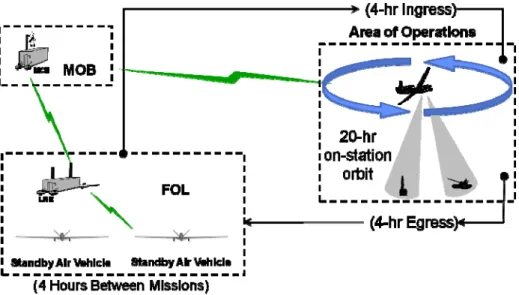
The Global Hawk Capabilities Development Document (CDD) defines “near-continuous” operations and Effective-Time-On-Station (ETOS) requirements based on a specific operational scenario depicted in Figure 1-5. The CDD-defined Global Hawk operational requirement is for a single Global Hawk CAP to provide 55 percent ETOS during a 30-day period of near-continuous operations. This equates to 396 effective on-station hours during a 720-hour period of
operations. While actual ETOS coverage requirements for a Global Hawk CAP vary significantly for specific operational scenarios, the capability to perform “near-continuous” operations for 30 days, as depicted below, enables the system to meet combatant commander expectations for persistent ISR support.
Figure 1-5. RQ-4B Global Hawk Block 30 Near-Continuous Operations (CDD Definition) Existing theater processes provide RQ-4B Global Hawk Block 30 mission tasking. A Global Hawk LNO, assigned to the Joint Force Air Component Commander staff, provides Global Hawk expertise to the theater CAOC ISR collection manager, and aids in developing specific Global Hawk missions.
Peacetime operational mission scenarios include Homeland Defense, Humanitarian Aid, Sensitive Reconnaissance, and other combatant command tasks. Most peacetime missions execute pre-planned routes to collect intelligence data on pre-planned targets. Peacetime mission generation and time-on-station requirements for a Global Hawk CAP vary by scenario and may not require near-continuous operations. Initial Air Force plans for peacetime operations project a sustained Global Hawk CAP mission generation rate of three 24-hour missions per week. Some peacetime operational scenarios may require intermittent “surge” periods beyond this level to support specific combatant commander ISR coverage requests.
Pre-conflict or wartime operational mission scenarios include Blockade and Quarantine Enforcement, Enemy Order of Battle Information, Combat Assessment, Targeting and Precision Strike Support, Personnel Recovery, Sensitive Reconnaissance Operations, and Special
Operations support. Wartime operations require a Global Hawk CAP to initiate near-continuous operations to provide theater commanders with persistent ISR coverage. Wartime missions are more fluid and include a greater proportion of ad hoc targets that emerge during mission execution. The Air Force RQ-4 Tactical Employment Manual describes three types of Global Hawk ad hoc target requests: standard, dynamic, and non-interference. Standard ad hoc targets are generally not time-sensitive and have a Latest Time Information of Value (LTIOV) greater than three hours. The mission crew adds standard ad hoc targets to the mission collection plan at an opportune time. Dynamic ad hoc target requests are time-sensitive with an LTIOV of less than three hours. The CAOC may prioritize collection of dynamic ad hoc targets ahead of all pre-planned targets. Non-interference ad hoc targets are the lowest priority and are collected without interference to any other mission priority or operation.
Key Operational Requirements
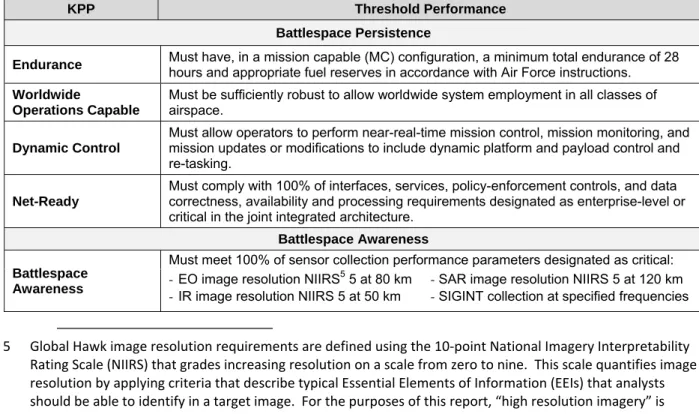
The 2006 Global Hawk CDD identifies five Key Performance Parameters (KPPs) for the Global Hawk Block 30 system shown in Table 1-1. The CDD requirements identified for delivery in FY 2009 or earlier define the system performance thresholds applicable to this
IOT&E and initial RQ-4B Global Hawk Block 30 fielding. The FY 2009 CDD thresholds define the current FY 2011 program performance baseline since there was a two-year program schedule delay resulting from system development problems.
Table 1-1. RQ-4B Global Hawk Block 30 Key Performance Parameters (KPPs)
KPP Threshold Performance
Battlespace Persistence
Endurance Must have, in a mission capable (MC) configuration, a minimum total endurance of 28 hours and appropriate fuel reserves in accordance with Air Force instructions. Worldwide
Operations Capable
Must be sufficiently robust to allow worldwide system employment in all classes of airspace.
Dynamic Control
Must allow operators to perform near-real-time mission control, mission monitoring, and mission updates or modifications to include dynamic platform and payload control and re-tasking.
Net-Ready
Must comply with 100% of interfaces, services, policy-enforcement controls, and data correctness, availability and processing requirements designated as enterprise-level or critical in the joint integrated architecture.
Battlespace Awareness Battlespace
Awareness
Must meet 100% of sensor collection performance parameters designated as critical:
- EO image resolution NIIRS5 5 at 80 km
- IR image resolution NIIRS 5 at 50 km
- SAR image resolution NIIRS 5 at 120 km
- SIGINT collection at specified frequencies
5 Global Hawk image resolution requirements are defined using the 10‐point National Imagery Interpretability
Rating Scale (NIIRS) that grades increasing resolution on a scale from zero to nine. This scale quantifies image
resolution by applying criteria that describe typical Essential Elements of Information (EEIs) that analysts
should be able to identify in a target image. For the purposes of this report, “high resolution imagery” is
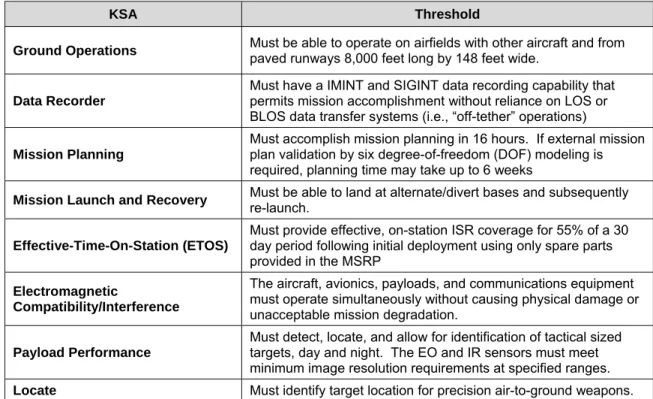
The 2006 Global Hawk CDD also identifies seven Key System Attributes (KSAs) necessary to ensure mission effectiveness shown in Table 1-2.
Table 1-2. RQ-4B Global Hawk Block 30 Key System Attributes (KSAs)
KSA Threshold
Ground Operations Must be able to operate on airfields with other aircraft and from paved runways 8,000 feet long by 148 feet wide.
Data Recorder
Must have a IMINT and SIGINT data recording capability that permits mission accomplishment without reliance on LOS or BLOS data transfer systems (i.e., “off-tether” operations)
Mission Planning
Must accomplish mission planning in 16 hours. If external mission plan validation by six degree-of-freedom (DOF) modeling is required, planning time may take up to 6 weeks
Mission Launch and Recovery Must be able to land at alternate/divert bases and subsequently re-launch.
Effective-Time-On-Station (ETOS)
Must provide effective, on-station ISR coverage for 55% of a 30 day period following initial deployment using only spare parts provided in the MSRP
Electromagnetic
Compatibility/Interference
The aircraft, avionics, payloads, and communications equipment must operate simultaneously without causing physical damage or unacceptable mission degradation.
Payload Performance
Must detect, locate, and allow for identification of tactical sized targets, day and night. The EO and IR sensors must meet minimum image resolution requirements at specified ranges.
Locate Must identify target location for precision air-to-ground weapons.
Maintenance and Training Concepts
Per the June 2007 Air Force Air Combat Command Enabling Concept for RQ-4 Global Hawk, Air Force military personnel provide RQ-4 Global Hawk maintenance support using a two-level maintenance concept. MOB and FOL military personnel perform organizational-level maintenance to maximize weapon system availability, unit flexibility, and self-sufficiency. Air Force Engineering and Technical Services and contractor field services representatives provide additional technical support to military maintenance personnel. Contractor personnel will perform all maintenance on the ASIP sensor payload through FY 2011. Military personnel will assume two-level maintenance responsibilities as ASIP maintenance training and technical data become available.
Contractor field services representatives provide on-site depot-level maintenance for components requiring maintenance activities beyond the scope of approved organizational-level maintenance technical orders. In the long-term, depot-level maintenance will be conducted at the three Air Force air logistics centers as directed by future Source of Repair Assignment Process decisions.
During wartime operations, contractor support personnel continue to provide
maintenance support. During periods of near-continuous operations, additional Active Duty, Reserve, and National Guard personnel may augment maintenance units. For operating locations
in high threat environments, unit commanders may decide to replace contractor personnel with military personnel.
The Air Force provides formal training for Global Hawk pilots and EISS sensor operators through the RQ-4 Global Hawk formal training unit located at Beale AFB, California. AF DCGS ASIP sensor operators receive formal training from the Air Force ISR Agency. Global Hawk maintenance personnel receive training that incorporates both Air Force formal training courses and on-the-job training.
Section Two
Test Adequacy
The operational testing of the RQ-4B Global Hawk Block 30 system was adequate to support an evaluation of operational effectiveness and operational suitability. The Air Force Operational Test and Evaluation Center (AFOTEC) conducted the RQ-4B Global Hawk Block 30 Initial Operational Test and Evaluation (IOT&E) from October 4 through December 14, 2010, in accordance with the DOT&E-approved test plan. During IOT&E, the Air Force 9th
Reconnaissance Wing operated four production-representative RQ-4B Global Hawk Block 30 air vehicles delivered by Northrop Grumman as low-rate initial production systems. One air vehicle was equipped with both the Enhanced Integrated Sensor Suite (EISS) and Airborne Signals Intelligence Payload (ASIP) payloads. The three remaining air vehicles carried only the EISS payload, since production ASIP sensors were not yet available. Production Launch and Recovery Element (LRE) and Mission Control Element (MCE) ground stations supported all IOT&E missions.
Developmental Testing
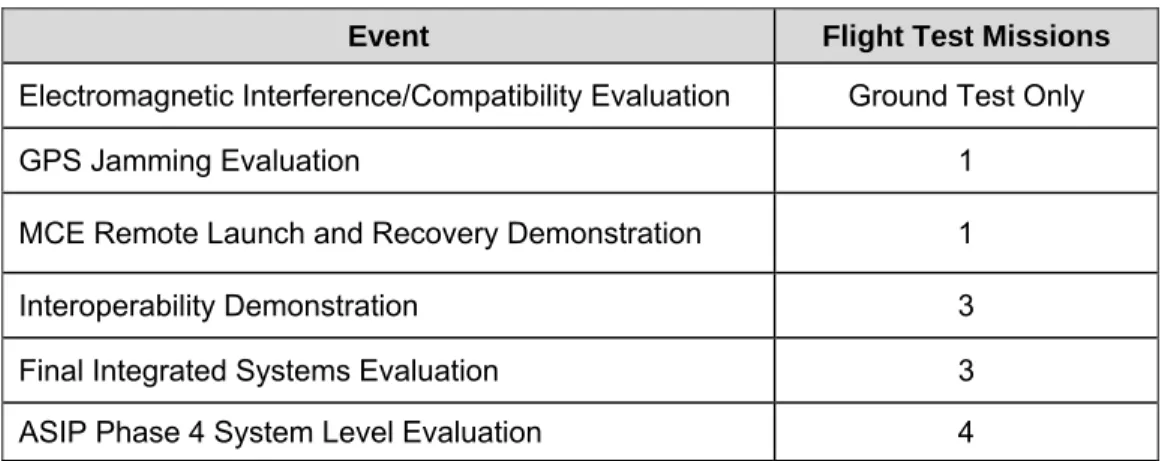
AFOTEC collected operational test data during selected Air Force Flight Test Center integrated developmental and operational test events conducted prior to IOT&E. Table 2-1 shows integrated test events that provided operational test data for air vehicle, ground segment, and mission payload performance.
Table 2-1. Integrated Developmental/Operational Test Events
Event Flight Test Missions
Electromagnetic Interference/Compatibility Evaluation Ground Test Only
GPS Jamming Evaluation 1
MCE Remote Launch and Recovery Demonstration 1
Interoperability Demonstration 3
Final Integrated Systems Evaluation 3 ASIP Phase 4 System Level Evaluation 4
The Joint Interoperability Test Command (JITC) and the Defense Information Systems Agency (DISA) Field Security Operations Penetration Test Team also conducted interoperability and information assurance testing to provide data for this report.
Operational Testing
AFOTEC planned 17 IOT&E missions and added four additional missions to replace test events lost due to weather and maintenance cancellations or mission aborts. The 9th
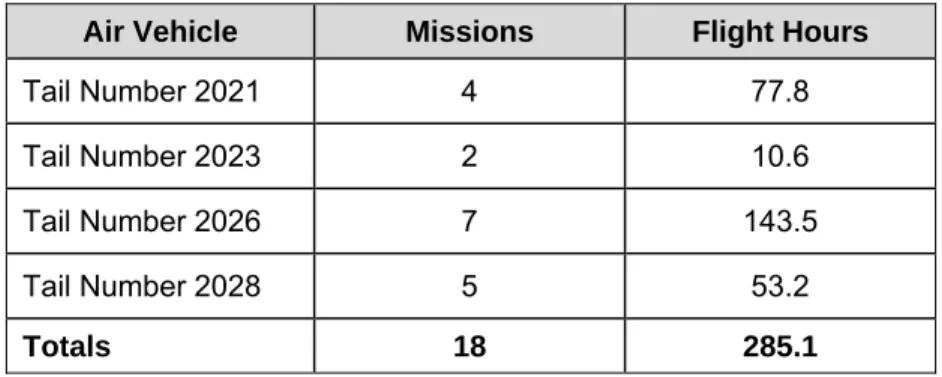
Reconnaissance Wing flew 18 of the 21 scheduled missions for a total of 285.1 flight hours. Two missions cancelled due to maintenance problems and one cancelled due to weather.
Table 2-2. IOT&E Missions and Flight Hours by Air Vehicle Air Vehicle Missions Flight Hours
Tail Number 2021 4 77.8
Tail Number 2023 2 10.6
Tail Number 2026 7 143.5
Tail Number 2028 5 53.2
Totals 18 285.1
The initial operational tempo during IOT&E replicated a peacetime mission generation rate of two to three missions per week. After four weeks of sustained peacetime operations, the operational tempo accelerated to a wartime mission “surge” to provide near continuous
intelligence, surveillance, and reconnaissance (ISR) coverage per the Global Hawk Concept of Employment. During the wartime surge period, the 9th Reconnaissance Wing attempted to generate and fly five consecutive 28-hour missions in accordance with the Global Hawk Concept of Employment.
Mission Conduct
The combined AFOTEC and 9th Reconnaissance Wing test team planned and flew IOT&E missions across the western and southeastern United States and Alaska to collect imagery in desert, high foliage, littoral, and arctic environments. Missions included long
endurance flights greater than 20 hours while using the following DoD test ranges and facilities:
• Utah Test and Training Range (UTTR)
• Nevada Test and Training Range (NTTR)
• Naval Strike and Air Warfare Center (NSAWC) Fallon Training Range
• Naval Air Warfare Center (NAWC) China Lake Electronic Combat Range
• Pacific Alaska Range Complex (PARC)
• Eglin Air Force Base (AFB) Test Ranges
• Fort Huachuca Electronic Proving Ground
• Yuma Proving Ground
• Fort Stewart Multi-Purpose Range Complex
• Mountain Home AFB Range Complex
Air Force 9th Reconnaissance Wing flight crews and maintenance personnel conducted IOT&E takeoff and landing operations missions at Beale AFB, California. The Air Force 412th
Test Wing provided takeoff, landing, and maintenance support for a limited number of additional missions flown from Edwards AFB, California. Air Force pilots and EISS sensor operators controlled IOT&E missions from the Global Hawk Operations Center (GHOC) and MCE at Beale AFB. ASIP sensor operators controlled the ASIP payload from the Air Force Distributed Ground Station (DGS)-2 facility at Beale AFB.
AFOTEC used operational intelligence processing, exploitation, and dissemination facilities to support IOT&E missions. Intelligence analysts from the Air Force 480th
Intelligence, Surveillance, and Reconnaissance Wing exploited imagery intelligence (IMINT) data at the DGS-2 site. Army intelligence analysts exploited imagery at a tactical intelligence site at China Lake Naval Air Warfare Center, California. Signals intelligence (SIGINT) analysts exploited SIGINT data at the DGS-2 site and other distributed communications intelligence exploitation sites.
The Air Force Combined Air Operations Center-Nellis (CAOC-N) at Nellis AFB, Nevada, tasked and directed IOT&E missions. The CAOC-N Global Hawk LNO provided operationally realistic, real-time interaction with mission crews to include coordination of dynamic mission plan and target changes.
Mission Types
The test team evaluated RQ-4B Global Hawk Block 30 mission effectiveness by evaluating system performance while executing mission scenario types derived from Major Combat Operation planning scenarios, current overseas contingency operations, and homeland defense operations. Scenarios included ISR operations to detect, locate, identify, and monitor targets and operations of intelligence interest. The test team developed 19 mission scenario variations to provide an operationally realistic mission context for planning IMINT and SIGINT data collection operations.
Data Collection
During IOT&E, Global Hawk crews collected IMINT and SIGINT information while executing operationally realistic mission scenarios and interfacing with operational intelligence processing, exploitation, and dissemination facilities and processes. Air Force intelligence analysts evaluated the image resolution and operational intelligence value of 1,138 target images containing pre-identified Essential Elements of Information (EEIs). Analysts rated images for intelligence value using the AFOTEC Four-Point EEI Rating Scale.6 EEIs are specific items of information regarding an adversary or the environment needed by commanders to support operational planning, execution, or assessment activities. They typically provide information regarding adversary capabilities, activities, status, or intentions. For IOT&E targets, EEIs included specific characteristics for personnel, missile facilities, vehicles, aircraft, buildings,
6 The AFOTEC Four‐Point EEI Rating Scale includes numerical Figure of Merit (FOM) ratings from 0 to 3 based on
intelligence analyst ability to exploit an image and identify specific EEIs. A FOM rating of 0 indicates that no
EEI content was identified by intelligence analysts. FOM 1 ratings indicate that up to 50 percent of EEIs were
identified. FOM 2 ratings indicate that 51 to 99 percent of EEIs were identified. A FOM 3 rating indicates that
railroad facilities, roads, antennas, radar sites, and decoy targets to include numbers, types, and operating status. The test team evaluated imagery collected in desert, high foliage, and arctic ground environments.
Intelligence analysts from the National Geo-Spatial Intelligence Agency evaluated 182 additional target images to determine image resolution performance for the electro-optical (EO), infrared (IR), and synthetic aperture radar (SAR) sensors. Analysts evaluated image resolution using the National Imagery Interpretability Rating Scale (NIIRS).
AFOTEC used data collected from automated systems, operator logs, and test ranges to evaluate communications, data link, and sensor payload technical performance. The test team also observed mission planning and logistics demonstrations to collect additional data in these areas. Air Force pilots, sensor operators, intelligence analysts, and maintenance personnel completed surveys to provide additional information and observations on all aspects of system performance. Survey responses included ratings based on a six-point acceptability rating scale and written comments.
AFOTEC collected system reliability, availability, and maintainability data during
IOT&E and developmental test events conducted between May 1, 2010 and December 14, 2010. A Joint Reliability and Maintainability Evaluation Team (JRMET) adjudicated suitability data in accordance with established procedures and approved test plans. DOT&E representatives participated in all JRMET data reviews.
Modeling and Simulation
During IOT&E, AFOTEC used the accredited AFOTEC Global Hawk Aircraft Readiness Model (ARM) to evaluate system reliability, availability, and maintainability (RAM)
performance during extended operating periods. The ARM simulation uses system design and JRMET-adjudicated maintenance data to simulate system and maintenance operations for a Global Hawk Combat Air Patrol (CAP) of three air vehicles, one MCE, and one LRE during 30 days of near-continuous operations. The model provided mission capability rates, sortie
generation rates, Effective-Time-On-Station (ETOS), break rates, air abort rates, cannibalization rates, and spare parts requirements. The Global Hawk program manager also accredited this model to track and report on system RAM performance and reliability growth.
The AFOTEC test team used the Air Force Automated Air Loading and Planning Software (AALPS) model to calculate the number of C-17 cargo pallet positions required to transport a single Global Hawk CAP consisting of three air vehicles, one MCE, one LRE, ground support equipment, and associated maintenance support packages. AALPS data provided the basis for computing the number of C-17 aircraft needed to deploy a Global Hawk CAP to a deployed operating location.
Maintenance and Logistics Support
For operations at Beale AFB, 9th Reconnaissance Wing military personnel provided maintenance support during IOT&E using a two-level maintenance concept. Air Force Engineering and Technical Services and contractor field services representatives provided additional technical support. Contractor personnel provided maintenance support for the ASIP
sensor payload per the current Air Force support concept. Air Force 412th Test Wing maintenance personnel provided limited maintenance support for three IOT&E missions launched and recovered at Edwards AFB, California.
Test Limitations
Operational and test resources were not available during IOT&E to demonstrate 30 consecutive days of near-continuous flight operations to evaluate wartime ETOS operational requirements. The accredited ARM simulation provided additional data necessary to complete the evaluation.
The AFOTEC test team did not observe or evaluate ground operations in extreme cold temperatures during IOT&E or the preceding developmental test program. Although operational requirements identify an operational need to operate in extreme temperature environments, initial RQ-4B Global Hawk Block 30 operating bases are not located in extreme cold weather climates.
Available test ranges were not equipped to replicate maximum SIGINT emitter density and simultaneity environments described by operational requirements documents. Observed signals environments did include high density, urban signal environments to provide a more stressing operational test scenario.
Section Three
Operational Effectiveness
The RQ-4B Global Hawk Block 30 demonstrated the capability to provide about 40 percent of requested intelligence, surveillance, and reconnaissance (ISR) coverage when used at planned peacetime or non-crisis operational tempos. However, the system is not operationally effective for conducting near-continuous, persistent ISR as specified in the Air Force Concept of Employment. The Enhanced Imagery Sensor Suite (EISS) provides imagery that meets or exceeds most operational requirements and provides actionable imagery intelligence (IMINT) products to operational users. The Airborne Signals Intelligence Payload (ASIP) provides a limited operational utility to detect, identify, and locate some threat radars and to detect some communication signals, but does not consistently deliver actionable signal intelligence (SIGINT) end-products to operational users due to technical performance deficiencies and immature
training, tactics, techniques, and procedures.
The RQ-4B Global Hawk Block 30 system can conduct launch and recovery operations from both deployed and main operating base airfields. A lack of air vehicle anti-ice or de-ice systems limits all-weather operations and may restrict takeoff and landing operations at cold weather operating locations. Redundant air vehicle command and control systems effectively support mission operations. Operators currently conduct worldwide operations by employing time-consuming, interim operating procedures to mitigate airspace compliance and mission planning deficiencies. Ground mission management and coordination capabilities are adequate for most operations, but communication system deficiencies and a lack of crew situational awareness tools reduce mission effectiveness.
When operating on-station, the RQ-4B Global Hawk Block 30 provides an operational capability to collect, transmit, and process IMINT information. During daytime, clear weather conditions, the EISS electro-optical (EO) sensor produces high-resolution spot mode imagery that provides valuable intelligence information at ranges up to 80 km. During night, clear weather operations, or in environments with high thermal gradients, the infrared (IR) sensor produces high-resolution spot mode imagery at short, near-nadir (overhead) ranges. The synthetic aperture radar (SAR) sensor provides around-the-clock, all-weather IMINT collection capabilities, producing high-resolution spot mode imagery at ranges up to 200 km, although intelligence value decreases as range increase. The EISS does not meet operational requirements for providing Wide Area Search (WAS) imagery, GMTI capabilities, or target-quality
coordinates from imagery. When integrated with supporting IMINT processing, exploitation, and dissemination systems, the RQ-4B Global Hawk Block 30 system provides imagery to support pre-planned and standard ad hoc target requests. IMINT transmission and processing times limit capabilities to respond to some short-notice, time-sensitive target imaging requests.
The RQ-4B Global Hawk Block 30 SIGINT payload collects large volumes of
information across the designated frequency spectrum and provides a limited capability to detect, identify, and locate specific signals of interest. However, when integrated with supporting intelligence processing and dissemination systems, the Global Hawk Block 30 system does not
consistently deliver actionable SIGINT reports to operational users. Technical deficiencies, inadequate training, and immature tactics currently limit SIGINT operational utility. ASIP sensor instability also reduces operational effectiveness when operating on station, requiring frequent sensor or application resets are required to clear system faults.
The RQ-4B Global Hawk Block 30 system does not meet Net Ready Key Performance Parameter (KPP) requirements for interoperability or information assurance. The system is not certified for joint interoperability and implementation of required DoD information assurance controls is incomplete.
Operational effectiveness was evaluated during 21 IOT&E missions attempted between October 4 and December 14, 2010. The test team evaluated mission effectiveness while executing mission scenarios derived from major combat operation planning scenarios, current overseas contingency operations, and homeland defense operations. The test team developed 19 mission scenario variations to provide an operationally realistic mission context for IMINT and SIGINT data collection operations.
Key Performance Parameters (KPPs)
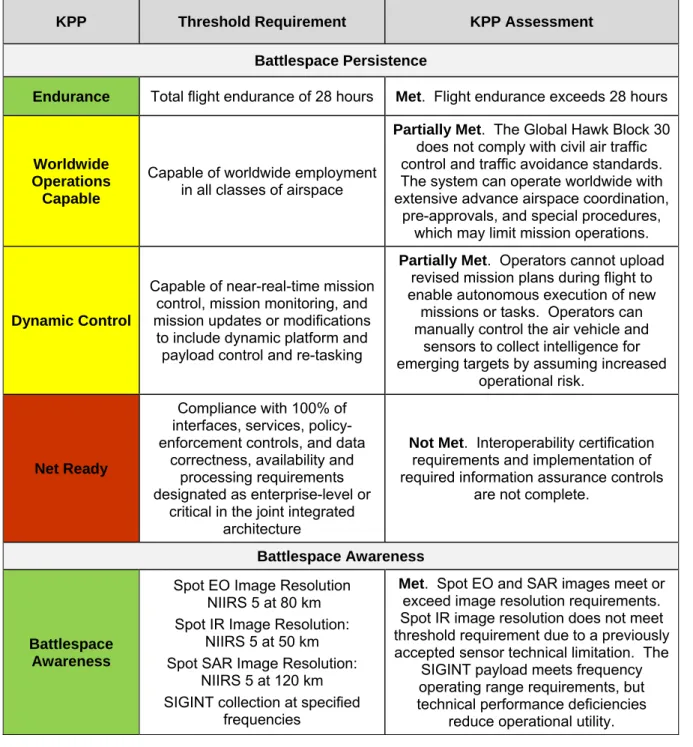
Table 3-1 shows evaluation results for the five RQ-4B Global Hawk Block 30 KPPs specified the Global Hawk Capabilities Development Document (CDD). These KPP operational requirements define essential system attributes that are pre-requisites for the delivery of desired end-to-end operational mission capabilities. The Global Hawk Block 30 system met the
Endurance KPP and Battlespace Awareness KPP and partially met two additional KPPs related to ground station, and air vehicle capabilities. The system does not meet Net Ready KPP requirements. Although the Global Block 30 system largely complies with four of five KPP requirements, IOT&E results show that KPP compliance alone is not sufficient to assure operational success in all mission areas.
Table 3-1. RQ-4B Global Hawk Block 30 Key Performance Parameters (KPPs)
KPP Threshold Requirement KPP Assessment
Battlespace Persistence
Endurance Total flight endurance of 28 hours Met. Flight endurance exceeds 28 hours
Worldwide Operations Capable
Capable of worldwide employment in all classes of airspace
Partially Met. The Global Hawk Block 30 does not comply with civil air traffic control and traffic avoidance standards. The system can operate worldwide with extensive advance airspace coordination,
pre-approvals, and special procedures, which may limit mission operations.
Dynamic Control
Capable of near-real-time mission control, mission monitoring, and mission updates or modifications
to include dynamic platform and payload control and re-tasking
Partially Met. Operators cannot upload revised mission plans during flight to enable autonomous execution of new
missions or tasks. Operators can manually control the air vehicle and
sensors to collect intelligence for emerging targets by assuming increased
operational risk.
Net Ready
Compliance with 100% of interfaces, services, policy-enforcement controls, and data
correctness, availability and processing requirements designated as enterprise-level or
critical in the joint integrated architecture
Not Met. Interoperability certification requirements and implementation of required information assurance controls
are not complete.
Battlespace Awareness
Battlespace Awareness
Spot EO Image Resolution NIIRS 5 at 80 km Spot IR Image Resolution:
NIIRS 5 at 50 km Spot SAR Image Resolution:
NIIRS 5 at 120 km SIGINT collection at specified
frequencies
Met. Spot EO and SAR images meet or exceed image resolution requirements. Spot IR image resolution does not meet threshold requirement due to a previously accepted sensor technical limitation. The
SIGINT payload meets frequency operating range requirements, but technical performance deficiencies
Battlespace Persistence
The RQ-4B Global Hawk Block 30 system is capable of long endurance missions exceeding 28 hours. However, air vehicle long endurance capabilities will not routinely yield persistent ISR coverage until existing system reliability problems are resolved. The RQ-4B Global Hawk Block 30 meets, with limitations, other operational requirements necessary to provide persistent worldwide operations.
Long Endurance Flight
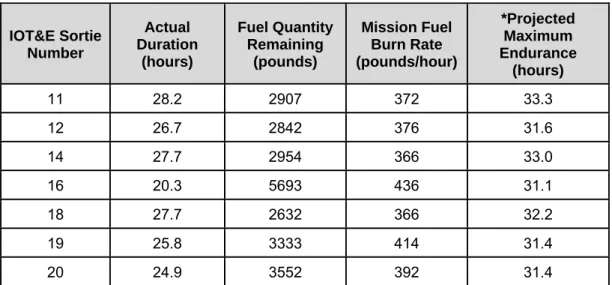
The RQ-4B Global Hawk Block 30 air vehicle is capable of long endurance flight in excess of 28 hours at operating altitudes up to 60,000 feet. The system demonstrated this capability during numerous developmental and operational missions. As shown in Table 3-2, IOT&E long endurance mission durations ranged from 20.3 to 28.2 hours. Each of these missions landed with sufficient fuel reserves to extend flight durations beyond 31 hours, if required.
Table 3-2: IOT&E Long Endurance Flight Missions IOT&E Sortie Number Actual Duration (hours) Fuel Quantity Remaining (pounds) Mission Fuel Burn Rate (pounds/hour) *Projected Maximum Endurance (hours) 11 28.2 2907 372 33.3 12 26.7 2842 376 31.6 14 27.7 2954 366 33.0 16 20.3 5693 436 31.1 18 27.7 2632 366 32.2 19 25.8 3333 414 31.4 20 24.9 3552 392 31.4
* Projected maximum endurance with 1,000-pound fuel reserve.
Airfield Operations
The RQ-4B Global Hawk Block 30 meets the operational requirement to operate from standard runways at airfields conducting mixed aircraft operations. Air vehicle performance is adequate for operations from paved surface runways at least 8000 feet long and 148 feet wide. The system demonstrated the capability to safely operate from airfields conducting diverse air traffic operations with mixed aircraft types during developmental test, operational test, and real-world operations.
All Weather Operations
RQ-4B Global Hawk Block 30 all-weather operational capabilities are limited. The air vehicle does not have anti-ice or de-ice systems and does not meet the operational requirement to
operate in light icing conditions. Current flight restrictions that require avoidance of visible moisture and precipitation at or above the freezing level restricts flight operations and will diminish sortie rates at some operating locations. This limitation primarily affects climb and descent flight operations near Global Hawk air vehicle operating bases.
Air vehicle and sensor payload operating limitations restrict ground and flight operations in extreme environmental conditions. Due to air vehicle and sensor payload sensitivity to hot and cold temperatures, maintenance personnel accomplish nearly all aircraft preflight and maintenance activities in environmentally controlled hangars. During high-altitude flight, operations are limited to air temperatures warmer than minus 65 degrees Celsius. This restriction may limit maximum operational altitudes for some missions.
Worldwide Airspace Operations
The RQ-4B Global Hawk Block 30 system is capable of worldwide employment in all classes of airspace, but only with extensive advance airspace coordination, pre-approvals, and special procedures. The RQ-4B Global Hawk Block 30 meets basic air traffic communication, navigation, and surveillance equipment requirements. However, the system does not currently meet all Federal Aviation Administration or International Civil Aviation Organization standards for response to dynamic air traffic control instructions or traffic awareness and avoidance. All unmanned aerial systems that operate in civil airspace currently share this deficiency and associated operating limitations. The Department of Defense is pursuing new technologies to address these shortfalls, but they are not yet available for integration with the Global Hawk system. In the interim, Global Hawk operations that transit or utilize civil airspace will require pre-coordinated special procedures and approvals. The days or weeks required to develop and implement these procedures may delay employment in new operating areas. In some cases, civil airspace operating agreements may restrict the frequency and volume of flight operations, which could reduce RQ-4B Global Hawk Block 30 operational capabilities.
Mission Planning
The current RQ-4B Global Hawk Block 30 mission planning process requires more than four weeks to produce and validate new mission plans necessary to deploy and operate in new operating areas. This meets the operational requirement threshold of less than six weeks for new missions. Creation of new Global Hawk mission plans, using the Air Force Mission Planning Support System (AFMSS), is a time and data-intensive process. Since the Global Hawk air vehicle operates autonomously during flight, all information needed to execute normal, contingency, and potential emergency flight operations is programmed using AFMSS and pre-loaded into the air vehicle mission computers for each mission. Mission planners must validate new AFMSS mission plans using a six degree of freedom (6-DOF) computer simulation to verify flight plan accuracy and preclude programming errors that could result in loss of the air vehicle. During the IOT&E mission planning event, programming an operationally realistic mission plan required 46 hours with an additional 58 hours required to create the pilot mission plan book. The required 6-DOF computer simulation and validation process required an additional four weeks. Although the Global Hawk mission planning process meets the current operational requirement of less than six weeks for new mission plans, it limits rapid system deployment or employment