Guide to Secure Web Services
Recommendations of the National Institute
of Standards and Technology
Anoop Singhal
Theodore Winograd
Karen Scarfone
Guide to Secure Web Services
NIST Special Publication 800-95
Recommendations of the National
Institute of Standards and Technology
Anoop Singhal
Theodore Winograd
Karen Scarfone
C O M P U T E R S E C U R I T Y
Computer Security Division
Information Technology Laboratory
National Institute of Standards and Technology Gaithersburg, MD 20899-8930
August 2007
U.S. Department of Commerce
Carlos M. Gutierrez, Secretary National Institute of Standards and Technology
Reports on Computer Systems Technology
The Information Technology Laboratory (ITL) at the National Institute of Standards and Technology (NIST) promotes the U.S. economy and public welfare by providing technical leadership for the nation’s measurement and standards infrastructure. ITL develops tests, test methods, reference data, proof of concept implementations, and technical analysis to advance the development and productive use of information technology. ITL’s responsibilities include the development of technical, physical,
administrative, and management standards and guidelines for the cost-effective security and privacy of sensitive unclassified information in Federal computer systems. This Special Publication 800-series reports on ITL’s research, guidance, and outreach efforts in computer security and its collaborative activities with industry, government, and academic organizations.
National Institute of Standards and Technology Special Publication 800-95 Natl. Inst. Stand. Technol. Spec. Publ. 800-95, 128 pages (Aug. 2007)
Certain commercial entities, equipment, or materials may be identified in this document in order to describe an experimental procedure or concept adequately. Such identification is not intended to imply recommendation or endorsement by the
National Institute of Standards and Technology, nor is it intended to imply that the entities, materials, or equipment are necessarily the best available for the purpose.
Acknowledgements
The authors, Anoop Singhal and Karen Scarfone of the National Institute of Standards and Technology (NIST) and Theodore Winograd of Booz Allen Hamilton, wish to thank their colleagues who contributed technical content to this document, especially Holly Lynne McKinley, Patrick Holley, and Karen
Mercedes Goertzel of Booz Allen Hamilton. The authors would like to acknowledge Tim Grance, David Ferraiolo, and Rick Kuhn of NIST, Jeremy Epstein of Web Methods and David Kleiner, Michael Colon, Steven Lavenhar, and Victoria Thompson of Booz Allen Hamilton, for their keen and insightful
Table of Contents
Executive Summary...ES-1
1. Introduction ...1-1
1.1 Authority...1-1 1.2 Purpose and Scope ...1-1 1.3 Audience ...1-1 1.4 Document Structure ...1-2
2. Background to Web Services and Their Relationship to Security ...2-1
2.1 Introducing Web Services ...2-1 2.1.1 Web Service Discovery ...2-1 2.1.2 Web Service Messaging...2-2 2.1.3 Web Portals ...2-3 2.1.4 Web Service Roles, Modes, and Properties...2-3 2.1.5 Coordination: Orchestration and Choreography...2-5 2.2 Elements of Security ...2-7 2.3 Web Services Security Dimensions ...2-8 2.3.1 Secure Messaging...2-8 2.3.2 Protecting Resources ...2-8 2.3.3 Negotiation of Contracts ...2-9 2.3.4 Trust Relationships...2-10 2.3.5 Requirements for Secure Software ...2-11 2.4 Meeting the Requirements for Securing Web Services ...2-11 2.4.1 Secure Web Service Standards Stack ...2-11 2.4.2 Relationship of Web Service Security Requirements to Standards...2-13 2.5 Core Services ...2-13 2.6 Threats Facing Web Services ...2-15 2.7 Common Risks Facing Web Services...2-17 2.8 Web Services’ Interfaces with Network/Infrastructure Security Architectures...2-19 2.9 Summary...2-20
3. Web Service Security Functions and Related Technologies ...3-1
3.1 Service-to-Service Authentication...3-1 3.1.1 Service Chaining ...3-1 3.1.2 WS-Security for Authentication...3-2 3.1.3 Security Concerns of WS-Security ...3-3 3.2 Identity Management ...3-4 3.2.1 Identity Management Architectures ...3-6 3.2.2 Laws of Identity...3-6 3.2.3 Identity Management and Web Services...3-7 3.3 Establishing Trust between Services ...3-8 3.3.1 Federation of Trust ...3-9 3.3.2 Trust Federation Frameworks ...3-9 3.4 Describing Web Services Policies (WS-Policy)...3-11 3.5 Distributed Authorization and Access Management ...3-14 3.5.1 Authorization Models ...3-14 3.5.2 Enforcing Least Privilege for Services...3-17 3.5.3 SAML...3-18
3.5.4 XACML ...3-25 3.5.5 Role of XML Schema in Implementing Access Control ...3-28 3.5.6 Use of Specialized Security Metadata for Access Control ...3-29 3.6 Confidentiality and Integrity of Service to Service Interchanges ...3-30 3.6.1 Transport Layer Confidentiality and Integrity: HTTPS ...3-30 3.6.2 XML Confidentiality and Integrity...3-30 3.6.3 WS-Security for SOAP Confidentiality and Integrity ...3-31 3.6.4 Role of XML Gateways in Integrity Protection ...3-32 3.7 Accountability End-to-End throughout a Service Chain ...3-33 3.7.1 Audit in the SOA Environment...3-34 3.7.2 Non-Repudiation of Web Service Transactions...3-34 3.8 Availability of Web Services ...3-35 3.8.1 Failover...3-36 3.8.2 Quality of Service ...3-36 3.8.3 Reliable Messaging ...3-37 3.8.4 Handling Service Deadlock ...3-37 3.8.5 Service Recursion ...3-38 3.9 Securing the Discovery Service: Secure Interfaces to UDDI and WSDL...3-38 3.9.1 UDDI Structure ...3-38 3.9.2 UDDI Operations ...3-39 3.9.3 Secure Access to the Registry ...3-40 3.9.4 Service Inquiry API ...3-40 3.9.5 Service Publishing API ...3-41 3.9.6 UDDI and WSDL ...3-42 3.10 Summary...3-42
4. Human User’s Entry Point into the SOA: Web Portals ...4-1
4.1 Proxy Agents...4-1 4.2 Using the Portal to Control User Authorization and Access to Web Services...4-2 4.3 Portal Interaction with the SOA’s Discovery Service ...4-3 4.4 Summary...4-3
5. Secure Web Service-Enabling of Legacy Applications ...5-1
5.1 Legacy Authentication to Web Services ...5-1 5.2 Authorization and Access Control in Legacy Applications ...5-1 5.3 Extending Non-Web Applications to Be Able to Participate in SOAs...5-2 5.4 Public Key Enabling Concerns Specific to Web Services and SOAs ...5-2 5.5 Accountability for Legacy Application Transactions ...5-3 5.6 Database Security Challenges in SOA Environments ...5-3 5.7 Maintaining Security of Legacy Systems Exposed via Web Services ...5-3 5.8 Summary...5-4
6. Secure Implementation Tools and Technologies ...6-1
6.1 Web Services Developer Toolkits ...6-1 6.2 XML Parsers ...6-1 6.3 Languages for Secure Web Service Development ...6-2 6.3.1 Procedural Languages ...6-2 6.3.2 XML ...6-4 6.4 Security Testing: Tools and Techniques ...6-5 6.5 Summary...6-6
List of Appendices
Appendix A— Common Attacks Against Web Services ... A-1 Appendix B— ebXML... B-1 Appendix C— Glossary ... C-1 Appendix D— Acronyms and Abbreviations ... D-1 Appendix E— Print Resources ... E-1 Appendix F— Online Resources ... F-1
List of Figures
Figure 2-1. Web Service Discovery Example ...2-1 Figure 2-2. Web Service Messaging Example ...2-2 Figure 2-3. Example Portal Interface ...2-3 Figure 2-4. Intermediary Services ...2-5 Figure 2-5. The Loan Service and Its Intermediaries ...2-5 Figure 2-6. A Web Service Choreography ...2-6 Figure 2-7. A Web Service Orchestration ...2-6 Figure 2-8. The Rate Service as an Orchestration ...2-7 Figure 2-9. Web Services Security Standards: Notional Reference Model ...2-12 Figure 2-10. Core Services Used by the Loan Service ...2-14 Figure 3-1. Identity Management Overview ...3-5 Figure 3-2. Sample WS-Policy Expression ...3-11 Figure 3-3. Sample WS-ReliableMessaging Policy Expression...3-12 Figure 3-4. Sample WS-Policy Expression Using ExactlyOne ...3-13 Figure 3-5. ABAC Policy Function ...3-15 Figure 3-6. Use of SAML and XACML in Implementing ABAC ...3-16 Figure 3-7. RAdAC Decision Tree ...3-17 Figure 3-8. SAML Assertion...3-20 Figure 3-9. SAML Protocol Request ...3-21 Figure 3-10. SAML Response...3-22 Figure 3-11. An XACML Policy ...3-26 Figure 3-12. An XACML Request. ...3-27
Figure 3-13. An XACML Response...3-27 Figure 4-1. Web Services Trust Relationships...4-2
List of Tables
Table 2-1. Specifications and Standards Addressing Security of SOAs ...2-13 Table 2-2. Threats Addressed by Current Web Service Standards ...2-17
Executive Summary
The advance of Web services technologies promises to have far-reaching effects on the Internet and enterprise networks. Web services based on the eXtensible Markup Language (XML), SOAP, and related open standards, and deployed in Service Oriented Architectures (SOA) allow data and applications to interact without human intervention through dynamic and ad hoc connections. Web services technology can be implemented in a wide variety of architectures, can co-exist with other technologies and software design approaches, and can be adopted in an evolutionary manner without requiring major
transformations to legacy applications and databases.
The security challenges presented by the Web services approach are formidable and unavoidable. Many of the features that make Web services attractive, including greater accessibility of data, dynamic application-to-application connections, and relative autonomy (lack of human intervention) are at odds with traditional security models and controls. The primary purpose of this publication is to inform people about securing Web services. Difficult issues and unsolved problems exist, such as protecting the
following:
Confidentiality and integrity of data that is transmitted via Web services protocols in service-to-service transactions, including data that traverses intermediary service-to-services
Functional integrity of the Web services that requires the establishment of trust between services on a transaction-by-transaction basis
Availability in the face of denial of service attacks that exploit vulnerabilities unique to Web service technologies, especially targeting core services, such as discovery service, on which other services rely.
Perimeter-based network security technologies (e.g., firewalls) are inadequate to protect SOAs for the following reasons:
SOAs are dynamic and can seldom be fully constrained to the physical boundaries of a single network.
SOAP is transmitted over HyperText Transfer Protocol (HTTP), which is allowed to flow without restriction through most firewalls.
Moreover, Transport Layer Security (TLS), which is used to authenticate and encrypt Web-based messages, is inadequate for protecting SOAP messages because it is designed to operate between two endpoints. TLS cannot accommodate Web services' inherent ability to forward messages to multiple other Web services simultaneously.
The Web service processing model requires the ability to secure SOAP messages and XML documents as they are forwarded along potentially long and complex chains of consumer, provider, and intermediary services. The nature of Web services processing makes those services subject to unique attacks, as well as variations on familiar attacks targeting Web servers.
Ensuring the security of Web services involves augmenting traditional security mechanisms with security frameworks based on use of authentication, authorization, confidentiality, and integrity mechanisms. This document describes how to implement those security mechanisms in Web services. It also discusses how to make Web services and portal applications robust against the attacks to which they are subject. The following is a summary of security techniques for Web services:
Confidentiality of Web service messages using XML Encryption1. This is a specification from the World Wide Web Consortium (W3C) and it provides a mechanism to encrypt XML documents. Integrity of Web service messages using XML Signature2. This is a specification produced jointly
by the W3C and the Internet Engineering Task Force (IETF). The power of XML Signature is to selectively sign XML data.
Web service authentication and authorization using XML Signature, Security Assertion Markup Language (SAML) and eXtensible Access Control Markup Language (XACML) as proposed by the Organization for Advancement of Structured Information Standards (OASIS) group. SAML and XACML provide mechanisms for authentication and authorization in a Web services environment. Web Services (WS)-Security3. This specification, produced by OASIS, defines a set of SOAP
header extensions for end-to-end SOAP messaging security. It supports message integrity and confidentiality by allowing communicating partners to exchange signed encrypted messages in a Web services environment.
Security for Universal Description, Discovery and Integration (UDDI)4. Produced by OASIS, UDDI allows Web services to be easily located and subsequently invoked. Security for UDDI enables publishers, inquirers and subscribers to authenticate themselves and authorize the information published in the directory.
Challenges
While many of the Web services challenges have been met with existing standards, there are a number of challenges that standards organizations are addressing—particularly in the area of Web services discovery and reliability. The Web Services Interoperability Organization (WS-I) acknowledges that there are many challenges that have yet to be addressed. Some examples of these challenges are:
Repudiation of transactions Secure issuance of credentials Exploitation of covert channels Compromised services
Spread of malware, such as viruses and Trojan horses via SOAP messages Denial of service attacks
Incorrect service implementations.
The following sections discuss several Web services security challenges in detail, including Web services discovery, quality of service and quality of protection, and protection from denial of service attacks.
Discovery
In Web services discovery, participants identify and compose Web Services Description Language (WSDL) specific services based on definitions in a UDDI registry. Due to the potentially large number of
1
XML Encryption Syntax and Processing is available at http://www.w3.org/TR/2002/REC-xmlenc-core-20021210/.
2 XML Signature Syntax and Processing is available at http://www.w3.org/TR/xmldsig-core/. 3
WS-Security v1.1 is available at http://www.oasis-open.org/specs/index.php#wssv1.1.
4
service candidates in the registry, performance rankings for algorithms used to search, match and compose services can vary from case to case.
As the set of available Web services expands, advanced tools to help identify services that match a customer’s functional and security requirements become increasingly important. It is important for service providers to describe their service capabilities and service requesters to describe their
requirements in an unambiguous and semantic way. Techniques that take advantage of Semantic Web technologies can improve discovery capabilities. The Ontology Web Language for Services (OWL-S) is an example, but more work needs to be done to integrate such technologies into Web service registries. In OWL-S, the service requester can describe the service requirements using terms from a semantic model. Reasoning techniques are then used to find the semantic similarity between the service
description and the request to find a set of matching services automatically. While both UDDI and OWL-S can be used to specify the security properties of a Web service, such support is not inherent in the discovery system. However, W3C's Semantic Annotations for WSDL is a step in the direction of merging Web services discovery technology with semantic Web technology. Even with semantic Web services discovery, true automation will require that the requester be able to determine explicitly the security requirements of the provider in addition to its functionality.
End to End Quality of Service and Protection
Most Web services deployed do not provide guarantees for Quality of Service (QoS) or Quality of Protection (QoP) under the scenario of attacks. QoS is important in defining the expected level of
performance a particular Web service will have. By prioritizing traffic, overall performance of the system can be improved. The WS-Reliability and WS-ReliableMessaging standards provide some level of QoS. Both standards support guaranteed message delivery and message ordering. The standard considers other QoS parameters, such as rate of failure or average latency, as out of scope because they are usually dealt with by lower layer protocols. For Web services to truly support QoS, existing QoS support must be extended so that the packets corresponding to individual Web service messages can be routed accordingly to achieve predictable performance.
Overlap between OASIS and W3C Standards
Similar and overlapping Web services security standards that are being developed by multiple standard bodies are a source of confusion to system developers. Moreover, these standards are constantly being updated, resulting in interoperability problems. There is a need for more formal specification and testing of standards.
Methodologies for Web Services Security
The main emphasis of Web services security today is on basic infrastructure (e.g., protocols and languages). As technology matures and Web services become widely adopted, there will be a need for methodologies and recommended practices for security to help developers identify assets to be protected, analyze possible attacks, and decide protection levels and tradeoffs.
Availability and Protection from Denial of Service Attacks
Availability enables a Web services application to detect a Denial of Service (DoS) attack, to continue operation as long as possible, and then to gracefully recover and resume operations after a DoS attack. There is a need for techniques to replicate data and services to ensure continuity of operations in the event of a fault. There is also a need for management and monitoring solutions to provide service performance and availability monitoring to meet certain service level objectives.
Security Actions to Consider
The items below are possible actions that organizations should consider; some of the items may not apply to all organizations. In particular, it is necessary to balance these actions against budget requirements and the potential risks an organization’s Web services may face.5
Replicate Data and Services to Improve Availability. Since Web services are susceptible to DoS attacks, it is important to replicate data and applications in a robust manner. Replication and redundancy can ensure access to critical data in the event of a fault. It will also enable the system to react in a coordinated way to deal with disruptions.
Use Logging of Transactions to Improve Non-repudiation and Accountability. Non-repudiation and accountability require logging mechanisms involved in the entire Web service transaction. As of early 2007, there are few implemented logging standards that can be used across an entire SOA. In particular, the level of logging provided by various UDDI registries, identity providers, and
individual Web services varies greatly. Where the provided information is not sufficient to maintain accountability and non-repudiation, it may be necessary to introduce additional software or services into the SOA to support these security requirements.
Use Threat Modeling and Secure Software Design Techniques to Protect from Attacks. The objective of secure software design techniques is to ensure that the design and implementation of Web services software does not contain defects that can be exploited. Threat modeling and risk analysis techniques should be used to protect the Web services application from attacks. Used effectively, threat modeling can find security strengths and weaknesses, discover vulnerabilities and provide feedback into the security life cycle of the application. Software security testing should include security-oriented code reviews and penetration testing. By using threat modeling and secure software design techniques, Web services can be implemented to withstand a variety of attacks. Use Performance Analysis and Simulation Techniques for End to End Quality of Service and
Quality of Protection. Queuing networks and simulation techniques have long played critical roles in designing, developing and managing complex information systems. Similar techniques can be used for quality assured and highly available Web services. In addition to QoS of a single service, end-to-end QoS is critical for most composite services. For example, enterprise systems with several business partners must complete business processes in a timely manner to meet real time market conditions. The dynamic and compositional nature of Web services makes end-to-end QoS management a major challenge for service-oriented distributed systems.
Digitally Sign UDDI Entries to Verify the Author of Registered Entries. UDDI registries openly provide details about the purpose of a Web service as well as how to access it. Web services use UDDI registries to discover and dynamically bind to Web services at run time. Should an attacker compromise a UDDI entry, it would be possible for requesters to bind to a malicious provider. Therefore, it is important to digitally sign UDDI entries so as to verify the publisher of these entries. Enhance Existing Security Mechanisms and Infrastructure. Web services rely on many existing Internet protocols and often coexist with other network applications on an organization’s network. As such, many Web service security standards, tools, and techniques require that traditional security mechanisms, such as firewalls, intrusion detection systems (IDS), and secured operating systems, are in effect before implementation or deployment of Web services applications.
For more information on risk assessment, see NIST Special Publication 800-30, Risk Management Guide for Information Technology Systems (http://csrc.nist.gov/publications/nistpubs/).
Conclusions
Web services are important drivers for the software industry. The primary goal of service-oriented computing is to make a collection of software services accessible via standardized protocols whose functionality can be automatically discovered and integrated into applications. While several standards bodies (such as W3C and OASIS) are laying the foundation for Web services, several research problems must be solved to make secure Web services a reality. Service description, automatic service discovery as well as QoS are some of the important problems that need to be solved.
Web services are increasingly becoming an integral part of organizational information technology (IT) infrastructures—even though there are still unmet security challenges. To this end, the development and deployment of secure Web services is essential to many organizations' IT infrastructures. However, Web service security standards do not provide all of the required properties to develop robust, secure, and reliable Web services. To adequately support the needs of the Web services based applications, effective risk management and appropriate deployment of alternate countermeasures are essential. Defense-in-depth through security engineering, secure software development, and risk management can provide much of the robustness and reliability required by these applications.
1. Introduction
1.1 Authority
The National Institute of Standards and Technology (NIST) developed this document in furtherance of its statutory responsibilities under the Federal Information Security Management Act (FISMA) of 2002, Public Law 107-347.
NIST is responsible for developing standards and guidelines, including minimum requirements, for providing adequate information security for all agency operations and assets; but such standards and guidelines shall not apply to national security systems. This guideline is consistent with the requirements of the Office of Management and Budget (OMB) Circular A-130, Section 8b(3), “Securing Agency Information Systems,” as analyzed in A-130, Appendix IV: Analysis of Key Sections. Supplemental information is provided in A-130, Appendix III.
This guideline has been prepared for use by Federal agencies. It may be used by nongovernmental organizations on a voluntary basis and is not subject to copyright. Attribution is desired and requested. Nothing in this document should be taken to contradict standards and guidelines made mandatory and binding on Federal agencies by the Secretary of Commerce under statutory authority, nor should these guidelines be interpreted as altering or superseding the existing authorities of the Secretary of Commerce, Director of the OMB, or any other Federal official.
1.2 Purpose and Scope
This publication seeks to assist organizations in understanding the challenges in integrating information security practices into SOA design and development based on Web services. This publication also provides practical, real-world guidance on current and emerging standards applicable to Web services, as well as background information on the most common security threats to SOAs based on Web services. This document presents information that is largely independent of particular hardware platforms, operating systems, and applications. Supplementary security mechanisms (i.e., perimeter security appliances) are considered outside the scope of this publication. Interfaces between Web services components and supplementary controls are noted as such throughout this document on a case-by-case basis.
1.3 Audience
The document, while technical in nature, provides the background information to help readers understand the topics that are discussed. The intended audience for this document includes the following:
System and software architects and engineers trained in designing, implementing, testing, or evaluating Web services
Software developers experienced in XML, C#, Visual Basic for .NET (VB.NET), C, or Java for Web services
Security architects, engineers, analysts, and secure software developers/integrators Researchers who are furthering and extending service interfaces and conceptual designs. This document assumes that readers have some minimal Web services expertise. Because of the constantly changing nature of Web services threats and vulnerabilities, readers are expected to take
advantage of other resources (including those listed in this document) for more current and detailed information.
The practices recommended in this document are designed to help mitigate the risks associated with Web services. They build on and assume the implementation of practices described in other NIST guidelines listed in Appendix F.
1.4 Document Structure
The remainder of this document is organized into five major sections. Section 2 provides background to Web services and portals and their relationship to security. Section 3 discusses the many relevant Web service security functions and related technology. Section 4 discusses Web portals, the human user’s entry point into the SOA based on Web services. Section 5 discusses the challenges associated with secure Web service-enabling of legacy applications. Finally, Section 6 discusses secure implementation tools and technologies.
The document also contains several appendices. Appendix A offers discussion of several attacks commonly leveraged against Web services and SOAs. Appendix B provides an overview of Electronic Business eXtensible Markup Language (ebXML), a Web services protocol suite developed by the United Nations Centre for Trade Facilitation and Electronic Business (UN/CEFACT). Appendices C and D contain a glossary and acronym list, respectively. Appendices E and F list print resources and online tools and resources that may be useful references for gaining a better understanding of Web services and SOAs, security concepts and methodologies, and the general relationship between them.
2.
Background to Web Services and Their Relationship to Security
Organizations are adopting SOA to support their mission critical applications. SOA is a computing paradigm emphasizing dynamic service discovery, composition, and interoperability. Web services are a technology that can be used to implement SOA and are increasingly becoming the SOA implementation of choice.6 For a SOA to truly meet its goals, applications must be secure and reliable. A large number of security standards have been proposed for Web services by a number of different organizations. This section provides an overview of Web services, the associated security challenges, and the standards available for securing Web services.
2.1 Introducing Web Services
There are various aspects of Web services: messaging, discovery, portals, roles, and coordination. This section uses an example Web service to illustrate the use of each aspect in developing a SOA application. The example consists of a loan processing Web service which relies on two other Web services: an interest rate service and a credit check service.
2.1.1 Web Service Discovery
To define the format of each SOAP message, W3C developed the WSDL. WSDL interfaces are created by each Web service and can be shared to allow dynamic binding. Through dynamic binding, Web services can communicate with newly added services without any additional programming or
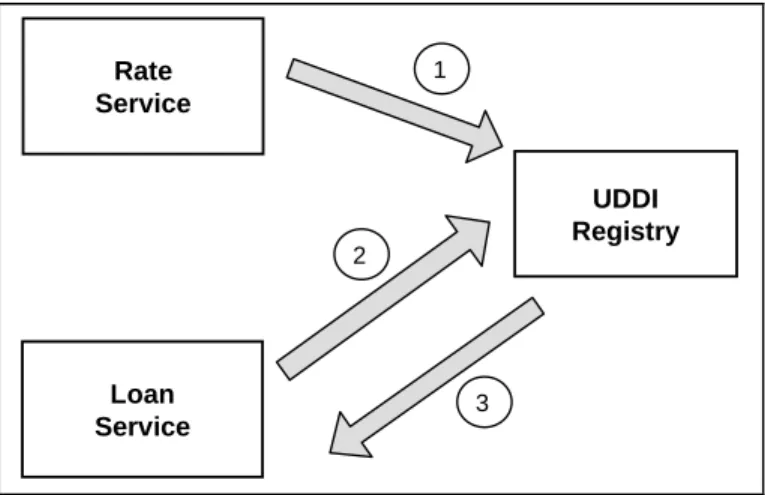
configuration changes. To facilitate the discovery of Web services, a discovery standard called UDDI was developed. UDDI allows Web services to search for one another dynamically. When combined with WSDL, Web services can easily discover and use new services at run-time without human intervention. In the bank loan example, the loan service needs to discover the rate service before using it. The rate Web service is listed in the UDDI registry as a Web service capable of providing information about the bank’s rates. When the loan service is initiated, the UDDI registry is accessed and searched for a Web service capable of providing the bank’s rate information. The UDDI registry returned the rate service’s Uniform Resource Identifier (URI) and details about how to access the rate service, which are derived from the WSDL interface. Figure 2-1 illustrates the discovery process.
1 UDDI Registry Rate Service Loan Service 3 2
Figure 2-1. Web Service Discovery Example
A SOA can be implemented using a number of other technologies, such as Representational State Transfer (REST) or Common Object Request Broker Architecture (CORBA). This guidance is limited to SOAP-based Web Services, but much of the guidance in this document may be applicable to other SOA technologies.
1. The rate service’s WSDL is mapped into a UDDI registry entry
2. The loan service queries the UDDI registry for a Web service capable of providing interest rate information
3. The loan service receives the rate service’s entry and a URI to access the rate service
2.1.2 Web Service Messaging
Web service messages are sent across the network in an XML format defined by the W3C SOAP specification. In most Web services, there are two types of SOAP messages: requests and responses.7 When a SOAP request is received, the Web service performs an action based on the request and returns a SOAP response. In many implementations, SOAP requests are similar to function calls with SOAP responses returning the results of the function call.
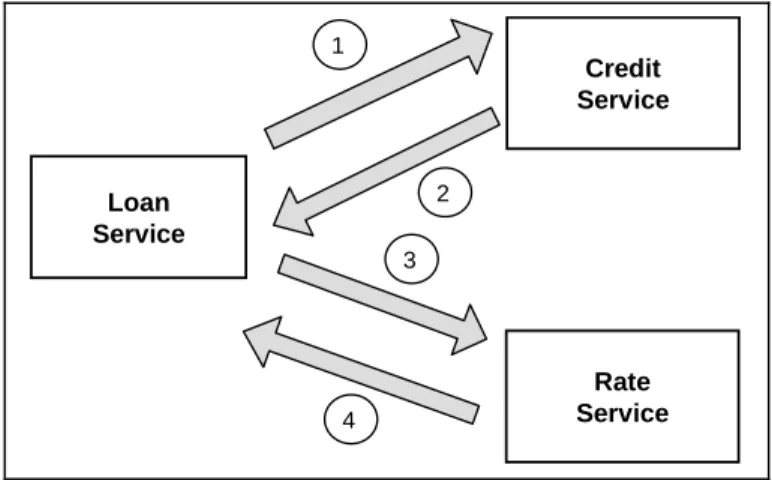
In the bank loan example, the loan service sends SOAP requests to both the credit and rate services to have them perform some calculations on data provided by the user. The loan service must have the credit check results of the individual to receive the loan and information about the current rates provided by the bank. Once both SOAP responses have been received, the loan service can determine whether or not to grant the loan to the user. Figure 2-2 illustrates how the loan Web service functions.8
1 Loan Service Credit Service Rate Service 3 2 4
Figure 2-2. Web Service Messaging Example
1. The loan service sends a SOAP message to the credit service requesting a credit check be performed on the user.
2. The credit service sends a SOAP response back to the loan service with the results of the credit check.
3. The loan service sends a SOAP message to the rate service requesting a compilation of the current rates provided by the bank.
4. The rate service sends a SOAP response containing the current rates.
7
SOAP was designed to support many message exchange patterns (MEPs) in addition to request/response, such as one-way and peer-to-peer.
8
Figure 2-1 shows Web services communicating with each other serially. Services may communicate in parallel or asynchronously depending on the application or supported protocols.
2.1.3 Web Portals
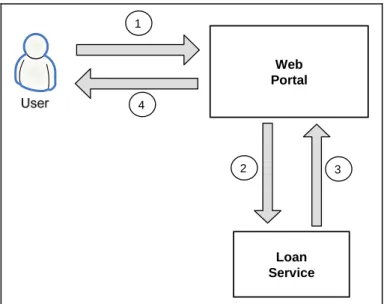
A Web portal provides a human readable interface to the functionality provided by a Web service. Web portals are essential because many Web services are designed to be initiated on behalf of a user.9 Figure 2-3 shows how messages pass between the user and the portal. When the user indicates that a particular action should be performed, the portal sends a SOAP request to the appropriate Web service, receives a SOAP response with the result of the action, and displays an appropriate response to the user. Web portals can provide access to more data sources than Web services alone, but almost all data sources can be implemented as Web services.
1 Web Portal Loan Service 3 2 4
Figure 2-3. Example Portal Interface
In the bank loan example, shown in Figure 2-3, a user accesses a Web portal that gives the user the option of taking out a new loan. The user initiates the loan request, causing the Web portal to send a SOAP request to the loan service. Once the loan service completes its calculations, a SOAP response is sent back to the Web portal. The Web portal processes the SOAP response and generates an associated HyperText Markup Language (HTML) page for the user.
2.1.4 Web Service Roles, Modes, and Properties
The following sections summarize the overarching roles of the constituent components of a Web service-based SOA: requester, provider, and intermediary. These roles are not exclusive: a single Web service may be designed to act as a requester, provider, and intermediary depending on the context of the Web service transaction.
2.1.4.1 Requester Web Services
The requester initiates a Web service transaction on its own or on behalf of a user via a portal. The requester service is tasked with ensuring messages are in the proper syntax and taking the security measures required by the provider.
In the loan Web service example, when a user accesses the bank’s Web site and makes a request for a loan, the loan service acts as a requester service and sends requests to the rate service and credit service.
9
After receiving the user’s credit rating and the current rates, the loan service can then provide the user with a loan or deny the user’s request.
2.1.4.2 Provider Web Services
The provider accepts a request from the requester and provides a response based on the input. The provider is responsible for setting the standards for authentication, authorization, encryption, and non-repudiation. The provider communicates its requirements through the extensibility of WSDL, a discovery service, or both. Some requirements may be negotiable, allowing requesters and providers to dynamically determine how to proceed, but at this time WSDL and discovery services do not provide a standard way for negotiating such requirements. Standards are under development to address this shortcoming.
In the loan service example, both the rate service and credit service are providers. When the rate provider receives a request, it performs the necessary calculations to determine the current rates offered by the bank. Once the request has been processed, the provider sends an appropriate response containing the bank’s current rate information. When the credit provider receives a request, it returns a response containing the creditworthiness of the customer.
Web services provide a SOA in which applications are loosely coupled, allowing Web services to dynamically bind to other Web services at run-time depending on the needs of the user or application. Web services publish their functions to the UDDI registry so that other Web services can find needed functionality. This enables the reuse of applications, particularly legacy applications; by developing a Web services interface that is accessible via SOA, organizations can conserve resources used for costly migrations between platforms. Often, this results in a chain of Web service invocations and an associated performance penalty. This penalty, however, is often offset by the savings in development time and consistency of results associated with re-using components.10 In a network with low latency and high availability, this performance penalty can be minimized to the point that it is not noticeable.
2.1.4.3 Intermediary Web Services
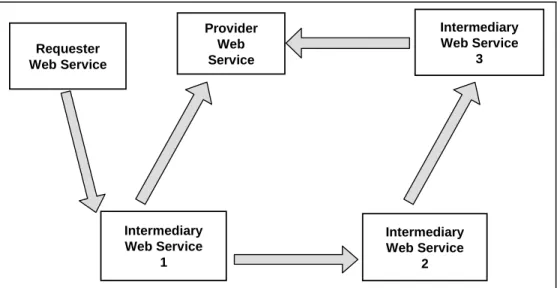
An intermediary service is a Web service that is invoked in a chain. The most common example of an intermediary Web service is an XML gateway that receives requests from requesters, performs security checks against the requests, and then forwards the requests to an internal Web service provider. From the perspective of the requester, there is only a single provider, but in reality there are two. There can be any number of intermediary services involved within a single Web service transaction. Figure 2-4 illustrates how multiple intermediary services may interact with other services.
10
While component re-use offers numerous benefits to developers, any implementation flaws in the component will affect all applications that rely on it.
Intermediary Web Service 1 Provider Web Service Intermediary Web Service 3 Intermediary Web Service 2 Requester Web Service
Figure 2-4. Intermediary Services
In the loan example, both the credit and rate services are intermediaries. As shown in Figure 2-5, the credit service receives a request from the loan service and then forwards the request on to the credit bureau services for each of the major credit bureaus. This allows the user’s credit information to be checked by multiple sources while allowing the loan service to use a single service. As part of its calculations, the rate service may wish to make a request to a Web service that provides the current Treasury bonds rate.
Credit Web Service Rate Web Service Fed Rate Web Service Credit Bureau Web Service Loan Web Service
Figure 2-5. The Loan Service and Its Intermediaries 2.1.5 Coordination: Orchestration and Choreography
When multiple requesters, providers, and intermediaries are participating in a Web service transaction, it may be necessary to coordinate them. There are two different types of mechanisms for coordinating Web services: Web services orchestration and Web services choreography. Web services orchestration is performed within an organization’s SOA and concerns the use of existing Web services to create another Web service. Web services choreography is performed among multiple organizations’ SOAs and describes relationships between Web services so that Web services understand how to interact with one
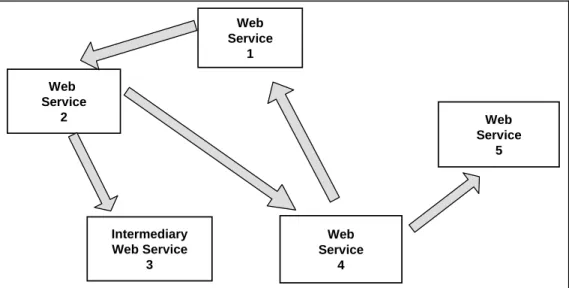
another to perform a process. Figure 2-6 illustrates how no single Web service is in control in a choreography. Web Service 4 Web Service 1 Intermediary Web Service 3 Web Service 5 Web Service 2
Figure 2-6. A Web Service Choreography
When invoking a Web service orchestration, the encapsulating Web service uses an orchestration engine to define which Web services will be invoked. In contrast, when invoking a Web service choreography, the sequence of Web services is more dynamic, and the decisions are made by the relationships defined between individual Web services rather than by a unifying orchestration engine. Figure 2-7 illustrates how the Web service orchestration is controlled by a single Web service.
Web Service 4 Web Service 1 Intermediary Web Service 3 Web Service 5 Web Service 2
Figure 2-7. A Web Service Orchestration
Using the loan service example, the credit service could be implemented as a choreography. Each Web service in the transaction is not necessarily operated by the same organization as the credit service. Each Web service, the credit service and the individual credit bureau service, would enumerate the rules and expectations for interacting with one another. The credit service would dynamically look up the credit bureau service, process the information that is needed to interact with it, and then initiate a choreography among the services.
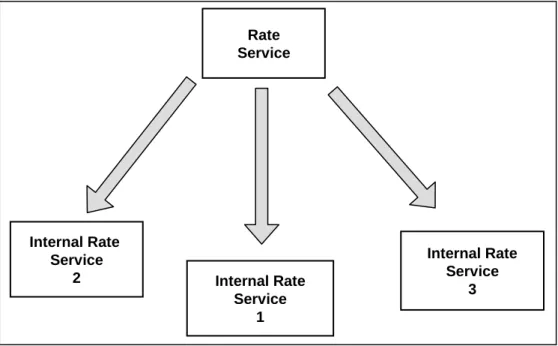
The rate service may be implemented as an orchestration, as all of the involved Web services would be internal to the rate service’s organization. To fully calculate the interest rates that the loan service will use, the rate service consists of a chain of SOAP requests and responses passed from one internal Web service to another to gather the necessary information to respond with accurate rates. Each transaction within the orchestration is controlled by the rate service, so that requests and responses occur in the proper order and failures do not propagate throughout the transaction. Once complete, the rate service returns the result of the orchestration to the loan service, as shown in Figure 2-8.
Internal Rate Service 3 Rate Service Internal Rate Service 1 Internal Rate Service 2
Figure 2-8. The Rate Service as an Orchestration
2.2 Elements of Security
Because a Web service relies on some of the same underlying HTTP and Web-based architecture as common Web applications, it is susceptible to similar threats and vulnerabilities. Web services security is based on several important concepts, including11:
Identification and Authentication: Verifying the identity of a user, process, or device, often as a prerequisite to allowing access to resources in an information system.
Authorization. The permission to use a computer resource, granted, directly or indirectly, by an application or system owner.
Integrity. The property that data has not been altered in an unauthorized manner while in storage, during processing, or in transit.
Non-repudiation. Assurance that the sender of information is provided with proof of delivery and the recipient is provided with proof of the sender’s identity, so neither can later deny having processed the information.
11 The definitions are taken from NIST IR 7298, Glossary of Key Information Security Terms and NIST SP 800-100,
Information Security Handbook: A Guide for Managers, available at http://csrc.nist.gov/publications/nistpubs/. More information on these concepts can be found in Computer Security: Art and Science by Matt Bishop.
Confidentiality. Preserving authorized restrictions on information access and disclosure, including means for protecting personal privacy and proprietary information
Privacy. Restricting access to subscriber or relying party information in accordance with Federal law and organization policy
2.3 Web Services Security Dimensions
The Web services security dimensions have been defined as: secure messaging, resource protection, negotiation of contracts, trust management, and security properties12. These dimensions encompass the elements of security (discussed in Section 2.2) in a Web services environment. Each dimension is essential to the development of secure applications using Web services, but each dimension affects a different layer of the Web service. This section describes each security dimension and provides an overview of what technologies are available, what is on the horizon, and what remains to be done.
2.3.1 Secure Messaging
Web services rely on the Internet for communication. Because SOAP was not designed with security in mind,13 SOAP messages can be viewed or modified by attackers as the messages traverse the Internet. There are several options available for securing Web service messages:
HTTP over SSL/TLS (HTTPS). Because SOAP messages are transmitted using HTTP, it is trivial to modify a Web service to support HTTPS.
XML Encryption and XML Signature. These XML security standards developed by W3C allow XML content to be signed and encrypted. Because all SOAP messages are written in XML, Web service developers can sign or encrypt any portion of the SOAP message using these standards, but there is no standard mechanism for informing recipients how these standards were applied to the message.
WS-Security. WS-Security was developed to provide SOAP extensions that define mechanisms for using XML Encryption and XML Signature to secure SOAP messages.
Each secure messaging option has its own strengths and weaknesses. They are discussed in more depth in Section 3.6.
2.3.2 Protecting Resources
When resources are made publicly available, it is important to ensure that they are adequately protected. Usually, Web services are intended to be accessible only to authorized requesters, requiring mechanisms for access control. To perform access control, Web services need to identify and authenticate one another. Several different methods are available, including transport layer authentication, token
authentication via the WS-Security specification using SAML assertions or other tokens, and the SOAP authentication header. Authorizations for Web services are often done through custom implementations, but the XACML is an OASIS standard available for performing authorization decisions, eliminating the time and cost associated with developing and testing a custom solution.
12
These dimensions are based on those defined in the paper Securing Service-Based Interactions: Issues and Directions by Hamid Nezhad, et al and can be found at http://dsonline.computer.org/WAS.
13
According to the SOAP specification, secure messaging was intended to be developed as an extension to the SOAP standard.
In the loan service example, the rate service is a provider service. When the rate provider receives a request, it needs to validate the identity of the requester and the supplied input. By validating the requester’s identity, the rate service can check with organizational policies to determine whether the requester is authorized to access rate information. By validating the input, the rate service can ensure that the request includes valid and acceptable parameters. If the requester submits unexpected content, it is reason to suspect that an attacker may be probing the Web service for vulnerabilities. Once the request has been processed, the provider sends an appropriate response containing the bank’s current rate information.
The challenges faced in protecting resources go beyond simply providing access control mechanisms. The goal of an attacker may not be simply accessing the Web service. Rather, the attacker’s objectives may include disrupting the service, acting as a man-in-the-middle, eavesdropping on the service, impersonating the service, or even using weaknesses in the service’s implementation to control the host platform. Typical threats to Web services are discussed in more detail in Section 2.6.
2.3.3 Negotiation of Contracts
One of the primary goals of SOA is to facilitate the automation of business processes by allowing services to automatically discover one another and immediately take advantage of the functionality offered. To facilitate business transactions, Web services need to be able to create, enforce, and abide by contracts between organizations. For example, a credit service relies on another organization’s Web services. A contract between the two organizations ensures that all Web services will operate as expected and that the information passed between organizations will be properly secured. In many situations, these contracts are negotiated and agreed upon by the organizations before implementation can begin. Ideally, Web services would be able to negotiate and agree upon such contracts electronically, immediately after discovery during runtime to take advantage of new functionality immediately. Negotiating such contracts electronically opens up a number of potential legal ramifications for the organizations involved.
Therefore, in lieu of this ideal, many SOAs rely on an implicit contract offered by the WSDL interface of a Web service and expect it to operate as advertised.
The ebXML14 suite of standards provides tools for negotiating business processes and contracts using Web services. However, ebXML was developed as a replacement for Electronic Data Interchange (EDI) and, as such, is often considered too complex to use for regular Web services. Because ebXML Web services rely on SOAP, portions of the ebXML standards may be individually adopted for small organizations. Usually, the WSDL interface or registry entry of an individual Web service can be considered an implicit contract between the services, but there are no standards that support the enforcement of implicit contracts. Research in the realm of Web service choreography will aid in enforcing implicit contracts.
Web services may have specific QoS or QoP requirements. For example, a credit service may require that certain information be encrypted and signed using WS-Security, while the requester service may require a guaranteed response through reliable messaging. The ebXML suite of standards provides support for security properties in contracts, but it does not fully support automatic security properties negotiation. The WS-Choreography standard provides some support for negotiating security
requirements. A promising area of research is Semantic Web services. Using Semantic Web technologies, Web services can intelligently search for other Web services with specific properties, including security properties. In addition, the Semantic Web Services Architecture (SWSA)15 developed by the Defense Advanced Research Projects Agency (DARPA) Agent Markup Language (DAML)
14
More information on ebXML can be found in Appendix B and at http://www.ebxml.org.
15
Program specifically addresses negotiating contracts among Semantic Web services and the associated architectural requirements:
Negotiation protocol. Web services require a protocol for negotiating properties of the transaction. Research is underway to develop negotiation protocols using Semantic Web technologies.
Negotiation service. To facilitate negotiation, a provider that allows other services to offload negotiation can serve as a core service within the SOA.
Mediation service. Services involved in negotiation may need to have disputes over various properties of the service contract mediated by a trusted core service.
Auditing service. The resulting contract between services will need to be stored for non-repudiation services by a trusted core service.
Negotiation-enabled Web service. Individual Web services will be able to inform one another that they support negotiation through the discovery process.
While these architectural requirements are specific to SWSA, these functions can prove useful when developing any SOA capable of supporting negotiation.
2.3.4 Trust Relationships
Web services standards are inherently flexible and have allowed several architecture models to evolve: a brokered trust model, a pairwise trust model, a federated trust model, and a perimeter defense model. While these models use the term trust, they are limited to being able to trust the identity of the service. Being able to establish a Web service’s identity does not mean that the service itself is inherently
trustworthy. There is always the possibility that a Web service has entered an erroneous state or has been compromised.
In their 1996 paper, McKnight and Chervany defined trust as “the extent to which one believes (and feels confident in believing) that the other person is trustworthy in the situation.”16 Based on this definition, authenticating the identity of a Web service may not be sufficient when determining whether or not to trust a remote Web service. When trust relationships span multiple organizations, the requirements for individual Web services will vary. For this reason, regardless of whether the provider is a trusted entity in terms of its identity, the requester should not presume that it will not send erroneous or potentially
malicious content in a response to the requester’s request. Similarly, because providers listen (like a server) for requests from various requesters, they should not presume that erroneous or malicious content will not be sent in place of valid requests. Nevertheless, identifying and authenticating Web services is an essential step in establishing trust. Each trust model provides different benefits and drawbacks, allowing trust to be supported in a wide variety of environments. With this caveat on the definition of trust in a Web services environment, the remainder of this document uses the term trust when discussing authentication to maintain consistency with standards and research papers.
The pairwise trust model is the simplest of all trust architectures, but the least scalable. In the pairwise architecture, each Web service is provided—at configuration—the security information of all other Web services that will be interacted with so that those transactions and Web services can be trusted. This approach eliminates the need for developers to coordinate with other entities, but it creates an unscalable and non-uniform security architecture because adding a new Web service would require adding new
16
McKnight and Chervany’s paper, The Meanings of Trust, is available at http://misrc.umn.edu/wpaper/WorkingPapers/9604.pdf.
information to all existing services it could interact with. When the SOA becomes large and dynamic, adding a new service can become time and resource intensive.
In the brokered trust model, an independent third party acts as a trusted third party (TTP) for the Web service. The requester and provider interface with the third party for a variety of security services. Unlike the pairwise trust model, Web services using the brokered trust model need to be designed with the broker’s interface in mind, so that identity information can be properly retrieved by the Web service. This approach eases the distribution of identity information between Web services; each Web service will only need to verify the identity of the trust broker rather than the identity of all Web services in the SOA. A federated trust model allows Web services from different organizations to seamlessly interact with one another via various federation mechanisms. It builds upon both the brokered and pairwise trust models by allowing organizations to use their own central trust brokers while relying on pairwise trust or brokered trust between organizations. Each organization that wishes to federate must do so following complex business procedures and protocols, but the end result allows the Web services of each organization to interact with few or no changes to their original configuration.
Another commonly used Web service architecture is the perimeter defense strategy. Devices known as XML gateways are placed between providers and requesters. An XML gateway acts as a proxy for the Web service by performing the security-related functionality in its place. Although XML gateways are useful tools in an organization’s security strategy, they are not a panacea. Should an attacker bypass the XML gateway, all internal Web services will be vulnerable to attack. Internal Web services must be designed, developed, and configured securely.
2.3.5 Requirements for Secure Software
All software, including Web services, needs to satisfy requirements for performance, cost, usability, and security. Examples of possible requirements for secure software are predictability, correctness, and availability.
2.4 Meeting the Requirements for Securing Web Services
Several organizations, including OASIS, W3C, the Liberty Alliance, and various members of industry have put together numerous security standards and techniques for securing Web services. For the most part, these standards and techniques all complement or extend one another, but there are some conflicting or competing standards. This section provides an overview of the various standards and how they can be used to meet security requirements and protect against threats to Web services. Section 3 discusses the most widely accepted standards, technologies, and techniques in detail.
2.4.1 Secure Web Service Standards Stack
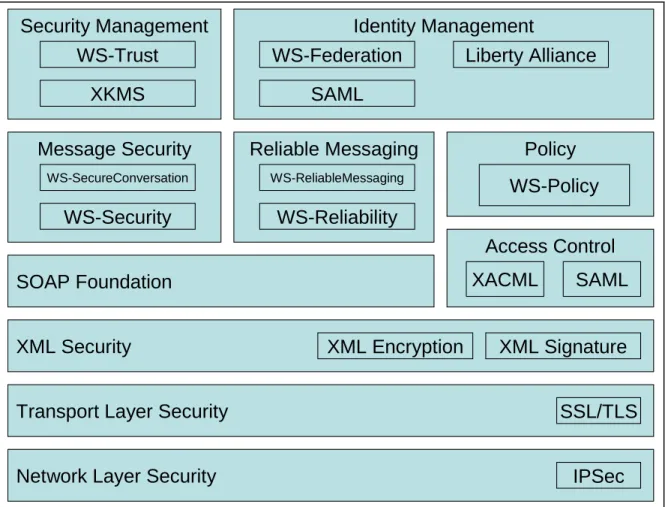
The open standards communities that created Web services developed a number of security standards for Web services. Figure 2-9 illustrates a notional reference model for Web services security standards. This reference model maps the different standards to the different functional layers of a typical Web service implementation. These layers are modeled after the OSI Reference Model but are not intended to be interpreted as strictly hierarchical.
Access Control
Network Layer Security
IPSec
Transport Layer Security
SSL/TLS
XML Security
XML Encryption
XML Signature
SOAP Foundation
Message Security
WS-Security
WS-SecureConversationReliable Messaging
WS-Reliability
WS-ReliableMessagingPolicy
XACML
WS-Policy
SAML
Security Management
XKMS
WS-Trust
Identity Management
Liberty Alliance
WS-Federation
SAML
Figure 2-9. Web Services Security Standards: Notional Reference Model
Standards at the network, transport and XML security layers are used to secure messages as they are transmitted over the network. The security standards IPsec, SSL/TLS (Secure Sockets Layer/Transport Layer Security), XML Encryption and XML Signature each operate on SOAP messages at a different level.
Above the XML Security layer, there are two types of standards: standards built on top of SOAP and standalone standards. Message security standards WS-Security and WS-SecureConversation define how to use XML Signature, XML Encryption and credentials to secure SOAP at the message layer while reliable messaging standards define the protocols and constructs necessary to ensure that messages will be received. The access control standards are not unique to Web services; XACML can define the access policy for any system and SAML can be used to define assertions in any environment. The policy layer’s WS-Policy defines a grammar to communicate the policy requirements of a Web service. These
standards are described in more detail in Section 3.
Security management specifications define other Web services to manage credentials such as PKI certificates within the SOA. Identity management standards take advantage of access control standards, policy standards and SOAP standards to offer services for distributing and managing user identities and credentials within the SOA.
2.4.2 Relationship of Web Service Security Requirements to Standards
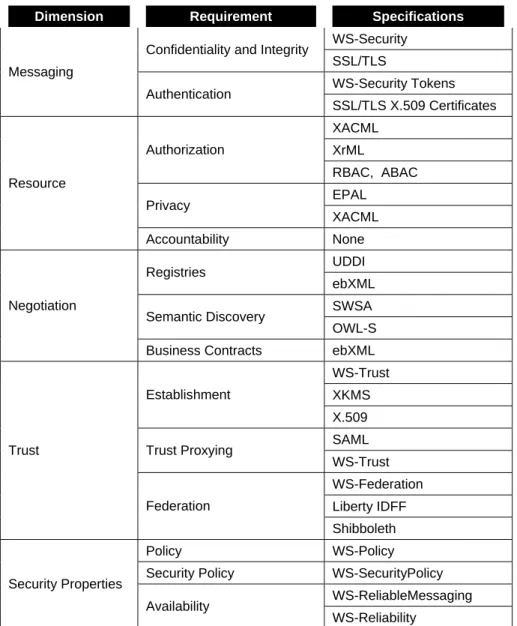
Table 2-1 shows which security requirements are satisfied by the various specifications and standards.
Table 2-1. Specifications and Standards Addressing Security of SOAs
Dimension
Messaging
Requirement Specifications
Confidentiality and Integrity WS-Security SSL/TLS
Authentication WS-Security Tokens SSL/TLS X.509 Certificates Resource Authorization XACML XrML RBAC, ABAC Privacy EPAL XACML Accountability None Negotiation Registries UDDI ebXML Semantic Discovery SWSA OWL-S Business Contracts ebXML
Trust
Establishment
WS-Trust XKMS X.509 Trust Proxying SAML
WS-Trust Federation WS-Federation Liberty IDFF Shibboleth Security Properties Policy WS-Policy Security Policy WS-SecurityPolicy
Availability WS-ReliableMessaging WS-Reliability
Each SOA security dimension has one or more security requirements. Each requirement may have any number of standards that support it. For example, both SSL/TLS and WS-Security provide
confidentiality, integrity and authentication support for the messaging dimension, while the accountability requirement of the resource protection dimension does not have any supporting standards.
2.5 Core Services
The notion of core services has yet to be completely defined. Traditionally, these are services that can be used by any of the Web services in an organization’s SOA. Two examples are the Open Grid Services Architecture (OGSA), developed for the Globus Grid, and the Department of Defense’s (DoD’s)
Centric Enterprise Services (NCES), developed for the Global Information Grid. Both OGSA and NCES provide a set of services available throughout an organization that are commonly used or essential to most Web services, such as discovery, authentication, and authorization. OGSA provides a comprehensive list of what can be offered as core services: service management, service communication, policy services, and security services. Most SOAs use these same categories of core services but may provide differing names:
Service management services: assist in managing a SOA by providing mechanisms to install, maintain, monitor, and troubleshoot Web services.
Service communication services: provide support for various types of communications models between services: queued messaging, publish-subscribe event notification, and distributed logging services.
Policy services: provide a framework for creating, administering, and managing policies for the infrastructure; these policies cover security, resource allocation, and performance.
Security services: provide support for different security models, mechanisms, protocols, and technologies that extend core Web services security protocols to support activities such as authorization, authentication, trust policy enforcement, and credential transformation.17
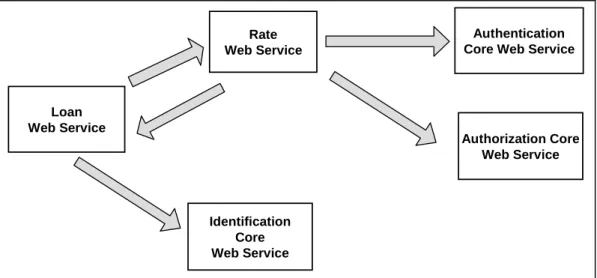
Rate Web Service
Authentication Core Web Service
Authorization Core Web Service Loan Web Service Identification Core Web Service
Figure 2-10. Core Services Used by the Loan Service
In the loan service example, shown in Figure 2-10, core services are used to offload identification, authentication, and authorization, among other capabilities, so that developers of the loan, rate, and credit services do not have to implement their own security functionality. For instance, when the loan service makes a request, it first retrieves an identifier from the identification service associated with the subject. When the rate service receives the request, it uses the authentication service to validate both the subject and the loan service. If authentication is successful, the rate service queries the authorization service to ensure the loan service and subject are authorized to receive policy information.
17
A visual tour of Open Grid Services Architecture can be found at http://www-128.ibm.com/developerworks/grid/library/gr-visual.
By offloading some of the processing to these core services, the implementation of the loan, rate and credit services is simplified when compared to a single Web service with similar functionality. This further improves security by lowering the number of possible defects that could exist in the individual services, but it introduces a slight performance penalty associated with the communication with the core services. Core services may also introduce a single point of failure in the SOA.
2.6 Threats Facing Web Services
Security decisions must always be made with an understanding of the threats facing the system to be secured. While there are a wealth of security standards and technologies available for securing Web services, they may not be adequate or necessary for a particular organization or an individual service. For that reason, it is important to understand the threats that face Web services so that organizations can determine which threats their Web services must be secured against. According to WS-I, the top threats facing Web services are:18
Message alteration. An attacker inserts, removes or modifies information within a message to deceive the receiver
Loss of confidentiality. Information within a message is disclosed to an unauthorized individual Falsified messages. Fictitious messages that an attacker intends the receiver to believe are sent from
a valid sender
Man in the middle. A third party sits between the sender and provider and forwards messages such that the two participants are unaware, allowing the attacker to view and modify all messages
Principal spoofing. An attacker constructs and sends a message with credentials such that it appears to be from a different, authorized principal
Forged claims. An attacker constructs a message with false credentials that appear valid to the receiver
Replay of message. An attacker resends a previously sent message
Replay of message parts. An attacker includes portions of one or more previously sent messages in a new message
Denial of service. An attacker causes the system to expend resources disproportionately such that valid requests cannot be met.
The importance of these threats may vary depending on an organization’s needs and purpose. In some instances, messages need not be kept confidential, so loss of confidentiality is not a concern. Similarly, organizations may offer a Web service to the public. For example, a Web service that provides
information about the current weather forecast need not be concerned if a request is from a falsified sender. Regardless, it is important to understand these threats and what technologies are available to mitigate them.
The following Web services and HTTP standards can protect against many of these threats:
W3C XML Encryption. Used by WS-Security to encrypt messages and provide confidentiality of part or all of a SOAP message
18
More information about the threats and challenges facing Web services can be found in Security Challenges, Threats and Countermeasures at http://www.ws-i.org/Profiles/BasicSecurity/SecurityChallenges-1.0.pdf.
W3C XML Signature. Used by WS-Security to digitally sign messages and provide message integrity and sender authentication
WS-Security Tokens. Allows messages to include credentials to aid receivers in determining whether or not the message sender is authorized to perform the requested action. Supported token types include:
– Username/password. The most common credentials in Web applications
– OASIS SAML Assertion. Asserts that the sender has been authenticated and/or supply attributes associated with the sender
– IETF X.509 certificate. Coupled with XML Signature, a receiver can verify that the CA issued the certificate used to sign the SOAP message
– ISO Rights Expression Language. Used to provide public key information, attributes of those keys, as well as information about the sender’s license
– IETF Kerberos token. Allows Web services to exist in a Kerberos domain.
W3C WS-Addressing IDs. Allows the message sender to supply a unique identifier for the message IETF SSL/TLS. Secures the HTTP protocol over which SOAP messages are sent and received SSL/TLS with client authentication. Requires both the sender and receiver to authenticate with one
another before securing the HTTP protocol
IETF HTTP authentication. Allows usernames, passwords (via HTTP Basic) or password digests (via HTTP Digest) to be sent as part of the HTTP header.
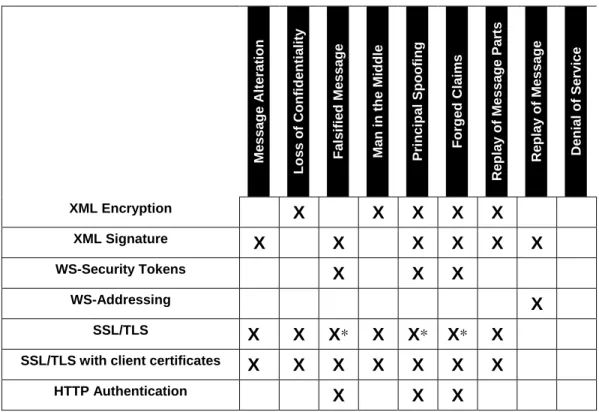
These technologies, along with other technologies that support them, are discussed in-depth in Section 3. Table 2-2 illustrates which standards provide protection against these threats. As the table shows, SSL/TLS and WS-Security, through XML Encryption and XML Signature, provide similar protections against threats; Section 3.6 discusses SSL/TLS, WS-Security and WS-SecureConversation and the trade-offs associated with each technology.