University of Cape Town
Modelling Intermediate Care Services as part of an Integrated Care Pathway by
NICOLA ANN WILSON WLSNIC008
SUBMITTED TO THE UNIVERSITY OF CAPE TOWN In partial fulfilment of the requirements for the degree
MPH (Health Systems)
Faculty of Health Sciences UNIVERSITY OF CAPE TOWN
Date of Submission Supervisors
Professor Lucy Gilson, Health Policy and Systems Division, School of Public Health and Family Medicine, University of Cape Town
The copyright of this thesis vests in the author. No
quotation from it or information derived from it is to be
published without full acknowledgement of the source.
The thesis is to be used for private study or
non-commercial research purposes only.
Published by the University of Cape Town (UCT) in terms
of the non-exclusive license granted to UCT by the author.
2
PART 0: PREAMBLE
1) Abstract
The primary objective of this study is to consider the implications of implementing enhanced or redesigned intermediate care initiatives in the Western Cape of South Africa from 2014/15 onwards. A dynamic simulation modelling methodology will draw on secondary data from the relevant District Health Information Software sources to consider the implications of enhanced or redesigned intermediate care services on hospital admissions, waiting times and length of stay of all patients, as a part of an integrated care pathway. This form of modelling focused on the integrated care provision process represents an original approach to healthcare planning in a developing country (such as South Africa).
2) Acknowledgements
Dynamic simulation modelling methods was a new research technique that I had to learn through the dissertation process with no experience to rely on. It was initially difficult to ‘sell’ the technique which is not particularly popular research method in health sciences, to academics and key decision makers in the Western Cape Government’s Health Department. However, I was lucky enough to get access to secondary data from District Health Information Software sources and work with a stakeholder group comprised of people with operational knowledge of the District Health System during the dissertation process. I would like to acknowledge the technical advice and support from the de-hospitalised care service review participants led by Professor Helen Schneider who looked at the service improvement and redesign for intermediate care in 2011/12, which became the impetus for this study. Regrettably, I cannot acknowledge all the review representatives by name. Most of all, special thanks to Professor Lucy Gilson and Dr Kevin Kotze for helping to shape and clarify ideas, giving critical feedback and moral support when required.
3
Table of Contents
PART 0: PREAMBLE ... 2 1) Abstract ... 2 2) Acknowledgements ... 2 1) Background ... 5 2) Problem statement ... 63) Research aim, question and objectives... 7
4) Justification for use of mathematical modelling in analysing integrated care .. 8
5) Modelling of an integrated care pathway ... 12
i. The purpose of the model ... 12
ii. Define the modelling level ... 12
iii. Define the modelling scope ... 13
iv. Define the modelling level of detail ... 13
v. Identify the components of the model ... 13
vi. Group components as endogenous or exogenous ... 14
vii. Create a casual loop (influence) diagram ... 15
viii. Create a stock-and-flow diagram ... 15
ix. Define the equations for stock-and-flow diagram ... 15
x. Model validation ... 15
xi. Model implementation ... 16
6) Ethical considerations ... 16
7) List of abbreviations ... 18
8) References ... 19
PART B: STRUCTURED LITERATURE REVIEW ... 21
1) Objectives... 21 2) Search strategy ... 22 3) Summary of literature ... 23 4) Conclusion ... 27 5) References ... 30 PART C: MANUSCRIPT ... 34 1) Abstract ... 34 2) Key words... 34
4
4) Methods ... 38
a) Model overview ... 39
i. Primary care ... 39
ii. Hospital treatment ... 40
iii. Intermediate care ... 41
iv. Domiciliary care ... 41
b) Model parameterisation ... 42
i. Population growth and the need for healthcare ... 42
ii. Primary care entrants ... 42
iii. Primary care to Intermediate and Domiciliary care ... 43
iv. Primary care admissions to District and Regional Hospitals ... 44
v. Emergency admissions to District and Regional Hospitals ... 45
vi. Transfers between District and Regional Hospitals ... 46
vii. Intermediate and Domiciliary care admissions to District and Regional Hospitals ... 46
viii. District and Regional Hospital Treatment ... 47
ix. District and Regional Hospitals to Intermediate and Home-based care .... 48
x. Home-based care to Intermediate care and vice versa ... 52
5) Model simulation and results ... 54
i. Base case scenario ... 54
ii. Increasing beds at the rate that is equal to District Hospitals ... 56
iii. Increasing beds at the rate to account for past shortfalls ... 57
iv. Decreasing the readmissions into Hospitals... 58
6) Discussion ... 59
7) Conclusion ... 62
8) References ... 64
Part D: APPENDICES ... 66
1) Letter of approval from UCT Human Research Ethics Committee ... 66
5
PART A: PROTOCOL
1) Background
Health sector reform in the Western Cape has been in a constant state of change since 1995. Demand for healthcare services has been increasing steadily during this period of time due to the ever-changing environment, including demographic and socio-economic determinants of health. In addition, the burden of disease and the deterioration in the risk profile, has contributed to a challenging environment [1].
According to the Census 2011 data the total population of the Western Cape is estimated to be 5.8 million currently, with a life expectancy that is slowly increasing. This estimate is largely due to the continuation of urbanisation and migration, whilst the average age is expected to increase as a result of the aging population. This is despite the fact that the province’s population is also afflicted with the quadruple burden of disease; TB/HIV, non-communicable diseases, injuries and the conditions associated with poor maternal and child health [2].
“Healthcare 2030: The Road to Wellness” is the Western Cape Government’s strategic framework that plots the course of action for the next two decades to a ‘reimagined future’ health service while recognising the high level of uncertainty and complexity of planning for the medium to long-term. According to Healthcare 2030, there is a need to ensure that planning parameters and tools take into account the impact of developments in one sector of the healthcare service on other sectors of the service. In this way the health service is viewed as an integrated care system [1].
Since 1995, the modelling approach to health system transformation in the Western Cape has focussed on specific targets that have been set at an institutional level and for staff establishments. These targets were dependent on the implementation of service shifts, but without the necessary operational management tools, it proved to be difficult to obtain the stated targets. As an alternative to this ‘learning by doing’ approach, the provincial government has recognised that norm-based, analytical tools are necessary to embed the integrated care pathway across the service delivery platforms of the various institutions.
The development of these analytical tools need to consider appropriate performance measures/indicators for which baselines can be determined and indicative interim targets can be set for specific points in time. The development of an empirical model will enable the Western Cape Government’s Health Department to better deal with uncertainty and complexity within the health system over time, where causal connections
6 and feedback effects may be identified. This may then give rise to the concept of ‘system as a cause’ [3].
2) Problem statement
This study focuses on the evaluation of proposed changes to healthcare policy to alleviate shortfalls in service delivery, through the formulation of viable solutions that will facilitate a ‘reimagined future’ health service for the Western Cape over the next two decades. The rendering of healthcare services is a national and provincial legislative competence in terms of Schedule 4, Part A of the Constitution of the Republic of South Africa, Act no. 108 of 1996. While the South African system of delivering or providing healthcare services has changed over the years, the District Health System (DHS) as a way of providing healthcare services to local communities, was introduced in 1996. The DHS is a self-contained segment of the provincial and national health system that comprises a well-defined population living within a clearly delineated administrative and geographic service area. It includes all institutions and individuals providing healthcare in the district whether governmental, non-governmental, private and traditional health practitioners up to and including the district hospital at the first referral level.
Due to the combined impact of the quadruple burden of disease and the growth in the aging population, the number of people in the Western Cape who require both healthcare and social services is increasing. In addition, there are likely to be more people with ‘complex health needs’, who require a combination of healthcare and social services. However, as these services find themselves within separate government departments they may not work all that well together. The result of this breakdown in services between the respective departments is that patients may stay in a hospital for too long a period, when it would have been better for them to get care at home [4].
In addition, in certain instances, patients may get the same service on two occasions – from the health and social care organisations. This would result in inefficiencies, which would contribute towards an increase in the burden of taxes on individuals. Alternatively, where a patient is missing an important part in their care pathway (as they and their families do not get the holistic care that they need), they could be in a position of increased risk, which would place them in potential harm.
A key focus of the current provincial strategic health framework is to develop the integrated care provision process, that is, to develop care pathways for specific patient groups. Care pathways are a combination of service components that are unique to a patient group and that may cut across levels of care and sectors [1]. The integrated care process also needs to focus on the continuum of care for services that are organised to
7 satisfy the requirements for treating a particular condition at each level of care within the health system. With more focus being placed on integrated care development in the Western Cape, the respective health and social care providers will need to work better together to ensure patients and their families receive the right services.
However, the Western Cape Government’s Health Department is currently experiencing the problem of ‘bed blocking’ (i.e. delayed transfers in care). Increasing patient volumes are adding to the deepening chaos with accident and emergency centres’ occupancy levels well over 100% and attendances continuing to rise by approximately 5% per annum [5]. The burden of disease data suggests that these patterns will continue for the foreseeable future [2]. Waiting list management and diversion to other services are well known policies to deal with a situation where the need outstrips the available resources [6]. Furthermore, rationing less urgent care, cancelling elective surgery and lengthy waiting lists are just some of the ways hospitals have found to cope with demand. The need to improve access to hospital beds from the accident and emergency centre, by increasing the throughput of patients, as well as their discharge into an appropriate continuum of care has been emphasised as a policy imperative. Delayed discharges are leading to accident and emergency centres being ‘blocked’ with too many patients, but finding alternative care settings for patients who no longer need hospital care is a major challenge.
3) Research aim, question and objectives
Given the importance of the Western Cape Government’s Healthcare 2030 proposals for the development of the health system, it would be highly desirable to develop a framework that could be used to model the alternative policy interventions in order to evaluate potential outcomes before they are implemented. Such a model could also be used to aid decision makers in the identification of potential shortfalls, which may be addressed in the healthcare planning process. Mathematical modelling is increasingly used to support healthcare planning globally.
However, despite the recognised importance of integrated care, which seeks to ensure that people receive well-coordinated and personalised care, the empirical modelling of alternative policy interventions to the care pathway has not been widely explored globally [7]. Hence, the overarching aim of this study is to develop suitable analytic tools for modelling an integrated care pathway by presenting a case of intermediate care development.
8 What are the implications of implementing enhanced or redesigned intermediate care initiatives, as part of the integrated care provision process in the DHS?
Finally the specific objectives are:
1) To define the linkages, relationships and interactions among service components that describe an integrated care pathway; and
2) To analyse the implications of one of the proposed Healthcare 2030 interventions – intermediate care – on the ‘whole system’ of care (from primary care through acute hospitals and community based services).
4) Justification for use of mathematical modelling in analysing integrated care
The use of mathematical models for policy analysis in the healthcare sector is becoming increasingly important, as it facilitates a better understanding of the health system’s functionality [8]. These models would usually represent a simplified version of the real world, where the relationships in the model are described by mathematical equations that may be used to answer a specific research question.
A mathematical model allows the synthesis of a diverse range of information and avoids the reliance on intuition, and in some cases, the risk, time and cost of primary research [9]. Within healthcare, there are two main areas where mathematical modelling is used to inform policy decisions; viz. the dynamics of ill health and the dynamics of services [3]. The former represents illness states and the impact of interventions on some underlying disease’s natural history to estimate costs and consequences. For example, a range of studies have been conducted that considered the impact of early detection and management of non-communicable diseases, such as diabetes, on rates of deterioration leading to a reduction in the number of people with long-term, irreversible complications [10]. The latter application of modelling involves the conceptual and mathematical representation of some part of the ‘whole system’ of care across cross-sectional population groups in order to identify areas for potential improvement. A number of these studies have focussed more on the delays that arise as a results of inefficiencies and the capacity across the ‘whole system’ of care being unbalanced in relation to inflow, waiting times and length of stay [11].
An analysis of integrated care refers to an investigation into the combined services that are provided by various organisations, professionals, clinicians, financing and administrative personnel, as well as those with other resources and responsibilities for maintaining or restoring health. These services could include those provided by both health and social care agencies that seek to promote faster recovery from illness, prevent
9 unnecessary hospital admissions, support timely discharge and reduce avoidable readmissions. Within this overall set of services, intermediate care is defined as:
“In-patient transitional care, which facilitates optimal recovery from an acute illness or complications of a long-term condition, enabling the service user to regain skills and abilities for daily living, with the ultimate discharge destination being home or an alternative supported living environment” [12, p. 4].
To facilitate this objective, it has been proposed that the DHS in the Western Cape will increase intermediate care capacity, by adding 1,000 beds to their facilities between 2013 and 2030 (for this service). Schneider [13] presents the basis of the service model for intermediate care, which is to be implemented in the DHS of the Western Cape. The research for this report was largely gathered through a number of consultations with key personnel who have operational understanding of the DHS (including those who will be responsible for implementing this aspect of the service model).
Whilst this research has enjoyed strong support within the Health Department in the Western Cape, its implementation could affect the way in which other services are (or should be) delivered, demonstrating that changes in one part of the system will affect the ‘whole system’ of care (from primary care through acute hospitals and community based services). This study seeks to model these dynamic interactions to facilitate appropriate implementation. It makes use of a theoretical model that is conducted as a part of the Systems Thinking approach. Thereafter, the theoretical model is taken to the data as a part of the System Dynamics approach to describe the dynamic interactions that exist between various entities.
Systems Thinking
Within the context of healthcare modelling, Systems Thinking refers to the method of thought that considers the holistic nature of the system, the so called ‘whole system’ of care, and the way in which various parts of the system interact qualitatively. This method may be used to describe various interactions between particular parts of a complex system that could be visualised with the aid of a schematic diagram.
The Systems Thinking approach could therefore be used to describe the qualitative relationships within a system. From a modelling perspective, the Systems Thinking approach is the process of deriving a theoretical model that could be taken to the data, at a later point. One of the major strengths of this approach is that one could describe a number of theoretical competing systems, with the aid of Systems Thinking. Such competing systems could include existing systems, or those that are the result of a proposed policy change that would result in an intervention to the system.
10 System Dynamics
To quantify the critical relationships in the theoretical Systems Thinking model, one may utilise the System Dynamics modelling technique to predict the result of a proposed policy intervention in the complex system. This technique seeks to quantify the totals as well as the changes to the existing state of the system. These concepts are usually based on the economic concepts of stocks and flows, where a stock refers to the value of a commodity at a particular date, and a flow refers to the total value of a change to a stock over a period of time.
In healthcare terms, the stocks (or totals) may be described by the number of people that require healthcare services and the flow could describe the way in which the person progresses through a care pathway (towards being discharged). From a mathematical perspective the relationship between stocks and flows may be summarised with the aid of differentiation and integration, which is described in the example below. Example
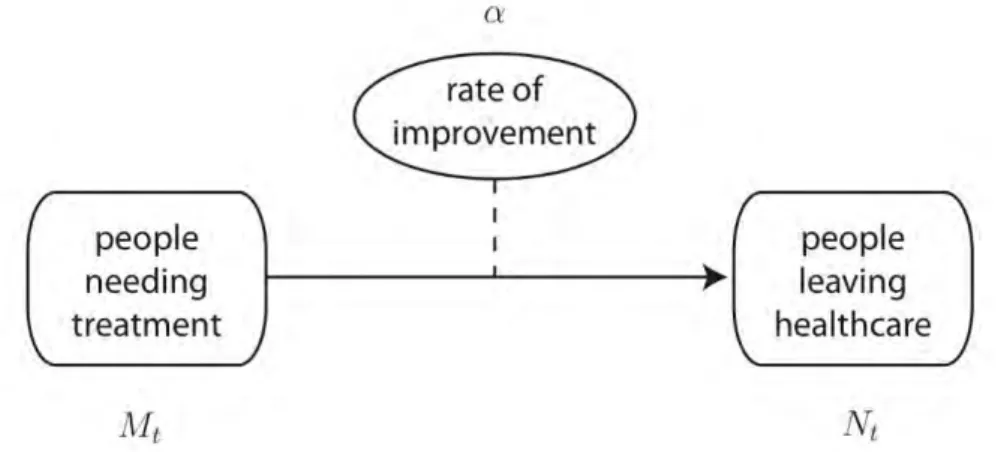
To describe the use of the mathematical methods, with the aid of a simple model that may be applied to an overly simplistic healthcare problem, consider the following theoretical model that makes use of a Systems Thinking approach. This model could include two stocks for different states of the system. The first could describe the case where we have a total for the number of people needing treatment. The second stock could then describe the total number of people that eventually leave the healthcare
facility. The flow that would link these two stocks would describe the rate
of improvement in the patients’ conditions.
This model may be characterised with the schematic representation in figure 1, where we have included the terms Mt, Nt and α, to describe the respective stocks and flow.
11 This model may then be represented by a linear difference equation that is consistent with the System Dynamic approach. In this example, a partial derivative may be used to describe the relationships in the model, where,
߲
߲ݐ ܯ௧ = ߙܰ௧
Or alternatively, for a given value of Mt, we could use integration to derive a value of Nt, such that,
ܯ௧ = න ܰ௧݀ߙ ௧
While the above expressions could be solved analytically, one should appreciate that the rate of improvement could be influenced by several factors, which may be described by other stocks and flows. This would extend the single difference equation into a system of difference equations, not all of which would necessarily be linear. This would make α, an extremely complex function, which would be difficult to solve analytically. In such circumstance, one could employ symbolic computation or numerical approximation methods to derive the solution to the model.
The advantage of employing symbolic computation is that one could derive the equivalent analytic solution, however, this procedure would usually require a great deal to time and computational power. As an alternative one could make use of a numerical approximation, which would usually derive an approximate solution in more time efficient manner (in the majority of cases).
Once we are able to characterise the functional form of the respective α parameters, we would then be able to perform a simulation to investigate how changes to the rate of improvement would impact on people
leaving the healthcare facility over time (i.e. over periods t+h, where
0<h<∞).
Disadvantages of the System Dynamics approach
Before concluding this basic example, it is perhaps worthwhile to consider an important possible disadvantage to the System Dynamics approach when applied to healthcare planning. For example, while this approach provides an admirable overall summation of a health system, it is not particularly good at describing the nuances that may affect individual patients that may have complex health needs. In these cases one may wish to employ techniques that focus on the detail. One such method would include Discrete Event Simulation that incorporates micro aspects of the care pathway. Discrete Event Simulation is particularly useful in healthcare to capture the changing attributes of individual patients, and
12 to characterise processes in which there is an emphasis on the use of resources.
5) Modelling of an integrated care pathway
While there are relatively few examples of studies that employ the System Dynamics approach for the modelling of healthcare systems (particularly for cases from the developing world), one such local study that focuses on proposed interventions to manage Human Immunodeficiency Virus (HIV) is provided in Nienaber [14]. The framework that was used in this report will be largely followed to investigate the implications of implementing enhanced or redesigned intermediate care initiatives as part of the integrated care provision process on hospital admissions, waiting times, and length of stay (for acute hospitals).
The following sub-sections outline the key decisions and steps that have been and will be taken in developing the model.
i. The purpose of the model
“A System Dynamics model is built to understand a system of forces that have created a ‘problem’ and continue to sustain it. To have a meaningful model, there must be some underlying problem in a system that creates a need for additional knowledge and understanding of the system” [15, p. 8].
The purpose of the model is to understand the linkages, relationships and interactions among service components that describe an integrated care pathway and to examine the implications of implementing enhanced or redesigned intermediate care services on ‘bed blocking’ (i.e. delayed transfers in care) within the ‘whole system’ of care from primary care through acute hospitals to community based services in the Western Cape.
ii. Define the modelling level
The model will represent one of the proposed Healthcare 2030 policy interventions – intermediate care – and its implications within the ‘whole system’ of care from primary care through acute hospitals to community based services in the Western Cape.
The reason for choosing to model the system at a district level is due to the fact that the Western Cape Government’s Health Department has implemented a DHS delivery model based on Primary Health Care (PHC) and the envisioned Healthcare 2030 delivery model retains this service configuration. The PHC service of the DHS is the most critical component, as it serves as the entry point into the care continuum and caters for a large number of patients. It comprises of two distinct but inter-related care settings.
13 1) Community based services which include:
a. Home and community based care, as well as residential care homes (i.e. domiciliary care) and,
b. Intermediate care
2) Primary care services at health facilities
PHC forms an integral part of the health system, of which it is the first level of contact and constitutes the first element of the continuum of care. To ensure a seamless continuum of care along the care pathway, key decision makers are concerned with ‘how to plan capacity’ across a ‘whole system’ of care to improve integration by minimising delays in care transitions. One of the reasons for such delays, which are frequently cited, is due to ‘bed blocking’ at district level. An additional reason for choosing to model the system at a district level is that current baseline data from the District Health Information Software (DHIS) is available at this level.
iii. Define the modelling scope
The scope of the model is based on the specific objectives of the research question, after considering the resources available from primary care through acute hospitals and community based services, as well as the areas of possible influence on hospital admissions, waiting times and length of stay (for acute hospitals).
Service components will be selected on the basis of their ability to generate and properly represent the continuity-related problems when patients move from one service to another, particularly at the organisational boundaries between the sectors. Various forms of aggregation are appropriate, where such aggregation does not change the nature of the problem being modelled [15].
iv. Define the modelling level of detail
The model is an over simplification of the various care pathways through the DHS. It only represents the necessary level of detail to show the proportion of patients flowing, their lengths of stay, and the capacities of each pathway. This might also facilitate a better understanding of the linkages, relationships and interactions among service components, which will enable one to investigate the effect of intermediate care services on admission avoidances and delayed transfers in care.
v. Identify the components of the model
A key principle of this model building process is that it will be used to improve our understanding of a complex system and it will take the form of an iterative process [3].
The modeller will work closely with a stakeholder group comprised of people with operational knowledge of the DHS, to guide the selection of service components necessary for creating a model of the ‘whole system’ of care [14].
14 In Healthcare 2030, the concept of embedding a continuum of care and establishing an integrated care pathway across service delivery platforms is emphasised [1]. Intermediate care, constituting just one part of the patient’s overall care pathway, is linked to the more curative, therapeutic and specialised components of the service platform that would include the primary care services, as well as acute and specialised hospitals. Important continuity logic also exists between intermediate care and the other components of health and social care services; namely home-based care, as well as residential care for people with disabilities and for the elderly. Interactions between the proportion of patients that flow through the system, their length of stay, and the capabilities of each service component lead to a certain degree of complexity in the care pathway. This is often influenced by the fact that various agencies own different pieces of the pathway and take a particular course of action (informal policy decision) if a patient’s movement affects their particular resources and performance targets. Computational modelling and simulation may assist with our understanding of the resultant behaviour that may induce a change over time in the operation of the whole system, which would clarify the need for joint capacity planning across organisational boundaries to improve integration and minimise delays [3]. The framework developed by Nienaber [14] for System Dynamics models in low resource settings suggests that performance measures/indicators could be used to guide component identification, together with other qualitative and/or quantitative approaches, to further validate the model content. The advantages of using performance measures/indicators include:
− Trends in performance measures/indicators are frequently reviewed
and may influence the commitment of key decision makers to the model building process
− Components selected using performance measures/indicators, as a
guiding mechanism, will be easier to model and validate through data from academic research, as well as secondary analysis of supporting data
− Translating the results of this study to all interested parties will be easier,
as key decision makers will be familiar with these performance measures/indicators
vi. Group components as endogenous or exogenous
To further clarify the scope and level of detail that will need to be modelled, the components are grouped into two categories:
− endogenous or dynamic variables involved in the feedback loops of
the system
− exogenous components whose values are not directly affected by the
15 vii. Create a casual loop (influence) diagram
Causal loop or influence diagrams emphasise causal connections or relationships between the service components. A schematic representation will support thinking and learning to help understand how the service components interact with each other (which will include interaction through their feedback effects). Often causal loop diagrams are employed in System Dynamic modelling exercises to represent either reinforcing (positive relationship) or balancing behaviour (negative relationship) between two or more variables. The possible disadvantages that are associated with causal loop diagrams is that one cannot discover the implications of alternative policy interventions, locate leverage points, or investigate how a complex system might behave under different conditions [15].
viii. Create a stock-and-flow diagram
The building blocks of any System Dynamics model include the allocation of stocks (also known as levels, accumulations or totals), flows (or rates/changes in stocks) and feedback loops [3]. Building a model from the influence diagram has two steps. The first is to draw a stock-and-flow diagram and the second is to derive the equations that govern the relationships in the model.
Mapping out the stock-and-flow diagram starts with defining the components as stocks and flows. A stock is associated with quantity, or a level, at a particular time, while a flow changes/influences the total value of a stock over time.
ix. Define the equations for stock-and-flow diagram
The relationship between stocks and flows can be expressed with differentiation and integration, where the value of each stock is determined by the changes to the flows that impact on the stock. An important consideration is that the dimensions of the variables need to be consistent to ensure that the relationships are mathematically compatible. In some cases the variables may need to be transformed or in other cases alternative proxies (instruments) will be used [16].
x. Model validation
The model will be validated in the sense that we need to develop a degree of confidence that may be used to infer that the model is of sufficient quality, to ensure that it will be used for its stated objective [16]. Therefore to validate the model, we will need to ensure that:
- The model is well designed.
The structure of the model will describe the salient features of the integrated care system, including all the main drivers of the system. If key decision makers believe that some of the key features are missing then they are unlikely to express confidence in the results that are
16 produced. In addition, the greater the use of real data in the model (for parameterisation), the greater the audience’s confidence in the model. Peer review will also be used to build confidence in the model. - The model is implemented correctly.
Basic tests may be used to ensure that the probability of an event is between zero and one, and that certain elements do not spiral to levels that are no longer feasible. Such tests will be conducted periodically, on either a subset of the model or on important interactions between various parts of the model.
- The results from the model are accurate.
To convey confidence in the model one should be able to show how expected results are achievable. Out-of-sample forecasting exercises will also be used to justify the results of a model, where data for a particular period (say between 2005 and 2010) is used to accurately forecast observed data for a subsequent period (say 2011).
Unfortunately, these types of tests are not always useful as there may be a relative scarcity of data, as well as a number of exogenous structural breaks, that may result from policy interventions. As a result, the use of observed data that is used to parameterise the model may differ from expected future behaviour. Model uncertainty will also be explicitly included in the model, by including distributions for the respective variables/parameters. Doing so will not only express the results in terms of their higher moments, but it will also provide the researcher with the degree of confidence with which these results can be interpreted.
xi. Model implementation
Where the purpose of the model is to compare various structures that may be implemented through policy reform, one could use the model to identify the potential benefits and shortfalls of an existing system before proceeding to show how various undesirable events/behaviour could be mitigated or eliminated. Different policies or operational procedures could be tested to investigate how one could go about making improvements to the system.
6) Ethical considerations
This study will draw on secondary data from the DHIS to perform a simulation-based analysis to describe the implications of enhanced or redesigned intermediate care services on hospital admissions, waiting times and length of stay of all patients, as a part of an integrated care pathway. Permission to access the DHIS service component data will be obtained from the Western Cape Government’s Health Department, once ethical approval is granted. No identifying information of healthcare services/facilities will be included in the manuscript resulting from this
17 study. Feedback sessions on the study results will be conducted with the key decision makers in the Western Cape.
18 7) List of abbreviations
DHIS District Health Information Software DHS District Health System
HIV Human Immunodeficiency Virus PHC Primary Health Care
19 8) References
[1] Western Cape Government: Health, “Healthcare 2030: The Road to Wellness,” 2013.
[2] P. Groenewald , D. Bradshaw, W. Msemburi, I. Neetheling, R. Matzopoulos, T. Naledi, J. Daniels and M. Dombo, Western Cape Mortality Profile 2009, Cape Town: South African Medical Research Council, 2012.
[3] D. McKelvie, Modelling social care complexity: the potential of System Dynamics, London: NIHR School for Social Care Research, 2013.
[4] A. Cameron and R. Lart, “Factors Promoting and Obstacles Hindering Joint Working: A Systematic Review of the Research Evidence,” Journal of integrated care, vol. 11, no. 2, pp. 9-17, 2003.
[5] Western Cape Government: Health, “Emergency Case Load Management Policy,” 2012.
[6] Western Cape Government: Health, “Position paper on waiting list management,” 2014.
[7] M. Fakhimi and N. Mustafee, “Applications of Operations Research within the UK Healthcare Context,” in Proceedings of the 2102 OR Society
Simulation Workshop, SW12, 2012.
[8] W. Hare, A. Rutherford, K. Vasarhelyi and C. S. M. Group, Modelling in Healthcare, Providence, Rhode Island: American Mathematical Society, 2010.
[9] H. Squires and P. Tappenden, “Mathematical modelling and its application to social care,” NIHR School of Social Care Research, London, 2011.
[10] J. Homer, B. Milstein and G. Hirsch, “Chronic illness in a complex health
economy: the perils and promises of downstream and upstream reforms,” System Dynamics, vol. 23, no. 2-3, pp. 313-343, 2007.
[11] E. Wolstenholme, D. Monk, D. McKelvie and S. Arnold, “Coping but not
coping in health and social care: masking the reality of running
20 vol. 23, no. 4, pp. 371-389, 2007.
[12]Western Cape Government: Health, “Intermediate Care Policy Framework,” 2012.
[13]H. Schneider, “Community Based Services Support Project: Policy Review of De-hospitalised Care Services,” School of Public Health: University of Western Cape, 2012.
[14]P. M. Nienaber, “The Sysstem Dynamics approach as a modelling tool for healthcare,” University of Pretoria, Pretoria, 2012.
[15]S. Albin, “Building a System Dynamics Model Part 1: Conceptualization,” Massachusetts, Massachusetts Institute of Technology, 1997.
[16]J. Forrester and P. Senge, “Tests for building confidence in System
21
PART B: STRUCTURED LITERATURE REVIEW
1) Objectives
The total population of the Western Cape is estimated to grow significantly each year, due to natural births (although at a slower rate, with fertility levels declining) as well as migration. The nature and extent of migration, both internal and trans-national, are the most prominent unknown variables. The number of refugees and displaced persons is expected to increase adding to population growth. The mortality rate is lower than previously predicted as people with HIV and AIDS live longer and this is also likely to influence population growth.
The use of simulation modelling in the health and social care sector is not new and its ability to deal with uncertainty, handle complexity and communicate the proposed solution is especially relevant in the context of a constant state of change. The aim of this review is to describe and analyse the application of System Dynamics, which provides dynamic simulations of future outcomes, to the health and social care systems, where special attention is paid to research that has been conducted on resource allocation across an integrated care pathway. The reasons outlined by Squires & Tappenden [1] for using such an empirical model include but are not limited to; a simulation ensures that policy recommendations do not merely rely on intuition. In the case of dynamic simulation modelling methods, these allow for the synthesis of diverse information and the ability to test innovative ideas like a ‘reimagined future’ health service for the Western Cape, where the implications of alternative policy interventions could be tested without experimenting on an actual population.
There have been a number of literature reviews on various aspects of simulation applied to health and/or social care [2] [3] [4] [5] [6] [7]. While the aforementioned reviews cover a range of simulation applications in health and/or social care, the purpose of this study is to focus on the potential of System Dynamics to deal with the uncertainty and complexity in the Western Cape’s Healthcare 2030 planning context. Therefore, we specifically concentrate on the sole use of simulation techniques within integrated care systems. This particular area of study, which comprises of multiple interdependent agencies and care pathways that cross organisational boundaries, is most amendable to a System Dynamics study. In addition, this research methodology may also be used to describe the nonlinear relationships that exist between various stocks (for example, the relationship between those receiving intermediate care and those being able to resume living at home is not proportional).
22 The objectives of the literature review are:
1) To identify published studies that investigate integrated care pathways using System Dynamics; and
2) To consider the implications of findings and the barriers to implementation for integrated care provision processes.
2) Search strategy
A review of the use of System Dynamics to model integrated care systems was undertaken to identify relevant published studies with a particular focus on the potential barriers facing the implementation and uptake of System Dynamics within the health and social care sector (which fulfils the aforementioned objectives). The literature review methodology was not an exhaustive ‘Cochrane type’ systematic review but was influenced by the approach adopted by Eddama & Coast [8]; where databases are searched using a process of refining and revising search terms. The articles are then screened and selected if they meet certain criteria which are based on the reading of titles and abstracts. Those articles that we retained are then reviewed.
The initial articles selected for this study were identified from a widely used academic electronic database, the Web of Science®, which contains studies published from 1962 onwards; with related bibliographic information from approximately 12,000 high impact research journals from over 250 disciplines. The objective therefore was to identify published System Dynamics studies on integrated care which have an accredited impact factor.
Our search strategy was defined by the simulation technique used in a particular application area within relevant published studies. To identify published studies that use System Dynamics to investigate the integrated care pathway, the following search terms were used: inclusion of the words, ‘simulat*’ OR ‘health*’ AND ‘social’ OR ‘community care’ in the article’s title. In addition, we stipulated these words/phrases (‘System* SAME ‘Dynamics’ AND ‘health*’ AND ‘social’ OR ‘community care’) needed to be in the abstract or keywords of the article. Note the syntax that has been used here refers to that which is applicable to the Web of Science® database. The first term should find articles that use simulation modelling and to increase the relevance score for articles they should contain the words/phrases ‘System Dynamics’, ‘health*’ and ‘social’ or ‘community care’. The search was limited to articles written in the English language with no restriction on the date range. Results obtained from the initial database search (n = 436) were screened based on their titles and abstracts to see if they met certain inclusion criteria, which required that the selected published studies should apply a dynamic simulation modelling method to an integrated care system. Based on a reading of
23 the abstracts and titles, 432 articles were excluded, because the term ‘System Dynamics’ wasn’t used in relation to the integrated care system in some way, and 4 retained. Articles that were not accessible were also excluded from the analysis. Upon reviewing the content of the remaining articles to assess if they answer the stated objectives, 2 were identified and used in the analysis. The other 2 were excluded as the focus was on demand for social care of an ageing population and how to better target services to specific patient needs.
Wolstenholme et al. [9] noted that while System Dynamics has been used widely in healthcare, its use in social care has not been extensive. This study searched articles from the Web of Science®, including more than 12,000 journals covering the sciences, social sciences, arts and humanities, yet found a limited number of articles, which is consistent with the comment made by Wolstenholme et al. [9]. Due to the limited number of studies that were found using this systematic sampling method – the other being Wolstenholme [10] – we employed a more general search strategy using Google Scholar. While such a review may be regarded as less systematic it does at least incorporate items of ‘grey literature’, such as conference proceedings and details of consulting projects that have been carried out in this area of research study.
Ultimately, the review of the literature presented next provides an overview of the range of literature relevant to work on modelling integrated care provision processes rather than only focussing on the two papers identified through the formal search strategy.
3) Summary of literature
This literature review is structured as follows: the range of topics to which System Dynamics has been applied in the health and social care sectors are discussed. This is then followed by an overview of the relevant papers drawn from the systematic sampling method that addressed integrated care pathways. Finally, papers reporting the challenges of dynamic simulation modelling methods and of implementing the model results are summarised.
System Dynamics aims to identify causal connections and feedback effects within systems by firstly drawing diagrams that indicate the relationships between various parts of the system. Thereafter, it makes use of differential equations to consider how the stocks and flows might influence the behaviour of a complex system over a period of time [11]. Feedback loops and time delays are typical features of dynamic systems and are often incorporated in causal loop (influence) diagrams that may actually complicate the connections between variables within the system. Wolstenholme [12] has proposed a set of generic two-loop system archetypes that are composed of an intended and unintended
24 consequence feedback loop, where there is a delay before the unintended consequence manifests itself and an organisational boundary that ‘hides’ the unintended consequence from the ‘view’ of those initiating the intended consequence. It is very important to understand the existence and nature of organisational boundaries, and to make them as clear as possible, so that the unintended consequences are not concealed. Successful system thinking aided by an empirical model could help to develop integrated care pathways by working across organisational boundaries and sharing information to recognise the unintended consequences of well-intentioned actions.
Applications of System Dynamics in the health sector have typically have been used to evaluate public health policy and economic models for TB/HIV and tobacco harm reduction [13] [14] [15] [16] [17] [18]. System Dynamics has also been used to better understand the management of non-communicable diseases such as diabetes [19]. Taylor & Dangerfield [20] used System Dynamics to model the feedback effects of service reconfigurations by providing cardiac catheterisation ‘closer to home’. System Dynamics also has the potential to model several parts of the entire health system, such as emergency and on-demand healthcare to identify delays [21]. Furthermore, Lane et al. [22] made use of a System Dynamics study to emphasise the need to consider the ‘whole system’ of care, when planning capacities of differing kinds. Their analysis of an accident and emergency department shows that the ‘spill over’ effects from this department have a large effect on the admissions for elective procedures. Solving real-world problems in healthcare for improving patients’ experience is a growing area for System Dynamics application [23]. In addition, a number of studies have investigated the possibility of reducing delays in emergency care experienced by patients [24] to improve the patient turnaround and hospital throughput [25].
While applications of System Dynamics in the health sector often have implications for social care at the boundaries between the sectors, there are few studies of System Dynamics modelling that have been used to understand the interface between health and social care systems [26]. For example, System Dynamics modelling examined how patients flow through the health and social care systems in Australia; where the federal government funds healthcare and social care through local government [27]. Further studies in the United Kingdom have explored the interaction between health and social care services to improve integration and minimise delays, by utilising intermediate care to reduce admission rates and accelerate the discharge processes [28].
The Wolstenholme et al. [29] review of System Dynamics modelling being applied to the local health and social care communities in the United Kingdom from 2003 – 2004 generated five core insights. The first related to
25 the existence of informal managerial policies that are used to accelerate the discharge processes and to ration the supply of scare resources, placing patients in potential harm, while the hospitals’ existing performance measures/indicators stayed on target. Secondly, inconsistencies between the perceived structure and data of organisations are perhaps an indicator of the informal managerial policies that are being used and therefore the perceived structure and/or data is likely to be wrong. In the search for an alternative structure, the third insight was that all the stakeholders in the modelling process need to share any informal managerial policies in order for them to be incorporated into the model. Additionally, the informal managerial policies often have more unintended consequences and feedback effects on system behaviour than formal policies – this being the fourth insight. Lastly, model policy testing exposed the consequences for patient care and costs of working beyond safe design capacity and identified the capacity additions needed to eliminate the use of informal managerial policies.
Wolstenholme [10] previously applied ‘models as learning’ to improve understanding of complex systems and demonstrated that computer simulation is a powerful tool for testing policies relating to multiple interdependent agencies and care pathways that cross organisational boundaries. In the case of the policies tested, the application of intermediate care initiatives had a much greater impact on the rate of admissions, waiting times and length of stay of all patients; when compared to capacity additions to acute hospitals. The main implication of the author’s findings was that adjustments to ‘rate’ (or flow) variables have greater feedback effects on system behaviour than a change to ‘stock’ (or capacity) variables.
However, whilst System Dynamics modelling provides an excellent overall summation of a health system, it is not particularly good at describing the nuances that may affect individual patients that may have complex health needs. In these cases one would usually need to employ techniques such as Discrete Events Simulation that are able to focus on micro aspects of the care pathway. Discrete Event Simulation is particularly useful in healthcare to capture the changing attributes of individual patients, and to characterise processes in which there is an emphasis on the use of resources. Furthermore, a problem that doesn’t have a time dimension would not be amenable to a System Dynamics approach [11].
More broadly, Onggo [30] reported that the common data challenges that affect the quality of a simulation model are as follows; (1) data availability, (2) missing observations in the data set, (3) inconsistency in translations of the data definitions, (4) separate data sources, (5) bias in the data, (6) data are not in the required format, and (6) data cleansing required due to missing data, duplications, etc. Fortunately, these can all
26 be overcome by collecting data, estimating data, or making assumptions in the absence of data. Moreover, the data requirements for System Dynamics modelling are typically much less demanding than Discrete Events Simulation. This is usually due to the fact that the model represents a higher and more aggregated-level of the system of interest [31].
System Dynamics modelling is associated with much uncertainty, including inconsistencies in the perceived structure and data of organisations, as well as the assumptions used during the model building process. Models or simulations have been suggested as the ‘third branch’ of science (after traditional quantitative and qualitative research designs) and are as yet underutilised in public policy and management settings where dynamic complexity is common [32].
An early survey of 200 simulation projects [2], conducted at a time when personal computers weren’t particularly powerful found only 16 were successfully implemented when judged against specific criteria. These include cases where their recommendations and suggestions were applied to real world systems, the model validity was demonstrated after implementation, and the results from the simulation were quantified (usually in the form of financial savings). Wilson [2] also suggests that key decision makers should participate in model development to gain a better understanding of the decision problem, which would facilitate the use of more appropriate model parameters that may be derived from appropriate data, while increasing the chances of implementation.
A more recent systematic review of the use and value of simulation in health care, found few studies that could be judged as successful, due to lack of reporting on the implementation of results [4]. In a later study by Brailsford et al. [33], there was hardly any change in overall levels of implementation of results. They suggest that possible reasons for the low number of implemented studies is due to the complex decision making structures in health care, the high cost of developing models, the data challenges, the suggestion that researchers are eager to publish before the implementation of results, and a demand for personalised simulation models [34]. A more recent review by Katsaliaki & Mustafee [7] also finds few implementation results are reported.
However, ‘implementation’ and/or a decision to change the real world systems, as defined by Wilson [2], is not a reasonable measure for success for work on integrated care systems [35]. The purpose of modelling such systems is to support ‘joined-up thinking’ through shared information and to use ‘models as learning’ via improved communication between modellers and stakeholders, so that joint capacity planning across organisational boundaries might achieve a seamless service. The lessons learned from Eldabi et al. [28] can be summarised in relation to two aspects; viz. the integrated care persceptive and the collaborative
27 approach to the modelling persceptive. The authors emphasise that the complexity of the integrated care provision process needs a participative modelling and iterative processing approach to support systems with multiple stakeholders. It is more important to build consensus amongst multiple stakeholders at the expense of model accuracy for the success of the exercise. Model assumptions need to be fully disclosed and open to challenge, which is difficult in the case of different stakeholders who might actually be competitors that are reluctant to share information openly and honestly in the model building process. However, a collaborative approach to model building facilitates certainty in the policy direction that is to be determined.
Yet, operational research studies aren’t always conducted in partnership with the real stakeholders (particularly key decision makers) and therefore there is a relatively low chance that the results will be implemented. Brailsford et al. [33] compare the low rates of implementation in statistical methods to high rates of implementation that are experienced in those that make use of qualitative methods, which almost always involve real stakeholders. Although, simulation doesn’t require a real stakeholder to work with, if key decision makers don’t have an interest in the model then regardless of the result it’s unlikely to be implemented.
Eldabi [35] suggests that barriers to implementation of System Dynamics modelling results can be categorised into three main classes, viz. conflicting interests of stakeholders, lack of relevant tools and mismatching expectations. Conflicting interests of stakeholders arises from the multiple ownership of various service components of the health and social care system with their associated complex decision making structures. Therefore, a model building process that aims to achieve a unified goal; for example, joint capacity planning across organisational boundaries and/or various agencies, requires the multiple stakeholders to identify which aspects of their respective systems are integrated with the other systems in the model [28]. Secondly, the lack of relevant analytical tools within the health and social care sectors – usually based on templates from other industries – has undermined the trust of healthcare stakeholders in the potential use of modelling tools. Thirdly, there is a mismatch of expectations between modellers and stakeholders, as a result of their lack of understanding of the most appropriate modelling approach to a particular healthcare problem. In addition, it has also been noted that modellers have a tendency to overcomplicate their models, which extends the modelling timeframe, and key decision makers will not commission a model that they believe takes longer to build than the problem requires.
4) Conclusion
The challenge for the Western Cape Government’s Health Department is to bring the ‘Healthcare 2030 Vision’ to life. One of the key strategic
28 initiatives of the reimagined future is the proposed implementation of integrated care [36]. Within this context integrated care includes two perspectives. From the patient’s point of view, it seeks to facilitate a ‘continuous caring, personalised relationship’ with an identified healthcare practitioner. Whereas from the providers perspective it is the premis of delivering a seamless service through linkage, coordination and sharing of information across time, place and provider, to ensure that care is uncompromised, effective and efficient. Since some people with ‘complex health needs’ may require a combination of health and social care services these ought to be integrated too. However, it is not usually the norm for health and social care providers to work in an integrated manner [28]. Morever, such integration ensures that people receive well-coordinated and personalised care [37]. In this section we considered whether the articles reviewed address the complexity of integrated care provision processes through System Dynamics modelling (in particular the need for joint capacity planning across organisational boundaries).
Joint capacity planning is imperative if the Western Cape Government is to achieve its ‘Healthcare 2030 Vision’. Therefore, there is a need to develop suitable analytical tools to aid integrated care provision processes. Planners and managers need to focus on understanding and improving the linkages, relationships and interactions among service components rather than just being concerned with their own objectives and targets. Given that System Dynamics modelling is mainly concerned with finding and testing alternative policy interventions related to multiple interdependent agencies and care pathways that cross organisational boundaries [10], building an empirical model should be a key stage in healthcare planning in order to identify potential unintended consequences for patient care and costs. Importantly, planners and managers need to recognise that high-leverage policy testing can connect and influence multiple stakeholders within the system, and provide insights into the systemic problem from the point of view of different agencies [29]. The key point is that where various agencies own different pieces of the integrated care pathway, the upstream agency implements informal managerial policies when parts of the pathway are capacity constrained with resultant behavioural effects for both agencies [26].
As mentioned previously, the barriers to implementation of simulation models are well known [34]. Wilson [2] reported four common factors to successful implementation, including: the incorporation of at least one member in the modelling team who worked in the respective system, timeliness (a high priority problem), some form of external funding, and a detailed description of the data collection process. A difficult challenge to overcome is the divergent agendas and timescales that exist between academics and key decision makers, which could be overcome by identifying the ‘building blocks’ or common components of integrated
29 care systems that are acceptable to all users. In addition, it is also advisable to seek to deliver an outcome that is easily modifiable to each provider of health and social care to secure buy-in [34]. Similarly, providers need to work together and pool resources in order to overcome silo-based or departmental mind-sets and implement robust, practical data collection systems along the integrated care pathway and across multiple agencies.
The literature shows that modelling initiatives arise out of real-world problems and solving them should drive the modelling requirements. The stakeholders go through a process of problem structuring and gathering information, which may involve talking to people and observing the real-world systems. By doing so, they would determine what additional information is required before they build and validate their model. Once this has been completed they could then develop scenarios for experimentation, document the process and make their recommendations on the basis of a well parameterised model [5]. However, since ethics approval requires the exact modelling methodology and data collection process to be specified in advance, the participative modelling and iterative processing approach that has been proved to be effective, is in most cases an ellusive goal [38]. It is also worth noting that simulation modelling is not like traditional health sciences research, as it is aimed at service improvement, system redesign and finding real-world solutions. This means that it is not always useful for the research question, methodology and protocol to be specified in advance of any sight of the data.
30 5) References
[1] H. Squires and P. Tappenden, "Mathematical modelling and its application to social care," NIHR School of Social Care Research, London, 2011.
[2] J. C. T. Wilson, "Implementation of computer simulation projects in health care," Journal of the Operational Research Society, vol. 32, no. 9, pp. 825-832, 1981.
[3] J. B. Jun, S. H. Jacobson and J. R. Swisher, "Applications of discrete-event simulation in health care clinics: A survey," Journal of the Operational Research Society, vol. 50, no. 2, p. 109, 1999.
[4] D. Fone, S. Hollinghurst, M. Temple, A. Round, N. Lester, A. Weightman, K. Roberts, E. Coyle, G. Bevan and S. Palmer, "Systematic review of the use and value of computer simulation modelling in population health and health care delivery," Journal of Public Health Medicine, vol. 25, no. 4, pp. 325-335, 2003.
[5] S. C. Brailsford, T. Bolt, C. Connell, J. H. Klein and B. Patel, "Stakeholder engagement in health care simulation," in Winter Simulation Conference, 2009.
[6] M. M. Gunal and M. Pidd, "Discrete event simulation for performance modelling in health care: a review of the literature," Journal of Simulation, vol. 4, no. 1, pp. 32-51, 2010.
[7] K. Katsaliaki and N. Mustafee, "Applications of simulation within the
heathcare context," Journal of the Operational Research Society, vol. 62,
pp. 1431-1451, 2011.
[8] O. Eddama and J. Coast, "A Systematic Review of the Use of Economic Evaluation in Local Decision-Making," Health Policy, vol. 86, pp. 129-141, 2008.
[9] E. Wolstenholme, D. Monk, D. McKelvie and S. Arnold, "Coping but not coping in health and social care: masking the reality of running
31 vol. 23, no. 4, pp. 371-389, 2007.
[10] E. Wolstenholme, "A patient flow perspective of U.K. Health Services:
Exploring the case for new "intermediate care" initiatives," System Dynamics Review, vol. 15, no. 3, pp. 253-271, 1999.
[11] D. McKelvie, Modelling social care complexity: the potential of System Dynamics, London: NIHR School for Social Care Research, 2013.
[12] E. F. Wolstenholme, "Towards the definition and use of a core set of
archetypal structures in system dynamics," System Dynamics Review, vol. 19, no. 1, pp. 7-26, 2003.
[13] R. A. Atun, R. M. Lebcir, M. Mckee, J. Habicht and R. J. Coker, "Impact of
joined-up HIV harm reduction and multidrug resistant tuberculosis control programmes in Estonia: System dynamics simulation model," Health Policy, vol. 81, no. 2-3, pp. 207-217, 2007.
[14] J. G. Anderson and M. M. Anderson, "HIV screening and treatment of
pregnant women and their newborns: A simulation-based analysis," Simulation, vol. 71, no. 4, pp. 276-284, 1998.
[15] S. Ahmad and J. Billimek, "Limiting youth access to tobacco: Comparing
the long-term health impacts of increasing cigarette excise taxes and raising the legal smoking age to 21 in the United States," Health Policy, vol. 80, no. 3, pp. 378-391, 2007.
[16] S. Ahmad, "Closing the youth gap: The projected health benefits and
cost savings of a national policy to raise the legal smoking age to 21 in the United States," Health Policy, vol. 75, no. 1, pp. 74-84, 2005.
[17] S. Ahmad and J. Billimek, "Estimating the health impacts of tobacco
harm reduction policies: A simulation modelling approach," Risk Analysis, vol. 25, no. 4, pp. 801-812, 2005.
[18] T. O. Tengs, S. Ahmad, R. Moore and E. Gage, "Federal policy mandating
safer cigarettes: A hypothetical simulation of the anticipated population health gains or losses," Journal of Policy Analysis and Management, vol. 23, no. 4, pp. 857-872, 2004.
[19] A. P. Jones, J. B. Homer, D. L. Murphy, J. D. K. Essien, B. Milstein and D. A.
Seville, "Understanding diabetes population dynamics through simulation modelling and experimentation," American Journal of Public Health, vol.