Northumbria Research Link
Citation: Storm, Fabio A., Buckley, Christopher and Mazzà, Claudia (2016) Gait event detection in
laboratory and real life settings: Accuracy of ankle and waist sensor based methods. Gait & Posture,
50. pp. 42-46. ISSN 0966-6362
Published by: Elsevier
URL: https://doi.org/10.1016/j.gaitpost.2016.08.012 <https://doi.org/10.1016/j.gaitpost.2016.08.012>
This
version
was
downloaded
from
Northumbria
Research
Link:
http://nrl.northumbria.ac.uk/id/eprint/43894/
Northumbria University has developed Northumbria Research Link (NRL) to enable users to access
the University’s research output. Copyright © and moral rights for items on NRL are retained by the
individual author(s) and/or other copyright owners. Single copies of full items can be reproduced,
displayed or performed, and given to third parties in any format or medium for personal research or
study, educational, or not-for-profit purposes without prior permission or charge, provided the authors,
title and full bibliographic details are given, as well as a hyperlink and/or URL to the original metadata
page. The content must not be changed in any way. Full items must not be sold commercially in any
format or medium without formal permission of the copyright holder. The full policy is available online:
http://nrl.northumbria.ac.uk/pol
i cies.html
This document may differ from the final, published version of the research and has been made
available online in accordance with publisher policies. To read and/or cite from the published version
of the research, please visit the publisher’s website (a subscription may be required.)
Full
length
article
Gait
event
detection
in
laboratory
and
real
life
settings:
Accuracy
of
ankle
and
waist
sensor
based
methods
Fabio
A.
Storm
a,b,*
,
Christopher
J.
Buckley
a,b,c,
Claudia
Mazzà
a,baDepartmentofMechanicalEngineering,TheUniversityofSheffield,Sheffield,UK b
INSIGNEOInstituteforinsilicoMedicine,TheUniversityofSheffield,Sheffield,UK c
MRC-ArthritisResearchUKCentreforIntegratedResearchintoMusculoskeletalAgeing(CIMA),TheUniversityofSheffield,Sheffield,UK
ARTICLE INFO
Articlehistory:
Received11February2016
Receivedinrevisedform28July2016 Accepted11August2016 Keywords: Inertialsensor Algorithm Gaitevents Freewalking Temporalparameters ABSTRACT
Wearablesensorstechnologybasedoninertialmeasurementunits(IMUs)isleadingthetransitionfrom laboratory-basedgaitanalysis,todailylifegaitmonitoring.However,thevalidityofIMU-basedmethods forthedetectionofgaiteventshasonlybeentestedinlaboratorysettings,whichmaynotreproducereal lifewalkingpatterns.Theaimofthisstudywastoevaluatetheaccuracyoftwoalgorithmsforthe detectionofgaiteventsandtemporalparametersduringfree-livingwalking,onebasedontwo shank-worninertialsensors,andtheotherbasedononewaist-wornsensor.Thealgorithmswereappliedtogait dataoftenhealthysubjectswalkingbothindoorandoutdoor,andcompletingprotocolsthatentailed bothstraightsupervisedandfreewalkinginanurbanenvironment.Thevaluesobtainedfromtheinertial sensorswerecomparedtopressureinsolesdata.Theshank-basedmethodshowedveryaccurateinitial contact,stridetimeandsteptimeestimation(<14mserror).Accuracyoffinalcontacttimingsandstance timewaslower(28–51mserrorrange).Theerroroftemporalparametervariabilityestimateswasinthe range0.09–0.89%.Thewaistmethodfailedtodetectabout1%ofthetotalstepsandperformedworsethan theshankmethod,butthetemporalparameterestimationwasstillsatisfactory.Bothmethodsshowed negligibledifferencesintheiraccuracywhenthedifferentexperimentalconditionswerecompared, whichsuggeststheirapplicabilityintheanalysisoffree-livinggait.
ã2016TheAuthors.PublishedbyElsevierB.V.ThisisanopenaccessarticleundertheCCBYlicense (http://creativecommons.org/licenses/by/4.0/).
1.Introduction
Theinterestinobjectivedailymonitoringofphysicalactivityin habitualenvironmentsis growingforboth clinicaland research purposes.Amongactivitiesofdailyliving,gaitisamajormarkerof diseaseprogression[1],andthestep-by-stepdeterminationofgait parameters is requiredfor theanalysis and characterization of quasi-periodicmotions[2],bothintermsofabsolutevaluesandof theirvariability[3].
To avoidaltering a subject’s natural movement,a necessary requirementduringdailyphysicalactivitymonitoringisthatthe smallestnumber of sensors shouldbe positionedin minimally cumbersomelocations.Thankstorecenttechnologicaladvances, wearable sensors based on inertial measurement units (IMUs) have become an ideal choice to capture continuous gait data, playing a crucial role in the transition of gait analysis from
traditionalassessmentcarriedoutinspecialisedgaitlaboratories todailylifemonitoring[4].
Todeterminetemporalgaitparameters,theaccuratedetection ofgaitevents,suchasinitialfootcontact(IC)andfinalfootcontact (FC)isrequired.MethodstoobtainICandFCtimingsfromasingle IMUpositionedonthelowertrunkhavebeenproposedinboth normal and pathologic gait [5,6]. Several authors have also proposedtheuseoftwosynchronizedIMUsonthelowerlimbs, withtheshanksbeingthemostpopularlocation[7,8].Thevalidity ofthesemethodshasgenerallybeentestedinlaboratorysettings, during straight walking, and against references such as instru-mentedmats[9],forceplatforms[5],andmotioncapturesystems [8], often relying on a limited number of consecutive strides. However,controlledsteady-statestraightwalkingconditionsthat areobtainedinalaboratorymaynotreproducereallifebehaviour. Currentlyit isnotknownwhethertheacceleration andangular velocitypatternsgeneratedduringreallifebehaviourcanaffectthe accuracy of algorithms tested in the controlled laboratory conditions.Indeed,thevariabilityofstridevelocityandgaitcycle timeduringscriptedstraightwalkinghasbeenshowntobehigher over longerdistances(>20m) in comparison toshortdistances
*Correspondingauthorat:DepartmentofMechanicalEngineering,ThePam LiversidgeBuilding,SirFrederickMappinBuilding,MappinStreet,Sheffield,S13JD, UK.
E-mailaddress:fastorm1@sheffield.ac.uk(F.A. Storm).
http://dx.doi.org/10.1016/j.gaitpost.2016.08.012
0966-6362/ã2016TheAuthors.PublishedbyElsevierB.V.ThisisanopenaccessarticleundertheCCBYlicense(http://creativecommons.org/licenses/by/4.0/).
Gait&Posture50(2016)42–46
ContentslistsavailableatScienceDirect
Gait
&
Posture
(<10m)[10],andrepeatedsinglewalkingprotocolsalsogenerated lowervariability ingait parameterswithrespecttocontinuous overground walking [11]. A recent study using a wearable accelerometry-based pendant showed that variability of step duration during activities of daily living performed in a semi-controlledenvironment was higher and did not correlate with laboratorygait[12].Thesefindingssuggestthatwalkingstrategies maybeaffectedbydifferentexperimentalconditions,andthatthis mightreflectintodifferentpatternsofthesignalsusedtoestimate ICandFCevent.However,tothebestoftheauthors’knowledge, theaccuracyoftheestimatesofbothICandFCeventsinfreeliving gait, i.e. carried out in a urban environment has not been yet assessed.
The aim of this study was to test the performance of two different IMU-based methods for gait temporal parameters estimation duringgaitin free living conditions.One methodis basedontheuseoftwoshank-wornIMUs[8],andtheotherona singlewaist-worn IMU [9]. Thesealgorithms were selectedfor theirpreviouslyreportedrobustness tochangesin IMU attach-mentsandtoanindividual’sgaitspeed,andfortheirreportedhigh accuracy [6]. The algorithms were applied to gait data of ten healthysubjectswalkingindifferentdailylifeenvironments,both indoorandoutdoor,andcompletingprotocolsthatentailedboth straightandfreewalking,andtheiroutputswerecomparedtodata obtainedfrompressureinsoles.
2.Materialsandmethods
Tenhealthyvolunteers(3females,7males,age283y.o.)were recruited forthe study.Ethical approval fromtheUniversityof Sheffield’s Research Ethics Committee was obtained, and the researchwasconductedaccordingtothedeclarationofHelsinki. Allparticipantsprovidedinformedwrittenconsent.
EachparticipantwasaskedtowearthreeIMUs(OpalTM,APDM; weight 22g, size 48.5mm36.5mm13.5mm) containing a 3-axisaccelerometer,a3-axisgyroscope,anda3-axis magnetom-eter. One IMU was positioned on thelower trunk onthe fifth lumbarvertebra(L5)[9],withitssensingaxesX,YandZpointing downward,totheleft,and forward,respectively.Theothertwo IMUswerepositionedateachankle,justabovethemalleoli[8], withX,YandZpointingdownward,totheright,andbackward, respectively. The devices measured accelerations and angular velocitiesatasamplingfrequencyof128Hz,andtheaccelerometer rangewassetat6g.Twopressure-sensinginsoles(F-Scan3000E, Tekscan)wereused toobtainIC and FCreferencetimings. The insoleswerecuttofittightlyintoeachparticipant’sshoe.They werecalibratedusing a stepcalibrationtechnique accordingto manufacturerinstructions.Samplingfrequencywassetat128Hz andthegaiteventswereobtainedusingthegroundreactionforce (10Nthreshold)[13].Averticaljumpwasusedasasynchronizing eventbetweentheIMUsandtheinsolesinordertorealignthetwo signalscomingfrombothinstrumentsatthebeginning ofeach trial.Theequivalencyofthenominalsamplingfrequencyof the twoinstrumentswasverifiedonthreeseparate20-minrecordings, whereat1minintervalsaseriesof impactsclearlydetectedby both instruments were generated, and showed a consistent mismatch between signals of one sample each two minutes recording(7.8ms).Thismismatchwascorrectedforinthe15-min free outdoor walking data by realigning the signals each two minutes. This procedure was not needed in the other walking conditions,whichlastedlessthantwominutes.
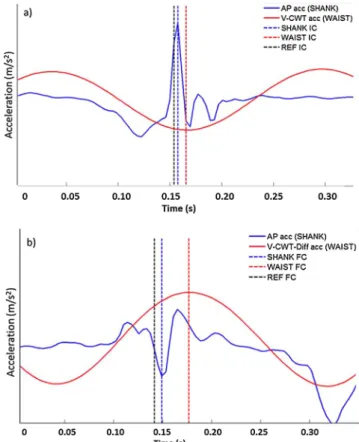
Fig.1showstypicalsignalscollectedattheshankandpelvis, andthecorrespondingICandFCinstantsforbothmethodsusedto computethetemporalgaitparameters.Intheshank-basedmethod (SHANK),thepeakin theangularvelocitysignalsinthesagittal planeduringmid-swingisusedtoidentifywindowsinthesignal
wherenogaiteventscanoccur.Whencoupledwiththealternate shank,theseintervalsallowtheidentificationofsearchwindows forICandFCevents.TheICisidentifiedastheinstantofminimum angularvelocityinthesagittalplanebetweenthebeginningofthe ICsearchwindowandtheinstantofmaximumanterior-posterior acceleration. The FC is identified as the instant of minimum anterior-posterior accelerationintheFCsearchwindow[8].For thewaist-basedmethod(WAIST),dataiscollectedfromasingle IMU positionedonthelowertrunkatL5 level.AfirstGaussian continuous wavelet transformation is applied to the vertical accelerationsignal,andtheminimaareidentifiedastheICtimings. TheresultingsignalisthendifferentiatedandtheFCtimingsare identifiedastheinstantsofitsmaxima[9].
Subjects completed four walking tasks in the conditions detailedinTable1,andtheIMUandpressureinsolesdatawere collected during each task. A stopwatch was used to measure walking time and compute average walking speed during the indoorandoutdoorstraightwalkingconditions.
Fortheoutdoorfreewalkingtask,participantswereinstructed towalkfreelyinthecitycentrewithoutanyrestrictionsregarding routeorwalkingspeed,andavoidingstairs.Boththeindoorfree walkingandoutdoorfreewalkingconditionshadthepotentialof recording the participant’s turns in addition to straight line walking, both of which were included in the analysis. On the contrary,datarecordedduringrestingortransitoryperiodswere Fig. 1.Gait event detection for the tested algorithms. (a)Anterior-posterior accelerationsignaloftheshank(APacc,solidblueline),withcorrespondingIC timings(SHANKIC,dashedblueverticalline).Wavelet-filteredpelvisacceleration signalintheverticalaxis(V-CWTacc,solidredline),withcorrespondingICtimings (WAISTIC,reddashedverticalline).ReferenceICtimingsarealsoshown(REFIC, blackdashedverticalline).(b)Anterior-posterioraccelerationsignaloftheshank (APacc,solidblueline),withcorrespondingFCtimings(SHANKFC,bluedashed verticalline).Derivativeofthewavelet-filteredpelvisaccelerationsignalinthe verticalaxis(V-CWT-Diffacc,solidredline),withcorrespondingFCtimings(WAIST FC,redverticallines).ReferenceFCtimingsarealsoshown(REFFC,blackdashed verticalline).(Forinterpretationofthereferencestocolourinthisfigurelegend,the readerisreferredtothewebversionofthisarticle.)
excludedfromtheanalysis.Tothispurpose,oncetheswingphase ofastepwasdetectedfromtheshankangularvelocitysignal,all thefollowingstepswereretainedfortheanalysisonlyuntilwhen thetimedistancebetweensubsequentstepswaslowerthan1s. Thepressureinsolespatternwasthenvisuallyinspectedtoverify theabsenceofanomalies.
For each conditionandmethod,theIC and FCtimings were obtainedfromtheIMUs,and used tocomputestride,step and stancetime. Meanvaluesand theircoefficient ofvariation(CV) were computed. The coefficient of variation is a standardized measureofdispersionandistheratioofthestandarddeviationto themeanforeachtemporalparameter.
Forthestatisticalanalysis,theoutdoorfreewalkingdatawas splitintotwodatasets.Toallowacomparableamountofstrides andafaircomparisonwiththeothertestedwalkingconditions,the OFWSdataincludedtwominutesofarbitrarilyselectedoutdoor free walking data. This analysis period was chosen for each participantbyselectingan intervalof two consecutiveminutes starting from a randomly identified sampled instant of time betweenthebeginningofthetrialandtheendofthe13thminute of test. In addition, to reflect the entire outdoor free walking condition,allthefifteenminutesof outdoorfree walkingwere includedin theOFWL condition. Missing and extra gaitevents werealsocountedandincludedinthestudy.
For each method, the absolute error for each estimated parameter(IC, FC,stridetime (meanand CV),step time (mean and CV), and swing time (mean and CV)) was determined as follows:
jEj¼jpprj ð1Þ
Wherepristhereferencevalueoftheparameterp.
Descriptive statistics for |E| (mean and standard deviation values)weredeterminedforeachsubject,andtheresultinggroup averagesandstandarddeviationswerefinallycomputed.
AShapiro–Wilktestwasperformedtocheckfordatanormality. Foreach methodandeach parametera FriedmanTestfor non-normal distribution was then used to compare the |E| values obtainedinthedifferentwalking conditions,withasignificance
levelof0.05.Post-hoctestswithBonferronicorrectionwerealso performedtotest if thereweresignificant differencesbetween indoor controlled walking (ICW) and the remaining walking conditions.
3.Results
ThetotalnumberofgaitcyclesanalysedintheISW,OSW,IFW, OFWS, and OFWL conditions were 9417, 12111, 18816, 13240,and767119,respectively.Theparticipantscompleteda median of 120 consecutive strides during the OFWL condition, whileduringtheindoorfreewalkingtask,themediannumberof consecutivestrideswas30.TheSHANKmethoddetected100%of bothICandFCevents.TheWAISTmethodshowed29missingIC eventsineachofbothOFWSandIFWcondition,correspondingto 1.3%ofthetotalnumberofanalysedsteps.IntheOFWLcondition,a totalnumberof124missingICeventsoverthe10participantswere detected,correspondingto0.7%ofthetotalanalysedsteps.The missingeventswereevenlydistributedacrossparticipants,with theexceptionofoneoutlier,addingup58missingICevents.No missing events were found in the OSW and ISW conditions. Furthermore, no missing FC events were found for the WAIST method in any of theinvestigated walkingconditions. Average recorded walking speeds during indoor and outdoor scripted walkingwere1.440.10m/sand1.510.11m/s,respectively.The descriptivestatisticsforstridetime,steptimeandstancetimeas estimatedbythepressureinsolesusedasreferenceareshownin
Table2.Descriptivestatistics(meanandSD)forgaitevents(ICand
FC) and temporal parameters absolute error (|E|) are listed in
Table3.
For the SHANK method,theFriedman test showed that the absoluteerrorsassociatedwithFCtiming,stridetime,steptime andstancetimeweresignificantlydifferentbetweenconditions (p<0.05).Pairwisecomparisonsshowedthat|E|weresignificantly smallerduringindoorscriptedwalking(ISW)thanthoseobtained in the outdoor free conditionfor stride time (both OFWSand OSWL)andsteptime(onlyOSWS).ForFCtimingandstancetime, errors weresignificantly largerin theindoorscriptedcondition
Table1
Summaryofthewalkingconditionsperformedduringtheexperimentalprotocol,withacronym,abriefdescription,andthedurationorrepetition.
Condition Acronym Description Duration/Repetitions
Indoorscripted walking
ISW Walkingatpreferredspeedalonga20.0mlongwalkway. Eightrepetitions.
Outdoorscripted walking
OSW Walkingatpreferredspeedalonga50.0mlongwalkway. Sixrepetitions.
Indoorfree walking
IFW Walkingalongcorridorswithinauniversitybuilding. Twominutes.
Outdoorfree walking (Short)
OFWS Walkingalongfootpathsopentothepublicinthecitycentrewithoutanyrestrictionsinrouteor walkingspeed,avoidingstairs.
Twominutesselectedfromafifteen minutewalk.
Outdoorfree walking (Long)
OFWL Walkingalongfootpathsopentothepublicinthecitycentrewithoutanyrestrictionsinrouteor walkingspeed,avoidingstairs.
Fifteenminutes.
Table2
MeanandSDvaluesoftemporalgaitparametersforallwalkingconditions.
Parameter ISW IFW OSW OFWS OFWL
StrideTime(s) 1.050.06 1.060.06 1.030.05 1.050.07 1.060.08 StepTime(s) 0.530.03 0.530.03 0.520.02 0.520.03 0.530.04 StanceTime(s) 0.640.05 0.640.05 0.630.04 0.640.05 0.640.06 StrideTimeCV(%) 1.540.37 2.881.08 2.210.30 3.020.95 3.991.21 StepTimeCV(%) 2.580.91 3.871.40 3.210.57 4.321.09 5.111.33 StanceTimeCV(%) 2.440.84 3.581.29 2.910.44 3.941.27 4.991.31
(ISW) than those obtained in the outdoor scripted condition (OSWS). In addition, stance time absolute error during indoor scriptedwalking(ISW)wasalsosignificantlylargerthanduring outdoorfreewalking(OSWS).Therewerenostatisticallysignifi -cantdifferencesinCVabsoluteerrorsbetweenwalkingconditions foranyofthetemporalparametersinvestigated.
For the WAIST method, the Friedman test showedthat the absoluteerrorsassociated withstridetime and steptime were significantlydifferentbetweenconditions(p<0.05).Both param-eters weresignificantly smallerduring indoorscripted walking (ISW)than during outdoor freewalking (OFWS and OFWL). In addition,steptimeerrorintheindoorscriptedcondition(ISW)was smallerthanduringindoorfreewalking(IFW).Forgaitvariability measures,the|E|associatedwithstridetimeCVwasfoundtobe significantlydifferentbetweentheISWandtheOFWScondition.
4.Discussion
ThisstudyaimedtoevaluatetheaccuracyoftwoIMU-based algorithmsforthedetectionofgaiteventsduringfreelivinggait, whichis anecessarysteptowards theimplementationof these methodsforprolongedphysicalactivitymonitoring.Twomethods wereselected,namedtheSHANK,whichwasappliedtodatafrom shank-wornsensors,and theWAIST,which wasappliedtodata form a waist-worn IMU. The SHANK method resulted more accuratethantheWAISTmethodforbothICandFCtimings.This wasanexpectedfindingsincesensorsthatareincloserproximity tothefoot-groundcontactpointhavebeenalreadyshowntobe facilitatedingaiteventsdetection[8].
The results for the SHANK method across all the walking conditionsprovided furtherevidence forthe robustnessof this algorithminlimitingtherisksofextraormissedevents.Incontrast toapreviouslypublishedvalidationstudyinhealthysubjects[6], including only straight walking conditions, the WAIST method showed some missed gait events during the free walking conditions. This confirms that attention should be paid when interpretingdatacollectedfromjustonesensoronthepelvisto quantifythenumberofstepswalkedoveracertainperiodoftime [14],withanerrorofabout1%tobeexpectedifusingthemethod hereinvestigated.
FortheSHANKmethod,theFCtimingswerelessaccuratethan the IC timings throughout all the tested conditions. This has previously beenreportedinliteraturefor theindoorcontrolled conditions,andislikelyduetothesmoothermovementoccurring duringFCmakingthegaiteventlessapparenttodetect[8].Forthe WAISTmethod,ICandFCabsoluteerrorsweresimilar:thisislikely tobeduetostricterfilteringappliedtothesignalinthisalgorithm. TheaccuracyoftheSHANKmethodinestimatingICtimings wassimilartothatreportedbytheauthorswhoproposeditduring scriptedstraightwalking[8],howeverFCtimingsinthepresent studywererelativelylessaccurateinallthewalkingconditions. AccuracyestimatesoftheWAISTmethodwerepoorerthanthose reported by the original paper [9] for both IC timings and FC timings,obtainedduringindoorscriptedwalking,but similarto those reported in a subsequent validation study [15]. Possible reasons for these inconsistencies include the use of different measurementinstruments,differentreferencemethods,different path lengths betweenprotocols,and populationcharacteristics. Overall,strideandsteptimeabsoluteerrorsforbothmethodswere limitedtoabsoluteerrorvalues between6ms and14ms,while stancetime errorincreasedtoupto44ms (SHANK) and32ms (WAIST). These results suggest that stride and step time were reasonablyaccurate,whilestancetimeshouldbeinterpretedwith morecaution.FortheWAISTmethod,stridetimeandsteptime absoluteerrorestimates wereless accurateduringoutdoorfree walking (OFWS and OFWL). Although these differences were consistent and resulted to be statistically significant, they generated only a smallincrease in absolute error(6–11ms for stridetime,9–13msforsteptime).Thisoutcomesuggeststhatthe accuracyof thealgorithm isaffectedbythewalking conditions tested.However,itisencouragingtonotethattheincreaseingait eventtimingandrelevanttemporalparametererrorswereonly moderateandshouldnotpreventtheuseofthismethodtocollect data duringprolonged free livinggait. Furthermore,theresults suggest that in ourstudy, thetemporal parameters estimation errorswerenotmarkedlyinfluencedbythelengthofthewalks. SimilartotheWAISTmethod,thestrideandsteptimeabsolute errors recorded using the SHANK method were higher during outdoor free walking(OFWS and OFWL), but generated onlya small increase inpercentage error(6–9msfor stride time, and
Table3
Mean(SD)valuesoftheabsoluteerror|E|forICtiming,FCtiming,andtemporalparameters(meanandCV)ofbothmethods(SHANKandWAIST).*Statisticallysignificant differencebetweenwalkingconditions(p<0.05).
9–14msforsteptime).Surprisingly,theerrorsgeneratedforFC timingsandstancetimesweresignificantlyhigherduringindoor thanduringoutdoorstraightwalking.ThedelayeddetectionofFC events (as shown in Fig. 1) increased in the ISW task as a consequence of a delayed appearance of the minimum in the anterior-posterioraccelerationidentifiedastheinstantof FC.If confirmedbyfurtherstudies,this finding maysuggest thatthe environmentplaysaroleingeneratingdifferentwalkingpatterns andsignals,influencingtheaccuracyoftheFCdetection.
TheabsoluteerrorsgeneratedinthecomputationofCVvalues for both methods were acceptable and similar across walking conditions,withmaximum|E|of0.13%and0.31%instridetimeCV, 0.89%and0.64%insteptimeCV,and0.54and0.46%instancetime CV(valuesareforSHANKand WAISTmethods,respectively). In terms of accuracy in estimating variability of the investigated temporal parameters, generally the two methods appeared to performsimilarly.Previousstudieshaveshownthatsmallerrorsin gaiteventdetectionmayaffect variabilitymeasuresmore than mean values [16]. The fact that no significant differences in accuracywerefoundbetweenwalkingconditionsfortheSHANK methodis encouragingand providesevidencefor the appropri-atenessofitsuseinfree-livingstudies.
Theresultsofthisstudymightrepresentanormativereference for future investigations of real life gait monitoringin healthy adults.However,ifaimingatdifferentapplications,suchasthose involvingpatientpopulations,theseresultscannotbegeneralised andtheaccuracyofthealgorithmsshouldbespecificallytestedto accountforpossibleadditionalerrors.
5.Conclusions
Overall,bothmethodstestedinthepresentstudyshowedsmall differences in gait event timings and temporal parameter estimation, for both mean and variability measures, between differentenvironments and different walking protocols. Conse-quently,thisisencouragingfortheapplicationofthesemethodsin freelivinggait.
Duringoutdoorfreewalking,theSHANKmethodshowedvery accurateinitialcontacttimingdetection,leadingtolowerrorsfor stridetimeandsteptime.RelativetotheICtiming,thefinalcontact timingwas less accurate. TheWAIST methodperformedworse thantheSHANKmethodinbothstepdetectionandininitialand final contact detection; however, these errors only marginally affectedthetemporalparameterestimationduringoutdoorfree walking.
Conflictofintereststatement
None.
Acknowledgements
ThisstudywassupportedbytheEPSRC FrontierEngineering Awards,GrantReferenceNo.EP/K03877X/1andbytheMRCand
ArthritisResearchUKaspartoftheMRC—ArthritisResearchUK CentreforIntegratedresearchintoMusculoskeletalAgeing(CIMA). Thedatausedinthispaperarepublicallyavailable(DOI:10.15131/ shef.data.3503180).
References
[1]S.DelDin,A.Godfrey,L.Rochester,Validationofanaccelerometertoquantifya comprehensivebatteryofgaitcharacteristicsinhealthyolderadultsand Parkinson’sdisease:towardclinicalandathomeuse,IEEEJ.Biomed.Health Inform.2194(2015)1–10,doi:http://dx.doi.org/10.1109/JBHI.2015.2419317. [2]J.J. Kavanagh, H.B. Menz, Accelerometry: a technique for quantifying
movementpatternsduringwalking,GaitPosture28(2008)1–15,doi: http://dx.doi.org/10.1016/j.gaitpost.2007.10.010.
[3]J.M.Hausdorff,Gaitdynamics,fractalsandfalls:findingmeaninginthe stride-to-stridefluctuationsofhumanwalking,Hum.Mov.Sci.26(2007) 555–589,doi:http://dx.doi.org/10.1016/j.humov.2007.05.003.
[4]S.A.Lowe,G.Ólaighin,Monitoringhumanhealthbehaviourinone’sliving environment:atechnologicalreview,Med.Eng.Phys.36(2014)147–168,doi: http://dx.doi.org/10.1016/j.medengphy.2013.11.010.
[5]W.Zijlstra,A.Hof,Assessmentofspatio-temporalgaitparametersfromtrunk accelerationsduringhumanwalking,GaitPosture18(2003)1–10. [6]D. Trojaniello, A. Ravaschio, J.M. Hausdorff, A. Cereatti, Comparative
assessmentofdifferentmethodsfortheestimationofgaittemporal parametersusingasingleinertialsensor:applicationtoelderly,post-stroke, Parkinson’sdiseaseandHuntington'sdiseasesubjects,GaitPosture42(2015) 310–316,doi:http://dx.doi.org/10.1016/j.gaitpost.2015.06.008.
[7]A. Salarian, H. Russmann, F.J.G.Vingerhoets, C. Dehollain, Y. Blanc, P.R. Burkhard,etal.,GaitassessmentinParkinson’sdisease:towardanambulatory systemforlong-termmonitoring,IEEETrans.Biomed.Eng.51(2004) 1434–1443,doi:http://dx.doi.org/10.1109/TBME.2004.827933.
[8]D.Trojaniello,A.Cereatti,E.Pelosin,L.Avanzino,A.Mirelman,J.M.Hausdorff, etal.,Estimationofstep-by-stepspatio-temporalparametersofnormaland impairedgaitusingshank-mountedmagneto-inertialsensors:applicationto elderly,hemiparetic,parkinsonianandchoreicgait,J.Neuroeng.Rehabil.11 (2014)152,doi:http://dx.doi.org/10.1186/1743-0003-11-152.
[9]J.McCamley,M.Donati,E.Grimpampi,C.Mazzà,Anenhancedestimateof initialcontactandfinalcontactinstantsoftimeusinglowertrunkinertial sensordata,GaitPosture36(2012)316–318,doi:http://dx.doi.org/10.1016/j. gaitpost.2012.02.019.
[10]B.Najafi,J.L.Helbostad,R.Moe-Nilssen,W.Zijlstra,K.Aminian,Doeswalking strategyinolderpeoplechangeasafunctionofwalkingdistance?GaitPosture 29(2009)261–266,doi:http://dx.doi.org/10.1016/j.gaitpost.2008.09.002. [11]K.L.Paterson,N.D.Lythgo,K.D.Hill,Gaitvariabilityinyoungerandolderadult
womenisalteredbyovergroundwalkingprotocol,AgeAgeing38(2009) 745–748,doi:http://dx.doi.org/10.1093/ageing/afp159.
[12]M.Brodie,M.Coppens,S.R.Lord,N.H.Lovell,Y.J.Gschwind,S.J.Redmond,etal., Wearablependantdevicemonitoringusingnewwavelet-basedmethods showsdailylifeandlaboratorygaitsaredifferent,Med.Biol.Eng.Comput. (2015),doi:http://dx.doi.org/10.1007/s11517-015-1357-9.
[13]J.Mickelborough,M.L.VanDerLinden,J.Richards,A.R.Ennos,Validityand reliabilityofakinematicprotocolfordeterminingfootcontactevents,Gait Posture11(2000)32–37,doi:http://dx.doi.org/10.1016/S0966-6362(99) 00050-8.
[14]F.A.Storm,B.W.Heller,C.Mazzà,Stepdetectionandactivityrecognition accuracyofsevenphysicalactivitymonitors,PLoSOne10(2015)e0118723. [15]D.Trojaniello,A.Cereatti,U.DellaCroce,Accuracy,sensitivityandrobustness
offivedifferentmethodsfortheestimationofgaittemporalparametersusing asingleinertialsensormountedonthelowertrunk,GaitPosture40(2014) 487–492,doi:http://dx.doi.org/10.1016/j.gaitpost.2014.07.007.
[16]T.R.Beijer,S.R.Lord,M.A.D.Brodie,Comparisonofhandheldvideocameraand GAITRitemeasurementofgaitimpairmentinpeoplewithearlystage Parkinson’sdisease:apilotstudy,J.ParkinsonsDis.3(2013)199–203,doi: http://dx.doi.org/10.3233/JPD-130179.