An Integrated Process Model of Stereotype Threat Effects on Performance
Toni Schmader
University of ArizonaMichael Johns
University of WyomingChad Forbes
University of ArizonaResearch showing that activation of negative stereotypes can impair the performance of stigmatized individuals on a wide variety of tasks has proliferated. However, a complete understanding of the processes underlying these stereotype threat effects on behavior is still lacking. The authors examine stereotype threat in the context of research on stress arousal, vigilance, working memory, and self-regulation to develop a process model of how negative stereotypes impair performance on cognitive and social tasks that require controlled processing, as well as sensorimotor tasks that require automatic processing. The authors argue that stereotype threat disrupts performance via 3 distinct, yet interrelated, mechanisms: (a) a physiological stress response that directly impairs prefrontal processing, (b) a tendency to actively monitor performance, and (c) efforts to suppress negative thoughts and emotions in the service of self-regulation. These mechanisms combine to consume executive resources needed to perform well on cognitive and social tasks. The active monitoring mechanism disrupts performance on sensorimotor tasks directly. Empirical evidence for these assertions is reviewed, and implications for interventions designed to alleviate stereotype threat are discussed.
Keywords:stereotype threat, stress and coping, working memory, vigilance, self-regulation
Stereotype threat has become one of the most widely studied topics of the past decade in social psychology. In 2003, Steele and Aronson’s (1995) seminal article on the subject was named a modern classic (Devine & Brodish, 2003; Fiske, 2003). Although a large body of work now testifies to the reliability and general-izability of stereotype threat effects on performance, lingering questions remain about precisely what processes underlie these effects. Researchers have found evidence for variables such as anxiety (S. J. Spencer, Steele, & Quinn, 1999), stereotype activa-tion (Davies, Spencer, Quinn, & Gerhardstein, 2002), self-doubt (Steele & Aronson, 1995), working memory (Schmader & Johns, 2003), and arousal (Ben-Zeev, Fein, & Inzlicht, 2005). Unfortu-nately, limitations of experimental research necessitate that only one or two process variables can be explored in any single study. Although these studies have advanced a basic understanding of the putative mechanisms of stereotype threat, one unintended conse-quence of this systematic dismantling of process is an unrealistic expectation that there is a single mediator of stereotype threat effects on performance. Complex behavior, however, is likely to
result from an interrelated sequence of processes. In the present article, we describe an integrated process model in which motiva-tional, affective, physiological, and cognitive processes interact to impair performance in a stereotype-relevant context.
A Primer on Stereotype Threat
In 1995, Steele and Aronson published research testing a pro-vocative explanation for the long-standing finding that African Americans tend to underperform on standardized tests (Steele & Aronson, 1995). They reasoned that knowledge of the prevalent cultural stereotype asserting the intellectual inferiority of African Americans could interfere with Black students’ performance on intellectual tests through fear of confirming that stereotype. In support of this hypothesis, their experiments revealed that African American college students performed worse than their White peers on standardized test questions when this task was described to them as being diagnostic of their verbal ability but that their performance was equivalent to that of their White peers when the same questions were simply framed as an exercise in problem solving (and after accounting for prior SAT scores). Part of the popular, practical, and scientific appeal of stereotype threat as an explanation for group differences in test scores is that it can be created in the performance situation itself. The threat is “in the air,” as Steele (1997) argued, and by implication, once the air is cleared, group differences should be diminished.
Since the publication of that seminal research, stereotype threat effects have been extended to account for a wide variety of performance decrements observed among those who are targeted by negative stereotypes. When a task is described as diagnostic of intelligence, Latinos and particularly Latinas perform more poorly
Toni Schmader and Chad Forbes, Department of Psychology, University of Arizona; Michael Johns, Department of Psychology, University of Wyoming.
Work on this article was supported by National Institute of Mental Health Grant 1R01MH071749 awarded to Toni Schmader. We would like to thank Lynn Nadel, Alfred Kaszniak, and David Sbarra for their com-ments and advice on an earlier version of the model articulated in this article.
Correspondence concerning this article should be addressed to Toni Schmader, Department of Psychology, University of Arizona, Tucson, AZ 85721. E-mail: [email protected]
than do Whites (Gonzales, Blanton, & Williams, 2002), children with low socioeconomic status perform more poorly than do those with high socioeconomic status (Croizet & Claire, 1998), and psychology students perform more poorly than do science students (Croizet, Despre´s, Gauzins, Huguet, & Leyens, 2003). Even groups who typically enjoy advantaged social status can be made to experience stereotype threat. Specifically, White men perform more poorly on a math test when they are told that their perfor-mance will be compared with that of Asian men (Aronson et al., 1999), and Whites perform more poorly than Blacks on a motor task when it is described to them as measuring their natural athletic ability (Stone, 2002; Stone, Lynch, Sjomeling, & Darley, 1999). In addition, Whites also show stereotype threat effects on tasks where they might fear confirming the stereotype that Whites are racist (Frantz, Cuddy, Burnett, Ray, & Hart, 2004).
Performance decrements have been observed in response to both explicit manipulations that call attention to one’s stigmatized sta-tus in a domain (e.g., S. J. Spencer et al., 1999) and more subtle manipulations in which the researcher’s expectations for poor performance are less likely to be consciously primed (e.g., Inzlicht & Ben-Zeev, 2000; J. L. Smith & White, 2002; Stone & McWhin-nie, in press). Furthermore, recent evidence confirms that such manipulations increase one’s motivation to try to disconfirm the negative stereotype, at least for those who are highly identified with the domain (Forbes, Schmader, & Allen, 2007; Jamieson & Harkins, 2007). Some have suggested that stereotype threat has little impact outside of the laboratory (Cullen, Hardison, & Sack-ett, 2004; Stricker & Ward, 2004). However, in a recent reanalysis of a field experiment by Stricker and Ward (2004), Danaher and Crandall (in press) revealed that marking one’s gender after (as compared with before) an advanced placement calculus test led to a 33% reduction in the gender gap in performance. Taken together, this research suggests that activating negative stereotypes about a social identity one possesses motivates individuals to try to combat that stereotype but that this creates some sort of extra situational burden that interferes with the ability to perform as well at a task as might otherwise be possible. In the present article, we unpack the sequence of processes that are likely to account for this pattern of interference.
An Integrated Process Model of Stereotype Threat
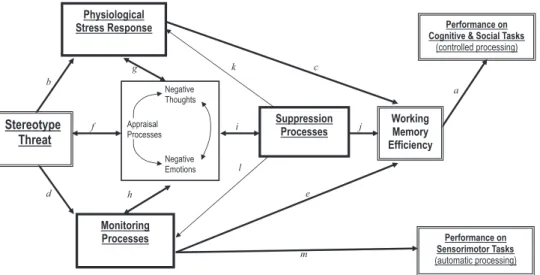
In our view, stereotype threat is triggered by situations that pose a significant threat to self-integrity, the sense of oneself as a coherent and valued entity that is adaptable to the environment (Steele, 1988). This self-integrity threat stems from a state of cognitive imbalance in which one’s concept of self and expectation for success conflict with primed social stereotypes suggesting poor performance. This state of imbalance acts as an acute stressor that sets in motion physiological manifestations of stress, cognitive monitoring and interpretative processes, affective responses, and efforts to cope with these aversive experiences (see also Major & O’Brien, 2005). The general outline of the proposed model is presented in Figure 1. In short, we assert that the threat to self-integrity stereotype threat elicits during or in anticipation of a performance cues a sequence of processes that can disrupt optimal performance on a variety of tasks. Developing an integrated me-diational model of stereotype threat requires consideration of both the nature of the predictor (i.e., how do situations trigger stereo-type threat?) and the outcome (i.e., what kind of performance is impaired?). Thus, we first outline the psychological process that we believe underlies the experience of stereotype threat and how situational cues and person characteristics combine to trigger that experience. We then consider how stereotype threat undermines performance on cognitive and social tasks that necessitate con-trolled processing. We identify working memory as the domain-general executive resource associated with efficient performance on a wide range of cognitive and social tasks that necessitate coordinated information processing while inhibiting interference from distracting information (Pathain Figure 1).
Having identified working memory as a core cognitive faculty that is implicated in cognitive and social stereotype threat effects, we then consider the discrete processes likely to be engaged in threatening situations that would rely on and disrupt this cognitive resource. These processes include an increased physiological stress response (Pathbin Figure 1) paired with increased monitoring of cues (Path d in Figure 1) to disambiguate what that situation implies about the self and/or one’s group. We assert that this increased monitoring, paired with increased physiological arousal
Performance on Sensorimotor Tasks (automatic processing) a e i k g f l m c h d b Physiological Stress Response Suppression Processes Performance on Cognitive & Social Tasks
(controlled processing) Working Memory Efficiency j Negative Thoughts Negative Emotions Appraisal Processes Stereotype Threat Monitoring Processes
and a primed state of cognitive imbalance created by stereotype threat, can lead people to appraise their experience in a biased manner that produces negative thoughts and feelings (Pathsf, g,
andhin Figure 1). However, because targets of stereotype threat are motivated to avoid stereotype confirmation by performing well, they engage in active efforts to suppress stereotypic and anxious thoughts that are inconsistent with their task goals (Pathi
in Figure 1).
Within this set of processes, there are three primary reasons why task performance could be impaired. These include (a) a direct physiological impairment of prefrontal processing caused by acti-vation of the hypothalamic-pituitary-adrenal axis (Pathcin Figure 1), (b) increased vigilance toward endogenous or exogenous cues to assess the self within the situation (Pathein Figure 1), and (c) active efforts to suppress or push out of mind stereotypic thoughts and anxious feelings (Pathjin Figure 1). An understanding of this interrelated set of mechanisms requires a review of literatures on working memory, stress and cognition, and self-regulatory pro-cesses that might be involved in a target’s active attempt to understand and cope with the threat of confirming a negative stereotype.
After describing the specific components of the model, we consider research showing the effect of stereotype threat on tasks where performance does not rely on controlled processing but benefits from the use ofautomatic processesto guide behaviors outside of executive attention. Research suggests that working memory impairments cannot easily account for the effect of ste-reotype threat on such tasks (e.g., Beilock, Jellison, Rydell, Mc-Connell, & Carr, 2006). However, because performance on auto-mated tasks suffers to the degree executive resources are used to monitor and control one’s behavior—a process also implicated in performance on cognitive and social tasks—we believe the model can be applied to explain these findings. We conclude our descrip-tion by considering how the model can account for these effects (Pathmin Figure 1).
Conceptualizing the Nature of Stereotype Threat
To understand the mechanisms that underlie performance im-pairments, we first consider the process by which situational cues trigger stereotype threat. In our view, all situations of stereotype
threat involve activation of three core concepts: the concept of one’s ingroup, the concept of the ability domain in question, and the self-concept. However, it is not merely the activation of these three concepts but the activatedpropositional relation(Gawronski & Bodenhausen, 2006) between them that we believe underlies the experience of stereotype threat. A positive unit relation means that the two concepts are defined in that context with respect to one another (My group has this ability; I am like my group; I have this ability). In contrast, a negative link primed between any of these two concepts would indicate that, in that context, one concept is defined in opposition to another (My group does not have this ability; I am not like my group; I do not have this ability). Drawing on balance theory (Heider, 1958) and similar to the framework posed by Nosek, Banaji, and Greenwald (2002), we conceive of stereotype threat as stemming from a situationally induced state of imbalance between these implied propositional links that the in-dividual is motivated to, and struggles to, resolve (My group does not have this ability, I am like my group, but I think I have this ability). Figure 2 depicts the imbalance among these three com-ponents that is created in situations of stereotype threat by the presence of situational primes and/or individual-differences vari-ables found to increase threat susceptibility.
The imbalance created by stereotype threat stems from the simultaneous activation of three implied links: First, cues in the environment signal a negative propositional relation between one’s concept of the ingroup and ability in a given domain such that the group is defined as deficient in that context. In prior research, such cues have involved manipulations of the diagnosticity of a test, (Steele & Aronson, 1995), explicit statements that one’s ingroup would do poorly in the domain (S. J. Spencer et al., 1999), or stereotypic group portrayals (Davies et al., 2002). The negative stereotypes activated by such manipulations are a manifestation of the primed negative link between the group and the domain. Furthermore, individual differences in stereotype endorsement (Schmader, Johns, & Barquissau, 2004) or stigma consciousness (Brown & Pinel, 2003) might increase susceptibility to stereotype threat because the negative link between group and domain is either stronger (as in the case of stereotype endorsement) or more likely to be activated in the face of ambiguous cues (as in the case of stigma consciousness). Situational primes of group stereotype or stereotype relevance of domain Individual differences in stereotype endorsement or stigma consciousness [ - ] Concept Concept of Ability Domain of Group Situational primes of group salience or collective self Individual differences in domain identification [ + ] [ + ] Individual differences in group identification Situational primes of ego involvement Concept of Self
Second, cues in the environment make salient one’s membership in the stigmatized group by activating a positive link between one’s concept of self and one’s concept of the group such that the self is defined in terms of group membership in that context. Past studies provide evidence for this association by showing that manipulations of group salience such as solo status (Inzlicht & Ben-Zeev, 2000), group priming (Shih, Pittinsky, & Ambady, 1999), and group representativeness (Schmader, 2002) produce stereotype threat effects. Work by Marx, Stapel, and Muller (2005) confirmed that situations of stereotype threat activate the collective self, which is a manifestation of a positive link between the concepts of self and group. Similarly, individuals high in group identification are predisposed to activate this link even in other-wise ambiguous circumstances, increasing their susceptibility to stereotype threat (Schmader, 2002).
The third link that contributes to the imbalance is a positive propositional relation primed between self and domain such that the self-concept is associated with doing well in that context because of either an expectation of success or a strong motivation to excel. Indeed, the original theory states that the high-achieving vanguard of a stigmatized group will be most affected by stereo-type threat, suggesting that personal investment in the domain is a necessary precondition (Steele, 1997). Moreover, studies have shown that individuals experience stereotype threat to the degree that doing well in the domain is personally important to them (Aronson et al., 1999; Stone et al., 1999). Situationally, this personal investment in the domain is accomplished in studies by providing cues to ego involvement such as reminding participants that the task, though challenging, should be within their abilities or by selecting participants with a history of success in the domain (Schmader & Johns, 2003; S. J. Spencer et al., 1999; Steele & Aronson, 1995). Such procedural elements help to increase exper-imental realism and garner participant involvement, but it is worth emphasizing that this is likely to be an important ingredient of stereotype threat.
Nosek et al. (2002) described a similar state of stable intraper-sonal associations that lead women to implicitly disassociate their sense of self from the math domain. In the present model, we expand upon these ideas to understand stereotype threat as the discrete experience of imbalance activated in a given performance situation. The implication is that each of the associations described above must be activated to produce clear signs of stereotype threat. In contrast, much of the literature to date has assumed that stereo-type threat can be elicited through many separate pathways (e.g., by priming the group or by changing the task frame). Although further research is needed to bolster our conceptualization, avail-able evidence generally supports the idea that each linkage must be activated to experience stereotype threat.
Most of the studies that have relied on group salience to ma-nipulate threat also have described the central task that participants complete as a stereotype-relevant task (e.g., Inzlicht & Ben-Zeev, 2000; Schmader, 2002; Schmader & Johns, 2003; Shih et al., 1999). Interestingly, one study that paired race salience with a nondiagnostic test description showed only a marginal effect (Steele & Aronson, 1995). Similarly, manipulations that on the surface seem designed to activate only one of the concepts in this triad can also activate other components in the model (e.g., Marx et al., 2005). We also have some preliminary evidence suggesting that self-relevance may be a necessary feature of stereotype threat
(Schmader, Zhang, & Johns, 2007). We were able to reduce stereotype threat and elevate math performance among a sample of math-identified women simply by giving them a false name (either female or male) and literally detaching their personal identity from a typically stereotype threatening situation. This finding compli-ments work by Wheeler, Jarvis, and Petty (2001), who showed that individuals perform consistently with an outgroup stereotype only when the outgroup is temporarily incorporated into their own working self-concept. Thus, even if one is not chronically identi-fied with a negatively stereotyped group, manipulations can tem-porarily prime a sense that the group defines the self, inducing the cognitive imbalance that underlies stereotype threat.
We can also understand different forms of stereotype threat (e.g., a threat to either one’s self or group concept; Shapiro & Neuberg, 2007) in terms of where the imbalance is most pro-nounced. For those concerned about the implication of the stereo-type for personal identity, the greatest tension might emanate from a strong link between self and domain (i.e., I really want to do well, but the activated set of cognitions primes a negative link). In contrast, those who are more concerned about confirming the stereotype for one’s social identity might feel the greatest cogni-tive tension as a result of a strong association between group and domain (i.e., I really want my group to do well, but the activated set of cognitions primes a negative link).
Furthermore, Shapiro and Neuberg’s (2007) predictions that different variables will make individuals more or less susceptible to threat in public or private settings can also be understood within this balance framework. For example, the person susceptible to public forms of group-concept stereotype threat might activate the negative link between group and domain only when he or she believes his or her group membership and performance will be publicly known. A variable such as stigma consciousness makes this link more accessible for these individuals even in ambiguously threatening situations. In contrast, the person susceptible to private forms of group concept threat will have the group– domain link activated even in situations that are private and to the degree that he or she personally endorses the stereotype. Thus, the balance framework represents a more general meta-model that describes how external information interacts with intraindividual cognition to produce the specific forms of threat identified by Shapiro and Neuberg.
Perhaps the most critical aspect of our model is the assumption that a primed state of imbalance creates a state of tension that the individual is motivated to resolve. Thus, as with other models of cognitive inconsistency, this experience of cognitive imbalance should have downstream consequences for arousal, thought emo-tion, and self-regulation as the individual seeks resolution to that imbalanced state (Carver & Scheier, 1998; Crandall, Silvia, N’Gbala, Tsang, & Dawson, 2007; Festinger, 1957; Higgins, 1987: Swann & Reid, 1981). The integrated process model that we articulate specifies these downstream effects and articulates the implications that these processes can have for performance.
Working Memory as a Proximal Mediator of Stereotype
Threat Effects in Cognitive and Social Performance
Situations
A review of the literature on stereotype threat and related phenomena reveals three broad categories of stereotype threat
outcomes. Most research has focused on how stereotype threat impairs performance on cognitive tasks such as verbal tests (Steele & Aronson, 1995), complex mathematical tasks (Quinn & Spen-cer, 2001), tests of memory (Hess, Auman, & Colcombe, 2003), and mental rotation (Wraga, Duncan, Jacobs, Helt, & Church, 2006). However, additional studies that can be characterized in terms of stereotype threat have involved tasks that are inherently social (Bosson, Haymovitz, & Pinel, 2004; Richeson & Shelton, 2003), such as maintaining a fluid interaction with someone in the face of negative stereotypes suggesting malicious intentions in that interaction. The third category of outcomes includes sensorimotor skills or other tasks that entail fluid movement or automated behavioral processes (e.g., Beilock et al., 2006; Stone et al., 1999). The primary focus of our model is on the first two types of performance situations (high-order cognitive tasks and intergroup interactions). Because the processes underlying performance dec-rements on sensorimotor tasks are governed by a specific compo-nent of the model—performance monitoring (Beilock et al., 2006)—we discuss these types of performance situations after we have described this component in detail.
To identify the processes that underlie stereotype threat effects, we start by focusing on what mechanism is common among the complex cognitive and social tasks that stereotype threat affects. Although these tasks seem quite different, they share one impor-tant element in common: They all require a certain degree of controlled attention, effortful processing, and active self-regulation. For example, stereotype threat produces gender differ-ences in math performance only on a difficult math test (S. J. Spencer et al., 1999) and specifically on complex word problems that require the formation of strategies to extract the relevant information to solve the problem (Quinn & Spencer, 2001). In fact, if tasks are easy or well learned, the motivation to disconfirm the stereotype leads to better performance (O’Brien & Crandall, 2003). Similarly, in social contexts, cognitive depletion effects are only observed by White Americans speaking in front of a Black American if they are in a position of having to consciously think about the wording they use to communicate their opinion (Richeson & Trawalter, 2005).
This pattern of evidence suggests that stereotype threat degrades the ability to regulate attention during complex tasks where it is necessary to coordinate information processing online and inhibit thoughts, feelings, and behaviors counterproductive to one’s cur-rent goals. Cognitive psychologists describe the mechanism that is responsible for this sort of efficient regulation as executive func-tioning or working memory (e.g., Engle, 2002). We next define working memory to provide the conceptual foundation for exam-ining how stereotype threat impairs performance on cognitive and social tasks.
Working Memory Defined
Contemporary models of working memory all posit that a cen-tral executive processor coordinates cognitive and behavioral pro-tocols in the service of task completion (Feldman-Barrett, Tugade, & Engle, 2004; Miyake & Shah, 1999). Although these models tend to differ with respect to the interrelationship between infor-mation storage and executive control (Conway, Jarrold, Kane, Miyake, & Towse, 2007), there is consensus that working memory is situated in the prefrontal cortex, which is responsible for
con-trolling attention and deploying inhibitory processes (Gray, Chabris, & Braver, 2003; Kane & Engle, 2002). Most models also endorse the basic idea that the central executive processor is of limited capacity and therefore is sensitive to variations in information-processing demands (Conway et al., 2007).
Our perspective on working memory is based on the work of Engle, Kane and colleagues. These researchers have developed dual-processing measures of working memory that predict perfor-mance on a wide variety of cognitive tasks, ranging from Raven’s Advanced Progressive Matrices (Engle, Tuholski, Laughlin, & Conway, 1999) to Stroop color naming (Kane & Engle, 2003). They proposed that working memory represents executive atten-tion—the general but limited ability to keep task-relevant infor-mation and goal representations accessible in the face of interfer-ence from task-irrelevant information and competing responses (Engle, 2002; Kane, Conway, Hambrick, & Engle, 2007). Thus, we use the termworking memoryto represent a limited-capacity executive process that coordinates cognition and controls behavior to achieve performance goals in the presence of exogenous or endogenous information that competes for attention.
It should be noted that although different researchers have used either working memory or executive function terminology to de-scribe the process of interest to us here, these two terms largely refer to the same domain-general ability to control the focus of one’s attention and regulate behavior. We adopt the termworking memoryto maintain consistency with the work of Engle, Kane, and colleagues, although we consider this usage compatible with the termsexecutive functionand executive control.It should also be noted that although working memory measures all involve the storage of information in short-term memory, current definitions of working memory are not equated with short-term memory. In fact, the amount of information that can be stored in short-term memory is unrelated to performance on measures of fluid cognition (Engle et al., 1999; Kane et al., 2004). It is this finding that working memory predicts high-order cognitive ability, while short-term memory does not, that has largely contributed to the development of the executive-based conceptualizations of working memory that is the focus of our model.
Evidence That Stereotype Threat Taxes Working Memory
Although research has often treated working memory as an individual-differences variable, when conceptualized as a state variable, working memory becomes a prime candidate for medi-ating stereotype threat effects in performance situations requiring controlled processing. Not only has research directly implicated this mechanism in performance on the same standardized tests that are the focus of the achievement gap between racial or gender groups (Conway, Cowan, Bunting, Therriault, & Minkoff, 2002; Engle et al., 1999; Su¨, Oberauer, Wittmann, Wilhelm, & Schulze, 2002; Unsworth & Engle, 2005), it is also clear that working memory captures variation in general executive processes critical for coping with acute stressors. For example, high working mem-ory predicts the ability to maintain the accessibility of task goals (Kane & Engle, 2003) as well as the ability to control attention (Kane et al., 2007) and minimize the influence of intrusive thoughts while completing resource-demanding tasks (Rosen & Engle, 1998). These findings suggest that working memory is critical for efficient thought regulation in situations that place
heavy demands on attention. Thus, it is reasonable to predict that stereotype threat temporarily degrades working memory efficiency in a manner that could account for the diversity of performance impairments found in the literature. There are now several pieces of evidence to support this assertion.
First, our own work has directly tested the hypothesis that reduced test performance under stereotype threat is attributable to decreased working memory (Schmader & Johns, 2003). In our initial studies, college students completed the operation span task to measure their working memory (Turner & Engle, 1989). In a typical trial of the task, participants are presented with a mathe-matical equation—for example, (2 ⫻ 3) ⫺ 5 ⫽ 1—and must decide whether the answer given is correct or incorrect. They are then given a word to remember for recall at a later point. These trials are grouped into sets such that participants might be pre-sented with a set of five equation and word pairings before being cued to recall the five words. Participants’ ability to correctly recall all of the words in each set provides an index of working memory in that it reflects the ease with which they can process the equations while simultaneously holding the words in their mind.
In our first experiment, male and female college students com-pleted the operation span task, which was either described to them as a reliable measure of working memory (control) or as a reliable measure of quantitative capacity and highly related to math ability (stereotype threat). As predicted, women in the stereotype threat condition showed significantly lower working memory scores (i.e., they recalled fewer words) than did men in the same condition or than women in the control condition. A second study replicated these effects among Latinos and Latinas who were told that the operation span task is highly indicative of general intelligence.
Finally, a third experiment tested whether reductions in working memory mediate the negative effects of stereotype threat on wom-en’s math performance. In the stereotype threat condition, women learned that they would be taking a math test as the only woman in a room of men. In the control condition, women learned that they would perform a problem-solving exercise in an all-female session. After these instructions, women completed a modified measure of working memory (instead of solving equations, partic-ipants had to count the number of vowels in a sentence) followed by a 20-min math test. Replicating earlier studies, women in the stereotype threat condition showed significantly lower working memory and performed worse on the math test. More importantly, mediation analyses demonstrated that the direct effect of stereo-type threat on math performance was significantly reduced and became nonsignificant when controlling for working memory, which was significantly associated with math performance. This set of experiments provides the most direct evidence that situations of stereotype threat reduce working memory specifically and that this reduction in executive attentional processes mediates the ef-fects on test performance.
Since we published this work, other studies have provided converging support for general impairments in executive function in stereotype threatening situations. Croizet et al. (2004) found that when psychology and engineering students were aware of intel-lectual stereotypes favoring engineers, both groups of students showed a decrease in heart rate variability while taking a diagnos-tic test. However, only psychology students performed more poorly on the test and showed test scores that were correlated with their heart rate variability. Although fluctuations in heart rate
variability can indicate a number of things (e.g., emotion regula-tion; Applehans & Luecken, 2006), some research has linked situational decreases in heart rate variability to increased mental load (Jorna, 1992; Mulder, 1992). Thus, these findings suggest that stereotype threat might increase the cognitive load of stigmatized individuals under stereotype threat.
Other research shows that working memory interference could be an important consequence of stereotype threat. For example, Beilock, Rydell, and McConnell (2007) recently showed that in-dividuals under stereotype threat do more poorly on a series of mathematical problems but only if those problems are complex enough to require working memory. These effects were eliminated when participants were given the opportunity to practice the dif-ficult math problems, presumably because practice decreased the need to rely on working memory resources to solve the problems. Additional research has specifically isolated stereotype threat effects on the ability to inhibit response conflict—a central func-tion of working memory (Kane & Engle, 2003). For example, Inzlicht, McKay, and Aronson (2006) showed that situations of stereotype threat impair Black college students’ performance on a Stroop task, a standard measure of cognitive interference. In a similar vein, Jamieson and Harkins (2007) showed that women under threat make more errors on an antisaccade task, a task that requires inhibition of a prepotent response. These findings suggest that increased motivation (due to stereotype threat) can produce the ironic effect of derailing performance on tasks where inhibition is necessary to avoid errors (Harkins, 2006).
In addition to threat experienced during tests of intellectual ability, we also see the role of working memory in other, nonac-ademic domains where attention regulation is likely involved. Whereas Blacks, Latinos, and American Indians are stereotyped in terms of intellectual skill, White Americans are stereotyped as being racist (Sommers & Norton, 2006; Vorauer, 2003). Thus, White Americans are likely to experience stereotype threat during interracial interactions or on tasks that they believe will reveal their racial biases. Not only does research support these predictions but the effects found specifically implicate the same sorts of central executive processes. For example, Richeson and colleagues (e.g., Richeson & Shelton, 2003) found that White participants with implicit negative biases against Blacks exhibit a decrease in performance on a test of executive function (a Stroop task) lowing an interracial interaction. Richeson and colleagues fol-lowed up on this work by showing activation in the anterior cingulate cortex and dorsolateral prefrontal cortex (regions of the brain thought to be involved in executive attention and control) that corresponds to increased self-regulation during an interracial interaction (Richeson et al., 2003; see also Amodio, Devine, & Harmon-Jones, 2007; Cunningham, Raye, & Johnson, 2005; B. K. Payne, 2005).
In a similar vein, Lambert et al. (2003) found that non-Black perceivers who are both socially anxious and racially biased have difficulty inhibiting a stereotyped judgment of a Black target when they anticipate public evaluation of their judgment. As a result, those who might be most concerned about saying the wrong thing in public actually make the most negative stereotypic judgments (see also Frantz et al., 2004). By applying a process dissociation procedure, these researchers showed that the effect was due more to decreases in cognitive control than to increases in stereotype accessibility. The fact that social anxiety moderates this effect
suggests that stress is a factor in reducing the inhibitory processes needed to regulate responding in this kind of social situation.
In sum, evidence converges to suggest that when individuals find themselves in situations where self-relevant negative stereo-types are made salient, they exhibit reduced efficiency of working memory. More importantly, this disruption in working memory corresponds with diminished performance on both cognitive and social interaction tasks. However, this information is merely de-scriptive unless we can offer an understanding of why situations of stereotype threat impact this specific mechanism.
Cognitive, Physiological, and Affective Processes That
Tax Working Memory
Knowing that stereotype threat interferes with difficult cognitive tasks by consuming working memory leads us to ask what precise processes are responsible for this effect. Why might marking one’s race on a test booklet (Steele & Aronson, 1995), taking a math exam in a room of men (Inzlicht & Ben-Zeev, 2000; Sekaquaptewa & Thompson, 2003), or speaking about racial issues (Richeson & Shelton, 2003) lead Black students, women, and Whites, respec-tively, to experience impairments in attention regulation pro-cesses? We propose that these effects are produced by an interre-lated set of cognitive, physiological, and affective processes (see Figure 1). We describe each of these processes and the evidence to support them in more detail below.
Physiological Stress Response
Before discussing how stress impacts attentional resources such as working memory, we first review the evidence that situations of stereotype threat are, in fact, stressful. Theoretically, the cognitive imbalance that results when stigmatized individuals are placed under stereotype threat should lead to increased arousal, distress, or discomfort that motivates a need for cognitive consistency. For example, studies have shown that individuals who experience other forms of self-inconsistency, such as cognitive dissonance, report a greater sense of discomfort (Elliot & Devine, 1994) and show increased activation of the sympathetic nervous system (SNS) as indicated by increased heart rate (Etgen & Rosen, 1993) and skin conductance (Harmon-Jones, Brehm, Greenberg, Simon, & Nelson, 1996; Losch & Cacioppo, 1990). Thus, we might expect that as individuals find themselves in situations of stereotype threat, attempts to reconcile the imbalance between self, group, and domain associations may in and of itself be distressing.
Although attempts to document stress under stereotype threat using self-report measures have yielded mixed results (Gonzales et al., 2002; Schmader, 2002; Schmader & Johns, 2003; S. J. Spencer et al., 1999), studies relying on physiological and other indirect measures of stress-based arousal (Ben-Zeev et al., 2005; O’Brien & Crandall, 2003) have yielded more promising support for Path
b in Figure 1. For example, Murphy, Steele, and Gross (2007) recently observed greater SNS activation among women merely watching a gender-imbalanced group of male and female college students discuss a math and science conference. Similarly, Blas-covich, Spencer, Quinn, and Steele (2001) showed that Black, but not White, students experience increased blood pressure while performing a test described as diagnostic of intellectual ability. Similarly, White Americans, who are likely to feel threatened by
the stereotype that Whites are racist, exhibit a physiological threat profile of cardiovascular responses (increased cardiac output com-bined with increases in total peripheral resistance) when interact-ing with a Black male (compared with a White male; Mendes, Blascovich, Lickel, & Hunter, 2002). Whites also perform more poorly on a verbal task in this condition. Although these studies have not shown a direct link between increases in cardiovascular threat reactivity and poorer cognitive performance, they have provided general evidence that individuals in situations of stereo-type threat experience stress-induced physiological arousal.
However, a complete understanding of how stereotype threat impairs attentional resources requires a nuanced account of arousal. Specifically, the physiological processes elicited under situations of acute stress— of which stereotype threat is one kind— are likely to include activation of both the sympathetic-adrenal-medullary system and the hypothalamic-pituitary-adrenal axis that reflect an increase in SNS activation (as seen in the studies reviewed above) and the release of corticosteroids and cat-echolamines as part of an integrated stress response (Schommer, Hellhammer, & Kirschbaum, 2003). Although these stress reac-tions serve the function of orienting the individual to the demands of a taxing situation, they might also impair cognitive performance (Eysenck & Calvo, 1992). Moreover, stress could have its biggest impact on cognitive processes that rely on the hippocampus and prefrontal cortex due to the high concentration of receptors in these regions sensitive to cortisol (Blair, 2006; Metcalfe & Jacobs, 1998). This would explain why stress can specifically impair processes such as memory consolidation and spatial memory that are mediated by the hippocampus (e.g., J. D. Payne, Nadel, Allen, Thomas, & Jacobs, 2002; Revelle & Loftus, 1990) and tasks involving executive function, attentional focus, and working mem-ory that are mediated by the prefrontal cortex (e.g., Baumeister, Twenge, & Nuss, 2002; Pruessner, Hellhammer, & Kirschbaum, 1999). Such evidence has implications for the types of tasks on which stereotype threat effects might be most pronounced.
In addition, research on stress and cognition more generally shows evidence for the role of stress-induced cortisol levels in these cognitive impairments (e.g., Bohnen, Houx, & Nicholson, 1990; Kirschbaum, Wolf, May, & Wippich, 1996), particularly in prefrontal processes such as working memory (Elzinga & Roelofs, 2005). Thus, in addition to research showing a correlation between chronic stress and less efficient working memory (Klein & Boals, 2001), this research suggests that acute social stressors elevate cortisol levels, which might directly reduce the efficiency of ex-ecutive processes. Interestingly, the effects of cortisol on general arousal, selective attention, and memory form an inverted-Ushape where some level of cortisol facilitates focused attention and resulting memory, but extreme levels impair these same processes (Lupien & McEwen, 1997), particularly when paired with high levels of SNS activation (Elzinga & Roelofs, 2005). This would explain why some studies find improved performance on selective attention tasks in high-pressure performance situations (Chajut & Algom, 2003; Ellenbogen, Schwartzman, Stewart, & Walker, 2002), while others show impairment on similar types of tasks that include greater cognitive load (Bernstein-Bercovitz, 2003; Ved-hara, Hyde, Gilchrist, Tytherleigh, & Plummer, 2000).
The above findings suggest that performance should be most impaired when stress levels are more extreme and the task requires more complex cognitive processing. When tasks are easy and do
not require sustained attention provided by working memory, increased arousal elicited under stress can provide a boost in performance. However, as tasks become complex, perhaps even contributing to one’s overall level of arousal, stress-induced arousal has the potential to directly impair performance via its impact on specific executive processes such as working memory (e.g., Blair, 2006). These observed patterns in the general stress and attention literature parallel the finding that stereotype threat manipulations have their largest effects when the task is complex (O’Brien & Crandall, 2003; Quinn & Spencer, 2001).
Furthermore, cortisol increases are highest in situations where one fears being negatively evaluated during a task on which individuals are motivated to do well (Dickerson & Kemeny, 2004). Thus, it seems likely that individuals who experience stereotype threat will show increased levels of cortisol in addition to other increases in sympathetic activity. Although there have been no studies that link increased cortisol reactivity to lower performance in a stereotype threat context, there has been some research sug-gesting a relationship between cortisol reactivity and social iden-tity threat more generally (Matheson & Cole, 2004). In this re-search, individuals who were presented with a threat to their social identity (a suggestion that students at their university are less competent) showed increased levels of cortisol to the degree that they had an emotion-focused coping style, and they exhibited lower levels of cortisol to the degree that they had a problem-focused coping style. This evidence indicates that cortisol is likely to be increased even in experimental inductions of stereotype threat. Furthermore, the interactive effects of coping style suggest that people’s appraisals of, or response to, the situation also play a role in modulating their physiological stress response. For this reason we represent Pathgin Figure 1 as a reciprocal pathway where stress can elicit appraisal processes but appraisal processes could also modulate the stress response.
When pairing this evidence of cortisol reactivity in response to social identity threat with evidence that injections of cortisol directly impair cognitive functioning (Kirschbaum et al., 1996), it is clear that a physiological stress response could play a direct role in impairing task performance under stereotype threat (Pathcin Figure 1). More research is needed to examine whether this spe-cific hypothesis holds both in naturalistic situations of stereotype threat where the real-world implications of performance have greater power to produce a strong physiological stress response and in short-term laboratory contexts where the stakes are often lower.
Monitoring the Self-Relevance of Performance
As specified earlier, we conceive of stereotype threat as a primed state of imbalance among concepts of self, group, and domain. In addition to eliciting an acute physiological stress re-sponse, this state of imbalanced self-perception also elicits vigi-lance to performance cues, internal states, and social feedback in an effort to disambiguate the uncertainty aroused by stereotype threat. Disambiguating that experience can be accomplished by attending to information that will change the links summarized in Figure 2 to create a more balanced state.
For example, if one’s preexisting identification with the domain is very strong (e.g., a stable positive link between self and do-main), individuals might search for cues that allow them to restore
balance by reversing the link between self and group. Indeed, research has shown that Blacks and math-identified women under threat distance themselves from activities, interests, and attributes commonly associated with members of their group (Pronin, Steele, & Ross, 2004; Steele & Aronson, 1995). Furthermore, some indi-viduals might be able to restore balance if information in the situation suggests that the link between the group and the domain is positive. For example, stereotype threat effects can be elimi-nated if people are provided with positive or stereotype-inconsistent exemplars of their group (Marx & Roman, 2002; McIntyre, Paulson, & Lord, 2003). Thus, situations that contain these cues hand targets the tools they need to restore balance in a way that preserves the positive link between self and domain. However, in the prototypical situation of stereotype threat, the negative link between self and domain that is suggested by ste-reotype threat, in combination with the motivation to disconfirm the stereotype, translates into a strong motivation to avoid failure. As a result, targets focus attention on themselves and their perfor-mance, becoming more vigilant to detect signs of failure. Although others have suggested that avoidance motivation is a key element of stereotype threat (e.g., J. L. Smith, 2004), here we extend these ideas to outline the cognitive mechanisms that might explain why this particular motivation can disrupt performance.
Becoming more conscious of the self and one’s performance.
One aspect of the motivation to avoid failure under stereotype threat is that it switches people from a more automated state of functioning into a more conscious and controlled state of moni-toring the self within the situation. Adopting a more conscious and controlled processing strategy is designed to resolve the discrep-ancy represented in the triad of primed constructs. In some re-spects, this reaction is similar to that seen in any high-pressure performance situation where attention is more likely to be focused on oneself (Baumeister, 1984; Lewis & Linder, 1997). However, situations of stereotype threat are unique because the concern with one’s performance stems from one’s association with a negatively stereotyped group. Put another way, the person under threat finds him- or herself confronting two alternative hypotheses about his or her performance: “Will I do well, consistent with my personal link to the domain?” or “Will I do poorly, consistent with the negative link to the domain suggested by the stereotype?” Although these alternatives are unlikely to be consciously considered, the primed state of cognitive imbalance manifests phenomenologically as a more conscious focus on the self and one’s performance. As a result, behavior that might have been enacted efficiently is now attended to more consciously in an effort to test these alternative outcomes against available cues.
In line with this logic, Seibt and Fo¨rster (2004) showed in a series of experiments that individuals under stereotype threat be-come more focused on avoiding failure, leading to more cautious and systematic performance, as opposed to the eager and creative performance seen by those who are positively stereotyped. In addition, Beilock et al. (2007) recently found that women under stereotype threat about their math abilities reported worrying more about and monitoring their performance. Beilock et al. suggested that such thoughts contribute to the effect of stereotype threat because working memory becomes loaded with distracting infor-mation that competes for attentional resources.
Increased vigilance to threat- and failure-related cues. The second aspect of this monitoring process is that, because
individ-uals feel cognitive conflict between an imbalanced set of cogni-tions, they then become more vigilant to internal or external cues that might help disambiguate this conflict. It has been well docu-mented that when an individual experiences visceral arousal en-gendered by an environmental threat, systems are brought online to focus attention on the perceived threat (Davis & Whalen, 2001). For example, recent studies using an emotional Stroop or dot-probe task showed that anxious individuals are more likely to be vigilant to anxiety-related stimuli (MacLeod & Mathews, 1988; Williams, Mathews, & MacLeod, 1996). Although this past re-search suggested that such attentional shifts to threat stimuli hap-pen automatically, such automatic vigilance to task irrelevant cues has the potential to harm performance on complex tasks that depend heavily on working memory efficiency to maintain focus on the task at hand (e.g., Conway, Cowan, & Bunting, 2001). Moreover, if situations of stereotype threat are episodes of acute stress, it follows that targets of threat might also show similar signs of vigilance to threat-related cues, particularly those that are highly self-relevant. For example, women anticipating working with a sexist man become more vigilant to identifying sexism-related cues in their environment (Kaiser, Vick, & Major, 2006), and cues to minority status in a stereotyped domain increase women’s vigilance to domain-relevant items in their physical environment (Murphy et al., 2007).
However, in active performance situations, stereotyped targets are likely to be monitoring not only for signs of threat but also for cues that might offer evidence for how one is coping with that situation. The question to be answered is whether one is in fact behaving in a stereotype-consistent way. This means that the monitoring process, informed by the motivation to avoid failure, will be more biased to detect any signs of failure at the task. For example, Amodio et al. (2004) have found that when White Americans perform a task that will reveal their racial biases, their bias-consistent errors on the task activate neural regions critical for monitoring responses that conflict with goals. Importantly, the level of activation to errors consistent with racial bias is greater than that observed to errors that are not indicative of bias. Thus, White Americans become more vigilant to internal signs of bias in situations where they are aware that such biases could be revealed. As is discussed more below, this vigilance is likely to be a necessary first step in controlling those biases that conflict with impression-management goals (Amodio, Kubota, Harmon-Jones, & Devine, 2006).
The above example focuses on situations of stereotype threat that involve some real or imagined social interaction; however, vigilance processes can also play a role in the academic testing contexts when individuals become vigilant to external feedback that might indicate that one is performing poorly and confirming the stereotype. To test this idea, we used the same event-related potential (ERP) methodology employed by Amodio et al. (2004) to examine stereotype threat effects on minority students’ tendency to be vigilant to task errors (Forbes et al., 2007). Black and Latino college students completed a rather basic response-conflict task (i.e., a flankers task) described as diagnostic of intelligence or as a neutral pattern recognition task. While they completed the task, ERPs were recorded from scalp regions located above the dorsal anterior cingulate cortex, a region of the brain involved in moni-toring behavior that conflicts with goals. Previous research showed that when individuals make errors on this type of task, their ERP
waveforms contain a negative deflection approximately 30 –180 ms after the response that is not present on correct responses (Gehring, Goss, Coles, Meyer, & Donchin, 1993). This error-related negativity (ERN) pattern is indicative of a performance-monitoring process sensitive to behaviors or outcomes that conflict with current goal states. Results from Forbes et al. (2007) revealed that academically identified minority students showed larger ERN amplitudes when the task was described as an intelligence test compared with a more neutral test frame. In other words, these engaged students under stereotype threat showed neural activity indicative of increased vigilance to their errors on the task.
However, in addition to monitoring the situation for actual signs of failure, individuals under threat might also become more vigi-lant toward their internal states that could aid in drawing infer-ences about how one is coping. For example, women anticipating a difficult math test show increased attention toward anxiety-related words, suggesting an increased vigilance for cues to their own level of anxiety (Johns, Inzlicht, & Schmader, 2007). More-over, a recent functional imaging study showed that women in a stereotype threat condition exhibited greater activation in the ven-tral anterior cingulate cortex, a region that has been implicated in detecting and processing emotionally relevant information (Krendl, Richeson, Kelley, & Heatherton, in press). Furthermore, studies have shown that threat-induced performance decrements can be reduced by providing individuals with an external expla-nation for arousal experienced under stereotype threat (Ben-Zeev et al., 2005; Johns, Schmader, & Martens, 2005; Stone et al., 1999). These same reappraisals have no effect on those who are not targeted by stereotype threat, suggesting that it is only those susceptible to threat who are prone to monitor their internal states and seek an explanation for them. Together, these findings indicate that awareness of one’s anxious feelings and thoughts could signal that one is performing poorly on a test just as awareness of biased reactions might be an important self-relevant cue to the person facing the threat of being seen as racist.
How do monitoring processes tax working memory? The pro-cess of monitoring performance for self-relevant information is likely to rely on the same working memory resources necessary to do the task efficiently. As working memory is often defined in terms of controlled processing (Kane et al., 2007; Miyake & Shah, 1999), any activity that involves consciously attending to the self as a performer of that task will rely on this central executive resource (e.g., Beilock et al., 2006). With respect to the vigilance aspect of this process, even basic research on sustained attention suggests that remaining vigilant to cues in the immediate environ-ment is an effortful cognitive process (Grier et al., 2003). We might also expect that monitoring emotionally arousing cues is particularly taxing to working memory (Dolcos & McCarthy, 2006). However, we make the point not just that individuals are vigilant to threatening cues but that their vigilance is designed to reconcile two competing cognitions in the form of a negative link between self and domain or a positive link between self and domain. Unfortunately, such resolutions are likely to come at some cost to executive resources.
For example, E. R. Smith and Henry’s (1996) demonstration that individuals are slower to make judgments about themselves on traits for which they and their social group differ suggests that stereotypic knowledge about one’s ingroup that conflicts with self-knowledge requires additional processing. Similarly, reaction
time measures such as the implicit association test that are used to measure the cognitive association between one’s self-conceptions and one’s group conceptions are based on an assumption that inconsistencies between these two concepts will slow processing speed (e.g., Nosek et al., 2002). In other words, longer response latencies when a set of imbalanced cognitions are simultaneously activated clearly reflect the difficulty of attentional switching between inconsistent cognitions.
The process of engaging in heightened vigilance and attentional switching alone could account for impairments in working mem-ory. However, as we discuss in the next section, the combination of cues that are gleaned from this monitoring process and how they are interpreted could engage coping efforts that might also be resource demanding.
Thought-Suppression Processes Tax Working Memory
Resources
A third mechanism contributing to cognitive inefficiency under stereotype threat includes suppression processes aimed at actively regulating negative thoughts and feelings. Before turning to those suppression processes, we consider the origin of the threatening thoughts and feelings that individuals are motivated to suppress. We suggest that stereotype threat elicits appraisal processes en-gaged to help an individual make sense of the cues that are detected. Moreover, the cues that feed into the appraisal process stem from the primed state of cognitive imbalance (Pathfin Figure 1), the heightened state of stress (Path g in Figure 1), and the monitoring system (Path hin Figure 1). Because threatened tar-gets’ focus of attention might be particularly drawn toward nega-tive emotional stimuli and signs of failure (Forbes et al., 2007), we reason that negative thoughts and feelings will often be the out-come of these appraisal processes.1
The above line of reasoning suggests that stigmatized and non-stigmatized individuals would have different phenomenological experiences during a performance situation. Those who benefit from positive stereotypes might feel challenged, confident, and exhilarated, whereas those who bear the burden of negative ste-reotypes might experience self-doubt and feelings of anxiety. Indeed, stereotype threat has been shown to activate thoughts of self-doubt (Steele & Aronson, 1995), negative expectancies (Stangor, Carr, & Kiang, 1998), feelings of dejection (Keller & Dauenheimer, 2003; Marx & Stapel, 2006b), and task-related worries (Beilock et al., 2007). Similarly, Cadinu, Maass, Rosabi-anca, and Kiesner (2005) showed that women taking a difficult math test reported having more negative thoughts under stereotype threat. Moreover, the number of negative thoughts they had during the first half of the test mediated the effect of stereotype threat on lower performance during the second half of the test.
While the above research suggests that stereotype threatened targets do experience more negative thoughts and feelings, it must be mentioned that studies have not always been so successful at detecting these phenomenological experiences when using stan-dard self-report measures (see Wheeler & Petty, 2001, for a review). However, studies that have used less conscious indicators of anxiety have been more revealing. For example, Bosson et al. (2004) found that homosexual men under stereotype threat exhib-ited more nonverbal anxiety than did heterosexual or nonthreat-ened homosexual men when asked to interact with preschool
children. However, these same men did not explicitly report feel-ing more anxious.
Given this evidence that stereotype threat makes individuals anxious, why do they not report this feeling on a questionnaire? One possible reason for the mixed results on self-reported anxiety measures is that in addition to trying to do well at the performance situation, targets of negative stereotypes are also engaged in efforts to regulate unwanted thoughts and emotions that result from the experience of threat, perhaps as part of a more general tendency to deny the experience of threat (von Hippel et al., 2005). Thus, the negative phenomenological experience that results from the ap-praisal process should elicit attempts to regulate these stressful experiences (Path i in Figure 1).2 In addition, people have an
intuitive belief that feeling anxious during a performance task or social interaction can interfere with the goal of doing well (T. W. Smith, Snyder, & Handeslman, 1982). Imagine the student giving a speech who loses her train of thought because she is consciously trying to not feel anxious in front of an audience. Because she is trying to suppress or even deny that she is anxious, when asked on a questionnaire, she may not freely admit (even to herself) the anxiety she is feeling. However, indirect measures such as non-verbal behavior or subtle shifts in attention can reveal those anxious feelings.
The problem with this sort of coping strategy is that such acts of emotional suppression and thought suppression more generally are effortful and therefore present another pathway by which stereo-type threat impairs working memory (Pathjin Figure 1). Evidence for the depleting effects of emotion regulation comes from various sources. First, it is generally assumed that suppressing unwanted thoughts from consciousness is an effortful and resource-depleting process (e.g., Muraven & Baumeister, 2000; Wenzlaff & Wegner, 2000). Furthermore, recent neuroimaging evidence supports the role of the prefrontal cortex in thought suppression over a sus-tained period of time (Mitchell et al., 2007). More specific to emotional suppression, efforts to regulate emotional responses have been found to tax cognitive resources (e.g., Gross, 2002; Richards & Gross, 2000; Schmeichel, 2007) and have the ironic effect of increasing accessibility of anxiety-related thoughts (Weg-ner, Erber, & Zanakos, 1993). Thus, if working memory is used to suppress irrelevant information (Rosen & Engle, 1998), the same cognitive process needed for successful performance might be hijacked under stereotype threat for the purpose of regulating one’s emotions. Even if the physiological stress-arousal mechanism or increased vigilance described previously does not affect working memory directly, self-regulation is still another process by which
1Appraisal processes are not represented as directly taxing working
memory because studies showing that reappraisal or misattribution can buffer working memory resources or task performance would suggest that appraisals alone do not lead to performance impairments (Johns et al., 2007).
2Negative thoughts and emotions are not represented as directly taxing
working memory given evidence that active expression of negative thoughts and feelings has psychological, physiological, and performance benefits rather than costs (e.g., Mendes et al., 2003). The links between negative thoughts/emotions and suppression are represented as reciprocal pathways in light of evidence that active suppression leads to the ironic effect of these states becoming more accessible (Wegner & Erber, 1992; Wegner et al., 1993).
performance on difficult cognitive tasks could be impaired in situations of stereotype threat.
There is emerging research showing that targets under threat try to suppress negative thoughts. For example, S. Spencer (2003) reported that adding further cognitive load to women who are already experiencing stereotype threat leads to a heightened acti-vation of stereotype-related constructs, supporting the notion that the load interferes with their attempts to suppress this information. Research has also shown that instructing women to replace ste-reotypic thoughts during the test with less threatening thoughts eliminates the negative effects of stereotype threat on performance (McGlone & Aronson, 2007). We suspect that individuals under threat might not always have negative stereotypes consciously brought to mind, particularly when cues to threat are subtle. However, individuals are likely to be conscious of the anxiety and discomfort that are the outcomes of the monitoring processes described above. If active regulation of thoughts and feelings requires some degree of conscious awareness of those thoughts or feelings, then targets might more commonly attempt to regulate and push out of mind their own feelings of anxiety or self-doubt rather than more abstract negative stereotypes about their group.
We have recently obtained additional evidence that individuals under stereotype threat attempt to regulate their feelings of anxiety during a performance situation and that these attempts at self-regulation predict lower working memory. Earlier, we described a study using a dot-probe task that allowed us to measure attention being directed toward threat-related stimuli (Johns et al., 2007). In one condition, women under stereotype threat showed evidence that their attention was directed toward threat-related words, indi-cating that they were anxious in the situation. We included a second condition where we described how the dot-probe task measures anxiety. Our reasoning was that if women know that this task is a measure of anxiety and they know how the task works (that anxious individuals would tend to look toward anxiety-related words), then a motivation to regulate one’s anxiety would be evidenced by women trying to look away from the anxiety-related words. This tendency would be revealed in the time it takes them to identify a dot that appears in the same position as, or opposite position from, the target word. The findings suggest that women under stereotype threat attempt to suppress the expression of anxiety when they know that their anxiety is being assessed. Moreover, the more participants engage in this suppression pat-tern, the more their working memory decreases on a subsequent task.
Other evidence for the role of emotion regulation in reducing processing efficiency under stereotype threat comes from a recent functional imaging study of women performing a mental rotation task under conditions designed to create stereotype threat (by emphasizing men’s superior spatial skills) or stereotype lift (by emphasizing women’s superior perspective-taking skills) com-pared with control (Wraga, Helt, Jacobs, & Sullivan, 2007). Re-sults from that study revealed greater activation in the right orbital gyrus during threat compared with control that correlated with a greater number of errors made on the task in this condition. Given that the orbital gyrus has been implicated in the regulation of negative self-conscious emotions such as shame (Beer, Heerey, Keltner, Scabini, & Knight, 2003), this pattern of results adds support to our assertions that stereotype threat increases negative
thoughts and feelings about the self that individuals are motivated to control.
If emotion regulation does underlie some of the cognitive def-icits seen in situations of threat, then manipulations designed to redirect appraisal processes or prevent emotion-focused coping should eliminate stereotype threat performance deficits. Indeed, giving targets an external attribution for heightened arousal is one way to deflect stereotype threat effects on performance (Ben-Zeev et al., 2005). This finding suggests that it is because arousal gets interpreted as indicative of anxiety that individuals try to engage in self-regulatory processes in the first place. In addition, telling participants that anxiety does not harm test performance eliminates stereotype-induced reductions in working memory, presumably because such a reappraisal of anxiety eliminates the need to regulate emotion (Johns et al., 2007).
To summarize, our process model of stereotype threat argues that when individuals find themselves having to perform complex tasks, cues that activate negative self-relevant stereotypes set in motion a series of processes including a physiological stress re-sponse, monitoring of the performance situation for self-relevant information, and efforts to suppress negative thoughts and feelings that result from the previous two processes. Each of these mech-anisms can impair the same executive resources (i.e., working memory) necessary for successful performance on many (but not all) of the types of tasks that have been studied in the stereotype threat literature.
Accounting for Stereotype Threat Effects Found on Tasks
Requiring Automated Routines
To this point, the model has focused on stereotype threat effects on tasks that require some amount of working memory to coordi-nate controlled processing (e.g., solving mathematical or verbal problems, regulating behavior during an interaction). However, not all tasks that have shown performance impairments under stereo-type threat require working memory for their successful execution. For example, programs of research by Beilock and Stone (Beilock et al., 2006; Stone et al., 1999) have shown that priming negative stereotypes about a certain athletic skill can hurt individuals’ golf-putting performance. Other research has shown stereotype threat effects by men on tests of social or emotional sensitivity (e.g., Leyens, De´sert, Croizet, & Darcis, 2000). Consideration of these effects requires recognition that optimal performance on some tasks does not require conscious attention to performance, and in fact, conscious attention to one’s behavior or decision making can actually impair performance. For example, part of becoming an expert golfer means that one no longer has to con-sciously attend to one’s stance, grip, swing, and follow-through; in fact, these well-practiced and now automated behaviors can be performed more reliably by not consciously attending to perfor-mance. Similarly, during social judgment, controlled attention leads one to overthink details and neglect gestalt impressions that are more accurate (Ambady & Gray, 2002). We briefly consider how our model accounts for stereotype threat impairments on tasks where successful performance depends on using more automated, as opposed to controlled, processes.
Beilock’s research conclusively showed that performance on a proceduralized motor task like golf putting is impaired under stereotype threat but not because of reduced efficiency of working