When and How to Use Multi-Level Modelling
JUAN DE LARA, Universidad Aut´onoma de Madrid (Spain)ESTHER GUERRA, Universidad Aut´onoma de Madrid (Spain)
JES ´US S ´ANCHEZ CUADRADO, Universidad Aut´onoma de Madrid (Spain)
Model-Driven Engineering (MDE) promotes models as the primary artefacts in the software development process, from which code for the final application is derived. Standard approaches to MDE (like those based on MOF or EMF) advocate a two-level meta-modelling setting where Domain-Specific Modelling Languages (DSMLs) are defined through a meta-model, which is instantiated to build models at the meta-level below.
Multi-level modelling – also called deep meta-modelling – extends the standard approach to meta-modelling by enabling meta-modelling at an arbitrary number of meta-levels, not necessarily two. Proposers of multi-level modelling claim that this leads to simpler model descriptions in some situations, although its applicability has been scarcely evaluated. Thus, practitioners may find it difficult to discern when to use it and how to implement multi-level solutions in practice.
In this paper, we discuss the situations where the use of multi-level modelling is beneficial, and iden-tify recurring patterns and idioms. Moreover, in order to assess how often the identified patterns arise in practice, we have analysed a wide range of existing two-level DSMLs from different sources and domains, to detect when their elements could be rearranged in more than two meta-levels. The results show that this scenario is not uncommon, while in some application domains (like software architecture and enter-prise/process modelling) is pervasive, with a high average number of pattern occurrences per meta-model. Categories and Subject Descriptors: D.2.2 [Design Tools and Techniques]: Object-oriented design meth-ods; D.3.2 [Language Classifications]: Design languages; Extensible languages; D.3.3 [Language Con-structs and Features]: Patterns; Classes and objects
Additional Key Words and Phrases: Model-driven engineering, meta-modelling, domain-specific modelling languages, multi-level modelling, meta-modelling patterns
ACM Reference Format:
Juan de Lara, Esther Guerra and Jes ´us S ´anchez Cuadrado, 2014. When and how to use multi-level mod-elling.ACM Trans. Softw. Eng. Methodol.V, N, Article A (January YYYY), 46 pages.
DOI:http://dx.doi.org/10.1145/0000000.0000000
1. INTRODUCTION
Models and modelling play a cornerstone role in the Model-Driven Engineering (MDE) development paradigm [V¨olter and Stahl 2006]. In contrast to code-centric ment approaches, MDE advocates a pervasive use of models throughout the develop-ment cycle, and their automated processing for simulating, verifying and generating code for the final system.
This work is supported by the Spanish Ministry of Economy and Competitivity with project Go-Lite (TIN2011-24139) and the EU commission with project MONDO (FP7-ICT-2013-10, #611125).
Author’s addresses: J. de Lara, Computer Science Department, Universidad Aut´onoma de Madrid (Spain); E. Guerra, Computer Science Department, Universidad Aut´onoma de Madrid (Spain); J. S ´anchez Cuadrado, Computer Science Department, Universidad Aut´onoma de Madrid (Spain).
Permission to make digital or hard copies of part or all of this work for personal or classroom use is granted without fee provided that copies are not made or distributed for profit or commercial advantage and that copies show this notice on the first page or initial screen of a display along with the full citation. Copyrights for components of this work owned by others than ACM must be honored. Abstracting with credit is per-mitted. To copy otherwise, to republish, to post on servers, to redistribute to lists, or to use any component of this work in other works requires prior specific permission and/or a fee. Permissions may be requested from Publications Dept., ACM, Inc., 2 Penn Plaza, Suite 701, New York, NY 10121-0701 USA, fax+1 (212) 869-0481, or [email protected].
c
⃝YYYY ACM 1049-331X/YYYY/01-ARTA $15.00
In MDE, models frequently describe the systems to be built from the problem per-spective, in contrast to algorithmic or solution-oriented descriptions. Therefore, as a central asset for the development process, MDE promotes the construction of Domain-Specific Modelling Languages (DSMLs) specially tailored and highly effective for par-ticular domains [V¨olter 2013]. DSMLs provide powerful, expressive primitives of the domain, while hiding any accidental complexity. Hence, domain-specific models become simpler and easier to understand than a description based on algorithmic construc-tions. In general, techniques, patterns and tools to strip models of accidental details are of great importance in MDE, enabling models to be truly intensional to better re-flect the intrinsic structure of systems.
Standard approaches to MDE rely on a two meta-level architecture1to define
meta-models for DSMLs and instantiate those into meta-models. This architecture, implemented in widely used frameworks like the Eclipse Modelling Framework (EMF) [Steinberg et al. 2008], forces the description of a domain (a meta-model) within one meta-level using the natively available meta-modelling facilities, like type definition, type inheri-tance, data types, definition of features and cardinalities. Such facilities are not avail-able at the model level; hence, whenever they need to be used in models, they must be explicitly modelled at the meta-model level, resulting in unnecessary accidental complexity [de Lara et al. 2014a].
Several researchers have proposed multi-level modelling as a means to overcome this limitation by making it possible to define deep languages that span more than two meta-levels [Atkinson and K ¨uhne 2003; Gonz ´alez-P´erez and Henderson-Sellers 2006]. Thus, this approach recognises the fact that some model elements may have a dual type/instance facet, and hence it makes some meta-modelling facilities available at every meta-level. In some situations, this may result in simpler models as the engineer does not need to explicitly model and give semantics to those meta-modelling facilities or resort to artificial workarounds [Atkinson and K ¨uhne 2008].
Altogether, multi-level modelling has become a promising technology for DSML en-gineering. Unfortunately, there are scarce applications of multi-level modelling in real-istic scenarios [de Lara et al. 2014b], and few attempts to show the range of problems where multi-level modelling provides benefits compared to other meta-modelling ap-proaches. Without such know-how, practitioners frequently find it difficult to discern when it is practical to use it, and how to implement multi-level solutions.
This paper aims at filling this gap by identifying a set of patterns and idioms where the use of multiple levels makes sense. For each pattern, we enumerate the advan-tages and disadvanadvan-tages of different modelling alternatives considering both a multi-level setting and a two-multi-level architecture, provide guidelines of the more appropriate solution depending on the modelling goal and scenario, and illustrate their usage in real scenarios. In order to assess the applicability of our patterns, we have analysed a large corpus of more than 400 existing meta-models and detected a number of them that could benefit from a multi-level architecture. The meta-models come from differ-ent sources (most notably, the ATL meta-model zoo [AtlanEcore 2014], the ReMoDD repository [ReMoDD 2014] and OMG specifications [OMG 2014]) and domains (like software architecture, process modelling, software design, web engineering, software modernization and health). Interestingly, for some domains like software architecture and enterprise/process modelling, some of our patterns are pervasive for most DSMLs in the domain, with a high number of pattern occurrences in each meta-model (es-pecially in the enterprise/process modelling domain). Moreover, for some sources, like
1Although the OMG proposes a four meta-layer architecture, in practice, MDE practitioners use just two
layers at a time: one to build meta-models for DSMLs and another one to instantiate those in the form of models.
OMG specifications, their frequency of occurrence is high (more than 35%). Therefore, we can conclude that multi-level modelling is applicable and potentially beneficial in real scenarios, and therefore a relevant technology for MDE in practice.
The rest of the paper is organized as follows. Firstly, we use an example to illus-trate different modelling idioms based on a two-level architecture in Section 2, and using multi-level modelling in Section 3. Section 4 presents different meta-modelling patterns and alternative modelling solutions for them, including both multi-level and two-level, and discusses advantages and disadvantages. Then, Section 5 evaluates the extent to which these patterns occur in practice by analysing a wide corpus of existing meta-models. In view of the results of this analysis, Section 6 discusses the benefits of using a multi-level modelling solution instead of two-level solutions, giving some guidelines on how to refactor into multi-level and proposing requirements and chal-lenges for multi-level modelling tools in order to address the different situations found. Finally, Section 7 reviews related research, and Section 8 draws some conclusions and lines for future work.
2. MOTIVATING EXAMPLE: DYNAMIC MODELLING OF OPTIMIZATION PROBLEMS
Assume we are interested in describing combinatorial optimization problems (e.g., determining the optimal way to deliver packages) and their solution techniques [Pa-padimitriou and Steiglitz 1998]. Our system is aimed at being extensible, and hence its description should enable a flexible, dynamic addition of new kinds of problems, like the Travelling Salesman Problem (TSP) or the Chinese Postman Problem (CPP) [Gutin et al. 2002]. Moreover, it would be desirable to classify problems according to their con-figuration features. For example, both TSP and CPP are problems on graphs, and so both need to be configured with the graph on which the problem should be solved.
We also want to be able to create new solution methods for a given problem dynam-ically, classified according to their working scheme, as some methods are direct (like those based on “brute force”, combinatorial solutions), while others are transformation-based, relying on transforming a particular instance of a problem into a different one [Papadimitriou and Steiglitz 1998]. For example, we may add a heuristic, di-rect solution of the TSP based on multi-agent systems [Wooldridge 2009] (e.g., the Ant Colony Optimization [Dorigo and Gambardella 1997]), or define a transformation-based method which translates CPP instances into TSP instances [Laporte 1997].
Finally, it should be possible to instantiate a problem kind (like solving the TSP on a graph of 24 cities) using an appropriate solution method (like a multi-agent system with 24 agents).
The following list summarizes the desired features of the system: (1) Dynamic addition of problem types.
(2) Dynamic addition of direct and transformation-based solution methods.
(3) Description of features for problem types (e.g., number of graph nodes) and solution types (e.g., number of agents), factoring out commonalities.
(4) Instantiation of problem types and their solution methods.
We will use different meta-modelling styles to solve this problem. A meta-modelM M
is a model that describes the structure of a setSM M of models considered valid. Each model in the setSM Mis said to be a valid instance, or conform to the meta-modelM M. Meta-models contain the definition of classes, attributes and relations that can be used (instantiated) in instance models. Additionally, meta-models may include further in-tegrity constraints that instance models need to satisfy. Different meta-modelling lan-guages and technologies can be used for describing meta-models, like MOF (imple-mented in popular frameworks like EMF Ecore [Steinberg et al. 2008]), KM3 [Jouault
and B´ezivin 2006], or UML class diagrams. Frequently, integrity constraints are spec-ified using the Object Constraint Language (OCL) [OMG 2012d].
In the following, when using standard two-level meta-modelling, we assume Ecore-based meta-models unless explicitly stated otherwise2, and in some occasions, we
re-port on unsupre-ported features of Ecore that would be needed for a particular example. 2.1. First solution: Static types
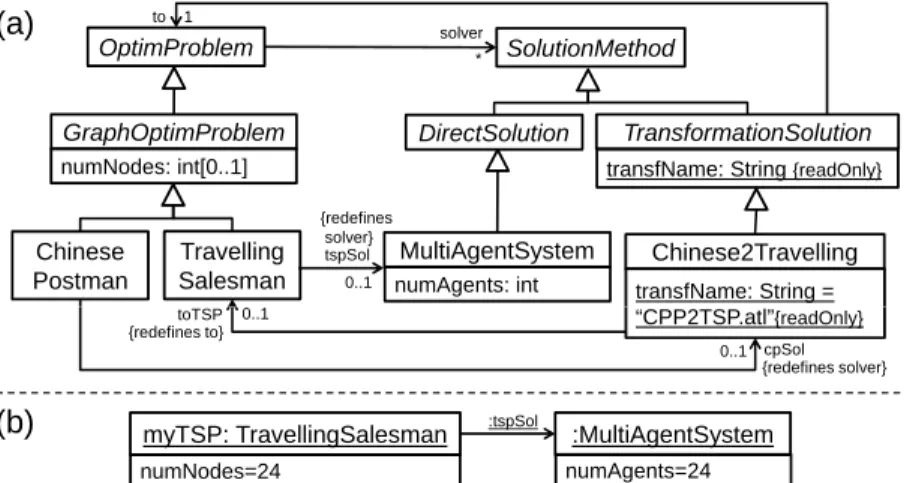
A first attempt to modelling the example system is shown in Figure 1. The upper part (labelled (a)) shows a meta-model of the problem, while the lower part (label (b)) depicts an instance model. In this attempt, we have modelled problem and solution types as meta-classes. At first sight, this seems natural, and enables a hierarchical classification of problem types through inheritance, reflecting the fact that both the ChinesePostmanandTravellingSalesmanproblem types are graph optimization prob-lems (as they are subclasses ofGraphOptimProblem) and share common properties like the number of nodes in the graph3. Similarly, we can define transformation-based and
direct solution methods, likeMultiAgentSystem, each defining their own configuration properties by means of attributes, like the number of agents used in the multi-agent system solution. This successfully addresses requirement 3 of our list. Below, the fig-ure shows a model defining an instance of the TSP to be solved using the multi-agent system solution method instantiated with 24 agents. Thus, this solution addresses suc-cessfully requirement 4. GraphOptimProblem numNodes: int[0..1] SolutionMethod solver * DirectSolution TransformationSolution to 1 MultiAgentSystem numAgents: int Chinese Postman OptimProblem tspSol 0..1 {redefines solver} Travelling Salesman Chinese2Travelling toTSP 0..1
transfName: String{readOnly}
transfName: String = “CPP2TSP.atl”
(a)
myTSP: TravellingSalesman numNodes=24 :MultiAgentSystem numAgents=24 :tspSol cpSol {redefines solver} {redefines to}toTSP 0..1 “CPP2TSP.atl”{readOnly}
0..1
(b)
Fig. 1. Modelling optimization problems and solution types as meta-classes.
However, this modelling solution does not cover requirements 1 and 2 in our list. The reason is that, to add a new problem type or solution method, one needs to modify the meta-model, which is normally rigid and non-modifiable at run-time in meta-modelling environments. While we can “dynamically create”objectsat the model level, this is not so for newclassesat the meta-level, for which we most probably need a recompilation step for the meta-model, or resort to complex reflective mechanisms.
2The main implication is that Ecore does not provide associations, but references, and so cardinalities are
only attached to the target reference ends. Or otherwise stated, the source cardinality of references can be assumed to be*. However, associations can be emulated with opposite references.
3We have simplified the problem, allowing the configuration of the number of nodes in the graph, but not
Another problem arises when trying to constrain the valid solution methods for spe-cific problem types. For instance, to specify thatMultiAgentSystemis a valid solution method for the TravellingSalesman problem, we have to redefine the solver refer-ence defined from OptimProblem to SolutionMethod. This solution becomes particu-larly tricky if we want to define several solution methods for the same problem, like being able to use aMultiAgentSystemor a solution based on exhaustive combinatorial search to solve the TravellingSalesman problem. This is so because it requires the meta-modelling framework to support advanced overriding mechanisms that are not available in popular frameworks like EMF, but that to some extent exist in (Complete) MOF [OMG 2013i] and UML [OMG 2011g]. A similar problem arises when defining transformation-based solution methods, as referencessolverandtoneed to be rede-fined. Moreover, if we want to store the name of the file with the code implementing the transformation, we need a mechanism to provide a value for attributes defined in meta-classes (attribute transfName inTransformationSolution), and forbid their modification in instances. In the example, this is done using a static, read-only at-tribute. However, some popular meta-modelling frameworks like EMF lack this over-riding mechanism.
2.2. Second solution: Explicit dynamic types
On reflection, we may realise that the system requirements demand meta-classes to have object-like features: dynamic creation of meta-classes for the definition of new types of problems and solutions, and valuation of references and attributes at the meta-model level. The previous solution emulates such object-specific features with type-specific mechanisms (subclassing and reference/attribute overriding). Hence, next we explore an alternative approach modelling those elements as objects.
Figure 2 shows a simplified version of the new solution using what we callexplicit dynamic types, where we model problem types (likeTravellingSalesman) and solution types (like MultiAgentSystem) as objects. In this way, requirements 1 and 2 are sat-isfied because we can create new types dynamically. However, we need to include in the meta-model elements to emulate such a typefacet. In particular, in order to ad-dress requirement 3, we need to add a meta-classFeatureto permit the definition of features for new problem and solution types, a relation extendsto allow organizing problem and solution types along hierarchies, and an attribute isAbstract for prob-lem and solution types (e.g.,GraphOptimProblemis abstract). For clarity, the figure only shows these elements for problem types.
Once we model problem types as objects, we can no longer use the native in-stantiation mechanism of the meta-modelling framework to instantiate them, but instantiation needs to be emulated. For this purpose, the meta-model includes dif-ferent meta-classes to model problem types (OptimProblemType) and their instances (OptimProblem), together with a referencetypefor theinstantiationrelation. In addi-tion, since problem types may define features, their instances need to defineSlots to assign each feature a value. Thus, although not shown in the figure, the meta-model needs to include OCL constraints checking that each problem instance has one slot for each feature in the problem type, and the value in the slot is correct according to the feature’s type (String,intand so on). A similar problem arises for the modelling of solution method types (subclasses ofSolutionMethodType) and their instances.
Altogether, while this solution addresses all system requirements, it adds much more complexity than the previous one. The reason is that we need to assign type-facet features to instances. Hence, we need to explicitly model and provide seman-tics to modelling facilities (inheritance, instantiation, data types) that a meta-modelling framework natively provides. However, such facilities are only available at the meta-model level (where types reside) and not at the model level (where instances
solver 0..1 solverType * OptimProblem Type type 1 to to extends * Feature name: String type: String Slot value: String slots * feats * type 1 myTSP:
OptimProblem mas: DirectSolution
GraphOptimProblem: OptimProblemType isAbstract: bool isAbstract = true :Feature name=“numNodes” type=“int” :feats TravellingSalesman: OptimProblemType ChinesePostman: OptimProblemType :extends MultiAgentSystem: DirectSolutionType Chinese2Travelling: TransfSolutionType transfName=“CPP2TSP.atl” :solverType :to :solverType :type :solver :type :Slot value=“24” :type OptimProblem 1 SolutionMethod Type DirectSolution Type TransfSolution Type DirectSolution TransfSolution type type transfName: String SolutionMethod 1 1 :extends :slots
Fig. 2. Modelling optimization problems and solution types as objects.
arise). The next section introduces a third solution based on the uniform modelling of types and instances and the possibility of using more than two meta-levels to describe the problem.
3. MULTI-LEVEL MODELLING AND THE ORTHOGONAL CLASSIFICATION ARCHITECTURE In order to alleviate the drawbacks of the solutions proposed in the previous section, we introduce two techniques that extend the standard two-level meta-modelling approach: potency-based multi-level modelling [Atkinson 1997; Atkinson and K ¨uhne 2001] and the orthogonal classification architecture (OCA) [Atkinson and K ¨uhne 2002; Atkinson et al. 2010].
3.1. Potency-based multi-level modelling
Potency-based multi-level modelling (also called deep meta-modelling4) was
intro-duced by Atkinson and K ¨uhne in [Atkinson 1997; Atkinson and K ¨uhne 2001]. It en-ables the use of an arbitrary number of meta-levels when describing a problem. In this way, elements within a model have a dual facet: they are instances with respect to some element in the meta-model above, and they are types with respect to ele-ments in the meta-level below. For this reason, they are often called clabjects (from class+object) [Atkinson 1997]. This approach solves the duality of the two previous solutions, as clabjects have both type and instance characteristics at the same time.
Figure 3 shows the multi-level solution for our running example. At the upper meta-level, we define meta-classes representing types of problems, transformation-based solutions and direct solutions. These meta-classes are instantiated in the in-termediate meta-level in order to dynamically create new problem types (like the
4For simplicity, we will use the term “multi-level modelling” to refer to potency-based multi-level modelling,
TravellingSalesman problem) and solution method types (like MultiAgentSystem). These instances are indeed clabjects and thus can be instantiated. In this way, the bottom-most model enables the configuration of specific problems and solution meth-ods, just like the model in Figure 1 (b).
@2 to 1 MultiAgentSystem: DirectSolution numAgents: int tspSol:solver @1 GraphOptimProblem: OptimProblem numNodes: int[0..1] Chinese2Travelling: 0..1 SolutionMethod solver * OptimProblem DirectSolution TransformationSolution transfName@1: String @0 ChinesePostman: OptimProblem TravellingSalesman: OptimProblem Chinese2Travelling: TransformationSolution transfName = “CPP2TSP.atl” toTSP: to cpSol: solver 0..1 0..1 myTSP: TravellingSalesman numNodes=24 :MultiAgentSystem numAgents=24 s:tspSol
Fig. 3. Modelling optimization problems and solution types using deep meta-modelling.
In the figure, the clabjects in the middle meta-level have a dual type/instance facet: TravellingSalesmanis an instance ofOptimProblem, and it is the type of myTSP. This duality applies also to references. For example,tspSolis an instance ofsolver, and is also a type for theslink at the bottom model. Being an instance,tspSolshould obey the cardinalities at the level above (*in this case); being a type, it can define its own cardinalities (0..1). Hence, similar to the solution based on explicit dynamic types, new problem types and solution methods can be dynamically created at the middle meta-level, therefore addressing requirements 1 and 2.
As multi-level modelling spans several meta-levels, it becomes necessary to control the instantiation depth of elements and the features of instances beyond the adjacent meta-level below. For this purpose, thepotencypermits specifying in how many meta-levels an element can be instantiated. The potency is a positive number (or zero) that can be attached to models, clabjects, fields and references. It gets automatically decre-mented in the instances at each deeper meta-level, and when it reaches zero, it is not possible to instantiate the element in lower meta-levels.
In Figure 3, we use ‘@’ to denote the potency of elements, following the syntax of the METADEPTH multi-level modelling tool [de Lara and Guerra 2010]. If an element is not tagged with a potency, then it receives the potency from its immediate container, and ultimately from the model. In the example, the top-level model has potency 2 and therefore can be instantiated in two meta-levels. All elements in this model receive the same potency, except the field transfName, which explicitly declares potency 1. This means that the instances ofTransformationSolutionshould provide a value for it at the next meta-level. If the field were defined with potency 2, it should receive a value two levels below, though it could still receive a value at the intermediate level acting as default for the instances at the level below. Hence, while in standard two-level
modelling a type can only control the features of its instances at the immediate meta-level below, the potency is a way for deep characterization, enabling the declaration of properties for elements several meta-levels below. An example of fields with potency 2 is given in the running example of Section 4. We take the convention of hiding the fields with primitive type and potency bigger than 0 at intermediate meta-levels.
The multi-level solution addresses all requirements of the running example, in con-trast to the static type solution in Figure 1. Moreover, it is conceptually simpler than the explicit dynamic type solution in Figure 2, as it has less modelling elements (11 clabjects vs 19 classes/objects, and 6 references vs 22 references) and there is no need to define OCL constraints to make explicit the instantiation semantics of any element. 3.2. The orthogonal classification architecture: Linguistic and ontological typings
Technically, one may wonder how it is possible to define inheritance relationships or fields (like numNodes) in the intermediate meta-level of our example. While two-level meta-modelling frameworks make available meta-modelling facilities (like inheritance or the ability to define abstract classes) only at the top meta-model, in multi-level mod-elling these facilities are available at every meta-level by adhering to the orthogonal classification architecture (OCA), as Figure 4(a) shows. This architecture was origi-nally proposed in [Atkinson and K ¨uhne 2002].
L in g u is ti c m e ta -m o d e l (m e ta -m o d e lli n g fa c ili ti te s ) ͙ Meta-meta-model (meta-modelling facilitites) Meta-model Model MM M MM M M’
«instance of» (onto)
«instance of» (onto)
« in st a n ce o f» (l in g ) in st a n ce o f» lin g ) « in st a n ce o f» (l in g ) «instance of» «instance of» (m e ta M M’ « in st a n ce (l in g ) (a) (b)
Fig. 4. (a) Orthogonal classification architecture. (b) Standard meta-modelling architecture.
OCA distinguishes two orthogonal typings for model elements:ontologicaland lin-guistic. The ontological classification structure or logical dimension of an element ex-presses instantiation within a domain. For instance,DirectSolutionis the ontological type of MultiAgentSystem. The linguistic typing or physical dimension of an element refers to the meta-modelling facility used for the construction of the element. Here, one assumes a linguistic meta-model which includes concepts like Clabject, Field andReference, and makes available meta-modelling facilities like inheritance and in-stantiation. For example, the linguistic type ofMultiAgentSystemisClabject, and the linguistic type oftoTSPisReference. While all elements in a model have a linguistic typing, they may lack the ontological typing. This is the case of the field numNodes. The set of elements of a model with only linguistic typing is called linguistic exten-sion[de Lara and Guerra 2010].
In contrast, standard two-level meta-modelling architectures do not distinguish be-tween ontological and linguistic typings, but there is only one typing, as Figure 4(b) shows. This architecture makes available modelling facilities only at the meta-model level. However, we have seen that making available these facilities at every
meta-level avoids the need to explicitly model them, as we did in the solution of Fig-ure 2. The instantiation relation betweenM M and the meta-meta-model is linguistic because it provides the meta-modelling facilities to buildM M. Thus, the meta-meta-model plays the role of the linguistic meta-meta-meta-model in the OCA architecture. The instan-tiation relation betweenM andM Mis of ontological nature.
So far, we have illustrated that multi-level modelling can help in building systems in a simpler way. However, when facing the development of a new system, the question still remains of whether using multi-level modelling for that particular case would be useful. To answer this question, in the next section we systematically identify different meta-modelling patterns, analyse potential solutions, and discuss the advantages and disadvantages of each solution depending on the scenario.
4. MULTI-LEVEL META-MODELLING PATTERNS
This section introduces different meta-modelling patterns where multiple levels are implicit, and discusses the advantages and disadvantages of different modelling solu-tions, including both two-level and multi-level. The patterns emulate different meta-modelling facilities, like theinstantiationrelation and thetype-objectfacet of elements, the dynamic creation and instantiation of features, the definition and instantiation of attributed entities, the configuration of references, and the classification of elements.
The patterns we present emerged from both our own experience building multi-level systems and by encoding such systems in a two-level setting following alternative ap-proaches. As we will show in Section 5, it was also crucial to perform an extensive analysis of the literature and existing meta-models, like the ATL meta-model zoo or the OMG specifications. This study made evident that these patterns were actually modelling different meta-modelling facilities using different techniques.
We use a presentation of the patterns in the style of [Gamma et al. 1994], includ-ing first a brief statement of the pattern goal (“intent” section), followed by additional names that practitioners use for the pattern (“also known as” section), a motivating ex-ample revolving around the classical problem of dynamically modelling product types and their instances (section “motivation”), several solutions (section “solutions”), the structure of the pattern (section “structure”) and some conclusions with the trade-offs of each solution (section “conclusions”). As a difference with [Gamma et al. 1994], in the solutions section we discuss the merits of both two-level and multi-level solutions. 4.1. Modelling types and instances: The type-object pattern
Intent.This pattern allows the explicit modelling of types and their instances, where types are not static but can be added dynamically. Types and their instances may define features, which are fixed and known a priori.
Also known as.This pattern also arises in programming, where it is called type-object [Martin et al. 1997], item descriptor [Coad 1992] or metaobject [Kiczales and Rivieres 1991] pattern.
Motivation.In the running example, we have the need to define different kinds of optimization problems and solution methods dynamically, and then create instances of them. Another example is the classical problem of modelling product types – like books or CDs – which need to be added to the system on-demand, as well as their instances [Atkinson and K ¨uhne 2002]. Product types have a value-added tax (vat), while instances have aprice.
Solutions.We next describe seven possible solutions for the “product types” example. Static types. The first two-level solution, shown in Figure 5(a), models product types
which they inherit both theprice (instance level property) and thevat(type level property). Thevatis given a value at the meta-level via redefinition.
The advantage of this solution is that it uses a native meta-model facility (the in-stantiation) to relate product instances (GoF) with their type (Book). The drawback is that this solution emulates values at the meta-level by means of redefinition, which may be difficult for references/associations as some meta-modelling frameworks (e.g., EMF) do not support their redefinition. Moreover, this solution does not meet the in-tent of the pattern, as the product types (likeBook) are fixed a priori; if a new kind ofProductis to be added, the meta-model has to be changed to add a new subclass of Product. Product Book: Product GoF: Book vat@1: double price: double vat=4.0 price = 35 @2 @1 @0 Product Book vat: double {readonly} price: double vat : double =4.0 ProductType vat: double Product price: double type 1 Book: ProductType vat = 4.0 :type (a) (b) (c) (d) GoF: Book price = 35 GoF: Product price = 35 ProductType Product - Book price: double /vat: double = self.type=ProductType.Book implies 4.0 GoF: Product type = ProductType.Book price = 35 /vat = 4.0 «enum» type 1
Fig. 5. Solutions for thetype-objectpattern. (a) Static types. (b) Enumerated types. (c) Explicit dynamic types. (d) Multi-level.
Enumerated types. Figure 5(b) shows another two-level solution where an enumerated type (ProductType) defines all possible types of product (Bookin this case). Since the types defined in the enumeration (Book) cannot declare attributes5, we definevatas
a derived attribute inProduct, and calculate its value depending on the selected type for the product.
Albeit simple, this solution does not meet the intent of the pattern because, similar to thestatic typessolution, the product types are fixed a priori in the enumeration. Another issue is that not all meta-modelling frameworks support the definition of derived attributes or automate their computation. On the other hand, the advantage of using an enumerated type is that it allows instances to have zero or several types just by changing the cardinality of the reference type, and it would be possible to change the type of an instance dynamically at the model level [Riehle et al. 2000]. Explicit dynamic types. Figure 5(c) shows a two-level solution consisting of the explicit
modelling of types (ProductType) and instances (Product). Thus, product types and products are both objects, fully satisfying the requirements of the scenario.
The drawback of this solution is that it requires adding an extra class to enable the in-stantiation of both product types and instances, and the inin-stantiation relation needs to be explicitly modelled (referencetype). As we will see, this solution can get quite complicated if sophisticated features like inheritance or dynamic features are also
5Some programming languages like Java support the definition of attributes in enumerated types, but most
needed. Nonetheless, the explicit modelling of meta-modelling facilities also has ad-vantages, as it provides greater flexibility to define domain-specific typings. Similar to theenumerated typessolution, it allows a product to have several types or no type at all by changing the cardinality of reference type, and the dynamic retyping of instances. This solution also enablesnon-uniforminstantiation, where types and in-stances have different structure. We will explore this possibility in Section 4.4. Multi-level. Figure 5(d) shows the multi-level solution. The feature for product types
(vat) is assigned potency 1, while the feature for instances (price) has potency 2 in-herited from the container model. Compared to (a), this solution allows the dynamic addition of new product types. Compared to (b), this solution permits assigning in-stance facets (e.g.,vat) to types. Compared to (c), this solution does not need to ex-plicitly model the instantiation relation, as it uses the native meta-modelling facili-ties of the framework. However, the drawback is that the instantiation semantics is fixed, as given by the meta-modelling framework. Moreover, instantiation is always mediated, that is, in order to be able to createGoFat level 0, first it is necessary to create its typeBookat level 1.
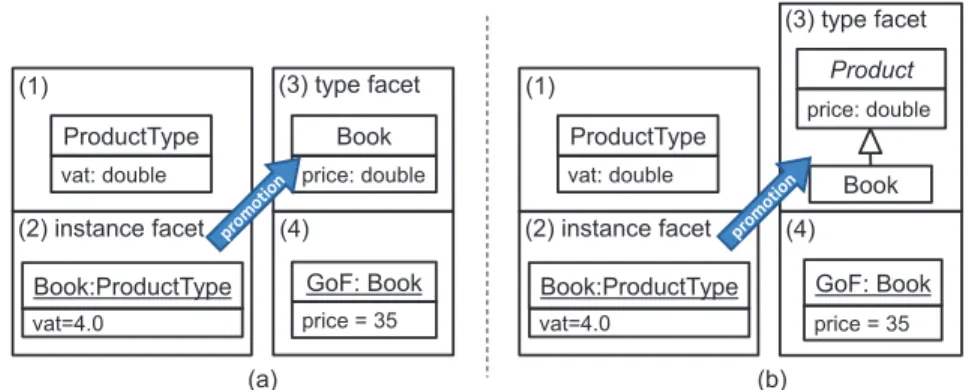
Promotion. A way to solve the drawbacks of thestatic typesand theexplicit dynamic types approaches using a two-level architecture is to model product types as ob-jects, and then promote these objects into instantiable meta-classes. This can be done through a so-calledpromotionmodel-to-model transformation which receives a model as input and produces a meta-model as output, as shown in Figure 6(a). In this way, we are conceptually emulating the multiple meta-levels of themulti-levelsolution, but here the instance and type facet of elements are separated. The instance facet is defined by instantiating the meta-model with label (1) in the figure, and then a transformation creates the type facet (meta-model with label (3)). Figure 6(b) shows a variant of this solution, where the meta-classes generated by the transformation inherit from some base class which provides them with common features (e.g., the price). Altogether, the generated meta-model is similar to thestatic typessolution of Figure 5(a), but product types can be created dynamically as objects.
ProductType Book:ProductType vat: double vat=4.0 (2) instance facet (3) type facet (1) (4) Book (3) type facet GoF: Book price = 35 (4) Product price: double (a) (b) Book price: double GoF: Book price = 35 ProductType Book:ProductType vat: double vat=4.0 (2) instance facet (1)
Fig. 6. Solutions for thetype-objectpattern. (a) Promotion. (b) Promotion with base classes. The main advantage of this design is its flexibility, as one can create types at will using the promotion transformation, enabling non-uniform instantiation. This benefit was also present in theexplicit dynamic typessolution. However, there are a number of drawbacks. First, there is the need to add an additional operational element when modelling: a promotion transformation. This transformation can “hide” important information about the system. For example, the fact that everyBook has a price in solution (a), or that any meta-class coming from a product type must inherit from
Product in solution (b), is hard-coded in the transformation. Moreover, there is a disconnection between the instance facet and the type facet of a same element (e.g., accessing thevatvalue ofBooks from theGoFobject may become cumbersome). Powertypes. A powertype [Odell 1994] is a type, the instances of which are subtypes
of another type. Conceptually, this is what the promotion transformation with base classes shown in Figure 6(b) yields, as the instances of ProductType – like Book – become subtypes ofProduct. Thus, following the same idea, we can use powertypes to model the system as depicted in Figure 7(a). The powertype (ProductType) holds the attributes for types (vat), while another type (Product) holds the attributes for instances (price). Then, we can create Book as an instance ofProductType, which by definition becomes a subclass ofProductand therefore can be instantiated to cre-ateGoF. In this way, using powertypes is a multi-level solution where the subtyping relation can cross meta-levels6.
GoF: Book price= 35 ProductType vat: double Product Book price: double vat= 4.0 CD vat= 4.0 {disjoint, incomplete} GoF: Book price= 35 ProductType vat: double Product Book:ProductType price: double vat= 4.0 «powertype» :ProductType « p o w e r ty p e » 1 * category (a) (b) U M L cl as s d iag ram U M L o b je ct d iag ram
Fig. 7. Solutions for thetype-objectpattern. (a) Powertypes. (b) UML powertypes.
The UML realizes the powertype concept using the notation shown in Figure 7(b). The figure contains a class diagram and an object diagram. Both diagrams are instances of the UML meta-model, which is defined one meta-level above. We use dash lines to separate both diagrams because the instantiation relation between class and object diagrams is modelled within the UML (i.e., it could be represented as an association namedtype, similar to theexplicit dynamic typesapproach).
This solution is problematic because UML classes do not have an instance facet (i.e., Classifier, which is the meta-class for UML classes, is separated from InstanceSpecification, which is the meta-class to represent UML objects); hence, it is not possible to assign a value to the slotvat. Actually, the UML standard states that “Power types are a conceptual, or analysis, notion. [...] In object-oriented imple-mentations, the instances of a class could also be classes”.
Altogether, powertypes separate the type and instance facet of elements in two meta-classes. This provides clarity to the design, but at the expense of a bigger number of meta-classes and associations. While potency-based multi-level modelling allows the characterization of features at any meta-level below by using potency, power-types are only able to characterize features of the next two meta-levels. Moreover, clabjects can define slots due to their instance facet; hence, they do not suffer from the problem in UML powertypes shown in Figure 7(b). However, subtyping across meta-levels as required by the powertype concept is not supported in potency-based
multi-level modelling and would be forbidden in strict meta-modelling frameworks (like the EMF), where only the instantiation relation can cross meta-levels and is not allowed between elements at the same meta-level [Atkinson and K ¨uhne 2002]. Alter-natively, one could use a promotion transformation with base classes to implement powertypes. Very few tools natively support powertypes [Volz and Jablonski 2010]. Stereotypes. Stereotypes [OMG 2011g] are an extension mechanism proposed by the
OMG for MOF-based meta-models. They are quite popular among engineers to define extensions for UML (called UML profiles) for different domains, like real-time [OMG 2011f] or business process modelling [OMG 2013b; 2008a].
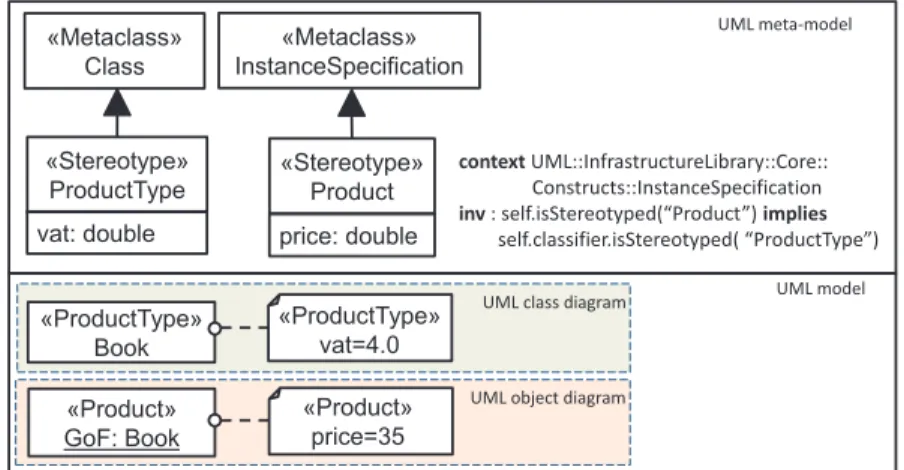
A stereotype represents a domain concept. It is defined as an extension of some meta-class of the UML meta-model, and can have attached tagged values (meta-attributes) defining specific features, as well as OCL constraints. Figure 8 shows a solution of the example using stereotypes. We need to define the stereotype ProductType with the tagged valuevatas an extension of the UML meta-classClass. This way, in UML models, we can assign a vat to a class stereotypedProductType. Moreover, since all product instances have a price, we define the stereotypeProductas an extension of InstanceSpecification, and attach to it the featureprice. Finally, we need an OCL constraint to check that any UML object stereotypedProductmust be an instance of a UML class stereotypedProductType.
«Metaclass» Class «ProductType» Book «Stereotype» ProductType vat: double «Product» GoF: Book «ProductType» vat=4.0 «Metaclass» InstanceSpecification «Stereotype» Product price: double UML meta-model UML model context UML::InfrastructureLibrary::Core:: Constructs::InstanceSpecification inv : self.isStereotyped(“Product”) implies self.classifier.isStereotyped( “ProductType”)
UML object diagram UML class diagram
«Product» price=35
Fig. 8. Solution for thetype-objectpattern using stereotypes.
This solution is simple and builds on MOF, which is a standard. As in multi-level modelling, there is no need to explicitly model the instantiation relation between do-main types and instances, but the one defined in the UML meta-model is reused; however, note that this instantiation relation is different from the one used between meta-levels, and its semantics is fixed, with objects being an instance of a type at a time. Among the disadvantages, this solution requires from the definition of two stereotypes, while just one clabject is needed in the multi-level solution. Moreover, the definition of profiles requires knowledge of the UML meta-model, and the result is an extension of the (rather large) UML, which sometimes may be useful but other times not. A small meta-model will normally be easier to instantiate for users than a large meta-model with many concepts. Stereotypes are limited to model domain types (e.g.,Book) and instances (e.g.,Product), but are unable to model more than two lev-els, because the UML provides linguistic support for classes (meta-classClass) and instances (meta-classInstanceSpecification) only. Moreover, this solution relies on
the degree of coverage of theprofilingmechanism by the used UML tool, which may vary between different tools. In particular, the definition of arbitrary OCL constraints in profiles is only supported by some tools. Finally, the fact that an instance ofBook (likeGoF) should be stereotyped withProductis not explicit, but it needs to be encoded as constraints. Some OMG specifications, like MARTE [OMG 2011f], informally doc-ument this fact through dependency relations.
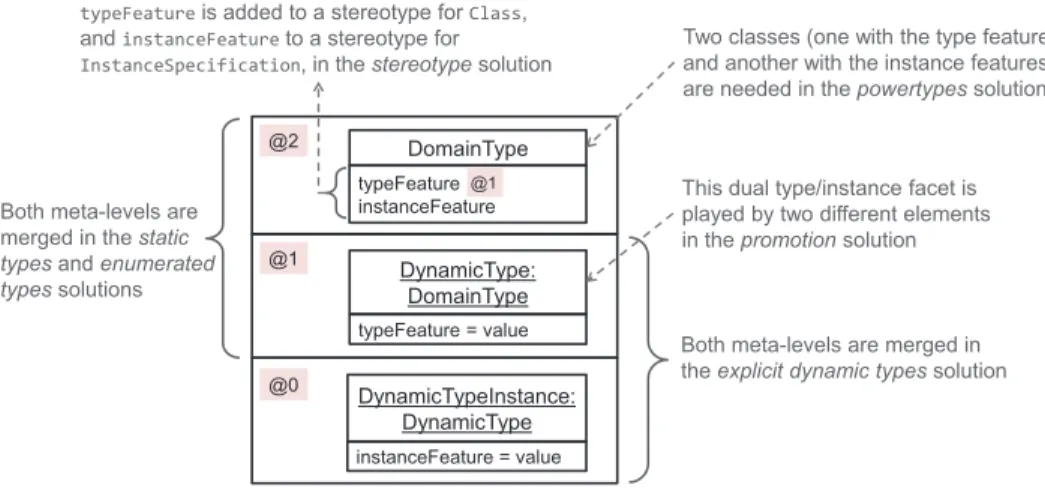
Structure.Figure 9 shows the structure of the type-object pattern using multi-level modelling, which is used as a basis to compare with the structure of the other solutions. Themulti-levelsolution declares the domain type with potency 2, the features of the type with potency 1, and the features of the instances with potency 2. In this way, the dynamic types can be created in the intermediate level. Such dynamic types have a dual type/instance facet, as they can be instantiated in the lower meta-level.
DomainType DynamicType: DomainType DynamicTypeInstance: DynamicType @2 @1 @0 typeFeature instanceFeature typeFeature = value instanceFeature = value @1
Both meta-levels are merged in the static types and enumerated types solutions
Both meta-levels are merged in the explicit dynamic types solution This dual type/instance facet is played by two different elements in the promotion solution
typeFeature is added to a stereotype for Class, and instanceFeature to a stereotype for
InstanceSpecification, in the stereotype solution
Two classes (one with the type features and another with the instance features) are needed in the powertypes solution
Fig. 9. Structure of thetype-objectpattern using multi-level modelling.
Other solutions emulate the instantiation relation and the dual type/instance facet of DynamicType in different ways. The static typessolution declares both DomainType andDynamicTypeat the top-most meta-level using subclassing, while theenumerated typessolution declares the dynamic types as literals in an enumeration. Hence, these two solutions “merge” the meta-levels with potency 2 and 1 in Figure 9, so that dy-namic types are not really dydy-namic, but they are statically defined. Instead, the ex-plicit dynamic types solution supports the creation of truly dynamic types and their instances at the model level by defining meta-classes for them. Hence, this solution merges the meta-levels with potency 1 and 0 in Figure 9. Thepromotionsolution em-ulates the dual type/instance facet ofDynamicTypeusing two separate elements: first, one has to create an instance ofDomainType (i.e., it works with the models at potency 2 and 1 in Figure 9); and then, it promotes that instance into a new type that can be instantiated (i.e., it works with the models at potency 1 and 0). Powertypes use two meta-classes to represent DomainType: one contains the features with potency 1, and the other the features with potency 2. In this way, the dynamic types are created by both instantiating the first meta-class and subclassing the second. Finally, stereo-typesallow extending UML with domain types (stereotype forClassdefining the type features) and instances (stereotype for InstanceSpecificationdefining the instance features). Then, dynamic types can be created in class diagrams and instantiated in object diagrams.
Conclusions.From the previous solutions, the ones that do not solve the scenario are thestatic typesand theenumerated typessolutions, because adding new dynamic types implies modifying the meta-model. While this may not break the conformance of ex-isting models, it may imply a recompilation step. Moreover, it might not be adequate to permit a direct manipulation of the meta-model to the users, as they would be able to make arbitrary changes which could break conformance of existing models.Explicit dynamic typesand promotion are the only solutions which may enable non-uniform instantiation.Explicit dynamic typesprovide extra flexibility, enabling instances with several types, as the instantiation relation is hand-made and can be customized. If such facilities are not needed, either multi-level orstereotypes are simpler to imple-ment, as the instantiation relation is built-in. Whereas multi-levelmodelling allows the construction of tailor-made DSMLs containing only concepts of the domain, stereo-typesextend the UML with domain concepts (i.e., the DSML is embedded in the UML). Altogether, the potency-basedmulti-levelsolution is simpler (it requires less modelling elements), and should be preferred tostereotypeswhen reusing the whole UML is not desired.
4.2. Dynamic features
Intent.This pattern permits the dynamic addition of new features to a type, and the corresponding slots to the instances of those types.
Also known as.This pattern arises in data modelling, where it is calledentity attribute value[Sanders 1995] model, and in programming, under the name ofobject attribute value,dynamic object model[Riehle et al. 2000], andadaptive object-model[Yoder and Johnson 2002].
Motivation.Sometimes, it is not possible to foresee the features needed by a certain type, or extensibility by the end-user is required in that aspect. In such cases, a mech-anism is needed to add and instantiate features on demand. This is in contrast with the type-objectpattern, where features for types and instances are fixed a priori. Dy-namic features appear together with thetype-object pattern and it can be seen as a special case of it, where the feature is the type, and the slot is the instance; however, dynamic features frequently need to impose additional constraints regarding the com-patibility of the elements defining and instantiating the features, and the adequacy of data types and values. A “shallow” version of this pattern appears when there is the need to define features for some element, but such features do not get instantiated.
The motivating example of Section 2 contains two instances of this pattern, as we need to define features for the created problem and solution types, and assign them a value in the instances. Coming back to the products example, we can extend it to re-quire the definition of features for product types. For example, we may add the number of pages to the product typeBook, or the RAM memory size toComputer.
Solutions.We next describe six solutions for the “product types” example. We omit the enumerated typessolution because it does not allow a direct declaration of features in the enumeration, but features should be modelled using a similar approach to the one we will explain for explicit dynamic types. Unless explicitly stated, the same advan-tages and disadvanadvan-tages discussed in Section 4.1 for each approach remain, so next we only comment on new issues.
Static features. Figure 10(a) shows an inadequate solution combining static types and features defined at the meta-model level. For instance, the product typeBook is as-signed the book-specific featurepagesat the meta-level. Adding features dynamically at the model level is not possible.
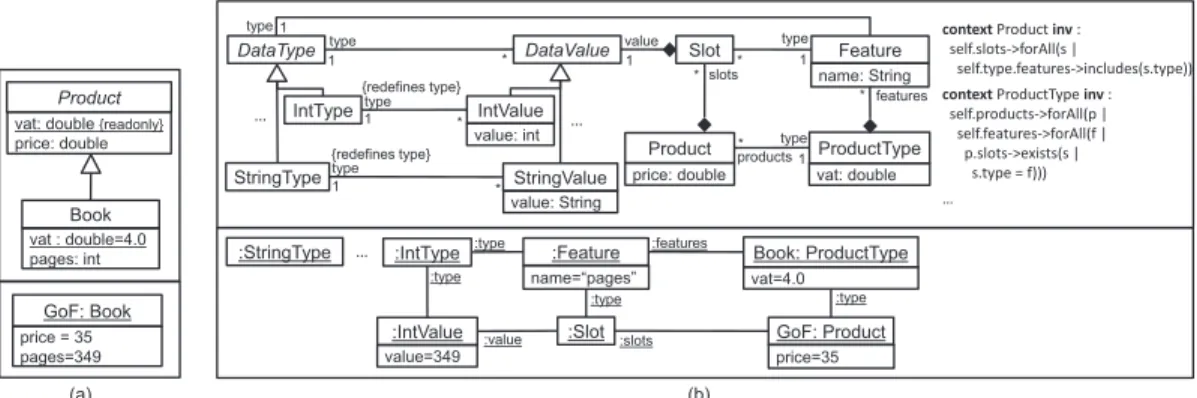
ProductType Product * type 1 :type Slot Feature name: String DataType StringType IntType DataValue … IntValue value: int StringValue value: String … type 1 * type type 1 {redefines type} * * {redefines type} 1 value 1 type 1 * slots features * * type 1 :IntType :StringType vat: double price: double Book: ProductType vat=4.0 :Slot :Feature name=“pages” :IntValue value=349 :value :type :type :type :slots :features … (a) (b) Product Book vat: double {readonly} price: double vat : double=4.0 pages: int GoF: Book price = 35 pages=349
context Product inv : self.slots->forAll(s |
self.type.features->includes(s.type)) context ProductType inv : self.products->forAll(p | self.features->forAll(f | p.slots->exists(s | s.type = f))) … GoF: Product price=35 products
Fig. 10. Solutions for thedynamic featurespattern. (a) Static features. (b) Explicit dynamic features. Explicit dynamic features. Figure 10(b) shows a general two-level solution solving the
scenario, where features, data types, slots and data values are explicitly modelled. As an example, the lower model shows the addition of the featurepagesto the product type Book, as well as the assignment of the value 349 to the corresponding slot in theGoFbook instance. Actually, one can interpret that the meta-model entails three nested occurrences of the type-objectpattern: for product types and their instances (ProductType / Product), for features and their instances (Feature / Slot), and for data types and their instances (DataType/DataValue)7. However, we need to define
additional OCL constraints ensuring the compatibility of the instantiated elements. The figure shows a pair of such constraints, which check whether a product has slots for all features in its product type; further constraints should take care of the cor-rect assignment of data values to the slots according to the data type of the feature. Although data types could be modelled with an enumerated type, the proposed solu-tion is more general as it enables the definisolu-tion of attributes and associasolu-tions on data types, being easier to extend if dynamic references are also needed.
This solution has the same pros and cons as the dynamic types version of the type-object pattern, but now a few more disadvantages arise. First, the meta-model in-troduces quite a number of extra meta-classes and OCL constraints, in particular to model data types and instances and to ensure compatible instantiation. Moreover, this solution does not model uniformly “fixed” features (price) and dynamic features (pages), which contributes to further complexity (e.g., when writing a model-to-model transformation).
Multi-level. Figure 11(a) shows a multi-level solution. It makes use of linguistic exten-sions at the intermediate meta-level (i.e., definition of elements without an ontolog-ical type) in order to add new features, likepages, dynamically. The added features can be assigned a value in the meta-level below. The advantage of the solution is its simplicity, and the fact that both dynamic features (pages) and “fixed” features (price) are handled uniformly.
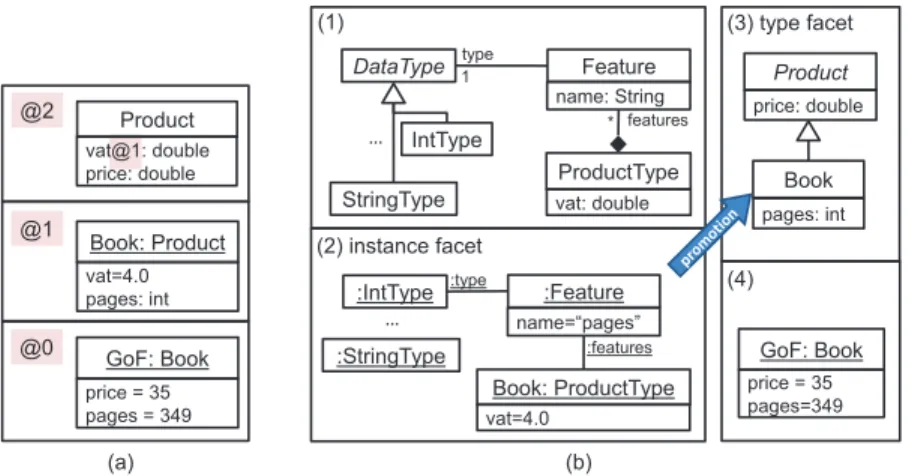
Promotion. Figure 11(b) shows a promotion-based solution. Only product types, data types and features are explicitly modelled (meta-model 1). A transformation promotes their instances (label 2) into meta-classes with an attribute coming from each feature (meta-model 3). Then, instantiation can be used to natively provide values for these attributes (model 4). Although dynamic and “fixed” features are used uniformly in
7Actually, one can also recognise the use of a static approach to define a fixed set of data types (likeIntType)
ProductType Feature name: String DataType StringType IntType … features * type 1 :IntType :StringType vat: double Book: ProductType vat=4.0 :Feature name=“pages” :type :features … Book pages: int GoF: Book price = 35 pages=349 Product price: double (a) (b) Product Book: Product GoF: Book vat@1: double price: double vat=4.0 pages: int price = 35 pages = 349 @2 @1 @0 (2) instance facet (3) type facet (1) (4)
Fig. 11. Solutions for thedynamic featurespattern. (a) Multi-level. (b) Promotion.
model 4, they are defined using different techniques (dynamic ones are modelled, but the generation of the “fixed” ones must be encoded in the promotion transformation). Powertypes. Figure 12(a) shows a solution using UML powertypes, in which we simply use the native UML modelling facilities to add features to the UML classBook and instantiate them in the UML objectGoF. However, as we explained previously, UML classes do not have an instance facet, and therefore, even though we could define the attributevatin the meta-class ProductType, it would not be possible to assign it a value inBook(see Figure 7(b)).
pages: int pages= 349 GoF: Book price= 35 pages = 349 ProductType Product Book price: double pages: int {disjoint, incomplete} :ProductType * 1 category (a) (b) «Metaclass» Class «Stereotype» ProductType vat: double «Metaclass» InstanceSpecification «Stereotype» Product price: double UML meta-model «ProductType» Book «Product» GoF: Book «ProductType» vat=4.0 «Product» price=35 UML model U ML c las s d iag ram U ML o b je ct d iag ram
Fig. 12. Solutions for thedynamic featurespattern. (a) UML powertypes (b) Stereotypes.
Stereotypes. Figure 12(b) shows a solution using stereotypes. As before, we can use the native UML modelling facilities to define features inBookand instantiate those in the GoFobject. However, a disadvantage is that the features coming from the stereotype (price) and those coming from the type (pages) are not handled uniformly, adding accidental complexity to the solution.
Structure.Figure 13 shows the structure of the pattern using multi-level modelling. The dynamic feature is defined at level 1 as a regular feature becauseDynamicTypehas a type facet. DomainType DynamicType: DomainType DynamicTypeInstance: DynamicType @2 @1 @0 dynamicFeature: primitiveType dynamicFeature = value Both meta-levels are
merged in thestatic featuressolution
The dynamic feature, its type and the slot for its value are instances of user-defined meta-classes, in theexplicit dynamic featuressolution The dynamic feature and its type are instances of user-defined meta-classes, in thepromotionsolution
Fig. 13. Structure of thedynamic featurespattern using multi-level modelling.
In contrast, thestatic featuressolution uses inheritance to relateDynamicTypeand DomainTypein the same meta-level, whiledynamicFeatureis declared inDynamicType. In the explicit dynamic features solution, the meta-model needs to include facilities to both declare and instantiate dynamic features, while the promotion solution only requires defining facilities for feature declaration. Powertypes can use the standard facilities to declare and instantiate features, and similar for stereotypes, as the UML provides support for feature definition (in UML classes) and feature instantiation (in UML objects).
Conclusions.The only approach that covers all requirements of the scenario and han-dles uniformly all types of features (i.e., type features likevat, “fixed” instance features likeprice, and dynamic instance features likepages) is themulti-levelsolution. The explicit modelling of dynamic features results in much complexity, though this solution allows for the definition of domain-specific data types that are not natively provided by the meta-modelling framework.
4.3. Dynamic auxiliary domain concepts
Intent.The pattern helps with the dynamic addition of new entities related to a type, as well as the instantiation of those entities, which should be correctly related to stances of the type. Entities may define their own features, in which case, their in-stances need to define slots for the feature values. This pattern can be seen as a vari-ant ofdynamic features, but instead of defining features for dynamic types, here the aim is defining dynamic entities in relation to dynamic types.
Also known as.None.
Motivation.Sometimes, it is not possible to foresee the entities needed to describe all properties of a certain type, or want to achieve extensibility in that aspect. In such cases, it is necessary to dynamically create and instantiate new entities, being able to relate these entities to the type they are describing. For example, resuming the products example, we may want to be able to dynamically add an entity Authorand use it to describe the authors of the product typeBook.
Solutions.We next describe six solutions for the “product types” example.
Static entities. Figure 14(a) shows how to define new entities (Author) related to par-ticular types (Book) at the meta-model level. However, this solution using static types and static relations is invalid because entities cannot be created dynamically.
ProductType (a) (b) (c) Book GoF:Book ProductType Product type 1 * Slot Feature name: String type 1 * slots features * * value: String Book: ProductType GoF: Product :Feature name=“author” :Slot value=“E. Gamma” :type :type :features :slots Author name: String authors * * :Author
name= “E. Gamma”
Author: Entity Author: EntityInstance :type Entity EntityInstance type 1 * relatedTo relatedTo * * Product Book: Product GoF: Book @2 @1 @0 Author name: String authors * * :Author
name= “E. Gamma”
+ OCL constraints
:authors :authors
Fig. 14. Solutions to thedynamic auxiliary domain conceptspattern. (a) Static entities. (b) Explicit mod-elling of domain concepts. (c) Multi-level.
Explicit modelling of domain concepts. Figure 14(b) shows a solution where entities and their features are explicitly modelled in the meta-model (we omit the OCL con-straints needed to ensure their correct instantiation, as they are similar to those in Figure 10(b)). This solution introduces a number of additional meta-classes and con-straints, which makes it complex to define (at the meta-model level) and use (at the model level). Moreover, it is not possible to configure the relations defined between the instances ofProductTypeandEntity, for instance, to enforceBooks to have more than oneAuthor. The proposed solution allows any number of them. In section 4.4 we will show how to deal with this problem using therelation-configuratorpattern. Multi-level. Figure 14(c) corresponds to the multi-level solution for this pattern. It
makes use of linguistic extensions at the intermediate meta-level to define a new entityAuthorrelated to the product typeBook. Relationauthorsis a proper relation, and therefore, it is possible to configure its cardinality, e.g.,1..*.
Promotion. A solution based on promotion would require explicitly modelling product types, entities and their features. Then, the promotion transformation should cre-ate meta-classes from the instances of the product types and entities, and attributes from the features. This is similar to the solution provided fordynamic features in Figure 11(b), having the same benefits (flexibility) and drawbacks (heterogeneity of specification mechanisms).
Powertypes. The solution for this pattern using powertypes is similar to the one shown fordynamic featuresin Figure 12(a). SinceBookis a UML class, it can define relations to other UML classes by means of UML properties. This solution has the same advan-tages and disadvanadvan-tages as the use of powertypes for modellingdynamic features. Stereotypes. The solution for this pattern using stereotypes is similar to the one shown
fordynamic featuresin Figure 12(b). SinceBookis a UML class, it can define relations to other UML classes by means of UML properties. This solution has the same advan-tages and disadvanadvan-tages as the use of stereotypes for modellingdynamic features. Structure.Figure 15 shows the structure of the pattern using a multi-level approach. The new dynamic auxiliary domain entity, as well as its features and relations, are defined at the meta-level with potency 1, and can be instantiated at the meta-level below in a straight-forward way.
In comparison, the two upper meta-levels in Figure 15 are merged in thestatic en-titiessolution, so that the classDynamicAuxiliaryDomainConceptand its relation with
DomainType DynamicType: DomainType DynamicTypeInstance : DynamicType @2 @1 @0 Both meta-levels are
merged in thestatic entitiessolution
The domain concept, its feature, its relation, and their instantiations, are all instances of user-defined meta-classes or associations, in theexplicit modellingsolution
The domain concept, its feature and its relation are instances of user-defined meta-classes or associations, in the promotionsolution DynamicAuxiliaryDomainConcept conceptFeature: primitiveType ConceptInstance: DynamicAuxiliaryDomainConcept conceptFeature = value concepts min..max
Fig. 15. Structure of thedynamic auxiliary domain conceptspattern using multi-level modelling. DynamicType can be defined in the same meta-level as DomainType; however, this so-lution does not allow defining new concepts dynamically. In the explicit modelling of domain concepts, the meta-model needs to include facilities to both declare and in-stantiate the auxiliary domain concept, its feature and its reference. In thepromotion solution, it is enough to include facilities for the declaration of these elements, but not for their instantiation. Finally, both powertypes and stereotypes can use the standard facilities to declare and instantiate dynamic entities.
Conclusions.Multi-level modelling, powertypes and stereotypes natively support the dynamic creation of entities and their features. Moreover, it is straightforward to con-strain the cardinality of the relations defined between the primary type (e.g., product type) and its constituent entities (e.g., author). The latter becomes more complex for the solutions based on the explicit modelling of domain concepts and promotion. 4.4. Relation configurator pattern
Intent.It allows the configuration of a reference type dynamically created, and the instantiation of the reference type according to that configuration.
Also known as.None.
Motivation.Sometimes, it is needed to define reference types on demand (e.g., inside new dynamic types) which can be instantiated (e.g., in the instances of the dynamic type). In this scenario, it may become necessary to configure the association ends of reference types created on demand, for instance to determine their cardinality or the allowed class of objects to which the reference or association instances can be con-nected.
Solutions.We next describe six solutions for an extended version of the “product types” example, where we consider that product types are made by zero or more manufacturer types, and we want to configure the relation between concrete products and manufac-turer types in a dynamic way. For example, we may want to specify that books are published by exactly one editorial.
Static references. Figure 16(a) shows a static solution where we redefine the relation madeByfor theBook product type. At the instance level, we can specify that theGoF book is published byAdWesley.
Although this is a neat solution, it does not allow creating product types and refer-ences to manufacturer types dynamically, but the meta-model needs to be changed, which can break the conformance of existing models. Moreover, as previously stated, association redefinition is not supported in many meta-modelling frameworks. In ad-dition, the solution does not adequately capture the requirements: themadeBy rela-tion is aimed at specifying that a product type (aBook) can be made by zero or more Manufacturertypes (e.g., published by oneManufacturerand written by oneAuthor). Hence, even if the*cardinality of madeByactually constrains the lower meta-level, our aim here is to constrain how many times the reference can be redefined, and then let the cardinality of the redefined associations constrain the lower meta-level. However, this is not possible with the static solution.
(a) (b) ProductType MadeByType name: String min: int max: int Product MadeBy type type 1 * 1 * Book: ProductType :MadeByType name = “pub” min = 1 max = 1 GoF:Book :type :MadeBy :type madeBy * imadeBy * Manufacturer Type Manufacturer 1 1 mto ito type 1 * Editorial: ManufacturerType AdWesley: Manufacturer :type :mto :ito :madeBy :imadeBy Product Book {redefines madeBy} Manufacturer Editorial madeBy * 1 pub
GoF:Book :pub AdWesley:
Editorial
context Product inv : self.type.madeBy->forAll (r | let sz= self.imadeBy->select(s| s.type=r)->size() in sz >= r.min and (sz <= r.max or r.max=-1))
Fig. 16. Solutions torelation configuratorpattern. (a) Static references. (b) Explicit reference modelling. Explicit reference modelling. Figure 16(b) shows a solution based on the explicit
mod-elling of reference types and their instances at the meta-level. In this solution, we need to create an intermediate classMadeByTypeto store the configuration (name and cardinality) of relation types. The OCL constraint ensures an appropriate number of instances of each relation type, according to the cardinality defined inMadeByType. This solution improves the previous one because it allows the creation of new relation types dynamically, and the cardinality constraint*on relationmadeBydoes constrain the number of relation types that can be defined on specific product types. However, it introduces complexity because the solution involves a relation configurator class (MadeByType) and another class for their instances (MadeBy). At the model level, this solution is not optimal because we would prefer to use references instead of an inter-mediateMadeByobject. This object is needed to distinguish between different relation types, which in the solution is done by the referencetypefrom theMadeByobject to theMadeByTypeobject.
Multi-level. Figure 17(a) shows the multi-level solution. Instead of modelling the re-lation configurator as a meta-class at the top meta-level, it is defined as a reference (madeBy) which can be instantiated at level 1 (pub). Since the instantiated reference pubhas a type facet, we can assign it a cardinality (1) and instantiate it at the lower meta-level. This solution is simpler than theexplicit reference modelling, and more flexible than thestatic referencessolution.
In the running example, therelation configuratorcustomises typical features of ref-erences, like their name and cardinality. If we need to customise features beyond those offered by the meta-modelling framework, like a feature dictating whether it is
(a) (b) Product madeBy Book: Product pub: madeBy GoF:Book :pub @2 @1 @0 Manufacturer * Editorial :Manufacturer 1 AdWesley :Editorial Product madeBy Book: Product ed: mTar GoF:Book :ed @2 @1 @0 Manufacturer 1 Editorial :Manufacturer 1 AdWesley :Editorial MadeBy mandatory@1: boolean + OCL constraint * mTar Publi:MadeBy mandatory=true 1 pub: madeBy :Publi :pub
Fig. 17. (a) Multi-level solution to therelation configuratorpattern. (b) Multi-level solution to the extended relation configuratorpattern.
mandatory for the target objects to be pointed by the reference, then the multi-level solution needs to explicitly model these features in a meta-class, as shown in Fig-ure 17(b) (clabjectMadeBy). In addition, we need an OCL constraint at the top-most meta-level to take care of the semantics of themandatoryattribute. Having the con-straint potency 2, it gets evaluated two levels below (see [de Lara et al. 2014a] for details on the working scheme of constraints in multi-level modelling). Thus, in gen-eral, multi-level modelling is most suitable when the features to configure are native for references (like cardinality), but otherwise, it requires their explicit modelling. Nonetheless, some multi-level meta-modelling frameworks (like [de Lara and Guerra 2010]) skip this problem by supporting attributed associations (though not attributed references).
Promotion. Figure 18 shows a solution using promotion. Similar to theexplicit refer-ence modellingapproach, the meta-model (1) contains meta-classes that enable the definition of newProductandManufacturertypes. From the instances of this meta-model (meta-model 2), a promotion transformation creates a meta-meta-model (3) that contains a meta-class for eachProductType andManufacturerType, and a reference for each MadeByTypeinstance. The created references have the configured name, type and car-dinality. Book pub (1) (2) instance facet (3) type facet (4) Product Type MadeByType name: String min: int max: int madeBy * Manufacturer Type 1 mto Book: ProductType Publi: MadeByType name=“pub” min=1 max=1 Editorial: Manufacturer Type :mto :madeBy Editorial 1
GoF:Book :pub AdWesley :Editorial
Fig. 18. Promotion solution to therelation configuratorpattern.
The advantage of using promotion is that it removes complexity from the model (4), as there is no need to explicitly instantiate theMadeByTypemeta-class, but a native reference (pub) is used instead. This is an example of what we callnon-uniform in-stantiation: if we see model (4) as an instance of model (2), we notice that while the