105
Project Phase Dependent Configuration of Project
Management Information Systems
Solvita Berzisa
1, Janis Grabis
2,
1-2Riga Technical University
Abstract – Project management information systems ensure the
collection and display of project information. The project information changes depend upon the project environment. According to project environment and requirements, the configuration of project management information system is ensured by means of an approach to configuration of project management information systems. However, topicality of information and access to it change during the project life cycle depending upon the user’s role and the project phase. The objective of this paper is to adapt the approach to configuration of project management information systems for definition of requirements that depend upon the user’s role and project phase. The adapted configuration approach could ensure storing of this requirement and the reconfiguration transformation during the project life cycle.
Keywords – project management information system, PMIS
configuration, XCPM
I. INTRODUCTION
A project management information system (PMIS) is a standardized set of automated tools and techniques used in project management (PM) for planning, execution, management and closing of the project, as well as for collecting, combining and distributing project information [1]. PMIS provides a wide range of functions directly supporting PM, as well as tools for its configuration and modification. An approach to configuration of PMIS (referred as ConfPMIS) [2] has been developed to ensure the standardized process of development of the PMIS configuration. For each project, it is necessary to find the most appropriate configuration depending on project situation. The appropriate PMIS configuration increases usability, information quality and functionality of PMIS [3], [4], [5]. The needs of the particular user’s role are also necessary to include in the PMIS configuration. These role needs and also PM processes change during the different project phases. However, the ConfPMIS ensures definition of only one configuration for all project phases and all users.
The objective of this paper is to adapt the ConfPMIS for definition of requirements that depend upon the user’s role and
project phase. This adapted ConfPMIS ensures that the PMIS configuration includes different views to PM data depending upon the user’s role, and this view for one role could change depending upon the project phase. Also ConfPMIS ensures the changes in PM processes depending upon the project phase. The main contribution of adapted ConfPMIS is the definition of the project phase and the user’s role depending on PMIS configuration and the reconfiguration transformation during the project lifecycle.
The paper is organized in five sections. Section 2 describes background of the research including description of the ConfPMIS, the project phases and the user’s role needs. The problems related to configuration of PMIS depending upon the user’s role and the project phase are discussed in Section 3. Solution of the project phase dependent configuration of PMIS and its application are presented in Section 4. Section 5 draws conclusions.
II.BACKGROUND
A. ConfPMIS
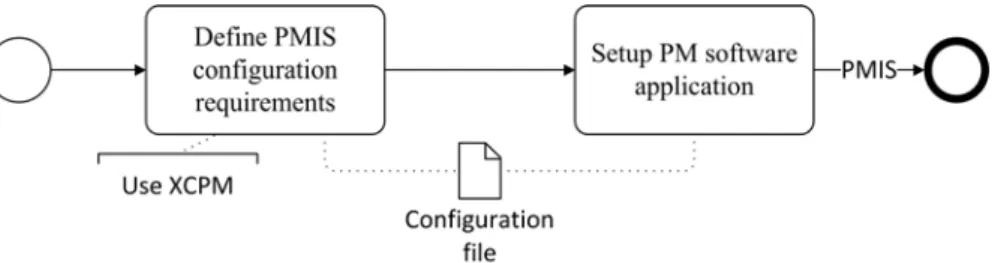
The ConfPMIS allows defining PMIS configuration requirements and configuring the chosen PM software application according to the project requirements, and the configuration process is supported by PM knowledge [2]. Simplified process of the ConfPMIS is shown in Fig. 1. The PMIS configuration requirements are defined with XML scheme for configuration of PMIS (XCPM) [6]. This scheme includes project data and process description. Project data are the different data entities used in the project, for example, task, change request, issue, risk, plan, document and others. Processes describe different PM activities, for example, change request workflow, project plan approval, document review etc. The result of requirement definition is the configuration file structured according to XCPM. This configuration file is used for setup of the chosen PM software application using the configuration transformations. Result of configuration process is the PM software application that works according to project needs/requirements. This software application is referred to as PMIS.
106
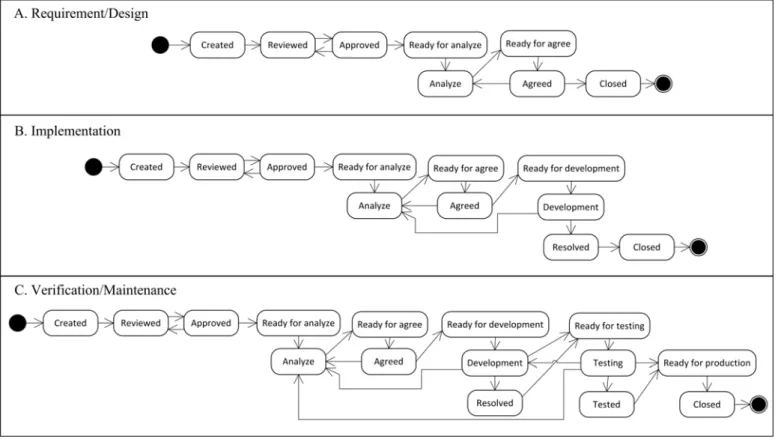
Fig. 2. Example of the project phase dependent workflow of the change request
B. Project Phases
The project life cycle consists of phase, iteration or other divisions. The classical project life cycle according to the PMBOK [1] consists of five phases: initiating, planning, executing, controlling and monitoring, and closing. The phases for software development projects also depend on the chosen software development model. Waterfall model includes the following phases: requirements, design, implementation, verification and maintenance [7]. Rational unified process model includes the following phases: inception, elaboration, construction and transition [8]. For incremental software process models, such as, Scrum [9] or Microsoft solution framework [10], there is not an explicit division in the software development phases, but the base project phases from the classical project life cycle are kept.
Like the phases of information technology project, also the construction project phases depend upon the technological process of the construction object [11]. The example of the construction project life cycle according to CIOB [12]: inception, feasibility, strategy, pre-construction, construction, engineering commission, completion and handover, and client occupation.
Depending upon the current project phase, the information necessary for the each involved role is established (detailed description in Section II. C) and processes. Some processes in the project also change depending upon the phase. In most cases, it has the workflows of the data entities. For example, workflow of the change request in software development project could vary depending upon the phase it has identified and implemented. The examples of the change request
workflows depending upon the project phases are given in Fig. 2. The change request in requirement/design phase affects only documents, and the workflow includes the following statuses: created, reviewed, approved, ready for analysis, analyzed, ready to agree, agreed and closed. If the same change request is identified in the implementation phase then it affects documents and development, and the workflow has already included the following statuses: created, reviewed, approved, ready for analysis, analyzed, ready to agree, agreed, ready for development, development, resolved, closed. Also the workflow of the change request has different statuses in verification/maintenance phase: created, reviewed, approved, ready for analysis, analyzed, ready to agree, agreed, ready for development, development, resolved, ready for testing, testing, tested, ready for production, closed.
C. User’s Needs
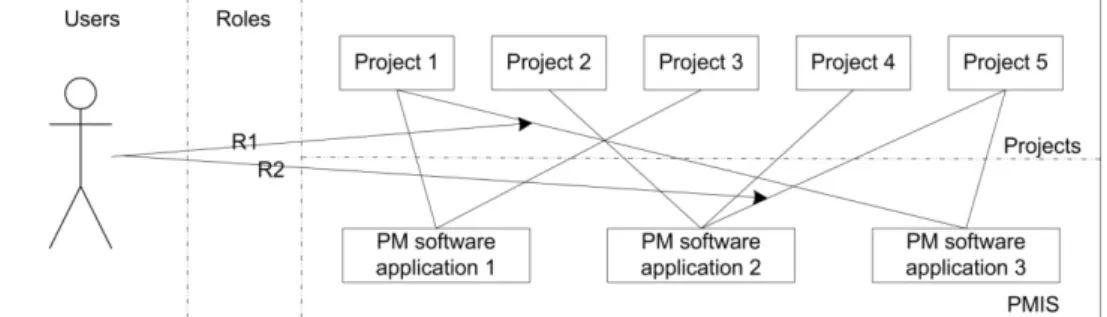
Data and information processing requirements for users also vary from phase to phase. The user’s needs are managed through his role taken in the project [1]. Main requirement of the user for PMIS is that it shows only necessary project data. If the user works in several projects with different roles, each project of PMIS he accesses displays only data needed for his role (Fig. 3). The project role limited view to project data has also project quality and security requirements [13].
All project roles could be divided into groups. The first group includes a project manager, quality manager and other project specialists. The roles of this group are important for all aspects of PM. The second group includes other team members or performers; their roles attract only information related to their tasks [14].
107 An example of the role needs depending upon the project
phase is shown in Table I. The example describes the project with five defined phases: planning, requirements/design, implementation, verification/maintenance and closing. Four roles have been used in the example: project manager and three performer’s roles – analyst, programmer and tester.
III. CONFIGURATION PROBLEMS
Main problems for configuring PMIS depending upon the user’s role and project phase are the following:
1) Events or milestones that identify the change of phase are needed. To use the phase dependent PMIS configuration, it is necessary to identify one phase end and next phase start. It is not possible that two phases occur at the same time. This
phase change event could be the start of activity, end of activity, milestone or fixed date.
2) XCPM must provide multiple definitions of the role views for the data element depending upon the phase. The role access to the project data consists of two phases: 1) whether the role has access to the data entity at all; 2) limited access to data fields and/or the set of data records that have been defined with views. One definition of view for data could be used for several roles and phases (Table I). Also if the data entity has no limitation related to the roles then the data entity could see all roles.
3) XCPM must provide multiple descriptions of one process configuration depending upon the phase (example in Fig. 2). Also, one process description could be used in several phases.
Fig. 3. User’s requirements for PMIS
TABLE I
EXAMPLE OF THE ROLE NEEDS DEPENDING UPON THE SOFTWARE DEVELOPMENT PROJECT PHASE
Role Project manager Performer
Phase Analyst Programmer Tester
Planning Project Plan Resource List Resource Calendars Deliverables Lesson Learned Risks Project Documents Calendar Project Plan Executing Requirements/Design Project Plan Calendar Task Deliverables Reports Change Requests Issues Test Cases Lesson Learned Risks Documents Project Documents Project Plan Task Calendar Change Requests Issues Lesson Learned Documents Project Plan Task Calendar Implementation Project Plan Task Calendar Change Requests Issues Lesson Learned Documents Project Plan Task Calendar Lesson Learned Verification and Maintenance Project Plan Task Calendar Change Requests Issues Test Cases Lesson Learned Documents Closing Reports Project Plan Change Requests Issues Lesson Learned Risks Documents Project Documents Calendar Closing Report Lesson Learned
108
If the process description has not defined relation to the phase, then this process is used for all phases that have not defined other process descriptions.
4) PMIS must provide the process that handles the events of phase transition and reconfigures the system. This process stores information about the project phase order. The reconfiguration transformations do not change the data entities, only the role access to them and related processes.
IV. SOLUTION AND ITS APPLICATION
To create the project phase dependent PMIS configuration, the existing ConfPMIS is supplemented with:
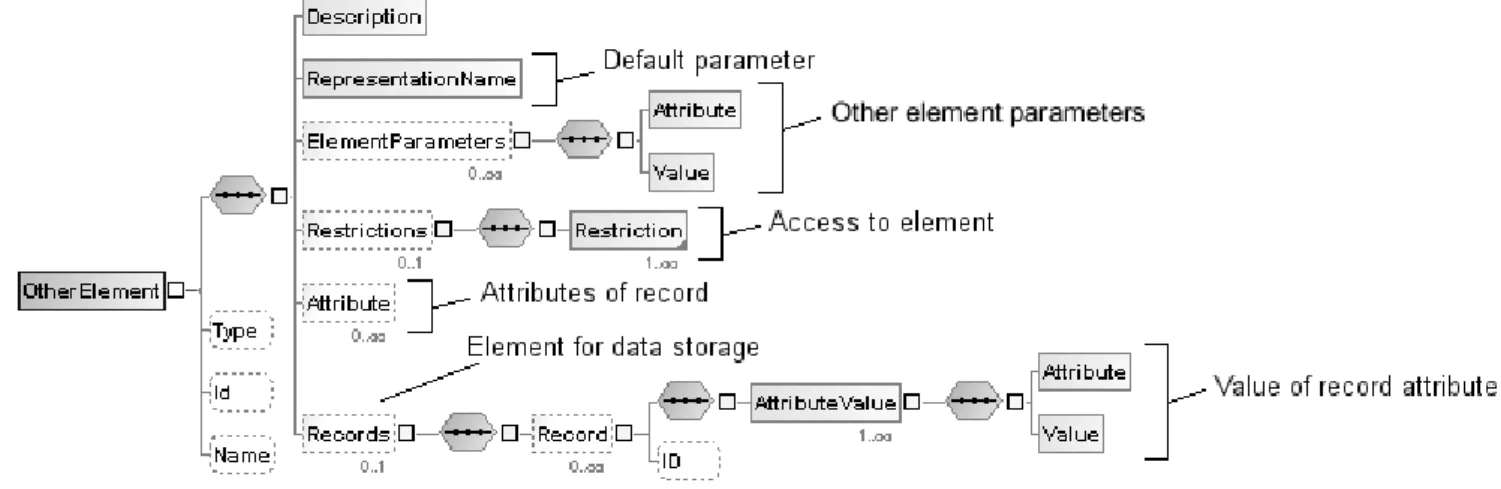
1) The new elements in XCPM for identification of the phase and the role. For each element of the data, the entity has the new sub-element “Restrictions”, where restrictions have
been described with the records (structure of “Restrictions” is
shown in Fig. 4). One restriction includes information about the phases, roles, view for limitation of data access and allowed actions (view, edit, create and delete). Full structure of the data entity definition is shown in Fig. 5. The data entity definition also includes information about entity parameters, their attributes and ensures data storage elements [6]. Also, the new element “Phases” has been added to the process
description that ensures the definition of process change depending upon the phases.
2) The definition of lifecycle process that ensures identification of the phase change. The new element
“ProjectPhases” is added to the project life cycle description
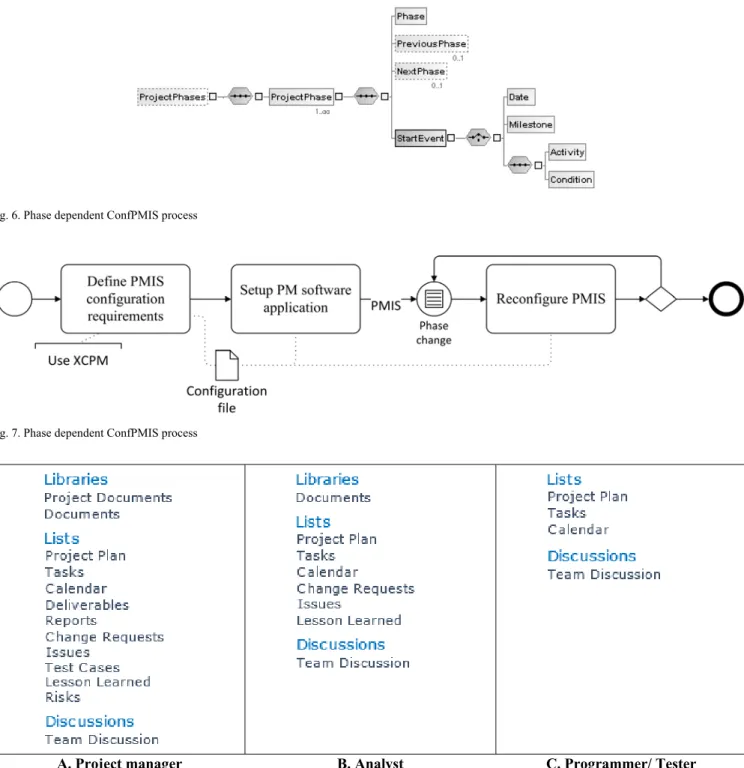
that defines the project phases; it starts events and order (Fig. 6). The phase start event could be defined with date, milestone or activity.
3) The transformations of reconfiguration in PMIS. The PMIS reconfiguration has been performed after every phase change. Activities in these transformations depend upon the chosen PMIS and its configuration options. For example, MS Project Server ensures storage and usage of all options for changeable configuration, but MS Team Foundation Server – only partially.
The adapted ConfPMIS process is shown in Fig. 7. New activity has been added to the ConfPMIS process – reconfigure PMIS. The definition of the PMIS configuration
requirements has been performed as above, only XCPM ensures definition of the user’s role and the phase dependent requirements. During the setup of PM software application, the configuration transformations have been performed as above, but also the project phase dependent requirements have been configured according to the first project phase. The PMIS reconfiguration activity has been performed after every phase change. During the reconfiguration transformations, the new phase dependent configuration requirements have been searched in the configuration file, and the user role access to the data entities and the PM processes has been changed.
The examples of different role access to the project data are shown in Fig. 8, where PMIS has been configured according to the requirement defined for “Requirement/Design” phase in Table I. Three different data access views have been used in this phase: project manager, analyst and programmer/tester. In the next phase (according to Table I), a project manager and analyst will use the same views, but the data access view of a programmer and tester will be reconfigured.
V. CONCLUSIONS
The main benefit of the configuration that varies depending upon the project phase is that each role has access to its required data, and these data are tailored to the particular stage of project execution. The PM processes are also tailored to the project phases.
Fig. 4.Structure of “Restrictions” element
109 However, the PMIS configuration depending upon the
user’s roles and the project phase is associated with some requirement identification and technical problems. The requirement problem has been related to identification of the phase dependent requirements during the project start-up. These requirements could change during the project life cycle according to new needs and situation. Thus, it is necessary to allow modifying the configuration file before the new phase start. The technical problems have been related to options of the PM software application to ensure the defined phase depended requirements. The ConfPMIS could not extend the PM software application functionality; thus, some applications
could ensure all requirements defined in the configuration file, but others – only partially.
REFERENCES
[1] Project Management Institute, A Guide to the Project Management Body of Knowledge (PMBOK® Guide) Fourth Edition. Newtown Square: Project Management Institute, 2008.
[2] S. Bērziša and J. Grabis, A Framework for Knowledge-Based Configuration of Project Management Information Systems in: The 17th International Conference on Information and Software Technologies, Butleris, R., Butkiene R., Ed. Kaunas: Kaunas University of Technology, 2011, pp. 31-38.
[3] M.G. Kaiser and F. Ahlemann, Measuring Project Management Information Systems Success – Towards a Conceptual Model and Fig. 6.Phase dependent ConfPMIS process
Fig. 7.Phase dependent ConfPMIS process
A. Project manager B. Analyst C. Programmer/ Tester
110
Survey Instrument in 18th European Conference on Information Systems,
2010
[4] A.S.B. Ali, F.T. Anbari and W.H. Money, Impact of organizational and project factors on acceptance and usage of project management software and perceived project success, Project Management Journal, Vol. 39., pp. 5-33, 2008
[5] A.J. Karim, Project Management Information Systems (PMIS) Factors: an Empirical Study of Their Impact on Project Management Decision Making (PMDM) Performance, Research Journal of Economics, Business and ICT. Vol. 2, pp. 22-27., 2011
[6] S. Bērziša, XML-based Specification of the Project Management Domain and Its Application in: Databases and Information Systems VI. Volume 224 Frontiers in Artificial Intelligence and Applications, J. Barzdins and M. Kirikova, Ed. Amsterdam: IOS Press, 2011, pp. 213-226.
[7] L. Westfall, The certified software quality engineer handbook. Welshpool: Quality Press, 2009.
[8] R.D. Gibbs, Project Management with the IBM(R) Rational Unified Process(R): Lessons From The Trenches. IBM Press, 2006.
[9] K. Schwaber, Agile Project Management with Scrum. Washington: Microsoft Press, 2004.
[10] M.S.V. Turner, Microsoft Solutions Framework Essentials: Building Successful Technology Solution. Washington: Microsoft Press, 2006. [11] M. Klinger and M. Susong, The construction project: phases, people,
terms, paperwork, processes. Chicago: American Bar Association , 2006 [12] CIOB, Code of Practice for Project Management for Construction and
Development. Wiley-Blackwell, 2009.
[13] ISO, ISO 9001:2008 - Quality management systems.
[14] S. Bērziša, The Baseline Configuration of Project Management Information System, Scientific Journal of Riga Technical University, Issue 5, Computer Science. Information Technology and Management Science, Vol. 5, No. 40, pp. 59-65, 2009.
Solvita Bērziša has completed doctoral studies in Information Technology (2012) at Riga Technical University, Latvia and is a candidate of scientific degree. She obtained her BSc (2005) and MSc (2007) degrees in Computer Science and Information Technology from Riga Technical University. Her research areas are IT project management, project management information systems configuration and project management knowledge.
She currently works as an Assistant at Riga Technical University and as a Senior Systems Analyst at JSC Exigen Services Latvia.
Jānis Grabis is a Professor at the Faculty of Computer Science and Information Technology, Riga Technical University, Latvia. He obtained his doctoral degree from Riga Technical University in 2001 and worked as a Research Associate at the College of Engineering and Computer Science, University of Michigan-Dearborn. He has publications in major academic journals, including OMEGA, European Journal of Operational Management, International Journal of Production Research, Human Systems Management and others. He has been a guest editor for two top academic journals and member of the program committee of several academic conferences. His research interests are enterprise applications and project management and optimization.
Solvita Bērziša, Jānis Grabis. Projekta fāžu atkarīga projektu vadības informācijas sistēmu konfigurācija
Projektu vadības informācijas sistēma nodrošina projektu vadības procesu atbalstu un projekta informācijas savākšanu, apkopošanu un izplatīšanu. Projektu vadības informācijas sistēma ir jāpiemēro konkrētā projekta situācijai un vajadzībām, lai nodrošinātu projekta aktuālās informācijas apkopošanu, apstrādi un attēlošanu. Izmantojot projektu vadības informācijas sistēmu konfigurēšanas pieeju, ir nodrošināts standartizēts process projektu vadības informācijas sistēmu piemērošanai konkrētā projekta vajadzībām. Bet projekta aktuālā informācija mainās arī atkarībā no katra lietotāja lomas un projekta fāzes. Tādējādi raksta mērķis ir adaptēt projektu vadības informācijas sistēmu konfigurēšanas pieeju, lai nodrošinātu projekta lomu un fāžu atkarīgas konfigurācijas prasību aprakstīšanu un uzturēšanu. Lai nodrošinātu fāžu un lomu atkarīgu konfigurācijas prasību aprakstīšanu, projektu vadības informācijas sistēmas konfigurācijas aprakstīšanas XML shēma (XCPM) ir papildināta ar elementiem, kas nodrošināta 1) fāžu un lomu uzdošanu datu entītijām; 2) fāžu uzdošanu procesiem un 3) projekta dzīves cikla fāžu secības un fāžu maiņas identificēšanas nosacījumu uzdošanu. Projektu vadības informācijas sistēmu konfigurēšanas pieeja ir papildināta ar jaunu aktivitāti – pārkonfigurēšanu, kas tiek veikta katras fāzes sākumā. Pārkonfigurēšanas laikā tiek izpildītas transformācijas, kurās tiek mainīta pieeja datu entītijām un to procesi atbilstoši konkrētajā fāzē uzdotajām prasībām. Izmantojot projekta fāžu atkarīgu projektu vadības informācijas konfigurāciju, lietotājam tiek nodrošināta pieeja tikai tiem datiem, kas tam ir nepieciešami konkrētajā projekta fāzē, un tāpat tiek piemēroti datu apstrādes procesi.
СолвитаБерзиша, ЯнисГрабис. Конфигурацияинформационныхсистемуправленияпроектами, зависящаяотфазпроекта Информационная система управления проектами обеспечивает поддержку процессов управления проектами, а также сбор, обобщение и распространение информации по проекту. Информационная система управления проектами применяется в зависимости от нужд и ситуации в конкретном проекте, чтобы обеспечить обобщение, обработку и отображение актуальной информации по проекту. Использование конфигурационного подхода в информационных системах управления проектами обеспечивает стандартизированный процесс в применении информационных систем управления проектами для нужд конкретного проекта. Однако актуальная информация по проекту изменяется, в том числе, в зависимости от роли каждого пользователя и текущей фазы проекта. Таким образом, цель статьи приспособить конфигурационный подход в информационных системах управления проектами, чтобы обеспечить описание и поддержку требований конфигурации в зависимости от ролей и фаз проекта. Чтобы обеспечить описание конфигурационных требований в зависимости от ролей и фаз проекта, описание XML схемы конфигурации информационных систем управления проектами (XCPM) дополнено элементами, которые обеспечивают: 1) задание ролей и фаз субъектам данных; 2) задание фаз для процессов и 3) задание условий идентификации последовательностей и изменения фаз жизненного цикла проекта. Конфигурационный подход в информационных системах управления проектами дополнен новым действием - переконфигурацией, которая проводится в начале каждой фазы. Во время переконфигурации выполняются трансформации, которые обеспечивают замену доступа к субъектам данных и их процессам в соответствии с требованиями, заданными для конкретной фазы. Использование конфигурации информационных систем управления проектами, зависящей от фаз проекта, обеспечивает пользователю доступ только к тем данным, которые ему необходимы в конкретной фазе проекта, точно также применяются и процессы обработки данных.