
Please cite this article as: A. R. Moradi, Y. Alinejad-Beromi, M. Parsa, M. Mohammadi, Optimal Locating and Sizing of Unified Power Quality Conditioner- phase Angle Control for Reactive Power Compensation in Radial Distribution Network with Wind Generation, International Journal of Engineering (IJE), IJE TRANSACTIONS B: Applications Vol. 31, No. 2, (February 2018) 299-306
International Journal of Engineering
J o u r n a l H o m e p a g e : w w w . i j e . i rOptimal Locating and Sizing of Unified Power Quality Conditioner-
phase Angle
Control for Reactive Power Compensation in Radial Distribution Network with Wind
Generation
A. R. Moradi*a, Y. Alinejad-Beromia, M. Parsab, M. Mohammadic
a Faculty of Electrical and Computer Engineering, Semnan University, Semnan, Iran b Faculty of Electrical Engineering, Islamic Azad University of Damghan, Semnan, Iran c Faculty of Electrical Engineering, Islamic Azad University of Semnan, Semnan, Iran
P A P E R I N F O
Paper history:
Received 25 December 2016
Received in revised form 10 October 2017 Accepted 27 October 2017
Keywords: Fuzzy Sets Theory
Multi-objective Grey Wolf Optimizer Radial Distribution Network Reactive Power Compensation Unified Power Quality Conditioner Wind Generation
A B S T R A C T
In this article, a multi-objective stochastic planning is demonstrated for reactive power compensation in radial distribution networks with wind generation via unified power quality conditioner (UPQC). UPQC model, based on phase angle control (PAC), is used. In presented method, optimal locating of UPQC-PAC is done by simultaneous minimizing of objective functions such as: grid power loss, percentage of nodes with voltage drop, and capacity of UPQC. The proposed model is a complicated non-linear optimization problem. For introducing group of non-dominated solutions, a multi-objective grey wolf optimizer (MOGWO) algorithm based on probabilistic load flow is used, then a fuzzy sets theory is used to achieve the best response. In order to evaluate reliability of mentioned approach, simulation is done on 33-bus distribution network. The results acquired from the simulation would illustrate that incase the wind uncertainty effect is analyzed in the article, the power loss and PNUVP percentage would be considerably decrease against the network without the wind uncertainty.
doi: 10.5829/ije.2018.31.02b.14
1. INTRODUCTION1
Lack of reactive power in power grids leads them to instability, which causes voltage drop and oscillation. Compensating reactive power in a proper place would solve voltage instability problems and could considerably improve a grid reaction. Compensation is considered as reactive power managing, compensators are usually installed in places where there are reactive loads. Various methods are presented for compensating reactive power in different articles. In [1], transformers equipped with tap changers are used to control reactive power, but this method because of limitation of transformers tap has low application range. In [2], a heuristic search-based approach is used to determine the optimal capacitor placement. This method has low approval rather than reactive power injection method,
*Corresponding Author’s Email: [email protected] (G. Rajesh Kumar)
parallel converters with a DC link, which is called UPQC, can be used. UPQC is a multi-purpose DFACTS which can compensate various aspects of power quality such as voltage drop, over voltage, voltage balance, flickers, harmonics, and reactive currents [7]. There are various UPQC models, such as UPQC-P, UPQC-Q, UPQC-S, and UPQC-VAmin. The series inverter only
provides active power in UPQC-P and reactive power in UPQC-Q by injecting a controllable in-phase and a controllable quadrature voltage, respectively so as to mitigate voltage sag problem [8]. A comparative evaluation of these models in reference [9] is presented. The series converter in UPQC-S can simultaneously provide both reactive and active power [10]. Almost in all researches, UPQC is used to protect a single load that is expected to be the most sensitive load, but there is a possibility that a grid contained the some loads with the same level of sensitivity. Putting importance some loads sensibility in a grid and protecting them via aid of UPQC is performed in a technic called phase angle control (PAC). UPQC-PAC can provide reactive power compensation in a distribution network. With this technic, the best place for situating optimizer compensator can be specified, where all grid elements are in the optimal condition. In reference [11], reactive power compensation done with phase angle control but in this reference compensation without considering of distributed generation (DG) is done. There is possibility to improve the result of reference [11] with aid of DG, sources which are glowing tendency to be used because of various consumption patterns. The presence of responsive loads in the promising active distribution networks (ADNs) would definitely affect the power system problems such as DGs studies. Hence, in Ref. [12], an optimal procedure is proposed which takes into account the simultaneous placement of DGs and smart meters (SMs) in ADNs.
On the other hand, not only in Ref. [11], but also in all the other references, using DG beside UPQC is not mentioned. Renewable DG sources are one of the various kinds that because of not contaminating the environment, lack of fuel cost and etc., they are in great attention. It can be imagined that controlling these sources and accompanying them with compensation such as UPQC-PAC would provide higher level of reliability in grid which is the main issue of research in this article. Here, a multi objective planning is presented for reactive power compensation in radial distribution networks with wind generation with specifying UPQC-PAC. The optimal locating and sizing of UPQC-PAC is determined with simultaneous minimizing of three objective functions: 1- capacity of UPQC 2- grid power loss 3- percentage of nodes with under voltage problem (PNUVP) rather than the grid without UPQC. For introducing group of non-dominated solutions, a MOGWO algorithm based on probabilistic load flow is
used, then a fuzzy decision making analysis is used to achieve the best response. Finally, in order to evaluate reliability for the proposed approach, simulation on radial distribution network with 33 buses is done.
Structure of the article is as follows: 2th chapter presents the mathematical modelling of UPQC-PAC and uncertainties. The multi-objective planning model via UPQC-PAC is in 3th chapter. 4th chapter describes the solution methodology of the proposed planning model. 5th, 6th chapters are simulation results and conclusion, respectively.
2. MODELING
2. 1. Modelling of Wind and Load Uncertainties The probability density functions (PDFs) are useful for modelling the uncertainties related to load demand and wind speed. In order to specify the stochastic behavior of wind speed, Weibull distribution is taken into account.
𝑓𝑤𝑑(𝑣) = (𝑘𝑐) (𝑣𝑐) 𝑘−1
𝑒𝑥𝑝 [− (𝑣
𝑐) 𝑘
] (1)
where, 𝑘,𝑐, 𝑓𝑤𝑑 and 𝑣 are referred consequently shaping,
scaling coefficients, probability density of wind speed and wind speed, respectively. The output wind power is calculated in every case as follows [13]:
𝑃𝑊=
{
0 𝑣 ≤ 𝑣𝑖 , 𝑣 ≥ 𝑣𝑜 𝑣−𝑣𝑖
𝑣𝑟−𝑣𝑖𝑃𝑊
𝑟𝑎𝑡𝑒𝑑 𝑣
𝑖≤ 𝑣 ≤ 𝑣𝑟
𝑃𝑊𝑟𝑎𝑡𝑒𝑑 𝑣𝑟≤ 𝑣 ≤ 𝑣𝑜
(2)
In above equation
𝑣
𝑖,𝑣
𝑜, 𝑣
𝑟 are the cut-in, cut-out, and rated wind speeds, respectively. 𝑃𝑊 and 𝑃𝑊𝑟𝑎𝑡𝑒𝑑 are theoutputs and rated wind powers. The Gaussian distribution helps us simulate the variation of load demand such as [13]:
𝑓𝑙𝑑(𝑙) = 1
√2𝜋𝜎2𝑒𝑥𝑝 [−
(𝑙−𝜇)2
2𝜎2 ] (3)
where,𝑙, 𝜎, 𝜇, 𝑓𝑙𝑑 are the load, standard deviation, mean
value, and PDF of the load, respectively.
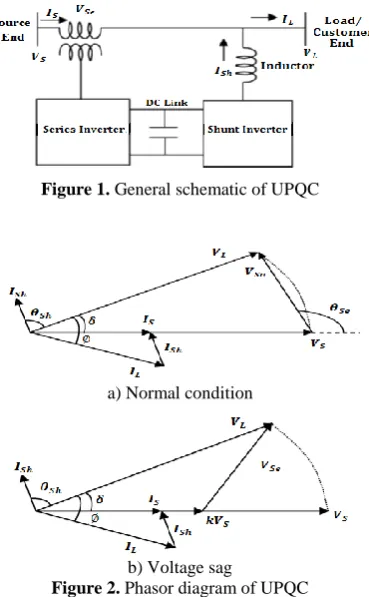
2. 2. Modeling of UPQC-PAC In this article, an integrated optimizer of power quality based on PAC is used which contains two series & shunt inverters as seen in Figure 1. In general, for mitigating sag and swell occurred in supply voltage, the series inverter is used. Moreover, in presence of reactive component of load current and harmonics shunt inverter is for compensation. In case of normal condition and voltage sag, series voltage (𝑉𝑆𝑒) and shunt compensating current
(𝐼𝑆ℎ) would be injected by series inverter and shunt
to create a phase angle (𝛿), shift of the load end voltage.as seen in Figure 2(a). In case of reactive power provision, this aspect -phase angle shift- boosts the series inverter that leads to reduction of shunt inverter rate and overall rating of a UPQC. In other words, if phase angle (𝛿) would be controlled suitably, load reactive power could be divided between shunt and series active filters without influencing on nominal amounts of UPQC. While there is voltage sag, 𝑉𝑆𝑒
injection can provide a constant situation for load end voltage as seen in Figure 2(b). Maximum rating of series inverter is the key element to indicate the amount of 𝑉𝑆𝑒.
Mathematical details and formulation of UPQC-PAC for reactive power compensation in distribution network can be found in [11].
3. MULTI-OBJECTIVE PLANNING MODEL VIA UPQC-PAC
In this article, a multi-objective planning model is formulated to determine the optimal locating of UPQC, the optimal amount of compensating reactive power at the desired location, and the optimal amount of 𝐾𝑆𝑒.
These optimizing variables would be calculated by simultaneous minimizing three targets.
They include [11]:
Figure 1. General schematic of UPQC
a) Normal condition
b) Voltage sag
Figure 2. Phasor diagram of UPQC
Target 1: Capacity of UPQC (VA)
Target 1: 𝑆𝑈𝑃𝑄𝐶= 𝑆𝑆ℎ+ 𝑆𝑆𝑒 (4)
This objective function would be recognized with
𝑆
𝑈𝑃𝑄𝐶.
where 𝑆𝑆𝑒 , 𝑆𝑆ℎ are nominal powers of series and
shunt inverter, respectively. Target 2: Network power loss
Target 2: 𝑃𝐿𝑜𝑠𝑠𝑈𝑃𝑄𝐶= ∑𝑗𝑘∈𝛾{𝐼𝐿(𝑚𝑛)}2𝑟(𝑚𝑛) (5)
where, 𝐼𝐿(𝑚𝑛), 𝑟(𝑚𝑛) show line current & resistance
of the branch 𝑚𝑛, and set 𝛾 consists of all branches in a network.
Target 3: Percentage of nodes with under voltage problem (PNUVP)
Target 3: 𝑃𝑁𝑈𝑉𝑃 = 100 (𝑁𝑈𝑃𝑄𝐶𝑈𝑉
𝑁𝐵𝑎𝑠𝑒𝑈𝑉 ) (6)
𝑁𝑈𝑃𝑄𝐶𝑈𝑉 illustrates number of nods having voltage drop
with UPQC, and 𝑁𝐵𝑎𝑠𝑒𝑈𝑉 shows number of nods with
voltage drop without UPQC.
4. MULTI-OBJECTIVE PLANNING ALGORITHM
4. 1. MOGWO This section summarizes the main steps in MOGWO algorithm. The GWO [14] is a new meta-heuristic algorithm inspired by grey wolves. The GWO algorithm mimics the hunting mechanism and headship hierarchy of grey wolves in nature. Four kinds of grey wolves such as alpha, beta, delta, and omega are used for simulating the leadership hierarchy. In addition, three main steps of hunting, entitled seeking for hunt, encircling hunt, and attacking to hunt are accomplished. The hierarchy of grey wolf is shown in Figure 3 which the dominance to decreases from top to down.
For mathematical social hierarchy modelling of grey wolf it is assumed that the best solutions are obtained by the wolves, alpha (α), beta (β) and delta (δ), respectively and other wolves are assumed omega (ω). In fact, hunting would be guided by three wolves, alpha, beta and delta and other wolves follow these three wolves. Encircling prey can be modelled by the following equations:
𝐷⃗⃗ = |𝐶 . 𝑋 𝑝(𝑖) − 𝑋 (𝑖)| (7)
𝑋 (𝑖 + 1) = 𝑋 𝑝(𝑖) − 𝐴 . 𝐷⃗⃗ (8)
where is the present iteration, 𝐶 and 𝐴 are coefficient vectors, 𝑋⃗⃗⃗⃗ 𝑝represents the position vector of the victim,
and 𝑋 represents the position vector of a grey wolf. The vectors 𝐴 and 𝐶 are calculated from the following equations:
𝐴 = 2𝑎 . 𝑟 1− 𝑎 (9)
𝐶 = 2. 𝑟⃗⃗⃗ 2 (10)
In Equations (9) and (10), coefficient 𝑎 decreases linearly from 2 to 0 in each iteration and 𝑟 1 and 𝑟 2 are
random vectors between [0,1].
For mathematical modelling of hunting assume that α is the best answer and β, δ are best knowledge for prey position. With saving these three answers and updating other search agents such as ω by the following equations, the new answers may be achieved. This continues once to reach the best answers. In this algorithm, for searching a prey, grey wolves diverge from each other. Mathematically modelling, when
|𝐴 | > 1 forces the wolves to diverge from wide search
space, hopefully find a better position. Afterwards, estimating a prey converge they would get ready to raid the prey. Also, 𝐶 ⃗⃗⃗ vector component has random values between [0-2] that not linearly decrease in contrast to 𝐴 ⃗⃗⃗⃗ . This parameter helps to avoid algorithm to stop on local optimum.
𝐷⃗⃗ 𝛼= |𝐶 1. 𝑋 𝛼− 𝑋 | , 𝐷⃗⃗ 𝛽= |𝐶 2. 𝑋 𝛽− 𝑋 | , 𝐷⃗⃗ 𝛿=
|𝐶 3. 𝑋 𝛿− 𝑋 |
(11)
𝑋 1= 𝑋 𝛼− 𝐴 1. (𝐷⃗⃗ 𝛼) , 𝑋 2= 𝑋 𝛽− 𝐴 2. (𝐷⃗⃗ 𝛽) , 𝑋 3=
𝑋 𝛿− 𝐴 3. (𝐷⃗⃗ 𝛿)
(12)
𝑋 (𝑖 + 1) =𝑋⃗ 1+𝑋⃗ 2+𝑋⃗ 3
3 (13)
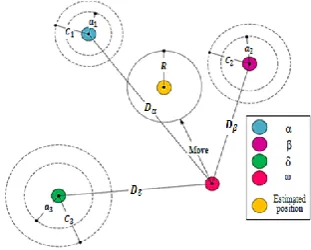
Figure 4 shows that in a two-dimensional space, how the search agents are updated by alpha, beta and delta positions. In other words, Figure 4 shows that α, β and δ estimate probable position of the prey (best answer) in the search space and other wolves update their position in the random place within a circle around the α, β and δ.
Two new components: first, an archive that is responsible for storage of optimal solutions of non-dominated Pareto and second, leader selection strategy that helps to choose the best leader between archive, are added here in order to create multi objective GWO algorithm [15]. Auxiliary components added are similar to MOPSO method. An archive which is added for creating multi objective GWO algorithm is a simple storage unit. This unit stores the best optimal solutions of non-dominated Pareto obtained so far.
Figure 4. Position updating in GWO
The second component helps to choose the leader by using roulette wheel method and probability function which is introduced in the following:
𝑝𝑖= 𝐶1 𝑁 𝑖
⁄ (14)
𝐶1: a constant number greater than 1
𝑁𝑖: Number of obtained Pareto optimal solutions.
More comprehensive description of the MOGWO algorithm is given in reference [15].
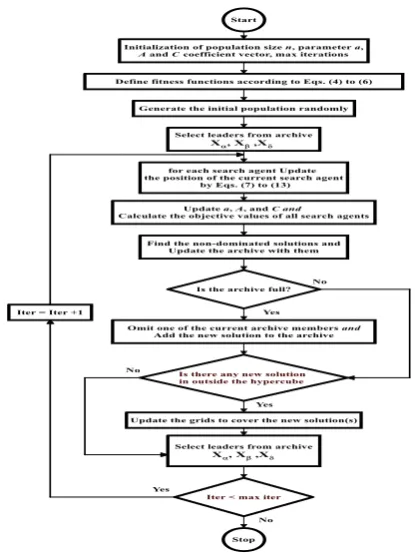
4. 1. 1. Utilization of MOGWO in Locating and Sizing of UPQC-PAC In this section, the MOGWO algorithm for optimal locating and sizing of UPQC-PAC is presented. In this algorithm, first, initial population of wolves, parameter 𝑎 , coefficient vectors 𝐴⃗⃗⃗ , 𝐶 and maximum numbers of iteration are defined. Then, initial population of wolves is spread randomly in the defined search space that the position of each wolf is composed of three variables such as location, size, and the parameters of UPQC-PAC. For each position, load flow algorithm runs in order to calculate the fitness functions according to Equations (4) to (6). Then, the non-dominant solutions are determined and the archive is initialized according to them. The best position of wolves in the archive, are named as 𝛼, 𝛽 and 𝛿 and the position of the rest of wolves called ω. Then, the value of parameter 𝑎
decreases linearly from 2 to 0 in each iteration in order to confirm exploration and exploitation. At this point, the position of the rest of wolves (ω) relative to top wolves' position (alpha, beta and delta), is updated according to Equations (11) to (12). This update, takes places depending on the distance of the rest of wolves (ω) from top wolves' position (alpha, beta and delta) and are named as 𝑋1, 𝑋2and 𝑋3. Then, next new position is
obtained by calculating average of the positions 𝑋1, 𝑋2
the parameters of UPQC-PAC are determined and the archive is updated according to them. Then if the archive be full, the grid mechanism runs to omit one of the current archive members and add the new solution to the archive. Else, if each of the new added solutions to the archive is located outside the hypercube, update the grids to cover the new solution(s). Else, select leaders from the archive. These processes will be continued until to reach favorable position or maximum iteration. The flowchart of utilization of MOGWO algorithm is shown in Figure 5.
4. 2. Point Estimate Method (PEM) In this paper, the two-point estimate method (2PEM) which is a variation of the original PEM, has been used for modelling the uncertainties. The probable input variables of the load flow problem are wind power and load demand. Moreover, the output variables (power loss & number of buses with voltage drop) for this problem are also probable variables. The algorithm of computing the moment for the probable output variables by using the 2PEM is described in reference [16].
4. 3. Fuzzy Sets Theory In order to specify a set of solutions, we need to get a pliable solution and demonstrate a trade-off among various objectives. In case of selecting an agreed-upon solution among a set of solutions, there are different approaches. A fuzzy method is of great interest because of its ease.
Figure 5. The flowchart of utilization of MOGWO algorithm
The fuzzy sets are specified by membership functions that represent the grade of membership in a fuzzy set, with values from 0 to 1 [17]. In the fuzzy approach, a strictly monotonically decreasing and continuous membership function is defined to each objective. The membership function illustrates the extent to which a solution is satisfying the objective functions 𝑞. A linear membership function can be applied for all objectives:
𝜇𝑓𝑞(𝑋̅) =
{
0 𝑓𝑞(𝑋̅) > 𝑓𝑞𝑚𝑎𝑥 𝑓𝑞𝑚𝑎𝑥−𝑓𝑞(𝑋̅)
𝑓𝑞𝑚𝑎𝑥−𝑓𝑞𝑚𝑖𝑛 𝑓𝑞
𝑚𝑖𝑛≤ 𝑓
𝑞(𝑋̅) ≤ 𝑓𝑞𝑚 𝑎𝑥
1 𝑓𝑞(𝑋̅) < 𝑓𝑞𝑚𝑖𝑛
(15)
Figure 6 shows the graph of this membership function. By taking the individual minimum and maximum values of each objective function into account, the membership function 𝜇𝑓𝑞(𝑋̅) for each objective function
can be specified in a subjective method. Then, for a multi-objective optimization problem with 𝑄 objective functions, the final solution can be found as:
𝑚𝑎𝑥 {𝑚𝑖𝑛 {𝜇𝑓𝑞(𝑋̅)}} ; 𝑞 = 1,2, … 𝑄 (16)
5. SIMULATION RESULTS AND DISCUSSION
The proposed model is tested on the 33-bus distribution network. The model is simulated in MATLAB R2014a software. The evaluation platform is a workstation system with a 2.66 GHZ Intel Core 2 Duo CPU and 4GBs of RAM. This distribution network contains one substation at bus 1, a wind turbine with an initial capacity of 1000 KW at bus 12, and other buses are considered as load buses. The parameters of this wind turbine are as follows:
Cut-in speed is 4 m/s, rated speed is 11 m/s and cut-out speed is 23 m/s.
The substation voltage is specified to be 1⦟0 p.u. The needed information for studied network is available in reference [18]. The total harmonic distortion (THD) of the load current is assumed to be 20% and the minimum voltage sag is guessed as 25% (i.e., Kse ≥ 0.5)
[11]. In this paper, the forward-backward sweep load flow algorithm is used [19]. The MOGWO optimized parameters for this simulation is shown in Table 1.
In order to accurate analyzing of results, two test systems are simulated and their results in each part are compared with other articles. Brief descriptions of simulated test systems in this paper are tabulated in Table 2.
5. 1. Test System1 In this case, results of the proposed planning model in 33-bus distribution network with wind generation without considering of UPQC-PAC are analyzed.
Purpose in simulation of this case is to determine power loss data and number of buses with voltage drop in distribution network. The results acquired of this case are shown in Table 3.
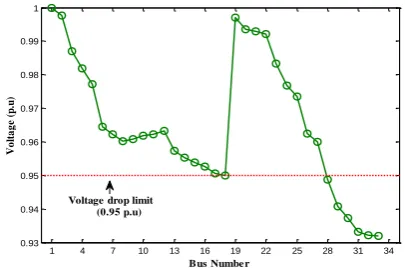
Regarding acquired results in Table 3, power loss for distribution network is 130.07 (KW). Figure 7 shows the number of buses with voltage drop for 33-buses distribution network with wind generation without considering of UPQC-PAC.
Regarding to acceptable voltage drop limit shown in Figure 7, the number of buses with voltage drop are 7 nodes of the 33-node (i.e., 21.21%).
5. 2. Test System 2 In this case, optimal locating and sizing of UPQC-PAC in 33-bus distribution network with wind generation is simulated. The optimized results for the second case are shown in Table 4.
TABLE 1. MOGWO parameters
Grey wolves number 100
Maximum number of iterations 100
Repository size 50
Number of grids per each dimension 5
Grid inflation parameter (alpha) 0.1
Leader selection pressure parameter (beta) 2
Extra (to be deleted) repository member selection
pressure (gamma) 2
TABLE 2. Brief descriptions of simulated test systems
33-bus distribution network without considering of UPQC
Test system 1
33-bus distribution network with considering of UPQC
Test system 2
TABLE 3. The results acquired of distribution network
simulation
Test system 1
number of buses with voltage drop Power loss (KW)
7 130.07
Figure 7. Number of buses with voltage drop in the test
system 1
TABLE 4. Optimal solutions based on the test system 2
𝐊𝐒𝐞
Optimal sizing of UPQC (MVA) Optimal locating
of UPQC
0.5 1.59
Branch5: 5-6 Test System 2
In order to show the strength of simulation which is done in network, obtained results from this case are compared with results of test system 1 and reference [11] as shown in Table 5. It should be mentioned that in reference [11], optimal locating and sizing of UPQC-PAC in the 33-bus distribution network is determined without considering of wind and load uncertainties by using two cases: Case A: The optimal locating of UPQC-PAC with simultaneous minimizing of two objective functions: 1- capacity of UPQC 2- power loss. Case B: The optimal locating of UPQC-PAC with simultaneous minimizing of two objective functions: 1- capacity of UPQC 2- percentage of nodes with under voltage problem (PNUVP) rather than the grid without UPQC. In this paper, the obtained results from this case are compared with results of the test system 1 and Case A in reference [11] as Table 5.
As it can be observed in Table 5, optimal locating and sizing of UPQC-PAC in distribution network with wind generation is able to reduce power loss from 130.07 (KW) in test system 1 to 90.6 (KW) in test system 2. Figure 8 shows the number of buses with voltage drop for 33-buses distribution network with considering of UPQC-PAC (test system 2) compared with the test system 1 and Case A in reference [11].
TABLE 5. Obtained results for this test system in comparison
with the test system 1 and reference [11]
CaseA [11] Test System 2
Test System 1
Power loss (KW) Power loss (KW)
Power loss (KW)
147.5 90.6
130.07
1 4 7 10 13 16 19 22 25 28 31 34 0.93
0.94 0.95 0.96 0.97 0.98 0.99 1
Bus Numbe r
V
o
lta
g
e
(p
.u
)
Figure 8. Number of buses with voltage drop for this test system in comparison with the test system 1 and reference [11]
As it can be observed in Figure 8, optimal locating and sizing of UPQC in distribution network with wind generation is capable to reduce the number of buses with voltage drop from 7 nodes of the 33-node (i.e., 21.21%) in the test system 1 to zero node in the test system 2. Also, in Case A [11], the number of buses with voltage drop are 14 nodes of the 33-node (i.e., 42.42%).
Figure 9 shows the Pareto-approximation fronts (PAFs) achieved from the proposed planning model. As shown in Figure 9, by using the UPQC the power loss and PNUVP are decreased considerably in distribution network.
Figure 9. PAFs achieved from the proposed planning model
6. CONCLUSION
In this article, a stochastic structure for reactive power compensation of radial distribution network via UPQC-PAC under wind and load uncertainties is presented. In order to optimal compensating of reactive power of distribution network, UPQC model based on phase angle control is used. Presented structure shows a multipurpose model for optimal locating and sizing of UPQC-PAC in presence of uncertainties. For explaining non-dominated answers, grey wolf optimizer algorithm based on probabilistic load flow is used. Then fuzzy method for choosing the best final answer is applied.
In order to evaluate reliability of mentioned approach, simulation is done on distribution network with 33-bus. Simulation results are compared with other researched articles. The results show, with using offered method, the power loss in distribution network would be decreased significantly and also the voltage profile in distribution network could be improved.
7. REFERENCES
1. Das, D., "Reactive power compensation for radial distribution networks using genetic algorithm", International Journal of Electrical Power & Energy Systems, Vol. 24, No. 7, (2002), 573-581.
2. Chis, M., Salama, M. and Jayaram, S., "Capacitor placement in distribution systems using heuristic search strategies", IEE Proceedings-Generation, Transmission and Distribution, Vol. 144, No. 3, (1997), 225-230.
3. El-Fergany, A.A. and Abdelaziz, A.Y., "Cuckoo search-based algorithm for optimal shunt capacitors allocations in distribution networks", Electric Power Components and Systems, Vol. 41, No. 16, (2013), 1567-1581.
4. Liang, R.-H. and Wang, Y.-S., "Fuzzy-based reactive power and voltage control in a distribution system", IEEE Transactions on Power Delivery, Vol. 18, No. 2, (2003), 610-618.
5. Calovic, M.S. and Saric, A.T., "An integrated fuzzy concept for multi-objective capacitor placement optimization in distribution networks", Electric Power Components and Systems, Vol. 30, No. 9, (2002), 947-966.
6. Ara, A.L., Tolabi, H.B. and Hosseini, R., "Dynamic modeling and controller design of distribution static compensator in a microgrid based on combination of fuzzy set and galaxy-based search algorithm", International Journal of Engineering-Transactions A: Basics, Vol. 29, No. 10, (2016), 1392. 7. Khadkikar, V., "Enhancing electric power quality using upqc: A
comprehensive overview", IEEE transactions on Power Electronics, Vol. 27, No. 5, (2012), 2284-2297.
8. Pal, Y. and Swarup, A., "A comparative analysis of upqc-p, upqc-q and upqc-vamin-a simulation study", Vol. 80, No. 5, (2014).
9. Basu, M., Das, S.P. and Dubey, G.K., "Comparative evaluation of two models of upqc for suitable interface to enhance power quality", Electric Power Systems Research, Vol. 77, No. 7, (2007), 821-830.
transactions on Power Electronics, Vol. 26, No. 9, (2011), 2414-2425.
11. Ganguly, S., "Multi-objective planning for reactive power compensation of radial distribution networks with unified power quality conditioner allocation using particle swarm optimization", IEEE Transactions on Power Systems, Vol. 29, No. 4, (2014), 1801-1810.
12. Sattarpour, T. and Nazarpour, D., "Assessing the impact of size and site of dgs and sms in active distribution networks for energy losses cost", International Journal of Engineering-Transactions A: Basics, Vol. 28, No. 7, (2015), 1002-1010. 13. Arabali, A., Ghofrani, M., Etezadi-Amoli, M., Fadali, M.S. and
Moeini-Aghtaie, M., "A multi-objective transmission expansion planning framework in deregulated power systems with wind generation", IEEE Transactions on Power Systems, Vol. 29, No. 6, (2014), 3003-3011.
14. Mirjalili, S., Mirjalili, S.M. and Lewis, A., "Grey wolf optimizer", Advances in Engineering Software, Vol. 69, No., (2014), 46-61.
15. Mirjalili, S., Saremi, S., Mirjalili, S.M. and Coelho, L.d.S., "Multi-objective grey wolf optimizer: A novel algorithm for multi-criterion optimization", Expert Systems with Applications, Vol. 47, (2016), 106-119.
16. Arabali, A., Hosseini, S.H. and Moeini-Aghtaie, M., "Private investor-based transmission expansion planning in deregulated environments", Electric Power Components and Systems, Vol. 43, No. 6, (2015), 620-632.
17. Maghouli, P., Hosseini, S.H., Buygi, M.O. and Shahidehpour, M., "A multi-objective framework for transmission expansion planning in deregulated environments", IEEE Transactions on Power Systems, Vol. 24, No. 2, (2009), 1051-1061.
18. Baran, M.E. and Wu, F.F., "Network reconfiguration in distribution systems for loss reduction and load balancing", IEEE Transactions on Power Delivery, Vol. 4, No. 2, (1989), 1401-1407.
19. Ghosh, S. and Das, D., "Method for load-flow solution of radial distribution networks", IEE Proceedings-Generation, Transmission and Distribution, Vol. 146, No. 6, (1999), 641-648.
Optimal Locating and Sizing of Unified Power Quality Conditioner-
phase Angle
Control for Reactive Power Compensation in Radial Distribution Network with Wind
Generation
A. R. Moradia, Y. Alinejad-Beromia, M. Parsab, M. Mohammadic
a Faculty of Electrical and Computer Engineering, Semnan University, Semnan, Iran b Faculty of Electrical Engineering, Islamic Azad University of Damghan, Semnan, Iran c Faculty of Electrical Engineering, Islamic Azad University of Semnan, Semnan, Iran
P A P E R I N F O
Paper history:
Received 25 December 2016
Received in revised form 10 October 2017 Accepted 27 October 2017
Keywords: Fuzzy Sets Theory
Multi-objective Grey Wolf Optimizer Radial Distribution Network Reactive Power Compensation Unified Power Quality Conditioner Wind Generation
ديكچ ه
یداب عبانم اب یعاعش عیزوت یاه هکبش رد ویتکار ناوت یزاس ناربج یارب هفده دنچ یفداصت یزیر همانرب کی ،هلاقم نیا رد
( ناوت تیفیک هچراپکی زاسهب قیرط زا
UPQC
لدم .تسا هدش هئارا )
UPQC
( زاف هیواز لرتنک هیاپ رب
PAC
هدش هدافتسا )
بایاج ،هدش هئارا شور رد .تسا هنیهب ی
UPQC-PAC
دصرد ،هکبش ناوت تافلت :دننام یفادها نامزمه ندرک لقادح اب
تیفرظ و هدش ژاتلو تفا راچد یاه نیش
UPQC
یطخ ریغ یزاس هنیهب هلاسم کی هدش حرطم لدم .تسا هدش ماجنا
زاس هنیهب هفده دنچ متیروگلا ،بولغم ریغ یاه باوج هعومجم ندرک نییعت یارب .دشاب یم هدیچیپ یرتسکاخ گرگ
(
MOGWO
خساپ نیرتهب یبایتسد یارب یزاف یریگ میمصت یروئت سپس ،تسا هدش هدافتسا یتلاامتحا راب شخپ هیاپ رب )
عیزوت هکبش یورب یزاس هیبش ،هدش حرطم شور نانیمطا تیلباق یبایزرا روظنم هب .تسا هدش هدافتسا 33
هدش ماجنا هساب
هب جیاتن .تسا هیبش زا هدمآ تسد
زاس یم ناشن ی دوش ظاحل هعلاطم دروم هکبش رد داب تیعطق مدع ریثات هک یتروص رد دهد
هرگ دصرد و ناوت تافلت یم شهاک یریگمشچ تروص هب تیعطق مدع نودب هکبش هب تبسن ژاتلو تفا راچد یاه
.دبای
![Figure 8. Number of buses with voltage drop for this test system in comparison with the test system 1 and reference [11]](https://thumb-us.123doks.com/thumbv2/123dok_us/202198.2014460/7.595.62.279.479.725/figure-number-buses-voltage-drop-test-comparison-reference.webp)
