Effect of system of feeding and watering on performance of lactating sows
1J. J. Peng,
2S. A. Somes,
3and D. W. Rozeboom
4Department of Animal Science, Michigan State University, East Lansing 48824
ABSTRACT: An experiment was conducted to deter-mine the effects of ad libitum access to feed and water and the option to mix feed and water, all in the same feeder, on the performance of multiparous lactating sows. Feed and water were made available to sows us-ing a self-fed wet/dry (SFWD) or a hand-fed (HF) feed-water system. In the SFWD system, feed and feed-water were dropped into a common trough area of the feeder. The sow determined when and how much of each was dropped. With feed falling onto the flat area of the bot-tom of the SFWD feeder trough and water falling into the shallow bowl area, and with the 2 areas seamlessly connected, the sow also determined the wetness of the feed consumed. In the HF system, sows were given dry feed twice daily in a J-shaped feeder that was indepen-dent of the sow’s water source. Sows (n = 114) were assigned to treatments based on parity and genotype. Total feed disappearance per sow during lactation (20 ±0.2 d) was greater (P<0.01) with the SFWD system than with the HF system (120 vs. 110±4.1 kg, respec-tively). The SFWD sows had greater (P < 0.01) BW
Key words:feed intake, lactation, sow, water intake
©2007 American Society of Animal Science. All rights reserved. J. Anim. Sci. 2007. 85:853–860 doi:10.2527/jas.2006-474
INTRODUCTION
Encouraging lactating sows to eat and drink as much as possible is critical for milk production, the conserva-tion of body nutrient stores, and efficient transiconserva-tion into the next reproductive cycle. Sow feed and water consumption during lactation are influenced by a
num-1Appreciation is extended to Berry Feeding System (Greencastle,
IN) for providing the self-fed wet/dry feed-water equipment and con-sultation concerning its operation. The authors also wish to thank J. Alan Snedegar, D. Lance Kirkpatrick, Marc Hartzler, Jessica Scrimger, Mark Labar, Mellisa Ryan, and Steve Grow for their help caring for the animals.
2Current address: Department of Youth Development &
Agricul-tural Education, Purdue University, West Lafayette, IN 47907.
3Current address: Cargill Innovation Center, Elk River, MN 53330. 4Corresponding author: [email protected]
Received July 18, 2006. Accepted October 26, 2006.
853
gains during lactation than HF sows (6.2 vs. 0.6±1.85 kg, respectively). Backfat depth change during lacta-tion did not differ (P= 0.37) between treatments. Like-wise, percentage of sows displaying estrus by d 11 post-weaning did not differ (P = 0.51). Piglet weaning BW was greater (P < 0.01) with the SFWD system than with the HF system (6.63 vs. 6.12 ± 0.22 kg, respec-tively). Sow average daily water intake and total feed wastage during lactation did not differ (P > 0.66) be-tween treatments. However, sows with the SFWD sys-tem wasted less water (P< 0.01) than those with the HF system (15 vs. 232 ± 12 L, respectively). From a commercial swine production perspective, the differ-ence in waste water volume would result in a significant variation in costs associated with manure storage and distribution. In conclusion, use of a SFWD feed-water system in lactation, which provides sows choices of when to eat, how much to eat, and if dry feed should be mixed with water during consumption, enhances sow appetite, improves litter growth performance, and wastes less water than a HF feed-water system.
ber of factors, including ambient temperature, geno-type, parity, sow health, lactation stage, and litter size (O’Grady et al., 1985; Matzat, 1990; Farmer et al., 2001). Wetness of feed and method of feed provision (self-fed or hand-fed) are other factors that may influ-ence sow feed and water intakes. Lactating sows pro-vided with wet feed tend to eat more feed compared with sows given dry feed (O’Grady and Lynch, 1978; Koketsu, 1994; Lynch, 2001). Peterson et al. (2004) re-ported improved total lactation feed disappearance when sows were fed using a self-feeder (sow operated a dispensing mechanism with a hopper) instead of a feeder requiring manual feed additions by a human caregiver. Improved feed intakes and heavier litters during summer have been reported when using a sys-tem that combined self-feeding and an option for the sow to wet her feed compared with a dry feed hand-fed system (Pettigrew et al., 1985). Notably, none of these studies measured water intake.
Agriculture engineers are challenged to design facili-ties and equipment suitable for animal production, profitability, and environmental compliance, especially those associated with intensive animal feeding opera-tions. The concept of providing lactating sows with eating and drinking choices, with freedom to make deci-sions relative to when they want to eat, how much they want to eat, and whether they mix feed and water while eating deserves further study.
The objective of this study was to determine the per-formance of lactating sows, including feed and water intakes, when fed and watered using a self-fed wet/dry (SFWD) feeding system compared with using a conven-tional hand-fed (HF) dry feeding system.
MATERIALS AND METHODS
Animal Use and Care
The experimental procedures in this study were ap-proved by the All University Committee on Animal Use and Care at Michigan State University.
Animals and Diets
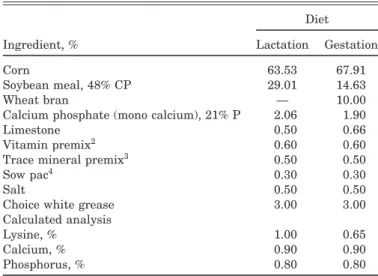
A total of 114 multiparous Yorkshire (n = 28) or York-shire×Landrace (n = 86) sows were randomly assigned based on parity and breed to 1 of 2 treatments during January and February 2002, and from September 2003 to January 2004. The study consisted of 7 replications that farrowed and lactated during the fall and winter seasons. Sow parity ranged from 1 to 9. Sows were moved into farrowing rooms and individual crates 7 d or less before parturition and were fed a corn-soybean meal-based lactation diet from that time until weaning. All sows were treated similarly after weaning; they were moved into individual crates in a breeding room and were managed to stimulate estrus and to be ser-viced for another pregnancy. A corn-soybean meal-based gestation diet was fed from weaning to estrus. Both diets were in mash form and met or exceeded NRC (1998) recommendations (Table 1).
Feed-Water Systems
The treatments consisted of 2 systems designed to provide sows with feed and water. The term system is used herein to describe the combination of feeding and watering equipment. One of the treatments was a SFWD system with the nipple drinker inside the feeder. The other treatment was a HF system with the nipple-cup combination drinker independent of the feeder.
Two adjacent farrowing rooms were used. The SFWD system was installed in all 12 crates of 1 room, and the HF system was installed in all 12 crates of the other room. Within a room, crates were set on a TriBar slatted floor (Nooyen Inc., Chicago, IL) in a single row and numbered 1 through 12. The rooms were structured and equipped similarly, except for the feed-water
sys-Table 1.Composition of the lactation and gestation diets (as-fed basis)1
Diet
Ingredient, % Lactation Gestation
Corn 63.53 67.91
Soybean meal, 48% CP 29.01 14.63
Wheat bran — 10.00
Calcium phosphate (mono calcium), 21% P 2.06 1.90
Limestone 0.50 0.66
Vitamin premix2 0.60 0.60
Trace mineral premix3 0.50 0.50
Sow pac4 0.30 0.30
Salt 0.50 0.50
Choice white grease 3.00 3.00 Calculated analysis
Lysine, % 1.00 0.65
Calcium, % 0.90 0.90
Phosphorus, % 0.80 0.80
1Diets were formulated to meet or exceed the NRC requirements
for swine (1998).
2Supplied per kilogram of diet: 5,511 IU of vitamin A; 551 IU of
vitamin D; 60 IU of vitamin E; 4.4 mg of vitamin K; 4.4 mg of ribofla-vin; 17.6 mg of pantothenic acid; 26.4 mg of niacin; 33g of B12; 33
g of thiamin; and 990g of B6.
3Supplied per kilogram of diet: 11.0 mg of Mn (MnSO
4), 11.0 mg
of Fe (FeSO4ⴢH2O), 11.0 mg of Cu (CuSO4ⴢ5H2O), 150g of I
(ethylene-diamine dihydroiodide), 100 mg of Zn (ZnO), and 300g of Se (Na
2-SeO3).
4Supplied per kilogram of diet: 2,756 IU of vitamin A; 386 mg of
choline; 220 mg ofD-biotin; and 1.65 mg of folic acid.
tems used in each room. The justification for using sepa-rate rooms is provided below in the general manage-ment subsection.
The bottom of the SFWD system (Berry Feeding Sys-tem, Greencastle, IN; manufactured by Lou Mfg., Inc, Austin, MN) included a flat area located below a plastic hopper and a sow-operated feed dispensing mechanism, and a shallow bowl area located below a water nipple. This allowed the sow an option of consuming dry or wetted feed. The sow-operated feed dispenser of the SFWD system included a rolling ball as the agitating mechanism that the sow used, and a knob that was inaccessible to the sow and used by the researchers to adjust the amount of feed flowing with each agitation by the sow. Feed passed from the hopper into the feeder when the sow moved the rolling ball dispensing mechanism.
The SFWD system was made of 3 materials: the feeder was made of stainless steel, the dispenser was made of PVC, and the hopper was made of polyethylene plastic. The dimensions of the SFWD feeder were: height, 54.6 cm without the hopper or 102.9 cm with the hopper; width, 41.6 cm; depth, 29.2 cm; lip to floor, 20.3 cm; and height of the bottom of the feed trough from the floor, 6.4 cm. The bottom of the HF feeder (Circle B Mfg. Inc, Three Rivers, MI) was J-shaped and free of corners in which feed could accumulate and spoil. All parts of the HF feeder that came in contact with the sow or feed were made of stainless steel. The dimen-sions of the HF feeder were: height, 69.2 cm; width,
36.2 cm; depth, 34.3 cm; lip to floor, 26.7 cm; and height of the bottom of the feed trough from the floor, 4.0 cm. In both systems, the feeders were mounted to the head-gate of individual farrowing crates. Ad libitum access to drinking water was available in both systems. The nipple drinker (Jalmarson, model 1720-180A, Eskilstuna, Sweden) was approximately 8.0 cm above the shallow bowl, which was pressed into the bottom of the feeder used in the SFWD system. Water for the HF sows was provided using a nipple-cup combination, with the nipple fixed into the mounting wall of the cup. The nipple drinker (Edstrom, model 1000-0743, Waterford, WI) for the HF system was located 10.0 cm above the TriBar slatted floor, and to the left front side of each sow (10.0 cm from the feeder). The HF watering equipment was mounted to the left panel of the sow crate.
General Management
Feed-water systems were assigned to separate, adja-cent farrowing rooms to assess most accurately the sow response to the feed and water systems. In a prelimi-nary study (unpublished), the SFWD and HD systems were randomly distributed among the 12 farrowing crates within 1 farrowing room. We observed that sows on both systems stood and ate when HF sows were being hand-fed in the morning and afternoons. The eating behavior of the sows on the SFWD system appeared to be influenced by the management of the HF system. Believing that this was a violation of the self-fed or operant, ad libitum access concept, which we wanted to evaluate with the SFWD system, the 2 systems were placed in separate but nearly identical farrowing rooms for the current study. The facilities, equipment, and management, other than the feed-water system, were identical. Sows were not trained to use the feed-water systems before experimentation.
Environmental temperatures in the 2 farrowing rooms were maintained with thermostatically con-trolled heating and ventilation. Temperatures of the 2 farrowing rooms were set at 18 to 22°C for the study period and monitored daily. The thermostat was set at 22°C when farrowing began and was reduced gradually until it reached 18°C, by the end of the first week of lactation. It remained set at 18°C until weaning. Mini-mum and maxiMini-mum temperatures were monitored daily (0830) at 30 cm above the floor. Within each repli-cation, temperatures in the 2 farrowing rooms were similar (21.2 ± 0.1°C). For piglet warmth during the lactation period, a heat pad (Standfield, Model RS2B40, 50×90 cm, Osborne Industries Inc., Osborne, KS) was provided on the floor on 1 side of the sow in each crate. The same 24-h lighting regimen was used throughout the study in both rooms, with lighting from fluorescent bulbs during the day (0700 to 1700) and lighting from incandescent bulbs during the night.
Feeding Management
From entry into the farrowing room until parturition, all sows were offered 2.0 kg of the lactation diet once daily. Twice each day for the first 3 d postpartum, the sows were offered the same amount. Thereafter, the sows were fed to appetite until weaning (20± 0.2 d). After d 3 postpartum, feed was manually added to the hoppers of the SFWD systems 1 or 2 times (0800 or 1600, or both) daily so that fresh feed was constantly available. Fresh feed was placed in the hopper of the SFWD system when the quantity of feed remaining would potentially limit sow intake in the following 12 h. The HF sows were fed to appetite (an amount slightly exceeding the feed disappearance in previous meals) twice each day (0800 and 1600). Feed additions were weighed and recorded in the morning and afternoon on each day for each individual sow during lactation. At the end of the time period of d 0 to 6, d 7 to 13, and d 14 to weaning, all residual feed in the feeder, including the feed in the hopper of the SFWD system, was col-lected and weighed to determine total feed disappear-ance. Sows were fed 2.3 kg of the gestation diet once daily from weaning to estrus.
Sow Performance
Total feed disappearance was determined over the entire lactation period for each sow. Sows were weighed within 24 h after parturition, on d 7 and 14 postpartum, and at weaning. Sow backfat depths were measured using a digital backfat indicator (Lean Meater, Renco Corp., Minneapolis, MN) on d 0 and at weaning at 5 cm to the left and right of the midline at the 10th rib. Standing heat in the presence of a boar was used as an indication of postweaning estrus. Several different boars were used rotationally, and exposure was 2 times each day.
Piglet Growth Performance
By d 3 postpartum, litters were standardized to have a minimum of 10 piglets per sow by cross-fostering. The number of piglets within a litter and piglet BW were recorded at birth, at cross-fostering, and on d 7, d 14, and at weaning. The CV for individual piglet BW within litter was calculated for each weighing day to evaluate the effect of treatment on piglet growth variation within a litter. No creep feed was provided before weaning.
Feed and Water Intake
To document feed and water intake of lactating sows, custom-built water tanks and feed and water wastage collecting systems were used to record water disappear-ance and to collect feed and water wastage. In each of the 5 replications studied from September 2003 to January 2004, 5 or 6 sows from a treatment group in a replication were randomly allotted to crates 7 to 12 of each room and used to more accurately determine
actual feed and water intakes. The water supply to crates 1 through 6 in both farrowing rooms was via standard plumbing within the barn (41 to 48 kPa). Sows in crates 7 through 12 in both farrowing rooms received their water from individual, pressurized (41 to 48 kPa) water tanks, which were designed to hold 42 to 43 L of water and which allowed measurement of water disap-pearance for sows in those crates.
The nipple drinker, water flow rate for the 2 rooms was adjusted to 1.0 to 1.4 L/min under a water pressure of 41 to 48 kPa. Water disappearance was recorded at 0800 and 1600 daily. The water tanks were refilled after each measurement of disappearance. Custom-fabri-cated systems to collect wasted feed and water were installed under the TriBar slatted floor of crates 7 through 12 in both farrowing rooms. Each crate had a separate collection unit, which consisted of a screen, a pan, and a carboy. The screen was set in the pan, and the carboy was fitted under the pan. This allowed sepa-ration of wasted water from the wasted feed for each sow. Wasted water drained through the screen onto the pan, where it then followed a designed slope into the carboy. Collection units were mounted on garage door tracks under the feeding and watering areas of the sow beneath the crates.
Wasted feed was collected on a 1- to 3-d basis (0800) throughout lactation, with wasted water collected twice daily (0800 and 1600). Carboys containing wasted wa-ter were weighed at the farm immediately afwa-ter collec-tion and were then emptied. Wasted feed was collected and transferred to labeled aluminum pans. The labeled aluminum pans were covered and transported to the laboratory, where DM of the waste feed was determined by oven dying for 24 h at 100°C and then was extrapo-lated back to as-fed moisture (12% moisture). The differ-ence in the amount between the original weight of the waste feed and its as-fed feed weight was added back into the amount of waste water. Care was taken to avoid collection of piglet and mice feces, although minor contamination was unavoidable.
After each collection, the waste collection equipment was scraped, brushed to clean off any residue, reassem-bled, and placed back under the crates. Average daily feed intake was calculated as total lactation feed disap-pearance per sow minus total lactation feed waste per sow divided by lactation length. Total lactation feed waste as a percentage of the total feed disappearance was also calculated for each sow. Average daily water intake was calculated as total lactation water disap-pearance per sow minus total lactation water waste per sow divided by lactation length.
Statistical Analysis
Sow feed disappearance and lactation performance data were collected for all sows (n = 114). Feed and water intake and wastage data were collected on a sub-set of those sows (n = 58). Piglet growth performance was evaluated using BW recorded on d 7, 14, and at
weaning. Piglet BW at birth and at cross-fostering were not analyzed because the exact date of weighing was inadvertently not recorded for several litters.
Thirteen of the sows on the HF system were not in-cluded in the analysis of the water wastage and average daily water intake data because of unanticipated water wastage in excess of the carboy capacity. Water wastage in excess of the carboy capacity did not occur with the SFWD system. Two outliers were detected using the Studentized outlier test for the feed wastage data, but data were included in the final analysis because there were no biological reasons for their removal.
Data were analyzed by ANOVA using PROC MIXED (SAS Inst. Inc., Cary, NC) for a completely randomized design, with the sow and piglet serving as the experi-mental unit for sow and piglet parameters, respectively. The models for the sow and piglet parameters included fixed effects of treatment and parity, as well as the treatment×parity interaction. When appropriate, non-significant interactions (P>0.25) were pooled into the appropriate error terms for the final models.
Lactation length was included as a covariate in mod-els analyzing sow total lactation feed disappearance, d 14 to weaning feed disappearance, water disappear-ance, feed wastage, water wastage, sow BW at weaning, sow BW change from d 0 to weaning, weaning backfat depth, backfat depth change during lactation, weaning-to-estrus interval, CV of piglet BW within litter at weaning, piglet BW at weaning, and piglet BW gain from d 14 to weaning. Litter size was included as a covariate in models analyzing total lactation feed disap-pearance; weekly feed disapdisap-pearance; water disappear-ance; feed wastage; water wastage; feed intake; water intake; sow BW at d 7, 14, and weaning; sow BW change during lactation; weaning backfat depth; backfat depth change during lactation; weaning-to-estrus interval; piglet survival; CV of piglet BW within litter; piglet BW at d 7, 14, and weaning; and piglet BW gain from d 7 to 13 and d 14 to weaning. Sow BW at d 0 was included as a covariate in models analyzing sow feed and water disappearance, feed and water wastage, and feed and water intake, as well as subsequent sow BW. For the above covariates, if more than 1 covariate was mentioned for a given parameter, all were included in a single covariate model.
Random effects in PROC MIXED for sow parameters included replicate, replicate×treatment, and replicate ×treatment×parity. Random effects for piglet parame-ters included replicate, replicate×treatment, replicate × treatment × parity, and sow (replicate × treatment ×parity).
Chi-square analysis was used to evaluate the effects of feed-water system on the occurrence of estrus by d 11 postweaning.
All means presented are least squares means. Differ-ences were considered significant at the level of P < 0.05.
Table 2.Effect of lactation feed-water system on sow performance1,2 Feed-water system
Item HF3 SFWD4 SEM P-value
No. of sows at farrowing 57 57 — —
Average parity 2.70 2.77 0.26 0.83
Lactation length 19.8 20.0 0.41 0.58
Feed disappearance, kg
Average daily d 0 to 65 3.85 3.95 0.14 0.62
Average daily d 7 to 135 6.23 6.64 0.37 0.18
Average daily d 14 to weaning5 6.83 7.45 0.38 0.01
Total d 0 to weaning 110 120 4.1 0.01 BW, kg d 0 206 198 3.1 0.06 d 7 211 205 3.5 0.11 d 14 210 206 4.3 0.23 Weaning 207 204 4.2 0.32 Change d 0 to weaning 0.6 6.2 1.85 0.01 Backfat depth, mm d 0 16.3 15.5 0.95 0.33 Weaning 14.4 14.1 0.58 0.76 Change d 0 to weaning −1.7 −1.2 0.58 0.37 Weaning-to-estrus interval,6d 5.7 6.0 0.41 0.35
Sows displaying estrus,7% 93.0 89.5 — 0.51 1Values are least squares means.
2Day 0 is defined as the day of farrowing.
3HF is hand-fed, stainless steel, J-shape, rounded bottom feeder plus nipple-cup combination drinker
independent of the feeder.
4SFWD is self-fed, wet/dry system with nipple drinker inside the feeder.
5Numbers of sows on HF and SFWD treatments were 46 and 46, respectively, because of missing data
in replicate 1.
6For sows that displayed estrus by d 30 postweaning. 7For sows that displayed estrus by d 11 postweaning.
RESULTS AND DISCUSSION
Sow Lactation Performance
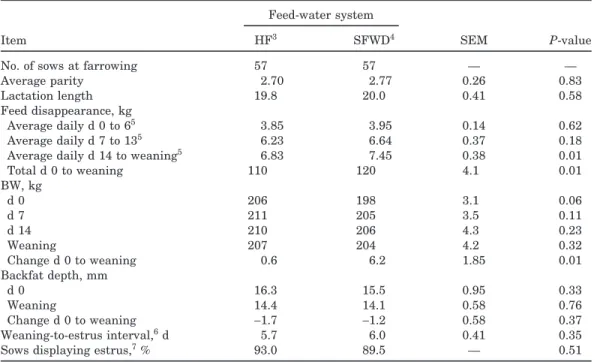
Average lactation total feed disappearance for sows on the SFWD system was greater (P<0.01) than that of the HF system (Table 2). The difference between the 2 treatments was over 10 kg with similar average parity and lactation length for both treatment groups. When lactation was divided into discrete periods, daily feed disappearance for sows on SFWD system was greater (P<0.01) than those on the HF system for the d 14 to weaning period. In other periods of lactation, d 0 to 6 and d 7 to 13, daily feed disappearances were numeri-cally greater for SFWD sows. These results are consis-tent with the research data from University of Minne-sota (Pettigrew et al., 1985), which showed greater daily feed intake when sows were provided with feed and water using a SFWD system than using a conventional HF system. Similar to the current study, the greater feed consumption of sows using their SFWD system occurred in late lactation. In that report, a season by feed-water system interaction was observed, where feed disappearance was greater during hot weather but sim-ilar in the other seasons. An increase in feed disappear-ance with the SFWD system was observed in the fall and winter seasons of the current study, which, like the University of Minnesota work, was conducted in a northern state of the United States. Thus, the results
of the current study are not in full agreement with those of the University of Minnesota work. An explanation for the seasonal disagreement between the 2 studies is not apparent.
The improvement in feed disappearance observed with the SFWD system was likely a consequence of sows having the choice of when to eat and the choice of how wet the feed should be when eaten. Other studies have evaluated these choices independent of one an-other. Peterson et al. (2004) reported a 7% improvement in the total lactation feed disappearance when lactating sows were given ad libitum access to dry feed using a self-feeder. In that study, the same feed dispensing mechanism as used in the current study was mounted above a stainless bowl-type dry feeder with the drinker located separately outside of the feeder. O’Grady and Lynch (1978), Koketsu (1994), and Lynch (2001) have reported that lactating sows ate 12, 11, and 7%, respec-tively, more feed per day when the feed was wet (hand-fed and manually made wet).
Sow BW at d 0, d 7, 14, and weaning were not different between treatments (Table 2). Both groups of sows gained BW during lactation, with those on the SFWD system gaining more from d 0 to weaning (P< 0.01). Sows in both groups lost BW between d 14 and weaning, suggesting a metabolic use of body tissues and the in-ability of either feed-water system to provide sufficient nutrients for milk production and litter growth at the end of lactation. Peterson et al. (2004) reported no
dif-Table 3.Effect of lactation feed-water system on piglet performance1 Feed-water system
Item HF2 SFWD3 SEM P-value
No. of litters 57 57 — — Litter size Cross fostering 10.2 10.0 0.12 0.40 d 7 10.2 10.0 0.13 0.24 d 14 10.1 10.0 0.13 0.50 Weaning 10.1 9.9 0.13 0.34
Survival crossfoster to wean, % 99.1 98.7 0.48 0.52 Piglet BW,4kg
d 7 2.88 2.88 0.09 0.99
d 14 4.66 4.85 0.14 0.16
Weaning 6.12 6.63 0.22 0.01
CV piglet BW within litter
Cross fostering 18.6 17.8 1.22 0.48 d 7 20.3 20.4 1.15 0.88 d 14 21.5 21.1 1.17 0.73 Weaning 20.4 18.6 1.16 0.09 Piglet ADG,5g d 7 to 13 254 280 9.4 0.01 d 14 to weaning 254 296 13.6 0.01
1Values are least squares means.
2HF is hand-fed, stainless steel, J-shape, rounded bottom feeder plus nipple-cup combination drinker
independent of the feeder.
3SFWD is self-fed, wet/dry system with nipple drinker inside the feeder.
4Piglet was the experimental unit or observation. On d 7, 14, and weaning, the number of piglets was
579 and 571, 573 and 569, and 573 and 564 for HF and SFWD treatments, respectively.
5Piglet was the experimental unit or observation. For the d 7 to 13 and d 14 to weaning periods, the
number of piglets was 573 and 569, and 573 and 564 for HF and SFWD treatments, respectively.
ference in BW change during lactation when comparing self-fed and hand-fed feeding. The studies of Whittem-ore et al. (1988), Mahan (1998), and Spencer et al. (2003), although not designed to compare methods of feed and water provision, likewise observed sows gain-ing BW durgain-ing lactation, when BW change was calcu-lated using weights taken immediately postpartum and at weaning. Although BW change in the current study suggests differing amounts of body tissue mobilization during lactation, subcutaneous backfat depth at wean-ing and backfat change from d 0 to weanwean-ing were not different between treatments. In contrast, Peterson et al. (2004) reported less backfat loss during lactation with greater feed intakes when using of the self-fed mechanism. Conservation of sow BW or tissue during lactation is thought to be important because it is related to the culling of highly productive sows because of post-weaning anestrus or failure to conceive after post-weaning. However, despite the greater BW gains of SFWD sows in the current study, feed-water system did not influ-ence weaning-to-estrus interval or the percentage of sows that displayed estrus postweaning. The current study only included one lactation, and the potential impact of the intake options provided the sow with the SFWD system on long-term reproductive performance over multiple parities is worthy of further investi-gation.
Piglet Growth Performance
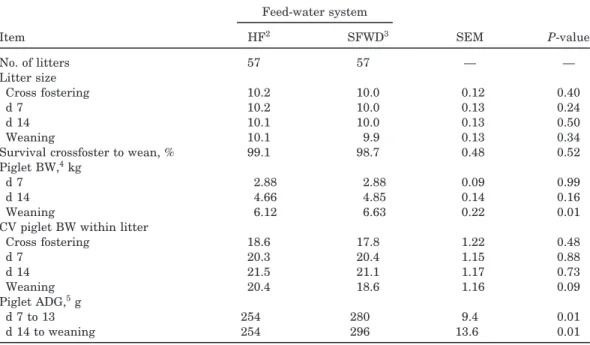
Litter sizes at cross-fostering, d 7, d 14, and weaning were not different between HF and SFWD treatments
(Table 3). Likewise, feed-water system had no effect on litter survival from cross-fostering to weaning or on the CV for piglet BW within litter at any time from cross-fostering to weaning. Piglet BW on d 7 and 14 were not different, but at weaning, the SFWD piglet BW was 0.51 kg greater (P <0.01) than that of the HF piglet. Piglets nursed by SFWD sows had greater ADG from d 7 to 13 and from d 14 to weaning (P <0.01 andP< 0.01, respectively) compared with those nursed by HF sows. Within treatment comparison of piglet ADG be-tween periods showed that piglets of SFWD sows in-creased gain from mid to late lactation. However, the ADG of HF piglets was 254 and 254 g/d for the same 2 periods, indicating that milk production of sows on this treatment did not increase enough to promote pig-let ADG in the later period of lactation. Treatment dif-ferences in piglet growth reflected similar treatment differences in feed disappearance, suggesting that the SFWD sows were producing increasing amounts of milk as lactation progressed. In contrast, in the studies of O’Grady and Lynch (1978) and Koketsu (1994), no im-provement in litter growth was reported when a wet feeding system was used, despite observing an increase in apparent feed consumption by sows.
Feed Intake and Wastage
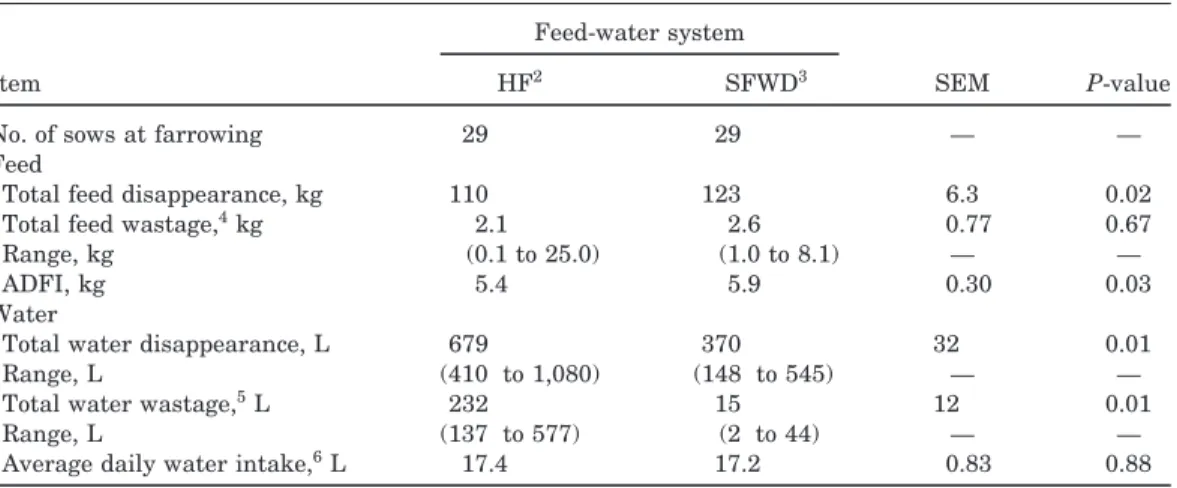
Total feed wastage per sow during lactation for the 2 feed-water systems was not different (Table 4). With no difference in feed wastage and a large difference in feed disappearance, ADFI was greater (P = 0.03) for
Table 4. Effect of lactation feed-water system on sow feed and water disappearance, wastage, and intake1
Feed-water system
Item HF2 SFWD3 SEM P-value
No. of sows at farrowing 29 29 — —
Feed
Total feed disappearance, kg 110 123 6.3 0.02 Total feed wastage,4kg 2.1 2.6 0.77 0.67
Range, kg (0.1 to 25.0) (1.0 to 8.1) — —
ADFI, kg 5.4 5.9 0.30 0.03
Water
Total water disappearance, L 679 370 32 0.01
Range, L (410 to 1,080) (148 to 545) — —
Total water wastage,5L 232 15 12 0.01
Range, L (137 to 577) (2 to 44) — —
Average daily water intake,6L 17.4 17.2 0.83 0.88 1Values are least squares means.
2HF is hand-fed, stainless steel, J-shape, rounded bottom feeder plus nipple-cup combination drinker
independent of the feeder.
3SFWD is self-fed, wet/dry system with nipple drinker inside the feeder.
4Values are total feed wastage during a whole lactation period per sow (as-fed basis).
5Values are total water wastage during a whole lactation period per sow; the number of sows for HF and
SFWD was 16 and 29, respectively.
6The number of sows for HF and SFWD was 16 and 29, respectively.
lactating sows on the SFWD system as compared with those on the HF system. Sows on the HF system had a wider range of feed wastage than those on the SFWD system. The maximum amount of 25 kg of feed waste with the HF system is the equivalent to nearly 21% of the total feed offered during the 20-d lactation period. The average feed wastage per sow during a lactation period was similar for both feed-water systems. It was about 2% of the total lactation feed disappearance on an as-fed basis. This wastage is near the least as re-ported by Taylor (1990), who documented a range of sow feed wastage from 0.1 to 38% when several different models of individual sow lactation feeders were evalu-ated. A 2% feed wastage is still a costly concern, being equivalent to about 12 t of feed per year in a production unit of 2,400 sows.
Water Intake and Wastage
Total water disappearance and water wastage of the HF feeding sows were greater (P<0.01) than those of the SFWD feeding sows (Table 4). However, average daily water intakes on the 2 treatments were not differ-ent, with sows consuming an average of 17.4 and 17.2 L of water per day for HF and SFWD, respectively. Leibbrandt et al. (2001) reported that ample access to drinking water can improve sow feed intake and de-crease sow BW loss compared with restricted sows. The current study showed that method of providing water to the lactating sows could affect sow water disappearance and wastage but not water intake.
Daily water requirement during lactation varies from 15 to 35 L (Thacker, 2001). The results of the current study are within this range but are much closer to the lesser requirement suggested. The wide range of water
requirement reported by Thacker (2001) may in part be the consequence of water disappearance measurement rather than actual water intake. For example, Seynaeve et al. (1996) and Farmer et al. (2001) reported water intake but did not take into account water wastage.
In this study, the amount of water wastage of the HF sows was more variable than that of the SFWD sows. Drinkers located inside the SFWD system resulted in an average of 15 L of waste water per sow during the entire 20-d lactation period. Comparatively, about 15 times more water was wasted per sow on the HF system. If the goal of a commercial swine operation is to reduce the amount of slurry or manure by limiting water waste by the animals, then the large amount of waste water with the HF system would be a concern. As an example, a 2,400-sow production unit would waste at least 1,362 t more water per year using the HF feeding system.
IMPLICATIONS
Providing lactating sows ad libitum access to feed and water, with the freedom to decide when and how much they want to eat and drink, and to what extent the feed is mixed with water during consumption, may enhance pork production efficiency and profitability through increased sow feed consumption and litter growth. Additionally, such feed and water management may contribute to improved sow well-being as a result of decreased BW loss and may also improve swine farm environmental compliance with less water waste, less total slurry, and reduced risk of spillage during storage, transport, and application to cropland.
LITERATURE CITED
Farmer, C., M. F. Palin, M. T. Sorensen, and S. Robert. 2001. Lacta-tional performance, nursing and maternal behavior of Upton-Meishan and Large White sows. Can. J. Anim. Sci. 81:487–493.
Koketsu, Y. 1994. Influence of feed intake and other factors on the lactational and postweaning reproductive performance of sows. PhD Diss. Univ. of Minnesota, St. Paul.
Leibbrandt, V. D., L. J. Johnston, G. C. Shurson, J. D. Crenshaw, G. W. Libal, and R. D. Arthur. 2001. Effect of nipple drinker water flow rate and season on performance of lactating swine. J. Anim. Sci. 79:2770–2775.
Lynch. P. B. 2001. Factors affecting voluntary feed intake in the sow during lactation period. PhD Diss. National University of Ireland, Dublin, Ireland.
Mahan, D. C. 1998. Relationship of Gestation Protein and Feed Intake Level over a Five-Parity Period Using a High-Producing Sow Genotype. J. Anim. Sci. 76:533–541.
Matzat, P. D. 1990. Factors affecting feed intake in lactating sows and the effect of feed intake in excess of ad libitum on lactation performance in multiparous sows. PhD Diss. Michigan State Univ., East Lansing.
NRC. 1998. Nutrient Requirements of Swine. 10th rev. ed. Natl. Acad. Press, Washington, DC.
O’Grady, J. F., and P. B. Lynch. 1978. Voluntary feed intake by lactating sows: influence of system of feeding and nutrient den-sity of the diet. Irish J. Agric. Res. 17:1–5.
O’Grady, J. F., P. B. Lynch, and P. A. Kearney. 1985. Voluntary feed intake by lactating sows. Livest. Prod. Sci. 12:355–366.
Peterson, B. A., M. Ellis, B. F. Wolter, and N. Williams. 2004. Effect of lactation feeding strategy on gilt and litter performance. J. Anim. Sci. 82(Suppl. 1):148. (Abstr.)
Pettigrew, J. E., R. L. Moser, S. G. Cornelius, and A. F. Sower. 1985. Feed intake of lactating sows as affected by feeder design. Minnesota Swine Research Reports AG-BU-2300. St. Paul. Seynaeve, M., R. De Wilde, G. Janssens, and B. De Smet. 1996. The
influence of dietary salt level on water consumption, farrowing, and reproductive performance of lactating sows. J. Anim. Sci. 74:1047–1055.
Spencer, J. D., R. D. Boyd, R. Cabrera, and G. L. Allee. 2003. Early weaning to reduce tissue mobilization in lactating sows and milk supplementation to enhance pig weaning weight during extreme heat stress. J. Anim. Sci. 81:2041–2052.
Taylor, I. Design of the sow feeder: A systems approach. 1990. PhD Diss. Univ. Illinois, Urbana-Champaign.
Thacker, A. P. 2001. Water in swine nutrition. Pages 499–518 in Swine Nutrition. 2nd ed. A. J. Lewis and L. L. Southern, ed. CRC Press, Boca Raton, FL.
Whittemore, C. T., W. C. Smith, and P. Phillips. 1988. Fatness, live weight and performance responses of sows to food level in preg-nancy. Anim. Prod. 47:123–130.