Thesis for the degree of Licentiate of Engineering
Resource Allocation in Downlink
Coordinated Multi-Point Systems
Jingya Li
Communication Systems Group Department of Signals and Systems
Chalmers University of Technology Gothenburg 2012
Li, Jingya
Resource Allocation in Downlink Coordinated Multi-Point Systems.
Department of Signals and Systems Technical Report No. R020/2012 ISSN 1403-266X
Communication Systems Group Department of Signals and Systems Chalmers University of Technology SE-412 96 Gothenburg, Sweden Telephone: + 46 (0)31-772 4826
Copyright©2012 Jingya Li
except where otherwise stated. All rights reserved.
This thesis has been prepared using LATEX.
Front Cover: Multi-cell joint transmission in a centralized coordinated multi-point cluster.
Printed by Chalmers Reproservice, Gothenburg, Sweden, December 2012.
Abstract
The raised user expectations of quality of service and the rapid growth of the data traffics impose a great challenge for mobile communication systems. The performance, e.g., the spectrum efficiency, peak data rate, cell-edge data rate, of current cellular systems is mainly limited due to the presence of inter-cell interference. One way to combat inter-cell interference is by exploiting cooperation between base stations (BSs), which is known as coordinated multi-point (CoMP) transmission/reception. Depending on the levels of BS cooperation, CoMP techniques can either coordinate or exploit the interference to improve the system throughput and the user fairness. In the design of realistic CoMP systems, the actual benefit of BS cooperation is affected by a variety of factors, including the quality of channel state information (CSI), the constraints on the over-the-air feedback links and the backhaul links between BSs, user mobility, resource allocation and data processing schemes. This thesis investigates the resource allocation algorithm design and the performance for downlink CoMP systems under practical constraints. The main contributions are summarized as follows.
First, we consider a CoMP cluster where all BSs are inter-connected via backhaul links with perfect CSI and data sharing. Joint optimization of user selection and power allocation across multiple subchannels and multiple BSs is studied in [Paper A] with zero-forcing joint transmission. Based on general duality theory, two centralized resource allocation algorithms are proposed. We show that the two proposed algorithms achieve a performance very close to the optimal, with much lower computational complexity. Multi-BS joint transmission requires tight phase synchronization between different Multi-BSs, which can be extremely difficult in practice due to the effect of carrier frequency offset, or/and phase noise from local oscillators in each BS. In order to deal with this situation, a power allocation scheme is proposed in [Paper B] considering a worst case scenario where the carrier phases between the BSs are un-synchronized.
The second part of the thesis focus on the investigation of the consequences of im-perfect CSI and backhaul constraints on CoMP. In [Paper C], three CoMP transmission schemes are studied under different network architectures that introduce different back-haul latencies and feedback errors, resulting in imperfect CSI at the transmitter side. It is shown that different schemes are performing better in different scenarios, thus, motivating a transmission mode switching functionality in order to improve the system performance. In any network architecture, the use of CoMP transmission is restricted to a cluster with limited number of cells due to practical constraints. The BS cooperation gain is then mainly limited by the inter-cluster interference, especially for the users located at the cluster edge area. In [Paper D], different fractional frequency reuse schemes are proposed to coordinate inter-cluster interference, therefore, reducing the cluster edge effect.
Keywords: Coordinated multi-point (CoMP) transmission, resource allocation, general duality theory, imperfect channel state information, imperfect synchronization, backhaul latency, inter-cluster interference coordination, fractional frequency reuse
List of Included Publications
This thesis is based on the following appended papers:[A] J. Li, X. Chen, C. Botella, T. Svensson, and T. Eriksson, “Resource allocation for OFDMA systems with multi-cell joint transmission,” in Proc. IEEE SPAWC’12, eme, Turkey, 2012, pp. 1-5.
[B] J. Li, T. Eriksson, T. Svensson, and C. Botella, “Power allocation for cell two-user joint transmission,” IEEE Commun. Letters, vol. 16, no. 9, pp. 1474-1477, 2012.
[C] J. Li, A. Papadogiannis, R. Apelfr¨ojd, T. Svensson,and M. Sternad, “On the gains of CoMP under imperfect CSI and backhaul constraints,” submitted to IEEE Trans. Vehicular Techn, Nov. 2012.
[D] J. Li, C. Botella, and T. Svensson, “Resource allocation for clustered network MIMO OFDMA systems,” EURASIP J. Wireless Comm. and Netw., vol. 2012, 2012.
Contents
Abstract i
List of Included Publications iii
Acknowledgements ix
Acronyms xi
I
Overview
1
1 Introduction 3
2 Coordinated Multi-Point Systems 7
2.1 Coordinated Multi-Point Transmission . . . 7
2.1.1 Joint Processing . . . 7
2.1.2 Coordinated Scheduling/Beamforming . . . 8
2.2 Challenges and Difficulties . . . 8
3 Resource Allocation in CoMP 11 3.1 System Model . . . 11
3.2 Convex Optimization Problem . . . 13
3.3 Joint Precoding Design . . . 14
3.3.1 Transmit Power Minimization . . . 14
3.3.2 Worst SINR Maximization . . . 15
3.3.3 Sum Rate Maximization . . . 15
3.4 Remarks on Practical Constraints . . . 17
4 System Level Design 19 4.1 Network Architectures . . . 19
4.2 Cell Clustering . . . 20
5 Conclusions and Future Work 25 5.1 Contributions . . . 25
5.1.1 Centralized Resource Allocation Algorithm Design . . . 25
5.1.2 Resource Allocation under Backhaul Constraints . . . 26
5.1.3 Inter-Cluster Interference Coordination . . . 27
5.2 Future Work . . . 27 v
5.3 List of Related Publications . . . 27
References 29
II
Included papers
33
A Resource Allocation for OFDMA Systems with Multi-Cell Joint
Trans-mission A1
A.1 Introduction . . . A2 A.2 System Model and Problem Formulation . . . A3 A.3 Joint Resource Allocation . . . A4 A.3.1 General Duality Theory . . . A5 A.3.2 Joint Resource Allocation Algorithm . . . A5 A.4 Low Complexity Algorithm . . . A7 A.5 Simulation Results . . . A8 A.6 Conclusions . . . A10 References . . . A10
B Power Allocation for Two-Cell Two-User Joint Transmission B1
B.1 Introduction . . . B2 B.2 System Model . . . B3 B.3 Optimal Transmit Power Allocation . . . B4 B.4 Joint Transmission Analysis . . . B7 B.5 Numerical Results . . . B8 B.6 Conclusions . . . B10 References . . . B10
C On the Gains of CoMP under Imperfect CSI and Backhaul Constraints C1
C.1 Introduction . . . C2 C.1.1 Literature Review . . . C3 C.1.2 Contributions . . . C3 C.2 Signal and System Model . . . C4 C.3 CoMP Transmission Schemes . . . C6 C.3.1 Coherent Joint Transmission . . . C7 C.3.2 Non-coherent Joint Transmission . . . C9 C.3.3 Coordinated Scheduling . . . C10 C.4 CoMP Network Architectures . . . C10 C.4.1 Centralized CoMP Architecture . . . C11 C.4.2 Semi-Distributed CoMP Architecture . . . C12 C.4.3 Fully-distributed CoMP Architecture . . . C13 C.5 Numerical Results . . . C15 C.5.1 Performance with Perfect CSI . . . C15 C.5.2 Performance with Imperfect CSI . . . C16 C.5.3 Transmission Mode Switching . . . C19 C.6 Conclusions . . . C22 C.7 Appendix . . . C22 References . . . C23
D Resource Allocation for Clustered Network MIMO OFDMA Systems D1
D.1 Introduction . . . D2 D.2 System Model and Problem Formulation . . . D5 D.3 Inter-Cluster Interference Mitigation . . . D8 D.3.1 Cooperative Frequency Reuse Scheme 1 . . . D8 D.3.2 Cooperative Frequency Reuse Scheme 2 . . . D10 D.4 Joint Scheduling and Power Allocation . . . D10 D.5 Simulation Results . . . D12 D.5.1 Frequency Partition and User Partition . . . D13 D.5.2 Performance Analysis . . . D17 D.6 Conclusions . . . D22 References . . . D23
Acknowledgements
First of all, I wish to express my deepest gratitude to my main supervisor, Associate Prof. Tommy Svensson, for giving me this opportunity of becoming a PhD student in the Communication Systems group, and for all the guidance, nice research discussions, and the constant support he has provided during these two years. This gratitude also goes to my co-supervisors, Prof. Thomas Eriksson and Dr. Agisilaos Papadogiannis, for all the fruitful discussions and their support. Many thanks to the head of our group, Prof. Erik Str¨om, for creating such a joyful research atmosphere.
Special thanks to Assistant Prof. Carmen Botella, who was a post-doc in our research group during the first year of my PhD study, for reading the rough draft of my papers, good collaborations, and all the help she has provided outside of my research. I am also grateful to Prof. Xiaofeng Tao and Associate Prof. Xiaodong Xu, who were my supervisors during my master study period, for their guidance and support at the beginning of my research career and the continuous collaboration during these years. I am also thankful to Prof. Mikael Sternad, for creating such a nice discussion and learning opportunity during our VR project meetings. I would like to specially thank Agisilaos, Rikke, Tilak, Behrooz, Nima, Anna, Annika for all the nice discussions and collaborations we have had.
I would also like to thank the current and former members of the Communication Systems group. In particular, I would like to thank Kasra and Yutao for providing me all kinds of information. I also want to thank Wanlu and Mohammad for the discussions on convex optimization. Thank you, Tilak, Rajet, Reza, Mikhail, Christian, Gabriel, Naga, Christopher, Johnny, and Ali for all the dancing styles you have taught me and all the wonderful parties we have had together! Gratitudes to Lars for the computer support and to Agneta, Natasha and Madeleine for all their help. I would like to thank Zhennan for the Latex support during my thesis writing. I’m also thankfull to Astrid and Ahmed, it was fun to learn Swedish together with you! I would also like to thank all my Chinese friends in Gothenburg for all the great moments we have experienced together.
Finally, I would like to express my sincerest gratitude to my family for their constant support, love and encouragement over the years. My warmest appreciation belongs to my husband Gongpei. His understanding, support and love has been the source of my courage and joy.
Jingya Li
Gothenburg, December 2012
This work has been supported by Swedish Governmental Agency for Innovation Sys-tems (VINNOVA), the Swedish Research Council (VR), and the Seventh Framework Pro-gram (EU FP7).
Acronyms
3GPP: 3rd Generation Partnership Project BBU: Baseband unit
bps: bit per second BS: Base station
CoMP: Coordinated multi-point CSI: Channel state information
CSIT: Channel state information at the transmitter CU: Control unit
FDD: Frequency division duplex ICI: Inter-cell interference KKT: Karush-Kuhn-Tucker LTE: Long term evolution
MIMO: Multiple input multiple output QoS: Quality of service
RRH: Remote radio head
SINR: Signal to interference plus noise ratio TDD: Time division duplex
ZF: Zero-forcing
Part I
Overview
Chapter 1
Introduction
Nowadays, wireless communication plays an important role as a way to let people get information and share data with each other anywhere and anytime. A study from Ericsson shows that the data traffic in mobile networks continues to grow at an impressive rate in mobile networks worldwide, mainly driven by the uptake of smart devices and apps [1]. The raised user expectations of quality of service (QoS) as well as the rapid growth of the data traffics impose very different requirements on future wireless communication networks, such as higher system throughput and spectral efficiency, sufficient data rate and speed to run apps with an affordable price. At the same time, the network also needs to provide a homogenous QoS distribution over the communication area in order to guarantee fairness among the users.
In a current cellular communication system as shown in Fig. 1.1, each base station (BS) transmits desired signals only to users within its coverage area, namely a cell; For each user, the signals received from other cells on the same time with the same frequency spectrum will be treated as interference. The presence of inter-cell interference (ICI) limits the system throughput, and it especially degrades the performance and affects the experience of the users located in the cell-edge areas, e.g., UE1 in Fig. 1.1.
Traditional techniques for combating ICI have focused on either allocating orthogonal radio resources to different transmit signals, for example, frequency reuse, cell sector-ing, or canceling interference via signal processing [2, 3]. These interference mitigation approaches can be characterized as passive. In the 3rd generation partnership project (3GPP) long term evolution (LTE) systems, inter-BS signaling can be accomplished over the X2 interface between BSs. Hence, inter-cell interference coordination or avoidance was proposed as a key technique to deal with the ICI issue in a proactive way [4]. The common theme of inter-cell interference coordination or avoidance in LTE is to apply restrictions to the time or frequency or power resources available in a cell in a coordi-nated way. Such restrictions provide improvement in the ratio of the desired received signal power over interference and noise power, on the corresponding resource blocks in the neighboring cells. Consequently, the cell-edge data rates and the cell coverage can be improved. However, it should be pointed out that the ICI is reduced at the expense of the available resources that can be scheduled in each cell, leading to a degradation in the system peak or sum throughput.
Instead of coordinating ICI by restricting how radio resources are used in each cell, multi-cell advanced coordination and joint transmission can be used as a more proactive way to handle the ICI issue with much tighter multi-BS cooperation. The technology
4 Introduction UE1 UE2 UE3 Cell1 Cell2 Cell3
Figure 1.1:An example of a traditional cellular system
component “Coordinated multi-point (CoMP) transmission/reception”, which has the same basic principles, is considered in 3GPP LTE-Advanced [5]. Based on the channel state information (CSI) and/or the user data shared via backhaul links between multiple points, CoMP operation performs dynamic coordination among multiple geographically separated transmission points. Depending on the levels of multi-point cooperation, CoMP techniques can either coordinate or exploit the interference in order to improve the cov-erage of high data rates, the cell-edge throughput, as well as the system throughput.
In an ideal and global CoMP system, where the CSI and the data of all users are perfectly shared between all transmission points, all the communication links can be ex-ploited to provide joint data transmission to all users as shown in Fig. 1.2. The ICI can be completely eliminated, and hence the system throughput as well as cell-edge data rates can be significantly improved [6]. However, the involved large number of cells and users, as well as the increased spatial degrees of freedom, make the radio resource management that performs scheduling, power control and precoding design, more difficult and impor-tant for a global CoMP system in order to achieve the promising cooperation gain. In a practical wireless communication system, the performance gain provided by CoMP oper-ation is limited by the large amount of overhead placed on the over-the-air feedback links and the backhaul links between transmission points. The imperfect synchronization be-tween transmission points, the transmission delay introduced by inter-transmission-point information exchange, as well as the imperfect CSI at the transmitter (CSIT), will also effect the resource allocation and the data transmission decisions made at the transmitter side, and thus reduce the ideal cooperation gain [7].
The aim of this work is to develop efficient radio resource allocation methods and to study the system level performance for realistic CoMP systems. In particular, targeting at practical downlink CoMP transmission scenarios, we propose a set of resource allocation algorithms considering different levels of multi-BS cooperation. The optimization criteria that are taken into account include the sum rate, weighted sum rate or sum utility of the system, the average and cell-edge user data rate. In addition, the consequences of imperfect CSI on CoMP transmission are studied under different backhaul constraints.
5 UE1 UE2 UE3 Cell1 Cell2 Cell3
Backhaul links between BSs
Figure 1.2:An example of a CoMP system with multi-cell joint transmission
CoMP transmission techniques, and discusses the associated challenges for practical im-plementations. Chapter 3 presents the system model considered for the downlink CoMP joint transmission, where different radio resource optimization problems are discussed. In Chapter 4, the system level design issues including network architectures and cell clus-tering are described. Finally, Chapter 5 summarizes the contributions of the thesis. The future work and a list of related contributions are also presented in Chapter 5.
Chapter 2
Coordinated Multi-Point Systems
Recently, cooperative transmission and reception among multiple points has been consid-ered as a promising technique to mitigate the interference, and thus improve the system spectrum efficiency as well as the cell-edge throughput. In the literature, a family of cooperative communication techniques have emerged and gained significant interest, such as “network multiple-input-multiple-output (MIMO)” [3], “network coordination” [6], “multi-cell processing” [7], “multicell multiuser MIMO” [8–10], “distributed antenna sys-tems” [11] and “group cells” [12]. In the 3GPP standard development organization, this concept is referred as CoMP acronym, which is considered as a dedicated study item in LTE-Advanced Release 11 [13].
In 3GPP LTE-Advanced, a CoMP cooperating set is defined as a set of points that directly participate in data transmission or contribute to making decisions on schedul-ing/beamforming in the time-frequency resource [13]. A CoMP cooperating set typically consists of multiple geographically separated transmission points from either a homoge-neous or a heterogehomoge-neous network. In the literature, cooperating sets are usually labeled as “CoMP cluster”. In a homogeneous CoMP cluster, a transmission point can be repre-sented as a set of co-located transmit antennas, a cell (sector of BS), or a remote radio head (RRH) which is connected to a baseband unit (BBU). A heterogeneous CoMP clus-ter may include a number of low-power transmission nodes, e.g., relay nodes or femtocells, which are deployed within the coverage of a macrocell. The work presented in this thesis mainly focuses on the homogeneous setup.
This chapter first gives an introduction of different transmission schemes considered in the downlink of a CoMP cluster. Then, the associated challenges and difficulties posed by practical constraints are discussed.
2.1
Coordinated Multi-Point Transmission
Depending on whether the user data is shared among all the transmission points within a CoMP cluster, downlink CoMP transmission schemes can be divided into two main categories: joint processing and coordinated scheduling/beamforming.
2.1.1
Joint Processing
In the CoMP joint processing approach, user data is available simultaneously at all trans-mission points within the CoMP cluster. By sharing both the CSI and the data of all users
8 Coordinated Multi-Point Systems UE1 UE2 UE3 UE1 UE1 a) UE2 UE3 BS1 BS1 BS1 BS2 BS3 BS2 BS2 BS3 BS3 b) c)
Figure 2.1: Illustrations of different downlink CoMP transmission schemes: a) joint transmis-sion, b) dynamic point selection/muting, c) coordinated scheduling/beamforming.
in the cluster, coordinated multiple points can act as a single and distributed antenna ar-ray. Simultaneous data transmission can then be performed coherently or non-coherently to a single user or multiple users from multiple transmission points in a time-frequency resource. In this way, the ICI is mitigated as signals transmitted from other points assist the transmission rather than acting as interference. This network MIMO technique falls into one subset of joint processing, labeled as joint transmission, see Fig. 2.1 a).
Another subset of joint processing, which is shown in Fig. 2.1 b), is dynamic point selection/muting, where the data of a user is only transmitted from one of the points within the CoMP cluster in a certain time-frequency resource. However, user data is available at multiple points and the transmission/muting point may change from one subframe to another via dynamic scheduling by exploiting changes in the channel fading conditions.
Note that dynamic point selection may be combined with joint transmission, that is, multiple points can be selected for data transmission in a time-frequency resource. In this case, data to a single user can be transmitted non-coherently from the selected multiple points without phase adjustment. Even with perfect CSI available at the transmitter side, this non-coherent joint transmission scheme can not completely mitigate ICI unless the unselected points are muted. However, it might be more robust to channel uncertainty than coherent joint transmission [14].
2.1.2
Coordinated Scheduling/Beamforming
In the coordinated scheduling/beamforming approach, as shown in Fig. 2.1 c), the data symbols to a user is only available at and transmitted from one point from the CoMP cluster on a time-frequency resource. However, by sharing the CSI of all users among multiple transmission points, user scheduling and beamforming can be coordinated in order to control ICI. Note that this CoMP approach can only mitigate ICI rather than exploiting it.
2.2
Challenges and Difficulties
Theoretically, it has been shown that CoMP techniques can provide significant perfor-mance gains both in terms of system spectrum efficiency and the cell-edge through-put [6, 7]. However, the realistic gains can be limited by many practical constraints
2.2 Challenges and Difficulties 9
for a CoMP system deployment. In this section, we discuss a number of challenges that have been partly addressed in this work.
Feedback overhead
In order to enable CoMP techniques, the CSI of all users in the CoMP cluster (named as
full CSI) is required at the transmitter side. In a time division duplex (TDD) system, each transmission point can obtain the CSI from the users belonging to its coverage (named as local CSI) by exploiting channel reciprocity. Then, the local CSI can be exchanged via backhaul links with other coordinated points or be forwarded to a control unit (CU), where the resource allocation and/or data processing take place. In frequency division duplex (FDD) systems, each point acquires local CSI through feedback from its users instead. In this thesis, we focus on FDD systems. In contrast to the traditional non-cooperative networks, each user within the FDD-mode CoMP cluster needs to not only estimate and feedback the CSI related to the strongest transmission point, but also related to the other coordinated points. Therefore, the feedback load grows proportional to the number of transmission points in the cluster [15, 16].
It should be pointed out that different levels of channel knowledge may be required by different categories of CoMP transmission schemes [17]. E.g., for coordinated schedul-ing/beamforming and dynamic point selection, no inter-point phase information is needed. However, for coherent joint transmission schemes, inter-point phase information is re-quired, inter-point amplitude information may also be needed. Therefore, the feedback overhead might be different when considering different CoMP techniques.
Backhaul overhead
The fed back local CSI needs to be shared over backhaul links among multiple points in order to gather the full CSI at the transmitter side. In addition, the control signaling information may also need to be exchanged between different points in order to either mitigate or exploit interference. For the case of joint processing, user data also needs to be available simultaneously to multiple points. All those inter-point information exchange places a large amount of overhead on the backhaul links [15, 18]. In order to achieve the potential cooperation gain, high capacity and low latency backhaul links are required, es-pecially for the joint processing schemes. Depending on the backhaul network deployment of a realistic system, e.g., the transport technology and the network topology, the overall latency introduced by only one hop backhaul link can range from hundreds of microsec-onds to 20 ms, and the capacity requirement ranges from a few Mbps to 10 Gbps [19]. It is also pointed out in [19] that, even with point-to-point fiber technology, inter-BS informa-tion exchange may require the X2 logical link to go through several aggregainforma-tion routers, hence, the normal latency between two BSs (eNBs) would be 10-20 ms. Besides capacity and latency constraints, the reliability of the backhaul links also plays an important role when performing different CoMP techniques [20].
Synchronization
CoMP transmission also requires tight time and frequency synchronization between dif-ferent transmission points. The synchronization constraint is most challenging for joint
10 Coordinated Multi-Point Systems
transmission between BSs, since the carrier phases between coordinated BSs also need to be synchronized, which can be extremely difficult mainly due to the effect of carrier frequency offset, or/and phase noise from local oscillators in each BS [21–23]. An example in [23] shows that for a small relative velocity (5 km/h), the phase noise process can be assumed to vary much faster than the channel. This is because the bandwidth of the phase noise (arising from the local oscillators) is much higher than the Doppler spread. Note that the user velocity of interest in 3GPP LTE-A CoMP scenarios is 3 km/h [13], which makes the difference even larger. In a worst case scenario, where the phase shift of each link (arising from the oscillator) has a random uniform distribution and varies much faster than the channel fading, the effect of phase adjustment by joint precoding will be averaged out. In this case, if phase uncertainty is not handled, joint precoding cannot contribute to the performance improvement when performing CoMP joint processing.
Resource allocation
In order to achieve a certain network design objective, the available resources need to be ef-ficiently allocated among the users. Resource allocation may include user scheduling, sub-channel allocation, antenna selection, power control, as well as precoding/beamforming design. In general, the optimization problems in a multi-cell multi-user system are non-convex and difficult to solve. The computational complexity for a centralized resource allocation increases with the number of subchannels, users and antennas in the system. In addition, resource allocation algorithms are designed based on the CSI available at the transmitter side. Therefore, the algorithms relying on perfect CSI may lose significant cooperation gains under practical scenarios, where the CSI can be corrupted. Develop-ing practical resource allocation solutions for CoMP systems, takDevelop-ing different practical constraints into account, is a difficult task. This is the main focus of this thesis.
System level design
The CoMP performance gains highly rely on the accuracy of CSIT. How to acquire the full CSI and design CoMP transmission parameters is an important issue for the system level design. Regarding this aspect, different centralized and decentralized CoMP architectures are proposed [24, 25]. In this thesis, the consequences of imperfect CSI and backhaul latency on different network architectures are investigated.
As the size of cluster increases, i.e., the number of transmission points and users in-crease, the inter-point information exchange via backhaul links, as well as the amount of CSI fed back from users over the feedback links will increase. In addition, the complexity for resource allocation will become prohibitively high. Therefore, the cluster size is limited by the feedback, backhaul, synchronization, and complexity constraints in a real system. A CoMP-enabled network is typically divided into clusters of coordinated points so that CoMP transmission techniques can be independently implemented within each cluster. The cluster formation becomes another important issue that affects the cooperation per-formance. Note that a coordinated cluster may also cause inter-cluster interference to the users in the neighboring clusters, especially to users in the cluster-edge area, named as
cluster edge effect. As we will show later in this thesis, fractional frequency reuse can be considered as a promising technique to coordinate the inter-cluster interference for static CoMP clusters, thus, mitigating this so-called cluster edge effect.
Chapter 3
Resource Allocation in CoMP
Resource allocation plays an important role in communication networks as a way of opti-mizing the assignment of available resources to achieve a network design objective and at the same time guarantee the QoS for all users. All CoMP techniques, i.e., joint processing and coordinated scheduling/beamforming, require the network to jointly design the user scheduling, subchannel allocation, power control, and the precoding/beamforming ma-trices for all transmission points within the CoMP cluster. In general, the optimization problems are non-convex and difficult to solve. In a CoMP cluster, where large number of cells and users are involved, the resource allocation and data processing problems can be more complex and challenging, especially for the joint transmission case. In addition, the design of resource allocation algorithms highly rely on the CSIT, which can be corrupted by various practical constraints as mentioned in Chapter 2. Developing practical resource allocation solutions for CoMP systems, taking different practical constraints into account, is a difficult task. This is the main focus of this thesis.
In this chapter, a system model for the downlink joint transmission in a CoMP cluster is presented in Section 3.1. In Section 3.2, we introduce basic concepts of convex op-timization. Then, different joint precoding problems that can be formulated in convex forms are discussed in Section 3.3. Finally, the effect of different practical constraints on the design of resource allocation algorithms for CoMP transmission will be discussed in Section 3.4.
3.1
System Model
We consider the downlink of a CoMP cluster, which consists of N single-antenna BSs and M single-antenna users. The system spectrum bandwidth, B, is divided into K subchannels and is universally reused by each BS. The N coordinated BS antennas are assumed to have the same maximum transmit power constraint Pmax. At each time slot, let xk = [xk
1, ..., xkN]T denote the signal vector transmitted from all N BSs on subchannel k. Then, the received signal at user m user on subchannel k is
ykm=h k mx k +nkm, (3.1) where hk
m = [hkm1, ..., hkmN] is the channel vector between user m and all N BSs on sub-channelk. Here,nk
m is the sum of the thermal noise and the uncoordinated out-of-cluster interference on subchannel k, modeled as independent complex additive Gaussian noise with zero mean and covariance σ2.
12 Resource Allocation in CoMP
Assume that the CSI and data symbols of the M users are perfectly known at each BS. TheN BSs can provide a set of users with joint transmission at the same time using the same spectral resource. Let S(k) be the set of scheduled users on subchannel k, with S(k) ⊆ {1, ..., M} and |S(k)| ≤ N. Here, |S(k)| denotes the cardinality of the set S(k). The channel matrix of the scheduled users on subchannel k is denoted by Hk∈C|S(k)|×N, whose row vector, hk
m, is the channel vector for a user m in set S(k). By using linear precoding, the transmit signal vector xk can be expressed as
xk =Wkbk, (3.2)
wherebk ∈C|S(k)| denotes the normalized complex data symbols for the users in setS(k),
with E[bkm(bkm)H] = 1. Here, Wk ∈ CN×|S(k)| is the precoding matrix used to map the data symbol vector to the transmit signal vector. Each column of Wk denoted by wk
m with wk
m = [wk1m, ..., wN mk ]T, corresponds to a precoding vector intended for a user m in set S(k) on subchannel k.
Substituting (3.2) into (3.1), the received signal of user m in set S(k) is yk m =hkmwkmbkm+ X i∈S(k),i6=m hk mwkibki +nkm, (3.3) We assume that data symbols for different users are independent. Then, the signal to interference plus noise ratio (SINR) of user m on subchannel k is
γmk = hkmwkm2 P i∈S(k),i6=m hkmwki2+σ2 (3.4) = hkmvkm2pkm P i∈S(k),i6=m hkmvki2pki +σ2 . (3.5) Here, wk m =pkmvkm and vk m
= 1. By treating interference as noise, the achievable data
rate of user m on subchannel k is Rk
m = log2(1 +γmk), m∈S(k). (3.6) Then, the data rate for usermin a given time slot becomesPKk=1Rk
m. According to (3.2), the transmit power of BS n on subchannel k can be derived as
Pk n =E[x k n(x k n) H] = X m∈S(k) kwnmk2. (3.7)
Thus, the total transmit power of BS n isPKk=1Pk n.
For any given time slot, the coordinated N BSs need to jointly determine the set of selected users S(k) for each subchannel k, as well as the precoding vector wk
m for each selected usermon subchannelk, so as to achieve a certain system-level criterion by taking user experiences into account. In general, the optimization objectives can be divided into two categories
Power minimization: min f0
PK k=1P1k, . . . , PK k=1Pnk. . . , PK k=1PNk ;
3.2 Convex Optimization Problem 13
Rate maximization: max f0
PK k=1Rk1, . . . , PK k=1Rkm. . . , PK k=1RkM .
Typical examples for the functions f0() are weighted sum, max or min. The constraints include 1) the per-BS power constraints,
K
X
k=1 Pk
n ≤Pmax, ∀n, (3.8)
and 2) the QoS required by the users, which is usually modeled as a function of the SINR γk
m ≥Γ k
m, ∀k and ∀m, (3.9)
or a function of the user data rate as K X k=1 Rk m ≥rm,∀m, (3.10) where Γk
m and rm denote the target SINR and the target data rate for user m.
Finding the optimal resource allocation solution for a cell user multi-subchannel CoMP system is generally NP hard. One idea aiming at simplifying the resource allocation problem is to separate the resource allocation problem into two phases. In the first phase, the user set is scheduled on each time-frequency resource block. Joint precoding with respect to the selected users is designed in the second phase. By doing this, as will be shown in Section 3.3, some joint precoding problems in the second phase can be formulated or transformed into convex problems. Thus, they can be efficiently solved by using standard optimization techniques.
3.2
Convex Optimization Problem
In this section we first review the basic concepts of convex optimization problem. Recog-nizing or formulating convex problems for joint precoding design will then be discussed in the next section. A generic optimization problem has the standard form
min
x f0(x)
s.t. fi(x)≤0, i= 1, . . . , m, hi(x) = 0, i= 1,· · ·, p,
(3.11)
where x ∈ Rn is the optimization variable, the function f
0 is the objective function, f1, . . . , fm are the m inequality constraint functions and h1, . . . , hp are the p equality constraint functions. A convex problem is one in which the equality constraint func-tions (h1, . . . , hp) are affine, and the objective function (fo) and the inequality constraint functions (f1, . . . , fm) are convex, i.e.,
fi(α1x1+α2x2)≤α1fi(x1) +α2fi(x2), i= 0,1, . . . , m, (3.12) for all x1,x2 ∈ Rn and all α1, α2 ∈ R with α1 +α2 = 1, α1, α2 ≥ 0. A fundamental property of convex problems is that the local optimal point is also globally optimal.
14 Resource Allocation in CoMP
Another attractive property is that the optimal solution of the primary convex problem (3.11) can be obtained by solving its Lagrange dual problem, leading to decomposable structures and distributed algorithm design [26, 27]. In general, a convex optimization problem can be solved efficiently and reliably by using interior-point methods or other methods. There are many standard convex optimization software, such as CVX [28], YALMIP [29], developed for solving different classes of convex problems.
The benefits of convex optimization only come when the problem is a convex problem. In many cases, the original optimization problem does not have a standard convex from. Recognizing a convex problem or transforming an original problem into a convex problem is a big challenge. In Section 3.3, we will introduce three widely considered resource allocation problems in CoMP systems. Some of them can be reformulated to a convex problem, thus, efficiently solved via convex optimization approaches.
3.3
Joint Precoding Design
Assuming that the user selection is pre-designed, i.e., S(k) is given for all subchannels k, the focus of this section is on the design of precoding vectors wk
m for the selected users on each subchannel k. Here, we discuss three main categories of optimization problems widely considered in joint precoding design: transmit power minimization, worst SINR maximization, sum rate maximization.
3.3.1
Transmit Power Minimization
The first category of the optimization problems is to minimize some functions of transmit power of N BSs subject to SINR constraints for the selected users. Let Γk
m be the target SINR value given for the mth selected user on subchannel k. We assume that the target SINR values are feasible. The weighted sum transmit power minimization problem can be formulated as min wk m N X n=1 αn K X k=1 Pnk ! s.t. 1) K X k=1 Pk n ≤Pmax, ∀n, 2)γmk ≥Γ k m, ∀k and ∀m ∈S(k), (3.13)
where αn denotes the weight assigned to BS n, which can be used to balance the power consumptions of different BSs. Plugging (3.4) and (3.7) into (3.13), the objective function and the per-BS maximum transmit power constraints are convex. The SINR constraints are not in a convex form. However, notice that a phase shift added on any precoding vectorwk
m will not effect the values ofγkm andPnk for allk,n andm∈S(k). Hence, ifwmk is optimal, then wk
mejφ
m
is also optimal. Therefore, as shown in [30–32], we can choose to find the optimal precoders so that hk
mwkm is a non-negative real value for all selected users on subchannel k. Then, the SINR constraints in (3.13) can be rewritten as a set of second order cone constraints as
s 1 + 1 Γk m hkmw k m ≥ hkmW k , σT ,∀k and ∀m∈S(k), (3.14)
3.3 Joint Precoding Design 15
which are convex. Thus, the optimization problem (3.13) can be transformed into a convex form, which can be efficiently solved via standard convex optimization techniques [33]. In case it is difficult to choose the weights for all BSs, an alternative is to minimize the maximum transmit power over all the N coordinated BSs [32]. In this case, the optimization problem is min wk m,ρ ρ s.t. 1) K X k=1 Pk n ≤ρ, ∀n, 2)γmk ≥Γ k m, ∀k and ∀m ∈S(k). (3.15)
Similar to (3.13), problem (3.15) can be transformed into a convex form, thus solved via convex optimization.
3.3.2
Worst SINR Maximization
Another category of joint precoding problems is to maximize the worst SINR subject to per-BS power constraints in order to guarantee the user fairness [30, 35, 36]. The optimization problem can be written as
max wk m min(γmk) s.t. K X k=1 Pnk ≤Pmax, ∀n. (3.16)
Using the fact that for any give target SINR value Γ, similar to (3.14), γk
m ≥ Γ can be reformulated as a second order cone constraint. Therefore, the objective function min(γk
m) is quasi-concave in wmk. Hence, (3.16) can be efficiently solved by using the bisection method, which is illustrated in Algorithm 1 [33].
In a system where some users have different QoS requirements, the design objective can be modified by replacing theγk
m withγmkβm in (3.16). Here,βm is the weight for user m used to prioritize different users. In this case, the solution of (3.16) ensures a weighted user fairness among users.
3.3.3
Sum Rate Maximization
In general, the weighted sum rate maximization problem subject to per-BS power con-straints can be formulated as
max wk m M X m=1 αn K X k=1 log2(1 +γmk) ! s.t. K X k=1 Pk n ≤Pmax, ∀n. (3.18)
Even if the scheduled user set S(k) is given for each subchannel k, the problem (3.18) is still not convex. Finding the optimal solution of (3.18) is typically non-tractable.
16 Resource Allocation in CoMP
Algorithm 1 Bisection method for maximization of the worst SINR given l≤γ∗ andu≥γ∗, tolerance ǫ >0.
repeat
1: t= (l+u)/2.
2: Solve the convex feasibility problem: find wmk, ∀k, m∈S(k) s.t. 1) K X k=1 Pnk≤ρ,∀n, 2) r 1 + 1 th k mwkm≥ h hkmWk, σiT ,∀k and∀m∈S(k), (3.17) 3: if (3.17) is feasible then 4: l:=t; 5: else 6: u:=t. 7: end if until u−l < ǫ.
However, some iterative algorithms can be designed to obtain the local optimal solutions, for example, by iteratively solving a set of Karush-Kuhn-Tucker (KKT) conditions of the non-convex problem [34], or by iteratively solving the problem in each step with respect to one variable keeping the other variables fixed [35].
Note that the precoding matrix specifies both the beamforming vectors and the allo-cated power to each data symbol. Thus,wk
m can be further divided into two parts, i.e., the normalized beamforming vector vk
m and the symbol power pkm allocated for themth user on subchannel k, with wk
m =pkmvkm and
vkm= 1. A simple linear beamforming scheme
for joint transmission is known as zero-forcing (ZF) beamforming, where the beamforming matrix Vk is firstly calculated as the pseudo-inverse of the channel matrix Hk, then the columns ofVk are normalized to have a unit norm. With ZF beamforming, the inter-user interference within the cooperation cluster can be eliminated, that is
hk mv
k
j = 0, j 6=m and m, j ∈S(k). (3.19) The problem of maximizing the weighted sum rate in (3.18) is reduced to a joint power allocation problem given by
max pk m M X m=1 αn K X k=1 log2(1 + hkmvkm2pkm σ2 ) ! s.t. K X k=1 X m∈S(k) kvnmk2pkm ≤Pmax, ∀n. (3.20)
where the beamforming vector vk are fixed. The problem (3.20) is convex since the objective function is concave in pk
m and the constraints are linear. Therefore, it can be effectively solved by standard convex optimization techniques [37, 38].
It should be pointed out that the optimization problems, i.e., (3.13), (3.15), (3.17) and (3.20), are convex only when the user selection is pre-fixed, or not coupled with the
precod-3.4 Remarks on Practical Constraints 17
ing design. The problem of jointly optimizing the user selection and the precoding design is difficult to address, since user selection and precoding design on different subchannels are coupled in the power constraints. In addition, user selection across multiple subchan-nels is a combinatorial problem which is non-convex. The computational complexity for finding the optimal solution is exponential in the number of coordinated BSs and sub-channels. One way for approximating the optimal solution while reducing the complexity, as shown in Paper A, is by using the Lagrange dual decomposition method [26, 27], where the dual problem can be decomposed into K independent per-subchannel optimization problems.
3.4
Remarks on Practical Constraints
The resource allocation problems discussed above are based on the assumption that the data symbols of allM users are perfectly synchronized at each BS. However, as mentioned in Chapter 2, the phase synchronization between coordinated BSs can be extremely diffi-cult in practice. Imperfect phase synchronization can significantly reduce the joint trans-mission gain. In the worst case, as shown in Paper B, the random phase shift arising from the oscillators of different BSs can average out the effect of phase adjustment provided by joint precoding, thus, resulting in a different power allocation solution. In addition, due to practical constraints on feedback and backhaul, only imperfect CSI is available at the transmitter side. As can be seen from Paper C, the quality of CSIT will also affect the user scheduling and the design of transmission parameters.
Chapter 4
System Level Design
In order to apply CoMP techniques in practice, CSI of all users in the system needs to be available at the transmitter side. For the joint transmission case, it is also required that coordinated BSs perfectly share the data of scheduled users. How to exchange the CSI as well as the control information between different BSs is an important issue for the CoMP system design. Different network architectures may pose different constraints on the feedback and backhaul links, leading to different CSI and control information distribution mechanisms. In this chapter, three network architectures, commonly considered when supporting CoMP transmission, are introduced in Section 4.1.
In any network architecture, as the number of transmission points and the number of users increase, the control information exchange via backhaul links as well as the amount of CSI fed back from users over the feedback links increase. In addition, the complexity for resource allocation will become prohibitively high. Therefore, the use of CoMP is restricted to a limited number of cells or areas of the system. How to divide the network into different clusters of cells will then be discussed in Section 4.2.
4.1
Network Architectures
In traditional single cell transmission systems, shown in Figure 4.1, each user feeds back the CSI to its serving BS. Based on the local CSI, each BS independently designs the resource allocation and data transmission parameters without considering ICI, resulting in poor situation for cell-edge users.
In CoMP systems, the ICI can be mitigated by multi-BS cooperation, which requires the CSI of all users to be available at the transmitter side. The CSI acquisition mechanism has great impact on the user scheduling and the adjustment of transmission parameters. Regarding this aspect, different network architectures are proposed for enabling CoMP techniques. Here, we focus on the systems under FDD mode.
Centralized architecture [39]: as illustrated in Figure 4.2, coordinated BSs are
as-sumed to be connected to a CU via backhaul links. Each user estimates the CSI to all coordinated BSs, and then feeds it back to its serving BS that is selected based on long-term channel gain. In a second step, each coordinated BS forwards this information via backhaul links to the CU. Based on the available CSI of all users (full CSI), the CU designs the resource allocation and transmission scheme. It
20 System Level Design UE1 UE2 UE3 BS1 BS2 BS3 Feedback links h33 h11 h22
Figure 4.1: An illustration of a traditional single-cell transmission system with 3 BSs and 3 UEs. BS iis the serving cell of UEi. Flat-fading channels are assumed. Here,hii
denotes the channel vector between UEiand BS i.
then forwards these decisions via backhaul links to each coordinated BS. This cen-tralized framework poses tight capacity and latency requirements on the backhaul links, which increase the infrastructure costs. If the backhaul latency is high, it can significantly decrease the system performance [14].
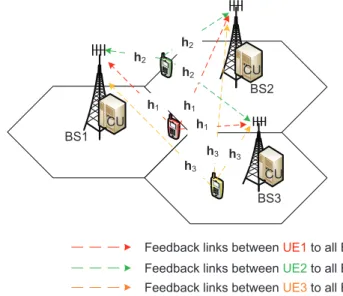
Semi-distributed architecture [22]: a CU is co-located at each BS. Each BS gathers
the CSI from the users belonging to its cell (local CSI), in a first step. Then, the full CSI is obtained at each BS by exchanging these local CSI between coordinated BSs via backhaul links. Therefore, the user scheduling and data transmission are performed in a distributed fashion at each BS. An illustration of a semi-distributed CoMP architecture is shown in Fig. 4.3.
Fully-distributed architecture [24]: a CU is co-located at each BS. Each user
broad-casts the CSI to all the coordinated BSs, see Fig. 4.4. This way, each BS gathers the full CSI without the need for any CSI exchange via backhaul links. Each BS performs CoMP transmission independently based on the received full CSI.
4.2
Cell Clustering
The cooperation area is limited by the feedback, backhaul, synchronization, and com-plexity constraints in a real system deployment. A CoMP-enabled network is typically divided into clusters of coordinated points so that CoMP transmission techniques can be independently implemented within each cluster. The cluster formation becomes an important issue that affects the cooperation performance.
There are various ways to divided the network into different cooperation clusters. Based on the cluster reconfiguration time scale, the cluster formation can be characterized into two categories:
4.2 Cell Clustering 21 UE1 UE2 UE3 BS1 BS2 BS3 Backhaul links CU Feedback links h2 h1 h3 h3 h1 h2 W(2,:) W(3,:) W(1,:)
Figure 4.2: An illustration of a centralized CoMP architecture with 3 BSs and 3 UEs. Here and in the following figures, we assume flat-fading channels withhi = [hi1, hi2, hi3]
denoting the channel vector between UEiand all three coordinated BSs, and BS
iis the serving cell of UE i. Based on the gathered full CSI, the CU designs the transmit precoding matrix, W, then distributes the ith row of W, i.e., W(i,:), to BSi. UE1 UE2 UE3 BS1 BS2 BS3 Backhaul links Feedback links h2 h1 h3 h3 h1 h2 CU CU CU h3 h1 h2
Figure 4.3: An illustration of a semi-distributed CoMP architecture with 3 BSs and 3 UEs. The transmit precoding weights are designed locally at each BS.
22 System Level Design
BS1
BS2
BS3
Feedback links between UE1to all BSs
h3 h1 h2 CU CU CU h3 h3 h1 h1 h2 h2
Feedback links between UE2to all BSs Feedback links between UE3 to all BSs
Figure 4.4: An illustration of a semi-distributed CoMP architecture with 3 BSs and 3 UEs. Each UEibroadcastshi to all BSs. The transmit precoding weights are designed
locally at each BS.
Static clustering, which specifies a predefined set of disjoint clusters of cells that do
not change in time [40, 41]. The static cluster formation is easily implementable, and it requires very limited inter-BS information exchange.
Dynamic clustering, where the clusters are formed based on the varying channel
conditions of the users [42, 43] or uneven traffic load of the system [44]. With higher flexibility, theoretically, the dynamic cluster formation can provide more co-operation gains compared to the static clustering approach. However, large amount of signaling information exchange between different BSs is needed for cluster recon-figuration decisions, which is infeasible in large networks. Examples of exchanged information can be traffic-distribution within different cells, downlink interference contribution from cell A to cell B, user channel conditions, etc.
Depending on where the cluster formation decision is made, cell clustering can also be classified as network-specific, user-specific or hybrid.
Network-specific clustering: disjoint clusters of cells are formed by the network
based on e.g., the dominating interference cells and/or the traffic-distribution within different cells, regardless of the channel condition of each individual user. Users belonging to the same cell are assigned to the same cluster. The cluster construction can be performed either in a static or a dynamic fashion. Static network-specific clustering can only mitigate the interference within the cluster. The performance is mainly limited by the inter-cluster interference, especially for the users located at the cluster edge area, referred as cluster edge effect. An example of network-specific dynamic clustering is shown in Fig. 4.5 where, in a certain time frame, cell 1 is grouped with cell 2 and cell 3 as a cluster; In the next time frame, according to the network traffic distribution cell 2 will be replaced by cell 4 to form a new cluster.
4.2 Cell Clustering 23 Cell1 Cell2 Cell3 Cell4 Cell1 Cell2 Cell3 Cell4
Figure 4.5:An example of dynamic network-specific clustering.
Cell1 Cell2 Cell3 Cell4 Cell1 Cell2 Cell3 Cell4 v1 v2 v1 UE2 v2 UE1
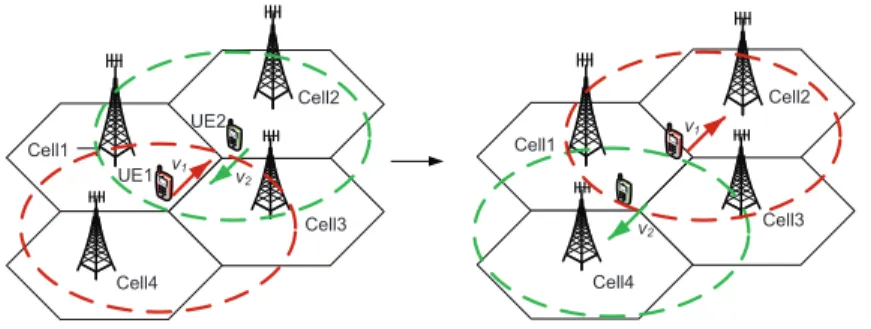
Figure 4.6: An example of user-specific clustering based on the slide Group Cell method.
User-specific clustering: each user selects a set of BSs that are suitable to form
a cluster. The clusters of different users may overlap. The construction of the cluster for each user can be semi-static or changed dynamically based on the channel conditions between the user and the BSs. This way, users are guaranteed to be always located at the cluster center to avoid the cluster edge effect. However, user-specific clustering requires joint scheduling across BSs, which increases the inter-BS information exchange as well as the resource allocation complexity. Fig. 4.6 illustrates a user-specific clustering method, named as slide Group Cell, proposed in [45]. In the current time slot, cells 1, 3 and 4 are selected by UE 1 as a CoMP cluster, while the cluster for UE 2 is formed by cells 1, 2 and 3. In the next time slot, with the possible move of UE 1 and UE 2, UE 1 will select cells 1, 2 and 3 as its cluster and UE 2 will choose cells 1, 3 and 4 to form a new cluster.
Hybrid clustering: the network pre-divides the whole system into several clusters.
Within each pre-defined cluster, each user selects a subset of cells from the cluster for CoMP transmission [17].
Chapter 5
Conclusions and Future Work
5.1
Contributions
This thesis aimed to develop efficient resource allocation algorithms and study the system level performance of realistic CoMP systems. To achieve this, a number of contribu-tions were introduced considering different levels of multi-BS cooperation. This section summarizes the contributions of this thesis, which can be divided into three categories: centralized resource allocation algorithm design, resource allocation under backhaul con-straints, and inter-cluster interference coordination. The main contributions are found in four included papers. Related contributions, which are not included in this thesis, are listed in Section 5.3.
5.1.1
Centralized Resource Allocation Algorithm Design
Assuming that all coordinated BSs are connected to a CU, different centralized resource allocation algorithms have been proposed.
Paper A: “Resource allocation for OFDMA systems with multi-cell joint trans-mission”
In this paper, we consider a a multi-cell multi-subchannel system with perfect CSI and data sharing between BSs. With the objective of maximizing the weighted sum rate under per-BS power constraints, joint optimization of user scheduling and power allocation is studied, considering zero-forcing coherent joint transmission. Based on dual decomposi-tion, the optimization problem is decomposed into a set of independent per-subchannel optimization subproblems in each iteration. Two iterative resource allocation algorithms are proposed and compared to the optimal solution, which requires an exhaustive search of all possible combinations of users over all subchannels. We show that the proposed algorithms achieve a solution close to the optimal with a lower complexity.
Paper B: “Power allocation for two-cell two-user joint transmission”
In this paper, we study a worst case scenario where the carrier phases between the BSs are un-synchronized so that joint transmission must be performed without precoding. A power allocation scheme is proposed for the downlink of a two-cell two-user joint transmis-sion system with the objective of maximizing the sum rate. The derived power allocation
26 Conclusions and Future Work
scheme is remarkably simple, i.e., each cell transmits with full power to only one user. In addition, we show that, in this scenario, the joint transmission case happens with higher probability when the two users are in the overlapped cell-edge area.
Related contributions
Multi-cell joint transmission can also be performed in a non-coherent way, which does not require joint beamforming between BSs. In this case, a joint user scheduling and power allocation algorithm was first proposed in [C1] focusing on a flat-fading channel, and then was extended to multi-subchannel scenarios in [C2]. In a communication system, different users may have different traffic patterns, resulting in diverse QoS requirement. Taking this into account, different utility based joint resource allocation algorithms have been proposed in [C3, C4, J1], considering mixed real-time voice over IP and best-effort services.
5.1.2
Resource Allocation under Backhaul Constraints
All CoMP techniques rely on information exchange between BSs through the backhaul network. The consequences of imperfect backhaul network for performing CoMP downlink transmission has been studied for different CoMP transmission schemes.
Paper C: “On the gains of CoMP under imperfect CSI and backhaul con-straints”
In this paper, we study the consequences of imperfect CSI and backhaul latency on dif-ferent CoMP transmission schemes. Three network architectures are characterized and compared: 1) a centralized architecture with a star-like backhaul topology, 2) a semi-distributed architecture with a mesh backhaul topology, and 3) a fully-semi-distributed archi-tecture without inter-connecting backhaul links. Different network archiarchi-tectures intro-duce different transmission latencies and feedback errors, resulting in imperfect CSIT. Particularly, the paper investigates two questions: 1) The effect of different network ar-chitectures on the performance of each CoMP transmission technique, considering both predicted CSI and outdated CSI. 2) The optimal transmission mode switching method for each considered CoMP architecture, and how is it affected by user mobility.
Related contributions
In the heterogeneous and future dense wireless networks, the backhaul links between different transmit nodes can be unreliable. In [C5], a backhauling model is introduced by assigning link failure probability to backhaul links. The performance of various CoMP schemes is investigated under unreliable backhaul. We show that the performance gains offered by CoMP quickly diminish, as the unreliability of the backhaul links grows. This work has been extended in [J2], where the impact of control channel reliability on CoMP is studied. Another constraint imposed by the backhaul network is backhaul capacity. This issue has been partly addressed in [C6] and [C7], where different backhaul load reduction schemes are proposed for zero-forcing joint transmission.
5.2 Future Work 27
5.1.3
Inter-Cluster Interference Coordination
Due to practical constraints, the use of CoMP techniques is restricted to a cluster with limited number of cells. Different frequency reuse schemes have been proposed to mitigate inter-cluster interference in order to reduce the cluster edge effect.
Paper D: “Resource allocation for clustered network MIMO OFDMA sys-tems”
In this paper, we assume that the whole system is statically divided into disjoint clusters of sectors. A two-step resource allocation scheme with inter-cluster interference mitigation and intra-cluster joint scheduling and power allocation has been proposed. The main task of managing the inter-cluster interference is accomplished by two fractional frequency reuse approaches, which restrict the available frequency resources for cluster-edge users in a cooperative way.
5.2
Future Work
The resource allocation algorithms proposed in the included papers, except Paper B, are based on the assumption of perfect CSIT. As shown in Paper C, imperfect CSIT due to feedback and backhaul constraints can significantly affect the performance gain provided by CoMP operation. In future heterogeneous and dense wireless networks, CoMP tech-niques will play a significant role for coordinating the transmit nodes to mitigate high ICI and guarantee high QoS. However, high-capacity and reliable feedback links are unlikely to be available due to the limited bandwidth and high ICI. Furthermore, the backhaul links interconnecting access nodes, e.g., macro BSs, relay nodes, or femto-cells, are highly likely to be wireless and unreliable. For future work, we will consider modeling the CoMP trans-mission problems by taking these new challenges into account. Distributed and robust resource allocation algorithms will be designed. In addition, fractional frequency reuse combined with interference pre-cancellation techniques will be considered for inter-cluster interference mitigation.
5.3
List of Related Publications
The related contributions, which are not included in this thesis, are listed below.
[C1] J. Li, T. Svensson, C. Botella, T. Eriksson, X. Xu, and X. Chen, “Joint scheduling and power control in coordinated multi-point clusters,” inProc. IEEE VTC’11, San Francisco, USA, Sept. 2011.
[C2] X. Chen, X. Xu,J. Li, T. Svensson, and H. Tian, “Optimal and efficient power allo-cation for OFDM non-coherent cooperative transmission,” inProc. IEEE WCNC’12, Paris, France, April 2012.
[C3] B. Huang,J. Li, and T. Svensson, “A utility-based scheduling approach for multiple services in coordinated multi-point networks,” in Proc. IEEE WPMC’11, Brest, France, Oct. 2011.
28 Conclusions and Future Work
[C4] B. Huang,J. Li, and T. Svensson, “Joint scheduling for multi-service in coordinated multi-point OFDMA networks,” in Proc. IEEE VTC’12, Yokohama, Japan, May 2011.
[J1] B. Huang, J. Li, and T. Svensson, “A utility-based joint resource allocation ap-proach for multi-service in CoMP networks,” Wireless Personal Communications, 2012, accepted.
[C5] Z. Mayer, J. Li, A. Papadogiannis, and T. Svensson,“On the Impact of Backhaul Channel Reliability on Cooperative Wireless Networks,” in Proc. IEEE ICC’13, submitted.
[J2] Z. Mayer,J. Li, A. Papadogiannis, and T. Svensson, “On the impact of control chan-nel reliability on coordinated multi-point systems,” to be submitted to EURASIP Journal on Wireless Communications and Networking, 2013.
[C6] T. R. Lakshmana, A. Papadogiannis, J. Li, and T. Svensson, “On the potential of broadcast CSI for opportunistic coordinated Multi-point transmission,” in Proc. IEEE PIMRC’12, Sydney, Australia, Sept. 2012.
[C7] T. R. Lakshmana,J. Li, C. Botella, A. Papadogiannis, and T. Svensson, “Schedul-ing for backhaul load reduction in CoMP,” in Proc. IEEE WCNC’13, Shanghai, China, April 2013, accepted.
[C8] J. Li, A. Papadogiannis, R. Apelfr¨ojd, T. Svensson, and M. Sternad, “Performance evaluation of coordinated multi-point transmission schemes with predicted CSI,” in
Proc. IEEE PIMRC’12, Sydney, Australia, Sept. 2012.
[C9] J. Li, B. Makki,T. Svensson, and T. Eriksson, “Power allocation for multi-point joint transmission with different node activeness,” inProc. IEEE WCNC’13, Shang-hai, China, April 2013, accepted.
[R1] EU FP7 INFSO-ICT-247223 ARTIST4G D1.4, “Interference avoidance techniques and system design,” July 2012. Available: https://ict-artist4g.eu/projet/deliverables.
Bibliography
[1] Ericsson, “Ericsson mobility report, on the pulse of the network society,” November 2012. Available: http://www.ericsson.com/res/docs/2012/ericsson-mobility-report-november-2012.pdf.
[2] J.G. Andrews, C. Wan and R.W. Heath, “Overcoming interference in spatial multi-plexing MIMO cellular networks,”IEEE Wireless Commun., vol. 14, no. 6, pp. 95-104, Dec. 2007.
[3] G. Boudreau, J. Panicker, N. Guo, R. Chang, N. Wang, and S. Vrzic, “Interference coordination and cancellation for 4G networks,” IEEE Commun. Mag. vol. 47, no.4, pp. 74-81, 2009.
[4] 3GPP TR 25.814 v7.1.0, “Physical layer aspects for evolved univeral terrestrial radio access (UTRA),” 2006.
[5] 3GPP TR 36.814 v9.0.0, “Further advancements for E-UTRA physical layer aspects,” 2010.
[6] M. Karakayali, G. Foschini, and R. Valenzuela, “Network coordination for spectrally efficient communications in cellular systems,”IEEE Trans. Wireless Commun.vol. 13, no. 4, pp. 56-61, Aug. 2006.
[7] D. Gesbert, S. Hanly, H. Huang, S. Shamai Shitz, O. Simeone, and W. Yu, “Multi-cell MIMO cooperative networks: a new look at interference,” IEEE J. Select. Areas Commun., vol. 28, pp. 1380-1408, 2010.
[8] H. Zhang and H. Dai, “Cochannel interference mitigation and cooperative processing in downlink multicell multiuser MIMO networks,” EURASIP J. Wireless Comm. and Netw., vol. 2004, no. 2, pp. 222-235, Dec. 2004.
[9] C. Botella, G. Pinero, A. Gonzalez, M. De Diego, “Coordination in a Cell Multi-Antenna Multi-User W-CDMA System: A Beamforming Approach,” IEEE Trans. Wireless Commun., vol. 7, no. 11, pp. 4479-4485, Nov. 2008.
[10] S.A. Ramprashad, H.C. Papadopoulos, A. Benjebbour, Y. Kishiyama, N. Jindal, and G. Caire, “Cooperative cellular networks using multi-user MIMO: trade-offs, overheads, and interference control across architectures,”IEEE Commun. Mag., vol. 49, no. 5, pp. 70-77, May 2011.
[11] C. Wan and J.G. Andrews, “Downlink performance and capacity of distributed an-tenna systems in a multicell environment,”IEEE Trans. Wireless Commun., vol. 6, no. 1, pp. 69-73, 2007.
30 Introduction
[12] X. Tao, X. Xu and Q. Cui, “An overview of cooperative communications,” IEEE Wireless Commun. Mag., pp. 65-171, June 2012.
[13] 3GPP TR 36.819 v11.1.0 “Coordinated multi-point operation for LTE physical layer aspects,” Dec. 2011.
[14] J. Li, A. Papadogiannis, R. Apelfr¨ojd, T. Svensson, M. Sternad, “Performance eval-uation of coordinated multi-point transmission schemes with predicted CSI,” inProc. IEEE PIMRC’12, Sept. 2012.
[15] A. Papadogiannis, H. J. Bang, D. Gesbert, and E. Hardouin, “Efficient selective feedback design for multicell cooperative networks,” IEEE Trans. Vehicular Techn., vol. 60, no. 1, pp. 196-205, Jan. 2011.
[16] R. Bhagavatula and R. W. Heath, “Adaptive limited feedback for sum-rate maxi-mizing beamforming in cooperative multicell systems,”IEEE Trans. Signal Processing, vol. 59, no. 2, pp. 800-811, Feb. 2011.
[17] EU FP7 INFSO-ICT-247223 ARTIST4G D1.4, “Interference avoidance techniques and system design,” July 2012. Available: https://ict-artist4g.eu/projet/deliverables. [18] O. Simeone, O. Somekh, H.V. Poor, and S. Shamai, “DownlinkMulticell Processing
with Limited-Backhaul Capacity,” EURASIP J. Advances in Signal Processing, vol. 2009, pp. 1-10, 2009.
[19] 3GPP R1-111174, Orange Telefnica, “Backhaul Modeling for CoMP,” Feb. 2011. [20] O. Simeone, O. Somekh, e. Erkip, H.V. Poor, and S. Shamai, “Robust communication
via decentralized processing with unreliable backhaul links,”IEEE Trans. Information Theory, vol. 57, no. 7, pp. 4087-4201, 2011.
[21] D. Lee, H. Seo, B. Clerckx, E. Hardouin, D. Mazzarese, S. Nagata, and K. Sayana, “Coordinated multipoint transmission and reception in LTE-advanced deployment: sce-narios and operational challenges,” IEEE Wireless Commun. Mag., vol. 50, no. 2, pp. 148-155, Feb. 2012.
[22] V. Jungnickel, T. Wirth, M. Schellmann, T. Haustein, and W. Zirwas, “Synchro-nization of cooperative base stations,” in Proc. IEEE ISWCS’08, pp. 329-334, Oct. 2008.
[23] R. Krishnan, M. R. Khanzadi, L. Svensson, T. Eriksson, and T. Svensson, “Varia-tional bayesian framework for receiver design in the presence of phase noise in MIMO systems,” in Proc. IEEE WCNC’12, 2012.
[24] A. Papadogiannis, E. Hardouin, and D. Gesbert, “Decentralising multicell cooper-ative processing: a novel robust framework,” EURASIP J. Wireless Commun. Netw., vol. 2009, pp. 1-10, Aug. 2009.
[25] R. Fritzsche and G. P Fettweis, “CSI distribution for joint processing in cooperative cellular networks,” in Proc. IEEE VTC’11, pp. 1-5, Sept. 2011.
References 31
[26] D.P. Palomar, and C. Mung, “A tutorial on decomposition methods for network utility maximization,” IEEE J. Select. Areas Commun., vol. 24, no. 8, pp. 1439-1451, Aug. 2006.
[27] W. Yu and R. Lui, “Dual methods for nonconvex spectrum optimization of multi-carrier systems,” IEEE Trans.Commun., vol. 54, no. 7, pp. 1310-1322, 2006.
[28] CVX Research, Inc. “CVX: Matlab software for disciplined convex programming, version 2.0 beta,” http://cvxr.com/cvx, September 2012.
[29] J. Lofberg, “YALMIP : a toolbox for modeling and optimization in MATLAB,”in
Proc. IEEE CACSD’04, Sept. 2004.
[30] A. Wiesel, Y.C. Eldar, and S. Shamai, “Linear precoding via conic optimization for fixed MIMO receivers,” IEEE Trans. Signal Processing, vol. 54, no. 1, pp. 161-176, 2006.
[31] W. Yu and T. Lan, “Transmitter optimization for the multi-antenna downlink with per-antenna power constraints,” IEEE Trans. Signal Processing, vol. 55, no. 6, pp. 2646-2660, June 2007.
[32] H. Dahrouj and W. Yu, “Coordinated beamforming for the multicell multi-antenna wireless system,” IEEE Trans. Wireless Commun., vol. 9, no. 5, pp. 1748-1759, May 2010.
[33] S. Boyd and L. Vandenberghe, “Convex Optimization”, Cambridge University Press, NY, USA, 2004.
[34] L. Venturino, N. Prasad, and X. Wang, “Coordinated linear beamforming in downlink multi-cell wireless networks,” IEEE Trans. Wireless Commun., vol. 9, no. 4, pp. 1451-1461, 2010.
[35] A. T¨olli, M. Codreanu, and M. Juntti, “Cooperative MIMO-OFDM cellular system with soft handover between distributed base station antennas,” IEEE Trans. Wireless Commun., vol. 7, no. 4, pp. 1428-1440, 2008.
[36] A. T¨olli, M. Codreanu, and M. Juntti, “Linear multiuser MIMO transceiver design with quality of service and per-sntenna power constraints,” IEEE Trans. Signal Pro-cessing, vol. 56, no. 7, pp. 3049-3055, July 2008.
[37] R. Zhang, “Cooperative multi-cell block diagonalization with per-base-station power constraints,” IEEE J. Select. Areas Commun., vol. 28, no. 9, pp. 1435-1445, 2010. [38] A. Garcia-Armada, M. Sanchez-Fernandez, and R. Corvaja, “Constrained power
allo-cation schemes for coordinated base station transmission using block diagonalization,”
EURASIP J.Wireless Commun. and Networking, 2011.
[39] F. Diehm, P. Marsch, and G. Fettweis, “The FUTON prototype: proof of concept for coordinated multi-point in conjunction with a novel integrated wireless/optical ar-chitecture,” inProc. IEEE WCNCW’12, pp. 1-4, April 2010.