The impact of employing the (Express -
Plan- Evaluate) Strategy in gaining some
mathematical skills and maintaining the
impact of learning among low achieving
sixth grade students
Abdel Kareem Mousa farrajallah
11 Mathematics and teaching method, Al –Aqsa University, Gaza Strip, Palestine
Correspondence: Abdel Kareem Mousa farrajallah, mathematics and education method department, Al Aqsa University, Gaza strip.
ABSTRACT:
This study aimed to investigate the impact of employing the (Express - Plan- Evaluate) Strategy in gaining some mathematical skills and maintaining the impact of learning among low achieving sixth grade students. To achieve the objectives of the study, the researcher used the quasi-experimental design, in which the study tool was a test for mathematical skills applied to a sample of 62 students, distributed evenly over two groups (experimental and control group), of which each group was made up of 31 students, where the experimental group were taught adopting the EPE strategy, while the control group was taught in the traditional way. The study resulted in organizing a list of mathematical skills necessary for low achieving sixth grade students; it also showed that there are statistical significant differences between the mean scores of the experimental group students and their peers in the control group in favor of the experimental group.
Key words:mathematic skills, express –plan –evaluate strategy.
Introduction:
Mathematics used to and is still playing an important role in all life aspects, for it is a science geared to serve the many applied fields in various sciences, such as humanitarian, political and economic sciences. Mathematics has gained great interest by scientists and thinkers, for it's characterized by both accuracy and rigidity, in which it has become an asylum for every human being looking for accuracy and reliability of thinking, and building information on a clear basis that is far from suspicion.
Those interested in mathematics seek for its development and for the modernization of its methods of teaching, in which the nature of this subject calls for the existence of many approaches that help to understand the interrelationships between facts, concepts and generalizations, thus increasing the effectiveness of teaching and learning methods.
However, teaching mathematics is still suffering from shortcomings inconsistent with its nature, in which teaching mathematics is still based on the lecturing and transmission of information by the teacher, and the reception, storage and memorization by the student, which makes it difficult to learn mathematics; and therefore resulting to students’ lack of interest in its study. The misery in learning and teaching mathematics is so large, as it’s an abstract subject that the student cannot acquire and retain in spite of the different ways and methods adopted in teaching, so students have a negative inclination towards it (Abu Lom, 2006).
In various studies, researchers sought to find out the reasons for the low achievement of students in mathematics, where the results varied to include the different teaching methods and strategies, the difficulty of the subject, and the lack of use of teaching aids, etc.. (Attiya, 2011).
Researchers are still conducting studies to investigate methods of teaching that are better and more effective in raising student achievement level, as well as to develop their tendencies toward mathematics, which has been observed to be negative among students. (Demjanovich, 2000).
teaching this material to students due to their use of traditional teaching methods, and to the lack of classroom interaction between the teacher and the student (Obaidat, 2005).
The results of the international study (TIMSS), which demonstrated the low level of achievement among students' in the Arab countries, including Palestine, verified the weakness of students in mathematics.
Mathematical skills are considered to be a primary goal of teaching mathematics; therefore, the low level of students in mastering basic mathematical skills, especially primary stage students, represents a major obstacle to their learning in subsequent grades, if they were not overcome in the primary stage. For this reason, many parents consider that educating students is all about gaining mathematical skills, and as their children are weak in such skills, they claim that the school and teachers are responsible for this weakness.
Therefore, the efforts of educators and researchers interested in the field of teaching and learning did not stop seeking treatment for the weaknesses of the basic mathematical skills, which may hinder the achievement of the desired educational goals, thus calling for the need to move from traditional teaching methods to more effective methods to be based on the needs and tendencies of the learner, as well as to help the teacher to deliver the educational material without the need for methods of lecturing and transmission of information.
The EPE strategy is considered to be an appropriate strategy to be adopted in teaching mathematical skills to low achieving students, by which it works on facilitating learning by identifying the needs of the learner in the subject of learning, and working to meet those needs through the preparation of various educational experiences, which are to be taught using various teaching methods that are appropriate to the nature of these experiences, where the learner see that going through these experiences correspond to their educational needs in the subject of learning (Habib, 2004: 13).
This strategy is directly based on determining the learning needs of each learner on the subject to be learned, allowing the student to self-express their own educational needs, selecting appropriate activities for those needs, and placing students in groups according to their needs (Afana and Jaish, 2008: 170).
The researcher believes that EPE strategy includes three main steps that depend on determining the educational needs of the learners in any subject to be learned by expressing their own needs, then selecting the appropriate activities for those needs, and finally placing students in small groups on the basis of similar educational needs and measure of their learning level.
The EPE strategy does not focus on one teaching method, but rather uses many different methods of teaching the different sciences, for example (problem solving, concept maps, discussions, learning cycle, cooperative learning strategies, and the Advance Organizers strategy). The teacher must choose the teaching method that is appropriate to students’ interests and style of thinking and that suits the experiences and activities that meet students’ educational needs, as well as with the nature of the concept to be learned (Abu Aazra, 2010).
The above mentioned confirms the necessity to make use of the EPE strategy to gain some mathematical skills and to maintain the impact of learning among low achievers in the sixth grade, as it makes it possible to provide the educational material in an exciting and stirring educational way, thus attracting students towards learning mathematical skills, and motivating their will to learn.
The researcher's sense of the problem of this study and the need for it has crystallized through the following indicators:
- The survey conducted by the researcher on 15 low achieving sixth grade students in mathematics, through running an interview, which showed that they have difficulty in learning mathematical skills.
- The results of some studies that showed difficulties in learning mathematics, as the teaching methods adopted in teaching are traditional and need to be renewed to suit students’ needs and the ongoing advancement in teaching methods.
- The complain of most math teachers that students have difficulties in understanding mathematical skills.
on memorization of information instead of understanding and thinking, which led to the students’ weakness and hatred to the course of mathematics.
In light of the foregoing, the current study arise as a scientific and practical attempt to study the impact of employing the (Express - Plan- Evaluate) Strategy on gaining some mathematical skills and maintaining the impact of learning among low grade sixth grade students.
The study problem:
The study aims to answer the following main question:
What is the impact of employing the (Express - Plan- Evaluate) Strategy on gaining some mathematical skills and maintaining the impact of learning among low achieving sixth grade students?
To answer this question, the following sub-questions have to be answered:
1. What mathematical skills are necessary for low achieving sixth grade students?
2. What is the impact of the employment of the EPE strategy on gaining some mathematical skills among low achieving sixth grade students?
3. What is the impact of the employment of the EPE strategy on maintaining the impact of learning among low achieving sixth grade students?
Study Hypotheses:
The study aims to verify the validity of the following hypothesis:
1. There are no significant statistical differences ( ≤ 0.05) between the mean scores of the experimental group students and their peers in the control group in the mathematical skills post-test.
2. There are no significant statistical differences ( ≤ 0.05) between the mean scores of the experimental group students and their peers in the control group in the delayed post-test of mathematical skills.
Objectives of the study:
The present study aims to achieve the following objectives:
- Determining some of the mathematical skills necessary for low achieving sixth grade students. - Determining the impact of the employment of the EPE strategy in gaining some mathematical
skills and maintaining the impact of learning among low achieving sixth grade students?
Significance of the study
The study is expected to contribute to the following
- Helping students to gain some mathematical skills, and to participate in an effective, useful and productive manner through the stages of the EPE Strategy. It can also help in the stabilization of information in students’ minds.
- Benefiting the teachers by giving them enough time to develop mathematical skills among low grade students through the use of the EPE Strategy
- It may be useful to educational supervisors in conducting training courses for teachers, in order to train them on using the EPE Strategy on a scientific basis and in accordance with its steps in teaching mathematics and developing mathematical skills and maintaining the impact of learning among students.
- The current study may open new avenues to the researchers to conduct future studies on the use of new strategies in the educational process in the different educational stages and varied educational material.
Limitations of the study:
This study is limited to the following:
- Objective limit: The study was limited to determining the impact of employing the (Express - Plan- Evaluate) Strategy in gaining some mathematical skills and maintaining the impact of learning among low achieving sixth grade students.
- Institutional Limit: UNRWA Schools.
- Spatial limit: Deir al-Balah Boys' UNRWA School (B)
- Human limit: a random sample of primary sixth-grade students.
Operational definitions of the study:
- Express, Plan, Evaluate Strategy (EPE): A strategy that has grown in the context of active and
collaborative learning and is based on determining the educational needs of learners in any subject to be learned, by self-expressing their own needs and planning for appropriate activities for meeting those needs; then the teacher divides the students into groups on the basis of the similarity of their educational needs, and measures the level of their learning through evaluation activities ; the strategy consists of three stages:
o Expressing needs (Express): identifying the student’s past experiences to build on them, as well as the diagnosis and treatment of students’ misconceptions, and identifying the information needed for the student to gain mathematical skills.
o Planning of Learning (Plan): This is a step shared by the teacher and the student, in which it is based on the student’s need and according to their experiences, taking into consideration students’ levels in mathematical skills.
o Evaluating the learner (Evaluate): In which the learner lists the questions that helped him in measuring what he learned and the goals which he has achieved.
- Mathematical skills: the mental conception drawn in the individual mind as a result of the
generalization of characteristics of similar things, and then understanding these things and being capable to apply it in new situations.
- Low Achievers in Mathematics: those students with an average score less than 50% in
mathematics final exam for the first semester of the academic year (2016/2017) according to the examination system of the United Nations Relief
Previous studies:
The present study referred to other relevant Arab and foreign studies to benefit from; these studies can be displayed in two axes, studies related to Constructivist learning, and studies related to the Express-Plan-Evaluate Strategy, where those studies are to be presented in descending order according to its date of application or publication:
First Axis : Studies related to Constructivist learning
Rizq, 2008: This study aimed at determining the impact of adopting the software that is based on
constructivist leaning on the achievement of the first grade students in Makkah. The study followed the semi-experimental approach that is based on the design of the two equal groups (the experimental and control groups), each consisting of 50 female students. The study tool was an achievement test, and the study reached a group of results, of which the most prominent are that there are significant differences between the experimental and the control group in the post-measurement of the achievement test in favor of the experimental group.
Moqat, 2007: This study aimed to identify the impact of a proposed program that is based on
constructivist learning on the achievement and the development of engineering thinking among students the basic eighth grade in Gaza governmental schools. This study followed the quasi-experimental approach that is based on the design of the two unequal groups, of which the experimental group consisted of (54) female student, while the control group consisted of (45) female students. The study tools were an achievement test and a test for engineering thinking.
The study results showed that there are significant statistical differences in both the achievement test and the geometric thinking test in favor of the experimental group.
Esra , 2007: This study aimed to identify the effect of the use of constructivist learning on the concepts
indicated in the calculus curriculum for mathematics teaching students. The study followed the semi-experimental approach that is based on the design of the two equal groups (the semi-experimental and control groups), each consisting of 60 students. A pre and post achievement test has been applied to the study sample, where the findings of the study showed that constructivist learning has made a positive contribution to the teaching of specific concepts of the experimental group.
Suk, 2005: a study that aimed to investigate the impact of using constructivist learning on academic
constructivist learning over the control group, which studied the traditional way in terms of academic achievement; it also showed that the constructivism doesn’t have a large influence on self-concept but have had some impact on Motivation.
Insook, 2004: A study designed to compare the constructive method and the traditional method of
reinforcing the concept of multiplication in the teaching of mathematics among the third grade students. The study followed the quasi-experimental approach that is based on the design of the two equal groups (the experimental and control groups), each consisting of 68 students, of which the study tool , an achievement test, has been applied on. The results showed the effectiveness of the constructive method on the experimental group, which led to the improvement of mathematical skills of students of the experimental group.
Second Axis: Studies related to the Express-Plan-Evaluate Strategy
Rehan, 2015: This study aimed to identify the impact of employing the Think-Pair-Share Strategy in
comparison with the Express-Plan-Share strategy on the development of mathematical thinking skills among ninth grade students in Gaza. The study followed the quasi-experimental approach that is based on the design of the two equal groups. The first experimental group adopts Think-Pair-Share Strategy in studying, while the second experimental group studied using the Express-Plan-Share strategy. The study sample consisted of (60) students, and the study tool is a mathematical thinking test. The study results showed that there are significant differences between the pre-test and the post-test in both groups in favor of the post test, and that are no differences between the first and second experimental groups.
Abu Azra, 2010: This study aimed at identifying the impact of using the Express-Plan-Share strategy in
teaching mathematics on the development of creative thinking among the seventh grade students in Gaza. The study followed the quasi-experimental approach that is based on the design of the two equal groups (the experimental and control groups), in which the study sample consisted of 140 student. The study tool used is a test for creative thinking. The study reached a number of results, of which the most important were that there are significant differences between the experimental group and the control in the post-measurement of the creative thinking test in favor of the experimental group.
Benson, 2005: The study aimed to identify the effectiveness of the Express-Plan-Share strategy in the
progress of achievement and creative thinking in mathematics among secondary school students. The study sample consisted of 90 secondary school students divided equally into two groups (the experimental and control group). The study tools included an achievement test and a creative thinking test. Results showed that students of the experimental group were superior to the students in the control group in the post-application of the achievement test and the creative thinking test.
Habib, 2004: This study aimed to identify the effect of using the Express-Plan-Share strategy on the
development of scientific research skills of the tenth grade students in the course of Physics. The study followed the quasi-experimental approach that is based on the design of the two unequal groups (the experimental group which reached 95 students and the control group which reached 91 students). The study tools consisted of a card for noting skills and selection of science processes skills, a scale of scientific trends, and a Physics achievement test. The study found a range of results, most notably is that there are significant differences between the experimental and control group in the post measurement for all study tools in favor of the experimental group.
General comment on previous studies:
Through the presentation of previous studies, the following points can be illustrated:
1. Previous studies related to constructivist learning focused on identifying its impact on achievement in the educational process, acquisition of mathematical concepts, development of geometric thinking, and achieving self-concept.
2. Previous studies related to the use of the Express-Plan-Share strategy focused on identifying its impact on achievement, development of creative thinking, and the development of scientific research skills, while the study Rehan (2015) has been distinguished as it studies the impact of the employment of the Think- Pair- Share Strategy in comparison to Express-Plan-Share strategy in developing mathematical thinking skills.
4. Of the most important findings of the Previous studies are the effectiveness of constructivist learning in raising the level of achievement, the realization of mathematical concepts, the development of engineering thinking, and the achievement of self-concept, as well as revealing the important role of the Express-Plan-Share strategy in raising academic achievement, developing creative thinking and mathematical thinking and scientific research skills.
5. The current study benefited from previous studies in the drafting of the study problem, establishing its theoretical framework, and preparation of study tools.
6. The current study is distinguished from other previous studies in which it’s a new study in the use of the EPE strategy in gaining mathematical skills and maintaining the impact of learning among low achieving sixth grade students
The study methodology and procedures:
First: Study Methodology
The researcher used the quasi-experimental approach that is based on two random groups (experimental and control group), by using the experimental design of the pre and post-test for two equal groups.
Second: Study population
Based on the statistics of the planning unit of the UNRWA in Gaza, the study population consisted of all low achieving sixth grade students, totaling (928) students, of which (508) are males and (420) are female students, during the second semester for the academic year (2016 - 2017).
Third: Study sample
The study sample consisted of two equal study groups, the experimental and the control group, which were chosen in a targeted way from all study groups from Deir Al Balah Boys UNRWA School (B), where each group consisted (31) students.
Fourth: Study Tools
1. List of Mathematical Skills, which has been prepared based on the following steps:
a. Identifying the purpose of preparing the list of mathematical skills necessary for low achieving sixth grade students.
b. Review of relevant researches and previous studies
c. Studying the results of some conferences and seminars that dealt with the mathematical skills required for the low achievers in the sixth grade
d. Survey of the opinion of a sample of specialists in education through personal interviews (Delphi method)
e. Reviewing the results of the standardized tests carried out by UNRWA at the end of each first semester of the academic years 2015/2016 and 2016/2017.
f. Benefiting from the researcher's experience in this field.
In light of the above, , the researcher prepared a list of the most important mathematical skills necessary for low achieving sixth grade students, which was then presented to a group of specialist in the field of curriculum and methods of teaching in Palestinian universities, and to mathematics supervisors and teachers of the sixth grade, as to check the appropriateness of the vocabulary used scientific and linguistically and the extent of necessity of these skills to low achieving sixth grade students ; suggested modifications were taken into consideration, in which some skills have been omitted, added, replaced and modified. In addition to that, the approval rate of the paragraphs of the list of mathematical skills needed for low achieving sixth grade students has been calculated using the following equation: Approval Rate :[N1 ÷. (N1+N2)] × 100%, where N1 = Number of Approvers and N2= Number of disapprovers.
of the study. Moreover, and to ensure that these skills are needed for low achievers in the sixth grade, the researcher prepared a diagnostic test for mathematical skills.
2. The test of mathematical skills, which has been prepared based on the following steps:
a. Identifying the purpose of the test: the test of mathematical skills aims to measure the impact of
the employment of the EPE Strategy on gaining some mathematical skills among low achieving sixth grade students.
b. Identifying mathematical skills: The researcher went through literary works and previous studies
discussing the issue of mathematical skills. He also analyzed the content of the Math book (Part II) assigned for grade six. The researcher also surveyed the opinions of a sample of specialists in education through personal interviews (Delphi method), where the researcher proposed a list of mathematical skills needed for low achieving sixth grade students, consisting of (44) skills.
c. The initial form of the test: The initial form of the test consisted of (46) multiple choice questions,
each with four choices.
d. Exploratory experimentation of the test: After the preparation of the initial test, it was applied on
an exploratory sample of (30) sixth-grade students outside the study sample, for the purpose of calculating the difficulty and discrimination indexes of the test paragraphs, testing the validity and reliability of the test, and determining how long it takes to answer the test when applied to the basic study sample.
e. Test Grading: test was graded after the sample answered its questions, in which the scores were
identified by giving one grade for each multiple choice question, in which that the grades were restricted between zero and 44.
f. Analysis of the paragraphs of the test: The results of students' answers on the test of
mathematical skills were analyzed in order to identify the degree of difficulty and discrimination index for each paragraph of the test, where the researcher found that the difficulty index for each paragraphs ranged from (0.27 - 0.57), which indicates graduated levels of difficulty. In addition to that, the discrimination index ranged from (0.30- 0.70) to distinguish between the responses of the upper and lower categories, where metrology accepts discrimination index when it reaches more than (0.20) (Kilani et al., 448: 2008). Based on the above, the researcher kept all of the test paragraphs.
g. Validity of the test of mathematical skills: The validity of the test was tested through presenting it
to a group of (8) specialized university teachers, and (7) educational supervisors to be guided from their views on the appropriateness of the paragraphs of the test to the sixth graders and to confirm the appropriateness of the vocabulary used scientific and linguistically; suggested modifications were taken into consideration.
The internal consistency of the test was ascertained using Pearson correlation between the scores of each paragraph of the test and the total score, in which the researcher found that all values of Pearson correlation are statistically significant at significance level (α = 0.01), which indicates that the test is strongly valid.
h. Reliability of the number sense skills test:To test the reliability of the test of number sense skills,
the researcher used Kuder–Richardson Formula 21 and found that the reliability coefficient is (0.962), which is highly reliable and statistically significant coefficient, which induces the researcher to apply the test on the study sample.
i. Determining the test duration: The time needed to answer the test of mathematical skills was
determined by calculating the mean duration it takes for the first and last student to finish the test; it was found to be (80 minutes).
j. The final form of the test of mathematical skills: Based on the results of the arbitration and
Fifth: Evenness of study groups:
The evenness of the experimental and control a group was assured in terms of: (mathematical skills pretest, students 'grades in mathematics, students' grades in all subjects, chronological age). Table (1) illustrates this as follows:
Significance Level Sig. Value T value Standard Deviation Mean Number Group Variable Statistically insignificant 0.759 0.309 3.192 4.516 31 Control mathematical skills
pretest Experimental 31 4.290 2.532
Statistically insignificant 0.690 0.401 2.369 38.290 31 Control students 'grades in
mathematics Experimental 31 38.032 2.689
Statistically insignificant 0.393 0.860 2.095 40.548 31 Control students' grades in
all subjects Experimental 31 40.032 2.601
Statistically insignificant 0.829 0.217 0.173 11.739 31 Control chronological age 3.192 4.516 31 Experimental
Limits of statistical significance at mean (α = 0.05) ,d.f. (60) and tabulated T-value is (2.00) Limits of statistical significance at mean (α = 0.01) ,d.f. (60) and tabulated T-value is (2.66)
It is clear from the above table that the calculated T-value equals (0.309, 0.401, 0.860, 0.217), respectively, which is less than the tabulated T-value (2.00), at the degree of freedom (6) and the level of statistical significance (α = 0.05); this indicates to insignificant statistical differences between the experimental and control group, and thus both groups are even.
Sixth: Steps of the study
The present study included the following steps:
1. Review of educational literature related to the present study, in order to learn how to prepare the study tools.
2. Preparation of the test of mathematical skills.
3. Application of tests on a small sample in order to determine the test duration, and to find the degree of easiness and difficulty, discrimination coefficient, and test the validity and reliability of the test. 4. Choose two classes randomly from Deir al-Balah Boys' School (b), in which one class was chosen as
the experimental group and the other as the control group.
5. Ensure evenness of the two groups in some variables that are expected to have an impact on the dependent variable in terms of: mathematical skills pretest, students' grades in mathematics, students' grades in all subjects, chronological age).
6. Teaching the unit to both the control and experimental groups according to the experimental design, so that the experimental group adopts the EPE strategy in learning, while the control group is taught using the traditional way.
7. At the end of the application of the experiment, the two tests were applied to detect the impact of using the EPE Strategy.
8. Test grading, data collection, analysis of the results of the study, and discussion.
9. Highlight the study recommendations in the light of its results, and then provide a set of proposals.
Seventh / statistical methods used:
The statistical Package for Social Sciences (SPSS) was used to perform the required analysis, in which the (T-test) for two independent samples was used to study the differences between the variables of the study, in addition to calculating the size of the impact of the employment of the Express-Plan-Evaluate Strategy through calculating ETA square (2(.
Results of the study (discussion and interpretation):
Based on the study questions and hypotheses, the following results were obtained:
Presenting and discussing the result of the first question:
What mathematical skills are necessary for low achieving sixth grade students?
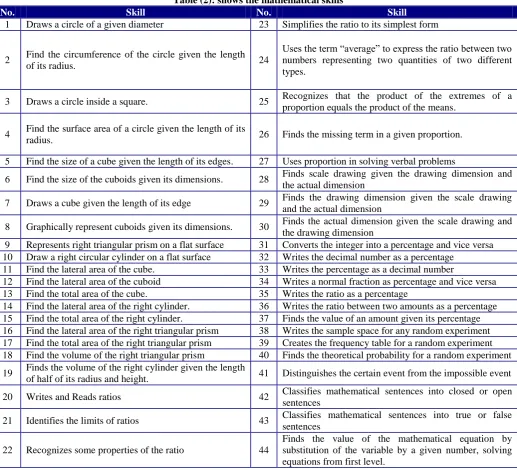
Table (2): shows the mathematical skills
Skill No.
Skill No.
Simplifies the ratio to its simplest form 23
Draws a circle of a given diameter 1
Uses the term “average” to express the ratio between two numbers representing two quantities of two different types.
24 Find the circumference of the circle given the length of its radius.
2
Recognizes that the product of the extremes of a proportion equals the product of the means.
25 Draws a circle inside a square.
3
Finds the missing term in a given proportion. 26
Find the surface area of a circle given the length of its radius.
4
Uses proportion in solving verbal problems 27
Find the size of a cube given the length of its edges. 5
Finds scale drawing given the drawing dimension and the actual dimension
28 Find the size of the cuboids given its dimensions.
6
Finds the drawing dimension given the scale drawing and the actual dimension
29 Draws a cube given the length of its edge
7
Finds the actual dimension given the scale drawing and the drawing dimension
30 Graphically represent cuboids given its dimensions.
8
Converts the integer into a percentage and vice versa 31
Represents right triangular prism on a flat surface 9
Writes the decimal number as a percentage 32
Draw a right circular cylinder on a flat surface 10
Writes the percentage as a decimal number 33
Find the lateral area of the cube. 11
Writes a normal fraction as percentage and vice versa 34
Find the lateral area of the cuboid 12
Writes the ratio as a percentage 35
Find the total area of the cube. 13
Writes the ratio between two amounts as a percentage 36
Find the lateral area of the right cylinder. 14
Finds the value of an amount given its percentage 37
Find the total area of the right cylinder. 15
Writes the sample space for any random experiment 38
Find the lateral area of the right triangular prism 16
Creates the frequency table for a random experiment 39
Find the total area of the right triangular prism 17
Finds the theoretical probability for a random experiment 40
Find the volume of the right triangular prism 18
Distinguishes the certain event from the impossible event 41
Finds the volume of the right cylinder given the length of half of its radius and height.
19
Classifies mathematical sentences into closed or open sentences
42 Writes and Reads ratios
20
Classifies mathematical sentences into true or false sentences
43 Identifies the limits of ratios
21
Finds the value of the mathematical equation by substitution of the variable by a given number, solving equations from first level.
44 Recognizes some properties of the ratio
22
In light of the above results, the researcher answers the first question of the study, by which the list of mathematical skills has been prepared with its final form consisting of (44) mathematical skill.
Presenting and discussing the result of the second question:
What is the impact of the employment of the EPE strategy on gaining some mathematical skills among low achieving sixth grade students?
To answer this question, the first hypothesis of the study was formulated, stating that there are no significant statistical differences ( ≤ 0.05) between the mean scores of the experimental group students and their peers in the control group in the mathematical skills post-test.To test this hypothesis, T-test was used for two independent samples; the results were as illustrated in table (3)
Table (3) shows the results of T-test to compare the mean scores of the experimental group students and their peers in the control group in the mathematical skills post-test
p-value Sig Calculated T-Value Std. deviation Mean Number Group
Limits of statistical significance begin at the level (α = 0.05), d.f. (60) when the tabulated T-value is (2.00)
Limits of statistical significance begin at the level (α = 0.01), d.f. (60) when the tabulated T-value is (2.66)
It is clear from the above table that the calculated T-value equal to (17.288), which is greater than the tabulated T-value (2.66), at the degree of freedom (60) and the level of statistical significance (α = 0.01); this indicates to the existence of significant statistical differences between the mean scores of the experimental group and their peers in the control group in the mathematical skills post-test; these differences were in favor of the experimental group. This result is consistent with several previous studies, such as the study of Rehan (2015), Abu Azra (2010), Benson (2005) and Habib (2004).
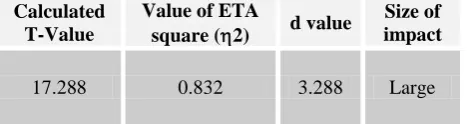
Regarding the size of the impact of the employment of EPE Strategy on gaining mathematical skills among primary sixth-graders, ETA square (2) was calculated to make sure that the size of the T-test resulting differences are real differences caused due to the study variables, and are not coincidental. The following table illustrates this :
Table (4) shows the size of the impact of the t-test of the differences between students of the experimental and control groups
Size of impact d value
Value of ETA square (2) Calculated
T-Value
Large 3.288
0.832 17.288
It is clear from the above table that the value of ETA square equals to (0.832), which indicates a large impact ,where (Afana, 2000: 42) indicates that the size of impact is considered large if the value of ETA square is greater than or equal to (0.14), as is the size of the impact is considered supplementary to the statistical significance , and does not replace it. The success of EPE Strategy in gaining mathematical skills among primary sixth-graders may be due to the following reasons:
- EPE strategy seeks to provide an opportunity for students for collaborative work, allowing them to participate effectively in classroom discussions, explore information and data and to apply them in new situations.
- Employing the EPE strategy turns the classroom into a scientific and cultural and entertainment field endeared to the students’ souls, by which the information is passed to the students’ in an interesting and attractive image; thus facilitating absorption and understanding and development of mathematical skills, such that the students listen and watch and interact with all senses, which stabilizes the proposed science.
- The flexibility of the EPE strategy in teaching, which accommodate a range of effective methods, tools and educational activities in an interesting context, where all these elements combine to achieve the desired goals of teaching.
- The EPE Strategy helps to increase the students’ attention, as it supplies them with continuous motivation.
- The use of the experimental group students of the EPE strategy and their practice of individual thinking in the first step, then the sharing of ideas and information between every pair of students in the second step, and group discussions in the third and final step while teaching the mathematical unit has helped create effective learning, playing an active positive role in the skills of thinking generally, and the ability to express and explain ideas and particularly.
- Providing proper reinforcement for each response from the students’ responses during practical experience.
- Introducing a variety of activities that seeks to increase active learning and collaborative interaction between students in the classroom environment.
- Providing a cooperative learning environment free of fear and risk, where students share discussions with each other’s and test their ideas before taking risk in front of the whole class.
- Makes the classroom vital through pair works, in which each pair of students work together and share their ideas and comments with the rest of the classroom, which meets the students’ need for social communication and the freedom to express their ideas and opinions.
- Creates a healthy and vibrant environment, which helps brings joy to the mathematics study. - Provides an opportunity for students to learn from their mistakes in an atmosphere tainted by threat. - This strategy produces working students, making them think and discuss what they are learning,
- Gives students the opportunity to write their ideas and solutions in cards, which are then collected and examined by the teacher, giving him a chance to see to what extent could the students absorb the information and data and if they have any difficulties in understanding.
Presenting and discussing the result of the third question:
What is the impact of the employment of the EPE strategy on maintaining the impact of learning among low achieving sixth grade students?
To answer this question, the second hypothesis of the study was formulated, stating that There are no significant statistical differences ( ≤ 0.05) between the mean scores of the experimental group students and their peers in the control group in the delayed post-test of mathematical skills.To test this hypothesis, T-test was used for two independent samples; the results were as illustrated in table (6)
Table (5) shows the results of T-test to compare the mean scores of the experimental group students and their peers in the control group in the delayed post-test of mathematical skills
p-value Sig
Calculated T-Value Std.
deviation Mean
Number Group
Sig at 0.01 0.00
-18.368 4.682
19.419 31
Control
3.405 38.516
31 Experimental
Limits of statistical significance begin at the level (α = 0.05), d.f. (76) when the tabulated T-value is (2.00)
Limits of statistical significance begin at the level (α = 0.01), d.f. (76) when the tabulated T-value is (2.66)
It is clear from the above table that the calculated T-value equal to (18.368), which is greater than the tabulated T-value (2.66), at the degree of freedom (76) and the level of statistical significance (α = 0.01); this indicates to the existence of significant statistical differences between the mean scores of the experimental group and their peers in the control group in the mathematical skills delayed post-test; these differences were in favor of the experimental group. This result is consistent with several previous studies, such as the study of Zoubi (2012), Khatib (2011), and Whitacre & Nickerson, (2006).
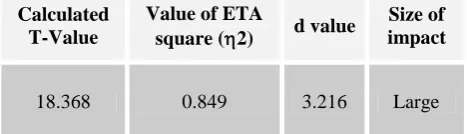
Regarding the size of the impact of the employment of EPE Strategy on gaining mathematical skills among primary sixth-graders, ETA square (2) was calculated to make sure that the size of the T-test resulting differences are real differences caused due to the study variables, and are not coincidental. The following table illustrates this :
Table (6) shows the size of the impact of the t-test of the differences between students of the experimental and control groups in the delayed post-test of mathematical skills
Size of impact d value
Value of ETA square (2) Calculated
T-Value
Large 3.216
0.849 18.368
It is clear from the above table that the value of ETA square equals to (0.849), which indicates a large impact ,where (Afana, 2000: 42) indicates that the size of impact is considered large if the value of ETA square is greater than or equal to (0.14), as is the size of the impact is considered supplementary to the statistical significance , and does not replace it. The success of EPE Strategy in gaining mathematical skills among primary sixth-graders may be due to the following reasons:
- Introducing a variety of activities that seeks to increase active learning and collaborative interaction between students in the classroom environment.
- Providing a cooperative learning environment free of fear and risk, where students share discussions with each others and test their ideas before taking risk in front of the whole class.
- EPE Strategy has provided an opportunity for each student to be heard from a colleague, where the researcher noted the solidarity of the one group even after the end of the experiment, which establishes the concept of cooperation between students and which consolidates affection and harmony among students of one group, which helps to develop mathematical skills.
- The teaching method that uses the EPE strategy makes learning more influential than others, stimulating the learner to learn, and make them alert and conscious of everything going on around them in the classroom.
- the nature of the EPE strategy gives students an opportunity to ask questions, discuss and exchange ideas, give and receive assistance, explore situations, search for patterns and relationships in the collection of data and the freely formulate and choose assumptions.
- Works on promoting personal contact and understanding the language of mathematics through students’ discussions with each other.
- Provides students with the opportunity to learn different ways and methods to solve the same problem and the ability to reach mathematical relationships.
Study Recommendations:
In light of the findings of the study results, the following recommendations can be provided:
- The need for those responsible for the development of mathematics curricula for the basic stage to focus on preparing activities and exercises that enable students to exercise mathematical skills of and not just be limited only pardoned activities and exercises that focus on conservation and memorization of mathematical information and knowledge.
- The need for the training of mathematics teachers in the various stages of education to promote student’ independence and self-reliance in the process of data collection and other tasks and homework assigned to them, such as to be discussed according to the EPE strategy.
- The introduction of the learning concepts which are centered on the student and active learning and its different strategies, such as EPE strategy and other strategies in the programs of preparing teacher students in education colleges.
- The need to include in the assessment programs the measure of students’ ability to learn and gain mathematical skills, along with the measurement of cognitive skills and emotional abilities.
- That the teacher guide prepared by the Ministry of Education for math book, to include models for how to present some lessons using EPE strategy for the development of mathematical skills.
- Conducting studies on the use of EPE Strategy to teach various subjects of study in a variety of levels, and its impact on some of the different learning outcomes.
References:
First: Arabic references:
1) Habib, Ayman (2004). The impact of the use of Express-Plan-Evaluate strategy on developing the skills of scientific research among tenth grade students in physics. The Eighth Scientific Conference, The Missing Dimensions in Science Curricula in the Arab World (July 25-28), Ismailia, vol. 1, part one, pp. 7 - 72.
2) Rizq, Hanan (2008). The Effect of Using Constructivist Learning in Mathematics Software on the Achievement of Seventh Grade Students in Makkah City, Unpublished PhD Thesis, Faculty of Education, Umm Al Qura University, Saudi Arabia.
3) Makat, Saadia (2007). The Impact of a Proposed Program in Constructivist Learning on the achievement and the development of thinking in Geometry for the eighth grade students, Gaza province. Unpublished MA Thesis, Al-Azhar University-Gaza.
4) Abu Azra, Karam (2010). The impact of employing the Express-Plan-Evaluate strategy in the teaching of mathematics on the development of creative thinking among seventh graders in Gaza. Master Thesis, Department of Curriculum and Teaching Methods of Mathematics, Islamic University, Gaza.
5) Abu Loam, Khalid (2006). Teaching fractions using cooperative mathematical games and competitions and its impact on the achievement of fourth grade students and their tendency towards mathematics, Journal of the Faculty of Education, Ain Shams University, Issue 30, Part IV.
6) Attiya, Ali (2011). The effectiveness of a proposed program by using educational games on gaining some geographical concepts among kindergarten children, Journal of the Educational Association for Social Studies - Egypt, No. 37, pp. 186-230.
7) Afana, Izzo (2000). The size of impact and its uses in the detection of the credibility of the results in educational and psychological research, Palestinian educational research and studies magazine, Palestinian Association for research and educational studies (3 . (
8) Kilani, Zaid; Al-Taqi, Ahmed, Adas, Abdul Rahman (2009). Measurement and Evaluation in Teaching and Learning, United Arab Company for marketing and procurement, pp.447 to 448.
10) Obeidat, Louay Taleb Mefleh (2005). The impact of the use of computerized educational games on the acquisition of some mathematical concepts of the third grade students in the first Directorate of Irbid. Unpublished Master's thesis, Hashemite University, Zarqa, Jordan.
11) Afana, Izzo and Al-Jaish and Yosuf (2008). Teaching and learning with the two-sided brain, ed. 1, Islamic University, Meqdad Printing house, Gaza.
Second: Foreign References
12) Tarzimah Tambychika, Thamby Subahan, Mohd Meerah (2010). Students’ Difficulties in Mathematics Problem-Solving: What do they Say? International Conference on Mathematics Education Research, Procedia Social and Behavioral Sciences 8, 142–151.
13) Benson, M.(20Q5), The effectiveness of (express - plan- evaluate) strategy in developing achievement and creative Thinking^ in mathematics for secondary school, Journal of Education Technology Research and Development, V.45, 51-64.
14) Esra, Bukoya (2007) : The Effect of a Constructivist Learning Environment on the Limit Concept among Mathematics Student Teachers , Eric{ 796231}.
15) Insook,chung(2004) : A Comparative Assessment of Constructivist and Traditionalist Approaches to Establishing Mathematical Connections in Learning Multiplication ,Eric{698724} .
16) Demjanovich, M. L.(2000). No table number, Teaching children mathematics, 6(8), PP: 504-505