Financial time series forecasting using support
vector machines
Kyoung-jae Kim
∗Department of Information Systems, College of Business Administration, Dongguk University, 3-26, Pil-dong, Chung-gu, Seoul 100715, South Korea
Received 28 February 2002; accepted 13 March2003 Abstract
Support vector machines (SVMs) are promising methods for the prediction of -nancial time-series because they use a risk function consisting of the empirical error and a regularized term which is derived from the structural risk minimization principle. This study applies SVM to predicting the stock price index. In addition, this study examines the feasibility of applying SVM in -nancial forecasting by comparing it withback-propagation neural networks and case-based reasoning. The experimental results show that SVM provides a promising alternative to stock market prediction.
c
2003 Elsevier B.V. All rights reserved.
Keywords:Support vector machines; Back-propagation neural networks; Case-based reasoning; Financial time series
1. Introduction
Stock market prediction is regarded as a challenging task of -nancial time-series prediction. There have been many studies using arti-cial neural networks (ANNs) in this area. A large number of successful applications have shown that ANN can be a very useful tool for time-series modeling and forecasting [24]. The early days of these studies focused on application of ANNs to stock market prediction (for instance [2,6,11,13,19,23]). Recent researchtends to hybridize several arti-cial intelligence (AI) techniques (for instance [10,22]). Some researchers tend to include novel factors in the learning process. Kohara et al. [14] incorporated prior knowledge to improve the
∗Tel: +82-2-2260-3324; fax: +82-2-2260-8824. E-mail address:[email protected](K.-j. Kim).
0925-2312/03/$ - see front matter c2003 Elsevier B.V. All rights reserved. doi:10.1016/S0925-2312(03)00372-2
performance of stock market prediction. Tsaihet al. [20] integrated the rule-based technique and ANN to predict the direction of the S& P 500 stock index futures on a daily basis.
Quahand Srinivasan [17] proposed an ANN stock selection system to select stocks that are top performers from the market and to avoid selecting under performers. They concluded that the portfolio of the proposed model outperformed the portfolios of the benchmark model in terms of compounded actual returns overtime. Kim and Han [12] proposed a genetic algorithms approach to feature discretization and the determina-tion of connecdetermina-tion weights for ANN to predict the stock price index. They suggested that their approach reduced the dimensionality of the feature space and enhanced the prediction performance.
Some of these studies, however, showed that ANN had some limitations in learning the patterns because stock market data has tremendous noise and complex dimensional-ity. ANN often exhibits inconsistent and unpredictable performance on noisy data. How-ever, back-propagation (BP) neural network, the most popular neural network model, suEers from diFculty in selecting a large number of controlling parameters which include relevant input variables, hidden layer size, learning rate, momentum term.
Recently, a support vector machine (SVM), a novel neural network algorithm, was developed by Vapnik and his colleagues [21]. Many traditional neural network models had implemented theempirical risk minimization principle, SVM implements the struc-tural risk minimization principle. The former seeks to minimize the mis-classi-cation error or deviation from correct solution of the training data but the latter searches to minimize an upper bound of generalization error. In addition, the solution of SVM may be global optimum while other neural network models may tend to fall into a local optimal solution. Thus, over-tting is unlikely to occur with SVM.
This paper applies SVM to predicting stock price index. In addition, this paper examines the feasibility of applying SVM in -nancial forecasting by comparing it with ANN and case-based reasoning (CBR).
This paper consists of -ve sections. Section 2 introduces the basic concept of SVM and their applications in -nance. Section3 proposes a SVM approachto the prediction of stock price index. Section 4 describes researchdesign and experiments. In Section
4, empirical results are summarized and discussed. Section 5 presents the conclusions and limitations of this study.
2. SVMs and their applications in nance
The following presents some basic concepts of SVM theory as described by prior research. A detailed explanation may be found in the references in this paper.
2.1. Basic concepts
SVM uses linear model to implement nonlinear class boundaries through some non-linear mapping the input vectors x into the high-dimensional feature space. A linear model constructed in the new space can represent a nonlinear decision boundary in
the original space. In the new space, an optimal separating hyperplane is constructed. Thus, SVM is known as the algorithm that -nds a special kind of linear model, the
maximum margin hyperplane. The maximum margin hyperplane gives the maximum separation between the decision classes. The training examples that are closest to the maximum margin hyperplane are called support vectors. All other training examples are irrelevant for de-ning the binary class boundaries.
For the linearly separable case, a hyperplane separating the binary decision classes in the three-attribute case can be represented as the following equation:
y=w0+w1x1+w2x2+w3x3; (1)
where y is the outcome, xi are the attribute values, and there are four weights wi to
be learned by the learning algorithm. In Eq. (1), the weights wi are parameters that
determine the hyperplane. The maximum margin hyperplane can be represented as the following equation in terms of the support vectors:
y=b+iyix(i)·x; (2)
whereyi is the class value of training example x(i),· represents the dot product. The
vector x represents a test example and the vectors x(i) are the support vectors. In this equation, b andi are parameters that determine the hyperplane. From the
implemen-tation point of view, -nding the support vectors and determining the parametersb and
i are equivalent to solving a linearly constrained quadratic programming (QP).
As mentioned above, SVM constructs linear model to implement nonlinear class boundaries through the transforming the inputs into the high-dimensional feature space. For the nonlinearly separable case, a high-dimensional version of Eq. (2) is simply represented as follows:
y=b+iyiK(x(i);x): (3)
The function K(x(i);x) is de-ned as the kernel function. There are some diEerent kernels for generating the inner products to construct machines with diEerent types of nonlinear decision surfaces in the input space. Choosing among diEerent kernels the model that minimizes the estimate, one chooses the best model. Common examples of the kernel function are the polynomial kernelK(x; y)=(xy+1)dand the Gaussian radial
basis function K(x; y) = exp(−1=2(x−y)2) where d is the degree of the polynomial
kernel and 2 is the bandwidth of the Gaussian radial basis function kernel.
For the separable case, there is a lower bound 0 on the coeFcient i in Eq. (3). For the non-separable case, SVM can be generalized by placing an upper bound C on the coeFcients i in addition to the lower bound [22].
2.2. Prior applications of SVM in 6nancial time-series forecasting
As mentioned above, the BP network has been widely used in the area of -nancial time series forecasting because of its broad applicability to many business problems and preeminent learning ability. However, the BP network has many disadvantages including the need for the determination of the value of controlling parameters and the number of processing elements in the layer, and the danger of over-tting problem.
On the other hand, there are no parameters to tune except the upper bound C for the non-separable cases in linear SVM [8]. In addition, over-tting is unlikely to occur with SVM. Over-tting may be caused by too muchJexibility in the decision boundary. But, the maximum hyperplane is relatively stable and gives little Jexibility [22].
Although SVM has the above advantages, there is few studies for the application of SVM in -nancial time-series forecasting. Mukherjee et al. [15] showed the ap-plicability of SVM to time-series forecasting. Recently, Tay and Cao [18] examined the predictability of -nancial time-series including -ve time series data with SVMs. They showed that SVMs outperformed the BP networks on the criteria of normalized mean square error, mean absolute error, directional symmetry and weighted directional symmetry. They estimated the future value using the theory of SVM in regression approximation.
3. Research data and experiments
3.1. Researchdata
The research data used in this study is technical indicators and the direction of change in the daily Korea composite stock price index (KOSPI). Since we attempt to forecast the direction of daily price change in the stock price index, technical indicators are used as input variables. This study selects 12 technical indicators to make up the initial attributes, as determined by the review of domain experts and prior research [12]. The descriptions of initially selected attributes are presented in Table 1.
Table 2 presents the summary statistics for each attribute.
This study is to predict the directions of daily change of the stock price index. They are categorized as “0” or “1” in the research data. “0” means that the next day’s index is lower than today’s index, and “1” means that the next day’s index is higher than today’s index. The total number of sample is 2928 trading days, from January 1989 to December 1998. About 20% of the data is used for holdout and 80% for training. The number of the training data is 2347 and that of the holdout data is 581. The holdout data is used to test results with the data that is not utilized to develop the model.
The original data are scaled into the range of [−1:0;1:0]. The goal of linear scaling is to independently normalize eachfeature component to the speci-ed range. It ensures the larger value input attributes do not overwhelm smaller value inputs, then helps to reduce prediction errors.
The prediction performance P is evaluated using the following equation:
P= 1 m m i=1 Ri (i= 1;2; : : : ; m) (4)
whereRi the prediction result for the ithtrading day is de-ned by Ri=
1 if POi=AOi;
Table 1
Initially selected features and their formulas
Feature name Description Formula Refs.
%K Stochastic %K. It compares where a security’s price closed relative to its price range over a given time period.
Ct−LLt−n
HHt−n−LLt−n×100, whereLLtandHHt mean lowest low and highest high in the lastt days, respectively.
[1]
%D Stochastic %D. Moving average of %K.
n−1 i=0 %Kt−i
n [1]
Slow %D Stochastic slow %D. Moving av-erage of %D.
n−1
i=0 %Dt−i
n [9]
Momentum It measures the amount that a se-curity’s price has changed over a given time span.
Ct−Ct−4 [3]
ROC Price rate-of-change. It displays the diEerence between the cur-rent price and the price n days ago.
Ct
Ct−n ×100 [16]
Williams’ %R Larry William’s %R. It is a mo-mentum indicator that measures overbought/oversold levels.
Hn−Ct
Hn−Ln ×100 [1] A/D Oscillator Accumulation/distribution
oscil-lator. It is a momentum indicator that associates changes in price.
Ht−Ct−1
Ht−Lt [3]
Disparity5 5-day disparity. It means the dis-tance of current price and the moving average of 5 days.
Ct
MA5 ×100 [5]
Disparity10 10-day disparity. Ct
MA10×100 [5]
OSCP Price oscillator. It displays the diEerence between two moving averages of a security’s price.
MA5−MA10
MA5 [1]
CCI Commodity channel index. It measures the variation of a se-curity’s price from its statistical mean. (Mt−SMt) (0:015Dt) whereMt= (Ht+Lt+Ct)=3; SMt= n i=1Mt−i+1 n , and Dt= n i=1 |Mt−i+1−SMt| n . [1,3]
RSI Relative strengthindex. It is a price following an oscillator that ranges from 0 to 100.
100− 100
1 + (n−1
i=0 Upt−i=n)=(n−i=01 Dwt−i=n)
where Upt means upward-price-change and Dwt means downward-price-change at timet.
[1]
Ct is the closing price at time t,Lt the low price at time t,Ht the high price at timet and, MAt the moving average oft days.
Table 2
Summary statistics
Feature name Max Min Mean Standard deviation
%K 100.007 0.000 45.407 33.637 %D 100.000 0.000 45.409 28.518 Slow %D 99.370 0.423 45.397 26.505 Momentum 102.900 −108.780 −0.458 21.317 ROC 119.337 81.992 99.994 3.449 Williams’ %R 100.000 −0.107 54.593 33.637 A/D Oscillator 3.730 −0.157 0.447 0.334 Disparity5 110.003 90.077 99.974 1.866 Disparity10 115.682 87.959 99.949 2.682 OSCP 5.975 −7.461 −0.052 1.330 CCI 226.273 −221.448 −5.945 80.731 RSI 100.000 0.000 47.598 29.531
POi is the predicted output from the model for the ithtrading day, and AOi is the
actual output for theithtrading day, m is the number of the test examples.
3.2. SVM
In this study, the polynomial kernel and the Gaussian radial basis function are used as the kernel function of SVM. Tay and Cao [18] showed that the upper bound C and the kernel parameter2 play an important role in the performance of SVMs. Improper selection of these two parameters can cause the over-tting or the under-tting problems. Since there is few general guidance to determine the parameters of SVM, this study varies the parameters to select optimal values for the best prediction performance. This study uses LIBSVM software system [4] to perform experiments.
3.3. BP
In this study, standard three-layer BP networks and CBR are used as benchmarks. This study varies the number of nodes in the hidden layer and stopping criteria for training. In this study, 6, 12, 24 hidden nodes for each stopping criteria because the BP network does not have a general rule for determining the optimal number of hidden nodes. For the stopping criteria of BP, this study allows 50, 100, 200 learning epochs per one training example since there is little general knowledge for selecting the number of epochs. Thus, this study uses 146 400, 292 800, 565 600 learning epochs for the stopping criteria of BP because this study uses 2928 examples. The learning rate is 0.1 and the momentum term is 0.1. The hidden nodes use the sigmoid transfer function and the output node uses the linear transfer function. This study allows 12 input nodes because 12 input variables are employed.
3.4. CBR
For CBR, the nearest-neighbor method is used to retrieve relevant cases. This method is a popular retrieval method because it can be easily applied to numeric data such as -nancial data. This study varies the number of nearest neighbor from 1 to 5. An eval-uation function of the nearest-neighbor method is Euclidean distance and the function is represented as follows: DIR= n i=1 wi(fiI−fiR)2; (5)
whereDIR is a distance betweenfIi andfRi, fIi andfiR are the values for attribute fi
in the input and retrieved cases,nis the number of attributes, and wi is the importance
weighting of the attribute fi. 4. Experimental results
One of the advantages of linear SVM is that there is no parameter to tune except the constantC. But the upper boundC on the coeFcienti aEects prediction performance
for the cases where the training data is not separable by a linear SVM [8]. For the nonlinear SVM, there is an additional parameter, the kernel parameter, to tune. First, this study uses two kernel functions including the Gaussian radial basis function and the polynomial function. The polynomial function, however, takes a longer time in the training of SVM and provides worse results than the Gaussian radial basis function in preliminary test. Thus, this study uses the Gaussian radial basis function as the kernel function of SVMs.
This study compares the prediction performance with respect to various kernel pa-rameters and constants. According to Tay and Cao [18], an appropriate range for 2 was between 1 and 100. In addition, they proposed that an appropriate range for C
was between 10 and 100. Table 3 presents the prediction performance of SVMs with various parameters.
In Table 3, the best prediction performance of the holdout data is recorded when
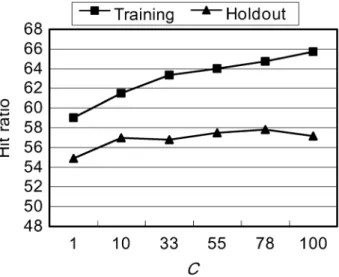
2 is 25 and C is 78. The range of the prediction performance is between 50.0861% and 57.8313%. Fig. 1 gives the results of SVMs with various C where 2 is -xed at 25.
Tay and Cao [18] suggested that too small a value forC caused under--t the training data while too large a value of C caused over--t the training data. It can be observed that the prediction performance on the training data increases withC in this study. The prediction performance on the holdout data increases when C increases from 1 to 78 but decreases when C is 100. The results partly support the conclusions of Tay and Cao [18].
Fig. 2 presents the results of SVMs with various 2 whereC is chosen as 78. According to Tay and Cao [18], a small value of2 would over--t the training data while a large value of2 would under--t the training data. The prediction performance
Table 3
The prediction performance of various parameters in SVMs
C Training data Holdout data
Number of hit/total number Hit ratio Number of hit/total number Hit ratio (a)2= 1 1 1358/1637 82.9566 305/581 52.4957 10 1611/1637 98.4117 296/581 50.9466 33 1634/1637 99.8167 291/581 50.0861 55 1637/1637 100 295/581 50.7745 78 1637/1637 100 293/581 50.4303 100 1637/1637 100 293/581 50.4303 (b) 2= 25 1 966/1637 59.0104 319/581 54.9053 10 1007/1637 61.515 331/581 56.9707 33 1037/1637 63.3476 330/581 56.7986 55 1048/1637 64.0195 334/581 57.4871 78 1060/1637 64.7526 336/581 57.8313 100 1076/1637 65.73 332/581 57.1429 (c)2= 50 1 954/1637 58.2773 331/581 56.9707 10 970/1637 59.2547 325/581 55.938 33 993/1637 60.6597 335/581 57.6592 55 1011/1637 61.7593 324/581 55.7659 78 1017/1637 62.1258 322/581 55.4217 100 1020/1637 62.3091 326/581 56.1102 (d) 2= 75 1 951/1637 58.0941 323/581 55.5938 10 973/1637 59.438 323/581 55.5938 33 975/1637 59.5602 325/581 55.938 55 982/1637 59.9878 331/581 56.9707 78 985/1637 60.171 333/581 57.315 100 990/1637 60.4765 333/581 57.315 (e)2= 100 1 938/1637 57.2999 320/581 55.0775 10 962/1637 58.766 317/581 54.5611 33 971/1637 59.3158 322/581 55.4217 55 974/1637 59.4991 324/581 55.7659 78 984/1637 60.11 325/581 55.938 100 980/1637 59.8656 329/581 56.6265
on the training data decreases with 2 in this study. But Fig. 2 shows the prediction performance on the holdout data is stable and insensitive in the range of 2 from 25 to 100. These results also support the conclusions of Tay and Cao [18].
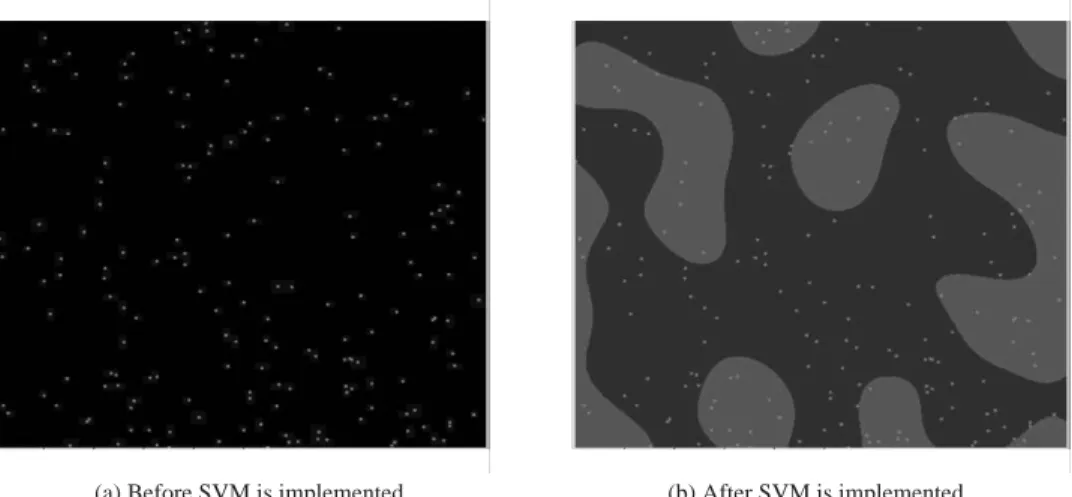
Figs. 3 and 4 present the results of the best SVM model for the training and the holdout data, respectively.
Fig. 1. The results of SVMs with variousCwhere2 is -xed at 25.
Fig. 2. The results of SVMs with various2 whereCis -xed at 78.
Figs. 3(a) and 4(a) represent data patterns before SVM is employed. Two diEerent colors of circles are two classes of the training and the holdout examples. Figs. 3(b) and4(b) show the results after SVM is implemented. The two classes are represented by green and red bullets.
In addition, this study compares the best SVM model with BP and CBR. Table 4
gives the prediction performance of various BP models.
In Table 4, the best prediction performance for the holdout data is produced when the number of hidden processing elements are 24 and the stopping criteria is 146 400 or
(a) Before SVM is implemented (b) After SVM is implemented
Fig. 3. Graphical interpretation of the results of SVM for the training data: (a) before SVM is implemented and (b) after SVM is implemented.
(a) Before SVM is implemented (b) After SVM is implemented
Fig. 4. Graphical interpretation of the results of SVM for the holdout data: (a) before SVM is implemented and (b) after SVM is implemented.
292 800 learning epochs. The prediction performance of the holdout data is 54.7332% and that of the training data is 58.5217%.
For CBR, this study varies the number of retrieved cases for the new problem. The range of the number of retrieved cases is between 1 and 5. However, the prediction performances of these -ve experiments produce same results. Thus, this study uses the prediction performance when the number of retrieved cases is 1. The prediction accuracy of the holdout data is 51.9793%. For CBR, the performance of the training
Table 4
The results of various BP models
Stopping criteria Number of hidden Prediction performance Prediction performance (epoch) nodes for the training data (%) for the holdout data (%)
146 400 6 58.1552 52.8399 12 58.6439 53.3563 24 58.5217 54.7332 292 800 6 58.1552 52.8399 12 58.6439 53.3563 24 58.5217 54.7332 565 600 6 58.1552 52.8399 12 58.1552 52.8399 24 58.1552 52.8399 Table 5
The best prediction performances of SVM, BP, and CBR (hit ratio: %)
SVM BP CBR
Training data 64.7526 58.5217
Holdout data 57.8313 54.7332 51.9793
Table 6
McNemar values (pvalues) for the pairwise comparison of performance
BP CBR
SVM 1642 (0.200) 4.654 (0.031)
BP 0.886 (0.347)
data is ignored because the retrieved case and the new case are the same in the training data. Table 5 compares the best prediction performances of SVM, BP, and CBR.
In Table 5, SVM outperforms BPN and CBR by 3.0981% and 5.852% for the holdout data, respectively. For the training data, SVM has higher prediction accuracy than BPN by 6.2309%. The results indicate the feasibility of SVM in -nancial time series forecasting and are compatible withthe conclusions of Tay and Cao [18].
The McNemar tests are performed to examine whether SVM signi-cantly outper-forms the other two models. This test is a nonparametric test for two related samples and may be used withnominal data. The test is particularly useful withbefore-after measurement of the same subjects [7]. Table 6 shows the results of the McNemar test to compare the prediction performance of the holdout data.
As shown in Table 6, SVM performs better than CBR at 5% statistical signi-cance level. However, SVM does not signi-cantly outperform BP. In addition, Table 6 also shows that BP and CBR do not signi-cantly outperform each other.
5. Conclusions
This study used SVM to predict future direction of stock price index. In this study, the eEect of the value of the upper bound C and the kernel parameter 2 in SVM
was investigated. The experimental result showed that the prediction performances of SVMs are sensitive to the value of these parameters. Thus, it is important to -nd the optimal value of the parameters.
In addition, this study compared SVM with BPN and CBR. The experimental results showed that SVM outperformed BPN and CBR. The results may be attributable to the fact that SVM implements the structural risk minimization principle and this leads to better generalization than conventional techniques. Finally, this study concluded that SVM provides a promising alternative for -nancial time-series forecasting.
There will be other research issues which enhance the prediction performance of SVM if they are investigated. The prediction performance may be increased if the optimum parameters of SVM are selected and this remains a very interesting topic for further study. The generalizability of SVMs also should be tested further by applying them to other time-series.
Acknowledgements
This work was supported by the Dongguk University Research Fund.
References
[1] S.B. Achelis, Technical Analysis from A to Z, Probus Publishing, Chicago, 1995.
[2] H. Ahmadi, Testability of the arbitrage pricing theory by neural networks, in: Proceedings of the International Conference on Neural Networks, San Diego, CA, 1990, pp. 385–393.
[3] J. Chang, Y. Jung, K. Yeon, J. Jun, D. Shin, H. Kim, Technical Indicators and Analysis Methods, Jinritamgu Publishing, Seoul, 1996.
[4] C.-C. Chang, C.-J. Lin, LIBSVM: a library for support vector machines, Technical Report, Department of Computer Science and Information Engineering, National Taiwan University, 2001, Available at http://www.csie.edu.tw/∼cjlin/papers/libsvm.pdf.
[5] J. Choi, Technical Indicators, Jinritamgu Publishing, Seoul, 1995.
[6] J.H. Choi, M.K. Lee, M.W. Rhee, Trading S& P 500 stock index futures using a neural network, in: Proceedings of the Annual International Conference on Arti-cial Intelligence Applications on Wall Street, New York, 1995, pp. 63–72.
[7] D.R. Cooper, C.W. Emory, Business Research Methods, Irwin, Chicago, 1995.
[8] H. Drucker, D. Wu, V.N. Vapnik, Support vector machines for spam categorization, IEEE Trans. Neural Networks 10 (5) (1999) 1048–1054.
[9] E. GiEord, Investor’s Guide to Technical Analysis: Predicting Price Action in the Markets, Pitman Publishing, London, 1995.
[10] Y. Hiemstra, Modeling structured nonlinear knowledge to predict stock market returns, in: R.R. Trippi (Ed.), Chaos & Nonlinear Dynamics in the Financial Markets: Theory, Evidence and Applications, Irwin, Chicago, IL, 1995, pp. 163–175.
[11] K. Kamijo, T. Tanigawa, Stock price pattern recognition: a recurrent neural network approach, in: Proceedings of the International Joint Conference on Neural Networks, San Diego, CA, 1990, pp. 215–221.
[12] K. Kim, I. Han, Genetic algorithms approach to feature discretization in arti-cial neural networks for the prediction of stock price index, Expert Syst. Appl. 19 (2) (2000) 125–132.
[13] T. Kimoto, K. Asakawa, M. Yoda, M. Takeoka, Stock market prediction system withmodular neural network, in: Proceedings of the International Joint Conference on Neural Networks, San Diego, CA, 1990, pp. 1–6.
[14] K. Kohara, T. Ishikawa, Y. Fukuhara, Y. Nakamura, Stock price prediction using prior knowledge and neural networks, Int. J. Intell. Syst. Accounting Finance Manage. 6 (1) (1997) 11–22.
[15] S. Mukherjee, E. Osuna, F. Girosi, Nonlinear prediction of chaotic time series using support vector machines, in: Proceedings of the IEEE Workshop on Neural Networks for Signal Processing, Amelia Island, FL, 1997, pp. 511–520.
[16] J.J. Murphy, Technical Analysis of the Futures Markets: A Comprehensive Guide to Trading Methods and Applications, Prentice-Hall, New York, 1986.
[17] T.-S. Quah, B. Srinivasan, Improving returns on stock investment through neural network selection, Expert Syst. Appl. 17 (1999) 295–301.
[18] F.E.H. Tay, L. Cao, Application of support vector machines in -nancial time series forecasting, Omega 29 (2001) 309–317.
[19] R.R. Trippi, D. DeSieno, Trading equity index futures witha neural network, J. Portfolio Manage. 19 (1992) 27–33.
[20] R. Tsaih, Y. Hsu, C.C. Lai, Forecasting S& P 500 stock index futures with a hybrid AI system, Decision Support Syst. 23 (2) (1998) 161–174.
[21] V.N. Vapnik, Statistical Learning Theory, Wiley, New York, 1998.
[22] I.H. Witten, E. Frank, Data Mining: Practical Machine Learning Tools and Techniques with Java Implementations, Morgan Kaufmann Publishers, San Francisco, CA, 2000.
[23] Y. Yoon, G. Swales, Predicting stock price performance: a neural network approach, in: Proceedings of the 24th Annual Hawaii International Conference on System Sciences, Hawaii, 1991, pp. 156–162. [24] G. Zhang, B.E. Patuwo, M.Y. Hu, Forecasting with arti-cial neural networks: the state of the art, Int.
J. Forecasting 14 (1998) 35–62.
Kyoung-jae Kimreceived his M.S. and Ph.D. degrees in Management Information Systems from the Graduate School of Management at the Korea Advanced Institute of Science and Technology and his B.A. degree from the Chung-Ang University. He is currently a faculty member of the Department of Information Systems at the Dongguk University. His research interests include data mining, knowledge management, and intelligent agents.