ISSUES FACED BY STUDENTS IN COMPREHENDING TOEFL READING TEXTS
THESIS
Submitted by:
MUHAMMAD KAMAL
The Students of English Education Department
Faculty of Education and Teacher Training
Reg. No: 231324271
FACULTY OF EDUCATION AND TEACHER TRAINING
AR-RANIRY STATE ISLAMIC UNIVERSITY
DARUSSALAM – BANDA ACEH
i
All praise is to Allah SWT, the Almighty and the Most Worthy of praise, who has given the strength, health, ability, and patience in writing this thesis. Peace and salutation to our prophet Muhammad SAW, who has guided us where the way to the darkness and where the way to the brightness. All honors are also addressed to his family and companions.
First, I would like to express my deepest thanks to Mrs.Yuni Setianingsih, M.Ag and Mrs. Azizah, M.Pd as my supervisors. They have given me a lot of inspiration, guidance, advise me lovely, patiently, and suggestions in completing this thesis.
Furthermore, I want to thank my beloved parents, Muhammad Husin Gade and Tihajar Awahab. For their love, motivation, kindness, patience, inspiration, and financial support in finishing my study. Then I also want to thank to my
lectures in UIN Ar-Raniry, who have shared their knowledge, especially Mrs. Yuliar Masna, M. TESOL, Qudwatin Nisak M.Isa. M.Pd, M.Ed, Habiburrahim, M. Com., M.S., Ph.D for their kindness.
Many thank also directed to my big family; my grandmother (Laibah Hasballah / Jannati), my grandfather (Awahab Ahmad / M.Gade), and my three brothers and sister (Ali, Nur Hadi, and Laila) who always motivate me to be success.
Moreover, a lot of thanks to my friends I met in English Education Department of UIN Ar- Raniry, for their care and assistance, generally for PBI 2013 and especially to Ridha Ihsan, Muhammad Saidi, and many other who always help and motivate me in finishing my thesis. Finally, I hope the reader will get some knowledge from this thesis and it will be helpful for other writer in the future.
May Allah, the Almighty, bless and love them all forever, Amin ya rabbal ‘alamin.
Banda Aceh, July 18th, 2018
The writer
iii ABSTRACT
This study entitled “Issues Faced by Students in Comprehending TOEFL Reading Text” (A Study at English Department UIN Ar-Raniry) was intended to (1) find out the most difficulties TOEFL reading text question type faced by the students in TOEFL reading text and (2) to know the students’ opinion toward TOEFL reading text. To obtain the data, the writer used test, questionnaire, and interview. It is analyzed through quantitative research and qualitative research method. The populations of this research are English Department students in 2015/2016 year. The technique in taking sample is random sampling technique. The sample of this study was the sixth semester students of English Department (Tarbiyah Faculty) of the Islamic State University (UIN) Ar-Raniry, that consist of 31 students from unit one. Based on the analysis of the test, the writer found that, the most difficult TOEFL reading texts question type faced by the students was supporting details questions type. This question was also classified into the most difficult question based on index difficulty formula. Then from the questionnaire, the writer found that most of the students faced the difficulties if the text used is long. From the interview, the writer found that, most of the students faced the difficulties in TOEFL reading text, because they did not have an adequate number of words’ mastery. So they do not understand the meaning of words in the text. It was also influenced by reading text that used is too long and it is not supported by the time. Furthermore, the students did not face the difficulties in TOEFL reading text if many vocabularies in the text had already known by them, they familiar with question type, and the text used is shorter than other text. As result they have no difficulties in comprehending TOEFL reading text.
iv ABSTRACT ... iii LIST OF CONTENTS ... iv LIST OF TABLES ... v LIST OF FIGURES ... vi LIST OF APPENDICES...vii CHAPTER I : INTRODUCTION A. Background of Study ... 1 B. Research Questions ... 3
C. The Aim of Study ... 4
D. Limitation of the Study...4
E. Research Benefits...4
F. Research Terminology...5
CHAPTER II : LITERATURE REVIEW A. Kind of TOEFL Tests...8
1. Paper-Based Test (PBT)...8
2. Computer-Based Test (CBT)...10
3. The Internet-Based Test(IBT)...11
4. The Institutional Testing Program (ITP)...13
B. Text Types in TOEFL Reading Text...15
1. Description...16
2. Narration...16
3. Exposition...17
4. Spoof...17
5. Argumentation...19
C. Theories of TOEFL Reading Text Strategy...19
D. Reading Comprehension Question Types in TOEFL Reading Test...24
a. Find the Main Idea...24
b. Seeking Supporting Details...25
c. Exeptions...25
d. Location of Information...25
e. Vocabulary...25
iv
g. Reference...26
h. Paraphrased Sentences...26
i. Sentence Insertion...27
CHAPTER III : RESEARCH METHODOLOGY A. Research Design...28
B. Population and Sample...29
C. Research Instruments...30
D. Technique of Data Collection...31
1. Test...31
2. Questionnaire...31
3. Interview...32
E. Technique of Data Analysis...34
1. Technique of Analyzing the Test...34
2. Technique of Analyzing the Questionnaire...35
3. Technique of Analyzing Interview...35
CHAPTER IV : RESULT AND DISCUSSION A. Test Result...37
B. Questionnaire Result...44
C. Interview Result...76
D. Discussion...79
CHAPTER V : CONCLUSION AND SUGGESTIONS A. Conclusion ... 84
B. Suggestion ... 86
BIBLIOGRAPHY ... 88 APPENDICES
v
Table 2.2: The Computer-Based Test (CBT) format...11
Table 2.3: The Internet-Based Test (IBT) format...13
Table 2.4: The Institutional Testing Program (ITP) Format...15
Table 3.1: The Classification of Index Difficulty...34
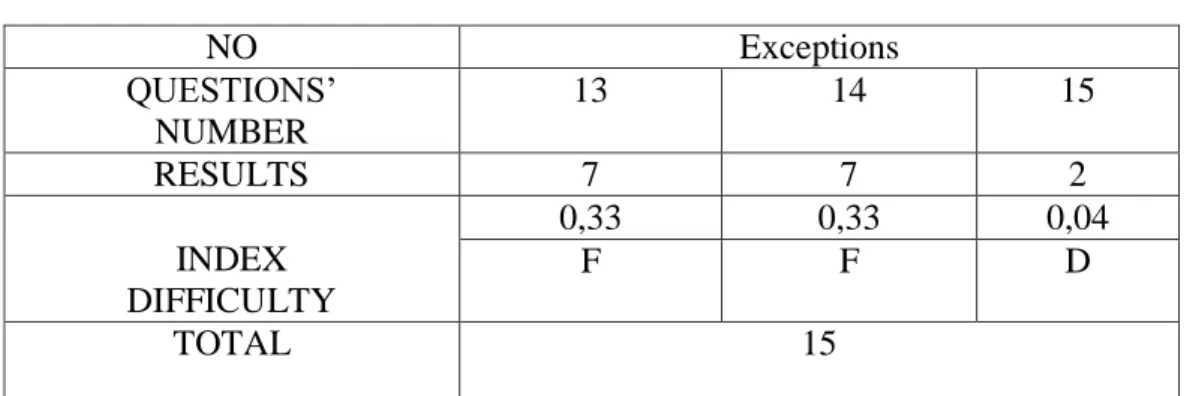
Table 4.1: Students’ Answers to Exceptions Questions...37
Table 4.2: Students’ Answers to Supporting Details Questions...38
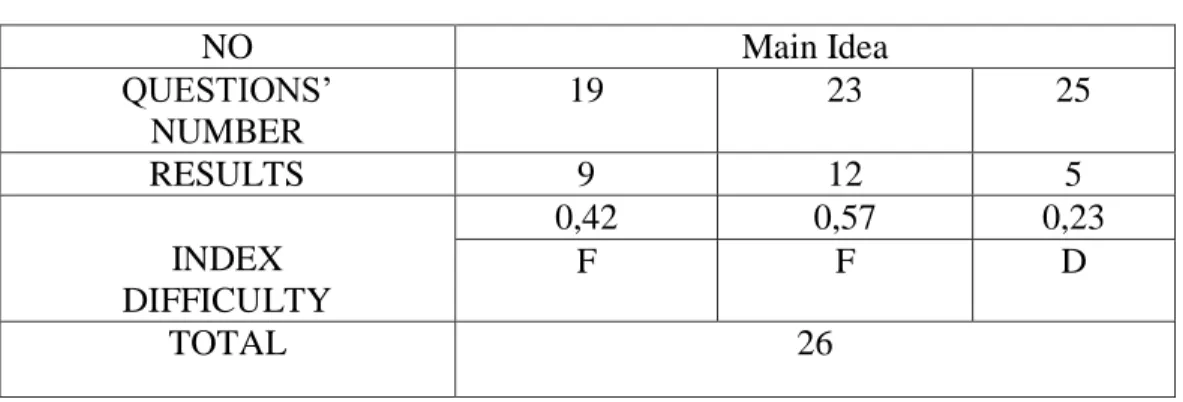
Table 4.3: Students’ Answers to Main Idea Questions...39
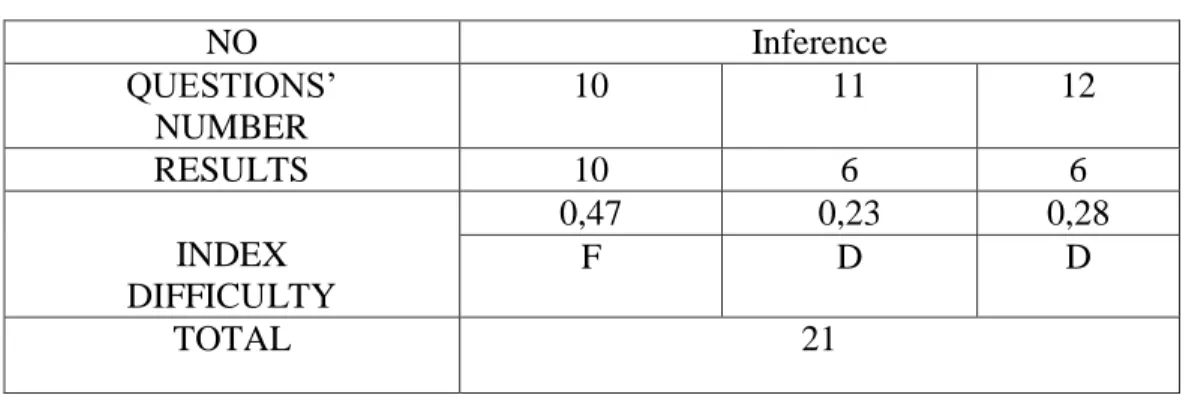
Table 4.4: The Students’ Answers to Inference questions...40
Table 4.5: Students’ Answers to Vocabulary Questions...40
Table 4.6: Students’ Answers to Location Information Questions...41
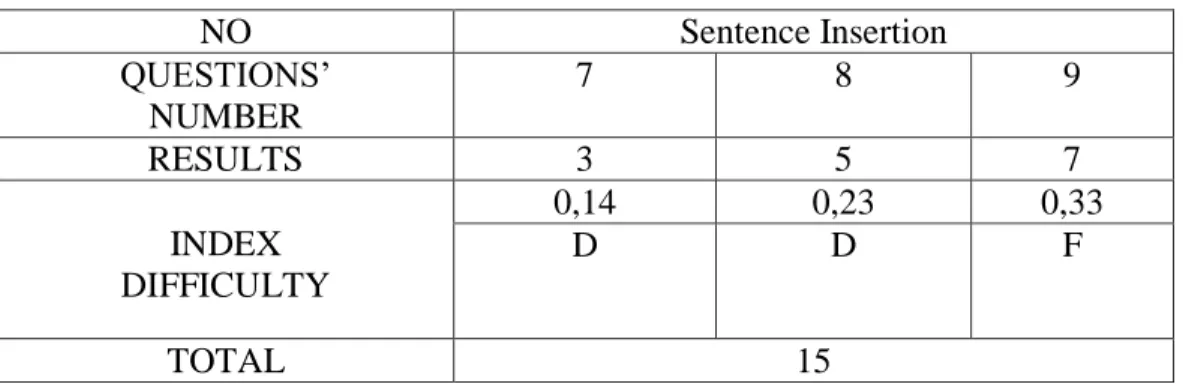
Table 4.7: Students’ Answers to Sentence Insertion Questions...42
Table 4.8: Students’ Answers to Paraphrased Sentence Questions...42
Table4.9: Students’ Answers to Reference Questions...43
Table 4.10: The Students’ Responses to the Q 1...45
Table 4.11: The Students’ Responses to the Q 2...46
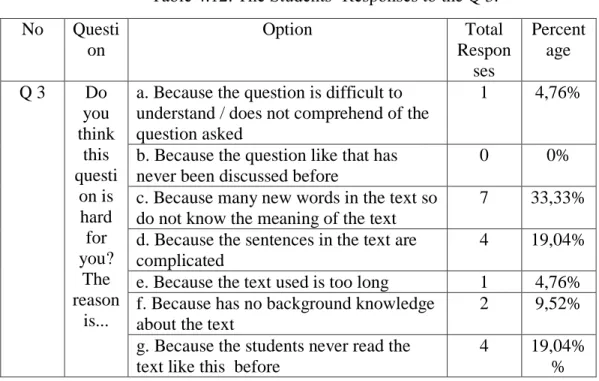
Table 4.12: The Students’ Responses to the Q 3...47
Table 4.13: The Students’ Responses to the Q 4...48
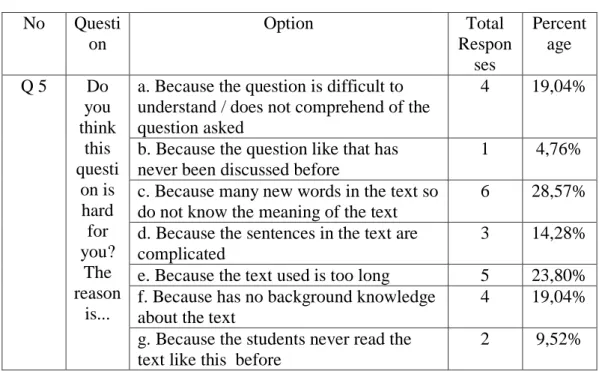
Table 4.14: The Students’ Responses to the Q 5...59
v
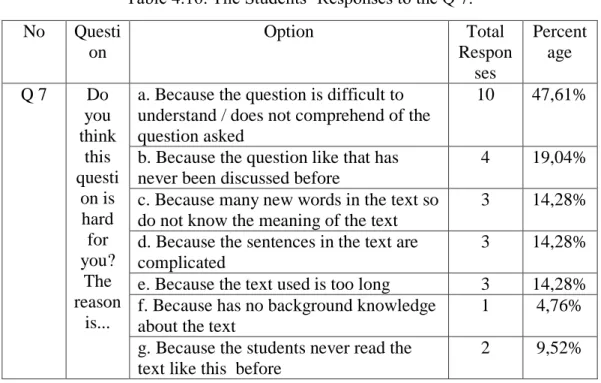
Table 4.16: The Students’ Responses to the Q 7...52
Table 4.17: The Students’ Responses to the Q 8...53
Table 4.18: The Students’ Responses to the Q 9...54
Table 4.19: The Students’ Responses to the Q 10...55
Table 4.20: The Students’ Responses to the Q 11...57
Table 4.21: The Students’ Responses to the Q 12...58
Table 4.22: The Students’ Responses to the Q 13...59
Table 4.23: The Students’ Responses to the Q 14...60
Table 4.24: The Students’ Response to the Q 15...61
Table 4.25: The Students’ Responses to the Q 16...62
Table 4.26: The Students’ Responses to the Q 17...63
Table 4.27: The Students’ Responses to the Q 18...64
Table 4.28: The Students’ Responses to the Q 19...65
Table 4.29: The Students’ Responses to the Q 20...66
Table 4.30: The Students’ Responses to the Q 21...67
Table 4.31: The Students’ Responses to the Q 22...68
Table 4.32: The Students’ Responses to the Q 23...69
Table 4.33: The Students’ Responses to the Q 24...70
Table 4.34: The Students’ Responses to the Q 25...71
Table 4.35: The Students’ Responses to the Q 26...72
vii
LIST OF APPENDICES
I. The Test and Answer Keys II. The Questionnaire Items
III. Interview Guides for the Students
IV. The Transcription of Interview of English Students V. The students’ Response to Questionnaire
VI. The classification of Students’ Results VII. The Students’ Result
VIII. The Students’ Participation Photos in this Study IX. Appointment Letter of Supervisor
X. The Letter of Conducting Data from Faculty of Tarbiyah and Teacher Training
1 A. Background of Study
Reading is a very complex mental activity that contains vision, dubbing, thought, and rendition (Çelenk, 2001: 77). Besides, Nuttal (1996) also said that reading is an activity that essentially concerned with the transfer of meaning from mind to mind, a message from a writer to a reader. Reading needs comprehension to understand the context, based on the syllabus of (2013) curriculum, the students able to understand the meaning in the forms of English texts (kemdikbud, 2016, p. 1). In other words, the reader’s background knowledge are useful to comprehend the text.
Furthermore, Jakpim (1992) said that “among the four skills students will have a chance to use, reading skill is the most. Reading skill means students’ reading texts they encounter in their daily lives properly and fluently by using right methods (Özbay, 2006: 5). Reading is the most important skills for the students learning development because students basically use written texts in searching for information and acquiring new data of knowledge (Khruawan & Nutprapha, 2017). Through the reading the students can get a lot of knowledge, information, enjoyment, or even problem solution, Inability to comprehension the reading materials the students will be left behind to obtain the information or in following the learning in school.
2
Undoubtedly, TOEFL test is hard. Many students failed in answering TOEFL test or many of them do not reach the standards passing grade. It is caused by many problems. According to Taglieber (1988), there are major problems that interfere with reader’s comprehension. First is lack of vocabulary. Second is difficulty in using language cues to meaning, last is lack of conceptual knowledge. It means that a reader’s background knowledge and competence are needed when the readers read a reading material because do not understand what they read. It is a big problem for the students.
To support this study, the writer read previous thesis related to the difficulties in TOEFL reading comprehension. The first study was at the English Education Department of Syiah Kuala University. The result shows that the most difficult skill in TOEFL reading comprehension section for the students is skill answer implied detail questions correctly (Iskandar, jannah & siti, 2017).
Another relevant study was conducted by Mahmud (2014) at the university in Makassar. His study shows that, based on the intensive interview and classroom observation, the main reasons were due to several conflicting factors, such as the less basic skills in English, less practice on the test, less motivation, and students’ individual differences such as age and social status.
From the related studies above, it showed that, the issues in TOEFL reading comprehension are important to be known and analyzed. The statement from educational testing service gives a reality that, TOEFL is used in all over the world included in Indonesia to test English proficiency of people who live in
non-English speaking countries. Because of widely used and internationally recognized test. In this case, TOEFL is useful for the students who want to master English as well as possible to improve their skills of answering the questions of TOEFL test.
The TOEFL tests consisted of one hundred and forty questions. In TOEFL test, there are three parts tested namely 50 listening questions, 40 about structure and written expression, and 50 reading questions. It mean, that more than a third of TOEFL test is reading test.
In The TOEFL certificate, there will be issued for the students, who were able to reach the passing grade, which then become the requirement for them to finish their study. Besides that, considering the students’ successful in TOEFL test, it is necessary to overcome the aforementioned problems.
This is of the reasons why the writer wants to study about the students issues, especially in TOEFL reading test question. It is expected that learning process can be effective and the writer hope an improvement for the students’ TOEFL test results. In accordance with the statement above, the writer is interested to find out the difficulties faced by students in TOEFL reading text and the causes of the difficulties faced by students of English Department in improving their TOEFL score especially reading comprehension section.
B. Research Questions
Based on the background of study presented above, there are two research questions as follows:
4
1. What kind of difficulties are faced by students in Comprehending TOEFL reading text?
2. What are the students’ opinion toward TOEFL reading text?
C. Aim of Study
The purpose of the study are:
1. To find out the most difficulties face by students in comprehending TOEFL reading text.
2. To know the students’ opinion toward TOEFL reading text.
D. Limitation of the study
Due to time, knowledge and financial limitation that the writer has, in conducting this study the writer limited his study on the issues faced by the students into nine categories: 1). The difficulty in understanding vocabulary, 2). Find the main idea, 3). The difficulty in detail information, 4). Seeking supporting details, 5). Exceptions, 6). Inferences, 7). Reference, 8). Paraphrased sentences, 9). Sentence Insertion.
E. Research Benefits
a. For the researcher
Through this research, the researcher will be able to improve his knowledge about the strategies in reading comprehension. This research is expected the researcher can add insight and knowledge on the implementation of
learning models. And able to provide a quality of learning. In addition the results of research can be used as research experience in TOEFL reading text.
b. For the Teachers
For the teachers, can be an alternative selection of effective learning techniques to improve students' ability in reading comprehension of English text. This research is expected to provide information for teachers to develop the students’ reading comprehension.
c. For the learner
For the students, research results can improve skill especially reading comprehension of English and through this research, the learners will be able to comprehend the reading text based this research.
F. Research Terminology
a. Comprehension
Comprehension is a process in which readers construct meaning by interacting with text through the combination of prior knowledge and previous experience, information in the text, and the stance the reader takes in relationship to the text (Pardo, 2004). According to Hudoyo (in Susanto, 2011) “comprehension is a phase in learning activities". In this case, the writer term of comprehension is the active process of constructing meaning from text entirely and can answer the questions of reading.
6
b. Reading
Reading is the recognition of words, from simple recognition of the individual letters and how these letters form a particular word to what each word means not just on an individual level, but as part of a text (Tennant, 2013). Moreover reading is a complex, dynamic process that involves the bringing of meaning to, and the getting of meaning from, the printed page (Rubin 1993, 5). In this case, the writer term of reading is an attempt to translate the writing symbol, able to achieve understanding from activities of thinking from reading texts, and able to obtain information from reading material.
c. TOEFL
Test of English as a Foreign Language (TOEFL) is used to evaluate the English proficiency of foreign language learners (ETS, 2006, p. 3). This test is highly recognized as a standard language testing in English language and had been “internationally recognized and respected” (Warfield et al., 2013). In this case, the writer term of TOEFL is the reading material that consist of reading comprehension questions section. It use to evaluate English language proficiency of students of English Teacher Education Department.
d. Issue
According to Jenn (1999) Issue is a problem often used as an excuse for some weird psychological problem. Cambridge Business English Dictionary
this case, the writer term of issue is the difficulties that are faced by the students in comprehending TOEFL reading text.
8 CHAPTER II
LITERATURE REVIEW
A. Kind of TOEFL Tests
The official TOEFL test is currently administered around the world in different types:
a. The Paper-Based Test (PBT) b. The Computer-Based Test (CBT) c. The Internet-Based Test (iBT) d. Institutional Testing Program (ITP)
(Liu et al., 2009)
1. Paper-Based Testing (PBT)
The Paper Based Test is one of the international testing programs. It includes four sections which are as follows (Phillips, 2003: xv-xvi):
a. Listening Comprehension
It is used to evaluate the examinees' ability to understand spoken English. The examinees must listen to different types of recorded passages and answer multiple choice questions about these passages.
b. Structure and Written Expression
It is used to evaluate the examinees' ability to recognize grammatically correct English sentences. In this section, they have to choose the correct way to complete sentences and to identify grammatical errors in sentences.
c. Reading Comprehension
It is used to measure the examinees' ability to understand written English passages. Then, the examinees must answer multiple choice questions concerning the ideas and the meaning of words in those reading passages.
d. Test of Written English (TWE)
It is used to evaluate the examinees' ability to write correct, organized and meaningful English essays. The examinees must write a certain essay on a given topic in only thirty minutes.
The format of these four sections, the number of items for each of them, and the time which is assigned for each of them can be clarified in the following table (Gear and Robert, 2002:8):
10
Table (2.1) The Paper-Based TOEFL Test (PBT) format
Sections Number of
Items
Time
Listening:
Part A questions about short conversations Part B questions about longer conversations Part C questions about lectures or talks Total 30 8 12 50 30-40 Minutes Structure and written expression:
Completing sentences correctly Identifying errors Total 15 25 40 25 Minutes Reading comprehension:
Questions about reading passages Total
50
50 55
Minutes Test of Written English (TWE):
One essay, 250 -300 words 30
Minutes
2. Computer-Based Testing (CBT)
The Computer-Based TOEFL Program. The writing section in this test is equivalent to the Test of Written English (TWE) in the Paper-Based TOEFL Test. In addition, everyone who takes the TOEFL during the same administration may not see or answer the same questions. These questions are selected according to the level of the student's proficiency. In this test, there are three sub –scores: listening, structure / writing, and reading. Actually, the total score is limited on a scale of (0 – 300) (Sharpe, 2009:11).w
The format, the number, and types of questions that can be seen in the Computer-Based TOEFL Test are shown in the following table (Gear and Robert, 2002:2):
Table (2.2) The Computer-Based Test (CBT) format
Listening: Number of passages Number of questions per passage Total number of questions Time Short dialogues Short conversation lectures and discussions 11-17 2-3 4-6 1 2-3 3-6 30-59 40-60 Minutes Structure: Number of items Total number of questions Time Completing sentences correctly identifying errors 10-15 10-15 20-25 15-20 Minutes Reading Comprehension Number of passages Number of questions per passage Total number of questions Time 4-5 10-12 44-55 70-90 Minutes Writing Number of essays Time 1 30 Minutes
3. The Internet-Based TOEFL program (IBT)
In The Official Guide to the New TOEFL (iBT), (2006: 2-5), this test is described as a new version of the TOEFL test. It is delivered in secure testing
12
centers around the world. It replaces the Computer-Based TOEFL Test and the Paper-Based TOEFL Test. Its main concern is to measure the examinees' ability to communicate successfully in an academic setting. It includes a new section which is the speaking section. This section is used to evaluate the examinees' ability to speak English. Moreover, there are new integrated writing and speaking tasks. These tasks are used to evaluate the examinees' ability to combine and communicate information which is from different sources. To sum up, this test consists of four sections: reading, listening, speaking and writing. It tests all the four skills that are influential for effective and successful communication, i.e. listening, speaking, reading and writing.
The format of these sections, the number of questions for each of them, and the time which is allotted for each of them can be seen in the following table:
Table (2.3) The Internet-Based Test (IBT) format
Test Section Number of Questions Timing
Reading 3-5 passages, 12-14 questions each 60-100
Minutes
Listening 4-6 lectures, 6 questions each
2-3 conversations, 5 questions each
60-90 Minutes
BREAK
Speaking 6 tasks: 2 independent and 4 integrated 20
Minutes
Writing 1 integrated task
1 independent task
20 Minutes 30 ,,Minutes
4. The Institutional Testing Program (ITP)
In The Institutional Testing Program (2005:2), it is clear that ITP Test, i.e. (the Institutional Testing Program) began in 1965 and is still administered throughout the world. Actually, it differs from other TOEFL Test Programs because it gives qualified universities, English language institutes, and other agencies the opportunity to use older forms of International Testing Program Paper-Based TOEFL Test or the preliminary test of English as a foreign language
14
(Pre-TOEFL) to their own students using their own facilities and staff and setting their own test dates.
As for the Institutional Testing Program (2006:3), it is mentioned that the purpose of ITP TOEFL Test is to measure English proficiency of people whose native language is not English. In fact, it consists of three sections. Each section contains a multiple - choice format in order to evaluate the ability to understand North American English. It is given in a single session of about two and a half hours to complete it besides completing the admission procedures. These sections are:
1. Listening Comprehension
It is used to evaluate the examinees' ability to understand English as it is spoken in North America.
2. Structure and Written Expression
It is used to evaluate the examinees' ability to recognize language that is appropriate for standard written English.
3. Reading comprehension
It is used to evaluate the examinees' ability to read and understand short passages. The format of these sections, the number of questions for each of them, and the time which is given for each of them can be seen in the following table (see TOEFL Practical Tests (2003) :
Table (2.4) The Institutional Testing Program (ITP) Format
Sections Number of Items Time
Listening:
Part A questions about short conversations Part B questions about longer conversations Part C questions about lectures or talks Total 30 7 13 50 30-40 Minutes Structure and written expressions:
Completing sentences correctly Identifying errors Total 15 25 40 25 Minutes Reading comprehension:
Questions about reading passages Total
50
50 55
Minutes
Zaidoon & Nagham (2011)
B. Text Types in TOEFL Reading Text
Reading comprehension is the process of meaning construction as a result of blending content and message of the text with the readers existing knowledge and skills during reader text interaction (Pardo, (2004). Calfee and Drum indicates that the power of reading comprehension consists of three components. These are interpretation of reading material (text), the reader and the text by the reader (Referred: Demirel, 2006). For Readers text to understand the differences often caused from insufficiencies seen in the analysis of the words of the text. (Torgesen, Rashotte, Alexander, Alexander and MacPhee, 2003). Karatay (2007: 17), stated that the text is a meaningful, logical and related structure composed of
16
all structures based on language. Addition, the text is to express an opinion or experience in writing (Hartman and Hartman, 1996).
Text is divided into two: that is, non-continuous text and continuous text. Non continuous text, for example: brochure label, graphic, table, map, and diagram. Continuous text for example: narrative, descriptive, exposition, and spoof (Tangguh et al. 2015).
The following classification of texts used in PISA is adapted from the work of Werlich (1976):
1. Description
It is the type of text where the information refers to properties of objects in space. The typical questions that descriptive texts provide an answer to are what questions. Impressionistic descriptions present information from the point of view of subjective impressions of relations, qualities, and directions in space. Examples of text objects in the text type category description are a depiction of a particular place in a travelogue or diary, a catalogue, a geographical map, an online flight schedule or a description of a feature, function or process in a technical manual.
2. Narration
It is the type of text where the information refers to properties of objects in time. Narration typically answers questions relating to when, or in what sequence. Narratives present change from the point of view of subjective selection and emphasis, recording actions and events from the point of view of subjective
impressions in time. Examples of text objects in the text type category narration is a novel, a short story, a play, a biography, a comic strip, and a newspaper report of an event.
3. Exposition
It is the type of text in which the information is presented as composite concepts or mental constructs, or those elements into which concepts or mental constructs can be analyzed. The text provides an explanation of how the different elements interrelate in a meaningful whole and often answers questions about how Expository essays provide a simple explanation of concepts, mental constructs, or conceptions from a subjective point of view. Definitions explain how terms or names are interrelated with mental concepts. In showing these interrelations, the definition explains the meaning of words. Examples of text objects in the text type category exposition are a scholarly essay, a diagram showing a model of memory, a graph of population trends, a concept map and an entry in an online encyclopedia. (Schleicher, 2009)
4. Spoof
According to Gerot and Wignell (1994) spoof text is a text type retell an event with a humorous twist. It means spoof text is a text which tell factual story with unpredictable ending. According to Budi (2004) the purpose of spoof text is to tell an event with a humorous twist and entertain the reader in spoof text. So if there is no twist in the end of the text, it will not be a spoof text. Moreover, the
18
story usually has a moral message for the readers. Sudarwati and Grace (2007, p. 178) state that a spoof has a generic structure/text organization and language features. Dealing with text organization, Djuharie (2007, p. 43) explains as follows:
a. Orientation: orientation appears as an introductory part of the text. It will guide the readers to show what kind of a text that he will be reading and it is also the beginning of the story.
b. Events: events are included as part of the text that recite the events that happened in the story usually in chronological order.
c. Twist: the twist is a part of text near the end of the story that tells about something that was unpredictable that make the readers smile and laugh. This is the funniest part of the story.
According to Sudarwati and Grace (2007, p. 178), a spoof text has the following language features:
a. Noun: deals with people, animals or certain things in the text.
b. Action verb: deals with the verbs that show events (examples: ate, ran, stayed, etc.).
c. Connectives: connectives with a sequence of events (examples: first, then, after, before, finally, etc.).
d. Adverbs of time and place: explain when and where the events happened (examples: in the garden, two days ago, etc.).
e. Simple past tense: simple past tense deals with activities that happened in the past, and uses verbs in the past form. (Nurma, & Harha, 2016)
5. Argumentation Enright et al. (2000, p. 30):
It is the type of text that presents the relationship among concepts or propositions. Argument texts often answer why questions. An important sub classification of argument texts is persuasive and opinionative texts, referring to opinions and points of view. Comment relates the concepts of events, objects, and ideas to a private system of thoughts, values, and beliefs. Scientific argumentation relates concepts of events, objects, and ideas to systems of thought and knowledge so that the resulting propositions can be verified as valid or non-valid. Examples of text objects in the text type category argumentation are a letter to the editor, a poster advertisement, the posts in an online forum and a web-based review of a book or film. (Schleicher, Zimmer, Evans, & Clements, (2009, p. 33)
C. Theories of TOEFL Reading Text Strategy
TOEFL reading test depends on many strategies to get the meaning of the text. According to Afflerbach at al. (2008), reading strategies help the readers to decode text, understand the words, and construct or derive meanings of the text. It means that, the readers will lose much information, when they do not understand the meaning of reading material.
There are different types of learning strategies which help the learners to solve their problems and improve their language competency. Reading strategies
20
are more useful and beneficial for them. In Cambridge preparation for the TOEFL test (2006), have a very good list called “Strategies to Use for the Reading Section of the TOEFL iBT test”. These include:
1. Read the entire passage first.
The reading passage are too long to fit on one computer screen. Use the scroll bar to move the passage up and down the screen. You must scroll through the entire passage before you can go on to the questions. The main topic is usually stated at the beginning of the passage. Understanding the main topic and looking for the ideas that support that topic will help you answer questions concerning the organization of the passage. Don’t spend time trying to understand every detail. You can return to the passage to search for specific details when you come to those questions.
2. Use context clues to understand the passage.
Even native speakers do not always understand the meaning of all the words used or the implications made in the passages. Instead, they use other words in the passage (context clues) to determine the meaning of unfamiliar words, the organization of the passage, and the supporting details of the text.
3. Read the passage even if you are familiar with the topic.
Sometimes you will come across a passage about a topic you are already familiar with. Read the passage anyway. Never try to answer the questions
without reading the passage first. It might contain new information concerning the topic or concepts that are different from your ideas about the topic.
4. Read the questions and the information carefully.
The reading section contains different question types. Read each question carefully and pay attention to any special instructions. Study the four basic question types that you will encounter and the examples of each type.
5. Try to answer all the questions following a passage before going on to the next one.
Although the test allows you to return to any question you have already seen, it is best to focus your attention on one passage and its set of questions at a time. Jumping around to questions in different passages requires rereading and refocusing your attention – something that you should try to avoid.
6. Use your time wisely.
The reading section has a time limit of 60-100 minutes, depending on how many passages appear on your particular test. Pacing yourself in order to make good progress is essential. Check the clock on the screen when you start the reading section to know how much time you have. The following suggestions will help you use your time wisely:
Be familiar with the question type and test directions so that you don’t have to spend time trying to understand what to do. If you are well
22
prepared for the test, you will be able to click on the Dismiss Directions icon the moment the directions appear, giving yourself more time to focus on the question items themselves.
Pay attention to the number of questions displayed on the computer screen and the amount of time remaining on the clock. Pace you’re self-according to the number of questions and the time you have left.
Be familiar with scrolling techniques. Be sure to scroll down to read the entire passage before you go on to the questions. The passage will be available to you if you need to refer to it once you have started answering the questions. Use the View Text icon if you need to see the entire passage Be familiar with the use of the Next, Back, and Review icons to move
back and forth among the questions.
Some questions are more difficult than others, but it is important that you answer them all – even if it means guessing. Rather than spending a lot of time on an answer that you are not sure of, quickly eliminate the answer choices you know are wrong, then decide which answer is best and move on. If you have time at the end of the section, you can go back to questions you were unsure of.
While Strategies to Use for Building Reading Fluency are: 1. Read extensively
The more you read, the better reader you will become. Read on a variety of topics in order to build your vocabulary. The larger your vocabulary, the less time
you will need to spend trying to understand unfamiliar words and the more time you will have to understand the material presented in the text.
2. Read challenging material.
Read material that challenges you. If you always read things that are easy for you, you will not develop your ability t read more difficult material.
3. Read about topics commonly found on the TOEFL test.
The reading passages on the test concern subjects taught in colleges and universities: science, technology, the social sciences, and the humanities. Choose reading material that will give you experience reading about these subjects and help you become familiar with the concepts and vocabulary commonly used in these fields.
4. Read actively.
Think about what you are reading. Ask yourself what the text is about. Ask yourself how the material is organized and how the ideas presented are supported.
5. Increase your formal and academic vocabulary.
Increase your vocabulary by reading extensively and practicing the strategies taught in vocabulary.
24
In the line of though (Tangguh et al., 2015) there are some tricks to answer the TOEFL reading test as follow:
a. Using the adjective clause b. Using the word of reference
c. Using words or phrases that indicate contradictions d. Using one form of the verb "to be"
e. Punctuation
f. Use of the word "or" g. Use of example
h. Use of certain expressions.
D. Reading Comprehension Question Types in TOEFL Reading Test
There are many type of TOEFL reading question test. In order to understand and finish the reading test on the TOEFL exam the reader be able to distinguish the types of questions that are used. There are nine categories of frequently asked questions on the TOEFL reading test.
a. Find the Main Idea
This type of query asks the reader to find the main idea of a section of text or paragraph. Example:
1. Which sentence best summarizes the main idea of the passage? 2. What is this paragraph mainly about?
3. What is the author’s main purpose in this passage? 4. What would be the best title for this passage?
b. Seeking Supporting Details
Questions like this, the reader are asked to identify specific facts or important details that explain in writing in the reading. Example:
1. What cause type II diabetes?
2. How many people in the United States have Type II diabetes?
c. Exceptions
For this question, the reader are asked to identify specific facts or details that are not mentioned in the text. Example:
1. Which characteristic does not describe the cuttlefish?
2. The author mentions all of the following as important causes of acid Except:
d. Location of Information
These model questions ask the reader to find out where specific information can be found. Example:
1. Where in the passage does the author define the term ecosystem?
e. Vocabulary
There are two models of vocabulary questions that often arise, asking the reader to find the meaning of a vocabulary based the word is used in the reading, and asking the reader to choose a synonym of a word in the text. Example:
26
2. The word commotion in paragraph 5 could best be replaced by...
f. Inferences
For this question, the reader are required to draw a logical conclusion based on the information contained in the text. Example:
1. The author suggests that cloning will lead to
2. This passage suggest that racial profiling is discriminatory because:
g. Reference
These questions require the reader to find out phrases or words are referred by a pronoun. Example:
1. The word it line 7 refers to: 2. The word they in line 25 refers to:
h. Paraphrased Sentences
This type of question asks you to identify the sentence with the most appropriate paraphrase pattern, and also be required to reiterate, one or more, important information in a passage of the reading text. Example:
1. What does the author mean by the sentence Woodstock should have been a colossal failure?
2. What does the author mean by the statement unfortunately, many state governments have not only permitted but sponsor it through lotteries?
i. Sentence Insertion
For this question, the reader are required to put a new sentence to the appropriate place in the text. Example:
1. The following sentence can be added to paragraph 1. 2. Where would this sentence best fit in the paragraph? (Tangguh et al., 2015).
28 CHAPTER III
RESEARCH METHODOLOGY
A. Research Design
This study to get the best result in doing the research, the writer prepare everything needed in this research. In this chapter, the researcher pointed out the approach used for this research was mix- mode approach. It means that to gain the data which was needed, the methods used in this study was using both quantitative research and qualitative research method, because the researcher used interview questionnaire and test as techniques in collecting the data.
According to Glesne (2006, p. 4), “qualitative research methods are used to understand phenomena from the perspectives of those involved, to contextualize issues in their particular socio-cultural-political milieu, and sometimes to transform or change social conditions”. Sandelowski (2000, p.1) argues that a “qualitative descriptive design is the method of choice when straight descriptions of phenomenon are desired”. The purpose of qualitative research is not solely to seek the truth, but rather on the subject's understanding of the surrounding world (Sugiyono, 2015).
Gay et al. (2006:9) asserted that “quantitative research is the collection and analysis of numerical data in order to explain, predict, and/or control phenomena of interest”. Addition that, the quantitative research is grounded upon a “hypothetical-deductive model” driven by the testing of general a priori propositions (Gephart, 2004: 455). In this study the writer use the test and
questionnaire before interview the students, to determine the ability of students in comprehending TOEFL reading test. The writer uses this research design because feels fit with the title of research taken. At the end of the study the writer interview the students. Furthermore, the test collected will be analyzed by looking at student's learning mastery.
B. Population and Sample
The population is needed in conducting a research. Senam and Akpan 2014) state that “a population is the universe of the study or the entire entity within which all the subjects of the study are found”. Population refers to all the elements (individuals, objects or substances) that meet certain criteria for inclusion in a given universe” (Bums & Grove, 2005:40). Then, the researcher decided the populations of this research are English department students in year of 2016/2017, or the sixth semester students of English department (Tarbiyah faculty) of the Islamic State University (UIN) Ar-Raniry who were studying English curriculum development subject, that consist of 201 students with each class approximately consisted of 30 students, and divided into 6 units. In other word, 201 students became the population of this study.
Sampling is the process of selecting a proportion of the population to represent the entire population, and is acritical aspect of design in quantitative research especially survey research (Lohr, 1999). According to Osuala (2007, p.114), “Sampling is taking any portion of a population or universe as representative of that population or universe.” In other word sample is a small
30
part of the total that is taken for representative of the entire totals that become the object of the research.
In this study the sample was chosen by using simple random sampling technique to choose the class. In this technique, each member of the population has an equal chance of being selected as subject. The entire process of sampling is done in a single step with each subject selected independently of the other members of the population (Sharma, 2017).
In this research the writer used random sampling, where the writer has to choose one class of the students of sixth semester as the sample. Of this research, there are some steps that should apply to choose the sample. The first step done by the researcher was by numbering all of units of English curriculum development class, from no 1 until no 6, second, the writer chooses one of the numbers, the chosen number will be the sample of this research. Finally, unit 1 was chosen as the sample, the class consist of 31 students. The class was held at 09.30 to 11.10 p.m. This class was taught by Mrs. Qudwatin Nisak M. Isa. M.Pd., M.Ed. And their schedule for the English curriculum development class was on Tuesday in the room of 17 in Tarbiyah or Teacher Training Faculty of UIN Ar-Raniry.
C. Research Instruments
In this study the writer used test, questionnaire, and interview technique. The test and questionnaire used to answer the first research question and the use the test was to obtain the data about what kind of TOEFL reading text questions
types the difficult for the students. Then collecting the data by using interview to find out why the students faced the difficulties in TOEFL reading text.
D. Technique of Data Collection
In order to collect the data for this study, research instruments are needed. The data was obtained by using test and non-test instruments. It means that the instrument that was used depended on objective of research itself. In collecting the data, the writer prepared three instruments: interview, questionnaire, and test which designed to collect the information about the students’ issues.
1. Test
In this study, test was one of the techniques used to collect the data and information in this research. The writer held the test to the students by giving the questions of TOEFL reading text questions that appropriate to the students. In this study, the writer conducted tests to find out the data and the information about the students’ difficulties in answering questions in TOEFL reading text, the test here was some sets of TOEFL reading text questions. The instrument used by the writer in doing the research was a written test in the form of multiple choice, and has nine aspects tested, in this case, a number of reading questions were of twenty seven questions for 29, 7 minutes to obtain their score in TOEFL reading text.
2. Questionnaire
A questionnaire (or form) is a group or sequence of questions designed to obtain information on a subject from a respondent (Ivan, 2003). In addition,
32
Questionnaire refers to a set of question that is written in a piece of paper in order to get the response or information from the respondents.
Based to find out the students’ difficulties, closed questions was used in this study, Ivan (2003) states that “closed questions are those where response categories are listed with the question”. In this case, the researcher prepares seven questions that were needed to obtain information about students’ perceptions and one ways to gain data about their problems in TOEFL reading text questions. In order, the students’ choose one or more of the available answers in the questionnaire based their opinions during answer the TOEFL reading text questions. The type of questionnaire used was the checklist question. According to Ivan (2003) “the checklist question is asks the respondent to pick one or more responses from the list”. In this study, the writer choose these type of questionnaires because it were could be more specific and fit with the title of research taken.
3. Interview
The interview was used to obtain more accurate data deeply, in order to verify the data that the writer found from test and questionnaire. The researcher asking several questions which correlate to the research topic directly to them. The data collection not only aimed to find out their problems in order to gather specific information from several students in TOEFL reading text to support the primary data, but also to find out the personal information about the students’ opinion on their problems in TOEFL reading text and to find out the students’
solution in TOEFL reading test based their opinions and to find out why the students face the difficulties in TOEFL reading text.
In this study, the students who had the low score in the ability to understanding the TOEFL reading text, would be selected to interview. Interview is “a specialized form of communication between people for a specific purpose associated with some agreed subject matter” (Anderson, 1990). Esterberg (2002), state that “interview is a meeting of two persons to exchange information and idea through question and responses, resulting in communication and joint construction of meaning about a particular topic”. Esterberg (2002) also said “interviewing is at the heart of social research. Besides, Esterberg (2002) suggests that there are several kinds of interviews, such as structured, semiterstructure, and not terstructure. In this study, the type of interview used was semiterstructured interviews. structured interviews was applied in this data collection. Semi-structured interview, which is a more flexible version of the Semi-structured interview as “it allows depth to be achieved by providing the opportunity on the part of the interviewer to probe and expand the interviewee's responses” (Rubin & Rubin, 2005: 88). This type of interview has been included in the category of in-depth interview, which in implementation is freer when compared with structured interviews. The purpose of this type of interview is to find the problem more openly, in which the interviewee is asked for opinions, and ideas. In conducting the interview, the researcher needs to listen carefully and record what the informant has to say (Sugiyono, 2005).
34
E. Technique of Data Analysis
1. Technique of Analyzing the Test
This research was intended to find out the difficulties in TOEFL reading test for the students of English Department at UIN Ar- Raniry. Therefore, to analyze the data, index difficulty of question item formula was needed. This following formula was used to find what kind the difficulties in TOEFL reading question types for students as suggested by Arikunto (2012):
P = 𝑩
𝑱𝑺
Where:
P = Proportion or index difficulty
B = Number of students who answer the item correctly JS = Total number of students.
After finding the proportion of each question items, the classification of index difficulty was needed in order to know the difficulties TOEFL reading test types. The classification of index difficulty was used to classify the most difficult TOEFL reading question types for the students.
The interpretation of index difficulty was in the following table: Table 3.1: The Classification of Index Difficulty
Interval Classification
0.00 - 0.30 Difficult
0.31 - 0.70 Fair
0.71 – 1.00 Easy
2. Technique of Analyzing the Questionnaire
The next step done in analyzing the data is measuring the students’ answers in the questionnaires. In this study the analysis was based on the percentage formula, to know the percentage point or the dominant response of students’ responses on the questionnaire, then the data collected from questionnaire were calculated as mentioned in Sudjana (2001):
P = 𝒇
N x100%
Where P: Percentage
F: Frequency (number of students who respond on the option)
N: Total of frequency (the total students’ number who respond on the option)
3. Technique of Analyzing Interview
In interview process, the writer used a device to record the responses from the students. The device was recorded by a record application of Samsung Galaxi J2 Prime from the beginning until the end of interview. The data collection techniques ware based on self- reports, or at least the knowledge or personal beliefs.
In this research, the writer asked the students some questions related to the students’ opinion through TOEFL reading test. The writer interviewed the students through face-to-face. The writer would give different code while transcribing and encoding the data from the interview. The writer gave “W”
36
symbol as the code for the interviewer, and “S” symbol as the code for the students.
In this study after the researcher hear their statement, the writer write the transcript from the recording to find out what is on their minds, what do they think or how do they feel about the test, then result of thematic analysis reported in Descriptive way. And there were some sample being interview, they were selected because they had the low score of the test. In this study, the time for interviewing each students will be as long as needed, in order to get the detail information. Firstly, the researcher drew the numbers of the group who answer the question. Then, the writer chose one sample from each group one by one. Besides that, the analysis was based on the students’ responds of interview to verify impression of participants to represent them.
37 CHAPTER IV
RESULTS AND DISCUSSIONS
A. Test Result
To answer the questions in this research, this chapter present the data and finding of the study. To collect the data, test, questionnaire, and interview guide were used in this study. The test used in this study was intended to obtain the data about the difficulties in TOEFL reading text face by students of English Department (Tarbiyah faculty) of the Islamic State University (UIN) Ar-Raniry. The Test was held on May 8 𝑡ℎ . Time 10.30-11.00 am, In Fathun Qarib Mosque. Test held in Fathun Qarib Mosque because there was a test in the class 17. After gathering the data, the data were put into table to calculate the students’ score. Then the writer analyzed the students’ results by using index difficulty formula. Here the writer explained the finding of students’ answer toward the test. Each types of TOEFL reading test were described from the difficulties to the least difficult faced by the students.
Table 4.1: Students’ Answers to Exceptions Questions
NO Exceptions QUESTIONS’ NUMBER 13 14 15 RESULTS 7 7 2 INDEX DIFFICULTY 0,33 0,33 0,04 F F D TOTAL 15
Exceptions questions were in number 13, 14, and 15. The students face the difficulty to answer the correct answer of the question of this type. The students faced the difficulties in question number 15. These question were classified into difficult questions based on index difficulty formula. These question reached point 0, 04 of index difficulty point. There were only 2 students who answer the question no. 15 correctly
However, the question number 13 and 14, were classified into average questions’ category which higher point 0, 33 of index difficulty point.
Table 4.2: Students’ Answers to Supporting Details Questions
NO Supporting Details QUESTIONS’ NUMBER 24 26 27 RESULTS 3 5 3 INDEX DIFFICULTY 0,14 0,23 0,14 D D D TOTAL 11
For the supporting details questions were in number 24, 26, and 27. The students face the difficulties to answer the correct answer of the questions. There were 3 students who answer the question no. 24. 5 students answer the correct answer for number 26, and 3 students answer the correct answer for number 27. Based on index difficulty formula, the supporting details question, were classified into difficult questions faced by the students. All questions were on difficult point. These three questions reached point 0, 14, 0, 23, and 0, 14 of index difficulty point.
39
This TOEFL reading text question type, was classified into the most question type faced by the students of English Department (Tarbiyah Faculty) of the Islamic State University (UIN) Ar-Raniry. The date was calculated based on the students’ answers to the questions and classified by using index difficulty formula.
Table 4.3: Students’ Answers to Main Idea Questions
NO Main Idea QUESTIONS’ NUMBER 19 23 25 RESULTS 9 12 5 INDEX DIFFICULTY 0,42 0,57 0,23 F F D TOTAL 26
For the main idea questions were in number 19, 23, and 25. The students face the difficulty to answer the correct answer of the question of this type. The students faced the difficulties in question number 25. These one question were classified into difficult questions based on index difficulty formula. These question reached point 0, 23 of index difficulty point. There were 5 students answer the correct answer for number 25.
But, for questions number 19 and 23, were classified into average questions’ category which reached higher point 0, 42 and 0, 57 of index difficulty point. A number of 9 students answer the correct answer for number 19 and 12 students answer the correct answer for number 23.
Table 4.4: Students’ Answers to Inference Questions NO Inference QUESTIONS’ NUMBER 10 11 12 RESULTS 10 6 6 INDEX DIFFICULTY 0,47 0,23 0,28 F D D TOTAL 21
For the inference questions were in number 10, 11, and 12. The students face the difficulty to answer the correct answer of the question of this type. The students faced the difficulties in question number 11 and 12. These two questions were classified into difficult questions based on index difficulty formula. These question reached point 0, 23 and 0, 28 of index difficulty point. There were 5 students answer the correct answer for number 11 and 6 students answer the correct answer for number 12.
However, the question in number 10, was classified into average questions’ category. These questions reached higher point 0, 47 of index difficulty point. There were 10 students answer the correct answer for number 10.
Table 4.5: Students’ Answers to Vocabulary Questions
NO Vocabulary QUESTIONS’ NUMBER 1 2 3 RESULTS 7 17 12 INDEX DIFFICULTY 0,33 0,80 0,57 F E F TOTAL 36
41
The vocabulary questions were in number 1, 2, and 3. The question of number 1 and 3 were classified into average questions. These question reached point 0, 33 and 0, 57 of index difficulty point. There were 7 students who choose the correct answer for number 1 and 12 students’ answer correctly for number 3.
The question, in number 2, was classified into easy questions’ category which reached higher point 0, 80 of index difficulty point. A number of 17 students answer the correct answer for number 2.
Table 4.6: Students’ Answers to Location Information Questions
NO Location Information QUESTIONS’ NUMBER 20 21 22 RESULTS 5 5 3 INDEX DIFFICULTY 0,23 0,23 0,14 D D D TOTAL 13
For the location information questions were in number 20, 21, and 22. The students face the difficulties to answer the correct answer of the question of this type. A number of 5 students answer the correct answer for number 20. 4 students answer the correct answer for number 21, and 3 students the answer correct answer for number 22. Based on the index difficulty formula, the location Information questions, were also classified into difficult questions faced by the students. All questions were on difficult point. These three questions reached point 0, 23, 0, 23, and 0, 14 of index difficulty point.
Table 4.7: Students’ Answers to Sentence Insertion Questions NO Sentence Insertion QUESTIONS’ NUMBER 7 8 9 RESULTS 3 5 7 INDEX DIFFICULTY 0,14 0,23 0,33 D D F TOTAL 15
For the Sentence Insertion questions were in number 7, 8, and 9. The students face the difficulty to answer the correct answer of the question of this type. The students faced the difficulties in question number 7 and 8. These two question were classified into difficult questions based on index difficulty formula. These question reached point 0, 14 and 0, 23 of index difficulty point. A number of 2 students answer the correct answer for number 7 and 5 students answer the correct answer for number 8.
However, this question, in number 9, was classified into average questions’ category which reached higher point 0, 33 of index difficulty point. A number of 7 students answer the correct answer for number 9.
Table 4.8: Students’ Answers to Paraphrased Sentence Questions
NO Paraphrased Sentence QUESTIONS’ NUMBER 16 17 18 RESULTS 4 7 1 INDEX DIFFICULTY 0,19 0,33 0,04 D F D TOTAL 12
43
For the Paraphrased Sentence questions were in number 16, 17, and 18. The students face the difficulty to answer the correct answer of the question of this type. The students faced the difficulties in question number 16 and 18. These two question were classified into difficult questions based on index difficulty formula. These question reached point 0, 19 and 0, 04 of index difficulty point. A number of 4 students answer the correct answer for number 16 and 1 students answer the correct answer for number 18.
But, the question in number 7 was classified into average question’s category which higher 0, 33 of index difficulty point. A number of 7 students answer the correct answer for number 17.
Table 4.9: Students’ Answers to Reference Questions
NO Reference QUESTIONS’ NUMBER 4 5 6 RESULTS 14 16 12 INDEX DIFFICULTY 0,66 0,76 0,57 F E F TOTAL 42
For the reference questions were in number 4, 5, and 6. The question in number 4 and 6 were classified into average question, these questions reached point, 0, 66 and 0, 57 of index difficulty point. A number of 14 students answer the correct answer for number 4 and 12 students answer the correct answer for number 6.
However, this question number 5 was classified into easy questions’ category. These questions reached higher point 0, 76 of index difficulty point. A number of 16 students answer the correct answer for number 5.
Indeed, based on the descriptions about the students’ results to the test, which was described from the most difficult TOEFL reading text question types to the least difficult, one above showed that the most difficult TOEFL reading text type faced by the students was supported detail type. It was classified into the most difficult type face by the students, because there were only two, three or four students who can answer each question of this type correctly.
B. Questionnaire Result
The questionnaire was used in this study. It aimed at finding out the answer why the students faced the difficulties. The questionnaire’s classifications or options in which the students should respond to the options to reveal their difficulties in TOEFL reading text.
All of students’ responses to the questionnaire were put in table. The table used to let the writer be easy in analyzing the data. All of the students’ responses
45
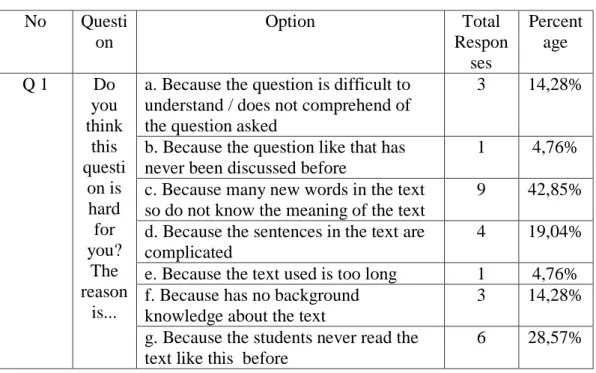
Table 4.10: The Students’ Responses to the Q 1.
No Questi on Option Total Respon ses Percent age Q 1 Do you think this questi on is hard for you? The reason is...
a. Because the question is difficult to understand / does not comprehend of the question asked
3 14,28%
b. Because the question like that has never been discussed before
1 4,76%
c. Because many new words in the text so do not know the meaning of the text
9 42,85%
d. Because the sentences in the text are complicated
4 19,04%
e. Because the text used is too long 1 4,76%
f. Because has no background knowledge about the text
3 14,28%
g. Because the students never read the text like this before
6 28,57%
From the table above, the most of the students’ responds to the (c) option, it achieves the highest percentage that is 42, 85% responses. It means that the students faced the difficulties because they do not know the meaning of many new word in the text. Then the students also faced the difficulties because the text used for question number 1 had never read by students before, the students showed their responses to this point by 28, 57% responses. Next reasons why the students also faced the difficulties to answer the questions because they do not have good grammar comprehension, the students’ responses to this category are 19, 04%. Another difficult faced by students are the students do not comprehend the questions asked to them, in this case, 14,28% of the students’ responded to them. And 4, 76% of the students also faced the difficulties because the lesson has never been learnt before, and length of the text used.
For question number 1, it can be concluded that, the most of the students faced the difficulties because they do not know the meaning of many new words in the text. Consequently, the students do not know what the text tells about and they fail to answer the question correctly.
Table 4.11: The Students’ Responses to the Q 2.
No Questi on Option Total Respon ses Percent age Q 2 Do you think this questi on is hard for you? The reason is...
a. Because the question is difficult to understand / does not comprehend of the question asked
1 4,76%
b. Because the question like that has never been discussed before
0 0%
c. Because many new words in the text so do not know the meaning of the text
8 38,09%
d. Because the sentences in the text are complicated
3 14,28%
e. Because the text used is too long 1 4,76%
f. Because has no background knowledge about the text
3 14,28%
g. Because the students never read the text like this before
7 33,33%
From the table above, the most of the students’ responds to the (c) option, it achieves the highest percentage that is 38, 09% responses. It means that the students faced the difficulties in pertaining to the vocabulary mastery. Then, the students also faced the difficulties because they never read the text like this before, the students’ responses to this category is 33, 33%. Next reasons why the students also faced the difficulties to answer the questions because they do not have good grammar comprehension and they have no background knowledge about the text. The students’ responses toward those reasons are 14, 28%. Another difficulty faced by students are they do not comprehend the question asked to