F
F
i
i
r
r
e
e
P
P
r
r
e
e
p
p
a
a
r
r
e
e
d
d
n
n
e
e
s
s
s
s
Special Investigation
FPB/SIR/30
Table of Contents
F Fiirree PPrreeppaarreeddnneessss ... 1 Introduction ... 1 Background ... 2 Regulatory Framework ... 2What Are The Potential Consequences? ... 2
Approach ... 3
Results ... 5
Wildfire Regulation s. 4 – Contact Details ... 5
Wildfire Regulation s. 5 – Sufficient Fire Tools ... 6
Wildfire Regulation s. 6(2) – Determination Of Fire Danger For High-Risk Activities ... 6
Wildfire Regulation s. 6(3)(a) – Operations Must Be Consistent With Danger Class Restrictions. ... 8
Wildfire Regulation s. 6(3)(b)(ii) – Adequate Fire Suppression System At The Activity Site ... 9
Wildfire Regulation s. 6(4) – Maintaining A Fire Watch ... 12
Wildfire Regulation s. 8 – Precautions To Ensure That An Engine Does Not Cause A Fire ... 12
Wildfire Act s. 9 – Railway Operations ... 13
Wildfire Act s. 10 – Utility Transmission Operations ... 13
Other Practices ... 14 Summary ...14 Good Practices ... 14 Non-Compliance ... 16 Conclusions ...17 Compliance ... 17
Representative Weather Information ... 17
Reliance on Professionals ... 18
Introduction
One of the risks that come with working in the bush is accidentally starting a fire. Since 1950, industrial activities have caused 12.5 percent of wildfires in BC, and all fires caused by humans are preventable.
Being adequately prepared for a fire can help to protect workers; minimize damage to
equipment and infrastructure; safeguard neighbouring communities; and ultimately protect the forest and all its values. Being unprepared for a fire, or unable to demonstrate fire
preparedness, can lead to financial ruin when all the costs and damages are added up. Section 68 of the Wildfire Act (WA) permits the Board to carry out special investigations to determine compliance with parts 1 and 2 of the Act, which includes fire preparedness. The Board decided to do so, to learn how forest operators are addressing the fire-preparedness requirements of the WA and the Wildfire Regulation (WR).
This investigation identifies fire preparedness issues facing those subject to the WA; determines if there are differences in fire preparedness between various groups (e.g., small versus large forest licensees, certified versus non-certified); and highlights fire preparedness practices in the interest of contributing to fire prevention.
Background
Regulatory Framework
Before 2005, the Forest Fire Prevention and Suppression Regulation (FFPSR) specifically described the numbers and types of equipment needed to be prepared for a fire. However, when the WA
and the WR were introduced, government moved to a less prescriptive approach to fire prevention and preparedness, with a greater reliance on forest professionals to decide what preparation is appropriate for their specific operation. For example, while the FFPSR required a “water delivery system” with specific capabilities be on a site in certain conditions, today an “adequate fire suppression system” is required, and it is up to a licensee to decide what “adequate” means.
It was not long before licensees and others subject to the Act and regulation asked for clarification—for example, what is “adequate”? In May 2007, and again in June 2008,i
government released interpretive bulletins to the forest industry providing general guidance to help demonstrate how activities conform to legal requirements. At the same time, industry partners collaborated through a “wildfire guidelines committee” to produce guidelines for fire suppression systems and fire-fighting hand tools.ii The Board understands that further guidance
from the Ministry of Forestry and Range’s (now Ministry of Natural Resource Operations, or
NRO) Wildfire Management Branch (WMB) is under development.
Despite this guidance, however, it is ultimately the responsibility of those subject to the WA to decide the most appropriate fire-preparedness approach to take for their specific circumstances. But licensees have different personalities and tolerance for risk. Some want government to tell them exactly what is required to comply with the law, while others are comfortable with the responsibility for deciding what is reasonable in the circumstances. In the event of a fire, fire preparedness and due diligence—which means taking all reasonable care to comply with the law—will be critically examined by government, and potentially the courts.
What Are The Potential Consequences?
When a forest burns, the Crown loses the value of the timber along with other forest resources such as wildlife habitat and recreation areas. In turn, forest companies can lose valuable equipment, and the safety of workers and neighbouring communities can be put at great risk. A person responsible for starting a fire can be subject to compliance and enforcement actions if they are found to have contravened the WA, and government may levy administrative penalties and recover fire suppression costs and damages. The WMB has stated that it will aggressively
i Available at http://bcwildfire.ca/Industry_Stakeholders/industry/Interpretive_WildfireReg.pdf ii Available at http://www.wsca.ca/index.php?Page=265.0&Key=690
pursue penalties for contraventions,iii and administrative penalties can range up to $100,000.
Fire suppression costs and damages to Crown timber can add up to millions of dollars. For example, in April 2008, a contractor was clearing a hydro right-of-way and burning debris piles on the Sunshine Coast. The fire escaped from a pile and burned 14 hectares of free-growing plantation and 25 hectares of mature forest. The fire centre manager determined that there was no adequate fire-suppression system on site and ordered the contractor to pay $90,000 for damages to Crown timber and $196,000 for suppression costs.
As of February 2011, there have been 13 fire-preparedness determinations (decisions about contraventions) made under the WA that resulted in administrative penalties and/or recovery of costs and damages. These determinations show that the potential for a penalty and/or recovery of fire-fighting costs and damages to Crown timber is real. A summary of these determinations appears in Appendix 1.
However, the risk of being held responsible for suppression costs can be managed by entering into a cost-sharing agreement with government, where a licensee pays government a fee in exchange for government’s agreement that it will either reduce or eliminate its fire suppression costs. Section 20 of the WR authorizes such agreements.
Approach
The Board is only mandated to investigate practices of holders of range or forest tenures, and government. Range tenure holders were excluded from this investigation because, in general, they do not conduct industrial activities as defined under the WA.
The Board selected the 100 Mile House and the former Arrow Boundary forest districts for the investigation based on fire risk, but also to avoid overlapping with other Board work planned for 2010. All the forest licensees in the two districts were potentially subject to investigation. To start, the Board mailed surveys to all woodlot licensees and conducted phone interviews with major licensees. The Board followed this with visits to active sites in the Arrow Boundary Forest District in late August, and in the 100 Mile House Forest District in late September 2010. To increase the sample size and geographic coverage of the investigation, the Board also included fire preparedness results from its annual compliance audit process. Any active sites
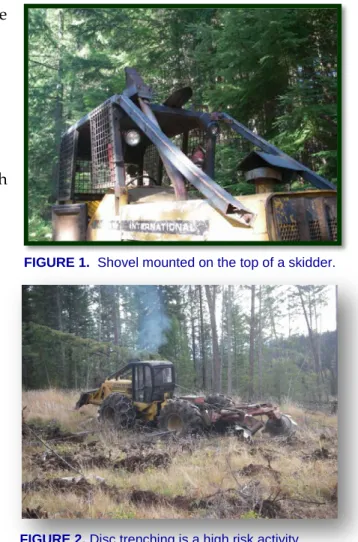
FIGURE 1. Shovel mounted on the top of a skidder.
FIGURE 2. Disc trenching is a high risk activity.
During site visits, the Board examined compliance with the following fire-preparedness
requirements. The applicable section of the WR
appears in brackets.
• Has the licensee provided a 24-hour contact number to an official? (s. 4)
• Is there one fire-fighting hand tool for each person at the site? (s. 5)
• If the activity is high risk:iv
− Has the fire danger class been determined? (s. 6(2))
− Is the reference weather station representative of the site? (s.6(2)(a))
− Is there an adequate fire
suppression system at the activity site? (s. 6(3)(b)(ii))
− If a fire watch is required, does the watcher have adequate means of communication, a fire tool, a view of the site and is he actively patrolling the site? (s. 6(4))
− Are activities consistent with the danger class (i.e. early shift and fire watch)? (s. 6(3)(a))
• Are “engines” in good repair and operating according to manufacturer’s specifications? (s. 8)
For complete fire-preparedness requirements, please refer directly to the Wildfire Actv and the
Wildfire Regulation.vi
The Board received 31 completed surveys from woodlot licensees, interviewed 11 licensees by telephone, and visited 34 active sites to interview licensees and examine fire preparedness. Nineteen active sites were sampled in the Arrow Boundary and 100 Mile House Forest Districts and 15 were sampled during Board audits throughout the province.
iv High-risk activities are defined in the regulation and include using a power saw, mechanical tree felling, mechanical brushing, skidding and cable yarding.
v Available at http://www.bclaws.ca/EPLibraries/bclaws_new/document/ID/freeside/00_04031_01 vi Available at http://www.bclaws.ca/EPLibraries/bclaws_new/document/ID/freeside/11_38_2005
Results
A common theme arising from interviews and surveys was that, in the absence of any explicit direction from government, many licensees rely on the old Forest Fire Prevention and Suppression Regulation to guide fire preparedness. “If it was good enough in 1995, it must be good enough today,” was a common comment. Since the government will not endorse “best management practices” or constructively critique their actions, most licensees assume the old regulation is acceptable by default.
The following section summarizes both the fire-preparedness requirements of the WR and what the Board heard and saw during the course of the investigation with respect to fire
preparedness. It is based on a combination of telephone and personal interviews, surveys and observations in the field. This section also includes determinations made by government officials that give some insight into what it means to be prepared. Finally, practices that contribute to fire prevention and preparedness and help to demonstrate due diligence are highlighted.
Wildfire Regulation s. 4 – Contact Details
If a forest licensee plans industrial activities during the fire season, he or she must provide 24-hour contact details to a government official. This information comes in handy if the official needs to know where the licensee is operating, what equipment and resources are available for fire suppression, or to inform the licensee of a fire.
Of the eight active sites sampled in Arrow Boundary, only two licensees provided contact information to the fire centre. In 100 Mile House, six of nine licensees provided contact information. It is easy to overlook this requirement, but in the event of a fire, this information could be crucial, and not providing it puts forest operators at risk. Providing accurate contact information is part of demonstrating that a licensee has been diligent in preparing for fires. In a determination regarding a fire that occurred on a woodlot in July 2008, ministry staff argued that the woodlot licensee did not provide a 24-hour contact number before starting operations. The licensee argued that the information had been provided. In the face of conflicting evidence, the fire centre manager determined that there had not been a
contravention of the WR, noting that there was no issue contacting the licensee on the day of the fire. In this case, where there was uncertainty, the result is what mattered to the fire centre manager—ministry staff were able to contact the woodlot licensee without difficulty.
FIGURE 4. Shovel mounted directly to a feller buncher.
FIGURE 3. Hand-tank pump mounted on aheadache rack.
Wildfire Regulation s. 5 – Sufficient Fire Tools
The WR requires a fire-fighting hand tool such as a shovel, Pulaski or hand-tank pump for each person on a site when there is a risk of a fire starting or spreading. All but four of the sites sampled met or surpassed this requirement.
Good practices observed included attaching hand tools to each machine and having a shovel, Pulaski and full and
functional hand tank pump in each pickup truck. This often meant there were more hand tools on-site than workers.
Wildfire Regulation s. 6(2) – Determination Of Fire Danger For High-Risk
Activities
A person carrying out high-risk activities must determine the fire danger class by referring to representative weather data for the area. The fire danger class is a relative index of how easy it is to ignite vegetation, how difficult a fire may be to control and how much damage a fire may do. The government has set up a system of weather stations complemented by an easy-to-use website that provides fire danger class information for each weather station.
The danger classes are: 1. Very Low
2. Low - Fires may start easily and spread quickly but there will be minimal involvement of deeper fuel layers or larger fuels.
3. Moderate - Forest fuels are drying and there is an increased risk of surface fires starting. Carry out any forest activities with caution.
4. High - Forest fuels are very dry and the fire risk is serious. New fires may start easily, burn vigorously, and challenge fire suppression efforts. Extreme caution must be used in any forest activities. Open burning and industrial activities may be restricted.
5. Extreme - Extremely dry forest fuels and the fire risk is very serious. New fires will start easily, spread rapidly, and challenge fire suppression efforts. General forest activities may be restricted, including open burning, industrial activities and campfires.
In the past, government provided maps to licensees showing the applicable weather station for each area of a district. It no longer distributes those maps, although some licensees still have and use them. Today, licensees must decide on their own which weather station is
representative of its particular work site, and it may not be the closest station. Government recognizes this and its guidance suggests that licensees may want to consider factors such as slope, aspect, elevation, date of snow melt, or the distance from the weather station. In addition to these factors, the wildfire guidelines committee suggests considering stand conditions, forest health, fuel type and fuel loading. Several licensees identified the need to have more explicit instructions on how to consider these factors in order to select the most appropriate weather station.
One practice observed during the investigation was that of averaging the danger classes of the three nearest weather stations, or three stations surrounding the activity site. However, this approach bears some risk because it means that the person is not thinking about whether or not the information from the three weather stations is representative of a particular work site. Also, averaging may lead a person to underestimate the fire danger, particularly if an extreme value is most representative of a work site. Three licensees averaged the danger class values of three weather stations to determine fire danger, and one licensee did not determine danger class at all.
Government restricts industrial activities based on danger class (see next section) and the Board heard anecdotes of persons picking one weather station over another because conditions
indicated by that station would permit an activity to continue versus shutting the activity down. For example, in a March 2007 determination about a fire caused by a metal machine track on a rock, a fire centre manager noted that the licensee did not use the weather station closest to a work site. Instead it used a more distant weather station that indicated a lower danger class, and a fire resulted. The fire centre manager said that there should have been a clearer rationalization regarding the choice of weather station.
The example above demonstrates the risk in choosing one site over another because of a lower danger class—it is difficult to demonstrate that a station is representative of a site without a solid rationale. The flip side of this issue is that a conscientious licensee may needlessly shut down early if it uses information from a non-representative site with a higher danger class. Ultimately, it makes sense that an on-site weather station would be the most representative weather station. Weather stations are available for purchase or rent and they provide the same quality of information as the government stations. However, they are expensive and vandalism is a concern when equipment is set up in remote locations. The user also needs the knowledge and tools to be able to convert the observed weather data into a danger class figure in order for the information to be useful.
FIGURE 6. A rain gauge.
Good practice – Tolko Cariboo Woodlands
Tolko has implemented a standard operating procedure for obtaining representative weather data. Supervisors, with input from contractors, consider the following when determining whether a weather station is representative of a particular site:
• Is the station at a similar or lower elevation?
• Does it receive similar weather? (e.g., similar exposure, is it an upslope area or in a rain shadow; does it experience high winds or is it sheltered?)
• Is the station operational and accurate?
Once the representative weather station is selected, Tolko’s contractors record precipitation using rain gauges at the activity site. The rainfall amount is radioed to the office where the danger class is calculated based on the precipitation and temperature at the site and the relative humidity and wind speed data from the representative weather station. This calculation can be done using either computer software or tables.
Contractors work according to the site-specific danger class. Tolko supervisors may reconsider the danger class if the representative weather station is higher, taking into account weather trends, precipitation amounts and coverage, on-site winds and other risks.
Wildfire Regulation s. 6(3)(a) – Operations Must Be Consistent With
Danger Class Restrictions
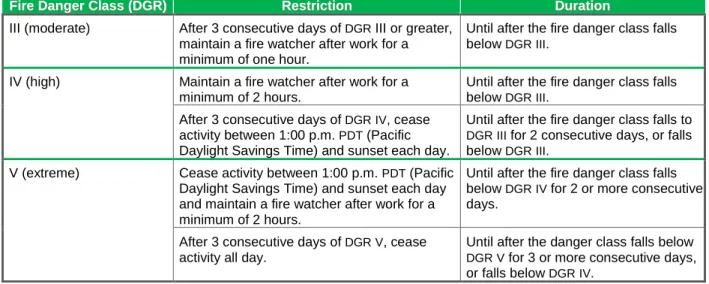
Government restricts high-risk activities based on danger class. For example, after three consecutive days of danger class 4, the WR requires that activities shut down from 1:00 pm to sunset each day and that there must be a two-hour fire watch after work. This is called “early shift.” The complete WR requirements appear in Table 1.
TABLE 1. Schedule 3 of the Wildfire Regulation – restrictions on high-risk activities
F
FiirreeDDaannggeerrCCllaassss((DDGGRR)) RReessttrriiccttiioonn DDuurraattiioonn
III (moderate) After 3 consecutive days of DGR III or greater, maintain a fire watcher after work for a minimum of one hour.
Until after the fire danger class falls below DGRIII.
IV (high) Maintain a fire watcher after work for a minimum of 2 hours.
Until after the fire danger class falls below DGRIII.
After 3 consecutive days of DGRIV, cease activity between 1:00 p.m. PDT (Pacific Daylight Savings Time) and sunset each day.
Until after the fire danger class falls to DGRIII for 2 consecutive days, or falls below DGRIII.
V (extreme) Cease activity between 1:00 p.m. PDT (Pacific Daylight Savings Time) and sunset each day and maintain a fire watcher after work for a minimum of 2 hours.
Until after the fire danger class falls below DGRIV for 2 or more consecutive days.
After 3 consecutive days of DGRV, cease activity all day.
Until after the danger class falls below DGRV for 3 or more consecutive days, or falls below DGRIV.
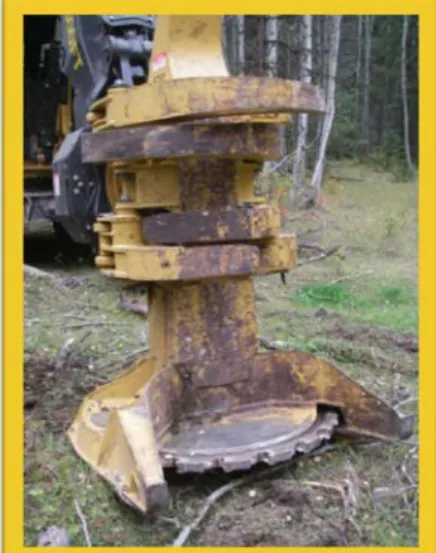
FIGURE 7. A feller-buncher head. The rotating saw blade can create sparks when it strikes a rock.
The Board did not encounter any activities continuing past 1:00 pm where prohibited, nor any sites where a fire watch should have been present but was not. It was not practical to examine this requirement for any of the sites visited before 1:00 pm on days when early shift was required because activities had not shut down at the time.
Some licensees modify their practices to minimize risk through timing of operations and choice of equipment. For example, this summer Monte Lake Forest Products processors worked from 2:00 am until noon. They also avoided working on rocky terrain with tracked equipment and used hand-falling instead. Many woodlot licensees told us that they have the flexibility to avoid working during the heat of the summer.
The possibility of fire caused by feller-buncher heads was a concern voiced by almost every operator the Board
interviewed. Fires start either by the buncher head striking rock and throwing a spark or by friction when small branches or debris get jammed in the felling head. One licensee
manages risk by shutting down his feller-bunchers two hours before the rest of his equipment. In effect, this provides an additional two-hour fire watch as the rest of the operation remains active.
Tolko’s Okanagan Regional Woodlands goes a step beyond the danger class ratings provided by government and
completes a risk assessment matrix for high-risk activities. The assessment is a one-page form that assigns points to risk factors including stand type, fuel loads, duff moisture, slope, type of operation (e.g., bunching or processing) and the distance to water to refill portable tanks. Based on the total points, the supervisor may impose early shift and a fire watch, even if not required by the danger class. In high-risk situations, log loading is limited to early shift, and buncher and stump-side processing operations are suspended.
Wildfire Regulation s. 6(3)(b)(ii) – Adequate
Fire Suppression System At The Activity Site
Persons conducting a high-risk activity when there is a risk of a fire starting or spreading must keep an adequate fire suppression system at the activity site. Without exception, all of the systems encountered consisted of a water source, pump, hose and accessories such as a nozzle, otherwise known as a water delivery system. Occasionally foam will be added to the water to stretch its fire-fighting power,FIGURE 11 & 12. Portable water tank with a compartment for pump, hose and fittings (left). Close up of the pump inpicture (right).
In general, licensees want to be able to get water to any part of the activity site to extinguish a fire. WMB
guidance suggests that a suppression system using water should be nearby, operational and capable of being deployed in a reasonable amount of time, taking danger class into consideration. This suggests that readiness should escalate as danger class increases and that water should be closer when the danger class is higher. In practice, water tanks are often positioned on the road at the entrance to a cutblock, or in a central location when more than one site is active.
Determinations also give some indication of what is adequate or inadequate. Fire centre managers have made nine determinations involving fire-suppression systems, summarized below:
• Four sites had no suppression system at all.
• At four sites, the water delivery system was not at the activity site. Water was:
− 1.4 kilometres distant in danger class 4;
− 3.8 kilometres distant in danger class 4;
− 18 kilometres distant in danger class 3; and
− 15 minutes return travel time away. The fire centre manager did not have evidence to correctly determine the danger class.
• One suppression system at a site-preparation operation was considered inadequate. It consisted of a five-gallon hand tank pump and three ten-pound fire extinguishers. The danger class was 5 (extreme).
FIGURE 9. Retired municipal fire truck used as part of a fire-suppression system.
FIGURE 10.
Pump, hose, fittings and a foamtank.
The Board found eight examples of apparent non-compliance related to adequate suppression systems:
• five sites had no suppression system at all;
• at one site the water tank was three kilometres away and there was not enough hose to deliver water to all parts of the block in danger class 4;
• at one site the water tank was three kilometres away in danger class 1; and
• at one site the tank, hose, nozzles and pump were incompatible and could not function together to deliver water to a fire.
Good practices observed
The Board observed the following good practices related to fire-suppression systems and preparedness:
• Consideration of the size and topography of the block before work began to ensure there was adequate hose to get water to any part of the block.
• More than one water tank on a site, placed to be near different activities.
• A pre-work meeting to check fire preparedness with weekly checks afterwards.
• Testing of equipment, including starting up the pump and holding regular fire suppression drills.
• Moving the water source around the site to keep it closest to the highest risk activity.
• Use of foam to extend the supply of water.
• Fire centre phone number painted on the water tank.
Some companies have standard operating procedures for adequate suppression systems. Here are two examples:
Ainsworth Engineered Canada LP
There must be enough hose to reach from the water supply to any part of a block—at a
minimum, one pump and 1,500 feet of hose is required. If there is no water supply on the block then a water tank with at least 500 gallons, if using foam, and 1,000 gallons if not using foam is required.
Tolko Cariboo Woodlands
In order to be able to apply water to any part of a block within ten minutes, contractors must have 2,200 litres (500 gallons) of water and 250 metres (820 feet) of hose on site. Note that the activity site is not necessarily the cutblock—if there are different activities within the cutblock, the water-delivery system should be located closest to the highest-risk activity, but available to all activities. As well, no high-risk activities are to be conducted in danger class 5 conditions
Wildfire Regulation s. 6(4) – Maintaining A Fire Watch
After three consecutive days of danger class 3 or greater, licensees must keep watch on a site for one hour after work. This requirement is extended to two hours after work when operating in danger class 4 or greater. A fire watcher must be able to see the site of the high-risk activity, have at least one fire tool on hand, and must have the means to report a fire. In addition, he or she must actively watch and patrol for sparks and fires and immediately carry out fire control if practicable.
Sometimes an operator will service his or her equipment after work, but this practice does not satisfy the requirement for a fire watch. In a 2008 case, a feller-buncher operator stopped harvesting at 1:00 pm and walked his machine back to the road to refuel it. The operator was also the fire watcher. The machine’s metal track contacted a rock and started a fire. The operator did not notice the fire until about 1:30 pm as he serviced the machine. The fire centre manager determined that the fire watcher did not have a view of the site of the high-risk activity and did not actively watch and patrol the site for sparks or fires.
At one site visited by the Board, an operator was processing trees in one corner of a block. He could not see the majority of the block and was concentrating on his work rather than actively patrolling for fires.
Good practice – Interfor Adams Lake Lumber
Interfor’s Adams Lake Lumber operation has developed a fire watch checklist as part of its fire-preparedness plan. This checklist reminds the fire watcher to walk through the block and focus on the sites where high-risk activities such as falling, bunching and skidding took place and record where he or she patrolled, and at what time. The form also contains a place to record wind speed, temperature, weather and other details. By actively patrolling the high-risk areas and completing the form, the fire watcher demonstrates diligence in meeting fire-watch requirements.
Wildfire Regulation s. 8 – Precautions To Ensure That An Engine Does
Not Cause A Fire
Skidders, excavators, feller-bunchers and other equipment used in industrial activities in the forest must be operated, equipped and maintained, so as not to cause fires. Engines must have spark arrestors and the exhaust system and muffler must be operating within manufacturer specifications.
There have been no determinations under the Act about the use of engines. On one site visited, the Board encountered a skidder operating without a muffler, which is a contravention of s. 8(e) of the WR.
Good practices
• Clean machines daily to remove needles, branches and other debris to reduce the risk of a fire.
• Ensure all equipment is equipped with a spark arrestor, and that the exhaust system and muffler are in good repair and operating within manufacturer specifications.
Wildfire Act s. 9 – Railway Operations
A railway company must maintain its equipment to prevent the start of fires, maintain the right-of-way so that it is mostly free of combustible material such as dry grass, and sufficiently patrol the right-of-way in order to detect fires.
The Board did not examine railway operations as part of this investigation because a railway is not considered a “party” as defined by WA. However, fire centre managers have made three determinations under the WA about railway-caused fires:
• In July 2005, a hot metal fragment from a train ignited a 5,560-hectare fire near Spences Bridge. The fire centre manager determined that the railway did not adequately
maintain its equipment or its right-of-way.
• The same train ignited a 1.5-hectare fire further down the line. Again, the fire centre manager determined that the railway did not adequately maintain its equipment.
• In February 2010, a fire centre manager determined that a railway caused, or contributed to, the spread of 10 separate fires during the 2008 fire season.
Wildfire Act s. 10 – Utility Transmission Operations
Utility transmission equipment such as power lines and poles must be maintained to reduce the likelihood of starting a fire. Related sites, such as a right-of-way, must also be maintained to prevent fires from spreading.
The Board did not examine utility transmission operations as part of this investigation, but a fire centre manager made a determination about a fire caused by a transmission line.
In July 2006, a dead tree fell on a power line leading to a communications tower southwest of Kamloops, causing a 380-hectare fire. The fire centre manager determined that the utility company did not maintain its equipment and that it had contravened s. 10(a) of the WR. The determination was appealed to the Forest Appeals Commission, which also found that the utility was liable and that the utility company had failed to establish due diligence as a defense; in other words, it did not take reasonable steps to comply with the law. A vegetation
Other Practices
Annual fire-preparedness planning and training
Many licensees, especially those that participate in voluntary forest certification initiatives, conduct annual fire-preparedness planning and training. Contractors and company employees meet before the fire season to review the requirements of legislation, practice using fire
equipment and review past fires with an eye toward continuous fire preparedness improvement.
Before work begins at a site, contractors and licensees review all fire-preparedness requirements during a pre-work meeting and complete a fire preparedness checklist. Regular inspections of the site confirm that fire-preparedness requirements are being met, and, in addition to regular inspections, some licensees also conduct surprise audits.
While details may differ slightly between licensees, standard operating procedures and
checklists clearly communicate a licensee’s expectations around fire preparedness, and provide a record of inspections. Regular on-site monitoring further helps to demonstrate that a licensee has taken reasonable steps to ensure its contractors or crews are taking reasonable steps to prevent fires.
Summary
Good Practices
Suggestions for being diligent about fire preparedness:
General
Consider developing standard operating procedures and checklists. These clearly communicate a licensee’s expectations around fire preparedness, and provide a record of inspections. Regular on-site monitoring further helps to demonstrate that a licensee has taken reasonable steps to ensure that its contractors or crews are taking reasonable steps to prevent fires.
Contact details
Provide 24-hour contact information to the fire centre before March 31 each year. Information about active operating areas and what equipment is on site is also useful to the fire centre.
Sufficient fire tools
Attach hand tools directly to machines and equip pick-ups with a shovel, Pulaski and a full and functional hand tank pump to ensure that there will always be enough tools for each worker even if individual tools are lost or broken.
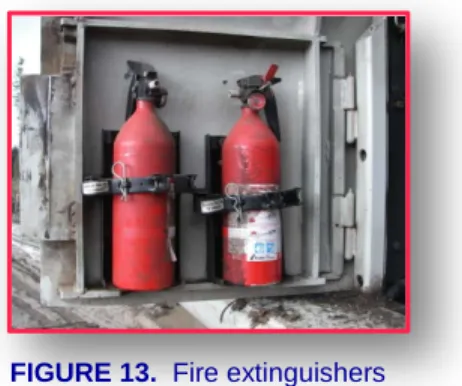
FIGURE 13. Fire extinguishers mounted on an excavator.
Selecting a representative weather station
When determining whether or not a weather station is representative of a work site, consider slope, aspect, elevation (is the station at a similar or lower elevation than the work site), date of snow melt, distance from the weather station and topographical considerations (e.g., is the work site sheltered or subject to high winds?). The wildfire guidelines committee further suggests considering stand conditions, forest health, fuel type and fuel loading. If accessible, also consider the weather station maps previously available from the government. Selecting a number of nearby weather stations and averaging the danger classes is not recommended. Document the reasons for selecting the representative weather station.
Operating in accordance with danger class restrictions
Operating according to the danger class restrictions is the law, but it should be viewed as a minimum requirement. Consider modifying activities as the danger class increases, for example:
• move to early shift before it is legally required;
• avoid tracked or chained equipment on rocky ground in high and extreme danger class; and
• avoid conducting high-risk activities when only one worker is present, when the danger class is very high or extreme.
Adequate suppression system
Before work begins, consider the size and topography of the work site to ensure that the suppression system can provide water to any part of the block should hand tools and fire extinguishers become ineffective. Identify on-site water sources and make sure everyone knows where they are.
Conduct a pre-work meeting to check fire preparedness, with weekly checks afterwards. Test equipment, including starting up the pump(s) and ensuring that parts are compatible and in good repair. Hold regular fire-suppression drills to test response time. Document these activities.
Consider having more than one water source on site, placed so as to be near different activities. Move the water around the site to keep it closest to the highest-risk activity.
Maintaining a fire watch
A fire watch must actively patrol the work site and be able to see the area where work took place. Performing other duties, such as maintaining a machine or processing wood while on fire watch does not satisfy the legal requirements for a fire watch. Ensure that the fire watch has the ability to call for help.
Engines
Ensure all equipment has a spark arrestor, that the exhaust system and muffler are in good repair and that the machine is operating within manufacturer’s specifications. Clean machines daily to remove needles, branches and other debris so as to reduce the risk of a fire.
Non-Compliance
Thirty-four active sites were sampled in the field—15 major licensees, 17 BC Timber Sales (BCTS) licensees and 2 contractors to BCTS. There were eight operations not compliant with the WA or WR—one major licensee, six timber sale licensees and one BCTS contractor.
1. Fire danger class 4 (high). Timber sale licensee operating under
BCTScertification.
The operation was on early shift and had shut down at 1:00 pm. A processor operator was the fire watch. The operator was processing logs in one part of the block but was not actively patrolling the activity site and could not see most of the activity site. The suppression system consisted of 250 gallons of water, a nozzle and 100 feet of hose. There was no pump on site. The suppression system could not deliver water to every part of the block. As well, the water tank was located three kilometres from the processor. The Board found this suppression system to be inadequate. This is non-compliance with 6(4)(a), 6(4)(c) and 6(3)(b)(ii) of the WR.
2. Fire danger class 4 (high). Timber sale licensee operating under
BCTScertification.
Falling and road construction were underway in a block. There were not enough hand tools for each worker on site and there was no suppression system on site. This is non-compliance with s. 5 and s 6.3 of the WR.
3. Fire danger class 4 (high). Timber sale licensee operating under
BCTScertification.
Falling and road construction were underway in a block. There were insufficient hand tools for each worker on site and there was no suppression system on site. This is non-compliance with s. 5 and s 6.3 of the WR.
4. Fire danger class 2 (low). Major licensee not certified.
Logs were yarded to a road, bucked by hand and piled with a machine. There were two hand tools for three workers and no suppression system at the activity site despite the high-risk activity (yarding). The licensee did not determine fire danger class. This is non-compliance with sections 5, 6(2) and 6(3) of the WR.
5. Fire danger class 1 (very low). Timber sale licensee operating under
BCTScertification.
A feller-buncher was cutting road right-of-way in a new block. A fire suppression system was located three kilometres away at the previous block, which was still active. Falling is a high-risk activity and there was no suppression system at the activity site. This is non-compliance with 6(3)(b)(2) of the WA.
6. Fire danger class 1 (very low). Timber sale licensee operating under
BCTScertification.
A grapple skidder was skidding wood to roadside, which is a high-risk activity. The skidder had no muffler, and there was no suppression system or hand tools on site. This is
non-compliance with section 8(e), 6(3)(b)(2) and 5 of the WR.
7. Fire danger class 1 (very low). Timber sale licensee operating under
BCTScertification.
The suppression system at a logging site consisted of a water tank and 50 feet of hose. There was no nozzle, fittings or a pump. A second water tank was empty. The suppression system was not adequate. This is non-compliance with section 6(3)(b)(ii) of the WR.
8. Fire danger class 1 (very low). Contractor working under
BCTScertification.
The contractor was doing mechanical-site preparation with a disc trencher, which is a high-risk activity. There was no suppression system on site. This is non-compliance with section
6(3)(b)(ii) of the WR.
Conclusions
Compliance
With only one exception, all of the major licensees sampled complied with the fire-preparedness requirements of the Wildfire Act. Most major licensees had some form of standard operating procedures for fire preparedness and monitored operations on a regular basis to ensure compliance.
The fire preparedness of timber-sale licensees and BCTS contractors was variable, ranging from excellent to poor. Of the 19 worksites visited, 7 did not comply with the WA. Despite the consequences of an industrial fire, some licensees and contractors are taking significant risks.
Representative Weather Information
Under the current system, weather information from network weather stations is applied to industrial operations that are often many kilometres away. This information is often not
A lot of effort is spent on using remote fire weather information to try to predict fuel moisture and danger class at a particular site rather than simply measuring fuel moisture on site. Many licensees told us that they would appreciate more direction from government on how to ensure that weather data is representative of a particular work site, and a simple and cost effective way of measuring fuel moisture would support that. At least one licensee is already doing so by collecting precipitation information on site and combining it with data from a representative weather station to calculate an on-site danger class.
Reliance On Professionals
Relying on professionals in the context of fire preparedness is not working as well as it could and one reason is the lack of availability of wildfire management expertise.
In the case of harvesting or engineering, there are many knowledgeable and experienced professionals, well-established best management practices, and a robust communications
network between academia, industry, consultants, regulating bodies and government. The same cannot be said for wildfire management—outside of government, there is an ongoing shortage of knowledgeable and experienced forest professionals. As a result, the probability of being unprepared for a fire is much higher.
A lack of detailed guidance from government is also an issue. Industry requires a level of assurance that its actions are reasonable, but in the absence of specific government guidance, licensees often default to the requirements of the old legislation. In the longer term this will likely increase costs to both government and industry, as best management practice will be developed by the courts rather than by professional fire managers. Timber-sale licensees in particular generally do not have in-house fire management expertise and they have limited capacity to obtain that expertise from elsewhere. They need guidance, coaching and mentoring from government.
Several licensees told the Board that they are taking on the brunt of the risk, but government is not providing the guidance to manage that risk. While the Board understands that government wants to encourage innovation and some licensees may appreciate the opportunity to innovate, government still needs to provide leadership and clear standards that will be used to judge performance. Many licensees suggested that the pendulum may have swung too far from prescriptive requirements to reliance on professionals, and that perhaps there is a place in-between where government can provide some direction and assurance while still encouraging innovation.
Government has listened to the concerns of industry and is developing industry guidance on wildfire prevention and suppression response. Licensees will have a choice—they can either use their own prevention and response system or they can use a system as defined in the guidance. The guidance is expected to be in place before the 2011 fire season.
Appendix 1: Fire Preparedness Determinations
D Deetteerrmmiinnaattiioonn DDeessccrriippttiioonn SSuupppprreessssiioonn C Coossttaanndd D Daammaaggee E Essttiimmaattee P Peennaallttyy l leevviieedd D Daammaaggeess// C Coossttsslleevviieedd C Coommmmeennttss DCH 24064 March 2007A contractor’s feller-buncher track ran over a rock and the resulting sparks ignited a 2.4 hectare fire. The weather station used was not representative of the site. The licensee and contractor contravened sections 3(1)(b) and 6(2) of the Wildfire Act (WA).
$2,190.60 suppression cost.
0 0 The district manager noted that a weather station close to the work site was not used, and that it showed a higher danger class rating than the station that was used. There should have been a clearer rationalization on the choice of weather station.
The licensee is responsible for establishing a free-growing stand on the burned area.
DCH 25287 August 2007
A contractor had an agreement with a private landowner to remove beetle-killed timber. The site was rocky and a feller-buncher track ignited a fire. The fire danger was 5 (extreme) and had been for 7 days (i.e., no high-risk activities were permitted at all). There was no suppression system on site. The fire centre manager determined that the contractor contravened 3(1)(b) and 6(2)(a) and (b) of the WA and 6(3)(a) and (b)(ii) of the WR.
$41,000 in suppression costs. $2,310 $34,758 in costs charged to the contractor. Penalty breakdown: $1,600 (contractor) $240 (supervisor) $120 (operator) $350 (landowner) DCS 24770-1 June 2008
A hot metal fragment from a train ignited a 5,560 hectare fire. The railway did not sufficiently patrol the line and did not adequately maintain its equipment or its right-of-way. The railway contravened WA 3(1), WR 9(a), 9(b) and 9(c). $5.7 million suppression cost and $340,000 in damages. $11,000 $255,000 for damage to Crown timber.
The province did not seek
suppression costs because it had a Fire Control and Cost Sharing agreement in principle with the railway.
DCS 24770 June 2008
A hot metal fragment from a train ignited a 1.5-hectare fire. The railway did not adequately maintain its equipment. The railway contravened WR 9(a).
$7,237
suppression cost.
$1,000 0 The province did not seek
suppression costs because it had a fire control and cost sharing agreement in principle with the
D Deetteerrmmiinnaattiioonn DDeessccrriippttiioonn SSuupppprreessssiioonn C Coossttaanndd D Daammaaggee E Essttiimmaattee P Peennaallttyy l leevviieedd D Daammaaggeess// C Coossttsslleevviieedd C Coommmmeennttss DOS 25265 August 2008 and October 2009
A contractor was working for a licensee. A feller-buncher ignited a 134-hectare fire. The contractor did not have an adequate
suppression system on site, did not maintain an adequate fire watch and did not adequately patrol. The contractor contravened WR 6(3)(b)(ii), 6(4)(a), 6(4)(c). The licensee was deemed to be vicariously liable.
$1.26 million in damages to Crown timber and $726,000 in suppression costs. $20,000 for contractor and $0 for licensee. $122,000 in damages billed to contractor, none billed to licensee.
The licensee appealed the determination to the Forest Appeals Commission but before the appeal was heard, the parties reached an agreement and the determination against the licensee was rescinded.
DOS 25294 September 2008
A contractor’s feller-buncher started a fire which eventually grew to 1,811 hectares. A water tank was 1,400 metres away. The fire centre manager found that there was no adequate suppression system on site. Contractor and licensee both contravened section 6(3)(b)(ii) of the WR.
$6.7 million in damages to Crown timber and $1.77 million in suppression costs. $10,000 for contractor and $10,000 for licensee. A decision on cost and damages was to come later.
The licensee and contractor appealed the determination to the Forest Appeals Commission. Before the appeal was heard, the parties reached an agreement and the determination against the licensee was rescinded. The government is now suing the licensee for damages. The contractor’s estate and the government reached an agreement and the estate withdrew its appeal. DHW 26454
December 2008
A licensee’s feller-buncher started a 70-hectare fire. A water tank and pump were 3.8 kilometres away and the fire watcher had no means to report a fire. The fire centre manager found that there was no adequate suppression system on site and no means to report the fire. Licensee contravened 6(3)(c) of the WA and 6(3)(b)(ii) and 6(4)(e) of the WR.
No estimate of damages or cost provided. $5,000 0 K20280 May 2009
A snag fell on a power line and started a fire that grew to 380 hectares. The fire centre manager determined that the utility did not maintain its equipment. The utility contravened WR 10(a). $1.27 million suppression cost and $868,000 in damages to Crown timber.
0 $2.14 million The utility appealed to the Forest Appeals Commission. The Forest Appeals Commission determined that the utility was liable, consistent with the fire centre manager’s determination and the appeal was dismissed in Oct. 2010. The utility has appealed to the BC Supreme Court.
D Deetteerrmmiinnaattiioonn DDeessccrriippttiioonn SSuupppprreessssiioonn C Coossttaanndd D Daammaaggee E Essttiimmaattee P Peennaallttyy l leevviieedd D Daammaaggeess// C Coossttsslleevviieedd C Coommmmeennttss DCC 26216 July 2009
A contractor’s feller buncher started a
29.5-hectare fire. A water delivery system was 18 kilometres away. The contractor and licensee used information from a weather station 25 kilometres away. A nearby weather station indicated a higher danger class and operations should have shut down at 1:00 pm. The fire centre manager determined that the weather station used was not appropriate and that there was no adequate suppression system on site. The contractor contravened 6(2) and (3) of the WR. Licensee also liable.
No estimate provided. $0 for contractor and $4,700 for the licensee.
0 $300,000 in equipment was burned in the fire.
DAB 26543 August 2009
A tracked excavator was doing site preparation and started a fire which grew to 190 hectares. The licensee had difficulties reporting the fire to government. The suppression system on site was a five-gallon back pack tank and three ten-pound fire extinguishers. The fire centre manager determined that this was insufficient for the conditions and the licensee contravened WR 6(3)(b).
$93,000 in damages to Crown timber.
$5,000 0 Government did not seek
suppression costs because BCTS had paid the fire protection levy. The determination was appealed to the Forest Appeals Commission but upon agreement of the parties, the Forest Appeals Commission rescinded the order.
February 2010 A railway caused or contributed to the spread of 10 fires. $42,700 in suppression costs. 0 $42,700 for costs. DSC 26763 March 2010
A contractor clearing a hydro right-of-way burned a slash pile. The fire escaped and burned 14 hectares of free-growing plantation and 25 hectares of mature forest. The fire centre manager determined that there was no adequate suppression system on site. The contractor contravened s. 6(1) WA. $90,000 in damages and $196,000 in suppression costs. 0 $286,000 in costs and damages. DOS 26935 April 2010
A fire started on a woodlot the day after the licensee was logging. The suppression system was located 15-minutes return travel time away. The fire centre manager determined that the licensee did not have an adequate suppression system on site and did not determine the fire danger class. The woodlot licensee
No estimate provided.
$1,250 0 The fire centre manager could not determine the cause of the fire based on the evidence.
PO Box 9905 Stn Prov Govt
Victoria, BC V8X 9R1 Canada
Tel. 250.213.4700 | Fax 250.213.4725 | Toll Free 1.800.994.5899
For more information on the Board, please visit our website at: www.fpb.gov.bc.ca