Generalized Potential Heuristics for Classical Planning
Guillem Franc`es
,
Augusto B. Corrˆea
,
Cedric Geissmann
and
Florian Pommerening
University of Basel, Basel, Switzerland
{
guillem.frances,augusto.blaascorrea,cedric.geissmann,florian.pommerening
}
@unibas.ch
Abstract
Generalized planning aims at computing solutions that work for all instances of the same domain. In this paper, we show that several interesting plan-ning domains possess compact generalized heuris-tics that can guide a greedy searchin guaranteed polynomial timeto the goal, and which work for
any instance of the domain. These heuristics are weighted sums of state features that capture the number of objects satisfying a certain first-order logic property in any given state. These features have a meaningful interpretation and generalize naturally to the whole domain. Additionally, we present an approach based on mixed integer lin-ear programming to compute such heuristics auto-matically from the observation of small training in-stances. We develop two variations of the approach that progressively refine the heuristic as new states are encountered. We illustrate the approach em-pirically on a number of standard domains, where we show that the generated heuristics will correctly generalize to all possible instances.
1
Introduction
Domain-independent planners scale up nowadays to prob-lems with very large state spaces, but the solutions they compute typically work only on a single problem. Gener-alized planning, in contrast, aims at computing more gen-eral solutions that work for potentially infinite classes of problems with similar underlying structure [Levesque, 2005; Srivastavaet al., 2008; Bonetet al., 2009; Hu and De Gia-como, 2011]. Once a generalized solution is found, instan-tiating it for a concrete problem of the class usually requires little effort. A possible generalized solution for the problem of clearing a particular blockbin Blocksworld, for instance, would somehow represent the idea that blocks abovebneed to be picked up and put away repeatedly untilbis clear.
Recently, Bonetet al. [2019] have shown how to learn an abstraction over a first-order logical language from sample in-stances, and how to use a fully-observable non-deterministic planner to obtain a generalized policy from that abstraction [Bonetet al., 2017]. Building on their work, we instead try to find generalized heuristics that capture greedy strategies in
planning domains. For that, we use the same feature space as Bonetet al. [2019], where features encode how many ob-jects in a state of the problem satisfy some property, such as “the number of blocks above blockb”. These features are de-fined in the first-order language of the domain description and are meaningful and easily interpretable [Foxet al., 2017]. We show that simple linear combinations of these features exist in many domains which aredescending and dead-end avoiding
heuristics as defined by Seippet al. [2016]. Such heuristics can be seen both as astrong measures of progressas defined by Parmar [2002], and as a generalization ofpotential heuris-tics[Pommereninget al., 2015], and can be used in a greedy search to reach the goal in a polynomial number of steps. The key difference with standard potential heuristics is that our heuristics are instance-independent: once found, they can be used in any instance of the domain.
We start by providing some background and formaliz-ing generalized potential heuristics (Sections 2–3). In Sec-tion 4 we demonstrate that generalized descending and dead-end avoiding potential heuristics exist for many standard do-mains. In Section 5 we show how to learn these heuristics au-tomatically from small training instances using a mixed inte-ger program (MIP). We present empirical results for a number of domains in Section 6, and conclude by discussing related work and the implications of this work in Sections 7 and 8.
2
Background
We start by introducing the formal basis and notation of plan-ning tasks, generalized planplan-ning, and concept languages.
2.1
Classical Planning Formalism
We consider deterministic planning tasks that compactly rep-resent a state space plus a first-order vocabulary with an in-terpretation over states. The state space of a task is a tuple
hS, L, T, sI, SGi, whereSis a set ofstates,La set oflabels,
T⊆S×L×Sthetransition relation,sI ∈Stheinitial state,
andSG ⊆ Sthe set ofgoal states. It is deterministic: for a
statesand labellthere is at most one transitionhs, l, s0i ∈T. The first-order vocabulary of a task is a tuple Σ =
hV,F,Pi, whereV is a set of variables,F a set of function symbols andP a set of predicate symbols. Each predicate and function symbol has an arity inN+0. We assume w.l.o.g. thatP contains only unary and binary predicates, andF con-tains only nullary functions, i.e., constants. Function symbols
with arityn > 0can be compiled into(n+ 1)-ary predicate symbols and predicate symbols with arityn >2 can be re-placed by multiple binary predicates. Each states∈Sin the planning task represents a first-order interpretationI(s)that assigns a truth value to any formula in the language induced byΣ. We writes|=ϕif formulaϕis true underI(s).
Classical planning tasks represented in PDDL [McDer-mott, 2000] fit our definition by using the set of PDDL ob-jects as constants and all possible sets of ground atoms as the set of states. More expressive formalisms such as Functional STRIPS [Geffner, 2000] also fit our definition after compiling away function symbols.
The set ofsuccessorsof statesconsists of all statess0such thaths, l, s0i ∈T for some labell. Apathbetween statess0 andsnis a sequence of labelshl1, . . . , lnisuch that there are
statess1, . . . , sn−1withhsi−1, li, sii ∈T for1≤i ≤n. A planis a path from the initial statesI to some goal state. A
state is calledreachableif there is a path to it fromsI, and it
is calledsolvableif there is a path from it to a goal state. A state isaliveif it is solvable, reachable and not a goal state.
2.2
Generalized Planning
Generalized planning is interested in finding solutions that work for a whole class of planning tasks [Srivastavaet al., 2008]. We call a set of planning tasks all using the same set of predicate symbols ageneralized planning domain. The plan-ning tasks in a domain can still have different sets of constants and thus different state spaces. In PDDL, there is a syntactic distinction between objects that are used in all tasks of a do-main and those that are used in one task only. While both are constants from a first-order logic point of view, we refer to the former asPDDL-level constantsto distinguish them.
In Blocksworld, for instance, all instances use predicates
on,clear, etc., but have different constants for the blocks be-ing used. If Blocksworld was encoded with a constant repre-senting the table, this constant would be a PDDL-level con-stant, while the ones representing blocks would not.
For the challenge of finding a general solution to a domain to be feasible, we assume that its instances share a common underlying structure.
2.3
Concept Languages
Concept Languages or description logics are a family of knowledge representation formalisms based on tractable sub-sets of first-order logic [Baaderet al., 2017]. They build on the notions of concepts, classes of objects that share some property, androles, relations between these objects. Several description languages have been studied in the literature, each with different expressivity. We here use the standard language
SOIwith equality role-value-maps.
Syntax. Formally,complex concepts and roles are defined inductively from sets of given (application-dependent) prim-itiveconcepts and roles, which are, respectively, unary and binary first-order predicates. Any primitive concept is a con-cept, and any primitive role is a role. Theuniversal concept >and thebottom concept ⊥are also concepts. LetC and C0 be concepts, andR andR0 roles. Thenegation¬C, the
union CtC0, the intersection C uC0, theexistential re-striction∃R.C, theuniversal restriction∀R.C, and the role-value-mapR = R0 are also concepts, and ifa
1, . . . an are
constants, thenominal{a1, . . . an}is a concept. Theinverse
roleR−1, the (non-reflexive)transitive closureroleR+, and thecompositionroleR◦R0are also roles.
Semantics. The semantics of the above constructs are de-fined relative to a givenuniverse∆. A model·Mmaps each
constant to an element of∆, each primitive concept to a sub-set of∆, and each primitive role to a subset of∆×∆. The definition ofMextends to complex concepts and roles:
>M= ∆, ⊥M=∅, (¬C)M= ∆\CM, {a1, . . . an}M={aM1 , . . . aMn }, (CtC0)M=CM∪C0M, (CuC0)M=CM∩C0M, (∃R.C)M={a| ∃b: (a, b)∈RM∧b∈CM}, (∀R.C)M={a| ∀b: (a, b)∈RM→b∈CM}, (R=R0)M={a| ∀b: (a, b)∈RM↔(a, b)∈R0M}, (R−1)M={(b, a)|(a, b)∈RM}, (R◦R0)M={(a, c)| ∃b: (a, b)∈RM∧(b, c)∈R0M}, (R+)M={(a0, an)| ∃a1, . . . , an−1: (ai−1, ai)∈RMfor all1≤i≤n}.
Complexity. We define thecomplexityK(X)of a concept or roleX as the size of its syntax tree, e.g., K(∃R.C) = 1 +K(R) +K(C). The complexity of>and⊥is0, and that of any primitive concept or role is1.
2.4
Concept Languages in Planning Tasks
We limit ourselves to tasks whose goals are expressed as con-junctions of ground atoms, and whose predicates have arity at most2. We take the unary predicates of the planning task to be primitive concepts, and its binary predicates to be prim-itive roles, in a universe that consists exactly of all constants in the task, which we consider to denote themselves. As a result, each statesof the planning task uniquely determines a modelM(s)for the concept language of the task where CM(s)={a| I(s)|=C(a)}for primitive conceptsC, and RM(s)={(a, b)| I(s)|=R(a, b)}for primitive rolesR.
To ensure that concepts can be interpreted in all instances of a domain, we restrict nominal concepts to PDDL-level constants, which are by definition common to all instances. To support goal-oriented reasoning, we follow Martin and Geffner [2004] and introduce goal concepts CG and goal rolesRG for every primitive conceptC and roleR that is
used in the goal formula of the task. The denotation of these elements is fixed in all statess, and given by the atoms in the goal formula.
In the Blocksworld encoding discussed above, the table constant would give rise to a nominal concept{table}. The universe∆ would consist of all blocks plus the table. The conceptclearwould then represent the set of all blocks that are clear; the concept∃on.{table}, all blocks that lie on the
table, and the conceptclearG, the set of all blocksb∈∆such
thatclear(b)is part of the goal conjunction.
3
Generalized Potential Heuristics
Potential heuristics, weighted sums over conjunctive state features, have enjoyed some recent success in classical plan-ning [Pommereplan-ning et al., 2015; Seippet al., 2015]. Here, we generalize the idea to features mapping states to integers.
Definition 1. LetSbe a set of states andFa set of features f : S → Z. Letw :F →Rbe aweight functionmapping
features to weights. The value of thepotential heuristicwith featuresFand weightswon states∈Sis
h(s) = X
f∈F
w(f)·f(s).
Note thatScan contain states from multiple planning tasks and that a potential heuristic is well-defined on any state of any task of a domain if all its features are. Following Bonet
et al.[2019], we use two types of features:
Definition 2. LetC andC0 be concepts andRa role from the concept language of a planning domain, andsa state of some task in the domain. The value of the cardinality fea-ture |C|ins is|CM(s)|. The value of the distance feature
dist(C, R, C0)ismin{n| ∃a
0, . . . , ans.t.a0∈CM(s), an ∈
C0M(s), and(ai−1, ai) ∈ RM(s)for1 ≤ i ≤ n}. When no suchR-path exists between the denotations of conceptsC
andC0, we define the value of dist(C, R, C0)to be zero.
For example, feature|∃carry.>|maps each state in Grip-per to the number of carried balls. In the VisitAll domain,
dist(at-robot,connected,placeu ¬visited)maps to the small-est distance between the robot and an unvisited place.
Potential heuristics with concept-based features compactly represent a heuristic function for the whole domain. How-ever, not all such heuristics are useful. We now investigate a useful subclass with strong theoretical guarantees.
3.1
Descending and Dead-End Avoiding Heuristics
Seipp et al. [2016] study descending and dead-end avoid-ing heuristics. A heuristic functionhisdescendingif every alive stateshas a successors0 ∈succ(s)with lower heuristic valueh(s0) < h(s), and it isdead-end avoidingif any suc-cessors0∈succ(s)of an alive statessuch thath(s0)< h(s) is solvable. Descending, dead-end avoiding heuristics are rel-evant because they guide standard greedy algorithms such as hill-climbing or greedy best-first search to a goal state (if pos-sible) or detect that the task is unsolvable (if not) without backtracking. If the heuristic values are integers, the num-ber of steps the algorithms take is bounded by the difference between the heuristic value of the initial state and the small-est heuristic value [Seippet al., 2016]. In our case, heuristic values can be real numbers but it is easy to see that the result generalizes for steepest ascent hill-climbing with a slightly stricter definition ofdescendingheuristics: for our heuristics, we require that every alive state s has a successor s0 with h(s0) + 1≤h(s). Steepest ascent hill-climbing improves the heuristic value by at least 1 in each step and thus has the same guarantee as with integer-valued heuristics.
The values of our features as defined above are always upper-bounded by|∆|. Since heuristic values are linear com-binations of such values and the weights are fixed for the whole domain, all heuristic values are inO(|∆|). The dif-ference between two heuristic values and thus the number of steps a greedy algorithm takes are also limited by O(|∆|). Thus, a potential heuristic using concept-based features that is descending and dead-end avoiding on all instances of a do-main can be used to solve every instance in polynomial time.
3.2
Limitations
While there are interesting domains that can be solved with concept-based potential functions, there are also some theo-retical limitations of the approach. First, since all heuristic values are finite, we cannot represent infinite heuristic val-ues and thus cannot detect unsolvable instances. Despite this, unsolvable states can be avoided as long as the initial state is solvable, as we demonstrate in the domain Spanner below. Next, the functions that can be expressed depend on the pred-icates available in the domain. If a relation between objects is implicitly encoded (e.g., in the available actions), we cannot express it. We will see this limitation in the domain Grip-per below. Finally, the downside of guaranteeing that greedy algorithms run inO(|∆|)is that the plans we discover must have a length in O(|∆|). With sufficiently high weights, a subset of tasks might be solved, but we cannot hope to find a general solution in domains with super-linear plans, as we will see in the domain VisitAll below.
4
Examples
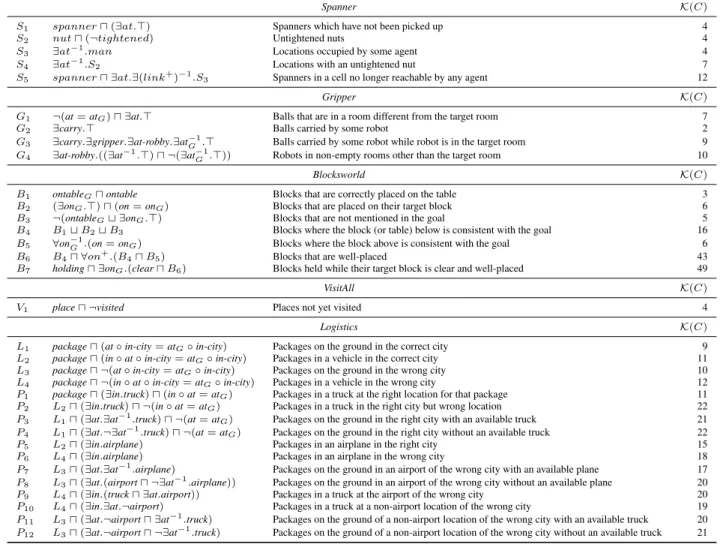
We now show examples of descending and dead-end avoid-ing potential functions for several classical plannavoid-ing domains. For simplicity, all used concepts and their intended meanings are listed in Table 1. The somewhat tedious proofs that the de-scribed functions are indeed descending and dead-end avoid-ing can be found in a technical report [Franc`eset al., 2019].
Spanner
In the domain Spanner, an agent has to pick up spanners on its way to a gate with nuts that have to be tightened. Spanners can only be used once, and the path to the gate is one-way. In the standard encoding, the function
|S1|+|S2|+dist(S3, link, S4) + 2|S5|
is descending and dead-end avoiding. Its value decreases when spanners are picked up (S1), nuts are tightened (S2), or the agent approaches the gate (dist(S3, link, S4)). Unsolv-able states are avoided through a penalty for leaving a posi-tion before picking up all spanners (S5). Interestingly, there is an alternative encoding with no distance features that uses a cardinality feature counting the cells behind the agent.
Gripper
In the domain Gripper, a robot with two grippers has to trans-port some balls between two rooms. We use a generalization of the standard domain with several rooms, robots, and grip-pers per robot. The goal remains to transport all balls into a certain room. The domain is dead-end-free, and the following function is descending:
Spanner K(C)
S1 spanneru(∃at.>) Spanners which have not been picked up 4
S2 nutu(¬tightened) Untightened nuts 4
S3 ∃at−1.man Locations occupied by some agent 4
S4 ∃at−1.S2 Locations with an untightened nut 7
S5 spanneru ∃at.∃(link+)−1.S3 Spanners in a cell no longer reachable by any agent 12
Gripper K(C)
G1 ¬(at=atG)u ∃at.> Balls that are in a room different from the target room 7
G2 ∃carry.> Balls carried by some robot 2
G3 ∃carry.∃gripper.∃at-robby.∃at−G1.> Balls carried by some robot while robot is in the target room 9
G4 ∃at-robby.((∃at−1.>)u ¬(∃at−G1.>)) Robots in non-empty rooms other than the target room 10
Blocksworld K(C)
B1 ontableGuontable Blocks that are correctly placed on the table 3
B2 (∃onG.>)u(on=onG) Blocks that are placed on their target block 6
B3 ¬(ontableGt ∃onG.>) Blocks that are not mentioned in the goal 5
B4 B1tB2tB3 Blocks where the block (or table) below is consistent with the goal 16
B5 ∀on−G1.(on=onG) Blocks where the block above is consistent with the goal 6
B6 B4u ∀on+.(B4uB5) Blocks that are well-placed 43
B7 holdingu ∃onG.(clearuB6) Blocks held while their target block is clear and well-placed 49
VisitAll K(C)
V1 placeu ¬visited Places not yet visited 4
Logistics K(C)
L1 packageu(at◦in-city=atG◦in-city) Packages on the ground in the correct city 9
L2 packageu(in◦at◦in-city=atG◦in-city) Packages in a vehicle in the correct city 11
L3 packageu ¬(at◦in-city=atG◦in-city) Packages on the ground in the wrong city 10
L4 packageu ¬(in◦at◦in-city=atG◦in-city) Packages in a vehicle in the wrong city 12
P1 packageu(∃in.truck)u(in◦at=atG) Packages in a truck at the right location for that package 11
P2 L2u(∃in.truck)u ¬(in◦at=atG) Packages in a truck in the right city but wrong location 22
P3 L1u(∃at.∃at−1.truck)u ¬(at=atG) Packages on the ground in the right city with an available truck 21
P4 L1u(∃at.¬∃at−1.truck)u ¬(at=atG) Packages on the ground in the right city without an available truck 22
P5 L2u(∃in.airplane) Packages in an airplane in the right city 15
P6 L4u(∃in.airplane) Packages in an airplane in the wrong city 18
P7 L3u(∃at.∃at−1.airplane) Packages on the ground in an airport of the wrong city with an available plane 17
P8 L3u(∃at.(airportu ¬∃at−1.airplane)) Packages on the ground in an airport of the wrong city without an available plane 20
P9 L4u(∃in.(trucku ∃at.airport)) Packages in a truck at the airport of the wrong city 20
P10 L4u(∃in.∃at.¬airport) Packages in a truck at a non-airport location of the wrong city 19
P11 L3u(∃at.¬airportu ∃at−1.truck) Packages on the ground of a non-airport location of the wrong city with an available truck 20
P12 L3u(∃at.¬airportu ¬∃at−1.truck) Packages on the ground of a non-airport location of the wrong city without an available truck 21
Table 1: Useful concepts and their complexities for selected classical planning domains.
Interestingly, in the default encoding no predicate relates robots to grippers, as these are allimplicitlyassumed to be-long to the only robot. Hence, we cannot express a concept likeG3that considers the carried balls and the location of the robot at the same time. This could be addressed with a sim-ple extension to our concept language, but there is a trade-off between expressivity and tractability of the set of features.
Blocksworld
In the domain Blocksworld, the goal is to stack and unstack blocks to achieve a target configuration. In contrast to Seipp
et al. [2016], we can represent the notion of well-placed blocks[Slaney and Thi´ebaux, 2001] and thus do not require exponential and instance-dependent weights:
−4|B6| − |holding| −2|ontable| −2|B7|
The function rewards placing a block in its final position (B6), unstacking a misplaced block (holding), dropping it (ontable) and picking it back up once its target is available (B7).
VisitAll
In the domain VisitAll, an agent has to visit all nodes of an undirected graph. For graphs with a diameter of at mostk,
the following function is descending:
k|V1|+dist(at-robot,connected, V1)
Moving closer to the closest unvisited location reduces the value by 1. Reaching it decreases the cardinality feature by1 but can increase the distance feature by up tok.
VisitAll shows the limitation to plans with a linear length: to generalize to all graphs, the weightkwould have to depend on the instance. A possible solution is to allow more general features, for example one that multiplies the cardinalities of two concepts. Replacingk|V1|with|V1×place|would yield a potential function that is descending in all VisitAll instances.
Logistics
In the domain Logistics, packages need to be transported be-tween different locations in different cities. Each city has a single airport, trucks move within cities, and planes between airports. The heuristic P12
i=1i|Pi| is descending: concepts
Piencode mutually exclusive states that a package can be in
and there is always an action that only moves packages from conceptsPito conceptsPjwithj≤i. Logistics is also
controls an elevator to deliver passengers can be seen as a Logistics domain with a single city and truck.
5
Learning the Heuristics from Sample Tasks
As we have seen, simple descending and dead-end avoiding potential heuristics exist for several standard domains. We next propose a way to learn them automatically. Our ap-proach takes as input a setF ofcandidate featuresand a set of statesS. It then computes a generalized potential heuristic with features fromFthat is descending and dead-end avoid-ingover all states inS, and further minimizes a measure of heuristic complexity. Following Bonetet al. [2019], forF
we consider all concept-based features up to a certain com-plexity, where the complexityK(f)of a featuref is the to-tal complexity of its concepts and roles (see Section 2.3). In turn, forSwe consider all reachable states from a few train-ing instances, which we assume small enough so that their reachable state space can be fully expanded. States inS can thus be labeled with information on whether they are alive or unsolvable. We denote bySAthe subset of alive states inS,
and byT the set of transitions starting in an alive state. FromSandFwe define the mixed integer linear program
M(S,F), with variableswf ∈Zfor eachf ∈ F, as follows:
min w X f∈F [wf 6= 0]K(f) subject to _ s0∈succ(s) h(s0) + 1≤h(s) fors∈ SA (1) h(s0)≥h(s) for(s, s0)∈ T, s0unsolvable, (2) where h(s) is used as shorthand for the linear expression
P
f∈Fwff(s). Note thatf(s) here are integer constants.
Constraints (1) encode the condition of being descending, while constraints (2) encode that of being dead-end avoid-ing. Because simpler features can be expected to generalize better, we minimize the total complexity of selected features. In order to deal with the nonlinearity of constraints (1), we use indicator constraints. Full details can be found in the technical report [Franc`eset al., 2019]. The resulting MIP has O(|F |+|T |)variables andO(|F |+|T |)constraints.
Theorem 1. Any solution to the MIP M(S,F) induces a generalized potential heuristic with features fromF that is descending and dead-end avoiding onS.
Many weights of such a solution will typically be zero, in which case we consider the corresponding feature as unused.
5.1
Incremental Constraint Generation
The above MIPM(S,F)has size linear in S, the number of reachable states of the training instances, which somewhat limits the approach. Often, however, many of the states inS
are intuitively redundant; for our approach to work, it would be enough to have a few states that arerepresentativeof the whole domain dynamics. We can not easily know in advance which states are representative, but we can use the above ob-servation to generate the constraints inM(S,F) incremen-tally within aconstraint generation loop.
For this, we assume that S contains labeled states from fully-explored training instances. We randomly sample a sub-set of states S0 ⊆ S. The solutions to the MIPM(S0,F) induce generalized potential heuristicshthat are descending and dead-end avoidingover the states inS0. We can check ifhis also descending and dead-end avoiding over the rest of states inS. If it is, we are done. Otherwise, we put the first χstates where it is not into a set offlawsS0
χ, and restart the
process by solving the MIPM(S1,F), whereS1=S0∪ S0
χ.
Since the size ofSiincreases monotonically withi, the
pro-cess eventually converges to the computation of M(S,F), but often we find a suitable heuristic before that. IfM(Si,F)
turns out to be unsolvable at some iterationi, then no gener-alized heuristic with the properties we seek existwhen using only features fromF, in which case we can increase the com-plexity bound used to generate the setFand start over.
5.2
Refinement of the Heuristic for Unseen States
Assume that we have a generalized potential heuristichthat is descending and dead-end avoiding over all statesSin our training set, computed with the MIP M(S,F). It might of course be the case that h does not generalize to other in-stances of the generalized problem. This will be quickly apparent, since a (steepest-ascent) hill-climbing search will reach a local minimum s 6∈ SG in polynomial time. When
that happens, we would like to refine h to make it behave correctly in states like s, but we will typically not have in-formation on which of the states in the instance are unsolv-able. If the path followed by the hill-climbing search is sI =s0, s1, . . . , sn=s, however, the reason for the heuristic
failure must be one of the following: (a) the problem is unsolvable,
(b) for some pair (si,si+1),siis solvable,si+1 is not, and h(si+1)< h(si),
(c) sis solvable, but none of its successors has smallerh -value.
We here assume that we deal with solvable instances only, since we view detecting unsolvability as an orthogonal prob-lem.1 In that case, upon finding a local minimum we can re-finehby adding to the original MIPM(S,F)the following
refinement constraintthat tackles cases (b) and (c):
n−1 _ i=0 h(si)≤h(si+1) ! ∨ _ s0∈succ(s) h(s0) + 1≤h(s) ,
using again indicator constraints to represent the disjunction. If the new MIP has a solution, we can then restart the search from sI. When new flaws are found, we add
refine-ment constraints for them iteratively until we are able to reach a goal state. Otherwise, if the MIP has no solution, then the setFof candidate features is not expressive enough to repre-sent a heuristic that generalizes to the instance. Again, we can restart the process with a larger set of candidate concepts.
1
A way to represent both finite and infinite heuristic values with finite potential heuristics is to use two functions: one that represents the finite values and one that recognizes unsolvable states [Corrˆea and Pommerening, 2019]. Different methods are useful for these two cases, and here we only focus on the first one.
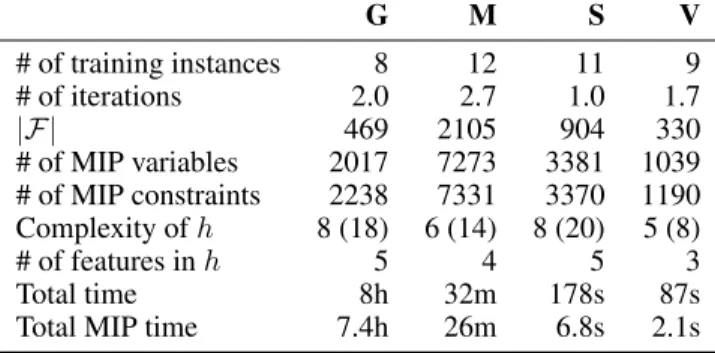
G M S V # of training instances 8 12 11 9 # of iterations 2.0 2.7 1.0 1.7 |F | 469 2105 904 330 # of MIP variables 2017 7273 3381 1039 # of MIP constraints 2238 7331 3370 1190 Complexity ofh 8 (18) 6 (14) 8 (20) 5 (8) # of features inh 5 4 5 3 Total time 8h 32m 178s 87s
Total MIP time 7.4h 26m 6.8s 2.1s
Table 2: Results of the incremental constraint generation approach on Gripper (G), Miconic (M), Spanner (S) and VisitAll (V). Number of iterations of the constraint generation loop, MIP size and running times averaged over 3 runs. Heuristic complexityk1(k2) denotes
heuristic with maximum complexity featurek1and total aggregated
complexityk2. “Number of features” stands for the number of
non-zero weights in the functionh. MIP dimensions and size|F |of the pool of candidate features reported for the last iteration. Total MIP time aggregates MIP solution times on each iteration.
6
Empirical Results
We have implemented a prototype of the above approach in Python, building on the feature generator by Bonet et al.
[2019] and on the Pyperplan planner.2 The experiments
be-low run on Intel Xeon E3-1275 CPUs using CPLEX v12.8 as a MIP solver. No run used more than 6 GB of memory. Source code and benchmarks are available online.3
We use the standard encodings of Miconic, Spanner, and VisitAll, and a generalization of Gripper to an arbitrary num-ber of robots, grippers, and rooms, as described in Section 4. For each domain, we use training instances with a (reachable) state space of at most15000states. To keep the set of can-didate concepts small, we limit role composition to primitive roles. In our experiments, allowing nested composition in-creased the number of concepts and the chance of overfitting without resulting in simpler heuristics. In all the experiments we use the incremental method described in Section 5.1, as it showed consistently better performance. We set a maximum complexity of k = 8 when generating cardinality features and ofk= 5for distance features. The initial set of statesS0 has100randomly sampled states along with their successors, plus all states in an arbitrary optimal plan. The generation of candidate features takes a few minutes in all cases.
Our main result is that for the four domains above, our ap-proach finds a potential heuristic that not only is descending and dead-end avoiding over all training instances, but which can be (manually) proven to generalize to all instances of the class, which means that when used within a steepest-ascent hill-climbing, it will be able to solve any such instance in polynomial time. The only exception is VisitAll, where we empirically confirm what we discussed in Section 4: we can only generalize to instances with graph diameter bounded by the largest diameter used in the training instances.
Table 2 gives an overview of the whole learning process. 2
https://bitbucket.org/malte/pyperplan/ 3
https://doi.org/10.5281/zenodo.3236083
In the four domains, the constraint generation loop converges quickly to a final solution, never requiring more than 3 it-erations. The number of features in the set of candidate fea-turesFvaries significantly, being a function of the number of unary and binary predicates as well as the logical structure of the problem encoding. In terms of runtime, Gripper by far re-quires the most time, most of which is spent solving the MIP in each of the two iterations. We have not further investigated the reason why CPLEX takes so long in this case. VisitAll is the only domain where distance features appear necessary.
Some of the computed heuristic functions have lower com-plexity than the ones discussed in Section 4, but they capture similar greedy mechanisms. In Spanner, for instance, repre-senting the distance to the gate turns out to be simpler by us-ing a transitive closure that counts the number of empty cells behind the agent than by using a distance feature. To illus-trate, the following is the heuristic computed automatically from12small training instances in the Miconic domain:
−3|boarded| −5|served|
+ 2|(∀origin−1.boarded)ulift-at|
+ 1|(∀destin−1.served)ulift-at|.
The first two features reward boarding passengers into the elevator and serving them to their destination. The third re-wards the elevator for moving away from a floorF once it has boarded all passengers that start their trip inF, and the last rewards the elevator for moving away fromFonce it has served all passengers that want to go toF. The function dif-fers from the idea we presented for the more general Logistics domain in Section 4, as the concepts here do not all represent mutually exclusive sets of passengers. This illustrates a gen-eral trend with the heuristics computed by our method: they often differ from the ones we had in mind and have lower overall complexity. Additionally, different MIP solutions in-ducing different generalized heuristics, all with equal overall complexity, can be found by our method.
Our prototype is not yet able to scale up to domains such as Blocksworld or Logistics. Although there exist descend-ing and dead-end avoiddescend-ing generalized potential heuristics for these domains (Section 4), the complexity of some of their features seems too high. For example, the number of features below the complexity bound of 49 in Blocksworld is in the order of 2 million. While this is out of scope now, solving a MIP with millions of variables is conceivably possible with sufficient computing resources. Better methods of feature se-lection can also help our method to scale up more robustly.
7
Related Work
Our work relates to a number of previous research threads. Parmar [2002] studies measures of progress from the first-order framework of situation calculus. A predicate p is a measure of progress if in every possible state there is some action that monotonically increases the extension ofp. If such a predicate can be succinctly represented, then a policy that always selects a p-increasing action is an efficient planning algorithm. Descending potential heuristics are measures of progress in dead-end-free domains. Parmar introduces mea-sures of progress for different types of domains. In particular,
tiered measures of progress underlie our heuristic for Logis-tics. Her discussion is limited to dead-end free domains, and leaves open the question of how to find measures of progress automatically, which is the focus of our work. This question is also tackled by Yoonet al.[2005], who use first-order fea-tures based on taxonomic syntax toapproximatemeasures of progress. In their case, these measures are lexicographic en-sembles of heuristics which they learn greedily from a num-ber ofsample plans. This is similar in spirit to our work, but we are interested in learningexactmeasures of progress over the whole state space of the problem, not over some sam-ple trajectories that need to be externally chosen, and we aim at minimizing the complexity of the learnt heuristic, which should help generalization. When our approach succeeds, we have learnt a (provably correct) polynomial search algorithm for all instances of the planning domain at hand.
Seipp et al. [2016] study descending, dead-end avoid-ing potential heuristics over conjunctive state features, but the features and weights in their heuristics are instance-dependent, and they do not address the question of how to obtain these heuristics automatically. Our contribution can be seen as a possible answer to such a question based on first-order features and learning from observing small instances.
Concept languages have been used to learn classical plan-ning policies before. Martin and Geffner [2004] learn simple rule-based policies in the form of lists of concept-action pairs, with a focus on capturing optimal behavior in Blocksworld. The taxonomic syntax used by Yoonet al. [2005], similar to concept languages, is also used in other works by the same authors [Yoonet al., 2006; Yoonet al., 2008].
This work is also related to recent research in gener-alized planning [Levesque, 2005; Srivastava et al., 2008; Hu and De Giacomo, 2011; Bonet and Geffner, 2018], in par-ticular to the approach taken by Bonet et al. [2019], who learn a generalized abstraction from training instances based on the same type of first-order features that we use here. Their work however requires that the generalized problem can be abstracted into a Qualitative Numerical Problem (QNP), where domain dynamics need to be expressible through (in-determinate) increments and decrements of numerical vari-ablesX and preconditions of the formX > 0 andX = 0. This inductively-learned QNP is then mapped into a fully-observable non-deterministic problem to obtain a general-ized policy with certain correctness guarantees [Bonet and Geffner, 2018]. Our approach, which is in contrast more di-rect, can reason with precise quantitative change (e.g., favor some transition iff featurefiincreases more thanf2), and can
handle domains such as Spanner, which do not have an obvi-ous QNP abstraction. On the other hand, we cannot capture things like looping policies, which Bonetet al.can.
Finally, our work is also related to the line of research by Toyeret al.[2018], who use a neural network-based approach for computing generalized policies for stochastic planning domains. A major difference with the work that we present here is that the logical grounding of our approach lends itself to better interpretability and, more relevantly, to the possibil-ity of reasoning, manually or automatically, about the theo-retical correctness of the heuristics that we learn.
8
Discussion
We have presented a way to automatically compute descend-ing and dead-end avoiddescend-ing potential heuristics that are well-defined on all instances of a generalized planning domain. The presented approach of course has a number of limita-tions, the most obvious being that not all problems have a greedy solution strategy that can be expressed as a compact generalized potential heuristic. Because of our choice of fea-tures, heuristic values are linear in the number of objects, and so is the length of the plans we can compute, which leaves out many interesting problems that do not have plans of that type. Our work can be seen however as a preliminary step towards the automatic synthesis of solvers with polynomial performance guarantees over all instances of a generalized planning problem. An important next step for this would be to deductively prove the correctness of the computed heuris-tics from the domain model, in the spirit of [Levesque, 2005]. The heuristic functions that we defined manually are easily interpretable by a human. The ones that our approach discov-ers automatically are sometimes slightly less obvious. It is not clear how to optimize for interpretability, but in general it seems that optimizing the total complexity of the heuris-tic yields heurisheuris-tics which are not too hard to interpret. The extent to which these heuristics and their interpretability re-late to the logical invariants that are implicit in the domain representation would deserve further examination.
We have also seen a trade-off in the choice of the under-lying concept language and of the complexity bounds. More expressive concepts allow some properties to be represented more concisely, but a richer language aggravates the combi-natorial explosion of the set of candidate features to be ex-plored and increases the size of the mixed integer linear pro-gram that we use. At the same time, for a fixed set of train-ing instances, increastrain-ing the allowed complexity of concepts increases the chances of overfitting. Such problems can be mitigated by using our incremental constraint generation ap-proach, which can increase the complexity bound progres-sively as the current bound is proven too low to contain a heuristic with the desired properties. An interesting research direction would be to devise techniques to explore the pool of candidate features more selectively.
Acknowledgments
This work was supported by the Swiss National Science Foundation (SNSF) as part of the project “Certified Correct-ness and Guaranteed Performance for Domain-Independent Planning” (CCGP-Plan). The authors thank Blai Bonet for his contribution to the codebase used in the experiments.
References
[Baaderet al., 2017] Franz Baader, Ian Horrocks, Carsten Lutz, and Uli Sattler. Introduction to Description Logic. Cambridge University Press, 2017.
[Bonet and Geffner, 2018] Blai Bonet and H´ector Geffner. Features, projections, and representation change for gener-alized planning. InProceedings of the 27th International Joint Conference on Artificial Intelligence (IJCAI 2018), pages 4667–4673. IJCAI, 2018.
[Bonetet al., 2009] Blai Bonet, H´ector Palacios, and H´ector Geffner. Automatic derivation of memoryless policies and finite-state controllers using classical planners. In Alfonso Gerevini, Adele Howe, Amedeo Cesta, and Ioannis Re-fanidis, editors, Proceedings of the Nineteenth Interna-tional Conference on Automated Planning and Scheduling (ICAPS 2009), pages 34–41. AAAI Press, 2009.
[Bonetet al., 2017] Blai Bonet, Giuseppe De Giacomo, H´ector Geffner, and Sasha Rubin. Generalized planning: Non-deterministic abstractions and trajectory constraints. In Carles Sierra, editor, Proceedings of the 26th Interna-tional Joint Conference on Artificial Intelligence (IJCAI 2017), pages 873–879. IJCAI, 2017.
[Bonetet al., 2019] Blai Bonet, Guillem Franc`es, and H´ector Geffner. Learning features and abstract actions for com-puting generalized plans. In Proceedings of the Thirty-Third AAAI Conference on Artificial Intelligence (AAAI 2019). AAAI Press, 2019.
[Corrˆea and Pommerening, 2019] Augusto B. Corrˆea and Florian Pommerening. An empirical study of perfect potential heuristics. In Nir Lipovetzky, Eva Onaindia, and David E. Smith, editors, Proceedings of the Twenty-Ninth International Conference on Automated Planning and Scheduling (ICAPS 2019). AAAI Press, 2019. [Foxet al., 2017] Maria Fox, Derek Long, and Daniele
Mag-azzeni. Explainable planning. InIJCAI-17 Workshop on Explainable AI (XAI), pages 24–30, 2017.
[Franc`eset al., 2019] Guillem Franc`es, Augusto B. Corrˆea, Cedric Geissmann, and Florian Pommerening. General-ized potential heuristics for classical planning: Additional material. Technical Report CS-2019-003, University of Basel, Department of Mathematics and Computer Science, 2019.
[Geffner, 2000] H´ector Geffner. Functional Strips: A more flexible language for planning and problem solving. In Jack Minker, editor, Logic-Based Artificial Intelligence, volume 597 ofKluwer International Series In Engineering And Computer Science, chapter 9, pages 187–209. Kluwer, Dordrecht, 2000.
[Hu and De Giacomo, 2011] Yuxiao Hu and Giuseppe De Giacomo. Generalized planning: Synthesizing plans that work for multiple environments. In Toby Walsh, editor,
Proceedings of the 22nd International Joint Conference on Artificial Intelligence (IJCAI 2011), pages 918–923. AAAI Press, 2011.
[Levesque, 2005] Hector Levesque. Planning with loops. In Leslie Pack Kaelbling and Alessandro Saffiotti, editors,
Proceedings of the 19th International Joint Conference on Artificial Intelligence (IJCAI 2005), pages 509–515. Pro-fessional Book Center, 2005.
[Martin and Geffner, 2004] Mario Martin and H´ector Geffner. Learning generalized policies from planning examples using concept languages. Applied Intelligence, 20(1):9–19, 2004.
[McDermott, 2000] Drew McDermott. The 1998 AI Plan-ning Systems competition. AI Magazine, 21(2):35–55, 2000.
[Parmar, 2002] Aarati Parmar. A logical measure of progress for planning. InProceedings of the Eighteenth National Conference on Artificial Intelligence (AAAI 2002), pages 498–505. AAAI Press, 2002.
[Pommereninget al., 2015] Florian Pommerening, Malte Helmert, Gabriele R¨oger, and Jendrik Seipp. From non-negative to general operator cost partitioning. In Proceed-ings of the Twenty-Ninth AAAI Conference on Artificial In-telligence (AAAI 2015), pages 3335–3341. AAAI Press, 2015.
[Seippet al., 2015] Jendrik Seipp, Florian Pommerening, and Malte Helmert. New optimization functions for po-tential heuristics. In Ronen Brafman, Carmel Domshlak, Patrik Haslum, and Shlomo Zilberstein, editors, Proceed-ings of the Twenty-Fifth International Conference on Au-tomated Planning and Scheduling (ICAPS 2015), pages 193–201. AAAI Press, 2015.
[Seippet al., 2016] Jendrik Seipp, Florian Pommerening, Gabriele R¨oger, and Malte Helmert. Correlation complex-ity of classical planning domains. In Subbarao Kambham-pati, editor, Proceedings of the 25th International Joint Conference on Artificial Intelligence (IJCAI 2016), pages 3242–3250. AAAI Press, 2016.
[Slaney and Thi´ebaux, 2001] John Slaney and Sylvie Thi´ebaux. Blocks World revisited. Artificial Intelligence, 125(1–2):119–153, 2001.
[Srivastavaet al., 2008] Siddharth Srivastava, Neil Immer-man, and Shlomo Zilberstein. Learning generalized plans using abstract counting. In Proceedings of the Twenty-Third AAAI Conference on Artificial Intelligence (AAAI 2008), pages 991–997. AAAI Press, 2008.
[Toyeret al., 2018] Sam Toyer, Felipe Trevizan, Sylvie Thi´ebaux, and Lexing Xie. Action schema networks: Gen-eralised policies with deep learning. InProceedings of the Thirty-Second AAAI Conference on Artificial Intelligence (AAAI 2018), pages 6294–6301. AAAI Press, 2018. [Yoonet al., 2005] Sung Wook Yoon, Alan Fern, and Robert
Givan. Learning measures of progress for planning do-mains. InProceedings of the Twentieth National Confer-ence on Artificial IntelligConfer-ence (AAAI 2005), pages 1217– 1222. AAAI Press, 2005.
[Yoonet al., 2006] Sung Wook Yoon, Alan Fern, and Robert Givan. Learning heuristic functions from relaxed plans. In Derek Long, Stephen F. Smith, Daniel Borrajo, and Lee McCluskey, editors,Proceedings of the Sixteenth Interna-tional Conference on Automated Planning and Scheduling (ICAPS 2006), pages 162–170. AAAI Press, 2006. [Yoonet al., 2008] Sung Wook Yoon, Alan Fern, and Robert
Givan. Learning control knowledge for forward search planning. Journal of Machine Learning Research, 9:683– 718, 2008.