Learning Dutch in a Self-Directed Environment Using Google Translate Catharina van Lieshout
A Thesis in
The Department of
Education
Presented in Partial Fulfillment of the Requirements for the Degree of Master of Arts (Applied Linguistics) at
Concordia University Montreal, Quebec, Canada
April 2019
CONCORDIA UNIVERSITY School of Graduate Studies
This is to certify that the thesis prepared By:
Entitled:
Catharina van Lieshout
Learning Dutch in a Self-Directed Environment Using Google Translate and submitted in partial fulfillment of the requirements for the degree of
Master of Arts (Applied Linguistics)
complies with the regulations of the University and meets the accepted standards with respect to originality and quality.
Signed by the final Examining Committee:
Chair
Pavel Trofimovich
Examiner
Teresa Hernández González
Examiner
Denis Liakin
Supervisor
Walcir Cardoso
Approved by ______________________________________ Chair of Department or Graduate Program Director
2019
iii ABSTRACT
Learning Dutch in a Self-Directed Environment Using Google Translate Catharina van Lieshout
The technology addressed in this study is Google Translate (GT) and its associated text-to-speech (TTS) and automatic-speech-recognition (ASR) built-in features. In the literature, the three technologies encompassed by GT have shown to have positive effects in the learning of second/foreign language (L2) vocabulary and pronunciation: Translation (Calis & Dikilitas, 2012), TTS (Soler-Urzua, 2011) and ASR (Liakin, Cardoso & Liakina, 2014). This study is an investigation of the affordances of GT and the accompanied technologies in a self-directed learning (SDL) environment.
The study examined the pedagogical use of GT as a source of L2 Dutch vocabulary and pronunciation in an SDL setting. Thirty participants used GT (its translation, TTS and ASR functions) for approximately one hour to learn a small number of “basic/beginner” words and phrases and their respective pronunciations in Dutch (e.g., how to say “hi” – “Hoi” [hoj]). The study followed a pre/post/delayed-post test design that examined the participants learning of vocabulary/phrases and their related pronunciations, combined with a qualitative analysis of video recordings of their self-directed interactions with GT. In addition, surveys about their learning experience and interviews were administered. The findings indicate that the participants were able to acquire Dutch vocabulary and pronunciation on a short-term basis, they interacted with GT’s TTS and ASR technology in different ways and to different extents, demonstrating that GT is a versatile tool. Finally, our findings suggest that participants had overall positive views of GT according to the four perception markers adopted (i.e., learnability, usability, motivation, and willingness to use the technology).
iv
Acknowledgements
First, I’d like to thank my supervisor Dr. Walcir Cardoso. You’ve made this experience more than just a learning opportunity for me. From my first class at Concordia to my last you were there encouraging me “Go, go, go, Roza!” Throughout these last 8 months you were patient as I went through the trial and error phases of creating this thesis and you gave up many hours to help me hone my skills. I’m very proud of the work we did together. I would also like to thank my committee members, Dr. Teresa Hernandez Gonzalez and Dr. Denis Liakin, for taking the time to read my proposal and thesis, and give helpful feedback and advice during this process.
Rachael Lindberg, if we had not gone through this challenging experience together I’m not sure I could have done it. You donated hours of your time, even at one in the morning, to help me pass the finish line. I don’t think there are words to describe how lucky I feel to have met you on the first day of class. I look forward to doing all the fun activities we said we would do but didn’t have time for in the last two-years.
I also want to thank each of my family members who all helped me with my thesis in one way or another like the truly supportive family that you are. Another thank you to my mom and dad who were kind enough to have supported me financially and in every other possible way a parent can support their child.
To my partner, Jacob Westermann, thank you for making sure that I had food to eat, a happy place to live and a sane mind to go to work with everyday. Thank you for supporting and
encouraging me, I promise to do the same when your turn comes.
An extra special thank you goes to the guys at Concordia’s Department of Education tech support office who provided everything I could ever need to complete my data collection. I’d also like to say thanks to Randall Halter for helping me with the last minute data analysis. Lastly, thanks to all of the other students at Concordia who helped me along the way.
v
Table of Contents
LIST OF FIGURES ... viii
LIST OF TABLES ... ix
Chapter One ... 1
Technology in Self-Directed Language Learning... 2
Translation, TTS and ASR ... 2
Google Translate, Goals and Hypotheses ... 3
Chapter Two ... 6
Introduction ... 6
Background ... 8
Self-Directed Learning ... 8
Self-Directed Second/Foreign Language Learning ... 9
Self-Directed Language Learning: What’s in a Name? ... 10
Technology and Language Learning ... 12
Vocabulary ... 12
Pronunciation: input, output and feedback ... 13
Text-to-Speech: access to input ... 15
Automatic Speech Recognition: opportunities for output and feedback ... 16
Google Translate ... 18
The Study ... 21
Methods ... 22
Participants ... 22
vi
Objectives list. ... 22
Instruments ... 23
Questionnaire. ... 23
Pre-test, post-test, delayed post-test ... 23
Procedure ... 24
Data Analysis ... 25
Questionnaire. ... 25
Pre-test, post-test, delayed post-test. ... 25
Video-recordings. ... 25
Survey. ... 26
Interviews. ... 26
Results ... 26
To what extent can learners acquire Dutch phrases and pronounce them intelligibly after using Google Translate in a SDLL environment? ... 27
How do learners interact with Google Translate to learn? ... 29
How do learners perceive Google Translate (and its inherent features such as TTS, ASR and translation) as a pedagogical tool? ... 31
Discussion ... 33
Vocabulary learning and interactions with Google Translate ... 34
Pronunciation learning ... 37
Learners’ perceptions ... 38
Conclusion ... 40
vii
Summary of Goals and Findings ... 44
Implications ... 45 Future Studies ... 46 References ... 48 Appendices ... 58 Appendix A ... 58 Appendix B ... 60 Appendix C ... 61 Appendix D ... 65
viii
LIST OF FIGURES
Figure 1. Google Translate ... 4 Figure 2. Features of Google Translate ... 19
ix
LIST OF TABLES
Table 1. Teacher-Structured Self-Directed Learning ... 12
Table 2. Vocabulary Gains: Mean Scores ... 28
Table 3. Learner Pronunciation: Mean Scores ... 29
Table 4. Learner Strategies while interacting with Google Translate ... 31
Table 5. Learner Perception Scores of Google Translate ... 32
1 Chapter One
Imagine needing to learn a new language but not having access to traditional learning tools such as a textbook or a teacher. Perhaps your budget will not allow you to purchase learning materials or perhaps your busy schedule will not allow you to take courses. What do you do? In this day and age, you would most likely turn to the Internet for help and use the free tools available there. That is exactly what I did when I was abroad in Morocco and I did not speak the local language. By using the text-to-speech function in Google Translate (GT), I was able to learn how to say important phrases such as “Where’s hotel name?” [ʔajn hotel name] (نيأ in Arabic) and successfully repeat them to find transportation, hostels and food.
I was able to use a similar method of communication when I visited my partner’s
grandmother in Denmark; although I speak a related language, Dutch, Danish and Dutch are not mutually intelligible. By using Google Translate’s text-to-speech, I was able to say such phrases as, “I would like a glass of water” and “thank you for dinner” in Danish. After these experiences, I continued using Google Translate to teach myself words and phrases in foreign languages. This has left me wondering if this tool could be used as a pedagogical tool to teach certain aspects of a second/foreign language (L2), such as useful phrases and their pronunciations. That is what this thesis is about; it looks into the pedagogical application of Google Translate in learning phrases (vocabulary) and pronunciations in an L2, Dutch. This study is partially inspired by these experiences using Google Translate as a communication tool in an environment where I quickly needed to teach myself phrases in a foreign language.
2 Technology in Self-Directed Language Learning
Technology has become an integral part of our daily lives; we interact with it everyday to communicate with other people, do online banking or to look up unknown information.
However, despite many being well versed in the world of technology, being comfortable and familiar with it does not mean that one is knowledgeable about learning with technology (Zhou & Wei, 2018). This realization developed into a new area of research that pivoted to look more into how one can learn using technology rather than looking at how effective technology is as a learning tool. With a focus on the learner, Zimmerman (1990) highlights that self-directed learners must be self-motivated, must rely upon self-directed learning strategies, and must be able to receive some type of feedback so that they can self-evaluate. According to the author, if a technology affords these three characteristics, the learner could potentially benefit from it in self-directed learning (SDL).
In the past, before we could simply turn to technology, self-directed language learners were limited to more traditional types of learning, including textbooks and audio recordings, which little or no opportunities for interaction in the target language. The introduction of technology and its application in SDL learning not only provided a larger variety of accessible learning material, but has also drastically increased exposure to the target language, allowing for more opportunities for interactive experiences (Chapelle, 2009).
Translation, TTS and ASR
The three types of technology that this research focuses on, all of which are included in Google Translate, are translation, text-to-speech (TTS) and automatic-speech-recognition (ASR). The translation function allows the learners to access vocabulary (and consequently learn it, as we hypothesize) in the target language. TTS allows users to hear written text (e.g., the translated
3
word or phrase), while ASR converts their speech into written text. In the literature, all three technologies have been shown to be an asset in L2 learning. Calis and Dikilitas (2012), for instance, found that translation tasks have the ability to promote perceptive and productive skills in students, while Soler-Urzua (2011) reported that learners were able to learn the English /I-i/ contrast (e.g., as in “bit” and “beat” respectively) in some of the measures she used in her research (i.e., in judges’ ratings for production accuracy). Furthermore, Liakin, Cardoso and Liakina (2014) found that French L2 learners who engaged in extracurricular ASR practice that targeted the phoneme /y/ (as “u” in French “tu”) significantly improved in their ability to produce the target phoneme, in comparison with a control group.
As demonstrated, all three of these technologies can be used as learning tools to aid language learners, at least when they are used in isolation. First, learners can translate their chosen word or phrase into the target language to learn the vocabulary words. Then, they can use the TTS to listen to the phrase being spoken in the target language. Lastly, if they want to
practice or test themselves, they can use the ASR function to verify if their attempt is being accurately transcribed, thus indicating pronunciation accuracy. With these three technologies incorporated into a single application (Google Translate), users can learn new vocabulary and practice their listening and speaking skills in the target language, at the same time.
Google Translate, Goals and Hypotheses
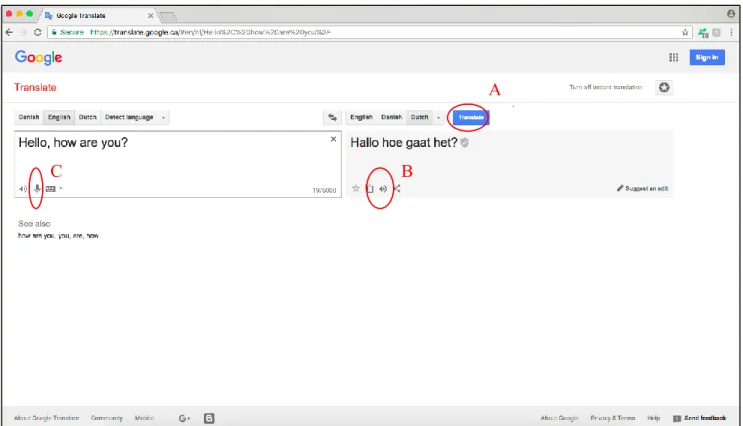
This study explores these technologies in tandem, observing how they work together to “teach” a language. Google Translate was selected as our language-learning tool as it includes the abilities discussed above. GT was created as a simple translation tool to translate words and phrases from one language into the other (see A in Figure 1). With just the click of a mouse, users can see and hear (via TTS) the desired word or phrase spoken in the target language (see
4
B). With a second click, users are able to verify whether their pronunciation is acceptable, using the orthography displayed in the target language, using the ASR function (see C).
Figure 1. Google Translate
Based on the CALL literature related to the three technologies included in this study (e.g., Calis & Dikilitas, 2012 for translation; Soler-Urzua, 2011 for TTS; and Liakin, et al., 2014 for ASR), it is hypothesized that the pedagogical use of Google Translate will yield positive results in the acquisition of vocabulary (a set of phrases) and pronunciation in L2 Dutch.
It is also predicted that the combined use of translation, TTS and ASR in Google Translate has the potential to contribute to L2 learning by helping enhance the learning
experience (Obari & Lambacher, 2015), and increase learners’ level of comfort (Altena, 2015), motivation (Ciampa, 2014), and (4) willingness to use the technology (Cumming & Rodriguez,
A A
B C
5
2013). As such, the current study seeks to investigate learners’ perceptions of Google Translate in the context of these four attitudinal factors.
Finally, this study aims to observe, from different angles, learners’ experiences in acquiring vocabulary and pronunciation in an SDL learning environment while using GT.
Having Dutch as the target language, participants will learn beginner words and phrases and their associated pronunciation using Google Translate. This technology provides a learning and self-checking environment with unlimited practicing possibilities, which are assumed to be ideal for the promotion of an SDL context. In summary, this study explores (1) the extent to which learners can acquire Dutch vocabulary and pronunciation, (2) the manner in which they interact with the technology, and (3) their overall perceptions of the proposed pedagogical experience. One of the key contributions of this study is its unique combination of three technologies
(Translation, TTS and ASR) and their effects on second/foreign language learning, using a single web-based application, GT.
Following the guidelines for a manuscript-based MA thesis, the next section constitutes “a full submittable draft of a manuscript” in which more details about the literature review, methodology, results and discussion are presented.
6 Chapter Two
Introduction
Many people who want to learn a new language are constrained by a myriad of different factors. These factors often include the lack of language courses offered, busy schedules as well as tight budgets (Roediger & Pyc, 2012). New language learning tools are developed annually to circumscribe these constraints. Duolingo, Memrise, and AccellaStudy Essential Apps are but a few examples of such tools. Fortunately, many of these tools are available online for free. What you need is a device and an Internet connection to access them.
Although there are many language learning tools, it may feel like there are only a limited amount of resources available online which target vocabulary, pronunciation (including aural and oral skills such as listening and speaking), and sentence structure. This is especially true when it comes to lesser-learned languages (Godwin-Jones, 2013) such as Dutch, Danish and Swedish. As some of these tools might not be as efficient in communicating aspects of a foreign language as others, it is important for researchers, teachers and students to be aware of the affordances of popular language learning tools (Neri, Cucchiarini, Strik & Boves, 2002). This could potentially help learners in a self-directed language-learning context to become more efficient with their time and more successful in their outcome.
There are three main features that shape the definition of a self-directed learner (Zimmerman, 1990): their self-motivation method (Motivation), their use of autonomous learning strategies (Learning Strategies), and their ability to assess the effectiveness of these strategies through self-evaluated feedback (note that Zimmerman uses the term “self-regulated”; however “self-directed” and “self-regulated” are commonly used interchangeably; e.g., Abar & Loken, 2010; in this study, we use the term “self-directed,” as will be clarified later). These three
7
features simultaneously summarize what autonomous learners must do to be successful
(Zimmerman, 1990). Consequently, as instructors, we should deliberate the use of technologies that can be used autonomously so that the learners can increase their motivation to learn, develop learning strategies, and learn how to benefit from the feedback provided. From a student’s perspective, the self-taught learner must perceive the use of technology positively and, more importantly, match it with their learning expectations (Lai, 2013).
The tool that will be under investigation in this study is Google Translate (2018), a non-pedagogical resource that is generally used for automatic translation purposes. However, it has many other useful functions which have not been explored by researchers in a comprehensive way; these include text-to-speech synthesis and automatic-speech-recognition (see forthcoming discussions).
The following is an investigation into the feasibility of using Google Translate (GT) in a self-directed language-learning context, emphasizing the tool’s abilities to motivate learning, help students develop their autonomous learning strategies, and understand the types of feedback afforded by the technology. In this environment, the language-learning context is not centered in a classroom nor directed by a teacher; instead it is a context of self-taught learning. We start by providing a summary of the research on self-directed learning in both general and second/foreign language contexts, and discuss the affordances of the pedagogical use of GT-related technologies such as text-to-speech synthesis and speech recognition on language learning. Then the methods and the results are presented, followed by a discussion. Lastly, the study closes with a conclusion that looks at the limitations, implications and future directions for research.
8 Background Self-Directed Learning
In a self-directed learning (SDL) context, the learner is in charge of the direction of his/her own learning, as opposed to in a classroom setting where both the teacher and student are responsible for learning (Little, 1995). Learners in the SDL context have the added
responsibilities of keeping themselves accountable and making sure that they progress. Du (2013) created a four-point list that describes why the development of self-directed learning skills is important. Among those points, Du argues that self-directed learning encourages
motivation, critical thinking and self-evaluation skills. He also points out that it “instil[s] interest in life-long learning necessary in the context of a global economy and an information-centered society” (p.2). This means that it is important that we are able to both self-teach and have the skills to do so effectively in order to succeed in the future. Sert and Boynuegri (2017) address the importance of technology while building on Du’s (2013) thoughts, stating that a critical
component of life-long learning is self-directed learning, which can be ameliorated by the use of technology. This paper intends to promote life-long learning through the use of the particular technology, Google Translate, as will be explained later.
In the context of language learning, learner autonomy (a component of SDL) can be defined as both the learner’s ability to know what is needed in terms of language learning and, since we are now living in the digital age, the learner’s ability to accomplish these goals through the use of technology (Chik, 2018). Another important factor is motivation. Zimmerman (2000) makes a connection between self-regulated learning and motivation. He also claims that a learner’s self-efficacy belief can act as the driving force to motivate their learning, discovering that highly self-efficacious and motivated learners, in a self-regulated context, produce higher academic achievements (Zimmerman, 2000). Therefore, the key is that learners must be able to
9
follow the process of knowing what is needed, be motivated to act on that knowledge, and use technology to achieve it.
Self-Directed Second/Foreign Language Learning
In the context of second/foreign language (L2) education, research on self-directed language learning is scarce, and it has mostly been done simultaneously as part of a language course. Thus, the research has often looked at the student’s work outside of class time (Bahri & Mahadi, 2016; LaRocca Morgan & Bellinger, 1999) and, for this reason, can not be classified as truly autonomous. However, these studies still have a lot to offer in terms of knowledge on learner behaviour. One of the most common findings among this research is the learners’ need for motivation (Bekleyen & Selimoglu, 2016; Botero & Questier, 2016; and Multu & Eroz-Yuga, 2013). When perceived motivation was high, the English as a second language (ESL) learners surveyed in Bekleyen and Selimoglu (2016) performed more language enhancing activities (such as listening to English music and watching English movies and TV) than learners with low motivation. The highly motivated students also showed more initiative outside of their English classes, which inevitably gave them more exposure to English, and consequently led to learning. Both Botero and Questier (2016) and Multu and Eroz-Yuga (2013) made similar discoveries about motivation. However, these two studies reported a second trend: learners need direction.
Botero and Questier (2016) reported that their learners were in need of more direction and examples when it came to autonomous language learning. They also noted that the learners needed motivation outside of their set task, which was using the target pedagogical application Duolingo (an online language-learning program) as an autonomous language-learning tool. Multu and Eroz-Yuga (2013) combined Botero and Questier’s (2016) findings to create a study that shows how these two factors (motivation and direction) interact. Their study showed that
10
more direction positively affected learners and their motivation. They had two participant groups; while one was instructed on different strategies for how to use technology for language learning, the other received no training. It was discovered that the group that received training was more successful in their language learning strategies and reported being more motivated to learn. Similarly, Lai, Shum and Tian (2016) found that training programs that teach students strategies on using technological learning tools effectively promotes the use of the tools for language learning purposes. It also created willingness, knowledge and skills that supported this purpose. The results of these studies show that the autonomous learning context differs from traditional classroom settings; they show that the guidance that the teacher normally provides (including direction and motivation) is now solely the responsibility of the learner.
In summary, there are four perception markers or themes that permeate the CALL literature and are claimed to enhance L2 learning by (1) improving the learning experience – learnability (Obari & Lambacher, 2015), (2) increasing learners’ level of comfort – usability (Altena, 2015), (3) boosting motivation (Ciampa, 2014), and (4) increasing students’ willingness to use the technology (Cumming & Rodriguez, 2013). In promoting self-directed learning through technology, Lai (2013) states that attitudinal factors such as these, which play crucial roles in technology use, need to receive more acknowledgment. In response to this call for further investigation of SDL in L2 pedagogy, these four perception markers are addressed by the current study, in the context of Google Translate as the target tool.
Self-Directed Language Learning: What’s in a Name?
For the purpose of this study, we use the term “self-directed” instead of “self-regulated” learning. Although the CALL and educational psychology literature often refers to the two constructs as semantically the same (see Cosnefroy & Carré, 2014 for a detailed discussion), as
11
they both involve active, controlled and goal-directed behaviour, we adopt the term “self-directed” for convenience and because it is the most frequently used in the adult education domain (Cosnefroy & Carré, 2014). In agreement with Cosnefroy and Carré, these two terms are “close, specific, and complementary concepts” (p. 11).
In order to better examine the effects of Google Translate in SDL and be able to compare learning among participants (e.g., it would be difficult to compare gains in vocabulary and pronunciation without isolating the technology and controlling the target forms), we have created a more controlled learning environment (a semi-self-directed learning setting). As such, it is a mixture of a purely self-directed learning environment, in which learners would generally be in charge of all of their own learning, and a teacher-based learning environment, where the teacher is generally in charge of the learning decisions. We refer to this as a “teacher-structured self-directed” learning environment, displayed in Table 1, where we illustrate the responsibilities of teachers and learners across four learning components: objectives, learning tools, learning strategies, and time on task. Observe that while a strict version of SDL involves learners in control of all four learning components (shaded cells), a more lenient version (the one utilized in this study) shares some of the learning responsibilities with a “teacher” (the researcher, in the context of the current study). In this scenario, the objectives and the learning tools are provided (so that we can control the target tool and learning outcomes), but students (as self-directed learners) are given the freedom to discover their own learning strategies and manage their own time to learn.
12 Table 1
Teacher-Structured Self-Directed Learning Learning Components Self-Directed
Learning
Teacher-Based Learning
Teacher-Structured Self-Directed Learning
Objectives Learner Teacher Teacher
Learning Tools Learner Teacher Teacher
Learning Strategies Learner Teacher Learner
Time on task Learner Teacher Learner
Technology and Language Learning
It has been well documented that technology has significantly altered the way we live. When investigating L2 learning, we can address numerous different facets of learning that are affected by technology, including self-directed learning. In order to determine the feasibility of using Google Translate in an SDL context, the following two language features will be
examined: vocabulary (including ready-to-use phrases or lexical bundles such as “How are you doing?”) and its related pronunciation.
Vocabulary. According to Nation (2003), vocabulary teaching should be tackled by a 4-pronged approach: learning through meaning-focused input, meaning-focused output, deliberate learning (i.e., focus on form) and fluency development. Together these approaches address many of the aspects of a language course and ensure that there exists a balance of different types of learning styles. This study includes learning involving meaning-focused input, meaning-focused output in addition to deliberate learning. According to Nation, meaning-focused input, a focus on listening and reading, seems to be essential at the beginning stages of language learning.
Meaning-focused output, on the other hand, encourages students to concentrate on
communicating messages through speaking and writing. Participants in the current study were asked to speak, read and listen in their target L2 (Dutch) through the help of Google Translate as
13
well as its built-in features, thereby addressing three items in Nation’s approach to vocabulary instruction, in a single activity.
The literature has some evidence that the use of technology can assist in vocabulary learning. Liu and Lin (2016), for example, compared the affordances of computerized versus manual dictionaries and found that vocabulary-learning efficiency was significantly higher when participants used an electronic pop-up dictionary in comparison with looking up a word in a dictionary. Through this technology-enhanced method (i.e., via personal digital assistants - PDAs), students encountered more new words and consequently had more opportunities to acquire them. Song and Fox (2008) identified PDAs as devices that help L2 English students register vocabulary in a more flexible, while also keeping in mind the students’ needs and
learning contexts based on the affordances of the technology (e.g., it promotes anytime anywhere learning). Based on these findings, in the current study, participants used Google Translate, a different tool that has the potential to offer abundant opportunities for learners to encounter (and consequently learn) new words and phrases.
Pronunciation: input, output and feedback. To know a word in an L2 includes much more than understanding its meaning. According to Nation (2005), this knowledge also includes knowing how the word is pronounced. To evaluate how this component of word knowledge is used in CALL (Computer-Assisted Pronunciation Teaching), Neri et al. (2002) conducted a comprehensive analysis of multiple programs according to three traditional pedagogical requirements for pronunciation: improving input, output practice, and feedback. These requirements were based on the assumption that learners needed vast amounts of input to contextualize the learning objectives; as such, input is a necessity of learning (Gass, 1997). Output allows learners to practice and compare their hypothesis with the first language (L1)
14
model regarding aspects such as the word (e.g., its denotation and connotations) and its pronunciation (Celce-Murcia, Brinton, Goodwin & Griner, 2010). Lastly, feedback is used to make learners aware of differences between the input and the output or the L1 and the second language (L2). In a number of studies, immediate feedback was considered to be the more effective form of feedback in the contexts of listening comprehension and oral activities (Shu-ping, Hui-Kai & Shin-da, 2012: Nistor & Comanetchi, 2018). Accordingly, in the current study, we adopt automatic speech recognition and text-to-speech synthesis, which offers students immediate feedback in the form of orthography (provided implicitly; see forthcoming discussion). However, we acknowledge that in the context of Google Translate and its technological affordances (TTS and ASR), the immediate feedback remains limited, as the participants must learn to interpret the orthography as feedback.
An important aspect in pronunciation studies is to determine how its acquisition can be measured and assessed. According to Derwing and Munro (2009), there are at least three measures to assess learners’ pronunciation: intelligibility, comprehensibility and accentedness. Intelligibility is defined as ‘the degree of a listener’s actual comprehension of an utterance’ (p. 478), while comprehensibility is ‘the listener’s perception of how easy or difficult it is to
understand a given speech sample’ (p. 479). Finally, accentedness is often defined as ‘the way in which speech differs from the local variety of [that speech]’ (p. 476). Adopting a similar holistic approach to assess pronunciation, these measures allow us to investigate to what degree Google Translate and its TTS and ASR affordances improve the pronunciation of L2 Dutch learners in an SDL setting.
15 Text-to-Speech: access to input
TTS software reads written text out loud, thus allowing learners to receive an increased amount of input and potentially better-targeted input than they would receive in a classroom setting. Liakin et al. (2017a) state that TTS creates an opportunity for access to quantity and quality input of languages which, according to Nation and Newton (2009), is often an issue in L2 (particularly foreign) learning contexts. This means that TTS is ideal for lesser-taught languages such as Dutch (the target language for this study) because it helps connect learners to input in both terms of quantity and quality, especially when native or fluent speakers are not accessible.
According to Chapelle (2003), input enhancement techniques such as repetition are key to L2 learning. In the context of vocabulary, it has been reported that students need to review vocabulary between two to ten times (i.e., through the listen-and-repeat tasks) to successfully recall them (Yeh, 2014). This finding falls in line with Cobb (2007), who claims that a minimum of six to ten meaningful encounters with a lexical item must be had to have the potential to be acquired. TTS gives learners this opportunity for an unlimited amount of repetitions. At this time, we are not aware of any research on the amount of aural input and repetition one needs to learn pronunciation.
Some arguments have been made that TTS is not ready to be used in a language-learning context. Handley (2009), for instance, suggests that more evaluation of the TTS technology is needed, specifically its accuracy and naturalness. Even though she is optimistic about the
benefits of this technology, she remarks upon the fact that not many applications are using it and, in addition, she critiques the output of the TTS synthesis. More recent studies confirm the
readiness of TTS. Cardoso, Smith and Fuentes (2015), for example, claim that TTS is ready for use in a language-learning environment, although they encourage further TTS evaluations,
16
especially in foreign language contexts where students lack access to the L2 input. We
hypothesize that the use of TTS, particularly combined with Automatic Speech Recognition, is ready for the next advancement in L2 education.
Automatic Speech Recognition: Opportunities for output and feedback
ASR software converts speech into written text. It exists for many different languages and has been used for a variety of different purposes. For example, Dalby and Kewler-Port (1999) state that ASR technology has been used as a form of speech therapy, mostly targeting the pronunciation of hearing-impaired children and children with articulation problems.
Additionally, LaRocca et al. (1999) describes how the US Military Academy has integrated ASR technology into their language training programs for cadets.
Regarding the use of ASR in an L2 learning context, research suggests that, since learners seldom have enough opportunities for speaking practice (output) in the classroom, they are willing to use the technology to practice newly-acquired forms outside the classroom (LaRocca et al., 1999). These opportunities for practice also create multiple opportunities for learners to receive and, we hypothesize, interpret feedback. Many studies emphasize the importance of feedback provided to students through ASR, as it can empower them to learn autonomously (Liakin, Cardoso, & Liakina, 2017b; McCrocklin, 2016; LaRocca et al., 1999).
Not only does ASR create additional opportunities to practice autonomously and provide learners with the chance to receive personalized feedback, it also positively effects their learning outcomes. For instance, Liakin, Cardoso and Liakina (2014) investigated learners’ improvement of production and perception of the French /y/ using ASR technology. The results indicated that learners who engaged in extracurricular ASR practice that targeted French /y/ significantly improved in their ability to produce the target phoneme, in comparison with a control group.
17
Similar findings have been reported in the literature, suggesting that ASR users improve L2 learners’ pronunciation and other components of grammar such as morphosyntax (e.g., Cucchiarini, Neri & Strik, 2009; Dalby & Kewler-Port 1999; de Vries, Cucchiarini, Bodnar, Strik & van Hout 2015). They also acknowledge that the ASR technology continues to improve and that, as a result, it will become even more valuable to the language learning community (e.g., Golonka et al., 2014; McCrocklin, 2016). Students (and sometimes teachers) already recognize the pedagogical value of ASR, as they believe the pedagogical use of the technology improves their performance in pronunciation (Liakin et al, 2014), and increases their motivation (LaRocca et al., 1999), and overall enjoyment in the classroom (Chiu, Liou, & Yeh’s 2007; McCrocklin, 2016). Since learners perceive ASR as useful and enjoyable, it is possible to conjecture that these traits will motivate them to use the tool more regularly in order to learn. The same applies to the compatibility of the technology and learners’ expectations. We interpret these constructs as instantiations of motivation: if learners perceive the tool as useful or compatible with their learning expectations, that might trigger an increase in motivation to learn.
In a study focused on learner’s perception of TTS and ASR technology, Liakin, Cardoso and Liakina (2017b) analyzed their data based on Dickerson’s (2015) 3Ps model for
pronunciation teaching. This model suggests that the development of prediction skills (using orthography) can lead to improvements in oral production (via ASR) and perception (via TTS). Prediction is assumed to be the result of the establishment of grapheme-to-phoneme rules (e.g., when students learn that orthographic “u” in French is pronounced /y/, as in “tu”), obtained through exposure to input (TTS) and oral practice (ASR). The researchers investigated learners’ perception of these technologies in an autonomous, mobile environment in which French
18
learners met much of the criteria set for effective L2 learning (e.g., multiple chances for output practice and building prediction skills), suggesting that TTS and ASR may be suitable for use in a self-directed learning context. The present study adopts Dickerson’s (2015) 3P view by
combining Translation, TTS and ASR and applying it to self-directed L2 learning. Interestingly, this approach supports Dalby and Kewler-Port’s (1999) recommendation that perception skills should be developed before production skills.
It is important to emphasize that teachers and learners should rely on the tools that are most practical and that address their learning needs and goals (Yoshida, 2018). This highlights the importance of TTS and ASR: they are practical and relevant to the self-directed learning context and they specifically address vocabulary building and pronunciation, as previous research has shown. What if the two technologies were combined and used in a self-directed learning setting? This scenario can be created using Google Translate.
Google Translate
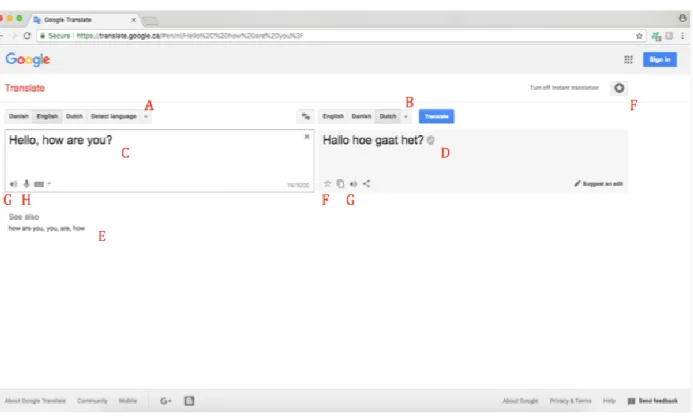
Google Translate (GT) is an instant translating tool that can be accessed via a web browser or an application (app). It uses both TTS and ASR and can translate words, phrases and even documents from one language to another. As illustrated in Figure 1, on the left side of their screen, GT users can choose their desired language in the textbox by pressing the drop-down arrow (see A in Figure 1). Next, they will move to the right side of their screen and choose the language of translation, again using the drop-down menu (B). Once the user has entered the text they wish to have translated in the left textbox (C), GT makes an instant translation (D). Below the textboxes, GT will often make suggestions or elaborations. Under the left textbox, GT can suggest alternative options of translation and under both textboxes GT can inform the user of the grammatical category of the word, such as verb, noun or adjective, and can also give synonyms
19
(E). GT also features a phrasebook option, only accessible through Google Account (available to users of Google products such as gmail), which automatically saves the translation in a
phrasebook when one presses the star icon in the translated text box (F). Furthermore, GT allows users to suggest edits if they believe the translation provided by the system is not accurate.
GT also uses TTS technology to read the original or translated text out loud. Users can use the TTS function by clicking on the speaker icons that appear in both the original and translated textboxes (G). ASR technology is used by pressing the microphone icon in the left textbox (H). The message then immediately appears in the textbox and is translated.
Studies using GT as a translator abound in the literature, with the majority suggesting that GT is a helpful tool particularly because it is easily accessible and free (Leite, Cochat, Salgado, da Costa, Queiros, Campos, and Carvalho 2016 & McDermott, 2016 & Spellman 2011). Although some researchers argue that GT is an intelligible and acceptable form of translation
A B C D E F F G G H
20
(Azer & Aghayi, 2015; Groves & Mundt, 2014), others caution against the use of GT given that its accuracy is not always reliable (Pollitt, 2014).
Google Translate has also been used in multiple school environments. GT provides an opportunity for translation when qualified human translators are not available (Van Rensburg, Synman, & Lotz, 2012) and assists in communication when there is a language barrier to overcome (Rodrígues-Castro, Salas, & Benson 2018). In Malaysia, Bahri and Mahadi (2016) examined how international students develop knowledge and language skills learning Malay, while using GT as a supplementary tool. They discovered that GT was beneficial for learning vocabulary along writing and reading. Most interestingly, this study concluded that students reported that they would benefit from GT in a self-directed learning environment if they were equipped with the appropriate knowledge to use it effectively. Building on this idea, the authors suggest that using GT in classroom activities would encourage them to study independently and allow them to create their own strategies to work out language learning problems. Some of these suggestions influenced the design of the current study, as will be discussed later.
From the above-mentioned research, it becomes clear that more research is needed concerning GT’s ability to assist users in vocabulary (and related pronunciation) learning in order to bring the literature up to date with the technology. Furthermore, there has been a lack of research combining TTS, ASR and translation which incorporates Liakin et al.’s (2017b)
proposal of extending Dickerson’s 3Ps to a CALL context.
Google Translate is the optimal tool to address these gaps in the literature, as it meets most of the criteria set by Chapelle (2001) and Chapelle and Jameson (2008) for computer-assisted language learning: GT is flexible (e.g., it can adopt to the learner), is authentic, has the
21
potential for feedback, and allows for strategy development (e.g., the use of the application for other purposes).
The Study
The following research questions aim to investigate different aspects of the feasibility and potential of using Google Translate as a pedagogical tool in a self-directed language learning (SDLL) context, as defined earlier:
1. To what extent can learners acquire Dutch phrases and pronounce them intelligibly after using Google Translate in a SDLL environment?
This question addresses the learning gains in vocabulary and associated pronunciation; it is answered through pre/post/delayed post-tests in which we
examine the learners’ ability to aurally produce and understand a set of target items in Dutch.
2. How do learners interact with Google Translate to learn?
This question targets the participants’ learning strategies and interactions with technology, which were analyzed qualitatively through video observations and interviews.
3. How do learners perceive Google Translate (and its inherent features such as TTS, ASR and translation) as a pedagogical tool?
This question examines two of the themes that informed this research: learners’ motivation and the types of feedback afforded by the target technology. It was answered through a combination of surveys (quantitative) and an oral interview (qualitative).
22
Based on the literature of SDLL (e.g., Little, 1995), it is hypothesized that participants would develop a basic level of lexical knowledge and become intelligible and comprehensible in producing the learned lexical items using GT. We also predicted that the participants would find and create individual ways to interact and learn from (and with) the technology (Dörnyei, 2005). Lastly, based on individual differences (Lee, Yeung & Ip, 2016), it was hypothesized that some participants would have reservations about the extent to which GT can aid their learning.
Methods
Participants
Thirty adults participated in the study (9 male, 21 female; Age: 18-35). They came from various language families (e.g., English, Kannada, Arabic, from a total of 13 languages) and educational backgrounds. None of the participants had any previous knowledge of Dutch, nor were they familiar with German or any Scandinavian language. Participants’ use of Google Translate prior to the study was reported, on average, as 3.8 out of 6 (where 6 constitutes the highest level of use). They used GT most often for translating from their L1 to another language and, accordingly, were not aware of GT’s speech capabilities. On average, participants rated the phrase “I enjoy working with technology” 4.9 out of 6, and the question “How interested are you in learning new languages?” 5 out of 6. Eight of the thirty participants reported that they had tried to learn a language on their own before using tools such as grammar books, Duolingo and Memrise.
Materials
Objectives list. During the experiment, the participants were provided with a list of ten learning “objectives” that they should accomplish within the allotted 45-60 minutes (see
23
Appendix B). These objectives (e.g., learn how to say “hello” in Dutch) were selected by the researcher and were based on their usefulness in real world scenarios and their status as beginner words or phrases (Thering, 2018). The last objective (i.e., “Choose your own phrase to learn in Dutch”) was chosen to allow the participants the freedom of choosing and learning their own expression. This also gave us a unique utterance to be used in the assessment of intelligibility (a transcription task), as we can not utilize any of the other utterances due to the three raters’ familiarity with the nine pre-determined learning objectives.
As indicated earlier, the tool that was used in this research was Google Translate, an instant translating tool that offers its users the option of utilizing TTS and ASR. For the purposes of this study, the desktop, browser-based version of GT was used.
Instruments
Questionnaire. A demographic questionnaire was used to collect the participants’ background information, including the languages they speak, whether they have ever learned a language in a self-directed learning context, if they have ever used GT, and their educational background (see Appendix A).
Pre-test, post-test, delayed post-test. A pre-test was used to ensure that the participants had no previous knowledge of Dutch; it asked participants to produce orally and in writing the target 10 (nine pre-determined and one participant-selected) learning objectives. The same test was then used for the immediate post-test and as the delayed post-test.
Survey. The survey consists of 28 Likert scale-rating questions, adapted from Rossing, Miller, Cecil, and Stamper (2012). They examine learner perceptions of the effectiveness of the learning processes (n=7), the target pedagogical tool – GT (n=7), the motivation (n=7), and the likelihood that they would use this tool in a self-directed learning environment in the future
24
(n=7) (see Appendix C). Some of the participants’ answers on the survey were also used as starting points for the oral interview, as will be described next.
Interview questions. These semi-structured interview questions concern the tool’s practicality, its associated enjoyment and motivation level, the types of feedback provided by the tool, and the participants’ knowledge gain based on their perceptions (see Appendix D).
Questions also included topics uncovered via the survey. For instance, the researcher asked follow-up questions about items that deviated from the initial hypothesis (e.g., if the participant found that the feedback provided by GT was difficult to understand).
Procedure
Participants were asked to sign an informed consent form before engaging in the study. The process began by providing participants with the necessary information pertaining to the order of events during the research period. All participants first completed the pre-test, which was audio-recorded. They were then given a brief 5-minute tutorial on how GT works as well as suggested techniques on how to use the tool. These techniques include the participants
translating a phrase, listening to it using GT’s TTS function, repeating after the TTS and testing their pronunciation using the ASR function. The participants were then provided with the objectives list and were given one hour (maximum) to complete the assigned goals. The participants were video-recorded throughout the experiment.
At the end of the experiment, the posttest was administered, in which the participants were asked to produce orally (audio-recorded) and in writing the target Dutch phrases, presented to them in random order. Participants then filled out the survey questionnaire and were asked to participate in a recorded interview with the researcher. Finally, approximately two weeks after
25
the initial research was completed, a delayed-post test was performed, consisting of procedures similar to the ones described for the posttest.
Data Analysis
Questionnaire. The general questionnaire was used to augment the data found. Pre-test, post-test, delayed post-test. The pre-tests were analyzed using descriptive statistics (i.e., via the computation of means and standard deviations) to ensure that the participant was a suitable candidate. Following Derwing and Munro’s (2009) approach to
assessing L2 pronunciation holistically, three Dutch native speakers (raters) transcribed and rated the relevant post-test audio to analyze intelligibility (how much was actually understood by the three raters, via the transcription of the personalized, unique phrase in the learning “objectives”), comprehensibility (how much the raters believed they could understand the participant), and accentedness (how accented the target speech was). Comprehensibility and accentedness were rated on a scale from 1-6, where 1 means “incomprehensible” or “very accented” and 6 “completely comprehensibility” or “not accented at all,” respectively.
The same three raters transcribed the last objective (participant selected). The transcribed phrases were rated 1 when wrong, 3.5 when partially correct, and 6 when correct (these 1-6 values were selected to comply with the scale used for the other pronunciation measures). The scores from the three raters were then analysed statistically (means and standard deviations or t-tests to determine pre-posttest improvements). The same procedures were used to compute the delayed posttest results. These results answer research question #1.
Video-recordings. Video-recordings of the users’ experience were watched, described and analyzed for the different strategies that the participants used to achieve the objectives: to learn a set of key phrases in Dutch using GT. The analysis addressed the following questions:
26
how many times did the participants listen to the TTS? How many times did they repeat after the TTS voice? How often did they try the ASR? How many times did they practice the phrase without using TTS or ASR? If the participants created their own learning strategy, what was it? This information answers research question #2.
Survey. The ratings from the survey were analyzed using descriptive statistics (the computation of means and standard deviations). These results answer research question #3. To verify the internal consistency of the items included under each perception marker, a Cronbach's alpha was run on the survey data of all participants. Cronbach’s alpha coefficients for the internal consistency of the participants’ perceptions across the four variables were: .82 for learnability, .87 for usability, .88 for motivation, and .85 for willingness to use GT as a pedagogical tool (note that values greater than .70 indicate high internal consistency).
Interviews. The interviews were transcribed and coded for any insightful opinions that the participants might have had regarding the target learning tool, using insights from Saldaña (2009). Briefly, the participants’ answers were compiled into two main categories reflecting their perceptions of the strengths and weaknesses of their pedagogical experience. The data was then divided into subcomponents that more directly reflect this study’s goals, considering the four perception markers adopted: learnability, motivation, usability, and willingness to use GT. These results reinforced the survey results from a qualitative perspective, therefore also contributing to research question #3.
Results
This study examined different aspects of the potential of using Google Translate as a pedagogical tool in a self-directed language learning context. Accordingly, it proposed to answer the following research questions: (1) To what extent can learners acquire Dutch phrases and
27
pronounce them intelligibly after using Google Translate in a SDLL environment? (2) How do learners interact with Google Translate to learn? And (3) How do learners perceive Google Translate (and its inherent features such as TTS, ASR and translation) as a pedagogical tool? In this section, we provide the results of the analysis conducted, using the instruments and
analytical tools specified earlier.
To what extent can learners acquire Dutch phrases and pronounce them intelligibly after using Google Translate in a SDLL environment?
To determine vocabulary learning, the Dutch phrases and words that were learned and recalled on the two posttests were calculated by two raters using the following values: 0 for incorrect, 0.5 for partially correct, and 1 for correct, for each target item. The inter-rater
reliability among these raters was calculated using intraclass correlation procedure: ICC(2, 2) = .98 for the post-test and ICC(2, 2) = .98 for the delayed post-test. Raters discussed and agreed on each of the discrepancies (i.e., 32 items or 5.33% from a total of 600 tokens) and arrived at a consensus for each problematic case. Each participant had zero knowledge of the target phrases at the pretest and so there was no need for a pretest-posttest comparison, as the gains in
vocabulary knowledge were robust, going from no knowledge (0 /10) to almost full acquisition of the ten target items (9.5 /10). However, from test (M = 9.5/10, SD = 1.5) to delayed post-test (DPT) (M = 5.4/10, SD = 4.5), t-post-test results showed that there was a significant decrease in the amount of vocabulary acquired, t(29) = 14.54, p = .001. A summary of the results are shown in Table 2.
28 Table 2
Vocabulary Gains: Mean Scores
Measures Pretest /6 SD Posttest /6 SD
Comprehensibility 0 N/A 4.2 1.1
Accentedness 0 N/A 5.0 1.2
Intelligibility 0 N/A 5.2 1.2
Our findings suggest that L2 learners can successfully acquire vocabulary and related pronunciation features when learning Dutch as a foreign language using Google Translate. Although the robust improvement was not sustained over the delayed post-test, over 50% of the target phrases and associated pronunciation were retained in those tests.
Pronunciation was only measured for the post-test because the delayed posttest was affected by vocabulary loss (as will be discussed later), consequently affecting the raters’ ability to assess the participants’ pronunciation at that stage. As seen in Table 3, there was substantial improvement in all three pronunciation components (comprehensibility, accentedness and intelligibility) from pre-test to post-test as participants had no initial knowledge of Dutch
pronunciation (recall that no knowledge of Dutch or closely related languages was a requirement for participation). Consequently, t-tests were not appropriate to measure pronunciation
improvements over time. These results mean that, considering the target 10 phases used in the experiment, the 30 Dutch learning participants became orally comprehensible (4.2 /6), had little foreign accent (5 /6) and were deemed intelligible (5.2 /6) by the three raters, considering the speech data collected immediately after the treatment.
29 Table 3
Learner Pronunciation: Mean Scores
Measures Pretest /6 SD Posttest /6 SD
Comprehensibility 0 N/A 4.2 1.1
Accentedness 0 N/A 5.0 1.2
Intelligibility 0 N/A 5.2 1.2
How do learners interact with Google Translate to learn?
To answer this question, we analyzed the video data of the learners’ interactions with Google Translate. During this analysis, 10 different kinds of interactions with the technology, referred to as learning strategies, were observed. For each participant, the amount of times they listened to the TTS, repeated after the TTS, used the ASR, and practiced without either
technology (No Prompt Practice) were recorded. The general patterns generated ten strategies, which are summarized in Table 4 via means and standard deviations for each action. For example, the eight participants in TTS-RP-ASR listened to the TTS 121.4 times (mean values; SD: 57.2), repeated (RP) after the TTS 67.1 times (SD: 41.8), used the ASR 120 times (SD: 30.9), and finally engaged in No Prompt Practice 121.4 times (SD: 43). It should be noted that these were the participants’ dominant learning strategies, as they also borrowed actions from the other strategies as well as used non-technology related approaches. For instance, while most participants used paper to varying extents (e.g., to write words and their pronunciations), one chose not to use any paper to help them learn the words. Interestingly, two participants used a chanting method in which they orally repeated the target word or phrase several times to memorise them.
30
Sixteen participants were categorized into two different learning strategies, containing eight participants each. In the first, most commonly used strategy, participants listened to the TTS, repeated after they heard the synthesized voice (RP), and then proceeded to try the ASR (TTS-RP-ASR). The participants in the second most commonly-selected strategy listened to the TTS and immediately afterwards tried the ASR (TTS-ASR), without orally imitating/repeating the TTS voice.
Twelve participants were sorted according to six different learning strategies, each containing two participants. The first pair of participants used a strategy similar to the TTS-ASR approach but added self-practice (SP; e.g., repeated the target phrase to themselves), using neither the TTS nor the ASR to self-assess their attempt (TTS-ASR-SP). The next pair used a TTS, repetition, and self-practice approach; minimal ASR was used (TTS-RP-SP). The
participants using the ½ TTS ½ ASR strategy split their time initially only engaging the TTS and then abandoning it to work with the ASR. Two further participants attempted to predict the pronunciation (Pr) of the word or phrase before they listened to the TTS. They then repeated after the TTS and attempted the ASR (Pr-TTS-RP-ASR). The next two participants split up each phrase and used the TTS for each individual word (W), then repeated and tried the ASR function (TTS(W)-RP-ASR). The subsequent pair of participants worked in silence writing down the translation of each word, then later listened to the TTS and attempted to pronounce it using the ASR (WR-TTS-ASR). The remaining two participants used unique strategies that were not used by any other participant. These strategies included: to listen to and repeat after the TTS for the first half of the session and attempt pronunciation with the ASR during the last half, or to type in all phrases while speaking simultaneously with the TTS (TTS-(S)RP), accompanied by ASR practice.
31 Table 4
Learner Strategies while interacting with Google Translate TTS
Listens TTS Repeats ASR Use No Prompt Practice
Learning Strategy N M/SD M/SD M/SD M/SD TTS-RP-ASR 8 121.4/57.2 67.1/41.8 120/30.9 121.4/43 TTS-ASR 8 86.4/25.3 8.8/8.7 124.9/55.8 15.4/28 TTS-ASR-SP 2 72.5/6.4 11.5/7.8 70.5/36.1 268/130.1 TTS-RP-SP 2 105/8.5 60/2.8 18.5/2.1 261.5/37.5 ½TTS ½ ASR 2 99.5/16.3 1/1.4 135.5/58.7 13.5/19.1 Pr-TTS-RP-ASR 2 104.5/12.0 74.5/19.1 89.5/50.2 303/141.4 TTS(W)-RP-ASR 2 117.5/78.5 55/65.1 49/21.2 21/28.3 WR-TTS-ASR 2 60/11.3 0.5/0.7 151/46.7 8/11.6 ½TTS-RP- ½ ASR 1 119/- 79/- 70/- 112/- TTS-(S)RP-ASR 1 123/- 51/- 44/- 113/-
Mean and SD are calculated from the total amount of times each participant engaged in the action. The acronyms used are: TTS (text-to-speech), ASR (Automatic speech recognition), RP (repeated practice), SP (self-practice), ½ TTS (half time on TTS, alternating between the two technologies), ½ ASR (half time on ASR, alternating between the two technologies), TTS(W) (TTS used for individual words), Pr (predicted pronunciation, without TTS assistance), WR (writing, taking notes), TTS-(S)RP (simultaneous repetition with the TTS output).
These results suggest that the participants used a variety of strategies to learn with Google Translate, but seem to prefer TTS-RP-ASR and TTS-ASR.
How do learners perceive Google Translate (and its inherent features such as TTS, ASR and translation) as a pedagogical tool?
This question was addressed quantitatively and qualitatively, based on four perception markers: the learnability of the tool (e.g., is it effective in teaching?), its usability (e.g., is it comfortable and easy to use?), motivation (e.g., is it fun and motivational?), and willingness to use it (e.g., plan to use it in the future?). As seen in Table 5, using a scale from 1 to 6, the mean
32
scores for all of the perception markers were higher than two thirds, with relatively low standard deviations.
Table 5
Learner Perception Scores of Google Translate
Perception Markers M/6 SD
Learnability 4.4 1.2
Usability 5.1 1.0
Motivation 4.4 1.2
Willingness to Use 4.5 1.3
To answer this question qualitatively, quotes were chosen from interviews with participants. They revealed that participants made both positive and negative observations of each perception marker pertaining to Google Translate. For instance, while some participants agreed that the TTS-ASR combination afforded by GT helped them learn Dutch vocabulary and its pronunciation patterns (e.g., “that I was improving […] pronouncing it maybe better as I was repeating it”), others highlighted that the proposed system should go beyond mere language features and provide information about culture and usage (e.g., “I would like to have that sociolinguistic part as well. More than just linguistic material”). Table 6 shows some of the participants’ positive and negative remarks of the four perception markers adopted in this study.
33 Table 6
Learner Perceptions of GT According to Four Perception Markers
Discussion
This study examined Google Translate and its speech-related affordances as pedagogical tools in a self-directed language-learning context. It specifically investigated participants’ ability
Perception Markers Positive Remarks Negative Remarks
Learnability “At the beginning was fine and then I realized that well I found that I was improving that I was pronouncing it maybe better as I was repeating it.” “I thought I could learn the
pronunciations pretty well with the text-to-speech, the software they have. And it was also really nice and helpful that you could talk into it and if it's a close enough pronunciation, then it would show up. So I thought it was nice. I thought it was helpful.”
“I think it would be really nice if you could adjust the speed at which they speak other than just fast and slow. Like if there was an actual speed button where you could change it according to a scale.”
“I would like to have that
sociolinguistic part as well. More than just linguistic material.”
Usability “I think the layout is simple, I think its user friendly. I like that and I like that you can say the word back to see if you learned it.”
“I'm missing more human.”
“I didn't like it, I hated it … it made me insecure because I didn't know whether it was me or the program.” (ASR) Motivation “Because there was this listening and
speaking aspect, I think I got more motivated, so I wanted to learn it more.”
“I just didn't know if what I was doing was right. And then as it progressed, I became more and more confident.”
“Duolingo has like pictures and they do lots of interactive things that are back and fourth. So it's much more of an exciting tool to use, whereas GT feels really basic.”
Willingness to Use “I would use it for pronunciation in the process of learning a language. It’s a good way to learn how to pronounce a word or phrase before you use it in the field.”
“If there was another system that I can choose to learn a new language from, I think I'll choose another system just because I think GT, I don't think its meant for learning a new language. I just don't trust it as much.”
34
to learn L2 Dutch vocabulary (phrases) and pronunciation using GT, the learning strategies they utilized during its use, and their perceptions of the technology involved. This was an important tool to explore because Google Translate is a free and accessible tool that has the potential to reach a large number of language learners. In addition, GT includes two speech technologies that have been shown to promote the acquisition of L2 pronunciation, TTS and ASR (e.g., Cardoso, Collins & White 2012; Liakin et al., 2014; 2017; Soler-Urzua, 2011). As such, this study examined the potential effects of combining a bi-directional translation tool with these two speech technologies on language learning.
Vocabulary learning and interactions with Google Translate
There was a substantial learning gain in vocabulary as participants scored an average of 9.5/10 on the immediate posttest. This score was accompanied by a strong inter-rater reliability rating, which informed us that the raters had little difficulty in assessing the participants’ speech, thus increasing the reliability of the results. Our findings show that Google Translate, in
combination with its two speech technologies, has the ability to be an effective learning tool, at least in terms of “short term learning.” Unfortunately, there is not much literature to attest to the hypothesis that both TTS and ASR are effective tools for short-term vocabulary learning, but the CALL literature indicates that when the pedagogical intervention is brief, as was the case in the current study, some of the learning is ephemeral (e.g., Laufer, 2006; also see
Chukharev-Hudilainen & Klepikova, 2017 for evidence that vocabulary repetition over a sustained period of time may increase learners’ long-term vocabulary retention), as will be discussed next.
From post-test to delayed post-test, there was a significant decline in vocabulary retention. Nonetheless, it is important to note that participants were still able to recall, on
35
GT-based learning session, without any further practice. To examine the lasting learning effects of GT, the participants were asked not to engage in any GT-based practice until they completed the delayed posttest. This decrease can be explained by the fact that the study does not
necessarily reflect a standard learning context, in which learners would probably be encouraged to study and practice the target forms, store them in long-term memory, and eventually master them. With the inclusion of sustained practice and spaced repetition, GT could become a more effective tool for long-term learning. Spaced repetition, a method in which participants review previously learned material with increasing intervals of time, has been shown to enhance retention of information even years later (Ullman & Lovelett, 2016). Similarly, it has been demonstrated that with only three minutes of technology-stimulated vocabulary activities a day, learners can increase their vocabulary retention (Chukharev-Hudilainen & Klepikova, 2016). Future studies on the use of GT could incorporate spaced repetition into their research and investigate the tool’s long-term effectiveness. This would also provide an opportunity to further examine the retention of pronunciation patterns at the delayed post-test time, which we were not able to assess due to the loss of vocabulary, as mentioned earlier.
The delayed post-test vocabulary scores not only showed us the long-term effect of GT, but it also revealed some individual differences between participants, reinforced by the high standard deviations observed for vocabulary retention. Some participants were able to remember up to eight of the phrases (80% of the target items) while others were only able to remember two (20%). These observations are similar to those found in Pulido and Hambrick’s (2008) study on vocabulary development, in which they also identified individual differences as a reason for variation in vocabulary retention. This suggests that GT is possibly a more impactful tool for some, but not all learners. Interestingly, this was not the only evidence of individual differences;