Consumer Products and Retail the way we see it
All
-
Channel Experience:
Engaging with
Technology-Enabled Shoppers In-Store
How New In-Store Digital Tools Can Drive Value for
Shoppers and Retailers
The ability to provide a superior in-store shopping experience is critical for retailers to drive value for consumers. According to a survey by RSR, 88% of retailers with annual revenue over $1 billion cite “improving the customer experience” as one of their top three uses of in-store technology.2 Retailers can
target several levers to help create an experience-led in-store environment: • Easy access to information
through smartphone apps, surface computing devices, self-service kiosks, digital signage and public social networks.
• Faster response to shopper queries with hand-held/multi-touch devices, augmented reality and online product recommendation engines.
• Ability to locate products quickly,
enabled by digital and e-paper signage and smartphone apps. • Quick and easy checkout through
the use of self-checkout kiosks, personal shopping scanners/mobile POS, mobile phone payments and contactless payments.
Digital Tools Drive Value for Shoppers and Retailers
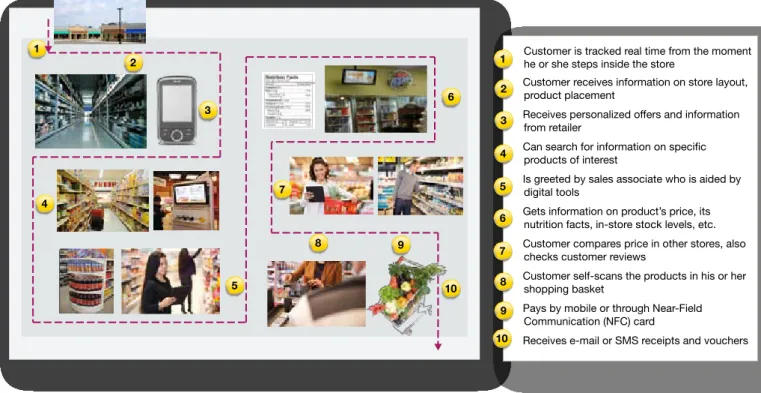
Powerful digital tools can be used in a wide range of applications in a retail environment to provide a more seamless experience (Figure 1). Following is a closer look at some of these applications.
partners.
The intelligent waste management solution is based on adjusting the messaging on electronic signs to reflect changes in pricing, product information, promotions and plan-o-grams. The system compares predicted and actual sales rates and analyzes expected deliveries and current stock levels to determine what predefined measures must be executed to avoid overstock or imminent out-of-stock situations. The solution consists of centrally controlled wireless digital displays and shop floor hand-held scanners (to be used by mandated personnel with the knowledge and experience to make decisions regarding freshness and promotions to increase sales).
The solution has resulted in numerous benefits, including:
• Lower costs and increased sales due to reduced waste
• Improved corporate social responsibility by addressing the food waste issue
• Reduced labor and print costs and the elimination of price discrepancies between shelf labels and POS systems
of mobile features and device convergence such as smartphones are driving mobile commerce. At the same time, store visits are being enhanced by dynamic digital displays and personalization through hand-held devices or the shopper’s own phone. These changes provide retailers with the opportunity to drive greater value by making the switch from “talking to” towards “engaging with” consumers and shoppers.
Creating an Experience-Led In-Store Environment
A growing number of digital channels, from apps to kiosks to the web, are replacing elements of the shopping experience that would previously have occurred in a physical space, calling for the store environment to evolve. This shift requires retailers to think differently about the shopper experience and service model
1“How Digital is Transforming Physical Experiences,” http://blogs.uk.capgemini.com/ceblog/page/6/, Customer Experience Blog, Capgemini, Dec. 2, 2010 2 “The 21st Century Store: The Search for Relevance,” RSR, June 2011
Consumer Products and Retail the way we see it
Smartphones allow retailers to interact with customers at every step of their shopping journey. The significant rise in the smartphone user base globally is leading retailers to leverage this technology to enhance interaction with shoppers. And for good reason. According to a Google survey, 70% of U.S. smartphone owners use their device while shopping in-store, and 74% of smartphone shoppers made a purchase as a result of using their smartphone.3
Before the actual in-store experience, shoppers can use their smartphones to access a store locator, search for product availability, and access price and promotional coupons. Using
mobile applications such as “geo-fencing” or location-based services retailers can identify customers in the vicinity of a store. They can then use this technology to entice customers into the store by sending out messages on products, promotions and exclusive deals to consumers in the geo-fenced area.
During the in-store shopping experience, smartphones can be used to scan a barcode or run a price comparison, access product information, check customer reviews and ratings, and get quick in-store/ aisle navigation. After the shopping experience, shoppers may use their phones to track and trace a product delivery from the store.
Figure 1: Digital Tools for Each Step of a Shopper’s in-Store Journey
1 5 8 9 10 4 6 3
Customer is tracked real time from the moment he or she steps inside the store
Customer receives information on store layout, product placement
Receives personalized offers and information from retailer
Can search for information on specific products of interest
Is greeted by sales associate who is aided by digital tools
Gets information on product’s price, its nutrition facts, in-store stock levels, etc. Customer compares price in other stores, also checks customer reviews
Customer self-scans the products in his or her shopping basket
Pays by mobile or through Near-Field Communication (NFC) card
Receives e-mail or SMS receipts and vouchers
1 4 5 7 8 9 10 6 3 2 2 7 Source: Capgemini
Retailers can also improve their understanding of the shopper buying journey by tracking smartphone usage in store, which can be a key input for improved store design and layout. And location-based capabilities make it easier for retailers to reach the customer at any time before, during or after a shopping trip.
While smartphones offer significant opportunities to enhance the shopper experience, they also present challenges. For example, retailers have to depend on third-party communications providers for connecting with shoppers, and some consumers worry about the possible erosion of privacy.
can locate and select products on touchscreens at an interactive station, download product information on a mobile device or locate items in-store. Tablets can be used for checkouts by applying finger signatures. These devices can also issue SMS or e-mail receipts, thus enabling faster checkout. And increasingly retailers are using tablets as “assisted sales tools” to provide more consistent and efficient sales support by store staff.
Surface computing technologies such as tablets help retailers provide a connected experience with a higher degree of service. Benefits include increased in-store sales and conversion rates; a reduced learning curve for new employees; a more engaging and efficient buying experience for shoppers; and the ability to assist sales associates in up-selling and cross-selling with quick product information, customer opinions, etc. On the downside, most of these devices are relatively low on mobility, compared with smartphones. In addition, tablet apps are still in a nascent stage so a complete understanding of their functionalities is not yet clear.
enhance real-world data or images with computer-generated input such as images, graphics or data. In addition, apps based on augmented reality using object recognition and GPS can help shoppers locate and find their way to or through a store. Additional retail applications include product reviews via image recognition, price checks, product availability, virtual fitting rooms and interactive window displays. Augmented reality can provide an enhanced way to interact with shoppers in real time. However, at this early stage, the set-up and management costs associated with augmented reality may outweigh the sales benefits.
Point-of-sale technology is moving from traditional to advanced systems, keeping in mind the changing customer. POS applications have the potential to move beyond transaction-only devices to become the primary medium to deliver customer-centric retailing. New applications provide the opportunity to improve the in-store experience by reducing consumer checkout times and abandon rates. For example, “line-busting” applications use wireless devices to emulate the cash register and give credit card shoppers the chance to skip checkout lines, helping to enhance a store’s service image. This type of portable POS is especially suited for goods and orders that are large and where a store employee is closely involved such as in a DIY store or home center.
iPhone solution – one that would offer superior functionality and service to its customers.
The Solution: The Capgemini Innovation Factory team worked with a team from Boulanger to design and integrate an application that would not only meet basic customer requirements (geo-localization of stores, item description and price, etc.) but would actually go beyond to set a completely new standard for the industry. The Result: In the first six weeks after it was launched, the application was downloaded more than 20,000 times, with peaks at 1,500 downloads per day. It quickly reached “top 25” status for all iPhone applications in its category. The success of the application has also resulted in a strong association of the Boulanger brand with a young, dynamic and eager clientele.
“Our aim was to develop a user-centric application designed to bring real value to our shoppers and customers. This is a complete application enabling purchase transactions with a real-time inventory look-up feature in the nearest selected stores, loyalty management and product guarantees,” said Patrick Perret, Director of Information Technology Studies at Boulanger.
In addition to mobility and speed, other standout features of the application are:
• Direct access to all available products in nearby stores
• Booking an item and retrieving it in the store within the hour
• Real-time updates on special events and promotions
• Real-time order/repair status
• Display of all purchase tickets to enable an improved after-sales service
• Viewing products using augmented reality wherein a Boulanger item could be visualized as it would appear at home.
Consumer Products and Retail the way we see it
POS applications can also improve convenience and flexibility. Store employees can connect a wireless access point into the retail backbone and create an instant “store” for special occasions or venues such as graduations or sporting events. And retailers can improve operating efficiency through faster processing, faster interaction with store employees, improved access to product and inventory data, and better employee tools.
Although advanced POS solutions can help retailers improve customer centricity, the rate of adoption remains slow. A key hurdle is the potential need for POS upgrades in order to accommodate the new applications.
Mobile payments is a growing area for retailers and is gaining importance due to the rise in smartphone adoption by customers.
Retail applications offer the potential to improve the shopping experience and increase efficiency. Mobile payment methods include proximity payment approaches like Near-Field Communication (NFC), barcodes and numeric codes, as well as remote methods like message-based, browser-based and application-based payments.
In one example, a mobile app was launched that uses facial recognition to confirm a shopper’s identity in payment transactions. And a new retail mobile payment service based on NFC technology lets consumers pay for items merely by waving or tapping their smartphones near a register at checkout.
Although the field of retail mobile payments is dynamic and evolving, several challenges exist, including: • Capital constraints and difficulty in
quantifying the technology ROI • Lack of comprehensive industry
standards for mobile technology adoption
• Government restrictions/regulations related to payment security concerns and fraud
• Unwillingness of stakeholders like mobile service providers and banks to adopt mobile payment systems
apps has given rise to a concept called “SoLoMo,” which represents the coming together of social, local and mobile media. SoLoMo works on the principle of mobile discovery that utilizes a device’s portability and location awareness to push content.
billboards with virtual store that are exact replicas of the physical stores. Shoppers can use their smartphones to scan a QR code near the food item, which gets delivered shortly to a location of their choice.
information to push relevant content to the shopper in real time.
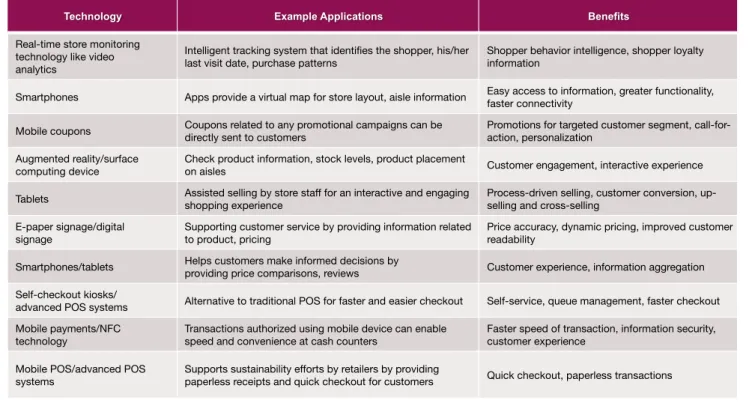
Figure 2: Reaping the Benefits of In-Store Digital Technology
Source: Capgemini
Real-time store monitoring technology like video analytics
Intelligent tracking system that identifies the shopper, his/her last visit date, purchase patterns
Shopper behavior intelligence, shopper loyalty information
Smartphones Apps provide a virtual map for store layout, aisle information Easy access to information, greater functionality, faster connectivity Mobile coupons Coupons related to any promotional campaigns can be directly sent to customers Promotions for targeted customer segment, call-for-action, personalization Augmented reality/surface
computing device Check product information, stock levels, product placement on aisles Customer engagement, interactive experience Tablets Assisted selling by store staff for an interactive and engaging shopping experience Process-driven selling, customer conversion, up-selling and cross-selling E-paper signage/digital
signage Supporting customer service by providing information related to product, pricing Price accuracy, dynamic pricing, improved customer readability Smartphones/tablets Helps customers make informed decisions by providing price comparisons, reviews Customer experience, information aggregation Self-checkout kiosks/
advanced POS systems Alternative to traditional POS for faster and easier checkout Self-service, queue management, faster checkout Mobile payments/NFC
technology Transactions authorized using mobile device can enable speed and convenience at cash counters Faster speed of transaction, information security, customer experience Mobile POS/advanced POS
systems
Supports sustainability efforts by retailers by providing
paperless receipts and quick checkout for customers Quick checkout, paperless transactions
Consumer Products and Retail the way we see it
Recommendations: How to Become a Digital Master
Successful in-store digital
transformation requires retailers to adopt the right tools to keep pace with technology-enabled shoppers. Retailers must craft a sound strategy that is centered around the shopper. To become a digital master, retailers should consider the following recommendations:
Focus on the shopping journey.
Retailers must implement digital tools and technologies while always considering the full customer shopping journey – from awareness to after-sales service – to help ensure a seamless experience.
Differentiate yourself. Technology adoption should be treated as a source of competitive advantage by retailers looking to improve their in-store customer experience.
Make it mobile. Mobile technology such as smartphones, mobile POS and mobile payments will play a key role in in-store digital implementations. Rapid smartphone adoption by customers will drive the manner in which they interact with retailers, both within and outside the store.
Deliver self-service capabilities.
Do-it-yourself technology like self-scanning and hand-held devices will be adopted in a big way by customers as they look for tools to make
shopping and checking out easier and faster.
Communicate a new reality.
Retailers should continue to adopt technologies like augmented reality that help provide the “Wow!” factor for shoppers and can improve interactions between the two parties.
Consider existing applications.
Retailers will need to balance adopting new technology innovations with their existing technology applications to ensure smooth integration and fast implementation in order to meet rapidly changing shopper preferences.
Focus on people. A successful in-store digital transformation is only possible if both the people and technology pillars are bound by robust and well-defined processes. Employee involvement and training is critical in technology implementation to realize the full potential of the technology and to achieve the business objectives.
The impact of in-store digital transformation is not only being felt by shoppers, but also by employees. According to a study conducted by RIS News, 50% of participating retailers said that providing their associates with better tools was their number one priority.5 Retailers today are looking to invest in employee-facing technologies to help improve in-store business processes as well as to provide more consistent and efficient sales support for shoppers. Employee-operated mobile handheld devices for line busting, in-store customer service, barcode scanning and inventory operations are among the new digital tools being used in-store.
The Role of Employees in Digital Transformation
Rightshore® is a registered trademark belonging to Capgemini. The information contained in this document is proprietary. Copyright © 2012 Capgemini. All rights reserved.
For more information on our “Engaging with Technology-Enabled Shoppers In-Store” research and solutions, please contact:
Brian Girouard
Laurence Jumeaux
The “Engaging with Technology-Enabled Shoppers In-Store” research was conducted by Capgemini’s Consumer Products & Retail Strategy Lab: Manvendra Khati and Pranav Toshniwal.
With around 120,000 people in 40 countries, Capgemini is one of the world’s foremost providers of consulting, technology and outsourcing services. The Group reported 2011 global revenues of EUR 9.7 billion.
Together with its clients, Capgemini creates and delivers business and technology solutions that fit their needs and drive the results they want.
A deeply multicultural organization, Capgemini has developed its own way of working, the Collaborative Business Experience™, and draws on Rightshore®, its worldwide delivery model.
More information is available at:
www.capgemini.com
Rightshore® is a trademark belonging to Capgemini
About Capgemini and the