N A N O E X P R E S S
Open Access
Porous polymers bearing functional
quaternary ammonium salts as efficient
solid catalysts for the fixation of CO
2
into
cyclic carbonates
Sheng Cai
1, Dongliang Zhu
2*, Yan Zou
1and Jing Zhao
1*Abstract
A series of porous polymers bearing functional quaternary ammonium salts were solvothermally synthesized through the free radical copolymerization of divinylbenzene (DVB) and functionalized quaternary ammonium salts. The obtained polymers feature highly cross-linked matrices, large surface areas, and abundant halogen anions. These polymers were evaluated as heterogeneous catalysts for the synthesis of cyclic carbonates from epoxides and CO2in the absence of co-catalysts and solvents. The results revealed that the synergistic effect between the functional hydroxyl groups and the halide anion Br−afforded excellent catalytic activity to cyclic carbonates. In addition, the catalyst can be easily recovered and reused for at least five cycles without significant loss in activity.
Keywords:Ionic polymer, Mesoporous materials, CO2fixation, Cycloaddition, Solid catalyst
Background
Global climate change and excessive CO2 emission have attracted widespread public concern in recent years. Since CO2 is expected to be a highly abundant, quite cheap, nontoxic, and nonflammable C1 resource in the organic synthesis, the capture and utilization of CO2to produce higher-value relevant chemicals, such as polycarbonates and cyclic carbonates, are receiving rising attention [1, 2]. In this context, the conversion of CO2to cyclic carbonates via epoxide substrates is demonstrated to be an atom-economical reaction, and the products can serve as excel-lent aprotic polar solvents as well as intermediates in the production of pharmaceuticals and fine chemicals [3–5]. In the past few decades, extensive efforts have been de-voted to develop efficient catalysts for the synthesis of cyclic carbonates, including salen-metal complexes [6–8], quaternary ammonium/phosphonium salts [9, 10], ionic liquids (ILs) [11, 12], molecular sieves [13], metal-organic
frameworks [14, 15], and so on. Among them, ILs have become a class of promising candidates owing to their unique features of high thermal stability, variety of struc-tures available, and easy shaping [16–18]. To simplify the separation process and improve the reusability of ILs, more efforts have been devoted to the supported IL cata-lysts [19, 20], which usually suffers from tedious prepar-ation process, large mass transfer resistance, and the leaching of IL active sites. Thus, new strategies for the preparation of efficiently heterogeneous IL catalysts for the synthesis of cyclic carbonates are highly desirable.
Nanoporous polymeric materials have attracted increas-ing attention due to their versatile and tunable structures, high surface area, and tunable surface chemistry, which allow potential applications in gas storage, explosive detec-tion, drug release, and catalysis [21, 22]. Particularly, ionic porous polymers obtained by the polymerization of meric ILs or copolymerization of ILs with other mono-mers have been investigated as innovative solid catalysts or catalyst supports [23, 24]. A wide range of ionic porous polymers have been developed and have shown excellent catalytic performances in numerous organic synthetic re-actions, among which, the cycloaddition of CO2 with epoxide is a hot topic [25]. For example, Wang et al. [26] * Correspondence:[email protected];[email protected]
2Research and Development Centre, China Tobacco Anhui Industrial Co., Ltd., 9 Tianda Road, Hefei, Anhui 230088, China
1State Key Laboratory of Coordination Chemistry, Institute of Chemistry and Biomedical Sciences, School of Chemistry and Chemical Engineering, Collaborative Innovation Center of Chemistry for Life Sciences, Nanjing University, Nanjing 210093, China
used an ionothermal method to prepare a novel meso-macroporous hierarchical poly(ionic liquid), which was applied as highly efficient heterogeneous catalysts for the conversion of CO2into cyclic carbonates at ambient pres-sure. Zhang et al. prepared imidazolium salt-modified porous hypercross-linked polymers and used them as highly efficient solid catalysts for synergistic CO2capture and conversion [27]. However, the present systems still suffer from long reaction time, high CO2pressure, or high reaction temperature. Moreover, most of the present ionic porous polymers are based on imidazolium ILs, while the quaternary ammonium salt IL-based ionic porous poly-mers are scarce, although quaternary ammonium salts have been proved to be one of the most efficient catalysts for CO2fixation. In addition, it has been reported that the functional groups such as hydroxyl and carboxyl are favor-able for the cycloaddition reaction due to the synergistic effect with Br ions [28, 29]. These considerations prompted us to design new hydroxyl-containing quaternary ammo-nium salt-based ionic porous polymers as “task-specific” catalysts for the cycloaddition of CO2with epoxides.
Herein, we designed and synthesized a new type of hy-droxyl functionalized quaternary ammonium salt-based ionic porous polymer via the radical copolymerization of hydroxyl functionalized triallylamine and divinylbenzene (DVB) (Scheme 1). The resulting porous materials with very high surface area can be sufficiently applied for the production of cyclic carbonates from CO2and epoxides, showing high conversion and selectivity, easy recovery, and steady reusability.
Methods
All chemicals in this work were used as received without further purification. Triallylamine (TAA); divinylbenzene (DVB), 3-bromo-1-propanol, 1-bromobutane, epichloro-hydrin (ECH), and propylene oxide (PO) were purchased from Sigma Aldrich Reagent Co., LLC. Styrene oxide (SO), allyl glycidyl ether (AGE), and cyclohexene oxide (CHO) were provided by Aladdin Chemical Reagent Co., Ltd. Other reagents were laboratory-grade reagents from local suppliers.
Characterizations 1
H NMR spectra were collected on a Varian Mercury plus 400-MHz spectrophotometer at ambient temperature using D2O as solvent. CHN elemental analysis was performed on a vario EL cube elemental analyzer. Fourier transform infra-red spectroscopy (FT-IR) spectra were recorded on a FT-IR instrument (Nicolet 360, KBr discs) in the 4000–400 cm−1 region. Thermogravimetric (TG) analysis was carried out with a STA409 instrument in nitrogen at a heating rate of 15 °C min−1. The nitrogen adsorption-desorption isotherms were measured on a BELSORP-MINI instrument at liquid nitrogen (77 K) temperature. The samples were evacuated at 423 K for 1.5 h before measuring. The specific surface areas were evaluated using the Brunauer-Emmett-Teller (BET) method, and the pore distribution was calculated by the BJH method from adsorption branches of isotherms. Transmission electron microscopy (TEM) analysis was per-formed on a JEM-2100 (JEOL) electron microscope operat-ing at 200 kV. Scannoperat-ing electron microscopy (SEM) images were recorded on a SUPERSCAN SSX-550 electron micro-scope (Shimadzu, Japan) operating at 20 kV. The morph-ology and the bromine (Br) element distribution were characterized by a Hitachi S-4800 field emission scanning electron microscope accompanied by energy-dispersive X-ray spectrometry.
Synthesis of catalysts Synthesis of HTA and BTA
Triallylamine (20 mmol, 2.74 g) and 3-bromo-propanol (20 mmol, 2.78 g) were dissolved in ethanol (15 mL). The mixture was then stirred at 80 °C for 24 h under nitrogen atmosphere. On completion, the solvent was removed by distillation and the solid product was washed with ethyl acetate three times to remove the unreacted substrates. After drying under vacuum, hydroxypropyl functionalized triallylamine (HTA) was obtained. 1H NMR (400 MHz, D2O, TMS) δ(ppm) = 1.93 (t, 2H, CH2), 3.21 (m, 2H, CH2), 3.51 (m, 2H, CH2), 3.62 (d, 6H, CH2), 5.81 (m, 6H, CH2), 5.94 (d, 3H, CH). The butyl functionalized triallyla-mine (BTA) was prepared accordingly in the same way and then was characterized by1H NMR (400 MHz, D2O,
TMS)δ(ppm) =1H NMR (400 MHz, D2O, TMS)δ(ppm) = 0.86 (t, 3H, CH3), 1.26 (m, 2H, CH2), 1.69 (m, 2H, CH2), 3.13 (t, 2H, CH2), 3.72 (d, 6H, CH2), 5.59 (d, 6H, CH2), 5.90 (m, 3H, CH).
Synthesis of ionic porous polymers DVB-HTA and DVB-BTA DVB (1.3 g, 10 mmol) and HTA (0.58 g, 2 mmol) were dissolved in 20 mL ethyl acetate and 4 mL methanol, respectively. These two solutions were mixed, and azodi-sisobutyronitrile AIBN (0.05 g) was added into it. After stirring at room temperature for 3 h, the mixture was solvothermally treated at 70 °C for 24 h. The yellow solid product DVB-HTA was filtered, washed with methanol three times, and dried under vacuum at 50 °C for 24 h. CHN elemental analysis for DVB-HTA found the follow-ing (wt.%): C 86.87, H 8.64, N 1.07. The ionic porous polymer DVB-BTA was prepared in the same way by reacting DVB with BTA. CHN elemental analysis for DVB-BTA found the following (wt.%): C 87.73, H 8.91, N 1.13.
Typical procedure for cycloadditions
As a typical example, ECH (20 mmol) and catalyst DVB-HTA-Br (0.05 g) were added into a 50-mL stainless steel autoclave equipped with a magnetic stirrer. After the reac-tion mixture was heated to 120 °C, CO2was then charged into the reactor until the desired pressure of 1.2 MPa was reached. The reactor was cooled to ambient temperature after reacting 6 h, and the resulting mixture was filtered and the filtrate was analyzed by gas chromatography (GC) that was equipped with a FID and a DB-wax capillary column (SE-54 30 m × 0.32 mm × 0.25 μm). Biphenyl was used as an internal standard to calculate the catalytic con-version. GC-MS (SCIONSQ-456-GC) was used to analyze the purity and structure of the products. For the catalyst recycling, the filtered solid catalyst was directly used in the next run after washing with diethyl ether and drying.
Results and discussion
Preparation and characterization of catalysts
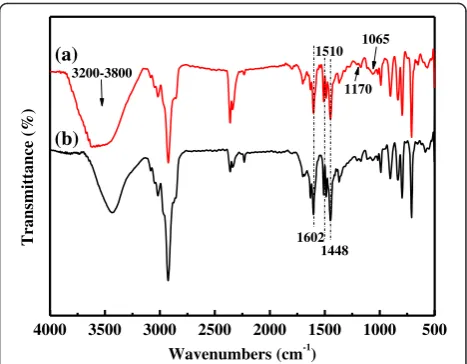
The hydroxyl functionalized unsaturation quaternary am-monium salt (HTA) was first prepared by reacting 3-bromopropyl alcohol and triallylamine and verified by 1H NMR spectroscopy. Then, quaternary ammonium salt IL-based ionic porous polymer (DVB-HTA) was synthesized through the radical copolymerization of DVB with HTA (Scheme 1). The butyl functionalized quaternary ammonium salt-based ionic polymer DVB-BTA was prepared accord-ingly. The obtained samples were characterized by FT-IR analysis, and the spectra are shown in Fig. 1. DVB-HTA shows the characteristic bands of–OH (3200~3800 cm−1), C–O (1065 cm−1), and C–N stretching vibrations (1170 cm
−1
). The peaks approximately between 1448 and 1602 cm−1 can be attributed to the skeletal vibration of aromatic ring in
DVB. The results indicate the successful copolymerization of HTA and DVB.
The ionic polymers are white powders and insoluble in water or common organic solvents, such as acetone, ethanol, chloroform, hexanes, N,N-dimethylformamide (DMF), and tetrahydrofuran (THF). The CHN elemental analysis for these polymers reveals that the molar ratio of quaternary ammonium salts to DVB was about 1:9, as illustrated in Scheme 1. The TG profile in Fig. 2 shows that DVB-HTA and DVB-BTA are stable up to 400 °C. For DVB-HTA, the weight loss of nearly 4 % in the range of 200~400 °C may be due to the elimination of hydroxyl functional groups in HTA. The further weight loss in 400~600 °C was attributed to the decomposition of organic polymer framework.
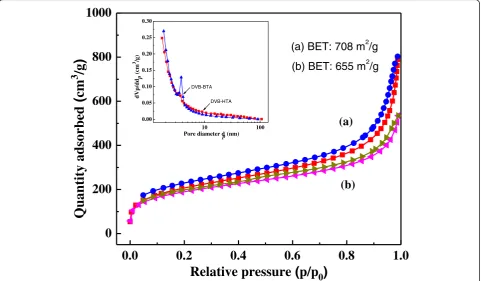
Figure 3 shows the N2adsorption-desorption isotherms and the corresponding pore size distributions of DVB-HTA and DVB-BTA. They display typical IV-type iso-therm with hysteresis loops at relative pressure of 0.8 <P/
4000 3500 3000 2500 2000 1500 1000 500
3200-3800
1065
Transmittance (%)
Wavenumbers (cm-1)
(a)
(b)
1602 1448 1510
1170
Fig. 1FT-IR spectra of(a)DVB-HTA and(b)DVB-BTA
100 200 300 400 500 600 700 800
0 20 40 60 80
100 DVB-BTA
Weight loss (%)
Temperature (oC)
DVB-HTA
[image:3.595.305.539.87.269.2] [image:3.595.306.538.546.713.2]P0< 1. Correspondingly, their average pore sizes are dis-tributed at 5–7 nm. The Brunauer-Emmett-Teller (BET) surface areas and pore volumes of HTA and DVB-BTA are 708 and 655 m2/g and 1.21 and 0.83 cm3/g, respectively.
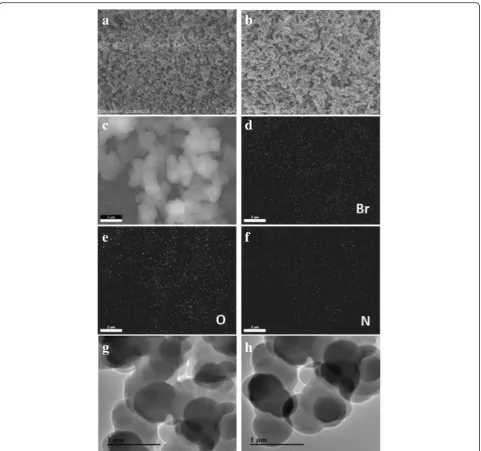
The SEM images of DVB-HTA and DVB-BTA in Fig. 4a, b show the abundant wormhole-like morphology with mi-crometer size. The EDS structural characterization vali-dates the uniform distribution of Br, O, and N on the surface of DVB-HTA, which further confirms the success-ful combination of HTA and DVB on one catalyst frame-work. In the TEM images of DVB-HTA and DVB-BTA in Fig. 4g, h, the porosity could be clearly observed. It is proposed that functional quaternary ammonium salt with three vinyl groups acts as the cross-linking node, which intertwines with the DVB to form a highly cross-linked network.
Catalytic performance
The catalytic activities were first tested on epichlorohydrin (ECH) as the model substrate at 120 °C with 1.2 MPa CO2 under solvent-free conditions, and the results are listed in Table 1. No product was detected in the absence of the catalyst (entry 1). The ionic polymers are insoluble in the reaction system, and DVB-HTA bearing hydroxyl func-tional groups exhibited 90 % yield with 98 % selectivity (entry 2). It is higher than that of hydroxyl-free ionic
polymer DVB-BTA, which gave 84 % yield with a relative low selectivity of 92 % (entry 3). The quaternary ammo-nium salt monomers HTA offered 84 % yield (entry 4) that is higher than that of hydroxyl-free BTA which showed 77 % yield (entry 5), but it is still lower than that of ionic polymer DVB-HTA. Additionally, HTA and BTA caused homogeneous catalysis, and the catalyst cannot be easily recovered and reused. The results of the above control experiments imply that the highly cross-linked polymer framework endows the catalyst with insolubility and thus result in heterogeneous catalysis. Although the halogen Br
− ions act as the active centers that are indispensable for
the catalytic efficiency of the catalyst, the mesoporous framework with such high surface area can accelerate the mass transfer and allow the Br− give full play as active centers, thus giving high catalytic activity. Furthermore, the hydroxyl functionalized samples demonstrated higher activity than the hydroxyl-free samples, demonstrating that the–OH groups are more favorable for the cycloadd-ition reaction mostly due to the synergistic effect with Br− ions. This result is inconsistent with those of the previous reports [30, 31].
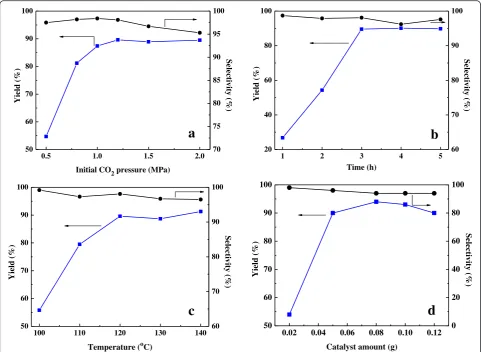
The results of the experimental optimization in Fig. 5 show that the reaction conditions, including reaction time, CO2 pressure, the reaction temperature, and the catalyst amount, have remarkable influence on the yield of cyclic carbonate in the presence of DVB-HTA as a catalyst. The
0.0
0.2
0.4
0.6
0.8
1.0
0
200
400
600
800
1000
(b) BET: 655 m
2/g
(b)
10 100
0.00 0.05 0.10 0.15 0.20 0.25 0.30
DVB-HTA
dVp/dd
p
(cm
3/g)
Pore diameter dp (nm)
DVB-BTA
Quantity adsorbed
(
cm
3
/g
)
Relative pressure
(
p/p
0)
(a)
(a) BET: 708 m
2/g
[image:4.595.58.540.89.370.2]best reaction condition is 1.2 MPa CO2pressure, 120 °C temperature, and 3-h reaction time. Notably, a further in-crease of the CO2pressure exceeding 1.5 MPa or reaction temperature exceeding 130 °C led to a slight decrease of the cyclic carbonate yield, which may result from the fur-ther oxidation of the cyclic carbonate formed. For the catalyst amount, with the increasing the of the catalyst amount to 0.08 g, a high yield of 94 % with 98 % selectivity could be achieved, demonstrating the high efficiency of this novel catalyst DVB-HTA.
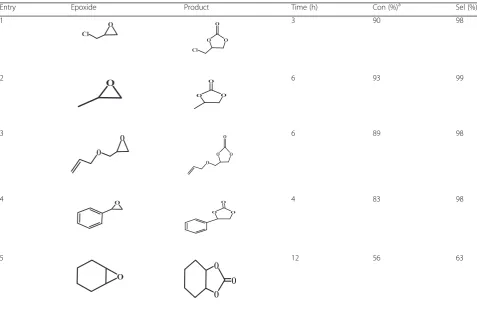
In order to investigate the scope of the ionic porous poly-mer DVB-HTA for the fixation of CO2, various functional-group-substituted epoxides, such as propylene oxide, styrene
[image:5.595.58.540.86.537.2]Fig. 4SEM images ofa,cDVB-HTA andbDVB-BTA; EDS elemental mapping ofdBr element,eO element, andfN element; and TEM images of gDVB-HTA andhDVB-BTA
Table 1Cycloaddition of CO2and ECH catalyzed by various
catalysts
Entry Catalyst Solubility Yielda(%) Selb(%)
1 No catalyst Homogeneous – –
2 DVB-HTA Heterogeneous 90 98
3 DVB-BTA Heterogeneous 84 92
4 HTA Homogeneous 84 97
5 BTA Homogeneous 77 95
Reaction conditions: ECH (16 mmol), CO2(1.2 MPa), catalyst (0.035 mmol
based on Br), 120 °C, 3 h
a
The yield of cyclic carbonate product
b
[image:5.595.56.291.606.689.2]oxide, allyl glycidyl ether, and cyclohexene oxide, were stud-ied as the substrates, and the result are summarized in Table 2. It can be seen that most of the epoxides can be transformed to the corresponding cyclic carbonates in high yield and selectivity at 120 °C with 1.2 MPa CO2pressure and 0.05 g catalyst under solvent-free condition. In the case of cyclohexene oxide, a moderate yield of 56 % with 63 % selectivity was obtained. Notably, the coupling of CO2with cyclohexene oxide is a rather difficult reaction, and it could not give a high yield of cyclic carbonate as well over other catalysts [32, 33]. This is possibly ascribed to the limited diffusion of large-sized epoxide substrate molecules into the pore canal of DVB-HTA thus exerting size-selective catalysis.
The reusability studies of the catalyst DVB-HTA in the cycloaddition of CO2 with ECH have been tested. The results of a five-run recycling performance are shown in Fig. 6A. It is obvious that the yield of cyclic carbonate which is 90 % for the first run only marginally decreased down to 82 % for the fifth run. To check if structural
deterioration occurred for the recovered catalyst, the recov-ered DVB-HTA was characterized by FT-IR. The IR spectrum of the reused DVB-HTA in Fig. 6B was very simi-lar to that of the fresh one, demonstrating a durable catalyst structure accounting for the steady catalytic reuse. The weight loss in the operation for recovering the catalyst is usually unavoidable during the recycling tests. Thus, the very slow decrease of yield is mostly probably due to the weight loss in the operation for recovering the catalyst.
According to previous reports, the cooperation of nu-cleophilic attack by a halogen anion and the activation by an onium cation through electron interaction could facilitate the opening of an epoxy ring [34, 35] and the functional groups such as the–OH and–COOH groups can also activate the cycloaddition reaction through hydrogen bonding [28, 29]. In this work, by rationalizing our experimental results and relating them to these nu-merous literatures, a synergistic catalysis of hydrogen bonding, electronic interaction, and nucleophilic attack for the cycloaddition of epoxides and CO2to form cyclic
0.5 1.0 1.5 2.0
50 60 70 80 90 100
Initial CO2 pressure (MPa)
Yield (%)
70 75 80 85 90 95 100
Selectivity (%)
a
1 2 3 4 5
20 40 60 80 100
Time (h)
Yield (%)
b
60 70 80 90 100
Selectivity (%)
100 110 120 130 140
50 60 70 80 90 100
Temperature (oC)
Yield (%)
60 70 80 90 100
Selectivity (%)
c
0.02 0.04 0.06 0.08 0.10 0.12
50 60 70 80 90 100
Selectivity (%)
Yield (%)
Catalyst amount (g)
0 20 40 60 80 100
d
Fig. 5Influences of reaction conditions on the cycloaddition of CO2and ECH over DVB-HTA.aInfluence of initial CO2pressure.bInfluence of
reaction time.cInfluence of reaction temperature.dInfluence of catalyst amount. Reaction conditions: catalyst 0.05 g, ECH 16 mmol, CO2
[image:6.595.57.539.88.440.2]1 2 3 4
0 20 40 60 80 100
Yield (%) Sel (%)
Yield/Selectivity (%)
Run times
a
4000 3500 3000 1500 1000 500
Wavenumber (cm-1)
Transmittance (%)
b
(b) (a)
Fig. 6ACatalytic reusability of DVB-HTA for the cycloaddition of CO2with ECH andBFT-IR spectra of(a)fresh DVB-HTA and(b)reused DVB-HTA.
[image:7.595.57.535.99.416.2]Reaction conditions: ECH 16 mmol, catalyst 0.05 g (0.035 mmol), 120 °C, CO21.2 MPa, 3 h
Table 2Cycloaddition of CO2with different epoxides catalyzed by DVB-HTA
Entry Epoxide Product Time (h) Con (%)a Sel (%)b
1 3 90 98
2 6 93 99
3 6 89 98
4 4 83 98
5 12 56 63
Reaction conditions: epoxide (16 mmol), CO2(1.2 MPa), catalyst DVB-HTA (0.05 g, 0.035 mmol), 120 °C a
The yield for the cyclic carbonate product
b
[image:7.595.63.537.510.703.2]carbonate was proposed, as illustrated in Scheme 2. The epoxy ring is first activated by the –OH group via a hydrogen bond interaction and the quaternary ammo-nium cations via electronic interaction (a). What follows is the opening of the epoxy ring through Br− nucleo-philic attack (b) then the insertion of CO2into the tran-sient species. Finally, the product cyclic carbonate was formed via an intramolecular nucleophilic attack, and the catalyst was regenerated to the original form (d). Notwithstanding, this mechanism is tentative and the detailed mechanistic studies to probe the intermediates during the cycloaddition reaction could be necessary, and research along this line will be conducted in the near future.
Conclusions
In summary, we have developed a new type of quater-nary ammonium salt-based ionic porous polymer, DVB-HTA, by the copolymerization of DVB and hydroxyl functionalized quaternary ammonium salts. The DVB-HTA was a highly cross-linked porous material with a large surface area of 708 m2/g and abundant Br− anions and acted as efficient heterogeneous catalysts for the transformation of CO2and epoxides into cyclic carbon-ates under metal-solvent-free conditions. The excellent catalytic performance of DVB-HTA results from the synergistic effect between the Br− active centers and functional –OH groups. Moreover, the DVB-HTA had good recyclability, attributed to the durable highly cross-linked framework structure. This catalyst is potentially
useful in industrial applications due to its low cost, ex-cellent catalytic efficiency, and good stability.
Competing interests
The authors declare that they have no competing interests.
Authors’contributions
JZ and SC designed the experiment. SC and YZ carried out the experiment, as well as wrote the manuscript. DZ and YZ were involved in the characterization and analysis of the data, as well as helped to prepare the manuscript. All authors read and approved the final manuscript.
Acknowledgements
Financial support was provided by the Doctoral Fund of Ministry of Education of China, the Guangdong Government (S20120011226), and the MOST of China (2014AA020512).
Received: 14 March 2016 Accepted: 24 June 2016
References
1. Fiorani G, Guoa WS, Kleij AW (2015) Sustainable conversion of carbon dioxide: the advent of organocatalysis. Green Chem 17:1375–1389 2. Adhikari D, Nguyen ST, Baik MH (2014) A computational study of the
mechanism of the [(salen)Cr + DMAP]-catalyzed formation of cyclic carbonates from CO2and epoxide. Chem Commun 50:2676–2678
3. Luo RC, Zhou XT, Chen SY, Li Y, Zhou L, Ji HB (2014) Highly efficient synthesis of cyclic carbonates from epoxides catalyzed by salen aluminum complexes with built-in“CO2capture”capability under mild conditions.
Green Chem 16:1496–1506
4. He Q, O’Brien JW, Kitselman KA, Tompkins LE, Curtisa GCT, Kerton FM (2014) Synthesis of cyclic carbonates from CO2and epoxides using ionic liquids
and related catalysts including choline chloride–metal halide mixtures. Catal Sci Technol 4:1513–1528
5. Xu BH, Wang JQ, Sun J, Huang Y, Zhang JP, Zhang XP, Zhang SJ (2015) Fixation of CO2into cyclic carbonates catalyzed by ionic liquids: a
multi-scale approach. Green Chem 17:108–122
6. Jiseul C, Kang S, Kang N, Lee SM, Kim HJ, Son SUK (2013) Microporous organic networks bearing metal-salen species for mild CO2fixation to cyclic
carbonates. J Mater Chem A 1:5517–5523
7. North M, Wang BD, Young C (2011) Influence of flue gas on the catalytic activity of an immobilized aluminium (salen) complex for cyclic carbonate synthesis. Energy Environ Sci 4:4163–4170
8. Rulev YA, Gugkaeva Z, Maleev VI, North M, Belokon YN (2015) Robust bifunctional aluminium–salen catalysts for the preparation of cyclic carbonates from carbon dioxide and epoxides. Beilstein J Org Chem 11:1614–1623 9. Chatelet B, Joucla L, Dutasta JP, Martinez A, Szeto KC, Dufaud Vé R (2013)
Azaphosphatranes as structurally tunable organocatalysts for carbonate synthesis from CO2and epoxides. J Am Chem Soc 135:5348–5351
10. Wang JQ, Gan J, Yang W, Yi GS, Zhang YG (2015) Phosphonium salt incorporated hypercrosslinked porous polymers for CO2capture and
conversion. Chem Commun 51:15708–15711
11. Wang JQ, Leong JY, Zhang YG (2014) Efficient fixation of CO2into cyclic
carbonates catalysed by silicon-based main chain poly-imidazolium salts. Green Chem 16:4515–4519
12. North M, Quek Sophie CZ, Pridmore NE, Whitwood AC, Wu X (2015) Aluminum (salen) complexes as catalysts for the kinetic resolution of terminal epoxides via CO2coupling. ACS Catal 5:3398–3402
13. Ravi S, Kang DH, Roshan R, Tharun J, Kathalikkattil AC, Park DW (2015) Organic sulphonate salts tethered to mesoporous silicas as catalysts for CO2
fixation into cyclic carbonates. Catal Sci Technol 5:1580–1587 14. Beyzavi MH, Klet RC, Tussupbayev S, Borycz J, Vermeulen NA, Cramer CJ,
Stoddart JF, Hupp JT, Farha OK (2014) A hafnium-based metal−organic framework as an efficient and multifunctional catalyst for facile CO2fixation
and regioselective and enantioretentive epoxide activation. J Am Chem Soc 136:15861–15864
15. Babu R, Kathalikkattil AC, Roshan R, Tharun J, Kim DW, Park DW (2016) Dual-porous metal organic framework for room temperature CO2fixation
via cyclic carbonate synthesis. Green Chem 18:232–242
16. Chen GJ, Zhou Y, Wang XC, Li J, Xue S, Liu YQ, Wang QN, Wang J (2015) Construction of porous cationic frameworks by crosslinking polyhedral oligomeric silsesquioxane units with N-heterocyclic linkers. Sci Rep 5:1–14 17. Liu MS, Liu B, Zhong SF, Shi L, Liang L, Sun JM (2015) Kinetics and
mechanistic insight into efficient fixation of CO2to epoxides over
N-heterocyclic compound/ZnBr2catalysts. Ind Eng Chem Res 54:633–640
18. Roy T, Kureshy RI, Khan NH, Abdi SHR, Bajaj HC (2013) Asymmetric cycloaddition of CO2and an epoxide using recyclable bifunctional
polymeric Co(III) salen complexes under mild conditions. Catal Sci Technol 3:2661–2667
19. Adam F, Appaturi JN, Ng EP (2014) Halide aided synergistic ring opening mechanism of epoxides and their cycloaddition to CO2using
MCM-41-imidazolium bromide catalyst. J Mol Catal A 386:42–48
20. Pourjavadi A, Hosseini SH, Doulabi M, Fakoorpoor SM, Seidi F (2012) Multi-layer functionalized poly(ionic liquid) coated magnetic nanoparticles: highly recoverable and magnetically separable Brønsted acid catalyst. ACS Catal 2:1259–1266
21. Gao CJ, Chen GJ, Wang XC, Li J, Zhou Y, Wang J (2015) A hierarchical meso-macroporous poly(ionic liquid) monolith derived from a single soft template. Chem Commun 51:4969–4972
22. Soll S, Zhang PF, Zhao Q, Wang Y, Yuan JY (2013) Mesoporous zwitterionic poly(ionic liquid)s: intrinsic complexation and efficient catalytic fixation of CO2. Polym Chem 4:5048–5051
23. Yuan JY, Giordano C, Antonietti M (2010) Ionic liquid monomers and polymers as precursors of highly conductive, mesoporous, graphitic carbon nanostructures. Chem Mater 22:5003–5012
24. Soll S, Zhao Q, Weber J, Yuan JY (2013) Activated CO2sorption in
mesoporous imidazolium-type poly(ionic liquid)-based polyampholytes. Chem Mater 25:3003–3010
25. Xie Y, Zhang ZF, Jiang T, He JL, Han BX, Wu TB, Ding KL (2007) CO2
cycloaddition reactions catalyzed by an ionic liquid grafted onto a highly cross-linked polymer matrix. Angew Chem Int Ed 46:7255–7258 26. Wang XC, Zhou Y, Guo ZJ, Chen GJ, Li J, Shi YM, Liu YQ, Wang J (2015)
Heterogeneous conversion of CO2into cyclic carbonates at ambient
pressure catalyzed by ionothermal-derived meso-macroporous hierarchical poly(ionic liquid)s. Chem Sci 6:6916–6924
27. Wang JQ, Sng WH, Yi GS, Zhang YG (2015) Imidazolium salt-modified porous hypercrosslinked polymers for synergistic CO2capture and
conversion. Chem Commun 51:12076–12079
28. Zhang YY, Yin SF, Luo SL, Au CT (2012) Cycloaddition of CO2to epoxides
catalyzed by carboxyl functionalized imidazolium-based ionic liquid grafted onto cross-linked polymer. Ind Eng Chem Res 51:3951–3957
29. Wang JQ, Cheng WG, Sun J, Shi TY, Zhang XP, Zhang SJ (2014) Efficient fixation of CO2into organic carbonates catalyzed by
2-hydroxymethyl-functionalized ionic liquids. RSC Adv 4:2360–2367
30. Chen X, Sun J, Wang JQ, Cheng WG (2012) Polystyrene-bound diethanolamine based ionic liquids for chemical fixation of CO2.
Tetrahedron Lett 53:2684–2688
31. Liu MS, Gao KQ, Liang L, Wang FX, Shi L, Li S, Sun JM (2015) Insights into hydrogen bond donor promoted fixation of carbon dioxide with epoxides catalyzed by ionic liquids. Phys Chem Chem Phys 17:5959–5965 32. Gao WY, Wojtas L, Ma SQ (2014) A porous metal–metalloporphyrin
framework featuring high-density active sites for chemical fixation of CO2
under ambient conditions. Chem Commun 50:5316–5318
33. Talapaneni SN, Buyukcakir O, Je SH, Srinivasan S, Seo Y, Polychronopoulou K, Coskun A (2015) Nanoporous polymers incorporating sterically confined N-heterocyclic carbenes for simultaneous CO2capture and conversion at
ambient pressure. Chem Mater 27:6818–6826
34. Zhang W, Liu TY, Wu HH, Wu P, He MY (2015) Direct synthesis of ordered imidazolyl-functionalized mesoporous polymers for efficient chemical fixation of CO2. Chem Commun 51:682–684
35. Dai WL, Jin B, Luo SL, Luo XB, Tu XM, Au CT (2014) Polymers anchored with carboxyl-functionalized di-cation ionic liquids as efficient catalysts for the fixation of CO2into cyclic carbonates. Catal Sci Technol 4:556–562
Submit your manuscript to a
journal and benefi t from:
7 Convenient online submission
7Rigorous peer review
7 Immediate publication on acceptance
7Open access: articles freely available online
7 High visibility within the fi eld
7Retaining the copyright to your article