c
ENERGY-EFFICIENT LATENCY TOLERANCE FOR 1000-CORE DATA PARALLEL PROCESSORS WITH DECOUPLED STRANDS
BY
NEAL CLAYTON CRAGO
DISSERTATION
Submitted in partial fulfillment of the requirements
for the degree of Doctor of Philosophy in Electrical and Computer Engineering in the Graduate College of the
University of Illinois at Urbana-Champaign, 2012
Urbana, Illinois
Doctoral Committee:
Professor Sanjay J. Patel, Chair Professor Wen-mei W. Hwu
Associate Professor Steven S. Lumetta Associate Professor Deming Chen
ABSTRACT
This dissertation presents a novel decoupled latency tolerance technique for 1000-core data parallel processors. The approach focuses on developing in-struction latency tolerance to improve performance for a single thread. The main idea behind the approach is to leverage the compiler to split the original thread into separate memory-accessing and memory-consuming instruction streams. The goal is to provide latency tolerance similar to high-performance techniques such as out-of-order execution while leveraging low hardware com-plexity similar to an in-order execution core.
The research in this dissertation supports the following thesis: Pipeline stalls due to long exposed instruction latency are the main performance lim-iter for cached 1000-core data parallel processors. Leveraging natural decou-pling of memory-access and memory-consumption, a serial thread of execu-tion can be partiexecu-tioned into strands providing energy-efficient latency toler-ance.
This dissertation motivates the need for latency tolerance in 1000-core data parallel processors and presents decoupled core architectures as an alterna-tive to currently used techniques. This dissertation discusses the limitations of prior decoupled architectures, and proposes techniques to improve both latency tolerance and energy-efficiency. Finally, the success of the proposed decoupled architecture is demonstrated against other approaches by
perform-ing an exhaustive design space exploration of energy, area, and performance using high-fidelity performance and physical design models.
ACKNOWLEDGMENTS
The work presented in this dissertation would not be possible without the technical and personal support of others. I have been very blessed as a doctoral student to constantly be surrounded by very able and intelligent people. That simply would not have been possible if I hadn’t studied at the University of Illinois.
I would like to thank the Rigel group for their efforts in developing the initial compiler and simulation infrastructure which I used as a basis for the architectural exploration presented in this dissertation. I would like to specifically thank John Kelm, who encouraged me early on in the formation of the early ideas presented in this work. Many thanks to Professor Steve Lumetta, Daniel Johnson, Matthew Johnson, and William Tuohy for their useful feedback on drafts and during presentations of this work.
I would like to thank my adviser Sanjay Patel for his encouragement and willingness to fund me while I worked on my dissertation. His grand challenge and expectation of greatness in the field of computer architecture encouraged me to fully develop my ideas and create high-quality research.
I also would like to thank Analog Devices for their generous support through fellowships during my first two years in graduate school. Many thanks to the Department of Electrical and Computer Engineering for pro-viding me funding and the opportunity to teach through assistantships. I would like to thank the Semiconductor Research Corporation (SRC) which
funded this dissertation research. Finally, I would like to thank the Trusted ILLIAC Center at the Information Trust Institute for their contribution of use of the computing cluster, without which most of the contributions of this dissertation never would have happened.
Much of my inspiration to pursue my doctorate is due to my family. I have always had much admiration for my family and their passion and suc-cess in academia. My great-grandfather Raymond Starbuck was a professor of dairy science at the Ohio State University in Columbus, Ohio, and my great-grandfather Samuel Kiehl was a professor of chemistry at Columbia University in New York City, New York. Many other relatives have devoted their lives to education, including my Uncle David Crago and my grand-mother Ellen Crago.
Most importantly has been the inspiration of my father and mother, who primarily inspired and encouraged me to pursue my interest in computer engineering from a young age. My father Steven first introduced me to programming when I was 8 years old, while encouraging my curiosity and initial skepticism for established thought. My mother Louise has always pushed me intellectually from a young age, taking time away from her own career as a professor of mathematics to teach my brothers and me. Most importantly, I thank Steven and Louise for always encouraging me to exceed my own expectations, and teaching me that with hard work and faith in the Lord all things can be done.
I would also like to thank my wife Christine, to whom I owe the greatest amount of credit for this work. Her constant and unconditional encourage-ment, friendship, and love throughout this time in graduate school have pro-pelled me further and spurred my creativity and passion for research. Only through her personal experience while pursuing her own graduate degrees
did she truly understand all the long nights and time away from each other, and for that I am grateful.
Finally, I would like thank my Lord, my Savior, and God Jesus Christ for His grace, love, and discipline during my whole life. I pray that any success I may have in my future would honor and glorify His name.
TABLE OF CONTENTS
LIST OF ABBREVIATIONS . . . x
CHAPTER 1 INTRODUCTION . . . 1
CHAPTER 2 BACKGROUND . . . 7
2.1 Rigel . . . 7
2.2 Contemporary Latency Tolerance Approaches . . . 12
CHAPTER 3 DECOUPLED ARCHITECTURES . . . 20
3.1 Memory Latency Tolerance through Strands . . . 21
3.2 Control Flow Requirement . . . 23
3.3 Data Communication Requirement . . . 25
3.4 Decoupled Access/Execute Implementation . . . 26
3.5 Decoupling as an Emerging Technique . . . 27
CHAPTER 4 EVALUATION METHODOLOGY . . . 29
4.1 Performance and Energy Modeling . . . 30
4.2 Code Patterns for Data Parallel Applications . . . 33
4.3 Microbenchmarks . . . 35
4.4 Benchmarks . . . 37
CHAPTER 5 A MODERN DECOUPLED ARCHITECTURE . . . . 40
5.1 Architecture Overview . . . 41
5.2 Evaluation . . . 44
CHAPTER 6 INCREASING STRAND-LEVEL PARALLELISM . . 48
6.1 Loss of Decoupling Events . . . 48
6.2 Memory Indirection . . . 50
6.3 Floating Point Latency . . . 53
6.4 Implementation . . . 54
6.5 Evaluation . . . 56
CHAPTER 7 COMPILER-DIRECTED INSTRUCTION STEERING 62 7.1 Hardware Assisted Strand Partitioning . . . 62
7.2 Implementation . . . 64
CHAPTER 8 AVOIDING CONTROL FLOW LOD . . . 74
8.1 Control Speculation . . . 74
8.2 Confidence Prediction . . . 76
8.3 Implementation . . . 77
8.4 Evaluation . . . 81
CHAPTER 9 EFFICIENT DECOUPLED HARDWARE . . . 85
9.1 Data Queues . . . 85
9.2 Strand Context and Core Complexity . . . 90
9.3 Evaluation . . . 91
CHAPTER 10 CODE GENERATION IMPLEMENTATION AND TOOLFLOW . . . 95
10.1 Strand Partitioning Scheme . . . 96
10.2 Compiler Support and Implementation . . . 102
CHAPTER 11 COMPARISON TO OTHER TECHNIQUES . . . 104
11.1 Energy-efficient Latency Tolerance . . . 105
11.2 Performance . . . 107
11.3 Design Space Exploration . . . 109
CHAPTER 12 COMBINING MULTITHREADING AND DECOU-PLED TECHNIQUES . . . 122
12.1 Implementation . . . 122
12.2 Evaluation . . . 125
CHAPTER 13 RELATED WORK . . . 129
13.1 Latency Tolerance Techniques . . . 129
13.2 Energy-efficient Mechanisms . . . 135
13.3 Energy and Performance Modeling . . . 136
13.4 Hybrid Processor Design . . . 137
CHAPTER 14 CONCLUSIONS . . . 139
LIST OF ABBREVIATIONS
AP Access processor CMP Chip multiprocessor DAE Decoupled access/execute
EP Execute processor
FLOPS Floating-point operations per second GPU Graphics processing unit
ILP Instruction-level parallelism
INO In-order
L1 Level one
L2 Level two
LOD Loss-of-decoupling
MIMD Multiple-instruction multiple-data MLP Memory-level parallelism
OOO Out-of-order execution
S# Strand number
SIMD Single-instruction multiple-data SMT Simultaneous multithreading TLP Thread-level parallelism VLIW Very long instruction word
CHAPTER 1
INTRODUCTION
Execution stalls due to memory and functional unit latency are the limiting factor for performance in highly parallel workloads. Most of the performance lost in a 1024-core data parallel processor is attributable to the memory system, rather than fetch, branch prediction, or functional unit latencies. Removing pipeline stalls due to memory latency can double performance in some cases, and tolerating functional unit latency also increases performance significantly. This indicates the importance of efficient mechanisms for tol-erating memory and function unit latency. There have been many proposed solutions for tolerating instruction latency, including data prefetching, more complex cache hierarchies, multithreading, and more complex core pipelines. This dissertation focuses attention on core pipelines, and evaluates how cur-rent techniques tolerate memory and functional unit latency, and what limits their suitability for deployment in data parallel processors.
This dissertation presents a novel implementation of a decoupled archi-tecture that reaches and can exceed the performance of other latency toler-ance techniques such as multithreading and out-of-order execution on highly parallel benchmarks while maintaining energy efficiency and low hardware complexity. Decoupled architectures leverage the compiler to separate a sin-gle thread of execution into multiple instruction streams that can be exe-cuted concurrently. The thread is split into memory-accessing and memory-consuming instruction streams, which are called strands. The strands
ex-ecute in separate hardware contexts while following the same control path through the program. Memory-accessing strands communicate data values from memory to the memory-consuming strands and have the ability to non-speculatively execute substantially ahead of the memory-consuming strands, thus tolerating memory and functional unit latency. By leveraging the com-piler to extract some degree of parallelism, decoupled architectures can have less complex hardware than out-of-order processors, while reducing the im-pact of cache contention and need for increasing number of threads found in multithreading.
Despite the promise of decoupled architectures for low-complexity latency tolerance, significant performance and energy inefficiencies limit broad plicability. Specifically, code patterns commonly found in data-parallel ap-plications can severely limit the latency tolerance capability and suitability of traditional decoupled architectures. Additionally, proper execution in tra-ditional decoupled architectures requires a substantial number of overhead instructions, increasing energy consumption significantly. In the proposed decoupled architecture, performance and energy pitfalls are combated by extracting more parallelism, enabling control speculation, and enabling the compiler and lightweight hardware to reduce instruction overhead. When combining all these techniques together, energy consumption can be reduced and performance improved significantly over prior decoupled architectures across data-parallel benchmarks. Additionally, combining multithreading and the proposed decoupled architecture is explored as an alternative for improving energy efficiency.
High-fidelity performance and physical design models are leveraged to per-form a comprehensive design space exploration and compare the energy ef-ficiency of common latency tolerance techniques on a 1024-core data
paral-lel processor. By designing a decoupled architecture specifically for energy efficiency, robust energy-efficiency across a wide range of code patterns is provided. The proposed decoupled architecture improves energy-efficiency over other techniques by 28% to 89% on data parallel benchmarks. A hybrid of multithreading and decoupling can improve energy-efficiency by another 14% on average across data parallel benchmarks.
The contributions of this dissertation are as follows:
• Techniques to avoid loss-of-decoupling events and performance pitfalls through extracting additional strand-level parallelism for superior func-tional unit and memory latency tolerance.
• Compiler-directed strand steering, which directly exposes strand-level parallelism to the hardware while reducing strand synchronization in-struction overhead.
• Control speculation using lightweight checkpointing hardware and energy-efficient branch confidence prediction.
• Hybrid decoupled and multithreading techniques.
• Quantitative evaluation of performance against hardware prefetching, traditional decoupled, out-of-order execution, multithreading, and hard-ware scout prefetching on Rigel, a 1024-core data parallel processor. A brief overview of the organization of this dissertation follows.
Chapter 2 provides background information about the current state of GPU computing, and describes the Rigel 1024-core data parallel processing platform and how it enables greater programmability. The great need for instruction latency tolerance is discussed, in particular memory latency
tol-latency tolerance and their pitfalls are discussed, among which five are chosen as points of comparison. This dissertation argues for decoupled architectures as a low complexity method for latency tolerance.
Chapter 3 delves more deeply into decoupled architectures. Decoupled architectures leverage the compiler to split a single thread of execution into multiple instruction streams that execute concurrently. These instruction streams, known as strands, execute as subprograms that follow the same control path through the program and communicate data values with each other. Finally, Decoupled Access / Execute is presented as an example of the canonical decoupled architecture.
Chapter 4 presents the evaluation methodology. A cycle-accurate perfor-mance model for Rigel is utilized, which is modified to run decoupled versions of parallel application kernels. Chapter 4 also explains the physical design model, which is used later in this dissertation for comparing area and energy during a design space exploration of five latency tolerance techniques.
Chapter 5 presents the vision for a modern decoupled core architecture which is used as the baseline Decoupled Access / Execute implementation. The most prominent feature in a modern decoupled architecture is the shar-ing of fetch and execution resources through a simultaneous multithreadshar-ing approach.
Chapter 6 introduces loss-of-decoupling events, which are common code patterns that can cause performance pitfalls. In particular, memory indi-rection and floating point latency can cause exposed latency and reduce the ability of the memory-accessing strand to execute ahead and tolerate latency. This dissertation explores how increasing strand-level parallelism by extracting additional memory-accessing and memory-access strands can avoid loss-of-decoupling and improve performance.
Chapter 7 presents an energy-efficient mechanism to allow the compiler to express strand parallelism directly to hardware. Increasing the number of strands also significantly increases the amount of instruction overhead needed for synchronizing control flow and memory-ordering. By utilizing a single fetched instruction stream rather than multiple independently fetching and executing strands, the number of overhead instructions can be significantly reduced.
Chapter 8 investigates control speculation to avoid loss of decoupling due to data-dependent control flow. A low overhead checkpoint and rollback mechanism is utilized, along with confidence predictors to predict and reduce wasteful misspeculations.
Chapter 9 presents mechanisms to improve both area and energy effi-ciency for the proposed decoupled core architecture. First, the large over-head of data queues is reduced by leveraging dynamic register renaming and compiler-sized buffers. Next, the complexity of each strand is reduced, while maintaining similar levels of performance.
Chapter 10 presents the code generation for the proposed decoupled archi-tecture. The implemented strand partitioning algorithm is presented. The code generation used for this dissertation, a binary translator, is explained.
Chapter 11 compares the proposed decoupled architecture with hardware prefetching, out-of-order execution, multithreading, and hardware scout prefetch-ing. To facilitate this, energy-efficient mechanisms are added to each latency tolerance technique and a design space exploration is performed.
Chapter 12 explores the benefit of combining latency tolerance techniques. In particular, there is high synergy of combining decoupled architectures and multithreading. Considering that many data parallel architectures use thread-level parallelism to enhance throughput performance, the effect on
performance and energy of combining latency tolerance techniques is ex-plored.
Finally, Chapter 13 details prior work and Chapter 14 presents conclusions of this dissertation.
CHAPTER 2
BACKGROUND
2.1
Rigel
Rigel [1] is a 1024-core data parallel processor envisioned as the evolution of current GPU computing. Similar to GPUs, Rigel targets highly parallel applications that scale up to thousands of concurrent tasks.
2.1.1
GPU Computing
In recent years, GPU computing has become very important to the computer architecture community. The end of single-processor performance scaling has increased the interest in and visibility of single-chip parallel processing. In particular, data parallel applications related to image processing, computer vision, and high-performance computing map well to multi- and many-core processors such as GPUs. In the last few years, GPUs have moved from fixed-function hardware to programmable pipelines with programming mod-els based in high-level languages. GPUs offer substantial peak performance and power consumption advantages by focusing purely on throughput per-formance. The assumption with GPUs is that there are thousands of threads of available parallelism in an application, and these processors are designed to maximize FLOPS/Watt and FLOPS/mm2.
!"#$%&'()*+*,-./*!0*!%.'"*1233* * 45*
67)-%8"77-8)*
94*!.8(-*:.7;<*
!/=<)-%*
!91*!.8(-*
! ! ! ! ! ! !!"
!/=<)-%*
>?!"%-*!/=<)-%*
Figure 2.1: Baseline Rigel architecture.
2.1.2
Rigel Architecture Overview
Rigel is a 1024-core data parallel processor envisioned as the evolution of current GPU computing. Current GPUs are continuing to improve in pro-grammability, and do not yet have several features commonly found in general purpose processors. Rigel improves upon current GPUs to support ease of programmability and reduce programmer burden. For example, Rigel utilizes a cache hierarchy which leverages hardware to manage memory, rather than requiring the programmer to manage different address spaces. Another major improvement in Rigel is the independent execution of threads in a multiple-instruction multiple-data (MIMD) fashion. Currently, GPUs require groups of threads to execute in synchronized lockup or single-instruction multiple-data (SIMD). While SIMD execution reduces some hardware overhead, it limits performance on irregular applications. In particular, threads with dif-ferent memory access latencies, or that follow difdif-ferent control flow paths in a program, cause stalls that limit performance. These stalls can be completely avoided through utilizing MIMD and independently executing threads.
Fi-nally, Rigel also enables a conventional programming model, which is bulk-synchronous and task-based.
A block diagram of Rigel is shown in Figure 2.1. Rigel is made up of 1024 cores arranged in a three-level cache hierarchy. The goal of Rigel is to maximize FLOP/Watt and FLOPs/mm2, and thus the chip is developed to be complexity effective. Each core is an area-optimized two-wide issue in-order core with a single-precision floating point unit, private L1 instruction and data caches, and a RISC instruction set. Eight cores connect to a shared unified L2 cache via a shared bus interconnect to form acluster. The clusters connect to a multi-banked shared last-level L3 cache through a two-level interconnect network. Groups of four L3 cache banks share an independent GDDR memory channel.
2.1.3
Cache Management and Coherence
All cores in Rigel share a memory address space, which is significantly differ-ent than GPUs which have several address spaces on a single chip. Communi-cation between threads rarely occurs in data parallel appliCommuni-cations, simplifying the method for keeping caches coherent with one another. While full hard-ware cache coherence would consume a significant amount of chip area, the memory space can instead be kept coherent by utilizing a software cache coherence mechanism [2]. L1 and L2 caches in a cluster are kept coherent utilizing a hardware snoopy protocol. However, clusters are not kept coher-ent with respect to one another using hardware, and the software coherence protocol must be used. Using the L3 cache as the global point of coherence, the cores operating in the cluster utilize a software coherence API and special hardware instructions to invalidate and flush data from the L1 and L2 caches
!"#$%&'()*+*,-./*!0*!%.'"*1233* * 45*
6.78*9:-;<=">*
?.%%&-%*
!"@@<>&;.=">*
9:-;<=">*
AB/-*6&@-*
Figure 2.2: Baseline Rigel architecture bulk synchronous model. out to the L3. This typically occurs at application synchronization points such as global barriers. Additionally, global memory operations that bypass the L1 and L2 and directly read from and write to the L3 cache can be used to ensure data is coherent among all threads on the chip.
2.1.4
Task Model
Rigel utilizes a bulk-synchronous parallel model to execute concurrent tasks. Figure 2.2 presents the high level execution of the bulk synchronous model. There is a spawn point at the start of a bulk synchronous phase, in which tasks begin execution. When all tasks have finished, a barrier synchronization is reached. To finish the bulk synchronous phase, modified data is written back with the software coherence mechanism and all data is again visible in the system.
!"#$%&'()*+*,-./*!0*!%.'"*1233* * 45*
!
6/"7./*8.9:*;<-<-*
=">./*8.9:*;<-<-9*
!"%-9*
! ! !
Figure 2.3: Baseline Rigel architecture hierarchical task queue. The programming model itself is a task queue based model, implemented in software and utilized by the programmer through API calls. A unique task descriptor is generated for each task, and the programmer can enqueue and dequeue tasks from the task queue. Figure 2.3 presents the hierarchical task queue, fully implemented in software. When the task queue is empty, cores in Rigel attempting to dequeue a task block, waiting for tasks to be enqueued. When all cores in Rigel are blocking on dequeue, an implicit barrier operation is triggered. Otherwise, when the task queue is empty, a single core will enqueue tasks to be executed. When the enqueue operation completes and tasks are available in the task queue, the waiting cores unblock, dequeue a task, and begin execution.
!"#$
%&$'($%)$ *'+,-./01$2$3456$*7$*-5/'$%8&&$ $9"#$
*':+.64-$
;,<5:.=$
>"!?@A#!*$
BC1D'(D'-E4-$
*'<F<C56$G6'H$;4='C+64E$
I-5.EJ$
#-4(41=0.</$ K5-EH5-4$L='C1$ #-4(41=0$90-45E$ MC6F10-45E.</$ G.<4D/-5.<4E$ *'5-J4D/-5.<4E$Figure 2.4: Categorization of latency tolerance techniques. Highlighted techniques are considered in this work.
2.2
Contemporary Latency Tolerance Approaches
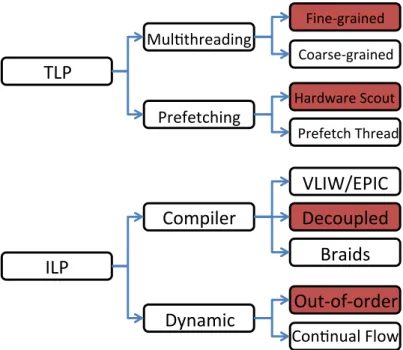
In this section, existing latency tolerance techniques that can be considered for future 1000-core data-parallel processors and how they can tolerate mem-ory and floating point latency are discussed. In-order execution and hard-ware prefetching are used as the baseline for comparison. Figure 2.4 provides a classification of techniques, which generally fall under either instruction-level parallelism (ILP) or thread-instruction-level parallelism (TLP) techniques. ILP techniques generally focus on improving the runtime of a single thread of execution, through leveraging some combination of the static compiler and dynamic hardware techniques. TLP techniques generally focus on improving performance by increasing the number of threads in the system either by adding more threads running the original program, or by adding “helper” thread contexts to improve performance of the original program. These sub-categories are explored in more depth in this section.
2.2.1
Baseline: Hardware Prefetching
Prefetching data into the caches can help avoid the effects of memory latency which can dominate memory-intensive data parallel applications. Given that the per-core additional complexity needs to be kept to a minimum, nextline and stride-based prefetching [3] are considered. Prior research has shown that stride-base prefetching performs well on GPUs and manycores [4]. When the prefetch tables are sized appropriately for data-parallel workloads, both of these approaches require a relatively low amount of additional hardware.
Prefetching is most successful when the memory access stream can be pre-dicted accurately, and when the data is prefetched into the cache in a timely manner. If the prefetching behavior is not ideal, cache pollution can occur, which can reduce performance and increase the number of cache accesses and energy consumption. Next-line prefetching suffers the most from poten-tial cache pollution, as it cannot predict more complicated access patterns. To provide better prefetching behavior, a table-base stride prefetching can be used to better predict the access stream and improve timeliness. Ad-ditionally, software can statically switch off prefetching if the compiler or programmer knows it will not be useful.
2.2.2
TLP: Multithreading
There has been significant research on leveraging multiple threads of execu-tion to tolerate instrucexecu-tion latency. Instead of a core pipeline stalling, in-structions from a separate thread are executed. These architectures assume application parallelism, and are the most common technique found in data parallel processors with hundreds and thousands of threads. Multithreading
!"#$"%&" '#()*+,-."/"0123"'4"'*2,#"%566" " 71,+8.1*"9+318" :'2;-1" <1;#=1" <'2;-1" :>?1?18" @A1;?.1" B?3C.-*12=+D," (a) !"#$%#&'# ($)*+,-./#0#1234#(5#(+3-$#&6!!# #
!"#$%&'('
)*#+,-.'
/$0'
!"#$%&'1'
)*#+,-.''
/$0'
(37.2
#83*9#
(37
.2
#:
2/9
#
(b)Figure 2.5: (a) Multithreaded core diagram. Added or modified
components relative to an in-order core are in blue. (b) Cache contention can lead to substantial performance and energy efficiency loss.
implementations are generally categorized as coarse-grained or fine-grained, depending on the frequency at which the execution of threads interleaves.
Coarse-grained or “switch on event” multithreading suspends an active thread of execution in a processor during a long latency event, and begins execution of a previously inactive thread. While the initiating event can be a variety of different events, typically a long latency operation such as a cache miss causes a change in active thread [5, 6, 7]. Coarse-grained multithread-ing has been implemented in several commercial processors includmultithread-ing Intel’s
!"#$%#&'# ($)*+,-./#0#1234#(5#(+3-$#&"!!# # 63+783+2#9:$;/# <2-,=/2+#>,42# ?(3:.2# @2:$72# @(3:.2# ?A;2;2=# BC2:;/2# (.D )/ # (a) !"#$"%!" &#'()*+,-"."/012"&3"&)1+#"%455" " 678#)90)" :1)9;1)0" <=#>-" ?0@#)("67A-)>=B#7A" &#@'>-0"67A-)>=B#7A" -)#2"C2#;"67A-)>=B#7A" DA0$>2"E)0$0-=," <-122"F>0"-#"&1=,0"?*AA" ?1*7""" " <=#>-"
G*@0"
<'0=>21BH0"67A-)>=B#7A" (b)Figure 2.6: (a) Hardware scout core diagram. Added or modified
components relative to an in-order core are in blue. (b) Hardware scout is initiated on a cache miss, and generates prefetches while a core is stalled. Itanium processor, where fine-grained multithreading is not as useful due to the VLIW scheduling [8].
In contemporary data parallel processors such as GPUs, fine multithread-ing is used to interleave multiple in-order threads of execution to provide instruction latency tolerance [9, 10]. Figure 2.5 depicts the additional hard-ware required for multithreading. In addition to register files for scratch space, memory space to hold the instruction and working data sets for each the thread contribute significant overhead. Figure 2.5(b) visually depicts cache contention, which can occur if the data set for each thread does not fit in the cache.
2.2.3
TLP: Prefetch Threading
Prefetch threading is another widely-studied technique that leverages TLP. Prefetch threads execute alongside the main thread, moving data into the caches to help avoid exposed memory latency. The prefetch thread is either generated statically at compile time or dynamically at runtime. Similarly to multithreading, there must exist hardware support in the form of additional thread contexts.
Helper threads [11] instantiate a partial thread of execution to improve the performance of the main thread. This thread is either programmer or compiler generated, and can either run completely independently or be con-trolled by the main thread. The main goal of the helper thread is to generate useful prefetches and warm up the data cache for the main thread. Similar to other prefetching techniques, helper threads are sensitive to timeliness and can cause cache contention and thrashing with the main thread if not properly controlled.
Hardware scout prefetching, also known as runahead execution, focuses on dynamically generating prefetches to tolerate memory latency [12, 13, 14]. The hardware scout thread operates as a separate thread of execu-tion which speculatively preexecutes the main thread to generate prefetches while the core is otherwise stalled during cache misses. Figure 2.6 depicts the added context checkpointing hardware required to support the hardware scout prefetching thread.
2.2.4
ILP: Dynamic Hardware
There have been several core architectures researched that purely leverage hardware to tolerate instruction latency and improve performance. Perhaps
!!"#$"%&" '#()*+,-."/"0123"'4"'*2,#"%5!!" " 67."#$"6*81*" 9-):+;23" <1,+:.1*"=+31" >'2;-1" ?'2;-1" >@+A8#B" CD1;7.1" ?1;#81" <1A2E1" <1#*81*"F7G1*"
Figure 2.7: Out-of-order core diagram. Added or modified components relative to an in-order core are in blue.
the most distinct of these architectures are out-of-order execution and in-order continual flow pipelines. There have been various versions of these techniques researched to further optimize for tolerating memory latency. Generally, these techniques rearrange instruction ordering from the original compiled program by buffering and identifying dependences between instruc-tions.
Out-of-order (OOO) execution is the most common dynamic latency tol-erance technique implemented in processors today, and thus it is considered as the representative dynamic hardware technique for 1000-core data par-allel processors. OOO cores generally work by buffering a large number of instructions yet to execute, and issuing instructions whose source operands are available. To increase the amount of instructions available and reduce data hazards, large register files and register renaming are often used. Exam-ples of processors using out-of-order execution include early commercial suc-cesses, the MIPS R10000 and Digital Alpha 21264 [15, 16]. Currently, OOO is used in multi-core processors from major vendors such as AMD, ARM,
IBM, and Intel. Figure 2.7 depicts a high level view of a typical OOO core. The additional hardware structures required over an in-order core include re-order buffers, physical register files, load-store queues, and register renaming. When sized appropriately, functional unit latency and even memory latency can be tolerated by dynamically executing non-blocked instructions in the instruction window.
Continual flow pipelines focus on tolerating data cache miss latency, and there have been several recent proposals for implementing this technique to extend in-order processors [17, 18]. The general idea is that only the dynamic instruction stream dependent on the data cache miss is buffered and executed later in a separate context, and register file checkpoints are used to correctly handle exceptions and recover from misspeculation. By buffering only waiting instructions, the amount of memory latency that can be tolerated is very high. The approach is similar to OOO techniques for buffering instructions waiting on memory [19, 20], but does not require most of the additional hardware.
2.2.5
ILP: Compiler Extracted
There has been signifcant research around leveraging the compiler to tolerate instruction latency. The goal of leveraging the compiler is to reduce hardware complexity.
VLIW and EPIC processors leverage the compiler to schedule instructions to avoid both functional and memory latency using loop unrolling and spec-ulative code motion [21]. While these designs can remove much of the hard-ware required for out-of-order execution, these designs still require significant hardware such as large register files and memory disambiguation hardware.
!"#$"%&" '#()*+,-."/"0123"'4"'*2,#"%566" " 718#9(31:" ;1,+<.1*"=+31<" >'28-1" 718#:1" 7'28-1" >?9191<" @A189.1" 72.2"?9191<" (a) !"#$"%&" '()#*+",-./*0"1/*(2)" 3#4+*567/"8"9(2:"30"3*26#"%;<<" " 9#"=>?" 3#-/*#:"@:#A" =>?" 3#)4B/(",-./*0"1/*(2)" 3#-/*#:"@:#A",-./*0"1/*(2)" 3#))B-5C2D#-" 1/*2-E";"""" " 1/*2-E"<"
F5)("
(b)Figure 2.8: (a) Decoupled core diagram. Added or modified components relative to an in-order core are in blue. (b) Decoupling provides latency tolerance by allowing the memory instruction stream to be executed ahead of the compute instruction stream.
Even with speculative code motion, VLIW and EPIC designs can still be sensitive to memory latency and can stall if not enough software pipelining is done.
Decoupled architectures focus on leveraging the compiler to statically ex-tract instruction-level parallelism by partitioning a single thread into separate memory-accessandmemory-consuminginstruction streams calledstrands[22, 23]. Figure 2.8 depicts a decoupled architecture, where strands execute in-dependent from each other and exchange values through FIFO data queues. When properly decoupled, the memory-access strands continue executing in-structions, thus tolerating functional unit and memory latency.
CHAPTER 3
DECOUPLED ARCHITECTURES
This dissertation adopts the strategy of directly tolerating memory latency by decoupling the instruction stream. Decoupled architectures enable the memory-accessing instruction stream to be executed well in advance of con-suming instructions similar to hardware scout and helper threads,but without duplicate execution of memory accessing instructions. Additionally, decou-pled architectures are not sensitive to timeliness like prefetching techniques. Decoupled architectures enable a limited form of dynamic issue similar to out-of-order processors, but without area-inefficient structures such as large physical register files, reorder buffers, and register renaming. Finally, decou-pled architectures have the ability of multi-threading through multiple in-struction streams, but without increasing the aggregate working set required on chip and thus cache contention.
This chapter presents the necessary elements for a software decoupled de-sign and introduces a traditional implementation. The serial instruction stream is partitioned at compile time into separate software entities which are called strands. Communication occurs between strands and facilities for control flow synchronization and data communication must be provided. Decoupled architectures trade off more complex software for lower hardware complexity. However, the complexity increase in software is on the order of other compiler transformations and utilizes much of the knowledge the compiler has already.
Communication Copy Instruction Store Pair fadd addi clt bgt ldw ldw add add 1 stw addi add
Exposed Memory Latency Memory Access Instructions Memory Consuming Instructions Control Flow Instructions Intra-block Dependence Inter-block Dependence
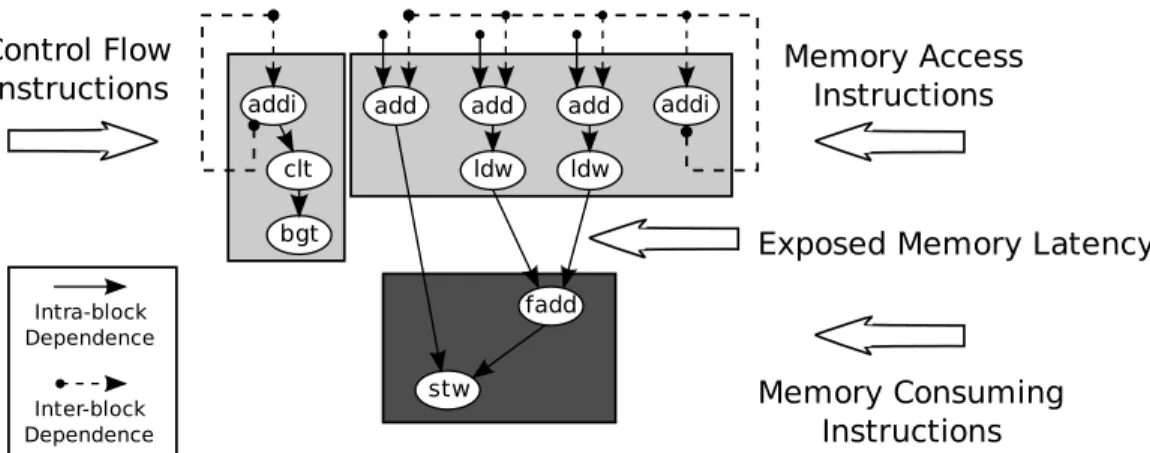
Figure 3.1: Dependency graph for the inner loop of code adding two
vectors. The instructions either depend on memory or do not, and misses in the cache can lead to significant stalls in in-order processors.
3.1
Memory Latency Tolerance through Strands
Decoupled architectures separate thememory-accessandmemory-consuming instructions of a program into separate instruction streams, called strands, that are executed on logically separate processors. These strands follow the same control flow path through the original program, but perform a specific function within each basic block. Strands must execute together in order to perform the same function as the original sequential thread, and by defini-tion communicate data values and control flow decisions with one another. Strands are responsible for either accessing memory or consuming memory values, with partitioning occurring along memory dependence lines. In the base case there are two strands, one accessing memory and one consuming memory values. Address generation instructions and memory operations are found in memory accessing strands, while floating point and integer arith-metic are found in memory consuming strands.
Strands execute in parallel with one another and persist throughout the execution of the thread. Strands have their own context of program counter, scratch register space, and mechanisms to communicate with other strands.
However, because an individual strand executes only a portion of an original sequential thread, the context requirements such as register working set are significantly smaller. Considering all the strands together, the aggregate register working set requirement is on the order of the original sequential thread.
The main advantage of decoupling a sequential thread into strands is the ability to tolerate memory latency. Traditional in-order processors stall when a primary data cache miss occurs and a dependent operation is waiting to be issued. Decoupling into separate strands enables the memory-accessing stream to continue to issue instruction and execute in a nonblocking man-ner under ideal circumstances. Essentially, decoupled architectures execute instructions out-of-order, but this parallelism is extracted by the compiler from the original program, rather than dynamically in hardware. On the other hand, the compiler must be designed to extract the separate instruc-tion strands. This limits backwards-compatibility of code, and requires that code be re-compiled.
Figure 3.1 shows the dependency graph of the inner loop of code that adds two vectors together. In this example, only the floating-point addition (fadd) and store (stw) instructions are dependent on memory. Consider the situation when the load (ldw) instructions require a long latency to fill the request from memory. In-order processors stall when a primary data cache miss occurs and a dependent operation is waiting to be issued. Decoupling into separate strands enables the memory-accessing stream to continue to issue instructions while the memory-consuming strand waits on the data to return from memory.
A
B
C
D
A
B
C
D
A
B
C
D
Thread 0
Strand 0
Strand 1
Control Flow Instructions Communication
Figure 3.2: High level architecture of decoupled designs. The serial instruction stream is partitioned into strands, and communicate control flow decisions and data with one another.
3.2
Control Flow Requirement
A default requirement of decoupled architectures is that each strand must ex-ecute down the same control path together. Figure 3.2 depicts the execution of several basic blocks of the thread as compared with that of a decoupled de-sign. Though the strands must execute down the same control path through the program in order to ensure correct execution, the execution does not need to be synchronized. That is, once a strand determines the direction in the control flow graph to take, there is no need to wait on another strand.
While there is no formal synchronization required by a strand when the control flow decision is generated, in practice data may be required from another strand. In the case of compute-generated control flow, the control
flow decision cannot be known ahead of time or generated independently by memory-accessing strands. As a result, the memory-accessing strands must wait for the control flow decision to be communicated by the memory-consuming strand.
Similarly, though some conditional control flow could potentially have its decisions calculated locally, this results in additional instruction overhead. An example of this is a counted loop. Though the counting instructions and control flow decision could be made locally, this duplicates effort. This in-struction overhead can be avoided by calculating the control flow decision on a single strand and then communicating that decision with all other strands. In order to promote decoupling, the ideal case is to have the thread executing furthest ahead generate control flow decisions.
The proposed decoupled architecture in this dissertation and other decou-pled architectures require the ability to communicate control flow decisions between strands. As a result, both software and hardware overheads must be incurred. The additional instruction overhead of branch instructions for each strand can substantially increase the number of instructions executed by decoupled systems. For applications that have small basic block sizes, this overhead can represent a large portion of the computation. Hardware for communicating the control flow decisions also must be provided. In order to ensure correct control flow, hardware must have the ability to order com-municated decisions and consume them in order. In other words, the strands must consume the oldest decisions that are waiting to be consumed.
3.3
Data Communication Requirement
By definition, strands communicate data with one another. More gener-ally, memory-accessing strands communicate data with memory-consuming strands. This reflects the compiler partitioning scheme, which creates strands based along those lines. In traditional decoupled architectures, communica-tion is performed using fixed-funccommunica-tion FIFO queues, which only allow the result of load operations to be communicated to the memory-consuming strand. However, enabling more general communication is appropriate for general decoupled designs such as the one proposed in this dissertation, as it eases restrictions during the partitioning and code generation process.
To support general data communication, varying degrees of hardware and software overhead may be incurred. The requirement for hardware is that a given strand may produce a value which is then consumed by another specific strand. The hardware must be able to identify each data transaction and distinguish it from others in order to ensure that the correct data is consumed by the correct instruction. Each strand must be able to tell whether there is data ready to be consumed, which strand it is from, and what instructions in its instruction stream required that data. In many ways, this requirement is similar to the requirement of out-of-order processors. Each data value produced must be identifiable so that each instruction can correctly consume it if need be. Out-of-order processors also keep track of how old values are, so that the correct value may be paired with the correct instruction.
With these requirements in mind, there are a number of possible hardware options. As decoupled architectures are meant to offer improved efficiency, a design with the smallest area and energy overhead is preferred. Potential options for facilitating data communication include FIFO data queues,
ro-!"#$%&'"()*##"++),)-."#%/")0!*-1)
23)45*56-)
!5*56-)
5$7/8$')9%"%"+)
*##"++)
:8$#"++$8)
45*56-)
-."#%/")
:8$#"++$8)
!;/;)9%"%"+)
5$&<8=>?/)@)A";')5B)58;>$)C3DC))EF)
EF)
*G-A)
F:HI)*JH)
Figure 3.3: Diagram of DAE, a traditional decoupled-style architecture. tating register files, register windows, and large physical register files with register renaming hardware. Each of these possibilities require both hard-ware and softhard-ware modification to support the requirements of the decoupled design. For example, the register renaming approach requires a mechanism to synchronize the process across strands. While some approaches such as register renaming can require an extra pipeline stage due to added hardware complexity, approaches such as FIFO data queues can add software complex-ity due to copy instructions. These copy instructions map the data found in the FIFO queue into the local strands working set, and are required when a single data value is used more than once.
3.4
Decoupled Access/Execute Implementation
Figure 3.3 depicts a classic implementation of the decoupled architecture, Decoupled Access/Execute (DAE) [22]. The access processor (AP) and
execute processor (EP) are physically separate entities that are only con-nected through FIFO data queues for communicating data values loaded from memory, data values to be stored into memory, and control flow de-cisions. DAE achieves memory latency tolerance by executing the memory instruction stream on the AP and the computation program on the EP. The nonblocking property of the AP requires that the AP calculate control flow decisions, which it then forwards well in advance to the EP’s control queue, which is later used by the EP’s instruction fetch hardware.
3.5
Decoupling as an Emerging Technique
There has been significant past research on DAE and derivative decoupled architectures, including cache behavior [24], dynamic execution [25], and uses in out-of-order execution [26]. However, most of this research was undertaken during the time when single-core performance was most important, and the power wall was not an issue. At that time, the difficulty of matching single-core performance to out-of-order execution and the obstacle of recompilation severely limited the broad adoption of decoupled architectures.
As the focus has shifted from single-core to many-core, the obstacles pre-viously limiting decoupling are less of a concern. Throughput performance is more important, and the low hardware overhead required for decoupled architecture enables many active cores to be on a single chip. Perhaps more importantly, introducing additional compiler transformations to support de-coupled architectures is much less of an issue for manycore processors. GPUs and manycores today compile OpenCL and CUDA applications to an inter-mediate representation, which is later translated to specific chip parame-ters [9]. Lightweight compiler transformations required for decoupled
archi-tectures can be implemented at the translation layer, enabling decoupling to be implemented today.
As a result, there has recently been renewed interest in decoupled archi-tectures for improving performance in GPUs and manycore, driven by the desire for energy-efficiency and complexity-effective performance [27]. This recent work shows both the performance and energy benefit of leveraging decoupled architectures, including the reduction in number of active threads on the processor. Overall, recent research has shown that by focusing on improving single-thread performance, concerns with multithreading can be avoided, such as cache contention and extracting enough parallelism to sat-urate a growing number hardware threads on chip.
CHAPTER 4
EVALUATION METHODOLOGY
In this dissertation, five common code patterns are identified that signif-icantly impact the performance and energy consumption of latency toler-ance techniques in 1000-core data-parallel processors: compute-intensive, data-dependent control flow, data-sharing intensive, pointer-chasing, and memory-streaming intensive. Using microbenchmarks to isolate these code patterns and highly parallel benchmark kernels from visual computing, a comprehensive design space evaluation is performed with in-order with hard-ware prefetching, out-of-order, multithreaded, hardhard-ware scout, and decou-pled techniques.
Detailed performance models of each latency tolerance technique are built and detailed physical design models are generated using synthesis and an-alytical SRAM models for a 45nm CMOS manufacturing process to deter-mine benchmark runtime, dynamic energy consumption, and leakage energy consumption. Each latency tolerance technique is individually implemented with complexity-effective and energy-efficient hardware to avoid naive and unfair comparisons. The runtime and energy values for a single technique are then analyzed to determine the Pareto-optimal configurations with re-spect to energy-efficiency.
!"#$%&'()*+*,-./*!0*!%.'"*1233* * 45*
!6!78*
9&'-/:&;*
:$<)(-=&=*
!"<>'*
97?*
@<-%'$*A"B-/*
6CDE&)$**
F.C)"%=*
!(&#*6%-.G*:).DC*H*I$<.;&C*@<-%'$*
9J<D;-*
K-<C(;.%L*
M#-%.D<'*
N"/).'-**
Figure 4.1: Workflow for generating energy, area, and leakage.
4.1
Performance and Energy Modeling
Figure 2.1 depicts the 1024-core data-parallel processor with a three-level cache hierarchy, based on the Rigel architecture [1]. Table 4.1 lists the chip and core design parameters. Figure 4.1 presents the flow for evaluating the performance, area, and energy consumption of the techniques in this disserta-tion. In this flow, each architectural configuration’s performance is measured using a cycle-accurate performance model, while the associated area and en-ergy costs of the design are based on models derived through a combination of RTL synthesis (for logic) and CACTI 6.0 [28] (for memories).
4.1.1
Performance Modeling
The performance modeling infrastructure is an execution-driven simulator that models the cores, caches, memory controllers, and DRAM. The core
Table 4.1: Parameters for the baseline 1024-core architecture. Core Base 8 stage, 2-wide in-order
32 entry RF
64-entry Gshare branch pred. 8 entry BTB
L1 ICache 2kB 2-way, 1 cycle 2 MSHRs, Next-line Pref. L1 DCache 1kB 4-way, 1 cycle
8 MSHRs, 4 Out. Loads, 4 Out. Stores L2 Cache 64kB Shared. 4 cycle, 8-way Interconnect Two-level tree and crossbar
16 cycle minimum latency L3 Cache 4MB Shared, 32-Bank,
4 cycle, 8-way each bank
DRAM 8 Channels & GDDR5
models the structure of the pipeline, including pipeline stages and storage components such as branch prediction tables, register files, reorder buffers, load-store units and instruction windows. Each structure is modeled with a specific number of read and write ports in the simulator. Each core also has private L1 instruction and data caches, a single-precision floating point unit, and a MIPS-like instruction set. Eight cores share a unified L2 cache, with lower access latency than the L3 cache. The L3 cache is connected via mem-ory controllers to off-chip DRAM. This performance modeling infrastructure was used to obtain performance numbers in terms of execution cycles for each of the microbenchmarks and benchmarks in the study.
4.1.2
Physical Design Modeling
For modeling the energy and area of each design, a CMOS 45 nm manufac-turing process was used. CACTI was used to model the register files, the caches (L1, L2 and L3), and other storage components (BTB, branch pre-diction tables, instruction queues, etc.); synthesized Verilog was used for all
other major core structures such as the integer execution unit, the floating point unit and bypass logic.
As the area and energy of each module depends on its implementation and how aggressively it is designed, each of the chip components was targeted for a range of delays, with different implementations yielding energy and area as a function of delay. Specifically, CACTI was modified to output the energy-area-delay points of all configurations considered during its internal design space exploration, and the synthesis toolflow was used to generate different circuit implementations at different target clock frequencies. All these data points were then used to generate Pareto-optimal curves of area, dynamic energy and leakage as function of delay. These curves allowed the selection of the most efficient implementation of a circuit based on the target frequency and were an important consideration, especially as the voltage and frequency were varied to find the most optimal design.
To model the effect of the operating voltage, voltage scaling equations extrapolated from SPICE simulations of 45 nm circuits were used. These equations model the impacts of scaling voltage on circuit delay, energy con-sumption, and leakage power. The voltage scaling equations were then tied together to the Pareto-optimal energy, area and delay values for each of the modules. Operating voltages from 0.7 to 1.4 V were considered. Linking these values into the core pipeline model defined by the simulator enabled the approximation of the operating frequency of each core configuration un-der different voltage operating points.
The final step in creating a full energy model requires linking the energy costs at the module level with the architectural activity factors to generate the total dynamic energy consumption. In addition to outputting the runtime of each benchmark, the simulation infrastructure also outputs the activity for
each component in the core and memory system. The activity factor of each component during execution is measured by counting the number of accesses performed to the structure. For storage components, reads and writes are counted, while function units count the number of active cycles. Associated lookup storage structures also count the number of lookups performed. These activity factors are then used with the module configurations and the selected operating voltage to determine area, dynamic energy and leakage.
4.2
Code Patterns for Data Parallel Applications
In this section, five key code patterns found in data-parallel programs are identified that impact the energy efficiency of the latency tolerance tech-niques studied in this dissertation. The code patterns are compute-intensive, data-dependent control flow, data-sharing intensive, pointer-chasing, and memory-streaming intensive. These patterns stress different aspects of the latency tolerance techniques, such as the ability to tolerate functional unit and memory latency and the ability to exploit locality in the cache hierarchy. However, this collection is not a comprehensive taxonomy; rather these are the patterns that this dissertation finds most significantly affect the tech-niques evaluated. Additionally, these patterns are not mutually exclusive; multiple patterns may be found in an application.
Compute-intensive: Compute-intensive code consists predominately of
arithmetic instructions, usually floating-point computation, as opposed to memory access instructions. As a result, these pieces of code often have long chains of dependent instructions and little control flow. In an in-order core, these chains of floating-point instruction lead to significant pipeline stalls
due to functional unit latency. Successfully tolerating these stalls requires finding independent instructions to issue during long latency instructions.
Data-dependent Control Flow: The data-dependent control flow
pat-tern occurs when the next basic block to execute cannot be known ahead of time. Data-dependent control flow poses a potential performance problem for several of the latency tolerance techniques evaluated. In order to find in-dependent work and continue execution under long instruction stalls, either another instruction stream must execute or speculative execution must be performed within the stalled instruction stream. If the control flow decision is difficult to predict, misspeculation can occur and result in wasted energy.
Data-sharing intensive: Memory-intensive code withhigh reuse exhibits
a large number of memory accesses that are favorable to a cache hierar-chy. Peak performance is achieved by fitting the dataset of a thread into the cache. Sharing intensity, that is, the fraction of data shared between threads, impacts the design of the hierarchy. When the dataset used by each thread is at least partially separate, the amount of space required on the chip increases commensurate with the number of threads. To improve per-formance in the presence of cache-favorable applications with low amounts of data sharing, latency tolerance techniques generally must limit contention for cache resources. Limiting contention generally requires sizing the cache hierarchy appropriately, or limiting the number of threads that simultane-ously execute. When enough sharing exists such that the data fits entirely in the cache, cache contention can be avoided.
Pointer-Chasing: Pointer-chasing behavior occurs when an application
linked-list or graph is a dynamic element whose address is not known ahead of time, requiring the inspection of pointers in the parent node’s data structure. The memory access patterns can be highly unpredictable, and the runtime can be dominated by the memory accesses. Depending on the data set size, each memory access can have a significant amount of latency. Additionally, instruction level parallelism can be relatively low.
Memory-streaming intensive: Memory-intensive code with low reuse,
also known as the memory-streaming pattern, exhibits a large number of memory operations that are consumed by the application approximately once. Due to the low amount of reuse, the memory accesses often miss in the cache hierarchy, causing significant stalls in an in-order core. Codes with this pattern often allow exploitation of memory level parallelism. With enough memory bandwidth, a latency tolerance technique that exposes ad-ditional requests to the memory subsystem can improve performance over an in-order core.
4.3
Microbenchmarks
4.3.1
Microbenchmarks
Microbenchmarks are used to isolate the identified code patterns and deter-mine their impact on the energy efficiency of the latency tolerance techniques.
Compute-Intensive: The compute-intensive microbenchmark consists of
a loop that performs iterations of floating point computation on values al-ready existing in the register file. Each iteration of the loop executes a col-lection of floating point instructions connected in a tree-like structure where
each stage fans into the next, much like a reduction operation. Therefore, while there is ILP that can be exploited at each stage in the tree, there is latency that must be tolerated to keep the core from stalling.
Data-dependent Control Flow: The data-dependent control flow
mi-crobenchmark consists of a loop where each iteration calculates a value, which is then compared to a threshold value. If the calculated value is less than the threshold, a running sum is updated. It is unknown ahead of time whether the running sum will be updated or not, corresponding to different control paths. The threshold conditional branch is statically biased to 75% taken.
Data-Sharing Intensive: The data-sharing microbenchmark consists of a
loop dominated by memory accesses. Each thread of execution has a vector dataset where each element is iterated on in an inner loop and the entire thread’s dataset is iterated over in an outer loop. The dataset for each thread is set such that the eight baseline threads in a cluster can fit in the L2 cache without aliasing.
Pointer-Chasing: The pointer-chasing microbenchmark is a linked-list
traversal, where a small number of floating point instructions are used to update a value in each node. Each task operates on a separate linked-list, and each node aligns to a cache line and is irregularly skewed across the ad-dress space, simulating the effects of dynamic memory allocation and linked list manipulation.
Memory-Streaming Intensive: A simple vector addition code to model
the memory-streaming code pattern. Using this code base, the situation where the dataset is resident in the L3 cache is modeled. When the data is
Table 4.2: Benchmarks and their primary and secondary code patterns. Primary code patterns dominate the benchmark, with the secondary pattern causing significant impact.
Code Pattern(s)
Benchmark Primary Secondary
blackscholes compute-intensive data-dependent control flow
cutcp data-dependent control flow compute-intensive
cg memory-streaming
dmm data-sharing
fft compute-intensive memory-streaming
heat memory-streaming compute-intensive
kmeans memory-streaming data-dependent control flow
mri compute-intensive memory-streaming
sobel memory-streaming
already in the L3 cache, the access latency is in the tens of cycles and a high amount of bandwidth is available.
4.4
Benchmarks
A set of nine optimized parallel kernels from scientific and visual comput-ing applications implemented for Rigel are used for evaluation. The bench-marks exhibit a high degree of parallelism and are written using a task-based, barrier-synchronized work queue model similar to Carbon [29]. For code generation, the LLVM compiler and backend are used [30]. LLVM com-piler optimizations are turned on and code is tuned at the source level using loop unrolling and software pipelining techniques. As a result, a significant amount of latency can be tolerated over naive code.
The benchmarks include black scholes (blackscholes), conjugate gradient linear solver (cg), coulumbic potential with cutoff (cutcp), dense matrix multiply (dmm), 2D fast Fourier transform (fft), 2D stencil computation (heat), k-means clustering (kmeans), medical image reconstruction (mri),
and image edge detection (sobel). Table 4.2 lists the dominant code patterns found in these benchmarks. Each benchmark is executed for at least one billion instructions.
Black Scholes Theblackscholesbenchmark performs pricing on a set of
options using the Black-Scholes partial differential equation. The equation is highly floating-point and compute-intensive, and thus is strongly dominated by that code pattern.
Conjugate Gradient Linear Solver Thecgbenchmark is a linear solver
for sparse linear systems. The execution is dominated by sparse matrix-vector multiply operations on the dataset. The sparse matrix and vector memory accesses in the program exhibit relatively low locality, causing the benchmark to exhibit a strong memory-streaming code pattern.
Coulombic potential with Cutoff The cutcpbenchmark is used to
cal-culate the potential energy between atoms. The benchmark has significant data-dependent control flow, with control flow depending on the result of the coulumbic potential calculation.
Dense Matrix Multiply The dmmbenchmark performs a blocked
single-precision dense matrix multiply on a pair of 1024x1024 matrices. The block-ing produces the potential for input data reuse among threads, makblock-ing the application exhibit a strong cache-favorable code pattern with high data sharing.
Fast-Fourier Transform Thefftbenchmark is a 2D FFT using 1D FFT
are rich in floating-point chains, leading to a compute-intensive code pattern, while the matrix transpose operations exhibit low-reuse and fall into the memory-streaming pattern.
Heat The heat benchmark performs a stencil computation to determine the heat flow in a 2D space. There is a small amount of data sharing exhibited between thread, due to sharing of boundary data. However, most of the data is not shared, and due to low reuse the application is memory-streaming. Additionally, the large number of floating point operations in the benchmark leads to the compute-intensive code pattern being exhibited.
K-means Clustering The kmeans benchmark implements a variant of
the K-means clustering algorithm. Much of the execution is spent doing histogramming operations, during which memory-streaming is observed. As a secondary code pattern, the cluster computation exhibits data-dependent control flow in an outer loop.
Medical Image Reconstruction Themribenchmark is compute-intensive,
with long chains of floating-point operations. Additionally, data accessed ex-hibits low reuse such that the memory streaming pattern is observed.
Sobel Thesobel benchmark performs edge detection on a 2D image. The
execution is dominated by matrix convolution operations. The kernels used for convolution exhibit a high amount of data reuse. However, the image matrix exhibits low locality, and thus the memory-streaming code pattern dominates. Additionally, there is little data shared between threads.
CHAPTER 5
A MODERN DECOUPLED
ARCHITECTURE
This chapter presents the baseline core architecture used for experiments in this dissertation. Throughput-oriented data parallel processors focus on maximizing utilization of functional units while minimizing chip area to pro-vide a large number of functional units on a single chip. A decoupled core architecture designed for a 1000-core data parallel processor should attempt to optimize its design based upon these goals.
Traditional decoupled designs such as DAE require separate fetch, decode, execute, and data queue resources for each strand processor, but these re-sources may not experience continuous utilization. This under-utilization results in opportunities to reduce the chip area overhead for the technique. These duplicated hardware resources could potentially be shared, improving utilization and reducing area overhead. For example, memory-consuming strands may execute integer or floating-point arithmetic, causing replication of hardware such as multipliers and shift units between decoupled proces-sors. Traditional fetch resources such as instruction caches also represent duplicated hardware that can be shared.
The method commonly used to share resources in core architectures today is multi-threading, which executes several thread contexts on the same core. In this dissertation, a similar technique is used to execute multiple strands on the same core pipeline. The benefit of using a multi-threading technique to share hardware resources between decoupled strands is decreased area and
!"#$"%&" '#()*+,-."/"0123"'4"'*2,#"%5!!" "
6#71*8"719#:(317"2*9-";"<6=">.)31"
?1,+>.1*"@+31>"A'29-1"
B19#71"
B'29-1"
AC:1:1>"
DE19:.1"
B2.2"C:1:1>"6+>>"F:G1*"
H#27"F:G1*"
<.#*1"F:G1*"
61I#*)"J991>>"K8+."
6+>>"F:G1*"
H#27"F:G1*>"
<.#*1"F:G1*"
61I#*)"J991>>"K8+."
Figure 5.1: Baseline modern decoupled architecture.
static energy consumption, but there is a possibility of increased contention for these shared resources, which can reduce performance. This dissertation finds that, in practice, the performance loss is generally quite low, resulting in a significant improvement in area-efficiency.
5.1
Architecture Overview
Figure 5.1 presents the core architecture used for the baseline in this dis-sertation. There are two strands, one accessing and one memory-consuming. Each strand has its own instruction queue, register file, and FIFO data queues for communication. The memory-accessing strand can issue multiple outstanding memory requests. Both strands compete for is-sue slots, and execution between the strands interleaves in a simultaneous multithreading (SMT) style.
!"#$"!%" &#'()*+,-"."/012"&3"&)1+#"!455" " 67289:-)1;<"1)=,*-0=-7)0" >0-=," ?0=#<0" @=,AB>" CD" CD" CD" E/F5" E/F!" >GH5" >GH!" >GHI" JKL/" 6L6"
Figure 5.2: Pipeline for modern decoupled architecture.
5.1.1
Shared Resources and SMT
Figure 5.2 presents the core pipeline for the modern decoupled architecture. The pipeline is seven stage with three total pipes: one for memory, one for integer/branch, and one for floating point computation. The entire pipeline is shared among the memory-accessing and memory-consuming strand. In-structions retrieved from the instruction cache at the fetch stage also go through the decode stage, at which point the instruction is stored into sepa-rate instruction queues. When instructions are ready to be issued, they are issued from the schedule and register file read stage in an SMT-style fashion, where all backend pipes are pipes are shared among strands. Two instruc-tions can be issued per cycle total, with instrucinstruc-tions coming from either strand.
5.1.2
Data Queues
FIFO data queues are used for communication between strands. In the mod-ern decoupled architecture with two strands, one FIFO queue is needed for each strand. Unlike the special-purpose queues found in DAE where queues are only used for either control flow or data communication, the data queues in the modern decoupled core architecture can be used for general