TRUSTWORTHY PEER-TO-PEER
INFRASTRUCTURE
USING HARDWARE BASED SECURITY
by
TIEN TUAN ANH DINH
A thesis submitted to
The University of Birmingham
for the degree of
DOCTOR OF PHILOSOPHY
School of Computer Science
College of Engineering and Physical Sciences
The University of Birmingham
University of Birmingham Research Archive
e-theses repository
This unpublished thesis/dissertation is copyright of the author and/or third parties. The intellectual property rights of the author or third parties in respect of this work are as defined by The Copyright Designs and Patents Act 1988 or as modified by any successor legislation.
Any use made of information contained in this thesis/dissertation must be in accordance with that legislation and must be properly acknowledged. Further distribution or reproduction in any format is prohibited without the permission of the copyright holder.
We shall not cease from exploration And the end of all our exploring Will be to arrive where we started And to know the place for the first time
T.S Elliot – Little gidding
If I have been able to see further, it was only because I stood on the shoulders of giants
Isaac Newton
Science is what we understand well enough to explain to a computer. Art is everything else we do
Donald Knuth
The important thing in science is not so much to obtain new facts as to discover new ways of thinking about them
Abstract
Peer-to-Peer (P2P) infrastructure, thanks to its scalability, has been used for designing many large-scale distributed systems. Of the two types of P2P infrastructure: unstruc-tured and strucunstruc-tured, the latter has received a greater amount of research attention. Security is one of many challenging problems faced by existing systems based on struc-tured P2P. Having trust in such the P2P environments can help mitigate many problems including security, because peers can choose to only interact with the ones that are deemed trustworthy. However, there exists numerous hurdles that need to be overcome before a reliable trust infrastructure (or trust system) can be implemented for P2P. This thesis investigates and seeks to improve the existing reputation metrics and feedback mecha-nisms which are important components of the trust system. It shows the limitations of existing reputations metrics and feedback mechanisms, then proposes new algorithms and protocols addressing these limitations. The new reputation metrics are more resilient to manipulations, and they take into account negative feedback. The new protocols are de-signed as parts of the feedback mechanisms, and they allow an honest peer in a structured P2P system to securely detect if another peer has misbehaved. The mechanism for de-tecting misbehavior has proved difficult in structured P2P, and has not been considered by existing feedback mechanisms.
The new protocols leverage hardware-based security which is in the form of trusted de-vices. Some protocols utilize the Trusted Platform Modules which are currently available at high-ends computers. The others make use of the newly proposed trusted hardware called Trusted Token Modules.
The protocols concerning the detection of misbehavior in structured P2P routing are analyzed in this thesis using both formal methods and simulations. CSP is used to model and verify the properties of these protocols. The performance of these protocols is then evaluated using the newly proposed, distributed simulation platform called dPeerSim.
ACKNOWLEDGEMENTS
With greatest gratitude, I would like to dedicate this thesis to my family: my grandpar-ents, my parents and my little sister. I thank my family for having brought me into this world and provided me with the nurturing environment that I am very lucky to have. I thank them for their unconditional love and support, without which I would not have had the necessary foundation and strength to pursue my dreams.
I am indebted to my supervisor, Professor Mark Ryan, who has served not only as a mentor to me, but also as a real life role model that I want to see myself become in the future. I am particularly grateful for his persistent encouragement, his incredible attention to details, and his perseverance in understanding and contributing to my thesis. One of the biggest lessons I have learned from working with Mark is the need to express ideas in the simplest, clearest but also most exact form. I always admire him for being considerate, and for the way he treats his students as peers. But above all, his charisma, his positive outlook on life, his kindness and his sense of humor are so infectious that I feel myself becoming a better person just by working with him.
I am sincerely grateful to my second supervisor, Dr Georgios Theodoropoulos. While working with Mark has taught me to be meticulous in research, the greatest skills I have learned from Georgios are how to take a step back, to look at the big picture, and to evaluate your work in context. I appreciate his conspicuousGreekness, his sense of humor, and the way he instills confidence into his students. I thank Georgios for his guidance, both technical and general, during the course of the thesis. I thank him for facilitating a lively distributed system group which consists of extremely smart and friendly people with whom I have had a number of successful collaborations.
Doing a PhD, as I have learned in almost four years, is not only about research, but also about meeting new people and making good friends. As I see old friends from undergraduate moved on with their jobs, I would have felt left out and sad if it was not for all the new friends, new colleagues that I have had the pleasure to know. They truly are exceptional characters that make my four-year PhD such a joyous experience. I would like to thank Rob Minson, Michael Lees for their early guidance and involvements in my first publication. Thanks also go to Tom Chothia and Rami Bahsoon for all the fruitful discussions, and for their valuable advice on doing research. I am grateful to Vinoth Suryanarayanan, Richard Price for their help in accessing the university cluster. I am thankful to have known people like Edward Robinson, Seyyed Shad, Peter Lewis, who always seem to have answers to all my technical, geeky problems. Last but not least, I would like to thank other colleagues such as Josef Baker and Ben Smyth, who have got me into running and kept on encouraging me with their great stories of achievements in running.
CONTENTS
1 Introduction 1
1.1 Motivation . . . 1
1.2 Scope and Contributions . . . 3
1.3 Structure of the Thesis . . . 6
1.4 List of Publications . . . 9
2 Background and Gap Analysis 12 2.1 Structured P2P and Its Applications . . . 12
2.1.1 Unstructured . . . 13
2.1.2 Structured . . . 15
2.1.3 Application of Structured P2P Overlays . . . 21
2.2 Trust and Reputation . . . 23
2.2.1 Trust in computer security . . . 24
2.2.2 Trust based on Reputation . . . 24
2.2.3 Model of Reputation . . . 25
2.3 Setting the Scene (or Gap Analysis) . . . 26
2.3.1 Current Issues with Structured P2P . . . 26
2.3.2 How Trust Could Help . . . 30
2.3.3 Reliable Trust System for P2P . . . 31
3 Reputation Metrics 37 3.1 Formal Computational Model of Reputation . . . 37
3.1.1 System Model . . . 38
3.1.2 Trust Graph . . . 38
3.1.3 Reputation Metric . . . 39
3.2 Sybil-resilient Metric . . . 40
3.2.1 PageRank reputation metric . . . 41
3.2.2 Sybil Manipulation in the Original PageRank . . . 42
3.2.3 PageRank with Undirected Trust Graph . . . 44
3.2.4 Cluster-Based PageRank (CPR) . . . 46
3.2.5 Experimental Study of CPR . . . 48
3.2.6 Related Work and Discussion . . . 52
3.3 Support for Negative Feedback . . . 53
3.3.1 Negative Feedback is Different from Distrust . . . 53
3.3.2 Why Negative Feedback? . . . 55
3.3.3 Reputation Metric with Negative Feedback . . . 56
3.3.4 Experimental Study . . . 58
3.3.5 Related Work and Discussion . . . 62
4 Detection of Misbehavior in P2P Using Trusted Platform Modules 65 4.1 Overview . . . 65
4.2 Trusted Computing and Trusted Platform Modules . . . 67
4.2.1 Trusted Computing and TPMs . . . 67
4.2.2 A Simple Protocol Involving Monotonic Counters and Transport Sessions . . . 70
4.2.3 Why Not Attestation? . . . 71
4.3 Detection of Misbehavior at the Routing Layer (DTR1) . . . 73
4.3.1 Root Authenticity (RA) Property of a P2P System . . . 74
4.3.2 Proposed System . . . 77
4.4 Detection of Misbehavior at the Application Layer (DTA1) . . . 80
4.4.2 Proposed System . . . 83
4.4.3 More Efficient Solutions . . . 85
4.5 Related Work and Discussion . . . 87
5 New Hardware for Detection of Misbehavior in P2P 89 5.1 Motivation . . . 89
5.2 Design Overview of TTM . . . 91
5.2.1 Logical Design . . . 92
5.2.2 Architectural Design . . . 94
5.3 Operations . . . 96
5.3.1 Creation and Removal of Tokens . . . 96
5.3.2 Transferring Tokens . . . 98
5.3.3 Cryptographic Operations . . . 105
5.3.4 Other Operations. . . 108
5.4 Example With Access Control Systems . . . 109
5.4.1 Online Access Control. . . 109
5.4.2 Offline Access Control. . . 110
5.5 Detecting Misbehavior at the Routing Layer (DTR2) . . . 112
5.6 Detecting Misbehavior at the Application Layer (DTA2) . . . 114
5.7 Discussion . . . 117
6 Formal Analysis 121 6.1 Overview . . . 121
6.1.1 Formal Verification of RA Property . . . 121
6.1.2 Why CSP? . . . 123
6.1.3 Methodology . . . 124
6.2 Introduction to CSP . . . 125
6.2.2 Trace semantics . . . 126
6.3 Data Independence Technique . . . 128
6.4 Verifying RA Property for DTR1 . . . 131
6.4.1 The DTR1 Model in CSP . . . 131
6.4.2 Specification . . . 138
6.4.3 Verification . . . 139
6.5 Verifying RA Property for DTR2 . . . 143
6.5.1 The Model in CSP . . . 143
6.5.2 Specification . . . 145
6.5.3 Verification . . . 146
6.6 Related Work and Discussion . . . 147
7 Experimental Analysis 149 7.1 Why Large-Scale Distributed Simulation of P2P? . . . 150
7.1.1 Why Simulation of P2P? . . . 150
7.1.2 Why Large-Scale Distributed Simulation? . . . 152
7.2 Distributed Simulation Platform (dPeerSim) for P2P Systems . . . 152
7.2.1 Overview . . . 153
7.2.2 Design of dPeerSim . . . 154
7.2.3 Scalability of dPeerSim . . . 157
7.3 Simulation-Based Analysis of DTR1 and DTR2 . . . 161
7.3.1 Methodology . . . 161
7.3.2 Results and Analysis . . . 164
7.4 Related Work and Discussion . . . 169
8 Conclusion and Future Work 173 8.1 Contributions and Evaluation . . . 173
8.1.1 Summary of Contributions . . . 174
8.2 Limitations and Future Work . . . 178
Appendix A: PageRank’s Resilience Against Sybil Manipulations 183
Appendix B: Root Authenticity and Neighbor Authenticity Property 187
Appendix C: CSP Trace Semantics 189
Appendix D: CSP Model for DTR1 191
Appendix E: FDR Implementation for DTR1 CSP Model 197
Appendix F: The Proof for DTR1 203
Appendix G: FDR Implementation for DTR2 CSP Model 209
Appendix H: The Proof for DTR2 213
List of References 219
Summary of Notations 226
LIST OF FIGURES
2.1.1 Gnutella architecture . . . 14
2.1.2 Example of a Chord overlay. . . 16
2.1.3 Example of routing neighbors of a Pastry node. . . 18
2.2.1 The core relationships between reciprocity, reputation and trust. Ostrom et al. [72] . . . 23
2.3.1 Abstraction levels of P2P applications. Adapted from [23] . . . 28
2.3.2 Trust system . . . 31
3.2.1 Two Sybil strategies for manipulating PageRank. . . 42
3.2.2 Sybil effect on Web vs P2P graph . . . 45
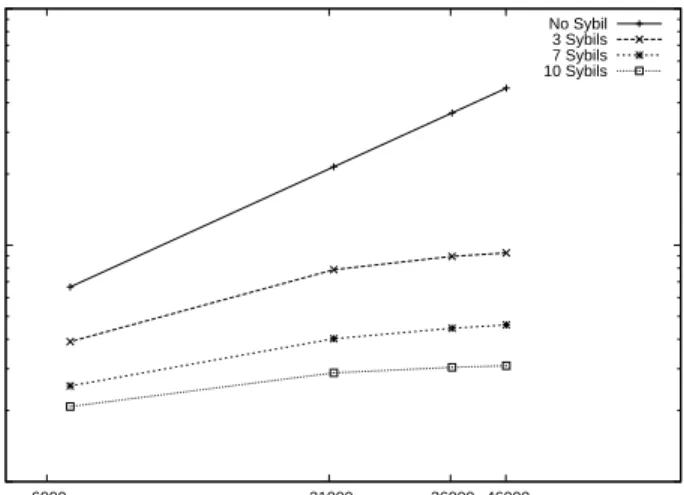
3.2.3 Sybil resilience under a power-law graph with 7 Sybils per attacker . . . . 49
3.2.4 Sybil resilience under a small-world graph with 7 Sybils per attacker . . . . 50
3.2.5 Resilience against Sybil attacks, with varying number of Sybils per attacker. The attacker’s initial rank is around 10,000. . . 50
3.2.6 Minimum Kendall distance of top-T ranks produced by PageRank and by CPR . . . 51
3.3.1 The relationship between feedback, reputation, trustworthiness, trust and distrust. . . 55
3.3.2 Ranks of the new node with 7 positive incoming edges . . . 59
3.3.3 Ranks of the new node with 15 positive incoming edges . . . 60
3.3.4 The effect of negative edges on reputations. rNEdges 0.1 . . . 60
3.3.6 Effect of Sybils in the graph having no negative edges . . . 61
4.2.1getSignedCounterValues(mode, n, cid) . . . 70
4.2.2 Attestation based on virtual machines. . . 72
4.3.1 Details of the pv.destVerification(k,pd) . . . 75
5.2.1 TTM logical design. . . 92
5.2.2 High-level hardware design of the Trusted Tokens Module (TTM). . . 96
5.3.1init(n,cid,isRT,isRecreatable,h,even) and remove(tks) commands . . . 97
5.3.2 Information flow of the protocol for transferring tokens from p2 top1 . . . 99
5.3.3 Commands for transferring B-type tokens . . . 100
5.3.4 Prepare a request for a range of tokens . . . 101
5.3.5 Commands for transferring a range of tokens . . . 103
5.3.6 Commands for generating and loading asymmetric keys. . . 106
6.1.1 The P2P system evolves from time t to time t 1 (for t¥0) as peers join and leave the network . . . 122
6.4.1 Channels and processes in the model of DTR1 . . . 137
7.1.1 Evaluation methods used in unstructured P2Pstudies . . . 151
7.1.2 Evaluation methods used in structured P2Pstudies . . . 151
7.2.1 Components of a Logical Process in dPeerSim . . . 155
7.2.2 Distribution of P2P nodes with multiple LPs . . . 157
7.2.3 Maximum number of nodes that can be simulated for Chord. . . 158
7.2.4 Maximum number of nodes that can be simulated for Pastry. . . 159
7.2.5 Execution time of Pastry under churn. . . 160
7.2.6 Average number of messages handled at each LP during simulation of Pas-try under churn . . . 161
7.3.1 The workload at the CA during the simulation. . . 165
7.3.3 The average hop-count in DTR1. . . 166 7.3.4 The average hop-count in DTR2. . . 166 7.3.5 Average rate of successful joins in DTR1 vs DTR2. . . 167 7.3.6 Average rate of query failure per completed query in DTR1 vs DTR2. . . . 168
LIST OF TABLES
2.1.1 Summary of structured P2P overlays . . . 20
5.2.1 Summary of the data structures used in TTM. . . 95
5.4.1 Access scenarios for systems and objects . . . 109
CHAPTER 1
INTRODUCTION
1.1
Motivation
The past decade has witnessed phenomenal developments in Peer-to-Peer (P2P) infras-tructure, thanks to the vast number of systems based on P2P, and to the research in P2P systems being an increasingly active field. A P2P system can be defined as a network of computers (or peers) that communicate mainly with each other without the need for a centralized party. Compared to a traditional system in which one server deals with re-quests from many clients, the P2P system is more scalable and its lack of the centralization components means that there is no single point of failure.
Two types of P2P infrastructure exist, and they differ in the graphs formed by the connections among peers and the mechanisms for locating objects. In unstructured P2P, peers form a random graph, as a peer can be a neighbor of any other peer. For locating an object, the peer broadcasts the request to its neighbors which again forward the request to their own neighbors. In structured P2P, peers form a rigid topology, which allows for efficient mechanisms for locating objects.
Well-known examples of systems based on unstructured P2P are file-sharings: Napster, Limewire [42], eDonkey [55], Bittorrent [22], etc. Because of its scalability, structured P2P has been used for many large-scale applications. For instance, it has been used for an application-level multicast infrastructure that enables multicast routing without the need
for hardware support [17]. The performance of such the infrastructure can come very close to that of a hardware-supported multicast infrastructure. Other examples include P2PSIP [14] (a Voice-over-IP application) and PAST [81] (a network storage system). Even botnets — networks of compromised computers used for sending spams — are built on structured P2P [49].
The scalability property of structured P2P comes with a number challenges that need to be addressed before one could take full advantage of the infrastructure. One of the main challenges is security, which is inherent in P2P because peers are autonomous and there lacks a centralized authority that polices peers’ interactions. An adversary could disrupt the mechanism for locating objects by redirecting the requests to another malicious party, or by impersonating the final nodes in the routing paths of the requests. It could also attack properties that are specific to the systems built on structured P2P.
Trust, a concept originating from human society, can help dealing with the security issues in structured P2P. In real-world societies, trust allows people to interact confidently with strangers. It also helps people identify and then avoid the untrustworthy. In the con-text of structured P2P, having trust helps the honest peers identify and avoid interacting with the adversaries — ones that cause harms to the system and are therefore considered untrustworthy. Having trust in the system also encourages peers to be trustworthy, since acting otherwise would impede their opportunities to interact with the others. In other words, the implication of having trust goes beyond security, as trust induces cooperation, which is important to systems that rely on peers sharing their resources.
To facilitate trust in P2P (both structured and unstructured), a trust infrastructure (or trust system) is needed. Such a system provides the information about one peer that can be used by others to decide whether to trust that peer. The trust system is usually based on reputation which has been shown to be a good indicator of trust. Particularly, the trust system comprises the feedback mechanism that allows peers to give each other ratings for their behavior, and the reputation metric that combines feedback into reputation values (or scores). A peer having a high reputation score is likely to be trustworthy and to be
subsequently trusted by others.
Implementing a trust system for P2P is challenging, since such the system requires two properties to be met: reliability and efficiency. The latter states that the system is efficient in terms of resources (memory, bandwidth, etc.) that it uses. The former means that the system can prevent honest peers from making incorrect trust decisions, even if it is given inaccurate feedback, and even in the presence of the so-called Sybil manipulation attack
in which the attacker introduces new peers to the system and uses them strategically to boost its reputation. In other words, in a reliable trust system, feedback elicited by the feedback mechanism is combined together by the reputation metric to yield reputation values which are intuitive and resilient to manipulation. It means that high reputation values are given to well-behaved peers and low reputation values are given to the poorly-behaved.
1.2
Scope and Contributions
This thesis is concerned with the reliability property of trust systems for structured P2P. In particular, it seeks the answers to the following research questions:
1. To what extent are existing reputation metrics such as PageRank [73] vulnerable to Sybil manipulations? Can they be improved? Are the feedback models used by those metrics strong enough? Can they be made more realistic?
2. Regarding the existing feedback mechanisms for structured P2P applications, is it always possible for peers to leave feedback to each other after their transactions? If not, can we design mechanisms that overcome such the limitation?
This thesis focuses on the resilience of the reputation metrics against manipulations, and on the use of hardware-based security in feedback mechanisms. More specifically, for reputation metrics, it enhances the capability of being resilient against manipulation, and it adds the support for negative feedback. For feedback mechanisms, it uses
hardware-based security to design mechanisms that enable a peer to detect the misbehavior of others in the structured P2P environment. It carries out formal analysis to show that the proposed mechanisms allow the correct detection of misbehavior, and experimental analysis to evaluate the performance of these mechanisms when implemented in practice.
The detailed contributions of this thesis are as follows: 1. Regarding reputation metrics:
(a) Extending the previous work on the resilience of the PageRank reputation metric [73] against Sybil manipulation [21], by considering a stronger Sybil strategy. The result indicates that PageRank has different degrees of sensitivity against different Sybil strategies.
(b) Showing, through experimental analysis, that PageRank is more sensitive to Sybil manipulation when used for undirected graphs — which are commonly found in P2P environments — than for directed graphs.
(c) Proposing a new reputation metric based on PageRank, called Cluster-based PageRank (or CPR). Experimental results indicate that compared to the orig-inal PageRank, CPR produces relatively intuitive reputation scores, and that CPR is more resilient to Sybil manipulation than PageRank when used for undirected graphs.
(d) Arguing that negative feedback is important for P2P trust system, which then leads to the proposal of the new reputation metric that is based on PageRank and supports negative feedback. The new metric, called PRN, is evaluated through experiments. The results indicate that it produces intuitive reputation values and is resilient against Sybil manipulation.
2. Regarding feedback mechanisms:
(a) Presenting two examples of structured P2P systems that demonstrate the dif-ficulties for an honest node to securely detect the misbehavior of another. The
detection is necessary in order for the honest node to leave appropriate feed-back to the other. One example is related to routing protocols, and the other is a marketplace built on top of structured P2P.
(b) Proposing two mechanisms that enable secure detection of misbehavior. One mechanism targets the routing layer (called DTR1), the other targets the P2P-based marketplace application (called DTA1). Both DTR1 and DTA1 rely on the Trusted Computing infrastructure, particularly on the Trusted Platform Modules (TPMs), to provide trusted operations involving monotonic counters. DTR1, in addition, relies on a centralized party called the Certificate Authority (CA).
(c) Proposing a new general-purpose security hardware called Trusted Tokens Module (TTM). Examples of using TTMs in access control systems are pre-sented to demonstrate that TTMs can be useful in other areas of application beside P2P. Next, new protocols that leverage TTMs for detecting misbehavior for the two case studies are proposed. DTR2 and DTA2 both improve upon DTR1 and DTA1. In particular, the centralized party (the CA) in DTR1 is removed in DTR2.
3. Regarding analysis:
(a) Formalizing DTR1 and DTR2 in CSP, and verifying that they satisfy the prop-erty that implies the honest peers’ abilities to securely detect misbehavior of other peers in the context of P2P routing. Data independence is used as a model abstraction technique that reduces the original CSP models of DTR1 and DTR2 to ones with smaller state spaces. For the small models with a lim-ited number of nodes, automated proofs showing that they satisfy the desired property are generated by the model checker tool FDR [37]. The automated proofs are accompanied by general, hand-written proofs for the models of ar-bitrary numbers of nodes.
(b) Introducing a new condition that when satisfied by a data-independent process allows the data type to be reduced without introducing new traces to the model. (c) Designing a new distributed simulation platform, called dPeerSim, by extend-ing the open-source, application-level P2P simulator named PeerSim [78]. Ex-perimental studies demonstrate that dPeerSim is capable of simulating large P2P systems in reasonable time scales.
(d) Using dPeerSim to evaluate the performance of DTR1 and DTR2 in practice. The preliminary results suggest that the CA in DTR1 is unlikely to be a perfor-mance bottleneck. Furthermore, the perforperfor-mance of DTR1 and DTR2 under churn are comparable, and they still leave much room for improvement.
1.3
Structure of the Thesis
Chapter 2 starts with the background on P2P systems, with particular focus on structured P2P. It explains why P2P is useful by describing a number of applications built on top of P2P. The chapter also introduces the concepts of trust and reputation in social sciences and how they have been used in computer science. The next and important part of the chapter contains the gap analysis of the current literature on P2P. It brings to the fore a number of currently challenging problems in structured P2P, especially security issues, and then explains why having a trust system can help mitigate those problems. Finally, it discusses the difficulties in implementing a reliable trust system for P2P, some of which are in the main focus of this thesis.
It should be noted here that Chapter 2 only serves as ascene-setting literature survey, whose goal is to clarify the problems addressed in this thesis, as well as to relate them to the other works in the field. Distributed over the following chapters are the literature surveys and related works that are relevant to the topic discussed in the chapters.
Chapter 3 presents the improvements made to the existing reputation metrics. It is a joint work with Mark Ryan, which elaborates on the contributions of this thesis regarding
reputation metrics: contribution 1.a to 1.d. It starts with a detailed model of reputation for P2P systems, and the model of the PageRank metric. It shows that the resilience of PageRank depends on the Sybil manipulation strategy, and that PageRank is less resilient against Sybil manipulation under undirected graphs than under directed graphs. Next, a new metric called Cluster-based PageRank is presented and demonstrated to be more resilient than PageRank under undirected graphs. The next part of the chapter focuses on motivating the integration of negative feedback into existing reputation metrics. It presents the new metric, called PRN, that includes negative feedback. PRN is then shown to produce intuitive reputation values and be resilient against Sybil manipulation. Chapter 4 contains the details of the contribution 2.a and 2.b. It presents the re-sults from collaborative work with Mark Ryan and Tom Chothia. The chapter starts by presenting two case studies in which the misbehavior of peers proves hard to detect. One example concerns the misbehavior in routing protocols, the other concerns the mis-behavior specific to the P2P-based marketplace application. The chapter introduces the concept and the main features of Trust Computing and the TPMs. For each case study, the property stating that peers are able to securely detect the misbehavior of each other is introduced. For example, in the case study concerning routing protocols, the property is called Root Authenticity (or RA) property. Finally, the chapter presents the details of two mechanisms, called DTR1 (for the example with routing protocols) and DTA1 (for the example with the marketplace application), that aim to satisfy the desirable properties.
Chapter 5 presents the contribution 2.c and 2.d in more detail. It discusses the limita-tions of TPMs in the context of detecting misbehavior in P2P: inefficiency and having to rely on a centralized party. It then describes the design of a new hardware device (TTM) whose main operations include the creation, storage and transferring of tokens between devices in secure manners. Examples of access control systems using TTMs are presented as examples to illustrate that TTMs can be used in other applications beside P2P. Finally, new mechanisms using TTMs that are designed to satisfy the RA property for the two case studies are presented. DTR2 improves upon DTR1 by removing the need for the CA.
DTA2 proves more efficient and allows for more application features than DTR1 does.
Chapter 6 provides the formal analysis for DTR1 and DTR2. The analysis of DTR1 was done in collaboration with Mark Ryan. It essentially contains the contribution 3.a and 3.b. It first explains the reasons behind selecting CSP as the modeling language for DTR1 and DTR2. Next, it presents a model of DTR1, and the formalization of the RA property, both in CSP. Due to the original of DTR1 being rather large and complex, the chapter presents two model abstraction techniques: weakening adversary and data independence that are used to reduce the verification that a model satisfies the RA property to checking the property of another model with a smaller state space. The existing data independence technique is extended in the chapter with the new condition that when satisfied allows the data type to be reduced without introducing new traces to the model. The chapter includes the automated proofs that DTR1 and DTR2 satisfy the RA property for a small number of nodes, and the general, hand-written proofs for arbitrary numbers of nodes. The automated proofs are generated by the CSP model checker called FDR.
Chapter 7 provides further analysis of DTR1 and DTR2 by evaluating their perfor-mance through simulation. Its contributions to this thesis are the contribution 3.c and 3.d. The first part of the chapter presents the motivations and designs of a new simulation platform called dPeerSim. It shows that dPeerSim is a scalable platform for simulating large P2P systems in reasonable time scales. This work was carried out with a number of collaborators: Michael Lees, Georgios Theodoropoulos and Rob Minson. The second part of the chapter presents and analyzes the preliminary results from simulating DTR1 and DTR2 under a strict failure model and with a simple maintenance protocol. The re-sults suggest that in DTR1, CA is unlikely to be a performance bottleneck under normal network conditions. The performance of DTR1 and DTR2 under churn are comparable, and they still leave much room for improvement.
1.4
List of Publications
Most parts of this thesis have been published in a number of papers and reports, as listed below.
1. Chapter 3:
(a) Tien Tuan Anh Dinh and Mark Ryan. A Sybil-Resilient Reputation Metric for P2P Applications. In3rd International Workshop on Dependable and Sustain-able Peer-to-Peer Systems (DAS-P2P 2008), in conjunction with the 2008 In-ternational Symposium on Applications and the Internet (SAINT2008), pages 193-196, Turku - Finland, August 2008.
This paper provides the contents for Section 3.1 and Section 3.2. It describes the need for, and the details of the Cluster-based PageRank.
2. Chapter 4:
(a) Tien Tuan Anh Dinh and Mark Ryan. Verifying Security Property of Peer-to-Peer Systems Using CSP. In 2010 European Symposium on Research in Com-puter Security (ESORICS).
(b) Tien Tuan Anh Dinh and Mark Ryan. Checking Security Property of P2P Sys-tems Using CSP. Technical report. University of Birmingham, CSR-10-07. Ac-cessible at http://www.cs.bham.ac.uk/~ttd/files/technicalReport.pdf
(c) Tien Tuan Anh Dinh, Tom Chothia, and Mark Ryan. A Trusted Infrastructure for P2P-Based Marketplaces. In 9th IEEE International Conference in Peer-to-Peer Computing (P2P’09), pages 151-154, Seattle - WA, October 2009. The ESORICS paper and the technical report CSR-10-07 provide the materials for the first part of the chapter where DTR1 is presented. The details of DTA1 presented in the second part of the chapter are based on the P2P’09 paper.
(a) Tien Tuan Anh Dinh and Mark Ryan. Secure Hardware Abstraction for Dis-tributed Systems. Technical report. University of Birmingham, CSR-10-08. Accessible athttp://www.cs.bham.ac.uk/~ttd/files/secureHardware.pdf
The contents of the chapter: the design of the new hardware and details of DTR2 and DTA2 are based on the technical report CSR-10-08.
4. Chapter 6: the formal analysis of DTR1 is presented in the ESORICS paper in brief details, and in the technical report CSR-10-07 in full details. The analysis of DTR2 is included in the technical report CSR-10-08.
5. Chapter 7:
(a) Tien Tuan Anh Dinh, Georgios Theodoropoulos and Rob Minson. Evaluat-ing large scale distributed simulation of P2P networks. In 12th IEEE Inter-national Symposium on Distributed Simulation and Real Time Applications (DS-RT’08), pages 51-58, Vancouver - Canada, October 2008.
(b) Tien Tuan Anh Dinh, Michael Lees, Georgios Theodoropoulos and Rob Min-son. Large Scale Distributed Simulation of p2p Networks. In2nd International Workshop on Modeling, Simulation, and Optimization of Peer-to-peer Environ-ments (MSOP2P 2008), in conjunction with Euromicro PDP 2008, pages 13-15, Toulouse - France, February 2008.
(c) Richard Price, Tien Tuan Anh Dinh and Georgios Theodoropoulos. Analysis of a Self-Organizing Maintenance Algorithm Under Constant Churn. In 3rd International Workshop on Dependable and Sustainable Peer-to-Peer Systems (DAS-P2P 2008), in conjunction with the 2008 International Symposium on Applications and the Internet (SAINT2008), pages 209-212, Turku - Finland, August 2008.
The first two papers describe dPeerSim and demonstrate its scalability through experiments with different P2P protocols. The details of dPeerSim being used for
studying maintenance protocols is included in the third paper. These papers provide the contents for the first part of Chapter 7.
CHAPTER 2
BACKGROUND AND GAP ANALYSIS
This chapter discusses how trust in general and trust based specifically on reputation are important for P2P environments, and how the latter comprises reputation metrics and feedback mechanisms. It outlines the problems faced by reputation metrics and feedback mechanisms in building a reliable trust system. The chapter sets the scene from which Chapter 3 extends an existing reputation metric. It links the work done in Chapter 4, 6 and 7, which are the secure mechanisms for detecting misbehavior using hardware based security, to the context of improving the feedback mechanism.
It should be stressed again that this chapter does not serve as the complete literature background for this thesis. The rest of the literature survey is distributed over the follow-ing chapters. This chapter starts with the background of structured P2P systems. The literature on trust and reputation is presented next. The final section discusses how the problems being addressed in this thesis are related to the others.
2.1
Structured P2P and Its Applications
The common understanding of P2P systems characterizes them as networks of computers (which could be referred to as peers or nodes) interacting directly with each other with-out centralized servers. This concept, however, fails to identify file-sharing systems like Gnutella [42], eDonkey [55] and Bittorrent [22] as P2P, because in this thesis, I define
P2P systems as networks of peers with following properties:
1. Autonomous. Peers are not under control of a central authority. They can join and leave the system at will.
2. Heterogeneous. The system can accommodate peers of different types, i.e. different operating systems, network connections, etc.
3. Most traffic passes between peers. A certain degree of centralization is allowed. Nevertheless, peers mainly interact with each other. This accounts for most of the system traffic. In P2P file-sharing applications, for example, bootstrapping servers are commonly used to help new peers join the systems.
P2P systems are overlay networks, because they run on top of another network (the Internet, for example). In the remaining, the term P2P, P2P overlays, P2P networks, P2Psystems, P2P infrastructures are used interchangeably to refer to systems satisfying the three properties listed above.
An essential part of a P2P system is the routing protocol that implements the search (or the lookup) operation for a piece of data. Two types of P2P infrastructures exist in the literature: unstructured and structured. In the following, a brief survey of unstructured P2P is presented for completeness and comparison with structured P2P.
2.1.1
Unstructured
File-sharing applications such as Limewire [42], eDonkey [55], and Bittorrent [22] are built on top of unstructured P2P. This infrastructure has evolved through three generations.
2.1.1.1 First generation — Napster
There exists a centralized indexing server that facilitates the sharing of data among peers. Search queries for a file, for example, are forwarded to the server. If the file exists, the server then responds with the contact information of the peers having the file.
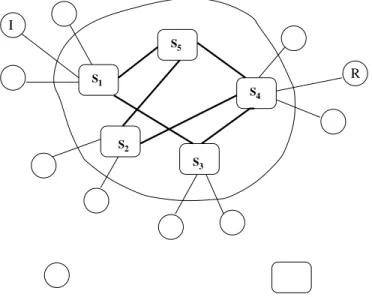
I R S1 S2 S3 S4 S5
Normal peer Super peer
Figure 2.1.1: Gnutella architecture
2.1.1.2 Second generation — Gnutella
The centralized index server is removed. A number of powerful peers (ones with high bandwidth, high up-time) form a network of superpeers. Ordinary peers connect and publish their shared data to at least one superpeer. Ordinary nodes forward their search queries to their superpeers. The superpeers then forward the queries to all of its neighbors, consequently flooding the network. For example, in Figure 2.1.1, peer I searching for a file residing at peer R first forwards its queryS1. The query is then broadcast to S3, S5
and finally to S4 which returns the contact information of R.
2.1.1.3 Third generation — Bittorrent
In the previous systems, peers from a single network to share their files. In Bittorrent [22], each file is associated with an independent network of peers interested in sharing the same file, calledswarms. Each swarm has a centralizedtracker that supplies information of the sharing peers and the data being shared. Bittorrent is a system ofmultiple networks with one file per network, as contrast to Napster and Gnutella — systems of one network with multiple files. The Bittorrent protocol consists of two key elements. First, the rarest-first piece selection strategy is used by a peer to select and download the rarest piece of data
in the swarm. Second, an uploading peer adopts the tit for tat peer selection strategy
to select and upload data to the peer from which it has downloaded the most. This strategy provides a robust incentive for peers to share data, rather than to free-ride the network [57], a major problem in the early file-sharing systems [90].
2.1.1.4 Summary
In unstructured P2P, a peer can be a neighbor of any other peer in the network. Therefore, the overlay topology approximates a random graph. In the early generation, the lookup is implemented by broadcasting the queries, which is unscalable. Limiting the number of hops that the queries propagate seems to mitigate this problem, but introduces nonde-terminism. In particular, a negative result only means that the searched data may still exist but cannot be reached within the given number of hops.
2.1.2
Structured
Structured P2P systems are designed to address the weakness in the lookup mechanism of the early unstructured P2P. Searching in structured P2P is deterministic and more scalable. This comes at the expense of the system’s robustness under frequent churn — the process of node joining and leaving the network. A number of structured overlays exist. The most popular ones can be divided into groups of different topologies: ring,
Plaxton graph, d-dimensional torus, etc..
In a structured P2P system, let P and D be the sets of peers and data in the system. A non-collision hash function is used to map each member of P and D to a distinct value in I. Unless stated otherwise, I r0,2
m
q where m is the security parameter with
the typical value of 160. A peer is uniquely identified by a peer ID. A data is uniquely associated with a key. The values of peer IDs and data keys come from the same set I. A data k is stored at the node called the destination node or root node of k. Let
550 144 609 1000 296 498 775 744 144 609 1000 296 Target Peer 144 + 1 144 + 2 144 + 4 144 + 8 144 + 16 296 144 + 32 296 144 + 64 296 144 + 128 296 144 + 256 144 + 512 144 + 1024 144 296 296 296 296 498 775
Figure 2.1.2: Example of a Chord overlay. ID r0,2
10
q, P
t144,296,498,609,775,1000u and D t550,744u. The small circles represent the IDs
that are used to construct the finger tables of peer 144.
be the function returning the root node of a given key in the set of nodes currently in the network. Structured overlays differ in the functionrootand the protocols that resolve the root nodes.
2.1.2.1 Ring topology — Chord
Chord [88], one of the first structured P2P overlays, is well known for its simplicity and efficiency. In Chord, the ID space wraps around to make an ID ring. Each Chord node connects to the peer immediate on its left (called the predecessor) and another immediate on its right (called the successor). In Figure 2.1.2, the predecessor and successor of peer 144 are 1000 and 296 respectively.
Let succpkq be the function returning the peer immediate on the right of k in the ID
ring. For example, both succp300q and succp400q returns peer 498, whereas succp250q
returns peer 296. In Chord:
rootsucc
In Figure 2.1.2, data 744 is stored at peer 775. For efficient routing, every node maintains connections to other neighbors in a finger table of sizem, in addition to the predecessor and successor. For a node p, the ith (1
defined as succpp`2
i1
q, where `is the addition operation in modulo 2
m. In the above
example, the 4th and 9th finger of peer 144 are peer 296 and 498 respectively.
To search for the destination node of k, i.e. to resolve succpkq, the searching peer
forwards its query to the neighbor (its successor, predecessor or a node in its finger table) that is furthest from it but is still on the left of k. This procedure is repeated at the new node until the current node is the closest on the left of k. In this case, the current node’s successor is returned. In Figure 2.1.2, the routing path from node 144 fork 744
is 144Ñ498Ñ609. Finally, node 775 is returned as the destination of k. WithN nodes
in the overlay, the average number of routing hop per query is 12.log2pNq.
When a new peerpjoins the network, it uses an existing node to initialize its successor and predecessor, namely succppq and succppq’s predecessor. It then initializes its finger
entries and notifies its existence to the other nodes that should havepin their finger tables. When leaving gracefully, p notifies the relevant neighbors, so that they can update their routing states. On average, the number of messages needed to maintain the network for a churn event is OplogNq.
2.1.2.2 Plaxton mesh — Pastry
In Pastry [82],rootpkqreturns the node whose ID is numerically closest to k (if two nodes
have the same distance tok, the one with smaller ID is returned). Data keys and peers IDs are are represented in base 2b for a value of b (usually b
4). Pastry nodes form a
Plaxton mesh topology [75], in which each node is the neighbor to ones sharing similar prefix with its own ID. In particular, the routing table contains log2bN rows, where N
is the number of peers in the network. Each row has 2b
1 entries. The entry at row i
(1 ¤ i ¤ log2bN), column j (1 ¤ j ¤ 2
b) is a peer whose ID has the same first
pi1q
digits as the current node and itsith digit is
pj 1q.
Figure 2.1.3 shows the routing table of node 10233102 in the Pastry overlay withb 2.
In addition to a routing table, each node also maintains a list ofl peers closest to its left and its right (on the circularI space), called the leafset. In the example in Figure 2.1.3,
Leafset 10233000 10233001 10233033 10233021 10233120 10233122 10233230 10233232 Routing Table 02212102 10233102 22301203 31203203 10233102 11301233 12230203 13021022 10031203 10132102 10233102 10323302 10200230 10211302 10222302 10233102 10230322 10231000 10232121 10233102 10233001 10233102 10233232 10233102 10233120 10233102
Figure 2.1.3: Routing neighbors of the Pastry node 10233102. This Pastry overlay uses
b 2 andl 8. Therefore, all peers’ IDs are in base 4, and each peer has 2*4=8 neighbors
in its leafset
the leafset size is 8 and it contains 4 peers closest to the left and 4 peers closest to the right of 10233102, sorted by their distances to 10233102. The entry at row 3 column 3, for instance, contains peer 1022302, because it shares the prefix 102 (of size 3) with the current node, and its 4th digit is 2. Some entries are empty and some refer to the current
node.
The lookup protocol for the root node of a key k consists of two steps. The query is first forwarded to the neighbor that is lexicographically closest to k. This neighbor is selected from the routing table as the node sharing the longest prefix with k. This step is repeated until the query arrives at a node whose leafset’s range covers k. In this case, the node in the leafset (including the current node) that is numerically closest to k is returned. The average number of hops per lookup operation is OplogNq, which is more
efficient than Chord in practice since logarithm of base 2b is used.
A new node joins the network by first asking a bootstrapping node to search for the root node of its own ID. The routing states can be initialized using most of the information from the other nodes in the routing path. The newly joined node then notifies its neighbors of its existence. When a node leaves the network gracefully, it also notifies the relevant neighbors. On average, the number of messages exchanged during a
churn event isOplogNq.
2.1.2.3 XOR space — Kademlia
Kademlia [66] is a structured overlay based on XOR metric. TheXOR distance between two value i and j in I is defined as pi XOR jq. rootpkq returns the node having the
smallest XOR distance tok (if two nodes have the same XOR distance tok, the one with smaller ID is returned). Each Kademlia node maintains m κ-buckets. The ith bucket
(1¤i¤m) containsκ nodes whose XOR distance from the current node is in the range r2
i1
,2i
q. For instance, withm 3, the 2
nd 2-bucket of node 1110 can include node 1010,
the 3rd 2-bucket can contain node 0111 and 0001.
The lookup process is done iteratively and is highly parallel. For a keyk, the searching peer forwards the query to the neighbors that are closest to k. Lists of peers that are closer to k are returned. The query is then sent to nodes in these lists. This process is repeated until no closer node can be found. On average, the number of peers visited peer lookup operation isOplogNq. The joining and leaving process in Kademlia are very
similar to those in Pastry. In particular, the number of maintenance messages exchanged during a churn event is also OplogNq.
2.1.2.4 Multi-dimensional space — CAN
In previous systems, peers IDs and data keys are from the range r0,2
m
q. In Content
Addressable Network (CANs) [77], they come from a d-dimensional torus. A peer ID is uniquely associated with a region, a key is uniquely mapped to a point in that space. The destination node of k is the peer whose region contains k.
A peer’s ID can be represented by the vector ppl0, h0q, ...,pld
1, hd1
qq where li, hi is
the low and high value in the ith axis. This region might be split when a new peer
joins and merged with another region when another peer leaves. The peer ID can, as a consequence, change as the network evolves. The routing table of a node p contains
Overlay Topology Routing state Hop counts Maintenance
Chord Ring OplogNq OplogNq OplogNq
Pastry, Tapestry
Plaxton mesh OplogNq OplogNq OplogNq
Kademlia XOR space OplogNq OplogNq OplogNq
Koorde de Bruijn graph 2 to OplogNq OplogNq to
OplogN{loglogNq -CAN d-dimensional torus Opdq Opd.N 1{d q Opdq
Table 2.1.1: Summary of structured P2P overlays
the query to adjacent regions until reaching the region containing the search key. For a system with N nodes, the lookup operation takes Opd.N
1{d
q steps on average. During
churn, only Opdq neighbors need to be informed.
2.1.2.5 Other overlays
Tapestry [106] is similar to Pastry regarding the topology and searching protocol. In Tapestry, a node having data k can publish this information by replicating it at all the nodes in the routing path from it to root node of k. A search for k is likely to encounter a replica before reaching the root node.
Koorde [52] extends on Chord and uses a de Bruijn graph to achieve efficient lookup. It allows the number of neighbors per node to be tuned from 2 toOplogNqto achieve hop
counts ranging fromOplogNq toOplogN{loglogNq. An important theoretical result that
comes out of Koorde is that:
Ann-node system with maximum degreed requires at leastlogdn1 routing
hops in the worst case andlogdnOp1q on average
2.1.2.6 Summary
2.1.3
Application of Structured P2P Overlays
Because of their decentralization, scalability and deterministic lookup mechanisms, struc-tured P2P overlays have been used to build a wide range of large-scale distributed systems.
2.1.3.1 Content delivery — Trackerless Bittorrent
In the original Bittorrent systems, there exist centralized servers providing tracker ser-vices for many swarms, such as The Pirate Bay [93] and Mininova [69]. The trackerless Bittorrent protocol [22] is proposed to eliminate such single points of failure. Peers form a structured overlay, namely Kademlia. Each peer is also a tracker server. A file being shared is mapped to a key k. The tracker service for file k is provided by the root node of k.
2.1.3.2 Application-level multicast
Multicast routing can be implemented at the software-layer. Such an application-level multicast infrastructure requires no hardware support, and it can be carefully designed to approximate the performance of the IP-level solutions. Structured P2P overlays have been used to support large multicast groups with low communication overheads.
Scribe [17] is built on top of Pastry. A multicast group is identified by an unique key
k. The root node of k becomes the rendezvous point, to which the multicast source sends its data to be broadcast to the members of the group. When a node p wishes to join a groupG, it routes a Join message to the rendezvous point. Nodes in the routing path that have not seen messages belong to group G register an entry indicating that p belongs to
G. The routing of the Join message stops when it arrives at a node that has registered an entry for G. The data being broadcast is first transferred to the rendezvous node, which then sends the data to all the members of the group that it knows. Experiments showed that the median and maximal delay penalty per group are 1.7 and 4.26 respectively.
2.1.3.3 Communication infrastructure
Voice-over-IP (VoIP) protocols also benefit from structured overlays. P2PSIP [14] im-plements the Session Initiation Protocol (SIP), an important part of the VoIP protocol, over the Chord overlay. VoIP clients form a Chord overlay, each is given an unique name, which is mapped to a key k. The connection details of the client, such as its IP address, are stored at the root node of k. When the details change, an update is sent to the root node. When another peer wishes to establish a connection with the client, it uses the latest information at the root node of k.
2.1.3.4 Botnets
Botnets are networks of compromised machines (or bots) under the control of a single attacker. They are mostly used for sending spam. Holz et al.[49] have reverse-engineered Stormworm [86], a large and popular botnet, and discovered that bots were organized into a Kademlia overlay. The control command is uniquely identified with a key k that is based on the current date and a random value known to all bots. The command is published at the root node ofk. Periodically, bots fetch new commands (with the newly generated keys) and execute them, which could result in new commands being published.
2.1.3.5 Others
A number of P2P network storage systems based on structured overlays have been pro-posed. PAST [81], for example, is a persistent global storage system built on top of Pastry. PAST supports only immutable files. It relies on the diversity of nodes (both geographically and politically) and the replication mechanisms to ensure high availability for data.
The Internet Indirection Infrastructure (I3) [87] used Chord to build a global rendezvous-based communication infrastructure. In particular, it supported unicast, multicast, any-cast routing abstractions and host mobility. Application-level multiany-cast and VoIP
appli-(individual and group) Trust Reputation Reciprocity Institutional variables Physical variables Cultural variables Level of cooperation Net benefit
Figure 2.2.1: The core relationships between reciprocity, reputation and trust. Ostromet al. [72]
cations could be built on top of this general infrastructure.
2.2
Trust and Reputation
Trust is a social phenomenon emerging from human interaction. Trust is important to society because it increases and reinforces the level of reciprocity and cooperation, as depicted in Figure 2.2.1. It is therefore not a coincidence that the concept of trust has been studied extensively in social sciences. This thesis uses the following definition by Hardin [46] (Chapter 2, page 11):
To say we trust you means we believe you have theright intentions toward us and that you arecompetent to do what we trust you to do
From this definition, trust is subjective and in relation to a given task. It is important to understand the relationship between trustworthiness (and its adjective: trustworthy) and trust. Many authors in the literature failed to recognize the differences between these terms and labeled their works as about trust, even though were in fact about trustworthi-ness. Roughly speaking, the decision to trust depends on the assessment of trustworthiness (and perhaps other factors that are specific to the context in which the decision is made). While trust is a boolean-valued relation, there are degrees of trustworthiness. Once we have evaluated how trustworthy another person is, we have the knowledge to trust or distrust. Hardin went as far as arguing that trust is cognitive and therefore is not a choice.
A well known conception of trustworthiness is theencapsulated interest conception [46], in which one’s trustworthiness is measured by one’s interest or incentive to be trustworthy in the relevant context. Reputation, defined as record of the past deeds ([92], page 71), fits in this model because one with good reputation has the incentive to sustain that reputation, i.e. to behave in a trustworthy way.
2.2.1
Trust in computer security
In computer security, works in authentication implicitly make use of the notion of trust. However, they are not concerned with the question of how trust is formed or how trust-worthiness is computed. Yahalom et al. [104] proposed three trust classes: direct trust,
indirect trust and recommendation trust. In distributed environments where one client might not know another directly, a set of rules was proposed to derive indirect trust from the other classes of trust.
Maurer [65] extended the work in [104] to design a distributed public key infrastructure (PKI). Given a certificate graph and the trustworthiness values that peers give to each other, a set of derivation rules was used to determine the authenticity of a public key. This approach is similar to that in the Pretty Good Privacy (PGP) system. The PGP system represents trustworthiness as fuzzy values, as opposed to integer values in [65].
2.2.2
Trust based on Reputation
In sociology, reputation is studied in the encapsulated interest model [46]. A person with good reputation has the incentive to behave in certain ways that maintain the reputation. This is because a good reputation encourages others to choose him for future transactions that could be in his interest. This is important in society, because people increasingly have interactions with those with whom they might never have the occasion to interact again. In many cases, one can turn to the law of contracts to be protected from uncooperative behavior. Often enough, however, there is no such safeguard, especially for small-scale
exchanges.
As shown in Figure 2.2.1, reputation is an important factor contributing to trustwor-thiness. The other variables are physical, cultural and institutional variables. In online settings, both physical and cultural information are not available. Furthermore, many exchanges online are not protected by institutional safeguards. As the consequence, rep-utation is the main indicator of trustworthiness.
2.2.3
Model of Reputation
In computer science, research on computational models of reputation extends on the following model. Let Fi be the set of feedback given to agent i. Let F be the set of all
feedback in the system, i.e. F ¤
i
Fi. The reputation value Ri of i is computed by
applying a reputation metric (or reputation function) µi to the set of feedback. More
specifically:
Ri µipFq (2.2.1)
Xiong et al. [103], investigated a simple reputation system, in which feedback is the amount of satisfaction regarding the transaction. The reputation metric was a simple averaging function, i.e. µipFq
° Fi |Fi|
. More discussion of other works on reputation models can be found in Section 2.3.
Another formal model of reputation exists and is based on game theory. Game the-orists first noticed the reputation effects on repeated games [54] and how it drives the system’s equilibrium to more socially desirable outcomes. Later studies focused on the nature of feedback in different environments. Perfect information (orimperfect informa-tion, conversely) means feedback is truthful (or contains noises). Public monitoring (or conversely private monitoring) indicates that the entire feedback history is (or is not) publicly available.
Aberer [4] analyzed the usefulness for game-theoretic models of reputations in online settings. The author argued that current computation models of reputation systems are
ad-hoc and rather intuitive. Game-theoretic models can predict how different strategies result in different equilibria, meaning that one can tune the system variables in order to achieve the desirable equilibrium (maximal overall profit, for example). In addition, one can also explain and predict how the users do exchanges with each other, for in the game theoretical framework players are rational utility maximizer and cannot do better than playing the equilibrium strategy. Nevertheless, the limitation of the game-theoretical ap-proach lies in its complexity. In terms of feedback, online environments need to be modeled as imperfect information and private monitoring. Furthermore, investigating non-trivial aggregation strategies in this framework is difficult. Finally, many argues against how well game-theoretic models approximate the real world, especially since research has shown that humans do not normally act as rational economic agents.
2.3
Setting the Scene (or Gap Analysis)
This section discusses current issues in structured P2P and motivates the use of trust in P2P. The problems with establishing trust in P2P are discussed next, which servers as the motivation to the work done in this thesis.
2.3.1
Current Issues with Structured P2P
Robustness under churn. The main advantage of structured P2P overlays compared with its unstructured counterpart is the lookup efficiency. The trade-off, however, is the cost to maintain the rigid topology under churn. The metric used to assess this cost is the number of messages exchanged during the churn event, called the maintenance messages. The original Chord protocol requires OplogNqmaintenance messages. In the extended
version, each Chord node periodically runs the stabilization protocol, which prioritizes fixing successor and predecessor pointers over fingers. Liben-Nowellet al.[62] constructed a mathematical model of the evolution of Chord networks. A half-life is defined as the minimum period of time after that the network’s size is doubled (N new nodes joined) or
halved (N
2 nodes departed). Their model showed that the cost for correct routing (queries
arrive at the correct destination) is ΩplogNq messages per half-life. For efficient routing
(i.e. OplogNq hops), the cost amounts to Ωplog
2N
q rounds of stabilization protocols per
half-life.
There exists a considerable number of works in the literature focusing on improving the performance of structured P2P under frequent churn. The node availability model consists of:
• Session time: the period during which the node stays in the network.
• Life time: the sum of the node’s session times (the node can have multiple sessions, i.e. joining and then leaving for many times).
A high churn rate implies a short session time. Unstructured P2P applications perform reasonably well under high churn rate [58]. In structured overlays, however, the lookup performance drops significantly. Rhea et al. [79] showed via simulations that the lookup success falls well under 45% when the session time is as small as 23 minutes. Bamboo [79] is an improved version of Pastry and more resilient to churn. In particular, Bamboo introduces three extensions to Pastry. First, thepush-pull mechanism for maintaining the leafset removes the need for newly joined node to announce itself to its leafset neighbors. Second, the global and localtuning protocol are executed periodically, which helps a node find better entries for its routing tables. Third, each node actively probes its neighbors to gather their up-to-date response time. If a neighbor has been unresponsive for longer than expected, it is considered as having departed and subsequent lookups can be forwarded to an alternative neighbor. Under the non-concurrent churn model with the median session time as short as 1.5 minutes, experiments showed that lookup success always exceeded 95%.
Load balancing. The load balancing problem in P2P systems arises because of the nodes’ heterogeneity and the non-uniform distribution of data. The use of secure hash functions to generate data keys and nodes’ IDs does not sufficiently address the problem,
Auction App−multicast
DHT
Routing
CAST/DOLR Storage Content distribution Communication
Application Interface layer
Routing layer Application layer
Figure 2.3.1: Abstraction levels of P2P applications. Adapted from [23]
because the hash function does not produce perfectly random values, especially when the number of of nodes and data is small.
One approach to mitigate this problem is to split an ordinary node into multiple
virtual nodes. Godfrey et al. [43] used virtual nodes as load balancing units which can be transferred from a heavily loaded peer to a lightly loaded one. Simulation results showed that in a system with the utilization rate of 0.9, up to 99.9% of the nodes are still underloaded, and the overhead of virtual nodes transferring is small. However, under high churn rate, this overhead could become significantly large. Byerset al. [15] proposed another approach, in which at least two hash functions are used to map data to different places in the ID space. Among all the possible root nodes, the data is stored at the node with the lightest load. Compared with the approach using virtual nodes, experimental results showed that the system load can be more balanced.
Security. Security is an inherent problem in P2P, because of peers being autonomous and the lack of centralized authorities that police peers’ interactions. As illustrated in Figure 2.3.1, a P2P system can be categorized as belonging to different groups corre-sponding to these layers. The hierarchy in these layers suggests that to achieve security at one layer, the lower layers need to be secure first.
1. Routing layer: The overlays discussed in Section 2.1 belong to this layer. They implement the lookup protocol that returns the root node of a given search key. An adversary targeting this layer can do the following:
+ No routing: routing queries are dropped. As the consequence, the network is partitioned into regions that cannot reach each other.
+ Redirection: queries are forwarded to other malicious nodes. They could also be forwarded to innocent nodes, in an attempt at a DDoS attack.
+ Impersonating the root node: claims to be root node in order to control traffic relating to the data key.
2. Application interface layer: this layer builds upon the lookup mechanism to im-plement the store(k,data) operation, which stores the tuple (k,data) at a node. In many systems, this tuple is placed at the root node of k. In some others, it is replicated at several nodes along the routing paths towards the root node ofk. An adversary can compromise this layer by dropping the tuple at the destination nodes that it controls. It can also tamper with the data.
3. Application layer: this layer consists of application-specific protocols that utilize the lower levels. For instance, P2P communication systems make use of the rout-ing layer, whereas P2P storage systems use the application interface layer to store data in a scalable way. The adversary at this layer attacks application-dependent properties, such as quality of services, availability, etc. For example, it could target replication, access control mechanisms or corrupt the application data.
Douceur [33] described another attack that is inherent to P2P environments, called the Sybil attack, in which the adversary gains multiple identities and appears as different peers in the network. Without proper identity management, Sybil attacks present real threats to P2P applications. In particular, the adversary can introduce Sybils in order to perform an attack at different places in the network, consequently increase the damage caused by the attack. For example, when attacking a system at the routing layer by dropping queries, the adversary can introduce additional Sybils so that more queries are routed through and subsequently dropped by it.
2.3.2
How Trust Could Help
The security problems described previously arise because honest nodes interact with the adversarial ones, which is what expected in a decentralized environment where peers do not know each other in advance. This model of interaction resembles human interactions in real-world societies. Trust in human society allows one to interact confidently with another stranger. It also helps one to identify and avoid the untrustworthy. In P2P, similarly, having trust encourages cooperation between nodes, which is important to sys-tems relying on cooperation such as content delivery and network storage syssys-tems. More importantly, in a trust-enabled environment, an honest peer could identify the adversarial (i.e. untrustworthy) ones and avoid interacting with them. As a result, the adversaries are isolated and eliminated from the network.
In the context of security, untrustworthy peers are defined as ones with the intentions to cause harms to the system. This definition can be extended to include unintentional but frequent activities that disrupt the normal operations of the system. Thus, the role of trust could go beyond security and into the realm of robustness. For example, peers with high churn rates that leave ungracefully can be considered as untrustworthy neighbors, because they induce high maintenance overhead and an increase in lookup failure. In this case, being trustworthy means being available and reliable for a long period of time.
Another implication of having trust is that it opens up new areas of applications for P2P. E-commerce systems, for instance, are currently based on n-tier client-server architecture because of the lack of a trust enabling infrastructure among the participants. Similarly, current implementations of anonymity systems (Onion routing [91], for example) are unscalable and inefficient, for they have to consider the interactions between honest and dishonest nodes.
Reputation metric
Trust Infrastructure
Implementation
Reputation Model
Feedback Data storage Computation
and retrieval
Figure 2.3.2: Trust system
2.3.3
Reliable Trust System for P2P
As discussed earlier in Section 2.2, reputation is a main indicator of trustworthiness in online settings, such as P2P. A trust system (or trust infrastructure) for P2P provides the knowledge necessary for peers to evaluate the trustworthiness of each other and then make trust decisions. The knowledge, in particular, is in the form of reputation values (or scores). The design of such an infrastructure must have the following properties:
• Reliability. Peers do not make incorrect trust decisions even if the system is given inaccurate information. This property can be translated into the requirement that the system generatesintuitive reputation scores and is resilient to manipulation. In other words, well behaved peers are given high scores and badly behaved ones are given low scores. In addition, badly behaved peers are prevented from colluding with each other in order to boost their reputations.
• Efficiency. The system is efficient with respect to its response time and the resources (memory, bandwidth, etc.) it consumes.
Figure 2.3.2 depicts two components of a reputation-based trust system for P2P. First, the component marked as Reputation Model represents the computational model for rep-utation, which consists of a feedback model and a reputation metric. The feedback model defines the process (or the mechanism) by which one peer can give ratings to another. It also describes the nature and values of the ratings. The reputation metric specifies how to combine feedback into reputation scores. Peers are then sorted in descending
![Figure 2.3.1: Abstraction levels of P2P applications. Adapted from [23]](https://thumb-us.123doks.com/thumbv2/123dok_us/10207210.2923701/45.918.209.719.44.254/figure-abstraction-levels-p-p-applications-adapted.webp)