Catherine Crockford1)& Christophe Boesch2)
(Max Planck Institute for Evolutionary Anthropology, Deutscher Platz 6, 04103 Leipzig, Germany)
(Accepted: 4 February 2005)
Summary
By combining different call types, such as barks with screams, individuals have the potential to vastly increase the range of information that can be decoded by listeners. Few animal studies, however, have examined the information content of call combinations compared with the information conveyed by each call singularly. We examined several aspects of call combinations in the repertoire of wild chimpanzees in the Taï Forest, Ivory Coast, including the types of combinations, the contexts and possible functions and compared these with the use of single calls. Almost half of all vocalisations produced by the Taï chimpanzees occurred in combination with other vocalisations or with drumming. A total of 88 different types of combinations were used. Single calls and call combinations were each produced in specific contexts. The contexts in which six of ten combinations were produced differed from the contexts of at least one of the component calls. The contexts in which the combinations were produced varied from the component calls in five different ways, three having potentially novel functions. Two of the three may have an additive function, such that two pieces of information can be conveyed simultaneously, increasing message complexity. This analysis clearly shows that call combinations are an important part of chimpanzee communication. The implications with regard to the evolution of human language are discussed. Testing of the information conveyed by single calls and of call combinations, using playback experiments, is advocated.
Keywords: chimpanzee, communication, information, call combination, context specific call
types.
1)E-mail address: [email protected] 2)E-mail address: [email protected]
© Koninklijke Brill NV, Leiden, 2005 Behaviour 142, 397-421
-Introduction
A basic aspect of vocal communication is that listeners decode information contained in the vocalisations of others (Hauser, 1996; Seyfarth & Cheney, 2003). Calls need to vary if different information is to be transmitted and de-coded. However, most mammals’ calls are innately programmed, such that signallers have limited ability to modify the structure of their calls into new call types (Janik & Slater, 1997). An alternative way of increasing decod-able information is to use sounds in combination rather than singularly. The combinatorial power of call combinations can vastly increase the number of different words, in the case of humans (Bickerton, 1990), or songs, in the case of birds (Kroodsma, 1982) and whales (Payne & Payne, 1985), which can be produced. In fact, in terms of more message possibilities, combin-ing sounds is more efficient than produccombin-ing new sounds (Jackendoff, 1999). Strikingly little research has examined the information content of combined calls compared with single calls (Zuberbühler, 2002).
Calls used in combination have, nonetheless, provoked interest in animal studies probing for ‘fossils’ of language (Jackendoff, 1999), in particular syntax. All human languages essentially require two types of syntax. In phonological syntax, where strings of sounds are grouped together according to certain rules, the individual sounds themselves do not convey meaning. In lexical syntax, where strings of words are grouped together according to certain rules, the individual words do convey meaning (Marler, 1977; Jackendoff, 1999).
Examples of phonological syntax in animals are not uncommon, espe-cially in the learned songs of birds (e.g., Kroodsma & Miller, 1982) and whales (Payne & Payne, 1985). In primates, the call combinations usually cited are long distance calls, used for regulatory spacing between groups (Marler, 1977). These have been described as stereotyped in structure, so that the combinations occur in a fixed order. Furthermore, the contexts in which the combinations occur differ from the contexts of the component calls (chimpanzee pant hoot: Marler & Hobbett, 1975; gibbon song: Mi-tani & Marler, 1989; gray-cheeked mangeby ‘whoop-gobble’: Waser, 1975; blue monkeys ‘ka-train’: Marler, 1973). As such they have been labelled as a primitive form of phonological, rather than lexical syntax (Marler, 1977).
Since then, there have been tantalising descriptions of call combinations by apes that are not just limited to long distance calls, for example, barks
combined with screams or grunts (chimpanzees: Goodall, 1986; bonobos: Bermejo & Omedes, 1999). However, little quantitative assessment of the extent and possible functions of these calls has been conducted. Crockford & Boesch (2003) found in chimpanzees, that barks produced in combination with buttress-tree drumming occurred specifically in travel contexts or dur-ing neighbour encounters. In other primates, there are a few studies that have examined different types of call combinations, their contexts of production and possible functions relative to each call produced singularly (Robinson, 1979, 1984; Cleveland & Snowdon, 1982; Zuberbühler, 2002). In each case the results indicated that primates are using certain forms of ‘lexical syntax’. Robinson (1984) unpacked Marler’s (1977) term ‘lexical syntax’ used to describe call combinations, into two aspects (a) where one call acts as a contextual modifier for the other and (b) where grammatical rules gener-ate combinations of words to form sentences. Call combinations produced in contexts intermediary to their component calls have been described by Robinson (1984) as acting as contextual modifiers. However to date, no ex-amples in animals can be described as having grammatical rules that generate combinations to form sentences.
Examples of contextual modifiers have been found in primates (Cleveland & Snowdon, 1982; Robinson, 1984; Zuberbühler, 2002), wolves (Schass-burger, 1993) and willow ptarmigans (Martin et al., 1995). Usually the con-texts in which call combinations were produced were intermediary to those
of the component calls. For example, in cotton-top tamarins, type E chirps
were produced in general alarm situations and squeaks in general alert situa-tions, other than alarm. The two call types combined were produced in inter-mediary contexts requiring vigilance but with reduced fear or alarm (Cleve-land & Snowdon, 1982).
Zuberbühler (2002) used playback experiments to establish that the re-sponses of listeners changed if a so called ‘leopard’ alarm call was preceded by a general alert ‘boom’ call. While diana monkeys produced their own leopard alarm calls on hearing a Campbell monkey leopard alarm, they pro-duced no alarm calls on hearing either a Campbell monkey ‘boom’ call alone or a ‘boom’ call followed by a Campbell monkey alarm call. The ‘boom’ call seems to have modified the information conveyed by the alarm call, and as such is indicative of an early form of lexical syntax.
In another form of contextual modification, a call combination may act as an intensification of the context of the component calls. Schassburger (1993)
documented that although wolves used barks and growls as threats, a bark-growl combination carried a more intense threat than either bark or bark-growl alone.
Clearly, the analysis of single call types relative to call combinations is necessary for ascertaining the functions of call combinations. In summary and in addition to the examples given above, suggested functions, to date, include expression of an intermediary internal state (Robinson, 1984), ex-pressing ambivalence (Schassburger, 1993), refined expression by emphasis-ing emotional intensity (Schassburger, 1993), or one call actemphasis-ing as a syntac-tic modifier of another (Zuberbühler, 2002). Alternatively, call combinations may advertise male quality (túngara frogs: Kime et al., 1988). All of these putative functions suggest that information conveyed by call combinations is additional to information conveyed by the single call types, such that call combinations increase the range of information that can be decoded by oth-ers.
It is unlikely that call combinations used by any animal approach the complexity of syntax used in human language, particularly in terms of re-cursion, which involves the limitless embedding of clauses into sentences (Jackendoff, 1999; Bickerton, 2003; Fitch & Hauser, 2004). Nonetheless, comparative research is crucial if we are to resolve what is unique to humans as oppose to what constitutes ‘fossils’ of human language or language abil-ities (Jackendoff, 1999; Hauser et al., 2002). As stated above it seems that chimpanzees use a range of call combinations (Goodall, 1986), one of which is produced in specific contexts (Crockford & Boesch, 2003). We further examine the extent of the occurrence of call combinations in the repertoire of wild chimpanzees, the types of combinations that occur, the contexts in which they occur and the possible functions they may have.
Methods
Study site, individuals and data collection
Chimpanzees from two neighbouring habituated groups were observed be-tween February 1999 through to May 2000 in the Taï National Park, Côte d’Ivoire, West Africa (site description in: Boesch & Boesch-Achermann, 2000). Data were collected continuously using focal animal sampling (Alt-man, 1974) with dawn to dusk follows, and ad-libitum sampling of non-focal
chimpanzees. All adults of the North community (3 adult males and 10 adult females) as well as all three adult males of the Middle community were in-cluded in the analysis. C.C. collected 590 hours of data from the six adult males and 520 hours from 10 adult females. Chimpanzees alternated as focal animals and could easily be followed at a distance of 3-5 m.
All vocalisations were recorded using a Sennheisser ME65/K6 directional microphone and windshield and a Sony WMD6C Professional Walkman at a distance of 3-15 m from the individual.
To determine the context of calling for the focal chimpanzee, each change of behaviour, each social interaction and each vocalisation of, or directed to, the focal chimpanzee was documented with the time of occurrence. Events in the forest that the target animal looked towards for more than 10 seconds were also documented, such as encounters with snakes and chimpanzees from other communities.
Classification of single and combined calls
Single call types were defined as those easily distinguishable from each other by ear. Chimpanzee vocalisations are graded such that each call type has ‘pure’, easy to categorise, variants such as screams and barks, and ‘inter-mediate’ variants such as those acoustically between scream and bark and therefore difficult to categorise. We excluded ‘intermediate’ variants of all call types from the analysis. We distinguished 15 vocalisations and included one frequently occurring non-vocal signal, buttress tree drumming (Table 1). This classification differs from the two published chimpanzee repertoires at other chimpanzee sites, probably as a result of differing tendencies to lump or split calls into the same or different call categories (32 different call types at Gombe: Goodall, 1986; 11 different call types at Kanyawara: Clark, 1991). Cross-site detailed acoustic analysis accompanied by contextual correlates of calling, for the entire chimpanzee repertoire, is required to resolve this issue. In addition, we noted combinations of calls and calls with drums (here-after ‘call combinations’ for simplicity). We distinguished between single and combined calls as follows: single calls were defined as those occurring as single elements or a series of elements of the same call type. Calls of the same type, joined by audible inhaled elements (or pants) were also counted as single calls. On the other hand, calls of one type that were immediately followed by another call type, and usually joined by an audible inhalation,
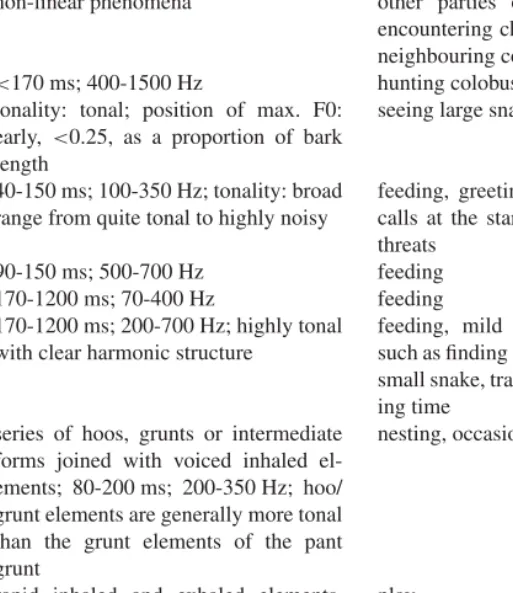
Table 1. Descriptions of chimpanzee vocalisation and drum structures and
their contexts of occurrence.
Vocalisation Acoustic characteristics∗ Contexts of production name
Bark <400 ms; 600-2000 Hz; sometimes non-linear phenomena
aggression, travelling, hearing other parties of chimpanzees, encountering chimpanzees from neighbouring communities Short bark <170 ms; 400-1500 Hz hunting colobus monkeys Tonal bark tonality: tonal; position of max. F0:
early, <0.25, as a proportion of bark length
seeing large snakes
Grunt 40-150 ms; 100-350 Hz; tonality: broad range from quite tonal to highly noisy
feeding, greeting, close contact calls at the start of travel, mild threats
‘Aaa’ grunt 90-150 ms; 500-700 Hz feeding
Deep grunt 170-1200 ms; 70-400 Hz feeding
Hoo 170-1200 ms; 200-700 Hz; highly tonal with clear harmonic structure
feeding, mild fear or surprise such as finding animal carcass or small snake, travelling near nest-ing time
Hoo grunt series of hoos, grunts or intermediate forms joined with voiced inhaled el-ements; 80-200 ms; 200-350 Hz; hoo/ grunt elements are generally more tonal than the grunt elements of the pant grunt
nesting, occasionally feeding
Laughter rapid inhaled and exhaled elements, generally quiet and voiced, grading to non-voiced; 50-100 ms; 80-300 Hz; rate of 4-7 exhaled elements/second
play
Pant unvoiced, rapid inhaled and exhaled el-ements; duration and F0 fall within the range for pant grunts
occasionally grooming or feed-ing excitement
Pant grunt series of grunts joined together by voiced inhaled elements; 30-200 ms; 100-200 Hz; tonality: highly noisy
greeting up the hierarchy
∗First two measures listed for each call type are the duration of a single element, followed
by the fundamental frequency (unless otherwise stated). Measures are intended as a guideline and are approximate rather than definitive.
Table 1. (Continued). Pant hoot comprised of up to four phases:
intro-duction: hoos; build-up: series of hoos interspersed with voiced inhaled ele-ments; climax: screams and sometimes barks; let down: similar to build-up but hoos having decreasing pitch
feeding, travelling, meeting chim-panzees from other parties or other communities
Scream 500-1000 ms; 800-2000 Hz; sometimes non-linear phenomena
receiving aggression, fear, as part of pant hoot and sometimes during copulation
Squeak shorter and more tonal than screams; 50-250 ms; 800-2000 Hz
when threatened by a dominant Whimper highly tonal series of hoo-like calls;
100-700 ms, 250-1300 Hz
begging; by infants and juveniles during weaning or separation from the mother; by young adult males when separated from other males Drum pounding of hands and/or feet against
large, resonant tree-buttresses; 1-30 beats at 2-13 beats/minute; lowest re-cordable frequencies<20 Hz (Moebius, unpubl. data)
travelling, display, encounters with chimpanzees from neighbouring communities, occasionally arriv-ing at large food sources
were classified as call combinations. For example, the pant hoot sequence, a species specific call combination found in all chimpanzee populations, can be made up of hoos, screams, barks and drums. The hoos, screams and barks usually follow each other without any audible break. In cases where call types were not joined by audible inhalations, such as grunts followed by hoos, different call types occurring in a single bout of calling were classi-fied as call combinations. The time gap between calls in a single bout is considerably shorter than the time gap between call bouts and can be reli-ably determined by ear. On randomly examining 50 recorded call bouts, we found that the time gap between calls in a call bout was generally less than one second, and never greater than 1.5 seconds. Single call elements which began as one call type and graded to a different call type within the same call element, for example a call starting as a scream and ending as a bark, were not included as call combinations and were also excluded from the analysis.
Analysis of contextual correlates of calls and call combinations
We first tested whether call types occurred in particular contexts more often
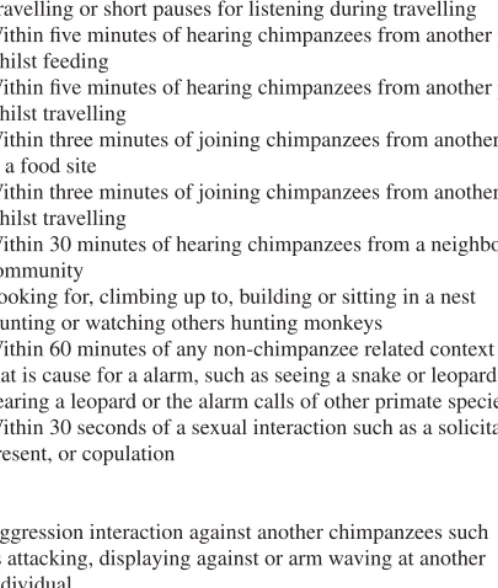
Table 2. Definitions and activity budgets of contexts and behavioural
inter-actions used to calculate expected values.
Context Definition % of total
activity budget
Food Arriving at, collecting or eating food 38%
Travel Travelling or short pauses for listening during travelling 30% Response Within five minutes of hearing chimpanzees from another party, 8%
(food) whilst feeding
Response Within five minutes of hearing chimpanzees from another party, 9% (travel) whilst travelling
Meet (food) Within three minutes of joining chimpanzees from another party, 3% at a food site
Meet (travel) Within three minutes of joining chimpanzees from another party, 3% whilst travelling
Neighbours Within 30 minutes of hearing chimpanzees from a neighbouring 1% community
Nest Looking for, climbing up to, building or sitting in a nest 3%
Hunt Hunting or watching others hunting monkeys 0.2%
Alarm Within 60 minutes of any non-chimpanzee related context 0.1% that is cause for a alarm, such as seeing a snake or leopard,
hearing a leopard or the alarm calls of other primate species
Sex Within 30 seconds of a sexual interaction such as a solicitation, 0.7% present, or copulation
Behavioural % of total
interaction interactions
Aggression/ Aggression interaction against another chimpanzees such 12.5% Display as attacking, displaying against or arm waving at another
individual
Receive Being the receiver of aggressive interactions described above 12.5% aggression
Greeting Submissive behaviour, such as crouching, bobbing, hesitant 37.5% approach – also approach and fast approach to within one
metre – accompanied by pant grunt, grunt or pant vocalisations
Other All other interactions, such as begging for food, soliciting 37.5% grooming, grooming, pass other, other approach or pass, hand
reach and embrace
Expected values for each context, used in Table 7, were calculated according to each contex-tual definition. The number of minutes chimpanzees engaged in each particular context were made into percentages relative to the total activity budget of all focal follows. Expected values for each behavioural interaction were calculated by dividing the number of each interaction type by the total number of interactions occurring during all focal follows. All contexts were mutually exclusive. The time designated to contexts such as ‘meet’ and ‘alarm’ was allocated according to the time period chimpanzees commonly continue to react to each respective event.
Expected values for each context were calculated from the percentage of time chimpanzees spent engaged in each activity. Since activity budgets for adult chimpanzees in Taï do not differ significantly, we have calculated the activity budget across all chimpanzees, using the same time period during which the behavioural data was collected (see Table 2 for calculation of ex-pected values). The data used in the t tests were the percentage of a particular call type used in each context for each chimpanzee. The percentages were tested against the expected value of each context Call types were collapsed into broad categories, for example all grunt types were simply grouped as ‘grunts’, unless otherwise stated. ‘Laugh’ was excluded because of its small sample size. We analysed call types where a context or interaction could be clearly attributed. This included all occurrences of less frequently occurring
call types. However, for common call types (those with>400 occurrences)
a representative distribution of single calls was analysed (taken from a ran-domly selected 50% of the total number of full day focal follows). In addition to conducting t tests, we noted when more than 80% of a call type occurred in a particular context.
Secondly, we tested whether call types were produced in similar pro-portions in particular contexts, when used in combination with other calls,
compared with when produced alone, using paired ttests. For this we used
the percentage of a call type that occurred in a particular context. As the sample size for some call combinations was small, giving a low statistical power compared to the single calls, we tested whether call combinations oc-curred in a particular context more than, and not less than, the component calls.
To limit multiple testing we ran one samplet tests only when there was
at least five percent more calls or drums in a particular context compared
with the expected value. We ran pairedt tests only when there was at least
20 percent more call combinations in a particular context compared with the percentage of single calls. We then corrected for multiple testing using a
modified Bonferroni procedure across thettests conducted on each call type
(Hochberg, 1988). Although results of all tests were considered significant
if p < 0.05, because of low statistical power for some call types we have
discussed values ofp <0.1 after correcting for multiple testing.
To test whether call combinations were likely to occur in a particular order we conducted paired t tests on call combinations and combinations with the reverse order respectively, such as pant hoot followed by grunt versus grunt followed by pant hoot.
Results
Distributions of single and combined calls
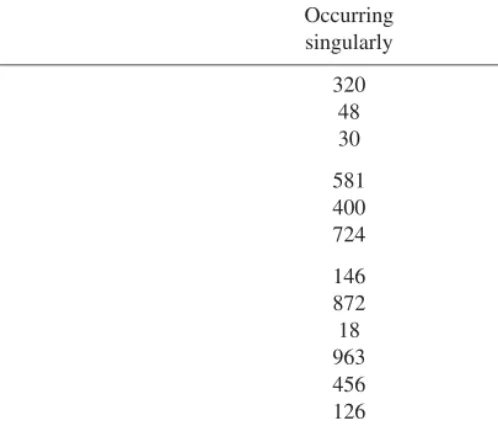
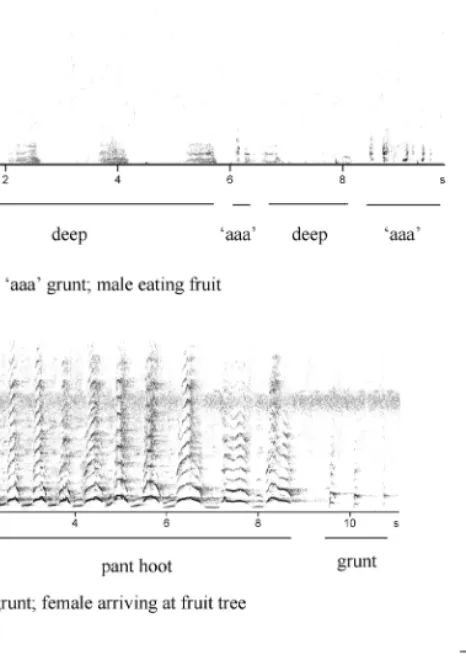
51% of all calls were produced singularly whereas 49% of calls were as combinations (Table 3), with spectrograms of the most commonly produced shown in Figure 1. Four call types, namely screams, pant hoots, drums and whimpers, were produced more often in combination with other calls than as single calls (Table 3). This was largely because the first three calls together
Table 3. Number of vocalisations and drums occurring alone and in
combi-nation with other vocalisation types.
Signal types Occurring Occurring in
singularly combination Bark 320 185 Short bark 48 8 Tonal bark 30 11 Grunt 581 156 Deep grunt 400 56 Aaa grunt 724 97 Hoo grunt 146 13 Hoo 872 143 Laugh 18 – Pant grunt 963 162 Pant hoot# 456 1496 Pant 126 46 Scream 286 1381 Squeak 31 5 Whimper 13 37 Drum 63 1101
Total signals produced∗ 5077 4899
Total number of signal episodes∗∗ 5077 1978
% of all signals produced∗ 51% 49%
% of all signal episodes∗∗ 72% 28%
∗where a signal combination is counted once for each component signal;∗∗one episode=
the production of single or repeated type of signal or signal combination; #refers to the ‘hoo’ section of a pant hoot sequence, normally termed the introduction and build-up phases (Marler & Hobbett, 1975).
made up one of the most commonly produced of all calls, the pant hoot and drum sequence (Figure 1). Only one (laugh) of the 16 call types never occurred in a combination.
It is evident from Table 4 that the distribution of actual call combinations compared to possible call combinations was non-random. There were a to-tal of 88 different signal combinations, which is 41% of all 214 possible combinations. 12 different combinations were produced more than 20 times whereas 56 were produced fewer than five times.
The call order of six call combinations was non-random (Table 4). In 97.5% of all combinations containing a pant hoot, the pant hoot was the first call in the combination. In other combinations the order was less strict. Although significantly more hoo and grunts were produced than grunt and hoos, 29% of all possible hoo and grunt combinations were produced as grunts and hoos. In fact seven additional combinations and their reverse orders were each produced at least five times: grunt and bark, grunt and pant, grunt and pant grunt, pant grunt and bark, pant hoot and pant grunt, scream and bark, scream and whimper. However sample sizes were too small to determine whether these combinations were non-randomly produced.
Contextual correlates of single and combined calls
All call types occurred in several contexts, with no call type being exclu-sively produced in one context. However, single and combined calls showed differences in their frequency of occurrence across contexts. Although all types of single and combined calls were produced in at least three contexts, single calls were generally produced across more contexts. Eight of ten sin-gle calls occurred in at least nine contexts whilst this was the case for only two of ten call combinations (Table 5). In addition, only one of ten single
calls was mainly produced in one context or behavioural interaction (>80%
of all the occurrences of that call type), compared to six of ten different call combinations (Table 7). However, more single call types were produced in certain contexts significantly more than expected, compared with the call combinations (13 and five respectively, Tables 5 & 6 for raw data, & Table 7 for statistical results).
When determining whether similar percentages of call combinations were produced in particular contexts compared to the component calls we found that five of the ten combinations were produced in different contexts
com-Figure 1. Spectrograms of call and drum combinations, shown in Table 8. Vertical axes (Hz); Horizontal axes (sec).
pared to at least one of the component calls (Table 8). For an additional call combination the context specificity was increased relative to the com-ponent calls. The call combinations that demonstrated significant contextual changes are shown in Table 8. Overall four different types of change were observed.
Ta b le 4 . Order o f signal combinations produced by adult m ale and female T aï chimpanzees. S ec o n d si g n al B AG RH OH GL AP NP GP H S M W P D R P H + P G P H + S MP H + D R P H + S M + D R First signal Bark (B A) 8 2 6 3 8 1 Grunt (GR) 10 41 24 4 1 9 2 6 2 16 1 3 Hoo (HO) 14 60 –5 8 4 4 2 3 2 3 2 4 Hoo g runt (HG) 2 1 – 1 Laugh (LA) – Pa n t (P N ) 3 9 1 – 1 1 P ant grunt (PG) 29 13 7 1 – 5 76 1 P ant hoot (PH) 5 1 5 85 – 247 5 160 1 Scream (SM) 40 41 2 2 1 3 1 1 Whimper (WP) 1 1 3 11 – Drum (DR) 5 – PH + P G 5 1 2 3 – PH + S M 5 5 3 7 828 – PH + D R 2 2 1 – PH + S M + DR 51 2 3 1 1 15 – Bold = combinations that were produced significantly more than the respecti v e re v erse order , where p< 0 . 05 using p aired t tests. Blanks indicate zeros, w hich ha v e been remo v ed to impro v e clarity . C ombinations of call subtypes are indicated as v alues in the d iagonal o f the matrix, for p airs of the same call type, for ex ample ‘grunt + g runt’ = ‘aaa’ grunt + d eep ‘grunt’.
Ta b le 5 . Mean percentages o f calls and call combinations per conte x t, across indi viduals. Call type N F ood T ra v el Response R esponse M eet Meet Neigh-Nest ∗ Hunt Alarm S ex (food) (tra v el) (food) (tra v el) bours Call combination GRa + GRd 3 4 9 1 0 0 0 6 0 0 3 0 0 0 GR + H O 2 3 4 7 2 2 9 0 9 9 0 4 0 0 0 HO + G R 5 8 5 1 7 11 0 2 2 5 0 0 0 2 2 GR + P G 2 6 4 2 1 9 0 0 1 6 1 9 0 0 0 0 4 PH ∗∗ +G R 1 8 2 8 0 3 3 6 2 2 1 1 0 0 0 0 0 PH + P G 7 3 1 1 8 3 1 37 31 0 8 0 1 0 PH + D M 6 4 1 2 5 0 6 6 8 15 0 0 0 3 0 PH + S M 212 21 22 16 25 7 0 1 5 1 2 0 PH + S M + DM 256 3 6 2 1 24 1 3 1 0 1 4 0 PH + S M + DM 48 0 6 1 0 20 0 0 19 0 0 0 0 +B A Single call Bark (B A) 311 14 20 7 1 7 5 7 6 0 8 14 2 Grunt (GR) 490 58 14 2 4 10 4 0 4 2 1 1 Hoo (HO) 370 30 19 7 1 0 8 6 0 11 1 6 2 Hoo g runt 83 25 5 2 2 4 0 0 62 0 0 0 P ant 73 44 20 0 0 14 16 0 3 1 1 1 P ant grunt (PG) 305 22 40 0 1 12 22 0 2 0 0 1 P ant hoot (PH) 223 18 14 23 19 9 9 0 4 1 3 0 Scream (SM) 229 28 29 0 1 12 11 4 0 4 1 10 Whimper 3 6 4 1 3 0 3 10 3 3 3 0 4 0 3 Drum (DM) 54 2 5 1 2 13 2 6 20 0 0 2 2 Pooled data of 18 adult m ale and female chimpanzees. G Ra = ‘aaa’ grunt, G Rd = deep grunt. ∗includes n esting at food site; ∗∗includes PH + S M. See T able 2 for conte x t d efinitions.
Ta b le 6 .Mean percentage of call combinations produced during certain beha vioural interactions compared with single calls, across indi viduals. A beha vioural interaction is either the signaller d irecting a beha viour at another o r another directing a beha viour at the signaller . Call type N Aggression/ Recei v e Greeting M eet Meet T ra v el Other O ther No Display aggression food (food) (tra v el) inter -inter -action action Call combination GRa + GRd 3 4 0 0 0 3 0 0 0 3 9 4 GR + H O 2 3 4 0 0 4 9 0 0 0 8 3 HO + G R 5 8 0 2 2 2 4 0 2 0 8 8 GR + P G 2 6 0 23 31 8 1 5 1 9 0 0 4 PH ∗+G R 1 8 6 0 0 0 1 1 0 0 0 8 3 PH + P G 7 3 0 5 9 35 28 5 6 3 9 PH + D M 6 4 3 9 (21 in tra v el) 0 0 0 0 0 0 3 57 PH + S M 212 6 0 0 0 0 0 0 0 94 PH + S M + DM 256 5 0 0 0 0 0 0 0 95 PH + S M + DM 48 9 0 0 0 0 0 0 0 91 +B A Single call Bark (B A) 311 5 2 2 0 0 0 1 0 2 7 0 Grunt (GR) 490 2 6 4 2 3 4 0 4 75 Hoo (HO) 370 0 1 2 2 2 0 0 4 89 Hoo g runt 93 0 0 0 0 0 0 0 1 99 P ant 73 0 4 11 3 1 8 0 18 56 P ant grunt (PG) 305 0 1 3 1 8 1 0 2 1 3 1 1 3 3 P ant hoot (PH) 223 7 1 1 2 2 1 1 4 81 Scream (SM) 229 2 5 3 1 2 4 3 0 7 3 3 Whimper 3 6 3 14 0 0 0 0 0 2 2 6 1 Drum (DM) 54 71 (54 in tra v el) 0 0 0 0 0 0 0 2 9 Pooled data of 18 adult m ale and female chimpanzees. G Ra = ‘aaa’ grunt, G Rd = deep grunt. S ee T able 2 for d efinitions of beha vioural interactions.
Ta b le 7 . Conte x ts and b eha v ioural interactions in which calls were produced more than expected ∗ , after Hochber g -Bonferroni correction. Call type p< 0 . 01 p< 0 . 05 > 80% of total call type ∗∗ Call combination GRa + GRd † F ood GR + H O HO + G R F ood (food + response + meet) GR + P G PH †+ G R F ood (response + meet) F ood (food + response + meet) PH + P G M eet (food) Meet (tra v el) Greeting PH + T M PH + S M R esponse (food + tra v el) PH + S M + TM T ra v el T ra v el (tra v el + response) P H +S M+T M +B A T ra v el (tra v el + response) Single calls Bark (B A) Hunt, alarm Response (tra v el) Grunt (GR) F ood Hoo (HO) Alarm Hoo g runt Nest Pa n t P ant grunt (PG) Meet (tra v el), g reeting G reeting P ant hoot (PH) Response (food + tra v el) Scream (SM) Recei v e aggression Se x Whimper Drum (DM) T ra v el, aggression ∗one sample t tests; ∗∗not necessarily produced more than expected, p robably b ecause of lo w statistical po wer; †includes P H + SM. ( ) = conte x ts calculated together . G Ra = ‘aaa’ grunt, G Rd = deep grunt.
Ta b le 8 . Significant conte x tual changes in the production o f call combinations compared with the component calls a . Component call C onte x ts where component Call combination C onte x ts in which call C lassification o f call calls occurred m ore than combinations occurred m ore combinations expected than component calls (see table le g end) ‘A aa’ grunt (GRa) F ood GRa + GRd F ood 4 Deep grunt (GRd) F ood P ant hoot (PH) Response in food and tra v el P H + DM T ra v el (Aggression) 1 Drum (DM) T ra v el, aggression P ant hoot Response in food and tra v el P H + GR (Response at food) 2 Grunt F ood P ant hoot Response in food and tra v el P H + PG Greet (Meet at food & tra v el) 1, 3 P ant grunt (PG) Greet, M eet in tra v el P ant hoot Response in food and tra v el P H + SM Response at food 1 Scream (SM) Recei v e aggression, se x (Response in tra v el) P ant hoot Response in food and tra v el P H + SM + D M T ra v el 1 Scream Recei v e aggression, se x Drum T ra v el, aggression apaired t tests; conte x ts without brack ets: p< 0 . 05 and ( ) p< 0 . 1 after Hochber g -Bonferroni correction; = call combination is not produced significantly more in an y conte x t than the component call. Relati v e to the component calls, call combinations were produced (1) in the same conte x ts as only one of the component calls (2) in the sum o f the conte x ts of the component calls (3) in a similar , related conte x t to each of the component calls (4) m ore specifically in the same conte x t than either of the component calls (numbering is in k eeping w ith that in the discussion).
First, call combinations occurred in the contexts expected for only one of the component calls (Table 8). Pant hoot followed by drums, for exam-ple, occurred more in travel and aggression contexts than pant hoots alone, travel and aggression being the two contexts which elicited more drums than expected. Second, pant hoot and grunts were produced in the sum of the con-texts of the component calls (Table 8). Pant hoots were produced more than expected in ‘responses during feeding and travelling’, whilst grunts were produced more than expected in food contexts. Pant hoot and grunts were produced more in ‘responses and meeting at food’ than expected and in more ‘responses at food’ than grunts. Thus pant hoot and grunt is produced in the response context associated with pant hoots, but only during feeding, the context associated with grunts. Third, pant hoot and pant grunt combina-tions were produced more than either of the component calls in a different but related context — ‘meeting at food’ (Table 8). Fourth, ‘aaa’ grunt and deep grunt, a combination of two different grunt types, was produced signif-icantly more in food contexts than single grunts, even though single grunts were produced significantly more in food contexts than expected.
The only combination in the analysis for which it was possible to test its reverse pair, hoo and grunts and grunts and hoos, did not show any signifi-cant differences, although Table 5 shows that the distribution of calls across contexts is not the same. Although both occurred in food contexts, grunt and hoos occurred more in travel whilst hoo and grunts occurred more in ‘meet-ing at food’. Unfortunately, the small sample sizes of other call combinations and their reverse pairs were too small to be included in the analysis.
Discussion
Almost half of all vocalisations produced by the Taï chimpanzees occurred in combination with other vocalisations or with drums. The combinations were a non-random selection of possible combinations, some of which occurred in a specific order. Single calls and call combinations were produced in specific contexts. The contexts in which several combinations were produced differed from the contexts of at least one of the component calls. The contexts in which the combinations were produced varied from the component calls in five different ways, three of which have not, to our knowledge, been described for other animal species. This analysis clearly shows that call combinations are an important aspect of chimpanzee communication.
Half of all vocalisations and drums were produced as combinations com-pared to 38% of all calls in wedge-capped capuchins, a species known for their extensive combining of calls (Robinson, 1984). While most of these were the more stereotyped pant hooting sequences, 19% were combinations from a range of call types and contexts. The latter is likely to be conservative estimate in chimpanzees, as calls were categorised by ear rather than spectro-graphically. Thus, more subtle call combinations or rapid call changes may have been missed. Clearly, call combinations constitute a substantial propor-tion of the vocal repertoire of chimpanzees.
Call combinations were non-randomly produced, a finding also shown for new world monkeys (cotton-top tamarins: Cleveland & Snowdon, 1982; wedge-capped capuchins: Robinson, 1984). While few combination types occurred frequently (more than 50 times), more than half of the combination types were rarely produced, less than 5 times in total. This suggests that although the observation time was probably not long enough to observe all possible combinations, a fluid, rather than a rigid, stereotyped, combination system seems to exist, whereby calls can be combined as contexts arise that require them.
As with other primates, some call combinations were more likely to occur in a specific order rather than the reverse order. In cotton-top tamarins, for example, chirps were always followed by whistles (Cleveland & Snowdon, 1982). In titi monkeys pants followed chirrups but chirrups never followed pants (Robinson, 1979). Using a playback experiment, Robinson (1979) showed that titi monkeys can discriminate variations in the order of call combinations, as has also been shown for gibbons (Mitani & Marler, 1989), golden-winged warblers (Ficken & Ficken, 1973) and the European robin (Bremond, 1968).
However, as pointed out by Robinson (1979), it has not yet been demon-strated in a species other than humans and captive chimpanzees (e.g., Gard-ner & GardGard-ner, 1969; Premack, 1971), that changing the call order actu-ally constitutes a difference in the information which is extracted from calls by listeners, for example ‘chimpanzee hunt’ versus ‘hunt chimpanzee’. We found that eight call combination types and their reverse orders were pro-duced. Further research should test whether call order affects the information conveyed to chimpanzees.
Single call types were produced broadly, across several contexts. Screams, like barks, occurred more than expected in at least two contexts. After using
detailed acoustic analysis with barks we know that two of these contexts (‘alarm’ and ‘hunt’) elicit specific bark types that are rarely produced in other contexts (Crockford & Boesch, 2003). Detailed acoustic analysis of screams may also reveal context specific call types.
Only one single call was predominantly produced in a single context. In contrast, more than half of the different call combinations were context specific, each being mainly produced in a single context. One explanation for this is that the act of combining calls refined the likelihood of a particular combination being produced in a particular context.
The effect of combining calls altered their contexts of production in five ways, suggestive of five possible functions that call combinations may have relative to the component calls. Two of these call combinations have already been documented for other species and are as follows. Some pant hoot and pant grunts were produced in a context related to, but not the same, as con-texts of the component calls. Similarly, cotton-top tamarins (Cleveland & Snowdon, 1982) and wedge-capped capuchins (Robinson, 1984) call combi-nations have been described as occurring in contexts intermediary to those of the component calls, constituting an early form of lexical syntax. The ‘aaa’ grunt and deep grunt combinations would seem to have a message intensi-fication function, as described for wolves (Schassburger, 1993). Again, this constitutes an early form of lexical syntax.
Three remaining putative functions of the call combinations found in chimpanzees, to our knowledge have not yet been described for other ani-mal species. First, the pant hoot and pant grunt combination, a longer range and a shorter range call respectively, may convey information simultaneously to different audiences. The combination is produced exclusively by females in Taï, specifically while greeting males during meeting contexts (Tables 3 & 4). The pant hoot usually starts as the female joins the new party whilst the pant grunt part only begins during the final approach to the male. As such, the pant hoot part may announce her arrival to the party as a whole and the pant grunt act as a greeting, exclusively directed at the male. Other combina-tions, not included in the analysis for reasons of sample size, may function similarly.
Second, the pant hoot and grunt combinations, produced in the sum of the contexts of the component calls, might convey information about co-occurring, rather than intermediary, contexts, such that both contexts are combined in a purely additive fashion. Thus, two pieces of information can
be decoded simultaneously, rather than just one. This would fit the descrip-tion of lexical syntax (Marler, 1977), however not as a form of contextual modification (Robinson, 1984).
A third, possibly related, function may explain why pant hoots are mainly combined with all other long distance calls and drums, but rarely with short distance calls. The main context of production of pant hoots was in response to hearing chimpanzees in another party. Three of five of the combination types with a pant hoot were produced in other contexts, however, as if the pant hoot ‘loses’ its context of production (pant hoot and drum, pant hoot and scream and drum, pant hoot and pant grunt). It might be that the tion of the pant hoot changes, or that we have wrongly inferred the func-tion of single pant hoots from their contexts of producfunc-tion. Pant hoots are known to encode individual and community differences (Marler & Hobbett, 1975; Crockford et al., 2004). Anecdotally, they are the easiest vocalisation by which researchers can identify out-of-sight chimpanzees, although encod-ing of individuality in other chimpanzee calls has not yet been examined. In addition, although pant hoots are combined with a range of other calls and drums, they are produced almost exclusively at the beginning of combina-tions. Furthermore, barks produced in combination with drums are produced specifically in either travel or neighbour encounter contexts (Crockford & Boesch, 2003). Barks and drums are also often combined with pant hoots (Table 5).
We hypothesise then that pant hoots act as signature calls for signallers, which can be combined with context information in the calls or drums which follow. If this is the case, this may represent a primitive form of ‘agent’ combined with ‘context’. Again this suggests an additive function, where two pieces of information can be decoded instead of one, such that the complexity of information available for decoding is increased.
Finally, one function discussed in the literature, was not found in chim-panzees. This is where combined calls were produced in completely different contexts to those of the component calls, such as in gibbon song (Mitani & Marler, 1989), in other words constituting an early form of phonological syn-tax (Marler, 1977). The evidence in this study goes against Marler (1977)’s suggestion, that chimpanzees’ apparently stereotyped pant hoot sequences demonstrate a primitive form of phonological syntax.
Several of the call combinations that we have found in chimpanzees fit the broad descriptions so far offered for lexical syntax (Marler, 1977; Robinson,
1984). The term lexical syntax may be appropriate for human language, however, it is clearly too broad a term to discriminate between the different types of combinations that we have so far seen in chimpanzees. Careful testing using playback experiments, such as those conducted by Zuberbühler (2002), of each component signal and of the call combination, is required to determine what information is really conveyed by single calls, and how this changes when calls are used in combination. Only then can we begin to compare apparent forms of lexical syntax found in animal communication with those found in human languages, and so determine if roots of human language or language abilities exist in animal communication.
Call combinations clearly make up a substantial part of the chimpanzee repertoire. By analysing the contexts in which call combinations were pro-duced compared with the information conveyed by each call singularly we have highlighted five possible functions of call combinations. Two resem-bled those described for other species, whilst three represent novel functions. Two of the three may have an additive function, such that two pieces of in-formation can be conveyed simultaneously, increasing message complexity. Although the functions of these call combinations remain to be tested, it seems likely in chimpanzees that call combinations serve several functions, all of which enable listeners to extract more precise information about the signaller or the current situation of the signaller. Since so many different call combinations were used, call combinations must provide a rich source of information. It seems highly likely that we are and will continue to under-estimate the types and complexity of information conveyed in chimpanzee calls until the information content of call combinations is tested. In addition, such an analysis may be crucial for determining whether or not the roots of human language date back to when humans last shared a common ancestor with chimpanzees, some 4-6 million years ago.
Acknowledgements
We thank the ‘Ministère de la Recherche Scientifique’, the ‘Ministère de l’Agriculture et des Ressource Animales’ of Côte d’Ivoire, the director of the Taï National Park and the ‘Projet Autonome pour la Conservation du Parc National de Taï’ for permission to conduct this study. We also thank the ‘Centre Suisse de la Recherche Scientifique’ in Abidjan and the staff of the ‘Station du Centre de Recherche en Ecologie’ and of the ‘Projet Chimpanzé Taï’. Many thanks go to Nohon Grégoire Kohon and Kpazahi Honora Néné for help with the data collection. Special thanks are due to Daniel Stahl for his statistical advice, to Julia Fischer and Roman Wittig for insightful discussion and helpful comments on the manuscript. This research was funded by the Max Planck Society.
References
Altmann, J. (1974). Observational study of behavior: sampling methods. — Behaviour 49: 227-267.
Bermejo, M. & Omedes, A. (1999). Preliminary vocal repertoire and vocal communication of wild bonobos (Pan paniscus) at Lilungu (Democratic Republic of Congo). — Folia Primatol. 70: 328-357.
Bickerton, D. (1990). Language and species. — University of Chicago Press, Chicago. Bickerton, D. (2003). Symbol and structure: a comprehensive framework for language
evolu-tion. — In: Language evolution (Christiansen, M.H. & Kirby, S., eds). Oxford Univer-sity Press, Oxford.
Boesch, C. & Boesch-Achermann, H. (2000). The chimpanzees of the Taï Forest. — Oxford University Press, Oxford.
Bremond, J.C. (1968). Valeur spécifique de la syntaxe dans le signal de défense territoriale du troglodyte (Troglodytes troglodytes). — Behaviour 30: 66-75.
Clark, A. (1991). The socioecology of wild chimpanzee vocal behaviour in the Kibale Forest, Uganda. — PhD thesis, University of Michigan.
Cleveland, J. & Snowdon, C.T. (1982). The complex vocal repertoire of the adult cotton-top tamarin (Saguinus oedipus oedipus). — Z. Tierpsychol. 58: 231-270.
Crockford, C. & Boesch, C. (2003). Context specific calls in wild chimpanzees, Pan
troglodytes verus: analysis of barks. — Anim. Behav. 66: 115-125.
Crockford, C., Herbinger, I., Vigilant, L. & Boesch, C. (2004). Wild chimpanzees produce group-specific calls: a case for vocal learning? — Ethology 110: 1-23.
Ficken, M.S. & Ficken, R.W. (1973). Effect of number, kind and order of song elements on playback responses of the golden-winged warbler. — Behaviour 46: 114-128.
Fitch, W.T. & Hauser, M.D. (2004). Computational constraints on syntactic processing in a nonhuman primate. — Science 303: 377-380.
Gardener, R.A. & Gardener, B.T. (1969). Teaching sign language to a chimpanzee. — Science 165: 664-672.
Goodall, J. (1986). The chimpanzees of Gombe — patterns of behaviour. — The Belknap Press of Harvard University Press, Cambridge, MA.
Hauser, M.D. (1996). The evolution of communication. — MIT Press, Cambridge, Massa-chusetts, USA.
Hauser, M.D., Chomsky, N. & Fitch, W.T. (2002). The faculty of language: what is it, who has it, and how did it evolve? — Science 298: 1569-1579.
Hochberg, Y. (1988). A sharper Bonferroni procedure for multiple tests of significance. Bio-metrika 75: 800-802.
Jackendoff, R. (1999). Possible stages in the evolution of the language capacity. — Trends Cogn. Sci. 3: 272-279.
Janik, V.M. & Slater, P.J.B. (1997). Vocal learning in mammals. — Adv. Stud. Behav. 26: 59-99.
Kime, N.M., Rand, A.S., Kapfer, M. & Ryan, M.J. (1988). Consistency of female choice in the túngara trog: a permissive preference for complex characters. — Anim. Behav. 55: 641-649.
Kroodsma, D.E. (1982). Song repertoires: problems in their definition and use. — In: Acoustic communication in birds: volume 2 (Kroodsma, D.E. & Miller, E.H., eds). Aca-demic Press, New York.
Kroodsma, D.E. & Miller, E.H. (1982). Acoustic communication in birds: volume 2. — Academic Press, New York.
Marler, P. (1973). A comparison of vocalisations of red-tailed monkeys and blue monkeys,
Cercopithecus ascanius and C. mitis, in Uganda. — Z. Tierpsychol. 33: 223-247.
Marler, P. (1977). The structure of animal communication sounds. — In: Recognition of comples acoustic signals (Bullock, T., ed.). Dahlem Konferenzen, Berlin.
Marler, P. & Hobbett, L. (1975). Individuality in a long-range vocalization of wild chim-panzees. — Z. Tierpsychol. 38: 97-109.
Martin, K., Horn, A.G. & Hannon, S.J. (1995). The calls an associated behaviour of breeding willow ptarmigan in Canada. — Wilson Bull. 107: 496-509.
Mitani, J.C. & Marler, P. (1989). A phonological analysis of male gibbon singing behavior. — Behaviour 106: 20-45.
Payne, K. & Payne, R. (1985). Large scale changes over 19 years in songs of humpback whales in Bermuda. — Z. Tierpsychol. 68: 89-114.
Premack, D. (1971). Language in chimpanzee? — Science 172: 808-822.
Robinson, J.G. (1979). An analysis of the organization of vocal communication in the titi monkey Callicebus moloch. — Z. Tierpsychol. 49: 381-405.
Robinson, J.G. (1984). Syntactic structures in the vocalisations of wedge-capped capuchin monkeys, Cebus olivaceus. — Behaviour 90: 46-79.
Schassburger, R.M. (1993). Vocal communication in the timber wolf, Canis lupus, Linnaeus: structure, motivation and ontogeny. — Paul Parey Scientific Publishers, Berlin. Seyfarth, R.M. & Cheney, D.L. (2003). Signalers and receivers in animal communication. —
Ann. Rev. Psych. 54: 145-173.
Waser, P. (1975). Experimental playbacks show vocal mediation of inter-troop avoidance in monkeys. — Nature 255: 56-58.
Zuberbühler, K. (2002). A syntactic rule in forest monkey communication. — Anim. Behav. 63: 293-299.