Overseas Learning
Experiences for
Students
Published by
International Education Division School Education Group
Department of Education and Early Childhood Development
Melbourne
Published August 2012 © State of Victoria 2012
The development of this resource has been managed by the Asia Education Foundation on behalf of the International Education Division, DEECD
The copyright in this document is owned by the state of Victoria. No part may be reproduced by any process except in accordance with the provisions of the Copyright Act 1968, NEALS (see below) or with permission.
An educational institution situated in Australia which is not conducted for profit, or a body responsible for administering such an institution, may copy and communicate the materials, other than third party materials, for the educational purposes of the institution. Authorised by the Department of Education and Early Childhood
Contents
Ballarat South Community Learning Precinct
Balwyn High School Beaufort Secondary College Colac Secondary College Crusoe College
Dandenong High School Footscray Primary School
Glen Waverley Secondary College Grovedale College
Hampton Park Secondary College Ivanhoe Grammar School Mount Clear College Norlane High School Rowville Secondary College Western Heights Secondary College Warrnambool College
Part 1: Why an Overseas Learning Experience?
2Developing Global Citizens 3
Benefits 4
Benefits for Students 4
Benefits for Teachers 5
Benefits for School Communities 6
Overseas Learning Experiences for Intercultural Understanding 7 International Education: A Whole-school Imperative 8 Key Elements of International Education 10
Part 2: Planning, Implementation and Follow-up
12School Readiness 12
Effective Overseas Learning Experiences 13
Action Overview 14
Before the Overseas Learning Experience 16
Pre-departure Organisation 18
Pre-departure Learning and Teaching 22
During the Overseas Learning Experience 26
In-country Organisation 26
In-country Learning and Teaching 27
After the Overseas Learning Experience 28
Post-experience Learning and Teaching 28
Sharing the Experience 29
Reflecting on and Evaluating the Experience 30
Acknowledgements
DEECD acknowledges the significant contributions from the following schools in the development of this resource.
Part 1: Why an Overseas Learning
Experience?
This resource is designed to support schools in effective planning, implementation and integration of student overseas learning experiences into school programs. It draws upon the work of schools that have successfully incorporated such experiences into whole-school programs for international education.
Although many of the examples in this resource are drawn from experiences in Asia, the support materials provided in the resource have been selected for their transferability to any in-country context. Underpinning the resource is the rationale that while student overseas learning experiences represent just one of many international education opportunities for schools, these experiences are invariably life-changing, building students’ capacity to operate effectively as active and informed local and global citizens. Throughout this resource, Victorian
principals, teachers and students advocate overseas learning experiences as a school improvement strategy and an investment in the future of young Victorians.
Experiential Learning
The need for Victoria’s young people to be globally connected, informed and active has never been greater:
Global integration and international mobility have increased rapidly in the past decade. As a consequence, new and exciting opportunities for Australians are emerging. This heightens the need to nurture an appreciation of and respect for social, cultural and religious diversity, and a sense of global citizenship.
Melbourne Declaration on Educational Goals for Young Australians (2008: p 4).
Across Victoria, schools are responding to these opportunities through innovative approaches to international education. Many schools have discovered that learning while living in another country is one of the most powerful catalysts for effective international education. The positive impact of learning in another country is profound; students return home with enhanced intercultural understandings, sharpened
self-awareness and emerging leadership skills.
Victorian schools’ overseas learning experiences
Australian Context
In Australia, two key national policy platforms provide schools with the authorising environments in which to provide an international education program: The Melbourne Declaration on Educational Goals for Young Australians December 2008 (MCEEDYA) includes among its educational goals the commitment to developing successful learners, confident individuals, and responsible global and local citizens able to relate and communicate across cultures, especially those of the Asia–Pacific region.
The Australian Curriculum supports the imperative for international education.
• General Capability: intercultural understanding enables students to respect and appreciate their own and others’ cultures and to work and communicate with those from different cultures and backgrounds.
• Cross-curricular priority: Asia and Australia’s engagement with Asia, one of three priorities identified to ‘equip young Australians with the skills, knowledge, and understanding that will enable them to engage effectively with and prosper in a globalised world’.
Victorian Context
• The Victorian Minister for Education the Hon. Martin Dixon, MP identified internationalising education as a key reform area in his ‘Victoria as a Learning Community’ speech delivered at the Melbourne Graduate School of Education on 29 November 2011.
Developing Global
Citizens
Throughout their learning students progressively develop knowledge, skills and behaviours that support them to develop into active and informed global citizens.
From Foundation to year 4 students connect with others through their family, school and local community. Through these years they come to understand cultural similarities and differences and to appreciate that different cultural, language and religious groups make up Australia. During years 5–8 students become increasingly aware of national events, environmental, social and political issues, and international events and crises.
Through these they evaluate their role as a global citizen.
As students consider future pathways in years 9–10 they have greater awareness of political, legal, national and international issues and consider their roles and responsibilities as global citizens.
AusVELS
The provision of an overseas learning experience supports students to consider and engage in the role and responsibilities they have as active and informed global citizens through connecting with peers in other countries, experiencing new cultures and developing new understanding of their place in the world.
Cultures of Excellence: learning beyond the overseas experience
Building respect: Joshua, Ballarat South Community Learning Precinct student
Encouraging personal growth: Sophia Fiusco, Ballarat South Community Learning Precinct teacher
Developing student leaders: Jonathan Heard, Balwyn High School teacher
“
You’re more about others than yourself
when you come home … You’re more of
a leader because of the skills you gain
from the experience.
”
Jayden, Warrnambool College student
Personal and social competence Intercultural understanding • Enhanced sense of self and
personal identity • Increased independence,
maturity, confidence and self-awareness
• Enhanced social competence, through confronting challenges beyond their familiar environment and comfort zone
• Opportunities to be ambassadors for the school
• Increased awareness of future study and career opportunities and broader community participation
• Move beyond stereotypical views and attitudes
• Greater interest in global and international issues
• Increased proficiency in the use of another language
• Motivation to further engage with other cultures through future travel and consideration of employment opportunities overseas
• A more global outlook on life, and a heightened sense of engagement with, and increased awareness and appreciation of, different cultures • A deeper understanding of their own
culture as distinct from others
Benefits for Students
Participation in an overseas learning experience enables students to build their personal and social competence and intercultural understanding, including language skills.
Benefits
“
Over 90 per cent of students felt the
experience gave them a broader view
of schooling, and skills and experiences
that would impress a future employer.
”
DEECD Overseas Study Program Longitudinal Impact
Evaluation Report (2010: p 7)
• increased knowledge and understanding of other cultures • broadened world views and life
experiences
• improved proficiency in other languages
• appreciation of the challenges faced by second-language learners of English
• insight into, and professional
engagement with, different education systems
• inclusion of authentic international experiences in curriculum programs and activities for students
• opportunities to develop rapport with
Developing intercultural understanding – a teacher’s perspective: Joanne Johnson, Rowville Secondary College teacher colleagues and students outside the
everyday school environment • increased capacity to lead
international education programs and activities in the school.
“
For those students coming back and talking
to teachers about the sorts of activities and
programs and work that they’d produced as part
of this project – it actually says to the teachers,
‘we are capable of doing fantastic work and now,
how are you going to challenge me as I work my
way through the school’.
”
Deborah Harman, Balwyn High School Principal
Benefits for Teachers
For school communities, benefits include: • a school culture that:
o promotes a sense of belonging for every student
o supports students’ personal growth
o prepares all students for success in an increasingly globalised and connected world
• opportunities to strengthen links with individuals and groups in the wider community to support and enhance international education programs • enhanced connectedness between
participants, their families and the school
• development of and continuing support for sister-school partnerships and other international links
• opportunities for families’ and friends’ attitudes and understandings to be broadened through contact with participating students.
A parent’s perspective: Patricia, Ballarat
Benefits for School
Communities
“
Some families clearly became
involved in researching the
host country, and so the
‘internationalisation’ impact spread
beyond the school gates.
”
DEECD Overseas Study Program Field Trials
Evaluation Report (2009: p 11)
“
For families who don’t have the
facilities at home they can join in in
the classroom – we put Skype on
the interactive whiteboard and not
only families can talk to each other,
students can talk to each other and
they can have a different learning
experience through Skype.
”
Looking back – a former student’s perspective: Lauren, Geelong Overseas learning experiences in
Victorian schools take a number of forms serving different purposes:
• language immersion programs • curriculum-focused programs • cultural study programs
• overseas service and community engagement projects
• sporting and arts programs
• individual student exchange programs • exchange programs with sister
schools and partner organisations. Regardless of purpose, all overseas learning experiences are intercultural experiences in which students have the opportunity to develop intercultural understanding. The development of intercultural understanding is a general capability of the Australian Curriculum:
In the Australian Curriculum students develop intercultural understanding as they learn to understand themselves in relation to others. This involves students valuing their own cultures and beliefs and those of others, and engaging with people of diverse cultures in ways that recognise commonalities and differences, create connections and cultivate respect between people.
Australian Curriculum: Intercultural Understanding
An intercultural experience is most effectively undertaken as a facilitated process of action and reflection. Whether involved in a French language learning study program, a sister-school visit to China or a program focused on environmental sustainability in Vietnam,
Overseas Learning Experiences for
Intercultural Understanding
students require support to develop intercultural skills and processes (such as the ability to recognise, interact and reflect) and dispositions and values (such as empathy, respect and responsibility). This resource provides a range of stimuli and materials assisting schools to ensure students (and accompanying teachers/ personnel) are prepared for intercultural experiences. These stimuli and materials support the overseas learning experience process that begins in the pre-program period, is built on during the in-country experience and continues when participants return.
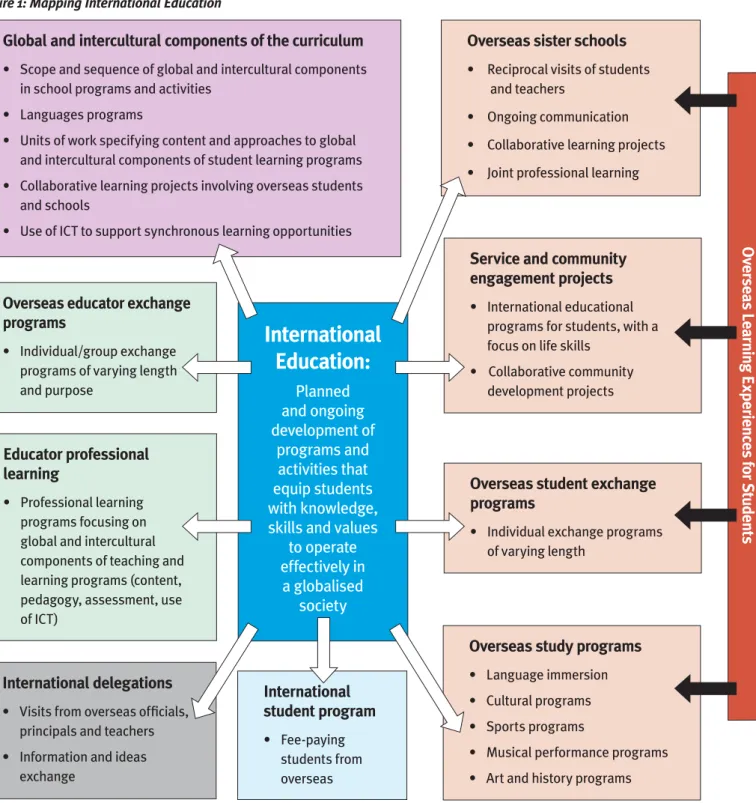
All Victorian students can expect to experience international education programs throughout their formal school years, supported by Victorian and national education policies. These programs take many forms and differ depending on a particular school’s context and priorities. Not all schools will design their international education programs similarly, nor will all schools be doing each of the components sampled in Figure 1 (page 9) simultaneously. However, schools delivering effective international education programs most
often include, or aspire to include, student overseas learning experiences, as shown in the following examples. Rowville Secondary College has mapped school programs and activities that have international and global foci.
Dandenong High School has designed a whole-school strategy designed to embed studies of Asia into school practice. It has developed an Asia literacy values wheel to show how the different elements relate to one another and the rationale for their inclusion in school programs.
Warrnambool Secondary College has mapped its engagement with Asia using the Effective Schools Model.
International Education:
A Whole-school Imperative
A rationale for overseas learning experience: Mary Pendergast, Warrnambool College principal
The following template (Figure 1) gives a map of program activity, which may be helpful for schools implementing an effective whole-school approach to international education.
Mapping International Education
Global and intercultural components of the curriculum
• Scope and sequence of global and intercultural components in school programs and activities• Languages programs
• Units of work specifying content and approaches to global and intercultural components of student learning programs • Collaborative learning projects involving overseas students and schools
• Use of ICT to support synchronous learning opportunities
Overseas sister schools
• Reciprocal visits of students and teachers• Ongoing communication • Collaborative learning projects • Joint professional learning
Service and community
engagement projects
• International educational programs for students, with a focus on life skills
• Collaborative community development projects
International
Education:
Planned
and ongoing
development of
programs and
activities that
equip students
with knowledge,
skills and values
to operate
effectively in
a globalised
society
Overseas student exchange
programs
• Individual exchange programs of varying length
International
student program
• Fee-paying students from overseasOverseas educator exchange
programs
• Individual/group exchange programs of varying length and purpose
International delegations
• Visits from overseas officials, principals and teachers • Information and ideas exchangeEducator professional
learning
• Professional learning programs focusing on global and intercultural components of teaching and learning programs (content, pedagogy, assessment, use of ICT)
Overseas study programs
• Language immersion • Cultural programs • Sports programs• Musical performance programs • Art and history programs
Ov
er
se
as
Le
ar
nin
g E
xp
er
ie
nc
es
fo
r S
tu
de
nt
s
Figure 1: Mapping International Education
Mapping International Education Template
Embedding overseas learning experiences into school programs and practices requires consideration of how current school vision, policies and practices reflect international education. Six key elements underpinning effective international education programs can support this process.
Leadership
School leaders embed international education across school policies, programs and activities.
School Culture
The school is culturally inclusive and encourages, promotes, embeds and sustains international education in policies, programs and activities.
Curriculum
The school implements a curriculum that equips students with the knowledge, skills, understandings and capabilities needed to effectively participate in globalised societies.
Professional Learning
Educators are encouraged to participate in international study programs. Opportunities for sharing experiences, building professional practice and using expertise to develop curriculum resources are provided.
Monitoring and Evaluation
The school monitors and evaluates international education programs and activities across the curriculum.Student, Parent and Community
Involvement
The school community understands, supports and is encouraged to contribute to the school’s international education program.
Overseas learning experiences – part of the curriculum: Tim Bush, Ivanhoe Grammar School teacher
Using the Elements of International Education for School Reflection
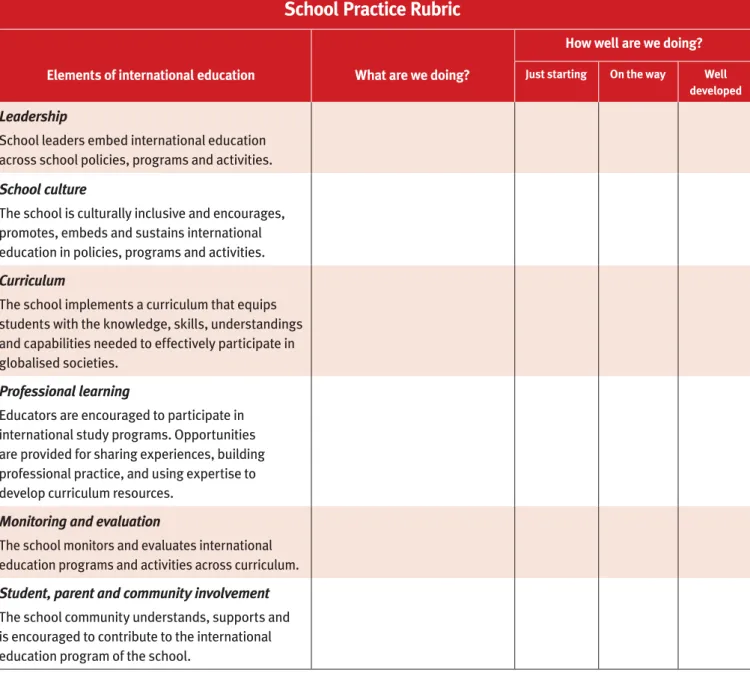
Schools should consider the six key elements of international education as the basis for reflection on the extent to which they are internationalising programs and activities. The school practice rubric in Table 1 may be used for this purpose.
Table 1: International Education: School Practice Rubric
School Practice Rubric
How well are we doing? Elements of international education What are we doing? Just starting On the way Well
developed
Leadership
School leaders embed international education across school policies, programs and activities. School culture
The school is culturally inclusive and encourages, promotes, embeds and sustains international education in policies, programs and activities. Curriculum
The school implements a curriculum that equips students with the knowledge, skills, understandings and capabilities needed to effectively participate in globalised societies.
Professional learning
Educators are encouraged to participate in international study programs. Opportunities are provided for sharing experiences, building professional practice, and using expertise to develop curriculum resources.
Monitoring and evaluation
The school monitors and evaluates international education programs and activities across curriculum. Student, parent and community involvement The school community understands, supports and is encouraged to contribute to the international education program of the school.
School Practice Rubric
Schools conducting successful overseas learning experiences for students recognise that careful planning and preparation are required to ensure the experiences are part of a whole-school approach to international education and that students derive maximum benefit from them.
Three interlinked stages comprise the planning, implementation and follow-up of overseas learning experiences for students:
• pre-departure • in-country
• post-overseas learning experience. Each stage is critically important for ensuring that the overseas learning experience has a significant impact. Thus careful planning for each stage is essential.
School Readiness
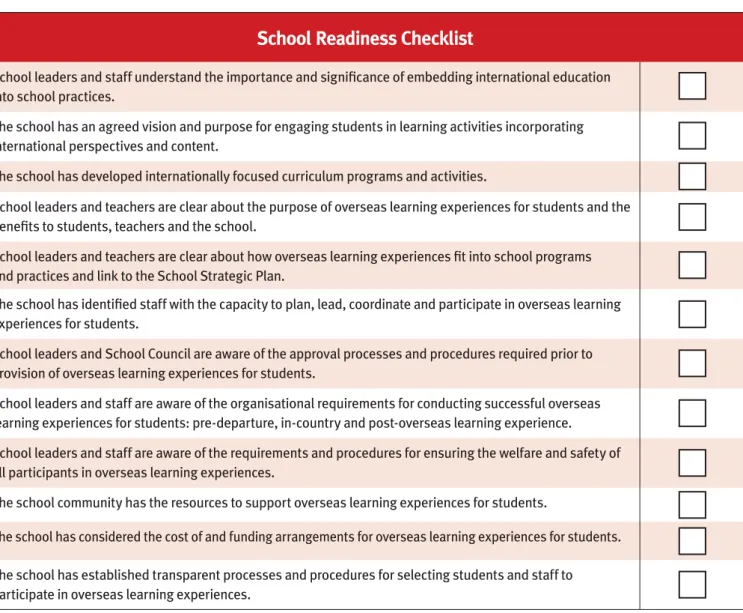
The School Readiness Checklist (Table 2) is designed to assist schools determine if they are ready to embark on overseas learning experiences for students. Before completing it, schools should gather data on their current engagement in international education programs and activities. The ‘Mapping International Education Template’ and ‘School Practice Rubric’ are useful tools for this task.School Readiness Checklist
School leaders and staff understand the importance and significance of embedding international education into school practices.
The school has an agreed vision and purpose for engaging students in learning activities incorporating international perspectives and content.
The school has developed internationally focused curriculum programs and activities.
School leaders and teachers are clear about the purpose of overseas learning experiences for students and the benefits to students, teachers and the school.
School leaders and teachers are clear about how overseas learning experiences fit into school programs and practices and link to the School Strategic Plan.
The school has identified staff with the capacity to plan, lead, coordinate and participate in overseas learning experiences for students.
School leaders and School Council are aware of the approval processes and procedures required prior to provision of overseas learning experiences for students.
School leaders and staff are aware of the organisational requirements for conducting successful overseas learning experiences for students: pre-departure, in-country and post-overseas learning experience.
School leaders and staff are aware of the requirements and procedures for ensuring the welfare and safety of all participants in overseas learning experiences.
The school community has the resources to support overseas learning experiences for students.
The school has considered the cost of and funding arrangements for overseas learning experiences for students. The school has established transparent processes and procedures for selecting students and staff to participate in overseas learning experiences.
Table 2: School Readiness Checklist
Part 2: Planning, Implementation
and Follow-up
School Readiness Checklist
Effective Overseas
Learning
Experiences
Determining that your school is ready to engage with overseas learning experiences for its students is an important step, but it is only a first step. Ensuring that the overseas learning experience is effective in achieving the hoped-for benefits depends on a number of factors:
• clearly stated purpose and aims linked to the School Strategy Plan
• sufficient lead-in and planning time • adherence to a pre-departure, during
and post-overseas learning experience framework
• incorporation of processes and activities designed to enable students to reflect on their experiences and how they can respond to them
• effective engagement strategy with teachers and staff, students, parents, school and broader community • motivated and well-prepared teachers,
students and parents
• embedded in the school’s curriculum • capacity for the in-country experience
to have a multiplier effect in the school community
• accountability to school community.
These factors are addressed in the following sections which deal with the learning and teaching and organisational aspects of the pre-, during and post-experience stages of the overseas learning experience for students.
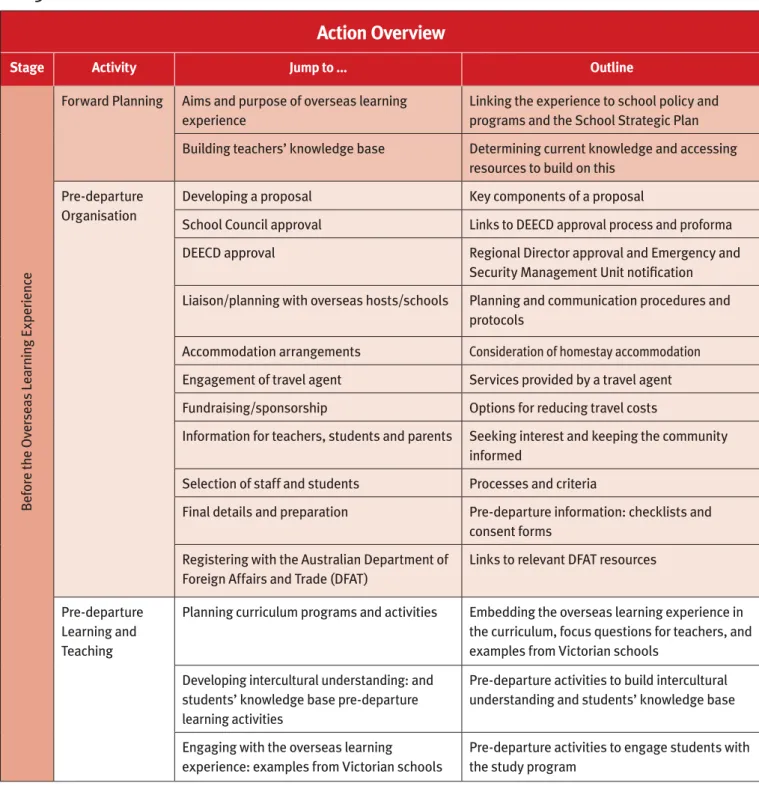
The following action overview (Table 3) covers the curriculum and organisational aspects to be addressed in the planning, implementation and evaluation of overseas learning experiences for students. It is intended as a guide and reference point for schools in the development of the proposal and to assist in planning; recognising that a lead-up time of 12 months will probably be required to ensure successful implementation. Items in the ‘jump to …’ column are hyperlinked to the relevant section in this resource for ready reference.
Action Overview
Stage Activity Jump to … Outline
Forward Planning Aims and purpose of overseas learning experience
Linking the experience to school policy and programs and the School Strategic Plan Building teachers’ knowledge base Determining current knowledge and accessing
resources to build on this Pre-departure
Organisation
Developing a proposal Key components of a proposal
School Council approval Links to DEECD approval process and proforma
DEECD approval Regional Director approval and Emergency and
Security Management Unit notification Liaison/planning with overseas hosts/schools Planning and communication procedures and
protocols
Accommodation arrangements Consideration of homestay accommodation Engagement of travel agent Services provided by a travel agent Fundraising/sponsorship Options for reducing travel costs
Information for teachers, students and parents Seeking interest and keeping the community informed
Selection of staff and students Processes and criteria
Final details and preparation Pre-departure information: checklists and consent forms
Registering with the Australian Department of Foreign Affairs and Trade (DFAT)
Links to relevant DFAT resources
Pre-departure Learning and Teaching
Planning curriculum programs and activities Embedding the overseas learning experience in the curriculum, focus questions for teachers, and examples from Victorian schools
Developing intercultural understanding: and students’ knowledge base pre-departure learning activities
Pre-departure activities to build intercultural understanding and students’ knowledge base
Engaging with the overseas learning experience: examples from Victorian schools
Pre-departure activities to engage students with the study program
B ef or e th e O ve rs ea s Le ar ni ng E xp er ie nc e
Table 3: Action Overview
Stage Activity Jump to … Outline In-country
Organisation
Daily organisation and planning Planning for a satisfying and rewarding experience for all
Engagement Communicating with school and home
In-country Learning and Teaching
Developing intercultural understanding and students’ knowledge base
In-country activities for developing intercultural understanding and students’ knowledge base and reflecting on the experience
Personal reflection: graphic organisers Alternative ways for participants to record their experiences
Curriculum programs and activities In-country activities planned or commenced prior to departure
Post-experience Learning and Teaching
Developing intercultural understanding and students’ knowledge base
Activities to enable students to reflect on intercultural experiences and their knowledge base and revisit pre-departure expectations Incorporation into school programs Students returning from overseas share their
learning with classmates (and in-country partners)
Sharing the Experience
Sharing information and key learning Sharing the experience with the school community
Professional learning for educators Building wider educator awareness of the overseas learning experience and its place in the school curriculum
Maintaining partnerships Encouraging relationships with international partners to grow
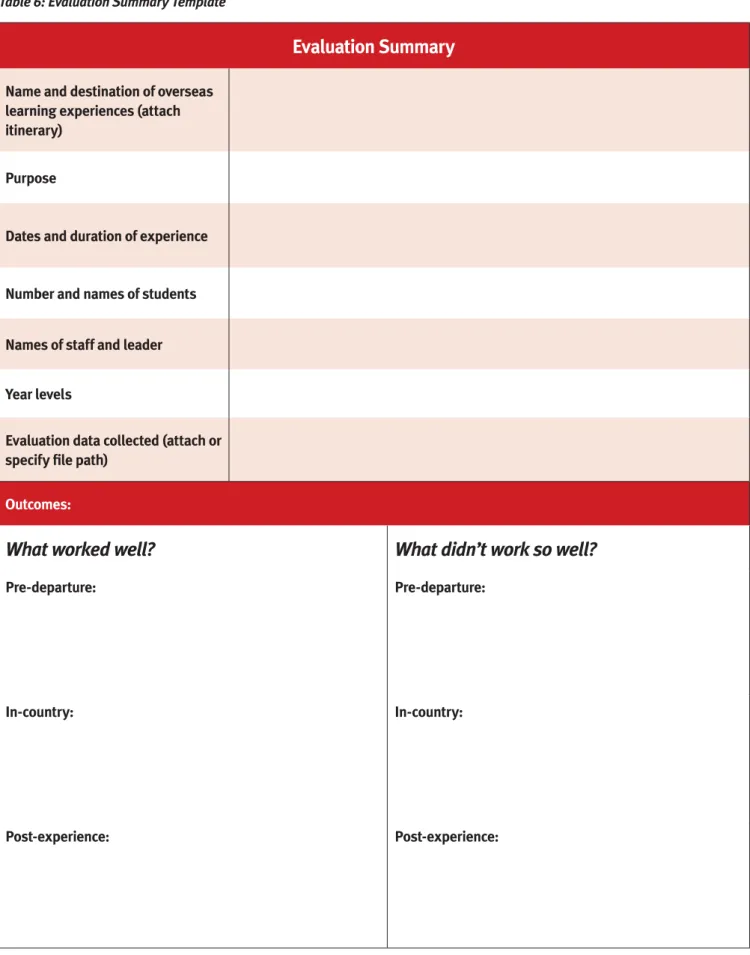
Reflecting on and Evaluating the Experience
Reflection and evaluation Choosing appropriate ways to reflect on, evaluate and report on overseas learning experiences D ur in g th e O ve rs ea s Le ar ni ng Ex pe ri en ce Af te r t he O ve rs ea s Le ar ni ng E xp er ie nc e
Forward Planning
This stage involves curriculum planning and organisational arrangements. In practice these activities will overlap and occur simultaneously. Schools indicate that effective planning and organisation requires around 12 months. During this stage engagement occurs with School Council, staff, students, parents and DEECD. If this engagement is to be effective, it is vital that the staff members proposing an overseas learning experience understand how the program fits into the School Strategic Plan. They should also have a thorough understanding of the planning required to ensure their knowledge base is sufficient to lead an overseas learning experience.
Aims and Purpose of Overseas
Learning Experience
Clarity about the aims, purpose and target group of students for the overseas learning experience is important for gaining in-principle School Council support and for generating essential information for staff, students and parents.
The following examples show how some schools in Victoria have demonstrated effective engagement strategies regarding their international education programs and overseas learning experiences.
• In its Vision and Values statement, Balwyn High School includes ‘an international perspective’ and ‘responsible global citizenship’ among the skills, attributes, knowledge and personal qualities it nurtures in its students.
•
• An exchange program with Phuoc Tien Primary School in Nha Trang, Vietnam is one aspect of Footscray Primary School’s commitment to international education.
• Rowville Secondary College states the goals and activities of its sister school program on its website.
Building Teachers’ Knowledge Base
Teachers must be clear aboutand comfortable with the roles, responsibilities and accountabilities associated with taking groups of students overseas.
The nature and extent of teachers’ personal and professional knowledge and understandings required for the overseas learning experience will depend on the specific aims and purpose of the experience.
In preparing themselves for the experience, teachers require:
• an understanding of cultural, belief and language issues and practices related to the places to be visited • knowledge of the histories,
geography, society, arts, literature and languages of the destination.
They can draw on:
• prior personal travel experiences • other staff members’ knowledge • experiences of other schools • school, parent and community
resources
• links with organisations (for example the Asia Education Foundation, Goethe-Institut, subject associations) • guidebooks, travel websites and
online forums
• embassies and consulates.
A well-developed knowledge base of the places to be visited is not only important for the teachers, but for communicating with students and parents and for developing teaching and learning activities for students.
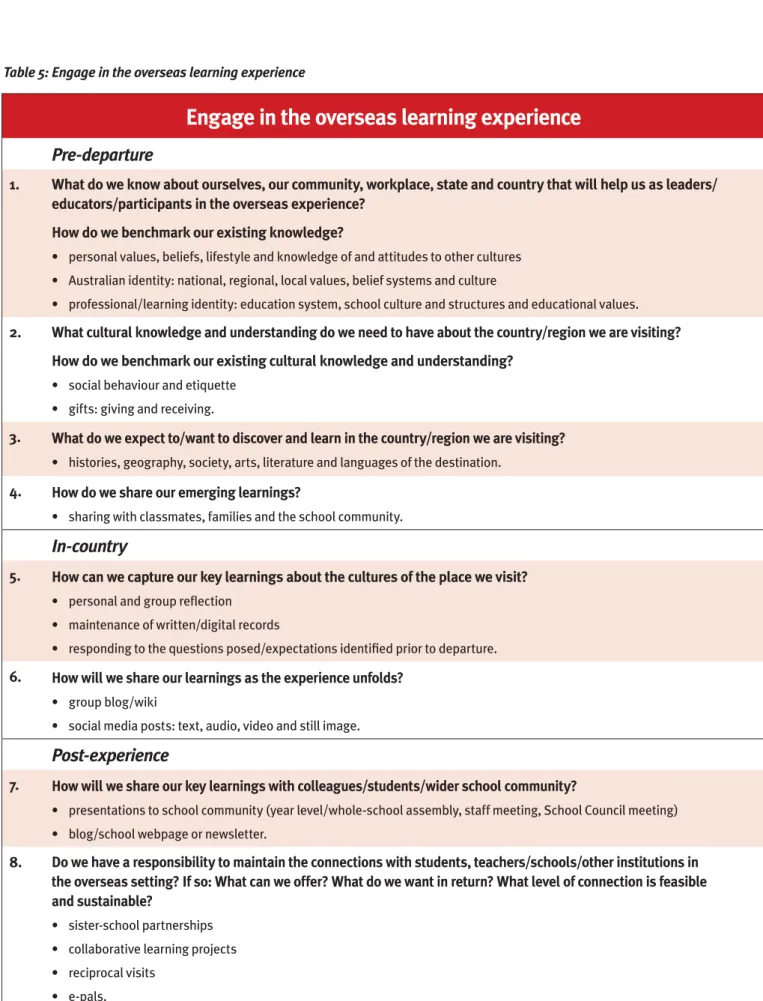
Completing the ‘Engage in the Overseas Learning Experience’ reflection
activity (see Table 5) in the forward planning phase of the overseas learning experience will help teachers to direct their planning so that the existing knowledge base is accessed, the experience meets the needs and expectations of the participants, and participant learning is captured and shared. It is important to remember that ‘participants’ in an overseas learning experience refer to both students and teachers/leaders.
It is important to benchmark participants’ existing knowledge, cultural
understanding and attitudes at a very early stage of pre-departure planning, so that the impact of the overseas learning experience can be quantified. One way that data can be collected is to conduct pre- and post-experience surveys. The DEECD 2011 Field Trials of Overseas Learning Program Student and Teacher Surveys could be used as a model for schools to adapt to their own circumstances as a pre-departure survey. Asking participants to complete the survey again after returning to Australia enables the school to gauge the impact of the overseas experience.
Before the Overseas Learning Experience
Pre-departure Teacher Survey Pre-departure Student Survey
Engage in the overseas learning experience
Pre-departure
1. What do we know about ourselves, our community, workplace, state and country that will help us as leaders/ educators/participants in the overseas experience?
How do we benchmark our existing knowledge?
• personal values, beliefs, lifestyle and knowledge of and attitudes to other cultures • Australian identity: national, regional, local values, belief systems and culture
• professional/learning identity: education system, school culture and structures and educational values. 2. What cultural knowledge and understanding do we need to have about the country/region we are visiting?
How do we benchmark our existing cultural knowledge and understanding? • social behaviour and etiquette
• gifts: giving and receiving.
3. What do we expect to/want to discover and learn in the country/region we are visiting? • histories, geography, society, arts, literature and languages of the destination.
4. How do we share our emerging learnings?
• sharing with classmates, families and the school community.
In-country
5. How can we capture our key learnings about the cultures of the place we visit? • personal and group reflection
• maintenance of written/digital records
• responding to the questions posed/expectations identified prior to departure. 6. How will we share our learnings as the experience unfolds?
• group blog/wiki
• social media posts: text, audio, video and still image.
Post-experience
7. How will we share our key learnings with colleagues/students/wider school community?
• presentations to school community (year level/whole-school assembly, staff meeting, School Council meeting) • blog/school webpage or newsletter.
8. Do we have a responsibility to maintain the connections with students, teachers/schools/other institutions in the overseas setting? If so: What can we offer? What do we want in return? What level of connection is feasible and sustainable?
• sister-school partnerships • collaborative learning projects • reciprocal visits
• e-pals.
Table 5: Engage in the overseas learning experience
Engage in
Overseas Learning template
Schools must invest significant time and effort in planning and organising overseas learning experiences for students. Duty-of-care issues, regulatory requirements and behaviour expectations should be understood by all participants. Clearly defined itineraries and travel and accommodation arrangements are also necessary components of the planning process.
Knowledge and understanding of DEECD regulations and compliance requirements are essential to this planning process. Relevant requirements can be found in the Safety, Emergency and Risk Management and Student Safety sections of DEECD’s School Policy and Advisory Guide. Development of a detailed proposal for the overseas learning experience is a key step in the planning process. Proposals provide school leaders and School Council with information upon which to base approval. They also pave the way for effective engagement with staff, students and parents.
Developing a Proposal
Mapping international educationprograms and activities across the school and using the School Practice Rubric and School Readiness Checklist will enable a school to identify its existing knowledge base and areas of engagement and to determine future directions. This process should inform the aims and purpose of a proposed overseas learning experience. The proposal should also reflect the school’s Strategic Plan, policies and curriculum. Development of the proposal for the overseas learning experience is at the heart of the pre-departure stage of implementation. It should draw together the initial preparation, curriculum planning and organisational aspects of the experience.
Proposals for the consideration and approval of the principal and School Council should cover:
• purpose and intended outcomes • links to school vision, policies and
Strategic Plan
• links to curriculum programs and school activities
• person in charge
• destination, dates, duration • year level(s)
• student safety and risk-management processes and procedures
• travel, insurance and accommodation arrangements
• costs, sources of funds and fundraising • process for selecting students and
staff
• processes for communicating with students and parents
• outline of pre-, during and post- overseas experience requirements, activities and communication procedures
• key contact persons/organisations for travel and in-country experiences and activities.
School Council Approval
All overseas travel must be approved by the School Council. The DEECD website provides information concerning the approval process. The approval proforma for all excursions and activities requiring School Council approval can also be downloaded.
DEECD advises that these forms: have been developed in view of legal advice received by the Department to ensure that schools’ legal obligations with regard to the duty of care towards students are met. Schools should not undertake substantive modifications to the wording or remove questions contained in these forms, without the prior approval of the Department’s legal branch.
DEECD Approval
Following approval by School Council, the school is required to submit the proposal to the Regional Director for approval. Relevant details about approved excursions must be provided to the Department’s Emergency and Security Management Unit using the online notification form (username PIN and password required).
This notification must be provided at least three weeks prior to the overseas learning experience.
Liaison and Planning with Overseas
Hosts/Schools
In many instances, development of the overseas learning experience proposal will require close liaison with hosts/ schools and key persons/organisations in the country/places to be visited. In these cases, the establishment of planning and communication procedures and protocols will be necessary.
Accommodation Arrangements
An important consideration in planning overseas learning experiences is whether or not a homestay will be included. Homestays provide students with significant opportunities for deepening intercultural understanding and appreciation of the similarities and differences between cultures. Including ahomestay provides more exposure to the language of the host country and may also reduce the overall accommodation costs.
The age of participating students, their welfare, the potential benefits to students and the views of parents are important considerations for deciding whether homestay accommodation is appropriate. Schools should also ensure that the vetting process for homestay families is adequate and that processes for dealing with homestay problems are in place beforehand.
Feedback from schools is that the homestay is often one of the most significant aspects of an overseas learning experience and it is strongly recommended that a homestay component be included where possible.
Engagement of Travel Agent
The choice of a reputable, licensed travel agent is an important decision for the school. Negotiations with travel agents will involve:
• planning of the travel itinerary and travel arrangements
• preparing travel and insurance information and requirements for students, parents and the school • costing of the overseas learning
experience.
Fundraising/Sponsorship
Once the costs have been established schools may choose to undertake fundraising or seek sponsorship to subsidise the experience for students whose parents/guardians cannot afford to pay the full cost.
Information for Teachers, Students
and Parents
In the early stages of planning, expressions of interest from students (parents) and teachers can be sought in order to gauge the viability of the overseas learning experience. In doing this, the key organiser should consider whose interest is to be sought, how information can be effectively disseminated to interested parties and what information they need to make informed decisions about their level of interest.
Partnerships with overseas institutions – Chris Rodier, Rowville Secondary College International Programs Coordinator and Linda Flynn, Mount Clear College principal
Developing intercultural understanding through homestays – principal and teacher perspectives: Linda Flynn, Mount Clear College principal, and Emma Risby Warrnambool College teacher
Example of preliminary information for parents: cover letter, expression of interest form and itinerary Pre-departure preparations – fundraising: Joanne Johnson, Rowville Secondary College teacher
Pre-departure preparations – keeping parents informed: Deborah Harman, Balwyn High School principal
Selection processes for staff and students should be transparent and include an application process, short-listing and interviews conducted by a selection panel.
Prior to the selection process, staff, students and parents should be provided with an outline of the overseas learning experience, its aims and purposes, the process and criteria for selection and the commitments required.
Staff should be informed of their responsibilities before they apply to participate in the overseas learning experience. They should have a clear understanding of:
• the nature and aims of the overseas learning experience and its place within the school curriculum • their duty-of-care responsibilities • additional responsibilities, which may
include:
o participating in student selection
o planning and implementation of overseas learning/research projects o liaising between homestay families and the students’ families
o representing the school at official functions
o understanding and managing the medical requirements of students o guest teaching in the host school o post-experience activities and follow-ups (e.g. changes to curriculum and sister-school relationships developed), presentations and professional learning activities for colleagues and other audiences.
Schools must ensure that accompanying adults who are not registered teachers have completed a Working with Children Check .
Suggested criteria for selection of staff • understanding of the nature and
purpose of the overseas learning experience and its place within the school’s curriculum and links to the School Strategic Plan
• high-level communication and social skills and relevant language skills • personal and professional qualities
enabling them to be ambassadors for the school, Victorian education
• first-aid training
• high-level planning and organisational skills
• ability to liaise and negotiate with key personnel in the overseas setting • appropriate qualifications for specific
outdoor activities that may be included in the experience.
Suggested criteria for selection of students
• capacity to be ambassadors for their school, community and country • capacity to work effectively in a team • good communication and social skills • ability to undertake and maintain
engagement in learning activities/ research projects prior to, during and after the overseas learning experience. Consideration should also be given to identifying students who might benefit most from the overseas learning experience; for example, students at risk of disengagement.
Once students and staff have been selected, schools should provide an immediate opportunity for parents and students to meet with all staff who will be travelling with the group.
Final details and preparation
In the weeks prior to travelling overseas it is important to attend to finalorganisational matters including: • setting expectations for students and
staff
• allocating responsibilities
• ensuring the relevant consent forms have been completed and lodged by parents
• ensuring that student and staff medical information forms have been completed and lodged
• confirming travel and personal insurance arrangements • establishing codes of conduct/
participation agreements • briefing participants on
o clothing and toiletry requirements o travel and luggage requirements o money and gift arrangements o resources/stationery items to be taken
o communication with school/home: telephone and internet access o establishing mechanisms for capturing learning while overseas (including high-quality photographs and video records). It is essential that staff meet with participating students regularly prior to departure. Knowing the students — their hopes, expectations, current knowledge base, anxieties, feelings, anticipated learning – is a pre-condition for ensuring that opportunities for learning are maximised. To prepare students for the intercultural challenges, see p 24.
Pre-departure Information and
Sample Forms
The following downloadable examples of pre-departure information and
sample forms/record sheets have been assembled following visits to schools and conversations with principals and teachers.
These documents should be regarded as examples only and could be used to assist the design of school-specific information notices and forms. The nature and purpose of overseas learning experiences will determine the content and detail of documents prepared by individual schools.
Registering with DFAT
Schools must register their overseas travel plans with the Department of Foreign Affairs and Trade (DFAT). This enables DFAT to respond to travellers’ needs more quickly should dangerous or exceptional circumstances arise. Before travelling overseas, schools should check the Smartraveller website, the Australian Government’s travel advisory and consular assistance service. This site provides up-to-date government travel advice for all countries as well as useful travel information and tips.
Pre-departure information for students Pre-departure checklist Participant information forms Sample code of conduct Permission for photographing/ filming students
Planning Curriculum Programs and
Activities
Embedding the overseas learning experience into the school’s curriculum programs will assist in maximising learning outcomes for students. Curriculum plans that include pre-departure, in-country and post-overseas experience learning sequences and activities represent the most effective way to achieve this. Ideally, curriculum programs and activities should be inclusive of all students. They should also refer specifically to the overseas learning experience and the range of activities intended for participating students. All students should be engaged in activities designed to:
• determine their current levels of knowledge, understanding and cultural awareness of the places to be visited
• pose questions that can be used as the basis for research and inquiry related to the overseas learning experience.
Posing research and inquiry questions to the whole group, not just those students who will go overseas, helps to embed the experience into the curriculum and will give participating students the opportunity to provide focused reports to students while overseas and on return.
Developing Intercultural
Understanding: Pre-departure
Learning Activities
The development of intercultural understanding is a general capability of the Australian Curriculum:
In the Australian Curriculum students develop intercultural understanding as they learn to understand themselves in relation to others. This involves students valuing their own cultures and beliefs and those of others, and
engaging with people of diverse cultures in ways that recognise commonalities and differences, create connections and cultivate respect between people.
Australian Curriculum: Intercultural Understanding
Many schools prepare a range of pre-departure material for teachers, students and parents that includes information on the customs and cultures of the countries they intend to visit. These ‘what to expect’ documents provide a quick overview to guide culturally appropriate behaviour in-country and to avoid offence and ensure respect. It is important, however, that preparation goes beyond a list of cultural ‘do’s and don’ts’, as such a list can inadvertently ‘blind’ students to anything outside the listed set of expectations.
Behaviour can be ambiguous in that the same action may have different meanings in different situations and no-one can be armed with information for every contingency. Instead, students need to first understand the assumptions and values that guide their own cultural behaviour. This can then be compared with what is found in the ‘other’ culture. Essentially, students need to understand their own cultural drivers in order to build their intercultural understanding through overseas learning experiences.
The following activities are designed using these concepts and reinforcing the need to assume difference instead of similarity when working across cultures. These activities could be incorporated into general classroom learning or could be part of a planned pre-departure briefing program. The activities will help teachers find out what students already Student engagement in
overseas learning: Ben, Ballarat South Community Learning Precinct student
Pre-departure Learning and Teaching
“
In a pre-trip survey,
59 per cent of
students said
they had already
changed their
impressions of the
destination country,
primarily through
pre-trip research,
information
provided by
teaching staff and
‘Googling’ with
their families.
Knowing that they
would be going
there stimulated a
desire to know and
understand that
would not have
been generated by
a normal curriculum
approach.
”
DEECD Overseas Study
Program Field Trials
Evaluation Report
(2009: p 10)
know and what they expect and will provide a reference point to build on in-country and revisit on return to Australia.
Cultural Comfort Zone
Students identify their cultural learning zone and understand the difference between this zone and their cultural comfort zone on one hand and their panic zone on the other.
Pictures of Perception
Students recognise that ‘typical’ images are often stereotypes. This activity is particularly useful as a preparation for a post-experience reflection on their own changed perceptions.
Origins of Culture
Familiar topics, such as food, clothing and the physical environment, are used to alert students to the role of culture in everyday life and how it is represented. This activity can be used as a stimulus for an in-country investigation.
Planning for
In-country Learning
Developing Curriculum Programs
and Activities: Focus Questions for
Teachers
• What do my students already know about the country they are visiting? • What do my students want to find out
about the country they are visiting? • What are the key focus areas/inquiry
questions I want students to engage in as part of their overseas learning
experience?
• What pre-departure, in-country and post-experience activities should be included to support learning and reflection?
• What resources can I use to support the overseas learning experience? • What Web 2.0 tools could students
use to investigate and collaborate with students in the sister school (if applicable)?
• How will I support students’ learning throughout the overseas learning experience?
• How will I evaluate and assess the learning activities?
Examples of Curriculum Plans
Depending on the nature and purpose of the overseas learning experience, it would be mutually beneficial where there is an overseas sister school to plan the in-country learning activities in collaboration with the host school.Connections 2010 Classroom
Project
Twenty Year 9 students and four teachers from Balwyn High School and Glen Waverley Secondary College participated in the Victorian Government’s
Connections 2010 classroom project at the World Expo in Shanghai. Over a six-day period students were engaged in a sequence of contemporary, inquiry-based learning activities related to the expo’s theme: ‘Better City, Better Life’. The students’ research question was ‘Can cities make for better lives?’. Undertaking the unit of work in an overseas setting enabled students to engage in comparative studies and to draw on resources available through the expo. The unit of work was developed Teacher instructions
for pre-departure learning activities
in the context of the Victorian Essential Learning Standards (VELS) and the e5 instructional model. Its intended learning outcomes were:
• Students will be able to demonstrate understanding of factors that contribute to urbanisation and the effects of urbanisation on people and the environment.
• Students will be able to explain and evaluate a range of approaches cities are undertaking in order to improve overall living standards.
The intended skills outcomes of the inquiry were:
• Students will be able to effectively select and use a range of learning technologies to visualise thinking, create and communicate.
• Students will be able to explore, practise and reflect on effective personal and collaborative learning strategies.
Inquiry-based Project: Anzac
Commemoration Service in France
Students from five government schools in Southern Metropolitan Region travelled to France in 2011 as part of a DEECD-funded overseas learning experience, which included attending an Anzac day dawn service in Villers-Bretonneux, France. To enhance their understanding of the experience, students undertook inquiry-based projects that drew on ideas from various key learning areas. The projects were developed using an Understanding by Design Framework:Stage 1: identifies desired results Stage 2: identifies assessment evidence Stage 3: outlines a learning plan. Students undertook their projects with reference to a concept map identifying the links between their research question and various VELS strands, domains and dimensions.
A Teaching and Learning Framework
for a Malaysian Learning Experience
Teachers from Colac Secondary College, supported by the regional LOTE consultant, developed a teaching and learning framework for a Malaysian overseas learning experience in July 2011. The framework sets out the learning objectives for different domains within the curriculum, the learning activities to be undertaken in Australia and Malaysia, and the ways in which students can publish and share their learning on return.A teaching and learning framework for a Malaysian learning experience
Anzac project design
Anzac project concept map
Connections 2010 Classroom Project: Can cities make for better lives?
Engaging with the Overseas
Learning Experience: Examples
from Victorian Schools
For many students, the overseas learning experience will be the first time away from Australia. Even for those who have travelled, a planned approach to engaging students with the overseas learning experience is vital to ensure that they understand the purpose of the study program and can make the most of the opportunities it offers.
In many instances, schools have tapped internal and community resources (staff, students and parents who have travelled overseas; and teachers of language, history, geography, economics and politics) to assist in the preparation of students prior to departure. In some schools, parents have participated with their children in these activities.
Footscray Primary School:
Pre-departure Language Lessons
Chau Cong, teacher at Footscray Primary School’s Vietnamese Bilingual Program, conducts weekly lessons for participating students prior to their visit to the sister school in Nha Trang. Parents are also invited to participate. Emphasis is placed on language use in situations likely to be experienced and audio and text resources are provided to help students (and their parents) practise at home.Mount Clear College: Pre-departure
Learning Activities
Prior to their visit to Gallipoli in 2009, students from Mount Clear College participated in an Art Competition with the theme of ‘Peace and Friendship’. Students at Mount Clear College’s sister school, Gallipoli Anatolian High School in Turkey, also participated in the competition. Prizes were awarded on Anzac Day.
Hampton Park Secondary College:
Overseas Learning Experience
Booklet
Staff from Hampton Park Secondary College, accompanying students from five schools on a trip to France, designed a booklet for students to refer to before and during their overseas learning experience and to keep as a memento of it. The booklet contained (among other things) travel tips, itinerary, language activities and space for journal writing.
Pre-departure learning: Deborah Harman, Balwyn High School principal
The nature and purpose of the overseas learning experience will impact on the teaching and learning, organisational and engagement components of the in-country learning experience for students. Individual student exchange programs will differ from language and cultural study programs, as will sporting programs and visits to, and activities undertaken with, sister schools.
In-country Organisation
Forward planning and organisation in conjunction with hosts, tour operators and guides will assist in making the experience a satisfying and rewarding one for students and staff.At all times, it is important to place priority on the safety and physical and emotional welfare of all students. Staff are required to ensure that all necessary duty-of-care arrangements and
procedures are in place and activated when necessary.
Daily Organisation and Planning
Continuing attention should be directed to:• awareness of risks and procedures for managing them
• protocols and etiquette required for specific occasions
• adherence to agreed codes of conduct • sharing of responsibilities
• accommodation and travel arrangements
• monitoring of student and staff wellbeing
• personal and recreational time for staff and students
• oversight of money and gifts • security for personal items and
documents.
Tour operators and in-country guides will be useful sources of information and assistance in many instances.
Communication
Organising times for contact with school and family will require consideration before embarking on the overseas learning experience, particularly in the case of significant time differences. School Contact
During the in-country experience it may be appropriate to use mobile telephone and other technologies to provide updates and progress reports to school leaders and staff at the home school. Students can be encouraged to prepare brief reports of their experiences and to send initial responses to questions posed pre-departure via blogs and wikis. They also could be encouraged and supported to provide written and photographic ‘snapshots’ of the experience for inclusion in newsletters and on the school’s website.
Home Contact
It is important that schools develop policies and protocols related to contact with home and that these are discussed with parents and students prior to the overseas learning experience. It may be appropriate for students, particularly primary school students, to be able to contact parents/guardians at times agreed and specified prior to departure. The cost of telephone contact may be prohibitive and therefore text messaging, email and networking technologies may be more viable options.
In-country Learning and
Teaching
There will be many unintended learning outcomes for students as they encounter experiences that take them outside their existing frames of knowledge, understandings and attitudes. Capturing this new learning, for example via photographs, video, daily journal writing, blog and phone messaging, is an important aspect of the overseas learning experience. Notwithstanding this, it is important that there are structured learning activities that link with the school’s curriculum and that enable the students to engage with the world around them.
Developing Intercultural
Understanding: In-country Learning
Activities
Activities that build students’ intercultural understanding by first helping them to recognise their own cultural drivers were
introduced in the Pre-departure Learning and Teaching section. The following activities are based on this principle. Daily Bread
Students play cultural detective – using interviews and observation to examine a narrowly defined activity (in this case, how people eat breakfast). This activity encourages students to test their assumptions about similarity while developing their research skills.
Look Who’s Talking
Students observe different elements of non-verbal behaviour and use prompts to examine the nuances of the observed behaviours in more depth.
School’s Out
Like the Daily Bread activity, students play cultural detective, but this time they investigate a familiar cultural scene, such as a school or a shopping centre, and use ethnographic techniques to concentrate on observation and resist the temptation to jump to conclusions. (Ethnography can be broadly defined as a method of social research committed to studying the cultural patterns, shared beliefs and behaviours of others in their natural setting.) The data collected in the School’s Out activity may be used for in-country group reflection or shared with classmates in Australia in the School’s Back In post-experience intercultural understanding activity.
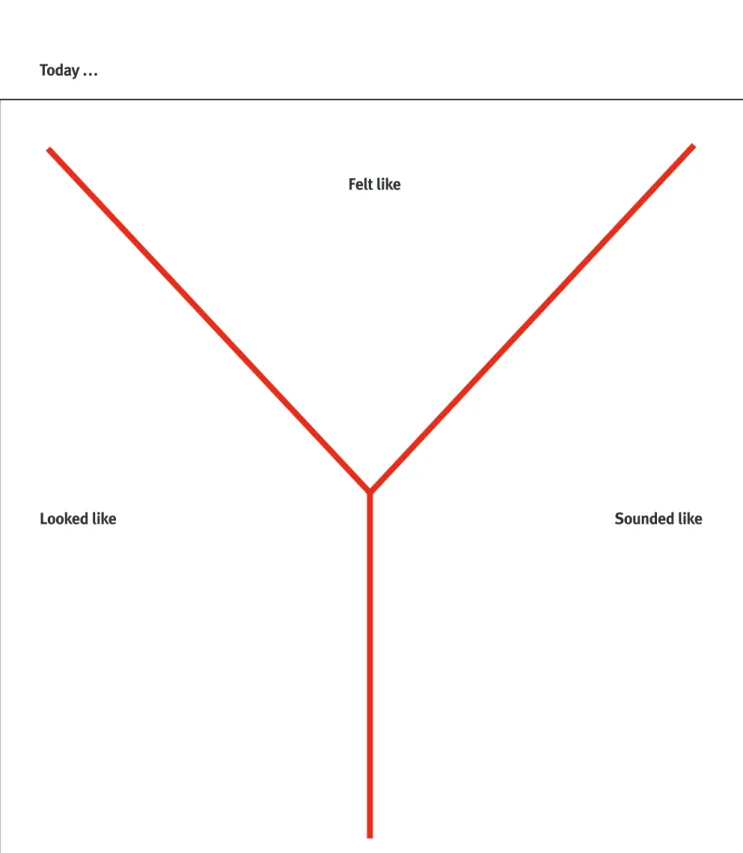
Personal Reflection: Graphic
Organisers
Taking time to reflect on the travel experience during the experience itself provides a valuable record for the traveller. However, trying to convey
experiences in written form can be overwhelming. Using graphic organisers as prompts for jotting down immediate reactions is one way to make a record of observations and reactions for later reflection.
Curriculum Programs and Activities
Curriculum programs developed and commenced prior to the in-country experience can be further implemented as the experience unfolds for students. Students can be engaged in activities that build on and flow from the pre-departure learning activities. Such activities, depending on the nature of the experience, enable students to:• reflect on and process their new experiences
• undertake research/inquiry-based projects
• pursue questions posed prior to the overseas experience and to frame responses ready for reporting on return • develop communication skills in
the context of maintaining records, planning and preparing reports and presentations in-country and on return • develop team and leadership skills in
the context of maintaining records, planning and preparing reports and presentations in-country and on return • develop skills related to the use of a
language other than English
• use technology to reflect, capture and present learning.
In some instances, joint learning projects and activities with students in the host-school may be possible with teachers working collaboratively to plan and implement such activities.
Teacher instructions for in-country learning activities Using technology to stay in
touch: Chau Cong, Footscray Primary School teacher
Sample graphic organisers
On their return, students and teachers will have a rich store of knowledge and new understandings that can be shared with fellow students, colleagues, parents and friends, and members of the wider community. They will also become sources of information and resources to be incorporated into the school’s teaching and learning programs.
Post-experience Learning
and Teaching
Developing Intercultural
Understanding: Post-experience
Learning Activities
The process of developing intercultural understanding does not stop once participants return from their overseas learning experience. On the contrary, the sensory overload of overseas travel can make it difficult to maintain perspective. Consequently, it is vital that time is given upon return to reflect on and discuss
observations and possible meanings of those observations.
The Pictures of Perception activity outlined in the Pre-departure Learning and Teaching section is designed specifically as a ‘pre- and post-’ activity. Other activities described in the Pre-departure and In-country Learning and Teaching sections can also be revisited after returning from the overseas learning experience.
Incorporation into School Programs
Students returning from overseas can prepare and deliver individual and team reports for whole classes. Doing so will not only enable students to process their direct experience of other countries and cultures, but also help them to organise their thinking and to decide onthe most appropriate ways in which to communicate their findings and new learning. Where these are aligned to the planned curriculum programs they will be more likely to have an impact on other students.
Many schools have promoted and encouraged the use of various media (including print, video, podcasts, audio-visual presentations and web pages) for this purpose in an inquiry-based learning framework. Use of the Ultranet will facilitate access by students and staff to the resources thus created. In the case of student exchange programs and visits to sister schools/host schools, reporting back to the hosts regarding the value of the experience is a powerful learning activity for students. A reciprocal arrangement is even more powerful and enhances international and intercultural relationships.
Teacher instructions for post-experience learning activities