CHALLENGES IN MINIMISING ENERGY CONSUMPTION
FOR WIRELESS SENSOR NETWORKS
1SUDHEER PEMBUSANI, 2ABHISHEK GUDIPALLI, 3SARAVANAN MAHADEVAN
1 Sreenivasa Institute of Technology and Management Studies, Chittoor, Andhra Pradesh, India. 2 School of Electrical Engineering, VIT University, Vellore – 632014, India.
3 Sree Vidyanikethan Engineering College, Tirupati – 517507, India
E-mail: [email protected], [email protected], [email protected]
ABSTRACT
Wireless sensor networks is one of the active research area now a days due to its vast applications in different fields such as defence , civilian and medical fields. One of the basic challenges in the design of Wireless Sensor Network (WSN) is maximizing their lifetime because of the sensors placement in remote places which is having batteries as power sources. To extend the WSN lifetime, energy management is the most important and critical aspect, for that we need different techniques in different aspects of WSN. This paper presents some methods which will be useful to minimize energy consumption in sensor networks and to increase lifetime of the WSN. Sensor nodes are using batteries as their power sources, effective and efficient utilization of these power sources is essential in order to use sensor networks for longer period hence it is required to reduce data transfer rate inside sensor networks, reduce amount of data that required to send to base station. For this, data aggregation methods are useful for aggregating data in an effective energy efficient manner so that network lifetime will enhance. In most applications once WSN deployed, it should continue to work for a long period of time, without the maintenance of the nodes and the replacement of their energy sources. Each sensor node in the network consumes power in different stages like sensing data, processing data and transmitting/receiving. In all stages minimizing energy consumption is required. Therefore routing protocols designed which should minimize power consumption in every stage of WSN because of its effective function.
Keywords: Wireless Sensor Networks, Data Aggregation, Routing Protocols, ESPDA Protocol, Energy Consumption
1. INTRODUCTION
Sensor is a device which senses and converts one form of energy into another form like mechanical, electrical or any other form. Sensor network is a combination of same or different sensors. Wireless sensor network is one type of network which is having number of sensors to sense the physical information and transfers that to the different locations by using network. In advanced wireless networks, sensors works in both direction to get the data.
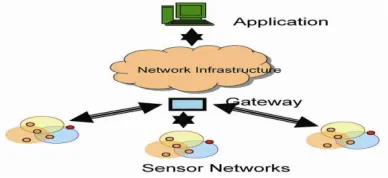
Wireless Sensor networks are a network of Sensor nodes ranging from single to many that is upto thousands and each node is connected to more number of sensors as shown in Figure 1. The base stations are having number of components of the Wireless Sensor Network (WSN) with more computational, and communication resources. This stations acts like a gateway between sensory nodes and the user.
[image:1.612.327.521.551.640.2]They typically forward data from the WSN to a server as shown in Figure 2.another special and attractive components in routing base networks are routers, which are designed to compute, and distribute the routing tables.
Figure 2: Communication Between Sensor Node And Server
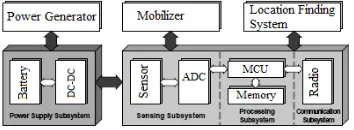
Sensor nodes are like small computers and it basically, consists of three components, as mentioned in Figure 3 namely; a sensing section, a processing section and a communication section [2]. The sensing system is commonly used for physical data acquisition from the environment. To process the local information and to store that we use the processing unit. Data transmission is performed by wireless communication system. In addition to this, a power supply unit is very much essential for providing energy to perform every task.
In WSNs we are using batteries to drive the systems, but it has energy limitation [3]. It is difficult to recharge battery if the nodes are deployed in remote areas. In some cases, the wireless sensor network requires longer lifetime to fulfil the different applications. So it is must to extend the network lifetime. This can be achieving by minimizing energy consumption in every stage WSN. The energy consumption of the sensing system mainly depends on the type of sensor using. In most of the cases energy consumption for sensing system is almost negligible with respect to that of processing system. It mainly depends upon the communication subsystems. So the energy conservation techniques mainly focus on the sensing system and the communication system.
Figure 3: Functional Diagram Of Sensor Node
2. DATA AGGREGATION
Power sources for sensor nodes are batteries, an efficient utilization of power sources is essential in order to use networks for longer
duration hence it is needed to minimize data transfer inside sensor networks and also reduce amount of data that need to transfer to base station. By using data aggregation algorithms we can aggregate data in an energy efficient manner and we can enhance network lifetime. Data aggregation algorithms receives the information from the sensor node and then aggregates that data by adopting appropriate aggregation algorithms such as centralized algorithm, Low Energy Adaptive Clustering Hierarchy (LEACH)technique, Tiny Aggregation (TAG) technique etc. By selecting the efficient path the aggregated data is transfer to the sink node.
2.1 Energy efficient data aggregation methods
Because of diverse applications, the reporting for wireless sensor networks are different which includes periodical reporting, reporting by query, and event driven reporting. Classification of data aggregation protocols are two types, that is structured and structure-free [17].
2.1.1 Structure based methods 2.1.1.1 Clustering method in WSN
It is a process of grouping sensor nodes in a sensor network is known as clustering. The energy efficient way of combining and compressing the information belonging to a single cluster is known as data aggregation in cluster based environment. There are some important issues involves with this clustering process in a wireless sensor Network. First issue- To optimize the performance how many clusters should be form. Second issue- How many nodes required for a single cluster. Third issue - Selecting cluster-head in a cluster. Last issue is that putting more powerful nodes in terms of energy as cluster head, and remaining nodes which is having less energy as cluster members in the network. In this method whole sensor network is divided in to number of different clusters. Each cluster has its own powerful cluster-head which is selected among that cluster members. The main role of cluster heads is aggregation which aggregates the information received from cluster members in its area and then transmits that result to sink or gateway [4]. 2.1.1.2 Centralized method
data packets to a leader node, which is the powerful node that is cluster head. The leader node aggregates the information received from different member nodes .Every intermediate node sends the data packets addressed to leader node from the child nodes. So a large number of messages transmitted for a query in the best case equal to the sum of external path lengths for each node.
2.1.1.3 Tree method
This method performs aggregation by constructing an aggregation tree, which is a minimum spanning tree, roots at sink and source nodes. The source nodes are considered as leaves in a tree. The sink nodes are considered as stem in a tree. Flow of data starts from (leaves nodes) source nodes up to the (stem nodes) sink nodes where the aggregation process takes place. 2.1.1.4 Network method
In this aggregation method by using multi-hop network we can do the process of gathering and routing our information. Processing the information at the intermediate nodes with the objective of minimizing power consumption, and increasing network lifetime. Here are two approaches for this aggregation method for minimizing energy consumption: first approach is with size reduction and second approach is without size reduction. The first approach refers to the process of combining & compressing the data received by a node from its neighbours in order to reduce the data packet length to be transmitted or forwarded towards. Second approach refers to the process of merging data packets received from different neighbours into a single data packet but without processing the value of data. In addition to above methods many proposals trying to reduce energy consumption have been suggested, such as allowing sensor nodes to enter power saving mode [7, 8], designing new appropriate placement approaches [9, 10], and reducing the number of transmissions [11, 12].
All the above data aggregation methods rely on a structured architecture to accomplish the data gathering task. Such structure-based methods suffer from high maintenance in a dynamic environment where sensor nodes may move or fail unexpectedly. To overcome this problem the proposal Structure-Free and Energy-Balanced (SFEB) data aggregation protocol is useful.
2.2 Structure free methods
2.2.1 Structure-Free and Energy-Balanced method (SFEB)
Structured methods perform effectively and efficiently in stable environments when nodes function properly at any time. But in practical environments nodes may not work for longer periods that may fail unexpectedly, but the benefit from this structure gathering method may not compensate for the construction and maintenance. The structure-free approaches do not spend extra energy to build any structure. Here in this method also there are two main challenges in performing structure-free data aggregation. First challenge is that there is no pre-constructed structure, routing decisions for efficient aggregation of data packets need to be made on-the-fly. Second challenge is that, as nodes do not explicitly know their upstream nodes, they can not explicitly wait on data from any particular node before forwarding their own data. Data-Aware any cast and Randomized Waiting (DAA+RW) [13] is a solution belonging to this class. It is shown in [13] that structure-free solutions have similar performance when compared to structured ones. Other benefits include reduced maintenance overhead and robustness when incurring node failures.
2.3 Advanced data aggregation methods
2.3.1ESPDA Protocol [20]
combining the pattern codes of the individual sensing units. Instead of transmitting the whole sensed data, sensor nodes first generate and then send the pattern codes to cluster-heads. Cluster-heads determines the distinct pattern codes and then request one sensor node to send the actual data for each distinct pattern code. This approach makes Energy-efficient and Secure Pattern based Data Aggregation (ESPDA) both energy and bandwidth efficient. ESPDA is also secure because cluster-heads do not need to decrypt the data for data aggregation and no encryption/decryption key is broadcast. The preliminary versions of the proposed security protocol appear in [21, 22].
3 ROUTING PROTOCOLS
WSN [23] once deployed, should continue to work in some applications for a long period of time, without the maintenance of the nodes and the replacement of their energy sources. Routing protocol designed for WSNs to minimize the power consumption at each stage of the WSN by using protocol’s functionality. Secondly, the network lifetime should be increasing its maximum by judiciously using the services of each sensor node. A routing protocol for WSN should be ideally simple – it should have less computational complexity, should be efficient in power consumption, should increase the network lifetime and should have less latency for data transmission from node to sink. The routing protocol that we present in this work is designed to comply with the above-mentioned characteristics of WSN. The routing protocols designed for WSN can be classified based on path selection, as proactive [24], reactive [25] and hybrid [26]. Based on the network architecture, they can be further classified as flat (data-centric, flooding) [27, 28, 29] hierarchical, such as LEACH [30], Threshold sensitive Energy Efficient sensor Network (TEEN) [31] and Adaptive Periodic Threshold-sensitive Energy Efficient sensor Network (APTEEN) [32] and geographical information based, such as Geographic Adaptive Fidelity (GAF) [33] and Geographic and Energy Aware Routing (GEAR) [34]. There are also classifications based on protocol operation, such as multipath-based, query-based, event-driven, negotiation-based and coherent-based. There exist other categories of protocols in the literature [35, 36] some of which include Rumor routing [37], Minimum Cost Forwarding (MCF) [29], Gradient-Based
Routing (GBR) [38], Information Driven Sensor Querying (IDSQ) [39], Energy-aware Routing [40], COUGAR [41], Active Query Forwarding in Sensor Networks (ACQUIRE) [42]. Apart from these protocols, there are protocols designed for energy-efficient routing such as Reliable and energy efficient routing protocol (REEP) [43], Energy Efficient Adhoc On-Demand Routing protocol (EEAODR) [44] and Sensor Protocols for Information via Negotiation (SPAN) [45]. The protocol which is data-centric, as the sensed data is represented with attributes which can vary with specific applications. It has similarities with MCF [29]. It assumes that the Base Station (BS) is fixed and data needs to be sent to BS only. It does not engage in diffusion of data as done by Direct Diffusion (DD) [27] and Sensor Protocols for Information via Negotiation (SPAN) [28].
3.1 LEO Protocol
LEO named as Simple Least-Time Energy-Efficient Routing Protocol with One-Level Data Aggregation. LEO is proactive, but the entire route from each node to the BS is not required to be known by all the nodes in the network. Each node has the information about its neighbours only, thereby reducing the memory requirement of each node. Two kinds of information of the neighbours is stored in the neighbour table of each node – first, the absolute time required for a packet to reach the BS from that node, and second, the residual node energy. This protocol saves the energy overhead involved for diffusion in diffusion-based routing protocols, creation of cluster heads in hierarchical routing protocols, and communication overheads in the geographical information based routing protocols. In sum, the key features of this protocol are its simplicity, less computational complexity, very less routing overheads and the need for the nodes to broadcast only once to create the neighbour table.
4 CONCLUSION
aggregation to minimize energy consumption and to increase life time of the WSN are presented. In addition to data aggregation, security issues are also showed by using ESPDA protocol which is based on pattern codes. Routing protocols are another aspect to increase lifetime of the WSN by reducing energy consumption of the sensor nodes.
REFERENCES:
[1] Fundamentals of Wireless sensor networks “http://en.wikipedia.org/wiki/Wireless_sens or_network”.
[2] M. Ilyas and I. Mahgoub "Handbook of Sensor Networks: Compact Wireless and Wired Sensing Systems", Proceedings of the CRC Press, 2005.
[3] V. Raghunathan, C. Schurghers, S. Park, M. Srivastava, “Energy-aware Wireless Microsensor Networks”, IEEE Signal Processing Magazine, March 2002, pp. 40-50.
[4] K. Dasgupta, K. Kalpakis, and P. Namjoshi, “An Efficient Clustering-based Heuristic for Data Gathering and Aggregation in Sensor Networks”, IEEE 2003.
[5] M. Lee and V.W.S. Wong, “An Energy-aware Spanning Tree Algorithm for Data Aggregation in Wireless Sensor Networks,” IEEE PacRrim 2005, Victoria, BC, Canada, Aug. 2005.
[6] E. Fasolo, M. Rossi, J. Widmer, and M. Zorzi, “In- Network Aggregation Techniques for Wireless Sensor Networks: A Survey”, IEEE Wireless communication 2007.
[7] T. van Dam and K. Langendoen, “An Adaptive Energy-Efficient MAC Protocol for Wireless Sensor Networks,” in ACM, Embedded Networked Sensor Systems, 2003, pp. 171 – 180.
[8] W. Ye, J. Heidemann, and D. Estrin, “An Energy-Efficient MAC Protocol for Wireless Sensor Networks,” in INFOCOM, vol. 3, 2002, pp. 1567 – 1576.
[9] X. Wang, G. Xing, Y. Zhang, C. Lu, R. Pless, and C. Gill, “Integrated Coverage and Connectivity Configuration in Wireless Sensor Networks,” Conference On Embedded Networked Sensor Systems, 2003, pp. 28 – 39.
[10] Y.-C. Wang, C.-C. Hu, and Y.-C. Tseng, “Efficient Placement and Dispatch of Sensors in a Wireless Sensor Network,” IEEE Transaction on Mobile Computing, vol. 7, pp. 262 – 274, 2008.
[11] W. R. Heinzelman, A. Chandrakasan, and H. Balakrishnan, “Energy-Efficient Communication Protocol for Wireless Microsensor Networks,” in System Sciences, IEEE, Jan 2000.
[12] D. Li, J. Cao, M. Liu, and Y. Zheng, “Construction of Optimal Data Aggregation Trees for Wireless Sensor Networks,” in Computer Communications and Networks, Oct 2006, pp. 475 – 480.
[13] K.-W. Fan, S. Liu, and P. Sinha, “Structure-free Data Aggregation in Sensor Networks,” IEEE Transactions on Mobile Computing, vol. 6, pp. 929 – 942, 2007.
[14] Chih-Min Chao and Tzu-Ying Hsiao, “Design of structure-Free and Energy-Balanced Data aggregation in wireless Sensor Networks” 11th IEEE International Conference on High Performance Computing and Communications,2009. [15] Kai-Wei Fan, Sha Liu, and Prasun Sinha,”
On the Potential of Structure-free Data Aggregation in Sensor Networks” IEEE Transactions on mobile computing ,volume 6 ,issue 8,august 2007.
[16] A. Perrig, R. Szewczyk, J.D. Tygar, V. Wen, D.E. Culler, SPINS:Security protocols for sensor network, Wireless Networks 8 (5) (2002)pp. 521–534.
[17] C. Intanagonwiwat, D. Estrin, R. Govindan, J. Heidemann, Impact of network density on data aggregation in wireless sensor networks,Proceedings of the 22nd International Conference on Distributed Computing Systems, July, 2002 pp. 575– 578.
[18] E. Cayirci, Data aggregation and dilution by modulus addressing in wireless sensor networks, IEEE Communications Letters 7 (8) (2003) pp. 355–357.
[19] C. Intanagonwiwat, R. Govindan, D. Estrin, J. Heidemann, F. Silva,Directed Diffusion for Wireless Sensor Networking, IEEE/ACM Transactions on Networking 11 (1) (2002) pp. 2–16.
Micro sensor Networks, “http://raidlab.cs.purdue.edu/papers/selfconf ig.pdf”.
[21] H. C¸ am, S.O¨ zdemir, D. Muthuavinashiappan, Prashant Nair, Energyefficient security protocol for wireless sensor networks, IEEE VTC Fall 2003 Conference, October, 2003 pp. 2981– 2984.
[22] H. C¸ am, S. O¨ zdemir, Prashant Nair, D. Muthuavinashiappan,ESPDA: energy-efficient and secure pattern-based data aggregation for wireless sensor networks, IEEE Sensors—The Second IEEE Conference on Sensors, October, 2003 pp. 732–736.
[23] Dhurandher, S.K., Misra, S., Obaidat, M.S., Gupta, P., Verma, K., 2009a. An energyaware routing protocol for ad-hoc networks based on the foraging behavior in ant swarms. In: Proceedings of IEEE International Conference on Communications (IEEE ICC 2009), Dresden, Germany, June 14–18.
[24] Macedo1, Daniel F., Correia1, Luiz H.A., dos Santos, Aldri L., Loureiro, Antonio A.F.,Nogueira1, Jos’e Marcos S., “ A pro-active routing protocol for continuous data dissemination in wireless sensor networks”, Proceedings of 10th IEEE Symposium on Computers and Communications (ISCC 2005).
[25] Wang, Ying-Hong, Hsu, Chih-Peng, Lin, Yi-Chien, Kuo, Chien-Shan, Ho, Hsin-Yi, “A routing method by reactive energy decision in wireless sensor networks”,Proceedings of the 21st International Conference on Advanced Information Networking and Applications Workshops, 2005, vol. 02, pp. 701–706. [26] Muruganathan, Siva D., Fapojuwo,
Abraham O., “A hybrid routing protocol for wireless sensor networks based on a two-level clustering hierarchy with enhanced energy efficiency”,Proceedings of WCNC 2008.
[27] Intanagonwiwat, C., Govindan, R., Estrin, D., “Directed diffusion: a scalable and robust communication paradigm for sensor networks”, Proceedings of ACM Mobi-Com 2000, Boston, 2000, pp. 56–67.
[28] Kulik, J., Heinzelman, W.R., Balakrishnan, H., “Negotiation-based protocols for disseminating information in wireless sensor
networks”. Wireless Networks 8,2002, pp.169–185.
[29] Ye, F., Chen, A., Liu, S., Zhang, L., “A scalable solution to minimum cost forwarding in large sensor networks”, Proceedings of 10th Int’l. Conf. Comp. Commun. and Networks, 2001, pp. 304– 309.
[30] Heinzelman, W., Chandrakasan, A., Balakrishnan, H., “Energy-efficient communication protocol for wireless microsensor networks”, Proceedings of 33rd Hawaii Int’l. Conf. Sys. Sci., January 2000. [31] Manjeshwar, A., Agarwal, D.P., “TEEN: a
routing protocol for enhanced efficiency in wireless sensor networks”, First Int’l. Wksp. on Parallel and Distrib. Comp. Issues in Wireless Networks and Mobile Comp., April 2001.
[32] Manjeshwar, A., Agarwal, D.P., “APTEEN: a hybrid protocol for efficient routing and comprehensive information retrieval in wireless sensor networks”,Proceedings of Int’l. Parallel and Distrib. Proc. Symp, 2006, pp. 195–202.
[33] Xu, Y., Heidemann, J., Estrin, D., “Geography-informed energy conservation for ad-hoc routing”, Proceedings of the Seventh Annual ACM/IEEE International Conference on Mobile Computing and Networking, 2001, pp. 70–84.
[34] Yu, Y., Estrin, D., Govindan, R., “Geographical and energy-aware routing: a recursive data dissemination protocol for wireless sensor networks”, UCLA Computer Science Department Technical Report, UCLA-CSD TR-01-0023, May 2001.. [35] Al-Karaki, Jamal N., Kamal, Ahmed E.,
“Routing techniques in WSN : a survey”, IEEE Wireless Communications, December 2004..
[36] Akkaya, K., Younis, M., “A survey of routing protocols in wireless sensor networks” Ad Hoc Networks 3/3, 2005,pp.325–349.
[37] Braginsky, D., Estrin, D., “Rumor routing algorithm for sensor networks” Proceedings of First Wksp. Sensor Networks and Apps., Atlanta, GA, October 2002..
Network-Centric Ops.: Creating the Info. Force, McLean, VA, 2001.
[39] Chu, M., Haussecker, H., Zhao, F., “Scalable information driven sensor querying and routing for ad hoc heterogeneous sensor networks”, International Journal of High Performance Computing Applications 16 (3), 2002. [40] Shah, R.C., Rabaey, J., “Energy aware
routing for low energy ad hoc sensor networks” IEEE WCNC, Orlando, FL, March 2002, pp. 17–21.
[41] Yao, Y., Gehrke, J., “The cougar approach to innetwork query processing in sensor networks”. SIGMOD Record, September 2002.
[42] Sadagopan, N., Krishnamachari, B., Hel, A., “The ACQUIRE mechanism for efficient querying in sensor networks”. Proceedings of First Int’l. Wksp. Sensor Network Protocol and Apps., Anchorage, May 2003. [43] Zabin, F., Misra, S., Woungang, I.,
Rashvand, H., Ma, N.-W., Ali, M.A., “REEP: a data-centric, energy-efficient and reliable routing protocol for wireless sensor networks”. IET Communications, (formerly IEE Proceedings – Communications), UK 2 (8), 2008,pp.995–1008.
[44] Dhurandher, S.K., Misra, S.,Obaidat,M.S.,Bansal, V., Singh, P.,Punia, V., “EEAODR:An energy-efficient on-demand routing protocol for wireless ad-hoc networks”, International Journal of Communication Systems (Wiley), 22(7), 2009, pp.789–817.