Lit tl er, N a d i n e ( 2 0 2 0 ) D e si g ni n g a n a d ol e s c e n t s af e g u a r d i n g c u r r i c ul u m f r a m e w o r k fo r p r e-r e g i s t r a ti o n n u r s e e d u c a ti o n p r o g r a m m e s . N u r si n g C hil d r e n a n d You n g P e o pl e . Do w n l o a d e d fr o m : h t t p ://i n si g h t . c u m b r i a . a c . u k /i d/ e p ri n t/ 5 5 6 3 / U s a g e o f a n y i t e m s f r o m t h e U n i v e r s i t y o f C u m b r i a’ s i n s t i t u t i o n a l r e p o s i t o r y ‘I n s i g h t ’ m u s t c o n f o r m t o t h e f o l l o w i n g f a i r u s a g e g u i d e l i n e s . Any it e m a n d it s a s s o ci a t e d m e t a d a t a h el d i n t h e U niv e r si ty of C u m b r i a ’s in s ti t u ti o n al r e p o si t o r y I n si g h t ( u nl e s s s t a t e d o t h e r wi s e o n t h e m e t a d a t a r e c o r d ) m a y b e c o pi e d , di s pl ay e d o r p e rf o r m e d , a n d s t o r e d i n li n e wi t h t h e JIS C f ai r d e a li n g g ui d eli n e s ( av ail a bl e
h e r e) fo r e d u c a t i o n al a n d n o t-fo r-p r ofi t a c tiviti e s p r o v i d e d t h a t
• t h e a u t h o r s , ti tl e a n d full bi blio g r a p h i c d e t ail s of t h e it e m a r e ci t e d cl e a rly w h e n a n y p a r t
of t h e w o r k is r ef e r r e d t o v e r b a lly o r i n t h e w ri t t e n fo r m
• a h y p e rli n k/ U RL t o t h e o ri gi n al I n si g h t r e c o r d of t h a t it e m is i n cl u d e d i n a n y ci t a ti o n s of t h e w o r k
• t h e c o n t e n t is n o t c h a n g e d i n a n y w a y
• all fil e s r e q ui r e d fo r u s a g e of t h e it e m a r e k e p t t o g e t h e r wi t h t h e m a i n it e m fil e. Yo u m a y n o t • s ell a n y p a r t of a n it e m • r e f e r t o a n y p a r t of a n it e m wi t h o u t ci t a ti o n • a m e n d a n y it e m o r c o n t e x t u ali s e it i n a w a y t h a t will i m p u g n t h e c r e a t o r ’s r e p u t a t i o n • r e m ov e o r a l t e r t h e c o py ri g h t s t a t e m e n t o n a n it e m . T h e full p oli cy c a n b e fo u n d h e r e.
Alt e r n a t iv ely c o n t a c t t h e U niv e r si t y of C u m b ri a R e p o si t o ry E di t o r b y e m a ili n g
Title: Designing an adolescent safeguarding education framework for pre-registration nursing education.
Author: Nadine Littler
Abstract
Adolescence is a crucial period of transition during which young people are exposed to a range of safeguarding risks in the wider social context. However, it has been identified that the need to safeguard adolescents is less well recognised than the need to safeguard children. Furthermore, there is evidence that child development education provided as part of pre-registration nurse education programmes tends to neglect adolescent development. Therefore, there is a need to adopt a life-course approach which focuses on all stages of child development, including adolescence and to review child development education to support future nurses in their role in safeguarding young people in practice. This article proposes a curriculum framework for adolescent safeguarding education, outlining a structure to support nurse educators when designing or reviewing pre-registration nurse education programmes.
Keywords: Adolescents, child abuse, child health, child protection, clinical, education, health promotion, pre-registration education, professional, safeguarding.
Adolescence has been defined as ‘the period of life stretching between childhood and adulthood’ (Sawyer et al 2018) and encompasses three phases of development: early adolescence (10-14 years), late adolescence (15-19 years) and young adulthood (20-24 years) (Patton et al 2016). It is one of the most significant periods of life (Hanson and Holmes 2014) and is characterised by a range of biological, psychological, emotional, social and environmental changes.
While this transition period can be exciting, as young people develop an identity and sense of self, it is also a time when they may develop mental health issues; 50% of all mental health issues will have arisen by the age of 14 years and 75% will have arisen by the age of 24 years (Kessler et al 2005). Furthermore, adolescence is often characterised by new risk behaviours, as the influence of family wanes and other influences, notably that of peers and social networks, take precedence (Currie et al 2012). Therefore, in the wider social context, adolescents may be exposed to a range of safeguarding risks (Viner 2013), such as sexual exploitation, gang violence, peer-on-peer abuse and intimate partner violence (Sidebotham et al 2016).
Despite these risks, it has been suggested that there is a ‘lack of recognition in health and education services, the media and society in general, of the need to protect adolescents in comparison with younger children’ (James et al 2017). This may be because adolescents are often a ‘forgotten’ age group (Kennedy 2010) caught between the end of childhood and the beginning of adulthood (Ledford 2018). Over the past 30 years, rates of death and serious harm among young people has either remained static or risen (Brandon et al 2013; Sidebotham et al 2016).
Therefore, it is essential that children’s nurses adopt a life course approach, that focuses on all phases of child development, including adolescence. Safeguarding systems should also be continually reviewed to ensure they reflect the societal changes that affect young people’s health and well-being, as well as child development education in pre-registration nurse education programmes, which has been identified as an area that requires improvement (Littler 2019). This would provide future nurses with a greater understanding of the three phases of adolescence and would support them in their role in safeguarding young people in practice.
The aim of this article is to support the development of the future nursing workforce by proposing an adolescent safeguarding curriculum framework that could be used in pre-registration nurse education programmes in approved higher education institutions (HEI’s). Its aim is not to provide a prescriptive curriculum, but to outline a structure that could support nurse educators when they design or review education programmes; for example, when HEI’s re-examine their programmes every five years or when new standards are published, such as the updated standards for pre-registration nursing programmes (Nursing and Midwifery Council (NMC 2018a). While the curriculum framework described in this article focuses on pre-registration nurse education programmes, the principles of its development can be used in education programmes for other healthcare professionals (Humphreys et al 2013).
Safeguarding education and training:
Several safeguarding and child protection reviews have emphasised the importance of delivering high quality education programmes to ensure nurses are fit for practise on registration (Munro 2011; Department for Education 2018). However, while the Nursing and Midwifery Order 2001 has established education and training standards to achieve proficiencies for admission to the NMC register, it does not detail or standardise the
educational content specifically required for safeguarding education programmes at each approved HEI (Wylie and Batley 2019).
There is existing guidance to support nurses to effectively safeguard children and young people, for example Safeguarding Children and Young People: Roles and Competencies for Healthcare Staff (Royal College of Nursing, RCN 2019), which provides a competency framework for healthcare staff, including nurses. However, formalising safeguarding education in a curriculum framework, could provide a set of standards that are aligned with the competencies in the RCN (2019) guidance.
The terms ‘safeguarding education’ and ‘safeguarding training’ are often used interchangeably in the literature, but they have distinct functions (Lines et al 2017). Safeguarding education concentrates on the theoretical framework, providing the historical context and evidence base that underpins practice. Safeguarding training focuses on the practicalities of safeguarding, adhering to policies and procedures, completing referrals and writing reports. There is a need to ensure that safeguarding education programmes aligns to safeguarding training in organisations. An adolescent safeguarding curriculum framework would ensure that safeguarding education and safeguarding training are aligned and reduce the gap between theory and practice (Littler 2018).
Adopting a life course approach to safeguarding:
One of the aims of proposing this curriculum framework is to raise awareness of the need to adopt a life course approach to safeguarding and improve the focus of adolescence, since serious case reviews have identified that adolescents are at the second highest risk of safeguarding issues after children (Currie et al 2012). Despite this, pre-registration nurse education programmes tend to focus on development in neonates, infants and children, and sometimes neglect development in adolescents (Littler 2019).
While safeguarding systems are beginning to change in practice by identifying risks adolescents are exposed to in the wider social context (Firmin 2017, Holmes and Scale 2018), there remains a need to develop safeguarding guidance that incorporates a life course approach to childhood, from the unborn child to the young adult (Powell 2011). Rather than having two separate safeguarding competency frameworks for children (RCN 2019) and adults (RCN 2018), there could be one piece of guidance to support all healthcare staff in their safeguarding role.
Developing a curriculum framework:
A curriculum framework ‘sets the parameters, directions and standards for curriculum policy and practice’ (International Bureau of Education, IBE and United Nations Educational, Scientific and Cultural Organisation, UNESCO 2017). Therefore, developing a curriculum framework for pre-registration nurse education programmes enables nurse educators to conceptualise and organise the delivery of the knowledge, skills and competencies required for nursing practice.
There are five stages involved in developing a curriculum framework (IBE 2017): Stage 1: evidence planning
Stage 2: preparation Stage 3: development Stage 4: implementation
Stage 5: monitoring and evaluation
This article focuses on stage 1, which relates to the rationale and evidence supporting curriculum development (IBE 2017). The IBE (2017) emphasise that the importance of stage
1 should not be overlooked. Stages 2 and 3 involve consultation with education and practice partners to add further detail and depth to the curriculum framework so that it is fit for purpose and ready for implementation. Stages 4 and 5 involve implementing the framework within the HEI to determine whether it is practicable, followed by ongoing monitoring and evaluation of its effectiveness and efficiency.
Designing the adolescent safeguarding curriculum framework
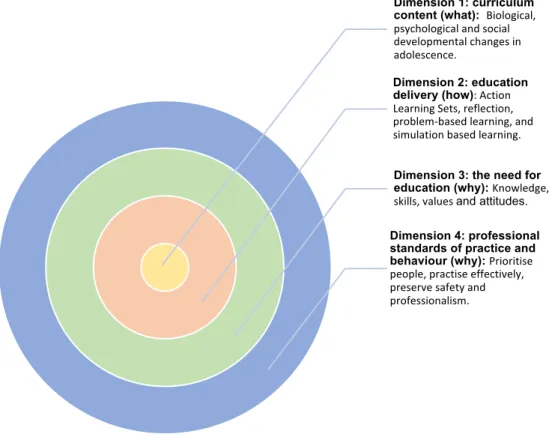
The proposed adolescent safeguarding curriculum framework is based on a four-dimensional model developed by Steketee et al (2014) as part of a national project on interprofessional health education in Australia. In Steketee et al’s (2014) model, dimensions 1 and 2 (the two inner layers) are about ‘what’ and ‘how’ and dimensions 3 and 4 (the two outer layers) are about ‘why’. Figure 1 shows the four dimensions of the adolescent safeguarding curriculum framework. Dimensions 1 and 2 are centred on academic principles, while dimensions 3 and 4 are centred on registered nurses’ attributes.
Dimension 1: curriculum content
Dimension 1 focuses on what the curriculum should contain. A biopsycho-social model has been used as its foundation, reflecting the interacting biological, psychological and sociological developmental changes that occur during adolescence (Lehman et al 2017), all of which have the potential to lead to vulnerabilities among young people.
Figure 1: The four dimensions of the adolescent safeguarding curriculum framework
Biological aspects of development during adolescence include neurological and physical changes as factors such as genetic vulnerabilities, disabilities, neurochemistry, hormones and stress reactivity. Psychological aspects include self-esteem, resilience, personality, coping skills, trauma/PTSD, anxiety and depression among adolescents. Social aspects include a range of safeguarding risks related to changes in adolescents’ relationships with family members and peers, as they socialise in settings such as school, college, online and in the community (Department for Education 2018). All of these aspects affect the safeguarding of adolescents in the wider social context, as opposed to safeguarding children in the family environment. in comparison to safeguarding children within the family environment.
Dimension 1: curriculum content (what): Biological, psychological and social developmental changes in adolescence.
Dimension 2: education delivery (how): Action Learning Sets, reflection, problem-based learning, and simulation based learning. Dimension 3: the need for education (why): Knowledge, skills, values and attitudes. Dimension 4: professional standards of practice and behaviour (why): Prioritise people, practise effectively, preserve safety and professionalism.
Dimension 2: education delivery
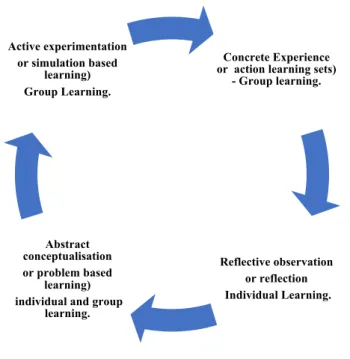
Dimension 2, which focuses on how nurse educators will deliver teaching and learning activities, is underpinned by two theories of learning: experiential learning (Kolb 1984) and social constructivism (Vygotsky 1978). In experiential learning ‘the learner learns both through and from the experience: through the experience by doing and from the experience by reflection’ (Dillon 2002). Kolb’s (1984) experiential learning theory comprises four stages – concrete experience, reflective observation, abstract conceptualisation and active experimentation. Social constructivism emphasises that learning depends on the interaction with others, including teachers and parents (Draper 2013). Based on these theories of learning, four teaching and learning strategies to be used in adolescent safeguarding education have been identified: action learning sets, reflection, problem-based learning and simulation-based learning. The proposed curriculum framework incorporates these four teaching and learning strategies, thereby providing individual and group learning experiences for nursing students.
Box 1 describes how each of the four teaching and learning strategies could be used during four adolescent safeguarding workshops for nursing students. These workshops incorporate the two theories of learning (Vygotsky 1978, Kolb 1984), as well as the knowledge, skills, values and attitudes outlined in the RCN (2019) guidance.
Box 1: Adolescent safeguarding workshops for nursing students
Workshop 1 - action learning sets
Action learning sets are structured group workshops which provide ‘a continuous process of learning and reflection, supported by colleagues’, in a high-quality learning environment (McGill and Brockbank 2004). In workshop 1, nursing students would collectively work
together to identify fundamental issues and concerns arising in a complex safeguarding scenario, for example a serious case review. The focus would be on enhancing nursing student’s knowledge of child development and public health and their ability to identify risk factors in adolescence. The group would incorporate nursing students from other fields of nursing practice and/or other professions such as paramedics, teachers and social workers. It is essential to include multi-professional approaches so that nursing students gain a better understanding of the roles and responsibilities of the other professionals involved in safeguarding practice, and the interplay between nurses and these other professionals (Littler 2018). This would enhance nursing students’ communication and leadership skills and develop their self-awareness (Haith and Whittingham 2012).
Workshop 2 – reflection
Workshop 2 would provide opportunities for nursing students to reflect individually on the safeguarding scenario presented in workshop 1. The emphasis would be on values and attitudes, with nursing students being asked to reflect on ‘how their own beliefs, experience and attitudes might influence their professional involvement in this safeguarding scenario’ (RCN 2019). The aim would be for nursing students to continue to learn, grow and improve practice (Jarvis 1992) through the development of new knowledge and its application to real life situations (Kassirer 2010).
Workshop 3 – problem-based learning
In workshop 3, nursing students would be presented with a problem-based scenario, continuing from the safeguarding scenario presented in workshop 1 and providing additional contextual information. Nursing students could work on that problem-based scenario independently before returning to the group to discuss their response and new knowledge acquired (Wood
2003). The focus would be on developing skills such as identifying safeguarding issues, record keeping/documentation and escalating concerns (RCN 2019). This will enhance nursing student’s ability to critically apply cumulative knowledge (Niemer 2010) and develop their clinical judgement and problem-solving skills (McMahon and Christopher 2011).
Workshop 4 – simulation-based learning
In workshop 4, nursing students would be required to collectively undertake an objective structured clinical examination (OSCE) based on a mock initial child protection case conference. This would enable nursing students to continue to develop their knowledge of their legal, ethical and professional responsibilities in safeguarding children and young people. Simulation-based learning provides an opportunity for nursing students to experience a complex practice scenario in a safe learning environment, promoting their professional insight (Hall et al 2015) confidence and knowledge.
Dimension 3 and 4: need for education on safeguarding and professional standards of practice and behaviour
In dimensions 3 and 4, the focus is on why there is a need to educate nursing students on the aspects of adolescent safeguarding education identified in dimension 1. This is about ensuring that nursing students acquire the appropriate knowledge, skills, values and attitudes required for safe and effective safeguarding practice (RCN 2019) guidance, which sets out indicative minimum training requirements for all healthcare staff involved in caring for children and young people. Nursing students need to meet level 2 competencies – the minimum level required for non-clinical and clinical staff ‘who, within their role, have contact (however small) with children and young people, parents/carers or adults who may pose a risk to children’ (RCN 2019). To enable nursing students to obtain the necessary knowledge, skills, values and
attitudes, the curriculum framework provides flexible learning opportunities that incorporate level 2 competencies and encompass various learning styles (RCN 2019) (Figure 2).
Table 1 illustrates how the adolescent safeguarding curriculum framework aligns with the knowledge, skills, values and attitudes competencies outlined in the RCN (2019) guidance. In dimension 4, the emphasis is on The Code: Professional Standards of Practice and Behaviour for Nurses, Midwives and Nursing Associates’ (NMC 2018b) which is centred on four themes, prioritise people, practise effectively, preserve safety, promote professionalism and trust.
Figure 2: Individual and group learning opportunities created by integrating experiential learning theory and social constructivism.
Concrete Experience or action learning sets)
- Group learning. Reflective observation or reflection Individual Learning. Abstract conceptualisation or problem based learning) individual and group
learning. Active experimentation
or simulation based learning) Group Learning.
Conclusion:
The proposed adolescent safeguarding curriculum framework is not prescriptive, but a structure to support nurse educators when designing or reviewing pre-registration nurse education programmes. The framework would align safeguarding education provided by HEI’s with safeguarding training undertaken in organisations, thereby closing the gap between theory and practice. It would also ensure that future nurses are competent in undertaking their central role in safeguarding adolescents.
Table 1: Royal College of Nursing competencies and the adolescent safeguarding curriculum framework
Adolescent Safeguarding Curriculum
Framework What
(Biological, Psychological and Social)
How (ALS, SBL, PBL, Reflection)
Why
(Knowledge, Skills, Values and Attitudes, NMC Code of Conduct (2015).
Safeguarding Children and Young People Intercollegiate Document (RCN 2019).
Knowledge/Education & Training:
Understanding Child Development/Perinatal MH/Public Health.
Awareness of abuse and neglect and factors associated with maltreatment.
Legal/ethical and professional
responsibility/record keeping/Caldicott Principles.
Child Death Review/Children and Young People’s Best Interests.
Needs of Children on Child Protection Plans, Care Leavers, Youth Offending, Looked after children.
Risk Factors associated with trafficking, Sexual Exploitation, FGM, Grooming and Terrorism/Radicalisation. X X X X X X X X X X X X X X X X Skills:
Document safeguarding concerns and share relevant information between teams, Able to identify further support is needed and escalate concerns appropriately, Able to document and code when a child is not brought to a health appointment and identify repeated patterns. X X X X X X X X Values/Attitudes:
Recognise how own beliefs, experience and attitudes might influence professional involvement in safeguarding work.
References:
Brandon M, Sidebotham P and Bailey S (2012) New lessons from serious case reviews: a two year report for 2009–2011, Department for Education, London. Available at: https:// www.gov.uk/government/publications/new-learning-from-serious-case-reviews- a-2-year-report-for-2009-to-2011 (Last accessed on 18th November 2019).
Currie, C; et al (2012) Social determinants of health and wellbeing among young people. Health behaviour in school-aged children (HBSC) study. International report from 2009/2010 survey. Health policy for children and adolescents, No.6, Copenhagen, WHO.
Department for Education (2018) Working Together to Safeguard Children: A Guide to Inter-Agency Working to Safeguard and Promote the Welfare of Children. Available at: assets.publishing.service.gov.uk/government/uploads/system/uploads/attachment_data/ file/779401/Working_Together_to_Safeguard- Children.pdf (Last accessed: 7 May 2020.)
Dillon, P (2002) The cognitive, competence and confidence development of baccalaureate nursing students over an academic year with clinical experience. (Doctoral dissertation), Widener University School of Nursing.
Draper, S (2013) Social Constructivism. Available at:
Firmin, C (2017) Contextual safeguarding: an overview of the operational, strategic and conceptual framework. University of Bedfordshire, Luton.
Haith, P and Whittingham, K (2012) How to use action learning sets to support nurses.
Nursing Times, 108: 18/19, 12-14.
Hall D, De Munter C, Ninis N, Goddard, A and Avila, H(2015) G72 Simulation training in safeguarding children and adolescents: trainees want it, trainees like it and we need to deliver it. Archives of Disease in Childhood 2015;100: A30.
Hanson E and Holmes D (2014) That Difficult Age: Developing a more effective response to risks in adolescence. Devon, Research in Practice.
Holmes D and Scale E (2018) Mind the Gap: Transitional Safeguarding – Adolescence to Adulthood. Research in Practice, Devon.
Humphreys, M; Wood, I, Johnson, C, Walsh, P, Witton, N, Green, J and Corkhill, S (2014) The Keele Curriculum Model: A contemporary framework for designing an
inter-professional technology enhanced nursing curriculum. Open Journal of Nursing, 2013, 3, 358-362. https://dx.doi.org/10.4236/362/ojn.2013.34048.
International Bureau of Education (IBE, 2017) Training Tools for Curriculum Development: Developing and Implementing Curriculum Frameworks. UNESCO/IBE.
Jarvis, P (1992) Reflective practice and nursing. Nurse Education Today. Vol. 12. No. 3. pp 174-181.
James D, Sargant N, Bostock N et al (2017) New challenges in adolescent safeguarding.
Postgrad Medical Journal, 2017; 93, 96-102.
Kassirer, J (2010) Teaching Clinical Reasoning: Case Based and Coached. Academic Medicine. July 2010, Vol 85, Issue 7, pp.1118-1124.
Kennedy I (2010) Getting it right for children and young people. Department of Health. London. Stationery Office.
Kessler RC, Berglund P, Demler O et al (2005) Lifetime prevalence and age-of-onset distributions of DSM-IV disorders in the National Comorbidity Survey Replication. Archives of General Psychiatry. 62, 6, 593-602. doi:10.1001/archpsyc.62.6.593
Kolb, D (1984) Experiential learning: experience as the source of learning and development. Englewood Cliffs NJ, Prentice Hall.
Ledford H (2018) The shifting boundaries of Adolescence. Nature, 22nd February 2018, Vol 554, pp.429-431.
Lehman BJ, David DM, Gruber JA (2017) Rethinking the biopsychosocial model of health: Understanding health as a dynamic system. Soc Personal Psychol Compass. 2017;11:e12328.
https://doi.org/ 10.1111/spc3.12328.
Lines, L; Hutton, A; and Grant, J (2016) Integrative review: Nurses roles and experiences in keeping children safe. Journal of Advanced Nursing. 73 (2), 302-322.
Littler, N (2018) An exploratory study investigating perceptions, opinions and experiences of safeguarding education within pre-registration children’s nursing curricula. Nursing Children and Young People. June 2018. https://doi:10.7748/ncyp. 2018.e1041.
Littler, N (2019) A qualitative study exploring school nurses’ experiences of safeguarding adolescence. British Journal of School Nursing. May 2019, Vol 14, No. 4, pp.169-176.
https://doi.org/10.12968/bjsn.2019.14.4.169
McGill, I and Brockbank, A (2004) The Action Learning Handbook London, Routledge Falmer.
McMahon, M and Christopher, K. A (2011) Case study method and problem- based learning: Utilizing the pedagogical model of progressive complexity in nursing education. International Journal of Nursing Education Scholarship, 8(1), 1-15.
Munro, E (2011) The munro review of child protection. The Stationery Office, London.
Niemer, L (2010) Problem based learning in nursing education: a process for scenario development. Nurse Educator, March-April 2010, Vol 35, Issue 2, pp.69-73.
Nursing and Midwifery Council (2018a) Realising professionalism: Standards for education and training. Part 1: Standards framework for nursing and midwifery education. NMC.
Nursing and Midwifery Council (NMC, 2018b) The Code: professional Standards of Practice and Behaviour for Nurses, Midwives and Nursing Associates. London, NMC.
Powell C (2011) Safeguarding and child protection for Nurses, Midwives and Health Visitors – A practical guide. Berkshire, Open University Press.
Royal College of Nursing (2018) Adult safeguarding: roles and competencies for healthcare staff. London, RCN.
Royal College of Nursing (2019) Safeguarding Children and Young People: Roles and Competencies for Healthcare Staff. London, RCN.
Sidebotham P, Brandon M, Bailey S et al (2016) Pathways to harm, pathways to protection: a triennial analysis of serious case reviews 2011 to 2014. Final Report. Department for Education. May 2016.
Skeketee, C, Forman, D, Dunston, R, Yassine, T, Matthews, L, Nicol, P and Alliex, S (2014) Interprofessional health education in Australia: Three research projects informing curriculum renewal and development. Applied Nursing Research. 27 (2014) 115-120.
Viner, R (2013) Life stage: adolescence. In Todd K (Ed) Annual Report of the Chief Medical Officer 2012: Our Children Deserve Better: Prevention Pays. Department of Health, London, 1-11.
Vygotsky, L (1978) Mind in society: The development of higher psychological processes. London, Harvard University Press.
Wood, D (2003) Problem based learning. British Medical Journal 2003; 326. https//doi.org/10.1136/bmj.326.7384.328.
Wyllie, E and Batley, K (2019). Skills for safe practice – A qualitative study to evaluate the use of simulation in safeguarding children teaching for pre-registration children’s nurses.