THE CORRELATION BETWEEN
SELF-DIRECTED LEARNING (SDL) LEVELS
AND STUDENTS’ ENGAGEMENT (SE) LEVELS
IN ENGLISH LANGUAGE LEARNING
IN MTSN 02 SIDOARJO
THESIS
Submitted in partial fulfillment of the requirement for the degree
of Sarjana Pendidikan (S.Pd) in Teaching English
By:
Lailiyatul Qudsiyah
NIM D05214011
ENGLISH LANGUAGE EDUCATION DEPARTMENT
FACULTY OF TARBIYAH AND TEACHER TRAINING
UNIVERSITAS ISLAM NEGERI SUNAN AMPEL
SURABAYA
ABSTRACT
Qudsiyah, Lailiyatul (2019). The Correlation between Self-Directed Learning (SDL) Levels and Students’ Engagement (SE) Levels in English Language Learning in MTsN 02 Sidoarjo.
A thesis, English Education Department, Faculty of Tarbiyah and Teacher Trainning, UIN Sunan Ampel Surabaya. Advisors: Rizka Safriyani, M.Pd., Hilda Izzati Madjid, MA.
Key Words: self-directed learning, students’ engagement, English language learning.
Self-directed learning is an approach to language learning: that the learner is trying to progress independently of a language classroom. Then, in the learning process, students‟ engagement is very important. In fact, not all students have high engagement in the learning process. Some previous studies found that the self-directed learning (SDL) affected students‟ engagement (SE) levels. This present study focuses on knowing and finding the correlation between self-directed learning (SDL) levels and students‟ engagement (SE) levels in English language learning. This study is quantitative research, specifically a correlational study. The data are gathered using two questionnaire sets to measure self-directed learning levels and students‟ engagement levels. The sample of this study are students of the 7th grade of Madrasah Tsanawiyah Negeri (MTsN) 02 Sidoarjo, who have been attended in English language learning. The findings indicate that the majority of students have moderate self-directed learning of English. Furthermore, the results showed that most of the students of MTsN 02 Sidoarjo have moderate students‟ engagement levels. The total score from both variables is calculated with the Pearson Product Moment Correlation, using SPSS 16.0 for Windows. The value of the Pearson coefficient is found to be (+)0.707 which indicates the positive and strong correlation between self-directed learning (SDL) levels and students‟ engagement levels in English language learning. Hence, the alternative hypothesis (H1) of this study which states that there is a correlation between self-directed learning (SDL) levels and students‟ engagement (SE) levels, is accepted. This correlation result indicates that the higher of the students‟ self-directed learning levels, the more likely for them to have higher of their students‟ engagement levels. Hence, the teacher or lecturer of
English language learning needs to maintain the students‟ engagement by motivating and facilitating the students in their English learning.
ABSTRAK
Qudsiyah, Lailiyatul (2019). The Correlation between Self-Directed Learning (SDL) Levels and Students’ Engagement (SE) Levels in English Language Learning in MTsN 02 Sidoarjo.
Skripsi, Prodi Pendidikan Bahasa Inggris, Fakultas Tarbiyah dan Keguruan, UIN Sunan Ampel Surabaya. Pembimbing: Rizka Safriyani, M.Pd., Hilda Izzati Madjid, MA.
Key Words: pembelajaran mandiri, keterlibatan siswa, pembelajaran Bahasa Inggris.
Pembelajaran mandiri merupakan sebuah pendekatan pada pembelajaran bahasa: yaitu siswa mencoba berkembang secara independen di kelas bahasa di mana guru mengarahkan pembelajaran. Kemudian, dalam proses pembelajaran, keterlibatan siswa sangatlah penting. Faktanya, tidak semua siswa memiliki keterlibatan yang tinggi dalam pembelajaran. Beberapa penelitian sebelumnya menemukan bahwa pembelajaran mandiri (SDL) memengaruhi tingkat keterlibatan siswa (SE). Penelitian ini berfokus untuk mengetahui dan menemukan korelasi antara tingkat pembelajaran mandiri (SDL) dan tingkat keterlibatan siswa (SE) dalam pembelajaran bahasa Inggris. Penelitian ini merupakan penelitian kuantitatif, khususnya penelitian korelasional. Pengumpulan data dilakukan menggunakan kuesioner untuk mengetahui tingkat pembelajaran mandiri pada siswa dan tingkat keterlibatan siswa dalam pembelajaran Bahasa Inggris. Sampel pada penelitian ini adalah siswa kelas 7 Madrasah Tsanawiyah Negeri (MTsN) 02 Sidoarjo, yang mengikuti pelajaran Bahasa Inggris. Dalam penelitian ini, mayoritas siswa MTsN 02 Sidoarjo memiliki tingkat moderate (tengah) pada pembelajaran mandiri. Selain itu, kebanyakan siswa memiliki tingkat keterlibatan siswa yang menengah. Skor total yang didapat dari korelasi Pearson dalam penemuan penelitian ini adalah (+)0.707 yang menunjukkan adanya hubungan yang positif dan kuat antara tingkat pembelajaran mandiri dan tingkat keterlibatan siswa dalam pembelajaran bahasa Inggris. Sehingga, hipotesis alternatif (H1) yang menyatakan adanya hubungan antara tingkat pembelajaran mandiri dan tingkat keterlibatan siswa dalam pembelajaran Bahasa Inggris, diterima. Hasil korelasi ini menunjukkan bahwa siswa yang memiliki tingkat pembelajaran mandiri yang tinggi akan memiliki tingkat keterlibatan siswa yang tinggi juga. Oleh karena itu, guru atau dosen bahasa Inggris
perlu menjaga keterlibatan siswa dengan memotivasi dan memfasilitasi mereka dalam pembelajaran.
TABLE OF CONTENTS
TITTLE SHEET ... i
PERNYATAAN KEASLIAN TULISAN ... ii
ADVISOR APPROVAL SHEET ... iii
EXAMINER APPROVAL SHEET ... iv
PENYATAAN PERSETUJUAN PUBLIKASI ... v
ABTRACT ... vi
ABSTRAK ... viii
TABLE OF CONTENTS ... x
LIST OF TABLES ... xii
LIST OF FIGURES ... xiii
LIST OF APPENDICES ... xiv
LIST OF ABBREVIATION ... xv
CHAPTER I: INTRODUCTION ... 1
A. Background of The Study ... 1
B. Research Questions ... 5
C. Objective of the Study ... 5
D. Hypothesis ... 5
E. The Significance of the Research ... 6
F. Scope and Limitation ... 7
G. Definition of Key Terms ... 7
CHAPTER II: REVIEW OF RELATED LITERATURE ... 9
A. Review of Related Literature ... 9
1. Self-Directed Learning (SDL) ... 9
a. The Definition of SDL ... 9
b. The Levels of SDL ... 10
c. SDL in ELT ... 14
2. Students‟ Engagement (SE) ... 17
a. The Definition of SE ... 17
b. The Levels of SE ... 20
c. SE in ELT ... 23
3. The Correlation between SDL and SE in ELL ... 26
B. Previous Study ... 27
CHAPTER III: RESEARCH METHOD ... 30
A. Research Design and Approach ... 30
B. Population and Sample ... 31
C. Research Instrument ... 32
E. Data Analysis Technique ... 36
CHAPTER IV: FINDINGS AND DISCUSSIONS ... 52
A. Findings ... 52
B. Discussions ... 76
CHAPTER V: CONCLUSIONS AND SUGGESTIONS ... 84
A. Conclusion ... 84
B. Suggestion ... 85
LIST OF TABLES
Table 2.1 Levels of SDL by Gerald O. Grow ... 10
Table 2.2 Levels of SE based on Phillip C. Schlechty ... 21
Table 2.3 SE with L2 Learning in Activity Theory ... 24
Table 3.1 Coefficient of Correlation Amount ... 31
Table 3.2 Blueprint of SDL Questionnaire ... 33
Table 3.3 Blueprint of SE Questionnaire ... 35
Table 3.4 the Results of Validity Test of SDL Variable ... 37
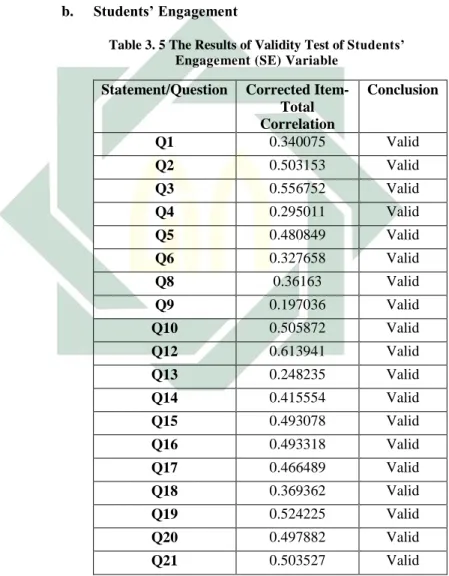
Table 3.5 the Results of Validity Test of SE Variable ... 39
Table 3.6 the Results of Reliability Test ... 41
Table 3.7 the Results of Normality Test ... 42
Table 3.8 SDL and SE Linearity Test Results ... 43
Table 3.9 Rank of Mean (M) ... 44
Table 3.10 Score Description for SDL Questionnaire ... 45
Table 3.11 Descriptive Statistics of Students‟ SDL ... 46
Table 3.12 Categories for SDL in ELL ... 47
Table 3.13 Score Description for SE Questionnaire ... 48
Table 3.14 SE Descriptive Statistics ... 49
Table 3.15 Categories for SE in ELL ... 50
Table 4.1 Bunches for Self-Directed Learning in ELL ... 64
Table 4.2 Bunches for Students‟ Engagement in ELL ... 73
Table 4.3 The Numeration Result of Correlation between SDL Levels and SE Levels in ELL ... 75
LIST OF FIGURES
Figure 4.1 Graphic of Responses toward Awareness ... 54
Figure 4.2 Graphic of Responses toward LS ... 56
Figure 4.3 Graphic of Responses toward LA ... 58
Figure 4.4 Graphic of Responses toward Evaluation ... 60
Figure 4.5 Graphic of Responses toward IS ... 62
Figure 4.6 Graphic of Responses toward BE ... 66
Figure 4.7 Graphic of Responses toward EE ... 68
LIST OF APPENDICES
Appendix 1: Questionnaire of Self-Directed Learning (SDL) Appendix 2: Questionnaire of Students‟ Engagement (SE) Appendix 3: Mean Rank of Awareness of SDL in ELLAppendix 4: Mean Rank of Learning Strategies of SDL in ELL
Appendix 5: Mean Rank of Learning Activities of SDL in ELL
Appendix 6: Mean Rank of Evaluation of SDL in ELL
Appendix 7: Mean Rank of Interpersonal Skills of SDL in ELL
Appendix 8: Mean Rank of Behavioral Engagement of SE in ELL
Appendix 9: Mean Rank of Emotional Engagement of SDL in ELL
Appendix 10: Mean Rank of Cognitive Engagement of SDL in ELL
Appendix 11: The Description of Data Participants
Appendix 12: Validity test of Self-Directed Learning (SDL) Appendix 13: Validity test of Students‟ Engagement (SE) Appendix 14: Reliability test of Self-Directed Learning (SDL) Appendix 15: Reliability test of Students‟ Engagement (SE) Appendix 16: Surat Tugas
Appendix 17: Form Validasi Instrumen
Appendix 18: Form Persetujuan Munaqosah
Appendix 19: Kartu Bimbingan
Appendix 20: Surat Izin Penelitian
LIST OF ABBREVIATION
1. MTsN : Madrasah Tsanawiyah Negeri
2. SMP : Sekolah Menengah Pertama (JHS)
3. MAN : Madrasah Aliyah Negeri
4. SMA : Sekolah Menengah Atas (SHS)
5. UNESCO :United Nations of Educational, Scientific,
6. UIN : Universitas Islam Negeri
7. U.S : United State
8. SDL : Self-Directed Learning
9. SE : Students‟ Engagement 10. ELT : English Language Teaching
11. ELL : English Language Learning
12. EFL : English Foreign Language
13. L1 : First Language
14. L2 : Second Language
15. NSSE : National Survey of Student Engagement
16. SRSSDL : Self-Rating Scale of Self-Directed Learning
17. AT : Activity Theory 18. A : Awareness 19. LS : Learning Strategies 20. LA : Learning Activities 21. E : Evaluation 22. IS : Interpersonal Skills 23. BE : Behavioral Engagement 24. EE : Emotional Engagement 25. CE : Cognitive Engagement
CHAPTER I
INTRODUCTION
The comprehensive explanation around the background of the research, research problems, objectives of the research, hypothesis, significance of the research, scope and limitation of the research, and definition of key terms would be delivered in this chapter.
A.
Background of the Study
The indicator of the successful learner is determined by understanding the material and passing the grade which is fixed by his/her learning process. Students‟ learning process can be seen from how he/she exploits his/her time for learning.
In the learning process, students‟ engagement is very important because students who are engaged would have a sense of pleasure in learning in school, studying in groups, and independent learning at home. Ganeshini states that when students are engaged during their learning in school, a positive attitude towards learning instilled; students will enjoy their lesson and appreciated the content taught.1 Unfortunately, based on the result of National Survey of Student Engagement (NSSE) in Indiana University it is known that most students only exploit of their time to study while in the classroom and few students take advantage of their time to study outside the classroom.2
Self-directed language learning generally describes an approach to language learning: that the learner is trying to progress independently of a language classroom in which the teacher directs the learning. The term self-directed learner is sometimes associated more with the concept of the non-traditional adult learner; that is with a general concept of autonomy. It is used here, however,
1 Sri Kanthan Ganeshini, Strengthening Student Engagement in the Classroom (Singapore: National University of Singapore, n.d. 2011), retrieved from www.math.nus.edu.sg. 2 National Survey of Student Engagement, “Engagement Insight; Survey Findings on the Quality of Undergraduate Education - Annual Results 2017,” Indiana University Center for Postsecondary Research (2017).
2
based on the definition offer by Benson, which is states that: “self-directed learning tend to refer simply to learning that is carried out under the learner‟s own direction, rather than under the direction of others.”3
Individual personal factors can influence the learning process such as student attitudes in the learning process. The attitude of students in learning can be influenced by feelings of pleasure or displeasure at the performance of teachers, lessons, or the surrounding environment.4 The attitude of students in the learning process is shown in the way students behave during the learning process.
Students' behavior in learning activities shows the level of student engagement at school. Student behavior such as ditching, chatting in class when the teacher is teaching, doing things that have nothing to do with learning activities, and not dressing in accordance with school rules are a form of student engagement in learning.5 Engagement in learning activities is when students behave intensively, have emotional qualities, and students take time to be involved during learning activities.
Student engagement in school activities also has an influence on student learning outcomes. Kuh said that increasing student engagement has a significant positive influence on student learning and results.6 Willms considers student engagement in schools as a very important school output, as a matter that directly affects academic achievement.7 A study by Lippman and Rivers showed that students who are not involved with their school had a tendency to be low in achievement, often absent, even out of school.8
3 Phill Benson, Teaching and Researching Autonomy in Language Learning (England: Pearson Education Limited, 2001), 34.
4 Muhibbin Syah, Psikologi belajar (Jakarta: Pt RajaGrafindo Persada, 2003), 5.
5 Jennifer A. Fredricks, Phyllis C. Blumenfeld, and Alison H. Paris, “School Engagement: Potential of the Concept, State of the Evidence,” Review of Educational Research 74(1) (2004): 59–109.
6
George D Kuh, “What Student Engagement Data Tell Us about College Readiness” (2007): 5.
7 J. Douglas Willms, “Student Engagement: A Leadership Priority” Ontario University in Conversation Reach Every Student 3(2)(2011): 12.
8 Laura Lippman and Andrew Rivers, “ASSESSING SCHOOL ENGAGEMENT: A GUIDE FOR OUT-OF-SCHOOL TIME PROGRAM PRACTITIONERS” (n.d.): 5.
3
Student engagement is one of the concepts to improve low levels of academic achievement, high levels of student boredom, dissatisfaction, and high rates of dropping out in urban areas. The findings of Glanville and Wildhagen indicated that student engagement decreases the number of school dropouts.9 Student engagement in learning activities is described as an important variable to prevent and intervene in the phenomenon of dropping out.
Students are expect to carry out activities that show involvement in the school. Dunleavy and Milton said that for students to engage, students are expected to have self-directed learning and responsibility for learning they do.10 Reeve explains that by having high self-directed learning, students will have high engagement.11
Self-directed learning is important for all students because with SDL students will hard try to solve their problems, if this process can occured deadlock then students can ask peers or instructors then explore and investigate solutions and other perspectives received. Self-directed learning makes students tend to be more responsible for their own learning process so that they will be more involved in the cognitive, affective, and social side. Research conducted by Ryan and Deci found that low self-directed learning became the highest cause of unsatisfactory learning activities.12 Reeve explains that having self-directed learning become more emotionally positive, optimal in challenging choices, decrease the possibility of dropping out, and higher academic achievement.13
Based on preliminary research which has been done by the researcher, this study would be conducted at MTsN 02 Sidoarjo. This school is one of the Islamic favorite schools in Krian,
9 Derek Lester, “A Review of the Student Engagement Literature,” College, Universities, and Schools 7, no. 1 (2013): 8.
10 Jodene Dunleavy and Penny Milton, “Student Engagement for Effective Teaching and Deep Learning,” Education Canada 48, no. 5 (2010).
11
Johnmarshall Reeve et al., „Enhancing Students‟ Engagement by Increasing Teachers‟ Autonomy Support‟, Motivation and Emotion, vol. 28, no. 2 (2004), pp. 147–69.
12 Richard M Ryan and Edward L Deci, “1: Overview of Self-Determination Theory: An Organismic Dialectical Perspective” (n.d.): 32.
13 Reeve et al., “Enhancing Students‟ Engagement by Increasing Teachers‟ Autonomy Support.”
4
Sidoarjo. Besides that, this school also have many program activity, such as English day, dhuha prayer, cultivate literation, etc. The problems that have appeared are students have a different ability in understanding the material given by teacher between one and the other students. Based on the preliminary research it become an important problem for students. The students‟ difference ability in understanding material in the classroom can affect students‟ involvement in the learning process.
There have been previous studies in self-directed learning (SDL) and student engagement such as conducted by Jason Donald Arndt with the title “Self-Directed Learning for English Language Learners.”14 The research intended to assist a motivated English language learner to take ownership of their own learning. The other research has came from student engagement which is done by Lathifah Ghoida Azhar with title “Students’ Engagement in English Learning.”15The research focused on the characteristics of students‟ engagement in English learning at one of the Junior High Schools in Bandung. The researcher used qualitative research as a method. However, this study is a different investigation among two previous studies above. This study focuses on the correlation between student self-directed learning (SDL) and students‟ engagement (SE) in English language learning. Quantitative research would be used in this research.
Based on Dunleavy and Milton, they state that self-directed learning can increase student engagement.16 Students who have self-directed learning will have high involvement in school. This is important for the school environment in order to create an atmosphere that supports the creation of self-directed learning. So as to increase student engagement. Therefore, the researcher conducted this research with an eye to discover the correlation between self-directed learning levels and students‟ engagement levels in English Language Learning in MTsN 02 Sidoarjo.
14 Jason Donald Arndt, “Self-Directed Learning for English Language Learners,” Tamagawa University (2017): 21.
15 Lathifah Ghoida Azhar, “Students‟ Engagement in English Learning” (Universitas Pendidikan Indonesia Bandung, 2013).
16 Dunleavy and Milton, “Student Engagement for Effective Teaching and Deep Learning.”
5
B.
Research Questions
Connecting to the background of the study earlier drafted above, the problems of the research are:
1. What is the level of self-directed learning (SDL) in English language learning?
2. What is the level of student‟s engagement (SE) in English language learning?
3. What is the correlation between self-directed learning (SDL) levels and students‟ engagement (SE) levels in English language learning?
C.
Objectives of the Study
Considering the statements of the research problems, this research is expected:
1. To find out the level of self-directed learning in English language learning of MTSN 02 Sidoarjo.
2. To find out the level of student‟s engagement in English language learning of MTsN 02 Sidoarjo.
3. To examine the correlation between self-directed learning level and student engagement levels in English language learning of MTSN 02 Sidoarjo.
D.
Hypothesis
A provisional answer to research questions by reason of the answer is only derived from interrelated theory was called the hypothesis. Thus, the hypothesis is not the answer which is evidence-based from the data.17 This research has an independent variable which is self-directed learning (SDL) and a dependent variable which is students‟ engagement levels. There are two hypotheses to reply the research question:
17 Sugiyono, Metode Penelitian Pendidikan: Pendekatan Kuatitatif, Kualitatif, Dan R&D (Bandung: Alfabeta, 2016), 96.
6
1. The H1 (Alternative Hypothesis) of this study is there is a significance correlation between self-directed learning (SDL) with students‟ engagement levels in English language learning. 2. The H0 (Null Hypothesis) of this study is there is no correlation
between self-directed learning (SDL) and students‟ engagement levels in English language learning.
E.
The Significance of the Research
In this spot, the researchist describes the significance of this study. The outcomes of this study are supposed can grant a subscription to all types of humanity.
1. For Readers
This research will contribute recent knowledge and more information to the readers around the correlation between Self-Directed Learning (SDL) levels and Students‟ Engagement (SE) levels.
2. For teachers or lectures
After knowing this study, the teachers or lectures will be conscious of the correlation of Self-Directed Learning (SDL) that can encourage students‟ engagement. Then, they know how to increase self-directed learning and student engagement. Besides, they will know the levels of self-directed learning and students engagement and how to overcome it.
3. For the researcher
The outcomes of this study are also meaningful for the next researcher who wanted to do research in this field. It implies that this study could be the previous study for the next researcher who desired to do their research revealed to the correlation between self-directed learning (SDL) levels and students‟ engagement levels in English language learning. The next researcher may try to find the correlation in self-directed learning or students‟ engagement with other variables.
7
F.
Scope and Limitation
1. Scope of the researchThe scope of this research are Self-Directed Learning (SDL), specifically the level of Self-Directed Learning (SDL) in English language learning, and students‟ engagement, specifically the level of students engagement in English language learning. This study investigates the relationship between Self-Directed Learning (SDL) levels and students‟ engagement (SE) levels in English language learning, in which this research focuses on if there is any correlation between those two variables of the research.
2. Limitation of the research
The limitation of this research is within the learners of MTsN 02 Sidoarjo who are the students in the 7th grade of the 2018/2019 school year.
G.
Definition of Key Terms
Here are the definitions of the key terms based on the perspective of this study or in other words the terms below are defined operationally.
a. Correlation
Correlation study is used when the researcher relates two or more variables to see if they influence each other. It is shown by numbers that indicate the direction and strength of the relationship between two or more variables. In this case, the direction is expressed in the form of a positive or negative relationship, while the strength of the relationship is expressed in the magnitude of the correlation coefficient.
b. Self-Directed Learning (SDL) Level
Self-directed learning is an increase in knowledge, skills, achievements, or personal development that is chosen and carried by an individual by his or her own attempt to use
8
any strategy under any situations at any time.18 Briefly, self-directed learning is an individual effort to improve his or her knowledge, skills, achievements, personal development by using its own method. Here, the researcher adapts from Grow‟s Theory to divide the levels of self-directed learning.19 They are dependent, interested, involved and self-directed.
c. Students’ Engagement Level
Students‟ engagement is bound with the interaction among the period, accomplishment and more linked origin by both learners and their schools that proposed to make best for the learners‟ incident enlarge the knowledge output and growth learners and the achievement, and prestige of the schools.20 Concisely, students‟ engagement is the involvement of students in learning activities in the classroom both in behavior, cognition, and emotions to improve learning outcomes and individual student development. Based on Schlechty‟s theory there are five students‟ engagement levels.21 They are; rebellion, retreatism, ritual compliance, strategic compliance, and authentic engagement.
d. English Language Learning
English language learning is refers to as the subject that must be learned in the schools in Indonesia. Moreover, in MTsN 02 Sidoarjo, English language learning as a foreign language is a lesson that must be learned. Besides, English language learning will be tested on national examinations held
in Indonesia simultaneously.
18 Maurice Gibbons, The Self-Directed Learning Handbook; Challenging Adolescent Students to Excel (San Fransisco: Jossey-Bass, 2002), 2.
19Gerald O. Grow, “Teaching Learners To Be Self-Directed,”
Adult Education Quarterly 41, no. 3 (September 1991): 125–149.
20 Vicki Trowler, Students’ Engagement Literature Review (Department of Educational Research: Lancaster University, 2010).
21Phillip C. Schlechty, Engaging Students: The Next Level of Working on the Work (San Francisco: Jossey-Bass, 2011), 15.
CHAPTER II
REVIEW OF RELATED LITERATURE
A summary information around theories which support the study containing a review of revealed literature and some previous research revealed to the theme of this study would be presented in this chapter. The theories revealed are including self-directed learning, students engagement, self-directed learning in ELT, students‟ engagement in ELT, level of self-directed learning, and level of students‟ engagement.
A.
Review of Related Literature
1. Self-Directed Learning (SDL)
a. The Definition of Self-Directed Learning (SDL)
Derived from Knowles statement that self-directed learning was a manner in which students took creativity, with or without the support from others, in identifying their learning necessaries, stating learning targets, diagnosing human and material resources for learning, selecting and performing suitable learning methods and assessing learning results.22 Gibbons suggests that self-directed learning (SDL) is a skill where a student was able to determine his own and chose the goals he/she wants to achieve, plans strategies to be carried out, try to solve problems, manages himself, and evaluated thinking and performance which has been done.23 These skills would enhance individual knowledge and achievements. Self-directed learning (SDL) implies the learning that is free to determine the direction of plans, sources, and decisions to
22 Malcolm S. Knowles, Self-Directed Learning: A Guide for Learners and Teachers (Chicago: Association Press, 1975); Sharan B. Merriam and Laura L. Bierema, Adult Learning: Linking Theory and Practice, First edition., The Jossey-Bass higher and adult education series (San Francisco, CA: Jossey-Bass, a Wiley brand, 2014).
10
achieve academic goals. The SDL process changes the role of the learner or the instructor to become a facilitator of the learning process.
b. The Levels of Self-Directed learning (SDL)
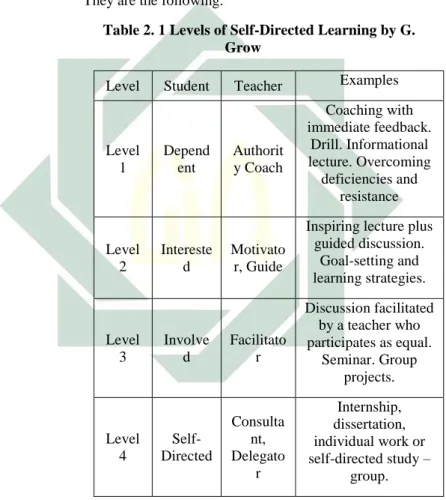
Grow classifies self-directed learning in four stages. They are the following.24
Table 2. 1 Levels of Self-Directed Learning by G. Grow
Level Student Teacher Examples
Level 1 Depend ent Authorit y Coach Coaching with immediate feedback. Drill. Informational lecture. Overcoming deficiencies and resistance Level 2 Intereste d Motivato r, Guide
Inspiring lecture plus guided discussion. Goal-setting and learning strategies. Level 3 Involve d Facilitato r Discussion facilitated by a teacher who participates as equal. Seminar. Group projects. Level 4 Self-Directed Consulta nt, Delegato r Internship, dissertation, individual work or self-directed study – group.
24 Gerald O. Grow, “Teaching Learners To Be Self-Directed,” Adult Education Quarterly 41, no. 3 (September 1991): 125–149.
11
Table 2.1 summarizes the levels or the stages of Self-Directed Learning developed by Gerald O. Grow. There are four levels of Self-Directed Learning. Here, the explanation of them.
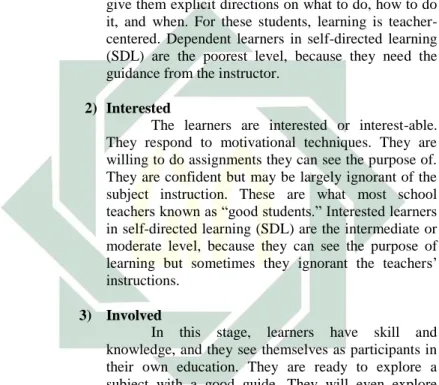
1) Dependent
Dependent learners need an authority figure to give them explicit directions on what to do, how to do it, and when. For these students, learning is teacher-centered. Dependent learners in self-directed learning (SDL) are the poorest level, because they need the guidance from the instructor.
2) Interested
The learners are interested or interest-able. They respond to motivational techniques. They are willing to do assignments they can see the purpose of. They are confident but may be largely ignorant of the subject instruction. These are what most school teachers known as “good students.” Interested learners in self-directed learning (SDL) are the intermediate or moderate level, because they can see the purpose of learning but sometimes they ignorant the teachers‟ instructions.
3) Involved
In this stage, learners have skill and knowledge, and they see themselves as participants in their own education. They are ready to explore a subject with a good guide. They will even explore some of it on their own. But they may need to develop a deeper self-concept, more confidence, more sense of direction, and a greater ability to work with and learn from others. Thus, involved learners can be classified as the high level of self-directed learning.
4) Self-Directed
Self-directed learners set their own goals and standards with or without help from experts. They use experts, institutions and other resources to pursue the
12
goals. Learners at this stage were both able and willing to take responsibility for their learning, direction, and productivity. Furthermore, the self-directed learners here, can be characterized as the highest level of Self-Directed Learning (SDL) based on Grow.
Self-direction is the basis of all learning; be it formal or informal. The effectiveness of learning is relative to an individual‟s motivation. All individuals are capable of self-directed learning but the degree of development varies due to their individual differences. It is important that both educators or teacher and learners have a clear understanding of the concept and nature of self self-directed learning skills for its further development. Educators, in this context, have added the responsibility of developing learners‟ full potential effective self-directed learning through building and maintaining a harmonious team relationship.
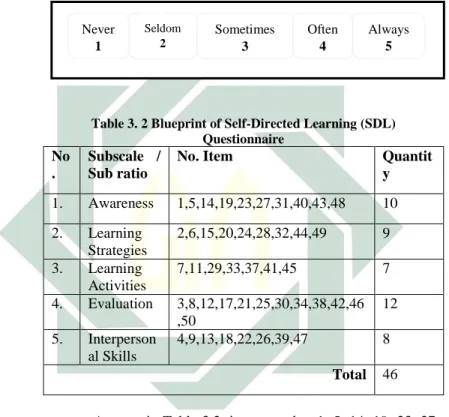
Williamson developed the Rating Scale of Self-Directed Learning (SRSSDL) and categorized it subordinate to five extensive fields of self-directed learning.25 They are the following:
1) Awareness
It is revealing to learners‟ comprehending of the aspects assisting to forming self-directed learners. Self-awareness is an alternative to maximize learning for students because awareness is an important principle for students in acquiring knowledge and education. Awareness begin with basic knowledge or some kind of rudimentary ability to know or realize what is happening.
2) Learning Strategies
It is analyzing the varied approaches self-directed learners ought to adopt with an eye to become self-directed in their learning action. The
25 Swapna Naskar Williamson, “Development of a Self-Rating Scale of Self-Directed Learning,” Nurse Researcher 14, no. 2 (January 2007): 66–83.
13
learning strategies in self-directed learning are the students involve in group discussion, they has study buddy, and they can decide learning strategies.
3) Learning Activities
It is certaining the required learning activities, learners ought to be aggressive engaged with an eye to become self-directed in their learning processes. The learning activities in self-directed learning are the students able to use mind mapping as their learning method, they able to use technology to improve their learning, and they can connect their English knowledge with the reality of their life.
4) Evaluation
It is relating students‟ characteristic associated in order to assist observed their learning activities. The evaluation in self-directed learning are the students able to correct their works, they can identify the material that had been mastered, and they able to observe the development of their learning.
5) Interpersonal Skills
It was relating to learners‟ skills in interpersonal relationships, which are pre-requisite to their becoming self-directed learners. Interpersonal skills in self-directed learning are the students intend to learn more the knowledge or English knowledge, they can share information with other people, and they can express their views freely.
The categorization of the Rating Scale of Self-Directed Learning (SRSSDL) items up to five broad areas allows for specific areas where students lack abilities in their self-directedness to be identified and support offered.
14
c. Self-Directed Learning (SDL) in English Language
Teaching (ELT)
Self-Directed Learning is the ways that individuals develop their own skills and their involvement and commitment to their own learning processes. SDL is a necessary skill for the development of long-life learning and for learners who want to develop their capacities to construct knowledge autonomously. The use or promotion of SDL has been implemented in different institutional contexts, and many researchers have reported benefits and positive effects when promoting this skill. In general, SDL refers to: “Learner‟s Autonomous ability to manage his or her own learning process, by perceiving oneself as the source of one‟s own actions and decisions as a responsibility towards one‟s own lifelong learning. In an instructional context, it means that students are able to take initiative, with or without a teacher, in making decisions concerning their own learning.”
Thus, self-directed learning plays a key role in the development of tasks designed to develop and enhance in EFL students. Duque and Cuesta argue that a high degree of awareness about learning strategies leads students to become more responsible for their own results.26
Knowles also states that students who are proactive learners will learn more and remember it better than those who are reactive learners. Based on Knowles‟ observations, the autonomous learner is more likely to be invested in their learning and more likely to be successful in their language learning experience. Benson argues that it is the natural progression for language learners to take control of their learning. He reasons that if learners lack autonomy, they are capable of developing it. Furthermore, Benson emphasizes that autonomous language learning is more effective for the learner than dependent language
26 Adriana Duque Micán and Liliana Cuesta Medina, “Boosting Vocabulary Learning through Self-Assessment in an English Language Teaching Context,” Assessment & Evaluation in Higher Education 42, no. 3 (April 3, 2017): 398–414.
15
learning.27 King recognizes the important learner autonomy has in relation to language learning precisely because it allows the student to gain control of their language acquisition.28 It is reasoned that the more a student has control over their learning, the more invested they will become in their growth as a language learner. For these reasons, autonomous learning has the potential to greatly increase student learning through self-empowerment.
Autonomous learning is done outside of the traditional classroom therefore, more flexible in its environment and content. Reinders and White attribute four modalities to autonomous learning: location, formality, pedagogy, and locus control. Location refers to the setting in which learning takes place.29 Some universities and language learning institutions have self-access learning centers in which dedicated learning advisors assist language learners on their path toward autonomy. Formality refers to the degree to which learning is linked to organized courses. Pedagogy refers to the degree to which actual teaching is involved. Locus of control means how much control the student has over the choices for their learning.
The desired outcome of the self-directed learning process is for the English language learner to take responsibility for their own learning. Research shows that students who are more invested in their learning experience are more likely to be successful language learners.30 Those learners are better able to focus on the
27 Phill Benson, “What‟s New in Autonomy?,” Hong Kong Institute of Education (2011): 4.
28 Murray Fisher, Jennifer King, and Grace Tague, “Development of a Self-Directed Learning Readiness Scale for Nursing Education”. Nurse Education Today. Harcourt Publishers Ltd (2001) 21, 516-525
29 Hayo Reinders and Cynthia White, “20 YEARS OF AUTONOMY AND TECHNOLOGY:,” Language Learning (n.d.): 12.
30 Jo Mynard, “The Role of the Learning Advisor in Promoting Autonomy,” Kanda University, Japan (2011): 6; Hayo Reinders, “Towards a Classroom Pedagogy for Learner Autonomy: A Framework of Independent Language Learning Skills,” Australian Journal
16
skill areas that are most needed in order to meet their language goals.
According to Reinders, students will likely need training and a large amount of support before they can become autonomous learners. Language advising is a form of learning support in which guidance is provided to students about their language learning.31 Whereas teaching and tutoring focus directly on the language itself, advising focuses oh how the students should go about learning the language. A language advisor is highly recommended to help raise the students‟ awareness of the potential for learning outside the classroom and preparing students for self-directed language learning.32
Several factors contribute to the success of the self-directed language learner. In a study on the benefits of self-directed learning, Du found that students with previous experience in self-study at the university level are more likely to have a positive learning experience. Also, students‟ self-efficacy is linked to performance in his project. Du reported that students who excelled in the project shared these traits: self-confidence, a willingness to take risks, a drive to attain goals, and a strong intellectual curiosity.33
The largest potential problem with autonomy and self-directed learning is that the students must remain disciplined. A significant amount of self-motivation and critical reflection are required to undertake and pursue autonomous learning. It is the responsibility of the students and the advisor to hold the student accountable if they do not complete their work or if they do not take time
of Teacher Education 35, no. 5 (January 1, 2010), accessed December 11, 2018, http://ro.ecu.edu.au/ajte/vol35/iss5/4.
31 Reinders, “Towards a Classroom Pedagogy for Learner Autonomy.” 32
Hayo Reinders, “THE WHAT, WHY, AND HOW OF LANGUAGE ADVISING” (2008): 7.
33 Fengning Du, “Student Perspectives of Self-Directed Language Learning: Implications for Teaching and Research,” International Journal for the Scholarship of Teaching and Learning 7, no. 2 (July 1, 2013), accessed November 15, 2018, http://digitalcommons.georgiasouthern.edu/ij-sotl/vol7/iss2/24.
17
to study. A language teacher, language counselor, or other educational professionals that advise the student is a valuable asset to help prevent attrition. Drawing on Self-Determination theory, we all have a universal desire to connect with other people.34 The relationship between in their search for autonomy in language learning. The advisor may provide the student with the incentive to continue on their desired path toward English language acquisition.
2. Students’ Engagement (SE)
a. The Definition of Student Engagement
Derived from Trowler‟s perspective, students‟ engagement is bound with the interaction among the period, accomplishment and more linked origin by both learners and their schools that propose to make best for the learners‟ incident enlarge the knowledge output and growth learners and the achievement, and prestige of the schools.35 Then Krause and Coates indicate that engagement is the quality of effort students themselves devoted to educationally purposeful activities that contribute directly to desired outcomes.36 So, students‟ engagement can be defined as the quality of their effort toward the class that automatically results in the learning outcome.
Fredricks, Blumenfeld, Paris, Skinner, Furrer, Marchand, Kindermand & Wellborn (cited in Jang, Reeve, and Deci) state that engagement has to consider their behavior and emotional quality.37 Besides that, Trowler
34 Karen A. Miller, Edward L. Deci, and Richard M. Ryan, “Intrinsic Motivation and Self-Determination in Human Behavior,” Contemporary Sociology 17, no. 2 (March 1988): 253.
35
Trowler, Students’ Engagement Literature Review.
36 Kerrie Lee Krause and Hamish Coates, Students’ Engagement in First Year University (Australia: Griffith University Australia, 2008).
37 Hyungshin Jang, Johnmarshall Reeve, and Edward L Deci, “Engaging Students in Learning Activities: It Is Not Autonomy Support or Stucture but Autonomy Support and Stucture,” American Psychological Association 102 (2010): 588–600.
18
argues three aspects of students‟ engagement.38 They are as the subsequent below:
1) Behavior engagement
Learners who are behaviorally engaged should characteristically fulfill with behavioral standards, such as presence and participation, and should establish the nonattendance of irritant or effect-less behavior.
2) Emotional engagement
Learners who engage emotionally should feeling impression impacts such as attention, excitement, or inclusive feeling.
3) Cognitive engagement
Cognitively engaged learners should be infused in their awareness, should search to start forth the necessities and should take pleasure in defiance. It intends the learners will create an attempt in their school.
Moreover, Jones‟s perspective the students‟ engagement level can be denominated from the features of students‟ engagement. They are emphatic body language, continual concentration, interest and happiness, personal concern, explication of studying, the significance of the action, accurate thought, and directive implementation.39
a) Emphatic body language
Learners reveal body manners that represent hearing and care to the teacher or other learners. It contains their eye ignition, head position, learning front, and behind, and the place of their hand.
38 Trowler, Students’ Engagement Literature Review.
39 Richard D. Jones, Strengthening Students’ Engagement (International Center for Leadership in Education, 2008).
19
b) Continual concentration
Learners are distinguished on the schooling activities with the smallest interruption incorporating the consideration that designates they interest with the activities.
c) Verbal participation
Learners express their thinking and respond which signify they are enthusiastic learners. For instance, they inquire thing that suitable for tuition, allow their thinking regarding the course, and contemplate an issue that they gain in the school.
d) Student confidence
Learners exhibit credence in performing their assignments with the restricted instructor or permission seeking and aggressive in the contribution of group-based action.
e) Interest and happiness
Learners display consideration, spirit and put on conclusive amusement. Students exhibit interest and enthusiasm and use positive humor.
f) Personal concern
Learners believe comfy in request assistance or inquiry. Students feel comfortable seeking help and asking questions.
g) Explication of studying
Learners can explain the objective of the course or unit to be exact than representing the hustle based on the material of the day. Students can describe the purpose of the lesson or unit. This is not the same as being able to describe the activity being done during class.
20
h) Significance of action
Learners understand that the activities are attractive, stretching, and interrelated to education. Students find the work interesting, challenging, and connected to learning.
i) Accurate of thought
Learners can be doing on intricate matters, produce settlements by themselves, and depict on the excellence of their performance. Students work on complex problems, create original solutions, and reflect on the quality of their work.
j) Directive implementation
Learners understand what goodness of effort is and how it will be evaluated. They can assess the excellence of their work/performance. Students understand what quality work is and how it will be assessed. They also can describe the criteria by which their work will be evaluated.
Deliberating those theories, the researcher deduces that in quantifying students‟ engagement levels, the researcher has to ponder the specifics of students‟ engagement, it contains learners‟ attitude, affective and cognitive in the classroom.
b. The Levels of Student Engagement (SE)
People who are engaged do tend to be on task, and sometimes they find to be entertaining. To be engaged, however, is to invest energy beyond that needed simply to get by. Engagement is active it requires the students to be attentive as well as in attendance: it requires the student to be committed to the task and find some inherent value in what he or she is being asked to do.
To assess engagement it is necessary to determine both the level of the effort a student is expanded and the meaning and significance the student attaches to the tasks he or she is assigned.
21
Schlechty classifies student engagement level in 5 levels, they are authentic engagement, ritual compliance, passive compliance, retreatism, and rebellion.40
Table 2. 2 Levels of Student Engagement based on P. Schlechty
Level Classification Criterion Level 5 Authentic Engagement High Attention + High Commitment Level 4 Strategic Compliance High Attention + Low Commitment Level 3 Ritual Compliance Low Attention + Low Commitment Level 2 Retreatisme No Attention + No
Commitment Level 1 Rebellion Diverted Attention +
No Commitment
Table 2.2 summarizes the levels of Student Engagement developed by Phillip C. Schlechty. The levels will be explained below.
1) Authentic Engagement
Authentic engagement is the highest level of student engagement. In this level, the students are immersed in work that has a clear meaning and immediate value to them, for instance, he/she like reading a book on a topic of personal interest. The characteristics of the students in this stage are persistence, sustained inquiry, self-direction, playfulness with contents, and unprompted transfer of understanding.
2) Strategic Compliance
The work has little or no immediate meaning to students, but there are extrinsic outcomes of value that keep them engaged, for example, they earn grades
40 Phillip C. Schlechty, Engaging Students: The Next Level of Working on the Work (San Francisco: Jossey-Bass, 2011), 15.
22
necessaries for college acceptance. This level is characterized by a clear effort, some creativity, focus on directions and task completion in order to meet extrinsic standards for motivation.
3) Ritual Compliance
In this stage, students see little or no meaning in the assigned work but expend effort merely to avoid negative consequences, she or he is not having to stay in during recess to complete work. The passive compliance‟ characters are a minimal effort made only to mitigate „consequences‟ or other negative „punishers‟: no creativity, genius, curiosity, or transfer.
4) Retreatisme
In this level, students are disengaged from assigned work and make no attempt to comply but they are not disruptive to the learning activity. Commonly, the students have characters such as little to no effort, productivity, or progress: no demonstrated inquiry, affection, or interest in the content, collaborations, or task.
5) Rebellion
On the contrary to authentic engagement, rebellion is the lowest level of engagement. In this stage, students refuse to do the assigned task, act disruptive, and attempt to substitute alternative activities. Rebellion is characterized by zero demonstration; outright disruption and defiance.
23
c. Students’ Engagement (SE) in English Language
Teaching (ELT)
Engestrӧm extended design of activeness network had been conceived to clarify the students‟ engagement by studying second language.41 As activeness environments certainly had general categories and coexisting a variety of correlation with others, the illustration of the class contexture is formated to contain these numerous correlation.
41
Yrjö Engeström, “Activity Theory and Individual and Social Transformation,” in Perspectives on Activity Theory, ed. Yrjo Engestrom, Reijo Miettinen, and Raija-Leena Punamaki (Cambridge: Cambridge University Press, 1999), 19–38, accessed December
11, 2018,
https://www.cambridge.org/core/product/identifier/CBO9780511812774A011/type/book_ part.
24
Table 2. 3: Students’ Engagement with Second Language Learning in Activity Theory
Mediating Artefacts - Language studying selection - Confidence - Books - Contemporary Technology - First Language and Second
Language
Subjects - Learners
Objects - Obtained Adequate second
language competence - Getting Test Grade
- Expanding individual compassion
Rules - Team regulation
- Classroom regulation - Second language schools
and college rules
Community - Second language
classrooms
- Second language instructors - Second language schools
and colleges - Relative - Pair systems - Work - Large societies Division of Labour
- Timework to other second language students or wearer
Table 2.3 condenses the implementation of Activity Theory (AT) to the students‟ engagement toward second language studying, the subject is second language student. The object of the activity contains the miscellaneous situation of studying which relied on the personal learner. It can be, for example, obtaining adequate second language competence, getting test grades, expanding individual
25
compassion, etc. The equipment employs could also relied on personal student, but they content Language studying selection, confidence, and may contain books, contemporary technology and the tongue itself, as well as first language and second language. The student as a social being existed in a kind of language societies. Accordingly, the society in this study would be, amongst others, second language classroom, second language instructors, second language schools and colleges, dormitory, relative, pair systems, work, and the larger society. Regulations would contain team regulations, classroom regulation, or second language schools and colleges instruction for the lesson. Indeed, the student corresponds to regulations of studying and applying the second language. Eventually, classification of labor should be essentially concentrated to the courses cooperation to other second language students or wearers. It can be that occasionally interpreted aspects might potency resisted one another and in such problems, strains might appeared. From inside of study sight, second language learning is the strategy of encountering and solving strains; however, if the strains insist, second language learning frozen, while whether the second language students can overcome the strains, they can obtained a advance level of second language proficiency and second language learning pleasure.
All the aspects of the activeness network clarifies up to now are personal unities. Personal student investigates these aspects in characteristic approaches to fulfill their own idea and to row up toward their own views.42 The human resources and learners in the activeness of studying the second language also personally clarifies their action in activity theory. Personal subjectively forms their own aims and act in approaches that were mediated by their own choice of equipment, containing studying selections. They
42 Danuta Wanda Bass-Dolivan, “Students‟ Engagement with Second Language Learning: A Sociocultural Approach, Doctor of Phylosophy Thesis” (University of Wollongong, 2011), http://ro.uow.edu.au/theses/3357.
26
has individual perspectives of the society and of the regulations and classification of labor.
3. The Correlation between Self-Directed Learning (SDL) Levels and Students’ Engagement (SE) Levels in English Language Learning (ELL)
Originated in Linnenbrink & Pintrich‟s point, scholarly engagement has triplet concepts which behavioral, cognitive, and stimulation engagement.43 Another scholar of engagement, Fredricks et al described that engagement in a variety attitude as behavioral engagement.44 Behavioral engagement, as declared by Fredricks et al, assisted in positive studying. It accommodates learners‟ compliance to make enterprises, perseverance to scholar assignments, awareness in the classroom, and entanglement in class. In the attachment, fellowship in school-associated pursuits is contemplated as significant in behavioral engagement.
Fredricks and her colleagues summed cognitive engagement up into two themes: (1) as an investment of time in thinking about learning; and (2) as developing learning experiences using strategic skills.45 Therefore, students who are cognitively engaged display a deeper level of learning by paraphrasing or summarizing materials or organizing knowledge with concept maps or outlines or we can call it they do self-directed learning. Students demonstrate effort in tasks when they are being engaged cognitively in monitoring and regulating their learning by reflecting on their own thinking, actions, and behavior.46 So, students who have self-directed
43 Elizabeth A. Linnenbrink and Paul R. Pintrich, “The Role of Self-Efficacy Beliefs in Student Engagement and Learning in the Classroom,” Taylor & Francis Group 19 (2003): 119–137.
44
Fredricks, Blumenfeld, and Paris, “School Engagement: Potential of the Concept, State of the Evidence.”
45 Fredricks et al., Measuring Student Engagement in Upper Elementary Through High School: A Description of 21 Instruments, 2011.
46 Linnenbrink and Pintrich, “The Role of Self-Efficacy Beliefs in Student Engagement and Learning in the Classroom.”
27
learning display a deeper level of learning in cognitively engaged.
directed learning is important for all students. Self-directed learning makes students tend to be more responsible for their own learning process so that they will be more involved in the cognitive, affective, and social side. Research conducted by Ryan and Deci found that the low self-directed learning became the highest cause of unsatisfactory learning activities.47 Reeve explained that having self-directed learning becomes more emotionally positive, optimal in challenging choices, decrease the possibility of dropping out, and higher academic achievement.48
B.
Previous Study
There are some studies related to the current study:
The first previous study has been done by James Boyd Canipe with the title “The Relationship between Self-Directed Learning and Learning Styles.”49 The study was aimed to examine the relationship between self-directed learning readiness and learning styles. The research design of this study was the mixed method of two research designs was employed: correlational and causal-comparative. The results of this research suggest that there are no significant differences between self-directed learning readiness and four learning styles as defined by the LSI (p> 0.05). Thus, self-directed learning readiness in this study appears to occur across all learning styles, instead of being identified with a particular learning style.
The second previous study was conducted by Jason Donald Arndt with the title “Self-Directed Learning for English Language
47
Ryan and Deci, “1: Overview of Self-Determination Theory: An Organismic Dialectical Perspective.”
48 Reeve et al., “Enhancing Students‟ Engagement by Increasing Teachers‟ Autonomy Support.”
49 James Boyd Canipe, “The Relationship between Self-Directed Learning and Learning Styles” (Tennessee University, 2001).
28
Learners.”50 The study was aimed to raise student‟s awareness about possibilities and directions their self-directed learning can take. This study intended to assist a motivated English language learner to take ownership of their own learning process and become an autonomous language learner who can direct their course of study in the manner that is most beneficial for him-self or her-self. The research design of this study is a descriptive qualitative method. The result of the study was how the learners can take ownership of learning English in order to hone the language skills needed to participate in the academic and the post-academic English speaking world.
The third previous study has been done by Asude Balaban Dagal and Dilan Bayindir with the title “The Investigation of the Level of Self-Directed Learning Readiness According to the Locus of Control and Personality Traits of Preschool Teacher Candidates.”51 The aims of this study were to investigate the relationship between the level of self-directed learning readiness, the locus of control and the personality traits of preschool teacher candidates. The survey method was used for this study. The research‟s result of this study indicated that there were the significants relationship between the level of self-directed learning readiness, “extraversion” and “conscientiousness” traits of personality and “personal control” subscale of the locus of control.
The fourth previous study was research was conduct by Lathifah Ghoida Azhar with title “Students’ Engagement in
English Learning.”52 The aim of this research was to find out whether the characteristics of students‟ engagement in English learning at one of the Junior High Schools in Bandung. The method of this research was qualitative research. She described the findings and data discussions. The result of this research can help teachers in improving students‟ engagement in English learning and enhancing their teaching skill.
50
Arndt, “Self-Directed Learning for English Language Learners.”
51 Asude Balaban Dagal and Dilan Bayindir, “The Investigation of the Level of Self-Direcred Learning Readiness According to the Locus of Control and Personality Traits of Preschool Teacher Candidates,” International Electronic Journal of Elementary Education 8(3) (2016): 391–402.
29
The last previous study has been conducted by Rahayu D. S. with the title “An Analysis of Students’ Engagement Level in
Outdoor and Indoor Class at English Intensive Grammar Class of MA Bilingual Krian.”53 This study was aimed to describe the students‟ engagement level in outdoor class and indoor class, to find out the students‟ engagement level in the indoor class, and to know the difference between students‟ engagement level in indoor class and students‟ engagement level in outdoor class. This study was designed using a qualitative research method. The result of this study showed that students‟ engagement level in the indoor class is higher than students‟ engagement level in outdoor class.
In general, the first, second, and third previous study have a similar topic which focused on self-directed learning and its relationship with others. Then, the fourth and fifth research has a similar topic with students‟ engagement.
Finally, there were five differences between these previous studies and the present study. The most previous studies focused on self-directed learning and students‟ engagement. But in this present study, the researcher focused on measuring the relationship between self-directed learning level and the level of students‟ engagement in learning English. This study was taken under consideration that students‟ activities to know their level in self-directed learning and students‟ engagement.
53 D.S. Rahayu, “An Analysis of Students‟ Engagement Level in Outdoor and Indoor Class at English Intensive Grammar Class of MA Bilingual Krian” (Universitas Islam Negeri Sunan Ampel Surabaya, 2014).