On Objects and Events
∗Patrick Th. Eugster
Distributed ProgrammingLaboratory Swiss Federal Institute of
Technology in Lausanne CH-1015, Switzerland
[email protected]
Rachid Guerraoui
Distributed Programming Laboratory Swiss Federal Institute ofTechnology in Lausanne CH-1015, Switzerland
[email protected]
Christian Heide Damm
† Department of Computer Science University of Aarhus 8200 Aarhus N, Denmark[email protected]
ABSTRACT
This paper presents linguistic primitives for pub-lish/subscribe programming using events and objects. We integrate our primitives into a strongly typed object-oriented language through four mechanisms: (1) seri-alization, (2) multiple subtyping, (3) closures, and (4) deferred code evaluation. We illustrate our primitives through Java, showing how we have overcome its respective lacks. A precompiler transforms statements based on our publish/subscribe primitives into calls to specifically generated typed adapters, which resemble the typed stubs and skeletons generated by the rmic precompiler for remote method invocations in Java.
Categories and Subject Descriptors
C.2 [Computer Systems Organization]: Computer Communication; C.2.4 [Computer Communication Networks]: Distributed Systems—distributed applica-tions; D.3 [Software]: Programming Languages; D.3.3 [Programming Languages]: Language Constructs and Features—concurrent programming structures
General Terms
Distributed ProgrammingKeywords
Java, type, publish/subscribe, event, linguistic support
∗This work is partially supported by Agilent Laboratories
and Lombard Odier & Co.
†Christian is currently visiting the Swiss Federal Institute
of Technology in Lausanne.
1.
INTRODUCTION
1.1
RPC et al.
One of the most popular styles of distributed program-ming relies on extending the notion of invocation to a dis-tributed context, i.e., offering some form ofremote procedure call (RPC) [7]. The integration of this distributed interac-tion style with an object-oriented programming language has been thoroughly studied, e.g., [41, 11, 42, 10]. More recently, Java [29] has introduced its own variant, the re-mote method invocation(RMI) [61], through a precompiler approach.
By using the same abstraction for distributed interactions as for local ones, RPC and its derivatives integrate naturally with a language, and make distributed programming look simple.
1.2
Publish/Subscribe
Motivated by the observation that RPC is not always the best solution, the integration of alternative distributed in-teraction styles, like asynchronous RPC (e.g., [65, 43]) or the tuple space [28] paradigm (e.g., [45]) with a language have also been studied. More recently, Oki et al.[50] have pointed out the existence of many distributed “event-based” applications for which apublish/subscribe interaction style is very appealing, thanks to its strong decoupling of partic-ipants in (1)time (participants don’t have to be up at the same time), (2)space(participants don’t have to know each other), and (3)flow (data reception/sending does not block participants).
Several authors suggested libraries for distributed inter-action based on publish/subscribe (e.g., JavaSpaces [27], SmartSockets [16], Distributed Asynchronous Collections [24]), also implementing standardized API’s (CORBA Event & Notification Services [53, 51], Java Message Service [31], etc.), but to our knowledge, very little effort has been done to inherently support publish/subscribe in a language.
1.3
Linguistic Support for Publish/Subscribe
The goal of this paper is precisely to explore the rami-fications of integrating publish/subscribe primitives into a strongly typed object-oriented language.1
1The goal of this paper is not to advocate for a library vs an integration approach in the case of publish/subscribe,
Permission to make digital or hard copies of part or all of this work or personal or classroom use is granted without fee provided that copies are not made or distributed for profit or commercial advantage and that copies bear this notice and the full citation on the first page. To copy otherwise, to republish, to post on servers, or to redistribute to lists, requires prior specific permission and/or a fee.
OOPSLA 01 Tampa Florida USA
Our linguistic primitives have been designed based on four simple principles:2
LP1 Type safety.In a strongly typed language, strong typ-ing is enforced in local interactions, and as far as possi-ble, should also be enforced for remote object interaction. Type errors should be recognized at compilation, allevi-ating the already cumbersome debugging of distributed applications.
LP2 Encapsulation preservation. Events are to be consid-ered as objects, and hence as instances of abstract types. Their implementation details should not be revealed, and should not be systematically used to describe subscription criteria.
LP3 Application-defined events. Events should be definable by the application, with minimal imposed design choices.
LP4 Composable event semantics. To express some form ofQualities of Service (QoS), different semantics should be assignable to events, and these semantics should be composable.
Combining these principles is not straightforward. For in-stance, combining (1) content-based subscription based on event properties and (2) preservation of encapsulation of event objects (i.e., not systematically expressing subscrip-tions asattribute-valuepairs, ruling out any query languages such as SQL) is already commonly pictured as a contradic-tion per se [38]. Further complexity is added by requiring (3) transparency of subscriptions, i.e., giving the underlying publish/subscribe system full access to subscription crite-ria in order to optimize the filtering of events (e.g, by fac-toring out redundancies between subscriptions of different subscribers [1]).
1.4
Contributions
We present two language primitives for the expression oftype-basedpublish/subscribe programming: publishand subscribe.
Instead of introducing a new programming language, we illustrate our three primitives through the well-known general-purpose Java language. Along the way, we identify a set of four mechanisms, which provided by a language, strongly enforce its support for publish/subscribe; roughly
serialization,multiple subtyping,closures, anddeferred code evaluation. These are however not to be viewed assufficient
nor asnecessary conditions, as shown by Java, which does not incorporate all these mechanisms.
Our solution for the Java language relies on a precompiler, which transforms our specific constructs to invocations on specifically generated typed adapters.
In that sense, our precompiler can be seen as the pub-lish/subscribe counterpart to the Java RMI compiler, and we but rather to explore the ramifications of an integration ap-proach (see Section 7).
2These principles have resulted from our previous expe-riences around objects and publish/subscribe (e.g., [24, 22]), including applications we have helped devising in the domains of banking and telecommunications. Obviously, these principles are not exclusive; other application domains might identify different requirements.
show that the two interaction paradigms are in fact not con-tradictory, but that a combination of these two paradigms can be seen as a powerful tool for devising distributed ap-plications.
1.5
Status
Our primitives were implemented using the infrastructure offered by the Distributed Asynchronous Computing Envi-ronment (DACE). This infrastructure has already been the base for a library approach to integrating publish/subscribe with Java [24, 22] along similar principles, making however use of other mechanisms to their achievement, namely re-flectionandparametric polymorphism together with serial-ization.
The goal of this paper is to emphasize language issues, leaving aside issues related to distribution; the implemen-tation of our distributed architecture, its underlying algo-rithms and their performance and scalability have been ad-dressed in other publications, e.g., [23, 21].
Supported by our two complementary approaches, we be-lieve that the current work is not intrinsically tied to our architecture, but could be deployed on most existing pub-lish/subscribe systems.
1.6
Roadmap
This paper is structured as follows: Section 2 introduces the type-based publish/subscribe variant which has allowed us to combine objects and events. Section 3 discusses the se-mantics of our primitives and their syntax in Java. Section 4 presents the implementation of our primitives. Section 5 discusses several issues, like design alternatives. Section 6 discusses related work. Section 7 concludes this paper.
2.
TYPE-BASED PUBLISH/SUBSCRIBE
This section introduces our model of events and objects, and thetype-basedvariant of publish/subscribe intrinsically coupled with that model. We depict the effects of subscrib-ing to types in Java, and give a rough idea of our primitives for publish/subscribe interaction along with a simple exam-ple.
2.1
Model
The core idea underlying our integration of pub-lish/subscribe with objects consists in viewing events as first class citizens, and subscribing to these events by explicitly specifying their type.
2.1.1
Obvents
By considering events as first class citizens, that is, not as specific constructs (e.g., [30]), but as specific application-defined objects, we strongly enforce the support ofLP3. To emphasize the object nature of events, we call theseevent objects, or to abbreviate notation, simplyobvents.
Similarly to [50], we distinguish mainly between two categories of objects, but introduce two further (sub)categories.
Unbound objects: Unbound objects are locality-unbound, that is, their semantics do not depend on any local resource. Such objects could be serialized and transferred to another address space (in [50] these are termed data objects).
Obvents: Obvents represent a specific kind of unbound objects. Such objects are used to notify events, and can in a nested way contain other unbound objects Bound objects: These objects are locality-bound, i.e., they
are tied to an address space and remain in that address space during their entire lifetime. They may make use of local resources (service objectsin [50]).
Subscribers: Potentially, any bound object could take the role of subscriber, but in general, only particular ob-jects subscribe to obvents.
An obvent class can best be pictured as a factory for in-stances incarnating notifications for events of the same kind, i.e., from the same event source. A notification from such an event source is reified through an obvent; basically an object which is serialized and sent over the wire to a set of destinations, where each copy is deserialized.
Note that we do not introduce a specific publisher type. Any object (bound but also unbound) can publish obvents. The subscribers introduced will mainly be used for illustra-tion purposes. As we will see shortly, the applicaillustra-tion will not be explicitly dealing with such objects, but will view these asobvent handlers, or simplyhandlers.
2.1.2
Effects of Publishing Obvents
Publishing an obvento can thus be understood as some form of distributed object creation, where the created ob-jects are clones ofowhich acts as template. More precisely, a distinct copy of a published obvent is created for each
subscriber:
Obvent Global Uniqueness: Suppose an obvento1published from an address spacea1: if an address spacea2contains two subscriberss1ands2, these will receive references to two new distinct clones of o1, sayo2ando3.
Obvent Local Uniqueness: In the above scenario, if the ad-dress spacea1also contains a subscribers3, thens3will receive a reference to a new obvento4.
A subscription can in that sense be seen as a contract for hosting objects created as copies of published objects. Note that if the same obvent is published twice, two distinct copies will be created again for every subscriber.
2.1.3
Type-Based Subscription
By using the type of obvents as basic subscription criterion, we strongly enforce the integration of pub-lish/subscribe interaction into a language in a way that respects type safety (LP1): by matching the notion ofevent kind with that of anevent type, i.e., using the type scheme of the programming language as subscription scheme, the type of the received events is known, and compile-time type checks can be performed.
Figure 1 illustrates the intuitive idea underlying our ap-proach, through a recurring example for publish/subscribe interaction, which is the stock trade application. A possible scenario is the following. The stock market, here denoted by p1, publishes stock quotes, and receives purchase requests. These can be “spot price” requests, which have to be satis-fied immediately, or “market price” requests for purchasing
quotes only at the end of the day, or once another given cri-terion is fulfilled. Latter requests can however expire, and for the broker’s (such asp2) convenience, an intermediate party (p3), e.g., a bank, might also handle such requests in behalf of her/him, for instance by issuing spot price requests to the stock market once the broker’s criterion is satisfied.
Note that by subscribing to a type StockObvent, p3 receives all instances of its subtypes StockQuote and StockRequest, and hence all objects of typeSpotPriceand MarketPrice.
StockRequest
SpotPrice
StockObvent
MarketPrice
p1
p2
p3
Figure 1: Type-based publish/subscribe
2.2
Type-Based Publish/Subscribe in Java
In many strongly typed object-oriented languages like C++ [19] or Eiffel [46], the inheritance hierarchy determines the conformance (subtype) relation. In such type schemes, the notions oftype (abstract type,type definition,interface,signature) and class (concrete type, type implementation)
are identical.
The Java type system is inspired by the separation of in-heritance and subtyping in the sense of [15]. To avoid prob-lems known from multiple inheritance, Java offers only single inheritance, yet introduces multiple subtyping through in-terfaces. In Java, types can be defined in the following two ways:
Explicit declaration: A type can be explicitly declared by declaring an interface, which can subtype several super-interfaces: an interfaceI1which extends another interface I2represents a subtype of the type declared by I2. Implicit declaration: Defining a classCimplicitly declares a
type, and at the same time gives the class which imple-ments it. If a classC1inherits from another classC2, then the type defined by C1 is a subtype of the type of C2. A class can subtype multiple interfaces: for any interface
I implemented by a class C, the type defined by C is a subtype of I.
Note that a classCwhich implements a single interfaceI without adding any new methods also defines anew type, which is a subtype of I’s type.
As a consequence of the intertwining of types and classes in Java, it must be possible to subscribe to interfaces as well as to classes.
2.3
Expressing Type-Based Publish/Subscribe
To express event-based distributed interaction based on the type-based publish/subscribe paradigm, we introduce two primitives. We give here an abstract overview of these, and give more details in Section 3.2.3.1
Publishing
An obvent o is published through a primitive publish, leading to the simple syntax:
publish o;
This statement triggers the creation of a copy ofofor every subscribed object, according to the rules described before-hand. In that sense, the publishprimitive can be seen as a distributed variant of the new primitive found in many languages. Syntactically, thepublishprimitive bears more resemblances with the very common return primitive, or thethrowprimitive for the raising of an exception in Java.
2.3.2
Subscribing
In attempt to satisfyLP1, LP2, and LP4, we chose the obvent type as thebasicsubscription criterion. A pure static subscription scheme, like topics (e.g., [50, 59, 2, 16, 64], also calledsubjects) or types in our case, has been shown to offer only limited expressiveness. This observation has motivated
content-based publish/subscribe (e.g., [1, 17, 12, 58], also calledproperty-based publish/subscribe), where a subscrip-tion takes properties of obvents into considerasubscrip-tion. When subscribing, the desired properties are expressed through a predicate, or filter. We thus combine a subscription to a typeTwith the declaration of such a filter:
Subscription s = subscribe (T t) {...} {...};
The first expression enclosed in brackets represents a block, provided by the application, which expresses how to handle obvents of typeT(represented by a formal argument calledt here) in order to return a boolean value indicating whether the obvent is of interest or not. The second expression is a block which is evaluated every time an event successively passes the filtering phase, and corresponds thus to the sub-scriber object. The same formal argumenttrepresents the event of interest in this case. A subscription handle is re-turned by a subscription expression. It allows, among other things, the activation and deactivation of a subscription.
The motivation of capturing the code for filtering in a closure is to delay its evaluation: to avoid redundant filter-ing, as well as wasting network bandwidth, it is interesting to apply filters on foreign hosts, which are possibly entirely dedicated to filtering. By gathering filters of several sub-scribers on a given host, a compound filter can be generated
which factors out redundancies between these individual fil-ters. By doing so, performance can be significantly improved (e.g., [1]).
The use of a closure also to capture the code applied for the evaluation of received events enables the avoiding of a callback mechanism, which greatly enforces type safety and has the great advantage of regrouping code related to a sub-scription in a single succinct expression.
Note that one can easily subscribe toallobvents of a type Tby doing something like the following:
Subscription s = subscribe (T t) { return true; } {...};
2.3.3
Example
Consider the stock market example introduced above. Stock quotes are published by the stock market, and are received by brokers. Stock quotes carry a set of attributes, like the amount and price of the stock quotes. Figure 2 shows the Java code for simple stock quotes and stock quote subscribers.
The stock market can publish a stock quote obvent by doing something like the following:
StockQuote q = new StockQuote("Telco Mobiles", 80, 10); publish q;
Below, we give an example of a subscription, which ex-presses an interest in all stock quotes of the Telco group with a price less than 100$:
Subscription s = subscribe (StockQuote q) {
return (q.getPrice() < 100 &&
q.getCompany().indexOf("Telco") != -1); } { System.out.print("Got offer: "); System.out.println(q.getPrice()); };
It can easily be seen that the stock quote published in the above example satisfies these criteria.
3.
JAVA
P SThis section illustrates mechanisms which strongly sup-port the implementation of publish/subscribe in a language according to our model. We discuss the syntax and precise semantics of our language primitives, and informally show how these fit into the Java language (leading to a new in-stance ofStatementWithoutTrailingSubstatement, and a new
PrimaryNoNewArray expression, § 14.5 and§ 15.8 in [29] respectively). We refer to this extension as Javaps. The
classes and interfaces related to our approach are regrouped in a packagejava.pubsub.
3.1
Inside Obvents
Obvents are objects that are serialized, sent over the wire, and deserialized. Java incorporates a default serial-ization mechanism, which can be exploited by subtyping java.io.Serializable.
3.1.1
Basic Type
The basic JavaObventtype (Figure 3) thus subtypes that type. This eases the implementation of our obvent model in general, and we state this as a first mechanism which enforces the realization of our model in a language:
/* stock quote obvents */
public class StockObvent implements Obvent { private String company;
private float price; private int amount;
public String getCompany() { return company; } public float getPrice() { return price; } public int getAmount() { return amount; } public StockObvent(String company, float price,
int amount) { this.company = company; this.price = price; this.amount = amount; } }
public class StockQuote extends StockObvent { public StockObvent(String company, float price,
int amount) { super(company, price, amount); } }
Figure 2: Stock quote notifications
LM1 Default serialization mechanism. A language-provided serialization/deserialization mechanism eases the transformation of event objects into conveyable low-level messages.
This principle strongly supports LP3: with a default se-rialization mechanism, developers can be relieved from the burden of implementing specific operations or hooks in their obvents. The design phase of obvents can be cut down to the essential meaning of the event.
3.1.2
Obvent Semantics
Obvents can also be viewed as reified messages, or mes-sage objects. According to the different semantics that such messages can manifest, several semantics are imaginable for obvents. The first kind of characteristics are the delivery semantics associated with obvents; an expression of quality of delivery.
Unreliable: When such an obvent is published, there is no guarantee that it will be received by any subscriber. There is only a best-effort attempt to deliver it. This is assumed by default.
Reliable: Once successfully published, a reliable obvent will be received by any subscriber that is “up for long enough”. A subscriber which never fails will eventually deliver every such obvent.
Certified: With such obvents, even if a subscriber temporar-ily disconnects or fails, it will eventually deliver the ob-vent.
Totally ordered: Obvents can furthermore be notified in a total order to the subscribers: roughly spoken, two sub-scribers s1and s2 which deliver two obventso1 and o2 both deliver o1 ando2 in the same order (we also term thissubscriber-side order).
package java.pubsub; import java.io.*; /* obvents */
public interface Obvent extends Serializable {...} public interface Reliable extends Obvent {} public interface Certified extends Reliable {} public interface TotalOrder extends Reliable {} public interface FIFOOrder extends Reliable {} public interface CausalOrder extends FIFOOrder{} public interface Timely extends Obvent {
public long getTimeToLive(); public long getBirth(); }
public interface Prioritary extends Obvent { public int getPriority();
}
/* exceptions */
public abstract class NotificationException extends Exception {...}
public class CannotPublishException extends NotificationException {...} public class CannotSubscribeException extends NotificationException {...} public class CannotUnsubscribeException
extends NotificationException {...} /* subscription handle */
public final class Subscription {
public void activate() throws CannotSubscribeException; public void activate(long id)
throws CannotSubscribeException; public void deactivate()
throws CannotUnsubscribeException; public void setSingleThreading(); public void setMultiThreading(int maxNb); ...
}
Figure 3: Obvents, exceptions, and subscriptions
FIFO ordered: Two obvents o1 and o2 that are published through the same object are delivered to all objects whose subscription matches both o1 and o2, and in the same order they were published (publisher-side order). Causally ordered: This type of obvents are delivered in the
order they are published, as determined by the happens-before relationship [39]. Note that the notion of event in [39] represents either a message send or receive. These translate respectively to the publishing and receiving of an obvent in our case (global order).
Further semantics, calledtransmission semantics, can be associated to obvents. These govern the handling of obvents when they are in transit, also with respect to other obvents. Prioritary: Obvents can have priorities, that is, the delivery of obvents can be delayed to defer to obvents with a higher priority.
Timely: Similarly, obvents can be delayed to prioritize more recent obvents. Also, obvents might expire, and become obsolete.
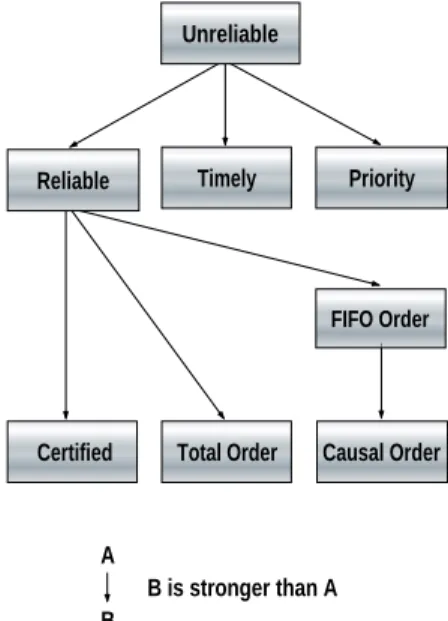
These different semantics are not all mutually exclusive. For instance, obvents can be certified and have some notion of priority, or be certified and totally ordered at the same time. It appears that contradictions reside for instance be-tween reliable and simultaneously timely limited obvents, as well as between total, fifo or causal order and priorities. In the above cases, the first type takes precedence (Figure 4 il-lustrates the dependencies between the different semantics). Note however that we have not yet explored all possible ram-ifications and combinations, and that the identification and implementation of these semantics is an ongoing task.
Note also that for any kind of order expressed by an ob-vent type, its instances satisfy that order with respect to instances of the same type, its subtypes, and supertypes with that same order only.
Priority Timely
Certified Total Order Causal Order Unreliable FIFO Order Reliable B A B is stronger than A
Figure 4: Dependencies between obvent semantics
3.1.3
Expressing Obvent Semantics
In our model, such characteristics are associated with the obvents, and should thus be part of these obvents. Indeed, it makes most sense that every obvent reflects its semantics (which can be seen as a context), such that a correct han-dling of the obvent can be assured at every moment of the transfer. Since instances of an obvent type are bound to the same obvent source, they present the same characteristics. In addition, the obvent type is the only contract between publishers and subscribers, and we have thus chosen to use subtyping to express this limited form of QoS, mandated by
LP4. Figure 3 shows the Java types corresponding to the different semantics outlined above.
Since several characteristics can be combined, this scheme requires some mechanism of expressing multiple subtyping.
LM2 Multiple subtyping. While simple subtyping eases the expression and addition of different event semantics, mul-tiple subtyping enforces the composition of such seman-tics.
This is independent of whether it is assured through some form of multiple inheritance as offered by C++, Cecil [14] or Eiffel, through subtyping abstract types (e.g., interfaces in Java), or evenmixins(e.g., Flavors [47], Ada [35]). The term multiple subtyping here simply denotes the ability of expressing multiple specialization relationships.
3.2
The
publishPrimitive
An obvent can be published, which means that it will be asynchronously sent to any concerned subscriber. Following the Java language specification grammar [29], based on a LALR(1) syntax, we introduce a new statement:
PublishStatement:
publishExpression;
Here Expression is a non-null expression of typeObvent, as opposed to most classes relying on Java serialization: in Java, a serializable root type is often “faked” by using for-mal parameters of the root typejava.lang.Object, yet ex-pecting an object of a specific typejava.io.Serializable and throwing an exception if the actual argument is not of that type. We prefer detecting such type errors at compi-lation. Nevertheless, this primitive can throw an exception of type CannotPublishException, signalling any problems in transmitting the obvent. Figure 3 summarizes the basic exceptions.
3.3
The
subscribePrimitive
As briefly shown in Section 2, we introduce a second prim-itivesubscribe, to express a subscription.
3.3.1
Syntax
A subscription expression combines the subscription to a type T with (1) a closure declaration representing a filter, where the full signature of that first closure is the following:
boolean (T t) {...}
and (2) the declaration of a second closure representing the handler, where the full signature is the following:
void (T t) {...}
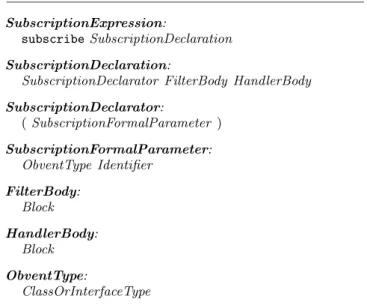
A subscription expression hence has the following syntax in Java (details are given in Figure 5):
SubscriptionExpression:
subscribe ( ObventType Identifier )Block Block
ObventType represents a type which can be widened to the Obvent type, that is, ObventType is a special case of the
ClassOrInterfaceType(§4.3 in [29]). The filter represented by the firstBlockmust return an expression of typeboolean, while the handler returns nothing. The creation of a sub-scription returns an object of typeSubscription(cf. Fig-ure 3). Such a handle uniquely identifies a subscription on a given host.
SubscriptionExpression:
subscribeSubscriptionDeclaration
SubscriptionDeclaration:
SubscriptionDeclarator FilterBody HandlerBody
SubscriptionDeclarator: (SubscriptionFormalParameter ) SubscriptionFormalParameter: ObventType Identifier FilterBody: Block HandlerBody: Block ObventType: ClassOrInterfaceType
Figure 5: Precise syntax of subscription statements
3.3.2
Handlers
Handlers are very close to the closures known from Smalltalk (block closure) or Cecil (anonymous function), and represent an intuitive way of handling callbacks from the underlying event dissemination system.
In languages like Java, which lack support for closures (or
higher order functions [49]), such callbacks are often imple-mented by having the application provide a callback object with a callback method. The argument of such a method represents the effective event of interest. In Java, an inter-face implemented for callbacks is commonly called alistener. To enforce strong typing, the type of the formal argument of a callback method in a listener must conform to the type of the event of interest. This can easily be achieved in lan-guages which supportparametric polymorphism[22], but in any case leads to isolating the event handling in a separate class.
The use of a closure on the other hand enables the re-grouping of all code related to a subscription in a single succinct expression, and since handlers are a specific type of closures, a language which already provides some gen-eral form of closures can easily support the integration of subscription expressions.
LM3 Closures. With handlers being a specific type of clo-sures, a language which provides general closures supports the expression of safely typed subscription primitives. By viewing these closures as objects, the handlers take the role of the subscriber objects outlined in Section 2.
3.3.3
Filters
Akin to handlers, filters are closures with a specific signa-ture. Besides the concentration of subscription-related code, the use of such a syntax in the case of filters is further con-ducted by the desire of confining the code for the filtering, while still “revealing” it. This enables (1) the migration of such code to foreign hosts, as well as (2) the factoring
out of redundancies between filters of different subscribers gathered on individual hosts.
The compilation of these filters is hence deferred, in a sense similar to the paradigm of deferred code evalution known from two-level programming [48] (or generalized to more than two levels,multi-stage programmingas advocated by MetaML [63]).
LM4 Deferred code evaluation. A mechanism providing some form of deferred code evaluation can easily sup-port the expression of safely typed content-based filters, in a way that supports optimizations (avoiding redundant queries) and the checking of the code.
3.3.4
Restrictions on Closures
“Local” closures vary in the degree of self-containment they advocate: the first class block closure in Smalltalk can use any variables in scope at the closure declaration (at com-pilation), and these variables are bound for the entire life-time of the closure, even if it is executed in a context where some of these variables are not visible. To avoid some of this binding of variables, an anonymous class in Java can only ac-cessfinalvariables from the enclosing block in addition to the non-local variables (members) in scope at compilation. The handlers described previously adopt these semantics.
Our “distributed” use of closures in the case of filters re-quires even more restrictions. Any variable used in a filter might reference an object (which might reference an object, etc.) of a type which is not known on a host where that filter is evaluated, forcing the transfer of code. Similarly, any method invocation, whether performed on a variable or as a static call, might force the transfer of further code. In the case of Java, a class can be compiled if the types it uses are present as byte code, and it is very difficult to fore-see the effects of calls to classes based on their byte code. Thus, method invocations (including the use of construc-tors) should be cut down to the essential ones, in order to avoid filters using opaque code as well as types unknown on filtering hosts.
Invocations: The only method invocations allowed in a filter are (nested) invocations on its variables.
Variables: The only variables allowed in a filter are (1) the formal argument representing a filtered obvent, (2) local variables, and (3)finalouter variables (from the enclos-ing block or class members). Latter two types of vari-ables are restricted to primitive types (e.g.,int) and their object-counterparts (e.g.,java.lang.Integer), including java.lang.String.
These restrictions enforce the location-independency of the expressed filter, offering the possibility of applying it at a more favourable stage (e.g., a remote host) to reduce network load and filtering cost. If the filter declares any local variables of unallowed types, or performs invocations differing from the ones described above, its migration might be problematic. In such a scenario, the filter is applied lo-cally (cf. next section).
Note that the above restrictions do not fully guarantee the location-independency of the filter, e.g., any Java object referred to by a variable gives access to a meta-object rep-resenting its class (java.lang.Class), through which many
“undesired” things can be done. We will come back to this particular case in Section 5. At the present, we are inves-tigating a precise semantical definition of filters, aimed at ensuring their “mobility”.
3.3.5
Thread Policies
Once an obvent has reached a process hosting an inter-ested subscriber, it is delivered by executing the handler. This is comparable to an RPC-style invocation of an arbi-trary method of abound object, in the sense that the thread which is used in that target object’s process for the invoca-tion is blocked until compleinvoca-tion of that invocainvoca-tion; the main difference being that an invocation made in the context of an RPC can yield a reply which is sent back to the invoker. There are different levels of concurrency which can be sup-ported. In our context, we distinguish between two kinds of
thread policies:
Multi-threading: A handler can be executed concurrently for any number of obvents. These semantics are assumed by default, except in the case of ordered obvents.
Single-threading: A handler never processes more than one obvent at a time.
One could easily extend this set, for instance by a thread policy ensuring that only one instance of the same obvent class is processed at a time.
Note that Java already integrates mechanisms for con-currency control with which the two above policies can be achieved. To ensure that never more than one obvent is processed at a time by a handler, one could easily write:
final Object lock = new Object(); Subscription s = subscribe (T t)
{...} {
synchronized(lock) { /* handler */ } };
However, in languages which do not integrate any rency mechanisms, to obtain more sophisticated concur-rency control, or to involve the publish/subscribe system into concurrency issues with the goal of optimizing concur-rency, thread policies should be made explicit. In our case, it seems most straightforward to express these through the subscription handle, since such an object uniquely defines a subscription. To control such parameters, corresponding methods are added to the Subscription type shown in Figure 3.
In general, the expression of QoS has been probably the most tedious task when devising our language primitives. Such QoS seem to become increasingly important when pro-gramming at a distributed scale, but there is to our knowl-edge only very little work on how to inherently express QoS in a programming language, in an other way than through an API.
3.4
Managing Subscriptions
As explained above, thesubscribe primitive creates an expression representing a subscription. Such a subscription must then be activated, triggering the effective action of sub-scribing, and later on, deactivated, representing the action of unsubscribing.
3.4.1
Activating a Subscription
A subscription is activated by a call to the activate() method on the corresponding subscription handle. This method throws a CannotSubscribeException exception if the subscription can not be issued, e.g., if the subscription is already activated.
Subscription s = ...; s.activate(); ...
The variant of theactivate() method with a long argu-ment is used in combination with certified events. Indeed, with such events, the lifetime of subscriptions might exceed the actual lifetime of the hosting process. When recover-ing from a failure, or reactivatrecover-ing an intentionally deacti-vated subscription, the concerned subscription can be (lo-cally) uniquely identified by using this method.
3.4.2
Deactivating a Subscription
Similarly, the action of unsubscribing is expressed through a deactivate() method defined on subscrip-tion handles, which can throw an exception of type CannotUnsubscribeException.
...
s.deactivate(); ...
As an immediate consequence, subscriptions can be can-celled also from inside a subscription, i.e., its associated handler. This is interesting when a particular event, from the point of view of the concerned subscriber, supersedes any following events, or signals the absence of any further events. Since a handler can only handlefinalvariables de-clared in its enclosing block however, the variable that the subscription handle is assigned to must be declared outside of that block, for instance as a private attribute of the en-closing class.
The activation/deactivation of subscriptions can be inter-leavingly performed an unlimited number of times. Cor-responding exceptions are also thrown upon an attempt of (de-)activating an already (de-)activated subscription.
4.
IMPLEMENTATION ISSUES
This section depicts how we have implemented our primi-tives for publish/subscribe interaction in Java in a way that satisfies the principles stated in Section 1.
4.1
General Implementation Choices
Along the lines of extensions to the Java language like Pizza [49] (adding parametric polymorphism, algebraic types and closures) or [8] (for multi-methods), we refrain from incorporating any new features into the Java virtual machine, as well as from extending a given compiler, or even modifying existing packages and classes of the Java environment. Instead, we advocate the use of a precompiler as the publish/subscribe counterpart to thermic compiler for generation of remote invocation proxies [61].
Since remote invocations benefit from an inherent support from the language, they require no specific primitives, and hence only remotely invocable Java types have to be com-piled withrmic. Besides generating obvent-specific classes,
ourpscprecompiler translates publish/subscribe statements and expressions to calls to these classes, and must hence be run not only on obvent types, but also on any class making use of our primitives.
4.2
DACE Distributed Architecture
The Distributed Asynchronous Computing Environment
(DACE) infrastructure has been initially developed as a general architecture to support publish/subscribe in-teraction, and has later been specialized for type-based publish/subscribe. The DACE architecture can be roughly pictured as relying on a class-based dissemination [22]. Every obvent class is mapped to a dissemination channel, representing a multicast group, which we refer to as multi-cast class. In the DACE architecture, such multicast classes are then implemented with different multicast protocols with guarantees ranging from strong guarantees (exploiting a broad variety of primitives from group communication
[6], e.g., for causal ordering) to primitives with weaker guarantees but strong focus on scalability (network-level
protocols like IP multicast [18] or its derivates, e.g., [54, 33, 26], orgossip-based protocols, e.g., [5, 62, 23]).
We have adopted a reflexive approach, by using specific channels to disseminate protocol messages, like subscrip-tion/unsubscription requests, or the advertisement of the publishing of obvents. Such messages are obvents them-selves, and allow distributed processes to learn about other, possibly new, multicast classes.
4.3
Typed Adapters
To avoid making the Java virtual machine distribution-aware, and also to exploit our class-based dissemination, we adopt theadapter [50] concept. Adapters are intermediate entities between the communication system and the applica-tion, whose role consists mainly in mediating between events in a serialized representation and objects.
In our case, adapters mainly mediate between serialized generic objects and strongly typed obvents. In other terms, adapters are type-specific, and are generated for each ob-vent class by thepsccompiler. For any given obvent class C psc generates a class CAdapter with code for publish-ing/subscribing instances of C. Similarly, to support sub-scriptions to abstract types (interfaces), for any given ab-stract obvent type I, psc generates a class IAdapter with code for subscribing to instances of I. Figure 6 illustrates an adapter for a given obvent typeT.3
4.4
Translating Primitives
With ourpsc precompiler, publish/subscribe statements and expressions are translated to method invocations.
4.4.1
Publishing
Since a published obvent is disseminated through the adapter for its dynamic type, which is only known at run-time, a PublishStatement can not be directly transformed to a call to publish on the corresponding adapter class. Hence, we add apublish()method to theObventinterface 3Interestingly, the same parametric polymorphism applied to the first class adapters used in our library approach [24], can not be applied here due to the purely static nature of the adapters.
import java.pubsub.*;
public final class TAdapter {
public static Subscription subscribe(LocalFilter l, Subscriber s) public static Subscription subscribe(RemoteFilter r,
Subscriber s) /* if T is a class */
public static void publish(T t) throws CannotPublishException {...} ...
}
Figure 6: Obvent adapter for a typeT
in Java (Figure 7), whose body is however automatically generated bypscfor each obvent classC:
public class C ... { /* generated by psc */ public void publish()
throws CannotPublishException { CAdapter.publish(this); } ...
}
Accordingly, a PublishStatement expressing the publish-ing of anObvent o,
publish o;
is transformed into a call to the publish()method of o, provided thato’s static type can be widened toObvent.
o.publish();
Note that every obvent class must implement a public no-argument constructor, in order to enforce deserialization with Java’s built-in mechanisms.
4.4.2
Subscriptions
By similarly transforming subscriptions to (static) calls to the corresponding obvent types, subscriptions to interfaces would be impossible. Hence, subscriptions, as well as unsub-scriptions, are handled differently. In short, a subscription statement involving a typeTis transformed to an invocation of one of thesubscribe()methods in classTAdapter (pos-sibly alsoOventAdapterin packagejava.pubsub), as shown in Figure 6.
An instance of an anonymous class representing a sub-scriber is created from the handler of a subscription expres-sion such as the following:
subscribe (T t) {...} { /* handler */ }
It implements theSubscriberinterface given in Figure 7:
new Subscriber() {
public void notify(Obvent o) { T t = (T)o;
/* handler */ }
package java.pubsub; import java.io.*; /* obvents */
public interface Obvent extends Serializable { /* generated by psc */
public void publish() throws CannotPublishException; }
/* top level */
public final class ObventAdapter {...}
public static Subscription subscribe(LocalFilter l, Subscriber s) public static Subscription subscribe(RemoteFilter r,
Subscriber s) }
/* filters */
public interface Filter {...}
public interface RemoteFilter extends Filter {...} public interface LocalFilter extends Filter {
public boolean eval(Obvent o); }
/* handlers */
public interface Subscriber { public void notify(Obvent o); }
Figure 7: Details of Obvent, and further types in
java.pubsub
Such an anonymous class declaration represents an ex-pression, and can thus be passed as argument to the subscribe()method of the corresponding adapter.
4.4.3
Filters
The handling of filters represents the most complex task during precompilation. A filter whose statements deviate from the guidelines which strongly enforce its mobility ac-cording to the previous section, is similarly transformed into an anonymous class representing a unary predicate of type LocalFiltershown in Figure 7, and applied locally. A sub-scription expression such as
subscribe (T t) { /* filter */ } {...}
is hence transformed into an invocation of the corresponding adapter class:
TAdapter.subscribe( new LocalFilter() {
public boolean eval(Obvent o) { T t = (T)o; /* filter */ } }, new Subscriber() {...} )
If the depicted restrictions are respected,pscgenerates an intermediate representation of the filter, in a way similar to
what is done for application-specific handlers (ASHs) [20], low-level message filters, except that those are applied lo-cally and expressed in a neutral specification language, while our filters promote the use of the native language syntax. Our precompiler generates two tree-like constructs, which are more specific than for instance the parse trees used in Smalltalk [57].
Invocation tree: First, a representation of the invocations made in the filter is generated: the root represents the filtered obvent, and every node represents a method invo-cation. A leaf node stands for the outcome of a condition on the value obtained by applying the methods of the nodes on the path downto that leaf in a nested fashion (nodes can also represent attribute accesses).
Evaluation tree: Second, a tree representing the relation-ships between the leaves of the former tree and the out-come of the filtering is generated: its nodes represent mainly logical combinations of its subnodes aso., and the leaves are references to the leaves of the former tree. This information is stored in an instance ofRemoteFilter (Figure 7).
A general description of our approach to instrumenting Java with first class parse trees, based on a generalization of deferred code evaluation expressed through filters, will be the subject of a future paper.
5.
DISCUSSION
This section discusses several issues, including two design alternatives as well as interoperability issues. We also con-trast our type-based publish/subscribe with RMI, pointing our the fact that the two paradigms are not contradictory but complementary.
5.1
Fork
We have explored several alternative primitives for the expression of publish/subscribe based on our obvent model, among which we outline what we believe to be the two which are most likely to come into mind. This first alternative for the expression of publish/subscribe based on our obvent model makes use of afork-similar primitive for notification delivery.
5.1.1
Obvent Variable
A new notification is assigned to a variable, and a block representing a handler is executed every time a new value is put into the variable:
T t = null;
t = subscribe {...} {...}; /* here t is null */
This primitive could, in the case of Java, be implemented similarly to the solution presented throughout this paper. However this syntax makes it difficult to express unsubscrip-tions, a problem which does not occur in the case of thefork primitive: when spawning a new coroutine, the execution of the corresponding block takes place once only. Here, noti-fications are delivered continuously, leading to a repeated evaluation of the handler. By the absence of a subscription handle, a subscription can not be referred to from outside
of its expression. Unsubscriptions would have to be dealt with inside the handlers, either through a parameterless un-subscription statement, or by having the handler return a boolean value after each obvent evaluation to signal whether the subscription is to be pursued. Either variant leads to a restrictive solution, where a subscription can only be can-celled after the next event has been delivered. While this can be desirable in many cases, it should not be the only possibility of cancelling a subscription.
5.1.2
Filter
Note that alternatively, with this model, one could think of implementing filters by giving the application the pos-sibility of instantiating the future variable t, and in that sense, using it simultaneously as atemplate object:
T t = new T(...); t = subscribe {...};
However, filtering events by matching them against tem-plate objects offers only little expressiveness: temtem-plate ob-jects are usually compared attribute-wise with events, mak-ing the matchmak-ing of an attribute against a range of values, or, since attributes might themselves be objects, the match-ing only of a nested attribute difficult to express. Alterna-tively, the matching can be performed inside the template object, which renders the matching opaque, disabling any optimizations targeted at avoiding redundancies.
5.2
Callback
As outlined in Section 3, a very common way of imple-menting a callback in a language such as Java consists in asking the application to provide a callback object imple-menting a given interface.
5.2.1
Listener
This second considered alternative, which is promoted by nearly all Java API’s for common publish/subscribe engines, introduces a specific listener like the Subscribertype pre-sented in Figure 7. This type, which, as depicted, is inher-ently implemented by every anonymous class representing a handler, would in this case be explicitly implemented and instantiated by the application to catch event notifications, e.g.:
Subscriber sr = ...;
Subscription s = subscribe (T t) { / *filter* / } sr;
The declarednotify()method with its weakly typed argu-ment does however not addressLP1. Adynamic overriding
of thenotify() method, i.e., adding a variant with an ar-gument typeT that subtypes Obventin order to subscribe to instances of T
public void notify(T t) {...}
would also allow handlers for several obvent types to be pro-vided by the same subscriber, yet does not add type safety.
5.2.2
Dispatching
Through this dynamic overriding, thenotifymethod be-comes a so-called multi-method. Yet,dispatching (method selection) in Java, unlike CLOS [36] or Cecil, does not sup-port multi-methods. Dispatching in Java, similarly than in
C++, offersdynamic uni-dispatch, i.e., the class of the ob-ject referenced by an invoked variable (representing its dy-namic type) is determined at runtime, but onlystatic multi-dispatch. This prevents a typed solution based on dynamic overriding of thenotify()method desribed above.
There have been several approaches to overcoming Java’s lack for multi-methods, ranging from using reflection over modifying the compilation to extending the virtual ma-chine. Another common technique is also given by double dispatch [34], which could however not be applied in this case, like some of the other solutions, unless a specific subscriber TSubscriber is generated and implemented for every obvent type T that a subscriber type handles. This would however remove the main advantage of this approach based on listeners, which consists namely in giving much freedom to the developer in defining event handlers for any types (including subtypes of subscribed types). In addition, the required dynamic multi-dispatch is a high price to pay, especially if only introduced for the use with publish/subscribe primitives, also given the fact that it does not improve type safety.
Note furthermore, that the scenario of multiple subscrip-tions of a subscriber to the same type, or through subtyp-ing related types, is not straightforward to handle: are the different filters combined, and is the same event delivered several times? On the other hand, the callback approach enables an easy expressing of thread policies: by subtyping aSingleThreadSubscriber, the developer could express the desire of processing only one instance of a given obvent type at a time. Multiple subtyping, introduced to express a lim-ited form of QoS for obvents, could here be used again to express complex event handling semantics.
5.3
Obvents vs Objects
In languages which provide a default serialization mech-anism through a type which must be subtyped, e.g., Java (java.io.Serializable), obvents are instances of that type. Hence in a general case, as shown by our distinction between bound/unbound objects, not every object can be an obvent: the opposite would have not only mandated the type system to be singly-rooted (requiring extensions to languages like C++ and Ada), but also to integrate the before-mentioned serialization mechanism at that very root like in Smalltalk, possibly including apublish()method.
How about an obvent publishing obvents, or subscribing to obvents? The former case does not bear any particu-lar dangers, and should thus not be prohibited. Simiparticu-larly, subscriptions could also be issued inside obvents, since a subscription expression does not affect the object in which it was declared. The effective handlers/subscribers can not be referenced, and hence can not be passed around, and in particular, can not be attributes of obvents. To underline this characteristic of subscriptions, theSubscriptiontype is not serializable.
Note that in the second presented design alternative, any application object can be defined as a subscriber by im-plementing a given interface, that is, a notify() method. Equipping all objects with the ability of subscribing would have translated to adding thatnotify()method to the root type. Furthermore, subscribers could be attributes of vents. The danger of endless recursions whenever an
ob-vent subscribes to itself could however easily be banned, by not considering a subscription as part of the state of a subscribed obvent: once published, the copies of an obvent would have to reissue any subscriptions performed by their “master copy”.
5.4
RPC and Publish/Subscribe
Originally introduced asremote procedure call (RPC) [7], remote invocations have been quickly applied to object-oriented languages, leveraging some form of remotely accessible entity, e.g.,guardiansin Argus [41] (its follow-up CLU [42]),network objects in Modula-3 [11] and Obliq [10] (every object is potentially a network object), and of course
remote objectsin Java RMI [61].
5.4.1
Invocations vs Events
There are mainly two differences between such remote in-vocations and our event-based model:
Interaction styles: The RPC model promotes the same ab-straction for remote object interactions as for local ones. By doing so, (synchronous) RPC is inherently integrated with the language, and requires little more support than that very inherent interaction abstraction. In contrast, our model promotes two interaction styles, namely (1) event-based publish/subscribe interaction remotely, and (2) method invocations locally, making the application developer more aware of distribution.
Object passing semantics: With remote invocations, there are two possible ways of passing objects, namely (1) by
reference, i.e., a proxy object is created in the receiver’s address space, and (2) by value. The distinction goes along the notion of the granularity mediated in Section 2, i.e., “large” locality-bound objects interact via remote in-vocations, where the invocation arguments are “small” unbound objects or references to “large” remotely invo-cable objects. In contrast, when using our obvent-based model, objects are primarily passed by value.
However, publish/subscribe and RPC are not contradic-tory, but complement each other. A combination of both represents a very powerful tool for devising distributed ap-plications, e.g., by passing object references with obvents.
5.4.2
Hand in Hand
A collaboration between the two interaction styles can be illustrated by reconsidering the simple example given in Sec-tion 2. Though the use of a publish/subscribe interacSec-tion for the dissemination of stock quotes seems appropriate by scal-ing easily to many brokers, it might seem more appropriate to use a sychronous interaction with the stock market when purchasing stock options, e.g., a remote method invocation. Figure 8 shows how Java RMI and publish/subscribe can work together, hand in hand. To correctly handle the seri-alization of remote objects (in the sense of RMI), the RMI serialization mechanism is used, enabling a transparent in-tegration of RMI and publish/subscribe. However, the cur-rent implementation of Java RMI presents a severe caveat, which becomes especially visible through this integration with events. In fact, the distributed garbage collection keeps a remotely accessible object from being garbage collected as long as there is at least one proxy for that object. When
publishing an event containing a reference to a remote ob-ject, such a proxy is created for each subscriber, which can sum up to several 1000’s. Every time a proxy is garbage col-lected, the Java virtual machine hosting the represented ob-ject is notified. Consequently, if a single subscriber crashes, the remote object will never be garbage collected. With a “weaker” implementation of Java RMI, such as the one proposed in [13], this problem could be circumvented.
5.5
100% Pure Content
Java, like most statically typed languages, uses name equivalence of types, which means that two types are compatible only if declared so. If two different typesT1and T2 have exactly the same parents in their type hierarchy, instances ofT1can not be assigned to variables ofT2or vice versa. A type scheme which allows this is said to enforce
structural equivalenceof types.
5.5.1
Reflection
When subscribing to obvents it might be of interest in cer-tain cases to subscribe toany obvents which implement a given method (specified by its name and formal/actual pa-rameters) irrespective of the types of these obvents. Java, just like Smalltalk, providesintrospection mechanisms [60], that enable the querying of objects for their type, and also members (attributes and methods, including facilities for dynamically reading/writing former ones and invoking lat-ter ones). Every Java object gives access to these features through a methodgetClass(), which would enable the ex-pression of a purely content-based subscription like the fol-lowing:
Subscription s = subscribe (Obvent o) {
...
Class c = o.getClass();
Method m = c.getMethod("getPrice", null); return
m.invoke(o,null).equals(new Float(150)); ...
} {...};
Now,anyobvent type which implements a given method getPrice()(e.g., the StockQuoteclass) could be captured by this filter, and the following handler could similarly dynamically extract information from a conforming event. This feature, though giving much flexibility to the appli-cation developer, is somehow opposed to our requirement for type safety (LP1), and we therefore do not consider introspection as a necessary language mechanism, though our current Java prototype supports such untyped filters. As shown by most currently existing engines, the lack for reflection in programming languages can be made up easily by providing specific event types which explicitly implement a form of introspection, like the self-describing messages advocated by [50].
5.5.2
Tuples: Back to the Roots
Another way of achieving structural equivalence could consist in coming back to the concept of tuples used in Linda [28] (see next section), one of the spiritual ancestors of the publish/subscribe pardigm. In that sense, the publishprimitive could be extended in order to accept any number of actual arguments:
import java.rmi.*; import java.rmi.server.*; import java.pubsub.*; /* user */
public interface StockBroker extends Remote {...} /* stock market */
public interface StockMarket extends Remote { public boolean buy(String company, float price,
int amount, StockBroker buyer) throws RemoteException;
... }
/* stock quote obvents */
public class StockObvent implements Obvent { private String company;
private float price; private int amount;
public String getCompany() { return company; } public float getPrice() { return price; } public int getAmount() { return amount; } public StockObvent(String company, float price,
int amount) { this.company = company; this.price = price; this.amount = amount; } }
public class StockQuote extends StockObvent { private StockMarket market;
public Stockmarket getMarket() { return market; } public StockObvent(String company, float price,
int amount, StockMarket market) {
super(company, price, amount); this.market = market;
} }
/* subscribing */
final StockBroker broker = ...; /* this broker */ ...
Subscription s =
subscribe (StockQuote q) { return (q.getPrice() < 100 &&
q.getCompany().indexOf("Telco") != -1); } { ... boolean bought = q.getMarket().buy(q.getCompany(), q.getPrice(), q.getAmount(), broker); ... }; ...
Figure 8: Buying stock quotes
String company = ...; float price = ...; int amount = ...;
StockMarket market = ...;
publish (company, price, amount, market);
Inversely, thesubscribeprimitive could be used with an arbitrary number of formal arguments, e.g,
Subscription s = subscribe (String company, float price, int amount,
StockMarket market) { /* filter */ }
{ /* handler */ };
which could all be used as subscription criteria by the filter, and could all be accessed by the handler.
Though one can argue that languages which do not inher-ently support structural equivalence should not be instru-mented with a distributed interaction style that relies on that paradigm, we believe that this could lead to a very ap-pealing style of distributed programming; requiring however a more complex filtering.
5.6
Language Integration vs Interoperability
Language integration seems to be somehow contradictory with the requirement of interoperability expressed in [50]. Publish/subscribe has however nowadays found application in various contexts (e.g, virtual reality [30], group collabora-tion [44], real time [25]), mainly due to its scalability prop-erties achieved through strong decoupling of participants.Just like CORBA [52] has added interoperability to the RPC through a neutral interface description language
(IDL), there have been several approaches to using a neutral event description language (EDL) to help adding interoperability to publish/subscribe. Proposals for such languages are plentiful, like the OMG’s object definition language(ODL) used in the Cambridge Event Architecture [4], languages used in tuple space implementations, e.g.,
object interchange language (OIL) in Objective Linda [37], or more recently, XML.
We believe that such a specification language could help adding interoperability to our system, and that in that sense, the types in packagejava.pubsubcan be seen as a Java map-ping. However, since events are in our case not pictured as structures as in the above cases, but also encompass meth-ods and thus code, an EDL can not by itself provide for interoperability. The issue of passing objects by value from one language to another has also been tackled in CORBA, and we are currently investigating on the impact of an ap-plication of those concepts to our system.
6.
RELATED WORK
Though publish/subscribe engines are plentiful, there has been only little work on integrating publish/subscribe inter-action with an object-oriented programming language up to now. We first overview the two closest efforts, and then focus on linguistic support for alternative distributed interaction styles other than RPC, which has already been discussed previously.
6.1
Publish/Subscribe
Most event-based solutions focus less on language integra-tion, and more on interoperability.
6.1.1
ECO
One approach to integrating event-based interaction with C++ is discussed in [30], but also starting from a general event model. The authors dissociate two ways of adding event semantics to an object-oriented language, namely (1) by extension with specific constructs and (2) by addition of specific classes, adopting the first approach. Their ECO (events + constraints + objects) model incorporates events as specific language constructs which are complementary to objects, and thus necessitate a considerable number of lan-guage add-ons. The use of a precompiler to handle these extensions is also mentioned, but [30] gives no details about its implementation.
6.1.2
CEA
The Cambridge Event Architecture (CEA) [4] promotes a publish/register/notify interaction style, where an inter-mediate event trader inter-mediates between publishers and sub-scribers. The CEA is based on an interopable object model, in which events are described by the ODMG’s object def-inition language (ODL), but alternative specification lan-guages, like XML, are also mentioned. Events are typed according to the definition language, and C++ and Java mappings are mentioned. Filtering mechanisms are also in-cluded, however based on viewing the events as sets of at-tributes, forcing the application to define filters based on attribute-value pairs.
6.2
Message Passing
Language integration has evolved along the communi-cation paradigms. One of the first distributed interaction paradigms was message passing, consisting basically of a usually asynchronous send of messages (mainly for single sends, but also for addressing groups similar to publish), and a blocking receive primitive. Like many “distributed” interaction paradigms, message passing has also extensively been used first in parallel and concurrent programming. Early, mainly procedural and process-oriented languages, like Occam [56] (using named unidirectional channels) or also SR [3] (first only with semi-synchronous sends, later also with synchronous remote procedure calls), included some form of message passing.
6.3
Tuple Spaces
The well-known tuple space paradigm [28] represents the distributed interaction scheme which is closest to publish/subscribe.
6.3.1
The Original
The tuple space, first introduced for parallel computing in Linda, can be viewed as a form of distributed shared mem-ory, with the main difference being the structured form of data inserted into and retrieved from the tuple space: tu-plesinserted into a tuple space are sets of values, and tuples read from the space are specified as a set of formal and actual arguments, where former ones can be seen as placeholders defining the types of the corresponding elements, and latter
ones define the values of the corresponding elements for a candidate tuple.
6.3.2
Decoupling
The original tuple space in Linda was based on a form of name-based addressing, i.e., tuple elements could be strings carrying a specific name. This idea has been reused in the “original” publish/subscribe variant based on topics, and the possibility of using more than one name element in Linda has been straightforwardly transposed to topic hier-archies, expressing containment relationships on topics. In general, the publish/subscribe paradigm has been strongly influenced by the tuple space, more specifically by its strong
decouplingof participants intime and inspace.
6.3.3
Publish/Subscribe vs Tuple Space
Publish/subscribe further increases this decoupling by adding flow decoupling, that is, replacing the synchronous interaction (pulling) of the subscribers with an asyn-chronous notification mechanism. In fact, the original tuple space had three primitives, namely (1)outto push a tuple into the space (similarly to publish), (2) read to read a tuple without erasing it, and (3) in to withdraw a tuple from the space. Publish/subscribe adds an asynchronous callback mechanism, and by omitting an equivalence toin, sacrifices concurrency control to scalability.
6.3.4
Linguistic Support
There have been a series of attempts to transform the structured form of tuples to anobject form, mainly by ex-tending the exact type equivalence for tuple elements in Linda to the notion of subtyping. While early approaches to integrating the tuple space with an object language like [45] (for Smalltalk) promoted tuples as sets of objects, later approaches, like [55] (C++) or [37] (Objective Linda) con-sidered tuples, just like events in our case, as single first class citizens, and added some form of content-based match-ing based on templates. Very recently, callback mecha-nisms have also been added, e.g. JavaSpaces [27], TSpaces [40] (both Java), supporting a publish/subscribe-like inter-action. In contrast to our approach however, latter ones ba-sically promote publish/subscribe interaction through some weakly typed first class channel, and advocate template-based matching.
7.
CONCLUDING REMARK
Throughout the history of computing, many paradigms have first been implemented as separate libraries, and have then made their way into programming languages. The
monitorabstraction for concurrent programming introduced by Hoare [32] for instance, was first implemented through a library before becoming a specific language construct (e.g., Portal [9]). Nowadays, every Java object is potentially a monitor.
This evolution does however not apply to all paradigms, as can be shown again by Java, which currently only includes a limited form of pointers through a library (Reference injava.lang.ref), while one of main spiritual ancestors, C++, integrates pointers as a first class concept.
This paper does not aim at advocating an integration vs a library approach to support publish/subscribe