Theses & Dissertations Boston University Theses & Dissertations
2016
The effect of teacher self-disclosure
on student motivation and affect
toward teacher in online education
https://hdl.handle.net/2144/17103Dissertation
THE EFFECT OF TEACHER SELF-DISCLOSURE ON STUDENT MOTIVATION AND AFFECT TOWARD TEACHER
IN ONLINE EDUCATION
by
ELDON M. STRICKLAND, III B.A., Boston University, 1986 M.A., New York University, 1996
Submitted in partial fulfillment of the requirements for the degree of
Doctor of Education 2016
© 2016 by
ELDON M. STRICKLAND, III All rights reserved
First Reader ________________________________________________________ Stephan E. Ellenwood, Ph.D.
Associate Professor of Education
Second Reader ________________________________________________________
Jordana R. Muroff, Ph.D.
Associate Professor of Clinical Practice
Third Reader ________________________________________________________
Karen Jacobs, Ed.D., CPE, OTR/L, FAOTA Clinical Professor of Occupational Therapy
Fourth Reader ________________________________________________________
Bruce Fraser, Ph.D.
iv
v
Jacobs, and Bruce Fraser for their time working with me through this laborious process; to Professor David Whittier, who inspired me to pursue my interest in education, media, and technology and who shares my interest in transforming education; to my parents, who supported my early educational dreams; Samantha Dearborn for her editing expertise and making me a better writer; and to my partner Libor, who supported me through the endless hours of data collection, writing, rewriting, and witnessed of the completion of this endeavor.
vi
IN ONLINE EDUCATION ELDON M. STRICKLAND, III Boston University School of Education, 2016
Major Professor: Stephan E. Ellenwood, Ph.D., Associate Professor of Education ABSTRACT
Combined with advancements in technology, prior research investigating the teacher-student relationship has radically changed the way we teach and learn in online education. This study examined the way teacher self-disclosure (TSD) influenced student motivation to enroll in an online course and altered their affect, or feelings, toward the teacher when applied within a purely online learning setting. The experiment took place online and was built within a Boston University’s learning management system (LMS), Blackboard Learn. In the online environment, TSD was controlled to provide high levels of male and female TSD in two treatment groups and a complete absence of TSD in two control groups. Out of the 336 Master of Social Work (MSW) students that responded to the recruitment email, 84 students were placed in one of four online settings led by fictional male and female teachers. Students in the treatment groups were granted access to male or female TSD via a Meet the Professor tab within the online learning
environment. This tab provided students with access to content collected from social media websites, such as LinkedIn, Pinterest, YouTube, and Twitter on a single web page. The social media content displayed personal and professional information about these
vii
(control) or including (treatment) TSD. Before and after exploring the sample course, participants completed pre- and post-surveys measuring their motivation to engage in the online course materials, their affect toward the teacher (ATT), and their perceptions of TSD within the online learning environment. Hypothesis testing using ANCOVA, correlation, t-test, and Chi-squared procedures revealed no statistical significance. Findings include recommendations for methodological requirement need to explore the complexities of the teacher-student relationship within a purely online learning
viii
DEDICATION ... iv
ACKNOWLEDGMENTS ... v
ABSTRACT ... vi
TABLE OF CONTENTS ... viii
LIST OF TABLES ... xv
LIST OF FIGURES ... xvi
LIST OF ILLUSTRATIONS ... xvii
LIST OF ABBREVIATIONS ... xviii
GLOSSARY ... xix
CHAPTER ONE: INTRODUCTION ... 1
Teacher Immediacy to Self-Disclosure ... 4
Problem Statement ... 7
Historical and Theoretical Frameworks ... 8
Teacher-Student Relationship in Learning ... 9
Teaching with Technology ... 11
Instructional Communication Theory ... 13
Study Aims ... 16
ix
Teacher Immediacy ... 26
Teacher Self-Disclosure ... 28
Interpersonal Self-Disclosure ... 29
Self-Disclosure: Breadth and Depth ... 30
Self-Disclosure: Amount, Reciprocity, and Curvilinear Relationships ... 31
Self-Disclosure: Gender and Content ... 33
Self-Disclosure: Gender and Liking ... 34
Teacher Self-Disclosure in Face-to-Face Classrooms: Gender and Timing ... 35
Teacher Self-Disclosure and Affective Learning ... 37
Student Affect Toward Teacher Research ... 39
Teacher Self-Disclosure, Gender, and Student Motivation ... 42
Student Motivation Research ... 45
Mediated Instructional Communication ... 47
Computer-Mediated Communication Research ... 48
Teacher Self-Disclosure and Social Media Research ... 50
Current Issues in Teaching Online ... 51
Research Area of this Study ... 53
CHAPTER THREE: METHODS ... 55
Introduction ... 55
x
Research Question and Hypothesis 2 ... 58
Research Question and Hypothesis 3 ... 58
Research Question and Hypothesis 4 ... 59
Online Environment Overview ... 61
Online Control and Treatment Groups ... 64
Study Procedures ... 65
Pilot Testing the Self-Paced Online Learning Environment ... 65
Study Participants ... 65
Participant Recruitment, Enrollment, and LMS Access ... 67
Timeline of Research Study Sessions ... 67
Instructor Gender in Control and Treatment Groups ... 67
Teacher Self-Disclosure – Treatment and Rationale ... 68
Teacher Self-Disclosure and Social Media – Use and Rationale ... 70
Online Surveys and Measures ... 72
Participant Expectancy Construct ... 73
State Motivation Construct ... 74
Affect Toward Teacher Construct ... 75
Teacher Self-Disclosure Construct ... 76
Open-Ended Questions ... 77
xi
Steps 4: Post-Study Surveys ... 84
Steps 5: Disclosure Statement ... 85
Data Analysis Procedures ... 86
Data Coding and Normalization ... 86
Cronbach Alpha ... 87
Analysis of Covariance (ANCOVA) ... 88
Hypothesis 1 Data Analysis ... 88
Hypothesis 2 Data Analysis ... 89
Hypothesis 3 Data Analysis ... 90
Hypothesis 4 Data Analysis ... 92
One-Sample and Independent T-Test ... 93
Pearson’s Correlations ... 94
Qualitative Data Collection ... 94
CHAPTER FOUR: RESULTS ... 95
Participant Demographic Data ... 95
TSD and Post State Motivation Results ... 97
Hypothesis 1... 97
Hypothesis 1a ... 98
Hypothesis 1b... 98
xii
TSD and Affect Toward Teacher Results ... 102
Hypothesis 3... 102
Hypothesis 3a ... 103
Hypothesis 3b... 103
TSD on Participant Perception of TSD Results ... 104
Hypothesis 4... 104
Hypothesis 4a ... 104
Hypothesis 4b... 105
Qualitative Themes from Responses to Open-Ended Questions ... 105
Supplemental Data Analysis ... 109
CHAPTER FIVE: DISCUSSION ... 111
Discussion ... 111
The Impact of TSD and Gender on Student Motivation ... 112
Measuring Perceptions of TSD and Student Motivation ... 112
The Relationship between TSD and Gender on Students' Affect the Toward Teacher ... 115
Measuring Perceptions of TSD and Student Affect Toward Teacher ... 116
The Effects of TSD and Gender on Student Percpetion of TSD ... 117
Exploring Perceptions of TSD and Instructor Gender ... 118
xiii
Current Trends in Online Learning ... 123
Conclusions ... 126
Further Research ... 128
APPENDIX A: RECRUITMENT EMAIL ... 130
APPENDIX B: 7-DAY FOLLOW-UP EMAIL ... 131
APPENDIX C: STEP-BY-STEP STUDY INSTRUCTIONS ... 132
APPENDIX D: CONSENT FORM ... 133
APPENDIX E: INSTRUCTIONS READ PRIOR TO TAKING A SURVEY ... 137
APPENDIX F: EXPECTANCY RATING SCALE ... 138
APPENDIX G: PRE/POST-STATE MOTIVATION SCALE ... 139
APPENDIX H: AFFECT TOWARD TEACHER SCALE ... 142
APPENDIX I: TEACHER SELF-DISCLOSURE SCALE ... 144
APPENDIX J: OPEN-ENDED QUESTIONS... 148
APPENDIX K: DISCLOSURE FORM ... 150
APPENDIX L: FEMALE AND MALE MEET THE PROFESSOR TABS ... 151
APPENDIX M: FEMALE AND MALE DAILY TWITTER POSTS ... 152
xiv
CURRICULUM VITAE ... 169 REFERENCES ... 171
xv
Table 3.2 Hypotheses 1 Testing ... 89
Table 3.3 Hypothesis 2 Testing ... 90
Table 3.4 Hypotheses 3 Testing ... 91
Table 3.5 Hypotheses 4 Testing ... 92
Table 3.6 Independent T-Tests ... 93
Table 4.1 Participant Demographic Data No TSD or TSD ... 96
xvi
Interaction, and Transaction Communication Patterns (Mottet et al., 2006) ... 24 Figure 3.1 The Self-Paced Online Learning Environment ... 62
xvii
(Self-Disclosure) Tab within the Twitter Posts Section ... 72
Illustration 3.2 LMS - Explore the Course Tab Displaying Both ... 78
Female and Male Online Courses ... 78
Illustration 3.3 LMS - Explore the Course Tab – Home Page Showing Steps 1 and 2 .... 79
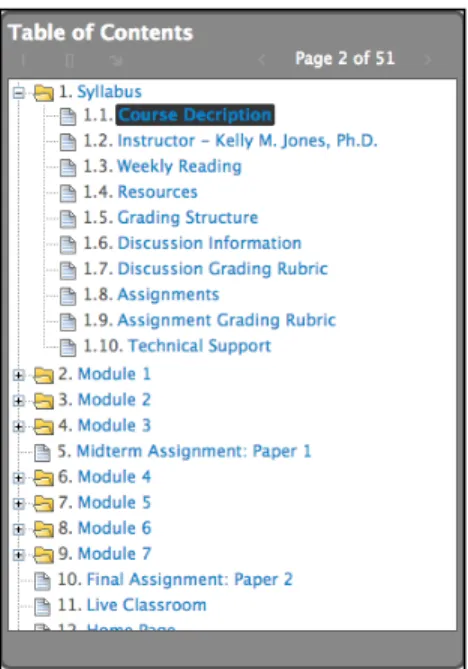
Illustration 3.4 LMS - Explore the Course Tab – Home Page Showing Steps 1, 2, and 3 81 Illustration 3.5 LMS - Course Table of Contents Showing Syllabus Content Topics ... 82
Illustration 3.6 LMS - Course Table of Contents Showing Module 1 Content Topics .... 82
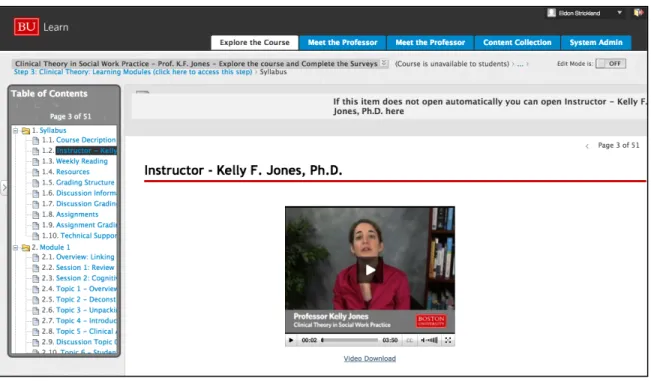
Illustration 3.7 LMS – Explore the Course Tab – Instructor Syllabus HTML Page Displaying Female Instructor Welcome Video ... 83
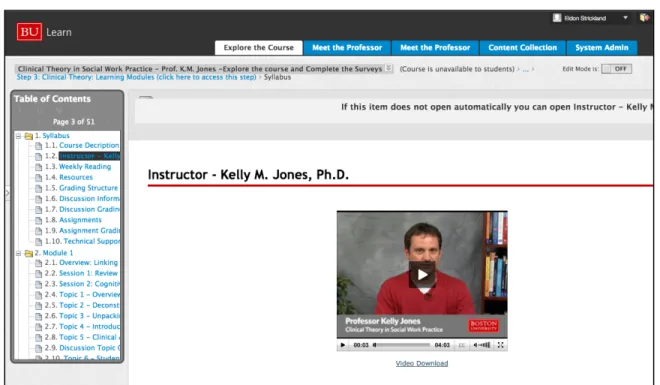
Illustration 3.8 LMS - Explore the Course Tab – Instructor Syllabus HTML Page Displaying Male Instructor Welcome Video ... 84
Illustration 3.9 LMS – Explore the Course Tab – Home Page Showing Steps 3, 4, and 5 ... 85
Illustration 3.10 LMS – Meet the Professor (Self-Disclosure) Tab – Displaying ... 151
Female Instructor Academic Profile, LinkedIn Profile, YouTube Video, ... 151
Pinterest Page, and Twitter Posts ... 151
Illustration 3.11 LMS – Meet the Professor (Self-Disclosure) Tab – Displaying ... 151
Male Instructor Academic Profile, LinkedIn Profile, YouTube Video, ... 151
xviii
CMC ... Computer-Mediated Communication F2F ... Face-to-Face LMS ... Learning Management System MSW ... Master of Social Work TSD ... Teacher Self-Disclosure
xix teacher (McCroskey, 1994).
State Motivation: An attitude toward a specific class (Christophel, 1990).
Teacher Self-Disclosure: Any message about the self that a teacher communicates to student (Cayanus, 2002).
CHAPTER ONE: INTRODUCTION
Most of us can recall a special teacher — someone who not only engaged us in learning but also inspired us, who made us feel good about learning and motivated us to excel. Parts of what we may remember about these special teachers are their personal stories, smiles, senses of humor, and even their unique mannerisms or dress. When students like and can relate to a teacher, learners engage more deeply in their learning. However, with the dramatic increase in overall “screen time” in education because the introduction of computers in the 1980s (Saettler, 1990; Rideout, Foehr, & Roberts, 2010), many wonder how these personal connections can survive. When learning becomes an exercise in logging into websites and viewing technology-based presentations, the teacher as a personal and affectively motivating influence is easily diminished. One of the most prominent areas where this concern arises is in online education.
The growth of online education in the 21st century has been nothing short of remarkable. Researchers Allen and Seaman of the Babson Survey Research Group (BSRG) collected data on the numbers of undergraduate students taking online courses from 2002 to 2013. Their data showed that in the decade from 2003 to 2013, the number of students taking at least one online course rose from 1.97 million in 2003 to 7.13 million in 2013, or an increase of 261.93%. Approximately 11% of all undergraduate higher education students took at least one online course in 2002. Comparatively, the percentage of all undergraduates taking an online course in 2013 was at an all-time high, measuring 33.5% (Allen & Seaman, 2014). The growth of online education was marked by Allen and Seaman’s 2002 online learning data collection, revealing that less than
one-half of all higher education institutions reported online education was critical to their long-term strategy. In 2013, 66% of the schools reported online learning was critical to their success (Allen & Seaman, 2014). However in their 2015 report, the data they collected showed a decrease in the expansion of online education within private for-profit, private non-profit and public colleges and universities as well as some other problems.
In 2015, three items from Allen and Seaman’s report diversify the picture of growth in online education. First, the growth of online education had leveled off. The average yearly growth rate was 18.55% from 2003 to 2010, 6.37% from 2011 to 2013, and only 3.7% for 2013. Second, there is a persistent finding among faculty who report they do not accept the “value and legitimacy of online education.” From 2002 to 2014, the average percentage of faculty who accepted this idea was approximately 30%, while the percentage of teachers that did not accept this idea increased, rising from 7.4% in 2002 to 13.8% in 2014. Third, and perhaps most pertinent to this dissertation research, the chief academic officers who responded to the BSRG survey showed a growing concern that it is more difficult to retain students in online courses than in face-to-face (f2f) courses. The number of respondents concerned about online retention rose from 27.2% in 2004 to 44.6% in 2014 (Allen & Seaman, 2015), although the authors admit that the numbers do not provide information about why retention is a growing concern. They also do not comment on the disciplines included in their research. Distance education providers typically explain that students drop out due to obligations, such as work, family, or other non-academic responsibilities. It is a premise of this research that
there is another possible explanation: the lack of personal connections between
instructors and students in online education. This is the domain tested in this study. Can instances of building human bonds in education, such as teachers’ smiles and personal stories, be adapted to inspire online learners? Building human bonds in online education can take many different forms, raising the questions regarding which types of personal connections have the best effect on learning outcomes in online education. Allen and Seaman’s findings support the need for continued research in online learning and, more specifically, investigations into the relationship between the teacher and student in this environment.
In online education, students often cannot see their teachers’ facial expressions and personal mannerisms, hear their personal anecdotes, or experience their sense of humor. Moore and Kearsley (1996; 2005; 2011) state that the relationship between teacher and student can easily become impersonal and isolating for students unless faculty and instructional designers consciously make an effort to humanize the learning experience. Given the centrality and importance of relationship building in learning, it is important to investigate how teachers form beneficial personal connections with students in an online learning environment and convey their personal style, personality, and concern for students. From this perspective, online instructors and instructional designers need a clearer understanding of how communicating humor, warmth, and appropriate details of personal lives in the online medium can improve students’ engagement and motivation to learn. To clarify this perspective, it is important to introduce terms that describe how personal connections between instructors and students have affected
education and how those connections are defined.
Teacher Immediacy to Self-Disclosure
The domain of instructor and student interaction that is personal and non-academic but that builds non-academic performance began as an area of research known as teacher immediacy (Mehrabian, 1971). Teacher immediacy was adapted from research in social psychology to mean that the teacher is immediately, or presently, “available” to the students (Andersen, Andersen, & Jensen, 1979). Teacher immediacy is defined as the instructor behaviors that bring the teacher and the students closer together. In common terms, teacher immediacy is a learner’s feeling of connection to or relating to the teacher and preference toward him or her. Teacher verbal immediacy behaviors can include calling the students by their first names, infusing humor into the discussions, and repeating back what students say. Teacher nonverbal immediacy behaviors can include smiling, hand gestures, direct eye contact, and nodding their head when a student is speaking (Andersen et al., 1979). These verbal and nonverbal behaviors build a connection between the teacher and student. All of these descriptions of developing personal relations labeled as “immediacy” in education came from studies in f2f classrooms. In addition to these findings, the use of technology for computer-mediated communication (CMC) in education has also been investigated over the past three decades.
Computer-mediated communication emerged as an area of educational research in the 1980s before the present environment of highly visual, web-based communication. CMC focused mainly on people using computers for text-based communication over the
Internet and started before the invention and proliferation of the more visually oriented World Wide Web (WWW) in the 1990s. Research has demonstrated that through CMC, teachers and students began utilizing self-disclosing activities and question-asking behaviors to connect and build relationships (Tidwell & Walther, 2002; An & Frick, 2006). These researchers found that students used “direct and intimate” methods of interpersonal communication to reduce social anxiety and collect information through CMC.
Student behaviors in f2f interactions used conversational behaviors, such as impersonal statements of fact, statements about third parties, exclamations, imperatives, greetings, summary statements, and other fillers that were not direct questions to
communicate with their peers or teacher. In contrast, CMC students used direct question-asking behaviors and messages that revealed personal information, providing more details about themselves to engage their peers and to get clarification from teachers on tasks. Tidwell and Walther also found that when instruction and communication was delivered through technology, people “alter or adapt their communication behaviors, methods of forming acquaintances, processes of forming attributions, and ways of relating to one another” (Tidwell & Walther, 2002, p. 338). These findings describe an evolution of interpersonal communication in education from f2f interactions of the classroom to those found in CMC. They show the emergence of revealing information about oneself in CMC, a trait not common in f2f classrooms, as a way to connect with others. In this discussion, it must be remembered that CMC emerged before Facebook and other web-based media that afforded visuals. CMC was initially a text-based form
and, as such, supported self-revelation, or self-disclosure, as a method of online attraction for building relationships online (Mantovani, 2002). Over time, revealing personal
information online became labeled as “self-disclosure,” which captures a key difference from the earlier work on immediacy in f2f classrooms. Self-disclosure emerged in text-based communication but continued as a useful descriptor in the more visually oriented, web-based environment that was the norm for online education at the time of this dissertation.
As online education and social media has proliferated in the 1990s and early 21st century, use of the term “self-disclosure” stabilized as a way to describe how people constructed their personal information online to present themselves in their desired fashion. Self-disclosure was a more accurate label because many of the behaviors described in immediacy, such as smiling, hand gestures, and direct eye contact, do not readily migrate to the online environment. In the first decade of the 21st century, the concept of self-disclosure in online education evolved along with the capabilities for identity construction prevalent in social media. On Facebook, for example, university students spend many hours creating and burnishing their online identity with curated pictures and text. While self-disclosure has some of the same features of personal connection as immediacy, it has come to mean more of a constructed form rather than a spontaneous form. The constructed form of self-disclosure was found to have an impact on learning, just as immediacy did in f2f classrooms. For example, Cayanus (2004) found that f2f teacher self-disclosure (TSD) in the form of personal narratives and humor tended to improve clarity in understanding of course content and motivated students to
learn.
This brief history explains the transition from teacher immediacy to self-disclosure in online communication. This history can also explain why the adoption of “self-disclosure” has become the operative term for the present research into how personal connections between teachers and students affected their attitude toward their teacher and their motivation to excel. Furthermore, these findings illustrate the
importance of self-disclosure in developing teacher-student relationships in online education. They also contributed to the formation of this dissertation, which investigated how personal connections may influence students’ affective perception of their instructor and motivation in a purely online environment.
Problem Statement
Researchers studying effective teaching practices have shown that teacher immediacy and self-disclosure can positively impact teacher-student relationships, as well as enhance student learning. As a result of the growth of online education a better understanding of how instructors can become more effective teachers online has become critically important. Adapting effective f2f instructional strategies and building on research of how learners developed relationships in web-enhanced environments offers promise for integrating the resulting methods into purely online learning environments and, consequently, yields the potential for increasing instructor effectiveness in online teaching. One of the methods for improving purely online learning experiences and positively impacting student learning would be to apply the research findings in self-disclosure and CMC. An example of this application would be the self-disclosure of personal
information by instructors. Appropriately applied, these activities are likely to enhance the relationship between the teacher and the student. The formation of better teacher-student relations in f2f classroom settings has been linked to positive outcomes in teacher-student learning. Many studies have positively linked TSD to student motivation to learn, as well as to students’ perception of affect toward the teacher (Cayanus, 2002, 2005; Cayanus & Martin, 2004; Mazer, Murphy, & Simonds, 2007; Aubry, 2009). The majority of previous research in post-secondary education has focused on TSD and the creation of teacher-student relationships within the f2f classroom. Despite this significant research, few studies have been specifically designed to increase our understanding of how students learn and interact affectively with teachers in a purely online environment. This
dissertation study furthers the research on various ways that teachers and students interact in the online learning environment and their effect on student motivation to learn.
Historical and Theoretical Frameworks
To set this dissertation research in the over-arching context of education, this section presents the historical contexts and theoretical models for the current study. Two examples of the importance of developing teacher-student relationships in the history of education is followed by an exploration of these relationships within the context of technology and learning in the online classroom. Additionally, the theoretical support for understanding methods of building relationships in the online learning environment is explored through the model of instructional communication theory.
Teacher-Student Relationship in Learning
Good teachers have been establishing productive relationships with their students throughout the history of education. For example, Plato (1968) uses Socrates’ stories and parables to teach learners. In the Meno, Socrates questions his students. Socrates creates the perfect question, and in doing so, his learners "discover" that they possessed the answers to the questions. Plato recounts Socrates as a teacher who engages the students in a dialogue. Through this dialogue and relationship with his students, Socrates helps students build their beliefs, opinions, and perceptions of the world around them. For Socrates, the acquisition of the information is not what matters; instead, it is the path, or process, of learning that is important.
Similarly, Montessori (1964) discusses teaching relationships in her writings. Students are taught in a prepared environment, where the teacher guides students to investigate the world around them. Her disciples were taught to observe the students in the classroom and then take action to reinforce the activities that were of interest to them. For Montessori, teachers "are the guides of these travelers just entering the great world of human thought. We are the guide on the side, not losing him or herself in vain discourse, but illustrating briefly and concisely the work of art in which the traveler shows him or her self-interests" (Montessori, 1964, p. 238). Montessori thought that students who could be guided to work independently could reach new levels of autonomy and
self-motivation. Her theories are particularly relevant to this study because she not only described a particular form of the teacher-student relationship but also because she nurtured the independent learner, which is very much a feature of online education.
Both Socrates and Montessori cultivated relationships that helped students learn and grow. In 2015, as educators move from face-to-face teaching to online teaching, where relationships are mediated through computer-based communications and online technologies, they are confronted with the same problems that Plato and Montessori addressed years ago. Online students can benefit from online instructors who not only can deliver content but also have methods and time for interacting with students and
cultivating motivational relationships. For example, in a digital world where nearly every topic can be offered "online" in a self-paced tutorial, we have immediate access to
information that is offered as a consumer good, such as Rosetta Stone and dozens of other courses offered through other computer-based training companies. In these online
learning “factories,” education is offered through self-contained, pre-constructed learning environment, where the instructor has no online presence, and there is little or no
possibility for personalized interactions.
History and research suggests that successful online learning needs to support the principles of active teaching and affective instruction. Given appropriate resources and training, instructors can create online learning environments that go beyond the basic "one-size-fits-all" of consumer-oriented, self-paced online products offered on the
Internet. To overcome the challenges pointed out by Allen and Seaman (2015), educators need to go beyond what is currently available to students and create technological
environments that are meaningful for both the instructor and the learner, while still meeting the requirements of quality education. A better understanding of online environments and the roles teachers and students take in them will help us to adapt an
online education where the teacher and the learner are at the center of an educational process. By constructing online classes that support the full range of building teacher-student relationships, academic parity between the f2f classroom and the online classroom can be achieved. However, developing teacher-student relationships online that support and encourage learners is a very different process than practicing immediacy behaviors in a f2f classroom. Learning more about how to do this is the problem this dissertation addresses.
Teaching with Technology
Historically, integrating technology into the f2f classroom setting has been problematic in a number of ways. One of these is that technology is often integrated without adequate teacher training and time to plan and experiment with how technology can help achieve instructional goals. This can lead to a lack of understanding of which learning activities and processes can be enhanced with the technology. With
technological advancements, computers can be integrated into the learning environment to support immediate relationships and enhanced interpersonal relationships, which in turn can allow for more fulfilling online learning experience.
To create greater parity with f2f instruction, online teachers and learners need to have the skills to use online technology effectively. Applying these skills, teachers and learners can use learning management systems, in conjunction with social media and video conferencing, to build online classrooms that support relationship building and knowledge development in a personal context. As applied in f2f classroom teaching, good teaching online should focus on the content being taught and the best way to present
it. The history of immediacy and self-disclosure suggests that technology-based, online learning may easily become mere information transmission unless it also focuses on the relationship between the instructor and the student. While the proliferation of the Internet has vastly expanded educational opportunities, it is also based on technology and media that lays between the teacher and his or her students, further impacting the teacher-student connection. Intentionally leveraging this technology is pertinent to avoiding the obstacles and hindrances that may be imposed upon building effective online
relationships.
It is challenging to design technology-based resources for learning that draw from knowledge about how people learn, how teachers act in the classroom, and how each learning experience fits into the overall curriculum. Instructional designers and teachers can now use technology to build scaffolding to support their educational goals similar to the way a frame for a home must be built before plumbing and electrical work can begin. Setting up technological scaffolding before beginning instruction enables teachers and learners to implement more advanced activities. For example, an instructional designer can work with the teacher to create course materials, such as lecture, assignments, and exams, in an online learning management system for basic information presentation and competency testing. Once this framework is created, the teacher and the designer can work together to use the interactive features of the learning management system, such as online discussions, video conferencing, and email, to engage the learner in the analysis, synthesis, and personalization of course content. Much of these higher-level activities are based on dialogues between and among instructors and students. When technology
functions properly, it can enhance the learning experience and student performance through dialogue (Bransford, Brown, & Cocking, 2000). Once the optimal online classroom structure is created, both teachers and learners must face the complexities of interacting online. Instructional communication theory provides a framework for understanding effective online interaction.
Instructional Communication Theory
Applying instructional communication theory to the growing issues of online education can aid in adapting teaching and learning relationships from the face-to-face classroom to those online. Instructional communication theory provides a framework for understanding how teachers and students communicate using technology. This theory focuses on the use of technology in the transmission of content and information, as well as affective communications between people, people and machines, or machines and machines (McCroskey, Valencic, & Richmond, 2004). McCroskey, Valencic, and Richmond (2004), researched this area and described six essential elements of the instructional communication model: 1) the instructional environment, 2) the student, 3) the teacher, 4) the teacher’s verbal and nonverbal behaviors, 5) the student’s perception of the teacher, and 6) the learning outcomes. This dissertation research addresses the challenge of adapting these elements to online education.
Teachers who understand these six elements are more capable of building successful online relationships with students. By applying this theoretical model to studies on self-disclosure, instructors can use technology to make self-disclosing statements online, as they would in face-to-face interactions, to connect with and
motivate students. In instructional communication research, learners and teachers conceptualize education as a process of cultivating knowledge where learning theories are applied and methods are employed to build knowledge (McCroskey, McCroskey, Mottet, & Richmond, 2006). In this model, communication is instrumental in facilitating a learning and teaching process that encompasses the personal connections teachers and students create.
To better understand technology’s influence on teaching and learning,
instructional communication theorists have focused on specific aspects of teacher-student communication that occur within the context of CMC and web-enhanced classrooms. Instructional communication theory provides an explanation for how students learn affectively, behaviorally, and cognitively using technology. Researchers have
investigated the teacher-student relationship and the specific skills and strategies teachers employ to build connections between themselves and learners. For example, the research focused on the individual traits and characteristics of the teacher, such as verbal and nonverbal behaviors, communication style, humor, clarity, immediacy, and self-disclosure. These individual teaching traits were then linked to other measurable outcomes, such as the students’ evaluation of the instructor’s teaching practices, the management of the classroom, and the students’ self-assessment of both their affective and cognitive knowledge gains. This research also found that specific teaching behaviors supported student motivation (Christophel, 1990). More recently, research in computer-mediated and/or web-enhanced classrooms has focused on the increased role social media plays in instructional communication by focusing on social networking sites (Tidwell &
Walther, 2002; Ellison, Heino, & Gibbs, 2006; Ellison, Steinfield, & Lampe, 2007; Frisby & Martin, 2010). This dissertation research builds on these early studies of social media and integrates them into an approach where they are more intentional in the context of an online learning environment.
While there is a body of research that has been conducted in f2f classrooms, more research is needed to further understand how teacher-student relationships are formed and maintained in the online environment. This is especially true when one considers that many studies have demonstrated a positive relationship between TSD and students' participation in class, motivation, and affective learning. Although current research shows that instructors who make self-disclosure statements using technology can establish relationships with their students to personalize the learning experience, more research is needed on the specific role that self-disclosure plays in this process. Yet, before deciding what information instructors want to share with their students and how it will impact them, instructional communication theory suggests that they need to think about the authenticity of their communications. The teachers need to have an idea of who they are as teachers and how they will use this identity as they create an online persona. Self-disclosure research helps to understand the processes of creating instructor identity in an online educational environment.
Additional research has found that online instructors who wish to develop productive relationships with their students can do so by self-disclosing. For instance, Mazer, Murphy, and Simonds (2007; 2009) linked TSD to student motivation and
they were able to positively increase students’ extrinsic motivation and increase students’ positive feelings toward the classroom environment and the teacher. They showed that small amounts of self-disclosure are perceived by their students to be effective in contributing to the explanation of course content in a f2f classroom. Self-disclosure research has found that learning outcomes are linked to teacher-student relationships and that they motivate students to engage in the content as well as the learning environment.
Study Aims
The aim of this study is to utilize research conducted in the fields of instructional communication theory, TSD, student motivation, and computer-mediated research to refine understanding of optimal teacher-student relationships online. The current literature does not specifically address the formation and support of teacher-student relationships for entirely online classes in post-secondary education institutions because the majority of the research and data is based on studies conducted in f2f classrooms or web-enhanced f2f classrooms. This study expands the research on TSD into the domain of online learning and identifies ways to enhance the teacher-student online relationship through the use of TSD to further students’ sense of connection with the teacher, and, in turn, increase students’ motivation to learn.
A literature review of relevant research methods and findings is presented in the Chapter 2 Literature Review.
CHAPTER TWO: LITERATURE REVIEW
Developing positive teacher-student relationships can be an essential element in improving learning outcomes for students. Research has shown that teachers who develop positive student relationships that are productive to learning effectively utilize verbal and nonverbal communications in both academic and personal areas, fostering these
connections (Andersen et al., 1979; Mehrabian, 1967; 1971; Gorham, 1988; Downs, Javidi, & Nussbaum, 1988; Frymier, 1993; 1994; Christophel & Gorham, 1995; McCroskey & Richmond, 1996; Christensen & Menzel, 1998; Chory & McCroskey, 1999; Ellis, 2000; McCroskey et al., 2004; Chesebro & McCroskey, 2001; Cayanus, 2002; Cayanus & Martin, 2004; 2008; Frisby & Martin, 2010). Applying instructional communication theory to the analysis of teachers’ verbal and nonverbal interpersonal communication behaviors, which engage and motivate students both cognitively and emotionally, can help teachers become aware of communications that encourage the development of positive personal relationships. This can be especially beneficial in online teaching because online communications are generally more structured, intentional, and impersonal when compared to the spontaneous communications that occur in f2f
teaching.
As a theory, instructional communication focuses on three areas: pedagogy, educational psychology, and communication in f2f classrooms. Researchers focus on the teacher, the student(s), and the communication styles and patterns used to exchange verbal and nonverbal messages between and among them. Research has shown that teacher behaviors, such as being humorous, speaking about him or herself, and telling
personal stories, influence students’ affect toward the teacher and student motivation to learn in f2f classroom environments. As more teaching and learning occurs online, instructional communication theory can aid in the adaptation of effective f2f teaching methods to purely online education, where the learning environment is highly structured.
Instructional Communication Theory
Instructional communication theory integrates research from the disciplines of pedagogy, educational psychology, and communication. Pedagogy focuses on the teacher and the methods that teachers use to instruct. Educational psychology focuses on the learner and the underlying psychological and intellectual processes that explain and predict student learning. Communication focuses on the meaning of messages, how the use of verbal and nonverbal communication stimulates meaning in the minds of others and how meaning is created through the use of verbal and nonverbal messages (Mottet, Richmond, & McCroskey, 2006). To better understand the teaching-learning process as communication, it is useful to identify communication patterns and characteristics, including the contexts in which they appear. Pedagogy describes the overall teaching process and methods for engaging student learning and, as such, is one of the most important contexts in which communication occurs.
Pedagogy emphasizes the systematic study of teaching and teaching methods, focusing on managing students in the classroom, enhancing student motivation, and applying various teaching techniques to engage students in learning the content being studied. Common teaching techniques include lecturing, creating experiential activities, and facilitating group discussions (Shulman, 1986; Freire, 1990; Bransford et al., 2000;
Eisner, 2002; McCroskey et al., 2006). Pedagogical research is primarily directed at teacher behaviors, self-perceptions of teacher efficacy, and the satisfaction in teaching that contributes to learning and in selecting methods that facilitate and encourage student understanding (Schwab, 1973; Csikszentmihalyi & McCormack, 1986; Mottet,
Richmond, & McCroskey, 2006). Moreover, master teachers help make knowledge accessible to students by knowing their students’ backgrounds and abilities and using that knowledge to customize the educational experience.
Mottet and Beebe (2006) suggest that productive teacher-student relationships improve teacher self-efficacy and job satisfaction. Teacher self-efficacy is the extent to which the teacher believes he or she has the capacity to affect student performance. They believe or are convinced that they can influence how well students learn, even those who may be difficult to work with or unmotivated. Teacher job satisfaction is a construct that has been studied in relationship to teacher self-efficacy. Mottet and Beebe (2006) define job satisfaction as determined when an individual perceives that his or her job-related needs are being met. Teacher self-efficacy and job satisfaction work together to create a positive learning environment for the teacher and the student.
Educational psychology emphasizes the learner and investigates the underlying psychological and intellectual processes that explain and predict student learning (Krathwohl, Bloom, & Masia, 1964; Anderson, 1995; Krathwohl, 2002). Research in educational psychology focuses on the learner and explores such questions as: 1) what student personality characteristics or traits are most receptive to various approaches to learning; 2) how do students process and use information; 3) how can one address
cognitive, affective, and behavioral learning outcomes; and 4) how student variance, such as gender, ethnicity, religion, socio-economic status, intelligence, prior knowledge, home life, and temperament play a role in learning (McCroskey & Richmond, 1992;
McCroskey, 1994; McCroskey, Morreale, & Brooks, 1994; Frymier, 1994). Much of the work in educational psychology is based on Bloom’s Taxonomy of Educational
Objectives, originally published in 1956 (Mottet et al., 2006). Once learning outcomes are identified, teachers can then begin the instructional process by selecting appropriate pedagogical teaching methods.
Educational psychology has helped explore the relationship between cognitive and affective learning. According to Krathwohl et al., (1964) affective learning, unlike cognitive learning, emphasizes feelings, tone, motion, and/or degree of acceptance or rejection. Often the affective component of learning is overlooked or neglected in education because cognitive and behavioral outcomes are more visible and measureable for administrators, teachers, and parents. Affective learning often occurs more discreetly and slowly than cognitive learning (Andersen, 1979; McCroskey & Richmond, 1992).
Rather than relying exclusively on theories from educational psychology or pedagogy, instructional communication research employs rhetorical and relational communication styles to explain and predict the outcomes of teaching and learning. The rhetorical approach is more teacher-directed, while the relational approach is more collaborative.
In rhetorical communication, teachers use verbal and nonverbal messages with the intention of influencing or persuading students to learn and to be motivated to learn. They
craft messages designed to change or reinforce knowledge, attitudes, beliefs, values, and behaviors. Rhetorical communications are typically linear because they focus on
information that flows from the teacher to the student. The model is one where the teacher is the source of knowledge and students are the recipients of information. Teachers help students to learn by using verbal and nonverbal messages, supported by evidence and reasoning that stimulate students’ cognitive and mental abilities (Mottet et al., 2006).
Rhetorical communication uses the traditional pedagogical delivery method of lecture, memorization, and testing to measure learning outcomes. In order to stimulate the selected meaning in the minds of students, teachers may use personal narratives and illustrations relevant to their students’ lives and experiences. Teachers create instructional messages so that they are relevant, clear, interesting, and appropriate. The messages may include personally relevant examples and humor to improve instructional clarity.
In contrast to rhetorical communication and the focus on message content, the relational perspective acknowledges and addresses the receiver’s emotional state. It also is typically more spontaneous and less strategic than the rhetorical perspective. Relational communication style takes place when both teachers and students mutually create and use verbal and nonverbal messages to develop their relationships with each other. The
relational perspective draws upon contemporary models of communication, in which meaning is mutually created and shared between individuals. The relational approach examines communication patterns from a transactional or coordination perspective, where two or more people coordinate their communications to generate a shared
perspective (McCroskey & Richmond, 1996).
The hallmark of the relational communication style is an emphasis on both teacher and student feelings and emotions, specifically how the teacher and students perceive and affectively respond to one another (Ellis 2000). In a productive, affective relationship, teachers are motivated to teach, and students are motivated to learn. The relational perspective focuses on both verbal and nonverbal messages. Moreover, teacher and student nonverbal communications have been shown to stimulate the majority of the emotional or social meaning in messages (Mehrabian, 1969; 1971). Teachers who are nonverbally expressive and/or emotionally available in the classroom positively influence students’ partiality toward the teacher (Frymier 1994), which increases students’
motivation to learn (McCroskey & Richmond 1992). In instructional communication, rhetorical and relationship communication styles can follow three conversational patterns: actions, interactions, and transactions.
Action communication patterns focus on the message produced by a teacher, a text, a video, or any source attempting to convey information to the learner. The action model of communication depicts communication as a linear one-way process, where meaning is stimulated in the minds of others using verbal and nonverbal messages (Mottet & Beebe, 2006). This model is applicable to classroom contexts where
instruction is teacher-centered. Action communication patterns often take the form of the traditional classroom lecture.
Interactive communications patterns are different than action communication patterns because they include the added concept of feedback (Mottet & Beebe, 2006). In
an interactive mode of communication, the message exchange process is one where the source message has a meaning that is verified, refined, and adapted based on the verbal and nonverbal responses that the sender obtains from the receiver. Applied to the
classroom, communication as an interaction occurs when teachers remain receptive to the verbal and nonverbal feedback they receive from their students and then adapt their instructional messages after receiving the feedback (Bloom, 1976).
Lastly, meaning in the transactional communication patterns is co-created, or mutually stimulated, by the teacher and the student, both who send and receive verbal and nonverbal messages simultaneously (Mottet & Beebe, 2006). Communication as a
transaction is a non-linear process. Transactional communication is evident when teachers respect student ideas and feelings, and students respect teacher ideas and feelings. Teachers and students openly debate ideas to clarify meanings and influence each other until meaning is shared. Transactional communication patterns not only address student compliance, learning, and motivation but also acknowledge teacher self-efficacy and satisfaction. In this context, all individuals involved in the learning process, not just teachers, have an impact upon learning. Transactional patterns are more inclusive of learners’ feelings and affective responses and occur as teachers change their
communication patterns from the unidirectional action mode to a bidirectional mode. In transactional communication patterns, both teacher and student grant each other
permission to influence one another.
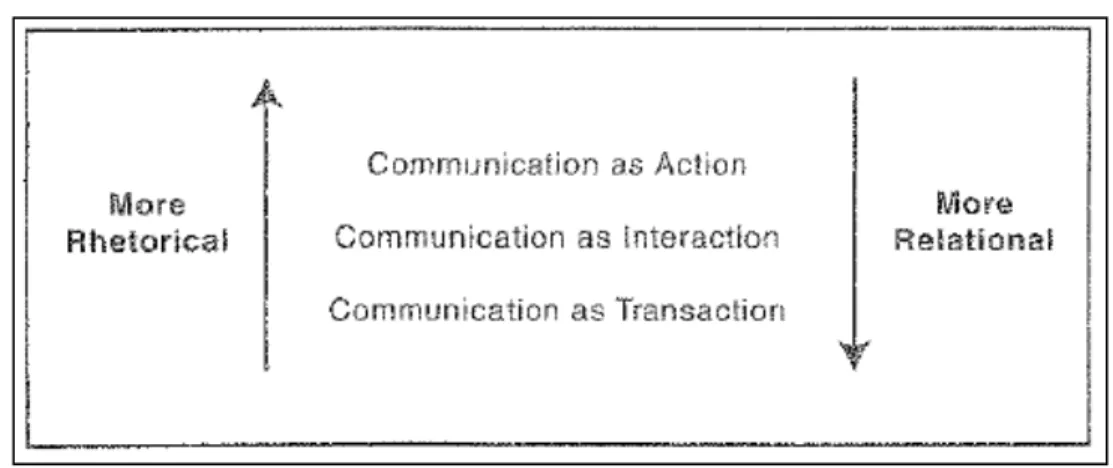
Together, these three communications patterns function on a continuum where action communications, which are more rhetorical in nature, occur on one end of the
continuum and transactional communications, which are more relational in nature, are on the other. Teachers and students use communication styles and patterns that are most comfortable for them but that suggest the question of which styles and patterns are most appropriate to achieve optimal learning outcomes? Figure 2.1 illustrates the inverse relationship between rhetorical and relational communication styles in instruction. This dissertation applied the relational style and transactional communication patterns.
Figure 2.1 Rhetorical and Relational Communication Styles Combined with Action, Interaction, and Transaction Communication Patterns (Mottet et al., 2006)
To better understand the teaching-learning process as communication, it is useful to identify fundamental communication characteristics and models that include both verbal and nonverbal message systems. Each of the three communication patterns described above is expressed both verbally and nonverbally. Understanding the
characteristics of verbal and nonverbal communication can aid in the diagnoses of any instructional context and suggest the use of these behaviors in teacher-student
communications to enhance instructional effectiveness.
According to Mottet and Beebe (2006), the first function of communication is how the message is said, and the second function of communication is the information
contained in the message. Verbal messages in instruction are typically content-rich and relationally lean. Verbal messages tend to be intentionally crafted and communicated, whereas nonverbal message are more likely to be unintentionally expressed. A certain level of cognition or conscious awareness is required for people to transmit verbal messages, which therefore tend to be intentional. Teachers’ nonverbal messages, however, function to establish the nature of the relationship. They tend to stimulate meaning about the quality of the interaction that is taking place. Nonverbal messages are often expressed outside of one’s awareness, and many teachers fail in their attempts to hide how they feel about their teaching content or their students. In this dissertation, both verbal and nonverbal elements of the teacher communications were conscious and intentional.
Building on the elements of instructional communication, this dissertation applies four of McCroskey et al.’s (2004) elements for developing personal relationships in educational settings. These are: teachers’ gender, students' perceptions of teachers' verbal and nonverbal communication behaviors through self-disclosure, students' perceptions of the teachers' attractiveness, and the instructional outcome of students’ motivation. It also addresses the challenge of adapting these elements to online education. To understand the relational aspects of these four elements in the context of instructional communication, teacher immediacy and self-disclosure need to be further defined.
Teacher Immediacy and Self-Disclosure
As previously discussed, teacher immediacy is a set of instructor behaviors used to reduce the social and psychological space between instructor and students. Gorham
(1988) established a specific set of verbal variables describing immediacy-related behaviors. Behaviors that can enhance students’ perception of and connection with the teacher include: asking students for personal examples to encourage students to talk, addressing students by name, asking students to use the teacher’s first name, creating conversation before and after class, providing feedback, calling on students in class to give answers or give their opinion, asking students how they feel, soliciting students’ viewpoints or opinions, and holding discussions about things unrelated to lecture materials.
Frymier (1993) and Christen and Menzel (1998) showed that using present versus past verb tenses and inclusive statements for example: "we” versus “I" and "I want" versus "you should" in interactions with students has increased the teacher-student connection. Additionally, Downs, Javidi, and Nussbaum (1988) revealed that the use of humor, storytelling, and personal narratives were positively related to increased student motivation to learn. Their research also showed evidence that other nonverbal behaviors had a negative effect on student motivation to learn. These nonverbal behaviors included sitting or standing behind a desk or lectern, continually looking at the blackboard or in a book, or maintaining a tense body posture.
Teacher Immediacy
Researchers Andersen et al., (1979), Mehrabian (1967; 1971), Gorham (1988), Gorham and Christophel (1992), Frymier (1993; 1994), Christen and Menzel (1998), Baringer and McCroskey (2000) and Ellis (2000) established that verbal and nonverbal immediacy behaviors personalize instruction and create a more satisfying learning
experience in f2f instruction. Furthermore, these researchers have linked positive teacher immediacy to increases in student motivation, cognition, teacher clarity, and positive feelings toward the teacher. For example, Frymier (1993) investigated the impact of teachers' use of immediacy behaviors on student-reported motivation to study by measuring students' state motivation, defined as “external motivation” and trait motivation defined as “internal motivation” to engage in f2f classroom learning. State and trait motivation were studied at three points during a semester. She found that the teacher's immediacy behaviors increased the students’ state motivation to study. She also noted that not all students responded similarly to a teacher with low-immediacy behaviors because students generally started the semester with either low or moderate state
motivation and reported having increased levels of motivation later in the semester when exposed to a “highly immediate” teacher. Frymier’s (1993) research supplied evidence that students beginning the semester with high trait motivation maintained high state motivation levels, regardless of their perceived level of immediacy of their teacher. In her study, the state motivations of students with pre-existing heightened levels of trait
motivation were less influenced by teacher immediacy behaviors.
Chesebro and McCroskey (2001) measured teacher immediacy and students’ apprehensions about learning, students’ motivation to learn, and their positive or negative feelings for the teacher at the beginning and end of an eight-week semester. Their
research showed that student apprehension is negatively related to learning but that teacher immediacy enhances student motivation to learn and positively influences their feelings toward the teacher. Furthermore, teacher clarity increases student motivation to
learn and positively impacts their feelings toward the instructor.
In a later study measuring teacher immediacy and student affect toward teacher and learning outcomes, Christensen and Menzel (1998) found a positive relationship between teacher immediacy and student state motivation. They also showed that teacher immediacy enhanced students’ perceptions of their cognitive affective and behavioral learning outcomes. These learning outcomes were measured by the students’ perceptions of how much they had learned, the actions they were required to complete for the course, and their feelings toward the course content or the instructor. These researchers
established that as levels of teacher verbal and nonverbal immediacy increased, so did student state motivation and learning outcomes.
In 2002, Cayanus linked teacher self-disclosure (TSD) and immediacy behaviors to student engagement in the course materials. These teacher behaviors included telling stories that disclosed personal information and sharing their personal beliefs. His research showed that TSD builds teacher immediacy and supports the teacher-student relationship (Cayanus, 2002). Cayanus’ research bridges the research between teacher immediacy and Sorensen’s 1989 research on teacher disclosure.
Teacher Self-Disclosure
Teacher disclosure refers to teacher statements in the classroom about oneself that may or may not be related to subject content but reveal information about the teacher that students are unlikely to learn from other sources (Sorensen, 1989). Additionally, teachers admit to talking about themselves in the classroom, while research supports that this behavior increases their effectiveness with students (Hurt, Scott, & McCroskey, 1978).
Because the teacher disclosure cannot be measured directly by how much a teacher talks about him or her self, it is often measured through student perceptions of teacher
disclosure statements. As such, student perceptions of teacher disclosure in the classroom may be a critical variable in determining the relationship between teachers and students.
Sorensen (1989) attempted to provide increased prediction of learning outcomes by examining self-disclosure statements of teachers, their association with affective learning, and student perceptions of their interpersonal relationship with teachers. She found that TSD based on Andersen’s (1979) immediacy behaviors, such as facial
expressions, tone of voice, vocal expressions, body movement, eye contact, and physical proximity, encourages students to engage in the classroom environment and creates teacher-student and student-student conversations before and after class. Sorensen (1989) revealed that these behaviors helped to engage students in the learning process.
Investigations into the concept of self-disclosure have detailed some of the elements within it that influence and impact the perceptions by the receiver of this personal information.
Interpersonal Self-Disclosure
Self-disclosure research is founded in social penetration theory, which is based on the premise that interpersonal relationships develop over time and move from relatively shallow, non-intimate connections to deeper and more intimate ones. Initially outlined by psychologists Irwin Altman and Dalmas Taylor in 1973, the theory provides an
previously stated dimensions of self-disclosure, breadth and depth, both of which are crucial in developing a fully intimate relationship.
Research on the forms of interpersonal disclosure has found that self-disclosure and liking were moderated by a number of variables, including study paradigm, type of disclosure, gender of the discloser, and the breadth (how much) and depth (how intimate) of the disclosure (Jourard, 1959). Gender bias in personal self-disclosure was a factor, in that females tend to disclose more than males (Derlega & Chaikin, 1976). Archer and Burleson (1980) also found that the timing of disclosure and associated perceptions of the person disclosing were influential variables. Lastly, Won and Doornink (1985) studied the reciprocal and curvilinear relationship of intimate disclosure statements between individuals. These research findings indicate that self-disclosure, when applied in specific ways, can be used to build and enhance relationships. The first variables to consider are the breadth and depth of the information an individual chooses to disclose.
Self-Disclosure: Breadth and Depth
Breadth in self-disclosure is the amount or range of personal or private information shared. In its simplest form, it is the sharing of one’s daily life, such as occupation and preferences. Depth in self-disclosure is the degree to which private or personal information is revealed. Depth in self-disclosure consists of an individual’s inner experiences and includes painful memories and unusual traits that some might try to hide. These two dimensions are influenced by individuals in the process of self-disclosing aspects of the self to others. For example, Jourard (1958) found that the amount of
personal information that one person is willing to disclose to another depends on the relationship between two individuals. He found that content variety of self-disclosures was how much (breath) information they shared between classmates than between
students and instructors. Students hesitated to disclose intimate details (depth) with either classmates or instructors; whatever disclosure they did make was moderated by social desirability. The depth aspect of self-disclosure can signify vulnerability, which may be viewed as undesirable (Jourard, 1958). Additionally, the amount of self-disclosure a person receives influences how they will respond.
Self-Disclosure: Amount, Reciprocity, and Curvilinear Relationships
Researchers have found that the amount of information one discloses is
curvilinear: too little or too much information will not contribute to a relationship. For example, Won and Doornink (1985) studied three stages of a relationship in opposite gender pairs: the early stage (30 days into relationship), the middle stage (more than 3 months into a relationship but less than a year), and the advanced stage (more than a year, “best friends”).
They found that “the reciprocity of non-intimate disclosures is at its highest level in the early stage of a relationship, with a steady decline thereafter, and that the reciprocity of intimate disclosures reaches a peak among those headed toward a close relationship and diminishes when the stage of the relationship becomes advanced” (Won & Doornink, 1985, p. 105).
Reciprocal self-disclosure is minimal at the beginning, rises as the relationship moves forward, creates intimacy over time, and then declines as the intimate relations are more firmly established. Furthermore, in terms of reciprocity in self-disclosure, the most
important factors are the topics initiated by the first speaker (Won & Doornink, 1985). Won and Doornink’s research supports the curvilinear association between the stage of a relationship and the output of intimate reciprocal self-disclosures. In a curvilinear relationship, two variables are measured. When one variable, such as self-disclosure, increases, the other variable, such as perceived likeableness by the receiver, also increases. However, this relationship occurs only up to a certain point. Won and Doornink found this curvilinear association in self-disclosure: after a certain point, further increases in self-disclosure led to decreases in perceived likableness and diminishing returns. A graph of this type of curvilinear relationship would look like a horseshoe, or an inverted U. The other type of curvilinear relationship will look U-shaped. In this model, as one variable increases, the other decreases up to a certain point, after which both variables increase together.
Won and Doornink’s (1985) research illustrated the complex relationship between the ways in which personal information is given out and how it is received, pointing to the efficacy of a moderate level of self-disclosure and relative intimacy with diminishing returns for excessive sharing. These factors can strongly impact the way individuals’ select self-disclosure activities and the response yielded.
Christensen and Menzel’s (1998) findings also support a curvilinear relationship between teacher immediacy and student learning. In their study, the curvilinear
relationship identified was that too little immediacy had no effect on the teacher-student relationship, and too much immediacy had a negative effect. Their research revealed that there was a peak effectiveness level of immediacy. These researchers showed that
moderate teacher immediacy has the greatest positive effect on the teacher-student relationship.
Self-Disclosure: Gender and Content
Researchers of self-disclosure have found that disclosure and liking were moderated by a number of variables, such as gender of the discloser and gender bias in personal self-disclosure. Derlega and Chaikin (1976) studied male and female
undergraduate students who interacted with male and female actors, who used expressive and non-expressive behaviors. In this study, the actors were individuals who did and did not discuss personal information, such as a psychological phobia. This research study found that “expressive males and non-expressive females were seen as less adjusted than males who were silent and women who disclosed” (p. 379). In addition, expressive females were perceived as more likable than non-expressive females, whereas expressive and non-expressive males were perceived as similar to each other (Derlega & Chaikin, 1976).
This study indicates that gender biases influence the perceptions of males and females who disclose personal information and that gender affects the way disclosing statements are perceived. The patterns of self-disclosure between individuals are also found in f2f classrooms, as researchers have shown that TSD impacts how and what students self-disclose. Based on this research, both male and female instructors were operationalized in this dissertation study to test for gender differences in the purely online learning environment the study employed.
Self-Disclosure: Gender and Liking
The act of liking someone can be used to build and shape interpersonal relationships. The link between this idea and self-disclosure is an essential aspect of positive personal connections between teachers and their students. Collins and Miller (1994) defined “liking” as the attraction for and/or toward another. The element of “liking” provides foundation for and shapes the development of interpersonal relationships, which is an essential aspect of positive personal connections between teachers and their students (Collins & Miller, 1994). In a meta-analysis of research on this topic, Collins and Miller (1994) found that if an individual trusts and likes someone, they will be more apt to disclose personal information. These researchers concluded that, “disclosure is viewed as a positive reward and that liking occurs when the recipient believes he or she has been personally singled out for intimate disclosure" (Collins and Miller, 1994, p. 465). Moreover, their results indicated: 1) people who engage in intimate disclosures tend to be liked by the recipients of these disclosures more than people who disclose at lower levels; 2) people disclose more to those whom they initially like; 3) people like others as a result of having disclosed to them; and 4) the impact of a person’s self-disclosure may vary depending on a number of variables, including the “sex of the discloser and recipient” (Collins & Miller, 1994, p. 466). Key elements of TSD studied in this dissertation were based on these and other research outcomes, such as the gender of the instructor and the timing of their self-disclosure.