IMPLEMENTING THE TEACHING HANDWRITING, READING AND
SPELLING SKILLS PROGRAMME WITH AN INTERMEDIATE PHASE
DEAF GAUTENG LEARNER USING THE SPOKEN LANGUAGE
APPROACH
by
VIVIEN PATRICIA MUMFORD
submitted in accordance with the requirements
for the degree of
MASTER OF EDUCATION
in the subject
INCLUSIVE EDUCATION
at the
UNIVERSITY OF SOUTH AFRICA
SUPERVISOR: PROFESSOR A. J. HUGO
i
Student number: 8075069
DECLARATION
I declare that ‘IMPLEMENTING THE TEACHING HANDWRITING, READING AND SPELLING SKILLS PROGRAMME WITH AN INTERMEDIATE PHASE DEAF GAUTENG LEARNER USING THE SPOKEN LANGUAGE APPROACH’ is my own work and that all the sources that I have used or quoted have been indicated and acknowledged by means of complete references.
______________________________ ___________________ SIGNATURE DATE
ii
ACKNOWLEDGEMENTS
I wish to acknowledge and express my profound gratitude to:
My Heavenly Father from whom I gained so much strength. Thank you for keeping me on this journey.
My husband of many years, who has always wholeheartedly supported my further studies, looked after our children so that mom could study, and encouraged me when I needed to be motivated.
My children who, although long out of the nest, have always spoken of me with such pride and have continued to boost my ego.
My colleagues, who have continually supported my endeavours, and have unselfishly stood in for me so many times.
My deaf learner and her family for committing themselves so enthusiastically to this study. You have been an inspiration to me. In the many years that I have been in education, never have I experienced such determination in a child and such dedication from her parents.
My supervisor, Prof. Anna Hugo, for her invaluable advice, guidance, support and encouragement.
DEDICATION
This dissertation is dedicated to my son, Rowan. It is because of you that I started on this long quest for knowledge in respect of children with barriers to learning. We together went on a prolonged journey involving much therapy over the years. When I see this man before me today I burst with pride over what you have achieved in life. You are truly a gift. So many children have benefitted over the years from the journey that you and I embarked on. God Bless you, Rowan!
iii
ABSTRACTThe rationale for this study was to investigate the implementation of the THRASS literacy programme on a deaf learner who uses the spoken language approach. Particular emphasis was given to the role played by the Phoneme Machine together with Cued Speech.
THRASS focuses on phoneme-grapheme correspondence by explicit phonics instruction to develop word analysis and recognition skills. Cued Speech is used as an instructional tool to facilitate visual access to auditory-based phonology.
The research was framed within the Interpretivist paradigm and a qualitative case study design predominated, although the launch and landing of the study was quantitative in nature.
The findings indicated that the auditory-based phonology of the English language may be accessed by a deaf learner, when supported by a visual instructional tool such as Cued Speech in synchronicity with speech-reading, to develop print literacy skills.
This study opens the gateway to further enquiry on enhancing deaf literacy levels.
KEY WORDS: Alphabetic Principle, articulation, collaborative co-teaching, Cued Speech, deafness, Inclusion, language acquisition, phonology, phonological awareness, phonemic awareness, phonics, Phoneme Machine, reading, spelling, spoken language approach, THRASS.
iv
ACRONYMSA-0 Auditory-Oral or Aural-Oral A-V Auditory-Visual
CI Cochlear Implant
CS Cued Speech
CSSA Cued Speech Association of South Africa CSAUK Cued Speech Association of the United Kingdom DEAFSA Deaf Federation of South Africa
FM System Frequency Modulation System DHH Deaf or Hard-of-Hearing NID National Institute for the Deaf NRP National Reading Panel
PG Phoneme Grid
THRASS Teaching Handwriting, Reading and Spelling Skills UN United Nations
UNESCO United Nations Educational, Scientific, and Cultural Organisation
UNICEF United Nations Children’s Fund (originally called the United Nations International Children’s Emergency Fund)
v
TABLE OF CONTENTS DECLARATION i ACKNOWLEDGEMENTS ii DEDICATION ii ABSTRACT iii ACRONYMS iv 1 CHAPTER ONEINTRODUCTORY ORIENTATION AND STATEMENT OF THE PROBLEM
1.1. INTRODUCTION 1
1.2. DEAFNESS AND DEAF EDUCATION 3
1.3. THE TEACHING HANDWRITING, READING AND SPELLING
SKILLS (THRASS) PROGRAMME 5
1.3.1 An overview 5
1.3.2 Lack of research on THRASS 8
1.4. STATEMENT OF THE RESEARCH PROBLEM ………..…….…….…….9
1.4.1 Introduction 9
1.4.2 The need for research based on experience 10
1.4.3 The problem statement 11
1.4.4 The research question ……….……11
1.5. AIM OF THE STUDY 12
1.6. ORIENTATION TO RESEARCH DESIGN AND METHODOLOGY 13
1.6.1 Paradigmatic perspective 13
1.6.2 Research design 13
1.6.3 Data collection and analysis strategies 14
1.6.4 Validity and reliability 15
1.6.5 Ethical considerations 16
1.7 EXPLANATION OF RELEVANT CONCEPTS 16
1.8 CHAPTER OUTLINE 22
1.9 SUMMARY OF CHAPTER ONE 23
2 CHAPTER TWO
DEAFNESS, EDUCATION FOR THE DEAF, AND LANGUAGE ACQUISITION, WITH REFERENCE TO INCLUSIVE EDUCATION
vi
2.1 INTRODUCTION 24
2.2 A DEFINITION AND DESCRIPTION OF DEAFNESS
AND HARD-OF-HEARING 24
2.2.1 The structure of the ear and the mechanisms of hearing 26
2.2.2 Classification and etiologies of hearing loss 27
2.2.3 Degrees or levels of hearing loss 29
2.2.4 Age of onset 32
2.2.5 Implications of hearing loss 33
2.2.6 Assistive devices and amplification technology 35
2.2.6.1 Hearing aids 35
2.2.6.2 Cochlear implants 38
2.2.6.3 Assistive listening devices 43
2.3 COMMUNICATION APPROACHES USED BY THE DEAF AND
HARD-OF-HEARING 44
2.3.1 Oral approaches 45
2.3.1.1 The Auditory-Verbal approach 46
2.3.1.2 The Auditory-Oral approach 46
2.3.1.3 Cued Speech 48
2.3.2 The manual approach 51
2.3.2.1 Fingerspelling 51
2.3.2.2 Pidgin sign 52
2.3.2.3 Manually coded English 52
2.3.3 Total communication 53
2.3.4 Bilingual-Bicultural Model 54
2.4 DEAF EDUCATION 56
2.4.1 Historical perspective of Deaf Education globally 56
2.4.1.1 Spain 56
2.4.1.2 Great Britain 57
2.4.1.3 France 58
2.4.1.4 Germany 59
2.4.1.5 The United States 59
2.4.1.6 The Twentieth and Twenty-First Centuries 61 2.4.2 Historical perspective of Deaf Education in South Africa 62
2.4.2.1 Introduction 62
2.4.2.2 An overview of the development of Deaf Education
in South Africa 63
vii
2.5.1 Inclusion as an international trend 65
2.5.1.1 Introduction 65
2.5.1.2 International policies 65
2.5.1.3 The Medical Model 66
2.5.1.4 Mainstreaming and integration 67
2.5.1.5 Inclusion 68
2.5.2 Inclusion within the South African policy framework 70
2.5.2.1 Introduction 70
2.5.2.2 Legislation and policies 70
2.5.3 Current Deaf Education developments and trends within
the South African context 73
2.6 THE CONCEPT OF DEAFNESS AS IT PERTAINS TO LANGUAGE
ACQUISITION AND LITERACY 76
2.6.1 The nature of language 76
2.6.2 Some approaches to language acquisition and language
development 77
2.6.2.1 The Environmental Model of language acquisition 77 2.6.2.2 The Cognitive Model of language acquisition 77 2.6.2.3 The Social Model of language acquisition 78
2.6.3 Phases of First Language acquisition 79
2.6.3.1 The Prelinguistic Stage 79
2.6.3.2 The Linguistic Stage 80
2.6.4 Speech sound production 82
2.6.4.1 Introduction 82
2.6.4.2 Articulation and phonology in speech sound
production 84
2.6.5 Metacognition and Metalinguistics 87
2.6.5.1 Metacognition 87
2.6.5.2 Metalinguistics 87
2.6.5.3 Language acquisition in deaf and hard-of-hearing
children 88
2.6.6 Reading acquisition 90
2.6.6.1 Introduction 90
2.6.6.2 The components of reading 90
2.6.6.3 Approaches to reading acquisition 92 2.6.6.4 Reading acquisition in deaf and hard-of-hearing
viii
2.7 SUMMARY OF CHAPTER TWO 98
3 CHAPTER THREE
THE TEACHING HANDWRITING, READING AND SPELLING SKILLS (THRASS) PROGRAMME
3.1 INTRODUCTION 101
3.2 THE THRASS PROGRAMME 104
3.2.1 An overview of THRASS 104
3.2.2 Characteristics of THRASS 106
3.2.3 Phase One of THRASS 107
3.2.4 Phase Two of THRASS 110
3.2.5 Phase Three of THRASS 111
3.2.6 Phase Four of THRASS 111
3.3 APPROACHES TO PHONICS INSTRUCTION 113
3.3.1 Introduction 113
3.3.2 The analytic approach 114
3.3.3 The synthetic approach 115
3.3.4 The THRASS approach 116
3.3.5 Synthetic versus analytic phonics approach 119 3.4 THE EFFICACY OF EMPLOYING A PHONOLOGICAL APPROACH
WITH LEARNERS WHO ARE DEAF 122
3.5 SUMMARY OF CHAPTER THREE 126
4 CHAPTER FOUR
RESEARCH DESIGN AND METHODOLOGY
4.1 INTRODUCTION 128
4.2 RESEARCH PARADIGM 128
4.3 RESEARCH DESIGN 131
4.3.1 Case Study design 131
4.3.2 Selection of research participant 134
4.3.3 The research participant’s background 135
4.3.4 The researcher 137
4.4 RESEARCH METHODOLOGY 140
4.4.1 Data collection strategies 140
4.4.1.1 Interviews 140
ix
4.4.1.3 Artefacts 143
4.5 DATA PROCESSING AND ANALYSIS 144
4.6 VALIDITY AND RELIABILITY 145
4.7 ETHICAL CONSIDERATIONS 147
4.8 SUMMARY OF CHAPTER FOUR 147
5 CHAPTER FIVE
ANALYSIS, INTERPRETATION AND DISCUSSION OF FINDINGS
5.1 INTRODUCTION 149
5.2 RESEARCH PHASES 150
5.2.1 Phase One data analysis of findings 150
5.2.1.1 The THRASS 120 Reading Test 151
5.2.1.2 The THRASS 120 Spelling Test 151
5.2.1.3 The THRASS 500 Reading Test 152
5.2.1.4 The THRASS 500 Spelling Test 153
5.2.1.5 The Schonell Graded Reading Test (1971) 154 5.2.1.6 The Burt Graded Reading Test
(Revised Norms 1974) 155
5.2.1.7 The Schonell Spelling Test B 156
5.2.1.8 A reflection of Phase One pre-tests 157
5.2.2 Phase Two data analysis and findings 158
5.2.2.1 Introduction 158
5.2.2.2 The Phase Two intervention process 158
5.2.2.3 Observations and error analysis 161
5.2.2.4 The Phoneme Machine and Cued Speech 163 5.2.2.5 A reflection of Phase Two intervention 166
5.2.3 Phase Three data Analysis of findings 166
5.2.3.1 The THRASS 120 Reading Test 167
5.2.3.2 The THRASS 120 Spelling Test 167
5.2.3.3 The THRASS 500 Reading Test 167
5.2.3.4 The THRASS 500 Spelling Test 168
5.2.3.5 The Schonell Graded Reading Test (1971) 168 5.2.3.6 The Burt Graded Reading Test
(Revised Norms 1974) 169
5.2.3.7 The Schonell Spelling Test B 169
x
5.3 INTERPRETATION AND DISCUSSION OF FINDINGS 171
5.3.1 Introduction 171
5.3.1.1 Interpretation and discussion of speech
production errors 172
5.3.1.2 Interpretation and discussion of reading errors 175 5.3.1.3 Interpretation and discussion of spelling errors 178 5.3.1.4 Discussion of the Cued Speech option 181
5.3.1.5 General observations 183
5.4 SUMMARY OF CHAPTER FIVE 185
6 CHAPTER SIX
CONCLUSIONS, IMPLICATIONS AND RECOMMENDATIONS
6.1 INTRODUCTION 188
6.2 THEMES THAT EMERGED FROM THE LITERATURE AND THE
FINDINGS 189
6.2.1 Introduction 189
6.2.1.1 The THRASS programme as case study 190
6.2.1.2 The research participant 191
6.2.1.3 Summary of findings 191
6.3 THE UTILITY OF THE THRASS PROGRAMME FOR DEAF AND
HARD-OF-HEARING LEARNERS 200 6.4 RECOMMENDATIONS 202 6.5 LIMITATIONS 208 6.6 FUTURE RESEARCH 209 6.7 CONCLUSION 211 BIBLIOGRAPHY 213
APPENDIX A: CONSENT FORM FOR RESEARCH PARTICIPANT 230
APPENDIX B: CONSENT AND CONFIDENTIALITY FORM – MOTHER OF
RESEARCH PARTICIPANT 234
APPENDIX C: CONSENT AND CONFIDENTIALITY FORM – EDUCATOR OF
RESEARCH PARTICIPANT 236
APPENDIX D: CONSENT AND CONFIDENTIALITY FORM – PRINCIPAL OF
SCHOOL FOR THE DEAF 238
APPENDIX E: CONSENT AND CONFIDENTIALITY FORM – EDUCATORS
xi
APPENDIX F: EXTRACTS FROM INTERVIEW TRANSCRIPTS – MOTHER
OF RESEARCH PARTICIPANT 243
APPENDIX G: EXTRACT FROM INTERVIEW TRANSCRIPT – EDUCATOR
OF RESEARCH PARTICIPANT 253
APPENDIX H: CUED SPEECH CHART 255
APPENDIX I: ALTERNATIVE WORD BANK BOOK 256
APPENDIX J: FIELD NOTES FROM RESEARCHER’S JOURNAL 257
APPENDIX K: AN EXAMPLE OF SALLY’S WRITTEN EXPRESSIVE LANGUAGE
AT THE CULMINATION OF THE THRASS INTERVENTION 263
LIST OF TABLES
TABLE 2.1: DEGREES OF HEARING LOSS 31
TABLE 2.2: MANNER, PLACE AND VOICE CHARACTERISTICS OF
CONSONANTS 85
TABLE 2.3: IPA VOWEL SOUNDS AND SYMBOLS 86
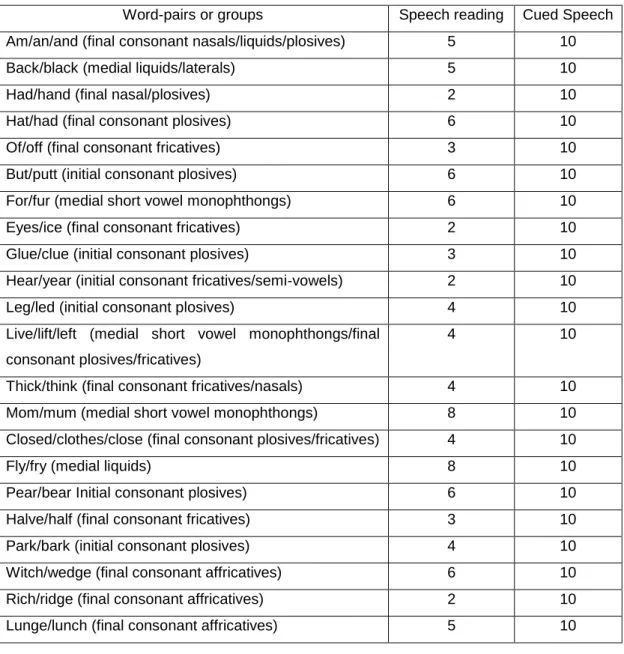
TABLE 5.1: CUED SPEECH TESTS 165
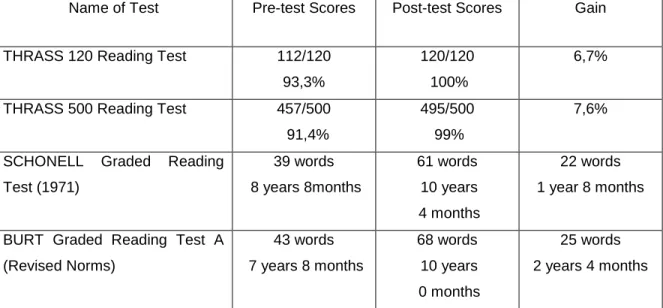
TABLE 5.2: RESULTS OF READING TESTS 177
TABLE 5.3: RESULTS OF SPELLING TESTS 180
LIST OF FIGURES
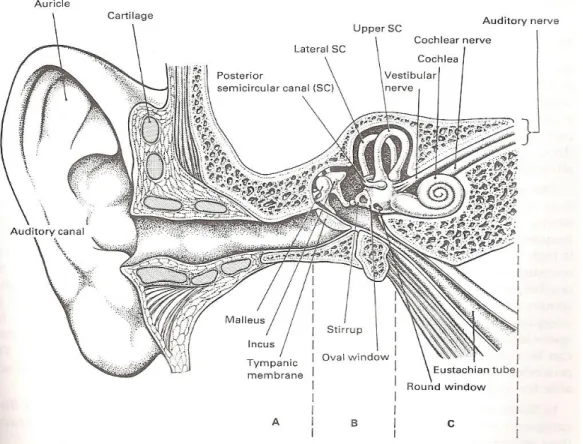
FIGURE 2.1: STRUCTURE OF THE HUMAN EAR 26
FIGURE 2.2: AUDIOGRAM OF FAMILIAR SOUNDS 30
FIGURE 2.3: STYLES OF HEARING AIDS 37
1
CHAPTER ONEINTRODUCTORY ORIENTATION AND STATEMENT OF THE PROBLEM
1.1 INTRODUCTION
Inclusion allows us to acknowledge that the traditional categories of ‘’able bodied’’ and ‘’disabled’’ don’t make much sense because we are all complex humans, and the line between ‘’us’’ and ‘’them’’ is constantly shifting and therefore meaningless (Sapon-Shevin 2007:22).
Inclusion in education is built on the premise that education is a fundamental, basic human right and the foundation of a more just society for all citizens; thus encompassing a social model in understanding educational problems (Landsberg & Gericke 2006:15,22). The concept of inclusive education was born out of the World Conference on Special Needs Education in Salamanca, Spain, in 1994, as a worldwide strategy for attending to the learning needs of all disadvantaged, marginalised and excluded learners - inclusive education is not just about accommodating learners with disabilities in mainstream school settings (Oswald 2005:140,146). Inclusive education may be viewed as both a response and a contribution to international economic and other trends because, not only is it linked to global economic developments, but it is also supported by a globalised discourse of fundamental human rights and entitlements driven by international declarations and international organisations (Artiles & Dyson 2005:37).
There is very little information regarding inclusive education in the majority of African countries. However, Kalabula (2000) has stated that although many African countries have formulated policies with regard to Special Education and have aspired to support equality of education for all, the majority of children with special education needs have not been adequately catered for.
Within the southern African context inclusive education is also underpinned by issues of equity and improving the capacity of education systems to act in response to the diverse needs that each learner brings to the teaching and learning event (Howell 2007:99). Nonetheless, as with the majority of initiatives that have been employed in any country’s attempt to liberate itself from historical disparities and build a democratic, humane and just society, the policy of inclusive education comprises a dual process of ‘’educational reconceptualisation’’ and ‘’radical reconstruction’’ (Slee, quoted in Howell 2007:99).
2
From a South African perspective, the context of education is complex because not only has it been shaped by colonial heritage, but also by the structures of the apartheid regime. After the country became a democracy in 1994 the New Constitution included a Bill of Rights pledging basic education for all; with the notions of human rights, equity and redress forming the cornerstones of all legislation and education policy (Stofile & Green 2007:4). Segregation on the grounds of race; the vast disparities in per capita funding; inequities in both mainstream and special education; departmental fragmentation; duplication of functions, responsibilities and services coupled with imbalances with regard to opportunities, expectations and educational rights were the flavour of the day under the apartheid government (Lomofsky & Lazarus, quoted in Stofile & Green 2007:52-53; Stofile & Green 2007:53).
Thus, the priority of those transforming education policies was to address disparities and inequalities with the challenge being to create a single, unified system of education and to build capacity within this system in order to provide quality education to all learners within the system. Several policy initiatives were developed addressing, amongst others, the needs for equity of educational access, non-discrimination and redress. These policies were influenced by the parallel international drive towards inclusive education and the emphasis on replacing the former charity or medical discourses concerning disability, with a rights discourse. White Paper 6 on inclusive education has endeavoured to transform the mainstream schooling system in order to accommodate both vulnerable and disabled learners (Naicker 2005:232; Stofile & Green 2007:53).
In Education White Paper 6. Special Needs Education: building an inclusive education and training system (2001), which is now accepted as policy, it is stated that inclusion involves the support of all learners, educators and the system in its entirety, in order to meet the full range of learning needs. Learning needs may stem ‘’from a range of factors including physical, mental, sensory, neurological and developmental impairments, psycho-social disturbances, differences in intellectual ability, particular life experiences or socio-economic deprivation’’. The focus is on overcoming barriers in the system by making available adaptive strategies and support systems in the classroom (Department of Education 2001:17). This entails bringing education to the child and teaching the child as opposed to teaching the curriculum.
As has been stated, the concept of Inclusive Education – whether it is on an international platform or within the South African context in particular – is underpinned by the need to support all learners in the least restrictive environment in order to meet the full range of learning needs. An investigation into the efficacy of implementing any intervention programme, such as the one under review, is thus indispensable in order that support may be offered to learners in their
3
diversity.
1.2 DEAFNESS AND DEAF EDUCATION
An issue of prime importance with regard to deaf education and deaf individuals has been patterns of literacy achievement and difficulties in this area that are faced by most students who are deaf or hard of hearing (Marschark & Spencer 2003:4).
Storbeck (2007:348) states that “deafness is one of the largest categories of impairments in South Africa and encompasses the full spectrum of hearing loss – from mild to total or profound deafness”. Statistics South Africa indicated that in 2001 there were no less than 412 421 people who are profoundly deaf and 1 237 264 people with severe hearing loss in the country (National Institute for the Deaf [NID] 2009: ¶ 4).
Generally speaking, the majority of learners who are deaf have hearing parents (Schick 2003:219). Storbeck (2007:354) ratifies this statement by indicating that as much as 90 per cent of children who are deaf are born to hearing parents. Hearing parents of children who are deaf tend to favour the oral or spoken language approach to communication as opposed to the manual
or sign language approach because oralism - although an approach which reinforces the medical model of deafness as being a deficit to be remediated - allows children who are deaf to assimilate with the hearing majority (Archbold 2000:259; Storbeck 2007:354).
Oralism places major emphasis on use of the spoken word in synchronicity with speech reading (previously known as lip-reading) ability and auditory training or learning; with residual hearing augmented by amplification technology such as hearing aids or cochlear implants. There are two major groups of approaches to oralism: unisensory and multisensory. Unisensory approaches centre on the development of audition (auditory modality only). The unisensory approach is known as the auditory, aural-oral, aural, Auditory-Verbal (O-V), acoupedic, acoustic or auditory-global method. In contrast, the multisensory approach embraces a balance of audition and vision (auditory and visual modality) where visual cues are used to supplement speech reading ability. This approach is known as the Auditory-Oral (A-O) method and Cued Speech is an example of such an approach. The multisensory approach may include a tactile component when necessary and this is called the auditory-visual-tactile technique (Trezek, Wang & Paul 2010:211). This spoken language approach is based on the tenet that developing proficiency in both expressive and receptive spoken language is an attainable goal for people who are deaf or hard-of-hearing (Florida Department of Education [FLDoE] 2007:2).
4
Manualism refers to the use of visual-gestural language with its own grammatical structures which differ from spoken language (FLDoE 2007:2). This approach is favoured by the Deaf community and it falls within the inclusionary framework of the social paradigm (Storbeck 2007:354). However, Marschark and Spencer (2003:492) maintain that “… no single method of communication is going to be appropriate for all deaf children”.
The age of onset and aetiology of hearing loss coupled with learning styles of children who are deaf or hard-of-hearing, as well as the family dynamics and the choice of communication methods, impact considerably on educational placement. These learners may be placed in Schools for the Deaf where sign language or manualism is the mode of communication, or in schools which embrace oralism, the auditory-oral or aural-oral approach (Ohio Coalition for Children with Disabilities [O.C.E.C.D.] n.d.:3-4). Storbeck (2007:353) concurs by stating that parents of learners who are deaf have challenging decisions to make with regard to both the communication approaches and the education options available to their children who are deaf. Although not without controversy, parents also need to consider the option of cochlear implantation (Archbold 2000:257).
It has been a customary worldwide trend for learners who are deaf to be placed in specialised education environments for the ‘deaf’ or ‘hard-of-hearing’. However, the 1970s and 1980s saw a movement towards the integration of learners who are deaf into mainstream school settings with various levels of support. The contemporary global trend of education for all revolves around the concept of inclusion in the least restrictive environment (Archbold 2000:257). One of a number of specific characteristics inherent in learners who are deaf that needs to be considered when designing and implementing effective educational objectives and learning experiences in order to best support these learners in the least restrictive learning environment, is the fact that learners who are deaf achieve well below their hearing peers in the area of language acquisition, with the gap increasing as they progress through the schooling system (Traxler, quoted in Power & Leigh 2003:43). Currently a large percentage of deaf and hard-of-hearing children are accommodated in inclusive classroom settings along with their hearing peers (Martin 2007:3-4).
It seems evident that in order for the education system to be able to provide support to learners who are deaf - in the least restrictive environment and in inclusive classroom settings - it is imperative that research is undertaken with regard to implementing programmes which may best support the literacy development of these learners.
Stobbart (2006:iii) states that the poor levels of literacy attained by learners who are deaf have troubled educators and researchers equally. Although reading achievement among learners who are deaf has received a great deal of focus over the past two decades, there is still much
5
evidence that their levels of reading attainment remain seriously deficient (Trezek & Malmgren 2005:256). Research has revealed that the performance in reading comprehension of learners who are deaf is about six grade levels below that of their hearing peers (Karchmer & Mitchell 2003:27). McAllister (quoted in Stobbart & Alant 2008:1) indicates that approximately 66 per cent of adults in South Africa who are deaf are functionally illiterate and unemployed. Marschark and Spencer (2003:493) advise that even though creative solutions in addressing the poor literacy levels of learners who are deaf have been sought over a number of decades, these learners are still developing at an extremely slow pace in comparison to their hearing peers in learning to read. No matter what type of background learners who are deaf come from, the majority have a tendency to be unable to map written expressive language onto a linguistic system known to them, the result of which is a diminished understanding of language (Albertini & Schley 2003:125). Power and Leigh (2004:xvii) are of the opinion that successful advancement in the literacy levels of learners who are deaf is “… the single greatest challenge that has faced the field of deaf education…” and that in order to support the literacy needs of these learners requires the use of new approaches. The Teaching Handwriting, Reading and Spelling Skills (THRASS) literacy programme may be considered as a new approach to potentially support the literacy levels of learners who are deaf or hard-of-hearing. This programme has been chosen above other programmes of a similar nature because it is in keeping with the Auditory-Oral or spoken language approach. The programme incorporates the use of a Phoneme Machine (see section 3.1) to demonstrate the human lip movements of spoken words as a visual component in congruence with auditory-based speech sounds to augment speech reading, and improve access to the phonology of the English language. Additionally, there is a Cued Speech option (see section 3.1) included in the programme. This is a visual communication system used to discriminate information and thus supports speech reading. (See section 2.3.1.3).
1.3 THE TEACHING HANDWRITING, READING AND SPELLING SKILLS (THRASS) PROGRAMME
1.3.1 An overview
The Teaching Handwriting, Reading and Spelling Skills (THRASS) programme is a whole-school, multi-sensory literacy programme based on the use of synthetic phonics to build phonemic awareness by teaching learners to utilise meta-cognitive strategies and word-solving skills when reading and spelling. The 44 phonemes (speech sounds) and the 120 graphemes (spelling choices) of written receptive and expressive English are the key elements around which the THRASS Programme is built (THRASS. nd. Key facts about THRASS ). (See Chapter Three for an in-depth discussion of the THRASS programme).
6
The THRASS literacy programme has been implemented in many schools in Europe, the Middle East, Australia, South America, Central America, the United States of America, and Africa including southern Africa and Sub-Saharan Africa. The programme has been embraced by a number of universities in South Africa and the two-day accredited course in THRASS has become part of the academic programme for aspirant educators. In addition ABSA has rolled out an extensive sponsorship programme in the form of substantial donations of THRASS materials to various schools as part of ‘The THRASS Absa Talk Together Literacy Project’. Varsity College, which has eight campuses, and is a licensed tuition provider of The University of South Africa (UNISA), joined the THRASS Absa Talk Together Literacy Project in January 2009. UNISA is the principal provider of student educators in South Africa and all third year B.Ed. student teachers are being introduced to the THRASS programme to equip them to teach literacy in schools (Inspired 2008:19).
The THRASS Phoneme Machine software forms an integral part of the THRASS Literacy programme. In January 2009 the THRASS Phoneme Machine Version 6 software, incorporating the Cued Speech (CS) option, was launched as an additional support strategy for learners who are deaf. In the Cued Speech option of the software, the shapes, positions and movements of the hands utilised in Cued Speech are presented next to the associated moving human lips, allowing up to 96 per cent of spoken language to be lip-read with greater accuracy. The updated version 6.1 was released on the 1st of October 2009 (THRASS. nd. Deaf children to be taught synthetic phonics). This version includes video clips of a Cued Speech transliterator demonstrating the hand shapes and associated mouth positions to represent the phonemes which make up words.
Cued Speech as a mode of communication is a system of manual signals or cues which are produced in coordination with visual mouth speech patterns to provide learners who are deaf with a sound-based model of oral expressive language via the visual modality (Krause, Kegl, & Schick 2007:433). Cued Speech as such does not fall into the categories of oralism or manualism as deaf communication methods. This system of visually expressing oral language at the phonemic level to represent clusters of visually distinct vowels and diphthongs is used in synchronisation with speech in order to disambiguate phonemes or syllables which may be confused through speech reading on its own (Krause, Kegl & Schick 2007:433; Leybaert & Alegria 2003:262-263). The THRASS programme has been chosen for evaluation in this study specifically because the programme incorporates the Phoneme Machine software together with Cued Speech to support the development of phonology in learners who are deaf, and who utilise the spoken language approach.
7
Phonology refers to the sound structure of spoken language in terms of the perception (reception), representation (print symbols) and production (expression) of speech sounds and this includes the prosodic elements of intonation, rhythm, stress and timing, as well as the articulatory units of phonemes, syllables and words. Phonological awareness refers to the awareness of the sound system of a language and the ability to recognise spoken language structures such as syllables or ‘chunks’ of sounds and rhymes that are separate from meaning. Phonemes are the smallest linguistic units of sounds and these are represented by graphemes which are the smallest units of written language – that is, letter symbols. Phonemes are considered the building blocks of any language, and phonemic awareness indicates the ability to manipulate phonemes in terms of analysis and synthesis – this ability is reliant on the development of phonological awareness. Phonics is concerned with the mapping or correspondence of phonemes to graphemes; and the awareness that printed symbols systematically represent spoken words is referred to as knowledge of the Alphabetic Principle (Trezek, Wang & Paul 2010:46,209,211).
The direct and explicit teaching of phonics by letter-sound correspondence is central to the THRASS programme, the aim of which is to develop knowledge of the fundamental building blocks of phonology, namely the phonemes of English and their corresponding graphemes, and thus increase phonological awareness. After extensively reviewing research aimed at identifying the skills and methods of instruction associated with reading achievement, the National Reading Panel (2000) identified the elements of phonemic awareness, phonics, fluency, vocabulary and comprehension as critical to the acquisition of reading skills. This is in keeping with Chall’s Stages of Reading Development which highlights the elements of phonemic awareness and phonics as pre-requisite skills in order to make the eventual transition from learning to read to reading to learn (Trezek et al 2010:32-34). The THRASS programme is centred on Word Level Teaching to addresses the critical pre-requisite reading skills of phonemic awareness and phonics; and the development of these skills is supported by the inclusion of Cued Speech as a supplementary reading instructional tool to subsidise speech reading. Cued Speech is a vehicle for accessing the phonology of the English language, because phonemes cannot be fully discriminated by speech reading alone when using the spoken language approach as mode of communication.
Classroom action research carried out by Grindal (2004:62) indicated the need for utilising an explicit phonics programme to support the development of literacy skills in learners who are deaf. Grindal (2004:60) further stated that “…it would be beneficial to establish the impact of THRASS when used with additional strategies such as Cued Speech, Visual Phonics or lip-reading skills.” However, there is a dearth of research on the theory of THRASS, and insufficient studies of rigor have been carried out to appraise the effectiveness of this programme.
8
1.3.2 Lack of research on THRASSAlthough there is a fairly extensive amount of information on an International level regarding the literacy attainments of learners who are deaf, there is a paucity of research within the South African context. This has necessitated the use of primarily international literature to provide the theoretical framework underpinning this study. Specifically, there is a dearth of research with regard to intervention studies – and this includes the Teaching Handwriting, Reading and Spelling Skills programme (THRASS) - in respect of best practices for enhancing the literacy levels of learners who are deaf. There is also hardly any current research related to the use of literacy intervention programmes in respect of learners who are deaf and in inclusive educational settings within the South African context. This absence of research indicates the need for investigating the implementation of a literacy programme with learners who are deaf.
Research has indicated that learners who are deaf and who use a phonological code when reading are at an advantage because “…the reciprocal relation between spoken and written language is activated by the association between phonology and orthography” (Paul 2003:106). Trezek and Malmgren (2005:269) concur by indicating that recent studies have revealed the efficacy of direct instruction in phonics and phonemic awareness on the reading skills of deaf and hard-of-hearing Middle School learners. Wang, Trezek, Luckner & Paul (2008:405) emphasise the critical importance of incorporating instructional tools such as Visual Phonics and Cued Speech into reading instruction and teaching strategies if learners who are deaf are to increase their literacy levels.
Research-based evidence indicates that the THRASS Literacy Programme has a positive influence on the growth in the ability of deaf learners to read and spell by virtue of their ability to access phonological information (Grindal 2004: 62). Worsfold, Executive Director of Cued Speech Association UK, has stated that the use of the new THRASS software will result “… in more deaf children achieving literacy levels equivalent to hearing children” (International Business Times 2008:2). Diederichs (International Business Times 2008:2), an educator at a School for the Deaf in Kwa-Zulu Natal, and founder of Cued Speech South Africa (CSSA), indicated that by utilising the THRASS programme and cueing simultaneously in the classroom, the language, spelling and reading skills of her deaf learners have increased substantially; even prior to her incorporating the newer version of the Phoneme Machine with the additional Cued Speech software. However, much of the information about the efficacy of this programme is anecdotal and there is a lack of sufficient empirical evidence to support this.
9
The intention of this research undertaking is to establish the efficacy of the THRASS programme in developing the literacy skills of an Intermediate Phase deaf learner who uses the spoken language approach. A specific objective of this study is to establish the role played by the Phoneme Machine together with the Cued Speech option, both of which are part and parcel of the programme, in supporting the development of phonological and phonemic awareness as pre-requisite skills for the acquisition of the higher order skills of reading and writing. The rationale and motivation for this study leads to the formulation of the problem statement.
1.4 STATEMENT OF THE RESEARCH PROBLEM
1.4.1 Introduction
Preliminary steps in research revolve around the process of asking questions and formulating problem statements related to educational practices in order to guide research; and this implies the opportunity to gather and analyse data. Qualitative research problem statements are expressed as research purposes or questions (McMillan & Schumacher 2006:51).The problem statement identifies what the problem is, why is it a problem, what has been done previously in an attempt to deal with the problem and whether any previous attempts were sufficient to solve the problem (Hofstee 2006:85). A noteworthy problem statement is one that will support the development of theory, provide knowledge, inform practice, add insight to a broader phenomenon, enhance methodology, is exploratory in nature or is associated with current issues and trends (McMillan & Schumacher 2006:67). To formulate a problem statement in the qualitative research paradigm the researcher must begin with the selection of a specific case for in-depth study (McMillan & Schumacher 2006:61). A case may refer to any one phenomenon such as, for example, one program, one process, one student, one group of students, or one policy (McMillan & Schumacher 2006:316). This study involves a programme as the case.
This study investigates and attempts to establish the extent to which the implementation of the Teaching Handwriting, Reading and Spelling Skills (THRASS) literacy programme - which includes the use of additional strategies such as the Cued Speech option incorporated in the computerised Phoneme Machine software which form part of the THRASS programme – supports the literacy development of an Intermediate Phase learner who is profoundly deaf and who uses the auditory-oral or spoken language approach as method of communication, with the aid of bilateral cochlear implants. The study takes place in an inclusive setting in an Independent School and a single case study design is employed.
10
1.4.2 The need for research based on experienceThe researcher, who has been involved in education for over thirty years, is based at a small private, inclusive school in Johannesburg which caters specifically for learners from Grade One to Grade Twelve who require additional support beyond that which they are able to access in the larger classes found in most mainstream schools. There are between 6 and 12 learners in a group. A multilevel teaching approach is used, and learners straddle the Grades and Phases where necessary. Multilevel teaching is underpinned by the principles of individualisation, flexibility and inclusion in order to involve all learners in classroom activities despite their diversity. Straddling of Grades and Phases is implemented as an adaptive procedure for learners who are unable to fit into a particular grade or phase because of the barriers to learning they may experience (Department of Education 2005:23,90).
During the latter part of 2008 the researcher was approached by the hearing parents of a learner who is deaf and who had been attending a special school where she followed an essentially Individualised Education Programme (IEP). The learner, born with apparently ‘normal hearing’, contracted pneumococcal meningitis at the age of 1 year 8 months, resulting in profound bilateral, sensorineural hearing loss. The learner has been implanted with bilateral cochlear units, and the parents have opted for the Auditory-Oral (aural-oral) or spoken language approach as method of communication for their child. This method of communication is used in the home environment and this is the communication method of choice for when their daughter is taught at school. (See section 1.2 and 2.3). The spoken language approach centres on the elements of speech reading augmented by residual hearing with the aid of amplification technology (bilateral cochlear implants) to support both the comprehension and production of spoken language (Marschark & Hauser 2012:53).
The researcher has recently attended both the Teaching Handwriting, Reading and Spelling Skills (THRASS) accredited course as well as a follow-up refresher course. The school has also been sponsored by ABSA with regard to resource material, and baseline assessments have been completed throughout the school. This has afforded the researcher the opportunity to conduct research. The researcher is of the opinion that by implementing the THRASS literacy programme, which incorporates the Phoneme Machine together with the Cued Speech option, the deaf learner may possibly be supported in gaining higher levels of literacy. The researcher has also recently attended a Cued Speech Foundation Course run by Cued Speech South Africa.
11
1.4.3 The problem statementThe inadequate levels of literacy achieved by learners who are deaf or hard-of-hearing have been of on-going concern for both educators and researchers. Although much research has been undertaken internationally in the field of deaf education, literacy development, and the utility of specific intervention programmes, the problem of poor literacy development continues to be problematic with these learners. There is a dearth of research on this topic within the South African context. Consequently, there is a pressing need to explore this topic further by implementing and evaluating programmes that may enhance the literacy development of deaf and hard-of-hearing learners. The intention of this study is to evaluate the efficacy of implementing the Teaching Handwriting, Reading and Spelling Skills Programme (THRASS) with an Intermediate Phase deaf Gauteng learner using the spoken language approach.
1.4.4 The research question
Based on the preliminary literature review and research undertaken in this field of study, the following research question may be posited from the research problem statement:
Will the implementation of the Teaching Handwriting, Reading and Spelling Skills (THRASS) programme - which incorporates the use of a Phoneme Machine with a Cued Speech option - enhance the literacy levels of an Intermediate Phase learner who is deaf and who uses the spoken language approach?
The following sub-questions which emerge from the primary research problem statement and research question are posed to explore the study further:
What is the nature of deafness?
What is the spoken language approach in contrast to other communication methods used by the deaf?
How do deaf children acquire language?
To what extent will the Teaching Handwriting, Reading and Spelling Skills literacy programme – which employs a phonographic method to support language acquisition at the Word Level – support the literacy development of an Intermediate Phase deaf learner who uses the spoken language approach?
What part does Cued Speech - with particular reference to the Cued Speech option of the THRASS Phoneme Machine - play in supporting a deaf learner’s ability to disambiguate phonics and facilitate access to the spoken word?
12
Once the research problem has been stated, the aims of the study coupled with the more specific research objectives clarify what the researcher hopes to achieve (Hofstee 2006:86).
1.5 AIM OF THE STUDY
The aim of this study is to explore and evaluate the implementation of the Teaching Handwriting, Reading and Spelling Skills (THRASS) literacy programme as a supportive intervention programme to address the literacy levels of an Intermediate Phase learner who is deaf and who uses the Auditory-Oral or spoken method of communication. In other words, this study seeks to determine the effect of this programme intervention.
In order to achieve this aim, the following specific research objectives will be considered in this study:
To define and describe the concept of ‘deafness’
To consider the language and communication approaches used by the deaf
To discuss the concept of deafness as it pertains to language acquisition and literacy
To investigate and implement the THRASS literacy programme with a learner who is deaf in order to establish the utility of this programme in an inclusive setting and to gauge whether and how this programme may be used to support the literacy levels of this learner. Particular reference will be made in respect of the Phoneme Machine which incorporates the Cued Speech option to address the critical components of phonemic and phonological awareness in respect of literacy development. This will take the form of observations, interviews and data collection and analysis.
To discuss the role of phonology in developing literacy skills of learners who are deaf. This will be in the form of a literature review.
The rationale and motivation for the study place the research undertaking in perspective and justify the necessity for embarking on this study. Although the primary aim is to evaluate the utility of a specific programme in attempting to enhance the literacy levels of a specific learner who is deaf and who uses a specific communication method, the researcher hopes that this study will provide a wealth of information to all current and potential educators of deaf learners.
With the increasing popularity of cochlear implants; early screening and intervention techniques; the growth in the number of learners who are deaf being included in mainstream schools; the integration of the THRASS Literacy Programme in Tertiary institutions and schools; and the National focus on literacy campaigns such as Foundations for Learning and the Kha Ri Gude
13
research and good educational practice.
1.6 ORIENTATION TO RESEARCH DESIGN AND METHODOLOGY
1.6.1 Paradigmatic perspective
This research is in keeping with naturalistic inquiry. This is a qualitative naturalistic approach used to acquire insight into phenomena by discovering both paradigmatic (fundamental beliefs and assumptions) as well as methodological (procedural and practical) meanings through our attempts to comprehend the whole. The terms Interpretivism and Constructivism have been used to accentuate the numerous dimensions of the naturalistic paradigm (Williams 2005:271). Interpretivism suggests that there are multiple realities of phenomena which may change across time and place (Neill 2006:2). Qualitative research is fundamental to a constructivist philosophy which assumes reality to be a multi-layered, collaborative, collective social experience within which individuals and groups may assign meaning or interpret events (McMillan & Schumacher 2006:315). Understanding the subjective world of the human experience, concern for the individual and focusing on action, interaction and shared experiences are the fundamental underpinnings of this paradigm (Cohen, Manion & Morrison 2000:21).
Within the qualitative research framework, the researcher will focus on one phenomenon, a literacy programme, as case study in order to acquire in-depth knowledge and insight into a specific bounded system or case, over time and in detail (McMillan & Schumacher 2006:316). The researcher is anticipating that changes will occur in the literacy achievement levels of the deaf learner as she interacts with the Teaching Handwriting, Reading and Spelling Skills (THRASS) literacy programme over a period of time. In order to quantify the changes that may occur in respect of literacy development, the launch and landing of this research undertaking will involve the administration of criterion-referenced and norm-referenced tests. The value of pre-tests is to establish a baseline assessment, and the post-pre-tests will indicate any changes that have occurred after the literacy intervention.
1.6.2 Research design
Qualitative research designs, which may be interactive or non-interactive, involve the systematic collection and arrangement of data, in the form of words, on naturally occurring phenomena. Interactive qualitative methods employ face-to-face data gathering techniques in real-world, natural settings. A case study is an interactive qualitative research design which focuses on a particular lived experience over time and in depth (McMillan & Schumacher 2006:26). It is a
14
rigorous study of a particular person or a specific context and a combination of data collection methods may be utilised to conduct a case study (Trochim 2006:2). A qualitative, emergent, evaluative case study research design will form the framework of the investigation in order to gather and analyse multiple sources of data in a natural setting, using a variety of methods, until an in-depth understanding of the phenomenon - in this case a programme - is attained (McMillan & Schumacher 2006:26). Case study has been adopted as a method for instructional use in education and this method satisfies the three basic tenets of qualitative method: description, understanding and explanation (Tellis 1997:3-4). Although this research study is inaugurated and culminated with quantitative, numeral data, the bulk of the year-long study is qualitative in nature and focuses on the observation of emerging patterns of behaviour. This study evaluates the efficacy of an intervention programme as case, and evaluation research can be both quantitative and qualitative in nature (Check & Schutt 2012:10-12).
1.6.3 Data collection and analysis strategies
Research entails the methodical collection and analysis of data by means of reliable and valid techniques in order to investigate a research problem (McMillan & Schumacher 2006:9). In qualitative research design the phases of data collection and analysis strategies are inextricably linked (McMillan & Schumacher 2006:322). Strategies refer to the sampling and data collection methods which are systematically refined over time in order to increase validity (McMillan & Schumacher 2006: 322,340).
Multimethod strategies such as observation, limited participation, collaborative co-teaching, conducting interviews, artefact collection and field records will be used to enhance the trustworthiness of this study (McMillan & Schumacher 2006:341). The naturalist or interpretive paradigm is dominated by the research methods of interviews and observations (Golafshani 2003:600). Participant observation involves a researcher becoming immersed in the context being observed (Trochim 2006:1). Artefacts may include samples of written work in all areas of the language arts, various class assessments, pre-tests and post-tests, school reports, learner portfolios, learner profiles, as well as medical and paramedical reports.
The researcher will take on the role of participant as observer and collaborative co-teacher when the THRASS programme is being utilised within the classroom during the THRASS ‘15 minutes a day’ programme implementation with the group of learners, in order to collect and analyse data. However, the researcher will take on the primary role of educator when the research participant interacts with the Phoneme Machine and learns to cue because the researcher has attended a course on Cued Speech offered by Cued Speech South Africa (CSSA).
15
Although there is no specific set of standard procedures to follow when analysing data, the qualitative data collected will be systematically recorded, categorised and coded in overlapping phases by means of an inductive process, and at regular intervals, in order to determine emergent themes, patterns, relationships, similarities, differences and concepts (McMillan & Schumacher 2006:364-366). The inductive process in qualitative study commences when the researcher gathers information in the form of observations and interviews, asks questions of participants and records notes in the field (Cresswell 2003:132).
Both mechanical recording and note-taking are important methods of data collection. Mechanical recorders facilitate word-for-word accounts of interactions whereas notes may be used to record non-verbal communication and may act as a back-up in case the recording instrument malfunctions (McMillan & Schumacher 2006:355).
1.6.4 Validity and reliability
Validity is concerned with the degree to which the descriptions of the phenomena and the realities of the world correspond (McMillan & Schumacher 2006: 324). Credibility refers to the results of the research being judged as being credible or legitimate from the perspective of the research participant (Trochim 2006:11). To ensure the validity and credibility of this study the researcher will make use of multi-method strategies such as prolonged direct observation, cooperative co-teaching, interviews, artefact collection and field records (McMillan & Schumacher 2006: 324).
Transferability or generalisability refers to the manner in which the knowledge gained from this particular study may be generalised across different people, settings, or time as in quantitative research (Trochim 2006:11). The researcher intends to give an in-depth, ‘thick’ description and definition of all aspects related to this study in order to contribute to a body of knowledge and assist in the transfer of this knowledge to other similar settings.
Dependability refers to the consistency of the findings and confirmability is concerned with the extent to which the outcomes of the study may be corroborated (Trochim 2006:12). In order to avoid researcher bias and establish dependability and confirmability the researcher will make use of peer assessment and debriefing or ‘auditing’. (McMillan & Schumacher 2006: 326; Trochim 2006:12).
16
1.6.5 Ethical considerationsSince qualitative research intrudes on the lives of all participants, certain guiding principles with regard to informed consent, deception, confidentiality, anonymity, privacy and caring must be adhered to. Qualitative researchers must prepare in advance how they intend to deal with potential ethical dilemmas in interactive data collection. The general reading public should not be able recognise either the settings or the participants. For this reason, researchers characteristically code the names of people and places by making use of pseudonyms (McMillan & Schumacher 2006: 333-334). Thus, for the purposes of this study the research participant will be referred to as Sally.
1.7 EXPLANATION OF RELEVANT CONCEPTS
The following concepts have been defined in order to provide the reader with a background to the terminology used throughout this research.
CONCEPT EXPLANATION
Articulation This refers to the physical production of speech sounds by adjusting the flow of air from the lungs through the movable articulators of the lips, mandible, soft palate , larynx and pharynx and the immovable articulators of the teeth, alveolar ridge and hard palate (Haynes, Moran & Pindzola 2006:54).
Articulatory feedback A system combining mouth movements with voiced and unvoiced vocal sensations to represent each phoneme. This tactile-kinaesthetic feedback system relies on the association between how phonemes feel on the mouth and in the vocal tract to the grapheme correspondence (LaSasso, quoted in Trezek et al 2010:54).
17
Auditory-Oral (O-A) or aural-oral approach
This approach to spoken language development permits the use of speech reading combined with residual hearing augmented by amplification technology such as hearing aids or cochlear implants to facilitate both the reception and the expression of spoken language (Marschark 2009:87). This approach falls within the oralist philosophy and may be referred to as oralism
Auditory-Verbal (O-V) approach
This approach to spoken language development centres around increasing listening skills (audition) and decreasing the use of speech reading (vision) so that children make use of residual hearing without making use of visual cues to support language comprehension
(Marschark 2009:87).
Bilateral In respect of hearing loss or cochlear implants, the word ‘bilateral’ refers to the involvement of both ears, whereas ‘unilateral’ would refer to one ear only.
Cochlear implants or units
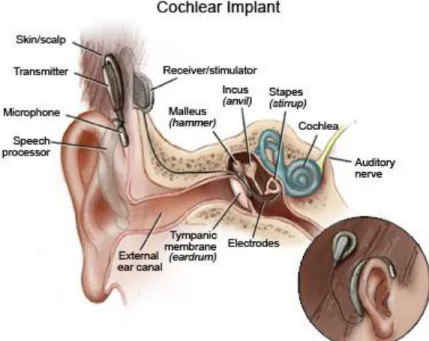
Assistive listening devices which comprise of a microphone, a speech processor, a transmitter, an internal receiver and an electrode array working together to augment sound by directly stimulating the auditory nerves of the inner ear. These devices can be fitted unilaterally, meaning in one ear, or bilaterally, meaning in both ears (Harkins & Bakke 2003:414).
Conductive hearing loss
This occurs when the transmission of sound vibrations through the middle ear is obstructed due to blockage of the ear canal or damage to the eardrum or the ossicles, thus restricting the volume or intensity of sound heard (Marschark 2009:33).
Constructivism The constructivist paradigm encompasses interpretivist philosophy because it highlights how various stakeholders in educational settings construct their belief systems (Check & Schutt 2012:15).
Co-teaching Involves two or more educators sharing the responsibility of teaching all or some of the learners in a group or classroom. The responsibility for planning, preparation of lessons, strategies for instruction and evaluation are distributed between or among the teachers involved.
18
Cued Speech Cued Speech is primarily a language or communication approach used to support the development of spoken language in learners who are deaf or hard-of-hearing. A system of visible sound-related hand shapes and non-manual cues are utilised to afford a greater accessibility to the phonology of a language (Paul 2009:131).
Graphemes Graphemes are the printed letters or symbols used to represent sounds or phonemes (Spencer & Marschark 2010:88).
Implementing To put into effect by following a specific plan or procedure. This term is used in this study to refer to implementing the THRASS programme (Dictionary.com nd. Unabridged).
Inclusion Accommodating and addressing the full range of learners needs by adapting and modifying teaching strategies and resources to meet the diverse needs of all learners within one educational environment or an inclusive education setting. The research site is a small, inclusive, independent school.
Independent School Independent Schools are also known as private schools. These schools are privately governed and may or may not receive limited financial support from local or national government.
Integration Special services are provided to learners who experience barriers to learning and who are integrated into mainstream school settings (Swart & Pettipher 2007:7).
Intermediate Phase This refers to the categorisation of learners according to the Department of Education. An Intermediate Phase learner within the South African context is a learner who is in Grade 4 to Grade 6. International Phonetic
Alphabet (IPA)
A system of phonetic notation based on the Latin alphabet to represent the phonemes of a spoken language and aid pronunciation (Trezek et al 2010:209).
Interpretivism From an educational perspective, Interpretivist philosophy embraces the idea that reality is socially constructed, and the aim of educational research is to comprehend the meanings that people assign to reality (Check & Schutt 2012:15).
Least Restrictive Environment
This refers to the placement of a learner in an educational setting where all the learner’s diverse educational needs may be met.
19
Learner who is deaf This refers to a child within an educational context who has a ‘hearing loss’ as seen from an audiological perspective.
Literacy Literacy refers to the ability to listen, speak, read and write, think and reason in a specific language. In this study a specific programme will be implemented in order to improve literacy skills.
Literacy Programme This refers to any programme designed to support the development of literacy skills in learners to enhance their ability to listen, speak, read, write, think and reason.
Mainstream The learner in a mainstream setting is expected to ‘fit in’ to the existing educational setting, which remains largely unchanged, and does not generally provide additional support (Swart & Pettipher 2007:7).
Manualism or the manualist approach
This approach to language development is centred on the visual-gestural modality. It is a sign language approach that emphasises the use of natural sign language as the first and barrier-free language of the Deaf. The spoken language of the hearing majority is considered the second language of the Deaf learner. Thus, this approach, which falls within the manualist philosophy, may be referred to as manualism (Storbeck 2007:354).
Meta-cognitive strategies
These are strategies used to enhance a learner’s awareness of his/her own unique thought processes. Meta-cognitive knowledge develops as learners learn about reading and writing processes and the strategies that are used when reading and writing (Dednam 2007:120-121).
Metalinguistics Metalinguistic awareness evolves from the understanding of the phonological, syntactic and semantic dimension of language (Dednam 2007:120-121). The first phase, being phonological awareness, is a core element in this study.