Winnie Gae
Thesis presented in fulfilment of the requirements for the degree of Master of Education in Educational Psychology in the Faculty of Education
DECLARATION
By submitting this thesis electronically, I declare that the entirety of the work contained therein is my own, original work, that I am the sole author thereof, that reproduction and publication thereof by Stellenbosch University will not infringe any third party rights and that I have not previously in its entirety or in part submitted it for obtaining any qualification.
Date: December 2016
Copyright © 2016 Stellenbosch University All right reserved
ABSTRACT
Primary school children’s perspectives on wellbeing and learning are always heard from the teachers’ or adults’ perspectives. It is seldom that learners are asked about their perspectives when it comes to their wellbeing and learning at school. Research has suggested that children are marginalised and not given an opportunity to participate in matters that concern them. According to the United Nations Convention on the Rights of the Child in 1989, Article 12 maintains that children have a right to express their views and have them taken seriously in accordance with their age and maturity. It has also been found that it has been one of the most challenging to implement. This study aimed to gain insight from the perspectives of the learners to be informed on what they think affects their wellbeing and learning at school. Bronfenbrenner’s bio-ecological model was used as a frame. Qualitative research, using visual methods, focus groups and classroom observations were used as tools to explore and then describe the participants’ perspectives. The study was conducted as a case study and purposive sampling was utilised to select the participants. Six girls and six boys from three Grade seven classes were selected. The participants gave their perspectives on factors that affect their wellbeing as they had been at the school longer than other learners. The data collected were analysed using thematic analysis. The findings suggested positive and negative aspects that affected the learners at school. Play or sport and extra-mural activities brought happiness to them though extramural activities are practised minimally at the school. Corporal punishment and bullying also emerged as themes that brought fear to the learners. From these findings it was recommended that the school be advised on bullying and on children’s rights in order to help them with drafting school policies that keep the children’s perspectives in mind.
OPSOMMING
Laerskoolkinders se perspektiewe oor welwees en leer word altyd vanuit die perspektief van onderwysers of volwassenes gehoor. Leerders word selde gevra oor hulle perspektiewe oor hul welwees en leer by die skool. Die navorsing dui daarop dat kinders gemarginaliseer word en nie ʼn geleentheid gebied word om deel te neem in kwessies wat hulle raak nie. Volgens Artikel 12 van die Verenigde Nasies se Konferensie oor die Regte van die Kind in 1989, het kinders ʼn reg om hul menings te lug en om ernstig opgeneem te word ooreenkomstig hul ouderdom en volwassenheid. Aanduidings is dat dit een van die mees uitdagende dinge is om te implementeer. Die studie het gepoog om vanuit die perspektiewe van die leerders insig te verkry oor hulle beskouings van wat hulle welwees en leer by die skool beïnvloed. Bronfenbrenner se bio-ekologiese model is as raamwerk gebruik. Kwalitatiewe navorsing met behulp van visuele metodes, fokusgroepe en waarnemings in die klaskamer is gebruik om die deelnemers se perspektiewe te verken en te beskryf. Die studie is as ʼn gevallestudie gedoen en deelnemers is deur middel van doelgerigte steekproefneming gekies. Ses meisies en ses seuns uit drie graad 7-klasse is gekies. Aangesien die deelnemers langer as ander leerders by die skool was, het hulle hul perspektiewe oor faktore wat hul welwees beïnvloed gegee. Tematiese analise is gebruik om die data wat ingesamel is te ontleed. Die bevindings het gedui op gunstige en ongunstige aspekte wat die leerders by die skool beïnvloed het. Speel of sport en buitemuurse aktiwiteite het hulle gelukkig gemaak – hoewel buitemuurse aktiwiteite weinig by die skool beoefen word. Lyfstraf en afknouery het ook na vore gekom as temas wat die leerders bang gemaak het. Na aanleiding van hierdie bevindings is aanbeveel dat die skool leiding kry oor die hantering van afknouery en oor kinders se regte om hulle te help met die opstel van ʼn skoolbeleid wat die kinders se perspektiewe in ag neem.
ACKNOWLEDGEMENTS
Thank you Lord for your blessings and favour. You have surrounded me with wonderful people who have supported me throughout my academic journey. I am incredibly grateful for their support and would like to express my sincere gratitude to them. I might not name them all but I really appreciate everyone’s support.
To my mother, Vela, though you are not here physically, I hope and know that you are happy for my achievement. Ndiyabulela Thahla, Ngqungqushe for being a pillar of strength to us, your children and for supporting us single-handedly.
To my family, and friends who became family, my sisters, you have always supported me since I started this journey. I really appreciate the support and advices. And for keeping on checking on my progress, it really meant a lot to me.
To my husband, Tavista, through our struggles and ups and downs I managed to pull through. To my wonderful and loving children, Tabisa, Tumelo and Thabang. Thank you bantwana bam for bearing with me when I could not see to your needs. To you Tabisa, I thank God for you, you have been more than a child to me but I saw a mother to your siblings and a true and supporting friend to me. I will always cherish that.
My patient and calm supervisor, thank you very much Prof Ronelle Carolissen. You believed in me when I did not and provided me with incredible support, I really appreciate your support. Dr. Le Roux for editing the thesis and Danielle for formatting the drawings. I have never met you but your support gave me more hope, thank you very much.
To the most important people, the participants, their parents and the staff of the school where the research was done. I am grateful for granting me the permission and making this possible.
CONTENTS PAGE Declaration ii Abstract iii Opsomming iv Acknowledgements v List of Abbreviations xi
List of Tables xii
List of Figures xiii
List of Appendices xiv
List of drawings xv
CHAPTER 1 1
1.2 INTRODUCTION 1
1.2 AIMS OF THE RESEARCH 4
1.3 THEORETICAL BACKGROUND 5
1.4 PROBLEM STATEMENT 5
1.5 STATEMENT OF THE OBJECTIVES 6
1.6 METHODOLOGY 6
1.6.1 Research paradigm 6
1.6.2 Research design 6
1.6.3 Sampling 7
1.6.4 Methods of data collection 7
1.6.5 Data analysis 7
1.6.6 Ethical considerations 8
1.7 DEFINITION OF CONCEPTS 8
1.7.1 Learners’ or students’ voice 8
1.7.3 Learning and wellbeing 9
1.8 THESIS OUTLINE 9
CHAPTER 2 LITERATURE REVIEW 10
2.1 INTRODUCTION 10 2.2 THEORETICAL FRAMEWORK 10 2.2.1 Microsystem 11 2.2.2 Mesosystem 11 2.2.3 Exosystem 12 2.2.4 Macrosystem 12 2.3 CHILD DEVELOPMENT 14
2.4 THE DEVELOPMENT OF THE CONCEPT OF WELLBEING 16
2.4.1 Definition of wellbeing 16
2.4.2 Mental health: A state of wellbeing 18
2.4.3 Wellbeing at school 19
2.5 SCHOOL HEALTH IN SOUTH AFRICA 21
2.6 YOUNG PEOPLE’S PERSPECTIVES ON WELLBEING 22
2.7 CHILDRENS’ VOICE AND DEVELOPMENT OF WELLBEING IN CHILDREN 22
2.7.1 What affects learners’ learning 24
2.7.2 Sense of belonging 25
2.7.3 Violence 27
2.7.4 Teacher-learner relationship 28
2.8 INTERVENTIONS THAT PROMOTE WELLBEING IN SCHOOLS 29
2.9 SUMMARY OF THE CHAPTER 30
CHAPTER 3 RESEARCH METHODOLOGY 31
3.2 RESEARCH DESIGN 31
3.3 THE RESEARCH PARADIGM 31
3.4 METHODS 32
3.5 RESEARCH METHODS 33
3.5.1 Sampling and site selection 33
3.5.1.1 Purposeful sampling 34 3.5.1.2 Case study 34 3.5.2 Generating data 35 3.5.2.1 Drawings 35 3.5.2.2 Interviews 36 3.5.2.3 Observations 37 3.6 DATA MANAGEMENT 37
3.6.1 Recording and transcribing 37
3.6.2 Data analysis 37 3.7 QUALITY ASSURANCE 40 3.7.1 Credibility 41 3.7.2 Transferability 41 3.7.3 Dependability 41 3.7.4 Conformability 42 3.8 ETHICAL CONSIDERATIONS 42 3.8.1 Autonomy 42 3.8.2 Confidentiality 43 3.8.3 No maleficence 43 3.8.4 Beneficence 44 3.8.5 Informed consent 44 3.8.6 Anonymity 45 3.9 SUMMARY OF CHAPTER 45
CHAPTER 4 DATA ANALYSIS 46
4.1 INTRODUCTION 46
4.2 BIOGRAPHICAL DETAILS OF THE RESEARCH PARTICIPANTS 46
4.3 RESEARCH FINDINGS 47
4.3.1 Learners’ perspectives on factors that enable their wellbeing at school 48
4.3.1.1 Enabling factors 48
4.3.1.2 Extra-mural activities 48
4.3.1.2.1 Cultural activities 48
4.3.1.2.2 Sport 53
4.3.1.3 Educational activities 56
4.3.1.3.1 Teachers encouraging learners’ leadership roles 56
4.3.1.3.2 Teaching and learning strategies 57
4.3.2 Learners’ perspectives on factors that are constraining their learning and
wellbeing at school 59
4.3.2.1 Learner-learner violence 59
4.3.2.1.1 Fighting 59
4.3.2.1.2 Bullying 60
4.3.2.2 Teacher-learner violence 62
4.3.2.2.1 Teacher embarrassing learners 62
4.3.2.2.2 Corporal punishment 63
4.3.3 Not being listened to by teachers 68
4.3.3.1 Taking part in class activities 68
4.3.3.2 Having your views listened to 68
4.3.4 Learners view of processes that can impact positively on their wellbeing 69
4.3.4.1 No corporal punishment 69
4.4 PROCESS ANALYSIS 71
4.4.1 Responding to questions 71
4.4.2 Trust and safety felt 71
4.5 CONCLUSION 72
CHAPTER 5 DISCUSSION OF RESEARCH FINDINGS AND
RECOMMENDATIONS 73
5.1 INTRODUCTION 73
5.2 DISCUSSION OF FINDINGS 74
5.2.1 Learners’ perspectives on factors that enable their wellbeing and learning
at school 74
5.2.1.1 Extra-mural activities 74
5.2.1.1.1 Cultural activities 74
5.2.1.1.2 Sport 75
5.2.1.2 Educational activities 76
5.2.1.2.1 Teachers encouraging learners’ leadership roles 76
5.2.1.2.2 Teaching and learning strategies 78
5.2.2 Learners’ perspectives on factors constraining their wellbeing and learning at
school 79 5.2.2.1 Learner-learner violence 79 5.2.2.1.1 Fighting 79 5.2.2.1.2 Bullying 80 5.2.2.2 Teacher-learner violence 81 5.2.2.2.1 Corporal punishment 81
5.2.2.2.2 Teachers embarrassing learners 82
5.3 PARTICIPANTS’ IDEAS OF AN IDEAL SCHOOL 83
5.4 LIMITATIONS OF THE STUDY 84
5.6 RECOMMENDATION 84
5.7 CONCLUSION 85
LIST OF ABBREVIATIONS
DoE – Department of Education SASA – South African Schools Act SGB – School Governing Body
UNCCR – United Nations Council for Children’s Rights WHO – World Health Organisation
LIST OF TABLES
LIST OF FIGURES
Figure 2.1- An example of a microsystem interaction 11
LIST OF APPENDICES
Appendix A - Focus group interview questions in isiXhosa 96
Appendix B- Example of drawings’ interviews transcripts 97
Appendix C- Sample of themes 102
Appendix D- Permission letter from the Department of Education 110
Appendix E- Explanation to the participants 111
Appendix F- Participants’ assent form 114
LIST OF DRAWINGS
Sample 4.1- Drawing showing love for acting 50
Sample 4.2- Drawing showing love for music and a wish for a school choir 51
Sample 4.3- Drawing showing a wish to sing at school 52
Sample 4.4- Drawing showing joy of finally having sport at school 55
Sample 4.5- Drawing showing violence (fighting) 60
Sample 4.6- Drawing showing bullying 61
Sample 4.7- Drawing showing corporal punishment 66
CHAPTER 1
1.1 INTRODUCTION
“You may give a voice to the children, even give them a very big platform, but if adults don’t stop to listen to what the children are saying it is as good as no voice”
began a 14 year old Njabulo when she introduced a live radio broadcast one Saturday morning in March 2009 (Meintjies, 2010/2011).
There is a universal call from educational organisations and other children’s organisations to give children a voice on matters that affect them. Despite those voices, children are seldom consulted and remain largely unheard. The call is to move towards the implementation of Article 12 of the United Nations Convention on the Rights of Children (UNCRC) which was endorsed in 1989. The article emphasises the importance of listening to children.
Different researchers use different terms when talking about learners’ voice or the lack of voice. The study will use the terms “participation” and “marginalisation”. Participation elicits the positive effects of listening to children while marginalization elicits the negative effects. According to Lansdown (2005), participation allows children to develop independence and social competence and also learn ways in which to bring out social change.
Messiou (2013) notes the action of not listening to or not hearing children and refers to it as “marginalisation” or regarding them as “forgotten”. She uses the terms to highlight the fact that children are marginalised because of their abilities or perceived lack of abilities and competencies. Again, Messiou (2012) explains marginalisation as a state of being disregarded which results in lack of equal treatment and denial of rights.
A number of reasons are provided for children not participating in their learning. It is notable that culture and pedagogy have a role in children not being listened to. For instance, in many Black South African communities, culture plays a big role in determining what children should be allowed to hear or say. Often many South African black children are trained to defer to adults and this prevents them from communicating confidently with adults. Their incapacity is seen as a sign of respect to adults (Martin, 2012; Mncube & Harber, 2013). However, my opinion from experience is that adults treat children in ways they see fit or according to what is beneficial to them as adults. For example, a child may be asked to stay home and look after his younger sibling or nurse a sick parent while the parent is sick, instead of going to school. Lansdown (2005) elicits another example of Ugandan belief about
listening to children. According to Ugandan custom, it is interpreted as disrespecting the family structure and the head of the household if adult authority is questioned.
This notion spreads to schools. In schools, culture tends to supersede rules and regulations and this is also true in many black South African schools. Sargeant (2012) suggests that many teachers continue to see children as unable to contribute positively. Primary schools, in particular, do not usually give learners a platform to give their views on matters that affect them. This is reflected in policy as well. The South African Schools Act (SASA) only considers high school children for participating in matters that affect them. However, it is observed that very often principals in South African schools manipulate the school governing body (SGB) to function while never disagreeing with the principals.
The aim of this study is to elicit participants’ perspectives on what impacts their wellbeing and learning at school. Children’s voices are not listened to and as a result there are few studies that capture children’s voices on matters that affect them. Furthermore (Cortina, et al., 2013) suggest that there are a small number of published studies of children’s wellbeing in Southern Africa.
Many policies have addressed the issue of children not being heard. Although policies are in place, there is lack of advocacy in executing what needs to be done in order to include
children (Martin, 2012). Martin (2012) points out that the issue around listening to children is not new. He suggests that as early as 1996, the Department of Education Act No. 27 of 1996 states that children should be consulted in the development of school codes of conduct, disciplinary matters, school governance, education policies and family-level education (Martin, 2012).
Also in South Africa, in the Integrated School Health Policy of South Africa, the government has agreed to make children their main focus. It further explains that one of its goals (goal 24) of the Integrated Strategy 2012-2016 is to ensure that the school is a conducive environment for both learners and teachers. The policy further commits to reinstate health programmes in public schools. However, the policy does not give details on how it will deal with emotional well-being.
Messiou (2013) notes that most recently, a concern with students’ voices has gradually moved to the centre of educational researchers’ attention. Kanyal and Cooper (2010) recommend that children’s perspectives on school and learning are important for their wellbeing. This is
evident when one looks at the Universal Foundation’s initiative which worked towards the development of a tool that will assess how school impacts on learners’ wellbeing (Awartani, Gordon & Whitman, 2008). The toolkit is called Voices of Children. Subsequently, a study was done in Palestine using the Voices of Children toolkit. The study showed that teacher-learner relationship results are the most important influence on teacher-learner-wellbeing (Awartani, et al., 2008 and Liberante, 2012).
There are also numerous positive and negative impacts of giving children a voice. The impacts are seen at schools, homes and communities. Children spend most of their time at school. Therefore learning environments have to be healthy. In this case, learning
environment does not refer only to cleanliness of the grounds and classrooms but to
relationships between peers and educators. Negative psychological impacts at school can be induced by poor relationships with educators, peers and not understanding the learning
content (Booth and Sheehan, 2008). Similarly, according to the ecological theory the school is a system and members of a system affect each other’s development (Donald, Lazarus & Lolwana, 2010). Booth and Sheehan (2008), again point out that a conducive school climate is vital for learners’ academic achievement. Conducive school considers the well-being of the learner.
It is important to let children express their opinions (Akengin, 2008). Policies that are designed with input from children are likely to be appropriate.
There is also evidence that children notice when they are marginalised and that it affects their well-being. For example, Messiou (2008) reports that children in a study complained that their teacher always demonstrated work of the same pupils because they were doing well in class and they felt that the teacher was unfair to them. Therefore, if children were given opportunities to decide how the process should be done, it would have satisfied everyone and not only those who are seen as high performers by the teacher.
Caregivers and educators should be aware of the fact that when children are listened to, they contribute to developing active citizenship and enhanced self-esteem among children.
The above overview suggests that although there are policies which give children a right to be listened to, they are still not listened to, especially if they are at primary school level. The literature suggests that children’s views on matters that affect them can influence policy makers’ decisions if they were to listen to children. Most importantly, the above literature
suggests that there is a correlation between learning and wellbeing. Similarly, a study done in Ireland (Roiste de Aingeal, et al., 2011) suggested that there are good relations between school involvement and healthiness and happiness. In this study I will explore primary school learners’ perspectives of factors that impact their learning and well-being
1.2 AIMS OF THE RESEARCH
The current study wishes to discover primary school learners’ perspectives on factors that impact on their learning and well-being at school.
The overarching research question is:
What can we learn about primary school learners’ perspectives on their participation in their learning and well-being by listening to them?
These are the sub-questions:
What are learners’ perspectives on their participation in learning? What are learners’ perspectives on their learning and well-being?
What do learners believe can be done to facilitate change and impact positively on well-being?
1.3 THEORETICAL BACKGROUND
The theoretical overview that this study will draw on is Bronfenbrenner’s bioecological model. I will also draw on theoretical strands from Erikson’s and Piaget’s theories of child development. These will be discussed further in chapter two.
1.4 PROBLEM STATEMENT
In 1989, Article 12 on the rights of children was released at the United National Convention of the Right of the Child. Article 12 is about the rights of children. One of the points in the article is that it is children’s right for their views to be viewed as important. However, even after the publication of Article 12 on the rights of children, some researchers noticed that
children were still not listened or asked about their experiences even though they were able to talk about their experiences (Daniels, Kalkman & Combs, 2001).
Subsequent research shows that researchers are now interested in engaging with children about their experiences. They also want to understand what children’s views are about what affects their learning at school. Similarly, Madeleine, Goetz and Lipnevich (2014) posit that recently there has been a move to study students’ experiences in the learning environment, especially with regards to academic emotions, and emotional and social skills. This then implies that children are slowly gaining recognition as active participants in matters that affect their well-being. This is what Atkins (2013) refers to as “research with children” as opposed to “research on children”. Research with children is likely to give them some voice. The school seems to be the ideal departure point for gaining insight into children’s
perceptions on school since they spend much of their time at school.
Furthermore, Adams (2013) postulates that school plays a role in contributing to the shaping of both childhood and adulthood.
The debate around school contributing towards learners’ well-being, either positively or negatively seems to have gained recognition. Some researchers have noted the relationship between participation and well-being of school children. This is notable when it is mentioned that schools that foster supportive relationships between staff and students encourage
participation and autonomy in students (Svirydzenka, Bone & Dorga, 2014). They further say that giving children autonomy promotes good mental health. There is strong suggestion that listening to learners and acting on their views, results in a stronger sense of themselves and a positive attitude towards learning (Lyle, Hendley, & Newcomb, 2010).
The above argument in the literature suggests that there is a need for learners’ views to be heard. Marshall and Rossman (2006) suggests that it is important to draw on children’s insights the world that they experience.
1.5 STATEMENT OF THE OBJECTIVES
The objectives of the study are:
To explore how learners understand participation in their learning at school.
To explore what learners’ perspectives are on the factors that impact on their learning in school.
To explore what learners’ perspectives are on the factors that will enhance their learning and well-being at school.
1.6 METHODOLOGY 1.6.1 Research Paradigm
Draper (2004) asserts that qualitative research focuses on individual experiences and the meaning that they have for individuals and societies. By listening during interviews, the researcher is able to analyse the meaning of children’s lived experience (Marshall &
Rossman, 2011). A paradigm that is relevant to the latter is the constructivist paradigm. The epistemology that underlies the constructivist paradigm suggests that people’s construction of their understanding of the truth is grounded on their interaction with their environments. The ontology inherent in constructivism suggests that there are many realities (Denzin & Lincoln, 2011). The methods that will be used in this study are based on and are informed by these beliefs.
1.6.2 Research Design
The study used a case study design. According to Mouton (2001) case studies provide a detailed explanation of a lesser small quantity of cases. Similarly, Yin (2009) posits that a case study is relevant when the researcher requires an extensive and “in-depth” description of some social phenomenon.
1.6.3 Sampling
The study used purposive sampling. Grade 7 learners were targeted for this study as they are the ones who have been at a primary school longest and may be better at responding to the questions. Twelve participants, six boys and six girls, were selected to participate in the study.
1.6.4 Methods of data collection
In keeping with the chosen paradigm and approach, drawings and focus group interviews were used to collect data. Interviews are likely to provide a rich description of the phenomena (Terre Blanche & Durrheim, 1999). The focus group interviews also elicit rich descriptions
and often contribute a composite picture where views in the group may be similar but also contested among group members. This provides depth that may not be provided in individual interviews (Kitzinger, 1995).
In the current study, children were asked to do two drawings in separate boys’ and girls’ groups: one showing an example of a situation where they felt good at school and one
showing an example of a situation where they felt bad at school. The drawings were done first as they are helpful in building rapport with children and acting as a catalyst for discussion in focus groups. Furthermore, Sewell (2011) argues that draw-and-write supports more inclusive and participatory research in that it gives access to a group who may be excluded as a result of their limited verbal skills and vocabulary.
After each group had been done separately, learners were immediately interviewed in focus groups methodologies. The focus groups were audio-recorded and drawings were
photographed.
Lastly, classroom observations were done in the three Grade seven classrooms of the school. The researcher wanted to gain a general overview of the learners’ participation during tuition.
1.6.5 Data analysis
All focus group interviews were transcribed and data were analysed using thematic analysis. Thematic analysis is relevant to this study because it can be used to identify and report themes within data (Braun & Clarke, 2006). Further, it reports experiences, meanings and the reality of participants (Braun& Clarke, 2006). Using the guidelines suggested by Braun and Clarke, data were coded by reading and rereading for themes that emerged from the data.
1.6.6 Ethical considerations
Following appropriate ethical principles when working with children is important. They should not be harmed in any way and should be treated as equals during the research process. Ethical clearance, number (HS1166/2015), was obtained from the Humanities Ethics Committee of Stellenbosch University. Consent to conduct the research in the school was also obtained from the Western Cape Education Department (WCED) and from the school principal.
The parents of the participants were also asked for their voluntary informed consent for the children to participate in the study. Similarly, the children were asked for their assent. The purpose and procedure of the study was first explained to the parents and the children in a language that they could understand. The researcher is Xhosa speaking, so could explain all the procedures to the participants and their parents in Xhosa.
Confidentiality, anonymity and voluntary participation were also discussed and that they could withdraw from the research anytime they wished to. Bless, Higson and Kagee (2006) point out that participants should know about their rights to discontinue at any time without being required to give an explanation.
A group of supportive teachers from the school’s support team were available for assistance if a need arose for counselling if learners were distressed. The district’s educational psychologist was also asked for assistance for more serious concerns, should this be necessary. In the course of the study no concerns that the researcher could not manage immediately, arose.
1.7 DEFINITION OF CONCEPTS 1.7.1 Learners’ or students’ voice
It is when learners’ opinions are heard and contribute to formulating policy and contributing to secure provision (Rudd, Colligan & Naik, 2006).
1.7.2 Children’s participation
Participation can be defined as children’s involvement in decision-making in matters that directly affect them (Lansdown, 2011). This means that adults and children should respect each other’s views and have the benefit of their views being considered.
1.7.3 Learning and wellbeing
There are different meanings attached to wellbeing. According to Rudolph, Monson, Collet and Sonn (2008) wellbeing includes physical and emotional health and safety. On the hand, Gough, McGregor and Camfield (2006) associate wellbeing with happiness and a sort of life that is good to lead. Similarly, (White 2009) explains that wellbeing entails satisfaction with life and participation by contributing positively to others’ wellbeing. In all, these meanings all point to satisfaction of one by either being happy or contributing to others’ happiness.
On the other hand, the Voices of the Children Toolkit define wellbeing as “an ongoing process of realizing one’s unique potential through physical, emotional, social, mental and spiritual development in relation to oneself, others, and the environment”. The latter is the relevant definition for the study.
1.8 THESIS OUTLINE
This study will be subdivided into five chapters. Chapter 1 introduces the study and states the study’s aims and objectives, as well as the methodology and methods that are going to be used. In Chapter 2, the literature will be reviewed, and will be outlined. Chapter 3 will explain the research design, methodology and data collection process, followed by Chapter 4 that will provide the analysis and discussion of the research findings and interpretation of themes identified in the study. Chapter 5 will provide a summary of the results and conclusion. It will also discuss limitations and recommendations for future research work.
The next chapter will present literature on children’s wellbeing and how it affects their learning and how school activities in the school environment affect learners’ wellbeing.
1.9 CONCLUSION
Chapter one provided the background and motivation for this study. It introduced the questions to be addressed in order for the research aim to be met. Furthermore, research design, methodology, research methods and data analysis techniques were briefly introduced. Lastly, ethical considerations were briefly mentioned and concluded with a brief outline of the structure of the chapters.
CHAPTER 2
LITERATURE REVIEW
2.1 INTRODUCTION
The purpose of this chapter is to gain insight into how primary school learners perceive factors that influence their learning and wellbeing at school. According to Gutman and Feinstein (2008), most children experience wellbeing when they interact with others in their immediate environment like the school. When talking about the school context, the researcher will explore the school climate which includes teachers, peers, teacher-learner relationships, learner-learner relationships, the curriculum, the infrastructure and other factors that may affect or influence the learners’ wellbeing at school. This will be done by describing Bronfenbrenner’s ecological framework, aspects of Erikson’s and Piaget’s developmental theories as well as drawing on social constructivism. The frameworks will serve as a lens through which to review important factors that impact children’s learning and wellbeing.
2.2 THEORETICAL FRAMEWORK
Bronfenbrenner’s bio-ecological theory highlights how different levels of a system in the child’s social context interact during the process of child development (Donald, et al., 2010). This is acknowledged by Hannaway, Steyn and Hartell (2014) when they state that an
individual does not operate in a vacuum, but is surrounded by circumstances, events,
timeframes and other phenomena. They further link it to Bronfenbrenner’s (1995) hypothesis which states that human development is made up of interaction among processes, person, context and time. This is true when one explores factors that impact the child’s learning at school. The school is a context, it also includes people, like teachers and peers and it can also be “time” because it presents a certain stage in the child’s development.
Bronfenbrenner identifies four nested systems wherein the child’s development happens. These are the:
Microsystem (such as the family, school or peers)
Mesosystem (interaction of two Microsystems)
Exosystem (social systems which in which the child does not function directly in them)
It is appropriate that the researcher uses the bioecological framework as it explains how each system influences the child in his or her context.
An explanation of each system follows:
2.2.1 Microsystem
According to Berk (2000) the microsystem is the environment closest to the child. This includes the family, parents, teachers at school and peers. These people all have direct
interaction with the child and may have an influence in the child’s development through their interaction.
In this study active members within the school system, such as teachers, parents and peers were included as they are likely to affect the learners’ wellbeing and learning.
2.2.2 Mesosystem
In the mesosystem, microsystems interact continuously and depending on the result of the interaction, the child is either affected negatively or positively (Donald, et al., 2010). The interaction can be between two or more microsystems. For an example, at a school where children bully each other, the victim may report the incident to the teacher and or to the parent. The parent and the teacher may meet to intervene and the perpetrator may be called in during discussions to resolve the problem (see Figure. 2.1).
Teacher/ parent
victim perpetrator
2.2.3 Exosystem
Unlike the previously mentioned systems, in the exosystem the child is not directly involved as an active participant (Swart & Pettipher, 2011). However, the child may be influenced by what happens in the settings and the relationships may be negatively affected. Swart and Pettipher (2011) provide an example of a parent who may be stressed by retrenchment and then the relationship at home with the child may be negatively affected. Going back a little to the microsystem, the emotionally affected learner may get solace from the teacher-learner relationship at school.
2.2.4 Macrosystem
The macrosystem is the dominant social and economic structures and the attitude, beliefs, values and ideologies that influence all other social systems (Donald, et al., 2010; Swart & Pettipher, 2011). According to (Donald et al., 2010) cultural values may include obeying authority and respecting senior members of the community. Although learners misbehave these days, culture still plays a primary role in how children and learners behave at school. It is noticeable that learners will agree or not voice their ideas for fear of being seen as
disrespectful. For example, the school where the study was done was my previous place of work. Learners were once dissatisfied about a fundraising activity which they felt was done unfairly. Instead of communicating their grievances appropriately, they sang outside the hall implying that they were robbed and that they wanted their money back. This incident showed me that the culture which prescribed obedience to adults all the time, on the other hand denies learners their right to be heard.
In this study, the microsystem will be discussed according to how it affects the child’s wellbeing and subsequently how it may affect learning at school. This is evident in many black communities where children are not given a voice or an opportunity to participate in matters that affect them.
If participation and voice is discussed, it is important to consider social constructivism as a theoretical lens in this study. Constructivism posits that an individual makes meaning of his/her world through interaction with other people in their context. I will consider constructivism in relation to learning.
Amineh and Asl’s (2015) make a distinction between constructivism and social
constructivism. According to them, constructivism describes the way that learners can make sense of the material and also how the materials can be taught effectively. This theory asserts that teachers should consider what learners know and allow them to put it into practice. Viewing the learner, this theory believes that learners make their own meaning to conceptualise knowledge. This takes place when the teacher creates situations in which learners will question their own and each other’s assumptions (Amineh & Asl, 2015). On the other hand social constructivism, according to Amineh and Asl (2015) assumes that understanding, significance, and meaning are developed in coordination with other human beings, constructed through activity. The learners play an active role in constructing
knowledge and the teacher encourages the learners’ own version of the truth that is influenced by his or her background, culture or knowledge of the world. Similarly, Kugelmass (2001) affirms that classrooms according to this theory address children’s physiological, emotional, and intellectual needs through mediated interactions among peers. It also promotes self-regulation and responsibility for individual and group learning. In both theories the learner appears to be an active agent in his or her own learning.
Subsequently, both theories enhance the learners’ independence and freedom which are important for wellbeing. Acceptance and self-worth is also evident in such classrooms and thus the learner feels happy and eager to come to school when they are allowed to actively participate in their learning.
Gilbert Christine (2006) reported on a group’s report which was tasked to establish a vision of what personalised teaching and learning might look like in 2020. The group came to these conclusions which they agreed that this what parents and learners deserve and what the country needs if it is to meet the global challenges of the twenty first century.
The group further postulated that personalising learning means focusing in a more structured way on each child’s learning in order to enhance progress, achievement and participation. One may notice that the latter points are all important for children’s wellbeing. The group also indicated that all children and young people have the right to receive support and challenges, tailored to their needs, interests and abilities. However, they mention that this demands commitment from the learners, parents and teachers.
According to the group, reflective schools view ‘pupil voice’ as far more than establishing a learner council but engaging learners actively in shaping learning and teaching. This is in line with constructivism which has been mentioned earlier. They maintain that this can be done by enhancing learner-learner relationship so that they can support one another with learning problems. They further suggested that teachers can invite learners to contribute when designing their teaching schemes. This notion is in line with learner participation or giving them a voice in matters that matter in their lives according to the UNCRC. According to them assessment should be used as a tool of helping teachers to collect information about learners’ achievement in order to adjust teaching to meet learners’ needs more fully.
However, it is evident that in some cases learners’ voice may be impeded by the teachers’ attitudes towards learners. Friedel, Marachi and Midgley (2002) reported that learners who perceived their teachers as embarrassing them or their peers, avoided seeking assistance from those teachers.
Developmental theories also help us understand how children develop into adults. The following short section will discuss child development briefly.
Child development is deemed important for this study for it shows us how children’s thoughts, behaviours and learning are shaped by their contexts and interaction with other people. Subsequently, all these systems shape many aspects of cognitive, social, emotional, moral, and spiritual development (Donald et al., 2010).
2.3 CHILD DEVELOPMENT
For the purpose of this study we will consider adolescence when discussing child
development. Most researchers have divided adolescence into three developmental periods. These entail: (1) early adolescence (typically ages 10–13); (2) middle adolescence (ages 14– 17); and late adolescence (18 until the early twenties), (Smetana, Campione-Barr & Metzger, 2006).
Using Erikson’s psychosocial stages of development, it is easy to understand what children are faced with in each stage of development. Erikson delves more into crises a child must negotiate in order to successfully master that stage (Hardman, 2012). Eccles (1999) maintains that in each stage there are basic biological and cognitive changes, and changes in social surroundings where children’s daily lives unfold. This statement resonates with Kosher,
Ben-Arieh, Jiang and Huebner (2014) when they assert that children’s wellbeing is not static and is generally situated within developmental and ecosystemic conceptual frameworks. For the purpose of this study we consider the school to be the social surrounding. The school is expected to be a social and academic environment which is supposed to allow optimal development for children’s social-emotional and academic skills (Kourkoutas, 2012).
Huitt and Hummel (2008) also illustrate Piaget’s cognitive developmental theory which states that children actively construct their understanding of the world and go through four stages of cognitive development. These stages are the sensorimotor stage which occurs between birth and two years of age. In this stage children construct an understanding of the world by
coordinating sensory experiences. The following stage is the preoperational stage, which lasts from approximately two to seven years of age. In this stage, children add words to their understanding of the world. The third stage is the concrete operational stage which lasts from approximately seven to eleven years of age. In this stage, children can perform operations that involve objects and can reason logically as long as reasoning can be applied to specific
concrete examples. The fourth and last stage is the formal operational stage which lasts from eleven to fifteen years of age and continues through adulthood. This is the stage in which the participants of this study are.
According to Ojose (2008) individuals can think abstractly and in more logical terms. As they can think abstractly, they develop images of ideal circumstances. This may suggest that the participants have ideas of how a school should be or know what makes them happy or not at school. However, it should be noted that children may not be in the same stage because of certain factors. Vally (2005) and Berliner (2009)assert that cognitive development can be negatively affected by poverty and poverty may lead to violence and misconduct. Therefore, it is important for teachers to be aware of such factors and approach their lessons in ways that will benefit each learner’s potential. This may be especially true in the low-income school where the current study was conducted.
This section has focused on theoretical foci central to the research: ecological approaches, constructivism and some aspects of Erikson and Piaget’s theories of development. In the following section, the concept of wellbeing and its different meanings will be discussed.
2.4 THE DEVELOPMENT OF THE CONCEPT OF WELLBEING 2.4.1 Definition of wellbeing
It is believed that schools may focus too strongly on academics and ignore the importance of essential human wholeness which incorporates emotional health and social wellbeing (Faupel & Sharp, 2003). Given that this study aims to explore learners’ perspectives on their
wellbeing, it is appropriate to define and explain the concept of “wellbeing”.
The definition varies depending on the field and policy area. According to Wagstaff (2011) the concept of wellbeing has evolved over time and it naturally links to multiple notions and points of view. The World Health Organisation (WHO) posits that the concept of wellbeing encompasses the physical, mental and emotional, social and spiritual dimensions of health (Wagstaff, 2011). Furthermore, the WHO in 1946 determined that wellbeing was one of the principles basic to the happiness, harmonious relations and security of all peoples. The WHO’s use of the term “happiness” in the previous statement befits this study’s participants as young children who may not understand the term “wellbeing”. The WHO’s definition of health refers to social and psychological wellbeing.
Looking at health and wellbeing deeper, Konu and Rimpela (2002) suggest that the concept of wellbeing has been divided into four categories:
School condition (having)
Social relationships (loving)
Means for self- fulfillment (being), and
Health status (health)
According to Konu and Rimpela (2002) “being” applied to the school context, can be seen as the way in which the school offers means of self- fulfillment, they further explain that each pupil should be considered an equally important member of the school community. They further postulate that positive learning experiences enhance self-fulfillment.
They state that it should be possible for each learner to participate in decision making
resonates with what has been said earlier in giving learners a voice or letting them participate in factors that affect them.
According to Kosher, et al. (2014), wellbeing can be explored from the children’s rights perspective which maintains that wellbeing is the realisation of children’s rights and the fulfillment of the opportunity for every child to be all she can be in the light of her abilities, skills, and potential. As has been indicated in chapter 1, according to the UNCCR’s article 12, children’s rights are stipulated and every country has to adhere to them. The article stipulates that schools should consult learners on the day-to-day life of the school, and asksthe school to develop learner participation and active citizenship in the school setting and as part of the school’s development planning process. These democratic policies sometimes clash with cultural practices in specific countries. Moletsane (2012) shows how different cultures interpret childhood and how they monitor physical maturity. She gives an example where a girl had to start going to school at the age of nine because the family thought she had to develop physically to be able to endure the long walk to and from school. However, the girl had to start doing chores at the age of six, and those included sweeping and chores that
increased in difficulty according to age. Someone from another culture may view some chores as adult chores where at eight the girl had to cook, and at nine she had to fetch wood from the bush. If there was a way of monitoring children’s rights, some chores would be seen as child abuse and many parents would be penalised. There should be ways in which these rights are not just highlighted in documents but all the relevant people like parents should know about them and the consequences of denying children their freedom to play and to voice their views. Furthermore, the case above depicts how sometimes children’s wellbeing are affected by their immediate contexts. Depending on resilience, especially the girl child’s self -esteem may be hampered when being the oldest in a class of young peers.
Furthermore, the above examples may imply that adults view children as passive participators because everything is imposed upon them when they are expected to execute these duties. Hence studies have suggest that children should be seen as active agents who are already contributing to their families and communities (Tisdall & Liebel, 2008).
Wellbeing also has to be understood in relation to individual preferences and opportunities. As such, the same level of commodities and resources do not produce the same level of wellbeing for all individuals (Ben-Ariech & Frones, 2007. This is true when we talk about
unique human beings. Wellbeing also results from the interaction the child has with
significant others and the society at large and how they share resources. These factors are not static, and the children’s developing capacities enable them to actively contribute to their wellbeing (Bradshaw, Hoelscher & Richardson, 2006).
The different definitions of wellbeing and the way in which contextual factors impact on definitions may suggest that wellbeing has not been clearly defined, especially when it comes to young people (Ben- Arieh, 2006).
2.4.2 Mental health: A state of wellbeing
Mental health is defined as a realisation of one’s potential and the ability to handle pressures in order to work effectively. Furthermore, the WHO emphasies that health includes all aspects of one’s wellbeing. This may suggest that if all these aspects are catered for and recognized as important, children at school may develop positive mental health. The following paragraph give hope that children are slowly gaining recognition and different stakeholders are becoming aware of how important it is to include children in matters that affect them.
According to Kosher, et al. (2014) children’s rights and their wellbeing have gained attention at the same time. They suggest that childhood is a unique period of life which emerged during the 19th century. It came along with attempts to grant protection and provision of rights to children. In the second half of the 20th century, children began to be allowed participation for they were now recognized as legal persons whose rights were equated to adults (Peterson-Badali & Ruck, 2008). They further assert that children should not be seen as their parents’ or the state’s property but as people who are entitled to the same rights as adults do. The current study explores how the school can allow children to practice their rights as equal active partners in their education.
Similarly, Boyden, Ling and Myers (1998) suggest that there are nine principles that can be applied in different contexts to guide studies of children’s wellbeing, whether their purpose is to monitor their experience, explore their understandings, or to track the process that
influences their wellbeing across their life course. In summary, these principles suggest that children are offered different rights and opportunities depending on the different perceptions of different cultures and communities or households. In some culture children are exposed to work at an early age. And from these principles it is evident that child work in some societies is regarded as important in strengthening family relations.
The above principles suggest that one should be conscious of the various components and dynamics of wellbeing. Some of the principles also show how Bronfenbrenner’s ecological theory plays in child development, especially the microsystem as the family is mentioned in almost all these principles.
2.4.3 Wellbeing at school
Previously, wellbeing has been referred predominantly to physical health. Since the ratification of the Convention on the Rights of the Child (1989) document, wellbeing also focuses on children’s participation in matters that concern them. In addition, ecological theory suggests that we could observe how the different systems influence the child’s development. In this study, greater emphasis is placed on the microsystem and the child’s immediate environment, which in this case, is the school.
According to Gutman and Feinstein (2008) most children experience wellbeing in primary school. In the same way, the school is regarded as the focal point for elevating children and adolescents’ health (Konu & Rimpela, 2002; Yetunde, Aoife, O’Higgins & Gabhainn, 2013). For Pullman, Bruns, Dalyn, and Sander (2013) schools are central and critical locations for youth health and mental health promotion. These statements suggest that because school is where learners spend most of their time there should be measures in place to look after the wellbeing of the learners.
There is some evidence to suggest that factors like children’s individual experiences such as bullying, victimization and friendships, and their beliefs about themselves and their environment, affect their wellbeing (Gutman & Feistein, 2008). According to them schools make a difference in children’s wellbeing, but it is children’s individual experiences within schools which are important. Children’s individual interactions with their peers may result in different experiences within the same environment.
In South Africa one of the core strategies of the government-appointed 2020 Review Group for example, actively involves learners as the owners of their own learning. However, it has been found that some teachers see children as dependent on teachers for knowledge. For example, one teacher in Zahorik’s (1990) study is quoted saying “I’ve never met students who could make decisions (about learning) for themselves.” The previous quote and the year of the study in which the quote is extracted may compel one to think that the quote was inspired by the Children’ Convention that was published the preceding year, 1989 and that the policies in those
articles were not yet practiced. The contrasting quotes may suggest that teachers have been and are still treating learners according to their own beliefs about children. In this quote the teacher indicated that “I’m flexible. I’ll go with students’ interests, I’ll go with current events of interest and trash the curriculum.” This also shows that this teacher respects the learners as humans who have their own interests and thus respects them. It may however be important to find a middle ground between the first and the second teacher’s views because one cannot reject learners’ views on learning. At the same time one cannot throw out all the positive aspects of the curriculum either.
One should consider learners’ views in their learning as giving them the respect which Kourkoutas (2012) considers fundamental in order for studying to be meaningful. In the context of well-being and learning, it is important to consider school health in South Africa.
2.5SCHOOL HEALTH IN SOUTH AFRICA
Recent research in South Africa shows that school health concerns the health and wellbeing of approximately 12 million school going children (Shung – King, & Slemming, 2013/2014). It seems as if South African school health has gone through several changes with the aim of improving the services. It is said that it has started since the 1920s with school feeding scheme and has evolved by including other aspects of health.
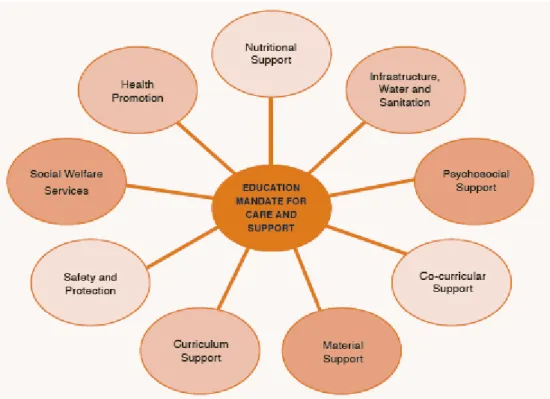
In Figure 2.2 is the framework which addresses children’s wellbeing through nine key areas of intervention.
Figure 2.2. The care and support for teaching and learning framework for children’s wellbeing (sourced from Department of Basic Education, 2012 as adapted from Bray and Moses, 2011).
The above diagram shows what is advocated by school health in South Africa which calls for all schools to become sites for health promotion for learners, educators and the broader school community (Shung-King, Orgill & Slemming, 2014). Likewise, Pullman et al. (2013) assert that school-based supportive programmes such as mental health, family and child support, and mentoring can influence school performance. However, they further indicate that it has been found that school-based mental health programmes have a relatively small effect on academic outcomes. This he discusses in depth by eliciting how learners are marginalized and not recognized as individuals who can be autonomous. When considering children, the latter postulates that wellbeing is no longer only about ordinary health issues but also participation or lack of it.
2.6 YOUNG PEOPLE’S PERSPECTIVES ON WELLBEING
As this study’s aim is to explore primary school learners’ perspectives on factors that affect their learning and wellbeing at school, I thought it may be interesting to compare perspectives
of children of different ages in the literature review. In a study done by Coverdale and Long (2015), 15 young people aged between 18 and 24 were interviewed to get their perspectives of wellbeing. The participants identified the school as valuable for promoting, supporting and managing emotional health issues. Their perspective resonates with many researchers who have been mentioned earlier in this study, like, Konu and Rimpela (2002), Askell-Williams and Lawson, (2015) and Gutman and Feinstein, (2008).
According to Coverdale and Long (2015) study participants said that peers and teachers played a vital role in their wellbeing. Views of young people are important for teachers and peers to hear and many researchers argue that teachers should have emotional training on managing children and young people’s emotional wellbeing and mental health. It is in this context that it is important to discuss the development of well-being among children in the context of children’s voice.
2.7 CHILDREN’S VOICE AND DEVELOPMENT OF WELLBEING IN CHILDREN
There are great expectations that education systems will take responsibility for the development of the whole person and his or her wellbeing. Due to the perceptions about children’s voice, governments are looking at different ways of getting children’s views about what affects them.
Young people need to be engaged in meaningful participation and not be marginalised and misrecognizedas individuals who can be autonomous (Giroux, 2009). This may suggest that learners are not given opportunities to participate. Participation is an essential element in both children’s healthy development towards responsible adulthood and citizenship and their wellbeing (Convention on the Rights of the child, 1989)
De Roiste, Colette, Michal, Gavin and Nic Gabhainn (2012) highlight that children are gaining recognition regarding the fact they can express themselves. They further posit that this change can be due to the Children’s Convention’s stipulation. In the same breath, it is noted that giving children a voice is not yet popular and Lansdown (2011) states that it is the adults’ obligation to consider children’s contribution, especially in aspects that affect them. In South Africa, one such platform that allows learners to participate is the School Governing Body (SGB). The SGB is based on the South African Schools Act (SASA) No. 84 of 1996
(Mncube, 2008).This act is based on the concept that learners are members of the school community and have the right to participate in decision-making processes (Duma, 2014). However, learners are not offered full opportunity to participate in crucial decisions by the adult members of the SGBs.
Bray and Moses (2011) and Lodge (2005) observed that the gap between legislation and reality around children’s participation in school governance illustrates the dilemma facing children seeking to influence public spaces which affect them. Bray and Moses (2011) further posit that principals are legally mandated by the South African Schools Act (SASA) no. 84 of 1996 (Government of South Africa, 1996c) to enable secondary school learners to elect representatives onto the School Governing Body (SGB), which governs the management of the school. Due to authoritarian attitudes towards children mentioned earlier, the adults in the SGB often present obstacles related to meeting times and the value and skills ascribed to children by the adults in charge. These actions often prevent learners from participating in meetings (Heystek, 2001). Bentley (2010) also notes that authoritarian practices within SGBs also lessen the democratic commitment of policy reform that encourages participation. Learners subsequently present their dissatisfaction through protest which is sometimes regarded as violent. This may imply that the other stakeholders on the receiving end do not realise that children reach a certain maturity where they feel unheard or not cared for. It is also expected that the protest is coupled with anger which might affect emotions negatively and thus affect the wellbeing of learners and schools.
Mncube (2008) warns that silencing the voices of learners by school governing bodies
contradicts principles of social justice and democracy. These principles maintain that learners or children should be given an opportunity to participate in matters, such as their learning, that concern them. It is therefore important to consider what the literature emphasises as affecting learners’ learning.
2.7.1 What affects learners’ learning
A number of factors may impact on a learner’s learning. These include mental disorders such as depression and anxiety. Teaching related factors such as curriculum and extracurricular activities also impact on learners learning and wellbeing. Similarly learner sense of belonging and levels of violence at schools also impact on learning. These will be discussed briefly.
Mental health
Askell-Williams and Lawson (2015) suggest that 20% of the world’s children and adolescents suffer from mental health problems. They also observe that half of mental disorders, including learning difficulties start before the age of 14. Both Australia and United States are reported to have similar problems where children and adolescents were identified as having mental problems. Similarly, South African children from low social economic environments are reported to suffer from psychological distress caused by violence (Mncube & Harber, 2013). According to Burton and Leoschit (2012), depression and anxiety are the two common contributors to truancy from school. They further argue that depression and anxiety are sometimes caused by violent victimization. This demonstrates how the school as a system where the child resides can have an impact on his/her learning and wellbeing. It is said that the consequences of depression and anxiety directly relate to educational outcomes which may include a noticeable decline in academic performance, a lack of interest in school work, lowered concentration, school drop-out and truancy. Conversely, there is a need to move from focusing on treatment of mental problems to focus on prevention and early intervention (Merikangas, et al., 2010).
Curriculum
Many investigators proposed that school curricula must provide learning experiences that address students’ development in the cognitive or academic, emotional, social, and moral domains (Cohen, 2006; Elias, & Arnold, 2006; Weisseberg, Wang, & Walberg, 2004). However, curriculum may add negative experiences to learners even though teachers mostly do not do it intentionally.
Awartani, Whitman and Gordon (2008) state that teachers who are required to produce good results from learners may ignore the children’s wellbeing and focus on ways of producing good test results. They further indicate that the whole process creates nervousness for both teachers and children. They also note that this process of focusing mostly on good academic results induces high stress levels and more negative emotional symptoms.
Severe stress and feelings of hopelessness may be induced by other factors. For example, Faircloth (2009) suggests that learners may bring their own identities, community and cultural
wealth, skills and resources into the classroom. It is envisaged that this situation may also affect the teachers’ teaching in the classroom.
Taken together, these statements suggest that there is a relationship between emotions and academic achievement (Zins, et al., 2004). It is important to tap into these experiences by acknowledging learners’ participation otherwise students’ voices will be silenced and they will be alienated from their educational experience (Faircloth, 2009).
2.7.2 Sense of belonging
According to Faircloth (2009) adolescents’ sense of belonging within the school settings allows them to be motivated. Theory and research suggest that positive school affect which is due to “belonging” supports students’ motivation, engagement and achievement (Faircloth, 2009).
Importantly, many psychological theories suggest that human behaviour and motivation are enhanced when basic needs are met. Thus, as mentioned earlier, in education “belonging” is imperative in order for learners to feel motivated and accepted. To endorse this point, the circle of courage theory developed by Brendtro, Brokenleg and Bockern (2005) claims that unfriendly schools and rejecting peers can contribute to a sense of alienation in children. This again reveals that belonging is important to all levels of education and not only to young learners. Research has shown that children who feel alienated at school are likely to drop out. Given these observations, Faircloth (2009) suggests that identity is an opportunity to establish trusting connections where one feels appreciated. She argues that identity is not only a general social interaction but also about engagement in classroom activities. She introduces the
identity of the “outsider” where there are low levels of engagement. According to her, this is when other learners’ cultures are not considered when lessons are presented in class. A typical South African example is representations of Santa Claus and a sleigh in snow in readings done in black schools where I worked. These images are often something unheard of to many learners yet they have to develop mental pictures of phenomena that they have little idea about. These everyday practices have changed since the introduction of inclusive education which aims to include every learner and consider their different cultures.
From the above one can deduce that learners feel connected to class when they participate in activities that allow them to express their feelings and beliefs.
According to the above discussion, belonging or acceptance by peers appears to be important to learners. Likewise, acceptance by teachers is also an important factor to children (Friedel, Marachi & Midgley, 2002). They further suggest that support from teachers establishes a sense of trust and acceptance between students and teachers. This may propose that a positive relationship between learners and peers and between learners and teachers is an important factor for learners’ wellbeing at school. This is echoed by Hughes and Chen (2011) when they speculate that supportive relationships between teachers and learners promote a sense of belonging and encourages cooperative classroom participation.
2.7.3 Violence
School violence is said to be one of the factors that affect wellbeing negatively (Burton & Leoschut, 2012). For example, the Human Rights Commission of South Africa report that the environment and climate necessary for effective teaching and learning is increasingly
undermined by school-based violence. Furthermore, depression and fatigue are mentioned as those factors that result from learners being exposed to violence. According to Burton and Leoschut (2012) truancy from school is the result of these factors as learners avoid the school environment in an attempt to avoid the violence.
Violent victimization impacts negatively on the schooling experience resulting in difficulties concentrating at school, absenteeism and poor school performance.
There is evidence that children and youth who are subjected to violence are at increased likelihood of experiencing depression, social isolation and loneliness, anxiety and depression (Murris, 2012). Such violence includes corporal punishment and bullying. Murris further suggests that corporal punishment increases fear and shortened attention span which results in academic underachievement. However, Glew, Fan, Katon, Rivara and Kernic (2005) in their study could not ascertain whether low achievement was the consequence of or preceded victimisation from bullying.
Teachers are often central to violence experienced by children at school. The worst violence reported by learners is that of psychological abuse from teachers (Awartani, Whitman & Gordon, 2008). This is contrary to what teachers are supposed to represent to learners. On the other hand it is noted that learners can behave unacceptably towards teachers too (De Witt & Lessing 2013; Marais & Meier, 2010). However, Vally (2005) argues that learners sometimes bring emotions from home to school. Vally (2005) further mentions that learners may come