International Journal of Emerging Technology and Advanced Engineering
Website: www.ijetae.com (ISSN 2250-2459, ISO 9001:2008 Certified Journal, Volume 6, Issue 7, July 2016)
108
Comparative Analysis and Improvement in AODV Protocol for
Path Establishment in MANETs
Reshu Gupta
1, Vikas Srivastava
21M. Tech student, 2Assistant Professor, Department of Computer Science and Engineering, IIMT Engineering College, Meerut,
U.P, India.
Abstract— MANET is a mobile ad hoc network that has the capability or changing its location and configuring itself as per the needs and requirements of the user on the go. A MANET is quite difficult to control in terms of its routing protocol as there is no fixed terminology that can be implemented onto it for the optimal transfer of the data from the source to the destination. In this paper, analysis between various routing protocols has been done. A bio-inspired technique is proposed to analyze network performance. AODV, DSR, DSDV and hybrid routing protocols are compared in terms of throughput. Packet loss and delay. Experimental results show that hybrid routing protocols has better performance as compared to the other protocols.
Keywords—AODV, DSR, DSDV, ACO, BCO and Cuckoo search
I. INTRODUCTION
MANET is represented as a wireless network that could be a group of heterogeneous mobile devices and is self-organizing, self-configuring. During this kind of network the devices communicate through a wireless medium with one another. The data packets are transmitted via intermediate devices when there is no direct path from source to target. Mobile ad-hoc network is decentralized and not depend on established infrastructure, such as routers in wired networks. Transfer of packets is completed with the help of routing protocols [1]. The routing protocol is responsible for creating the correct path from supply to destination for initiating as well as maintaining a communication between the nodes. Due to mobility of nodes network topology is dynamic in nature, which result in high link breakage and interruption in communication over the network [2].
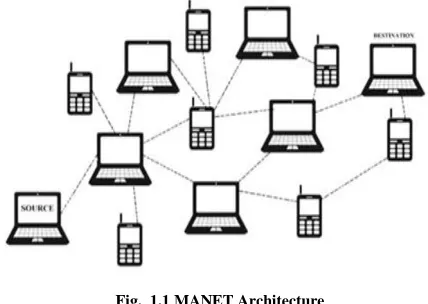
Highly dynamic nature of wireless network, routing protocols have to face so many challenges. Ad hoc network can be described as a wireless network which works without the presence of a central and permanent infrastructure as displayed in Figure 1. Due to distributed nature, there exist various issues & challenges in the working of these wireless ad hoc networks. Thus a wireless network consisting of mobile nodes which is ad hoc in nature can be called as MANET [3].
[image:1.612.334.548.321.473.2]The mobile nodes in the network are capable to acknowledge and pass the traffic via the intermediate nodes towards the destination; mobile nodes present in the network can act as a router as well as a host. The frequent fading of mobile nodes result in connection termination and re-association of nodes includes another variable to the characteristics of mobile nodes which is energy [4].
Fig. 1.1 MANET Architecture
1.1 Challenges in MANET
The various mobile nodes can form network at any place when required. In MANETs, no central controller is present; it is decentralized type of network. In such type of network following are the various key challenges:
1. Mobile nodes can move without restrictions in the network. When the mobile node changes its position, network topology certainly changes with it. For such type of networks there are several challenges for choosing routing protocol. The Multi cast routing is the key challenge in MANET [5].
2. The security and reliability are the other major challenges of MANET. In this, certain types of internal and external attacks are possible. The attacker node can join the network at any time and trigger the attack. It has been a tedious task to design the key management and self-authentication mechanism for MANET [6].
International Journal of Emerging Technology and Advanced Engineering
Website: www.ijetae.com (ISSN 2250-2459, ISO 9001:2008 Certified Journal, Volume 6, Issue 7, July 2016)
109
3. The real time application like video conferencingrequires fixed resource reservation to ensure quality of service. It is difficult to design such mechanism that guarantees good quality of service.
4. The Mobile Ad hoc networks have been formed when nodes from various handheld devices or sensor nodes communicate. Power consumption is another major shortcoming of MANETs. The wireless sensor networks are deployed for sensing the environment conditions and generally deployed at far places. In such places, it is difficult to recharge or replace the battery of the sensor nodes. There have been certain requirements of efficient mechanism for power management.
5. The mobile nodes can move freely in the network. In MANETs, it is very difficult to design a protocol which supports Location-aided Routing.
6. There has been the existence of hidden terminal and exposed terminal problems in case of MANETs. There is an obvious need of a helpful mechanism to solve these problems [7].
7. The mobile nodes can change its position at any time. This approach has led to the problem of link failure which degrades the network performance.
1.2 Routing Protocol in MANET
The protocol should be able to perform in an effective & efficient manner throughout the networking environment consisting of heterogeneous ad hoc networks i.e., from small to large Multi-hop networks. Figure 1.2 displays the various categories of ad hoc routing protocols [8]. There are three categories of these routing protocols, which include proactive routing protocols, reactive routing protocols and hybrid routing protocols with respect to the routing topology used in MANET. Proactive routing protocols constantly retain the updated state of the network topology and are typically table-driven [6]. The Proactive routing protocols includes DSDV, OLSR routing protocols. The second category includes reactive routing protocols also known as source-initiated on-demand routing protocols, these are demand driven reactive protocols. Therefore, they do not follow the procedure creating & updating routing tables with routing information at regular intervals. As they are on demand routing protocols, so they start route discovery only when they are asked to. DSR & AODV are example of these types of routing protocols [7]. Hybrid protocols are the one which utilizes the advantages of both reactive and proactive approaches. It includes Zone Routing Protocol.
Fig.1.2 Classification of Routing Protocol
1.2.1 Proactive Routing Protocol
These routing protocols constantly retain the updated state of the network topology by creating a routing table and this predefined information is used to establish path from source to destination. All the nodes present in the network creates& maintains routing information to every node keep information of their adjacent node which is used at the time of path establishment and maintained information will be updated time to time [8]. The protocols which maintain routing protocols are least using in this type of network due to random topology and has high routing overhead in the network
1.2.2 Reactive Routing Protocol
These protocols are also known as source-initiated on-demand routing protocols, these are on-demand driven reactive protocols [9]. Therefore, they do not follow the procedure creating & updating routing tables with routing information at regular intervals. As they are on demand routing protocols, so they start route discovery only when they are asked. In order to send a packet to another node in the network using this protocol, then this protocol initiates a route discovery process to find reliable path to destination and establishing the connection to transmit data from source to destination [8]. In this process the RREQ packet is broadcasted throughout the network which adds a significant amount of control traffic to the network due to query flooding.
1.2.1 Hybrid Routing Protocol
International Journal of Emerging Technology and Advanced Engineering
Website: www.ijetae.com (ISSN 2250-2459, ISO 9001:2008 Certified Journal, Volume 6, Issue 7, July 2016)
[image:3.612.59.278.242.539.2]110
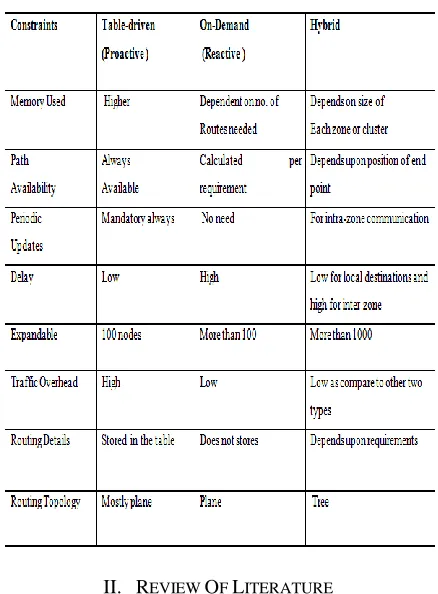
In the initial stage routing is done with some predefined information which is kept on the node and after that source flood route request packets to gather network information. The basic idea is that each node has predefined information of its zone head and nodes which are in the zone, the protocol used to maintain routing information in the network is proactive.Table 1:
Comparison of Routing Tables
II. REVIEW OF LITERATURE
Jagdeep Kaur, Rupinder Kaur Gurm et.al [1] described that MANET is a network in which nodes can freely join and leave the network. MANET has some properties like inrastructureless, dynamic in nature and decentralized control. Due to frequently topology change network performance decreases. Cuckoo search optimization algorithm is a good technique for developing efficient routing protocols for MANETs. CSO is beneficial to find out best optimal path with shortest routing to send data in MANET. In this paper, AODV and DYMO routing protocol with CSO algorithm. Further implemented CSO algorithm on AODV & DYMO protocols using NS2 simulator and compared its simulator results with simple AODV & DYMO protocols.
Dr. Umadevi Chezhiyan [2] they explained the importance of the adhoc networks which communicate and establish path between two end nodes. Routing is the path for path establishment between source and destination to transfer data. Reactive routing is a performed well in MANET than proactive routing. In this paper various routing protocols with their advantages and disadvantages has been discussed. At the end measurement performance analysis is also done in MANET.
Sweety Goyal [3] explained that ZRP is a combination of active and passive for large network In the process of a protocol, inside the routing area, members maintain timely IARP Routing table. Outside the region, the route discovery mechanism is carried out by the reactive component IERP using a routing request and routing reply. Border casting process for routing Borders found that the use of casting Resolution Protocol (BRP). In order to reduce the amount of query Traffic, access control mechanisms and early termination query detector can be used. ZRP is a unique protocol that can be used as routing architecture.
Prof. B.N. Jagdale et.al [4] described that routing protocol plays an important role in MANET for communication and established path from source to destination. It also helps to discover optimal path for data transmission. AODV, DSDV and DSR, ZRP are the various routing protocol to establish efficient path from source to destination. In this paper two routing protocols has been discussed. In this paper it is concluded that AODV is better than DSDV. DSDV consumes more bandwidth as compared to AODV due periodically broadcast packets. On the other hand, AODV has no need for table maintenance contains less bandwidth and less overhead. Even the throughput is less in DSDV as it continuously broadcast route information, but in case of AODV throughput is stable as it don’t needed to maintain any route information.
International Journal of Emerging Technology and Advanced Engineering
Website: www.ijetae.com (ISSN 2250-2459, ISO 9001:2008 Certified Journal, Volume 6, Issue 7, July 2016)
111
The proposed BCO algorithm has been explained with examples. C++ compiler has been generated to find out the faults which are maximum in number and in minimum execution of time. With the help of 5 different types of example bee colony concept is explained with showing that maximum faults are covered with their shortest path.III. OPTIMIZATION TECHNIQUES
Optimization techniques are those which give the best fit solution. It is used to solve complex computational solutions [5]. It finds out the best result from the given feasible solutions. There are several techniques which are based upon the natural phenomena. These techniques are as following:
1. Bee Colony Optimization 2. Ant Colony Optimization
3.1 Bee Colony Optimization: Bee Colony Optimization is nature inspired technique. It is based upon the swarm intelligence technique. It is meta-heuristic technique which is concern with memory based searching. Bee colony optimization technique is used to find the best path from the number of the solutions. It is bottom-up approach used to solve complex combinatorial problems. It is decentralized and self organizing technique. There are two types of bee which are present in the bee hive. These are in hundred and thousand in numbers which work together. It is a global optimizer which ahs effective searching process [14].
3.2 Ant Colony Optimization:Ant Colony Optimization is a probalistic and meta-heuristic technique. It is also natural insipid technique which is meta-heuristic in nature and used to solve complex combinatorial problems. It uses the previous results to find out the present optimal paths. It is dynamic in nature. It gives the idea for team coordination, their behaviour and functionality. It is also based upon swarm intelligence. Ant starts from nest to reach to destination and follow different paths. Each ant secretes pheromone trails to attract other ants following that path.
The path which has the highest pheromone trails are the optimal paths compared to others. So the path is depending upon the trails. It is also upgradeable technique according to the secrete pheromone trails.
When they ant’s returns back to the home they follow the same as the path of starting not the shortest path [14].
3.3 Cuckoo Search Algorithm:Cuckoo search is one of the optimization algorithms which is used in various fields of image processing, networking, artificial intelligence This search carries concept from various cuckoo spices. Earlier this algorithm is used for complex computational problems. Later on this research is applied with PSO and Genetic algorithm and finds out that it achieves better results than PSO and Genetic algorithms. Basically cuckoo search is deal with multimodal problems naturally and efficiently.
CS algorithm revolves around the behaviour of obligatory brood parasitism of some species of cuckoo as well as the Levy Flights (after the name of French mathematician Paul Pierre Levy) of some birds and fruit flies which follow the random walk of heavy tailed probability distribution step size.
IV. PROPOSED METHODOLOGY
International Journal of Emerging Technology and Advanced Engineering
Website: www.ijetae.com (ISSN 2250-2459, ISO 9001:2008 Certified Journal, Volume 6, Issue 7, July 2016)
112
V. EXPERIMENTAL RESULTSSimulation Parameters
Parameter Parameter value Antenna type Omi Directional Mac Standard 802.11
Number of nodes 24
Routing Protocol AODV Simulation Time 8 Seconds
Area 800*800
Pause time 0.1 sec
Physical medium Wireless physical medium
Link layer LL
Range 18 Meter
Packet Size 1000 bytes Transmission Power 2.4 Ghz
Traffic Type CBR
[image:5.612.326.563.180.493.2]The whole scenario is implemented in Ns2.
Fig.5.1 Delay Graph
As shown in figure 5.1, the AODV, DSR, DSDV and hybrid routing protocols are compared in terms of delay. It is been analyzed that hybrid routing protocol has least delay as compared to other routing protocols
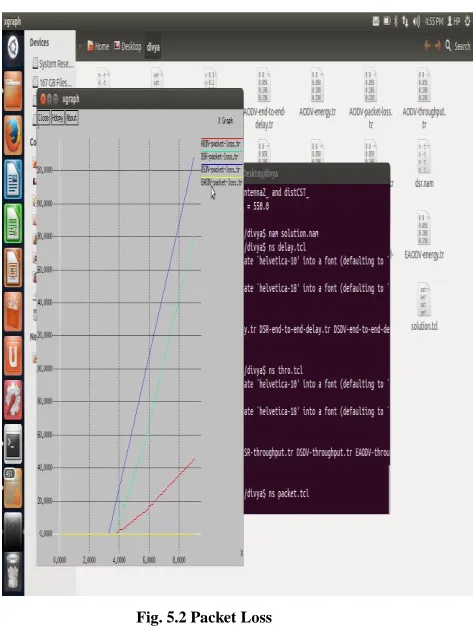
Fig. 5.2 Packet Loss
International Journal of Emerging Technology and Advanced Engineering
Website: www.ijetae.com (ISSN 2250-2459, ISO 9001:2008 Certified Journal, Volume 6, Issue 7, July 2016)
113
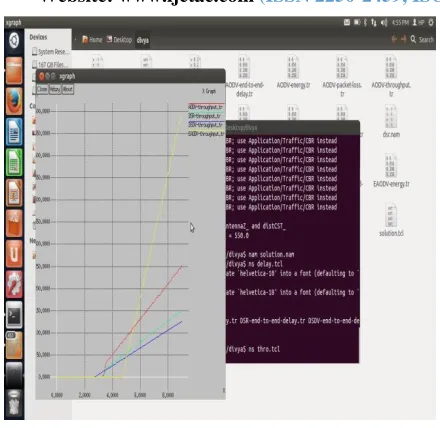
Fig.5.3 Throughput [image:6.612.59.279.126.340.2]As shown in figure 5.3, the AODV, DSR, DSDV and hybrid routing protocols are compared in terms of throughput. It is been analyzed that hybrid routing protocol has maximum throughput as compared to other routing protocols.
Table of Comparison
Parameter DSDV DSR AODV Proposed
Throughput 25 packets 32 packets 40 packets 52 packets
Delay 68 packets 60 packets 52 packets 30 packets
Packet loss 80 packets 73 packets 68 packets 45 packets
VI. CONCLUSION
MANET is a self controlling network. Nodes can easily join and leave the network. Topology changes very frequently in MANET. MANET has various challenges like security, routing, energy consumption etc. In this paper various routing protocols analysis has been done on the basis of bio-inspired technique. In this work, comparative analysis will be done between the proactive and reactive type of routing protocols. In this paper, improvement will be proposed in AODV routing protocol using bio-inspired techniques. The bio-inspired techniques are Ant colony and bee colony. It is concluded that hybrid routing protocols provide better results in terms of packet loss, throughput and delay and improve networks performance.
REFERENCES
[1] Jagdeep Kaur, Rupinder Kaur Gurm, “Performance Analysis of AODV and DYMO Routing Protocols in MANETs Using Cuckoo Search Optimization”, International Journal of Advance Research in Computer Science and Management Studies Volume 2, Issue 8, August 2014 pg. 236-247
[2] Dr. Umadevi Chezhiyan, “Measurement Based Analysis of Reactive Protocols in MANET”, International Journal of Wired and Wireless Communications Vol.1, Issue 2, April, 2013
[3] Charu Sharma and Jaspreet Kaur, “Simulative Analysis of AODV Routing Protocol Of MANET Using OPNET Modeler 14.0”, International Research Journal of Engineering and Technology (IRJET) e-ISSN: 2395 -0056 Volume: 02 Issue: 03 | June-2015 [4] Prof. B.N. Jagdale, Prof. Pragati Patil , Prof. P. Lahane , Prof. D.
International Journal of Emerging Technology and Advanced Engineering
Website: www.ijetae.com (ISSN 2250-2459, ISO 9001:2008 Certified Journal, Volume 6, Issue 7, July 2016)
114
[5] Dr. Arvinder Kaur, Shivangi Goyal. (2011). A Bee Colony Optimization Algorithm for Fault Coverage Based Regression Test Suite Prioritization. International Journal of Advanced Science and Technology , 29.
[6] S.A. Ade1& P.A. Tijare, “Performance Comparison of AODV, DSDV, OLSR and DSR Routing Protocols in MANET”, International Journal of Information Technology and Knowledge Management, Vol. 2, No. 2, , Dec. 2010, pp. 545-548
[7] S. Mohseni, R. Hassan, A. Patel, and R Razali, “Comparative Review Study of Reactive and Proactive Routing Protocols in MANETs”, 4th IEEE International Conference on Digital Ecosystems and Technologies 2010 IEEE, Apr. 2010, pp.- 304-309. [8] S.S. Tyagi, R.K. Chauhan, “Performance analysis of ProActive and
ReActive routing protocols for ad hoc networks”, International journal of computer applications, Vol. 1 No.-14, 2010, pp. 27-30
[9] T.P. Singh, Dr. R.K. Singh, J. Vats, “Effect of quality parameters on energy efficient Routing protocols in MANETs”, Vol. 3 No-7, July 2011,pp. 2620-2626.
[10] W. Kiess, M. Mauve, "A survey on real-world implementations of mobile ad-hoc networks”, Vol. 5, Issue 3, Apr. 2007, pp 324-339. [11] X. Hong, K. Xu, M. Gerla, “ Scalable routing protocols for mobile
ad hic networks”, Network IEEE, Vol. 16, Issue 4, july 2002, pp. 11-21.
[12] Y. Shaima, A. Shaima, J. Sengupta,”Performance evaluation of mobile ad hoc network routing protocols under various security attacks”, 2010, pp. 118-124.
[13] Z. Ghaleb, A. Mekhlafi and R. Hassan,“Evaluation Study on Routing Information on Protocol and Dynamic Source Routing in Ad-Hoc Network”,International IT in Asia Conference, 2011.