HEA-OR-057
DO COGNITIVE FACTORS AFFECT EXPERIENCE OF PREMARITAL SEXUAL INTERCOURSE AMONG UNMARRIED YOUTH IN INDONESIA?
Yuniarini
National Population and Family Planning Board for Aceh Provincial Office, Banda Aceh, Indonesia
Corresponding author‘s email: [email protected]
According to the 2010 Indonesia Population Census, 26.7% of Indonesia‘s population is aged 10 to 24. This large number clearly requires serious attention and treatment of all sectors responding to youth‘s issues. When young people have little information and knowledge about sexuality and reproductive health (SRH), they may not be able to protect themselves from risky behavior including premarital sexual intercourse. The negative impact may result in unwanted pregnancy and illegal abortions that endanger youth‘s lives.
The objectives of the study are to investigate the relationship between cognitive factors (SRH knowledge and attitude toward woman‘s virginity) and premarital sexual intercourse among unmarried youth in Indonesia.
The study employed secondary data of Indonesia Demographic and Health Survey 2012. A total of 10,861 unmarried men and 8,816 unmarried women aged 15 to 24 were selected for analysis.
Premarital sexual intercourse is found to be more common among unmarried males (12.4%) compared to unmarried females (1.9%). SRH knowledge were significantly associated with premarital sexual intercourse among unmarried male, but conversely for unmarried female. Both unmarried male and female who agree that women should maintain virginity before marriage were less likely to have premarital sexual intercourse than who disagree. In addition, both unmarried male and unmarried female who agree that men still value women‘s virginity were less likely to have premarital sexual intercourse than those who disagree.
The study indicates premarital sexual intercourse committed by unmarried youth in Indonesia is affected by cognitive factors. The findings suggest that SRH education should be provided formally in universities which focused on students aged 20 to 24.
Keywords: Premarital Sexual Intercourse, Sexuality and Reproductive Health, Youth, Indonesia
1.
INTRODUCTION
Youth knowledge about SRH in Indonesia is becoming an interesting issue. The proportion of women who think that HIV can be prevented by limiting sexual intercourse to one partner has increased considerably from 55 percent in 2007 to 66 percent in 2012 ( Statistics-Indonesia et al. 2013). The trend of premarital sexual intercourse of unmarried youth in Indonesia is increasing (Statistics-Indonesia et al. 2008). About 3.7 per cent males in age group 15-19 in 2007 reported that they were engaged in premarital sex which increased to be 7.2 per cent in 2012, while females in the same age group showed the same percentage (1.3 %) for both 2007 and 2012 surveys. In addition, there were 10.5 % (2007) males in age group 20-24 reported that they were engaged in premarital sex which had been increased to 20.93 % in 2012, while females in the same age group also showed the inclining of proportion from 1.4 % in 2007 to 3.43 % in 2012.
Committing premarital sexual intercourse also may lead to a consequence about committing an unsaved abortion as a result of premarital pregnancy. Abortion is prohibited in Indonesia. According to Indonesia Law no. 36 of Health 2009 of article 75 paragraph 1 that abortion is only allowed under some conditions such as emergency medical indications detected as threatening the lives of mother and / or fetus; or pregnancies resulting from rape that can cause psychological trauma for rape victims (National-Law-Agency 2009).
2.
OBJECTIVES
The ultimate objective of the study is to help policy maker to design strategies and programs related to youth and sex education in Indonesia. Whilst, a specific objective comprise one point on unmarried youth in Indonesia which are to investigate the relationship between knowledge about sexuality and reproductive health and premarital sexual intercourse.
3.
RESEARCH METHODOLOGY
The secondary data from quantitative research of Indonesia Demography and Health Survey (IDHS) 2012 is used for this study. This was carried out by Indonesia Statistic Bureau (BPS), National Population and Family Planning Board (BKKBN), Ministry of Health of Indonesia, MEASURE DHS and ICF International. The 2012 IDHS sample intended for providing the reliable estimation of key characteristics for female aged 15 to 49, currently-married male aged 15 to 54 and never-married male aged 15 to 24 in Indonesia as a whole, in urban and rural areas, and in each of the 33 provinces included in the survey ( Statistics-Indonesia et al. 2013).
The subgroup for this study selects never-married females and males aged 15 to 24 whom living both in urban and rural areas. Therefore, there were 10,861 males and 8,816 females as respondents selected for the analysis.
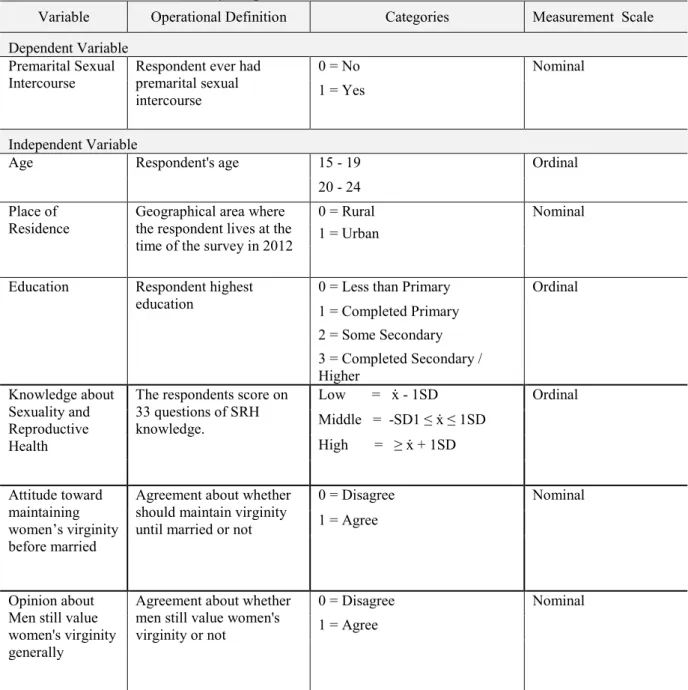
Table 1 shows the summary of operational definition and measurement of the variables used in this study. The data was analyzed using the licensed software of STATA version 12 owned by Mahidol University. This study has official approval of Board of IRB committee of Institute for Population and Social Research Mahidol University coded as COA No. 2014/1-1-30.
Table 1: Summary of operational definition and measurement of variables
Variable Operational Definition Categories Measurement Scale Dependent Variable
Premarital Sexual
Intercourse Respondent ever had premarital sexual intercourse
0 = No Nominal
1 = Yes Independent Variable
Age Respondent's age 15 - 19 Ordinal
20 - 24
Place of
Residence Geographical area where the respondent lives at the time of the survey in 2012
0 = Rural Nominal
1 = Urban
Education Respondent highest
education 0 = Less than Primary Ordinal
1 = Completed Primary 2 = Some Secondary 3 = Completed Secondary / Higher Knowledge about Sexuality and Reproductive Health
The respondents score on 33 questions of SRH knowledge. Low = ẋ - 1SD Ordinal Middle = -SD1 ≤ ẋ ≤ 1SD High = ≥ ẋ + 1SD Attitude toward maintaining women‘s virginity before married
Agreement about whether should maintain virginity until married or not
0 = Disagree Nominal
1 = Agree
Opinion about Men still value women's virginity generally
Agreement about whether men still value women's virginity or not
0 = Disagree Nominal
1 = Agree
4.
RESULTS AND DISCUSSIONS
4.1.
Results
The sample size of this study is 19,677 youth which comprises of 10,861 unmarried male youth and 8,816 unmarried female youth.
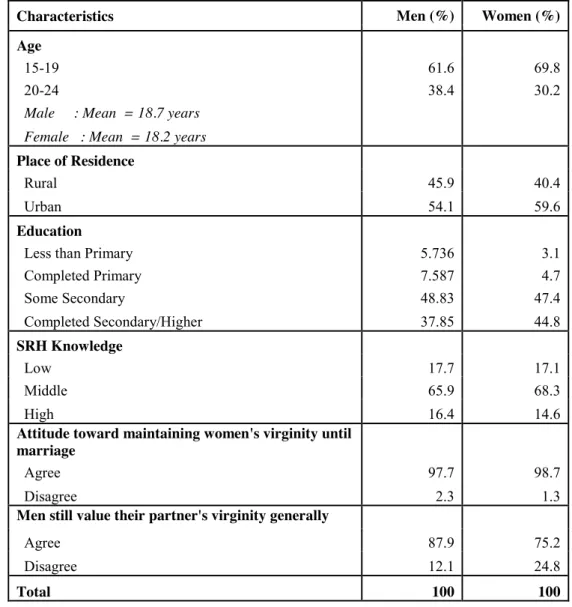
In Table 2, it can be seen that three-fifths of the unmarried males and almost 70% of the unmarried females are in the 15-19 years group of age. In terms of place of residence and highest education level, more than half of both unmarried males and females are youth who stay in urban
It also shows that most unmarried males and unmarried females agree that men still value their partner‘s virginity generally (87.9% and 75.2% respectively).
Table 2. General characteristic of the respondents
Characteristics Men (%) Women (%)
Age
15-19 61.6 69.8
20-24 38.4 30.2
Male : Mean = 18.7 years
Female : Mean = 18.2 years
Place of Residence
Rural 45.9 40.4
Urban 54.1 59.6
Education
Less than Primary 5.736 3.1
Completed Primary 7.587 4.7 Some Secondary 48.83 47.4 Completed Secondary/Higher 37.85 44.8 SRH Knowledge Low 17.7 17.1 Middle 65.9 68.3 High 16.4 14.6
Attitude toward maintaining women's virginity until
marriage
Agree 97.7 98.7
Disagree 2.3 1.3
Men still value their partner's virginity generally
Agree 87.9 75.2
Disagree 12.1 24.8
Total 100 100
4.1.1. Binary Logistic analysis for unmarried male youth
The odds ratio shows that unmarried male who age 20-29 years were 1.16 times more likely to have premarital sexual intercourse than those who age 15-19 years. Regarding education and place of residence, having some secondary education with either reside in urban or rural area was positively related to premarital sexual intercourse. For SRH knowledge, the higher level of SRH knowledge (middle to high), the more likely for unmarried male to have premarital sexual intercourse (2.29 to 2.77 times, respectively) compared with those with low level of knowledge. For attitude toward women‘s virginity, unmarried male who agree that women should maintain virginity before marriage were 80% less likely to have premarital sexual intercourse than who disagree. In addition, unmarried male who agree that men still value women‘s virginity were 29% less likely to have premarital sexual intercourse than those who disagree.
4.1.2. Binary Logistic analysis for unmarried female youth
The odds ratio shows that unmarried female who age 20-29 years were 1.17 times more likely to have premarital sexual intercourse than those who age 15-19 years. For attitude toward women‘s virginity, unmarried female who agree that women should maintain virginity before marriage were 84% less likely to have premarital sexual intercourse than who disagree. In addition, unmarried female who agree that men still value women‘s virginity were 66% less likely to have premarital sexual intercourse than those who disagree.
4.2.
Discussion
The youth‘s sexual activity is an issue of greater concern in Indonesia these days than ever before. The youth in this study are unmarried young people (mean age is 18.7 for males and 18.2 for females) and descriptive statistics are deployed to present that generally unmarried youth in Indonesia are not trying premarital sexual intercourse. According to the survey, the proportion of those who have had premarital sexual intercourse is approximately 12.4% for males and 1.9% for females. Similarly, a qualitative and quantitative study of 676 adolescents in East Wollega shows that a much higher percentage of young men reported having premarital sex than young women (Seme and Wirtu 2009). Male-female differential in sexual activity may be better explained by the double-standard norms in terms of sexual initiation. In most developing countries male sexual adventures are socially acceptable but not for women (Algaa 2000). In this study, it can be assumed that premarital sexual intercourse among women is under reported due to social and cultural standard.
5.
CONCLUSIONS
The study indicates premarital sexual intercourse committed by unmarried youth in Indonesian is affected by personal and cognitive factors. The findings also suggest that sexuality and reproductive health education should be provided formally in schools and universities, with more programs focused on university students due to the finding that older youth (20-24 years) committed premarital sexual intercourse. In addition, family resilience to create open communication is another point that should be taken into account by involving parents and family members to be exposed with Sexuality and Reproductive Health (SRH) information. Therefore, adequate life skill education for youth and family is strongly recommended.
ACKNOWLEDGMENTS
First of all, I would like to thank Allah, SWT for His mercy and guidance in giving full strength to complete this research. I also would like to render special thanks to my husband Mr. Yusrizal and my kids Yordan and Yazkia for their patience and never ending supports through-out my research.
REFERENCES
1. Algaa S. Factors affecting premarital sex among school adolescents: Mahidol University; 2000.
2. Seme A, Wirtu D. Premarital sexual practice among school adolescents in Nekemte Town, East Wollega. Ethiopian Journal of Health Development. 2009;22(2):167-73.
5. Statistics-Indonesia, (BKKBN) NPaFPB, Health-Ministry, ICF-International. Indonesia Demographic and Health Survey 2012. Jakarta: BPS, BKKBN, Kemenkes, ICF International, 2013.
6. National-Law-Agency. Undang-undang No. 36 Tahun 2009 Tentang Kesehatan: Guidance of National Law Agency of Indonesia (BPHN), 2014 [cited 2014 15 May]. Available from: