U.S. Equity Options Market:
Changing Competitive Landscape
101 Arch Street Suite 501 Boston, MA 02110 Tel: 617.338.6050 Fax: 617.338.6078 [email protected] Sang Lee [email protected] 617.338.6015
T A B L E O F C O N T E N T S
IMPACT POINTS ... 3 INTRODUCTION... 4 MARKET OVERVIEW ... 6CHANGING MARKET STRUCTURE ... 6
CONSISTENCY IN CLEARING ... 9
CHANGING FACES AND NEEDS OF CLIENTS ... 10
IMPACT OF PENNY PILOT... 13
FUTURE OF OTC ... 15
PUSH AND PULL BETWEEN EXCHANGES VS. OTC... 19
EMERGENCE OF DARK POOLS ... 20
LEADING EXCHANGES ... 25
NYSE EURONEXT U.S. OPTIONS TRADING ... 27
NASDAQ OMX OPTIONS ... 30
CHICAGO BOARD OPTIONS EXCHANGE (CBOE) ... 32
INTERNATIONAL SECURITIES EXCHANGE (ISE) ... 35
BOSTON OPTIONS EXCHANGE (BOX) ... 37
LEADING BROKER/DEALERS... 39
FULL-SERVICE BROKERS... 39
AGENCY BROKERS ... 44
CLIENT PERSPECTIVE ... 49
LOOKING AHEAD... 52
I M P A C T P O I N T S
This Impact Report examines some of the important industry issues and trends in the U.S. equity options market and highlights key players in the marketplace, including exchanges and broker/dealers. This report also presents perspective from various client segments captured through interviews with 20 firms, which included hedge funds, traditional asset managers, and proprietary trading firms. Some of the key findings of the report include the following.
• The recent wave of consolidation indicates leading options exchanges are betting that the two competing options market models (i.e., quote-driven, market-maker model vs. order-driven, maker-taker model) can co-exist and cater to different types of client base.
• The existence of the Options Clearing Corporation (OCC) and its services around margining, clearing fund management and support for product fungibility have played a key role in nurturing and maintaining the exponential growth of the U.S. equity options market over the last few years.
• The institutionalization of the equity options market
continues as institutional clients replace retail clients as the dominating marketplace client segment, projected to represent 57% of the client base by the end of 2009.
• Given ongoing industry concerns over counterparty risk and the ability of the exchange-traded market to provide much-needed liquidity and transparency, Aite Group expects to see continued robust growth of the exchange-traded market at the expense of the OTC equity-linked derivatives market. • Dark pools in the equity options market currently function as
size discovery mechanisms, and have positioned themselves within the existing market structure, seeking alliance with exchanges to fight against the outflow of liquidity into the OTC market.
With a strong centralized clearing house in place and continued diversification of client profiles, the future of the U.S. exchange-traded equity options market looks promising for years to come.
I N T R O D U C T I O N
As the global market struggles to navigate through the current market
uncertainties and unprecedented volatility, it is good to be a player in the U.S. equity options market.1 Having already grown exponentially over the last four years, 2008 has been the best year historically, with the equity options market enjoying an average daily trade volume of nearly 14 million contracts. The options market even reached 30 million contracts one day in September 2008, an
astounding number when one considers that the market was averaging a mere 1.6 million contracts per day only a decade ago.
Things have changed quite dramatically since then. Driven by adoption of
electronic trading, institutionalization of clients, effects of penny pilot rollout, and growing participation of high-frequency trading firms, the U.S. equity options market has outstripped its past image as a speculative retail market, and has gained acceptance among mainstream institutional players. To better understand and manage these changes, the importance of continued investor education has come to the fore. The Options Industry Council (OIC), which was formed in 1992 by U.S. options exchanges and the Options Clearing Corporation (OCC), has played
1. For detailed introduction to equity options market, please see Aite Group’s report, Equity Options Landscape: More Options Than Ever!, May 2007.
FIGURE 1: GROWTHOF U.S. EXCHANGE-TRADED EQUITY OPTIONS
a leading role in the overall options education, not only of retail investors but also for institutional clients. The OIC has relied on various in-person and online
seminars, newsletters, educational software, and deployment of options information centers to educate the investor community about the potential benefits and pitfalls of using equity options. Education has become even more important in recent years as the U.S. equity options market continues to undergo fundamental changes.
Spreads are compressing as a result of decimalization, and, by some accounts, decreasing drastically (greater than 50%) in some of the option classes currently under the penny pilot. The ongoing credit crisis has actually led to wider spreads in recent months. Once the market returns to normal conditions, we can assume that the spread compression will continue.
On the negative side, liquidity is beginning to evaporate in certain option classes under the penny pilot, making it harder for institutional clients to move large size. As a result, there is growing concern over the ultimate impact of decimalization in the equity options market, which may dampen further institutional participation and push liquidity into the over-the-counter (OTC) market.
Market structure changes are also underway, with NYSE Euronext and NASDAQ OMX Group acquiring American Stock Exchange (Amex) and Philadelphia Stock Exchange (PHLX), respectively. The traditional quote-driven, pro-rata model of the large equity options exchanges (e.g., CBOE, ISE, PHLX, and Amex) is being challenged by the equities market-centric order-driven, maker-taker model, which is being promoted by a number of upstarts (e.g., NYSE Arca, NASDAQ Options, and BOX).
On the other hand, the industry is undergoing significant changes in terms of client segments. Over the last couple of years, a number of high-frequency trading firms that have built up strong reputations in the equities and futures markets have moved aggressively into the equity options market drawn by improved industry infrastructure for electronic trading, collapsing spreads, market fragmentation and the introduction of the maker-taker models. Use of algorithmic trading is up, driven by these active traders as well as broker/dealers that are leveraging their equities or futures algorithmic trading IT infrastructure to break into the highly competitive equity options market, which is traditionally dominated by only a handful of market-makers.
This Impact Report examines some of these important industry issues and trends, and highlights key players in the marketplace including exchanges and broker/ dealers. This report also presents perspective from various client segments captured through interviews with 20 firms, consisting of hedge funds, traditional asset managers and proprietary trading firms.
M A R K E T O V E R V I E W
C H A N G I N G M A R K E T S T R U C T U R E
Since the advent of listing fungible options contracts on multiple exchanges and the entrance of the ISE as the first full electronic options exchange in 2000, the U.S. exchange-traded equity options market has never been the same. While the ISE succeeded in revolutionizing the equity options market with its first fully electronic marketplace, one could argue that the next real structural change occurred with the adoption of the maker-taker model, whose rollout would not have been possible without the fundamental changes brought on by the ISE. Two types of options business models exist in the U.S. exchange-traded market:
• Quote-driven, pro-rata model. In this traditional options market model, market-makers provide continuous two-sided quotes, and orders are filled based on size rather than time. Leading exchanges in this category include Chicago Board Options Exchange (CBOE), International Securities Exchange (ISE), Philadelphia Stock Exchange (PHLX), and American Stock Exchange (Amex).
- Pro: Dedicated market-makers are there to provide liquidity when needed with large size, especially in those less liquid options, and clients pay no fee.
- Con: Payment for order flow is prevalent, and the market-making business is dominated by only a handful of firms because it is a capital intensive business, leading to potentially higher spreads for clients.
• Order-driven, price-time, maker-taker model. In this market model, orders are executed based on price-time priority, and a fee is charged to liquidity takers. Rebates are offered to liquidity providers mirroring the market model prevalent in the U.S. equities market. Leading exchanges in this category include NYSE Arca, Boston Options Exchange (BOX), and NASDAQ Options (NSDQ).
- Pro: Ideal conditions for maker-taker model are thin spreads and heavily electronic trading environment, leading to cheaper execution prices and attracting more self-service execution services such as DMA and
algorithmic trading.
FIGURE 2: LEADING MARKET-MAKERS
- Con: Not an ideal environment for trading less liquid options, which still account for 50% of the market. Less sophisticated traders can be mowed down by high-frequency trading firms.
The growing market is certainly big enough to accommodate both market models, and the wave of consolidation that took place over the last 12 months indicates that leading options exchanges are betting that the two market models can co-exist and cater to different types of client bases (see Table A on page 8). Instead of trying to integrate the two different market models, NASDAQ and NYSE Euronext have chosen to operate two separate markets, with PHLX and Amex respectively.
At least in the short- to medium-term, peaceful co-existence between the pro-rata and maker-taker models appears entirely plausible for a couple of reasons. First,
FIGURE 3: COSTOF OPTIONS EXECUTION
Source: Exchanges, Broker/Dealers, Clients, Aite Group Estimates
TABLE A: RECENT M&A ACTIVITIESINTHE U.S. EQUITY OPTIONS MARKET
Acquirer Target Announced Date Completed Date
Eurex ISE April 2007 December 2007
NASDAQ PHLX November 2007 July 2008
NYSE Euronext Amex January 2008 October 2008
despite its vast number of listings (having nearly 400,000 options contracts on about 3,500 options classes), the options market is concentrated when it comes to generating daily trading volume: According to the OCC, the top 10 options classes represented approximately 34% of daily average trade volume as of October 2008 YTD (see Figure 4 on page 9). This, of course means that a significant percentage of the options market cannot function properly without active participation from market-makers.
Secondly, the maker-taker model does not adequately address the need for institutional clients to move large order sizes. If any lessons can be learned from the equities market, it is the fact that the maker-taker model, coupled with decimalization, will lead to a decline in average trade size and an increase in average daily number of trades (i.e., more smaller trades to fill large orders). As a result, one can safely assume that institutional clients looking for larger size will be attracted to the pro-rata-based exchanges that reward those seeking larger size. Much of this will depend on how the rest of the penny pilot progresses, and whether or not regulators take industry feedback seriously and modify certain aspects of the penny rollout.
C O N S I S T E N C Y I N C L E A R I N G
Despite all of the changes occurring in the market, the U.S. exchange-traded equity options market has been able to sustain its incredible growth in large part due to the existence of the Options Clearing Corporation, which was founded in
FIGURE 4: CONCENTRATIONOF DAILY TRADE VOLUME
1973 as the central counterparty for U.S. exchange-listed options trading. The OCC is the largest derivatives clearing organization in the world and the first clearinghouse to receive a “AAA” rating from S&P.
The OCC is currently under the regulatory supervision of both the Securities Exchange Commission (SEC) for its clearing activities in securities and the Commodities Futures Trading Commission (CFTC) for clearing futures products. Integrated horizontally with the equity options exchanges, the existence of OCC and its services around margining, clearing fund management, and support for product fungibility have played a key role in nurturing and maintaining the exponential growth of the U.S. equity options market over the last few years.
C H A N G I N G F A C E S A N D N E E D S O F C L I E N T S
Along with changes in market structure, the institutionalization of the equity options market continues as institutional clients replace retail clients as the most dominating client segment in the marketplace, forecasted to represent 57% of the client base by end of 2009 (see Figure 5 on page 10). Continued growth of institutional clients will have a significant impact on how exchanges battle for market share as well as implications for the potential legalization of off-exchange trading platforms.
A key trend sweeping across the equity options market is the growing market clout of high-frequency trading firms that function as de-facto electronic market-makers in various liquid asset classes, such as equities, equity options, futures and FX.
FIGURE 5: CHANGING FACESOF CLIENTS
Within the equity options market, Aite Group expects to see approximately 40% of the trading volume being accounted for by high-frequency trading firms by end of 2010 (see Figure 6 on page 11) giving a huge boost to the survival of maker-taker exchanges and a potential lifeline to alternative trading systems (ATSs).
With the changing profiles of clients and transformation of leading exchanges, adoption of electronic trading has skyrocketed. It is safe to say that electronic trading has taken the central role in equities from broker order-routing to exchange order execution. Approximately 85% of options trading is expected to take place electronically by the end of 2010 (see Figure 7 on page 12), though the same cannot be said for how things are done on the client-side. Depending on the client segment, the overall adoption level of electronic order entry differs widely. On the one hand are prop shops, hedge funds and retail clients that exhibit high adoption rates. Traditional asset managers are still far behind others, barely registering 10% in electronic order entry, and continuing to rely on their brokers via phone (see Figure 8 on page 12).
FIGURE 6: INCREASING INFLUENCEOF HIGH-FREQUENCY TRADERS
In addition to electronic trading and the maker-taker model, another import from the equities market is algorithmic trading (though one can legitimately argue that most of the options market-makers in the equity options market have been using
FIGURE 7: PROJECTED ADOPTIONOF ELECTRONIC TRADING
Source: Aite Group Estimates
FIGURE 8: CLIENT ORDER ENTRY
algorithms for years). Unlike the equities market, use of algorithms in the equity options market has been spearheaded by market-makers, hedge funds, and prop shops instead of bulge bracket firms. In addition, IT-centric options agency brokers such as LiquidPoint (now part of BNY ConvergEx), RedSky (now part of ITG and renamed ITG Derivatives), and On Point have facilitated the growth of
automated trading strategies by providing low-latency smart-order routing capabilities into all of the exchanges as well as a trading front-end. Most of the bulge bracket firms are now also entering the options algorithms market led by firms like Credit Suisse and Goldman Sachs. While most of these firms’ first-generation algorithms tended to be more sophisticated order types (e.g., delta-neutral, multi-legged orders, etc.), as the interest level in broker-provided
algorithms increased, leading providers such as Credit Suisse have introduced next generation algorithms, such as Guerilla, that seek liquidity with minimal market impact.
I M P A C T O F P E N N Y P I L O T
There are numerous examples of regulations leading to undesirable market structural consequences in the U.S. equities market, which have fundamentally altered how the market functions. Perhaps not so strangely, the greatest change to the equity options market in the long-run could also be forced by the well-intentioned regulators. The rollout of the penny pilot, initiated by regulators’ desire to stamp out the practice of payment for order flow and create greater
transparency into the equity options market has led to widely expected results:
FIGURE 9: PROJECTED ADOPTIONOF ALGORITHMIC TRADING
• Compressed spreads. Spreads have declined dramatically on those option classes currently on penny pilot. Specifically, exchanges and broker/dealers estimate that on first 35 options classes on the penny pilot have on average experienced a spread decline of 37%. Compression in spreads is actually a positive thing for retail clients, but certainly not good for the market-maker business.
• Decline in liquidity. Another effect of the penny rollout has been the decline in the depth of displayed quotes inside the market. The decline appears to be fairly substantial, with an average of 62% among the first 35 options classes on the penny pilot.
• Good for retail, bad for institutional. Overall, declining spreads have been good for the retail client, but its impact on the institutional client has been mixed. Spread
compression is also positive for institutional clients, but decreasing size is a growing concern for the institutional side as well as the potential for further market fragmentation for liquidity driven by increased use of DMA and algorithms.
FIGURE 10: TIMETO RECONSIDER?
F U T U R E O F O T C
The over-the-counter equity derivatives have profoundly impacted a wide array of investors, from small retail investors in Europe looking for yield, to the largest corporations, investment banks, asset managers and hedge funds that are looking for diversification of portfolios, protection from volatility, and specific strategies for gaining exposure to equity markets.
OTC equity derivatives are truly a global phenomenon; they are actively traded in Europe, the Americas (Canada, Latin and South America, the United States) and Asia. Many of the issues that arise with OTC equity derivatives stem from the global nature of the business, the very wide-ranging nature of participants, and the myriad of products that exist. According to the Bank for International
Settlements (BIS), Europe leads the trading in equity derivatives with 62% of the global market. The United States represents 17%, Japan follows with 9% and Asia (ex Japan) about 8% (see Figure 11 on page 15). Europe has been gaining market share over the past couple of years, while the U.S. presence in OTC options has been declining.
FIGURE 11: GEOGRAPHICAL BREAKDOWNOF OTC EQUITY DERIVATIVES
OTC equity derivatives, while considerably varied in products, can be divided broadly into four areas: options, equity swaps, volatility swaps and structured products. Table B on page 16 presents an indicative sampling of products in these four broad areas:
• Equity Options. Single-name equity options refer to options on individual equities (i.e., a put or call on IBM, Vodafone or Hitachi). Equity index options refer to options on stock indices (i.e., a put or call on the S&P 500, EuroStoxx 50, or Nikkei 225). Options include the plain-vanilla products that trade OTC (look-alikes), as compared to on an exchange. Some of the reasons these trades do not go on an exchange
FIGURE 12: HISTORICAL GROWTHOF EQUITY-LINKED OTC DERIVATIVES MARKETS
Source: BIS
TABLE B: TYPESOF OTC EQUITY DERIVATIVES
Class A Few Examples
Options Look-Alikes (i.e., looks like an exchange-traded call or put): Single Stock (e.g.,
IBM, Vodafone, Hitachi); Index (e.g., S&P, EuroStoxx, FTSE, Nikkei, etc.). Exotics: Barrier, Rainbow, Quantos, Margrabe, Mountain Range (Himalayan, Everest, Atlas, Annapurna, Altiplano), Cliquets, Binary.
Options on Swaps: Swaptions
Types of Expiries: American, European, Asian, Bermuda.
Swaps Equity Swaps, Equity Default Swaps, Total Return Swaps, Dividend Swaps.
Volatility Variance Swaps, Volatility Swaps, Dispersion Swaps, Gamma Swaps.
Structured Equity Products constructed from multiple products across currency and asset classes.
include the avoidance of leaving a footprint on large trades, mitigating exchange costs (clearly a function of counterparty risk and more pronounced in Europe), developing an expiry date that perfectly suits the clients' needs, or just the avoidance of mixing OTC and listed in one transaction. The nature of option trading varies widely across the globe. In the more fragmented and costly exchange environment of Europe and Japan, the look-alike business drives tremendous flows, particularly in single-name equity options. (It is estimated that about 75% to 80% of these options trade OTC in Europe.) In the United States, where the domination of the many options exchanges and the "electronification" of options are occurring on a rapid basis, the look-alike
business is less important. The liquidity that exists across the growing number of options exchanges and the availability of competitive pricing is driving much of the OTC single-name options trading onto exchanges in the United States. This possibly explains the nearly two-to-one trading of OTC options in Europe versus in the United States.
• Equity Swaps. Equity swaps provide a means of getting equity exposure through a counterparty without necessarily taking a position in the actual cash equity. They provide funding, tax, and collateral advantages, and, in a regulatory sense, they allow investors to take a view without affecting the underlying equity. Dividend swaps, which are very popular in Europe for their tax benefits, provide a means to expose investors directly to index and equity dividends while removing other factors from the equation. Total return swaps allow direct exposure to equity or equity index returns in return for a periodic floating rate. Another product, the equity default swap, has seen periods of both interest and apathy by investors. The equity default swap is another product that sees occasional interest, as more and more strategies look across asset classes; it acts as a default swap linked to the underlying stock's price.
• Volatility Swaps. The volatility swap is a product that is used to take a direct view on the volatility of an underlying equity or equity index. The focus of this product set is currently the variance swap. Variance is volatility squared, and is particularly useful for mapping the volatility profile that is typical in equity options. Variance swap transactions have grown dramatically, driven by hedge funds and large institutional traders. Variance swap growth will exceed 100%
this year, and is quickly moving from its hedge fund base to other types of institutional investors.
• Structured Equity. These products can incorporate numerous asset classes — at minimum, cash equity and a derivative product. Structured equity provides a means of exposure to an equity or equity index with predetermined upside and downside risk. These are the types of products that have been particularly interesting to retail investors in Europe. This class is broad, and only subject to the limits of financial engineers' imaginations. In the largest European markets, growth has recently been in the range of 25% to 40% per year for these products.
OTC equity derivatives are a highly client-driven business. Most of the trading occurs between dealing banks and their clients, though there is a substantial amount of inter-dealer trading in certain areas, much of which trades between the dealing banks in the inter-dealer broker market. These trades are primarily in options, and in equity swaps to some degree. Overall, in terms of revenue, the inter-dealer part of this market is very small, and is notional traded compared to the dealer-client part of the market. However, there are substantial growth opportunities for inter-dealer brokers, as larger dealing banks look to lay off risk with other dealers in somewhat anonymous ways. Hence, inter-dealer brokers are looking for ways to participate in a variety of products where they see dealer-to-client growth precipitating ancillary growth in their market space.
The table below gives a general indication of some of the players involved in the various products:
TABLE C: MAJOR PLAYERS
Player Products Involvement General Side of Market
Hedge Funds All. They are a major
cli-ent in volatility products.
Trading, hedging, investing, volatility trading, replication of cash, relative-value strategies, tax efficiency, correlation trad-ing, and ease of implementing positions.
Buyer/Seller
Investment Banks
All Trading, investing, hedging, market-making, client-service, structuring and correlation.
Buyer/Seller
Commercial Banks
Options, equity swaps and structured
Hedging, yield-enhancement strategies and client-service.
Buyer
Institutional Managers
Options, equity swaps, nascent volatility swaps, and structured.
Hedging, investing, yield-enhancement strategies, port-folio protection, and tax effi-ciency.
Buyer
P U S H A N D P U L L B E T W E E N E X C H A N G E S V S . O T C
The major trading regions of the world have markedly different habits when dealing with equity options. There is considerable difference in the nature of trading in the two biggest regions; the European equity options are by-and-large an OTC endeavor, while options in the U.S. market have active OTC and exchange-traded businesses.
Surveying traders at various types of institutional firms yields interesting results as to the decision-making process in determining whether to trade on an exchange or OTC. Words like “flexibility” and “anonymity” are used quite often when firms decide to go with the OTC option. As the exchange-traded market continues to undergo certain changes hostile to institutional clients, the OTC market has been an attractive outlet for getting large size done in an efficient way. It is also evident, however, that firms active in the OTC market are committed in the exchange-traded market so that certain risks associated with the OTC component can be laid off on the highly liquid exchange-traded side, which explains the mutual growth for both markets in recent years.
With the recent credit crisis and the resulting backlash against various OTC markets, the exchange-traded market experienced a huge growth in 2008. Given ongoing concerns over counterparty risk and the ability of the exchange-trade market to provide much-needed liquidity and transparency, Aite Group expects to see continued robust growth of the exchange-traded market at the expense of the OTC equity-linked derivatives market (see Figure 13 on page 20).
Retail Accounts Equity swaps and
struc-tured
Yield-enhancement strategies and tax efficiency.
Buyer
Corporations Options, equity swaps,
and structured.
Hedging, tax efficiency, and implicit diversification.
Buyer
TABLE C: MAJOR PLAYERS
Player Products Involvement General Side of Market
E M E R G E N C E O F D A R K P O O L S
Some structural and regulatory changes are leading to trading conditions hostile to institutional clients looking for size in the public market. In the equities market, this reality led to the creation of non-displayed alternative execution venues that cater to those clients looking for size and anonymous trading capability to minimize market impact. This was possible due to the fact that the existence of Regulation ATS enabled the creation of alternative execution venues. There is no Regulation ATS equivalent in the equity options market, and all transactions must take place on exchanges.
Conceptually speaking, many good reasons exist for the potential adoption of dark pools in the exchange-trade equity options market, such as shrinking order size, potential threat from OTC, lack of depth in displayed quotes, and market
fragmentation. In addition, the existence of horizontally integrated central clearing and product fungibility make it quite conducive for dark pool adoption. Even so, regulatory change must occur so that off-exchange trading can create a level playing field for any viable dark pool to compete effectively. One clear argument against regulatory change could be simply looking at the massive fragmentation that has taken place in the U.S. equities market.
FIGURE 13: EXCHANGE-TRADEDVS. OTC
Source: BIS, CBOE, Aite Group Estimates
OTC market size represented by notional amount outstanding
Exchange-traded market represented by dollar value of open interest, which denotes the number of outstand-ing options contracts at any point in time
One could also argue, however, that the risk of further market fragmentation should be taken in order to facilitate the growing needs of institutional clients that have legitimized the equity options market. If nothing is done, migration to the unregulated OTC market can resume, creating greater market risk overall, and also unfairly favoring only those institutional and other sophisticated traders that have the resources to build up high-performance trading infrastructures in order to compete in an increasingly low-latency trading environment.
This barrier to entry certainly has not stopped progress toward creating quasi-dark pools in the equity options market, however. Two early entrants in this area are 3D Markets and Ballista Securities. Due to regulatory constraints, these firms currently exist as size discovery mechanisms, awaiting potential regulatory changes to really go after exchange and OTC market share. In the meantime, these new players have positioned themselves within the existing market
structure, seeking alliances with exchanges to fight against the outflow of liquidity into the OTC market.
3 D MA R K E TS
Founded in 2007 as the first dark pool in the U.S. exchange-traded equity options market, 3D Markets is headquartered in New Hope, Pennsylvania and has 12 employees. 3D Markets is designed to provide support for block trading in the equity options market. The business concept for 3D came about as the founders viewed that as a result of recent market changes (i.e., the penny rollout, increased use of electronic trading, introduction of the maker-taker model, and growing transparency, etc.) block size orders have been migrating from exchanges to the OTC market — and more institutions entering the derivatives/options markets. 3D’s ultimate goal is to bring the OTC volume back onto the exchange-traded markets. Key information on 3D Markets includes the following:
TABLE D: DARK POOLSIN EXCHANGE-TRADE EQUITY OPTIONS MARKET
Firm Founded
in Headquarters Product Target Market
Number of Liquidity Providers Number of Clients 3D Markets September 2007
New Hope, PA ArchAngel Electronic market-mak-ers and institu-tional asset managers
7 8
Ballista 2008 New York, NY Ballista Broker/deal-ers, hedge funds, prop desks, etc.
20 N/A
• Attempting to bring electronic makers (i.e., market-makers, hedge funds and prop shops) together with institutional clients;
• Currently has 24 traditional asset managers firms signed up; • Undisclosed number of liquidity providers on the platform; • All crosses must be executed on an exchange per SRO rules;
and
• Establishing the options industry's first benchmark — Gamma Weighted Average Price (GWAP).
• Key products include the following:
- Archangel Blind Bid. Under this product, institutional clients anonymously disclose certain characteristics of the block order, including sector, size and side to synthetically build a risk profile in order to attract liquidity from
electronic market-makers. Once the other side of the trade is found, the potential cross-orders are sent to an
exchange (3D prefers to use CBOE, ISE, and BOX since they have an electronic crossing mechanism) for execution, at which point the trade may be broken up/participated with.
- Archangel GWAP (Gamma Weighted Average Price). In partnership with the CBOE, CBOE member and clients will be able to cross large orders during a special matching session (right before the market opens) and the execution price will be determined at the end of the trading day using GWAP pricing methodology. Archangel GWAP essentially introduces the concept of calculating a fair execution price based on trading over a period of time similar to the way VWAP has been used for decades in the equities market. CBOE expects to set a minimum order size of at least 1,000 contracts per cross.
BA L L I S TA SE C U R I T I E S ( BA L L I S TA)
Launched in 2008 and headquartered in New York, Ballista Securities is the second entrant into the electronic block equity options market. In addition to providing block trading capabilities, Ballista also offers aggregation and smart-order routing services. Ballista currently has 27 employees.
Ballista is available as a stand-alone, software-based trading platform, through independent OMS/EMS providers or via a FIX-based interface with clients' proprietary trading systems. Key information on Ballista includes the following:
• Launched in late October 2008 with approximately 40 clients; • Designated as an ATS by the SEC in October 2008;
• Received approval for its FINRA membership in August 2008; • Minimum trading requirement of 500 contracts per trade,
initial maximum of 2,500 contracts (will expand over time); • Provides simultaneous access to public liquidity (options
exchange) and passive liquidity (broker/dealers, hedge funds, prop trading desks, etc.) under a single roof; • Provides direct electronic initiator/contra communication,
eliminating the need for IM and phone communications; • Ensures a trading community of qualified buy-side initiators
and sell-side liquidity providers that trade organically in large block sizes;
• Hides user identity from all counterparties;
• In addition to directional block option orders, Ballista specializes in delta-neutral and complex orders by enabling traders to conduct simultaneous trading of options and underlying cash equities (with options-leg execution occurring on exchanges once a potential cross has been found after a five-minute auction);
• Enables both "Auction" orders with complete exclusivity or "Hidden" orders that conceal the initiator's intent:
- Exclusive orders. This order type is designed to prevent an order from being outbid during the timed auction by displaying the size and side, and is ensured execution if the other side of the trade exists.
- Phantom orders. This order displays the size only and is designed to attract bid and offer on the size displayed. • Two-phase trading process:
- Private negotiation with closest counterparty should auction process end without a fully consummated trade.
L E A D I N G E X C H A N G E S
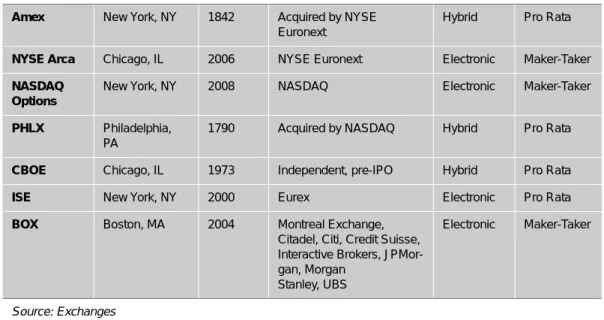
Table E on page 25 lists the seven equity options exchanges in the U.S. market. NYSE Arca is the direct heir to the options business of the Pacific Stock Exchange (PCX) which was acquired by Archipelago, which in turn was purchased by NYSE Euronext in 2006. The most recent market entrants, BOX and NASDAQ Options have followed the lead of NYSE Arca Options in implementing the maker-taker model to compete against the incumbents. As mentioned earlier in the report, a wave of consolidation in the U.S. equity options market has resulted in Amex becoming part of NYSE Euronext, NASDAQ Options owning PHLX, and Eurex acquiring the ISE. With the Montreal Exchange owning majority of BOX, only CBOE remains independent at this point. In recent weeks, the CBOE announced plans to launch a separate electronic equity options exchange designed to attract high frequency options traders.
Most options exchanges have experienced substantial increase in their trade volume over the last few years. The most impressive growth has been exhibited by the ISE, which reached an elite status within the equity options market only three years after its initial launching. In doing so, it left behind many doubters that once questioned whether or not a new exchange could seriously challenge the dominant competitive position of CBOE which had 50% of the market in 1999, the year before ISE officially launched (see Figure 15 on page 26). The market remains
TABLE E: U.S. EQUITY OPTIONS EXCHANGES
Exchange Headquarters Founded
in Corporate Structure Trading Model Pro Rata vs. Maker-Taker Amex New York, NY 1842 Acquired by NYSE
Euronext
Hybrid Pro Rata
NYSE Arca Chicago, IL 2006 NYSE Euronext Electronic Maker-Taker
NASDAQ Options
New York, NY 2008 NASDAQ Electronic Maker-Taker
PHLX Philadelphia, PA
1790 Acquired by NASDAQ Hybrid Pro Rata
CBOE Chicago, IL 1973 Independent, pre-IPO Hybrid Pro Rata
ISE New York, NY 2000 Eurex Electronic Pro Rata
BOX Boston, MA 2004 Montreal Exchange, Citadel, Citi, Credit Suisse, Interactive Brokers, JPMor-gan, Morgan
Stanley, UBS
Electronic Maker-Taker
quite competitive today, with CBOE, ISE, PHLX, and NYSE Arca rounding out the top four, representing close to 90% of exchange-traded equity options market share.
FIGURE 14: ABSOLUTE GROWTHFOR EVERYONE!
Source: Exchanges, OCC
*NYSE Arca under the name of PCX until 2006
FIGURE 15: CHANGING MARKET SHARE
Source: Exchanges, OCC
The rest of this section presents profiles of the seven equity options exchanges.
N Y S E E U R O N E X T U . S . O P T I O N S T R A D I N G
With NYSE Euronext's acquisition of the American Stock Exchange (Amex), NYSE Arca Options and NYSE Amex Options collectively comprise the third-largest U.S. equity options marketplace by number of contracts traded. Having two U.S. options exchanges enables NYSE Euronext to operate a dual market structure, providing customers with the choice of price-time priority on NYSE Arca Options or the traditional market-maker model on NYSE Amex Options, under a single umbrella.
N Y S E AR C A OP T I O N S
Headquartered in Chicago, NYSE Arca Options represents the new breed of options exchanges that rely on fast technology and a new market approach driven by price/time priority and the innovative maker-taker model, blended with Lead Market Maker (LMM) participation. NYSE Arca Options positions itself as a low-cost, high-efficiency venue offering sophisticated order types and greater transparency, reliability and capacity. NYSE Arca Options is typically the fourth largest options exchange and one of the first exchanges to implement the maker-taker model in options trading.
FIGURE 16: AVERAGE DAILY TRADE VOLUME
NYSE Arca's origins can be traced back to the Pacific Stock Exchange's options business, which was acquired by Archipelago Holdings, Inc. in September 2005. In August 2006, NYSE Arca Options replaced its legacy trading platform, PCX Plus with NYSE Arca trading technology, enabling advanced auto-execution capabilities. Key competitive differentiators for NYSE Arca Options include:
• Offers electronic order executions in nearly 2,000 options issues.
• Supports for multiple order types, including reserve orders and the recently introduced Complex Order Book, which allows customers to simultaneously execute option and equity orders on NYSE Arca;
• Efficient post-trade processing; • Low latency platform;
• Robust capacity and the ability to take unlimited number of quotes and orders (currently averaging 80,000 orders per second and 1,000,000 quotes per second); and
• No cancellation fees charged to attract liquidity from high frequency trading crowd.
N Y S E AM E X OP T I O N S ( AM E X)
Founded in 1842 and headquartered in New York, the American Stock Exchange was once one of the largest exchanges in the U.S. equity options market. The Amex was acquired by NYSE Euronext in 2008 and brought under the NYSE Euronext U.S. options trading umbrella. NYSE Amex Options provides customers with a separate, customer-driven marketplace offering industry-leading technology combined with the proven open-outcry trading environment. NYSE Amex is typically the fifth or the sixth largest options exchange on any given day.
NYSE Amex has certainly witnessed many changes in the options market, especially in recent years. The general market trend has seen an increase in percentage of participation from institutional clients. This trend represents an industry wide shift in attitude from viewing the options market as an unwanted, speculative retail market, to a legitimate investment product for institutional players with growing volumes.
NYSE Amex has maintained its order-driven, pro-rata market model and operates a hybrid platform, although it has seen a tremendous increase in volume coming through the electronic channel. Some of the key differentiators for NYSE Amex include the following:
• Provides major index options;
• Launch of binary options (i.e., fixed return options) on ETF and equity options -- viewed more as a retail product, as 40% of all options' premiums are less than $1.00 and consequently attract retail flow;
• NYSE Amex's electronic trading platform, Auction and Electronic Market Integration (AEMI) platform has been built specifically to support hybrid trading;
FIGURE 17: AVERAGE DAILY TRADE VOLUME
• AEMI will more than likely be phased out and electronic trading is expected to migrate over to NYSE Arca Options technology. NYSE Arca will modify its existing platform to support floor trading on NYSE Amex; and
• NYSE Amex has recently brought in remote market makers, giving firms the ability to internalize and increasing the use of FIX.
N A S D A Q O M X O P T I O N S
With acquisition of PHLX, NASDAQ OMX Options operates a dual market structure with the price-time priority on NASDQ Options and the traditional market-maker model on PHLX under a single umbrella.
N A S D A Q OP T I O N S
Launched in 2008 and headquartered in New York, The NASDAQ Options Market is the latest entrant into the U.S. equity options market featuring a price/time priority, maker-taker market model. The NASDAQ Options Market has been averaging slightly higher than 1.5% market share on a daily basis, representing the smallest of the seven existing exchanges.
The NASDAQ Options Market was designed to address recent developments in the options market landscape, including fragmentation, increased transparency, compressing spreads, increasing volume, and the options penny pilot. The
NASDAQ Options Market is not solely reliant on order flow from market-makers as it allows non-market-makers to send orders on both sides of the market.
Some of the key competitive differentiators of the NASDAQ Options Market include:
• Price improving orders at penny increments in nickel and dime MPV options provide price improvement to incoming orders;
• Exchange connectivity via OTTO (proprietary protocol to accept limit orders from system subscribers), FIX and NOMAD;
• Full depth of book data available via ITTO (high-speed proprietary limit order book protocol), and DAP (price-point depth of book);
• Routing capability allowing participants to access prices on the other six options exchanges when NASDAQ does not have the best price;
• Third-party trading front-end participants currently includes LiquidPoint HEAT, GL Trade, REDIPlus, Mixit, Orc Software and Townsend Analytics; and
• Looking to leverage significant equities presence by attracting order flow (new to the options industry) from systematic trading firms with experience in the equities penny environment.
PH I L A D E L P H I A ST O C K EX C H A N G E ( P H L X )
The Philadelphia Stock Exchange (PHLX), founded in 1790, has the distinction of being the first organized exchange in the United States. PHLX currently supports trading of equities, equity options, index options, World Currency Options (WCO), and futures (through PBOT, its futures subsidiary).
On the options side of the business, PHLX has grown significantly over the last couple of years. PHLX is currently the third-largest equity options exchange and averages well over two million contracts per day (YTD Q3 2008). During the market fragmentation frenzy of 2005, PHLX was one of the first regional
exchanges to secure investments from leading broker/dealers (i.e., Citadel, Merrill
FIGURE 18: AVERAGE DAILY TRADE VOLUME
Lynch, Citi, Credit Suisse, Morgan Stanley and UBS). Closer involvement of these stakeholders certainly helped PHLX grow its market share.
In November announced its acquisition of PHLX which was completed in July 2008 and today PHLX is part of the NASDAQ OMX Group known as NASDAQ OMX PHLX. Some of the key competitive differentiators of PHLX include the following:
• PHLX operates a hybrid trading model with PHLX XL as the electronic trading platform, which was launched in 2003; • First exchange to offer electronic and floor-based trading to
all equity and index options; and
• Remote market-making and directed order-flow functionality.
C H I C A G O B O A R D O P T I O N S E X C H A N G E ( C B O E )
Founded in 1973 and headquartered in Chicago, CBOE is the largest U.S. equity options exchange. CBOE was initially started by Chicago Board of Trade (CBOT) members which has led to the prolonged legal fight over their exercise right privileges (ERPs). The issue over how to resolve the ERP issue has been a huge stumbling block to CBOE's wish to go through de-mutualization. As its drawn-out disagreement with the CBOT was finally resolved in Q3 2008, CBOE is expected to de-mutualize by Q1 2009. CBOE currently has more than 700 employees and over 50 member firms currently participating at the exchange.
CBOE's market share initially declined after the launch of ISE in 2000, but it has been successful at gaining market share overall since 2004. While the ISE is the largest in volume for equity options alone, CBOE continues to be the largest exchange in U.S. equity options market for all options products (dominant position in index options), averaging close to 5 million contracts traded a day, representing more than 30% market share on a daily basis.
Faced with the electronic competition from the ISE, CBOE launched its hybrid platform, and has successfully recaptured its leadership position to-date. The CBOE is a proponent of the traditional pro-rata, quote-driven options market model. Some of the key competitive differentiators of CBOE include the following:
• CBOE Hybrid, launched in 2003, blends open outcry trading with its electronic trading platform, CBOEdirect (launched in 2001, initially as an extended hours platform). The CBOE electronically executes more than 90% of its orders through the Hybrid platform (see Figure 20 on page 34);
FIGURE 19: AVERAGE DAILY TRADE VOLUME
• CBOEdirect currently supports trading of multiple asset classes beyond equity options, including equities (for CBSX) and futures (for CFE and OneChicago);
• Introduced market’s first electronic price improvement auction for complex orders (Complex Order Auction —COA) as part of the exchange’s Complex Order Book (COB); • Hybrid Trading System (HyTS) terminals offered by Belzberg
and Nexa for connectivity to CBOE and other options exchanges;
• Support for FIX 4.2, CBOE's proprietary CMi, and CMS; • Creation of CBOE Volatility Index (VIX) as a key measure of
near-term volatility associated with S&P Index options prices;
• Creation of VXN Volatility Index based on NASDAQ-100; and • Flex options, which are customized options with any strike
price, spread, or option date, designed to compete against OTC options:
FIGURE 20: CBOE HYBRID EXECUTION: ELECTRONICVS. OPEN OUTCRY
- Trading of Flex options is all done on Web-based RFQ system separate from CBOEdirect.
- All Flex options can be cleared through OCC, so are fungible and fairly standardized for a customized contract. Most recently, CBOE announced its plans to launch a new electronic options exchange in 2009, dubbed “C2,” which would enable the CBOE to operate two options exchange licenses under the single umbrella of the CBOE franchise.
I N T E R N A T I O N A L S E C U R I T I E S E X C H A N G E ( I S E )
Launched in 2000 and headquartered in New York, ISE is the second-largest U.S. options exchange and the world's largest equity options exchange. One could argue that the dramatic change in the U.S. equity options market began with the launch of ISE, which introduced the industry's first fully electronic trading
platform. ISE typically ranks first when counting single name equity options but falls behind CBOE when counting equity index options into the mix (thanks in large part to CBOE's exclusivity in specific index products). ISE also operates an equities exchange called the ISE Stock Exchange, but those operations will be folded into Direct Edge ECN, which the ISE bought into in August 2008. ISE itself was acquired by the European derivatives exchange Eurex in December 2007.
ISE currently has approximately 250 employees and approximately 200 members, including 22 market-makers. ISE currently averages 4.1 million contracts per day (YTD Q3 2008), representing an impressive 36% increase from last year (see Figure 21 on page 36).
As an outcome of the integration initiative with Eurex, the ISE and Deutsche Börse technology teams are jointly developing a new electronic trading platform to be launched in early 2011, replacing ISE's current system built by OMX Group. ISE's order flow is currently about 50% retail and 50% institutional (including hedge fund flow). Some of the key competitive differentiators for ISE include the following:
• Looking to have linked clearing with Eurex by the second half of 2009 to facilitate trans-Atlantic trading capability;
• Support for sophisticated order types, including multi-legged strategies via ISEspreads;
• Recent launch of iceberg orders;
• PrecISE trade application enables users to trade both stock options and underlying at the same time and also allows user to route orders out to other exchanges;
• Ability to trade delta-neutral strategies;
• In addition to PrecISE, clients can also connect via FIX and API; and
FIGURE 21: AVERAGE DAILY TRADE VOLUME
• Co-location and proximity options for low-latency trading firms.
B O S T O N O P T I O N S E X C H A N G E ( B O X )
The Boston Options Exchange Group LLC (BOX) was established in February 2002 by the Boston Stock Exchange Inc. (BSE), Bourse de Montréal Inc., and Interactive Brokers Group LLC. BOX's equity partners are among the most important options firms in the United States: Citigroup, Credit Suisse First Boston, Interactive Brokers, JPMorgan, Morgan Stanley, UBS and Citadel Derivatives Group LLC. BOX is an all-electronic equity derivatives market and was created as an alternative to the existing market models. BOX launched trading in February 2004.
BOX was the first to offer a price-time priority matching algorithm, where all orders are tradable with no exchange facilitated payment for order flow mechanism. BOX reached US$222 million in investor savings via price improvement in September 2008.
BOX typically averages around 5% market share in overall options market with more than 7% market share in penny names. BOX currently lists 1,500 classes of options on the exchange, and BOX participants must be a broker/dealer or the client of a broker/dealer. The key competitive differentiators for BOX include the following:
FIGURE 22: AVERAGE DAILY TRADE VOLUME
• New electronic trading system, SOLA, provided by Montreal Exchange launched in 2006, and currently hosted and managed by Montreal Exchange with dedicated BOX hardware;
• Trading platform accessible via all major ISVs;
• Multiple competing market-makers with no specialists or DPM's;
• No seats to purchase or lease;
• Participants can connect to the exchange via FIX, CMS and SAIL (native protocol for SOLA);
• PIP (Price Improvement) provides possibility of price improvement on all marketable orders by allowing BOX participants to improve the price of clients' order; • Make-or-take pricing structure on penny classes; • No cancel order fees; and
L E A D I N G B R O K E R / D E A L E R S
In recent years, leading broker/dealers have aggressively moved into the equity options market armed with trading front-ends, DMA capabilities and algorithms. And the traditional options powerhouses also offer OTC capabilities as well as strong market-making capabilities. This section profiles some of the active broker/ dealers in the U.S. equity options market.
F U L L - S E R V I C E B R O K E R S
BA N K O F AM E R I C A
Bank of America has focused on leveraging its large derivatives trading desk as well as its ability to commit capital to provide options execution services for clients. Bank of America currently utilizes the IT infrastructure from its Electronic Trading Services (ETS) Group, and relies on its growing options market-making group to gain market share in the exchange-traded equity options market. Some of key features of Bank of America's options business include the following:
TABLE F: SAMPLE LISTOF BROKERSIN OPTIONS MARKET
Type Firms Front-End
Type of Market Algorithms Exchange -Listed OTC F u ll-Servic e
Bank of America InstaQuote z z None
Credit Suisse None z z Delta adjusted, Guerilla
Goldman Sachs REDIPlus z z SIGMA Options Routing,
Prowler, Iceberg, Delta adjusted
JPMorgan Neovest z z None
*Barclays Capital Townsend
Analytics
z z Options Work and Pounce
UBS PinPoint z z Delta adjusted, TWAP,
Trig-ger, Scale Trigger
A
g
en
cy
LiquidPoint HEAT z Piranha, Shark, Angler,
Pilot
On Point On Point Trader z None
RedSky R3** z None
Source: Firms
*The unit formerly belonging to Lehman Brothers only **Renamed ITG Matrix
• Provides smart-order routing capability and sophisticated order types, such as multi-legged options and delta hedge functionality across all exchanges;
• Provides efficient allocation process for electronic allocation by leveraging the OCC's same-day Clearing Member Trade Agreement (CMTA) process.
• Currently developing execution functionality around the delta frontier, including placing volatility-based orders into the market (e.g., if volatility reaches a specified point, then routing order flow accordingly);
• Planning to open up FIX interface to accept spread orders with (options smart-order routing) OSOR as the route; • Witnessing growing demand from institutional clients,
including hedge funds;
• Clients relying on Bank of America for capital commitment when dealing in larger size;
• More than 6,000 users on InstaQuote, as vast majority of options clients accessing options market via InstaQuote, though Bank of America still integrates with other third-party platforms for access; and
• Product development ideas that are driven by both internal feedback from our options desk as well as from clients.
CR E D I T SU I S S E
Credit Suisse has been leveraging its dominant position in algorithmic trading through the Advanced Execution Services (AES) Group to move aggressively into other asset classes beyond equities. AES currently supports trading in equities, equity options, futures, FX and commodities. Not surprisingly, Credit Suisse has been spearheading its electronic equity options initiatives through AES. Some of the key features of Credit Suisse's options business include the following:
• Building up options capability to growing demand for
sophisticated products and services coming from institutional client base;
• Targeting long/short asset managers, volatility and high-frequency hedge funds, and electronic market-makers;
• Provides delta adjusted strategies and various sophisticated order types;
• Working on ability to build fair price model and using Guerrilla algorithm to react to price sensitivity and ping the spread;
• Currently 80 clients live, with 50 more in the pipeline; and • AES is focused on U.S. equity options trading. Europe will be
live by year-end, with Asia to follow. Clients from other markets can access U.S. equity options.
GO L D M A N SA C H S
Goldman Sachs has leveraged the broad reach of its REDIPlus execution
management system and its position as one of the largest options market-makers to build a dominant position in electronic trading in the U.S. equity options market. Goldman Sachs currently utilizes a multi-asset IT infrastructure to build up its client-facing options execution capabilities. In order to market the product, Goldman Sachs provides separate education and sales expertise for equity derivatives trading products and services. In addition, Goldman's global prime brokerage group provides full front-to-back trade processing and services to simplify workflow. Key features of Goldman Sachs' options business include the following:
• Provides electronic and algorithmic trading capabilities for both equity options and futures;
• Target client segments includes real money managers and hedge funds;
• Seen growing demand for agricultural, metals and energy futures electronic trading;
• Options algorithms, which resemble smart-order routing and sophisticated order types, developed three years ago; • Currently has five algorithms for equity options, and 12 for
trading futures. Options strategies including SIGMA Options Routing (market sweep), Prowler (market sweep within orders limit), Iceberg (small order posting while hiding large size), Delta adjusted (float with underlying security
according to options delta), and Volatility Limit (volatility limit translated into explicit limit real-time waiting for a match);
• Moving into more adaptive algorithms such as Participate, trading benchmarks, etc.;
• Connections to more than 30 global derivatives exchanges for equity derivatives and algorithms; and
• REDIPlus enables clients to trade multiple asset classes and engage in sophisticated multi-asset class, correlation trading if desired. Key features of REDIPlus include:
- Portfolio trader enables traders to create baskets of equity derivative orders to launch simultaneously;
- Intramarket spread trading capability; and - Multiple connections to ISVs and OMSs.
J . P. MO R G A N
J.P. Morgan views itself as more of a traditional options player with a strong OTC and market-making capabilities. As such, J.P. Morgan has put a lot of emphasis around its electronic connectivity, ability to commit capital, and tailored OTC derivatives products to attract clients.
J.P. Morgan's electronic listed options business has been largely built through internal development. Clients are able to access J.P. Morgan through its wholly owned EMS, Neovest, as well as a variety of third-party providers delivering sophisticated listed options trading capabilities. Key features of J.P. Morgan's options business include the following:
• Client electronic offering includes buy-side OMS/EMS connectivity to J.P. Morgan's options smart-order router, as well as cash equities and futures trading venues;
• Significant number of clients leveraging flow trading desk for high touch sales coverage and capital commitment; and • Implementation of STP processing model, leveraging existing
futures STP technology for the listed options market.
BA R C L A Y S CA P I TA L ( OP T I O N S UN I T FO R M E R L Y BE L O N G I N G T O
LE H M A N BR O T H E R S)
Similar to J.P. Morgan, Barclays also views itself as a strong traditional options player with a strong OTC presence and market-making capabilities. Over the last couple of years, Barclays has been building their electronic options capability on
top of their traditional option business, largely by leveraging the existing IT infrastructure of Lehman Model Execution (LMX) platform, which spearheads the firm's global development of algorithms across multiple asset classes.
Barclays is also working closely with Townsend Analytics (RealTick) for product development and functionality for front-end enhancements. Key features of Barclays' options business include the following:
• Electronic trading of equity derivatives is the fastest growing segment within Barclays;
• Seeing huge increase in use of EMS by buy-side clients to trade options electronically;
• Offers electronic trading of options, swaps, convertible bonds, etc.;
• Provides capability to trade off of Greeks and advance swap functionality so clients can see a live custom swap market with real-time prices;
• Targeting mostly hedge funds with the electronic options trading service;
• In addition to close development work with RealTick, also connecting to all major EMS/OMS vendors for distribution; • Barclays' product management team coordinates with
Townsend to build out front-end derivatives trading functionality;
• Developed Options Work and Pounce algorithm during middle of 2007, and delivered to clients during the fall of 2007; • Initial demand for options algorithm driven by Lehman
internal trading groups as well as clients;
• All listed equity derivatives sales and marketing efforts embedded within Electronic Trading Services (ETS); and • Currently has 40 clients on options algorithms with 20 clients
using it actively.
U B S
UBS, one of the top market makers in the equity options market, has been building up its US agency business by strengthening its full-service trading desk and
creating advanced options trading functionality within its EMS, UBS Pinpoint, as well as through a multitude of third party provider EMS and OMS platforms (17 major providers). UBS has been using its existing algorithmic trading group franchise and its ability to commit large amount of capital to attract business on the equity options side. The electronic trading suite includes DMA and a series of algorithmic trading strategies.
UBS Options DMA enables clients to send their listed options orders to the UBS Smart-Router (which optimizes the order's access to all US options exchanges based on marketability and price or volume parameters), or they may elect to direct their orders to a particular destination.
The smart order router allows access to all seven of the US listed options exchanges. Its logic ensures that orders are routed to the best exchange at the right moment, and will also re-route orders from one exchange to another if necessary in order to access available liquidity or attain best execution.
UBS's advanced, intelligent order strategies that employ self-adapting logic and offer customizable parameters. The four UBS algorithms being launched in this first phase are:
• Options Delta Adjust: A strategy that enables a trader to peg an order's limit price to a specific delta
• Options TWAP: Intelligently spreading slices of an order across a specific time period, with the ability to peg to delta • Options Trigger: An algorithm that operates with a
price-conditional model related to the underlying stock
• Options Scale Trigger: Uses parameters for a price range, a "scale," and employs interpolation for more aggressive orders
A G E N C Y B R O K E R S
LI Q U I DPO I N T ( PA R T O F B N Y CO N V E R GEX GR O U P)
Founded in 1999 and headquartered in Chicago, LiquidPoint is one of the largest independent agency brokers in the U.S. listed options market. During the summer of 2007, LiquidPoint was acquired by BNY ConvergEx Group, a global agency brokerage and investment technology firm. Since the acquisition, the total number of LiquidPoint employees has reached 79 (pre-acquisition figure was 48).
With the acquisition, ConvergEx has leveraged LiquidPoint's derivatives offering, broadening its multi-asset class execution capabilities to include options. Although LiquidPoint's business is heavily concentrated in the U.S. listed options market, the company also provides equities and futures trading capabilities.
Key information on LiquidPoint includes the following:
• Agency-only posture provides unconflicted execution and helps to reduce costs;
• Focused on providing low-latency execution service with customized trading application platform for clients;
• Operates floor presence on CBOE and Amex and trading desk to handle manual and high-touch options orders;
• More than 7,500 terminal installations in the marketplace; • Averages three to five million options contracts per day; • Clients include hedge funds, broker-dealers and investment
managers;
• Has more than 125 clients on both the buy-side and sell-side;
• The sell-side clients account for 85% of the volume based on total number of contracts traded;
FIGURE 23: CLIENT BREAKDOWN BASEDON NUMBEROF CONTRACTS TRADED
• Key products and services include order routing, workflow automation, technology white-labeling, and internalization functionality; and
• Provides FIX-enabled DMA/order routing engine for integration with proprietary or third-party EMS/OMS.
One of LiquidPoint's greatest strengths is its front-office trading application, HEAT™, which provides real-time market data and execution management capabilities. Key functionality of HEAT includes the following:
• Pretrade liquidity analysis;
• Support for DMA and sales trading;
• Ability to provide inside quote (instant RFQ); • Real-time market aggregation;
• iSpreads functionality for multi-legged orders and direct access to ISE, PHLX, and CBOE spread books;
• Workflow functionality for automating traditionally phone-based manual activities on trading desks;
• Provides a complete electronic audit trail and detailed trade reporting to meet best execution and compliance
requirements; and
• Provides algorithms that find options liquidity across all seven U.S. options exchanges, with time-released
sequencing and user-specified parameters against market impact:
- Piranha (large size seeking) - Shark (dark algorithm) - Angler (iceberg type)
- Pilot (dynamic algorithm to react to user-defined delta and gamma parameters).
ON PO I N T EX E C U T I O N S ( ON PO I N T)
One of the last remaining independent options agency brokers in the market, On Point, was founded in 2004 and is headquartered in New York. On Point currently has 18 employees.
On Point relies heavily on its bulge bracket and other sell-side clients as a
distribution channel to and sales leads into buy-side firms. Key information about On Point includes the following:
• More than 120 sell-side clients;
• Provides execution service in equity and index options; • Provides not only electronic routing services, but also special
handling — located on the floor of Amex — for execution guidance;
• Smart-order router, called STING, provides connectivity to all options exchanges and access to any potential dark pools. STING sweeps all exchanges simultaneously, and is compatible with all third-party EMS/OMS. Additionally, it provides the electronic execution up to four (4) legged complex option strategies; and
• Averages more than 2.6 million contracts per month
representing approximately 1% of the daily exchange-traded equity options volume.
IN V E S T M E N T TE C H N O L O G Y GR O U P ( I T G )
ITG acquired RedSky Financial in July 2007 to diversify the firm's multi-asset class capabilities. The acquisition enables ITG to use the existing IT infrastructure of RedSky to build its multi-asset class functionality, including support for options, futures, FX, fixed income and equities. In addition, the acquisition allowed RedSky to expand its traditional client base of professional traders and proprietary traders and move into capturing more business from ITG's institutional client base. Redsky was heavily exchange-traded options focused, but also had certain
functionality for routing FX and fixed income orders. RedSky's R3 multi-asset class trading platform has been renamed ITG Matrix™. Key derivatives information on ITG includes the following:
• In the process of incorporating derivatives functionality into ITG's various trading platforms (e.g., Triton® and Radical™) and services;
• Key focus on attracting professional trading community and institutional clients; relying ITG's clients on EMS (Triton and Radical) and OMS (Macgregor XIP™);
• Provides reliable, low-latency execution services via ITG Matrix multi-asset class trading platform or API (for black-box automated strategies);
• ITG Matrix currently supports equities, options, futures, fixed income and foreign exchange trading;
• Provides API to high-frequency trading clients for direct access to multiple execution venues and market data; • Completed adding options functionality to Radical and futures
capabilities to Triton; and
• Long-term goal of developing a full end-to-end multi-asset class trading platform with robust pretrade and post-trade analytics.