NWCommons
NWCommons
Master's Theses & Capstone Projects Education
Spring 2020
Guided Reading: Effects of Ability Grouping on Reading Levels
Guided Reading: Effects of Ability Grouping on Reading Levels
and Self-Efficacy
and Self-Efficacy
Tearrany Nelson
Northwestern College - Orange City
Follow this and additional works at: https://nwcommons.nwciowa.edu/education_masters Part of the Language and Literacy Education Commons
Recommended Citation Recommended Citation
Nelson, Tearrany, "Guided Reading: Effects of Ability Grouping on Reading Levels and Self-Efficacy" (2020). Master's Theses & Capstone Projects. 213.
https://nwcommons.nwciowa.edu/education_masters/213
This Article is brought to you for free and open access by the Education at NWCommons. It has been accepted for inclusion in Master's Theses & Capstone Projects by an authorized administrator of NWCommons. For more information, please contact [email protected].
Guided Reading: Effects of Ability Grouping on Reading Levels and Self-Efficacy Tearrany Nelson
Northwestern College
An Action Research Project Presented in Partial Fulfillment of the Requirements
Table of Contents
Abstract……… 3
Introduction……….. 4
Literature Review………. 6
Purpose of Guided Reading……….. 6
Benefits of Ability Grouping……… 7
Controversies for Ability Grouping……….. 9
Benefits of Homogeneous Groups……… 10
Homogeneous Flexible Grouping………. 11
Heterogeneous Grouping……….. 12
Ability Grouping and English Language Learners………... 12
Self-Efficacy in Reading………13
Ability Grouping and Self-Efficacy……….. 15
Methods………. 17
Participants……… 17
Measures………... 20
Procedures………. 22
Results………... 24
Book Level Data Analysis……… 24
FAST Data Analysis………. 25
Self-Efficacy Data Analysis………. 26
Discussion………. 27
Summary of Major Findings………..27
Limitations of the Study………28
Further Study……….29
Abstract
This action research study investigated the use of ability grouping during guided reading and if ability grouping had an effect on a student’s self-efficacy. The study looks at three first grade classrooms during the 2019-2020 school year. Two of the classrooms used cross-classroom ability grouping focusing on student needs and book levels. The third classroom stayed self-contained and had groups of different levels and needs. Data was collected from Oral Running Records (ORR), the FAST assessments for sight words, word segmenting and sentence reading, and a self-efficacy questionnaire. The ORR’s provided the students beginning book levels at the beginning of the year and in February. FAST provided student needs in reading. The comparing the scores from September and January. The self-efficacy questionnaire was given to students at the end of the study. Comparing the two different styles of grouping did not indicate statistical significance either on book levels or on a student’s self-efficacy. Although, there was not a significant impact, the study did reveal that the two classrooms that implemented cross-classroom leveling made more gains in book levels and on their FAST assessment. It also showed that the students in those two classrooms had higher self-efficacy in both the lower group and higher group.
Guided Reading: Effects of Ability Grouping on Reading Levels and Self-Esteem
Teachers have hard decisions that they need to make day after day. Educators are always looking for practical ways of responding to the diversity and range of literacy need in the regular elementary education classroom (Tobin, 2008). Language arts is the one area, more so than any other, that requires differentiation in the order to meet needs in students (Tobin, 2005).
Curriculum and standards that students should accomplish by the end of the year are always changing. The pressure on teachers to have their students perform at grade level has not
changed. Educators are always trying new ways to meet the needs of their students. The school day no longer looks like it did 10 years ago.
Guided reading is a framework that a teacher uses to observe students reading at their instructional level (Clay, 1994). Clay (1994) states that it helps students use their new acquired skills in a unified reading system. Creating groups is the one area of guided reading that has been a topic of discussion. Fountas and Pinnell (1996) stated that during guided reading, teachers work with students in small groups that are comparable in their reading development and their instructional level of text (Ford & Opitz, 2011). Research has shown very inconsistent data on whether homogeneous ability grouping leads to achievement (Du Plooy, 2019).
There are several different views of grouping students and the impact it has on their self-efficacy. Some research says that ability grouping does not allow role models for students reading at a lower level with different needs (Donnelly, 2019). In other research, it states that children placed in groups based on their abilities have different learning experiences (Du Plooy, 2019). The researcher goes on to state, that this learning dynamic assist in learner characteristics and low-ability groups may feel inhibited and disabled.
The researcher looks at three different first grade classrooms and the way they group students for guided reading. Staying self-contained has caused challenges for the guided reading block. Multiple students in one group may be in different levels and have different abilities. The research will look at the two types of grouping to determine which grouping is most beneficial.
The other part of the research will look at how students view themselves and their self-efficacy. Some research shows that ability grouping can have an effect on students’ self-efficacy in reading, it is important to see if there is a correlation between the two. This study will
research the questions; does ability-grouping students during guided reading help them make higher gains in their reading level? Does being in a lower ability group affect their self-efficacy in reading?
Literature Review Purpose of Guided Reading
Guided reading is a way for teachers to try to meet the reading needs of students in small group instruction (Ford & Opitz, 2008). Ford & Opitz (2008) state that educators use guided reading to have a balance between whole group instruction and then continue to use small group instruction to be able to differentiate student needs. Whole group instruction can sometimes leave students behind (Ford & Opitz, 2008; Tobin, 2008). Educators need to make sure that they do not stick with just one method of teaching because children do not learn from one method of teaching (Aftab, 2015).
Guided reading has been in the education system for more than 50 years (Ford & Opitz, 2011). It started in New Zealand, but since the start of it, the focus has changed (Fountas & Pinnell, 2012) It is hard to determine when guided reading actually started in the United States classrooms, but it was very prevalent in the 1940’s through the 1970’s (Ford & Opitz, 2011). In the 1980’s and the early 1990’s guided reading had lost its influence in the classroom. Ford and Opitz (2011) state that guided reading could have been pushed away due to the way colleges started education pre-service teachers on the latest reading techniques.
An educator by the name of Emmett Betts put forth the foundations of guided reading (Ford & Opitz, 2011). Later on, two women, Lillian Gray and Dora Reese, built on Betts’ view and coined the term guided reading (Ford & Opitz, 2011). As guided reading started to evolve, so did the elements of guided reading. As educators started to incorporate guided reading into their classrooms, they realized that it could not stand-alone (Richardson, 2016). In the book The Next Step Forward, Jan Richardson noted that guided reading needed to build on whole group lessons taught to the students (Richardson, 2016). The book also discusses educators using
read-aloud and other reading techniques to help teach reading standards. Guided reading is the bridge to help students go from modeling to independent reading (Richardson, 2016). A well-balanced literacy instruction model includes read-aloud, shared reading, guided reading, and independent reading (Young, 2018). It is in guided reading instruction that the learner and teacher share responsibility in student learning (Ford & Opitz, 2011). Fountas and Pinnell (2012) pointed out that a key concept in implementing guided reading is that the groups are dynamic. It is important that groups are temporary and static.
Benefits of Ability Grouping
Ability grouping helps to accommodate individual differences by using small groups based on initial assessment of their levels of readiness or ability (Ford & Opitz, 2008; Tieso, 2003). Groups of three to five students are optimal to support each child individually in an environment that is relaxed and non-threatening so that students can share their ideas freely (Batt & Frencham, 2009; Scholz, 2004). The instructional level, which is usually used to make the groups, is defined by a level at which a student can read a text with the support of the teacher (Young, 2018). Not all students have the same skill set and need help being able to navigate difficult grade level text presented to them during whole group instruction (Ford & Opitz, 2008; Tobin, 2008). Ford and Opitz (2008) include that small group instruction would help the number of students who may need interventions outside of the classroom. Students who are not able to self-select reading material will benefit from leveling (Donnelly, 2019). Ideally, desirable reading and writing behaviors are most likely to occur during a small group and individual context (Greenwood, Tapia, Abbott & Walton, 2003). It is important to recognize and expose students to peer tutors, reading partners, one-on-one instruction or independent instructional arrangements as compared to whole group instruction (Greenwood et al., 2003).
Fredericks (2003) discusses that teachers should select an appropriate text, grouping four to six students who are at the same level and who may need a specific reading strategy to work on. It is essential that the leveled text be within the student’s ZPD range (Young, 2018). The benefit of guided reading is that the text selection does not follow a sequence (Fountas & Pinnell, 2012). Educators are able to pick a text that works for that guided readings skill set (Fountas & Pinnell, 2012). While ability grouping can be beneficial, it is important that the teacher
acknowledges the diversity in their classrooms and gear their lessons toward individual students (Scholz, 2004). Scholz (2004) goes on to explain that because there is diversity in today’s classrooms, the teachers must vary their lessons to meet these needs.
A survey that was conducted by Chorzempa and Graham (2006) gave a lot of insight about why primary grade teachers use ability grouping. Chorzempa and Graham (2006) contacted close to 500 first through third grade public and private school teachers to answer questions about their current use of ability grouping
.
Of those teachers, about 200 responded to the survey. Teachers who responded to the survey stated that they are able to meet a student’s instructional and social needs by implementing ability groups (Chorzempa & Graham, 2006). In another study, they found that by ability grouping it helped close a reading gap because students had more of a chance to interact with the teacher on a more personal level (Robinson, 2008). In the study conducted by Chorzempa and Graham (2006), they found that teachers formed more groups with fewer students in each group. They also reported to make sure that students were moving between groups. It is worth noting that some of the reasons the teachers gave for utilizing ability grouping in their classroom were because of curriculum specifications and requirements by administration (Chorzempa & Graham, 2006). A different study conducted by Jaweria Aftab (2015) found that teachers are willing to implement ability groups, however, onlyhalf of those teachers actually do it. The teachers believe that differentiating a child’s instruction will enhance their success and motivate them to participate in class and increase their interest in learning (Aftab, 2015).
Controversies for Ability Grouping
Ability grouping has been used as early as 1927 in Utah (Kulik, 1992). The research conducted during that time found that the homogeneous classes outperformed the mixed ability classes by two months (Kulik, 1992). It was during this time that the terms “tracking” and “ability grouping” were used interchangeably (Loveless, 1998).
Tracking was described as a permanent approach in which teachers assessed students based on prior achievement and the students were placed into groups that they could not escape from (Tieso, 2003). Tracking required schools to look at achievement and IQ test scores and then students were placed into certain tracks that best meet their needs (Loveless, 1998). Ability grouping is frequently implemented in lower elementary grade levels (Kulik, 1992). Some researchers say that once a teacher places a student in a group, the teacher will continue to have lower expectations for those children and this will inadvertently affect achievement (Robinson, 2008). Ability grouping came off as a more fitting way of teaching because teachers would aim their lessons towards the middle level of students and not really worry about the low group or pushing the high group (Scholz, 2004). There were also issues in how often students were moved around. In a study conducted by Chorzempa and Graham (2006), teachers would change their groups but mostly for the lower achieving and on grade level students. For the higher achieving students, they would remain more stagnant (Chorzempa & Graham, 2006).
In the 1930’s, research had come out about progressive education, which then led
those who believed in the progressive education started to discuss about the feeling of the classroom and teaching children in the traditional way. All of their reviews focused on the negative effects of ability grouping. It was not until the 1960s that grouping started to make its way back into the classrooms (Kulik, 1992). Research conducted in Michigan in the 1950s evaluated two different types of ability grouping; one was cross-grade level grouping and one was within-class ability grouping. In the end, the study showed that 80% of the studies done were positive results regardless of the group that the students were in (Kulik, 1992; Loveless, 1998). It is important to note that in some studies ability grouping would cause disparity because the higher ability students would cover more material than the lower ability students (Robinson, 2008).
Some researchers worry that by ability grouping students, teachers become focused on achieving higher reading levels than with student ideas and interests (Donnelly, 2019). The other issue with ability grouping in the past is that educators would place children more on their
reading level than their actual ability and this caused educators to try to find other ways of grouping and more towards flexible grouping (Ford & Opitz, 2011). Ability grouping can sometimes cause teachers to put blinders on (Boaler, William, & Brown, 2000). No matter how the students are grouped, they tend to get certain expectations for that group of students instead of seeing them as individuals (Boaler et al., 2000).
Benefits of Homogeneous Groups
One way to ability group is homogeneously for guided reading. This allows teachers to accommodate children’s ongoing changing needs (Batt & Frencham, 2009). In a survey
conducted by Ford and Opitz (2008), about 700 teachers completed a questionnaire about guided reading. They reported that 46% of the teachers primarily used homogenous groups. Some
educators said they grouped by developmental levels and needs and others used other methods to group their students. Homogeneous groups are often useful with beginning readers in the
organization of guided reading (Tobin, 2008). Tobin (2008) goes on to state that teachers need to have the opportunity to work with small groups of readers that have similar reading needs. It is important for students to encounter an instructional text (Tobin, 2008).
For some students it is necessary to put them into an environment that is not judgmental and understanding so that they are able to gain conceptual foundations (Scholz, 2004). Scholz (2004) goes on to state that ability groups move at a pace that is more suited to the capabilities and level of understanding of students. Ability grouping encourages achievement and it does not matter if a student is in the high, middle, or low ability group, no one misses making gains (Kulik, 1992; Loveless, 1998).
Homogenous Flexible Grouping
Homogenous groups can be useful; however, it is necessary that teachers allow these students to be a part of an assortment of other groups, not just based on student ability (Tobin, 2008). Even when teachers choose to ability group homogenously it is important to make these groups flexible for the changing needs of the students (Batt & Frencham, 2009). In the same article it goes on to state that their needs are more than just an instructional level found from doing a running record. It includes the types of errors (meaning, syntax, visual), their
comprehension, and the strategies that they are using when stuck on a word. Groups should be flexible and temporary; while teachers make lesson adjustments to the students’ needs that is when significant achievements can be gained (Tieso, 2003).
Students should be placed in groups and be regrouped frequently based on observation and assessments that are always being done (Ford & Opitz, 2011). The article continues to state
that these assessments inform teachers about who to teach, what to teach, what materials to use, and how to teach what is needed (Ford and Opitz, 2011). Ireson and Hallam (1999) go on to say that teachers must actually vary their pace and level of instruction to meet the students’ readiness and learning rate. Ford and Opitz (2008) stress that it is important to keep these groups flexible or it will lead to the same problems that happened in the past. Guided reading groups are supposed to remain fluid and flexible (Ford & Opitz, 2008). When there is flexibility and purpose in making groups for different purposes, maximum differentiation is achieved (Tobin, 2005). In the past, homogenous groups were inflexible while being used in reading programs (Ford & Opitz, 2008).
Heterogeneous Grouping
There are many different ways to group students in a classroom. One way is grouping students heterogeneously. In this type of grouping, the student groupings are based off abilities and interest, not just reading levels (Ireson & Hallom, 1999). Heterogeneous groups can benefit low ability students but may hold back the average and high achieving students (Loveless, 1998). Some research has shown that by grouping students heterogeneously it can interrupt higher achievers’ development because they are waiting for the lower group to catch up and it does not provide those advanced readers a chance to talk about their thinking and ideas (Sumadi, Waras & Nyoman, 2017; Donnelly, 2019). While grouping students, teachers should not just limit it to the same high and low achieving students but should look at the individual students and their needs (Scholz, 2004).
Ability Grouping and English Language Learners
Ability grouping can assist English Language Learners considerably because of three reasons; the material is level appropriate and presented to children at their level, students are able
to interact with students and teacher in a small group setting, and students can participate and monitor the students in a less threatening environment (Robinson, 2008).
Some critics against ability grouping say that it is likely that students from poor families will end up in lower ability groups and wealthier white students will end up in higher ability groups (Loveless, 1998). Robinson (2008) notes that it is important to look at placement decisions when it comes to placing historically underprivileged groups for the fear of widening achievement gaps and less access to learning opportunities. Through Robinson’s (2008) research, he found that Hispanic children are likely to benefit from ability grouping in
kindergarten and first grade. Robinson goes on to talk about that by using ability grouping in these younger grades it can help to close the achievement gap if the students are ability grouped in kindergarten and continue to use ability grouping in first grade (Robinson, 2008).
Self-Efficacy in Reading
Self-efficacy dates back all the way to 1762, when a philosopher by the name of Rosseau explained that educators could teach reading using any method they choose as long as there was adequate motivation on the part of the learner (McKenna & Kear, 1990). Believing in your ability to accomplish challenging tasks and that your ability can grow with effort is the definition that is used by most researchers for self-efficacy (Erickson & Noonan, 2018). One unknown thing is how young students are able to tell the difference between beliefs about performing certain tasks and the beliefs about overall ability in school (Lee & Jonson-Reid, 2016). The article goes on to state that some believe that academic self-efficacy develops as early as first grade and they recommend that more effort be put in to change this in preschool and
kindergarten (Lee & Jonson-Reid, 2016). Students look at their personal accomplishments to decide on their ability, which then influences their self-efficacy (Corkett, Hatt, & Benevides,
2011). The article continues to say it is important not to overlook the impact that self-efficacy can have on student achievement in reading and writing. Some students may have interest to write a story but they have low self-efficacy because they have not had success with that skill in the past (Abbott et al., 2017). It is important to identify and alter students’ low self-efficacy so that they can become successful and utilize adaptive functioning or they may not be able to change it (Usher & Pajeras, 2008; Corkett, Hatt, & Benevides, 2011). There are signs such as anxiety, sweaty palms, and a racing heart rate that may signal to teachers that a student is not able to complete a task and in return lowering the level of their self-efficacy (Corkett et al., 2011). When these types of signs start to happen it is psychologically normal for children to start staying away from things that cause the anxiety (Abbott et al., 2017).
Lee and Jonson-Reid (2016) surveyed 825 first through third grade students. They were trying to find out if a students’ self-efficacy is able to be measured in earlier grades, to determine if reading skills and reading self-efficacy are associated with each other, and last to determine if behavior and motivation have an effect on self-efficacy and reading achievement. Lee and Jonson-Reid (2016) found that in their studies, students with a high reading self-efficacy had a positive impact on three standardized reading test scores. They also found that motivation correlated with self-efficacy but not with classroom behaviors. Compared to other research conducted, they were able to find that academic self-efficacy had a large influence on academic achievement in reading (Lee & Johnson-Reid, 2016). Even though self-efficacy builds their confidence in trying to achieve different tasks, students still must have the knowledge and the skill set to complete the task (Corkett, Hatt, & Benevides, 2011). Abbott et al. (2017) describes that students who once may have been interested in a certain topic, may lose interest if they are constantly trying to do their best and still coming up short. They will start to develop a low
self-efficacy (Abbott et al., 2017). Educators must understand that they cannot carry on with a lesson if the students do not have the prerequisite skills to complete the task (Tobin, 2008). According to Tobin (2008), this may cause failure and frustration from their students.
Ability Grouping and Self-Efficacy
One mistake made in the past were the names given to the groups. A study conducted by Du Plooy (2019) discussed how teachers would give names such as cheetah or giraffe to a group. Du Plooy noted that with these names, students would start to perceive themselves as these animals, cheetahs were fast; giraffes were slow. She goes on to state that teachers would also start to recognize students in this manner. Ford and Opitz (2011) stated that there were usually three basic kinds of ability grouping- high, middle, and low- and these were the names that the educators would use when addressing the groups. This would in turn cause issues with how the students viewed themselves and their ability in reading (Ford & Opitz, 2011). If teachers
continue to use terms such as these to label groups it could lead to a debilitating effect and cause problems like it did in the past for students (Ford & Opitz, 2011).
Certain ability grouping can cause low self-efficacy in students (Sumadi et al., 2017). The same article goes on to explain that students in a low or middle ability group may not have any competition so there is not a lot of pressure on the students to perform. However, students in the higher ability group may have more stress because of the competition that is happening with other higher ability students (Boaler, William & Brown, 2000; Sumadi et al., 2017). There were too high of expectations, fast-paced lessons and pressures to succeed (Boaler et al., 2000;
Sumadi et al., 2017). In other research that was done about ability grouping, it showed that students in the lower ability groups’ self-efficacy is actually strengthened because their
the results from Sumadi et al. (2017) found that academically and socially students in the lower homogeneous group made the least amount of gains. As students get older, they become more social and rely more on their peers for being role models (Corkett et al., 2011). These role models can have an impact on students’ self-efficacy (Corkett et al., 2011).
Methods Participants
The action research to decide if ability grouping helps students make higher gains in their reading levels and development and if being in the lower ability group affects their self-efficacy in reading is conducted at Prairie Elementary School in Worthington, Minnesota. The
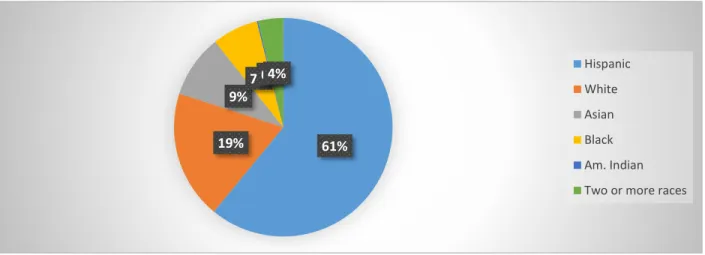
elementary has a lot of diversity. There are currently 1,228 students in grades kindergarten through fourth grade enrolled in the school year 2019-2020 (Minnesota Report Card, 2020). Of the 1,228 students 60.9% are Hispanic, 19% are White, 9.3% are Asian, 6.8% are Black or African-American, 3.7% are two or more races and .2% are American Indian or Alaska Native (Minnesota Report Card, 2020). The school demographics continue with 54.2% English
Language Learners, 75.2% are on free/reduced price meals, 13.8% are in Special Education, and .3% are homeless (Minnesota Report Card, 2020). Some students fall into multiple categories. The pie graph in figure 1 breaks down the demographics of Prairie Elementary. Three
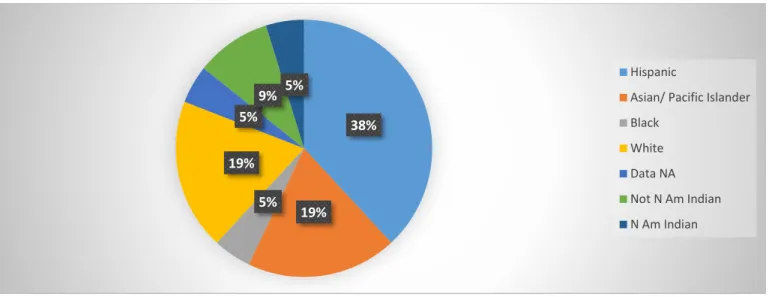
classrooms are a part of this research. The demographics for each classroom are different from each other. The graphs show each classroom ethnicity demographics compared to the school.
Figure 1. Prairie Elementary demographics (N = 1,228).
61% 19% 9% 7%0%4% Hispanic White Asian Black Am. Indian Two or more races
Figure 2. Classroom A demographics (N = 21).
Figure 3. Classroom B demographics (N = 21).
38% 19% 5% 19% 5% 9% 5% Hispanic
Asian/ Pacific Islander Black White Data NA Not N Am Indian N Am Indian 57% 9% 29% 5% Hispanic Black White Am Indian
Figure 4. Classroom C demographics (N = 21).
In figure 3 and figure 4 you will see that the percentage of Hispanics is higher than compared to the students in figure 2. The number of students who qualify for English language services vary in the classrooms also. Figure 4 shows that 60% of the students are Hispanic, however only ten students qualify for ELL services. All of these students list Hispanic as their ethnic background. Figure 2 and Figure 3 show that the classrooms also have comparable diversity in their classrooms and each of those classrooms have thirteen students that qualify for ELL services with various ethnic backgrounds.
There are multiple students on IEP’s for various disabilities in each classroom. In classroom A, two students fall under a SPED category. One student has the label of
developmentally delayed and the other has a specific learning disability. All students in this classroom participate in guided reading. For classroom B, there are two students who are on IEP’s and one student is who has a developmental delay but terminated their IEP. One of the students is Autistic and the other has an emotional disorder. The student who has a
developmental delay does not participate in guided reading. Classroom C has four students
60% 5% 5% 25% 5% Hispanic
Asian/ Pacific Islander Black
White
who are on an IEP. One student is receiving services and labeled Autistic, the other student has specific learning disabilities. The other two students share a one on one para. One is has a SPED disability of mild-moderate mentally disabled and the other falls under the category of other health impaired. Neither of these students participate in guided reading.
Measures
Data collection for this research project will be comparing the students reading growth at the beginning of the year ORR to February ORR levels. The independent variable in this study is ability grouping and the dependent variable is the students’ reading level. The researcher will find the average growth or the mean of the groups’ growth on guided reading levels. Each level gained is worth 1 point. Classroom A and C students are combined, and classroom B is self-contained. The researcher will compare the lowest group of classrooms A and C and the lowest group of classroom B. The highest groups will be compared to each other. An IRB exemption form has been filled out and gotten approval to use prior data.
The researcher will also look at student FAST scores from the fall and winter testing time. FAST scores that will be compared are sentence reading, sight words, and word
segmenting. The independent variable in this study are the three test that will be used and the dependent variable will be students’ scores on these tests. These three concepts are taught during guided reading.
The researcher conducted a survey that students were able to express their views on their own self-efficacy. The independent variable is the students in the lower and higher ability groups and the dependent variable is their score on the self-efficacy questionnaire. Students had a choice of five answers to pick from for each question. There were 13 questions. The
for the students. The questions had to do with college, career paths and the brain as a muscle. To help students in filling out the survey the researcher read the questions to the student. In front of them, they had five emoji’s ranging from double thumbs up happy emoji to and a crying emoji. After asking a question, the student had to point to the emoji that correlated with their feelings. A crying emoji was worth 1 point and the double thumbs up emoji was worth 5 points. The researcher added up the total number of points from the survey. During the time of this research, student have been moved around into different groups in all three classrooms. The survey will compare students’ self-efficacy in the low groups to the students’ self-efficacy in the higher groups. I will find the mean of the groups self-efficacy scores and compare them to each other. Figure 5 shows two sample questions from the questionnaire. Questions seven, eight and eleven were taken out.
Procedures To compare the types of grouping that are beneficial in guided reading data collection began in September of 2019. There are 21 students in each classroom. Some variations in the students have changed due to move out and move in of students. Students took the FAST test the week of September 16th. Students took a test in four areas but only three of the areas are utilized in this research. They are sight words, sentence reading and word segmenting. The other data collected in September was the students beginning reading levels based on a cold read Oral Reading Records. I also gave all students a self-efficacy survey created by Erickson and Noonan (2018). Some of the questions on the survey were not developmentally appropriate for first grade students. They were questions about the brain as a muscle and their college and career path. The researcher felt that the other questions were appropriate for the study and would give a good indicator of where the students were in terms of self-efficacy. All three classrooms used FAST scores and the ORR as part of their placement plan to group students.
Staying self-contained has caused challenges for the guided reading block. Multiple students in one group may be in different levels and have different abilities because there are not enough children in the class to make cohesive groups. Two of the classrooms in the research work together to group students based on their reading needs, interests, FAST scores and their instructional level. Guided reading is effectively done when students are similar in their needs and reading levels. In the other classroom, the teacher stays self-contained and makes groups based on reading levels and FAST scores.
Classroom A and classroom C are the two classrooms that work together and mix students based on their abilities. They have a one-hour reading block and each have a paraprofessional to utilize during guided reading. They have four groups with four to five
students in each group. Each group is seen for 15 minutes every day. The four rotations include teacher, paraprofessional, listening center, and independent work. Classroom A works with the higher ability students and classroom C works with the lower ability students. Classroom A and C incorporate a reader’s theatre that students participate in every month. During this time, students of various reading levels are able to work together in groups to complete the readers theater.
Classroom B has a half hour reading block and four different reading groups. The lower groups have four students in each group and the higher groups have six students in them. Each week, two groups meet with the teacher and the other two groups are with a paraprofessional or working independently. On a five-day week, the teacher sees all four groups during that time to check in with their independent reading folders. Classroom B teacher reported that students do not participate in readers theatre due to time constraints in the classroom.
For all three classrooms, each week teachers do a running record on the students’ instructional level that is a warm read. Each week classroom A and C look at the running records and the mistakes that students may have made and adjust the students reading groups. Classroom B uses the running records to identify the needs of the students and to find the teaching points for the next lesson. Students move around at the end of each month to change the groups.
Results Book Level Data Analysis
In the order to determine if ability grouping was beneficial to help students make higher gains in their reading levels, data collection for this research was Oral Running Records and FAST at the beginning of the school year and again in February. The researcher compared two different types of ability grouping. One type was ability grouping by using cross-classroom leveling, looking at student needs and the other was a self-contained classroom that used general ability grouping of students who were close in levels but may not be in the same level.
For classrooms A and C that used cross-classroom leveling a dependent group t test revealed that there was a statistically significant difference in pre-intervention scores on the use of ability grouping in guided reading (M = 3.25, SD = 1.89, n = 39), as compared to post test scores on the use of ability grouping in guided reading (M = 8.49, SD = 1.70, n=39) following the use of ability grouping by cross classroom leveling based on book levels and students reading needs with a strong effect size, t(38) = 28.22, p < .05, d = 2.91. There was a 5.23 point
difference in means.
For classroom B that stayed self-contained and used limited ability grouping a dependent group t test revealed that there was a statistically significant difference in pre-intervention scores on the use of limited ability grouping in guided reading (M = 3.6, SD = 2.62, n = 20), as
compared to post test scores on the use of ability grouping in guided reading (M = 7.35, SD = .93, n=20) following the use of ability grouping by within classroom ability grouping on levels size, t(19) = 7.63, p < .05, d = 1.9. There was a 3.75 point difference in means.
FAST Data Analysis
The researcher used FAST data to help determine if ability grouping was beneficial. The skills that tested were sight words, sentence reading, and word segmenting. The researcher looked at the composite score of these three test and each of these skills are worked on during the guided reading block. The skills are done at the students’ level.
For classroom A & C a dependent group t test revealed that there was a statistically significant difference in pre-test scores on the use of cross-classroom ability grouping (M = 28.5, SD = 8.70, n = 39), as compared to post-test scores on the use of cross-classroom ability
grouping (M = 45.61, SD = 13.25, n = 39) following the use of ability grouping in the classroom with a strong effect size t(38) = 13.76, p < .05, d = 1.53. The use of cross-classroom ability grouping had a positive effect the students’ FAST scores. There was a 17.11 difference in means.
For classroom B a dependent group t test revealed that there was a statistically significant difference in pre-test scores on the use of self-contained ability grouping (M = 32.35, SD = 10.47, n = 20), as compared to post-test scores on the use of self-contained ability grouping (M = 46.5, SD = 13.37, n = 20) following the use of limited ability grouping in the classroom with a strong effect size, t(19) = 8.50, p < .05, d = 1.18. The limited ability grouping had a positive effect on the students’ FAST scores. There was a 14.15 difference in means.
Self-Efficacy Data Analysis
Tobin (2008) states that it is important to avoid fixed ability groups because it could cause problems with a student’s self-efficacy who may be in the low group. The researcher gave a self-efficacy questionnaire to students in all three classrooms used in this research. Then the researcher compared the scores of the students in the low group to the high group. It is important
to determine if being in the low group has effected the students self-efficacy compared to their peers in the high groups.
For classroom A and C an independent group t test revealed that there was not a
statistically significant difference in the low ability group self-efficacy (M = 44.2, SD = 7.33, n = 10), as compared to the high ability group self-efficacy (M = 45.3, SD = 3.74, n = 10) with a weak effect size t(19) = 0.42, p < .05, d = .19.
For classroom B an independent group t test revealed that there was not a statistically significant difference in the low ability group self-efficacy, (M = 42.14, SD = 3.48, n = 7), as compared to the high ability group self-efficacy (M = 43.64, SD = 5.08, n = 11), with a weak effect size t(17) = 0.68, p < .05, d = .34. For the self-efficacy questionnaire, there was one child in classroom B that refused to participate.
Discussion Summary of Major Findings
This research was done to compare the use of different types of ability grouping during guided reading in three first grade classrooms. The last part of the research was to compare the self-efficacy of the students in the low and high groups in the three different classrooms.
Two of the classrooms combined students to make cohesive ability groups, while the other classroom stayed self-contained and grouped students close their ability. The dependent t- test indicated that there was a significant statistical difference in both ability grouping samples for book levels gained and also the same on their FAST scores. However, even though there was statistical significance for both samples, the students in classroom A and C made an average gain of 5 book levels compared to the student in classroom B that made an average of 3.75 book levels. The FAST scores also showed similar results. The results were also significant in both sample of students. The average growth in the scores was greater in classrooms A and C. The average growth for their scores was 17 points and for classroom B the average growth was 14 points. In both areas of book levels and FAST the students in classroom A and C made more gains.
The other important part of this study was looking at the students’ self-efficacy. The researcher took each of the sample classrooms and compared the low groups’ self-efficacy to the high groups’ self-efficacy. Both samples had a low group of students grouped together and a high group of students grouped together. Instead of using animals or any other titles that might indicate why the students were grouped that way, both samples used colors. The purple group was the low group and red was the high group. Students were never informed as to why they were in a certain group. An independent t test showed that in both samples there was not a
statistical significance between the low group and high groups self-efficacy. This means that the students self-efficacy were not affected based on their placement in groups. In both cases, the difference had a medium to small effect size. This is an important part of the study, working with young children and trying to educate them on how to read it could be detrimental to their growth if their self-efficacy was affected by ability grouping.
Limitations of the Study
Multiple limitations of the study are existent, which could affect the validity of the results. The samples that were used in this study were three first grade classrooms in a Title 1 school district. This is a small sample size in comparison to what it could be. It would be hard to use these results outside of this study. Another limitation is how the students were grouped between the two samples. In classrooms A and C there were more students in the lower groups compared to the lower group in classroom B. This could make an impact on the results of the study. Baseline data was used from the beginning of the year for all students. The students’ retention levels from the previous year could have been very different in terms of what they retained from Kindergarten. The time limits that the educators used for guided reading also varied. The researcher who conducted this study was an educator in one of the classrooms. More emphasis could have been put on certain skills during the guided reading time. The
implementation of guided reading depends heavily on the expertise of the educator. Two of the educators had been teaching for 5 years and one of the educators for 25 years.
Factors that limited the study on self-efficacy included the questionnaire and the
participants. The questionnaire was not worded in a developmentally appropriate way. Most of the participants are English Language Learners and may not have understood the questions. Another limitation was the questionnaire was given only once at the end of the research project.
It may have been important to give the questionnaire at the start of the school year to see if their self-efficacy changed throughout the school year due to guided reading.
Further Study
To study ability grouping and self-efficacy, a researcher could conduct this study with multiple first grade classrooms in a Title 1 school. It would be important to make sure that the groups are equitable in time spent with the teacher during group and the activities that are done outside of guided reading. Whole group reading, reader’s theatre, read aloud, and independent reading are important aspects of guided reading and should be implemented with guided reading. A survey given to educators on their perspectives of ability grouping and the ways they
implement it could give greater insight on the benefits of grouping students in other ways for guided reading to meet the student needs.
Using a different questionnaire to assess the students’ self-efficacy could be beneficial to the study. It is important that the questions are to the point and worded in a child friendly way. It could be beneficial to find the average self-efficacy score for a first grader and compare the student scores to the average. A researcher conducting this study could also give the
Conclusion
The study that was done has shown that cross-classroom leveling based on student needs and book levels has a greater impact on student learning in guided reading. By implementing this style of ability grouping teachers are better able to meet the needs of their students as individuals. FAST testing looked at skills such as sentence reading, word segmenting and sight words. These skills are a focus in guided reading. It is important that guided reading groups are fluid and flexible to meet the needs of the students. It can be detrimental to students reading development if they remain in stagnant groups, working on skills they may not be ready for or have already mastered. The researcher looked at book levels for the trimester 2 grading period, more students in classrooms A and C met their trimester 2 goal than in other classrooms.
A lot of measures were taken to ensure that students did not really understand why they were in a certain group or a certain classroom. The groups remained very fluid to help with this. Studies have shown that ability grouping can have a negative effect on a student self-efficacy. The measures that were taken seemed to help students still have a confidence in themselves and the work they were completing. There was not a large difference between the lower ability students and the higher ability students.
The research and findings of this study show that it is important to meet the needs of all students based on their needs. The groups need to remain flexible to continue their learning to the next level. When students are in their zone of proximal development they are engaged and getting the support they need to move on to the next level. Teachers are able to continually evaluate needs and understanding of students when they are in their ZPD range. Educators need to find useful and efficient ways of being able to meet the diversity and the large range of reading needs in the general classroom (Tobin, 2008).
References
Abbott, R., Mickail, T., Richards, T., Renninger, K. A., Hidi, S. E., Beers, S., & Berninger, V. (2017). Understanding interest and self-efficacy in the reading and writing of students with persisting specific learning disabilities during middle childhood and early
adolescence. International Journal of Educational Methodology, 3(1), 41-64. Retrieved from ERIC database. (Accession No. EJ1167300)
Aftab, J. (2015). Teachers' beliefs about differentiated instruction in mixed ability classrooms: A case of time limitation. Journal of Education and Educational Development, 2(2), 94-114. Retrieved from ERIC database. (Accession No. EJ1161474)
Batt, J., & Frencham, R. (2009). A recipe for guided reading--powerful teaching of reading. Practically Primary, 14(2), 29-33.
Boaler, J., William, D., & Brown, M. (2000). Students' experiences of ability grouping: Disaffection, polarisation and the construction of failure. British Educational Research Journal, 26(5), 631-648. Retrieved from JSTOR database. (Accession No. 1501995)
Chorzempa, B. F., & Graham, S. (2006). Primary-grade teachers' use of within-class ability grouping in reading. Journal of Educational Psychology, 98(3), 529-541.
https://doi.org/10.1037/0022-0663.98.3.529
Clay, M.(1994). Reading recover. A guidebook for teachers in training. Portsmouth, NH: Heinemann.
Corkett, J., Hatt, B., & Benevides, T. (2011). Student and teacher self-efficacy and the connection to reading and writing. Canadian Journal of Education, 34(1), 65-98. Retrieved from ERIC database. (Accession No. EJ932470)
Donnelly, P. (2019). A new guide for guided reading: More guided, more reading. Practical Literacy, 24(1), 9-12.
Du Plooy, L. L. (2019). The manifestations of the practice of within-class homogeneous ability grouping. South African Journal of Childhood Education, 9(1), NA.
https:// doi:10.4102/sajce.v9i1.690
Erickson, A.S. & Noonan, P.M. (2018). The skills that matter: Teaching interpersonal and intrapersonal competencies in any classroom. Self-Efficacy Formative Questionnaire. 175-176.
Ford, M. P., & Opitz, M. F. (2008). A national survey of guided reading practices: What we can learn from primary teachers. Literacy Research and Instruction, 47(4), 309-331.
https://doi.org/10.1080/19388070802332895
Ford, M. P., PhD., & Opitz, M. F., PhD. (2011). Looking back to move forward with guided reading. Reading Horizons, 50(4), 225-240. https://doi.org/10.1108
Fountas, I & Pinnell, G. (1996). Guided reading: Good first teaching for all children. Portsmouth, NH: Heinemann.
Fountas, I & Pinnell, G. (2012). Guided reading: The romance and the reality. The Reading Teacher, 66(4), 268-284. Retrieved from www.jstor.org/stable/233210=307
Fredericks, A. D. (2003). The ins and outs of guided reading. Science and Children, 40(6), 22-27. Retrieved from ProQuest 5000 database.
Greenwood, C. R., Tapia, Y., Abbott, M., & Walton, C. (2003). A building-based case study of evidence-based literacy practices: Implementation, reading behavior, and growth in reading fluency, k-4. The Journal of Special Education, 37(2), 95-110.
Ireson, J., & Hallam, S. (1999). Raising Standards: Is Ability Grouping the Answer? Oxford Review of Education, 25(3), 343-358. Retrieved from www.jstor.org/stable/1050925 Kulik, J. A. (1992). An analysis of the research on ability grouping: Historical and contemporary
perspectives. The National Research Center on the Gifted and Talented, 3-77. Retrieved from ERIC database. (ED350777)
Lee, Y., & Jonson-Reid, M. (2016). The Role of Self-Efficacy in Reading Achievement of Young Children in Urban Schools. Child & Adolescent Social Work Journal, 33(1), 79– 89. Retrieved from https://doi/10.1007/s10560-015-0404-6
Loveless, T. (1998). The tracking and ability debate. Thomas B. Fordham Foundation, 2(8), 1-30. Retrieved from ERIC database. (ED422454)
McKenna, M. C., & Kear, D. J. (1990). Measuring attitude toward reading: A new tool for teachers. The Reading Teacher, 43(9), 626-639.
Minnesota Department of Education. (2018). Minnesota report card. Retrieved from https://rc.education.mn.gov/#demographics/orgId--10518001000__p--9
Richardson, J. (2016). The next step forward in guided reading: An assess-decide-guide framework for supporting every reader. Scholastic, Inc.
Robinson, J. P. (2008). Evidence of a differential effect of ability grouping on the reading achievement growth of language-minority hispanics. American Educational Research Association, 30(2), 141-180. Retrieved from JSTOR database.
Scholz, S. (2004). Ability groups: Ineffective or ineffectively used? Australian Primary
Mathematics Classroom, 9(N2), 29-31. Retrieved from ERIC database. (Accession No. EJ793889)
Sumadi, D., Waras, S., & Nyoman, S. (2017). Effect of Ability Grouping in Reciprocal Teaching Technique of Collaborative Learning on Individual Achievements and Social Skills. International Journal of Evaluation and Research in Education, 6, 216-220.
https://doi.org/10.11591/ijere.v6i3.
Tieso, C. L. (n.d.). Ability grouping is not just tracking anymore. Social Science Premium Collection, 26(1), 29-34. Retrieved from ERIC database. (Accession No. EJ677968) Tobin,R. (2005). Responding to Diversity: Differentiating in the Language Arts
Classroom. Language and Literacy, 7(2). https://doi.org/10.20360/G2J59K Tobin, R. (2008). Conundrums in the differentiated literacy classroom. Reading
Improvement, 45(4), 159-167. Retrieved from EBSCO database. (Accession No. 35898333)
Usher, E. L., & Pajares, F. (2008). Self-efficacy for self-regulated learning: A validation study. Educational and Psychological Measurement, 68(3), 443-463.
https://doi.org/10.1177/0013164407308475
Young, C. (2018). Increased frequency and planning: A more effective approach to guided reading in grade 2. The Journal of Educational Research, 112(1), 121-130.