Education and Human Development Master's
Theses Education and Human Development
Spring 5-16-2017
Using the Superkids Reading Program with a First
Grade Inclusive Class
MacKenzie Bailey [email protected]
Follow this and additional works at:http://digitalcommons.brockport.edu/ehd_theses Part of theEducation Commons
To learn more about our programs visit:http://www.brockport.edu/ehd/
This Thesis is brought to you for free and open access by the Education and Human Development at Digital Commons @Brockport. It has been accepted for inclusion in Education and Human Development Master's Theses by an authorized administrator of Digital Commons @Brockport. For more information, please [email protected].
Repository Citation
Bailey, MacKenzie, "Using the Superkids Reading Program with a First Grade Inclusive Class" (2017).Education and Human Development Master's Theses. 769.
Using the Superkids Reading Program with a First Grade Inclusive Class
by
Mackenzie E. Bailey
A thesis submitted to the Department of Education of The College at Brockport, State University of New York, in partial fulfillment of the requirements for the degree of Masters of Literacy
Abstract
This qualitative study explores what happens when an inclusive class of first graders are taught to read through a scripted phonics-based program called Superkids (2015). This study also explores student and teacher perceptions regarding the Superkids reading program. The purpose of this research is to better support and inform both teachers and students who are mandated to use this specific reading curriculum. Data were collected for this study over a period of 4 weeks using the students’ reading assessments, student and teacher interviews, and observational notes. Data were analyzed in order to discover student and teacher perceptions of the program, as well as what happens to students’ literacy skills as they engage with the Superkids reading program.
Table of Contents
Abstract 2
Introduction 6
Topic and Research Problem 6
Rationale 7 Purpose 8 Research Questions 8 Literature Review 9 Superkids 9 Explicit/Systematic Phonics 10
Social Constructivist Theory 11
Authentic Literacy Practices 14
Interactive Read Aloud 15
Literature Circles 15
Shared/Performance Reading 16
Writing about Reading 16
Technology 17
Guided Reading 18
Methodology 18
Participants 19
Teachers 19 Setting 20 Researcher’s Positionality 20 Data Collection 21 Field Notes 21 Semi-Structured Interviews 21 Assessments 22 Procedures 23 Trustworthiness 23 Analysis 24
Finding One: Student Disengagement 25
Finding Two: Students prefer to read/listen to authentic literature 30 over Superkids books.
Finding Three: Teachers have negative perceptions of the Superkids Program 32 Finding Four: Students who have used Superkids for two years lack in 34 phonological awareness and phonics skills compared to students
who have used authentic literacy practices in kindergarten
Finding Five: Students heavily rely on the sound out strategy 34
Discussion 36
Conclusions and Implications 36
Conclusion 1 36
Implication 1 37
Conclusion 2 38
Limitations 39
Recommendations for Future Research 40
Overall significance 40 References 41 Appendices 43 Appendix A 43 Appendix B 45
Introduction
As my class of 19 first graders transition from our exciting, interactive morning meeting to the SMART Board to decode, read, and repeat black words on a big white background I hear moans and groans coming from their little 6-year-old mouths. I can’t help but think, “what is happening here?” I have always been taught to engage my students, make learning enjoyable, and to do whatever I can to help children love to learn. Last year, I received compliments from some of my students’ parents. They told me that their children loved to come to school because they said that I made school fun. This year, my goal of teaching kids to love school has stayed the same but the way I teach has had to change in several ways. I am now required by my school district, to teach literacy, through a scripted program called Superkids (2015). Superkids is a phonics-based reading program that provides explicit, systematic phonics instruction while connecting phonics to reading, writing, and spelling. According to Mesmer & Griffith (2005) systematic, explicit instruction is a direct teaching of a skill in an organized and sequential order. The Superkids reading program is said to provide direct phonics instruction that follows a
sequence of skills which early readers must master.
Topic and Research Problem
Multiple studies (e.g., Dresser, 2012; McIntyre, Rightmyer, & Petrosko, 2008) have indicated that both teachers and students have been negatively affected by scripted reading programs and explicit phonics instruction. This research is significant because scripted, explicit phonics instruction is the core of the Superkids reading program that I am currently mandated to use with my first grade class. These studies have shown that teachers who are required to teach using scripted programs tend to lose their eagerness to be creative and become more passive and
less active while instructing. According to Dresser (2012), students who learn through scripted programs are less likely to think critically, self-reflect, and use their imaginations. While students and teachers are said to lose their motivation, McIntyre’s study (2008) shows that there is no significant difference in achievement of struggling readers who receive scripted instruction verses non-scripted instruction. Additional studies (Beverly, Giles, & Buck, 2009, Rupley; Blair & Nichols, 2009) have indicated that explicit and direct instruction has been shown to be
beneficial when teaching the major components of the reading process including: phonemic awareness, phonics, vocabulary and fluency, but as readers’ progress, they are more likely to benefit from more meaningful and challenging literature. The research implies that in order for students to demonstrate higher levels of achievement, students need to be actively engaged in authentic learning for a substantial amount of time.
Rationale
With the Superkids reading program I am required to show words, have students decode them read, and repeat. I can tell from the children’s faces, body language, and moans, that they are becoming more disengaged every day. I believe that this program has, in some ways, taken away my creativity, and what I consider to be best teaching practices. As a first grade teacher, I have always been intrigued by the process young children go through as they begin to read and write. I have previously taught reading through interactive read-alouds, and guided reading that connects to the phonics skills we are working on to real meaningful textual experiences. The read-alouds, and guided reading books I have used always related to themes that the students were interested in. More than half of my first graders are currently reading below grade level. I agree with the research that explicit phonics instruction is something that I should be
incorporated into authentic literacy experiences in a highly engaging environment, and that is not currently possible. I am unable to connect the skills that my students are learning to authentic texts based on their interests because I am required to use specific texts provided by the Superkids Reading Program. Thus, this research is important to me as an inclusive teacher because I need to find ways to meet the needs of all of my students within the confines of a scripted reading program.
Purpose
The purpose of this project was to qualitatively investigate what happens when I teach my first grade students using a scripted phonics-based program. This study also explores student and teacher perceptions regarding the Superkids (2015) reading program. This study is important because I want to learn more information about the effects of the different components of the program in order to better support my students as they learn to read. It is also necessary for me to pay attention to how my students feel as I am teaching with this program. Through my study I am able to add to the knowledge in the field of early literacy education regarding scripted reading programs and explicit phonics instruction.
Research Questions
Since I am now teaching literacy through a scripted program that I am told not to stray from, my study aims to answer the following questions:
• What happens when I teach my inclusive class of first graders reading through a scripted phonics-based program called Superkids?
• What are the students’ and teachers’ perceptions of the Superkids reading program?
Literature Review
This literature review explains and summarizes the scripted, explicit/systematic phonics-based program I am currently using to instruct my first grade students called Superkids (2015). The explicit and systematic way of teaching reading contradicts the social constructivist theory that says learning should be authentic and student-centered rather than teacher directed
(Morrison & Wlodarczyk, 2009). Research on social constructivism shows how students, especially students with special needs, benefit from authentic literacy practices and social collaboration.
Superkids
Superkids is a systematic, comprehensive, phonics-based reading program that is typically used in grades K-2. According to Borman and Dowling (2009) the Superkids reading program was originally developed in 1978 by Addison Wesley but was not actively marketed. In 2003, the Rowland Reading Foundation adopted and updated the Superkids reading program. My school has decided to pilot this program in four classrooms: two first grade inclusive classes, one kindergarten inclusive classroom and one 8:1:1 self-contained special education classroom. The Superkids program is phonics-based and it is said to cover 13 ELA skills concurrently. The skills taught within the program include: “phonemic awareness, phonics, fluency, comprehension, vocabulary, listening and speaking, handwriting, spelling, expressive writing, early literacy, grammar, structural analysis, and study skills” (Borman & Dowling, 2009, p.214). The Superkids program is completely scripted and all materials, such as independent activities and decodable texts are provided. Teachers introduce the skills and then the students review and
practice the skills in whole group, small group, and independent settings. Superkids is a
multimodal program that is said to provide children with activities to meet their auditory, visual, and kinesthetic needs (Borman & Dowling, 2009). It is said to be multimodal because most of the whole group instruction is done on the Smartboard. Through my experience with the
program, I have found that many of the lessons are dull, repetitive and not meaningful to my own diverse group of students.
According to a comparative research study conducted by the Rowland Reading
Foundation (2005) supporters of the program, first graders that used the Superkids program had significantly higher standardized test scores compared to first graders that did not use the program. The students who used the Superkids program scored higher for both phonological awareness and graphophonemic knowledge. According to Fountas and Pinnell (2011)
Phonological awareness is “the awareness of words, rhyming words, onsets and rimes, syllables, and individual sounds”. Graphophonemic knowledge is the recognition of letters and the
understanding of sound-symbol relationships and spelling patterns (Fountas & Pinnell, 2011). Borman’s and Dowling’s research (2009) concluded that the Superkids impacts were moderately large compared to standards of other reading programs. Borman and Dowling (2009) also found that teachers who use Superkids are fairly pleased with the program. The teachers interviewed in the study believed that their students have benefited from the Superkids program. Much of the research currently published is funded by the manufacturers of the Superkids program, and this may have had influence over the research results.
Explicit/Systematic Phonics
The purpose of phonics instruction is to teach students sound-symbol relationships and how to use those relationships to read print. Multiple studies (Beverly, Giles & Buck, 2009;
McIntyre, Rightmyer & Petrosko, 2008; Mesmer & Giffith, 2005; Rupley, Blair & Nichols, 2009; Shapiro & Solity, 2008) have shown that explicit, systematic phonics is a critical
component of early literacy instruction. During explicit, systematic instruction teachers connect new learning to background knowledge, present step-by-step explanations, model, and guide the students so that they can practice the skills independently (Rupley, Blair & Nichols, 2009). Explicit phonics instruction directly and intentionally teaches the sound-symbol relationship before students see them in a word. According to Mesmer and Griffith (2005), systematic instruction is carefully sequenced and builds upon prior knowledge. The Superkids reading program is said to teach phonics skills explicitly in a sequence necessary to understand the alphabetic code. However, I believe that this program is a “one size fits all” approach to reading instruction because of its scripted nature. The Superkids reading program teaches the sound-symbol relationship and then provides activities and decodable texts that use the letter-sound correspondences that have been taught in earlier lessons. Decodable texts are controlled books that emphasize phonic skills, spelling patterns and high frequency words. Research has shown that explicit phonics instruction and reading practice with decodable books can be the
prerequisite to effective comprehension for early literacy learners, however, as students’ progress, they are more likely to benefit from more meaningful and authentic literacy practices (Beverly, Giles & Buck, 2009).
Social Constructivist Theory
Since learning is a social activity, social collaboration should be a part of our literacy instruction. Many studies have shown that students learn more from peer collaboration approaches compared to leaning through teacher-dominated instruction (Morrison &
methods of teaching and learning (Powell & Cody, 2004). Research shows, students learn best through experience, listening, practice, and reflective thinking (Adams, 2006).
According to Lev Vygotsky, the founding father of social constructivism, constructivism is a way of learning based on inquiry, social interaction, collaboration, culture, and real world connections and experiences (Powell & Cody, 2004). Social constructivism is important when it comes to education because it gives students the opportunity to think outside the box and explore their preexisting knowledge, focus on learning, establish teacher-student/ student-student
relationships and engage in meaningful and authentic lessons (Adams, 2006).
Teacher-centered, explicit instruction teaches students to memorize and repeat. When this happens children are unable to think critically or problem solve (Bay, Bagceci & Bayram, 2012). In social constructivist learning environments teachers are organizers and facilitators that help students acquire and improve top-level skills. Students need to be given the time to talk and teachers should act as a guide that listens, observes and asks open-ended questions that requires students to think critically and apply their knowledge (Adams, 2006).
Students should not rely on teacher-student interaction alone. It is important that students work together and collaborate by working with others, students take control over their own learning (Adams, 2006). Students should help, support and challenge each other. When students engage with one another they begin to understand and respect different viewpoints. It is
important for teachers to learn about the cultures of their students and work to incorporate each culture into the learning community and instruction (Gay, 2007). Lessons should be adapted to reflect the way each student learns and communicates best and teachers should able to adapt to different students’ needs (Rychly & Graves, 2012). According to social constructivism,
students (Peterson & Hittie, 2010). This is not possible when teaching within the Superkids program due to its scripted format. It is up to teachers to build a strong learning community that is culturally sensitive, fun, safe and creative in order to bridge a gap between different learning styles (Gay, 2007). Students learn in different ways based on their culture and backgrounds. When students are able to make connections between what they are learning in school and their culture it makes learning authentic and meaningful and the student will feel important (Adams, 2006).
Social constructivism theory emphasizes the need for young children with disabilities to belong and have rights as contributing members of a learning community (Mallory & New, 1994). When students with disabilities are included in general education classrooms they begin to learn routines and course knowledge. Peer collaboration is crucial in an inclusive classroom; children acquire a deeper understanding of the knowledge being shared between peers in the group. Both students and teachers should play a role in deciding what is to be learned and how. All students should feel like they are included and able to attain high standards of learning (Peterson & Hittie, 2010).
Overall, scripted reading programs contradict the social constructivist theory and what researchers have found to be effective literacy practices. Studies have shown that when teachers are required to use scripted curriculum they tend to lose their eagerness to be creative and become more passive and less active when teaching (Dresser, 2012). With scripted and explicit instruction, students are less likely to think critically, use their imaginations, or self-reflect. My research investigates what happens during literacy instruction when using Superkids and how my students and colleagues feel about this scripted, phonics-based reading program.
Authentic Literacy Practices
Research has shown that learning progresses and becomes deeper through meaningful and authentic activities (Ruppar, 2013; Morrison & Wlodarczyk, 2009; Fountas & Pinnell, 2011; Cumming-Potvin, 2007; Stahl, 2012; Fisher, 2008). Teaching also becomes more engaging, and exciting when students are able to participate in genuinely important tasks. My classroom is inclusive; six of my students have IEPs. I believe that these students would benefit from individualized, authentic literacy practices. Unfortunately, due to the set curriculum in districts like my school, many students, especially students with disabilities, are not able to acquire literacy skills through purposeful and engaging contexts, but are only given access to scripted programs like Superkids.
Getting students to engage in the reading process involves an assortment of synchronized authentic activities, including reading strategies, motivation, content knowledge, and social collaboration (Morrison & Wlodarczyk, 2009). Authentic literacy practices occur when teachers instruct, and allow students to read and write for a purpose that is meaningful and useful to the individual. In order to motivate young children, especially struggling readers, teachers must provide choice within a variety of forms and genres (Morrison & Wlodarczyk, 2009). Interactive read-alouds, literature discussion, shared reading, writing about reading, technology-mediated activities, and guided reading, are all authentic literacy practices that have been said to help students develop and improve literacy skills (Cumming-Potvin, 2007).
Interactive Read-Alouds and Literature Discussion
An interactive read-aloud is an instructional practice that helps engage children in the reading process. During interactive read-alouds and literature discussion, children have the opportunity to increase their understanding through talk (Fountas & Pinnell, 2011). Through interactive read-aloud, teachers have the opportunity to engage students with text that are often times more complex than they can read on their own. Teachers plan strategic moments to pause for quick discussion during the reading and continue conversation after the end of the story. Student talk provides evidence of their thinking (Fountas & Pinnell, 2011). Students are motivated by authentic literature that they can connect to in some way. The more prior
knowledge the child has about the topic, the easier it is for that child to understand the topic or concept (Morrison & Wlodarczyk, 2009). When a teacher is required to read texts provided by a program, it is not possible to choose books based on the interests and needs of the children. Research has shown that the authentic read-aloud experience can increase students’
comprehension and vocabulary development (Morrison & Wlodarczyk, 2009).
Literature Circles
Literature circles are student groups where children come together to build conversational skills for discussing text in thoughtful, and personal ways. In literature circles, the students’ inquiries and insights, not the teacher’s list of questions, guides the discussion. Literature circles function as scaffolds that help students generate ideas and their own discussions about what they have read (Fountas & Pinnell, 2011). One goal of literature circles is to allow children to listen carefully and think deeply with other students to create understandings that go beyond those of individual students. Reading/literature discussions are effective in an inclusive classroom
because they give the students opportunities to work collaboratively, critically and personally with others while discussing text (Cumming-Potvin, 2007). Discussion groups allow students to participate in the classroom community and improve learning.
Shared and Performance Reading
Shared and performance reading offers an authentic purpose for reading aloud (Fountas & Pinnell, 2011). Shared and performance reading share several of the same goals as an
interactive read-aloud, but they go farther than active listening and discussion (Fountas & Pinnell, 2011). As students read together or take part in readers’ theater they begin to notice dialogue and punctuation. They also think about the meaning of the text as they are reading. These actions provide evidence that students understand the text they are reading (Fountas & Pinnell, 2011). Shared reading can be done in a variety of different ways. One of the most frequently used way in first grade is done with a big book. With a teacher, children engage in reading enlarged text by jointly reading parts of the text, identifying sight words, and different conventions in print. The support of the teacher in the whole group setting provides the link that enables a student to gain new understandings that later allow him or her to effectively engage in the reading process independently (Stahl, 2012). By bringing an inclusive classroom together for shared reading of an authentic text, teachers are able to create a literacy community around a common purpose. Using shared reading in a first grade classroom can expand the range of books that the students can read independently (Stahl, 2012).
Writing about Reading
Writing is a way of expressing oneself, and deepening understanding of different text students have read (Fountas & Pinnell, 2011). When teachers examine writing in response to reading, they can make an educated guess about how well the reader has understood the text
(Fountas & Pinnell, 2011). Through writing and drawing pictures about what has been read, students are able to expand and express their thinking and improve their ability to reflect on text (Fountas & Pinnell, 2011). Writing prompts that are based on opinions and reality get students thinking about their learning and how it connects to real life. When students discuss their prompts with other group members they are able to express and validate their viewpoints and agree or disagree with others (Cumming-Potvin, 2007).
Technology
Learning to use technology to communicate is a necessity in the current world that we live in (Fountas & Pinnell, 2011). It is obvious that students are much more in tune with technology than most teachers, therefore we need to teach students to use their technological skills to their advantage. There are a number of different technologies that support literacy including but not limited to; audiobooks/electronic books, software programs/apps that reinforce reading and writing skills, and a variety of internet-based activities. Technology-mediated activities have a great impact on how children learn to read and teachers need to be aware of out of school literacy experiences in order to provide scaffolding in the classroom (Cumming-Potvin, 2007). Scaffolding is fundamental to facilitating students access in being confident members of a literacy community (Cumming-Potvin, 2007). The social nature of education shows that student achievement in literacy is active and dependent on peer groups and teacher support (Cumming-Potvin, 2007).
Guided reading is an instructional approach that is designed to help individual students learn how to process a variety of increasingly challenging texts with understanding and fluency (Fountas & Pinnell, 2011). Guided reading is done with a small group of students who read at the same instructional level. Guided reading offers support and precise, intentional teaching to help students read more challenging texts. Children provide evidence of their thinking through oral reading and discussion about text. Fisher’s (2008) research on guided reading showed that teachers saw a benefit from using guided reading in the classroom. Many of the teachers in the study saw guided reading as an opportunity to listen to students read and guide instruction based on what they heard and saw during the process. Guided reading leads to independent reading. Through independent reading students: learn to exercise choice as readers, develop favorite books, authors, and genres, engage in fluent reading on a regular basis, learn about themselves as readers, and become a part of a reading community (Fountas & Pinnell, 2011).
Methodology
The purpose of this research study was to qualitatively investigate what happens when I taught literacy through a scripted phonics-based program with my first grade students in an inclusive classroom. Through the implementation of the Superkids reading program, I was able to study my students’ reactions and perceptions, as well as how they were engaged in the reading process. I also explored other teachers’ attitudes and perceptions of the program. Data were collected for a period of six weeks is in the form of observations, field notes, semi-structured interviews with students and colleagues, and first grade literacy assessments.
Participants Students
The student participants in this study were selected because they are children in my first grade inclusive classroom for the 2016-2017 school year. My classroom is extremely diverse in every way. My class is made up of 19 students: eight are females and eleven are males. My class is racially and culturally diverse: ten of my students are Caucasian, seven are African American, and two are Hispanic. All of my students speak English as their first language. My class is also diverse when it comes to socioeconomic status. All of the students in my school receive free and reduced lunch, but 6 of my students are a part of the Backpack Program, which means they receive bags of food on the weekends because their families are suffering from poverty. My class has the highest number of Backpack Program participants in the entire school. Two of my students are currently homeless and living in a local motel with their families. Since I have an inclusive class, my students are also diverse when it comes to academics. Six of my students currently have Individual Education Plans (IEP) and 13 out of my 19 students receive Academic Intervention Services (AIS) daily for literacy support. Half of my students received instruction through the Superkids program in kindergarten, while the other half did not.
Teachers
The other participants in this study are teachers who have experience using the Superkids phonics-based reading program in the K-2 school I work in. I have interviewed another first grade inclusive teacher who is also a first year teacher in the district. I also have interviewed my consultant teacher, a self-contained 8:1:1 special education teacher, and a kindergarten inclusive teacher all of whom have worked in the district for more than five years. Both the kindergarten teacher and the self-contained teacher have been using the Superkids program for a year and a half. My consultant teacher, the other first grade teacher, and I are brand new to this program this year.
Setting
The setting of my study is an urban school district in Central New York that has approximately 520 students in grades K-2. According to my district’s report card (2015) the majority of students in the school are Caucasian (44%) or Hispanic (31%). Since more than half (65%) of the students in the school qualify for free or reduced lunch, the whole school receives free breakfast and lunch on a daily basis. My study took place in my first grade inclusive classroom. The environment is colorful, comfortable, and welcoming. During whole group Superkids instruction, students sit on their assigned “smart spots” on the carpet and face the SMART Board. Superkids reading groups are held at my kidney shaped table and are done with small groups of 3 to 5 children at a time. Students also participated in independent activities at their tables and moved freely from station to station while small group instruction is being administered.
Researcher’s Positionality
My role in this study is as a teacher, observer, and researcher. I am a 23-year-old Caucasian women who comes from a middle class, three-person family. I collected data in the elementary school that I am currently employed in. I also graduated from this school district, and I am still living with my parents in the town where I grew up. Additionally, I graduated from The College at Brockport with a Bachelor’s Degree in Health Studies and received certification in both Childhood Education grades 1-6 and Students with Disabilities grades 1-6. I am currently a first year teacher in my local district. When I got hired to teach first grade, I was extremely excited to use all of the authentic literacy practices I have used in the past. I could not wait to do authentic read-alouds and find books to meet the needs and interests of my students, but then I
was told I had to use a scripted reading program and my ideas and beliefs about authentic literacy had to be put on hold.
Data Collection
This is a qualitative study that explores scripted phonics-based reading instruction, specifically the program that I am required to follow called Superkids (2015). Data collection for this study is in the form of observations and field notes, semi-structured interviews, first grade reading assessments, and audio recordings.
Field Notes
I took field notes on my students’ behavior as they participate in the Superkids (2015) activities. I also observed my students as they participated in whole group Superkids instruction. I wanted to see how they reacted as I move from skill to skill. I paid particular attention to engagement during this time. I observed and took field notes of my students participating in independent activities provided by the Superkids program. Through these observations, I was able to see how the kids were progressing through the activities, noting student engagement, interactions, and literacy behaviors. These observations and field notes have helped me gain an understanding of my students’ perceptions towards the phonics-based reading program.
Semi-structured interviews
I interviewed my students and colleagues about their perceptions and experiences with the Superkids phonics-based reading program. I conducted all interviews in my classroom and they were audio recorded on my iPhone. I used the audio recordings to get the exact dialogue of conversation between the participants and I.
I was able to assess my students’ literacy skills using the Fountas and Pinnell Benchmark Assessment System or BAS (2016). According to Fountas and Pinnell, the BAS is used to determine students’ independent and instructional reading levels. I audio recorded students as they read a book in order for me to be able to analyze their miscues accurately. By giving the BAS, I have a baseline of where my students are reading and what strategies they are using when reading. This information has helped me investigate if students are using the information and skills learned from Superkids in their reading.
Another assessment I used for my data collection was iReady, a digital platform that is used to assess student achievement on first grade literacy standards and sub-standards. The iReady program has two components: instruction and diagnostic (or assessment) both of which are useful for formatively assessing student literacy achievement and growth. iReady diagnostic is an electronic, adaptive test, that school districts utilize as a tool to identify specific areas of student weakness and strength, organized by grade-level expectations and standards. The diagnostic is given to all students at the conclusion of each semester (Fall, Winter, and Spring) and is meant to target the level of each student on an individual basis. The diagnostic asks students a series of questions that vary in level of difficulty and vary in the standards that they test. As the student persists through the diagnostic, the program is able to generate a report that specifies which students exceed grade level, meet grade level, or are below grade level on each standard.
Based on the results of the iReady diagnostic, the program generates a series of instructional lessons based on the needs identified in each standard. Therefore, the iReady instructional program is based on the individual student and tailored to their literacy needs and abilities. The iReady instruction provides individualized computer based instruction and can be
used as Tier 2 and Tier 3 support. Teachers are able to increase or decrease lessons assigned to students based on student performances and growth.
I also used the Words Their Way Primary Spelling Inventory V3 (Bear, 2004). This assessment consists of 26 words that are ordered by difficulty to evaluate students spelling. I used this assessment to analyze what strategies the students are using when they are spelling. I was mainly looking to see if the students are applying the phonics skills taught through the Superkids program.
Procedures
All of my first grade students have been given the Benchmark Assessment System assessment, iReady diagnostic, and the Words Their Way Primary Spelling Inventory as part of my district guidelines. These assessments are used to create a baseline of where each of my students are currently at and where they will be at the end of the school year. I teach using the Superkids phonics-based reading program every day. I began taking field notes and closely observing my students as they participated in the various components of the Superkids program. I began interviewing my students and colleagues about the Superkids program to find out their attitudes and perceptions of the program. Since we have been using the program since the beginning of the year, I was able to start the interview process right away. At the end of the data collection process, I assessed my students again and analyzed the assessments to see what skills and strategies they were using when reading and spelling.
Trustworthiness
I collected multiple forms of data in order to ensure that my research design was valid. To ensure that my interviews were authentic, I used audio recordings to get exact dialogue. My research has been reviewed by my advisor and research partners throughout this process. Since I
researched a program that I am currently using and have some preconceived opinions about, I used the process of bracketing when analyzing my data to ensure that my perspectives did not overwhelm the perspectives of my participants. “Bracketing is a process by which a researcher reflects on his or her own views and experiences related to the study’s central phenomenon, describes these perspectives in writing, and then works to set them aside (or “bracket” them) during the analysis process” (Clark& Creswell, 2015, p. 364).
Analysis
Data from semi-structured interviews, assessments, and observations were coded for identification of themes and patterns. “Coding is a procedure where a researcher identifies segments of text (or images), places a bracket around them or highlights them, and assigns a code that describes the meaning of the text segment” (Clark & Creswell, 2015 p.359). Results were examined as a whole and then assessed in order to address the following research
questions: What happens when I teach my inclusive class of first graders reading through a scripted phonics-based program called Superkids? And, what are the students’ and teachers’ perceptions of the Superkids reading program?
Semi-structured interview transcripts were separated by student and colleague and were coded by ideas and concepts communicated in the various questions and were compared and contrasted with themes from the literature. As I compared the codes within the interviews, I created categories by grouping codes which went together and which related to the central concepts of my study, including teacher and student perceptions of the Superkids program, reading strategies used by students, and authentic vs. scripted explicit literacy practices. I then analyzed these categories in relation to my research questions as well as relevant literature and my theoretical framework and positioned my results within this context.
I also used the process of coding to analyze my students’ assessment data in order to determine what happens when I teach my inclusive class of first graders reading through a scripted phonics-based reading program. I examined my students’ current reading level, as well as their strengths and weaknesses based on Fountas and Pinnel BAS and iReady data. I also categorized my students according to their previous experience with the Superkids program in kindergarten. I was able to use this information to discover themes in my data.
An observation protocol was used to observe my students during different portions of Superkids, including small group guided reading, independent workbook activities, and independent center activities provided by the program. By using a coding procedure to locate emerging themes, I was able to capture the dynamics of behaviors taken from real-life situations.
In order to assure emerging themes would be correct, I triangulated my data from all three sources and crosschecked data points across these sources. “Triangulation is the process of corroborating evidence about a finding from different individuals or types of data” (Clark & Creswell, p.364). By doing this, I was able to discover four key findings that provided answers to my research questions.
Finding One: Field notes indicate student disengagement, but when students were asked “How do you feel when I teach Superkids?” most students had positive answers.
For first grade students, it is typically difficult to sit on the carpet and listen to a teacher for an extended amount of time. This became very clear to me as I observed my students during Superkids, whole group instruction. In the beginning of the school year, I had ELA scheduled in the afternoon, immediately following lunch. This was the time where I would teach whole group Superkids lessons. When I noticed that my students were disengaged, playing with their shoes, looking out the window, and I even had students falling asleep, I could not help but blame it on
the time of day. I made the decision to swap my math and ELA time so that ELA would be in the morning and math would come after lunch, and with math the kids would be using manipulatives and ultimately be more engaged and hopefully stay awake. Well, for the most part this worked, I had kids awake in the afternoon but I still had kids disengaged during morning ELA/Superkids, whole group instruction. These past 6 weeks I have taken a very close look at what my students are doing during whole group Superkids instruction. What stuck out to me the most was that the kids who were most engaged, and raising their hands to participate, were my excelling students, who knew all the answers to my questions. My lower achieving students were the ones who were looking out the window and playing with the Velcro on their shoes. Was this because they didn’t know how to read the words that I was asking them to read, or was it because I wasn’t
differentiating to motivate them and meet their needs? I began to watch one student more
closely. This is a student who is far below grade level and he sits in the front of the carpet closest to me. I kept a tally of how many times he undid then redid the Velcro on his shoe during one 45 minute lesson. The tally totaled a whopping 22 times even after reminders to focus, and
questions about the lesson were asked. I believe that this is because the scripted portion of the Superkids program had me doing all the talk and asking all of the questions. If I were able to have the students lead the discussion, or had given them the opportunity to work together, would he still be playing with his shoes 22 times?
I also observed the students as they participated in independent centers- both authentic centers that I have created and Superkids centers that the program provided. During centers, I had a mix of different activities. The carpet center is always reading a Superkids book and completing pages in the Superkids workbook. The others I have incorporated into my day are: Imagine Learning on the computer, word work, writing, and math. Since these are independent
centers, I was able to keep a closer eye on the students. From my observations, I concluded that my students were most engaged in the word work center and the math center, which are not part of the Superkids program. They were most disengaged with the workbook center on the carpet, which is part of the Superkids program. When I began to watch my students during the carpet work book center I noticed several different things. First, I noticed that many of the students rushed through the work book activities and often times wrote incorrect answers. When I asked one student why she rushed through the center, she told me that she wanted to get to the
computer before they got filled up. From this I asked her what she thought about the work book. I first asked her if she thought it was too hard, she told me “No it’s not hard.” Then I asked her if she enjoyed the work book center and she told me “Not really, it is not as fun as the other ones.” This answer was particularly important to me because it showed me that she prefers authentic literacy tasks and technology mediated activities over Superkids activities. Another thing I noted during my observation, was that one of my students who has behavioral needs, completes all of his centers but when he gets to the carpet center he becomes disengaged. He often times refuses to read the book and writes any answer in the work book. The aide in my classroom works closely with this student and one day when she walked him to the carpet center I heard him say “No, I don’t wanna do it!” When she asked why he said “Cause its boring”. This also stood out to me because since I have varying needs in my classroom, whether it be academic or behavioral, I need to meet the needs of all of my students. I need to make sure that each and every student in my classroom is motivated and learning something new each day.
The center my students are motivated by the most is the word work center and it is not a part of the Superkids program. I use the high frequency words given to me by the Superkids program but I allow choice when it comes to practicing these words. The Superkids program
does not have activities to go along with the high frequency words the students are just supposed to practice them from flash cards on a daily basis. Instead of just using the flash cards, I have created a choice board with different activities for the students to participate in. The students can choose which activity they want to use to practice their sight words.
Play dough words Students can create their words using play dough
Pencil-crayon-marker Students can write their words in pencil, then crayon, then marker.
This ensures that the students are writing their words three times each.
Magnet Words
Students can use magnets to make their words. They should make the words three times each.
Funky words
Students first write the words normally then they can write the words using funky letters. (bubble, block, zig-zag, etc)
WORD WORK ABC order
The students can put their words in ABC order, then write a sentence using one word and draw a picture to match.
Rainbow words
Students first write their words in pencil then they trace the words with 3 crayons.
Hidden words:
Students write their words with white crayon then color over the words in marker making the words appear
Shaving cream words Students trace their words in shaving cream three times each.
Figure 1. Student choice board used during independent center time
Since the students are given the choice with this center, they are more motivated and excited about it. I also asked the students what their favorite center is and 14/18 students answered “word work”. The other four students answered “math”. With the math center, there is almost always a manipulative to use or a game to play with a partner. The students who answered math
as their favorite center explained that it is their favorite because they get to play games with their friends which connects back to the social constructivist theory that says that students benefit from and are motivated by social collaboration. According to Tomlinson (2014) engagement and motivation happens when a lesson or activity captures a child’s imagination and ignites their opinions.
Although my observations and field notes indicate disengagement when I used the Superkids program, when I asked my students how they felt when I teach Superkids and why, many of my students had positive answers. All but one student answered “Happy or good.” One student answered “Bored, some parts are not entertaining, too easy for me.” As I began thinking about these answers I started to question if I asked the question the right way or if the students were telling me what I wanted to hear.
Table 1
Student participants’ response indicating misunderstanding of the question: Question 4: How do you feel when I teach Superkids and why?
Student V: “I feel happy because you are a good teacher, I like it when you teach it.” Student M: “Good, when you teach, I want to be just like you. I like when I be smart like
you”
Student C: “I like it when you teach us because it is fun”
Table 1: Indicates participants responses for the fourth question on the semi-structured interview conducted during the study
It is very possible that the students misunderstood the question I was asking; they may have thought I was asking them what they thought of me as a teacher, or my teaching skills. Above I
have added a table of some of the students answers that may indicate their misunderstanding of the question asked.
Finding Two: Students prefer to read/listen to authentic literature over Superkids books.
The next theme that I became aware of through the coding of student semi-structured interviews and observation field notes, was that when given the choice during independent reading time, students preferred to read authentic literature over books provided by the Superkids program.
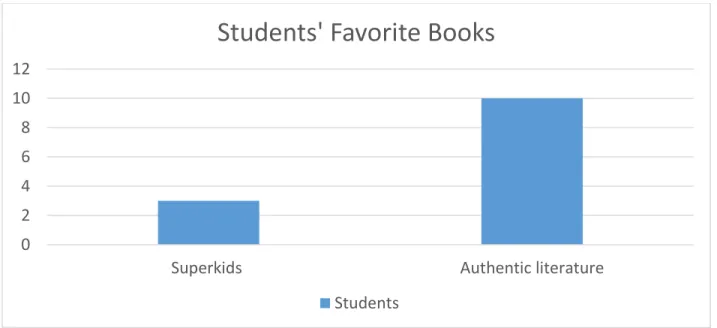
The very first question I asked the students during the interview was: “What is your favorite book and why?” I asked this question first in order to receive valid answers. If I were to ask the question after asking several questions about Superkids, the students may have thought I was asking them solely about Superkids books. Ten students reported that their favorite books were authentic literature like: Dr. Suess books, books about dinosaurs, Llama Llama books, Disney books, and books about super heroes. The other three students who answered this
question choose books provided by the Superkids program. When I asked those students why the Superkids books were their favorite, all three of the students answered “because I can read it good” or “because it’s easy”.
Figure 2. Students’ Favorite Books
In order to validate my finding, I also used observations to determine what books my students prefer to read during independent reading time. Each day, I provide ten minutes for my students to read independently. They are able to choose any book they want to read for those ten minutes. It can be books from their Superkids drawers that they have practiced several times during guided reading, books they have checked out from the library, or books from our classroom library. I observed my students during independent reading time over a four-week period and I found that the majority of students choose books from either our classroom library or from the books they checked out of our schools’ library. This data confirmed my second finding and connected to the data I found during the semi-structured interviews.
Students need to be motivated to learn to read. Motivation is crucial because it is the tendency to continue working on a task with engagement (Morrow, 2012). If a student is not motivated to read they will not grow as literacy learners. “We can motivate and engage struggling readers by creating authentic, meaningful tasks; offering consistent opportunities to engage in and respond through multiple representations of thinking; ensuring the availability of a
0 2 4 6 8 10 12
Superkids Authentic literature
Students' Favorite Books
large selection of diverse, multimodal, accessible text; engaging students in numerous collaborative experiences; structuring inquiry based projects based on student interest; and communicating with students in positive ways” (Marrow, 2012, p. 324). I believe that choice is one of the most important motivators when it comes to reading. Students who choose the topic that they read and write about ultimately gain confidence, control and responsibility of their learning.
Finding Three: Inclusive teachers have negative perceptions of the Superkids Reading program and prefer authentic literacy practices.
The teachers in my study spoke about the different aspects of the Superkids program including the scripted format, materials, leveled groups and meeting the needs of their students. The issue of not being able to meet the needs of all students developed in every semi-structured interview and like previous research studies (Margolis & McCabe, 2006; Ainsworth, Ortlieb, Cheek, Pate & Fetters, 2012; Costello & Costello, 2016; Broemmel & Evans, 2011; Wyatt, 2014), was a hindrance for many teachers who use scripted curriculum. While the teachers in my study acknowledged the positive aspects of the program, they agreed that authentic literacy practices better meet the needs of students both high and low as seen in the following quote from Teacher 1:
“Based on what I have done so far, I feel the script does not meet the needs of all kids. Because it is taught whole group, it is hard to modify for all extremities due to the significant differences in abilities in my room.”
Participants also talked about the materials provided by the program. All of the teachers stated that their students were motivated by, and enjoy the read alouds done on the smart board because they include the same characters each time and the students are able to relate to the
characters. Unfortunately, the teachers reported that one of their least favorite parts of the program are the guided reading books, because often times they are either too hard or too easy depending on the student.
Since there are only four classrooms using the Superkids program at my school, teachers found it to be very difficult to determine if students were below, at, or above grade level. This trouble stemmed from the fact that the students are being assessed based on the F&P BAS, but do not currently participate in guided reading based on F&P levels. When talking with the other first grade inclusive teacher about this frustration she said, “I struggle with the fact that
according to F&P my students are below grade level but according to Superkids they are on grade level? Why should my students be assessed using F&P leveled books when I am unable to do guided reading using those levels?” Another teacher also added: “How do I grade my
students on their report cards when technically they are a level below grade level in F&P terms, but on grade level in Superkids terms? That is a problem for me. Especially because as a school, the kids have to get assessed using the BAS at the end of the year.” These are all questions and comments that we have yet to answer because the program is so new to our school.
Through these conversations, I was able to ask the teachers what they considered to be the best teaching practices. All of the participants agreed that instruction needs to be
differentiated and tailored to meet the needs and interests of all students in order for them to achieve. Therefore, concluding that “students from any learning context learn better when teachers persistently study their students as people, ascertain the proximity of their students to essential content goals, and use that knowledge to modify instruction in ways that support growth, motivation to learn, and efficiency of learning” (Tomlinson, 2014, p.35). The strict
implementation of the Superkids program has contributed to teachers feeling constrained by what to teach and the amount of time to teach individual lessons.
Finding Four: Students who have been using Superkids for two years lack in phonological awareness and phonics skills compared to students who used authentic literacy practices in Kindergarten.
After coding F&P running records, iReady diagnostic data, and field notes, I discovered that many of my students are struggling when it comes to phonics and phonological awareness. I separated my data into groups of students who used the Superkids program in kindergarten and students who used authentic literacy practices in kindergarten. Eight of my students used Superkids in kindergarten and ten did not. I then captured their guided reading level based on F&P running records to analyze which students were on/above grade or below grade level at this point in the year. Three of the eight students who used Superkids in kindergarten are at or above grade level for reading and four of the ten students who did not used authentic literacy practices in kindergarten are currently at or above grade level. I then used iReady data and running record information to find out my students’ strengths and weaknesses in reading. From this information I was able to determine that seven of the eight students who used Superkids in kindergarten lack in phonics and phonological awareness compared to eight of the ten students who used authentic literacy practices in kindergarten who showed strengths in phonics and phonological awareness.
Finding Five: Students heavily rely on the sound out (decoding) strategy
Based on interviews, F&P running records and observations, I discovered that many of my students rely too heavily on the “sound it out strategy”. Since Superkids is a phonics-based reading program, students are taught and encouraged to decode words in text. While, decoding is a requisite skill for reading, it cannot be relied on due to the fact that many words in text cannot
be decoded or sounded out. When I asked my students, “What do you do when you come to a word you don’t know?” 100% of them answered “Sound it out.” After coding the interviews, I took a closer look at my students’ running records to see the information matched with their answer to the interview question. I found that on several running records, students did rely on sounding out when they came to words they did not know.
Figure 3. Running record. The figure illustrates an over use of the sound out strategy when reading unfamiliar text.
According to Henderson and Ganske (2000), children who try to read and spell by sound alone will be overcome. Children who learn how to “walk through” words with practical expectations, noting pattern, sound, and meaning relationships, will know what to remember and will then become successful readers and writers.
Discussion
Summary of Findings
The purpose of this study was to qualitatively discover what happens when I teach my inclusive class of first grade students using a scripted phonics-based program called Superkids. I also explored student and teacher perceptions of the Superkids reading program. This study was focused around the following research questions:
• What happens when I teach my inclusive class of first graders reading through a scripted phonics-based program called Superkids?
• What are students’ and teachers’ perceptions of the Superkids reading program?
During this six-week study, I found that my first grade students were generally disengaged and unmotivated when it came to interacting with the Superkids program, and ultimately chose authentic literature over books, and materials provided by the program. Data analysis showed that teachers who use the program in their primary inclusive classrooms struggled to balance students’ needs with the demands of the mandated Superkids curriculum. Data analysis also revealed that students who have been using the program for two years tend to: 1) lack in phonological awareness and phonics skills compared to students who used authentic literacy practices in kindergarten and 2) students who used the Superkids program rely too heavily on the “sound out” strategy when reading.
Conclusions and Implications
Conclusion 1: The Superkids reading program does not meet the needs and interests of all students.
The results of this study indicate that teachers are aware that one size does not fit all when it comes to the field of education but are in constant conflict with trying to meet the needs of their students within the confines of a mandated scripted reading program. Programs like Superkids, in which teachers are expected to take an unresponsive role in planning and instruction, fail to recognize the position of teacher decision making that is necessary for
successful literacy instruction. “When teachers are held accountable for implementing a program with fidelity, that program, rather than the needs of the students, becomes the central focus for teachers’ daily lives” (Broemmel & Evans, 2011). The results of my study also indicate that previous professional development and education did not prepare teachers to adequately differentiate within the program.
Implication 1: There needs to be more flexibility in modifying the Superkids program to meet the needs of each student.
Instruction needs to be delivered in ways that bring personal meaning and cultural relevance to students. Since the teachers in this study are required by the district to use the Superkids program to teach literacy, there should be more allowance for thoughtful teacher decision making and flexibility. Teachers should also be given proper professional development regarding the program. It is likely that there are some ways to differentiate within the
components of the program, but since the teachers have not received appropriate training, they are not aware of these differentiated pieces. If teachers are taught how to adjust the way the lessons in the program are designed and delivered, it is very possible that the program would be able to serve our diverse populations’ needs.
Conclusion 2: Students who use authentic literacy practices tend to achieve higher level literacy skills compared to students who are taught through direct and explicit phonics teaching.
Data analysis shows that students who were taught ELA through authentic literacy practices in kindergarten generally scored higher on literacy assessments then students who used the phonics-based Superkids program in kindergarten. The students who used authentic literacy practices in their previous year of schooling had a wider range of reading skills and actually excelled in phonics and phonological awareness, while the other students showed more
weaknesses with using those skills. Students who were taught using explicit and direct phonics instruction are likely to use those skills in isolation but struggle to use them within text.
According to Rupley, Blair, and Nichols (2016), the teaching of phonics skills through explicit and direct instruction tends to involve lower level cognitive processing, and students are less likely to use those skills in everyday reading and writing compared to student-led strategy learning through authentic literacy practices.
Implication 2: There needs to be a balance between direct and explicit phonics instruction and authentic literacy practices.
This study has revealed that both students and teachers prefer authentic literacy practices and literature, and students who used authentic literacy practices in kindergarten tend to achieve higher literacy skills compared to those who have been taught through direct and explicit phonics teaching. “Providing children with rich learning experiences can amplify their ability, and
denying them such richness or experiences can diminish their intelligence” (Tomlinson 2014, p. 31). Research shows that the reading process is complex and the components need to be balanced with a combination of teaching skills with meaning-making, authentic literacy experiences in an
engaging environment (Beverly, Buck & Giles,2009). From my findings, it is clear that there needs to be a balance between authentic literacy practices and explicit instruction within the confines of the scripted reading program. According to Beverly, Buck and Giles (2009) “Highly effective teachers provide skills instruction in reaction to children’s needs, prodding students to new heights”. In order for students to become more confident learners, teachers need to teach them to use multiple strategies in order to learn new words and read more accurately. Teachers should model, support, prompt, reinforce, and praise children when teaching different reading strategies. It is evident that teachers want students to use a balance of meaning, structure, and visual information to solve words. In order to do this successfully, teachers should scaffold students learning by simplifying the child's role in the task and gradually increasing their role. Teachers also need to provide opportunities for students to practice multiple strategies
continually, within different forms of text. Therefore, teachers need to be able to use authentic literacy practices, and literature throughout the day, especially in an inclusive classroom.
Limitations
As is the case with any study, my research experienced limitations. First, due to the fact that only 5 teachers in my school use the Superkids program, the population of my study was relatively small. None of the teacher participants in my study have used the program for more than a year and a half, and none of my student participants went through the full three
recommended years of program. This means that some of my findings may not transfer to a larger population with more program experience. Also, the length of my study was fairly short data was collected over a span of six weeks due to time constraints.
Future Research
Based on the results of my research, I believe there is a gap in education research about scripted literacy programs, especially the Superkids reading program. I believe there is a need for research to answer the following questions:
• What are the perceptions of teachers in schools who have more than 1-2 years of experience with the program?
• How do teachers who use scripted programs balance the requirements of the programs with the needs of their students?
Overall Significance
This study is important as it looks into a specific reading program being used in several elementary schools around the United States. The results of this research has provided insights into what happens when a scripted phonics based program is used in an inclusive first grade class and it also provided teacher and student perceptions of the Superkids program. It is evident that programs work differently depending on the context in which they are implemented, and in this case, it is proven that the scripted nature does not meet the needs of all students. The results of this study show that all students are different and teachers need to be able to design instruction based on individual student needs and interests in order for the student to reach their highest potential.
References
Adams, P. (2006). Exploring social constructivism: Theories and practicalities. Education 3-13: International Journal of Primary, Elementary and Early Years Education. 243-256.
Ainsworth, M. T., Ortlieb, E. e., Cheek, E. H., Pate, R. S., & Fetters, C. (2012). First-grade teachers’ perception and implementation of a semi-scripted reading curriculum.
Language & Education: An International Journal, 26(1), 77-90.
Bay, E., Bagceci B., Cetin, B. (2012). The effects of social constructivists approach on the learners' problem solving and metacognitive levels. Journal of Social Sciences, 8(3), 343-349.
Beverly, B
.
L., Giles, R. M., & Buck, K. L. (2009). First-grade reading gains following enrichment: Phonics plus decodable texts compared to authentic literature read aloud.Reading Improvement,46(4),191-205.
Borman, G.D., & Dowling M. (2017). Student and teacher outcomes of the superkids quasi-experimental study. Journal of Education for Students Placed at Risk, 14 (3), 207–25.
Broemmel, A. D., & Evans, K. (2011). Listening to the teachers: Experiences in success for all classrooms. Journal of School Connections, 3(1), 63-90.
Clark, V.P. & Creswell, J.W. (2015). Understanding research: A consumer’s guide. Upper Saddle Ridge, NJ: Pearson Education.
Costello M, Costello D. The struggle for teacher professionalism in a mandated literacy curriculum. Mcgill Journal of Education, 51(2), 833-856.
Cumming-Potvin, W. (2007). Scaffolding, multiliteracies, and reading circles. Canadian Journal of Education, 30(2), 483-507.
Dresser, R. (2012). The impact of scripted literacy instruction on teachers and students. Issues in Teacher Education, 21(1), 71+.
Fisher, A. A. (2008). Teaching comprehension and critical literacy: Investigating guided reading in three primary classrooms. Literacy, 42(1), 19-28.
Gay, G. (2002). Preparing for culturally responsive teaching. Journal of Teacher Education, 53(2), 106-116.
Margolis, H. h., & McCabe, P. P. (2006). Motivating struggling readers in an era of mandated instructional practices. Reading Psychology, 27(5), 435-455.
Marrow, L. (2012). Literacy development in the early years: Helping young children read and write. Boston: Pearson.
Mallory, L. M., New, S. R. (1994). Social constructivist theory and principles of inclusions: Challenges for early childhood special education. The Journal of Special Education, 28 (3). 322-337.
McIntyre, E., Rightmyer, E., & Petrosko, J, P. (2008) Scripted and non-scripted reading instructional models: Effects on the phonics and reading achievement of first-grade struggling readers. Reading & Writing Quarterly24(4), 377–407.
Mesmer, H., & Griffith, P. (2005). Everybody's selling it: But just what is explicit, systematic phonics instruction? The Reading Teacher,59(4), 366-376.
Morrison, V., & Wlodarczyk, L. (2009). Revisiting read-aloud: Instructional strategies that encourage students' engagement with texts. Reading Teacher, 63(2), 110-118.
Peterson, J.M. & Hittie, M.M. (2010). Inclusive teaching: The journey towards effective schools for all learners. (2nd edition). Boston, MA: Pearson.
Powell, C. K. $Kalina, J.C. (2004). Cognitive and social constructivism: Developing tools for an effective classroom. Education, 103(2), 241-250.
Rowland Reading Foundation. (2005). A quasi-experimental study of the Superkids program. Madison, WI: Author.
Ruppar, A. R. (2013). Authentic literacy and communication in inclusive settings for students with significant disabilities. Teaching Exceptional Children, 46(2), 44-50.
Rupley, W. H., Blair, T. R., & Nichols, W.D., (2009). Effective reading instruction for struggling readers: The role of direct/explicit teaching. Reading & Writing Quarterly25 (2–3),125– 38.
Rychly, L., Graves, E. (2012). Teacher characteristics for culturally responsive pedagogy.
Multicultural Perspectives, 14(1), 44-49.
Stahl, K. (2012). Complex text or frustration-level text: Using shared reading to bridge the difference. Reading Teacher, 66(1), 47-51.
Tomlinson, C. A. (2014). The differentiated classroom: Responding to the needs of all learners
(2nd ed.). Alexandria, VA: ASCD.
Wyatt, T. R. (2014). Teaching across the lines: adapting scripted programmes with culturally relevant/responsive teaching. Pedagogy, Culture & Society, 22(3), 447-469.