Graduation thesis
Pelle de Wit
Management of complex spatial development projects
Colophon:
Title: The balance between “project” and “process”
Management of complex spatial development projects
Location: Baarn / Delft
Date: 30th of March, 2010
Pages: 163
Status: Final version
Author
Name: P.Y. (Pelle) De Wit BSc. Student number 1219626
Email: [email protected] / [email protected]
Master Program: System Engineering, Policy Analysis and Management (SEPAM) Specialisation: Land Use & Development (LUD)
Faculty: Faculty of Technology, Policy and Management (TPM) University: Delft University of Technology
Graduation Committee
Graduation section: Policy, Organisation, Law & Gaming
Graduation professor: Prof. Dr. J. A. (Hans) De Bruijn (Faculty of TPM, section POLG) First supervisor: Dr. W.W. (Wijnand) Veeneman (Faculty of TPM, section POLG) Second supervisor: Prof. dr. W.A.M. (Wil) Zonneveld (OTB Research Institute)
External supervisor: Drs. P.A. (Peter) Kee (AT Osborne)
Delft University of Technology
Faculty of Technology, Policy and Management Postbus 5015 2600 GA Delft 015-27 87100 www.tbm.tudelft.nl AT Osborne B.V. Postbus 168 3740 AD Baarn Tel: 035 - 5434343 www.atosborne.nl
Preface
This research report, on combining project and process management, is the result of my graduation internship at AT Osborne and also serves as thesis for the Master System Engineering, Policy Analysis and Management. The past 6 years I have followed this education programme and the preceding Bachelor programme at the faculty of Technology, Policy and Management at Delft University of Technology. Education and research at this faculty focuses at social problems in which technology plays an important role. I have enjoyed this education programme which fitted well with my broad in-terest.
From the beginning of my study at the faculty of TPM, I followed a specialization in spatial develop-ment. During an earlier internship I already learned a lot about policy issues related to housing and spatial development. In addition to this experience I wanted to focus on the implementation and management of these developments during my graduation project. Therefore, it was with great moti-vation that I took the possibility that AT Osborne offered me to focus my graduation research on the management of complex spatial development projects. During the graduation period I could not only develop my knowledge on this subject, I also got a unique inside look into many of the largest projects in the Netherlands.
At the conclusion of my research I warmly thank my supervisors from the TU Delft for the provided assistance. Wijnand Veeneman, Wil Zonneveld and graduation professor Hans de Bruijn have repeat-edly supported me with useful comments. Within a moment, Wijnand was always able to focus at the most important elements of my work and to provide me with subtle instructions that kept me on the correct path. Discussions with Will were a perfect opportunity to reflect on my research and he made sure that I was keeping a close eye on the structure of my report. At slightly greater distance also Hans de Bruijn redirected my research with some crucial comments.
During my research I have also received support and a pleasant working environment within AT Os-borne. Therefore at first I’d like to thank Peter Kee, who was my first external supervisor and contact person within AT Osborne. He supported me by ensuring that my research was well in line with prac-tice and he brought me in contact with many other specialists that work within AT Osborne. However, Peter was not the only one who provided me with advice. During different stages of my internship, about a dozen of colleagues contributed to the result of my research. They provided me with com-ments on the draft versions of my research proposal and my interview protocol. They shared informa-tion with me about recent studies and interesting practices that could enrich my research. They ac-companied me to some of my interviews. They discussed with me on preliminary research results. This support was a nice incentive to pursue my research.
My enthusiasm about managing spatial development projects has only grown during this research and thereby this graduation period offered me a nice conclusion of my study. I hope you all enjoy reading the results.
Pelle de Wit March 2010
Summary
I Problem statement and research design
The planning and implementation of a high proportion of complex spatial development projects is fac-ing problems. Managfac-ing these projects is a challenge because they are technically complex, take place in a dynamic environment and many stakeholders are involved. To successfully manage these projects a combination of project management and process management is required. This is in contrast with the scientific literature, where project and process management are quite separated worlds. A clear scientific framework or theory about connecting project and process management is not yet present. Project managers seem to have insufficient support to successfully apply project and process man-agement interventions. It is expected that project managers who have a better picture of potential in-terventions can manage more effectively.
The objective of this research is to develop a scientifically based framework that presents a catego-rised and extensive overview of project and process management interventions. This framework should support project managers to successfully apply these managerial interventions in the man-agement of infrastructure and urban development projects. To achieve this objective a research ques-tion is formulated and further detailed in four sub-quesques-tions.
How can managers of spatial development projects, given the context and management issues in these developments, properly apply project-oriented and process-oriented interventions and by that increase the success of their management?
1 Which project management and process management interventions can be applied by project managers?
2 Which types of complexity and issues do project managers face during spatial development pro-jects?
3 What are the possibilities and limitations in combining project and process management interven-tions?
4 Given a specific issue and context in spatial development projects, which interventions should be applied to increase the success of the overall project?
To answer these questions, two research methods are used. First is a literature review performed to compose a theoretical framework. Second, 31 interviews with experienced project managers are con-ducted to obtain information on the implementation of project and process management and on in-terventions with a decisive influence on project results.
II Answers on the sub-questions
1 Which project management and process management interventions can be applied by project managers?
Managers of spatial development projects have the availability of a large range of managerial inter-ventions. Interventions are conscious interferences of a project manager in a project or process. With an intervention managers steer or influence the current situation and aim at achieving change.
Pure project management and pure process management exist of opposing approaches to comparable situations. Project management aims at structured accomplishment of a definite and demarcated scope and thereby steers on control of time, money and quality. Process management aims at collec-tive enabling of a dynamic and discussable scope and thereby steers on increasing support, accepta-tion and feasibility.
During the interviews 20 intervention opportunities are observed whereby project managers were able to achieve a decisive influence on the project results. To further categorize these interventions three major characteristics of interventions are described:
1 The intervention depth describing the intensity of a proposed change. 2 The intervention width describing the number of involved stakeholders.
3 The intervention length on describing the period in which the intervention takes place.
2 Which types of complexity and issues do project managers face during spatial development pro-jects?
Complexity
The context of spatial development projects is characterized by four components of complexity: Size complexity, related to the number of parts, such as stakeholders or sub-projects. Interdependence complexity, related to the interdependencies between these parts. Uncertainty in goals, which means objectives or scope of the project are uncertain.
Uncertainty in methods, which means there is uncertainty on how project goals will be achieved. The interviews revealed practical examples of complexity in spatial development projects. Financial complexity of urban development projects is high because earnings are vulnerable to market devel-opments. Infrastructure projects are mainly funded by the government, which causes a lower level of uncertainty of benefits. Social complexity in spatial development projects is high which is mainly caused by political involvement. Involvement of various governmental levels is greatly complicating and unexpected political interventions can disrupt the progress of a project.
Issues
In spatial development projects many different issues can occur and give cause to an intervention. An important distinction among the issues can be made between risks and uncertain events. In the case of a risk, the probability of the issue can be determined and a project manager can take action on forehand. In the case of an uncertain event the issue is not predictable and project managers have to react after the event.
The interviews revealed practical examples of important issues. Achieving and maintaining spatial quality is one of the major issues in urban development projects. Planning issues are relatively less important in the realisation of urban development projects in comparison to infrastructure projects. The planning is often perceived as a derivative of quality and budget. Increasing the speed of the planning phase is one of the biggest issues for project managers in infrastructure projects. Involving and informing the appropriate stakeholders is one of the key issues in all spatial development pro-jects.
3 What are the possibilities and limitations in combining project and process management interven-tions?
Project management is based on control and reducing complexity, while process management is based on flexibility and coping with complexity. Caused by these intrinsic discrepancies, interventions can constrain each others possibilities. Applying a project management intervention can have nega-tive consequences for the possibility to apply a process management intervention. Process manage-ment interventions can also raise a blockade for subsequent project managemanage-ment interventions. Still there are different possibilities to combine project and process management. The relationship varies by project due to project specific characteristics or circumstances. Project managers consider the chart in figure I as the best visualisation for the combination of project and process management in spatial development projects. This graphs shows that the quantitative share of process manage-ment is declining but a small amount of process managemanage-ment remains required. The decrease of proc-ess management is capricious, which means that the long term decrease is interrupted by a temporary renewed attention for the process. Connections between project and process management are visible through the peaks in the graph.
Figure I: The development of the proportion of project and process management during projects
The peaks in the graph indicate two different events. First, a peak can indicate a decision-making process. Process management plays an important role in the phase previous of decision-making, caus-ing a peak in the share of process management. A second explanation for the peaks is the emergence of unexpected issues. In order to resolve issues, additional process management is often needed. The capricious graph indicates that project managers should be able to switch between different ap-proaches because at one moment a project management intervention is required, but shortly thereaf-ter a process approach might be desirable.
4 Given a specific issue and context in spatial development projects which interventions should be applied to increase the success of the overall project?
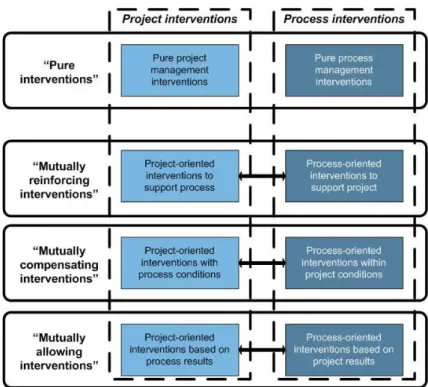
Project managers and their organization have to posses the ability to apply an intervention at the right time, which offers exactly what is required in a unique situation. The substance of the interven-tion should be unique, but it is possible to present an overview of the applicable interveninterven-tion mecha-nisms. An overview of observed intervention mechanisms that can have a crucial contribution to pro-ject results are shown in figure II.
Pure interventions refer to process management interventions and project management interven-tions that are fully consistent with the definiinterven-tions of project and process management as used in this research. Elements that require project management are a defined scope, hierarchical rela-tions, a stable environment and limited complexity. Elements that require process management are a discussable scope, interdependent stakeholders, a dynamic environment and high complex-ity.
Mutually reinforcing interventions show synergy between project and process management. Ex-amples are project-oriented interventions that contribute to the objectives of process manage-ment and process-oriented interventions that contribute to the achievemanage-ment of project goals. This shows that interventions can be applied to achieve unexpected goals and contribute to each other’s objectives.
Mutually compensating interventions are project-oriented interventions complemented with process conditions and process-oriented interventions complemented with project conditions. These conditions function as a compensation for potential negative effects of the original inter-vention.
Mutually allowing interventions are project-oriented interventions that are possible through the outcomes of an earlier process and process-oriented interventions that are possible by the results of previous project phases. This mechanism shows that project and process management interven-tions can be applied based on each other’s results.
Figure II: Overview of different intervention mechanisms
III Conclusions
Answer main research question
How can managers of spatial development projects, given the context and management issues in these developments, properly apply project-oriented and process-oriented interventions and by that increase the success of their management?
Project managers can influence the success of their project by applying interventions that match the current project situation. There are 20 distinctive interventions opportunities observed that may have a decisive influence on project results.
It is possible to distinguish elements of a projects situation that require project management and elements that require process management. However, a project situation is almost never purely suited for project management or purely suited for process management. Therefore in many interven-tions aspects of project and process management have to be combined. There are several mechanisms to combine project and process management by interventions.
Determining the most appropriate intervention is difficult due to the ambiguous and complex project situations. To support this choice the project manager and his organization must posses:
A good analytical ability to recognize upcoming problems in spatial development projects.
A good analytical ability to assess the presence of factors that influence the success of interven-tions, specifically the presence of various components of project complexity.
Knowledge about factors that determine if a project situation requires a project management or a process management approach.
Knowledge on combining project and process management in intervention mechanisms.
The quality to create and apply effective interventions that are appropriate to deal with unique situations which emerge in spatial development projects.
Contribution to scientific literature
There are three elements of this research that can contribute in connecting the currently separate lit-erature schools on project and process management.
1 This study shows that the combination of project and process in practice takes place regularly. Pro-ject and process management are often naturally combined by proPro-ject managers to match the characteristics of the project situation. Also in scientific literature these separate worlds have to be combined.
2 This research provides insight into the connection between project and process management at the project level. Project managers switch between a project and a process approach around deci-sion-making processes and in response to unexpected events. This approach can be visualized into a capricious relationship between the demand for project and process management during spatial development projects.
3 A conceptual framework is designed to show how interventions can be applied at the interface of project and process management. This framework provides a description of mechanisms by which managers combine originally opposite management approaches. The analysis shows that in prac-tice project and process management are not only connected, but by applying these mechanisms both approaches reinforce each other.
Comments on research
The disadvantage of the research method is that through interviews the perceptions of project man-agers are measured and there was no possibility to objectively monitor these perceptions. This has several consequences. Respondents may have presented their projects more positive than it is reality and they may have focused on achieved successes. Moreover, respondents might have overestimated their own role in the projects and underestimated the influence of the context. Although interviews
are rated as the best method for answering the research question, these factors weaken the certainty of the formulated conclusions.
IV Recommendations
Based on this research, three recommendations are formulated:
Windows of opportunity
The success of interventions is depended on the context in which they are applied. Applying an inter-vention in the appropriate context requires a good preparation. It is recommended to actively search for “windows of opportunity”, which offer the perfect opportunity to successfully apply a specific in-tervention.
A necessary element of a window of opportunity is dissatisfaction about the current situation or a chance of significant improvement. To apply a process-oriented intervention the presence of a shared sense of urgency among the stakeholders is also important. To apply a project-oriented intervention the absence of possible resistance is critical.
Connect project and process management
Project situations contain both elements that require process management and elements that require project management. These elements often appear simultaneously and cause ambiguous project situations. To intervene successfully in these ambiguous situations, interventions should contain a combination of project and process management. It is recommended to weave project and process management together in an individual intervention or in a series of linked interventions. Mechanisms to realize this connection are described in the next recommendation.
Combining intervention mechanisms
Three intervention mechanisms are identified to combine project and process management.
1 Mutually reinforcing interventions: Project management should not only be used for the realiza-tion of project-oriented objectives, it may also contribute to the achievement of process-oriented goals. Conversely, process management should not only be used for the achievement of process management objectives, it may also contribute to the achievement of project-oriented objectives. It is recommended to let project and process management contribute to each others objectives. 2 Mutually compensating interventions: Project management interventions could raise resistance
among other stakeholders and process management interventions may contain excessive open-ness and thus cause additional uncertainty about the scope, schedule or budget. It is recom-mended that these potential negative effects of interventions are compensated by adding project-oriented conditions to process-project-oriented interventions and by adding process-project-oriented conditions to project-oriented interventions.
3 Mutually allowing interventions: Appointing and utilizing achievements in relation to project man-agement objectives can create conditions that allow the appliance of process manman-agement inter-ventions. Conversely also the results of performed process management can be used to create conditions that allow appliance of project management interventions. Project and process man-agement interventions can therefore be applied based on each other's results.
Content
Preface 5
Summary 7
1 Introduction 15
1.1 Research topic: (un)manageable projects? ...15
1.2 Research context...15
1.3 Structure of the report ...16
2 Research design 17 2.1 Problem statement: management of complex projects ...17
2.2 Research objective and research questions...18
2.3 Research method ...19
3 Project and process management interventions 23 3.1 Introduction...23
3.2 Project and process management...23
3.3 Opposing management interventions...25
3.4 Categorisation of interventions ...32
3.5 Conclusion management interventions ...35
4 Complexity and management issues 37 4.1 Introduction...37
4.2 Complexity in spatial development projects ...37
4.3 Management issues...39
4.4 Conclusion complexity and management issues...41
5 The challenge of combining project and process management 43 5.1 Introduction...43
5.2 Combinations of project and process management ...43
5.3 Limitations in combining project and process management...47
5.4 Conclusion possibilities and limitations...48
6 Experiences of project managers 51 6.1 Introduction...51
6.2 Selection of respondents ...51
6.3 Interview protocol ...53
6.4 Experiences with project and process management...53
6.5 Experiences with crucial interventions...59
6.6 Further analysis of interventions ...66
7 Integration of project and process management 69
7.1 Introduction...69
7.2 Pure project and process management...71
7.3 Mutually reinforcing interventions...74
7.4 Mutually compensating interventions ...82
7.5 Mutually allowing interventions ...87
7.6 Conclusions appropriate interventions...94
8 Conclusions and recommendations 99 8.1 Introduction...99
8.2 Answers on the sub-questions ...99
8.3 Answer main research question ... 108
8.4 Discussion research results... 109
8.5 Recommendations ... 112 9 Epilogue 115 9.1 Comments on research... 115 9.2 Further investigation... 117 9.3 Personal reflection... 118 10 Literature 121
Appendix I: Categorized interventions 125
Appendix II: Lijst met interview respondenten 133
Appendix III: Interview protocol 137
Appendix IV: Summary of interviews in 150 quotes 143
1
Introduction
1.1 Research topic: (un)manageable projects?
Management of large spatial development projects has an unfortunate image. As research indicates, 90% of infrastructure projects faces cost overruns and benefit forecasts are often wrong by more than 20% (Flyvbjerg, 2007). But not only infrastructure projects are confronted with these drawbacks. Also urban development projects are often confronted with delays and cost overruns. A look at the headlines of the Dutch newspapers in 2009 gives an indication that realisation of large spatial devel-opment projects is still associated with problems.
Box 1-1: Headlines Dutch newspaper in 2009 indicating problems in management of large projects
Some of these projects, such as recently the Noord/Zuidlijn in Amsterdam, are delayed by technical and financial issues during realization. However, also social complexity during the initiatory and plan-ning phase causes problems for the management. This indicates that those large spatial development projects are complex in several dimensions, both technical and social.
Traditional project management tools are not sufficient to deal with this complex and ambiguous real-ity (Streatfield, 2001). To deal with all present dimensions of complexreal-ity those projects require a combination of management styles. As is further explained in the problem statement, both project and process management are necessary to successfully complete large infrastructure or urban devel-opment projects.
1.2 Research context
This research is performed by Pelle de Wit as graduation thesis for the Master System Engineering, Policy Analysis and Management at the faculty of Technology, Policy and Management of Delft Uni-versity of Technology. During the realization of the research, Pelle is appointed as intern at AT Os-borne. AT Osborne is a Dutch consultant and management company working in the field of spatial de-velopment and real estate. Employees of their department “Infrastructure, Urban Planning and Environment" are active as project manager or consultant in several large infrastructure and urban development projects in the Netherlands. To perform in these complex projects it is important that their employees are able to apply an effective combination of managerial interventions.
“Works at North/Southline shut down for at least two weeks”
“City council Wieringen rejects EIA Wieringenborderlake; construction companies threat with claims” “Antwerp hit as Westerschelde works suspended”
“Diversion A9 at Badhoevedorp delayed”
“Banks withdraw as partners, auction nV Zuidas stopped”Employees of AT Osborne learn by experience but also participate in research projects to increase their understanding of management of infrastructure projects and urban development. AT Osborne also explicitly offers possibilities for students to execute their graduation thesis at AT Osborne and to develop more knowledge about management of large spatial development projects. This research is an example of that commitment en does focus at the challenge of connecting project and process management.
1.3 Structure of the report
In chapter 2 the research design and the analytical framework of this study are discussed. The chapter explores the research problem and the objectives of the study. Also the applied research strategy is formulated.
Chapter 3, 4 and 5 elaborate on the theoretical framework of the research. Assumption is that to suc-cessfully manage spatial development projects knowledge is needed on what interventions (chapter 3) should be applied in which situations (chapter 4) and that project managers should deal with the mutual relationship between these interventions (chapter 5).
Chapter 3 focuses on project management and process management. The characteristics of the two management styles are discussed and differences are shown by describing the opposing interventions that these styles use to tackle managerial problems. Chapter 3 also describes a further categorization of interventions based on three distinctive criteria.
In chapter 4 the various situations in which process and project management interventions are im-plemented are discussed. A description is given of various types of project complexity that play a role in large spatial development projects. It also discusses the various kinds and types of issues that can arise and force managers to apply interventions.
Chapter 5 presents the final part of the theoretical framework. It further explores the relationship be-tween project and process management throughout the duration of a project. What expectations exist in the literature about this relationship? And what limitations impose the two management styles on each other?
Besides literature study, empirical data is gathered by conducting interviews. The set up of the inter-views and a first analysis of the results are presented in chapter 6. The way project managers experi-ence the relationship between project and process management is compared with the hypotheses from chapter 5.
Chapter 7 is a detailed analysis of the interventions discussed in the interviews. Specific attention is paid to the question which interventions are applicable in which situations. Not only pure process and project management interventions are described, but also intervention mechanisms that combine both approaches.
The study is concluded in Chapter 8 by providing conclusions on the research questions. Based on the obtained information recommendations are formulated to improve the management of complex spa-tial development projects. Also the added value of this research to the existing scientific literature is discussed.
Chapter 9 contains an epilogue in which the quality of the research is discussed. Moreover, the chap-ter explores the possibilities for further research and presents a personal reflection of the researcher.
2
Research design
In this chapter the research design is explained. In paragraph 2.1 the problem is demarcated on the basis of which a problem statement can be formulated. Subsequently on basis of this statement in paragraph 2.2 a research objective is defined. To achieve this objective in the same paragraph a main research question is formulated and divided in a number of sub-questions. Paragraph 2.3 elaborates on the research method to answer these questions.
2.1 Problem statement: management of complex projects
2.1.1Demarcation of the problem
The research topic of combining project and process management is too broad to research all involved aspects in the limited time for this graduation project. Therefore demarcation of the research problem is necessary.
A large amount of scientific literature is available on both project management and process manage-ment. However, project and process management schools can be qualified as separated worlds. Only recently a smaller section of these literature schools underlines that both project and process man-agement are essential and should be combined in spatial development projects (Collyer and Warren, 2009; Geraldi, et. al., 2008; Shenhar and Dvir, 2007; Whitty and Maylor, 2009).
Next step is to create knowledge how to realize this combination between project and process man-agement interventions. The amount of scientific research that addresses this issue is relatively small. Available research projects are partly case studies on projects where project and process management are successfully combined (Edelenbos and Klijn, 2009; Klijn and Teisman, 2002). However, results of these case studies are predominantly theoretical and for the most part not applicable in practice by project managers. Nevertheless it can be concluded that recently literature is seeking the relation be-tween project management and process management in managing complex projects (Geraldi et. al., 2008).
The personal skills and preferences of project managers play an important role in the application of managerial interventions. Often managers constrain themselves unconsciously to a small amount of managerial interventions which they are comfortable with. There is no extensive framework for man-agers with an overview of managerial interventions they can apply to realize a successful combination of project-oriented and process-oriented strategies. Literature suggests that fruitful combinations of project management and process management approaches might be possible (Geraldi, 2008). There-fore such a framework is expected to contribute to the success of the management of spatial devel-opment projects.
Based on this observation the problem that is addressed in this research is demarcated and limited to the lack of practical guidelines for project managers to use an effective combination of project and process management interventions during spatial development projects.
2.1.2Practical and scientific problem
To define a clear problem statement, a closer look is taken at the work of project managers and pro-ject delivery organizations. Propro-ject managers have to posses a certain combination of knowledge and skills to successfully manage complex projects. They should posses the ability to analyze the current situation of a project, to identify objectives of the project and to compare these two situations. Based on this comparison project managers should posses the capacity to apply an appropriate intervention (either process or project oriented) that contributes to achieving these objectives. Last but not least, they need the skills to implement these interventions.
This demanding combination of skills is not always present among project managers. First problem is that the managers in daily practice of spatial development projects do not posses an extensive over-view of managerial interventions. Second, there is limited knowledge about the question which inter-vention is appropriate in which situation of a project. These two aspects contribute to a situation in which managers mainly trust on their personal skills, preferences and intuition while managing their projects.
The preceding description of the work of project managers introduces the practical aspects of the problem. In addition to this the problem statement also has a scientific aspect. There is a lack of scien-tific theory or a scienscien-tific framework which provides evidence about successful mechanisms to com-bine and integrate project and process management.
In box 2-1 both the practical and scientific aspects of the problem statement are presented.
Box 2-1: Problem statement
2.2 Research objective and research questions
On the basis of the formulated problem statement an objective for the research is defined (box 2-2).
Box 2-2: Research objective
Develop a scientifically based framework that presents a categorised and extensive overview of project and process management interventions to project managers. This framework should sup-port them to successfully apply these managerial interventions in the management of infrastruc-ture and urban development projects.
Practical problem statement: Managers in spatial development projects rely significantly on personal skills, preferences and intuition in the application of project and process management interventions which causes a risk of unsatisfying management results. It is expected that pro-ject managers who have a better picture of potential interven-tions can manage more effective.
Scientific problem statement: A clear scientific framework or theory to combine project and process management is not yet present which is an important knowledge gap in this field of research.
In accordance with this research objective, focus of this research is on identifying managerial inter-ventions and applying those interinter-ventions in appropriate situations in spatial development projects. To achieve this objective a research question is formulated in box 2-3.
Box 2-3: Research question
To answer this main research question, sub-questions are defined. By answering these questions a so-lution for the defined problem statement is generated.
1 Which project management and process management interventions can be applied by project managers?
Sub-question 1 presents a categorised list with possible interventions related to project and process management. Project managers can use these interventions to influence spatial development pro-jects. The list of interventions can be used as an operationalization of the concepts project manage-ment and process managemanage-ment.
2 Which types of complexity and issues do project managers face during spatial development pro-jects?
Sub-question 2 aims at exploring the context in which project managers operate by describing the complexity and issues that managers face during spatial development projects. Describing this con-text is important because different concon-text characteristics require different types of interventions.
3 What are the possibilities and limitations in combining project and process management interven-tions?
Sub-question 3 does focus on the relationship between project and process management. Project and process management interventions influence each potential. Therefore it is important to explore the possibilities and limitations to apply interventions from both approaches in spatial development pro-jects.
4 Given a specific issue and context in spatial development projects, which interventions should be applied to increase the success of the overall project?
Sub-question 4 describes a range of intervention mechanisms and the appropriate situations in which they should be applied. Thereby this question presents the answer on the practical problem statement of this thesis.
2.3 Research method
To answer the defined research questions a research approach is composed (figure 2-1). Two main re-search methods are used, namely literature study and interviews.
How can managers of spatial development projects, given the context and management issues in these developments, properly apply project-oriented and process-oriented interventions and by that increase the success of their management?
2.3.1Literature study
The literature study is used to answer the first three research questions. This paragraph provides a short overview of the steps that are taken in the literature review.
First a description of project and process management and a list of available managerial interventions in complex projects is formulated (question 1). An extensive literature review is performed as theo-retical method for composing this overview of managerial interventions. In literature on project and process management a wide range of managerial interventions is identified. To understand the work-ing of interventions and make a further categorization of interventions, also literature on intervention management is studied. Based on this literature, different types of interventions are identified.
Figure 2-1: Research approach
Second an extensive overview is presented of the context in which managers operate in spatial devel-opment projects and the important managerial issues that arise in these projects (sub-question 2). The context of large spatial development projects is among other things characterized by complexity and uncertainty. This categorization is used to order project contexts into different categories. Presenting an overview of both important the managerial issues and the context of spatial develop-ment projects is important because this determines which managerial interventions can effectively be applied. The results from the literature study are used as input for the interviews.
2.3.2Interviews
During the interviews empirical data is collected that presents a necessary supplement to the data collected in literature. Empirical data is of more recent date than available data in literature. Besides the topicality, the gathered empirical data is better suited to answer the fourth research questions and not yet available in literature. This advantage above literature review is expected because collect-ing data among people is specifically suited to gather information about knowledge, attitude and opinion of the interviewee’s. To ensure the quality of the data, correct respondents should be se-lected. This selection is further discussed in Chapter 6.
The method that is used for the interviews is a structured interview. Advantage of a semi-structured interview in comparison with a semi-structured interview is the possibility to bring up new ques-tions during the interview as a result of the answers of the interviewee. This structure is chosen be-cause the quality of the data will be improved if the interviewer can focus on the most relevant topics without a constraining format.
Conducting a semi-structured interview does not mean that the topics to be explored should not be discovered well in advance. Therefore the interviewer composes an interview protocol that describes the main topics that will be discussed. This interview protocol is added in Appendix III.
The data collected in the interviews is analyzed and mainly used to formulate and answer on sub-question four. However, also the answers on the other research sub-questions are supplemented with the results from the interviews.
3
Project and process management interventions
3.1 Introduction
In the first two chapters the research has been introduced and the research questions are defined. This chapter describes project management and process management interventions and thereby an-swers the first research question:
1 Which project management and process management interventions can be applied by project managers?
First an introduction in project and process management is presented in paragraph 3.2. In paragraph 3.3 the concepts project and process management are further operationalized by presenting an ex-tensive overview of opposing interventions. This exex-tensive overview is needed to make it possible to categorize the interventions that are discussed during the interviews as either project-oriented or process-oriented. The description of the interventions is all-embracing but rather simplified. As a con-sequence relatively extreme archetypes of a project and a process management approach are de-scribed. In chapter 7 a more intensive description of important interventions is given. This description is based on the empirical data.
The interventions that are identified in paragraph 3.3 posses a wide range of characteristics. It is de-sirable to be able to classify the interventions that are discussed during the interventions in specific categories. This makes it possible to investigate if specific types of interventions are more or less suit-able for specific issues and contexts. Therefore in paragraph 3.4 a categorisation is made of these in-terventions based on intensity, dimension and duration. Finally paragraph 3.5 answers sub-question 1.
3.2 Project and process management
Both project and process management are essential elements in the management of nowadays com-plex spatial development projects. Interactive process strategies are necessary to operate as a man-ager in the current network society. Process management is a style of management that emerged mainly in the last twenty years and is specifically aimed at dealing with interdependencies and dynam-ics in network situations.
Also control strategies based on more “old-fashioned” project management are needed. Controlling budget and time of a project remains important. Not all aspects of spatial projects are complex and especially in more simple contexts project management remains critical.
This paragraph introduces process and project management and shortly addresses the strengths and weaknesses of both management styles.
3.2.1Project management
The characteristics of project management as described in this paragraph are based on the work of Meredith and Mantel (2000), Mantel (2005) and Miller and Lessard (2000).
Project management can be seen as “the means, techniques, and concepts used to run a project and achieve its objectives” (Meredith and Mantel, 2000). In project management the substance of a plan
is the leading element and project management is aimed at realization of the defined project objec-tives, which are related to performance, time and cost. The management approach and decision-making occurs structured and linear. Key element in this traditional project management approach is control. To realize strict control over the project the project manager has to set up a project organiza-tion with effective informaorganiza-tion flows (Mantel, 2005; Meredith and Mantel, 2000). Also risk assess-ment and risk manageassess-ment are incorporated in the control strategy.
Projects are split up in phases. In (inter)national literature a large number of different divisions in phases can be found. One of the most used project management methods is the so-called Prince 2 method. Prince 2 offers a framework and clear guidelines for managing project by dividing them in four phases: preparation, initiation, implementation and closing.
In project management methods, the content of plan is worked out in detail at the start of the project and afterwards this content is used as a communication tool and to create support among involved actors. Starting point is that the content of the plan will not be adapted as consequence of the dynam-ics in or around the project.
Decision-making in project management is characterized by hierarchy. In hierarchical situations the decision-making has a structured progress from problem definition to solution. Project management solves problems by splitting them up in solvable, smaller projects and rapid decision-making.
3.2.2Process management
The description of process management is mainly based on the work of De Bruijn et. al. (2002) and supported by work from Teisman and Edelenbos (2008) and Koppenjan and Klijn (2004).
Where project management does focus at the substance of a project, process management or interac-tive management strategies focus at gaining support and acceptance for a plan or process. The feasi-bility of a plan or project plays a central role, even if this means that original plans have to be adapted. The process is more important than the originally defined objectives. Therefore process management is sometimes referred to as consciously directing the dynamics in and around a project, by managing the interaction between people.
Process management acknowledges that a project manager is not in the position to use hierarchical management tools, but that the project manager is one of the interdependent actors around the pro-ject. Decision-making in process management is related to decision-making in networks, which in-volves unpredictability and whimsicality. Process management broadens the problem definition to search for solutions and postpones difficult decisions
Although the process is leading, this does not mean that process management is without rules. De Bruijn et. al. (2002) identified four main principles for setting up a good process.
1 First the process has to be transparent and open to all relevant parties. Everybody should have the possibility to join the process
2 Second the core values of the actors involved have to be respected. Besides by protecting their main interests, this is possible by let them commit to the process rather then to the result and by offering them exit options from the process.
3 Third the process has to show speed, which for example is stimulated by offering prospects of gain. 4 Fourth and last principle is that the process should posses enough substance. Therefore it is
3.3 Opposing management interventions
To create better understanding of the differences between project and process management in this paragraph an overview of interventions is introduced. Interventions can be defined as the way by which a manager interferes in a project or process to steer or to influence the current situation. Also consciously not taking action or ignoring a specific signal is an intervention. Thereby interventions create change (De Caluwe and Vermaak, 2006; Boonstra and De Caluwe, 2006).
Box 3-1: Definition of interventions
The discrepancies between project and process management are explained by describing the oppos-ing approaches from project and process management to react on comparable situations. On the basis of this contrast it is possible to define interventions that are discussed during the interviews as a pro-ject-oriented or a process-oriented intervention.
Consequence of the ambition to present a comprehensive overview of interventions is that the de-lineation of these interventions is short and simplified. To show the contrast between project and process management extra emphasis is put on the differences of the interventions. This leads to ex-treme archetypes of a project management and a process management approach.
It should be noticed that these short descriptions do not reflect the full complexity and specific char-acteristics of the interventions. In reality more complicated interventions can be applied, for example possessing elements from both project and process management. As counterbalance to this “quanti-tative” paragraph, based on the empirical research chapter 7 presents a more “quali“quanti-tative” view on in-terventions. The crucial interventions that are discussed in the interviews are compared with this ex-tensive list based on literature. Thereby the most important intervention opportunities according to project managers are selected.
3.3.1Categorisation of interventions
In spatial development projects managers have to intervene on different subjects. Interventions can for example affect the costs of a project, the technical possibilities or the support among stake-holders. The large variety of possible subjects is categorized in seven subjects.
The classic project management approach is aimed to realize a plan according to the defined specifi-cations (performance), at the desired time (planning) and within budget (cost) (Meredith and Mantel, 2000). The classic triangle of scope, cost and planning are core elements of project management and present the first three subjects in which interventions are classified.
To realize a project within scope, time and budget, according to the same authors, a project managers’ first task is to set up a project organization including effective information flows. Therefore ‘organiza-tion’ is the fourth subject of interventions.
The subjects identified so far are mainly internal focused. However, projects are operated in an envi-ronment and a large number of stakeholders are involved in spatial development projects. Three sub-jects of interventions related to stakeholders are defined. These are related to building a stakeholder network (stakeholder involvement), maintaining relations with the actors in this network (stakeholder
Interventions are conscious interferences of a project manager in a project or process to steer or to influence the current situation and thereby aimed at achieving change.
management) and dealing with conflicts between these stakeholders (conflict management). Summa-rizing the seven subjects in which the interventions are divided are:
1 Performance 2 Cost 3 Planning 4 Organization 5 Stakeholder involvement 6 Stakeholder management 7 Conflict management
3.3.2Interventions related to performance
There is a clear distinction between project and process management regarding the determination of scope. First step of a process approach is to define a joined problem definition because it is expected that different stakeholders have different perceptions of the problem (Schultz, 2009). The process manager assumes that defining a joined problem definition involves winners and losers. Moreover, the process manager offers flexibility in scope and stimulates the search for multi issue coupling, be-cause this offers possibilities to realize win-win situations (De Bruijn et. al., 2002:98; De Bruijn, et. al. 2004b:38; Van de Blaak 2006:34). During the process a regular re-assessment of the goals and the progress is made, if necessary goals are adjusted (TCI, 2004). Sometimes an unexpected but feasible solution is discovered. In those cases a process manager will change the scope to provide a problem that is matching the new available solution (De Bruijn et. al., 2002:29).
Table 3-1: Interventions related to the scope of a project
Subject Process oriented Project oriented
Problem perception Develop joint problem perception with stakeholders
Assume all stakeholders hold to same problem perception
Problem definition Defining the problem definition involves winner and losers and behave according to that
Assume that all actors are associated and loyal to the defined problem definition Determination of
scope
Offer flexibility in scope, support prob-lem shifting
Freeze scope during project, assume stable problem
Range of scope Broaden the project, search for multi issue coupling
Focus a one single issue and unravel in small solvable problems
Control of scope Perform regular re-assessment of progress and goals
Hold on to original plan and persuade actors on chosen goals
Problem vs. solution Define a problem which can be solved by the available solution
Define a solution that solves the actual problem
A project management approach assumes that there already is one clear problem definition and that the stakeholders are loyal to this definition (Grit, 2000:52; Meredith and Mantel 2006:311). In an early stage of the project the scope is determined. To deal with complexity, preference is to constrain the scope to a single issue or to unravel the issue in smaller solvable problems. Dynamics during the project are no reason to change the plan. The project manager holds on to the chosen solution, which
is intended to solve the originally identified problem (Van de Blaak, 2006:35; Deloitte et. al., 2009:26).
There are also important differences between project and process management concerning the design process. A process manager does focus a process which is finally intended to lead to a solution. The design takes place along a general vision whereby the solution finding moves from a variety of options to selection of a final solution (De Bruijn and Ten Heuvelhof, 1999). In selecting the possible designs main criteria are manageability and feasibility of the design. The process managers offer room for creativity in the design and even stimulate this by using several design teams (Klijn et. al., 2006). The quality of the product is improved by iterative design circles (Collyer and Warren, 2009).
In contrast a project manager does focus at identifying one thorough solution for the identified prob-lem. The design is constrained and focused at finding the best solution for the identified problem so-lution (Teisman and Edelenbos, 2008). The technological performance of the product is one of the main criteria for the design. The design is executed by a single design team, operating within strict constraints and delivering the best technical solution after a profound design process (Meredith and Mantel, 2006:311).
Table 3-2: Interventions related to the design of the project
Subject Process oriented Project oriented
Focus of design Focus at process which is intended to lead to a solution
Focus at a thorough solution for the identified problem
Basis of design Design along a general vision Design along clear constraints and on basis strict problem solution
Solution finding From variety to selection Focus on one problem solution Focus quality control Acceptation and feasibility Technological and spatial quality Design strength Offer room for creativity Design within strict constraints Design team Stimulate creative concurrence by using
several design teams
Focus on one design team Design approach Iterative design (spiral model) Classic design (waterfall model) 3.3.3Interventions to deal with planning
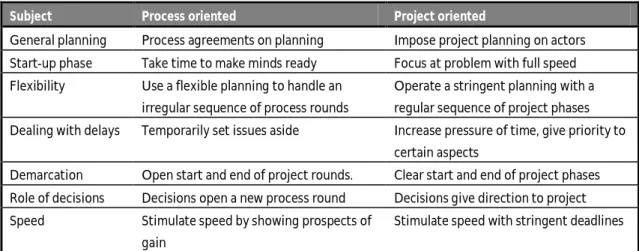
A pure process management approach starts with making process agreements with involved stake-holders about the planning (De Bruijn, et. al., 2002:57; De Bruin and Ten Heuvelhof, 1999:65). In the exploration phase of the project, a process manager is patient and takes time to make the minds of stakeholders ready to deal with new plans (Verheij and Boers, 2007). The planning is flexible to deal with an irregular sequence of the process and maintain the possibility to temporarily set problems aside. The start and end of process rounds are left open and decisions are used to start new process rounds (De Bruijn and Ten Heuvelhof, 1999).
By contrast, a manager applying a pure project management approach imposes a project planning on the involved stakeholders. A project management approach is result-oriented and focuses directly on problem solving. The planning exists of a stringent order of project phases. If there is a risk of delays, the time pressure will be increased. The start and end of every project phase is clearly defined and de-cisions give direction to the implementation of the project (De Rooy, et. al., 2006:162; Veeneman, 2004).
Table 3-3: Interventions related to the planning of the project
Subject Process oriented Project oriented
General planning Process agreements on planning Impose project planning on actors Start-up phase Take time to make minds ready Focus at problem with full speed Flexibility Use a flexible planning to handle an
irregular sequence of process rounds
Operate a stringent planning with a regular sequence of project phases Dealing with delays Temporarily set issues aside Increase pressure of time, give priority to
certain aspects
Demarcation Open start and end of project rounds. Clear start and end of project phases Role of decisions Decisions open a new process round Decisions give direction to project Speed Stimulate speed by showing prospects of
gain
Stimulate speed with stringent deadlines
3.3.4Interventions to deal with costs
In a process management approach it is more likely that a manager tries to establish a public private partnership or starts a search for co-financers. Thereby a process manager tries to create a common interest to decrease the costs (Miller and Lessard, 2000). When awarding contracts, emphasis is on meeting functional requirements and long term benefits. A process-oriented approach provides a cer-tain flexibility to modify the budgets (Heuvelhof, et. al., 2007:30).
A pure project management approach primarily does focus at a stand alone financing structure. Con-tracts are awarded based on meeting specific project requirements, where the costs are of great im-portance. Limiting and controlling the costs is a responsibility of the project organization and there-fore a strict regime of financial accountability is implemented (Marrewijk, et. al., 2008).
Table 3-4: Interventions related to the costs of a project
Subject Process oriented Project oriented
Financing structure Search possibilities for public-private partnership
Stand alone financing
Contract structure Functional requirements, focus on quality Specific requirements, emphasis on cost Freedom Flexible budgets if necessary Strict regime of financial accountability 3.3.5Interventions to deal with the project organization
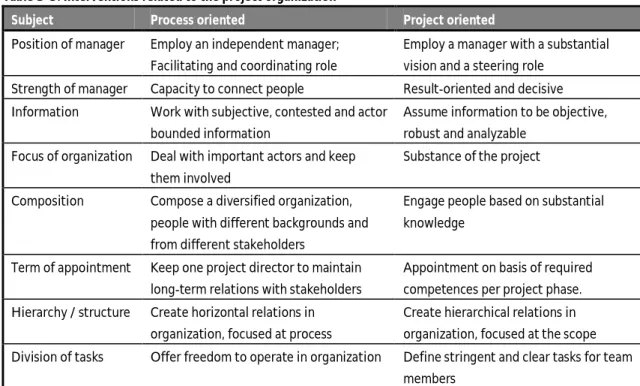
The choice for a process or project management approach influences the set up of the project organi-zation. A pure process management approach assumes the appointment of a process manager; inde-pendent from all involved stakeholders and prepared to work with actor bounded information (De Bruijn and Leijten, 2007). The process managers’ main strength is networking capacity and the ability to connect stakeholders (Verheij and Boers, 2007).
The process manager composes a diversified project organization in which he cooperates with repre-sentatives of various involved stakeholders (Verheij and Boers, 2007). The process manager associ-ates himself to the project and maintains long term relations with stakeholders (Deloitte, 2009:26; Whitty and Maylor, 2009; De Rooy, et. al., 2006:162). The project organization is a horizontal
ori-ented and employees have a certain freedom to operate within the organization (Van de Blaak, 2006:34-35; Heuvelhof, et. al.; 2007:32).
Conversely a project management approach starts with the appointment of a project manager associ-ated to the main stakeholder(s). The project manager is assumed to make use of objective and analyz-able information (Meredith and Mantel, 2006:158) and merely result-oriented. The project organiza-tion is composed with the main aim to realize a substantial product. Employees and the project manager are appointed based on their substantial knowledge (Collyer and Warren, 2009) and posi-tions of employees change depending on the project phase. The project organization is a hierarchical oriented organization with a stringent division of tasks (Grit, 2000:101).
Table 3-5: Interventions related to the project organization
Subject Process oriented Project oriented
Position of manager Employ an independent manager; Facilitating and coordinating role
Employ a manager with a substantial vision and a steering role
Strength of manager Capacity to connect people Result-oriented and decisive Information Work with subjective, contested and actor
bounded information
Assume information to be objective, robust and analyzable
Focus of organization Deal with important actors and keep them involved
Substance of the project Composition Compose a diversified organization,
people with different backgrounds and from different stakeholders
Engage people based on substantial knowledge
Term of appointment Keep one project director to maintain long-term relations with stakeholders
Appointment on basis of required competences per project phase. Hierarchy / structure Create horizontal relations in
organization, focused at process
Create hierarchical relations in organization, focused at the scope Division of tasks Offer freedom to operate in organization Define stringent and clear tasks for team
members 3.3.6Interventions to involve stakeholders
The approach related to the involvement of stakeholders is one of the main differences between pro-ject and process management. A process manager believes in the value of openness. All motivated ac-tors are invited in the process; the focus of the manager is on assembling a network with maximum diversity (De Bruijn, et. al., 2002:56; De Rooy, et. al., 2006:162). Local stakeholders are invited to de-liver their local intelligence (Hertogh and Westerveld, 2009). Private stakeholders are invited for their market knowledge and to connect public and private interest. Public partners are invited to cre-ate support and decision-making power.
The process manager makes agreements with stakeholders about exit options and the possibility to join the process in a later stadium (De Bruijn, et. al., 2002:59). In general, actors are allowed to “come and go”. To tempt stakeholders to join the process, the process manager offers the possibility to co-operate loosely (Verheij and Boers, 2007). Only commitment to the process is demanded, not to the results of the process (De Bruijn, et. al., 2002:59).
On the other hand, the project-oriented manager involves only a limited number of stakeholders to keep the project manageable. The manager does focus on cooperation with the major stakeholders. Local, non-governmental actors are excluded because of their unpredictability (Hertogh and Westerveld, 2009). The number of involved private and public stakeholders is also restricted to avoid conflicting interests and legal procedures. The stakeholder network as compiled at the beginning of the project will not be changed. Actors who joined the network have to commit to the result of the project.
Table 3-6: Interventions related to stakeholder involvement
Subject Process oriented Project oriented
Involving actors Involve all motivated actors Constrain number of actors Focus Focus on maximum diversity Focus on major actors Local actors Involve local intelligence Exclude local unpredictability Public vs. private Involve private stakeholders to connect
public and private interests
Avoid conflict between public and private interests
Timing Early involvement of public partners for creativity and knowledge
Avoid risk of conflict with compulsory public contract law
Flexibility Options to join and leave Solid composition of field of actors Intensity Offer possibilities for loosely participation Intense cooperation with main
stakeholders Commitment Ask for commitment on process, make
declaration of intent
Ask for commitment on result of project, set obligation of result
3.3.7Interventions for stakeholder management
Once stakeholders have become involved in a project, it is important for the project manager to main-tain relationships with these stakeholders. Cooperating with the various actors is qualified as stake-holder management. Also related to stakestake-holder management distinctions between project and proc-ess management exist.
A process manager cooperates with the stakeholders in an informal way. Cooperation is based on trust and within the network transparency and communication are of main importance (De Bruijn, et. al., 2002:113, Mackay, 2005; De Rooy, et. al., 2006:162). This contributes to horizontal relations where all stakeholders receive equal treatment.
One of the tasks of the process manager is to stimulate joint fact finding to establish a basis of nego-tiated knowledge (De Bruijn, et. al., 2002:170, Van de Blaak, 2006:34-35). In addition to joint fact finding, it is important to identify the shared values (Verheij and Boers, 2007). The process manager does focus on building support among all the stakeholders (De Bruijn, et. al., 2002:113) and takes into account that there exists a political autonomy to change already made decisions (Schultz, J.M. et. al., 2009; De Rooy, et. al., 2006:162).
The project-oriented manager assumes that the best results are achieved by a formal organization of the project. Agreements with involved stakeholders are set down in contracts and the cooperation be-tween stakeholders is characterized by hierarchy. The project manager has no involvement in the knowledge position or values the stakeholders. Focus of the project manager is on gaining support
within the project organization (Meredith and Mantel, 2006:308). The content of the plan is used to generate support. In principle the project team holds to made decisions, there is little flexibility.
Table 3-7: Interventions related to stakeholder management
Subject Process oriented Project oriented
Stakeholder analysis Ongoing activity Once-only activity Dealing with
regulation
Informal organization of process, effectively breaking the rules
Formal organization of project, the “royal way”
Basis of agreements Trust Contracts
Transparency Focus on transparency and communication in network
Only inform stakeholders when really necessary
Hierarchy Create horizontal relations Create hierarchical relations Substantial
knowledge
Joint fact finding to establish negotiated knowledge
Make every actor responsible for its own knowledge position
Values Invest in creating shared values Don’t engage in stakeholders’ values Basis of support Focus on external support Focus on internal support
Generating support Allow actors to exert influence By content of the initiative Influencing actors Indirect steering, external stimuli Direct steering from manager Dealing with politics Prepare for political dynamics, constant
search for commitment
Assume political support as stable, external factor
Communication Pro active, search for exposure Passive and limited communication 3.3.8Interventions to manage conflicts
Despite investing in stakeholder management, conflicts may occur. In dealing with conflicts differ-ences exist between a project management and a process management approach.
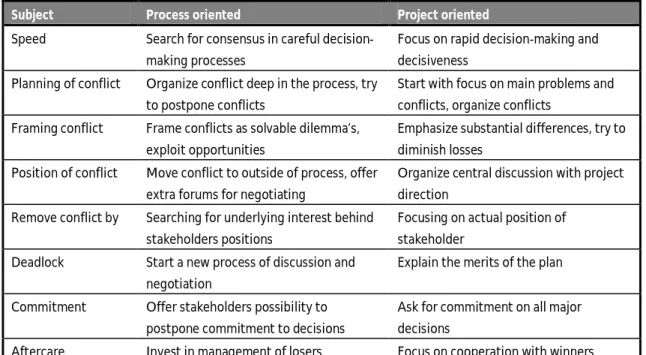
The process manager tries to search consensus by careful decision-making. If stakeholders fail to reach agreement, the moment of decision making is postponed. By organizing foreseeable conflicts in a later phase of the project, it is possible to increase the commitment of stakeholders to the process. Based on the accumulated trust, conflicts will less soon lead to a definitive break between involved stakeholders (De Bruijn, et. al., 2002:83). To solve conflicts the process manager does focus on un-derlying interests that explain the positions of stakeholders. Based on better understanding of stake-holders’ positions, new discussion and negotiations can start (De Rooy, et. al., 2006:162). Stake-holders also have the possibility to postpone their commitment to decisions, which offers them possibility to explain the decisions inside their own organization (De Bruijn, et. al., 2002:59). After a decision is made, the process manager invests in management of losers (De Bruin and Ten Heuvelhof, 1999:65; De Vries and Hertogh, 2006).
In contrast the project-oriented manager does focus on rapid decision-making and decisiveness to eliminate conflicts. The project manager tries to solve the main problems and conflicts as fast as pos-sible. Therefore he identifies the position of the stakeholders and tries to convince the opponents by explaining the merits of his plan (Teisman and Edelenbos, 2008). To avoid future conflict, the project manager asks for commitment on all major decisions. The project manager does focus on the winners of conflict to realize its goals.