BREAKING THE CODE:
Understanding The Current Standards For Rating Efficiency
Of Computer Room Air Conditioning Equipment
INTRODUCTION:
UNDERSTANDING THE STANDARDS FOR RATING EFFICIENCY
OF CRAC UNITS
Effective on January 1, 2016, the U.S. Federal Department of Energy (DOE) enforced new energy efficiency requirements for Computer Room Air Conditioning (CRAC) equipment, which had not been federally regulated before. This has introduced some confusion to the heating, ventilating, and air conditioning (HVAC) & data center industry as to which efficiency rating to use for the computer room application for air conditioning equipment. The confusion should not come as a surprise though, prior to 2010 efficiency and rating tables specific to computer room air conditioning units did not exist and this type of equipment was treated as comfort cooling equipment which was predominantly evaluated by other efficiency ratings such as EER, SEER, and IPLV (see left).
These efficiency ratings were created and used for comfort cooling equipment, which is optimized to perform to building occupancy periods and seasonal weather. Computer room spaces however, are designed to provide sensible cooling capacity 24/7/365 in mission critical environments. For example, EER examines equipment’s net total cooling capacity whereas SCOP uses net sensible cooling capacity.
Mechanical Engineers of Record are constantly tasked with implementing the most energy efficient equipment in their facilities while ensuring the equipment is certified by the all governing authorities, including the Federal DOE.
How can an Engineer of Record ensure they are using the correct energy ratings and properly regulated equipment? The answer is to be knowledgeable of the correct efficiency rating and DOE certification system.
This white paper explains the correct efficiency rating and DOE certification system to ensure a facility is using energy efficient and compliant equipment for computer room applications.
Applications Engineering | Data Aire, Inc.
EFFICIENCY RATINGS CONTINUE TO CHANGE
Individuals ranging from Engineers of Record to Facility Owners are misinformed on what the current standards require for rating efficiency of a computer room air conditioning unit.
Energy Efficiency Ratio (EER), Seasonal Energy Efficiency Ratio (SEER), Integrated Part Load Value (IPLV), Integrated Energy Efficiency Ratio (IEER), Coefficient of Performance (COP), and Sensible Coefficient of Performance (SCOP) have all been used in the HVAC industry for efficiency ratings; all but one of which are incorrect for current CRAC standards, SCOP.
THE WAITING GAME:
CREATION AND ADOPTION OF ENERGY CODES
The life of an energy code is one of progress, revision, stagnation, and perseverance. Energy codes are created and approved through forums open to the public, allowing for collaboration with industry representatives and due process to arrive at a widely accepted code. Once the code has been introduced, it’s made available to the public for feedback regarding the impact the impending code may have to the industry’s business. Any revisions made to the code are then accounted for and a final draft is produced and submitted to a governing body, in this case the DOE, where it sits and waits for adoption or adaption into legislative action. Once the DOE approves the code, the legislation is again open to the public for feedback, usually from affected parties, and comments are recorded in a revised proposal. This proposal is then approved and made effective by the DOE at future date. The reasoning behind selecting a future date, and not effective immediately, is to give affected parties time to understand and apply these new codes to areas of their business that is impacted.
ENERGY CODE APPROVAL PROCESS
THE RISE OF ASHRAE 90.1
In 2010, the efficiency ratings in regards to computer room air conditioning equipment changed, specifically a table titled “Air Conditioners and Condensing Units Serving Computer Rooms” in Section 6.8.1, which uses Sensible Coefficient Of Performance (SCOP) as a standard rating. SCOP is defined as “The ratio of net sensible cooling capacity (Watts) divided by the total power input (Watts, excluding reheat and humidifier)”, at conditions defined in ASHRAE Standard 127.[1]
SCOP has become the backbone and common reference for state and federal regulatory codes on air conditioning equipment applied to computer room spaces, and provide the most accurate energy rating method for the equipment and application.
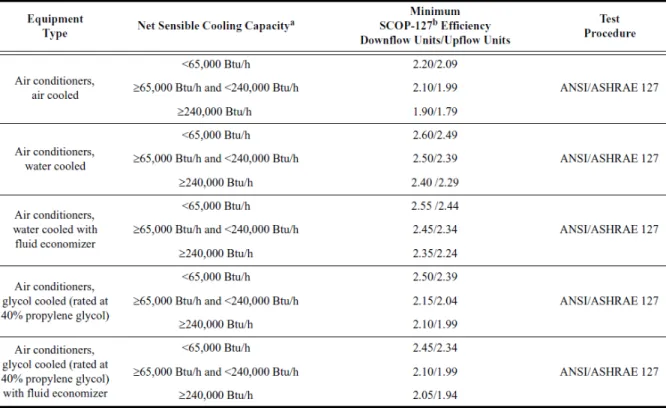
Figure 1 Table 6.8.1-11 from the current 2013 ASHRAE Standard 90.1; the table is identical to the 2010 standard except the Table number was 6.8.1K
previously.[2]
Sources:
1. Source: ASHRAE Standard 127 Method of Testing for Rating Computer and Data Processing Room Unitary Air Conditioners
2. Source: ASHRAE Standard 90.1-2013 Table 6.8.1-11
ASHRAE 127: TESTING CONDITIONS, SCOP EFFICIENCY
RATINGS, AND DOE CONFUSION
ASHRAE 127 defines the method of testing for rating computer room and data processing room equipment. This details the exact conditions and process to follow in order to produce uniform SCOP efficiency ratings across the industry. The recent milestone years of publication for Standard 127 are 2007 and 2012, with the major changes occurring in 2012 that introduced rating classes and accounted for outdoor heat exchanger pump/fan power consumption as part of the overall system.
As shown in Figure 1 above, Standard 127 is referenced as the Test Procedure, but does not clarify which year of the standard to utilize; one might assume since Standard 90.1 was published in 2013, Standard 127 should follow the 2012 publication. However, the Department of Energy (Federal Government) requirements do not support this assumption (of 127-2012) and utilizes 127-2007 as described in the following section.
A minor change introduced in Standard 127-2012 worth noting is that SCOP was redefined as Net Sensible Coefficient of Performance Rating (NSenCOP) in order to clarify net sensible capacity is used in the rating, not total. Note (a) in Figure 1’s footer clarifies this, but ASHRAE renamed the rating to avoid all confusion.
ENTER THE DEPARTMENT OF ENERGY AND CODE OF
FEDERAL REGULATIONS
The DOE has adopted CFR Title 10, Volume 3, Chapter II, Subchapter D, Part 431, Subpart F [3] for 2016 which requires all computer room air conditioning
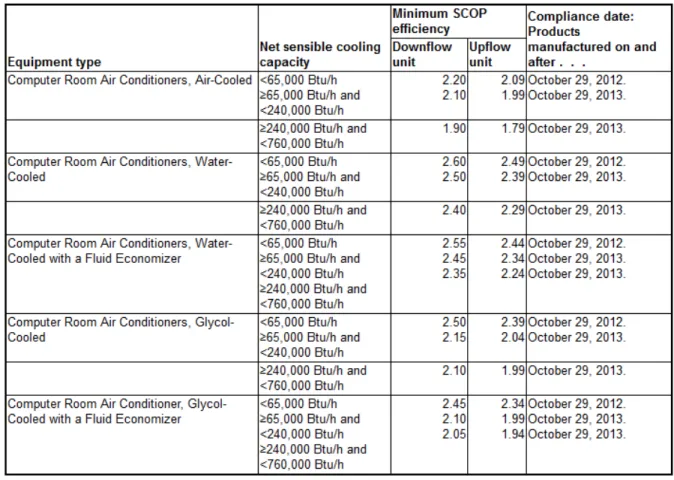
equipment nationwide to meet a minimum efficiency rating. Part 431.96 identifies ASHRAE 127-2007 as the standard to follow when examining the efficiency requirements defined in Table 8 of Part 431.97 (Figure 2).[4]
A quick examination of Figure 2 below reveals it is identical to ASHRAE 90.1-2013 shown in Figure 1. This Indicates that SCOP is unquestionably the method in which computer room air conditioning equipment are to be rated for efficiency. While some local governments have adopted standards years ago, minimum standards were enforced January, 1 2016.
Sources:
3. http://www.ecfr.gov/cgi-bin/
retrieveECFR?gp=&SID=4ce21c75b10b106313807f43554702b1&mc=true&n=sp10.3.431.f&r=SUBPART&ty=HTML 4. Source: CFR Title 10, Volume 3, Chapter II, Subchapter D, Part 431, Subpart F
CONCLUSION
Considering energy efficiency regulation of computer room air conditioning equipment has been overlooked in the HVAC industry for some time now, it is no wonder the established and engrained rating methods are commonly misapplied in this space.
The gap in understanding is the regulation of the computer room application, not the equipment or companies whom manufactured it.
Air conditioning manufacturers and representatives are an excellent resource for guiding designers through the selection process of compliant equipment as they are often participating in the industry committees that help shape and form the aforementioned energy codes.
The U.S. Federal DOE is working with leaders and manufacturers in all facets of the HVAC industry on continual consolidation of standards to create an appropriate efficiency rating benchmark, and that benchmark is SCOP for the computer room application.
Sources:
5. https://www.regulations.doe.gov/
6. https://www.regulations.doe.gov/certification-data/CCMS-461423879169.html#q=Product_
Group_s%3A%22Air%20Conditioners%20and%20Heat%20Pumps%20-%20Computer%20Room%20Air%20 Conditioners%22
7. Source: CFR Title 10, Volume 3, Chapter II, Subchapter D, Part 431.97 “Energy efficiency standards and their compliance dates” which points to certification falling under 10 CFR 429.102 “Prohibited acts subjecting persons to enforcement action”.
http://www.ecfr.gov/cgi-bin/text-idx?SID=f567049827c8117662a9481352f43398&mc=true&node=pt10.3.431&rgn =div5#sp10.3.431.f
http://www.ecfr.gov/cgi-bin/text-idx?SID=3dc0cc5404e5485f5b979a9c0482b835&mc=true&node=pt10.3.429&rgn =div5#se10.3.429_1102
FEDERAL DOE LISTING
Manufacturers are required to list their compliant equipment with the U.S. Federal DOE’s Building Technologies Program online. Through Compliance Certification Management System (CCMS), manufacturers of covered products and commercial equipment must electronically submit compliance and certification information to DOE. This on-line system permits manufacturers to create, submit and manage certification reports using product or equipment specific templates.[5] The
Compliance Certification Database houses certification and compliance reports submitted by manufacturers for covered products and equipment subject to Federal conservation standards.[6]
Equipment not listed in this database per the U.S. Federal DOE is ineligible for sale in the Computer Room Application.[7]