Original Research Article
Prevalence and susceptibility to diabetes mellitus using
Indian diabetic risk score
Divya S.
1, Radhamani M. V.
2, Kiran Ravi
3, Deepa S.
4*
INTRODUCTION
The prevalence of diabetes is rapidly rising all over the globe at an alarming rate.1
Over the past many years, the status of diabetes has changed from being considered as a mild disorder of the elderly to one of the major causes of morbidity and mortality affecting the youth and middle aged people.2 In Kerala the prevalence of diabetes was 16.3%.3
The International Diabetes Federation (IDF) estimated 100 million people with diabetes worldwide representing about 6% of all adults.4 Although great efforts have been made by developed countries to control infectious diseases, but non-communicable diseases have not received the same attention. Diabetes mellitus is one of the non–communicable diseases which have become a major global health problem. Around 20% of current global diabetic population resides in South– East Asia
ABSTRACT
Background: India is the diabetes capital of the world. The burden of diabetes mellitusis increasing daily. If people
with higher risk for diabetes are identified before the disease has developed, then some interventions could be undertaken to reduce the modifiable risk factors. Objective of the study wasto identify the high risk subjects by using Indian diabetes risk score (IDRS) for detecting undiagnosed diabetes among people aged above twenty five years in rural area of Thrissur.
Methods: A cross-sectional study was conducted among 262 inhabitants above 25 in Thrissur. Fasting blood sugar
within 3 months prior was noted. The risk of diabetes was assessed using Indian Diabetes Risk Score and grouped into low, moderate and high risk.
Results: Majority were females (58.4%) and (80.5%) reported either of their parents as diabetic. Waist circumference
was higher for majority. Most (62.2%) people had regular exercise. 199 (76%) had moderate risk. 92% were at moderate to high risk of developing diabetes. Higher the risk score higher was the FBS, and was statistically significant (p=0.035). IDRS was statistically significant with the educational status (p=0.023) and sex (0.000). Forty four (16.8%) were diabetic, 60 (22.9%) hypertensive and 12 (4.6%) had coronary artery disease.
Conclusions: There is a shift in age of onset to younger age groups. Hence, the early identification of at risk individuals and appropriate intervention help to prevent, or delay, the onset of complications. This definitely suggests the importance of IDRS for identifying undiagnosed high risk diabetes.
Keywords: Age, Exercise, Indian diabetic risk score, Strenuous, Waist circumference
1
Department of Community Medicine, Malabar Medical College, Kozhikode, Kerala, India
2
Department of Obstetrics and Gynaecology, 4Department of Radiodiagnosis, Government Medical College, Kottayam, Kerala, India
3
Department of General Medicine, Baby Memorial Hospital, Kozhikode, Kerala, India
Received: 22 June 2018
Revised: 30 July 2018
Accepted: 01 August 2018
*Correspondence:
Dr. Deepa S.,
E-mail: [email protected]
Copyright: © the author(s), publisher and licensee Medip Academy. This is an open-access article distributed under
the terms of the Creative Commons Attribution Non-Commercial License, which permits unrestricted non-commercial use, distribution, and reproduction in any medium, provided the original work is properly cited.
Region. Indeed, the number of people with diabetes in India is likely to double in less than 2 decades.5,6 The population in India has an increased susceptibility to diabetes. There are 30–33 million diabetic cases, the prevalence of disease in adults was found to be 2.45 in rural and 11.6% in urban dwellers.7,8
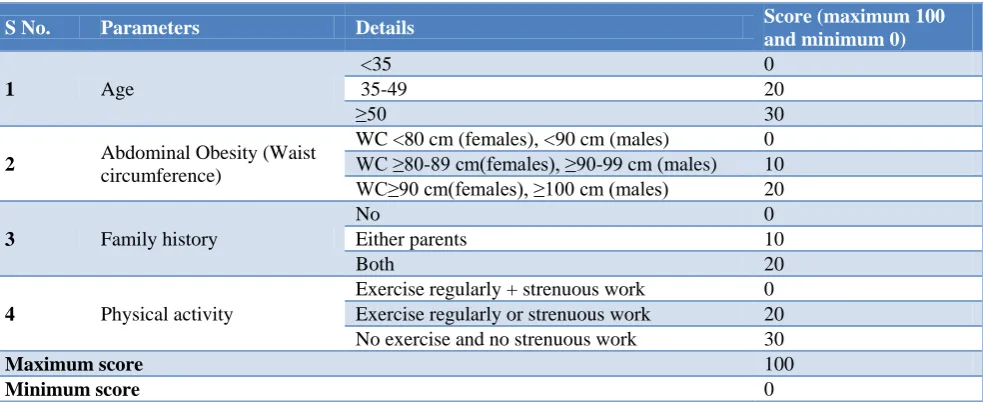
Indian diabetes risk score (IRDS) developed by Dr. Mohan and his colleagues is one of the strongest predictor of incident diabetes in India. It is a simplified risk score for identifying undiagnosed diabetic subjects using four simple parameters like age, waist circumference, family history of diabetes and physical activity. The minimum score is 0 and maximum is 100. A score of 60 and above is indicative of diabetes risk. IDRS is more cost effective, involves simple non-biochemical measurements and is easily applicable in field. It can therefore be used as a simple first step in identifying the individuals with increased risk.
The evidence for the effects of physical inactivity on the prevalence of diabetes and cardiovascular diseases can be seen in CUPS.9,10 was observed that the prevalence of diabetes was almost three times higher in individuals with light physical activity compared to those having heavy physical activity (23.2 vs. 8.1%, p<0.001).9 It was also noted that prevalence of metabolic syndrome and hypertension was also significantly higher among people with light physical activity.8 Overall, individuals with light-grade physical activity had 2.4 times higher chances of developing coronary artery disease compared to heavy grade physical activity group.10 Hence early identification of the risk factors associated with diabetes and appropriate interventions aimed at preventing the onset of diabetes and its complications are urgently required.
METHODS
A community- based cross-sectional study was conducted from February 2016 to November 2016, in Kaiparambu panchayath of Thrissur district to assess the prevalence of
diabetes and to determine the high risk status of diabetes using IDRS score. All persons above 25 years were chosen for the study. Bed ridden patients and people on steroids were excluded.
According to 2014 National Diabetes Statistics Report, 27.8% of the people with diabetes are undiagnosed. The sample size taken was 262. By convenient sampling, one ward was chosen. A street was randomly selected and house to house visit was done and the first person above 25 year in that street was selected. Consecutive houses were surveyed till 262 samples were obtained.
They were personally interviewed using a pre- tested and structured questionnaire.
Variables under study: - Socio-demographic details, associated co-morbidities such as diabetes, hypertension and CAD.
• High-risk cases of diabetes: participants with IDRS ≥60 were considered at high risk of diabetes.
• Waist circumference: Waist circumference was measured to the nearest 0.1 cm at the midpoint between the tip of the iliac crest and the last costal margin in the back and at the umbilicus in the front, using a non-stretchable tape, at the end of normal expiration, with the subject standing erect in a relaxed position. Abdominal/central obesity was considered to be present when the waist circumference was ≥80 cm in women and ≥90 cm in men.
Informed written consent was taken in their local language from each subject. There are no risks involved in the study. Confidentiality of the subjects is also preserved. The data obtained was coded and entered in microsoft Excel sheet& analysed using the statistical software Statistical Package for Social Sciences (SSPS Version-23).
Table 1: Indian diabetic risk score.
S No. Parameters Details Score (maximum 100
and minimum 0)
1 Age
<35 0
35-49 20
≥50 30
2 Abdominal Obesity (Waist
circumference)
WC <80 cm (females), <90 cm (males) 0 WC ≥80-89 cm(females), ≥90-99 cm (males) 10 WC≥90 cm(females), ≥100 cm (males) 20
3 Family history
No 0
Either parents 10
Both 20
4 Physical activity
Exercise regularly + strenuous work 0 Exercise regularly or strenuous work 20 No exercise and no strenuous work 30
Maximum score 100
RESULTS
Socio- demographic characters of the subjects
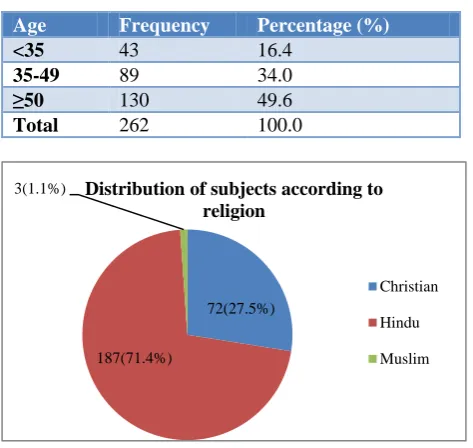
Majority of the subjects were above 50 years. Among 262 subjects, 153 (58.4%) were females.
Table 2: Distribution of the study subjects by age.
Age Frequency Percentage (%)
<35 43 16.4
35-49 89 34.0
≥50 130 49.6
Total 262 100.0
Figure 1: Distribution of the study subjects by religion.
According to modified BG Prasad classification, majority belonged to class II SES.
Table 3: Distribution of the study subjects by SES.
Socio-economic class (Percapita family income)
Frequency Percentage (%)
Class I 94 35.87
Class II 98 37.40
Class III 64 24.4
Class IV 4 1.5
Class V 2 0.76
Total 262 100.0
Table 4: Distribution of the study subjects by their educational status.
Educational status Frequency Percentage (%)
Illiterate 1 0.4
Primary school 70 26.7
Middle school 97 37.0
High school 34 13.0
Diploma 34 13.0
Graduate/PG 10 3.8
Professional 16 6.1
Total 262 100
Out of 262, 97 (37%) had up to middle school education and 70 had up to primary school education. Sixteen (6.1%) were professionals
Table 5: Distribution of the study subjects by their occupation.
Occupation Frequency Percentage (%)
Professional 2 0.8
Semi- professional 42 16
Clerical/shop
owner/farmer 44 16.8
Skilled 64 24.4
semi- skilled 48 18.3
unskilled 14 5.3
Unemployed 48 18.3
Total 262 100.0
Personal history of co-morbidities
Sixty were hypertensive (22.9%), 44 (16.8%) were diabetic and 12 (4.6%) had CAD.
Figure 2: Showing the number of subjects with comorbidities.
Indian diabetic risk score - components
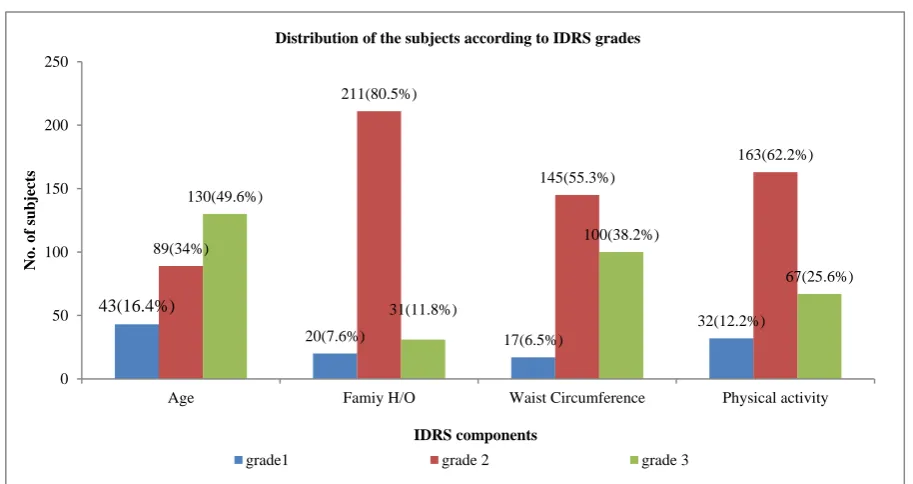
IDRS has four components and each has three grades of risk.
Risk status based on Indian diabetic risk score
Table 6: Distribution of the study subjects based on Indian diabetic risk score.
IDR score Frequency Percentage(%)
<30 low risk 21 8
30-50 moderate
risk 199 76
>60 high risk 42 16
Total 262 100
72(27.5%)
187(71.4%)
3(1.1%) Distribution of subjects according to
religion
Christian
Hindu
Muslim
60(22.9%)
44(16.8%)
12(4.6%)
202(77.1%) 218(83.2%)
250(95.4%)
0 50 100 150 200 250 300
HTN DM CAD
No
.
o
f
subjects
Comorbidity
Distribution of the subjects based on comorbidities
YES
Figure 3: Distribution of the subjects according to IDRS grades
Table 7: Shows association between IDRS risk status and diabetes.
IDRS risk status
Diabetes
Total
P value Statistical test
Yes n (%)
No n (%)
P value 0.035
Fischer Exact Value = 6.719 Df=2
<30 low risk 4 17 21
30-50 moderate risk 27 172 199
>60 high risk 13 29 42
Total 44 218 262
Association between IDRS risk status and diabetes
IDRS score was found to be significant with development of Diabetes (p=0.035).
Association of IDRS with other factors
IDRS is found to be statistically significant with female gender of the subject (p<0.001), which can be due to the gender susceptibility and also with the educational status (p=0.023). It is not significant with the presence of comorbidities like HTN and CAD (p=0.357). Religion has no role for development of risk for diabetes (p=0.672).
DISCUSSION
The prevalence of diabetes is 16.8% in the present study. In Kerala, the prevalence of diabetes was 16.3%.3 In the study conducted by Mohan et al, CURES 2006, the prevalence was15.5 %,which are comparable with the result of our study.9 According to Sanjay Kumar Gupta et al, the study done in Pondicherry in 2013, the prevalence was 8.3%, in the Amrita Diabetes and Endocrine
Population Survey (ADEPS), Ernakulam, it was 19.5%.11 In the National Urban Diabetes Survey (NUDS) conducted in 2001–the prevalence was 12.1% and the prevalence of diabetes according to The Sentinel Surveillance Systems for CVDs at Trivandrum was 9.2%.13,14
IDRS was statistically significant with Diabetes (P=0.035) and 76% belonged to moderate risk IDRS and 16% had high risk IDRS. According to the study done by Sanjay Kumar Gupta et al, 76% of Diabetics had high IDRS score. 11
In the study done by Deo SS et al 2006- 56% of diabetics had significant higher IDRS scores.15.
According to Sanjay Kumar Gupta et al, 32% had family H/O DM.11 In NUDS, 17% of diabetics had positive family H/O DM.13 HTN was three times higher with light physical activity. 13
There is statistically significant difference of diabetes risk status in – gender and educational status.
43(16.4%)
20(7.6%) 17(6.5%)
32(12.2%) 89(34%)
211(80.5%)
145(55.3%)
163(62.2%)
130(49.6%)
31(11.8%)
100(38.2%)
67(25.6%)
0 50 100 150 200 250
Age Famiy H/O Waist Circumference Physical activity
No
.
o
f
subjects
IDRS components
Distribution of the subjects according to IDRS grades
CONCLUSION
The prevalence of diabetes in the present study is 16.8%. Our study shows Indian Diabetic Risk Score is simple, fast, economical and can be used in field very effectively. It can be used as an effective screening tool for individuals with high IDRS for diabetes in the community. The score helps to identify the undiagnosed diabetes from the general population and thus the disease can be controlled and complications can be prevented.
In conclusion, the past decades have witnessed a rapid rise in the prevalence of diabetes. The fact that there is a shift in age of onset to younger age groups is alarming as this could have adverse effects on the nation’s economy. Hence, the early identification of at risk individuals and appropriate intervention in the form of weight reduction, changes in dietary habits and increased physical activity could greatly help to prevent, or atleast delay, the onset of diabetes and thus reduce the burden due to non communicable diseases in India.
Recommendations
Integration of IDRS to routine NCD clinic may be done. It is important to focus on IEC activities. Early screening, detection and treatment may prolong the onset and intensity of complications.
It is necessary to find out the modifiable risk factors for the development of diabetes among people.
ACKNOWLEDGEMENTS
I thank all my co- authors, faculty, friends and research centre for all the co-operation and guidance that had supported me.
Funding: No funding sources Conflict of interest: None declared
Ethical approval: The study was approved by the Institutional Ethics Committee
REFERENCES
1. Huizinga MM, Rothman RL. Addressing the diabetes pandemic: A comprehensive approach. Indian J Med Res. 2006;124:481-2.
2. Mohan V, Sandeep S, Deepa R, Shah B, Varghese C. Epidemiology of type 2 diabetes: Indian scenario diabetes. Indian J Med Res, 2007;136(4):217-30. 3. Raman Kutty V, Joseph A, Soman CR. High
prevalence of type 2 diabetes in an urban settlement in Kerala, India. Ethn Health 1999;4:231-9.
4. Sicree R, Shaw J, Zimmet P Diabetes and impaired glucose tolerance. In: Gan D, editor. Diabetes Atlas. International Diabetes Federation;2006: 15-103. 5. Available at: http://www.searo.who.int/EN/
Section1243/Section1382/Section1386/Section1898 _9438.htm. Accessed 10 March 2018.
6. World Health Organization, Regional Office for South East Asia. Health Situation in South East Asia Region, Regional office for SEAR, New Delhi; 2002.
7. Ahuja MM, Sivaji L, Garg VK, Mitroo P. Prevalence of diabetes in northern India (Delhi area). Horm Metab Res. 1974;4:321-4.
8. Gupta OP, Joshi MH, Dave SK. Prevalence of diabetes in India. J Adv Metab Dis. 1978;9:147-65. 9. Mohan V, Gokulakrishnan K, Deepa R Shanthirani
CS,Datta M. Association of physical inactivity with componentsof metabolic syndrome and coronary artery disease – The Chennai Urban Population Study (CUPS No. 15). Diabet Med. 2005;22:1206-11.
10. Li G, Hu Y, Yang W, Jiang Y, Wang J, Xiao J, et al. Effectsof insulin resistance and insulin secretion on the efficacy of interventions to retard development of type 2 diabetesmellitus: the DA Qing IGT and Diabetes Study. Diabetes Res Clin Pract. 2002;58:193-200.
11. Gupta SK, Singh Z, Purty AJ, Kar M, Vedapriya DR, Mahajan P, Cherian J. Diabetes prevalence and its risk factors in rural area of Tamil Nadu. Indian J Comm Med. 2010;35:396-9.
12. Rathod HK, Darade SS, Chitnis UB, Bhawalkar JS, Jadhav SL, Banerjee A. Rural prevalence of type 2 diabetes mellitus: A cross sectional study. J Soc Health Diabetes. 2014:2:82-6.
13. Upreti B, Zaman FA, Satpathy SV. Prevalence of diabetes mellitus among ethnic adult population in an urban community in East Sikkim, India. J Evid Based Med Healthc. 2017;4(83):4900-5.
14. Prakash Upadhyay R. An Overview of the Burden of Non-Communicable Diseases in India. Iran J Public Health. 2012;41(3):1–8.
15. Deo SS, Zantye A, Mokal R, Mithbawkar S, Rane S, Thakur K. To identify the risk factors for high prevalence of diabetes and impaired glucose tolerance in Indian rural population. Int J Diabetes Dev Ctries. 2006;26:19–23.
Cite this article as: Divya S, Radhamani MV, Ravi