Original Research Article
A comparative study of knowledge and practice regarding menstrual
hygiene among private and government schools of Jaipur city
Nikita Sharma, K. K. Meena, Kusum Gaur, Dharmesh Sharma*
INTRODUCTION
According to World Health Organization, a person aged 10–19 years is considered as an adolescent.1 The transition period between the childhood and adulthood is called adolescence which is marked with the growth and development of the child. During this period, physical, psychological, and biological development of the child occurs.2 Due to lack of knowledge on menstruation preparedness and management or due to shyness and embarrassment the situation becomes worse for school going girls.3 An additional source of infection may occur due to type of absorbent used during menstruation which is said to be of paramount importance since reusable materials could cause infections if improperly cleaned
and poorly stored.4 Since 2014, May 28 is observed as the menstrual hygiene day worldwide to raise awareness regarding the challenges women and girls face to deal with menstrual cycles and highlight solutions implementable at global, national, and local levels to address these issues.5
In many schools, due to shyness or embarrassment both male and female teachers are not ready to discuss menstruation and menstrual hygiene management with students. The female teachers are also not available in many schools. Teachers often skip such topics in books as they do not want any open discussion in the class or to escape from the questions asked by students. Teachers also feel shy and embarrassed to discuss such topics in
ABSTRACT
Background: Menstruation is a normal physiological process to the females but sometimes it is considered as unclean phenomenon in the society. Hence this community based study was carried out with the objective to assess the difference in level of knowledge and practice regarding menstrual hygiene among school going adolescent girls of government and private school.
Methods: A community-based cross-sectional study was conducted from July 2017 to April 2018 to find out the difference inprevailing knowledge and practices regarding menstrual hygiene between private and governmentschool going adolescent girls of Jaipur city. Data were collected by the predesigned and pretestedstructured questionnaire.
Results: 87.57% girls from private schools were aware of menstruation prior to attainment of menarche. The difference in knowledge regarding menstruation in students of private and government school was significant. More than three fourth of the participants (76.95%) were from private school use sanitary pad.
Conclusions: Knowledge and practice regarding menstruation was better in private school girls as compared to those of government school. Significantly more number of girls in the private schools was using sanitary pads as compared to government school girls.
Keywords: Adolescent girls, Menarche, Menstrual hygiene, School Department of PSM, SMS Medical College, Jaipur, Rajasthan, India
Received: 16 July 2019
Revised: 01 August 2019
Accepted: 02 August 2019
*Correspondence:
Dr. Dharmesh Sharma,
E-mail: [email protected]
Copyright: © the author(s), publisher and licensee Medip Academy. This is an open-access article distributed under the terms of the Creative Commons Attribution Non-Commercial License, which permits unrestricted non-commercial use, distribution, and reproduction in any medium, provided the original work is properly cited.
class.6 Therefore, targeting school girls at the time of adolescence is an appropriate strategy and it is important to know about their knowledge and practice regarding menstrual hygiene since it is the time when most of them are curious about their bodily changes and also active learning phase takes place. The present study is therefore conducted among adolescent school girls in a government and private school to study the level of awareness about menstruation and assess their menstrual hygiene practices in Jaipur city.
METHODS
This community based study was carried out to find out the difference in prevailing knowledge and practices regarding menstrual hygiene between private and government school going adolescent girls of Jaipur city. The study was conducted under Preventive and Social Medicine department of SMS Medical College, Jaipur (Rajasthan), India.
Study area:Senior secondary schools of Jaipur city. Study type: This is a community based descriptive type of observational study which was conducted on adolescent female students (10-19 years) of Jaipur city. Study design:Cross sectional study design.
Study period
After getting approval from the institutional research review board and Ethical committee, plan of study was executed. Data collection for this study was carried out from 1st July 2017 to 10th April, 2018.
Study universe
Female students of age group 10-19 years studying in class 6th -12th of randomly selected schools of Jaipur city.
Inclusion criteria
Inclusion criteria were female students of 10 to 19 years studying in government and private senior secondary schools having ≥500 students of Jaipur city; female students present on the day of study; female students who had attained menarche.
Exclusion criteria
Exclusion criteria were those whose principal/school authorities did not give consent; female students who had not attained menarche; female students who were absent on the day of study.
Sample size
The sample size calculated was 793 at 95% confidence interval and 7% relative error to verify the expected
minimum 50.8% of prevalence of adolescent girls practicing the use of sanitary pads during menstruation.7 It is enhanced to 1000, to cover the expected 20% non-response.
Sampling technique
A complete list of senior secondary; government and private schools of Jaipur city; with ≥500 students was procured from Department of Education, Jaipur. All schools in each zone of the city (East, West, North and South) were categorized into government and private schools. One school each of government and private category from each zone (East, West, North and South zone) was selected by simple random sampling technique i.e. 8 schools in total. Permission to collect information was taken from District Education officer. Permission was taken from principals of the selected School. If permission from selected school authority was not granted then it was replaced by the next school in the list in same category. 126 female students studying in class 6-12th from each school were randomly selected to cover the sample size of 1000. Hence 18 randomly selected female students from each class (6th to 12th) were included. In case there was more than one section in a class, section was selected by chit in box method and 18 female students were selected by simple random method from the list of class roll numbers by using computer generated random numbers. If the selected female had not attained menarche than next roll number female student was selected. The aim was to take18 girls from each class and if the number was not achieved from one section than shortened number of girls was selected from next consecutive section. All randomly selected eligible female students were asked to fill the designed, pre-tested, structured knowledge and practice questionnaire after explaining them the purpose of study and promise anonymity.
Data analysis
All the descriptive data collected was entered into Microsoft excel 2007 Worksheet in the form of master chart. This data was classified and analyzed as per the aims and objectives. Continuous variables like age of participants, age of menarche were summarized as mean and standard Deviation while Nominal/Categorical variables as proportion (%). Chi-square test was used to find out the association. Microsoft Excel and Primer version 6 statistical software were used for analysis of the data.
RESULTS
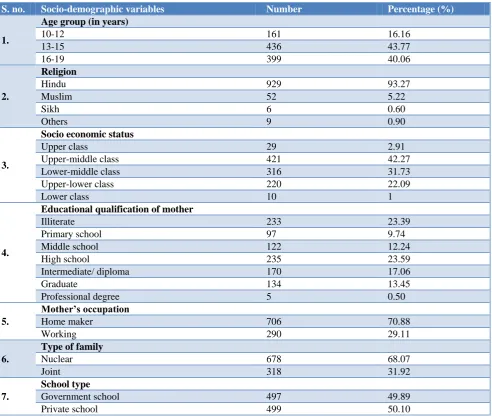
mother’s educated till high school followed by intermediate/diploma course in 17.06%. Participants whose mothers were graduates were 13.45%; less than one percent was having professional degree. 70.88% of girl’s mothers were homemakers (housewives) and 29.1% mothers were working. 68.07% participants were living in a nuclear family while 31.92% were living in joint family.
Table 2 depicts that the proportion with knowledge of menstruation before menarche is more in students of private school (87.57) than students of government
(73.84%) school and the difference is found to be significant (p<0.001).
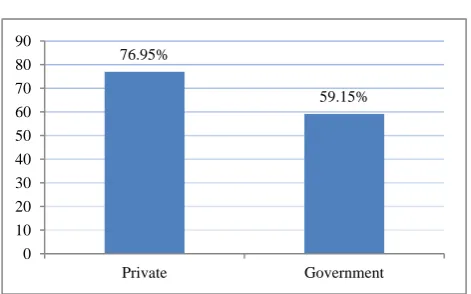
In the present study 71.94% of girls from private school had correct knowledge regarding the process of menstruation in contrast to the girls of government school where only 48.28% had correct knowledge (Table 3) and the difference was found to be significantly associated. More than three fourth of the participants(76.95%) from private school use sanitary pad while 59.15% participants from government school uses sanitary pad (Figure 1).
Table 1: Socio-demographic distribution of study population (n=996).
S. no. Socio-demographic variables Number Percentage (%)
1.
Age group (in years)
10-12 161 16.16
13-15 436 43.77
16-19 399 40.06
2.
Religion
Hindu 929 93.27
Muslim 52 5.22
Sikh 6 0.60
Others 9 0.90
3.
Socio economic status
Upper class 29 2.91
Upper-middle class 421 42.27
Lower-middle class 316 31.73
Upper-lower class 220 22.09
Lower class 10 1
4.
Educational qualification of mother
Illiterate 233 23.39
Primary school 97 9.74
Middle school 122 12.24
High school 235 23.59
Intermediate/ diploma 170 17.06
Graduate 134 13.45
Professional degree 5 0.50
5.
Mother’s occupation
Home maker 706 70.88
Working 290 29.11
6.
Type of family
Nuclear 678 68.07
Joint 318 31.92
7.
School type
Government school 497 49.89
Private school 499 50.10
Table 2: Difference in association of government and private schools with knowledge of menstruation before menarche.
School type
Did you had knowledge about menstruation before menarche
Chi square; P value
Yes (n=804) No (n=192) Total
(n=996)
N % N %
Private 437 87.57 62 12.42 499 29.298;
p<0.001
The difference between the participants correct practice of changing pad in government (25.35%) school was less than the private school (43.68%) and the difference was also found to be significant (Table 4).
The proportion of correct practice of cleaning genitalia during menstruation was found more in students of private school (31.26%) than in government schools (27.16%) but the difference is not significant (Table 5).
Table 3: Difference in association of government and private schools with knowledge of process of menstruation.
School type
What is menstruation?
Chi square; P value Correct knowledge*
(n=599)
Incorrect knowledge (n=397)
Total (n=996)
N % N % N %
Private 359 71.94 140 28.05 499 100 57.136;
p<0.001
Government 240 48.28 257 51.71 497 100
*Correct knowledge: normal process, source of bleeding is uterus.
Table 4: Difference in association of government and private schools with practice of changing pad during menstruation.
School type How frequently you change pad during menstruation? Chi square;
P value Correct practice*
(n=344)
Incorrect practice (n=652)
Total (n=996)
N % N % N %
Private 218 43.68 281 56.31 499 100 36.218;
p<0.001
Government 126 25.35 371 74.64 497 100
*Correct practice: to change pad every 4-5 hrs.
Table 5: Difference in association of government and private schools with practice of cleaning genitalia during menstruation.
School type
How many times do you clean your genital area during menstruation?
Chi square; P value Correct practice*
(n=291)
Incorrect practice (n=705)
Total (n=996)
N % N % N %
Private 156 31.26 343 68.73 499 100 1.830;
p=0.493
Government 135 27.16 362 72.83 497 100
*Correct practice: 2 or more than 2 times.
Figure 1: Usage of sanitary pad in government and private school.
DISCUSSION
A total of 996 adolescent girls between 10-19 years of age, 497 in a government and 499 in a private school were interviewed. Most of the participants (43.77%) were in age group 13-15 years. Mean age of participants was
found to be 15.13±1.63 years. Majority of participants were Hindu (93.27%). In the present study the proportion with knowledge of menstruation before menache is more in students of private school (87.57) than that of government (73.84%).
It is also concluded that 71.94%of girls from private school had correct knowledge regarding the process of menstruation in contrast to the girls of government school where only 48.28% had correct knowledge, this is also supported by the study done by Biruk et al who concluded that good knowledge about menstruation and menstrual hygiene were 7.01 times higher for those respondents from private school compared to the government ones.8 In contrast study done by Baisakhiet al in West Bengal conclude that only 21.07% girls believed menstruation as a physiological process.9 The difference may be due to difference in socio cultural characteristics.
More than three fourth of the participants (76.95%) from private school use sanitary pad while 59.15% participants 76.95%
59.15%
0 10 20 30 40 50 60 70 80 90
from government school uses sanitary pad which was supported by the study done by Manohar et al who concluded that 58.82% from the private school and 56 percent from the Government school were using disposable sanitary pads.10 In the present study the difference between the participants correct practice of frequency of changing pad in government (25.35%) and private school (43.68%) was also found to be significant. The proportion of correct practice of cleaning genitalia during menstruation was found more in students of private school (31.26%) than in government schools (27.16%) but the difference is not significant.
CONCLUSION
Knowledge and practice regarding menstruation was more better in private school girls as compared to those of government school. Significantly more number of girls in the private schools was using sanitary pads as compared to government school girls. Girls should be educated about the facts of menstruation, physiological implications, significance of menstruation, and proper hygienic practices during menstruation. It is also required to bring them out of traditional beliefs, taboos, misconceptions, and restrictions.
ACKNOWLEDGEMENTS
The authors sincerely thanks the staff of the schools involved in the study for their co-operation.
Funding: No funding sources Conflict of interest: None declared
Ethical approval: The study was approved by the Institutional Ethics Committee
REFERENCES
1. World Health Organization, “Programming for adolescent health and development,” WHO Technical Report Series No. 886. 1996; 2.
2. Thakre SB, Thakre SS, Reddy M, Rathi N, Pathak K, Ughade S. Menstrual hygiene: knowledge and practice among adolescent school girls of Saoner, Nagpur District. J Clin Diagnos Res. 2011;5(5):1027–33.
3. Nagar S, Aimol KR. Knowledge of Adolescent Girls Regarding Menstruation in Tribal Areas of Meghalaya. Studies Tribes Tribals. 2017;8(1):27– 30.
4. Oche MO, Umar AS, Gana GJ, Ango JT. Menstrual health: the unmet needs of adolescent girls in Sokoto, Nigeria. Sci Res Essays. 2012;7(3):410–8. 5. Resources on MHM; About Menstrual Hygiene
Day. Available at: http://www.menstrualhy gieneday.org/ about/about‑mhday/. Accessed on 30 October 2018.
6. Bott S, Jejeebhoy S, Shah I, Puri C. Towards adulthood: Exploring the sexual and reproductive health of adolescents in South Asia. Department of Reproductive Health and Research (RHR), World Health Organization (WHO); 2003: 3-28.
7. Srivastava D, Kumari C. Awareness and health seeking behavior of adolescent school girls on menstrual and reproductive health problems. Asian J Home Sci. 2011;6(2):150-3.
8. Biruk E, Tefera W, Tadesse N, Sisay A. Assessment of menstrual hygiene management and its determinants among adolescent girls: A cross-sectional study in school adolescent girls in Addis Ababa, Ethiopia. Available at: https://t.co/wa EskzAluk). Accessed on 8 October 2018.
9. Paria B, Bhattacharyya A, Das S. A Comparative Study on Menstrual Hygiene Among Urban and Rural Adolescent Girls of West Bengal. J Family Med Prim Care. 2014;3(4):413–7.
10. Sharma M, Johal KK, Malhotra V. To study the knowledge, attitude and practice regarding menstrual hygiene and restrictions imposed upon them during menstruation in Adolescent girls studying in a government and a private school in Sahibzada Ajit Singh Nagar (Mohali City) In Punjab; A comparison Pilot Study. IOSR J Dent Med Sci. 2017;16(8):30-7.
Cite this article as: Sharma N, Meena KK, Gaur K, Sharma D.A comparative study of knowledge and practice regarding menstrual hygiene among private and government schools of Jaipur city. Int J