Original Research Article
Morbidity profile and use of personal protective equipment amongst
traffic police of Mumbai
Rupali V. Sabale
1, Saurabh N. Tripathi
2, Gajanan D. Velhal
1*
INTRODUCTION
Currently 28% of population of India is living in urban area, and by the year 2020, 41% people of India will live in cities.1 Indian cities are thus growing rapidly. This has led to an increase ownership and use of motor vehicles. Traffic police play a very significant role in controlling traffic system especially in the metropolitan cities. Traffic police direct traffic or serve in traffic or roads policing unit enforcing rules of the road.
With the steady rise of vehicular traffic in the city, police manning the traffic are being exposed to all kinds of health hazards. The job of traffic police personnel is a tough job, which has a direct influence on their life. Study conducted by Prajapati et al on traffic police personnel, concludes that traffic police personnel suffer from respiratory problems, partial deafness, high blood pressure and gastric problems due to irregular food habits.2 Many of them who had job experience more than 3 to 6 years suffer from joint problems, GIT problems,
ABSTRACT
Background: Traffic police play a very significant role in controlling traffic system. The job of traffic police personnel is a tough job, which has a direct influence on their life. The aim of the present study was to assess prevalence of morbidities, use of personal protective equipment viz., mask, oxygen therapy and pressure stocking amongst Mumbai traffic police and study association of some job related factors with their present health profile. Methods: Record based study was conducted by analyzing 1959 health record forms filled by the traffic police of Mumbai. Frequency, percentages, Chi-square test and unpaired t test were calculated.
Results: The mean age of traffic police was 46.87±7.95 years. The duration of years in traffic branch ranged from 6 months to 18 years. Prevalence of stress, hypertension, diabetes mellitus, eye, skin, and ear morbidities were 26%, 20.9%, 14.2%, 10.2%, 3.6%, 3.3% respectively. In traffic police officers, prevalence of hypertension (28.3% v/s 19.8%), diabetes mellitus (23.6% v/s 12.8%), ear morbidities (5.5% v/s 2.9%) and stress (31.1% v/s 25.3%) were significantly high as compared to traffic policemen (p value <0.05). There was significant association of prevalence of respiratory morbidities, ear morbidities with current work placement (p value <0.05). There was significant relation of duration in police service and stress, eye morbidities, diabetes mellitus, hypertension and respiratory morbidities. Proportion of traffic police using mask, oxygen therapy and pressure stockings were 60.2%, 21.5% and 15.8% respectively.
Conclusions: Morbidities amongst traffic police is high. Use of personal protective equipment is very low. Worksite Prevention Program should be planned to reduce health problems amongst traffic police.
Keywords: Health profile, Morbidities, Traffic police, Personal protective equipment
1Department of Community Medicine, Seth G.S. Medical College and KEM Hospital, Parel, Mumbai, Maharashtra,
India
2Deputy Commissioner of Police (Traffic), Parel, Mumbai, Maharashtra, India
Received: 12 October 2019 Accepted: 16 November 2019
*Correspondence: Dr. Gajanan D. Velhal,
E-mail: [email protected]
Copyright: © the author(s), publisher and licensee Medip Academy. This is an open-access article distributed under the terms of the Creative Commons Attribution Non-Commercial License, which permits unrestricted non-commercial use, distribution, and reproduction in any medium, provided the original work is properly cited.
eye problems and respiratory problems. Most of them experience job stress. Prevalence of hypertension and obesity is also high. They are also habituated to tobacco consumption. Different morbidities that were detected by a study conducted by Satapathy et al were anaemia (43.75%), musculoskeletal disorders (27.08%), hypertension (25%), eosinophilia (18.75%), respiratory disorders (16.66%), gastrointestinal disorders (14.58%), diabetes (6.25%), dermatoses (6.25%), allergic conjunctivitis (6.25%) and varicose veins (4.16%).3
Occupational environmental plays a major role on the health of the exposed. The health hazards get more severe when the duration of the exposure increases. Besides being exposed to physical health hazards, traffic police are also frequently subjected to mental illness and anxiety. Rules are frequently broken by people and it becomes hectic and tiresome job for these personnel to maintain law and order. Hence they are likely to develop high blood pressure and anxiety syndromes.4
Study conducted by Chettri et al on traffic policemen, reveals that traffic policemen do not use adequate safety measures.7 Occupational health is essentially preventive medicine. Occupational health should aim at the promotion and maintenance of the highest degree of physical, mental and social wellbeing of workers in all occupations; the prevention among workers of departures from health caused by their working conditions; the protection of workers in their employment from risks resulting from factors adverse to health; the placing and maintenance of worker in an occupational environment adapted to his physiological and psychological equipment and to summarize, the adaptation of work to man and of each man to his job.5
One of the fundamental means of achieving the objectives of occupational health programmes is the early detection of health impairment.6 Early detection of health impairment could be through pre-placement examination or periodical examination. Pre-placement examination is the foundation of an efficient occupational health service. It is done at the time of employment. Periodical examination of workers is very necessary when they are exposed to occupational environment which can be hazardous. The frequency and content of periodical medical examination will depend upon the type of occupational exposure. Health education and counselling of the workers regarding use of personal protective measures are also essential for maintaining optimum health.
In Mumbai district, pre-placement examination of police is mandatory. Once they are in police force, they may get traffic police duty on rotation basis. Duration of traffic police duty may vary. Currently, there is no planned worksite prevention program for traffic police. Health record forms are filled by traffic police. Thus a record based study was planned to assess the health profile of traffic police of Mumbai. The objectives of the study
were to assess prevalence of morbidities, use of personal protective equipment viz., mask, oxygen therapy and pressure stocking amongst traffic police and study association of some job related factors with their present health profile. The findings will throw insight to current health status of traffic police of Mumbai. The study findings will help in planning the worksite preventive programs for the traffic police.
Mumbai and its traffic police
Mumbai is the financial and commercial capital of India. Mumbai’s population was around 12.44 million as per Census 2011. With the population, vehicular number is also increasing in the city. Total 33 lakh vehicles are registered in Mumbai. Around 500 to 700 vehicles are added daily. Most of the ridership population of Mumbai comprises of work and education based traffic in the morning and home based return trips in the evening.8
Mumbai’s concern regarding traffic control dates back to 1924 when the traffic department was created by the Police administration. The traffic control branch has now grown to strength of over 2,000. Mumbai is one of the most densely populated cities in the world. Despite various constraints, Mumbai Traffic Police is known all over the country for its scientific and efficient management of traffic.9
Traffic police work placement in Mumbai can be in any of the four zones viz., Headquarter, City, Eastern suburbs and Western suburbs. Hierarchy of police force in the traffic branch from junior level to senior most level is police constable, police nayak, head constable, assistant sub inspector, police sub inspector, assistant police inspector, police inspector, senior police inspector, Assistant Commissioner of Police and Deputy Commissioner of Police. There are two cadres of traffic personnel. Those with the designation from constable, police nayak and head constable are called as traffic policemen or policewomen. Those with designation from assistant sub inspector, police sub inspector, assistant police inspector, police inspector and senior police inspector are called as traffic police officers. Both traffic policemen or policewomen and traffic police officers once posted in the Traffic branch of Police Department, need to do field duty or on road duty. Traffic police officers’ job role is more of supervisory and administrative level with field duty as well.
METHODS
forms had incomplete information. Those incomplete forms were excluded for analysis purpose. Thus total 1959 forms were analysed. Study was conducted from February to May 2019.
Serial numbers were entered in the Microsoft Excel. Names were not entered. All the other data were coded. The Microsoft excel file was password protected. Password was shared amongst investigators only. Analysis of the record was done based on the study objectives. Descriptive statistics were presented by frequency and percentages. For inferential statistics, categorical variables analysed using Chi-square test and numerical variables analysed using unpaired t test.
Operational definitions
Since, this is a record based study, with self-administered forms, the morbidities were defined accordingly.
Hypertension and/or diabetes mellitus
Those who were currently on any medication for blood pressure control and/or blood sugar control respectively.
Stress
Any form of tension perceived by traffic police.
RESULTS
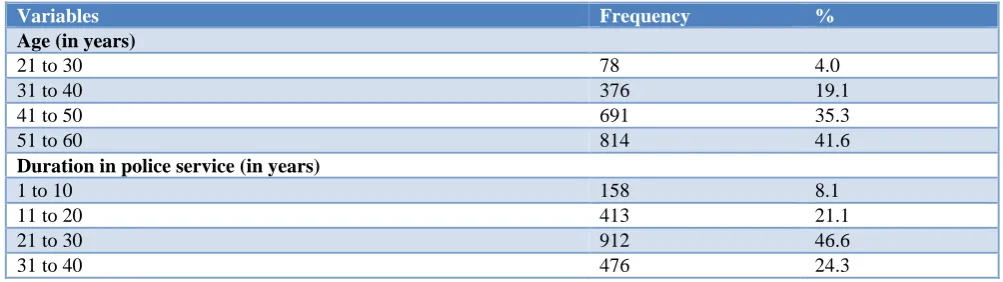
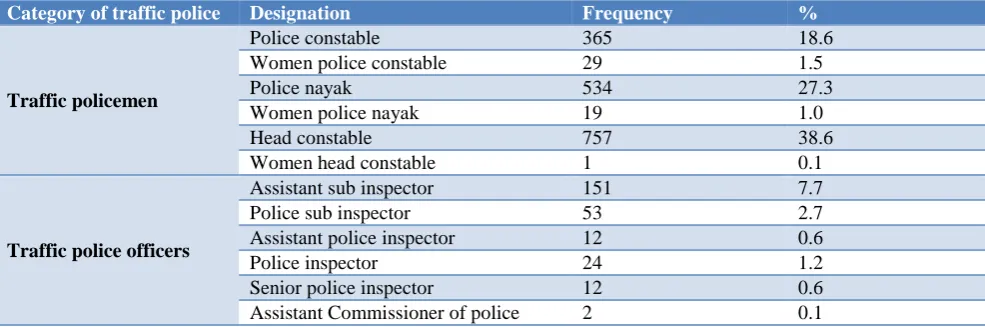
The mean age of traffic police was 46.87±7.95 years. The age range was from 21 years to 58 years. The mean duration in police service was 24±8 years. Around 46.6% were in police service for 21 to 30 years while almost 63% were in the traffic branch for 2 to 10 years. Almost 40% were posted in the city which is one of the work placement areas (Table 1). The duration of years in traffic branch ranged from 6 months to 18 years. Proportion of traffic policemen and traffic police officers were 87.03% and 12.97% respectively. There was significant difference in mean age of traffic policemen and traffic officers (45.77±7.840 years v/s 54.22±3.620 years). Distribution of traffic police based on their designation is shown in Table 2.
Point prevalence of illness was 27.3% amongst traffic police. Table 3 shows prevalence of various morbidities amongst traffic police. Dimness of vision was most common eye morbidity (8.52%). Other eye morbidities were burning sensation in eyes, cataract, dryness of eyes, glaucoma, pain in eyes and watering from eyes. Skin morbidities were acne, darkening of face, pigmentation on face, itching and psoriasis. Almost 3% of traffic police had hearing loss (61 out of 1959). Other ear problem was pain in ears. Most common cited reasons for stress were dispute with public while regulating traffic, long duty hours, heavy traffic and standing work.
In traffic police officers, prevalence of hypertension (28.3% v/s 19.8%), diabetes mellitus (23.6% v/s 12.8%), ear morbidities (5.5% v/s 2.9%) and stress (31.1% v/s 25.3%) were significantly high as compared to traffic policemen (p value<0.05).
There was significant association of prevalence of respiratory morbidities, ear morbidities with current work placement (p value <0.05). Out of 20 traffic police who suffered from respiratory morbidities 3, 5 and 12 were from city, eastern suburbs and western suburbs respectively. ‘None were from head-quarter workplace. Out of 64 traffic police who suffered from ear morbidities 36, 11, 3, and 14 were from city, eastern suburbs, head-quarters and western suburbs respectively.
There was significant relation of duration in police service and stress, eye morbidities, diabetes mellitus, hypertension and respiratory morbidities. As years of service increased prevalence increased, with maximum prevalence of stress, eye morbidities, diabetes mellitus and hypertension seen in those with 21 to 30 years of police service. Respiratory morbidities were higher in those with 31 to 40 years of police service.
Proportion of traffic police using mask, oxygen therapy and pressure stockings were 60.2%, 21.5% and 15.8% respectively. Mean duration of use this personal protective equipment is shown in Table 4.
Table 1: Age distribution and duration of service (n=1959).
Variables Frequency %
Age (in years)
21 to 30 78 4.0
31 to 40 376 19.1
41 to 50 691 35.3
51 to 60 814 41.6
Duration in police service (in years)
1 to 10 158 8.1
11 to 20 413 21.1
21 to 30 912 46.6
31 to 40 476 24.3
Variables Frequency %
Duration in traffic branch (in years)
≤1 718 36.7
2 to 10 1230 62.8
>10 10 0.5
Current work placement
City 782 39.9
Eastern suburb 529 27.0
Headquarter 39 2.0
Western suburb 609 31.1
Table 2: Distribution of traffic police based on designation (n=1959).
Category of traffic police Designation Frequency %
Traffic policemen
Police constable 365 18.6
Women police constable 29 1.5
Police nayak 534 27.3
Women police nayak 19 1.0
Head constable 757 38.6
Women head constable 1 0.1
Traffic police officers
Assistant sub inspector 151 7.7
Police sub inspector 53 2.7
Assistant police inspector 12 0.6
Police inspector 24 1.2
Senior police inspector 12 0.6 Assistant Commissioner of police 2 0.1
Table 3: Prevalence of various morbidities in traffic police (n=1959).
Morbidity Frequency %
Stress 510 26.0
Hypertension 409 20.9
Diabetes mellitus 279 14.2
Eye morbidities 199 10.2
Skin morbidities 70 3.6
Ear morbidities 64 3.3
Respiratory morbidity (breathlessness) 20 1.0
Table 4: Duration of use of personal protective equipment (in hours).
Personal protective equipment Mean SD Mode Median Min Max
Mask 2.66 1.78 1 2 0.5 10
Oxygen therapy 1 1.12 1 0.5 1 7
Pressure stocking 0.25 0.82 0 0 0 8
DISCUSSION
The present study is a record based study which focuses on the health profile and use of personal protective equipment amongst traffic police of Mumbai and factors influencing it. The result findings are largely dependent upon information given by the respondents since it was a self-administered form in a Marathi language.
Various studies have been conducted on traffic police in India and in other countries. However, it included only the traffic police constables or police officers, who are the
part of the traffic police personnel. There is paucity of information on entire traffic police. The results of the present study because of large sample size and inclusion of all those who are involved in traffic duty i.e., both traffic policemen and traffic police officers, resembles the true picture of traffic police.
In the present study, almost 3% of traffic police had hearing loss. This is similar to the study findings conducted by Tripati et al on self-reported hearing of traffic policemen.10 In their study, 2.3% of the subjects
Moreover, in this study, prevalence of ear morbidity (common being hearing loss) was higher in city area. Reason for the higher prevalence in these areas could be due to heavy workload in this workplace area. However, audiometry screening may detect more number of traffic police suffering from any hearing loss.
Prevalence of respiratory and eye morbidities was 1% and 10.2%. Bandopadhyay et al got a prevalence of respiratory and eye morbidity of 29.6% and 25% respectively.11 Even in their study, dimness of vision was most common eye problem. In our study, eye morbidities were associated with duration in police service. Eye problems are usually as a result of spending most of their time outdoors, including under the sun or in bad weather and over exposure to bright sunlight. In the present study, respiratory morbidity that was specifically asked was about breathlessness. Thus, 1% reflects only those suffering from breathlessness. There may be other respiratory morbidities that were not self-reported.
Prevalence of hypertension and diabetes mellitus were 20.9% and 14.2% respectively in Mumbai traffic police. In the study conducted by Satapathy et al in Brahmapur city, prevalence of hypertension and diabetes mellitus were 25% and 6.25% respectively.3 The prevalence of hypertension amongst various studies ranged from 17.9 to 25%.11 We found that, as years of police service increased, prevalence of hypertension and diabetes mellitus increased. Also, it was seen higher in traffic officers as compared to traffic policemen. The reason may be due to increase job responsibilities and accountability.
Prevalence of skin morbidity was 3.6%. In a study conducted by Mishra, 21% of policemen reported skin problems.12 Skin problems might be due to the long exposure to pollution, standing directly under the sun for long hours and might be due to the exposure to fume.
Prevalence of stress was 26%. Stress is the way human beings react both physically and mentally to changes, events, and situations in their lives. In this study, stress was defined as self-reported perceived feeling of tension. Stress was significantly associated with duration in police service. In essence, police stress is a complex phenomenon that has many different contributory factors. Police stress could be divided into different types as stress experienced due to the nature of police work (i.e., occupational stressors), and stress, which is the result of the nature of the police agency (i.e., organizational stressors).13 Current study did not assess the type of stress. Further studies can be conducted to assess the same.
Proportion of traffic police using mask was 60%. However, the use was very inadequate. On an average, they used only for 1 hour, whereas their duty hours is atleast for 8 hours. To prevent varicosity in legs, pressure stockings are provided to traffic police. However, only
16% used it. But amongst those, who used it, the duration of use of pressure stocking was very less. To prevent breathing problems, traffic police can avail oxygen therapy. However, even this facility was not fully utilized. Thus, it was observed that there is infrequent use of personal protective equipment amongst traffic police. Similar finding was observed by Dhakal et al. This may be due to lack of awareness about occupational hazards they are exposed to and their health consequences.14
Based on the result findings, to prevent health problems amongst traffic police, worksite prevention program can be planned. Routine periodical examination should be conducted for early detection of hypertension, diabetes mellitus, stress and other morbidities. Moreover, the frequency of periodicity should be more in traffic officers. Awareness drive on use of personal protective equipments should be conducted. Studies can be conducted to identify factors for not using mask, oxygen therapy and pressure stockings. Based on the findings, remedial measures can be undertaken.
CONCLUSION
Morbidities amongst traffic police are high. Use of personal protective equipment’s is very low. Worksite Prevention Program should be planned to reduce health problems amongst traffic police.
Funding: No funding sources Conflict of interest: None declared
Ethical approval: The study was approved by the Institutional Ethics Committee
REFERENCES
1. Srivstava K. Urbanisation and mental health. Ind Psychiatry J. 2009;18(2):75-6.
2. Prajapati P, Modi K, Rajul K, Shah A. A study related to effects of job experience on health of traffic Police Personnel of Ahmedabad City, Gujarat, India. Int J Interdisciplinar Multidisciplinar Stud. 2015:2(6):127-33.
3. Satapathy D, Behera T, Tripathy R. Health status of traffic police personnel in Brahmapur City. Indian J Community Med. 2009;34(1):71-72.
4. Neopane A. Occupational hazards for traffic police. 2012. Available from: Kathmandu Medical College Teaching Hospital. http://www.ekantipur.com/2012/ 03/12/related-articles/occupational-hazards//for-traffic/police-officer/350418.html. Accessed on 13th October 2019.
5. Park K. Textbook of Preventive and Social Medicine. 24th ed. Jabalpur, India: M/s Banarsidas Bhanot Publishers; 840.
7. Chettri B, Rodrigues DE. Knowledge on occupational hazards and utilization of safety measures among traffic police of south Kanara district, India. Am Int J Res Human Arts Social Sci. 2015;11(1):44-7.
8. Gajjar R, Mohandas D. Critical assessment of road capacities on urban roads– a Mumbai case-study. Transportation Research Procedia. 2016;17:685-92. 9. Mumbai Police. Available at: https://mumbaipolice.
maharashtra.gov.in/aboutus.asp. Accessed on 3 July 2019.
10. Tripati SR, Tiwari RR. Self-reported hearing of traffic policemen. Indian J Occupal Environ. 2006;10:82-4.
11. Bandopadhyay A, Bandopadhyay S, Lele P, Pati RN. Assessment of respiratory, eye and ear health
problems in traffic police. J Clin Diagnos Res. 2018;12(11):1-5.
12. Misra R. Occupational health hazards in traffic force. Intl J Res Innovat Social Sci. 2018;2(7). 13. Rajeswari B, Chalam GV. A review of literature on
stress in police personnel. IOSR J Business Manag. 2018;20(7):52-6.
14. Dhakal M, Shah RK, Sainju NK, Manandhar N. Health status of traffic police in Kathmandu Valley: findings from a cross-sectional study. Intl J Occup Saf Health. 2017;7(1):2-6.