S H O R T R E P O R T
Open Access
Leaks can dramatically decrease FiO2 on home
ventilators: a bench study
Philippe Goutorbe
*, Erwan Daranda, Yves Asencio, Pierre Esnault, Bertrand Prunet, Julien Bordes, Bruno Palmier
and Eric Meaudre
Abstract
Background:Long term oxygen therapy improves survival in hypoxemic patients with chronic obstructive pulmonary disease (COPD). Because pressure support ventilation with a home care ventilator is largely
unsupervised, there is considerable risk of leakage occurring, which could affect delivered FiO2. We have therefore conducted a bench study in order to measure the effect of different levels of O2supply and degrees of leakage on delivered FiO2. Ventilator tested: LegendairW(Airox™, Pau, France). Thirty-six measures were performed in each four ventilators with zero, 5 and 10 l.min-1 leakage and 1,2,4 and 8 l O2 flow.
Findings:FiO2decreased significantly with 5 l.min-1 leakage for all O2 flow rates, and with 10 l.min-1 at 4 and 8 l. min-1 O2.
Conclusion:During application of NIV on home ventilators, leakage can dramatically decrease inspired FiO2 making it less effective. It is important to know the FiO2 dispensed when NIV is used for COPD at home. We would encourage industry to develop methods for FiO2 regulation Chronic use of NIV for COPD with controlled FiO2 or SpO2 requires further studys.
Keywords:NIV, Leaks, Home ventilation, COPD, FiO2
Background
Long-term oxygen therapy (LTOT) improves survival in hypoxemic patients with chronic obstructive pulmonary disease (COPD) [1,2]. The minimum recommended duration of O2therapy is 15 hours per day. Non-invasive ventilation (NIV) is now recommended for acute on chronic COPD respiratory distress, whereas its chronic use is more controversial [3,4]. Nocturnal non-invasive ventilation (NIV) improves quality of life and blood gas status, with fewer intensive care admissions, although survival is not affected [5,6]. Most home care ventilators deliver pressure support via a turbine and a constant normobaric O2supply [7,8]. The O2source is liquid O2 or from extractors. We hypothesized that, whereas ICU ventilators deliver the set Fi02 (hyperbaric 02 witch permits variable O2 supply), with pressure support NIV, leakage around the mask could influence the received FiO2. Indeed leaks are well compensated by modern’s
home ventilators by delivering higher flows, using an additional volume taken from the room air. Under constant O2 supply FiO2 should decrease. We therefore analysed the variation of delivered FiO2 in pressure support ventilation with a home care ventilator under different levels of O2supply and leakage in a bench study.
Material and method
Experimental bench study
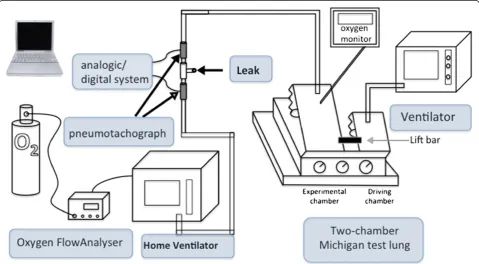
A LegendairW(Airox™, Pau, France) ventilator was set to give pressure support ventilation (PSV) with an expiratory pressure (PE) of 5 cmH2O and inspiratoty pressure (PI) of 15 cmH2O. A standard single circuit with valve was used to connect the ventilator with the test chamber. In place of the mask we used a ‘leaks valve’, which could allow 0, 5 or 10 l.min-1leakage. The level of leakage was calibrated during a continuous airway pressure 10 cmH2O, with two pneumotachographs one before and one after the valve (Fleisch 6V, Lausanne, Switzerland). Signals were digitized by an analogic/digital system (MP150, Biopac Systems, Goleta, CA) with modules (DA 100V 1000z, Biopac System). The O2 supply was
* Correspondence:[email protected]
Emergency, Anesthesia and ICU Departement, Military Teaching Hospital Sainte Anne, Boulevard Sainte Anne, Toulon 83000, France
set on the ventilator and flow was measured by a FlowAnalyser PF-300 (Imtmedical, Switzerland).
The test lung was the two-chamber Michigan test lung (Training/test lung-TTLW, adult infant lung simulator; Michigan Instrument™, Grand Rapids, MI), which has been described in detail in previous studies [9,10]; the infant lung was used as driving chamber and linked with the pressurized (test) chamber. The driving ventilator Puritan Bennet (PB) 840 (set in controlled ventilation) produces a negative pressure in the adult chamber, which is recognized as an inspiratory effort by the test ventilator. The characteristics of the test chamber were that of a parabolic airway resistor of 20-cmH2O l-1.s-1 (PneufloW Airway resistor; Michigan Instrument™, Grand Rapids, MI) and compliance was set at 60 ml/cmH2O. The respiratory rate of the driving ventilator was set to 15 per minute. The oxygen fraction in the test chamber was measured with a Puritan Bennet™ O2 Monitor 7820. We tested four flows of oxygen supply (1, 2, 4 and 8 liters/minute) and FiO2for each with a 0, 5 and 10 liter/ minute leak. The test chamber FiO2was noted three times for each condition (Figure 1).
The Kruskal-Walis test was used to compare all variables and the post hoc Steel test if significance was found. All data are presented as group median [25–75]. Statistical analysis was performed with JMP 9.3 (SAS Institute, Cary, NC). Statistical significance was defined asp< 0.05.
Findings
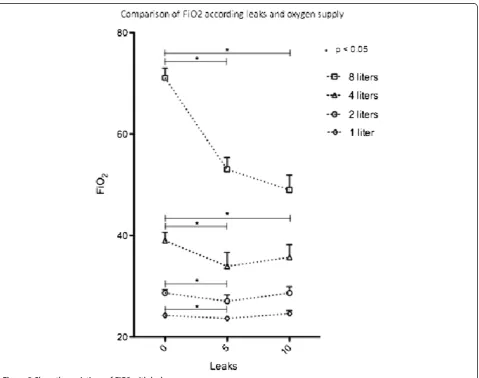
Four different ventilators were tested three times each, with 12 measurements of FiO2 for each condition of oxygen supply and leakage. Leakage significantly affected FiO2 for all O2 supply between no leak and 5 liters per minute of leaks. FiO2 decreased significantly with 10 liters per minute of leaks only for 4 and 8 liters O2 supply (Table 1 and Figure 2).
Discussion
The bench study confirms our hypothesis in six cases of eight; FiO2 decreases with all O2 flows with 5 liters per minute leaks and with 4 and 8 liters O2 supply with 10 liters per minute of leaks. We are not able to explain why in several conditions FiO2 increased with 10 liters per minute of leaks. We assume that it would be possible venturi effect with increased O2 flow but this one was continuously measured by a FlowAnalyser PF-300 (Imtmedical, Switzerland) and it was constant.
[image:2.595.58.538.449.713.2]The Nocturnal Oxygen Therapy Trial (NOTT) and the Medical Research Council study, using similar inclusion criteria, demonstrated the beneficial effects of LTOT on survival in subjects with COPD and severe resting hypoxemia. The median survival in those using O2 for 15 hours/day was approximately twice that of those receiving no O2 [1,2]. The use NIV in acute exacerbation of COPD is now recommended. Two RCTs of long term NIV for respiratory failure failed to demonstrate any effect
on mortality, although quality of life was improved and there were fewer hospital admissions. SPO2at home was not reported [5,6].
Although some studies show no improvement in mor-tality [5,6,11], the physiological basis for NIV is clear; it relaxes the inspiratory muscles. External PEEP should counteract intrinsic PEEP [12], and VA/Q ratios may be improved [13]. However, leakage caused by movement of the mask is common. Opening the mouth, and poor
[image:3.595.55.552.100.197.2]fit to the face associated with weight loss, leads to leakage, especially at night [14]. Fortunately, many home ventilators now have well-developed software to detect and compensate for leaks from room air, and can compensate for leakage of about 30 l.min-1[15]. Nevertheless, leaks can decrease the delivered FiO2 because the O2 supply is constant, as demonstrated here. NIV failure to improve surviving in chronic COPD may be due to this.
Table 1 Comparison of FiO2 according leakages and oxygen supply
Leakage (liters per minute)
0 5 10
n = 12 n = 12 n = 12
Oxygen supply
1 l/min 24.2 [23.7 - 24.4] 23.6 [23.2 - 23.9]* 25.1 [23.8 - 25.1]
2 l/min 28.6 [28.5 - 28.8] 27.0 [26.1 - 27.6]* 29.3 [27.4 - 29.6]
4 l/min 39.0 [38.0 - 40.0] 34.0 [33.0 - 34.6]† 36.6 [34.5 - 38.0]*
8 l/min 70.4 [67.5 - 71.9] 53.1 [51.2 - 54.0]† 49.5 [47.1 - 51.6]†
†p < 0.0001 ; * p < 0.05 compared to control group (no leakage).
[image:3.595.60.540.344.722.2]There are no studies of the delivered FiO2 in NIV, the value of which is increased by oxygen supplementation with home ventilators. Thys and Schwartz showed the influence of site oxygen delivery on FiO2 [16,17]. Although in several home ventilators using a liquid O2source or an O2extractor, FiO2can be monitored but it is not possible to set. Unfortunately regulation of FiO2with home ventila-tors is not yet available. Our study is the first to focus on the affect of leakage on FiO2during NIV with home ventilators, although such effects have been previously shown with ICU ventilators [18]. In several conditions FiO2can vary by up to 30%. With the O2 supply of 8 l. min-1we found a decrease in FiO2from 70 to 50% with a leakage of 10 l.min-1.
NIV offers an excellent treatment for chronic respira-tory insufficiency, but in the home there is no control of leaks or measurement of SPO2. In a recent meta-analyse Chen et al. point out that with an inspiratory positive airway pressure (IPAP) greater or equal than 14 cmH2O the PaO2 decreased [19]; increasing of leaks with high airway pressure should explain that. With increasing leakage, FiO2decreases, and hypoxemia ensues leading to an increase of minute respiratory intake which in turn results in aspirating room air; if the O2 supply is constant then FiO2decreases again leading a vicious circle of hypoxemia. This may explain the poor results of treating respiratory failure with NIV in the home.
The O2supply can be triggered by the patient’s SpO2or the ventilator FiO2. The former is more relevant clinically; the latter is more easily measured. The cost of measuring FiO2is about 1000 Euros; SpO2is less expensive but the measurement is subject to artefacts.
The design (bench test) limits the impact of the findings. On the over hand we underestimated the leaks, which could reach 30 liters per minute; the FiO2 decrease may be greater in clinical conditions.
We purpose to adjunct and O2 turbine witch should adjust O2 flow supply to a SpO2 objective.
New home NIV chronic use in COPD study’s should be conducted with this O2 flow control.
We propose to add a dedicated O2 turbine allowing automated O2 flow adjustment in order to achieve a predefined SpO2.
Thereafter, studies will be mandatory to evaluate effects of this automated O2 flow supply on COPD prognosis.
Conclusion
This lung model study demonstrates that during application of NIV on home ventilators, leakage can dramatically decrease FiO2 making it less effective. As consequence, it is essential to know the FiO2 dispensed during NIV at home. Further research should explore the role of the O2 flow control during application of NIV in chronic hypercapnic COPD patients.
We hope that industry can address the problems we have highlighted in this study.
Abbreviations
COPD:Chronicle obstructive pulmonary disease; FiO2: Inspired fraction of oxygen; IPAP: Inspiratory positive airway pressure; LTOT: Long term oxygen therapy; O2: Oxygen; NIV: Non invasive ventilation; NOTT: Nocturnal Oxygen Therapy Trial; PEEP: Positive end expiratory pressure; VA/Q: Ratio: ventilation perfusion ratio.
Competing interest
The authors declare no competing interest.
Authors’contributions
GP drove the research and write the article, AY made the statistical analysis; and all the authors contributed to measurements. All authors read and approved the final manuscript.
Received: 6 May 2013 Accepted: 18 July 2013 Published: 21 July 2013
References
1. Continuous or Nocturnal Oxygen Therapy in Hypoxemic Chronic Obstructive Lung Disease [Internet] annals.org.; 2012. 2012 [cited 2012 Feb 8]. Available from: http://www.annals.org/content/93/3/391.abstract?sid=79927bd3-e7f2-4273-baab-19b98e3d4991.
2. Council M:Long term domiciliary oxygen therapy in chronic hypoxic cor pulmonale complicating chronic bronchitis and emphysema: Report of the Medical Research Council Working Party.Lancet1981,
1(8222):681–686.
3. Rossi A:Noninvasive ventilation has not been shown to be ineffective in stable COPD.Am J Respir Crit Care Med2000,161(3 Pt 1):688–689. 4. Hill NS:Noninvasive ventilation has been shown to be ineffective in
stable COPD.Am J Respir Crit Care Med2000,161(3):689–691.
5. Casanova C, Celli BR, Tost L, Soriano E, Abreu J, Velasco V,et al:Long-term controlled trial of nocturnal nasal positive pressure ventilation in patients with severe COPD.Chest2000,118(6):1582–1590.
6. Clini E, Sturani C, Rossi A, Viaggi S, Corrado A, Donner CF, Ambrosino N, Rehabilitation and Chronic Care Study Group, Italian Association of Hospital Pulmonologists (AIPO):The italian multicentre study on noninvasive ventilation in chronic obstructive pulmonary diseases patients.Eur Respir J2002,20(3):529–38. Erratum in: Eur Respir J. 2002 Dec;20(6):1617. 7. Cuvelier A, Molano LC, Muir JF:Domiciliary ventilation in patients with
COPD.Rev Mal Respir2005,22(4):615–33.
8. Lloyd-Owen SJ, Donaldson GC, Ambrosino N, Escarabill J, Farre R, Fauroux B,
et al:Patterns of home mechanical ventilation use in Europe: results from the Eurovent survey.Eur Respir J2005,25(6):1025–1031. 9. Tassaux D, Strasser S, Fonseca S, Dalmas E, Jolliet P:Comparative bench
study of triggering, pressurization, and cycling between the home ventilator VPAP II and three ICU ventilators.Intensive Care Med2002,
28(9):1254–1261.
10. Richard J-C, Carlucci A, Breton L, Langlais N, Jaber S, Maggiore S,et al:
Bench testing of pressure support ventilation with three different generations of ventilators.Intensive Care Med2002,28(8):1049–1057. 11. Kolodziej MA, Jensen L, Rowe B, Sin D:Systematic review of noninvasive
positive pressure ventilation in severe stable COPD.Eur Respir J2007,
30(2):293–306.
12. Diaz O, Begin P, Torrealba B, Jover E, Lisboa C:Effects of noninvasive ventilation on lung hyperinflation in stable hypercapnic COPD.Eur Respir J Eur Respiratory Soc2002,20(6):1490–1498.
13. Robert D, Argaud L:Clinical review: long-term noninvasive ventilation. Crit Care2007,11(2):210.
14. Mehta S, Hill NS:Noninvasive ventilation.Am J Respir Crit Care Med Am Thoracic Soc2001,163(2):540.
15. Battisti A:Performance Characteristics of 10 Home Mechanical Ventilators in Pressure-Support Mode: A Comparative Bench Study.Chest2005,
27(5):1784–1792.
17. Thys F, Liistro G, Dozin O, Marion E, Rodenstein DO:Determinants of Fi, O2 with oxygen supplementation during noninvasive two-level positive pressure ventilation.Eur Respir J2002,19(4):653–657.
18. Miyoshi E:Effects of Gas Leak on Triggering Function, Humidification, and Inspiratory Oxygen Fraction During Noninvasive Positive Airway Pressure Ventilation.Chest2005,128(5):3691–3698.
19. Chen H, Liang B-M, Xu Z-B, Tang Y-J, Wang K, Xiao J,et al:Long-term non-invasive positive pressure ventilation in severe stable chronic obstructive pulmonary disease: a meta-analysis.Chin Med J2011,124(23):4063–4070.
doi:10.1186/1756-0500-6-282
Cite this article as:Goutorbeet al.:Leaks can dramatically decrease FiO2 on home ventilators: a bench study.BMC Research Notes20136:282.
Submit your next manuscript to BioMed Central and take full advantage of:
• Convenient online submission
• Thorough peer review
• No space constraints or color figure charges
• Immediate publication on acceptance
• Inclusion in PubMed, CAS, Scopus and Google Scholar
• Research which is freely available for redistribution