Original Research Article
Study on oral smokeless tobacco use among migrant labourers and
their attitude towards tobacco cessation in an urban settlement
in Ernakulam district of Kerala
Anjana Rameshan
1, Leyanna Susan George
2*, Devraj Ramakrishnan
2, Anu Vasudevan
3INTRODUCTION
Tobacco is the causative agent for a number of chronic diseases, cancers of oral cavity and cardiovascular problems. Tobacco can either be smoked in the form of ‘Beedi’, cigars, cigarettes, ‘hookah’, pipe smoking and so on or used in the smokeless form as chewing ‘pan’, ‘gutka’, snuffs, rolls, etc. WHO has named it as world’s single greatest preventable cause of death.1 Consumers of tobacco loose around 15 years of their life according to
statistics. Most of these deaths are in middle and low-income nations, accounting for almost 80 percent of all tobacco related deaths. India is the third largest tobacco producer and second largest consumer of tobacco worldwide. Mortality due to tobacco use in India is estimated at upwards of 1.3 million.2
Under the leadership of the World Health Organization (WHO), a Global Tobacco Surveillance System (GTSS) was established to assist all 192 WHO Member States in
ABSTRACT
Background: Interstate migrant workers in the state of Kerala are increasing day by day. Tobacco usage is quite common among them; however, there are only few studies about oral smokeless tobacco consumption among them. The objectives of the study were to study the prevalence of oral smokeless tobacco use among migrant labourers in an urban settlement in Ernakulam district of Kerala and to assess the knowledge and attitude of users towards cessation.
Methods: A cross sectional study was conducted among 140 migrant workers residing in an urban settlement in Kochi. Data regarding their socio demographic characteristics, knowledge, attitude and practices of smokeless tobacco consumption was collected using a questionnaire adapted from the global adult tobacco survey questionnaire (GATS). Data was entered into excel sheet and was analyzed using Epi Info.
Results: The prevalence of oral smokeless tobacco was found to be 32.85%. Of which, majority of them used a tobacco-lime mixture called Khani (50%) and used tobacco on a daily basis (65.2%). It was observed that 71.74% of the users were unaware of the ill effects of the use of smokeless tobacco and 69.57% of them were not interested in quitting this habit. Among those who had quit, majority of them had done it on their will power alone.
Conclusions: The use of smokeless tobacco is quite prevalent among the migrant population. Effective behavioural change communication activities need to be directed towards them.
Keywords: Oral smokeless tobacco, Migrant labourers, Tobacco cessation, Urban settlement
1
Amrita Institute of Medical Sciences, Amrita Vishwa Vidyapeetham, Kochi, Kerala, India
2
Department of Community Medicine, 3Department of Biostatistics, Amrita Institute of Medical Sciences, Amrita Vishwa Vidyapeetham, Kochi, Kerala, India
Received: 24 February 2019
Revised: 04 April 2019
Accepted: 05 April 2019
*Correspondence:
Dr. Leyanna Susan George,
E-mail: [email protected]
Copyright: © the author(s), publisher and licensee Medip Academy. This is an open-access article distributed under the terms of the Creative Commons Attribution Non-Commercial License, which permits unrestricted non-commercial use, distribution, and reproduction in any medium, provided the original work is properly cited.
collecting data on youth and adult tobacco use. The Global Adult Tobacco Survey (GATS) is the global standard for systematically monitoring tobacco use (smoking and smokeless) and keeping track of all key tobacco control indicators.2,3 It monitors tobacco use among adults aged 15 or above. Due to increased awareness, there has been monitoring use of smoking tobacco products like cigarettes. However, there is a deficit in the available data on use of oral smokeless tobacco products like ‘pan’ which are equally deadly in the long run. An effort to find out the burden of smokeless tobacco use and coming up with suitable interventions is extremely important.
Over the years there has been a tremendous increase in the number of migrant labourers in Kerala, who leave their families behind in search for a better living. They work at construction sites, fields, factories and various other places and are often engaged in manual work. Kerala has approximately 4 million migrant labourers,
who are mostly from the states of West
Bengal, Bihar, Assam, Uttar Pradesh, and Orissa. They reside in makeshift settlements near their places of work which are mostly substandard and overcrowded.4,5 Most of them migrate at a very young age and due to various factors such as freedom, loneliness, stress, peer pressure and lack of knowledge they fall prey to the use of various addictive substances such as tobacco and alcohol.6 Tobacco usage is quite common among the migrants since it contains nicotine an alkaloid which is a potent stimulant. It can be used as either smoked or in smokeless form.7,8 Many tobacco control interventions have been carried out in the state of Kerala for reducing the tobacco usage among the general population. However, there is hardly any data regarding the impact of these interventions on the migrants who are increasing daily in Kerala. Therefore, there is a need to obtain data regarding the current prevalence of smokeless tobacco use among the migrants and their attitude towards cessation exists. This information would enable the decision makers to implement more specific and effective measures for controlling tobacco usage among the migrants.
Hence, this study aimed to estimate the prevalence of oral smokeless tobacco use among migrants in an urban settlement in Ernakulam district of Kerala. Also, to assess the attitude of users of smokeless tobacco towards tobacco cessation and to determine the socio-demographic factors associated with smokeless tobacco use and their attitude towards cessation.
METHODS
A cross sectional study was carried among 140 migrant labourers employed inside the campus of a tertiary health care center located in an urban area of Ernakulam. The study proposal was reviewed and approved by the Amrita institutional ethical committee order number IEC-AMS-2017-MBBS-345. Migrant workers who could converse in Hindi and were willing to participate were included in
the study after obtaining informed verbal consent. The study was conducted at the temporary migrant camps that were situated in Edapally an urban area in Ernakulam district just outside the campus of the Amrita Institute of Medical Sciences. The duration of the study was six months from March 2018 to August 2018. Migrants who did not understand or speak Hindi and were not willing to participate were excluded from the study. The data was collected by using a questionnaire adapted from the Global Adult Tobacco Survey questionnaire (GATS) prepared by the World Health Organization (WHO).3 The questionnaire was translated into Hindi and the data was collected by personally interviewing them. The questionnaire had three parts - Socio-demographic profile & their awareness regarding tobacco usage for all participants, Questionnaire for current users of smokeless tobacco: Pattern of usage and their attitude towards cessation, and the third part of the Questionnaire was for former users of smokeless tobacco.
The initial part of the questionnaire was aimed at collecting the socio-demographic details such as religion, current occupation, socio-economic status, educational qualifications, marital status etc and their awareness regarding tobacco usage. The next sets of questions aimed at getting data regarding the patterns of tobacco consumption and their attitude towards quitting tobacco. If the participant answered that he did not use tobacco currently and had never used any tobacco product in the past, he was classified as a non tobacco user and no more questions were asked. The rest of the participants were then further classified into current tobacco users and former tobacco users based on their current usage. The sample size was calculated based on the study conducted by Aslesh et alin North Kerala where the prevalence of tobacco users among the migrants were found to 71.7%.7 With 95% confidence and 20% allowable error, the minimum sample size was calculated to be 140 by using standard formula. The data collected was tabulated using MS Excel and analyzed using EpiInfo 7.
RESULTS
Sociodemographic characteristics
BPL while 16.4% claimed to not have a card or not knowing the details. Most of the participants reported that they visited their native place at least once a year. Data regarding this is depicted in Table 1.
Table 1: Distribution of participants based on sociodemographic characteristics.
Socio demographic
characteristics Frequency
Percentage (%)
Age group (in years)
15-24 70 50
25-44 50 35.7
45-64 18 12.85
65+ 2 1.42
Sex
Male 137 97.9
Female 3 2.1
State of origin
Madhya Pradesh 1 0.7
Orissa 138 98.6
Uttar Pradesh 1 0.7
Place of residence
Rural 134 95.7
Urban 6 4.3
Education
No formal schooling 50 35.7
Less than primary school
completed 3 2.1
Primary school completed 15 10.7
Less than secondary
school completed 9 6.4
Secondary school
completed 43 30.7
High school completed 20 14.3
Socio-economic status
BPL 87 62.1
APL 30 21.4
Status unknown 23 16.4
Marital status
Married 71 50.7
Unmarried 66 47.1
Widowed 3 2.1
Patterns of smokeless tobacco use
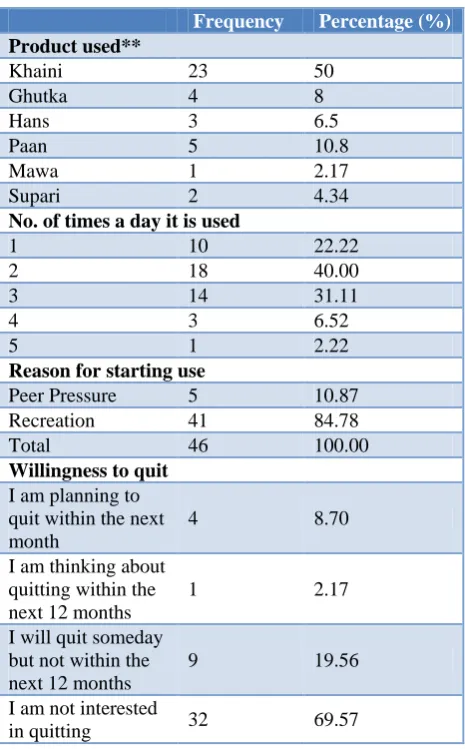
Out of the total 140 participants, 42.85% have used tobacco at some point of their life. Out of these people, 23.33% have successfully quit and the rest 76.66% continue to use it currently. Current smokeless tobacco users are 32.85% and past users of smokeless tobacco are 10% of our total participants. Among the adults who use smokeless tobacco currently, 65.2% use smokeless tobacco on a daily basis, and the remaining 34.7% use it occasionally.
About 30% stated that somebody in the family uses Smokeless tobacco back home. In most cases it was the father using tobacco products. Past or current use of smokeless tobacco increases with age, from 25.7% percent among younger population aged 15-24 to more than half among adults with more people in the older age groups likely to have tried smokeless tobacco at some point of their life.
The mean age of initiation of use of smokeless tobacco is 22.88 years. 21% of users of smokeless tobacco started using tobacco on a daily basis by the age of 15. 38.33% of participants started use of smokeless tobacco before the age of 18, i.e., when they were minors.
Among current users, average duration of use is 6.49 years with 43.47% had starting the habit before migration from their state of origin and the rest starting it after coming here.
Table 2: Patterns of use and willingness to quit among current tobacco users.
Frequency Percentage (%)
Product used**
Khaini 23 50
Ghutka 4 8
Hans 3 6.5
Paan 5 10.8
Mawa 1 2.17
Supari 2 4.34
No. of times a day it is used
1 10 22.22
2 18 40.00
3 14 31.11
4 3 6.52
5 1 2.22
Reason for starting use
Peer Pressure 5 10.87
Recreation 41 84.78
Total 46 100.00
Willingness to quit
I am planning to quit within the next month
4 8.70
I am thinking about quitting within the next 12 months
1 2.17
I will quit someday but not within the next 12 months
9 19.56
I am not interested
in quitting 32 69.57
are used by a small proportion of adults as shown in Table 2. The same person could use more than one product. A few people did not mention their preference.
Majority users need to consume smokeless tobacco at least 2 or more times a day with most consuming it within the first hour of waking up. Many claim that the product actually helps to go to the bathroom in the morning and that they would get indigestion or constipation if they don’t take it regularly. A large number (84.78%) of current users started off using the product as a method of recreation.
30.4% current smokeless tobacco users attempted to quit with majority of them attempting to quit in the past few months and not using any special methods and trying to control based on their willpower. Majority of the people are unwilling to quit the habit with only very few actually contemplating to quitting.
26% of current smokeless tobacco users visited a healthcare provider within the 12 months preceding the survey. Among those who visited, only 50 percent had been asked whether they were users of smokeless tobacco. However, among those who were asked, about all were advised to quit.
Among former smokeless tobacco users, majority of successful quitters, 13 out of 14 participants, have managed it on their will power. There was only one person who seeked medical help.
Awareness about harmful effects of tobacco
Table 3: Awareness about harmful effects of tobacco among participants.
Knowledge Frequency Percentage
(%)
Views among participants on if smoking tobacco cause serious illness
Yes 75 53.57
No 25 17.86
Don’t know 40 28.57
Total 140 100
Views among participants on if using smokeless tobacco cause serious illness
Yes 54 38.57
No 47 33.57
Don’t know 39 27.86
Total 140 100
There is lack of awareness about the ill effects of tobacco products among then. Around 50% of total participants know that smoking tobacco is harmful but only 38.57% think that the smokeless form is harmful as shown in Table 3. This gap is a major point that must be focused on. Among the people who currently use smokeless tobacco products, 71.74% are not aware of its harmful
effects. This calls for use of better education strategies that to induce effective behavioral change.
DISCUSSION
According to GATS 2 India, 2016-17,2 the state of Kerala has 5.4% of total population and 7.4% men using smokeless tobacco. Among the migrants, current smokeless tobacco users are 32.85%. There is a huge difference between percentage of smokeless tobacco users between the natives and migrants. According to GATS report, the state of Orissa has 42.9% of total population and 52.1% among men using smokeless tobacco and is higher but comparable to the prevalence we got among the migrants.2 The sample taken here is small compared to the samples taken for GATS 2 India, 2016-17.2 Majority of the participants (97.9%) were males. There were only 3 females among the participants which could be due to the fact that there are very few female migrant laborers employed within the campus. Also the magnitude of problem could be larger than the result of the study due to sections of people being not ready to admit the fact that they use the certain products especially since Kerala is one of the few states to ban sale of tobacco.9
A study by Aslesh et al in Northern Kerala gave the prevalence of smokeless tobacco uses to be 71.7%among migrants.7 A recent 2017 study by Ali et al showed prevalence of smokeless tobacco to be as high as 73% in Cochin area construction workers.8 This is much larger than the prevalence that we got here and could be due to various factors. The setting under which the study was conducted is a hospital campus with a lot of restrictions on tobacco usage and this might have influenced the outcome of our study. The prevalence outside in other unorganized sectors could be higher. This higher rate could be due to them being a more vulnerable group compared to those who work in an organized and monitored place like a hospital campus with more regulations. Also there could be differences due to the State representation and could be probably due to the pattern in which they are recruited for work by contractors with lot of people among the participants
being recruited together and having similar
characteristics. This study had almost everybody hailing from Orissa. Other areas could be having different representation from other States as we see in the study by Aslesh et al which has majority of the participants (86.6%) from the states of UP and Bihar.5
Socioeconomic characteristics of the participants seem to be similar in many aspects. Majority are of the same socio demographical background- males from rural areas of Orissa with none of them studying beyond 12th class. Most of them are also below poverty line families and have to support families back home which they visit at least once a year.
Talking of the patterns of tobacco use, most people in the study consume Khaini. This is similar with the GATS results2 where Khaini is the most popular product in the country. According to GATs, Khaini is not very popular in the state of Kerala where only 0.7% population uses it. But in the state of Orissa from where most of them hail from has Khaini as the most popular among users. Majority started it off as a method for recreation. One thing that was noted that majority took it for the first time in the morning within 1 hour of waking up and consumed it at least twice or more times a day. Many claim that the product actually helps to go to the bathroom in the morning and that they would indigestion or constipation if they don’t take it regularly.
Also it was noticed that there is a lack of proper programs for cessation among them. Almost everyone who tried to quit tried it on their on will power with no medical support or counseling.
Also this is pretty alarming that majority of the people are unwilling to quit the habit with only very few actually contemplating to quitting. This won’t be surprising as majority don’t seem to know the ill effects of tobacco with 56.52% of people who use smokeless tobacco claiming to believe that it has no effect on health at all and 15.22% claiming that they don’t know and have no idea about it.
CONCLUSION
Controlling tobacco usage is a major concern due to its potential to cause various chronic diseases and cancers. Migrants often fail to benefit from various health promotion programs by the state and their health issues are often neglected. There is a need to address the issue as they form a significant population of the state. The data generated from this survey would help concerned authorities know about various trends in tobacco use among migrants. This would help to evaluate conditions and take more specific steps (Education, behavior change communication, policies, etc.) outreach of existing cessation support programmes need to be expanded and further strengthened. This would help to increase their health standards.
Funding: No funding sources Conflict of interest: None declared
Ethical approval: The study was approved by the Institutional Ethics Committee (order number IEC-AMS-2017-MBBS-345)
REFERENCES
1. WHO. Report on the Global Tobacco Epidemic.
The MPOWER Package.2008. Available at: https://www.who.int/tobacco/mpower/2008/en. Accessed on 23 September 2017.
2. Tata Institute of social Sciences (TISS), Mumbai and Ministry of Health and Family Welfare, Government of India. Global Adult Tobacco Survey GATS 2 India 2016-17. Available at: http://www. tiss.edu/view/6/mumbai-campus/school-of-health- systems-studies/global-adult-tobacco-survey-2-india-2016-17/outcomespublications-3. Accessed on 20 October 2018.
3. Global Adult Tobacco Survey Collaborative Group.
Global Adult Tobacco Survey (GATS): Core Questionnaire with Optional Questions, Version 2.0. Atlanta, GA: Centers for Disease Control and Prevention, 2010. Available at: https://www.who. int/tobacco/surveillance/en_tfi_gats_corequestionnai rewithoptionalquestions_v2_FINAL_03Nov2010.pd f. Accessed on 23rd September 2017
4. Saikia D. Economic Conditions of the Migrant
Workers in Kerala: A Study in the Trivandrum District. J Indian Res. 2014;2:33-46.
5. Saraswathy S. Problems of Migrant Labourers in Perumbavoor. Intl J Res Soc Sci. 2017;7:83-91.
6. Kumar AN. Vulnerability of migrants and
responsiveness of the state: The case of unskilled migrant workers in Kerala, India. Working Paper No. 26, November 2011.
7. Aslesh OP, Paul S, Paul L, Jayasree AK. High Prevalence of Tobacco Use and Associated Oral Mucosal Lesion Among Interstate Male Migrant Workers in Urban Kerala, India. Iranian J Cancer Prev. 2015;8(6):e3876.
8. Mishra A, Sharma D, Tripathi G, Adhikari P,
Kabirpanthi V, Kumar M. Pattern and prevalence of tobacco use and associated oral mucosal lesions: a hospital based cross sectional study at a tertiary care hospital in central India. Int J Res Med Sci. 2015;2169–73.
9. Arora M, Madhu R. Banning smokeless tobacco in
India: Policy analysis. Indian J Cancer.
2012;49:336-41.
Cite this article as: Rameshan A, George LS,
Ramakrishnan D, Vasudevan A.Study on oral