Original Research Article
Study on practice of physical activity among medical interns in a
private medical college hospital in Chennai
Ramkumar Boopathirajan
1*, Aswathy Raveendran
1, Pavithra Ayyalusamy
2INTRODUCTION
As defined by WHO, physical activity is any bodily movement produced by skeletal muscles that requires energy expenditure. These activities include travelling, recreational activities, household activities, playing, working, etc. Globally, insufficient physical activity is one of the major risk factor for death and it is considered as fourth leading cause of mortality, which contributes to approximately 3.2 million deaths each year.1-3
The risk for chronic and non-communicable disease increases with insufficient physical activity. There is increased risk for developing type II diabetes mellitus, hypertension, carcinoma and mental health issues.4 And also, insufficient physical activity can be compared with tobacco, alcohol consumption and obesity as a cause of reduced life expectancy.1 Various studies done earlier state that approximately 21-25% breast and colon carcinomas, 27% of diabetes and 30% of ischemic heart disease burden is caused by insufficient physical actvity. 5-7
ABSTRACT
Background: Physical inactivity is one of the leading risk factors for death worldwide. It is a key risk factor for non-communicable diseases (NCDs) such as cardiovascular diseases, cancer and diabetes. Physical activity has significant health benefits and contributes to prevent NCDs. Globally, 1 in 4 adults are not active enough. More than 80% of the world's adolescent population is insufficiently physically active. So the aim of this study is to assess the practice of physical activity among the medical interns, as they are the future doctors.
Methods: A cross sectional study was conducted among 124 medical interns. A pre-tested, semi-structured questionnaire was used to collect the data. Microsoft Excel 2010 spread sheet version 14.1.3 and statistical package for social sciences (SPSS) version 21 were used for data entry and analysis. The results are expressed as percentages and proportions.
Results: In our study majority of the interns 66 (64.1%) had normal body mass index (BMI). The practice of non-exercise physical activity is more in female than male interns whereas the non-exercise physical activity is more in males comparing to female interns.
Conclusions: Physical inactivity is an urgent public health priority, so long-term follow-up is needed to identify the factors promoting for the practice of physical activity among medical interns.
Keywords: Physical activity, Medical interns, Healthy lifestyles 1
Department of Community Medicine, SRM Medical College Hospital & Research Centre, Kattankulathur, Chennai,
Tamilnadu, India 2
Department of Radio Diagnosis, Shri Sathya Sai Medical College & Research Institute, Ammapettai, Kanchipuram District, Tamil Nadu, India
Received: 01 April 2019 Revised: 18 April 2019 Accepted: 20 April 2019
*Correspondence:
Dr. Ramkumar Boopathirajan, E-mail: [email protected]
Copyright: © the author(s), publisher and licensee Medip Academy. This is an open-access article distributed under the terms of the Creative Commons Attribution Non-Commercial License, which permits unrestricted non-commercial use, distribution, and reproduction in any medium, provided the original work is properly cited.
According to WHO statistics, 23% of adults more than 18 years of age and 81% of adolescents in the age group of 11-17 years were insufficiently active.8,9 As the physical inactivity increases non communicable disease burden of the community, WHO has set up a global target of 10% relative reduction in the prevalence of insufficient physical activity by the year 2025.8
Currently, there is recommendation of engaging in minimum 150 minutes of moderate intensity aerobic activity or 75 minutes of vigorous intensity physical activity per week for adults to improve cardio respiratory and muscle fitness.10
Insufficient physical activity and sedentary life style habits have negative impact on overall health status of a population.11,12 Particularly among university going students it is a common and noteworthy issue.13,14
Among the college going students, it will be assumed that medical students have greater knowledge about the benefits of healthy life style practices, dietary habits and the risks associated with physical inactivity and sedentary lifestyle. But physical inactivity is also common among medical students. The reasons being lack of time due to workload, academic activities and laziness. Also, usage of gadgets like smartphones and computers reduces the quality time which results in physical inactivity.13 So the future doctors should be physically active themselves to promote physical activity and to educate the population about the risks associated with physical inactivity.15,16 The aim of this study is to assess the practice of physical activity among medical interns.
METHODS
This is a cross sectional study which was conducted among medical interns in SRM medical college, Kattankulathur, Chennai. This college was established before 15 years and it actively promotes physical activity among the students by infrastructural development, providing indoor, outdoor play ground, gym, swimming pool and regularly organises inter-college and intra-college sports events.
The study was conducted from March 2018 to February 2019 with the sample size of 124. Medical interns who passed their final MBBS university examinations in February 2018 and interns who were willing to participate were included the study. Interns who did not give their oral consent were excluded from this study. A
pre-tested, semi-structured questionnaire was
administered to the interns who were posted in the department of Community Medicine and data was obtained. On the first day of their posting along with the orientation, the purpose of this study was clearly explained to the participants. The participant’s informed oral consent was obtained before administering the questionnaire and collected back after 30 minutes. Out of 124 responses, only 103 responses were complete and
adequate. Rest of the 21 responses were inadequate hence they were excluded from this study. The questionnaire included demographic details, details about physical activity, height and weight. Body mass index (BMI) was calculated using the formula weight in kilograms/height in meter square. Data was entered into Microsoft Excel 2010 spread sheet version 14.1.3 and analysed using Statistical Package for Social Sciences (SPSS) version 21.0. Descriptive statistics were reported as frequencies (percentage) for demographic data. A Chi-Square test of significance was used for analysis of categorical variables. P value <0.005 were considered significant.
RESULTS
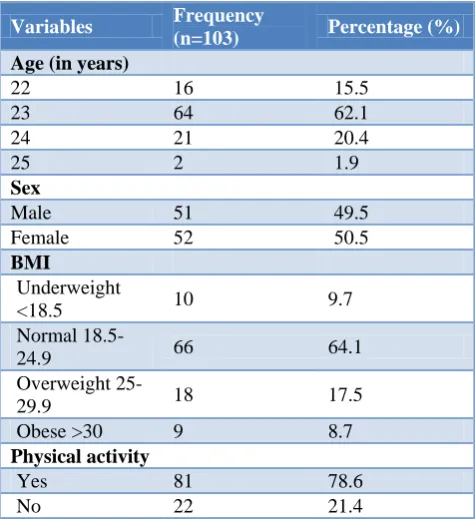
In our study population, 64 (62.1%) interns were aged 23 years, 21 (20.4%) were aged 24 years, 16 (15.5%) were aged 22 years and 2 (1.9%) were aged 25 years. The minimum age was 22 years and the maximum age was 25 years. The mean age was 23.09. There were 51 (49.5%) male interns and 52 (50.5%) female interns. Out of 103 interns, 66 (64.1%) had normal body mass index (BMI), 18 (17.5%) were overweight in which 12 (23.1%) were females and 6 (11.7%) were males. In our study population, 9 (8.7%) were obese in which 5 (9.6%) were females and 4 (7.8%) were males. Nearly 81 (78.6%) interns were physically active (Table 1).
Table 1: Distribution of proportion of the demographic variables.
Variables Frequency
(n=103) Percentage (%)
Age (in years)
22 16 15.5
23 64 62.1
24 21 20.4
25 2 1.9
Sex
Male 51 49.5
Female 52 50.5
BMI
Underweight
<18.5 10 9.7
Normal
18.5-24.9 66 64.1
Overweight
25-29.9 18 17.5
Obese >30 9 8.7
Physical activity
Yes 81 78.6
No 22 21.4
activity 65 (63.1%) was for walking, 47 (45.6%) for jogging/running and gymming. In games 38 (36.9%) was for batminton, 34 (33%) for swimming and 26 (25.2%) for cricket, 30 (29.1%) for dancing/zumba.
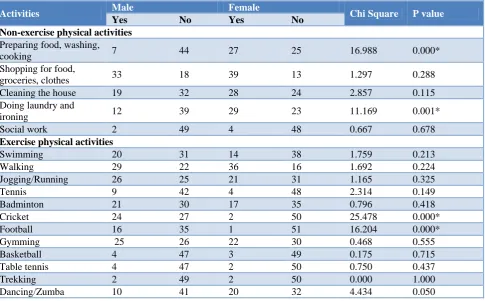
The result of cross tabulation between the practice of non-exercise physical activities and exercise physical activities with sex showed non exercise physical activities were statistically significant among female interns with P value of <0.005.
Table 2: Distribution of proportion of non-exercise physical activities and exercise physical activities.
Activities Yes No Total
N (%) N (%) N (%)
Non-exercise physical activities
Preparing food, washing, cooking 34 (33) 69 (67) 103 (100)
Shopping food, groceries, clothes 72 (69.9) 31 (30.1) 103 (100)
Cleaning the house 47 (45.6) 56 (54.4) 103 (100)
Doing laundry and ironing 41 (39.8) 61 (60.2) 103 (100)
Social work 6 (5.8) 97 (94.2) 103 (100)
Exercise physical activities
Swimming 34 (33) 69 (67) 103 (100)
Walking 65 (63.1) 38 (36.9) 103 (100)
Jogging/Running 47 (45.6) 56 (54.4) 103 (100)
Tennis 13 (12.6) 90 (87.4) 103 (100)
Badminton 38 (36.9) 65 (63.1) 103 (100)
Cricket 26 (25.2) 77 (74.8) 103 (100)
Football 17 (16.5) 86 (83.5) 103 (100)
Gymming 47 (45.6) 56 (54.4) 103 (100)
Basketball 7 (6.8) 96 (93.2) 103 (100)
Table tennis 6 (5.8) 97 (94.2) 103 (100)
Trekking 4 (3.9) 99 (96.1) 103 (100)
Dancing/Zumba 30 (29.1) 73 (70.9) 103 (100)
Table 3: Association between non-exercise physical activities and exercise physical activities with sex.
Activities Male Female Chi Square P value
Yes No Yes No
Non-exercise physical activities Preparing food, washing,
cooking 7 44 27 25 16.988 0.000*
Shopping for food,
groceries, clothes 33 18 39 13 1.297 0.288
Cleaning the house 19 32 28 24 2.857 0.115
Doing laundry and
ironing 12 39 29 23 11.169 0.001*
Social work 2 49 4 48 0.667 0.678
Exercise physical activities
Swimming 20 31 14 38 1.759 0.213
Walking 29 22 36 16 1.692 0.224
Jogging/Running 26 25 21 31 1.165 0.325
Tennis 9 42 4 48 2.314 0.149
Badminton 21 30 17 35 0.796 0.418
Cricket 24 27 2 50 25.478 0.000*
Football 16 35 1 51 16.204 0.000*
Gymming 25 26 22 30 0.468 0.555
Basketball 4 47 3 49 0.175 0.715
Table tennis 4 47 2 50 0.750 0.437
Trekking 2 49 2 50 0.000 1.000
These statistically significant activities included house-hold activities like preparing food, washing and ironing. The exercise physical activities was statistically significant among male interns with P value of <0.005. The statistically significant activities included outdoor activities like playing cricket & football. In our study, we draw a result of female interns doing more household activities and less outdoor activities as compared to male interns (Table 3).
DISCUSSION
Regular physical activity is an essential part of healthy lifestyle. Maintaining the recommended physical activity is crucial for physical as well as mental wellbeing of a person. Our study was focused mainly to evaluate the level of physical activity among medical interns as the young future doctors should be physically active to promote healthy lifestyle and to spread awareness about the risks associated with physical inactivity.
The present study reports the prevalence and practice of non-exercise physical activity and exercise physical activity among medical interns aged 22 to 25 years. The male and female ratio was similar to study conducted by Rao et al.17 Majority of the participants in our study was having normal body mass index 66 (64.1%), this was similar to a study conducted in India and Thailand.17,18 The prevalence of overweight was 18 (17.5%) and the prevalence of obesity was 9 (8.7%), this was similar to a study conducted by Tiwari et al.19
In our study, 43 (84.3%) male participants were physically active compared to 38 (73.1%) female participants. Hence physical activity is less in females compared to males, which was similar to other studies. 20-24
Majority of the participants in this study were physically active and beneficial 81 (78.6%), which is similar to conducted by Dayi et al.25
The main source of non-exercise physical activity in the present study was from non-work related activity. Shopping food, groceries, clothes were the most common non-exercise physical activity 72 (69.9%), followed by cleaning the house 47 (45.6%), doing laundry and ironing 41 (39.8%), preparing food, washing, cooking 34 (33%) and least was from social work 6 (5.8%). Among the exercise physical activity, walking is the most common one accounting for 65 (63.1%), which was similar to a study conducted by Saranya et al.26 There are no existing data on non-exercise physical activity in adolescents for comparison, but the prevalence of light-intensity physical activity was reported to be similar between adolescent boys and girls27 or even higher in girls.28,29
Limitations
In our study only small number of participants was included. Next, using a self-report questionnaire to collect physical activity participation is subjective and
based on participant’s recall memory. Another limitation is that this study has been undertaken in a single medical college and its findings may not fully reflect the situation for medical students elsewhere in India or internationally.
The sample group selected also may not fully reflect the population of students at our college
CONCLUSION
There is a need to encourage physical activity in medical colleges and also to emphasize the importance of inculcating physical activity in the lifestyle of medical students, so that as physicians of tomorrow, they will able to advice their patients regarding healthy lifestyle practices.
Recommendations
We recommend that there is a need to promote physical activity among medical students, particularly among female students. Both individual and population approaches are needed. For an individual approach, developing social support from friends and families may be a key to increase physical activity. For a population approach, the policymakers of the medical school should take suitable action to highlight the importance of physical activity among medical students. There is a need to encourage physical activity in medical schools and also to emphasize the importance of inculcating physical activity in the lifestyle of medical students, so that as physicians of tomorrow, they will able to advice their patients regarding healthy lifestyle practices.
ACKNOWLEDGEMENTS
We would like to thank and acknowledge the support given by all the interns in conducting this study by their participation.
Funding: No funding sources Conflict of interest: None declared
Ethical approval: The study was approved by the Institutional Ethics Committee
REFERENCES
1. World Health Organization. Factsheet: physical
activity, 2018. Available at: https://www.who.int/ news-room/fact-sheets/detail/physical-activity. Accessed on 14 July 2017.
2. Lee IM, Shiroma EJ, Lobelo F, Puska P, Blair SN, Katzmarzyk PT, et al. Effect of physical inactivity on major non-communicable diseases worldwide: an analysis of burden of disease and life expectancy. Lancet. 2012;380(9838):219–29.
3. World Health O. Global Health Risks-Mortality and
4. Warburton DE, Charlesworth S, Ivey A, Nettlefold L, Bredin SS. A systematic review of the evidence for Canada’s Physical Activity Guidelines for Adults. International J Behavioral Nutrition Physical Activity. 2010;7(1):39.
5. Liu L, Shi Y, Li T, Qin Q, Yin J, Pang S, et al. Leisure time physical activity and cancer risk: evaluation of the WHO’s recommendation based on 126 high-quality epidemiological studies. Br J Sports Med. 2015;50:372-8.
6. Aune D, Norat T, Leitzmann M, Tonstad S, Vatten
LJ. Physical activity and the risk of type 2 diabetes: a systematic review and dose-response meta-analysis. Eur J Epidemiol. 2015;30:529-42.
7. Sattelmair J, Pertman J, Ding EL, Kohl HW 3rd, , Haskell W, Lee IM. Dose response between physical activity and risk of coronary heart disease: a meta-analysis. Circulation. 2011;124:789-95.
8. World Health Organization. Global status report on
communicable diseases 2014. Geneva, Switzerland: World Health Organization, 2014.
9. Samitz G, Egger M, Zwahlen M. Domains of
physical activity and all-cause mortality: systematic review and dose–response meta-analysis of cohort studies. Int J Epidemiol. 2011;40:1382–400.
10. Alzamil HA, Alhakbany MA, Alfadda NA,
Almusallam SM, Al-Hazzaa HM. A profile of physical activity, sedentary behaviors, sleep, and dietary habits of Saudi college female students. J Fam Community Med. 2019;26:1-8.
11. Al-Hazzaa HM. Physical activity, fitness and fatness
among Saudi children and adolescents: Implications cardiovascular health. Saudi Med J. 2002;2.
12. Musaiger AO. Diet and prevention of coronary heart
disease in the Arab Middle East countries. Medical Princ Practice. 2002;2:9-16.
13. Wang D, Chen M, Ni Duan N. Health promoting
lifestyles of university students in Mainland China. BMC Public Health. 2009;9(9):379.
14. Chakma JK, Gupta S. Lifestyle practice and
associated risk factors of non-communicable diseases among the students of Delhi University. Int J Health Allied Sci. 2017;6:20-5.
15. Oberg EB, Frank E. Physicians health practices
strongly influence patient health practices. J R Coll Physicians Edinb. 2009;39(4):290–1.
16. Rogers LQ, Bailey JE, Gutin B, Johnson KC,
Levine MA, Milan F, et al. Teaching resident physicians to provide exercise counseling: a needs assessment. Acad Med. 2002;77(8):841–4.
17. Rao CR, Darshan BB, Das N, Rajan V, Bhogun M,
Gupta A. Practice of physical activity among future doctors: A cross sectional analysis. Int J Prev Med. 2012;3:365‑9.
18. Ing-arahm R, Suppuang A, Imjaijitt W, authors. The
Study of Medical Students’ Attitudes toward Exercise for Health Promotion in Phramongkutklao
College of Medicine. J Med Assoc Thai. 2010;93:173–8.
19. Tiwari R, Jain V, Rajput AS, Bhagwat AK, Goyal M, Tiwari S. A study to assess prevalence of obesity among medical students of G.R. medical college, Gwalior, M. P., India. Int J Res Med Sci. 2014;2:1412-6.
20. Guthold R, Stevens GA, Riley LM, Bull FC.
Worldwide trends in insufficient physical activity from 2001 to 2016: a pooled analysis of 358
population-based surveys with 1•9 million
participants. Lancet Glob Health. 2018;6:1077–86.
21. Ahmad S, Zarkasi Z, Ramdzan K, Ramli A, Zuliani
N. Physical Inactivity Among Medical And Non- Medical Students: A Cross Sectional Study. 2015;3:2289-7577.
22. Riddoch CJ, Bo Andersen L, Wedderkopp N, Harro
M, Klasson-Heggebo L, Sardinha LB, Cooper AR, Ekelund U: Physical activity levels and patterns of 9- and 15-yr-old European children. Med Sci Sports Exerc. 2004;36 (1):86-92.
23. Klasson-Heggebo L, Anderssen SA. Gender and age
differences in relation to the recommendations of physical activity among Norwegian children and youth. Scand J Med Sci Sports. 2003;13(5):293-8.
24. Santos P, Guerra S, Ribeiro JC, Duarte JA, Mota J.
Age and gender-related physical activity. A descriptive study in children using accelerometry. J Sports Med Phys Fitness. 2003;43(1):85-9.
25. Dayi A, Acikgoz A, Guvendi G, Bayrak L, Ersoy B,
Gur C, et al. Determination of Factors Affecting Physical Activity Status of University Students on a Health Sciences Campus. Med Sci Monit. 2017;23:325–34.
26. Saranya SV, Rao CR, Kumar SC, Kamath V,
Kamath A. Dietary habits and physical activity among medical students of a teaching hospital in South India: A descriptive analysis. Trop J Med Res. 2016;19:172-7.
27. Gavarry O, Giacomoni M, Bernard T, Seymat M,
Falgairette G. Habitual physical activity in children and adolescents during school and free days. Med Sci Sports Exerc. 2003;35(3):525-31.
28. Trost SG, Rosenkranz RR, Dzewaltowski D.
Physical activity levels among children attending after-school programs. Med Sci Sports Exerc. 2008;40(4):622-9.
29. Dunton GF, Whalen CK, Jamner LD, Henker B,
Floro JN. Using ecologic momentary assessment to measure physical activity during adolescence. Am J Prev Med. 2005;29(4):281-7.